
Showing 14 items matching "japanese emperor"
-
 Returned Nurses RSL Sub-branch
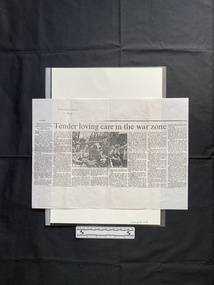
Newspaper - Photocopy of newspaper clipping, [The Newcastle Herald], Tender loving care in the war zone, [21 Feb 1987]
... ...Japanese Emperor...WWII World War Two WW2 Korea Alternative Publishing Co-operative Adelaide Alexandria Tobruk Crete Merewether Beach Red Cross BBC World Service Big Ben Red Cross Radio Syria 7th Australian Division Casa Nova Monastery Terra Santa Monastery Rouna Falls Laloki River Loribaiwa Church of the Nativity Bethlehem Westmead Hospital New South Wales South Australia Molucca Group MacArthur Philippines Japanese Emperor Potsdam agreement Nagasaki American America POWs Prisoners of war 'THE NEWCASTLE HERALD / 21 FEB 1987' [photocopied ink, top left] A photocopy of a large newspaper clipping consisting of a title, eight columns of text and a black and white photo of a group of women sitting outside Tender loving care in the war zone Newspaper Photocopy of newspaper clipping [The Newcastle Herald] Stephen Leeder ...Book review of "A special kind of service" by Joan Crouch. The book is about a wartime field hospital, the 2/9th Australian General Hospital (AGH). It was a portable group of about 300 nurses, doctors and support servicemen. The 2/9th AGH started it's life by heading by sea for the Middle East, where it was to care for ill and injured troops. It operate with a minimum of 600 bed, with 4000 at times of stress. Sister Joan Crouch has collected dairies, correspondence, official records, recollections and photos from people who served with the 2/9th for her book, told chronologically. The book begins with the first passage as a unit, via India, to the Middle East. They established the 2/9th AGH near the Arab village of Amiriya, where sand storms penetrated everything, including the operating theatre, but the staff were able to go sightseeing at the Pyramids. Next they moved to a monastery in Nazareth, where it snowed over Christmas 1941. The 2/9th AGH was recalled after Pearl Harbour to assist in South-East Asia, but Singapore fell so they came back to Northfield, Australia for a few months. They were then moved to a site 30km out of Port Moresby, called Seventeen-Mile. There they bore the brunt of casualties from the Kokoda Trail, with December 1942 seeing them looking after 4000 with a staff of twenty-nine doctors, 112 sisters and about 300 others. The 'walking wounded' were known to help nurse the bedridden. In September 1943 the first group of the Australian Army Medical Womens Service (AAMWS) arrived to assist the 2/9th AGH. March 1944 ended the service of the 2/9th AGH in what is now Papua New Guinea and they briefly returned to Tamworth, Australia, before closing temporarily for a few months. March1945, the 2/9th AGH were sent to assist in the Borneo campaign at Morotai, where they saw out the war. Joan Crouch worked as a nurse with 2/9th AGH, during World War II, continued afterwards in the Army Nursing Service (ANS) and was later involved in the Korean War, working in Japan and Seoul. A photocopy of a large newspaper clipping consisting of a title, eight columns of text and a black and white photo of a group of women sitting outside'THE NEWCASTLE HERALD / 21 FEB 1987' [photocopied ink, top left]wwii, world war two, ww2, korea, alternative publishing co-operative, adelaide, alexandria, tobruk, crete, merewether beach, red cross, bbc world service, big ben, red cross radio, syria, 7th australian division, casa nova monastery, terra santa monastery, rouna falls, laloki river, loribaiwa, church of the nativity, bethlehem, westmead hospital, new south wales, south australia, molucca group, macarthur, philippines, japanese emperor, potsdam agreement, nagasaki, american, america, pows, prisoners of war -
 Geelong RSL Sub Branch
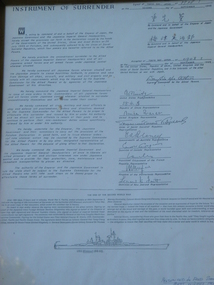
Instrument of Surrender, Late 20th Century
... The Instrument of Surrender was signed on 2 September 1945 and is the Surrender of the Empire of Japan. Emperor Hirohito announced the Surrender of Japan in August 1945, the surrender document was signed by board USS Missouri on 2 September 1945....Geelong RSL Sub Branch 50 Barwon Heads Road Belmont geelong-and-the-bellarine-peninsula The Instrument of Surrender was signed on 2 September 1945 and is the Surrender of the Empire of Japan. Emperor Hirohito announced the Surrender of Japan in August 1945, the surrender document was signed by board USS Missouri on 2 September 1945. ...The Instrument of Surrender was signed on 2 September 1945 and is the Surrender of the Empire of Japan. Emperor Hirohito announced the Surrender of Japan in August 1945, the surrender document was signed by board USS Missouri on 2 September 1945.The Instrument of Surrender ended WW2 in 1945.A paper copy of the Instrument of Surrender in a gold painted wooden frame.Presented to Fred Stanley, Best Wishes from RSL Club Norfolk Island 1995.ww2, instrument of surrender, aif -
 Federation University Art Collection
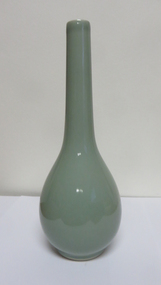
Ceramic - Ceramics, Ino Shukuho, 'Celedon Bottle' by Ino Shukuho, c1982
... He is considered a Jaoanese 'national treasure' and he once handcrafter pottery for the Japanese emperor. In 1982 Shikuho Ino was a distinguished guest of the Gippsland Centre of Art and Design (GCAD)....He is considered a Jaoanese 'national treasure' and he once handcrafter pottery for the Japanese emperor. In 1982 Shikuho Ino was a distinguished guest of the Gippsland Centre of Art and Design (GCAD). jan feder memorial collection ceramics artist artwork gippsland campus ino shukuho jan feder memorial ceramics collection Artist's stamp on base. ...Ino SHUKUHO (13.02.1943- ) Born Kyoto, Japan The work of Ino Shukuho are completely handmade with the vast majority of his pots rectangle, squares or oval in shap. His pottery techniques limit production to a maximum of 3-4 pots daily. He is considered a Jaoanese 'national treasure' and he once handcrafter pottery for the Japanese emperor. In 1982 Shikuho Ino was a distinguished guest of the Gippsland Centre of Art and Design (GCAD). Wheel thrown porcelain with celadon glaze.Artist's stamp on base. jan feder memorial collection, ceramics, artist, artwork, gippsland campus, ino shukuho, jan feder memorial ceramics collection -
 Disability Sport & Recreation Victoria
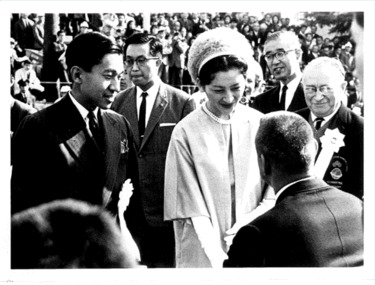
Photograph, Photo from opening ceremony of 1964 Tokyo Paralympic Games, mid 1960s
... Black and white photo from the opening ceremony of the 1964 Paralympic Games held in Tokyo, Japan. Prince (and later Emperor) Akihito is pictured with his wife, Princess Michiko with an athlete....Black and white photo from the opening ceremony of the 1964 Paralympic Games held in Tokyo, Japan. Prince (and later Emperor) Akihito is pictured with his wife, Princess Michiko with an athlete. ...This photo is from the opening ceremony of the 1964 Tokyo Paralympics. The Opening Ceremony was held at the Oda Field located within the Olympic village, as nearly 5,000 spectators looked on. The patrons of the Games, His Imperial Highness Prince Akihito and Princess Michiko, were in attendance.Black and white photo from the opening ceremony of the 1964 Paralympic Games held in Tokyo, Japan. Prince (and later Emperor) Akihito is pictured with his wife, Princess Michiko with an athlete.Reverse side of the photo has "Tokyo 1964" written on it.1964 paralympics, paralympics -
 Wangaratta RSL Sub Branch
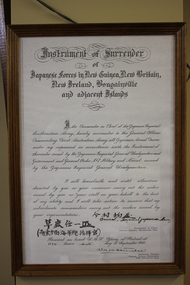
Document - Framed Document, Instrument of Surrender of Japanese Forces, C1945
... With the Japanese cities of Hiroshima and Nagasaki destroyed by atomic weapons, the will of the Japanese leadership was tested Emperor Showa of Japan announced his intention to surrender to the Allies unconditionally over public radio on 15 Aug 1945. ...Wangaratta RSL Sub Branch 2-4 Templeton Street Wangaratta high-country With the Japanese cities of Hiroshima and Nagasaki destroyed by atomic weapons, the will of the Japanese leadership was tested Emperor Showa of Japan announced his intention to surrender to the Allies unconditionally over public radio on 15 Aug 1945. ...With the Japanese cities of Hiroshima and Nagasaki destroyed by atomic weapons, the will of the Japanese leadership was tested Emperor Showa of Japan announced his intention to surrender to the Allies unconditionally over public radio on 15 Aug 1945. The date of Japan's formal surrender was 2 Sep 1945, and it took place aboard American battleship Missouri in Tokyo Bay. There were other surrender ceremonies including that on Sept 6 1945. At 0900 hours, sloop HMS Hart picked up Hitoshi Imamura and Jinichi Kusaka at Kabanga Bay, who would sign the surrender documents aboard HMS Glory at 1127 hours which surrendered 139,000 remaining personnel at Rabaul plus all forces in Australian territory in the South Pacific. The surrender of Imperial Japan was announced on August 15 and formally signed on September 2, 1945, bringing the hostilities of World War II to a close. The surrender ceremony at Rabaul, New Britain took place on 6 Sep 1945 aboard the British carrier HMS Glory surrendering 139,000 remaining personnel at Rabaul plus all forces in Australian territory in the South Pacific. Light brown frame with glass, of a black and white photocopy. Script is very ornate and has Japanese lettering at the bottom. Instument of Surrender of Japanese Forces in New Guinea, New Britain, New Ireland, Bougainville and adjacent Islands. I the Commander in Chief of the Japanese Imperial Southeastern Army, hereby surrender to the General Officer Commanding First Australian Army all Japanese Armed Forces under my command in accordance with the Instrument of Surrender issued by the Japanese Imperial General Headquarters and Government and General Order No.1 Military and Naval issued by the Japanese imperial General Headquarters. I will henceforth and until otherwise directed by you or your successor carry out the orders issued by you or your staff on your behalf to the best of my ability and I will take action to ensure that my subordinate commanders carry out the orders issued by your representatives. Commander in Chief Japanese Imperial Southeastern Army. Received on board H.M.S. Glory off Rabaul at 1130 hours sixth day of September 1945. Lieutenant General General Officer Commanding First Australian Army.wwii, world war 2, imperial japanese army, japanese army, surrender, rabaul -
 Bendigo Military Museum
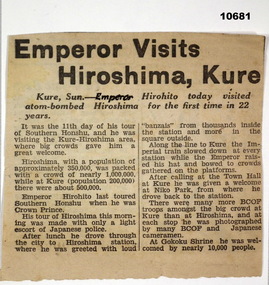
Newspaper - ARTICLE, NEWSPAPER, HIROSHIMA, JAPAN, "Emperor Visits Hiroshima, Kure"
... ...Emperor Hirohito...Japan...Alva Bennetts Bennetts Collection Hiroshima Emperor Hirohito Japan Newspaper Cuttings Handwritten in black ink over original type: "Emperor". ...Article reports on Emperor Hirohito's visit to Hiroshima for the first time in 22 years. Part of the Bennetts Collection. See Cat No. 9726P for details of service for Alva Marie Bennetts VFX128835.Newspaper clipping with heading and text in black type. Edges trimmed with scissors.Handwritten in black ink over original type: "Emperor".alva bennetts, bennetts collection, hiroshima, emperor hirohito, japan, newspaper cuttings -
 Bendigo Military Museum
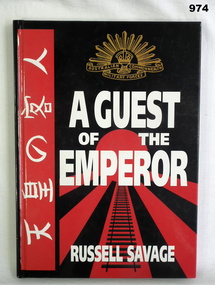
Book, A Guest of the Emperor, 1995
... Japanese writing on left. Pages 141. Illustrated with maps and photos. A Guest of the Emperor. ...Book hardcover - front cover is coloured red and black. Stylized imperial Japanese flag. Image of rail track in central foreground. Rising sun at top. Writing is in white ink. Japanese writing on left. Pages 141. Illustrated with maps and photos."Donated by BGO YMCA". "Bill 0 with my best wishes - RUSSELL SAVAGE October 1995" Thailand Hellfire Pass - Ex POW Project. books-military-history, japan -
 Monbulk RSL Sub Branch
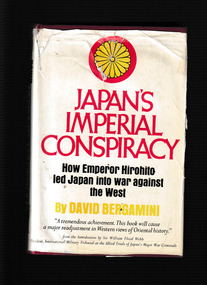
Book, David Bergamin, Japan's Imperial Conspiracy : How Emperor Hirohito led Japan into war against the West, 1972
... Japan's Imperial Conspiracy : How Emperor Hirohito led Japan into war against the West...Japan's Imperial Conspiracy : How Emperor Hirohito led Japan into war against the West Book David Bergamin Panther ...Japan's Imperial Conspiracy completely shatters all previous accounts of Japanese history before and during World War IIIll, index, maps, p.1235.non-fictionJapan's Imperial Conspiracy completely shatters all previous accounts of Japanese history before and during World War IIjapan - history - 1912-1945, japan - foreign relations - 1941-1945 -
 Ararat Gallery TAMA
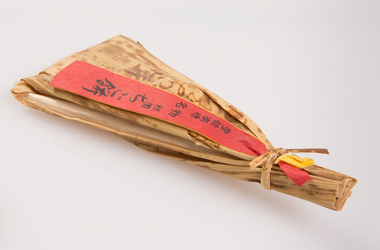
Functional object, Gion Chigo Mochi, c. 1900s
... The descriptions of the featured objects were written by Hideyuki Oka, curator of ‘The Art of the Japanese Package’, 1979. japanese art japanese packaging tsutsumi gift giving An elegant wooden box, fashioned in the style of boxes used for gifts to the emperor some eight or nine centuries ago, is filled with a Kyoto confection called Gion Chigo Mochi. ...‘The Art of the Japanese Package’ was an exhibition that toured to 10 Australian and 11 New Zealand public galleries in 1979 and 1980. The touring exhibition comprised 221 objects of traditional Japanese packaging which extended from ceramics, wood and paper to woven fibre containers. At the conclusion of the tour, The Japan Foundation and the Crafts Board of the Australia Council donated the vast majority of the exhibition to the Ararat Gallery for its permanent collection. Combining the natural qualities of bamboo, paper and straw with delicate craftsmanship, these unique objects express Japanese aesthetics as applied through fibre crafts. In Japan, the qualities and traits of natural materials are exploited rather than hidden. The texture of straw, the septa of bamboo are not concealed but lovingly incorporated into the whole. In 1979 Hideyuki Oka, curator of ‘The Art of the Japanese Package’ wrote: “In no way self-conscious or assertive, these wrappings have an artless and obedient air that greatly moves the modern viewer. They are whispered evidence of the Japanese ability to create beauty from the simplest products of nature. They also teach us that wisdom and feeling are especially important in packaging because these qualities, or the lack of them, are almost immediately apparent. What is the use of a package if it shows no feeling?” The descriptions of the featured objects were written by Hideyuki Oka, curator of ‘The Art of the Japanese Package’, 1979. Gift of the Japan-Australia Foundation and the Crafts Board of the Australia Council, 1981An elegant wooden box, fashioned in the style of boxes used for gifts to the emperor some eight or nine centuries ago, is filled with a Kyoto confection called Gion Chigo Mochi. The Gion is one of Kyoto's entertainment districts, chigo are children dressed in ceremonial Buddhist costume for one of the city's numerous festivals, and mochi are cakes of steamed and pounded rice. The name of the confection derives from the style of the bamboo-sheath wrapping, which suggests the figure of a chigo. - Professor Hideyuki Oka, curator.japanese art, japanese packaging, tsutsumi, gift giving -
 Ararat Gallery TAMA
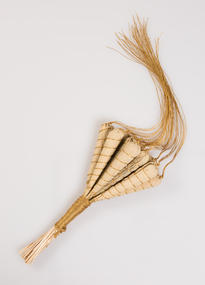
Functional object, Doki no Kenjo Chimaki, c. 1900s
... japanese packaging tsutsumi gift giving Here we see a creation of the type whose beauty is said to have astonished the celebrated sixteenth-century tea master Sen no Rikyu. Originally, confections of mochi (steamed and pounded rice) filled with bean jam were wrapped in chigaya, a species of reed, and came to be called chimaki. We are told that a shopkeeper named Kawabata Doki used bamboo leaves to wrap the chimaki he presented to the emperor ...‘The Art of the Japanese Package’ was an exhibition that toured to 10 Australian and 11 New Zealand public galleries in 1979 and 1980. The touring exhibition comprised 221 objects of traditional Japanese packaging which extended from ceramics, wood and paper to woven fibre containers. At the conclusion of the tour, The Japan Foundation and the Crafts Board of the Australia Council donated the vast majority of the exhibition to the Ararat Gallery for its permanent collection. Combining the natural qualities of bamboo, paper and straw with delicate craftsmanship, these unique objects express Japanese aesthetics as applied through fibre crafts. In Japan, the qualities and traits of natural materials are exploited rather than hidden. The texture of straw, the septa of bamboo are not concealed but lovingly incorporated into the whole. In 1979 Hideyuki Oka, curator of ‘The Art of the Japanese Package’ wrote: “In no way self-conscious or assertive, these wrappings have an artless and obedient air that greatly moves the modern viewer. They are whispered evidence of the Japanese ability to create beauty from the simplest products of nature. They also teach us that wisdom and feeling are especially important in packaging because these qualities, or the lack of them, are almost immediately apparent. What is the use of a package if it shows no feeling?” The descriptions of the featured objects were written by Hideyuki Oka, curator of ‘The Art of the Japanese Package’, 1979.Gift of the Japan-Australia Foundation and the Crafts Board of the Australia Council, 1981Here we see a creation of the type whose beauty is said to have astonished the celebrated sixteenth-century tea master Sen no Rikyu. Originally, confections of mochi (steamed and pounded rice) filled with bean jam were wrapped in chigaya, a species of reed, and came to be called chimaki. We are told that a shopkeeper named Kawabata Doki used bamboo leaves to wrap the chimaki he presented to the emperor Gokashiwabara (1464-1526) and that thereafter the use of bamboo leaves for wrapping such confections became predominant. In fact, the bamboo-wrapped chimaki seen here are known as Doki chimaki after the pioneering shopkeeper, and it is small wonder that this product of Kyoto should have an air of refinement and dignity suggestive of the imperial court. The two different flavours of the contents are indicated by exposing either the upper sides or the undersides of the leaves. The cord used to bind the chimaki together is made of rushes, and ceremonial gift cords (mizuhiki) are attached. - Professor Hideyuki Oka, curator.japanese art, japanese packaging, tsutsumi, gift giving -
 Ararat Gallery TAMA
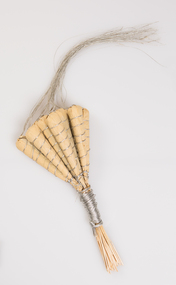
Functional object, Doki no Kenjo Chimaki, c. 1900s
... japanese packaging tsutsumi gift giving Here we see a creation of the type whose beauty is said to have astonished the celebrated sixteenth-century tea master Sen no Rikyu. Originally, confections of mochi (steamed and pounded rice) filled with bean jam were wrapped in chigaya, a species of reed, and came to be called chimaki. We are told that a shopkeeper named Kawabata Doki used bamboo leaves to wrap the chimaki he presented to the emperor ...‘The Art of the Japanese Package’ was an exhibition that toured to 10 Australian and 11 New Zealand public galleries in 1979 and 1980. The touring exhibition comprised 221 objects of traditional Japanese packaging which extended from ceramics, wood and paper to woven fibre containers. At the conclusion of the tour, The Japan Foundation and the Crafts Board of the Australia Council donated the vast majority of the exhibition to the Ararat Gallery for its permanent collection. Combining the natural qualities of bamboo, paper and straw with delicate craftsmanship, these unique objects express Japanese aesthetics as applied through fibre crafts. In Japan, the qualities and traits of natural materials are exploited rather than hidden. The texture of straw, the septa of bamboo are not concealed but lovingly incorporated into the whole. In 1979 Hideyuki Oka, curator of ‘The Art of the Japanese Package’ wrote: “In no way self-conscious or assertive, these wrappings have an artless and obedient air that greatly moves the modern viewer. They are whispered evidence of the Japanese ability to create beauty from the simplest products of nature. They also teach us that wisdom and feeling are especially important in packaging because these qualities, or the lack of them, are almost immediately apparent. What is the use of a package if it shows no feeling?” The descriptions of the featured objects were written by Hideyuki Oka, curator of ‘The Art of the Japanese Package’, 1979.Gift of the Japan-Australia Foundation and the Crafts Board of the Australia Council, 1981Here we see a creation of the type whose beauty is said to have astonished the celebrated sixteenth-century tea master Sen no Rikyu. Originally, confections of mochi (steamed and pounded rice) filled with bean jam were wrapped in chigaya, a species of reed, and came to be called chimaki. We are told that a shopkeeper named Kawabata Doki used bamboo leaves to wrap the chimaki he presented to the emperor Gokashiwabara (1464-1526) and that thereafter the use of bamboo leaves for wrapping such confections became predominant. In fact, the bamboo-wrapped chimaki seen here are known as Doki chimaki after the pioneering shopkeeper, and it is small wonder that this product of Kyoto should have an air of refinement and dignity suggestive of the imperial court. The two different flavours of the contents are indicated by exposing either the upper sides or the undersides of the leaves. The cord used to bind the chimaki together is made of rushes, and ceremonial gift cords (mizuhiki) are attached. - Professor Hideyuki Oka, curator.japanese art, japanese packaging, tsutsumi, gift giving -
 Ararat Gallery TAMA
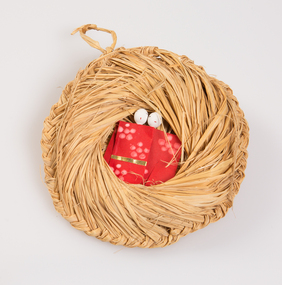
Functional object, Sandawara Ningyo, c. 1900s
... The descriptions of the featured objects were written by Hideyuki Oka, curator of ‘The Art of the Japanese Package’, 1979. japanese art japanese packaging tsutsumi gift giving This toy is a product of Tottori City, and its only connection with traditional packaging is that it copies the mats used to close the straw bales in which rice is packed for the market. It is interesting, nevertheless, for its clever use of such a cheap and common material, and there is no denying its charm. The two dolls, made of paper and wood, represent the emperor ...‘The Art of the Japanese Package’ was an exhibition that toured to 10 Australian and 11 New Zealand public galleries in 1979 and 1980. The touring exhibition comprised 221 objects of traditional Japanese packaging which extended from ceramics, wood and paper to woven fibre containers. At the conclusion of the tour, The Japan Foundation and the Crafts Board of the Australia Council donated the vast majority of the exhibition to the Ararat Gallery for its permanent collection. Combining the natural qualities of bamboo, paper and straw with delicate craftsmanship, these unique objects express Japanese aesthetics as applied through fibre crafts. In Japan, the qualities and traits of natural materials are exploited rather than hidden. The texture of straw, the septa of bamboo are not concealed but lovingly incorporated into the whole. In 1979 Hideyuki Oka, curator of ‘The Art of the Japanese Package’ wrote: “In no way self-conscious or assertive, these wrappings have an artless and obedient air that greatly moves the modern viewer. They are whispered evidence of the Japanese ability to create beauty from the simplest products of nature. They also teach us that wisdom and feeling are especially important in packaging because these qualities, or the lack of them, are almost immediately apparent. What is the use of a package if it shows no feeling?” The descriptions of the featured objects were written by Hideyuki Oka, curator of ‘The Art of the Japanese Package’, 1979.Gift of the Japan-Australia Foundation and the Crafts Board of the Australia Council, 1981This toy is a product of Tottori City, and its only connection with traditional packaging is that it copies the mats used to close the straw bales in which rice is packed for the market. It is interesting, nevertheless, for its clever use of such a cheap and common material, and there is no denying its charm. The two dolls, made of paper and wood, represent the emperor and empress who occupy the chief places in the traditional Doll Festival display. - Professor Hideyuki Oka, curator.japanese art, japanese packaging, tsutsumi, gift giving -
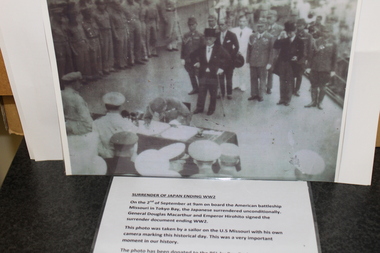 Dandenong/Cranbourne RSL Sub Branch
Photograph - Photograph depicting the Surrender of Japan ending WW11
... Dandenong/Cranbourne RSL Sub Branch 44 – 50 Clow Street Dandenong melbourne General Douglas MacArthur & Emperor Hirohito Signing Document. Surrender of Japan ending WWII. ...Surrender of Japan ending WWII.General Douglas MacArthur & Emperor Hirohito Signing Document. -
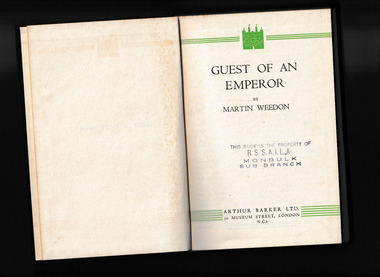 Mrs Aeneas Gunn Memorial Library
Book, Arthur Barker, Guest of an emperor, 1948
... Mrs Aeneas Gunn Memorial Library via Monbulk RSL, 48 Main Rd Monbulk yarra-valley-and-the-dandenong-ranges World war 1939-1945 - Prisoners of war World War 1939-1945 - Prisoners of war - Japan Diary kept by the authors when a prison in Japanese hands. p.233. Guest of an emperor Book Arthur Barker Martin Weedon. ...Diary kept by the authors when a prison in Japanese hands.p.233.non-fictionDiary kept by the authors when a prison in Japanese hands.world war 1939-1945 - prisoners of war, world war 1939-1945 - prisoners of war - japan
