
Showing 8 items matching "john dudley cullen"
-
 St Kilda Historical Society
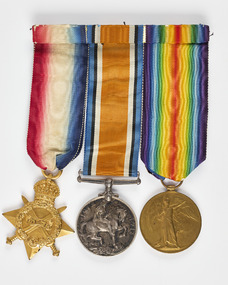
Medal - Military medals, Campaign Star, British War Medal and Victory Medal: Gunner John Dudley Cullen, 1919
... Campaign Star, British War Medal and Victory Medal: Gunner John Dudley Cullen...John Dudley Cullen...The combination of the 1914-15 Star, British War Medal and Victory Medal were popularly dubbed 'Pip, Sqeak and Wilfred' after cartoon characters of the time. John (Jack) Dudley Cullen was the first person from St Kilda to enlist in World War I. ...Campaign Star, British War Medal and Victory Medal: Gunner John Dudley Cullen Medal Military medals ...Most British and Commonwealth soldiers who served in World War I were awarded these three medals. The 1914-15 Star was awarded for service on the establishment of a unit in a theatre of war. It was never issued singly; recipients also received the British War Medal and the Victory Medal. The British War Medal was awarded to those who had entered a theatre of war on duty, or served overseas between 5 August 1914 and 11 November 1918. The Victory Medal commemorated the victory of the Allied Forces. Each nation designed their own medal but used the same ribbon. Australians received the medal issued by Great Britain. The combination of the 1914-15 Star, British War Medal and Victory Medal were popularly dubbed 'Pip, Sqeak and Wilfred' after cartoon characters of the time. John (Jack) Dudley Cullen was the first person from St Kilda to enlist in World War I. He lived at 23 Argyle Street (now Waterloo Crescent), St Kilda. An electrician with three years service with the militia behind him, Jack enlisted on 18 August 1914 at the age of 21. By 20 October that year he was sailing to Egypt on the HMAT Shropshire as a member of the 5th Battery, 2nd Field Artillery Brigade. He served in the Middle East for a short time before being hospitalised with enteric fever and returning home to Australia. After recovering, Jack undertook permanent guard duties at Broadmeadows Training Camp until October 1916, when he went to England with the 118th Howitzer Battery on the HMAT Aeneas. He again returned to Australia on health grounds, this time suffering a bronchial condition, and was discharged in June 1918. The inscription '2/F.A. BDE A.I.F.' refers to the '2nd Field Artillery Brigade Australian Imperial Forces'.A gold coloured star medal (1914-15 Star), a round silver medal (British War Medal), and a round bronze medal (Victory Medal), joined by different multi-coloured ribbons to a bar.1914-15 Star: The medal is a four-point star in bright bronze with a crown at the top. On the front are two crossed swords overlaid with a wreath and a scroll inscribed '1914-15'. The back is inscribed '1023 GNR J. Cullen, 2/F.A. BDE A.I.F'. The ribbon has a white band in the middle with a red band on one side and a blue band on the other. British War Medal: The front shows a mounted horse. The back shows the head of King George V in profile. The ribbon has a wide orange centre stripe and narrow blue, black and white stripes on each side. Victory Medal: The front has a winged figure of Victory. On the back are the words 'The Great War for Civilisation 1914-1919' surrounded by a laurel wreath. The ribbon design colours are of two rainbows.john dudley cullen, jack cullen, wwi recognition of service -
 St Kilda Historical Society
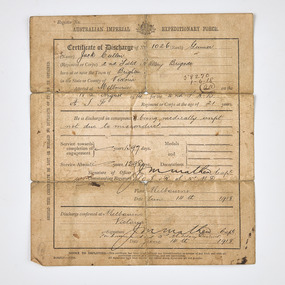
Administrative record - Certificate, Certificate of Discharge, 1918
... John Dudley Cullen...John (Jack) Dudley Cullen was the first person from St Kilda to enlist in World War I. ...John (Jack) Dudley Cullen was the first person from St Kilda to enlist in World War I. ...John (Jack) Dudley Cullen was the first person from St Kilda to enlist in World War I. He lived at 23 Argyle Street (now Waterloo Crescent), St Kilda. An electrician with three years service with the militia behind him, Jack enlisted on 18 August 1914 at the age of 21. By 20 October that year he was sailing to Egypt on the HMAT Shropshire as a member of the 5th Battery, 2nd Field Artillery Brigade. He served in the Middle East for a short time before being hospitalised with enteric fever and returning home to Australia. White (discoloured with age) Certificate of Discharge form, printed in black and handwritten in black ink on both sides. Front Handwritten notations that Gunner Jack Cullen (service number 1026) of the 2nd Field Artillery Brigade was born at Brighton, Victoria and enlisted in the AIF on 18 August 1914 at the age of 21 years. He was discharged in consequence of "being medically unfit, not due to misconduct." It is recorded that he served 1397 days, 1298 days of which were served overseas. The certificate was signed in Melbourne, Victoria by Captain JM Matthew on 14 June 1918. Back Sections about conduct and character have not been completed and are overstamped in red: "The practice of including a statement of character or special qualifications on the Discharge Certificate has been discontinued from 1st December. 1917." Handwritten notations that, upon discharge, Cullen was 24 years and 10 months old. His complexion was sallow and his hair light brown. He was 5 feet 8 inches tall and had grey eyes. His trade is recorded as 'Electrician (Improver)'. He had a vaccination scar on his left arm and a tattoo on his right. His intended place of residence was 23 Argyle Street St Kilda. The certificate is signed by J.D. Cullen.john dudley cullen, jack cullen, wwi -
 St Kilda Historical Society
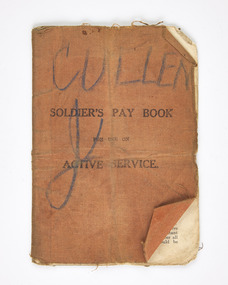
Administrative record - Pay book, Soldier's pay book, 1914
... John Dudley Cullen...John (Jack) Dudley Cullen was the first person from St Kilda to enlist in World War I. ...John (Jack) Dudley Cullen was the first person from St Kilda to enlist in World War I. ...John (Jack) Dudley Cullen was the first person from St Kilda to enlist in World War I. He lived at 23 Argyle Street (now Waterloo Crescent), St Kilda. An electrician with three years service with the militia behind him, Jack enlisted on 18 August 1914 at the age of 21. By 20 October that year he was sailing to Egypt on the HMAT Shropshire as a member of the 5th Battery, 2nd Field Artillery Brigade. He served in the Middle East for a short time before being hospitalised with enteric fever and returning home to Australia.Pay book with tan coloured material cover and containing white pages printed in black, with handwritten and stamped entries.CULLEN J in pencil on front cover Notations on first page identifying the soldier as No. 1026 Jack Cullen, the date of attestation 18/8/1914, and his age on enlistment 21 years. Stamped 5th BTY. 2ND F.A. BDE. A.I.F. Subsequent pages show notations of amounts and dates paid (based on a net daily rate of 3 shillings) from 21 October 1914 to 30 May 1916.john dudley cullen, jack cullen, wwi -
 St Kilda Historical Society
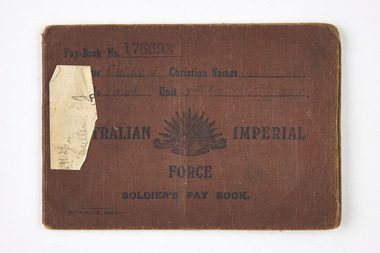
Administrative record - Pay book, Soldier's pay book, 1917
... John Dudley Cullen...John (Jack) Dudley Cullen was the first person from St Kilda to enlist in World War I. ...John (Jack) Dudley Cullen was the first person from St Kilda to enlist in World War I. ...John (Jack) Dudley Cullen was the first person from St Kilda to enlist in World War I. He lived at 23 Argyle Street (now Waterloo Crescent), St Kilda. An electrician with three years service with the militia behind him, Jack enlisted on 18 August 1914 at the age of 21. By 20 October that year he was sailing to Egypt on the HMAT Shropshire as a member of the 5th Battery, 2nd Field Artillery Brigade. He served in the Middle East for a short time before being hospitalised with enteric fever and returning home to Australia. After recovering, Jack undertook permanent guard duties at Broadmeadows Training Camp until October 1916, when he went to England with the 118th Howitzer Battery on the HMAT Aeneas. He again returned to Australia on health grounds, this time suffering a bronchial condition, and was discharged on 14 June 1918.Maroon coloured pay book with white pages printed in black, with handwritten and stamped entries.On front cover Pay-Book No. 17663 First name Cullen Christina Names John Dunlop No 1026 Unit 5th BTY. 2ND [illegible] A.I.F. AUSTRALIAN IMPERIAL FORCE SOLDIER'S PAY BOOK Rising sun motif Internal pages show name and contact details, notations of amounts and dates paid from 8 February 1917 to 10 May 1918, and a will. Each page overstamped in blue: DISCHARGEDjohn dudley cullen, jack cullen, wwi -
 St Kilda Historical Society
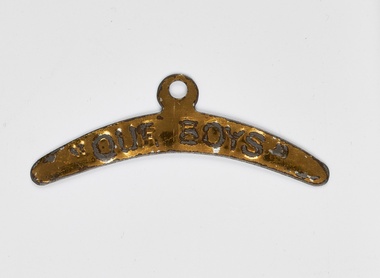
Badge - WWI souvenir, Boomerang badge, 1914-1918
... ...John Dudley Cullen...This badge was donated to the St Kilda Society by the wife of John (Jack) Dudley Cullen, who was the first person from St Kilda to enlist in World War I. ...WWI memorabilia John Dudley Cullen Jack Cullen "Our Boys" Gold coloured metal boomerang with eyelet for attachment. ...During World War I, "boomerang badges" were popular sweetheart brooches and fundraising pins. The boomerang motif was chosen to symbolize the solder's safe return from the war, much like a thrown boomerang comes back. This badge was donated to the St Kilda Society by the wife of John (Jack) Dudley Cullen, who was the first person from St Kilda to enlist in World War I. He lived at 23 Argyle Street (now Waterloo Crescent), St Kilda. An electrician with three years service with the militia behind him, Jack enlisted on 18 August 1914 at the age of 21. By 20 October that year he was sailing to Egypt on the HMAT Shropshire as a member of the 5th Battery, 2nd Field Artillery Brigade. He served in the Middle East for a short time before being hospitalised with enteric fever and returning home to Australia. After recovering, Jack undertook permanent guard duties at Broadmeadows Training Camp until October 1916, when he went to England with the 118th Howitzer Battery on the HMAT Aeneas. He again returned to Australia on health grounds, this time suffering a bronchial condition, and was discharged in June 1918. In February 1918, while still in England, Jack married Miss Daisy Dawes of Durrington, near Salisbury. They settled for a short while in Australia but returned to England to live in 1921.Gold coloured metal boomerang with eyelet for attachment."Our Boys"wwi memorabilia, john dudley cullen, jack cullen -
 St Kilda Historical Society
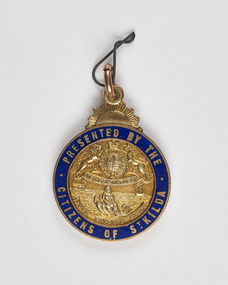
Memorabilia - Medallion, St Kilda tribute medallion, 1918
... John Dudley Cullen...Cullen attended the May 1919 function. John (Jack) Dudley Cullen was the first person from St Kilda to enlist in World War I. ...Cullen attended the May 1919 function. John (Jack) Dudley Cullen was the first person from St Kilda to enlist in World War I. ...Tribute medallions were presented to all 1914 enlistees from St Kilda by the citizens of St Kilda. Two presentations were held, one in November 1918 (98 recipients) and one in May 1919 (90 recipients). Both were organised by the St Kilda Patriotic Committee and held at the St Kilda Town Hall. Gunner J.D. Cullen attended the May 1919 function. John (Jack) Dudley Cullen was the first person from St Kilda to enlist in World War I. He lived at 23 Argyle Street (now Waterloo Crescent), St Kilda. An electrician with three years service with the militia behind him, Jack enlisted on 18 August 1914 at the age of 21. By 20 October that year he was sailing to Egypt on the HMAT Shropshire as a member of the 5th Battery, 2nd Field Artillery Brigade. He served in the Middle East for a short time before being hospitalised with enteric fever and returning home to Australia. After recovering, Jack undertook permanent guard duties at Broadmeadows Training Camp until October 1916, when he went to England with the 118th Howitzer Battery on the HMAT Aeneas. He again returned to Australia on health grounds, this time suffering a bronchial condition, and was discharged in June 1918. In February 1918, while still in England, Jack married Miss Daisy Dawes of Durrington, near Salisbury. They settled for a short while in Australia but returned to live in England in 1921.Round medal, 9 carat gold and dark blue enamel. Eyelet attachedFront: The City of St Kilda coat of arms within a dark blue enamel band bearing gold lettering 'PRESENTED BY THE CITIZENS OF ST. KILDA' Back: Engraved with the inscription 'GNR J.D. CULLEN' and raised lettering 'ENLISTED AND EMBARKED IN 1914 THE GREAT EUROPEAN WAR 1914-18'john dudley cullen, jack cullen, wwi recognition of service, citizens welcome to anzacs, st kilda patriotic committee, wwi -
 St Kilda Historical Society
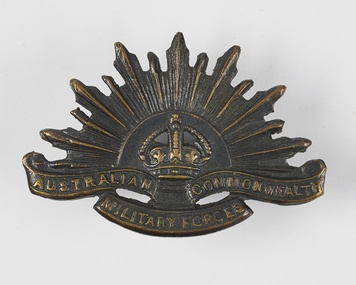
Badge - Military badge, Army Rising Sun badge, 1914-1918
... ...John Dudley Cullen...Military badges WWI memorabilia John Dudley Cullen Jack Cullen AUSTRALIAN COMMONWEALTH MILITARY FORCES Dark bronze coloured badge of 'Rising Sun' design with central crown and the words ‘Australian Commonwealth Military Forces’ Army Rising Sun badge Badge Military badge ...This badge belonged to St Kilda resident J Cullen, who served in World War I. The Rising Sun badge is the official emblem of the Australian Army. It was originally introduced in 1902 when a badge was needed for Australian contingents serving in the Boer War and was known as the General Service Badge. It features a radiating sun pattern with a central crown and the pattern has evolved over time to reflect the era in which it was worn and the changing identity of the Army. This item is the third pattern, which was worn throughout both World Wars.Dark bronze coloured badge of 'Rising Sun' design with central crown and the words ‘Australian Commonwealth Military Forces’ AUSTRALIAN COMMONWEALTH MILITARY FORCESmilitary badges, wwi memorabilia, john dudley cullen, jack cullen -
 St Kilda Historical Society
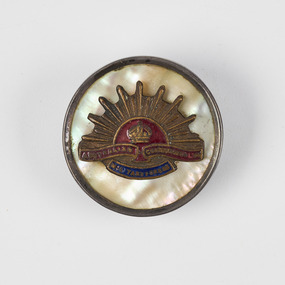
Badge - Military badge, Rising Sun sweetheart badge, 1914-1945
... ...John Dudley Cullen...Military badges WWI memorabilia John Dudley Cullen Jack Cullen Rising sun badge AUSTRALIAN COMMONWEALTH MILITARY FORCES Circular badge made of metal with the 'Rising Sun' motif of radiating swords and bayonets, a crown, and a scroll displaying the words 'Australian Commonwealth Military Forces', mounted on mother of pearl. ...This is an example of a 'sweetheart badge'. Soldiers made or purchased badges with the rising sun pattern for family and loved ones. The pattern has evolved over time since 1902, when it was first introduced. This badge displays the third pattern, which was worn throughout both World Wars.Circular badge made of metal with the 'Rising Sun' motif of radiating swords and bayonets, a crown, and a scroll displaying the words 'Australian Commonwealth Military Forces', mounted on mother of pearl. The crown and first line of the scroll appear against a background of red enamel. The background of the second line of the scroll is blue enamel.AUSTRALIAN COMMONWEALTH MILITARY FORCESmilitary badges, wwi memorabilia, john dudley cullen, jack cullen, rising sun badge
