
Showing 482 items matching "john styling"
-
 Emerald Museum & Nobelius Heritage Park
Award - Lifesaving Club trophy
... ...John Styling...Fuller 1975-76 Alan Chandler 1976-77 Peter Castricum 1979-80 John Styling 1980-81...C. McClelland John Styling Graeme Osborne J Fowles Perpetual cup 440 yards - men -|on base: C McCellland A Chandler 1974-75 D. ...One of 6 trophies from the Emerald Life Saving ClubSilver cup shaped trophy, with 2 handles (one broken) on Bakelite stand - inscription plate looseJ Fowles Perpetual cup 440 yards - men -|on base: C McCellland A Chandler 1974-75 D. Fuller 1975-76 Alan Chandler 1976-77 Peter Castricum 1979-80 John Styling 1980-81emerald, victoria, australia, clubs, associations, societies, j fowles, emerald life saving club, alan chandler, peter castricum, d. fuller, c. c. mcclelland, john styling, graeme osborne -
Emerald Museum & Nobelius Heritage Park
Award - Trophy Shield
... John Styling...One of 6 trophies from the Emerald Community Youth and Lifesaving Club John Styling Mark Louise Styling Chris Fuller Tania Klene M Klene U Rockman R Schmidt S Little Peter Castricum Alan Chandler James Ganson Emerald Victoria Australia Geoffrey Sandback Kerry Hawkins Tracey hawkins Craig Osborne B Burbridge P Lockyer G Butterworth M Mulcahy D Mulcahy Clubs Associations societies Emerald Community Youth and Life Saving Club|Perpetual Annual Trophy Awarded to Winning Team Large trophy shield and smaller annual winners shields affixed Award Trophy Shield ...One of 6 trophies from the Emerald Community Youth and Lifesaving ClubLarge trophy shield and smaller annual winners shields affixedEmerald Community Youth and Life Saving Club|Perpetual Annual Trophy Awarded to Winning Teamjohn styling, mark, louise styling, chris fuller, tania klene, m klene, u rockman, r schmidt, s little, peter castricum, alan chandler, james ganson, emerald, victoria, australia, geoffrey sandback, kerry hawkins, tracey hawkins, craig osborne, b burbridge, p lockyer, g butterworth, m mulcahy, d mulcahy, clubs, associations societies -
Emerald Museum & Nobelius Heritage Park
Award - Lifesaving trophy
... JJ Eudey Perpetual Cup Swimming Championship Men C McClelland, Bruce Rush, John Styling, D Palmer, D.Fuller, Mark Osborne, Peter Castricum, Mak Albert, Graeme Osborne...one of 6 trophies from the Emerald Life saving Club Emerald Victoria Australia swimming pools clubs associations societies Emerald Life Saving Club J J Eudey JJ Eudey Perpetual Cup Swimming Championship Men C McClelland, Bruce Rush, John Styling, D Palmer, D.Fuller, Mark Osborne, Peter Castricum, Mak Albert, Graeme Osborne cup trophy with decorative bakelite baseSilver Award Lifesaving trophy ...one of 6 trophies from the Emerald Life saving Clubcup trophy with decorative bakelite baseSilverJJ Eudey Perpetual Cup Swimming Championship Men C McClelland, Bruce Rush, John Styling, D Palmer, D.Fuller, Mark Osborne, Peter Castricum, Mak Albert, Graeme Osborneemerald, victoria, australia, swimming pools, clubs, associations, societies, emerald life saving club, j j eudey -
 Ringwood RSL Sub-Branch
ww1 Memorial Plaques, C. 1923
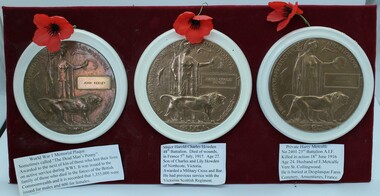
... 00320.1 John Keely later style naming 00320.2 Harold Charles Howden 00320.3 Harry Metcalfe...There are number of soldiers by this name on the Commonwealth War Graves Register thus unable to confirm personal details. 00320.2 Major Harold Howden Military Cross and Bar died of wound 5/7/1917 aged 27 48th Battalion AIF. 00320.3 Private Harry Metcalfe killed in action 18/6/1916 aged 24 23rd Battalion AIF 00320.1 John Keely later style naming 00320.2 Harold Charles Howden 00320.3 Harry Metcalfe 3 circular brass plaques mounted on a board for display ww1 Memorial Plaques ...00320.1 John Keely. There are number of soldiers by this name on the Commonwealth War Graves Register thus unable to confirm personal details. 00320.2 Major Harold Howden Military Cross and Bar died of wound 5/7/1917 aged 27 48th Battalion AIF. 00320.3 Private Harry Metcalfe killed in action 18/6/1916 aged 24 23rd Battalion AIF 3 circular brass plaques mounted on a board for display 00320.1 John Keely later style naming 00320.2 Harold Charles Howden 00320.3 Harry Metcalfe -
Emerald Museum & Nobelius Heritage Park
Photograph - Emerald Football Club, 1981 U17s, Unknown photographer, 1981
... . / 1981 / Grand / BACK ROW:- STEVEN PATTERSON, STEPHEN QUINN / GRANT SVANBERG, PAUL TRANFIELD, IAN SKINNER, / JOHN STYLING, DAVID HARTNELL, ROBERT TENBURREN, / DARREN SALAH, STEVE MOORE (COACH) / FRONT ROW: STAN MORRIS (TRAINER) MARK MISSPEM / GEOFF SANDBACH, ADAM COLE, BRETT HOPE, / PHILIP CADDAYE, JOE WARDALE, TROY ARNOTT, / CRAIG HOLMES / VEMUP0659 /.... / 1981 / Grand / BACK ROW:- STEVEN PATTERSON, STEPHEN QUINN / GRANT SVANBERG, PAUL TRANFIELD, IAN SKINNER, / JOHN STYLING, DAVID HARTNELL, ROBERT TENBURREN, / DARREN SALAH, STEVE MOORE (COACH) / FRONT ROW: STAN MORRIS (TRAINER) MARK MISSPEM / GEOFF SANDBACH, ADAM COLE, BRETT HOPE, / PHILIP CADDAYE, JOE WARDALE, TROY ARNOTT, / CRAIG HOLMES / VEMUP0659 / Colour rectangular photograph printed on gloss photographic paper. ...The Emerald Football Club, formerly known as the Mountain District Football Association and as the Yarra Valley Mountain District Football League, and commonly known as the 'Emerald Bombers', was first established in 1905. Australian Rules Football is deeply rooted in Australian culture. Local football clubs are commonly the anchor for communities and help to boost morale.This image, depicting the Emerald Football Club U17 Premiers for the 1981 season, holds strong historic significance. Australian Rules Football has a long history in the country, with the first clubs founded in Melbourne and Geelong in 1858 and 1859 respectively. The photograph also has strong research potential, particularly in the area of sociology.Colour rectangular photograph printed on gloss photographic paper. Depicted in the photograph are 19 males from the Emerald Football Club dressed in red and black uniforms. The reverse inscriptions show they are the 1981 Premiers (undefeated champions). They are standing and seated outdoors, possibly in front of the club house on an oval or reserve.Reverse: U 17 GRAND FINAL 1981 / PREMIERS - UNDEFEATED / CHAMPIONS. / 1981 / Grand / BACK ROW:- STEVEN PATTERSON, STEPHEN QUINN / GRANT SVANBERG, PAUL TRANFIELD, IAN SKINNER, / JOHN STYLING, DAVID HARTNELL, ROBERT TENBURREN, / DARREN SALAH, STEVE MOORE (COACH) / FRONT ROW: STAN MORRIS (TRAINER) MARK MISSPEM / GEOFF SANDBACH, ADAM COLE, BRETT HOPE, / PHILIP CADDAYE, JOE WARDALE, TROY ARNOTT, / CRAIG HOLMES / VEMUP0659 /old photo, sports, australian rules football, grand final, emerald, victoria, australia, 1980s -
 Federation University Art Collection
Bookplate, 'John Gartner'
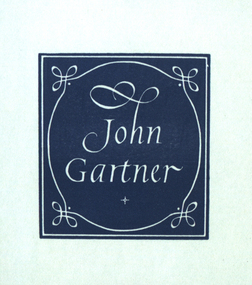
... John Gartner in cursive style white on a blue background within a rectangle with white borders...(http://www3.slv.vic.gov.au/latrobejournal/issue/latrobe-84/t1-g-t7.html) keith wingrove memorial trust australian bookplate design awards bookplate printmaking Nil John Gartner in cursive style white on a blue background within a rectangle with white borders 'John Gartner' Bookplate ...John Gartner was a fine printer and publisher, an author, a noted philatelist, and also collector of Australian banknotes and coins. He was born on 16 July 1914 and was largely self-educated, leaving school at fourteen for work following the death of his father. Gartner developed a strong interest in the history of typography and printing and was apprenticed at the Advocate where his father had been a linotype operator. Aged 17, Gartner bought a hand press and some fonts of type, and in 1937 acquired a platen press from which he set and printed his private press books, published under the imprint of The Hawthorn Press. Gartner had a strong collection of Australian bookplates. He also looked at the work of artists overseas and commissioned personal plates. He subsequently built an international collection with preference for artists who printed from wood. His initial searches were in Belgium and Holland.(http://www3.slv.vic.gov.au/latrobejournal/issue/latrobe-84/t1-g-t7.html) John Gartner in cursive style white on a blue background within a rectangle with white bordersNilkeith wingrove memorial trust, australian bookplate design awards, bookplate, printmaking -
Moorabbin Air Museum
Document (Item) - Collection of Research and Collations by John Hopton, Reproduced for Doug Hart, John Hopton, D. W. Hart c/- Moorabbin Air Museum
... Contents of the folder are indexed in John Hopton's own style, and present some form of encyclopedia or collection of his research into Australian aviation....Contents of the folder are indexed in John Hopton's own style, and present some form of encyclopedia or collection of his research into Australian aviation. ...Contents of the folder are indexed in John Hopton's own style, and present some form of encyclopedia or collection of his research into Australian aviation. -
 Ballarat Tramway Museum
Photograph - Colour Print/s - set of 10, Carolyn Dean and Gavin Young, 8/03/2004 12:00:00 AM
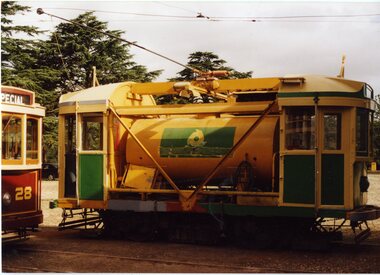
... Nos. 1, 5 and 6 taken on 6/3/2004, remainder 8/3/2004. .1 - Scrubber tram No. 8 showing progress on repainting to MMTB style. .2 - John Phillips photographing John Shaw in front of No. 27, with the destination "Alstom" on depot fan. .3 - John Shaw standing in front of No. 27 .4 - John Shaw attending to the trolley rope of No. 27 .5 - Six BTM standings in front or on No. 27 - John Shaw, Roger Salen, Simon Green, Carolyn Dean, Alastair Reither and John Phillips. .6 - ditto .7 - Wearing their Alstom tops and caps, BTM Crew with 661 and 671 in the background: = left to right - Simon Green, Alastair Reither, John Shaw, Len Millar, Roger Salen , Carolyn Dean, John Phillips, Alan Snowball, Peter Winspur, Stephen Butler and Sam Boon on Monday 8/3/2004. .8 - ditto .9 - as for .3 .10 - as for .1...Nos. 1, 5 and 6 taken on 6/3/2004, remainder 8/3/2004. .1 - Scrubber tram No. 8 showing progress on repainting to MMTB style. .2 - John Phillips photographing John Shaw in front of No. 27, with the destination "Alstom" on depot fan. .3 - John Shaw standing in front of No. 27 .4 - John Shaw attending to the trolley rope of No. 27 .5 - Six BTM standings in front or on No. 27 - John Shaw, Roger Salen, Simon Green, Carolyn Dean, Alastair Reither and John Phillips. .6 - ditto .7 - Wearing their Alstom tops and caps, BTM Crew with 661 and 671 in the background: = left to right - Simon Green, Alastair Reither, John Shaw, Len Millar, Roger Salen , Carolyn Dean, John Phillips, Alan Snowball, Peter Winspur, Stephen Butler and Sam Boon on Monday 8/3/2004. .8 - ditto .9 - as for .3 .10 - as for .1 Photograph Colour Print/s - set of 10 Carolyn Dean and Gavin Young ...Set of ten photographs taken or arranged by Carolyn Dean during the 2004 Begonia Festival. On Kodak paper. Nos. 1, 5 and 6 taken on 6/3/2004, remainder 8/3/2004. .1 - Scrubber tram No. 8 showing progress on repainting to MMTB style. .2 - John Phillips photographing John Shaw in front of No. 27, with the destination "Alstom" on depot fan. .3 - John Shaw standing in front of No. 27 .4 - John Shaw attending to the trolley rope of No. 27 .5 - Six BTM standings in front or on No. 27 - John Shaw, Roger Salen, Simon Green, Carolyn Dean, Alastair Reither and John Phillips. .6 - ditto .7 - Wearing their Alstom tops and caps, BTM Crew with 661 and 671 in the background: = left to right - Simon Green, Alastair Reither, John Shaw, Len Millar, Roger Salen , Carolyn Dean, John Phillips, Alan Snowball, Peter Winspur, Stephen Butler and Sam Boon on Monday 8/3/2004. .8 - ditto .9 - as for .3 .10 - as for .1On rear of each photo in ink, date and who took the photograph.btm, begonia festival, alstom, wendouree parade, tram 8, tram 27, tram 661, tram 671 -
Federation University Historical Collection
Booklet, Report on the Viability of Establishing a Post Secondary Education Facility Located at the Aradale Traininf Centre, Ararat, Victoria, 1993, 12/1993
... Aradale was designed in 1864 in the Victorian Italianate style by John James Clark of the Public Works Department, Victoria. ...Aradale was designed in 1864 in the Victorian Italianate style by John James Clark of the Public Works Department, Victoria. ...Aradale is located 3 km from the centre of Ararat and covers approximately 101 hectares. It consistes of an impresive group of mainly heritage buildings of national significance surrounded by open farmland. Aradale was designed in 1864 in the Victorian Italianate style by John James Clark of the Public Works Department, Victoria. A three storey nurses quarters was built in the 1930s and the Forensic Psychaitry Centre was established in the 1980s. The design of asylums as a specific building type orginated in England in the mddle of the 19th century when it was decided that 'pauper lunatics' would be better cared for in a separate institution rather than being house within the workhouses. Some of the early purpose built asylums were based on the radiating principle of prisons but the arrangement of separat wings at right angles used in hospitals and whorkhouse design soon came to be seen as the most appropriate. The largest 19th century asylum in England was built at Colney Hatch. Kew, Beechworth and Ararat Asylums closely followed the Colney Hatch model. In victoria the population rose due to the gold rushes resulting in severe housing shortages, and additional pressure on asylums. The first asylum in Melbourne was established at Y arra Bend. In 1862 a new asylum was established at Kew. Ararat Asylum and Beechworth Asylum were designed in 1864. Ararat was opened on 19 October 1867, with Beechworth Asylum opening five days later. Soft covered bookletararat regional development board inc., aradale training centre, aradale, grano street ararat, alfred st ararat, ivar nelson, john christie, jon duggan, wes matthews, peter helfer, michael burke, john grant, asylum, lunatic asylum, colney hatch asylum, ararat asylum, fever tents, sunbury asylum, kew asylum, beechworth asylum, wine industry training -
 Federation University Historical Collection
Book, The Work of Dwight James Baum, 1927 (exact)
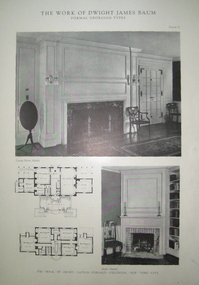
... During the 1920s, Baum designed a significant buildings and several houses in Sarasota, Tampa, Terrace, Temple and Florida all in the Mediterranean Revival Style such as the Ringlings dubbed Cà d'Zan, which is now known as the John and Mable Ringling Museum of Art. ...During the 1920s, Baum designed a significant buildings and several houses in Sarasota, Tampa, Terrace, Temple and Florida all in the Mediterranean Revival Style such as the Ringlings dubbed Cà d'Zan, which is now known as the John and Mable Ringling Museum of Art. ...Dwight James Baum is an American architect. He was born in 1886 in Newville, New York. As a young man, Baum moved to Syracuse. In 1909, he graduated from Syracuse University with an architecture degree. He worked for Boring and Tilton and Sanford White which are well known Architecture firms in America. Around 1912, he started his own residential design firm. During the 1920s, Baum designed a significant buildings and several houses in Sarasota, Tampa, Terrace, Temple and Florida all in the Mediterranean Revival Style such as the Ringlings dubbed Cà d'Zan, which is now known as the John and Mable Ringling Museum of Art. In 1923-1924, he also designed Sunset Hill for Mrs. Eugene D. Stocker at Warren, New York which was listed on the National Register of Historic Places in 2007. During the Depression Baum became involved with Good Housekeeping Magazine as consulting architect, and as designer of their building exhibit at the 1933 Chicago World's Fair. His later work includes Hendricks Memorial Chapel at Syracuse University, with John Russell Pope in 1929–1930 and the pedestal for V. Renzo Baldi's statue of Columbus in the city's Columbus Circle. Dwight James Baum died in 1939. Book with large blue hard cover. Title is written on the front cover and the spine in gold. Manufacturer's logo is written on front cover in gold. The book includes index, preface and an introduction. black and white illustrations, plates and floor planes of the architect's work such as Ca d Zan, the fantastical Venetian Gothic waterfront palace of John and Mable Ringling in Sarasota, Florida and the stately Italianate house of Anthony Campagna in Riverdale, New York and more.architecture, architectural designs, art moderne, domestic designs, ca d zan -
 Federation University Historical Collection
Tool, Brick mould and brick, 1) UNKNOWN .2) c.1888
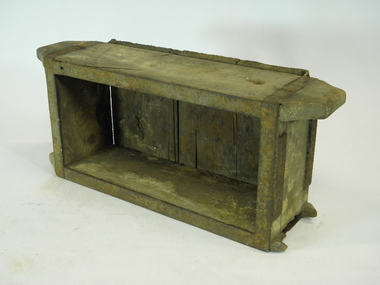
... style timbers. The nails in the base piece appear to be hand-made. Remnants of clay still line the interior. .2) Light brown brick. Please note: Brick mould and brick may be from different sources. Brick mould and brick Tool John ...John Nunn was one of the earliest brickmakers on record in Ballarat and has a road named for him - Nunn Street - where he resided..1) An oblong-shaped timber box open at top. Only butt joints are used. Iron strapping wraps around the vertical pieces of timber and across the top edge of the box. The longest pieces of vertical timber protrude past the end and are shaped like solid handles - one is broken. On each end piece there are small, blank iron plates held with screws. The base piece of timber is made from two different width weatherboard-style timbers. The nails in the base piece appear to be hand-made. Remnants of clay still line the interior. .2) Light brown brick. Please note: Brick mould and brick may be from different sources..1) Handwritten (possibly in ink) on one long side: MR H. G. SMITH ...(illegible) Ballarat .2) Imprinted: J. NUNNjohn nunn, j nunn, brick, mould, brick mould, industrial mould, brickmaker, ballarat, clay, ceramics -
 Mission to Seafarers Victoria
Decorative object - Finial, c. 1920
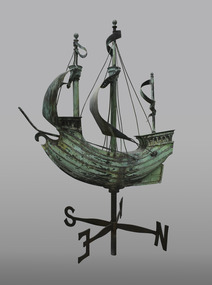
... The galleon is often a decorative design of Mission to Seafarers wind vane (London, Adelaide). weather vane wind vane sculpture galleon sailing ship finial henry alfred saw david hope windvane weathervane walter richmond butler (1864–1949) richard butler john sanderson Bronze and copper sculpture fashioned as a Wind Vane in the form of a Galleon style sailing ship with 2 pennants flying and two sails rigged atop with lower cross piece with wind directions N S E W . ...Appearances to the contrary, the item is not a weathervane but a finial. It was the gift of Mr John Sanderson (Jottings Easter 1920), from John Sanderson & Co., wool merchants, stock and station agents, commission and shipping agents before he leaves for England to become senior partner in Sanderson Murray & Elder, London, import and export agents. It was designed by Walter & Richard Butler Architects. (sketch published in Building : the magazine for the architect, builder, property owner and merchant vol.33, no 193, 12 Sept. 1923). The finial was already drawn on the sketch of the Central Institute made by Walter Butler. The maker of the finial, was Henry Alfred George Arnold Saw (born June 1881 in Hotham, Victoria was the son of Edward Saw (1854-1926) a tinsmith and Catherine Barton (1863-1907). He worked as a metal artificer for a metal-working business located opposite the Trades Hall in Lygon Street and was given the job of making the copper ship finial. Henry married Florence Charlotte Reeder and they had four children. Also known as Harry Saw according to his grandson Brian, he died on 9th February 1960. Henry and Florence both died within two months of each other in 1960. It is not clear when the ship was actually installed on the roof, the earliest photograph dating from 1927. The windvane fell or moved several times because of gale forces: - In 1995 : After the funds were raised to repair it, it was treated by sculptor David Hope, and reinstalled in the 1998 (Ship to Shore #3 Sept 1998). - In 2017: Carmela Lonetti from the Grimwade Centre for Cultural Materials Conservation (Ship to Shore Autumn 2017) - In 2019: a generous passerby donated the necessary funds for the conservation. It was sent to Grimwade Centre for Cultural Materials Conservation (Ship to Shore 2019), treated by Evan Tindal (City of Melbourne Magainze Oct. 2020). It was reinstalled over the Summer of 2019-2020 (Ship to Shore Summer 2020). The weathervane was stolen during the night of the 6-7 March 2022. Copper price surge sparks rise in theft in Victoria in 2021-22 so it's likely the vane was stolen to be melted This sculpture is closely associated with the 1917 building and described in clippings and annual reports when the building was first newly opened. It can be seen in some of the earliest photographs of the new building and in the artist/architect Butler's impressions. The galleon is often a decorative design of Mission to Seafarers wind vane (London, Adelaide).Bronze and copper sculpture fashioned as a Wind Vane in the form of a Galleon style sailing ship with 2 pennants flying and two sails rigged atop with lower cross piece with wind directions N S E W . There is a decorative ornamental pierced scrollwork ferrule / finial with reinforcing chrome steel piping armature at base of main support which attaches to the roof or a base support. See also comments below weather vane, wind vane, sculpture, galleon, sailing ship, finial, henry alfred saw, david hope, windvane, weathervane, walter richmond butler (1864–1949), richard butler, john sanderson -
 Federation University Historical Collection
Photograph - Photograph - Black and White, Proposed Ballarat School of Mines Trade Workshops, c1984
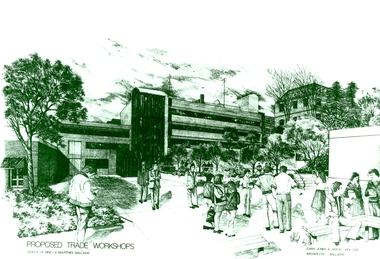
... John Building (Building K), a three storey, face red brick, restrained Late Twentieth Century International styled building with an elongated, cuboid form (defined by the parapeted facades) that is offset by projecting exposed concrete framed, round‐arched entrance and stair wells on the east (Albert Street) elevation (the centrally located entrance breaking the brick façade with glazing). ...John Building (Building K), a three storey, face red brick, restrained Late Twentieth Century International styled building with an elongated, cuboid form (defined by the parapeted facades) that is offset by projecting exposed concrete framed, round‐arched entrance and stair wells on the east (Albert Street) elevation (the centrally located entrance breaking the brick façade with glazing). ...A design for a Trade and Art Workshop at the Ballarat School of Mines was prepared by Ewan Jones and Associates on the Albert Street boundary around 1984. The M.B. John Building (Building K), a three storey, face red brick, restrained Late Twentieth Century International styled building with an elongated, cuboid form (defined by the parapeted facades) that is offset by projecting exposed concrete framed, round‐arched entrance and stair wells on the east (Albert Street) elevation (the centrally located entrance breaking the brick façade with glazing). The facades are also characterised by banks of aluminium framed, horizontal ribbon windows, which wrap around the building corners. Metal shades project beyond the windows, while post‐supported bullnosed verandahs and hoods and projecting concrete stairs are other features. On the west elevation, the cuboid façade is punctuated by projecting curved concrete and glazed, elongated bays at first floor level. (David Rowe/Wendy Jacobs) The M.B. John Trade–Art building of SMB was officially opened by the Hon. John Cain, Premier of Victoria, in the presence of Morgan B. John. Programs include 3 Dimensional Art, Painting & Decorating, and Engineering Trades. (SMB Institutional Plan 1989)Black and white photograph of a sketch for the proposed Trade Workshops at the Ballarat School of Mines, from the Albert Street vantage point. This building is known as the M.B. John Building on the SMB Campus.ballarat school of mines, trade workshops, flecknoe, m.b. john, ewan jones and associates pty ltd, albert street, morgan b. john, ewan jones and associates -
 Federation University Historical Collection
Poster - Ballarat Teachers' College Ceremonial Collar, Welcome to: Ballarat Teachers College: Class of 1971: 45 Year Reunion: 5 & 6 November 2016, 2016
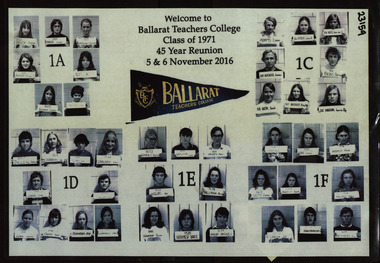
... Three sticky notes are attached to the poster to identify famous persons. ballarat teachers' college denis spielvogel marg heffernand joy dunstan rachel smith alumni reunion john mildren ian fryar ian gribble geoff mcrea Ballarat Teachers College logo as part of a flag. This is a photographic collage poster featuring many mug-shot style photographs of the members of the class of 1971, with a note to identify which classroom they were a part of. ...The Ballarat Teachers College held a 45 year Reunion for the class of 1971 on the 5 & 6 November 2016. All students plus their four teachers were invited. Three sticky notes are attached to the poster to identify famous persons.This is a photographic collage poster featuring many mug-shot style photographs of the members of the class of 1971, with a note to identify which classroom they were a part of. Sticky notes with hand-written labels identify three members of the group with a personal achievement. A poem titled 'Extra Muros' is displayed verso inbetween two logos of the Ballarat Teachers College.Ballarat Teachers College logo as part of a flag.ballarat teachers' college, denis spielvogel, marg heffernand, joy dunstan, rachel smith, alumni, reunion, john mildren, ian fryar, ian gribble, geoff mcrea -
 The Beechworth Burke Museum
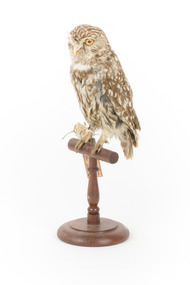
Animal specimen - Ural Owl, Trustees of the Australian Museum, 1860-1880
... style gives the appearance of a large bird. The eyes are dark brown and relatively small, and the bill is yellowish. Tarsi and toes are feathered grey and the talons are yellowish brown with darker tips. This specimen is part of a collection of almost 200 animal specimens that were originally acquired as skins from various institutions across Australia, including the Australian Museum in Sydney and the National Museum of Victoria (known as Museums Victoria since 1983), as well as individuals such as amateur anthropologist Reynell Eveleigh Johns between 1860-1880. ...style gives the appearance of a large bird. The eyes are dark brown and relatively small, and the bill is yellowish. Tarsi and toes are feathered grey and the talons are yellowish brown with darker tips. This specimen is part of a collection of almost 200 animal specimens that were originally acquired as skins from various institutions across Australia, including the Australian Museum in Sydney and the National Museum of Victoria (known as Museums Victoria since 1983), as well as individuals such as amateur anthropologist Reynell Eveleigh Johns between 1860-1880. ...Ural Owls are one of the largest nocturnal birds of prey and are distributed across Northern hemisphere land masses from Scandinavia in the west, across Russia and China to Japan in the east. They average between 500-640mm in length, have large ears, a very long tail, and wing spans up to 1340mm. Ural Owls display reverse sexual dimorphism. They have a range of calls and sounds that vary between regions and among subspecies. Ural Owls prefer mature primary forest habitats that are not too dense, but adapt to a range of environments, including damp heathland and high elevation mountain forests. The species is considered nocturnal but may be more correctly described as ‘cathemeral’, due to frequent daylight activity in the taiga zone. Ural Owls are non-migratory and highly territorial. They prefer to hunt from a perch into open areas of forest, seeking small mammal prey, such as voles, as well as birds, amphibians, and invertebrates. Ural Owls have a broad, rounded head and a well-developed round facial disc with a small V-shaped indentation. They tend to be plain greyish-brown to whitish overall, though some subspecies display darker colour variation. The underparts are pale cream to grey-brown and boldly overlaid with dark brown streaking. Ural Owls lack the richer colour tones of other Strix owls. Their flight style gives the appearance of a large bird. The eyes are dark brown and relatively small, and the bill is yellowish. Tarsi and toes are feathered grey and the talons are yellowish brown with darker tips. This specimen is part of a collection of almost 200 animal specimens that were originally acquired as skins from various institutions across Australia, including the Australian Museum in Sydney and the National Museum of Victoria (known as Museums Victoria since 1983), as well as individuals such as amateur anthropologist Reynell Eveleigh Johns between 1860-1880. These skins were then mounted by members of the Burke Museum Committee and put-on display in the formal space of the Museum’s original exhibition hall where they continue to be on display. This display of taxidermy mounts initially served to instruct visitors to the Burke Museum of the natural world around them, today it serves as an insight into the collecting habits of the 19th century.This specimen is part of a significant and rare taxidermy mount collection in the Burke Museum. This collection is scientifically and culturally important for reminding us of how science continues to shape our understanding of the modern world. They demonstrate a capacity to hold evidence of how Australia’s fauna history existed in the past and are potentially important for future environmental research. This collection continues to be on display in the Museum and has become a key part to interpreting the collecting habits of the 19th century. This Ural Owl is an average sized specimen with a broad, rounded head and characteristic V-shaped facial marking between the eyes. Overall plumage is plain and consistent in colour and pattern, with white, brown and grey streaks. The eyes are large and the bill is small and yellow. This specimen stands on a wooden perch with identification tags attached to its leg.Swing tag: Strix noctua / Athene noctua, [illegible] / near leiden / 26 Mai 1860. / Holland / Other tag: N38 / Strix noctua / Holland. / Metal tag: 4062 /taxidermy, taxidermy mount, burke museum, australian museum, owls, birds of prey, heart-shaped faced owl, nocturnal birds, predator birds, carnivore, territorial owl, animalia, large owl, long-tailed owls, ural mountains, taiga zone owls, cathemeral, monogamous, iucn red list, strix, wood owl, attacking owl, long-tailed owl, large-eared owl, owls with facial disc -
 The Beechworth Burke Museum
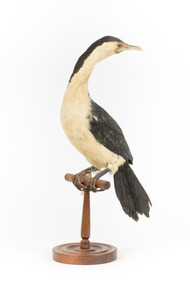
Animal specimen - Little Pied Cormorant, Trustees of the Australian Museum, 1860-1880
... johns bird cormorant little piet cormorant waterbird Swing tag: 21a. / Pied Cormorant / Catalogue page 41 / Mount: 152 / The Little Pied Cormorant specimen is a small bird with white and black colouring. The back of the head, neck, wings and tail are black while the undersides are a creamy white. The feet are webbed and are also dark in colouring. The bird has pale glass eyes and a medium sized bill and a long tail. This specimen is styled ...The Little Pied Cormorant is commonly seen in Australia's wetlands. These birds reside amongst large flocks in locations where fish is plentiful. On the occasion that this bird is seen on inland streams and dams they will be solitary. This particular species willingly mixes with similar sized birds including the Little Black Cormorant. They feed on aquatic animals ranging from insects and yabbies and are labelled as benthic feeders because they find their prey on the seafloor. This specimen is part of a collection of almost 200 animal specimens that were originally acquired as skins from various institutions across Australia, including the Australian Museum in Sydney and the National Museum of Victoria (known as Museums Victoria since 1983), as well as individuals such as amateur anthropologist Reynell Eveleigh Johns between 1860-1880. These skins were then mounted by members of the Burke Museum Committee and put-on display in the formal space of the Museum’s original exhibition hall where they continue to be on display. This display of taxidermy mounts initially served to instruct visitors to the Burke Museum of the natural world around them, today it serves as an insight into the collecting habits of the 19th century.This specimen is part of a significant and rare taxidermy mount collection in the Burke Museum. This collection is scientifically and culturally important for reminding us of how science continues to shape our understanding of the modern world. They demonstrate a capacity to hold evidence of how Australia’s fauna history existed in the past and are potentially important for future environmental research. This collection continues to be on display in the Museum and has become a key part to interpreting the collecting habits of the 19th century.The Little Pied Cormorant specimen is a small bird with white and black colouring. The back of the head, neck, wings and tail are black while the undersides are a creamy white. The feet are webbed and are also dark in colouring. The bird has pale glass eyes and a medium sized bill and a long tail. This specimen is styled to look over it's left wing with its long neck bent to look in that direction. It stands on a wooden mount with a paper identification tag attached to the bird's right foot. The mount has the number 152 written on the wood.Swing tag: 21a. / Pied Cormorant / Catalogue page 41 / Mount: 152 /taxidermy mount, taxidermy, animalia, burke museum, beechworth, australian museum, skin, reynell eveleigh johns, bird, cormorant, little piet cormorant, waterbird -
Marysville & District Historical Society
Article (Item) - Magazine article, Are Media Pty Limited, Beyond All Expectations, 1992
... A magazine article taken from the magazine A Country Style in 1992 on "The Hermitage" at Narbethong in Victoria. "The Hermitage" was built by photographer John William Lindt as a home and guesthouse in 1894. ...A magazine article taken from the magazine A Country Style in 1992 on "The Hermitage" at Narbethong in Victoria.A magazine article taken from the magazine A Country Style in 1992 on "The Hermitage" at Narbethong in Victoria. "The Hermitage" was built by photographer John William Lindt as a home and guesthouse in 1894. John Lindt had previously photographed the mountain scenery of the Black Spur and purchased 71 acres and subseqently built his home and guesthouse from where he continued his career. "The Hermitage had a garden designed by John Lindt's friend, Ferdinand von Mueller, who was at one stage the Director of the Melbourne Botanic Gardens. The garden featured New Guinea tree houses from which John Lindt made frequent panoramas of his property and the surrounding forest of towering mountain ash. Aged 81 Lindt died of heart failure during disastrous bushfires on 19 February 1926 at the Hermitage. He was survived by his wife Catherine who continued to run ‘The Hermitage’ guest house before she retired to the city. At the time of the publication of this article, John and Val Stafford had become the fifth owners of "The Hermitage".the hermitage, john william lindt, narbethong, victoria, black spur, ferdinand von mueller, melbourne botanic gardens, new guinea, catherine lindt, john stafford, val stafford -
Marysville & District Historical Society
THE TRIANGLE NEWS-VOL 41 NO 17-MAY 9 2014
... style...afl legend doug hawkins speech...marysville lions club...news contact details for triangle news...what's on when in may...2014 seasonal influenza vaccine available...the committee of management of the gallipoli park precinct...marysville community market...creative triangle...adventurous cooks...marysville fire brigade good friday appeal...church notices...marysville golf report...dr neil mckern running legend...alexandra high school reunion...mayor's chair by cr margaret rae...councillor comment by cr john...marysville victoria australia villains season 2014 kicks off in style afl legend doug hawkins speech marysville lions club news contact details for triangle news what's on when in may 2014 seasonal influenza vaccine available the committee of management of the gallipoli park precinct marysville community market creative triangle adventurous cooks marysville fire brigade good friday appeal church notices marysville golf report dr neil mckern running legend alexandra high school reunion mayor's chair by cr margaret rae councillor comment by cr john walsh koriella ward celebrating volunteers week marysville & triangle community men's shed united approach for visitor information centres buxton nursery social dancing alexandra residential & rural real estate marysville triangle real estate lake mountain mountain mayhem depression recovery program free information evening cleaner needed for marysville villains marsysville shines for 1000 hands project opening buxton hotel burger night draft budget 2014-2015 council plan review recognising those who returned from the war black spur inn mother's day lunch el kanah marsyville eat in eat out menu marysville preschool centre long day care & kindergarten marysville beer & platter garden closed for winter black spur inn kitchen assistant wanted council plan keeps focus on community emergence from surviving to thriving el kanah conference room dandyman play buxton hall trivia night review of dandyman play draft budget 2014/15 sets council's direction THE TRIANGLE NEWS-VOL 41 NO 17-MAY 9 2014 ...marysville, victoria, australia, villains season 2014 kicks off in style, afl legend doug hawkins speech, marysville lions club, news contact details for triangle news, what's on when in may, 2014 seasonal influenza vaccine available, the committee of management of the gallipoli park precinct, marysville community market, creative triangle, adventurous cooks, marysville fire brigade good friday appeal, church notices, marysville golf report, dr neil mckern running legend, alexandra high school reunion, mayor's chair by cr margaret rae, councillor comment by cr john walsh koriella ward, celebrating volunteers week, marysville & triangle community men's shed, united approach for visitor information centres, buxton nursery, social dancing alexandra, residential & rural real estate, marysville triangle real estate, lake mountain, mountain mayhem, depression recovery program free information evening, cleaner needed for marysville villains, marsysville shines for 1000 hands project opening, buxton hotel burger night, draft budget 2014-2015 council plan review, recognising those who returned from the war, black spur inn mother's day lunch, el kanah marsyville, eat in eat out menu, marysville preschool centre, long day care & kindergarten, marysville beer & platter garden closed for winter, black spur inn kitchen assistant wanted, council plan keeps focus on community, emergence from surviving to thriving, el kanah conference room dandyman play, buxton hall trivia night, review of dandyman play, draft budget 2014/15 sets council's direction -
Federation University Historical Collection
Book - Book - Scrapbook, Ballarat School of MInes: Scrapbook of Newspaper Cuttings, Book 14, March 1982 to June 1982
... john leith employed by smb - aboriginal employment training scheme...third time lucky for ballarat (high) school...ballarat moving back to more humane style...The papers concerned are The Courier, Ballarat, The Australian, The Age over the period of 13 March 1982 to 12 June 1982. courses available teaching positions advertised training course for clothing machinists in doubt beanland farewelled graham beanland to take up position with tafe board in melbourne turmoil over funding from tafe board smb museum reopened food waiters training program dick richards - a great survivor antarctic expedition john leith employed by smb - aboriginal employment training scheme third time lucky for ballarat (high) school ballarat moving back to more humane style of architecture death of leo shannon - head of plumbing smb peter shiells appointed principal of smb peter manzi top apprentice painter and decorator glenn sobey top metal trades apprentice adam lovett apprentice motor mechanic at smb dorothy jenkins to lead major tafe study supply chief major general powell is from ballarat john francis top apprentice motor mechanic visit by schools commission flaf presented to smb museum ballarat and the art world frank sheehan's first 6 weeks in parliament sheehan's maiden speech national move in business studies sue williams top secretarial student scott barling and greg harris of smb master builders association study proposals for heated swim pool Book with white cover, front, spiral bound. ...Collection of newspaper articles related to Ballarat School Of Mines.They cover activities and advertisements for staff. The papers concerned are The Courier, Ballarat, The Australian, The Age over the period of 13 March 1982 to 12 June 1982.Book with white cover, front, spiral bound. courses available, teaching positions advertised, training course for clothing machinists in doubt, beanland farewelled, graham beanland to take up position with tafe board in melbourne, turmoil over funding from tafe board, smb museum reopened, food waiters training program, dick richards - a great survivor, antarctic expedition, john leith employed by smb - aboriginal employment training scheme, third time lucky for ballarat (high) school, ballarat moving back to more humane style of architecture, death of leo shannon - head of plumbing smb, peter shiells appointed principal of smb, peter manzi top apprentice painter and decorator, glenn sobey top metal trades apprentice, adam lovett apprentice motor mechanic at smb, dorothy jenkins to lead major tafe study, supply chief major general powell is from ballarat, john francis top apprentice motor mechanic, visit by schools commission, flaf presented to smb museum, ballarat and the art world, frank sheehan's first 6 weeks in parliament, sheehan's maiden speech, national move in business studies, sue williams top secretarial student, scott barling and greg harris of smb, master builders association, study proposals for heated swim pool -
 Lara RSL Sub Branch
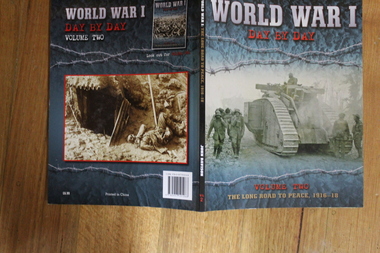
book - world war 1 - Volume two, book - World War 1 - Volume Two - The Long Rod to Peace, 1916 - 18, 2000
... Author - John Davidson Soft cover magazine style book of World War 1 - Day By Day - pictorial in nature how World War 1 was fought. book - World War 1 - Volume Two - The Long Rod to Peace, 1916 - 18 book - world war 1 - Volume two ...Soft cover magazine style book of World War 1 - Day By Day - pictorial in nature how World War 1 was fought.Book - World War 1 - Day By Day - Volume Two - The Long Road To Peace, 1916 - 18. Author - John Davidsonbook, magazine world war 1, pictorial magazine -
 Lara RSL Sub Branch
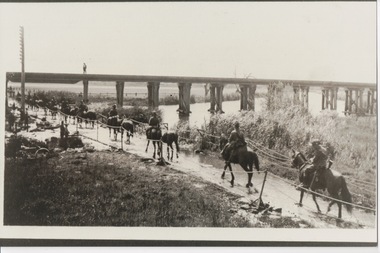
Photograph, Set 4 photographs. and others for Torquay Light Horse camp, 1940
... style, when they would normally have ridden close to an objective then dismounted to fight. The fall of Beersheba swung the battle tide against the Turks in Palestine; and changed the history of the Middle East. While 19 men from the Surf Coast Shire served with the 4th Light Horse over the course of WW1, only four were involved in the charge of Beersheba- John GAYLARD, Philip QUINN....style, when they would normally have ridden close to an objective then dismounted to fight. The fall of Beersheba swung the battle tide against the Turks in Palestine; and changed the history of the Middle East. While 19 men from the Surf Coast Shire served with the 4th Light Horse over the course of WW1, only four were involved in the charge of Beersheba- John GAYLARD, Philip QUINN. ...These images capture for all time Light Horsemen travelling through Geelong on their way to camp at Torquay for the last Group meeting in Australia . information following - details obtained from .........https://torquayhistory.com/light-horse-brigade/ On Australia Day, 1997, Sir John Young unveiled this plaque on Point Danger, Torquay. Torquay history, Light Horse Training Camp, WW2 Plaque at Pt. Danger Note----- (See images to view plaque) The plaque identifies a significant event in Torquay’s history and the sentiments of ‘change’ for the Light Horse Brigade – from horses to machines. In 1940 the four Light Horse Regiments (4th, 8th, 13th and 20th), some 5000 Light Horse and 2000 horses camped and trained at Torquay. Three other regiments, formerly mounted on horses, were also at Torquay ‘mounted’ on privately owned trucks and cars. Division troops included Artillery, Engineers, Signals, Field Ambulance and other branches of the Army necessary to enable a Division to function. It wasn’t just the sheer numbers of men coming to this little town that made the event significant, it was also the fact that the men of the Light Horse were dramatic, almost glamorous figures and it is easy to see their exploits as some splendid adventure. Horses have played a special role in the story of Australia. They were the only means of transport across this huge country, so it was necessary for everyone to have the ability to ride a horse. When war broke out in 1899 between Britain and the Boers of South Africa (“Boer” was Dutch for “farmer”) Australia sent troops to fight. At first Britain was wary of using untried, unprofessional colonial cavalrymen but soon saw that the slouch-hatted Australian “bushmen” were a match for the fast-moving and unconventional mounted commandos of the Boers. The Australians proved themselves to be expert rough-riding horsemen and good shots. Bush life had hardened them to go for long periods with little food and water. They also showed remarkable ability to find their way in a strange country and use its features for cover, in both attack and defence. By 1914, when Australia joined the war against Germany, there were 23 Light Horse regiments of militia volunteers. Many men from these units joined the Light Horse regiments of the Australian Imperial Force (AIF). Men were given remounts (if not using their own horses) – army horses bought by Commonwealth purchasing officers from graziers and breeders. These were called “walers” because they were a New South Wales stockhorse type – strong, great-hearted animals with the strains of the thoroughbred and semi-draught to give them speed, strength and stamina. On 1st November, 1914, Australia’s First Infantry Division and the first four Light Horse regiments sailed for England in a fleet of transport ships. The first of the Light Horse arrived at Gallipoli in May without their horses. Back with their horses after Gallipoli, they were formidable combatants across the Sinai and Palestine. Some British commanders observed that the light horseman moved with a “lazy, slouching gait, like that of a sleepy tiger” but described how the promise of battle “changes that careless gait, into a live athletic swing that takes him over the ground much quicker than other troops”. They had Light Horse, Torquay, training campdeveloped a reputation as formidable infantrymen. The Turks called them “the White Ghurkas” – a reference to their deadly skill with the bayonet. The Arabs called them “The Kings of the Feathers”. The plume had originally been a battle honour of the Queensland Mounted Infantry for their work in the shearer’s strike of 1891. During WW1 it was adopted by almost all the Light Horse Regiments. It was the proud badge of the light horseman. The most famous of their battles was the attack on Beersheba- the charge of the 4th Light Horse Brigade. Mounted infantrymen and their superb walers had carried out one of the most successful cavalry charges in history – against what seemed impossible odds. They surprised the Turks by charging cavalry-style, when they would normally have ridden close to an objective then dismounted to fight. The fall of Beersheba swung the battle tide against the Turks in Palestine; and changed the history of the Middle East. While 19 men from the Surf Coast Shire served with the 4th Light Horse over the course of WW1, only four were involved in the charge of Beersheba- John GAYLARD, Philip QUINN.(Winchelsea); Wallace FINDLAY (Anglesea); Harry TRIGG (Bambra). After the war, Light Horse units played a key role in the Australian Government’s compulsory military training programme. The Citizen Military Forces (C.M.F.) thrived on the glamour of the wartime Light Horse tradition, ignoring the possibility that motor vehicles would soon replace the horses. When training was no longer compulsory, the C.M.F. regiments declined and horses became more of a luxury during the 1930s depression years of poverty and unemployment. Some regiments were motorised. Then, in 1939, Australia joined Britain in another world war. Training was increased for the militia at both home bases and regional training camps. The camp at Torquay in 1940, commanded by Major General Rankin, was at Divisional strength. By the end of the camp some felt that the Division was ready for active service. Gradually, over the next four years, the Australian Light Horse units were mounted on wheels and tracks and the horses were retired. Six men enlisted at the Torquay camp and another 57 men and women enlisted at Torquay for service in WW2. Those who served in the Militia provided valuable Officers and NCOs and men for the armed services during the war. Each infantry division of the 2nd AIF had a Light Horse regiment attached to it. But the day of the Australian mounted soldier hadn’t quite passed. During World War II, Australia’s 6th Cavalry Regiment formed a mounted unit they called “The Kelly Gang” which did valuable scouting work. In New Guinea, a mounted Light Horse Troop did patrol duty and helped carry supplies. Some fully equipped walers were flown into Borneo for reconnaissance in rugged mountain country. But by the end of the war, in 1945, the horse had disappeared from the Australian Army. References: Australian Light Horse Association www.lighthorse.org.au National Australia Archives Australian War Memorial Surf Coast Shire WW1 memorials www.togethertheyserved.com The Light horse- a Cavalry under Canvas Light Horse, Training Camp, Torquay, WW2 Late in 1939 it was decided to set up a Lighthorse training camp in Torquay to train both men and horses for the battles of the Second World War. Horses, men and equipment came on special trains from all over Victoria and NSW, and as you would expect horseman came from areas such as Omeo and Sale, the Wimmera and the Western District. They arrived at the Geelong racecourse for watering in the Barwon River and then were ridden across the ford at the breakwater and began their 11 mile trek to Torquay. Light Horse, Training Camp, Torquay, WW2 Tent city By the end of January 1940 the camp at Torquay accommodated some 5000 men and 2500 horses of the Second Cavalry Division. The rows of horses, tents and huts near Blackgate Road were quite a sight. While the cavalrymen engaged in exercises on the land and on the beaches, many of the troops took over the Torquay School for special training of men and officers. Mr Bob Pettit local farmer and Councillor for the Barrabool Shire, wrote about the Light horse in the Surf Coast Community News in 1985 saying “They used to travel about the district riding four abreast in one long convoy. To my annoyance they went through my property and shut all the gates behind them. I had certain gates open to let stock in to the water holes and it would take me three -quarters of an hour to follow the horsemen up and put all the gates right again” he continued “the men from the Light Horse were here when the fire went through in March 1940. He recalled an incident when early one morning, as some one blew the bugle, a soldier putting a white sheet on the line frightened the horses. They panicked and ran off in all directions. Six went over the cliff near Bird Rock, five were never found, and the rest were gathered up after nearly a fortnight in the bush around Addiscott and Anglesea" Light Horse, Training Camp, Torquay, WW2, Geelong Parade Geelong parade The training camp culminated in a parade through the streets of Geelong on March 12th 1940. The salute was given at the Town Hall and the troops continued on a route to the You Yang’s for a training exercise. Note-----(see media section for photograph) The Camp was abandoned in mid 1940 as it was deemed unsuitable for training during winter and the cost of a permanent camp could not be justified if it could not be used all year. Historic.......Rare,,,Interpretive.Sepia photographs.set of four ....post card size ....Horses &LighthorsemenNo 1, Lighthorsemen Regiment Geelong 1940......No 2 Light Horse at Breakwater Geelong 1938 to 1940....No 3 Light Horse at Breakwater Geelong 1938 to 1940.....No 4 Light Horse crossing Breakwater camped at Geelong Showgrounds. These markings are on reverse of photographs.light horsemengeelong 1940., world war 2 -
 Federation University Historical Collection
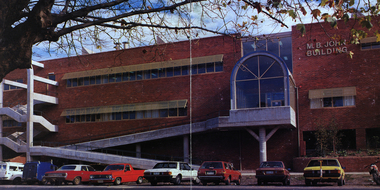
Image - Colour, Ballarat School of Mines M.B. John Building, Albert Street, Ballarat, 1987, 1987
... John Building (Building K), a three storey, face red brick, restrained Late Twentieth Century International styled building with an elongated, cuboid form (defined by the parapeted facades) that is offset by projecting exposed concrete framed, round‐arched entrance and stair wells on the east (Albert Street) elevation (the centrally located entrance breaking the brick façade with glazing). ...John Building (Building K), a three storey, face red brick, restrained Late Twentieth Century International styled building with an elongated, cuboid form (defined by the parapeted facades) that is offset by projecting exposed concrete framed, round‐arched entrance and stair wells on the east (Albert Street) elevation (the centrally located entrance breaking the brick façade with glazing). ...The M.B. John Trade–Art building (Albert Street front) of SMB was officially opened by the Hon. John Cain, Premier of Victoria, in the presence of Morgan B. John. Programs include 3 Dimensional Art, Painting & Decorating, and Engineering Trades. (SMB Institutional Plan 1989) The M.B. John Building (Building K), a three storey, face red brick, restrained Late Twentieth Century International styled building with an elongated, cuboid form (defined by the parapeted facades) that is offset by projecting exposed concrete framed, round‐arched entrance and stair wells on the east (Albert Street) elevation (the centrally located entrance breaking the brick façade with glazing). The facades are also characterised by banks of aluminium framed, horizontal ribbon windows, which wrap around the building corners. Metal shades project beyond the windows, while post‐supported bullnosed verandahs and hoods and projecting concrete stairs are other features. On the west elevation, the cuboid façade is punctuated by projecting curved concrete and glazed, elongated bays at first floor level. (David Rowe/Wendy Jacobs)Image of a multi-storey brick building on the Ballarat School of Mines campus. The building is known as the M.B. John Building.ballarat school of mines, m.b. john building, morgan b. john, albert street, m.b. john -
 Flagstaff Hill Maritime Museum and Village
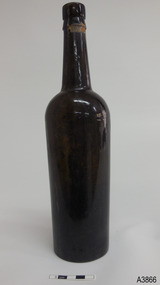
Container - Bottle, 1840s to 1910
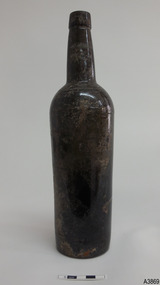
... style of bottle was generally used for storing and transporting wine and ale. Many bottles similar to this one have their bases embossed with “6 TO THE GALLON”. It is one of many artefacts recovered from unidentified shipwrecks along Victoria’s coast between the late 1960s and the early 1970s. It is now part of the John...style of bottle was generally used for storing and transporting wine and ale. Many bottles similar to this one have their bases embossed with “6 TO THE GALLON”. It is one of many artefacts recovered from unidentified shipwrecks along Victoria’s coast between the late 1960s and the early 1970s. It is now part of the John ...This handmade ‘gallon’ style of bottle was generally used for storing and transporting wine and ale. Many bottles similar to this one have their bases embossed with “6 TO THE GALLON”. It is one of many artefacts recovered from unidentified shipwrecks along Victoria’s coast between the late 1960s and the early 1970s. It is now part of the John Chance Collection. The capacity of this is one-sixth of a gallon (imperial measure), which is equal to 758 ml. (American bottles were often inscribed “5 TO THE GALLON”, which is one-fifth of an American gallon, equal to 757 ml.) Contemporary home brewers can purchase new ‘6 to gallon’ bottles that hold 750 ml. and are sold in cases of 36 bottles, which is equal to 6 gallons of wine. Glass was made thousands of years ago by heating together quartz-sand (Silica), lime and potash. Potash was obtained from burnt wood, but these days potash is mined. The natural sand had imperfections such as different forms of iron, resulting in ‘black’ glass, which was really dark green or dark amber colour. The ‘black’ glass was enhanced by residual carbon in the potash. Black glass is rarely used nowadays but most beer, wine, and liquors are still sold in dark coloured glass. Glass vessels were core-formed from around 1500 BC. An inner core with the vessel’s shape was formed around a rod using a porous material such as clay or dung. Molten glass was then modelled around the core and decorated. When the glass had cooled the vessel was immersed in water and the inner core became liquid and was washed out. Much more recently, bottlers were crafted by a glassblower using molten glass and a blow pipe together with other hand tools. Another method was using simple moulds, called dip moulds, that allowed the glass to be blown into the mould to form the base, then the glassblower would continue blowing free-form to shape the shoulders and neck. The bottle was then finished by applying a lip. These moulded bottles were more uniform in shape compared to the free-form bottles originally produced. English glassblowers in the mid-1800s were making some bottles with 2-piece and 3-piece moulds, some with a push-up style base, sometimes with embossing in the base as well. Improvements allowed the moulds to also have embossed and patterned sides, and straight sided shapes such as hexagons. Bottles made in full moulds usually displayed seam seams or lines. These process took skill and time, making the bottles valuable, so they were often recycled. By the early 20th century bottles were increasingly machine made, which greatly reduced the production time and cost. This bottle is historically significant as an example of a handmade, blown inscribed glass bottle manufactured in the mid-to-late 1800s for specific use as a liquor bottle with a set measurement of one-sixth of gallon. It is also historically significant as an example of liquor bottles imported into Colonial Victoria in the mid-to-late 1800s, giving a snapshot into history and social life that occurred during the early days of Victoria’s development, and the sea trade that visited the ports in those days. The bottle is also significant as one of a group of bottles recovered by John Chance, a diver in Victoria’s coastal waters in the late 1960s to early 1970s. Items that come from several wrecks have since been donated to the Flagstaff Hill Maritime Village’s museum collection of shipwreck artefacts by his family, illustrating this item’s level of historical value. Bottle, brown glass, handmade. Tall slim Gallon style liquor bottle. Applied, double collar lip; square upper with flared lower. Neck has seams and shoulder seam from 3-piece mould. Body with horizontal ripples tapers inwards to base. Push-up base with pontil mark and embossed inscription. Tape over wire around mouth. Cork remnants inside mouth. Embossed on base "6 TO THE GALLON"flagstaff hill, warrnambool, flagstaff hill maritime museum, maritime museum, shipwreck coast, flagstaff hill maritime village, great ocean road, shipwreck artefact, john chance, glass bottle, antique bottle, gallon bottle, 6 to the gallon bottle, handmade, dip mould, mouth blown, pontil mark, blown bottle, liquor bottle, ale bottle, double collar, 19th century bottle, collectable -
 Flagstaff Hill Maritime Museum and Village
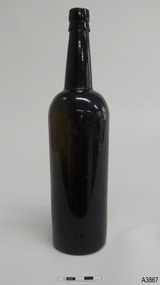
Container - Bottle, 1840s to 1910
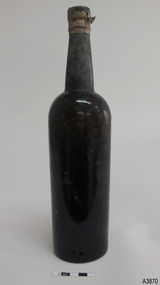
... style of bottle was generally used for storing and transporting wine and ale. Many bottles similar to this one have their bases embossed with “6 TO THE GALLON”. It is one of many artefacts recovered from unidentified shipwrecks along Victoria’s coast between the late 1960s and the early 1970s. It is now part of the John...style of bottle was generally used for storing and transporting wine and ale. Many bottles similar to this one have their bases embossed with “6 TO THE GALLON”. It is one of many artefacts recovered from unidentified shipwrecks along Victoria’s coast between the late 1960s and the early 1970s. It is now part of the John ...This handmade ‘gallon’ style of bottle was generally used for storing and transporting wine and ale. Many bottles similar to this one have their bases embossed with “6 TO THE GALLON”. It is one of many artefacts recovered from unidentified shipwrecks along Victoria’s coast between the late 1960s and the early 1970s. It is now part of the John Chance Collection. The capacity of this is one-sixth of a gallon (imperial measure), which is equal to 758 ml. (American bottles were often inscribed “5 TO THE GALLON”, which is one-fifth of an American gallon, equal to 757 ml.) Contemporary home brewers can purchase new ‘6 to gallon’ bottles that hold 750 ml. and are sold in cases of 36 bottles, which is equal to 6 gallons of wine. Glass was made thousands of years ago by heating together quartz-sand (Silica), lime and potash. Potash was obtained from burnt wood, but these days potash is mined. The natural sand had imperfections such as different forms of iron, resulting in ‘black’ glass, which was really dark green or dark amber colour. The ‘black’ glass was enhanced by residual carbon in the potash. Black glass is rarely used nowadays but most beer, wine, and liquors are still sold in dark coloured glass. Glass vessels were core-formed from around 1500 BC. An inner core with the vessel’s shape was formed around a rod using a porous material such as clay or dung. Molten glass was then modelled around the core and decorated. When the glass had cooled the vessel was immersed in water and the inner core became liquid and was washed out. Much more recently, bottlers were crafted by a glassblower using molten glass and a blow pipe together with other hand tools. Another method was using simple moulds, called dip moulds, that allowed the glass to be blown into the mould to form the base, then the glassblower would continue blowing free-form to shape the shoulders and neck. The bottle was then finished by applying a lip. These moulded bottles were more uniform in shape compared to the free-form bottles originally produced. English glassblowers in the mid-1800s were making some bottles with 2-piece and 3-piece moulds, some with a push-up style base, sometimes with embossing in the base as well. Improvements allowed the moulds to also have embossed and patterned sides, and straight sided shapes such as hexagons. Bottles made in full moulds usually displayed seam seams or lines. These process took skill and time, making the bottles valuable, so they were often recycled. By the early 20th century bottles were increasingly machine made, which greatly reduced the production time and cost. This bottle is historically significant as an example of a handmade, blown inscribed glass bottle manufactured in the mid-to-late 1800s for specific use as a liquor bottle with a set measurement of one-sixth of gallon. It is also historically significant as an example of liquor bottles imported into Colonial Victoria in the mid-to-late 1800s, giving a snapshot into history and social life that occurred during the early days of Victoria’s development, and the sea trade that visited the ports in those days. The bottle is also significant as one of a group of bottles recovered by John Chance, a diver in Victoria’s coastal waters in the late 1960s to early 1970s. Items that come from several wrecks have since been donated to the Flagstaff Hill Maritime Village’s museum collection of shipwreck artefacts by his family, illustrating this item’s level of historical value. Bottle, brown glass, handmade. Tall slim Gallon style liquor bottle. Applied double collar lip; square upper with flared lower. Push-up base with pontil mark and embossed inscription. Base is uneven, glass composition has imperfections.Embossed on base "6 TO THE GALLON"flagstaff hill, warrnambool, flagstaff hill maritime museum, maritime museum, shipwreck coast, flagstaff hill maritime village, great ocean road, shipwreck artefact, john chance, glass bottle, antique bottle, gallon bottle, 6 to the gallon bottle, handmade, dip mould, mouth blown, pontil mark, blown bottle, liquor bottle, ale bottle, double collar, 19th century bottle, collectable -
 Flagstaff Hill Maritime Museum and Village
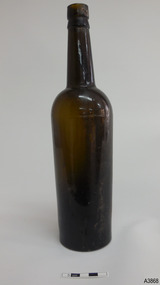
Container - Bottle, 1840s to 1910
... style of bottle was generally used for storing and transporting wine and ale. Many bottles similar to this one have their bases embossed with “6 TO THE GALLON”. It is one of many artefacts recovered from unidentified shipwrecks along Victoria’s coast between the late 1960s and the early 1970s. It is now part of the John...style of bottle was generally used for storing and transporting wine and ale. Many bottles similar to this one have their bases embossed with “6 TO THE GALLON”. It is one of many artefacts recovered from unidentified shipwrecks along Victoria’s coast between the late 1960s and the early 1970s. It is now part of the John ...This handmade ‘gallon’ style of bottle was generally used for storing and transporting wine and ale. Many bottles similar to this one have their bases embossed with “6 TO THE GALLON”. It is one of many artefacts recovered from unidentified shipwrecks along Victoria’s coast between the late 1960s and the early 1970s. It is now part of the John Chance Collection. The capacity of this is one-sixth of a gallon (imperial measure), which is equal to 758 ml. (American bottles were often inscribed “5 TO THE GALLON”, which is one-fifth of an American gallon, equal to 757 ml.) Contemporary home brewers can purchase new ‘6 to gallon’ bottles that hold 750 ml. and are sold in cases of 36 bottles, which is equal to 6 gallons of wine. Glass was made thousands of years ago by heating together quartz-sand (Silica), lime and potash. Potash was obtained from burnt wood, but these days potash is mined. The natural sand had imperfections such as different forms of iron, resulting in ‘black’ glass, which was really dark green or dark amber colour. The ‘black’ glass was enhanced by residual carbon in the potash. Black glass is rarely used nowadays but most beer, wine, and liquors are still sold in dark coloured glass. Glass vessels were core-formed from around 1500 BC. An inner core with the vessel’s shape was formed around a rod using a porous material such as clay or dung. Molten glass was then modelled around the core and decorated. When the glass had cooled the vessel was immersed in water and the inner core became liquid and was washed out. Much more recently, bottlers were crafted by a glassblower using molten glass and a blow pipe together with other hand tools. Another method was using simple moulds, called dip moulds, that allowed the glass to be blown into the mould to form the base, then the glassblower would continue blowing free-form to shape the shoulders and neck. The bottle was then finished by applying a lip. These moulded bottles were more uniform in shape compared to the free-form bottles originally produced. English glassblowers in the mid-1800s were making some bottles with 2-piece and 3-piece moulds, some with a push-up style base, sometimes with embossing in the base as well. Improvements allowed the moulds to also have embossed and patterned sides, and straight sided shapes such as hexagons. Bottles made in full moulds usually displayed seam seams or lines. These process took skill and time, making the bottles valuable, so they were often recycled. By the early 20th century bottles were increasingly machine made, which greatly reduced the production time and cost. This bottle is historically significant as an example of a handmade, blown inscribed glass bottle manufactured in the mid-to-late 1800s for specific use as a liquor bottle with a set measurement of one-sixth of gallon. It is also historically significant as an example of liquor bottles imported into Colonial Victoria in the mid-to-late 1800s, giving a snapshot into history and social life that occurred during the early days of Victoria’s development, and the sea trade that visited the ports in those days. The bottle is also significant as one of a group of bottles recovered by John Chance, a diver in Victoria’s coastal waters in the late 1960s to early 1970s. Items that come from several wrecks have since been donated to the Flagstaff Hill Maritime Village’s museum collection of shipwreck artefacts by his family, illustrating this item’s level of historical value. Bottle, brown glass, handmade. Tall slim Gallon style liquor bottle. Applied double collar lip; square upper and flared lower. Neck has seams and shoulder seam from 3-piece mould. Body tapers towards base. Push-up base with pontil mark and embossed inscription. Base is uneven. Mouth has remnants of the seal in it and tape remnants around its outside. Embossed on base "6 TO THE GALLON"flagstaff hill, warrnambool, flagstaff hill maritime museum, maritime museum, shipwreck coast, flagstaff hill maritime village, great ocean road, shipwreck artefact, john chance, glass bottle, antique bottle, gallon bottle, 6 to the gallon bottle, handmade, dip mould, mouth blown, pontil mark, blown bottle, liquor bottle, ale bottle, double collar, 19th century bottle, collectable -
 Flagstaff Hill Maritime Museum and Village
Container - Bottle, 1840s to 1910
... style of bottle was generally used for storing and transporting wine and ale. Many bottles similar to this one have their bases embossed with “6 TO THE GALLON”. It is one of many artefacts recovered from unidentified shipwrecks along Victoria’s coast between the late 1960s and the early 1970s. It is now part of the John...style of bottle was generally used for storing and transporting wine and ale. Many bottles similar to this one have their bases embossed with “6 TO THE GALLON”. It is one of many artefacts recovered from unidentified shipwrecks along Victoria’s coast between the late 1960s and the early 1970s. It is now part of the John ...This handmade ‘gallon’ style of bottle was generally used for storing and transporting wine and ale. Many bottles similar to this one have their bases embossed with “6 TO THE GALLON”. It is one of many artefacts recovered from unidentified shipwrecks along Victoria’s coast between the late 1960s and the early 1970s. It is now part of the John Chance Collection. The capacity of this is one-sixth of a gallon (imperial measure), which is equal to 758 ml. (American bottles were often inscribed “5 TO THE GALLON”, which is one-fifth of an American gallon, equal to 757 ml.) Contemporary home brewers can purchase new ‘6 to gallon’ bottles that hold 750 ml. and are sold in cases of 36 bottles, which is equal to 6 gallons of wine. Glass was made thousands of years ago by heating together quartz-sand (Silica), lime and potash. Potash was obtained from burnt wood, but these days potash is mined. The natural sand had imperfections such as different forms of iron, resulting in ‘black’ glass, which was really dark green or dark amber colour. The ‘black’ glass was enhanced by residual carbon in the potash. Black glass is rarely used nowadays but most beer, wine, and liquors are still sold in dark coloured glass. Glass vessels were core-formed from around 1500 BC. An inner core with the vessel’s shape was formed around a rod using a porous material such as clay or dung. Molten glass was then modelled around the core and decorated. When the glass had cooled the vessel was immersed in water and the inner core became liquid and was washed out. Much more recently, bottlers were crafted by a glassblower using molten glass and a blow pipe together with other hand tools. Another method was using simple moulds, called dip moulds, that allowed the glass to be blown into the mould to form the base, then the glassblower would continue blowing free-form to shape the shoulders and neck. The bottle was then finished by applying a lip. These moulded bottles were more uniform in shape compared to the free-form bottles originally produced. English glassblowers in the mid-1800s were making some bottles with 2-piece and 3-piece moulds, some with a push-up style base, sometimes with embossing in the base as well. Improvements allowed the moulds to also have embossed and patterned sides, and straight sided shapes such as hexagons. Bottles made in full moulds usually displayed seam seams or lines. These process took skill and time, making the bottles valuable, so they were often recycled. By the early 20th century bottles were increasingly machine made, which greatly reduced the production time and cost. This bottle is historically significant as an example of a handmade, blown inscribed glass bottle manufactured in the mid-to-late 1800s for specific use as a liquor bottle. It is also historically significant as an example of liquor bottles imported into Colonial Victoria in the mid-to-late 1800s, giving a snapshot into history and social life that occurred during the early days of Victoria’s development, and the sea trade that visited the ports in those days. The bottle is also significant as one of a group of bottles recovered by John Chance, a diver in Victoria’s coastal waters in the late 1960s to early 1970s. Items that come from several wrecks have since been donated to the Flagstaff Hill Maritime Village’s museum collection of shipwreck artefacts by his family, illustrating this item’s level of historical value. Bottle, olive green glass, handmade. Tall slim, Gallon style liquor bottle. Applied double collar lip; square upper with flared lower. Neck is slightly bulged and there is a mould seam where shoulder joins base. Body tapers inward to base. Uneven base with deep push-up centre with small pontil mark. Scratches and imperfections in glass. Also encrustations on surface. flagstaff hill, warrnambool, flagstaff hill maritime museum, maritime museum, shipwreck coast, flagstaff hill maritime village, great ocean road, shipwreck artefact, john chance, glass bottle, antique bottle, gallon bottle, handmade, dip mould, mouth blown, pontil mark, blown bottle, liquor bottle, ale bottle, double collar, 19th century bottle, collectable -
 Flagstaff Hill Maritime Museum and Village
Container - Bottle, 1840s to 1910
... style of bottle was generally used for storing and transporting wine and ale. Many bottles similar to this one have their bases embossed with “6 TO THE GALLON”. It is one of many artefacts recovered from unidentified shipwrecks along Victoria’s coast between the late 1960s and the early 1970s. It is now part of the John...style of bottle was generally used for storing and transporting wine and ale. Many bottles similar to this one have their bases embossed with “6 TO THE GALLON”. It is one of many artefacts recovered from unidentified shipwrecks along Victoria’s coast between the late 1960s and the early 1970s. It is now part of the John ...This handmade ‘gallon’ style of bottle was generally used for storing and transporting wine and ale. Many bottles similar to this one have their bases embossed with “6 TO THE GALLON”. It is one of many artefacts recovered from unidentified shipwrecks along Victoria’s coast between the late 1960s and the early 1970s. It is now part of the John Chance Collection. The capacity of this is one-sixth of a gallon (imperial measure), which is equal to 758 ml. (American bottles were often inscribed “5 TO THE GALLON”, which is one-fifth of an American gallon, equal to 757 ml.) Contemporary home brewers can purchase new ‘6 to gallon’ bottles that hold 750 ml. and are sold in cases of 36 bottles, which is equal to 6 gallons of wine. Glass was made thousands of years ago by heating together quartz-sand (Silica), lime and potash. Potash was obtained from burnt wood, but these days potash is mined. The natural sand had imperfections such as different forms of iron, resulting in ‘black’ glass, which was really dark green or dark amber colour. The ‘black’ glass was enhanced by residual carbon in the potash. Black glass is rarely used nowadays but most beer, wine, and liquors are still sold in dark coloured glass. Glass vessels were core-formed from around 1500 BC. An inner core with the vessel’s shape was formed around a rod using a porous material such as clay or dung. Molten glass was then modelled around the core and decorated. When the glass had cooled the vessel was immersed in water and the inner core became liquid and was washed out. Much more recently, bottlers were crafted by a glassblower using molten glass and a blow pipe together with other hand tools. Another method was using simple moulds, called dip moulds, that allowed the glass to be blown into the mould to form the base, then the glassblower would continue blowing free-form to shape the shoulders and neck. The bottle was then finished by applying a lip. These moulded bottles were more uniform in shape compared to the free-form bottles originally produced. English glassblowers in the mid-1800s were making some bottles with 2-piece and 3-piece moulds, some with a push-up style base, sometimes with embossing in the base as well. Improvements allowed the moulds to also have embossed and patterned sides, and straight sided shapes such as hexagons. Bottles made in full moulds usually displayed seam seams or lines. These process took skill and time, making the bottles valuable, so they were often recycled. By the early 20th century bottles were increasingly machine made, which greatly reduced the production time and cost. This bottle is historically significant as an example of a handmade, blown inscribed glass bottle manufactured in the mid-to-late 1800s for specific use as a liquor bottle with a set measurement of one-sixth of gallon. It is also historically significant as an example of liquor bottles imported into Colonial Victoria in the mid-to-late 1800s, giving a snapshot into history and social life that occurred during the early days of Victoria’s development, and the sea trade that visited the ports in those days. The bottle is also significant as one of a group of bottles recovered by John Chance, a diver in Victoria’s coastal waters in the late 1960s to early 1970s. Items that come from several wrecks have since been donated to the Flagstaff Hill Maritime Village’s museum collection of shipwreck artefacts by his family, illustrating this item’s level of historical value. Bottle, olive green glass, handmade. Tall slim Gallon style liquor bottle. Applied double collar lip; square upper and flared lower. Mouth has remnants of tape and wire seal. Mould seam around shoulder. Body tapers slightly inward to the base. Push-up base has pontil mark and is embossed in large letters. Base is uneven. Embossed on base "6 TO THE GALLON"flagstaff hill, warrnambool, flagstaff hill maritime museum, maritime museum, shipwreck coast, flagstaff hill maritime village, great ocean road, shipwreck artefact, john chance, glass bottle, antique bottle, gallon bottle, 6 to the gallon bottle, handmade, dip mould, mouth blown, pontil mark, blown bottle, liquor bottle, ale bottle, double collar, 19th century bottle, collectable -
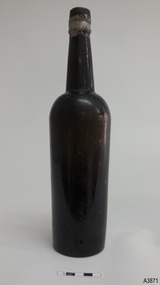 Flagstaff Hill Maritime Museum and Village
Container - Bottle, 1840s to 1910
... style of bottle was generally used for storing and transporting wine and ale. Many bottles similar to this one have their bases embossed with “6 TO THE GALLON”. However, this bottle is rare, in that the base has been embossed then over-embossed with the same text, letters overlapping. It is one of many artefacts recovered from unidentified shipwrecks along Victoria’s coast between the late 1960s and the early 1970s. It is now part of the John...Items that come from several wrecks have since been donated to the Flagstaff Hill Maritime Village’s museum collection of shipwreck artefacts by his family, illustrating this item’s level of historical value. flagstaff hill warrnambool flagstaff hill maritime museum maritime museum shipwreck coast flagstaff hill maritime village great ocean road shipwreck artefact john chance glass bottle antique bottle gallon bottle 6 to the gallon bottle handmade dip mould mouth blown pontil mark blown bottle liquor bottle ale bottle double collar 19th century bottle collectable over embossed rare Embossed on base "6 TO THE GALLON", then over-embossed with the same "6 TO THE GALLON" Bottle, over embossed, brown glass, handmade, rare. Tall slim Gallon style ...This handmade ‘gallon’ style of bottle was generally used for storing and transporting wine and ale. Many bottles similar to this one have their bases embossed with “6 TO THE GALLON”. However, this bottle is rare, in that the base has been embossed then over-embossed with the same text, letters overlapping. It is one of many artefacts recovered from unidentified shipwrecks along Victoria’s coast between the late 1960s and the early 1970s. It is now part of the John Chance Collection. The capacity of this is one-sixth of a gallon (imperial measure), which is equal to 758 ml. (American bottles were often inscribed “5 TO THE GALLON”, which is one-fifth of an American gallon, equal to 757 ml.) Contemporary home brewers can purchase new ‘6 to gallon’ bottles that hold 750 ml. and are sold in cases of 36 bottles, which is equal to 6 gallons of wine. Glass was made thousands of years ago by heating together quartz-sand (Silica), lime and potash. Potash was obtained from burnt wood, but these days potash is mined. The natural sand had imperfections such as different forms of iron, resulting in ‘black’ glass, which was really dark green or dark amber colour. The ‘black’ glass was enhanced by residual carbon in the potash. Black glass is rarely used nowadays but most beer, wine, and liquors are still sold in dark coloured glass. Glass vessels were core-formed from around 1500 BC. An inner core with the vessel’s shape was formed around a rod using a porous material such as clay or dung. Molten glass was then modelled around the core and decorated. When the glass had cooled the vessel was immersed in water and the inner core became liquid and was washed out. Much more recently, bottlers were crafted by a glassblower using molten glass and a blow pipe together with other hand tools. Another method was using simple moulds, called dip moulds, that allowed the glass to be blown into the mould to form the base, then the glassblower would continue blowing free-form to shape the shoulders and neck. The bottle was then finished by applying a lip. These moulded bottles were more uniform in shape compared to the free-form bottles originally produced. English glassblowers in the mid-1800s were making some bottles with 2-piece and 3-piece moulds, some with a push-up style base, sometimes with embossing in the base as well. Improvements allowed the moulds to also have embossed and patterned sides, and straight sided shapes such as hexagons. Bottles made in full moulds usually displayed seam seams or lines. These process took skill and time, making the bottles valuable, so they were often recycled. By the early 20th century bottles were increasingly machine made, which greatly reduced the production time and cost. This bottle is a rare find, in that the base has been over-embossed with the same lettering, letters overlapping one another. This bottle is historically significant as an example of a handmade, blown inscribed glass bottle manufactured in the mid-to-late 1800s for specific use as a liquor bottle with a set measurement of one-sixth of gallon. It is also historically significant as an example of liquor bottles imported into Colonial Victoria in the mid-to-late 1800s, giving a snapshot into history and social life that occurred during the early days of Victoria’s development, and the sea trade that visited the ports in those days. The bottle is also significant as one of a group of bottles recovered by John Chance, a diver in Victoria’s coastal waters in the late 1960s to early 1970s. Items that come from several wrecks have since been donated to the Flagstaff Hill Maritime Village’s museum collection of shipwreck artefacts by his family, illustrating this item’s level of historical value. Bottle, over embossed, brown glass, handmade, rare. Tall slim Gallon style liquor bottle. Applied double collar lip; square upper and flared lower. Mouth has sealing tape remnants around top. Mould seam around shoulder. Body tapers inwards to push-up base. Top edge of lip has application faults. There is also a rectangular indent in the upper edge of lip. Base is embossed and over embossed, with the letters overlapping each other. Embossed on base "6 TO THE GALLON", then over-embossed with the same "6 TO THE GALLON"flagstaff hill, warrnambool, flagstaff hill maritime museum, maritime museum, shipwreck coast, flagstaff hill maritime village, great ocean road, shipwreck artefact, john chance, glass bottle, antique bottle, gallon bottle, 6 to the gallon bottle, handmade, dip mould, mouth blown, pontil mark, blown bottle, liquor bottle, ale bottle, double collar, 19th century bottle, collectable, over embossed, rare -
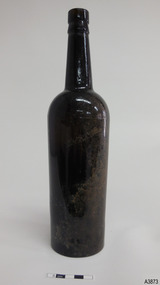 Flagstaff Hill Maritime Museum and Village
Container - Bottle, 1840s to 1910
... style of bottle was generally used for storing and transporting wine and ale. Many bottles similar to this one have their bases embossed with “6 TO THE GALLON”. It is one of many artefacts recovered from an unidentified shipwrecks along Victoria’s coast between the late 1960s and the early 1970s. It is now part of the John...style of bottle was generally used for storing and transporting wine and ale. Many bottles similar to this one have their bases embossed with “6 TO THE GALLON”. It is one of many artefacts recovered from an unidentified shipwrecks along Victoria’s coast between the late 1960s and the early 1970s. It is now part of the John ...This handmade ‘gallon’ style of bottle was generally used for storing and transporting wine and ale. Many bottles similar to this one have their bases embossed with “6 TO THE GALLON”. It is one of many artefacts recovered from an unidentified shipwrecks along Victoria’s coast between the late 1960s and the early 1970s. It is now part of the John Chance Collection. The capacity of this is one-sixth of a gallon (imperial measure), which is equal to 758 ml. (American bottles were often inscribed “5 TO THE GALLON”, which is one-fifth of an American gallon, equal to 757 ml.) Contemporary home brewers can purchase new ‘6 to gallon’ bottles that hold 750 ml. and are sold in cases of 36 bottles, which is equal to 6 gallons of wine. Glass was made thousands of years ago by heating together quartz-sand (Silica), lime and potash. Potash was obtained from burnt wood, but these days potash is mined. The natural sand had imperfections such as different forms of iron, resulting in ‘black’ glass, which was really dark green or dark amber colour. The ‘black’ glass was enhanced by residual carbon in the potash. Black glass is rarely used nowadays but most beer, wine, and liquors are still sold in dark coloured glass. Glass vessels were core-formed from around 1500 BC. An inner core with the vessel’s shape was formed around a rod using a porous material such as clay or dung. Molten glass was then modelled around the core and decorated. When the glass had cooled the vessel was immersed in water and the inner core became liquid and was washed out. Much more recently, bottlers were crafted by a glassblower using molten glass and a blow pipe together with other hand tools. Another method was using simple moulds, called dip moulds, that allowed the glass to be blown into the mould to form the base, then the glassblower would continue blowing free-form to shape the shoulders and neck. The bottle was then finished by applying a lip. These moulded bottles were more uniform in shape compared to the free-form bottles originally produced. English glassblowers in the mid-1800s were making some bottles with 2-piece and 3-piece moulds, some with a push-up style base, sometimes with embossing in the base as well. Improvements allowed the moulds to also have embossed and patterned sides, and straight sided shapes such as hexagons. Bottles made in full moulds usually displayed seam seams or lines. These process took skill and time, making the bottles valuable, so they were often recycled. By the early 20th century bottles were increasingly machine made, which greatly reduced the production time and cost. This bottle is historically significant as an example of a handmade, blown inscribed glass bottle manufactured in the mid-to-late 1800s for specific use as a liquor bottle with a set measurement of one-sixth of gallon. It is also historically significant as an example of liquor bottles imported into Colonial Victoria in the mid-to-late 1800s, giving a snapshot into history and social life that occurred during the early days of Victoria’s development, and the sea trade that visited the ports in those days. The bottle is also significant as one of a group of bottles recovered by John Chance, a diver in Victoria’s coastal waters in the late 1960s to early 1970s. Items that come from several wrecks have since been donated to the Flagstaff Hill Maritime Village’s museum collection of shipwreck artefacts by his family, illustrating this item’s level of historical value. Bottle, brown glass, Tall slim gallon style. Applied double collar lip; upper is straight, lower is flared. Lip has bumps around the top. Neck has slight taper towards shoulder, which has a shoulder seam from the mould. Body tapers inwards towards base. Push up base has a pontil mark. Base is embossed.Embossed on base "6 TO THE GALLON"flagstaff hill, warrnambool, flagstaff hill maritime museum, maritime museum, shipwreck coast, flagstaff hill maritime village, great ocean road, shipwreck artefact, john chance, glass bottle, antique bottle, gallon bottle, 6 to the gallon bottle, handmade, dip mould, mouth blown, pontil mark, blown bottle, liquor bottle, ale bottle, double collar, 19th century bottle, collectable -
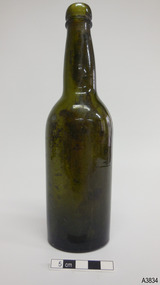 Flagstaff Hill Maritime Museum and Village
Container - Bottle, 1840s to 1870s
... Items that come from several wrecks have since been donated to the Flagstaff Hill Maritime Village’s museum collection by his family, illustrating this item’s level of historical value. flagstaff hill warrnambool flagstaff hill maritime museum maritime museum shipwreck coast flagstaff hill maritime village great ocean road shipwreck artefact john chance glass bottle antique bottle handmade dip mould mouth blown pontil mark 19th century bottle collectable soda bottle mineral water bottle green glass blob finish push-up base Bottle; green glass, soda or mineral water style, handmade. ...This small green bottle has been handmade by a glassblower and is the typical shape of a carbonated soda or mineral water bottle. It was made from 1840s-1870s. The bottle was found in the coastal waters of Victoria about 100 years from when it was made. It is part of the John Chance Collection. Glassblowers made bottles like this one by blowing air through a long pipe and into molten glass at the end of it. The shape of the glass would be blown out to fit into the shape of the cylindrical dip mould. Once it set, the glass was removed from the mould and the glassblower would continue using the pipe to create the neck and another ponty tool to push up and form the base. The bottle would be cracked off the end of the glassblower’s pipe and a blob of molten glass would be wrapped around the top of the neck and shaped to finish the lip of the bottle. The seal was usually a cork, held in place with a ball-wire fitting attached between the upper and lower parts of the neck finish. This style of handmade bottles usually had thick glass so that it could be heat-sterilised, then re-filled. The bottles would often have horizontal bubbles in the applied finish, caused by twisting the glass, and vertical bubbles and diagonal lines in the body from it being blown, and a pontil mark in the base where the ponty tool had been attached. Although the bottle is not linked to a particular shipwreck, it is recognised as being historically significant as an example of bottles imported for use in Colonial Victoria in the mid-to-late 1800s. The bottle is also significant as it was recovered by John Chance, a diver in Victoria’s coastal waters in the late 1960s to early 1970s. Items that come from several wrecks have since been donated to the Flagstaff Hill Maritime Village’s museum collection by his family, illustrating this item’s level of historical value. Bottle; green glass, soda or mineral water style, handmade. Double ring collar blob finish on neck; upper is wide and rounded, lower is a thin ring. Diagonal lines in glass on neck, low shoulder mould seam, rippled texture around body. Push-up base with pontil mark, rectangular impression in heel. Uneven base. Sediment on inside surfaces.flagstaff hill, warrnambool, flagstaff hill maritime museum, maritime museum, shipwreck coast, flagstaff hill maritime village, great ocean road, shipwreck artefact, john chance, glass bottle, antique bottle, handmade, dip mould, mouth blown, pontil mark, 19th century bottle, collectable, soda bottle, mineral water bottle, green glass, blob finish, push-up base
