
Showing 6 items matching "jonathan swift"
-
 Flagstaff Hill Maritime Museum and Village
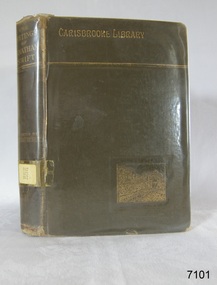
Book, The Tale of a Tub and Other Works
... ...jonathan swift...The Tale of a Tub and Other Works Author: Jonathan Swift Publisher: George Routledge & Sons Date: 1889 ...The Warrnambool Mechanics' Institute’s publication collection is of both local and state significance. warrnambool shipwrecked-coast flagstaff-hill flagstaff-hill-maritime-museum maritime-museum shipwreck-coast flagstaff-hill-maritime-village shipwrecked-artefact book the tale of a tub and other works jonathan swift The label on the spine with typed text PAT 823 SWI Pastedown front endpaper has a sticker from Warrnambool Mechanics Institute and Free Library Front loose endpaper has a sticker from Corangamite Regional Library Service Front loose endpaper has a stamp from Corangamite Regional Library Service The Tale of a Tub and Other Works Author: Jonathan Swift Publisher: George Routledge & Sons Date: 1889 The Tale of a Tub and Other Works Book ...Pattison Collection This item is from the ‘Pattison Collection’, a collection of books and records that was originally owned by the Warrnambool Mechanics’ Institute, which was founded in Warrnambool in 1853. By 1886 the Warrnambool Mechanics’ Institute (WMI) had grown to have a Library, Museum and Fine Arts Gallery, with a collection of “… choice productions of art and valuable specimens in almost every branch and many wonderful national curiosities are now to be seen there, including historic relics of the town and district.” It later included a School of Design. Although it was very well patronised, the lack of financial support led the WMI in 1911 to ask the City Council to take it over. In 1935 Ralph Pattison was appointed as City Librarian to establish and organise the Warrnambool Library as it was then called. When the WMI building was pulled down in 1963 a new civic building was erected on the site and the new Warrnambool Library, on behalf of the City Council, took over all the holdings of the WMI. At this time some of the items were separated and identified as the ‘Pattison Collection’, named after Ralph Pattison. Eventually, the components of the WMI were distributed from the Warrnambool Library to various places, including the Art Gallery, Historical Society and Flagstaff Hill. Later some were even distributed to other regional branches of Corangamite Regional Library and passed to and fro. It is difficult now to trace just where all of the items have ended up. The books at Flagstaff Hill Maritime Village generally display stamps and markings from Pattison as well as a variety of other institutions including the Mechanics’ Institute itself. RALPH ERIC PATTISON Ralph Eric Pattison was born in Rockhampton, Queensland, in 1891. He married Maude Swan from Warrnambool in 1920 and they set up home in Warrnambool. In 1935 Pattison accepted a position as City Librarian for the Warrnambool City Council. His huge challenge was to make a functional library within two rooms of the Mechanics’ Institute. He tirelessly cleaned, cleared and sorted a disarrayed collection of old books, jars of preserved specimens and other items reserved for exhibition in the city’s museum. He developed and updated the library with a wide variety of books for all tastes, including reference books for students; a difficult task to fulfil during the years following the Depression. He converted all of the lower areas of the building into a library, reference room and reading room for members and the public. The books were sorted and stored using a cataloguing and card index system that he had developed himself. He also prepared the upper floor of the building and established the Art Gallery and later the Museum, a place to exhibit the many old relics that had been stored for years for this purpose. One of the treasures he found was a beautiful ancient clock, which he repaired, restored and enjoyed using in his office during the years of his service there. Ralph Pattison was described as “a meticulous gentleman whose punctuality, floorless courtesy and distinctive neat dress were hallmarks of his character, and ‘his’ clock controlled his daily routine and his opening and closing of the library’s large heavy doors to the minute.” Pattison took leave from 1942 to 1945 to serve in the Royal Australian Navy, Volunteer Reserve as Lieutenant. A few years later he converted one of the Museum’s rooms into a Children’s Library, stocking it with suitable books for the younger generation. This was an instant success. In the 1950’s he had the honour of being appointed to the Victorian Library Board and received more inspiration from the monthly conferences in Melbourne. He was sadly retired in 1959 after over 23 years of service, due to the fact that he had gone over the working age of council officers. However, he continued to take a very keen interest in the continual development of the Library until his death in 1969. The Pattison Collection, along with other items at Flagstaff Hill Maritime Village, was originally part of the Warrnambool Mechanics' Institute’s collection. The Warrnambool Mechanics’ Institute Collection is primarily significant in its totality, rather than for the individual objects it contains. Its contents are highly representative of the development of Mechanics' Institute libraries across Australia, particularly Victoria. A diversity of publications and themes has been amassed, and these provide clues to our understanding of the nature of and changes in the reading habits of Victorians from the 1850s to the middle of the 20th century. The collection also highlights the Warrnambool community’s commitment to the Mechanics’ Institute, reading, literacy and learning in the regions, and proves that access to knowledge was not impeded by distance. These items help to provide a more complete picture of our community’s ideals and aspirations. The Warrnambool Mechanics Institute book collection has historical and social significance for its strong association with the Mechanics Institute movement and the important role it played in the intellectual, cultural and social development of people throughout the latter part of the nineteenth century and the early twentieth century. The collection of books is a rare example of an early lending library and its significance is enhanced by the survival of an original collection of many volumes. The Warrnambool Mechanics' Institute’s publication collection is of both local and state significance. The Tale of a Tub and Other Works Author: Jonathan Swift Publisher: George Routledge & Sons Date: 1889 The label on the spine with typed text PAT 823 SWI Pastedown front endpaper has a sticker from Warrnambool Mechanics Institute and Free Library Front loose endpaper has a sticker from Corangamite Regional Library Service Front loose endpaper has a stamp from Corangamite Regional Library Service warrnambool, shipwrecked-coast, flagstaff-hill, flagstaff-hill-maritime-museum, maritime-museum, shipwreck-coast, flagstaff-hill-maritime-village, shipwrecked-artefact, book, the tale of a tub and other works, jonathan swift -
 Greensborough Historical Society
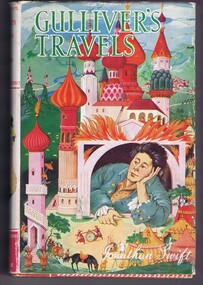
Book, Jonathan Swift, Gulliver's travels
... Jonathan Swift...Gulliver's travels Book Book Jonathan Swift Blackie and Son ...182 p.fictionst katherine's church st helena, dawn petts -
 Robin Boyd Foundation
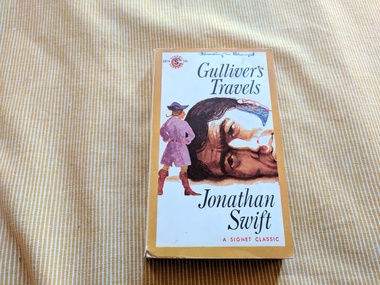
Book, Jonathan Swift, Gulliver's Travels, 1962
... Jonathan Swift...Irish literature Walsh St library Penleigh Boyd front cover/front inside Softcover Gulliver's Travels Book Jonathan Swift The New American Library ...SoftcoverPenleigh Boyd front cover/front insideirish literature, walsh st library -
 Mrs Aeneas Gunn Memorial Library
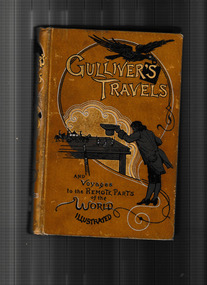
Book - Gullivers travels into several remote nations of the world, Ward Lock and Bowden, ????
... ...Jonathan Swift...Book Gullivers travels into several remote nations of the world Ward Lock and Bowden Jonathan Swift ...Gulliver's Travels by Jonathan Swift is a witty and insightful satirical novel recounts the history of Lemuel Gulliver, "First a Surgeon, and then a Captain of several Ships". In his travels Gulliver visits the Land of Lilliput, where he towers over the local inhabitants, the land of Brobdingnag where he is much smaller than the citizens, the floating island of Laputa, infested with fanatical scientists who in their obsession with reason behave with no sense at all and finally to the land of the brutish Yahoos who look to all intents and purposes like humans and are derided by the intelligent horse people. John Gay said in a 1726 letter to Swift that "it is universally read, from the cabinet council to the nursery"Ill, p.361.fictionGulliver's Travels by Jonathan Swift is a witty and insightful satirical novel recounts the history of Lemuel Gulliver, "First a Surgeon, and then a Captain of several Ships". In his travels Gulliver visits the Land of Lilliput, where he towers over the local inhabitants, the land of Brobdingnag where he is much smaller than the citizens, the floating island of Laputa, infested with fanatical scientists who in their obsession with reason behave with no sense at all and finally to the land of the brutish Yahoos who look to all intents and purposes like humans and are derided by the intelligent horse people. John Gay said in a 1726 letter to Swift that "it is universally read, from the cabinet council to the nursery" voyages - imaginary, literary fiction -
 Phillip Island and District Historical Society Inc.
Book, SWIFT, Jonathan, Travels into several remote nations of the world / Lemuel Gulliver ; pref. Henry Craik ; illus. C.E. Brock, 1894
... SWIFT, Jonathan...C.E. Brock Book SWIFT, Jonathan Macmillan ...Labelled 'Himmer Bequest'. Stamped 'Cowes Public Library'. -
 Flagstaff Hill Maritime Museum and Village
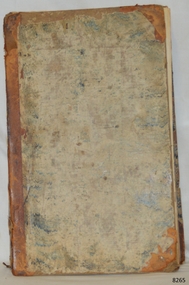
Book - Reference Travel/History/Cartography, Mr Salmon (Thomas Salmon) et al, Modern History or, the Present State of All Nations. Vol III, 1746
... Known for his crisp line work, distinctive decorative vignettes, and high detail, Moll moved in prominent intellectual circles, often frequenting coffee houses with Daniel Defoe, Jonathan Swift, and pirate-explorer William Dampier. ...Known for his crisp line work, distinctive decorative vignettes, and high detail, Moll moved in prominent intellectual circles, often frequenting coffee houses with Daniel Defoe, Jonathan Swift, and pirate-explorer William Dampier. ...This 1746 3rd Edition of Thomas Salmon’s Modern History is a fantastic slice of Enlightenment era geography and publishing history. It sits at a fascinating intersection of early modern travel literature, top tier cartography, and the rise of one of London's most famous publishing houses. Thomas Salmon’s Modern History: or, the Present State of All Nations was an ambitious encyclopedic project. Rather than focusing strictly on dynastic timelines, Salmon took a modern geographical and ethnographic approach. For each region covered, he detailed its geography and climate, along with its natural resources, plants, animals, and minerals. Culture and society were covered by focusing on local habits, dress, religious rites, laws, customs, and architecture. Economy and trade were also detailed, including the arts, sciences, husbandry, and commercial manufactures.Hard cover book,Modern History: or, the Present State of All Nations Vol III Author: Mr Salmon (Thomas Salmon) Illustrator: Herman Moll Publisher: T Longman and T Shewell, London. Date: 1746 (MDCCXLVI), 3rd Edition Further Information: Set of Three Volumes. Hard covered book has reinforcing on the spine and corners. The cover is very well worn and has remnants of a coloured design. The fly page is printed in red and black ink and has a long description of the contents. Inside the cover is printed a Coat of Arms, there is a stocker on the inside cover. non-fictionThis 1746 3rd Edition of Thomas Salmon’s Modern History is a fantastic slice of Enlightenment era geography and publishing history. It sits at a fascinating intersection of early modern travel literature, top tier cartography, and the rise of one of London's most famous publishing houses. Thomas Salmon’s Modern History: or, the Present State of All Nations was an ambitious encyclopedic project. Rather than focusing strictly on dynastic timelines, Salmon took a modern geographical and ethnographic approach. For each region covered, he detailed its geography and climate, along with its natural resources, plants, animals, and minerals. Culture and society were covered by focusing on local habits, dress, religious rites, laws, customs, and architecture. Economy and trade were also detailed, including the arts, sciences, husbandry, and commercial manufactures.flagstaff hill, flagstaff hill maritime museum and village, warrnambool, maritime museum, maritime village, great ocean road, shipwreck coast, pattison collection, ralph eric pattison, warrnambool mechanics’ institute, mechanics’ institute library, warrnambool library, free library, corangamite regional library service, mr salmon, thomas salmon, 18th century, 1746, history, geography, social studies, culture, maps, modern history, present state of all nations vol iii, herman moll, t longman and t shewell, social history, cartography
