
Showing 8 items matching "juggernaut"
-
 Lilydale RSL Sub Branch
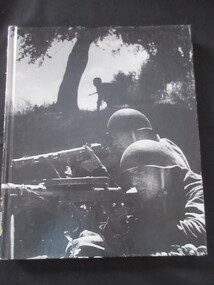
Book, Earl F. Ziemke, World War 11 - The Soviet Juggernaut, 1980
... World War 11 - The Soviet Juggernaut...Book World War 11 - The Soviet Juggernaut Book Book Earl F. Ziemke Time-Life Books ...Book -
 4th/19th Prince of Wales's Light Horse Regiment Unit History Room
Magazine Publication, W J Morgans, Parade, March 1977
... A soft covered publication covering a variety of subjects, including "The Juggernauts" - the story of the development of the tank, "First Victory" - Cambrai proving ground of tank warfare, "Makeshift Army" - the story of Churchill's chocolate soldiers and the defence of Antwerp in 1914, and an article about General Lettow-Vorbeck in Africa....magazine publication Parade A soft covered publication covering a variety of subjects, including "The Juggernauts" - the story of the development of the tank, "First Victory" - Cambrai proving ground of tank warfare, "Makeshift Army" - the story of Churchill's chocolate soldiers and the defence of Antwerp in 1914, and an article about General Lettow-Vorbeck in Africa. ...A soft covered publication covering a variety of subjects, including "The Juggernauts" - the story of the development of the tank, "First Victory" - Cambrai proving ground of tank warfare, "Makeshift Army" - the story of Churchill's chocolate soldiers and the defence of Antwerp in 1914, and an article about General Lettow-Vorbeck in Africa.magazine publication, parade, -
 Kiewa Valley Historical Society
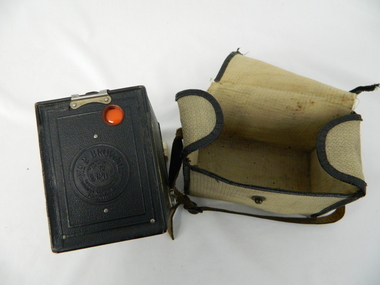
Bag Camera, circa 1920s
... It was well before the post World War II explosion of the Asian manufacturing juggernaut....It was well before the post World War II explosion of the Asian manufacturing juggernaut. This item shows one of the most popular avenues of not only bringing new "modern" age equipment into the Kiewa Valley but also providing the local market with actual overseas inexpensive merchandise. ...This item was manufactured in a period where the cheapest containers for portable equipment was canvas. The market place for cheap cameras was still restricted to European, England and its colonies. It was well before the post World War II explosion of the Asian manufacturing juggernaut.This item shows one of the most popular avenues of not only bringing new "modern" age equipment into the Kiewa Valley but also providing the local market with actual overseas inexpensive merchandise. It was a time when the new European fashion and "new age" equipment took years to permeate into regional Australia. The world, through Australia eyes, was still a very large planet and supply of "modern" lifestyle equipment emphasised the geographic isolation of Australia. Post World War II emigrants and an increasing flow of tourists to Australia provided the contact needed by rural settlements to open up not only their social contacts but lifestyle activities.Canvas, yellow, cream in color and with a weave pattern on the external side. It has stitched brown laminated fabric boarders containing all ends and corners. A flap opening top fastened on one side by a large press stud (15mm). A brown coloured leather carry strap (adjustable and 10mm wide) fasted at either of the longitudinal ends of the bag.camera, case photography, hobby, personal equipment -
 Greensborough Historical Society
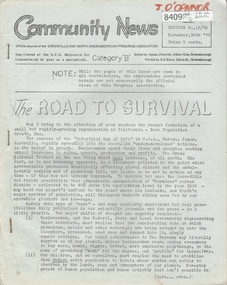
Newsletter, Greenhills and North Greensborough Progress Association, Community News: official journal of the Greenhills and North Greensborough Progress Association. 30 November 1970. Edition No. 10/70, 30/11/1970
... This edition includes a report on the Progress Association's November 1970 meeting, Councillors' report, The road to survival, Save the Juggernaut, The origins of Greensborough, Eradication of a noxious weed - Boneseed, Scout news, Kinder news, Is there a future for Community News? ...This edition includes a report on the Progress Association's November 1970 meeting, Councillors' report, The road to survival, Save the Juggernaut, The origins of Greensborough, Eradication of a noxious weed - Boneseed, Scout news, Kinder news, Is there a future for Community News? ...This edition includes a report on the Progress Association's November 1970 meeting, Councillors' report, The road to survival, Save the Juggernaut, The origins of Greensborough, Eradication of a noxious weed - Boneseed, Scout news, Kinder news, Is there a future for Community News? Supplement to "Community News". No. 11/70. Greenhills' panorama #2. p. 4-5. A digital copy of this Newsletter is available from Greensborough Historical Society.Newsletter, 16 p., illus. greenhills and north greensborough progress association, greenhills -
Moorabbin Air Museum
Book - Mitsubishi Zero, Zero Fighter
... ...Juggernaut...Mitsubishi Zero Foretaste of the end Changing the guard The new fighter Crucible Juggernaut Time of the Zero Slugging match Final act Historical & technical overview of Japanese Zero WWII fighter, circa 1969 Zero Fighter Book Mitsubishi Zero ...Historical & technical overview of Japanese Zero WWII fighter, circa 1969non-fictionHistorical & technical overview of Japanese Zero WWII fighter, circa 1969foretaste of the end, changing the guard, the new fighter, crucible, juggernaut, time of the zero, slugging match, final act -
 Melbourne Tram Museum
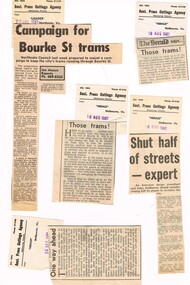
Newspaper, Leader Northcote, Melbourne Herald, " Campaign for Bourke St trams", " Those Trams" and "One way ahead", 1980 - 1981
... Noted the "MMTB juggernauts". .5 - Melbourne Herald - 8/11/1980" - titled "Shut half of streets - expert" reporting that an American design consultant - Desmond Muirhead - about shutting streets to traffic, keeping trams as in the Bourke St Mall - uses Munich as an example....Noted the "MMTB juggernauts". .5 - Melbourne Herald - 8/11/1980" - titled "Shut half of streets - expert" reporting that an American design consultant - Desmond Muirhead - about shutting streets to traffic, keeping trams as in the Bourke St Mall - uses Munich as an example. " Campaign for Bourke St trams", " Those Trams" and "One way ahead" Newspaper Leader Northcote, Melbourne Herald ...Series of five news paper cuttings regarding tram operation in the CBD and in particular along Bourke St. Each cutting has the Aust. Press Cuttings Agency source sheet pasted to the top left hand corner along with the paper name and date stamp. .1 - Leader Northcote - 22/7/1981 - " Campaign for Bourke St trams", written by Ian Munro, regarding a proposal by the City Commissioners to remove trams from Bourke St and run via Lonsdale St. .2 - Melbourne Herald - 18/8/1981 - "Those Trams", editorial regarding the possibility of removing trams from Bourke St. .3 - as for .2, but a short piece - just the last paragraph of .2 .4 - Melbourne Herald - 10/9/1981 - editorial titled "One way ahead" about the possibility of a converting some city streets to one way, a ring road and traffic flows. Noted the "MMTB juggernauts". .5 - Melbourne Herald - 8/11/1980" - titled "Shut half of streets - expert" reporting that an American design consultant - Desmond Muirhead - about shutting streets to traffic, keeping trams as in the Bourke St Mall - uses Munich as an example.Some have In pencil "Ballarat Trams" in top left hand corner.trams, tramways, bourke st, lonsdale st, city of melbourne, mmtb, traffic control -
 Kiewa Valley Historical Society
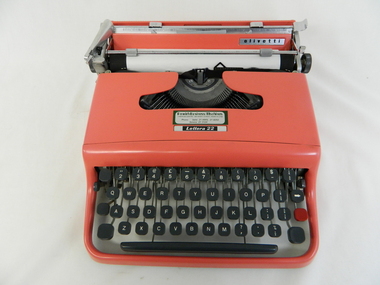
Typewriter Mechanical Portable, 1950s
... This reduction of parts and therefore cost of production was the major principle of the Japanese manufacturing juggernauts of the post World War II era. Efficiency and low costs material was becoming prime factors in the success of rural industries from the 1960s. ...The Olivetti company was founded in Italy in 1908.This particular typewriter is a Olivetti Lettera 22, oblique front stroke and portable manufactured after 1950. The 1950s and 1960s was a time when British manufactured goods were still purchased by many Australian consumers. The later 1960s onwards, there was a shift, mainly in the cities, to European made goods. The invasion of Japanese manufactured goods was relatively slower, especially in rural areas. The demand for long lasted and dependable merchandise was in the rural area still the most important criteria. The ease of setting up this typewriter and its compact mobility was its major benefit to trades people and travelling professionals, e.g. rural doctors, other medical professionals, accountants, lawyers and educators. This item facilitated the growing numbers of professional nomads requiring a relatively light office stationery package e.g. travelling novelist, writer, businessman and academics. This typewriter needed no electrical or battery power to operate it. Outback Australia, where at this point in time, was still relatively isolated from a good available electrical power reticulation and battery power, and therefore could not be totally measured as a highly efficient office environment.Although this typewriter was purchased from a business in Penrith, Sydney, N.S.W., it is significant that it travelled easily to the Kiewa Valley, demonstrating the mobility of certain sections of the community. This typewriter was designed by an Italian industrial designer, Marcello Nizzoli, in line with the art deco style of the 1930s and the colour and flexibility of the vibrant 1950s. The underlying theme of manufacturing in the 1950s was to produce equipment that was more efficient than what was inherited from the earlier period of 20th century. Improvements were made to this Olivetti typewriter by Giuseppe Beccio by reducing the number of parts made from 3,000 to 2,000. This reduction of parts and therefore cost of production was the major principle of the Japanese manufacturing juggernauts of the post World War II era. Efficiency and low costs material was becoming prime factors in the success of rural industries from the 1960s. Competition from overseas producers was starting to affect rural industries and the removal of the large range of tariff protection, especially rural products, required not only a shift of farm management but a more efficient cost savings modus operandi. This Olivetti Lettera 22, oblique front stroke portable (weighs 4kg) mechanical typewriter has a coral coloured plastic casing. The keys are made of black hardened plastic with white lettering, numbers and symbols (imperial fractions, and pound). It has a QWERTY keyboard as opposed to the Italian QZERTY. It has a lever to move the ribbon between black, neutral (for mimeograph stencils)and red colours (a red key is provided for highlighting specific words,letters or symbols) . This machine is fitted with only a black ribbon. It has a black rubber paper rollers and chromed metal parts on the carriage way. It has four rubber feet underneath the main body. On the left side of the roller there is a lever to adjust the roller from fixed (when mobile) through 1,2 and 3 line space gradients. This model has a key for zero but not one for the number one (uppercase letter l is used) see KVHS 0459 for the carrying bag.On the cover over the ribbon wheels letter strikers has a plate marked "Lettera 22" and the back plate behind the paper roller and in front of the paper supports has a silver metal label marked "olivetti made in great britain".commercial, mobile office equipment, mechanical typewriter -
 Kiewa Valley Historical Society
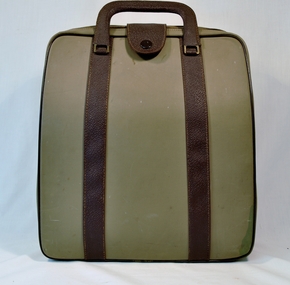
Typewriter Case Olivetti, Circa 1950
... This was the major principle of the Japanese manufacturing juggernauts of the post World War II. Efficiency and low cost material was becoming prime factors in the success of rural industries from the 1960s. ...This typewriter case allowed the Olivetti typewriter to be securely and free from contaminants to be totally mobile. The Olivetti typewriter company was founded in Italy in 1908 and became a leader in portable dependable typewriters.This particular typewriter contained is a Olivetti Lettera 22, oblique front stroke and portable manufactured after 1950. During the 1950s and 1960s was a time when British and European manufactured goods were still purchased by many Australian consumers. After the 1970s however, there was a shift, mainly in the cities, to Japanese made goods. The invasion of Japanese manufactured goods was relatively slower, especially in rural areas. The demand for long lasting and dependable merchandise was in the rural area still the most important criteria. The ease of setting up this typewriter and its compact mobility was its major benefit to trades people and travelling professionals, e.g. rural doctors, other medical professionals, accountants, lawyers and educators. This item(carrying case) facilitated the growing numbers of professional nomads requiring a relatively light office stationery package e.g. travelling novelist, writer, businessman and academics. This typewriter needed no electrical or battery power to operate it therefore the inside compartment did not require additional storage pockets . Outback Australia, where at this point in time, good available electrical power reticulation and battery power, was a scarce and therefore could not be totally measured as a highly efficient office environment. The protective carrying bag provided the only mobile way to operate in some business and home locations.Although this typewriter cover and its typewriter was purchased from a business in Penrith, Sydney, N.S.W., it is significant that it travelled easily to the Kiewa Valley, demonstrating the mobility of certain sections of the community. This typewriter cover protected the expensive typewriter it contained which was designed by an Italian industrial designer, Marcello Nizzoli, in line with the art deco style of the 1930s and the colour and flexibility of the vibrant 1950s. The underlying theme of manufacturing in the 1950s was to produce equipment that was more efficient than what was inherited from the earlier period of 20th century. Improvements were made to this Olivetti typewriter by Giuseppe Beccio by reducing the number of parts made from 3,000 to 2,000. Protection of such a typewriter was of an utmost necessity. The need for mobile expensive typewriters waned as less expensive typewriters became available. This was the major principle of the Japanese manufacturing juggernauts of the post World War II. Efficiency and low cost material was becoming prime factors in the success of rural industries from the 1960s. Competition from overseas producers was starting to affect rural industries and the removal of the large range of tariff protection, especially rural products, required not only a shift of farm management but a more efficient cost savings modus operandi.This is a semi hard cover (cloth over cardboard on inside, plastic over cardboard on outside), camel coloured outside and tartan cloth covered pattern inside the typewriter case. the case can be opened up by "unzipping" the top from the bottom halves of the case. For carrying purposes the case has two plastic covering metal handles with brass fittings. There are two stitched on brown reinforcement straps encompassing both sides of the case. The two reinforcing straps are brown in colour and a securing strap with a press button at one end to allow an extra securing tongue to keep the cover secure. The top inside of the case has a three quarters long paper compartment (flap style). See KVHS 0455 for Olivetti Lettera typewriter.commercial, protective carry bags/cases for mobile office equipment, mechanical typewriter
