
Showing 210 items matching "jungle war"
-
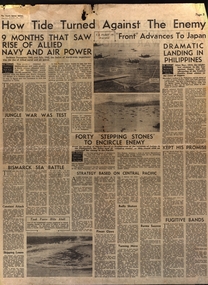 Federation University Historical Collection
Newspaper, Jungle War and Bismark Sea Battle, 1945, 1945
... Jungle War and Bismark Sea Battle, 1945......Jungle War...World War 2 Japanese Jungle War Bismark Sea Battle US Fleet Phillipines Burma Munition workers Land Army ration books Jungle War and Bismark Sea Battle, 1945 Newspaper ...world war 2, japanese, jungle war, bismark sea battle, us fleet, phillipines, burma, munition workers, land army, ration books -
 National Vietnam Veterans Museum (NVVM)
Film - Film, DVD, 1st Australian Field Hospital, Vung Tau, South Vietnam, 1968-1972, 1968-1972
... ...Vietnam War - Jungle warfare...Vietnam War - 1961-1975 - Soldiers - Australian Vietnam War - Jungle warfare Vietnam War 1961 - 1975 Personal narratives - Australian 1st Australian Field Hospital B/W footage of Australian soldiers in Vietnam camping & also a helicopter crew taking them incl. one wounded soldier away. 1st Australian Field Hospital, Vung Tau, South Vietnam, 1968-1972. ...B/W footage of Australian soldiers in Vietnam camping & also a helicopter crew taking them incl. one wounded soldier away.vietnam war - 1961-1975 - soldiers - australian, vietnam war - jungle warfare, vietnam war, 1961 - 1975, personal narratives - australian, 1st australian field hospital -
National Vietnam Veterans Museum (NVVM)
Film - Film, DVD, Combat Vietnam: to Hell and Beyond, 2000
... ...Vietnam War - Jungle warfare...Vietnam War 1961-1975 Vietnam War - Military helicopters Vietnam War - Jungle warfare Combat Vietnam: to Hell and Beyond. ...vietnam war, 1961-1975, vietnam war - military helicopters, vietnam war - jungle warfare -
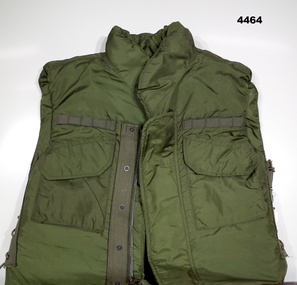 Bendigo Military Museum
Uniform - BODY ARMOUR - FRAGMENTATION, US Govt et al, c.1962-75
... This is a vietnam war era, jungle warfare flak jacket....This is a vietnam war era, jungle warfare flak jacket. Vietnam War Uniform Body Armour Vest shaped with raised thick collar. ...This is a vietnam war era, jungle warfare flak jacket.Vest shaped with raised thick collar. It has a green vinyl outer layer. It has two chest pockets, it has a central vertical metal zip. Both sides have a webbing strap with eyelet holes, They have an elastic nylon cord joining the two sides. Size is medium.vietnam war, uniform, body armour -
Frankston RSL Sub Branch
Boots, Jungle
... Australian Army boots, pattern 10085, with jungle cleats, part of world war 2 kit...Australian Army boots, pattern 10085, with jungle cleats, part of world war 2 kit Boots, Jungle W A Peatt Boot Company ...The jungle cleats were added after Kokoda trail, to give added traction in the mud.Australian Army boots used in world war 2, for use in tropical areas.Australian Army boots, pattern 10085, with jungle cleats, part of world war 2 kit1945, with number 6 underneath that, and number 5 underneath that. with 7 cleats on the front sole, 4 marked "R" and 3 marked "L". Plus a metal ring around the heel.boot, ww2, kokoda -
Frankston RSL Sub Branch
Webbing, Belt, No maker discernible, Unknown
... Towards the end of World War II, some 37 Webbing was produced in jungle green for troops fighting in the Pacific Theatre, although purpose-made 44 Pattern Webbing was then introduced for the humid jungle conditions, being lighter in weight, quicker drying, and rot-proofed.[ Although 44 Pattern continued in use with the British Army for jungle warfare in its various post-World War II colonial conflicts, it did not replace 37 Pattern in general service, which was in use up until the introduction of 58 Pattern. ...Towards the end of World War II, some 37 Webbing was produced in jungle green for troops fighting in the Pacific Theatre, although purpose-made 44 Pattern Webbing was then introduced for the humid jungle conditions, being lighter in weight, quicker drying, and rot-proofed.[ Although 44 Pattern continued in use with the British Army for jungle warfare in its various post-World War II colonial conflicts, it did not replace 37 Pattern in general service, which was in use up until the introduction of 58 Pattern. ...Used with dress uniform for ceremonious purposes.An example of the standard issue webbing belt used by Australian service personnel. The name "Bretterecker" and the number 360053, (possibly a post World War 2 service number) is written in black ink on the inside surface of the belt. The belt has been "blackened" for ceremonial use and has brass fittings, the 2 angled buckles normally located on the rear of the belt have been removed. The 1937 pattern equipment (also known as '37 webbing') was an item of military load-carrying equipment. Pattern 37 replaced the 1908 Pattern and 1925 Pattern—on which it was based—and was standard issue for British and Commonwealth troops from its introduction in 1937, throughout World War II, and in the post-war period until it was superseded by 58 pattern webbing. The design was confirmed on 8 June 1938 and wide-scale issue began in 1939. Towards the end of World War II, some 37 Webbing was produced in jungle green for troops fighting in the Pacific Theatre, although purpose-made 44 Pattern Webbing was then introduced for the humid jungle conditions, being lighter in weight, quicker drying, and rot-proofed.[ Although 44 Pattern continued in use with the British Army for jungle warfare in its various post-World War II colonial conflicts, it did not replace 37 Pattern in general service, which was in use up until the introduction of 58 Pattern. However, 37 Pattern was used for ceremonial purposes and still issued to Cadets in the 1990s. 1937 Pattern Webbing was made from cotton webbing, which was waterproofed and dyed before being woven. The fittings were made of stamped brass and it was produced by various manufacturers.Written in black ink on the inside "Bretterecker" and the number 360053, possibly a post World War 2 service number.webbing belt, dress webbing -
Lara RSL Sub Branch
Book, RAAF Saga - The RAAF at War, 1944
... Personal recounts from RAAF service personnel by way of stories, poems, cartoons, illustrations and portraits raaf wwii beaufighters waafs partisans parachute middle east squadron kitty hawk flying nurses medical air evacuation unit wewak new guinea jungle diary the p24 Message from Air Vice Marshall Chief of air staff C Jones RAAF Saga - The RAAF at War, blue hardcover front, back and spine with black Text of title and a black silhouette picture on front cover showing aircraft. ...This volume is like a veteran 'gong' - winner with years of tough going and breathless incidents to draw from. The service and the blokes in it have been able to dig into this pile of gen. and present some amazing stories, pictures, poems, graphics and cartoons.Personal recounts from RAAF service personnel by way of stories, poems, cartoons, illustrations and portraitsRAAF Saga - The RAAF at War, blue hardcover front, back and spine with black Text of title and a black silhouette picture on front cover showing aircraft. Front and back inside cover is a blue sepia background with the RAAF insignia and a range of bombers being maintained.Message from Air Vice Marshall Chief of air staff C Jonesraaf, wwii, beaufighters, waafs, partisans, parachute, middle east squadron, kitty hawk, flying nurses, medical air evacuation unit, wewak, new guinea, jungle diary, the p24 -
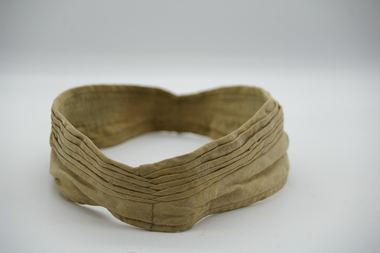 Lara RSL Sub Branch
Service Gear, Clothing Military Various - Puggaree
... War Two, a flat type of band was issued. Troops who were on active service in the Middle East at the time introduced a folded puggaree as a distinguishing mark of active service. Later, the Army reverted to various types of plain bands, green dyed puggarees for example, for jungle warfare. ...War Two, a flat type of band was issued. Troops who were on active service in the Middle East at the time introduced a folded puggaree as a distinguishing mark of active service. Later, the Army reverted to various types of plain bands, green dyed puggarees for example, for jungle warfare. ...The term ‘puggaree’ originates from the Hindu word, ‘Pagri,’ meaning a turban or thin scarf of muslin. Intended for insulation, the puggaree was a traditional Indian head-wrap, adapted by the British for headdress worn in hot, sunny regions. During World War One (1914-1918) a plain khaki cloth band was worn and this practice continued until compulsory training was suspended in 1929. Following the introduction of Voluntary Training in 1930, new puggarees were issued to the Commonwealth Military Force with different coloured folds denoting Arm or Service. During World War Two, a flat type of band was issued. Troops who were on active service in the Middle East at the time introduced a folded puggaree as a distinguishing mark of active service. Later, the Army reverted to various types of plain bands, green dyed puggarees for example, for jungle warfare. However, the official puggaree at the conclusion of World War Two was still the flat band. The current puggaree has seven pleats, one for each state and one for the Australian Territories. It is made from light khaki coloured cotton and is worn on the slouch hat with a unit colour patch sewn on the right side. While the majority of the Australian Army wear the light khaki coloured puggaree, there are slight variations for members of the 1st Battalion, the Royal Australian Regiment, and the Corps of Staff Cadets. Soldiers of the 1st Battalion, the Royal Australian Regiment, wear jungle green puggaree. The dark green puggaree was introduced during the Battalion’s service in Malaya over the period 1959-61. Unable to get puggarees from Australia for an official parade; the task of producing them was given to the Battalion tailor, Mr. Mohavved Beseek. Mr Beseek used ‘bush shirts’ (common issue British field uniform at the time) to make the puggarees as he was unable to obtain the khaki material locally or from Australia. It is thought that the Commanding Officer, Lieutenant Colonel W. Morrow decided that the green puggaree would be the puggaree worn by the 1st Battalion, the Royal Australian Regiment, in Malaya. After the battalion’s return to Australia, the dark green puggaree was adopted for permanent use. Because the dark green puggaree is so distinctive, the battalion does not wear a colour patch. Royal Military College staff cadets wear a distinctive puggaree of olive drab colour. The puggaree has eight pleats, with seven representing each state and one for the Australian Territories. The eighth pleat signifies the graduation of the first international cadet through the Royal Military College who hailed from New Zealand. Worn on slouch HatHat BandNilpuggaree,hat band, slouch hat, lara rsl -
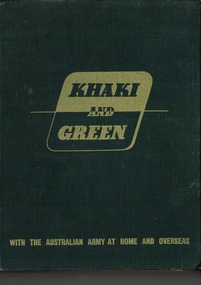 Lara RSL Sub Branch
Book, Khaki and Green, 1943
... jungle fighters...prisoners of war... 2 blaney aif 6th and 7th division poetry middle east south west pacific darwin nassau bay kokoda rats of moresby bullybeef night patrol jungle fighters prisoners of war World War 2 WW2 To the memory of fallen comrades ‘They gave their lives. ...Khaki and Green is a summary of the scope of the activities of the Australian soldiers since last they related their experiences, in book form. To their homeland. It speaks of desert and jungle epitomising the two major regions of the campaign in which Australians have participated since October 1942 - the overthrow of Rommel's forces at El Alamein and the smashing of the Chinese in Papua.Collection of servicemen recounts, poems and cartoons from World War 2Faded light green hardcover front and back with title in centre symmetrical green and back lettering (shadowed) With the Australian Army at home and overseas. Text is repeated on spine of book. Front and back inside pages has an illustrations of a kit bag and it's contents and text - Palestine, United Kingdom, Egypt, Libya, Greece, Crete, Eritrea, Cyprus, Syria, Siam, Malaya, Java, Ambon, Ceylon, China, New Britain, Ocean islands, Nauru, New Caledonia, New Guinea, Solomon's, Papua, Timor, Dutch New Guinea. Photos, illustrations, cartoons, poems. There are three copies held at the Lara RSL Sub Branch.To the memory of fallen comrades ‘They gave their lives. For the public gift they received a praise which never ages and a tomb most glorious – not so much the tomb in which they lie, but that in which their fame survives, to be remembered forever when occasion comes for word or dead…. ‘ blaney, aif, 6th and 7th division, poetry, middle east, south west pacific, darwin, nassau bay, kokoda, rats of moresby, bullybeef, night patrol, jungle fighters, prisoners of war, world war 2, ww2 -
 Lara RSL Sub Branch
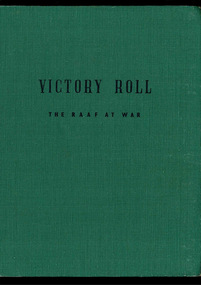
Book, Victory Roll - The RAAF at War, 1952
... jungle dawn...the victory in europe...story of a prison camp...night flight over hamburg...youth's prayer at a war...In making final victory possible, we lost many comrades, to w home this book, together with those which preceded it, becomes a permanent memorial. wwii raaf end of conflict test pilot wewak the sisters fly on battle of borneo the biscuit bombers anzacs on bougainville raaf pacific return to timor pacific landing long range from darwin air victory over burma lifeline to china photo recce first over malaya jungle dawn the victory in europe story of a prison camp night flight over hamburg youth's prayer at a war memorial victory at the alps waaf's good service Message from the Chief of Air Staff.... ...The stories in 'Victory Roll' tell of some of the deeds performed in the final and victorious year of WWII. They add to a long tradition of gallant service and sacrifice and will serve as an eternal inspiration in the task of building a new world in which the spirit of the Four Freedoms must predominate. In making final victory possible, we lost many comrades, to w home this book, together with those which preceded it, becomes a permanent memorial.Green hardcover and spine with black text - 'Victory Roll The RAAF at war' on front cover and spine. The inside front and back covers have silhouette, green sepia pictures of a variety of aeroplane. Illustrations, photographs and cartoonsMessage from the Chief of Air Staff.... Air Vice Marshal, Chief of Ai Staff C.Joneswwii, raaf, end of conflict, test pilot, wewak, the sisters fly on, battle of borneo, the biscuit bombers, anzacs on bougainville, raaf pacific, return to timor, pacific landing, long range from darwin, air victory over burma, lifeline to china, photo recce, first over malaya, jungle dawn, the victory in europe, story of a prison camp, night flight over hamburg, youth's prayer at a war memorial, victory at the alps, waaf's good service -
 Lara RSL Sub Branch
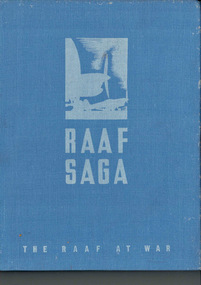
Book, RAAF Saga - The RAAF at War, 1944
... Personal recounts from RAAF service personnel by way of stories, poems, cartoons, illustrations and portraits raaf wwii beaufighters waafs partisans parachute middle east squadron kitty hawk flying nurses medical air evacuation unit wewak new guinea jungle diary the p24 Message from Air Vice Marshall Chief of air staff C Jones RAAF Saga - The RAAF at War, green hardcover front, back and spine with black Text of title and a black silhouette picture on front cover showing aircraft. ...This volume is like a veteran 'gong' - winner with years of tough going and breathless incidents to draw from. The service and the blokes in it have been able to dig into this pile of gen. and present some amazing stories, pictures, poems, graphics and cartoons.Personal recounts from RAAF service personnel by way of stories, poems, cartoons, illustrations and portraitsRAAF Saga - The RAAF at War, green hardcover front, back and spine with black Text of title and a black silhouette picture on front cover showing aircraft. Front and back inside cover is a green sepia background with the RAAF insignia and a range of bombers being maintained.Message from Air Vice Marshall Chief of air staff C Jonesraaf, wwii, beaufighters, waafs, partisans, parachute, middle east squadron, kitty hawk, flying nurses, medical air evacuation unit, wewak, new guinea, jungle diary, the p24 -
 Lara RSL Sub Branch
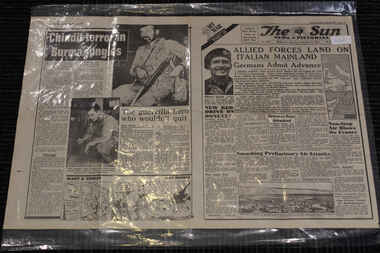
Newspaper - TheSun Newspaper Dated 4/9/1943 - Special - My War Part 38 - Allied Forces and On Italian Mainland - Chindit Terror In Burma Jungles, Local Newspaper Dated 4/9/1943 - Special My War Part 38 - Allied Forces and On Italian Mainland - Chindit Terror In Burma Jungles
... Local Newspaper dated 4/9/1943 - Special - My War Part 38 Local Newspaper reporting on Events in World War 2 dated 4/9/1943 - My War Part 38 allied forces and on italian mainland - chindit terror in burma jungles. world war 2 Allied Forces and On Italian Mainland - Chindit Terror In Burma Jungles. ...Local Newspaper dated 4/9/1943 - Special - My War Part 38Local Newspaper reporting on Events in World War 2 dated 4/9/1943 - My War Part 38Local Newspaper Dated 4/9/1943 Reporting On Word War 2 Events - Special - My War Part 38Allied Forces and On Italian Mainland - Chindit Terror In Burma Jungles.allied forces and on italian mainland - chindit terror in burma jungles., world war 2 -
 City of Moorabbin Historical Society (Operating the Box Cottage Museum)
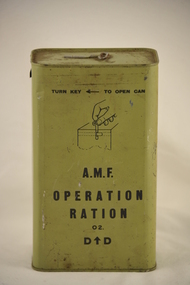
Container - World War 1939-45 Ration pack, c1940
... jungle-patrol, emergency and air-drop rations. His 'Who Called the Cook a Bastard?' (Sydney, 1972) gave an account of his experiences in military catering. Men from most families in the City of Moorabbin area served in the Australian Military Forces during World War 2. world war 11 australian military forces sir cedric stanton hicks army catering corps soldier rations food supplys australian diggers food preservation TURN KEY ← TO OPEN CAN / diagram of key / A.M.F. / OPERATION/ RATION/ 02 / D↑D A tin container , khaki colour, used for the storage of a food ration item for a soldier serving in the Australian Military Forces World War 11. ...AMF Operational Ration This ration pack was developed by Sir Stanton Hicks. It contained three meals, each waterproofed (a vital consideration for the tropics), which offered a balanced selection of meat, vegetables, fruit and vitamin supplements. Before the development of this ration pack, Australian soldiers were supplied with quantities of preserved food that were difficult for a man to carry and divide, and which often did not provide a nourishing diet. Sir Cedric Stanton Hicks (1892-1976), university professor and army catering officer, was born on 2 June 1892 at Mosgiel, New Zealand. University of Otago (B.Sc., N.Z., 1914; M.Sc. Hons, 1915; M.B., Ch.B., 1923) 1916-18 Hicks served as a non-commissioned officer in the New Zealand Expeditionary Force and he assisted Professor J. K. H. Inglis in the synthesis and production of Chloramine-T for use against meningitis among the troops. Hicks was appointed government analyst in 1918. On a Fellowship 1923, he travelled to England and studied at Trinity College, Cambridge (Ph.D., 1926) and caried out research in Switzerland, Germany and the United States of America. 1927 he was appointed to the new chair of physiology and pharmacology at Adelaide University, which he was to hold until 1957. During the Depression he studied the dietary patterns of five hundred families receiving relief. 1940 Hicks was appointed temporary captain, Australian Military Forces, and performed part-time duty as catering supervisor. Moved to Melbourne as chief inspector of catering, he began a campaign for applying scientific principles to the feeding of troops. 1943 the Australian Army Catering Corps was formed. Hicks altered the basis of the allowance for military rations from a monetary to a nutrient entitlement, improved the pay and promotion opportunities of cooks, established schools of cooking and catering, devised new methods for preparing food, supported the service's adoption of the Wiles steam-cooker, and designed jungle-patrol, emergency and air-drop rations. His 'Who Called the Cook a Bastard?' (Sydney, 1972) gave an account of his experiences in military catering.Men from most families in the City of Moorabbin area served in the Australian Military Forces during World War 2.A tin container , khaki colour, used for the storage of a food ration item for a soldier serving in the Australian Military Forces World War 11.TURN KEY ← TO OPEN CAN / diagram of key / A.M.F. / OPERATION/ RATION/ 02 / D↑Dworld war 11, australian military forces, sir cedric stanton hicks, army catering corps, soldier rations, food supplys, australian diggers, food preservation -
 City of Moorabbin Historical Society (Operating the Box Cottage Museum)
Uniform - Armed Services, Cape/groundsheet, 20th century
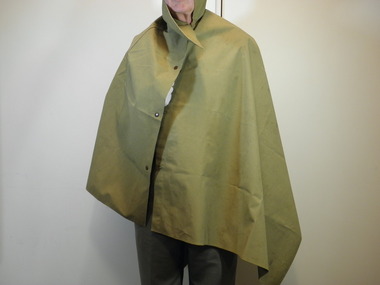
... war in the Pacific Australia began issuing its troops a lighter weight version of the groundsheet manufactured from polyurethane-coated cotton – During the Malayan Emergency of the 1950s, Australian troops were issued with hooded ponchos. Unlike the WWII US pattern ponchos which always had a hole in the dead centre of the poncho sheet, the Australian-issue hooded ponchos made an effective shelter – especially when two where clipped together. The problem of course is that the rubberized canvas ponchos were far too heavy for jungle...war in the Pacific Australia began issuing its troops a lighter weight version of the groundsheet manufactured from polyurethane-coated cotton – During the Malayan Emergency of the 1950s, Australian troops were issued with hooded ponchos. Unlike the WWII US pattern ponchos which always had a hole in the dead centre of the poncho sheet, the Australian-issue hooded ponchos made an effective shelter – especially when two where clipped together. The problem of course is that the rubberized canvas ponchos were far too heavy for jungle ...Rain cape, also used as a groundsheet, issued Australian servicemen. Purchased for the donor from an "Army Surplus" store and re-purposed for camps as a Scout in the late 1960s. The MK VII Groundsheet (Rain Cape / Poncho) was introduced in October 1917 during WW1. They were made from dyed cotton, proofed with a rubber compound, "well vulcanized" on one side. Weight 3lb. 8oz;. 78 inches long by 36 inches wide and made by the Victoria Rubber Co. Edinburgh. They were used again during WWII 1939-45 Today the Army uses the hootchie - a sheet of 70D nylon or PU-coated cotton with various press snaps and webbing tape loops attached around the outside which allow it to be used in a variety of configuration. During WWII Australian forces fighting the Japanese in the Islands had an urgent requirement for a decent individual shelter. The rubberized canvas groundsheets and rain capes continued to be used, but these were less than effective in the tropics. Towards the end of the war in the Pacific Australia began issuing its troops a lighter weight version of the groundsheet manufactured from polyurethane-coated cotton – During the Malayan Emergency of the 1950s, Australian troops were issued with hooded ponchos. Unlike the WWII US pattern ponchos which always had a hole in the dead centre of the poncho sheet, the Australian-issue hooded ponchos made an effective shelter – especially when two where clipped together. The problem of course is that the rubberized canvas ponchos were far too heavy for jungle use. 1960s Australian units in Borneo were issued with the first pattern lightweight hootchies. 1 Kg. 1970 the Vietnam War, a second pattern lightweight hootchie was issued made from nylon, but retaining the hardware and loops. This lightweight hootchie weighed a mere 680 grams, still heavy, but suitable for tropical use. Currently the hootchie is made from AUSCAM nylon material . Historic significance; representative of the type believed to have been issued to Australian servicemen in World War II, possibly in World War I.Waterproofed Canvas rain cape, also used as a groundsheet in the Australian Army, press studs to close as a cape, collar to cover neck.NILuniforms, australian army, world war ii, army surplus, scouts australia, bentleigh, moorabbin, world war 1, hooded ponchos, borneo, auscam nylon material, hootchies, malayan emergency, vietnam war, groundsheets -
 Greensborough Historical Society
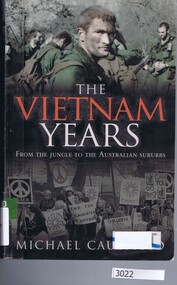
Book, Hachette, The Vietnam years: from the jungle to the Australian suburbs / Michael Caulfield, 2009_
... The story of Australia's role in the Vietnam War and the lives of soldiers and their families on return to Australia. vietnam war 503p., illus., map. The Vietnam years: from the jungle to the Australian suburbs / Michael Caulfield Book Book Hachette ...The story of Australia's role in the Vietnam War and the lives of soldiers and their families on return to Australia.503p., illus., map.vietnam war -
 Montmorency–Eltham RSL Sub Branch
Weapon - Artillery shell for 25 pounder Gun/Howitzer, Artillery Shell, 1954
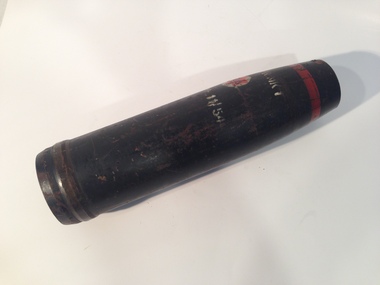
... War. Many Commonwealth countries used them during WW2 and Australia produced the guns at General Motors Holden. They were renowned for their rapid rate of fire and when firing at maximum range (12,253m -13,400yds) one gun could have up to 5 shells in the air at once. In North Africa during WW2, they were sometimes called upon to act as anti-tank guns. A shortened and lightened version of the gun was made in Australia and used in jungle...War. Many Commonwealth countries used them during WW2 and Australia produced the guns at General Motors Holden. They were renowned for their rapid rate of fire and when firing at maximum range (12,253m -13,400yds) one gun could have up to 5 shells in the air at once. In North Africa during WW2, they were sometimes called upon to act as anti-tank guns. A shortened and lightened version of the gun was made in Australia and used in jungle ...The Ordnance QF 25-pounder was the major British field gun and howitzer during the Second World War. Many Commonwealth countries used them during WW2 and Australia produced the guns at General Motors Holden. They were renowned for their rapid rate of fire and when firing at maximum range (12,253m -13,400yds) one gun could have up to 5 shells in the air at once. In North Africa during WW2, they were sometimes called upon to act as anti-tank guns. A shortened and lightened version of the gun was made in Australia and used in jungle operations.Steel conical projectile25 PR MK 1 L35 ME 11/54 -
 Greensborough Historical Society
Weapon - Machete cover, A. I. F, 1939c
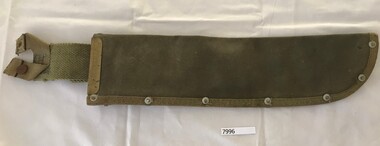
... Australian Army issue, probably for use in jungle warfare machete australian army World War II Khaki canvas sheath for machete, edges reinforced with binding, sewn and riveted, with belt strap Weapon Machete cover A. ...Australian Army issue, probably for use in jungle warfareKhaki canvas sheath for machete, edges reinforced with binding, sewn and riveted, with belt strapmachete, australian army, world war ii -
 Red Cliffs Military Museum
Letter
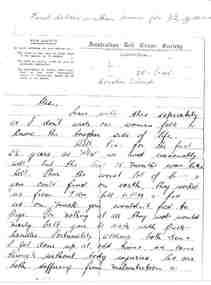
... Japanese soldier Teruo Nakamura was discovered in the Morotai jungle in 1974, as one of the WWII Japanese soldiers who held out subsequent to the Japanese military's surrender. 2 pow morotri island morotai island world war prisoner of war australian red cross society Added to head of letter at a later date is inscription ' First letter written home for 3 1/2 years'.Top left hand- FOR SAFETY/ IN YOUR LETTERS DO NOT REFER TO:-/ The name of your ship or other ships in the convoy, or its escorts. ...Letter written from (unknown) POW imprisioned by the Japanese on Morotai Island from 1942 - 1945 to (unknown) friend. Descriptive of life and treatment in POW camp. The island was captured by the Japanese in early 1942. Morotai's southern plain was taken by American forces in September 1944 during the Battle of Morotai, and used as a staging point for the Allied invasion of the Philippines in early 1945, and of Borneo in May and June of that year. Japanese soldier Teruo Nakamura was discovered in the Morotai jungle in 1974, as one of the WWII Japanese soldiers who held out subsequent to the Japanese military's surrender.Photocopy of letter, 4 pages, originally written in ink on (unofficial) Australian Red Cross form.Added to head of letter at a later date is inscription ' First letter written home for 3 1/2 years'.Top left hand- FOR SAFETY/ IN YOUR LETTERS DO NOT REFER TO:-/ The name of your ship or other ships in the convoy, or its escorts./The date of sailing, ports of call, or probable destination./ The description of troops, their loca-/tion or any other information/ which, if intercepted, would be of/ value to the enemy. In your Top right hand- Australian Red Cross Society/ (UNOFFICIAL)/ 25-8-45/ (added at later date 'Morotri Island')/ Alex, Have witten this especially/ as i don't wish our women folk to know the tougher side of life./Well Alex for the first/ 2 1/2 years as POWs we lived reasonably/ well, but the last 15 months was like /hell. Heres the worst lot of b-s/ you could find on earth, they worked /us from 7AM till 6 PM, & fed/ us on muck you wouldn't feed to/ Pigs. I'm nothing at all they would 2, pow, morotri island, morotai island, world war, prisoner of war, australian red cross society -
 Australian Commando Association - Victoria
Book - 6th Div, Shawn OLeary, To The Green Fields Beyond:The story of the 6th Division Cavalry Commandos
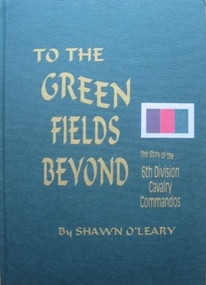
... War II. As an armoured cavalry unit it fought the Italians and Germans in the sands of the African desert and the Vichy French in the mountains of Syria. Later as a dismounted commando unit it fought the Japanese in the terrifying jungles of New Guinea. ...The comprehensive history of the 6th Australian Division Cavalry Commandos – a (now out of print) reprint of one of the rarer Armoured unit history books. This is the story of one of Australia’s most famous fighting regiments during World War II. As an armoured cavalry unit it fought the Italians and Germans in the sands of the African desert and the Vichy French in the mountains of Syria. Later as a dismounted commando unit it fought the Japanese in the terrifying jungles of New Guinea. The heroism of the men in its ranks and the actions in which they engaged are portrayed in a way which makes battle deeds leap realistically from the pages. “To The Green Fields Beyond” is a documented and detailed book which is of value to everyone who is interested in Australia’s story. Seldom before has such a contribution been made to record of our national history. The book has been approved and sponsored by the Australian War Memorial. The 6th Division Cavalry Regiment was formed in November 1939 and, just two months later, was sent overseas to the Middle East in January 1940. Arriving in Egypt, the regiment immediately went to Palestine, where it joined the rest of the 6th Division and trained using machine-gun carriers and, from October, six old Vickers light tanks. At the end of the year the regiment moved into the Western Desert, where it joined British forces ready for the major offensive to commence on 9 December. Two days later the regiment became the first unit of the 2nd Australian Imperial Force (AIF) to go into action when one of its squadron fought a sharp action against the Italians holding Garn el Grein and Fort Maddalina on 11 and 12 December. By 21 December British forces had captured Sidi Barrrani and the desert was now open for the 6th Division’s advance along the Libyan coast. On 3 January 1941 the division attacked and captured the Italian fort of Bardia. The regiment’s A Squadron, under the command of Major Denzil Macarthur-Onslow, who went on to command the 4th Armoured Brigade, supported the attack. Tobruk was the next Italian fort to be captured, with the regiment again in support and covering the 19th Brigade’s advance. The regiment, though, was under-equipped and without its full compliment of vehicles, using only machine gun carriers. To compensate for this, A Squadron was parity re-equipped with captured Italian light tanks, which had large kangaroos painted on the hulls and turrets to distinguish them from enemy vehicles. After Tobruk, the regiment was used as part of the advance guard in the capture of Derna and then Benghazi. In April the unit moved to Helwan, where it was equipped with Vickers light tanks and machine-gun carriers, and operated with British troops in capturing Sollum. Towards the end of May the regiment moved to Palestine, where it came under the command of the 7th Division for the imminent invasion of Syria. The regiment experienced its heaviest fighting during the Syrian campaign, which began on 7 June. A Squadron was attached to the 21st Brigade and advanced along the coast, where the rugged hills made it difficult to manoeuvre the tanks and carriers. The squadron was relieved by one of the 9th Division Cavalry Regiment’s squadrons on 13 and 14 June. C Squadron, meanwhile, was with the 25th Brigade, and advanced along the Rosh Pinna road, engaging strong enemy defences at Fort Khirbe. C Squadron was relieved by B Squadron, which was later attacked by Vichy French tanks that were supported by heavy artillery and machine-gun fire, which forced the Australians to withdrawal. Always willing or needing to improvise during the campaign, A and B Squadrons both operated three captured French R35 Renault light tanks, while C Squadron provided personnel for a horse troop, quickly nicknamed the “Kelly Gang”, to patrol the high, rugged hills near the Mardjayoun–Banis Road. The regiment remained in Syria as part of the occupation force and returned to Australia in March 1942. It was sent to the Adelaide River, in the Northern Territory, and then later to Murgon, in Queensland. In 1943 and 1944 divisional cavalry regiments were reorganised into cavalry (commando) regiments. In January 1944 the 6th Division Cavalry Regiment became the 2/6th Cavalry (Commando) Regiment. The regiment lost its vehicles and became the administrative headquarters for the 2/7th, 2/9th, and 2/10th Commando Squadrons. The regiment remained with the 6th Division and participated in the Aitpae–Wewak campaign, in New Guinea, during 1945. Includes Nominal Rollnon-fictionThe comprehensive history of the 6th Australian Division Cavalry Commandos – a (now out of print) reprint of one of the rarer Armoured unit history books. This is the story of one of Australia’s most famous fighting regiments during World War II. As an armoured cavalry unit it fought the Italians and Germans in the sands of the African desert and the Vichy French in the mountains of Syria. Later as a dismounted commando unit it fought the Japanese in the terrifying jungles of New Guinea. The heroism of the men in its ranks and the actions in which they engaged are portrayed in a way which makes battle deeds leap realistically from the pages. “To The Green Fields Beyond” is a documented and detailed book which is of value to everyone who is interested in Australia’s story. Seldom before has such a contribution been made to record of our national history. The book has been approved and sponsored by the Australian War Memorial. The 6th Division Cavalry Regiment was formed in November 1939 and, just two months later, was sent overseas to the Middle East in January 1940. Arriving in Egypt, the regiment immediately went to Palestine, where it joined the rest of the 6th Division and trained using machine-gun carriers and, from October, six old Vickers light tanks. At the end of the year the regiment moved into the Western Desert, where it joined British forces ready for the major offensive to commence on 9 December. Two days later the regiment became the first unit of the 2nd Australian Imperial Force (AIF) to go into action when one of its squadron fought a sharp action against the Italians holding Garn el Grein and Fort Maddalina on 11 and 12 December. By 21 December British forces had captured Sidi Barrrani and the desert was now open for the 6th Division’s advance along the Libyan coast. On 3 January 1941 the division attacked and captured the Italian fort of Bardia. The regiment’s A Squadron, under the command of Major Denzil Macarthur-Onslow, who went on to command the 4th Armoured Brigade, supported the attack. Tobruk was the next Italian fort to be captured, with the regiment again in support and covering the 19th Brigade’s advance. The regiment, though, was under-equipped and without its full compliment of vehicles, using only machine gun carriers. To compensate for this, A Squadron was parity re-equipped with captured Italian light tanks, which had large kangaroos painted on the hulls and turrets to distinguish them from enemy vehicles. After Tobruk, the regiment was used as part of the advance guard in the capture of Derna and then Benghazi. In April the unit moved to Helwan, where it was equipped with Vickers light tanks and machine-gun carriers, and operated with British troops in capturing Sollum. Towards the end of May the regiment moved to Palestine, where it came under the command of the 7th Division for the imminent invasion of Syria. The regiment experienced its heaviest fighting during the Syrian campaign, which began on 7 June. A Squadron was attached to the 21st Brigade and advanced along the coast, where the rugged hills made it difficult to manoeuvre the tanks and carriers. The squadron was relieved by one of the 9th Division Cavalry Regiment’s squadrons on 13 and 14 June. C Squadron, meanwhile, was with the 25th Brigade, and advanced along the Rosh Pinna road, engaging strong enemy defences at Fort Khirbe. C Squadron was relieved by B Squadron, which was later attacked by Vichy French tanks that were supported by heavy artillery and machine-gun fire, which forced the Australians to withdrawal. Always willing or needing to improvise during the campaign, A and B Squadrons both operated three captured French R35 Renault light tanks, while C Squadron provided personnel for a horse troop, quickly nicknamed the “Kelly Gang”, to patrol the high, rugged hills near the Mardjayoun–Banis Road. The regiment remained in Syria as part of the occupation force and returned to Australia in March 1942. It was sent to the Adelaide River, in the Northern Territory, and then later to Murgon, in Queensland. In 1943 and 1944 divisional cavalry regiments were reorganised into cavalry (commando) regiments. In January 1944 the 6th Division Cavalry Regiment became the 2/6th Cavalry (Commando) Regiment. The regiment lost its vehicles and became the administrative headquarters for the 2/7th, 2/9th, and 2/10th Commando Squadrons. The regiment remained with the 6th Division and participated in the Aitpae–Wewak campaign, in New Guinea, during 1945. Includes Nominal Rollww2, australian commandos, australian special forces, world war 2 -
 Australian Commando Association - Victoria
Book, A.B.Feure, Australian Commando: Their Secret War against the Japanese in World War II
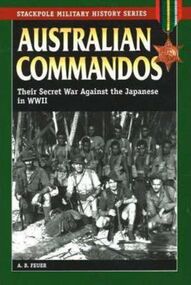
... In the jungle islands of the southwest Pacific, Australia's elite M/Z commando teams conducted daring rescue, sabotage, and intelligence missions during World War II. ...In the jungle islands of the southwest Pacific, Australia's elite M/Z commando teams conducted daring rescue, sabotage, and intelligence missions during World War II. ...non-fictionww2, australian commandos, australian special operations, australian special forces, world war ii -
 Australian Commando Association - Victoria
Book, Z Special- Desert-Jungle- Sabotage
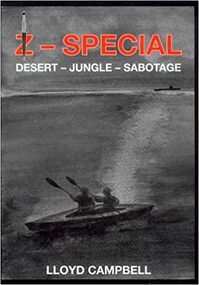
... Although the unit was disbanded after the war, many of the training techniques and operational procedures employed were later used during the formation of other Australian Army special forces units and they remain a model for guerrilla operations to this day. pp. 274, illusts, maps ww2 The Australian special operations Special forces Z Special Unit Z Special- Desert-Jungle ...When Lloyd Campbell joined the AIF, he was underage and went to the Middle East with 2/17 Battalion. Later in New Guinea he made a major career change and volunteered for an unknown unit and special operations. What he had joined was the SRD – known as Z-Special Unit. Z Special Unit—also known as Special Operations Executive (SOE), Special Operations Australia (SOA) or the Services Reconnaissance Department (SRD)—was a joint Allied special forces unit formed during the Second World War to operate behind Japanese lines in South East Asia. Predominantly Australian, Z Special Unit was a specialist reconnaissance and sabotage unit that included British, Dutch, New Zealand, Timorese and Indonesian members, predominantly operating on Borneo and the islands of the former Netherlands East Indies. The unit carried out a total of 81 covert operations in the South West Pacific theatre, with parties inserted by parachute or submarine to provide intelligence and conduct guerrilla warfare. The best known of these missions were Operation Jaywick and Operation Rimau, both of which involved raids on Japanese shipping in Singapore Harbour; the latter of which resulted in the deaths of 23 commandos either in action or by execution after capture. Although the unit was disbanded after the war, many of the training techniques and operational procedures employed were later used during the formation of other Australian Army special forces units and they remain a model for guerrilla operations to this day. pp. 274, illusts, maps ww2, the australian special operations, special forces, z special unit -
 Australian Commando Association - Victoria
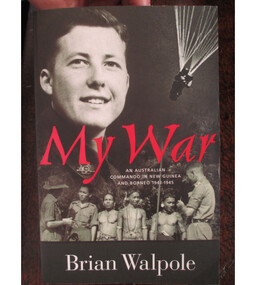
Book, My War: An Australian Commando in New Guinea and Borneo 1943 to 1945
... His commanding officer was the well-regarded George Warfe, whose portrait was sketched by war artist Ivor Hele. Brian blazed a trail through the New Guinea jungle which appears on some maps as Walpole’s Track, discovering and naming the ambush site Goodview Junction. ...jungles along the Rejang River. One of the people saved was a young nurse in her 20s, Lena Ricketts. WW2 Australian special operations Australian commando New Guinea Borneo World War II My War: An Australian Commando in New Guinea and Borneo 1943 to 1945 Book ...Brian Walpole, the author, was a Australian Commando and special operations operative behind enemy lines in New Guinea and Borneo during WW2. Brian was a commando with the Australian 2/3 Independent Company. He went to New Guinea in January 1943 and remained until the fall of the Japanese base at Salamaua in September. He fought on the Bobdubi Ridge. His commanding officer was the well-regarded George Warfe, whose portrait was sketched by war artist Ivor Hele. Brian blazed a trail through the New Guinea jungle which appears on some maps as Walpole’s Track, discovering and naming the ambush site Goodview Junction. Soon afterwards (July 1943) Goodview Junction was the scene of a key campaign victory which contributed to George Warfe being awarded the Military Cross.Brian’s Special Operations training mostly took place at Careening Bay (Western Australia) and Fraser Island (Queensland). He arrived in Borneo at the time of the 9th Division’s landing at Labuan Island, and took part in two SRD operations – Colt and Semut 3. After the surrender, Walpole's work continued as many of the Japanese did not recognise the surrender and continued to fight on. Brian relates how on the 14th of September 1945 while still an operative in SRD he was able to save POWs from certain death and after a firefight arrested 10 Japanese soldiers at Simanggang Borneo. He was alone and had been assisted in the battle by 20 headhunters from the jungles along the Rejang River. One of the people saved was a young nurse in her 20s, Lena Ricketts. ww2, australian special operations, australian commando, new guinea, borneo, world war ii -
 Eltham District Historical Society Inc
Document (Item) - Article, The Eltham Roll of Honour: Second World War, 9 Aug 2020
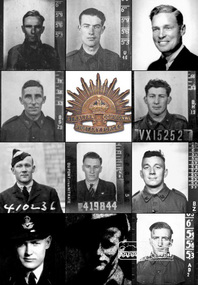
... war (pow)...ranau number 1 jungle camp...Lt., 410262 (KIA 5 Apr 1945, Varrelbusch, Germany) FIELD, Kevin Francis, Pte., VX144763 (KIA 28 Jun 1945, Bougainville, PNG) BUTHERWAY, Jack Herbert, Pte, VX37645 (DOD 8 Jul 1945, Borneo) eltham war memorial roll of honour second world war eltham eltham roll of honour shire of eltham 2/4 field workshop 22 independent brigade group ordnance workshop a.i.f. australian army ordnance corps australian corps of electrical and mechanical engineers changi falkiner street florence mary butherway jack herbert butherway prisoner of war (pow) ranau number 1 jungle camp sandakan death march singapore thomas james butherway vx37645 2/2 field company 6th division abington annie castledine arthur frederick castledine george ernest castledine greece jean simonson lower plenty old eltham road royal australian engineers vx10044 sapper g. e. castledine 2/23 bn derril gahan house main road rats of tobruk studley manston gahan tobruk vx48379 3 squadron r.a.a.f. aboukir alamein memorial beulah alice (simpson) rutter bir el gubbi broken hill aero club david rutter egypt hubert rutter libya yarra braes 2/21 bn 23rd australian infrantry brigade 8th division alfred charles clerke ambon island battle of ambon bidgeland park estate inga caroline (nicholls) clerke inga mary nicholls laha airfield nora ann clerke rose matilda clerke vx23112 william charles clerke 2/14 bn 2/16 bn 21st brigade 7th division cuthbert douglas dunlop gona gona war cemetery henry street janet dunlop kokoda track new guinea palestine papua new guinea port moresby (bomana) war cemetery reuben cuthbert dunlop syria vx15252 10 operational training unit 410236 ada (key) ingram berkshire bomber command england group no. 91 john ingram lester neil ingram longworth n.1374 r.a.a.f. r.a.f. r.a.f. abington research (vic.) whitley v bomber 419844 514 bomber squadron emmerich germany gordon stanley mclean ji-g2 kleve lancaster lm735 lucy mclean mount pleasant road r.a.f. waterbeach reichswald forest war cemetery stanley mclean 2/10 ordnance workshops albert feldbauer eltham cricket association eltham girls club frank street henry feldbauer jessie margarette feldbauer june feldbauer ken ingram margaret (feldbauer) ingram montmorency imperials research cricket club research state school sandakan number 1 camp sandakan number 2 camp theodore albert feldbauer valerie (feldbauer) waller violet amelda (teagle) feldbauer vx51733 247 ‘china-british’ squadron caithness cloppenburg donlad hemphill rutter essen gloucester hanover war cemetery hanover-limmer british military cemetery holten-lochem oldenburg r.a.f. castletown r.a.f. station lealing stoppenburg typhoon ib jp443 typhoon ib sw526 15th australian infantry brigade 1940 cup 3rd division 57th/60th bn best and fairest bougainville island buin road mary field mayona road mivo river mobiai river montmorency vx144763 william field Word/PDF document file The Eltham Roll of Honour: Second World War Document Article ...Information regarding the circumstances of the eleven men of the Shire of Eltham who died serving their country in the Second World War and for whom the Eltham War Memorial was dedicated. Their names are listed on the Eltham Roll of Honour in order of rank. The image portrayed shows the eleven men (left to right, top to bottom) by date of fatality: CASTLEDINE, George Ernest, Spr., VX10044 (KIA 18 Apr 1941, Greece) GAHAN, Studley Manston, Capt., VX48379 (KIA 17 May 1941, Tobruk, Libya) RUTTER, David, Flying Off., 833 (400833) (KIA 9 Dec 1941, Bir El Gubbi, Libya) CLERKE, Alfred Charles, Cpl., VX23112 (KIA 2 Feb 1942, Laha, Ambon Island) DUNLOP, Cuthbert Douglas, Sgt., VX15252 (KIA 22 Nov 1942, Gona, New Guinea) INGRAM, Lester Neil, Flt. Sgt., 410236 (DOD 22 Apr 1943, Longworth, England) McLEAN, Stanley, Flt. Sgt., 419844 (KIA 7 Oct 1944, Emmerich, Germany) FELDBAUER, Theodore, Sgt., VX51733 (DOD 27 Mar 1945, Borneo) RUTTER, Donald Hemphill, Flt. Lt., 410262 (KIA 5 Apr 1945, Varrelbusch, Germany) FIELD, Kevin Francis, Pte., VX144763 (KIA 28 Jun 1945, Bougainville, PNG) BUTHERWAY, Jack Herbert, Pte, VX37645 (DOD 8 Jul 1945, Borneo)eltham war memorial, roll of honour, second world war, eltham, eltham roll of honour, shire of eltham, 2/4 field workshop, 22 independent brigade group ordnance workshop, a.i.f., australian army ordnance corps, australian corps of electrical and mechanical engineers, changi, falkiner street, florence mary butherway, jack herbert butherway, prisoner of war (pow), ranau number 1 jungle camp, sandakan death march, singapore, thomas james butherway, vx37645, 2/2 field company, 6th division, abington, annie castledine, arthur frederick castledine, george ernest castledine, greece, jean simonson, lower plenty, old eltham road, royal australian engineers, vx10044 sapper g. e. castledine, 2/23 bn, derril, gahan house, main road, rats of tobruk, studley manston gahan, tobruk, vx48379, 3 squadron r.a.a.f., aboukir, alamein memorial, beulah alice (simpson) rutter, bir el gubbi, broken hill aero club, david rutter, egypt, hubert rutter, libya, yarra braes, 2/21 bn, 23rd australian infrantry brigade, 8th division, alfred charles clerke, ambon island, battle of ambon, bidgeland park estate, inga caroline (nicholls) clerke, inga mary nicholls, laha airfield, nora ann clerke, rose matilda clerke, vx23112, william charles clerke, 2/14 bn, 2/16 bn, 21st brigade, 7th division, cuthbert douglas dunlop, gona, gona war cemetery, henry street, janet dunlop, kokoda track, new guinea, palestine, papua new guinea, port moresby (bomana) war cemetery, reuben cuthbert dunlop, syria, vx15252, 10 operational training unit, 410236, ada (key) ingram, berkshire, bomber command, england, group no. 91, john ingram, lester neil ingram, longworth, n.1374, r.a.a.f., r.a.f., r.a.f. abington, research (vic.), whitley v bomber, 419844, 514 bomber squadron, emmerich, germany, gordon stanley mclean, ji-g2, kleve, lancaster lm735, lucy mclean, mount pleasant road, r.a.f. waterbeach, reichswald forest war cemetery, stanley mclean, 2/10 ordnance workshops, albert feldbauer, eltham cricket association, eltham girls club, frank street, henry feldbauer, jessie margarette feldbauer, june feldbauer, ken ingram, margaret (feldbauer) ingram, montmorency imperials, research cricket club, research state school, sandakan number 1 camp, sandakan number 2 camp, theodore albert feldbauer, valerie (feldbauer) waller, violet amelda (teagle) feldbauer, vx51733, 247 ‘china-british’ squadron, caithness, cloppenburg, donlad hemphill rutter, essen, gloucester, hanover war cemetery, hanover-limmer british military cemetery, holten-lochem, oldenburg, r.a.f. castletown, r.a.f. station lealing, stoppenburg, typhoon ib jp443, typhoon ib sw526, 15th australian infantry brigade, 1940 cup, 3rd division, 57th/60th bn, best and fairest, bougainville island, buin road, mary field, mayona road, mivo river, mobiai river, montmorency, vx144763, william field -
 Bendigo Military Museum
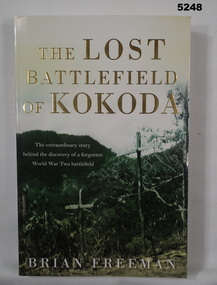
Book - BOOK, KOKODA BATTLEFIELD DISCOVERY, Brian FREEMAN, The Lost Battlefield of Kokoda, 2012
... War Two Battlefield." Books History WW2 Kokoda Soft cover book. Soft cover - cardboard, gold, white and dark green print on front, spine and back. Illustrated - green tones - photograph of jungle ..."The Lost/ Battlefield/ Of Kokoda/ The extraordinary story/ behind the discovery of a forgotten/ World War Two Battlefield."Soft cover book. Soft cover - cardboard, gold, white and dark green print on front, spine and back. Illustrated - green tones - photograph of jungle scene with 2 timber crosses in foreground. 269 Pages - paper, plain, cut, white, illustrated - colour photographs.books, history, ww2, kokoda -
 Bendigo Military Museum
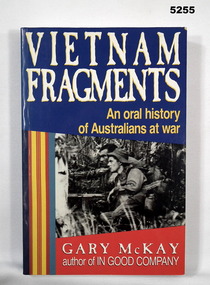
Book - BOOK, VIETNAM WAR NARRATIVES, Gary McKAY, "Vietnam Fragments", 1992
... "Vietnam Fragments/ An oral history of Australians at War" Books History Vietnam War Soft cover book Soft cover - cardboard, white, yellow and black print on front, spine and back. Background - blue, red and light blue colours. Illustrated with campaign ribbon and black and white photograph of two soldiers in a jungle setting - on front. 307 pages - paper, cut, plain white, illustrated black and white maps. front and back end papers - illustrated black and white photographs. ..."Vietnam Fragments/ An oral history of Australians at War"Soft cover book Soft cover - cardboard, white, yellow and black print on front, spine and back. Background - blue, red and light blue colours. Illustrated with campaign ribbon and black and white photograph of two soldiers in a jungle setting - on front. 307 pages - paper, cut, plain white, illustrated black and white maps. front and back end papers - illustrated black and white photographs.books, history, vietnam war -
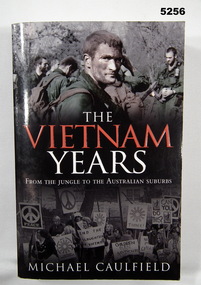 Bendigo Military Museum
Book - BOOK, VIETNAM WAR FROM BOTH SIDES, Michael CAULFIELD, "The Vietnam Years", 2007
... "THE VIETNAM YEARS/FROM THE JUNGLE TO THE AUSTRALIAN SUBURBS". The Vietnam Years is the story of both sides of that war."..."THE VIETNAM YEARS/FROM THE JUNGLE TO THE AUSTRALIAN SUBURBS". The Vietnam Years is the story of both sides of that war." ..."THE VIETNAM YEARS/FROM THE JUNGLE TO THE AUSTRALIAN SUBURBS". The Vietnam Years is the story of both sides of that war."Soft cover book. Soft cover - cardboard, red and white print on front, spine and back. Illustrated on front, top colour photograph of soldiers. Bottom black and white photograph of a civilian crowd. 493 pages, paper, cut, plain, white. Illustrated, black and white photographs and maps.books, history, vietnam war -
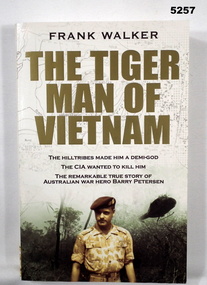 Bendigo Military Museum
Book - BOOK, VIETNAM CONFLICT BIOGRAPHY, Frank WALKER, "The Tiger Man of Vietnam", 2009
... WAR HERO BARRY PETERSEN" Books History Biography Vietnam Conflict Soft cover book. Soft cover - cardboard, gold and black print on front, spine and back. Illustrated, front montage photo of sepia toned soldier with jungle ..."THE TIGER MAN OF VIETNAM/ THE HILL TRIBES MADE HIM A DEMI-GOD/ THE CIA WANTED TO KILL HIM/ THE REMARKABLE TRUE STORY OF/ AUSTRALIAN WAR HERO BARRY PETERSEN"Soft cover book. Soft cover - cardboard, gold and black print on front, spine and back. Illustrated, front montage photo of sepia toned soldier with jungle scene behind. Back - sepia toned photograph - portrait of a man with an animal skin. 356 pages, paper, cut, plain, white. Illustrated - black and white photographs.books, history, biography, vietnam conflict -
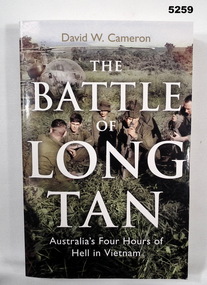 Bendigo Military Museum
Book - BOOK, VIETNAM WAR BATTLE, David W. CAMERON, "The Battle of Long Tan", 2016
... War Soft cover book. Soft cover - cardboard, white and light gold print on front, spine and back. Illustrated - colour photograph from front to back of soldiers resting in foreground, helicopter in background, with jungle vegetation. 392 pages - paper, cut, plain, white. ..."The Battle of Long Tan/ Australia's Four Hours of Hell in Vietnam".Soft cover book. Soft cover - cardboard, white and light gold print on front, spine and back. Illustrated - colour photograph from front to back of soldiers resting in foreground, helicopter in background, with jungle vegetation. 392 pages - paper, cut, plain, white. Illustrated colour, sepia and black and white photographs.books, history, vietnam war -
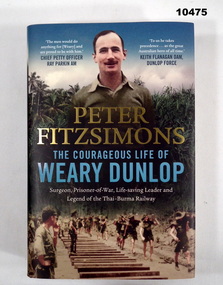 Bendigo Military Museum
Book - BIOGRAPHY, WWII, Peter Fitzsimons, "THE COURAGEOUS LIFE OF WEARY DUNLOP", 2025
... War, Life-Saving Leader and/Legend of the Thai-Burma Railway". Publication Book Military History Biography WW2 Weary Dunlop Handwritten details - black ink pen. "14-11-25/ Steve/I hope you and the Bendigo Military Museum love this! Kind regards/ Peter Fitzsimons". Hard cover book with dust cover. Hardcover - cardboard, black colour buckram with gold colour print on spine. Dustcover - paper with gold, blue and white colour print on front, spine and back. Illustrated in colour, top front informal portrait photograph of Weary Dunlop with background jungle ...Details from Dust Cover. "THE COURAGEOUS LIFE OF/ WEARY DUNLOP/ Surgeon, Prisoner-of-War, Life-Saving Leader and/Legend of the Thai-Burma Railway".Hard cover book with dust cover. Hardcover - cardboard, black colour buckram with gold colour print on spine. Dustcover - paper with gold, blue and white colour print on front, spine and back. Illustrated in colour, top front informal portrait photograph of Weary Dunlop with background jungle scene with railway work party of Japanese guards, railway sleepers and POW soldier. Back cover - formal portrait in uniform of Weary Dunlop. 540 pages - cut, plain, off white paper. Illustrated black and white, sepia and colour photographs, painting and drawings. Handwritten information on Title page. Handwritten details - black ink pen. "14-11-25/ Steve/I hope you and the Bendigo Military Museum love this! Kind regards/ Peter Fitzsimons".publication, book, military history, biography, ww2, weary dunlop -
 Bendigo Military Museum
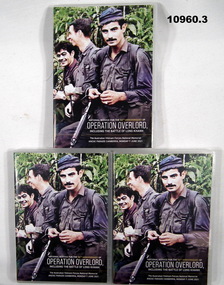
Mixed media - DVD'S, VIETNAM, Aust Govt, 2021
... War Long Khanh Printing in white ink: - “Aust Govt. Dept Vet Affairs, Canberra” There are three of the same discs. The cover on the packet shows 3 Australian soldiers in jungle. ...Vietnam War - Australian involvement.There are three of the same discs. The cover on the packet shows 3 Australian soldiers in jungle. It has probably been colourised. The soldiers are wearing Australian pattern jungle greens. One is wearing a bush hat with the brim trimmed, commonly done.They have SLR rifles. They are using pattern 56 webbing. The rear cover shows two Australian soldiers - probably in a bamboo thicket. One is hatless, wearing a belt of 7.62 mm M.G. Ammo. The hatted soldier is wearing pattern 56 webbing with at least 2 water bottles. He is holding a SLR Rifle.Printing in white ink: - “Aust Govt. Dept Vet Affairs, Canberra”dvd's, south vietnam war, long khanh
