
Showing 9 items matching "k. g. luke pty ltd"
-
 City of Moorabbin Historical Society (Operating the Box Cottage Museum)
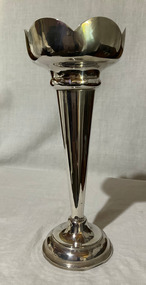
Domestic object - Silver Plated Vase, Paramount - K. G. Luke Pty Ltd
... Paramount - K. G. Luke Pty Ltd......k. g. luke pty ltd...Manufactured by K. G. Luke Pty Ltd....Manufactured by K. G. Luke Pty Ltd. In 1921 Kenneth Luke became a partner in a small metal-spinning and silverware business at Carlton. ...Manufactured by K. G. Luke Pty Ltd.In 1921 Kenneth Luke became a partner in a small metal-spinning and silverware business at Carlton. By 1925 he was its proprietor and an employer of seven. These employees were still with him thirty years later, with 650 others, making an ever-increasing range of products: silverware, stainless steel surgical equipment, plated goods and glass-washing machines. In 1929 he bought a larger factory in Queen's Parade, Fitzroy (since redeveloped), doubled his staff and introduced new lines. At the outbreak of World War 2 production was again stepped up and Luke became an honorary adviser to the Department of Supply and Shipping. Luke went on to achieve many major public roles. In 1938-55 he was president of the Carlton Football Club. A delegate (from 1935) to the Victorian Football League, he was its vice president (1946-55) and president (1956-71). With post-war growth generating record crowds, he consolidated central administration and professionalised the game for players.A Silver Plated Vase manufactured by K.G. Luke Pty Ltd.A1 - Paramount Plate - Best EPNS Quality Plate 4001-0paramount, k. g. luke pty ltd -
 Bendigo Military Museum
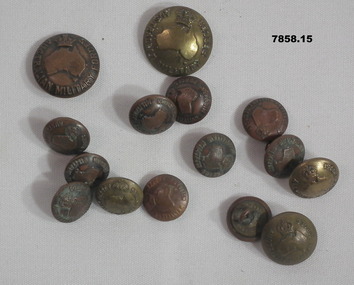
Uniform - BUTTONS, AMF, cWW2
... Pty Ltd...K. G. Luke Pty Ltd...LUKE PTY LTD Collection of three large and twelve small copper coloured army uniform buttons. Each features a raised map of 'Australia below a Kings Crown. Word 'Australian Military Forces' written around the edge of each button. metal loop on the back of each for attaching to a ubniform. Uniform BUTTONS, AMF A. J. PARKES Stokes & Sons J. R. Gaunt & Sons P J King Pty Ltd K. G ...Part of the Cooper Collection.Collection of three large and twelve small copper coloured army uniform buttons. Each features a raised map of 'Australia below a Kings Crown. Word 'Australian Military Forces' written around the edge of each button. metal loop on the back of each for attaching to a ubniform.Various Manufacturers names stamped on back: AJ. PARKES, BRISBANE STOKES & SONS, MELBOURNE J.R. GAUNT & SON LD, LONDON P.J. KING PRY LTD, MELBOURNE, K.G. LUKE PTY LTDcooper collection, buttons, uniform, australian military forces -
 4th/19th Prince of Wales's Light Horse Regiment Unit History Room
Trophy, abt 1960
... K G Luke A'asia Pty Ltd...Insciption plate under circle motif. Trophy K G Luke A'asia Pty Ltd ...Presented to Sgt Max D'Atri, a former member of the RegimentMetal plate affixed to bakelite mount. Plate consists of 4.6 cm circle in which is 3 basket ball players. Columns at each side of circle. Laurel wreath under circle. Insciption plate under circle motif.REGIMENTAL BASKETBALL TEAM Best and Fairest Summer 1961 SGT M D'ATRI On back of stand - 4/19 PWLH Sgts Mess 1997trophy, basket ball, d'atri, -
 Emerald Museum & Nobelius Heritage Park
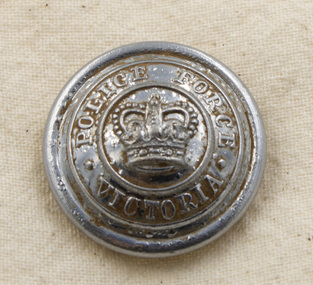
Accessory - Victoria Police Button, c. 1950s
... Front: 'POLICE FORCE / VICTORIA' Back: 'K. G. LUKE PTY LTD / MELB'...K. G. Luke, who was one of Australia's largest manufacturers of silverware, including buttons. This button was likely made sometime in between the death of King George VI in February 1952 and the changing of the company's name in May 1953, due to the presence of the Queen's crown on the front and the manufacturing details on the back. This button is significant as it demonstrates the presence of the Victorian Police Force in Emerald in the mid-20th Century Emerald 20th Century 1950s Police Front: 'POLICE FORCE / VICTORIA' Back: 'K. G. LUKE PTY LTD ...This button was found adjacent to the old lock-up in the backyard of present-day Fernlea Op-Shop, formerly the site of the Emerald Police Station. It was made by button manufacturer K. G. Luke, who was one of Australia's largest manufacturers of silverware, including buttons. This button was likely made sometime in between the death of King George VI in February 1952 and the changing of the company's name in May 1953, due to the presence of the Queen's crown on the front and the manufacturing details on the back.This button is significant as it demonstrates the presence of the Victorian Police Force in Emerald in the mid-20th CenturyA circular silver metal plated button with a raised Queen's crown in the centre. On the back there are four holes for sewing into.Front: 'POLICE FORCE / VICTORIA' Back: 'K. G. LUKE PTY LTD / MELB'emerald, 20th century, 1950s, police -
Clunes Museum
Medal - MEDAL AND CASE, Andor Mészáros
... .1 OBVERSE: Horse bounding left, broken shackles on foreleg, carrying woman holding sword and man holding torch; around, EQUALITY AND JUSTICE THROUGH FREEDOM Artist's name behind horse's tail REVERSE: Two people puddling, one person holding a long shovel and the other rocking a gold cradle above, CENTENARY OF GOVERNMENT OF VICTORIA 1851 - 1951; inscribed, Awarded to Clunes Football Club Members and Champions 1951 .2 Embossed in gold on white satin liner K G. Luke Pty. Ltd. Medalists Melbourne. Victoria's coat of arms embossed in gold on the outer lid...THE CENTENARY OF GOVERNMENT OF VICTORIA 1851 - 1951 MEDAL .1 OBVERSE: Horse bounding left, broken shackles on foreleg, carrying woman holding sword and man holding torch; around, EQUALITY AND JUSTICE THROUGH FREEDOM Artist's name behind horse's tail REVERSE: Two people puddling, one person holding a long shovel and the other rocking a gold cradle above, CENTENARY OF GOVERNMENT OF VICTORIA 1851 - 1951; inscribed, Awarded to Clunes Football Club Members and Champions 1951 .2 Embossed in gold on white satin liner K G. Luke Pty. Ltd. Medalists Melbourne. Victoria's coat of arms embossed in gold on the outer lid .1 CIRCULAR BRONZE MEDAL .2 DARK RED LEATHERETTE CASE WITH SPRING BUTTON, LINED WITH RED VELVET AND WHITE SATIN WITH GOLD EMBOSSING Medal MEDAL AND CASE Andor Mészáros ...Medal commemorating the Centenary of Government of Victoria and the Discovery of Gold, commissioned by the Victorian Government, designed by Andor Mészáros and minted by K.G. Luke, Melbourne, 1951. 1951 marked the centenary of Victoria's separation from the colony of New South Wales..1 CIRCULAR BRONZE MEDAL .2 DARK RED LEATHERETTE CASE WITH SPRING BUTTON, LINED WITH RED VELVET AND WHITE SATIN WITH GOLD EMBOSSING .1 OBVERSE: Horse bounding left, broken shackles on foreleg, carrying woman holding sword and man holding torch; around, EQUALITY AND JUSTICE THROUGH FREEDOM Artist's name behind horse's tail REVERSE: Two people puddling, one person holding a long shovel and the other rocking a gold cradle above, CENTENARY OF GOVERNMENT OF VICTORIA 1851 - 1951; inscribed, Awarded to Clunes Football Club Members and Champions 1951 .2 Embossed in gold on white satin liner K G. Luke Pty. Ltd. Medalists Melbourne. Victoria's coat of arms embossed in gold on the outer lidthe centenary of government of victoria 1851 - 1951, medal -
 Flagstaff Hill Maritime Museum and Village
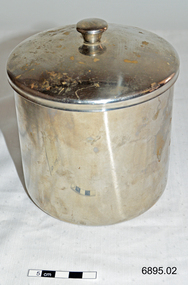
Surgical Container, mid 29th century
... Luke Pty. Ltd. Melbourne Paramount stainlett steel Australia Stamped into base “STAINLESS / STEEL / BY / PARAMOUNT / K G LUKE / MELB / 58” Stainless steel, round surgical container with lid, part of the W.R. ...This stainless steel surgical contain with lid was amongst the medical and surgical equipment used by Dr. W.R. Angus in his medical practice. The steel for the containter was made by Paramount and the container maunfactured by K.G. Luke of Fitzroy North in Melbourne, Australia. (Sir) Kenneth Luke was born in Port Melbourne and had a very successful business that grew from small beginnings in 1921 in the metal and silverware business “making an ever-increasing range of products: silverware, stainless steel surgical equipment, plated goods and glass-washing machines.” K. G. Luke (Australasia) Ltd was registered as a public company in 1953. During World War 2 Kenneth Luke became an honorary advisor to the Australian Department of Supply and Shipping. He was also an administrator for Football in Victoria. This container was donated to Flagstaff Hill Maritime Village by the family of Doctor William Roy Angus, Surgeon and Oculist. It is part of the “W.R. Angus Collection” includes historical medical equipment, surgical instruments and material once belonging to Dr Edward Ryan and Dr Thomas Francis Ryan, (both of Nhill, Victoria) as well as Dr Angus’ own belongings. The Collection’s history spans the medical practices of the two Doctors Ryan, from 1885-1926 plus that of Dr Angus, up until 1969. ABOUT THE “W.R.ANGUS COLLECTION” Doctor William Roy Angus M.B., B.S., Adel., 1923, F.R.C.S. Edin.,1928 (also known as Dr Roy Angus) was born in Murrumbeena, Victoria in 1901 and lived until 1970. He qualified as a doctor in 1923 at University of Adelaide, was Resident Medical Officer at the Royal Adelaide Hospital in 1924 and for a period was house surgeon to Sir (then Mr.) Henry Simpson Newland. Dr Angus was briefly an Assistant to Dr Riddell of Kapunda, then commenced private practice at Curramulka, Yorke Peninsula, SA, where he was physician, surgeon and chemist. In 1926, he was appointed as new Medical Assistant to Dr Thomas Francis Ryan (T.F. Ryan, or Tom), in Nhill, Victoria, where his experiences included radiology and pharmacy. In 1927 he was Acting House Surgeon in Dr Tom Ryan’s absence. Dr Angus had become engaged to Gladys Forsyth and they decided he further his studies overseas in the UK in 1927. He studied at London University College Hospital and at Edinburgh Royal Infirmary and in 1928, was awarded FRCS (Fellow from the Royal College of Surgeons), Edinburgh. He worked his passage back to Australia as a Ship’s Surgeon on the on the Australian Commonwealth Line’s T.S.S. Largs Bay. Dr Angus married Gladys in 1929, in Ballarat. (They went on to have one son (Graham 1932, born in SA) and two daughters (Helen (died 12/07/1996) and Berenice (Berry), both born at Mira, Nhill ) According to Berry, her mother Gladys made a lot of their clothes. She was very talented and did some lovely embroidery including lingerie for her trousseau and beautifully handmade baby clothes. Dr Angus was a ‘flying doctor’ for the A.I.M. (Australian Inland Ministry) Aerial Medical Service in 1928 . Its first station was in the remote town of Oodnadatta, where Dr Angus was stationed. He was locum tenens there on North-South Railway at 21 Mile Camp. He took up this ‘flying doctor’ position in response to a call from Dr John Flynn; the organisation was later known as the Flying Doctor Service, then the Royal Flying Doctor Service. A lot of his work during this time involved dental surgery also. Between 1928-1932 he was surgeon at the Curramulka Hospital, Yorke Peninsula, South Australia. In 1933 Dr Angus returned to Nhill and purchased a share of the Nelson Street practice and Mira hospital (a 2 bed ward at the Nelson Street Practice) from Dr Les Middleton one of the Middleton Brothers, the current owners of what previously once Dr Tom Ryan’s practice. Dr Tom and his brother had worked as surgeons included eye surgery. Dr Tom Ryan performed many of his operations in the Mira private hospital on his premises. He had been House Surgeon at the Nhill Hospital 1902-1926. Dr Tom Ryan had one of the only two pieces of radiology equipment in Victoria during his practicing years – The Royal Melbourne Hospital had the other one. Over the years Dr Tom Ryan had gradually set up what was effectively a training school for country general-practitioner-surgeons. Each patient was carefully examined, including using the X-ray machine, and any surgery was discussed and planned with Dr Ryan’s assistants several days in advance. Dr Angus gained experience in using the X-ray machine there during his time as assistant to Dr Ryan. When Dr Angus bought into the Nelson Street premises in Nhill he was also appointed as the Nhill Hospital’s Honorary House Surgeon 1933-1938. His practitioner’s plate from his Nhill surgery is now mounted on the doorway to the Port Medical Office at Flagstaff Hill Maritime Village, Warrnambool. When Dr Angus took up practice in the Dr Edward and Dr Tom Ryan’s old premises he obtained their extensive collection of historical medical equipment and materials spanning 1884-1926. A large part of this collection is now on display at the Port Medical Office at Flagstaff Hill Maritime Village in Warrnambool. In 1939 Dr Angus and his family moved to Warrnambool where he purchased “Birchwood,” the 1852 home and medical practice of Dr John Hunter Henderson, at 214 Koroit Street. (This property was sold in1965 to the State Government and is now the site of the Warrnambool Police Station. and an ALDI sore is on the land that was once their tennis court). The Angus family was able to afford gardeners, cooks and maids; their home was a popular place for visiting dignitaries to stay whilst visiting Warrnambool. Dr Angus had his own silk worm farm at home in a Mulberry tree. His young daughter used his centrifuge for spinning the silk. Dr Angus was appointed on a part-time basis as Port Medical Officer (Health Officer) in Warrnambool and held this position until the 1940’s when the government no longer required the service of a Port Medical Officer in Warrnambool; he was thus Warrnambool’s last serving Port Medical Officer. (Masters of immigrant ships arriving in port reported incidents of diseases, illness and death and the Port Medical Officer made a decision on whether the ship required Quarantine and for how long, in this way preventing contagious illness from spreading from new immigrants to the residents already in the colony.) Dr Angus was a member of the Australian Medical Association, for 35 years and surgeon at the Warrnambool Base Hospital 1939-1942, He served with the Australian Department of Defence as a Surgeon Captain during WWII 1942-45, in Ballarat, Victoria, and in Bonegilla, N.S.W., completing his service just before the end of the war due to suffering from a heart attack. During his convalescence he carved an intricate and ‘most artistic’ chess set from the material that dentures were made from. He then studied ophthalmology at the Royal Melbourne Eye and Ear Hospital and created cosmetically superior artificial eyes by pioneering using the intrascleral cartilage. Angus received accolades from the Ophthalmological Society of Australasia for this work. He returned to Warrnambool to commence practice as an ophthalmologist, pioneering in artificial eye improvements. He was Honorary Consultant Ophthalmologist to Warrnambool Base Hospital for 31 years. He made monthly visits to Portland as a visiting surgeon, to perform eye surgery. He represented the Victorian South-West subdivision of the Australian Medical Association as its secretary between 1949 and 1956 and as chairman from 1956 to 1958. In 1968 Dr Angus was elected member of Spain’s Barraquer Institute of Barcelona after his research work in Intrasclearal cartilage grafting, becoming one of the few Australian ophthalmologists to receive this honour, and in the following year presented his final paper on Living Intrasclearal Cartilage Implants at the Inaugural Meeting of the Australian College of Ophthalmologists in Melbourne In his personal life Dr Angus was a Presbyterian and treated Sunday as a Sabbath, a day of rest. He would visit 3 or 4 country patients on a Sunday, taking his children along ‘for the ride’ and to visit with him. Sunday evenings he would play the pianola and sing Scottish songs to his family. One of Dr Angus’ patients was Margaret MacKenzie, author of a book on local shipwrecks that she’d seen as an eye witness from the late 1880’s in Peterborough, Victoria. In the early 1950’s Dr Angus, painted a picture of a shipwreck for the cover jacket of Margaret’s book, Shipwrecks and More Shipwrecks. She was blind in later life and her daughter wrote the actual book for her. Dr Angus and his wife Gladys were very involved in Warrnambool’s society with a strong interest in civic affairs. He had an interest in people and the community They were both involved in the creation of Flagstaff Hill, including the layout of the gardens. After his death (28th March 1970) his family requested his practitioner’s plate, medical instruments and some personal belongings be displayed in the Port Medical Office surgery at Flagstaff Hill Maritime Village, and be called the “W. R. Angus Collection”. The stainless steel container is significant for its association with business man Sir Kenneth Luke and his manufacturing factory K.G. Luke Pty Ltd. and early and successful Melbourne business. The container is also significant for because of its association with the W.R. Angus Collection. This collection is significant for still being located at the site it is connected with, Doctor Angus being the last Port Medical Officer in Warrnambool. The collection of medical instruments and other equipment is culturally significant, being an historical example of medicine from late 19th to mid-20th century. Dr Angus assisted Dr Tom Ryan, a pioneer in the use of X-rays and in ocular surgery. Stainless steel, round surgical container with lid, part of the W.R. Angus Collection. Stamped into base “STAINLESS / STEEL / BY / PARAMOUNT / K G LUKE / MELB / 58”flagstaff hill, warrnambool, shipwrecked coast, flagstaff hill maritime museum, maritime museum, shipwreck coast, flagstaff hill maritime village, great ocean road, dr w r angus, dr ryan, surgical instrument, t.s.s. largs bay, warrnambool base hospital, nhill base hospital, mira hospital, flying doctor, surgical container, medical equipment, surgical equipment, k.g. luke pty. ltd. melbourne, paramount stainlett steel australia -
 National Wool Museum
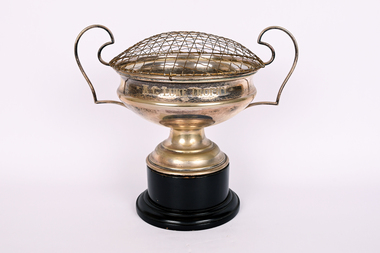
Award - K G Luke Trophy
... Textile Mills - sporting teams Textile Mills - staff Woollen Mills Sporting teams Classweave Industries Pty Ltd Federal Woollen Mills Ltd Foster Valley Mill Pty Ltd Valley Worsted Mill sport Textile Mills - sporting teams Textile Mills - staff Woollen Mills Sporting teams Working Life Bowl of cup: K G Luke Trophy Stem of cup: Paramount Plate Trophy cup in three parts. ...Donated when "Classweave Industries" closed down.Trophy cup in three parts. The round silver plated bowl is inscribed and has two side handles. A wire flower guard fits to the top of the bowl. The bowl stands on a round black-lacquered wooden base with screw-in steel plate. Bowl of cup: K G Luke Trophy Stem of cup: Paramount Plate textile mills - sporting teams textile mills - staff woollen mills sporting teams, classweave industries pty ltd federal woollen mills ltd foster valley mill pty ltd valley worsted mill, sport, textile mills - sporting teams, textile mills - staff, woollen mills, sporting teams, working life -
 Melbourne Tram Museum
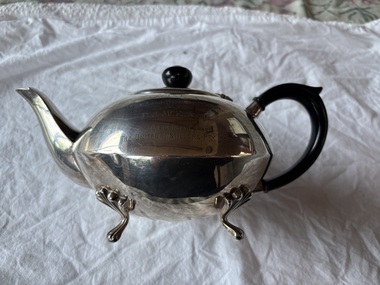
Domestic object - Silver Tea pot - Jack McKenzie, K G Luke, 1954
... K C Luke Pty Ltd Melb". Demonstrates an award to the Best and Fairest player in the VTFA in 1954. Glen Huntly Depot gifts tea pot football VTFA Engraved - "VTFA Best and Fairest player 1954 D J McKenzie / presented by the United Distilliers Pty Ltd". On the base stamped "Paramount plate Best Quality EPNSAI warranted hard soldered K C Luke Pty Ltd Melb" Silver tea pot with inscription, bakelite handle, spout and lid. Domestic object Silver Tea pot - Jack McKenzie K G ...Metal tea pot, silver plated with an engraved inscription "VTFA Best and Fairest player 1954 D J McKenzie / presented by the United Distilliers Pty Ltd". Victorian Tramway Football Association Jack worked as a conductor at Glen Huntly Depot. Stamped on the base "Paramount plate Best Quality EPNSAI warranted hard soldered K C Luke Pty Ltd Melb".Demonstrates an award to the Best and Fairest player in the VTFA in 1954.Silver tea pot with inscription, bakelite handle, spout and lid.Engraved - "VTFA Best and Fairest player 1954 D J McKenzie / presented by the United Distilliers Pty Ltd". On the base stamped "Paramount plate Best Quality EPNSAI warranted hard soldered K C Luke Pty Ltd Melb"glen huntly depot, gifts, tea pot, football, vtfa -
 Returned Nurses RSL Sub-branch
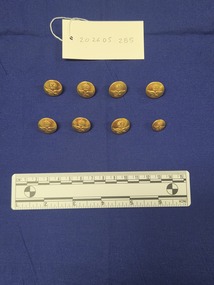
Uniform - Royal Australian Air Force buttons, K. G. Luke Melbourne, Unknown
... LUKE PTY. LTD. MELB' On reverse of two of eight buttons: 'STOKES & SONS' Eight brass buttons with a raised Royal Australian Air Force crown and eagle motif, and engraved makers mark and metal shank on reverse. All buttons are the same size with the exception of one smaller button. Uniform Royal Australian Air Force buttons K. G ...Part of a series of items related to Clare Rothwell Macintire. Claire Rothwell Macintire was born 27 July 1910 in Essendon and enlisted with the Royal Australian Airforce on 3 August 1943. Her service number was 500432. Eight brass buttons with a raised Royal Australian Air Force crown and eagle motif, and engraved makers mark and metal shank on reverse. All buttons are the same size with the exception of one smaller button.On reverse of six of eight buttons: 'K.G. LUKE PTY. LTD. MELB' On reverse of two of eight buttons: 'STOKES & SONS'army nurse, clare rothwell macintire, wwii, world war two, ww2, royal australian air force
