
Showing 14 items matching "key holder"
-
 Moorabbin Air Museum
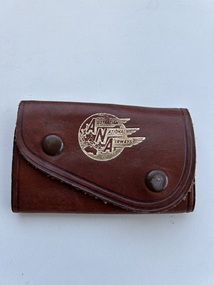
Functional object (Item) - Australian National Airways Key Holder Case Leather Holds Six Keys
... Australian National Airways Key Holder Case Leather Holds Six Keys.... Australian National Airways Key Holder Case Leather Holds Six Keys.... Australian National Airways Key Holder Case Leather Holds Six Keys....Australian National Airways Key Holder Case Leather Holds Six Keys. Australian National Airways Key Holder Case Leather Holds Six Keys. ... -
 Warrnambool and District Historical Society Inc.
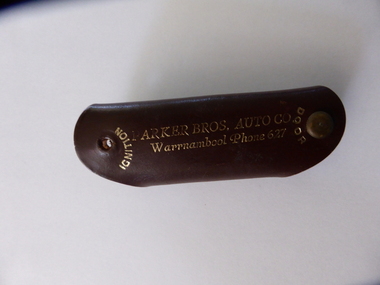
Souvenir - Key holder, Parker Bros Auto Co Key Holder, Mid 20th century
... Key holder...Parker Bros Auto Co Key Holder...This is a brown leather key holder issued as an advertising feature by Parker Bros Auto Co. ...Parker Bros Auto Co Key Holder Souvenir Key holder ...The Parker Bros Auto Company was established in 1927 in Liebig Street, with the business selling Chevrolet cars and used cars and later becoming the original Holden dealer in Warrnambool. The company employed a large staff with show rooms, a workshop, a panel shop, and a spare parts section. In 1968 the business relocated to 109 Lava Street and was still operating in the 1980s.This key ring holder is of great interest as a souvenir of Parker Bros. Auto Co, a prominent business in Warrnambool for over 50 years.This is a brown leather key holder issued as an advertising feature by Parker Bros Auto Co. Warrnambool. The key holder is folded over to include a metal bottle opener which is held to the leather with a metal stud and a metal press stud enables the holder to be locked shut. There are two holes at the end to attach keys to the holder. The printing on the holder is in gold lettering. ‘Ignition’, ‘Door’, ‘Home’, ‘Office’ ‘Auto Keys’ ‘Parker Bros. Auto Co. Warrnambool Phone 627’ parker bros auto co warrnambool, history of warrnambool -
 Charlton Golden Grains Museum Inc
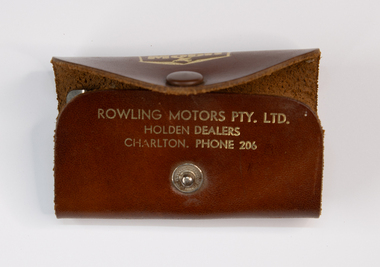
Domestic object - Key Holder
... Key Holder...Key Holder...Brown Leather Key Holder with one press stud. Inside there is 4 metal key rings...Key Holder Business Rowling Motors Pty Ltd Holden Dealer Mobil Inside - Rowling Motors Pty Ltd Holden Dealers Charlton Ph. 206 Outside - Mobil Brown Leather Key Holder with one press stud. ...Brown Leather Key Holder with one press stud. Inside there is 4 metal key ringsInside - Rowling Motors Pty Ltd Holden Dealers Charlton Ph. 206 Outside - Mobilkey holder, business, rowling motors pty ltd, holden dealer, mobil -
 Charlton Golden Grains Museum Inc
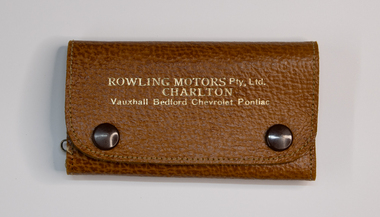
Domestic object - Key Holder with Bottle Opener
... Key Holder with Bottle Opener......Key Holder...Inside there is 6 key clips and a metal bottle opener Domestic object Key Holder with Bottle Opener ...Brown leather (pig skin) case with 2 dark brown press studs which folds to close. Inside there is 6 key clips and a metal bottle openerRowling Motors Pty Ltd Charlton Vauxhall Bedford Chevrolet Pontiacbusiness, rowling motors, key holder, cars, vauxhall, bedford, chevrolet, pontiac -
 Glenelg Shire Council Cultural Collection
Souvenir - Souvenir Key Holder - Portland, Victoria, c. 1970
... Souvenir Key Holder - Portland, Victoria...Key holder, homemade, pine lacquered, square, with rounded top, 3 hooks at bottom, hole in top for hanging. ...Coloured postcard with 9 views of Portland attached to front of key holder. Souvenir Souvenir Key Holder - Portland, Victoria ...Key holder, homemade, pine lacquered, square, with rounded top, 3 hooks at bottom, hole in top for hanging. Coloured postcard with 9 views of Portland attached to front of key holder.souvenir of portland, portland harbour -
 Melbourne Tram Museum
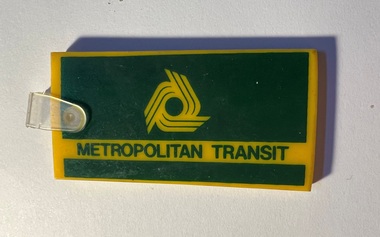
Badge - rubber type, The Met, "Metropolitan Transit", c1985
... Purpose of item not known - could be have been for a key ring holder. Has the first The Met logo....Purpose of item not known - could be have been for a key ring holder. Has the first The Met logo. Demonstrates a "The Met" produced branded item. badges The Met public transport Badge is made from a rubber-type flexible material with a semi-transparent clip on one end, "Metropolitan Transit" Badge rubber type The Met ...Purpose of item not known - could be have been for a key ring holder. Has the first The Met logo.Demonstrates a "The Met" produced branded item.Badge is made from a rubber-type flexible material with a semi-transparent clip on one end, badges, the met, public transport -
 Bendigo Military Museum
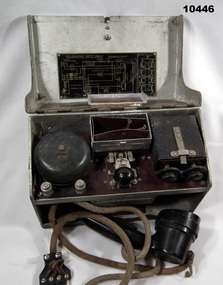
Equipment - TELEPHONE, FIELD, AUSTRALIAN, P.M.G. W/S, 1941
... On that shelf are:- a bell, line terminals, morse key, battery holder, and buzzer assembly. Under the shelf is a four terminal socket for the handpiece. ...On that shelf are:- a bell, line terminals, morse key, battery holder, and buzzer assembly. Under the shelf is a four terminal socket for the handpiece. ...Cast aluminium field telephone. The lid assembly hinges from the rear. Inside the lid is a schematic diagram on a metal plate. In the main body of the set is a small shelf. On that shelf are:- a bell, line terminals, morse key, battery holder, and buzzer assembly. Under the shelf is a four terminal socket for the handpiece. The handpiece is a black Bakelite material. It has a “Press to Talk” switch on the handset. The cable is cotton covered for insulation. At the rear are two webbing straps, 25 mm wide. There is a strap loop for each side.Stencilled on top of lid is: “TELE SET D MK.V” There is a black broad arrow stencilled on front. Painted roughly on the back, in pink paint, are the letters "C.M.S".communications, signalling, telephone, ww2 -
 Flagstaff Hill Maritime Museum and Village
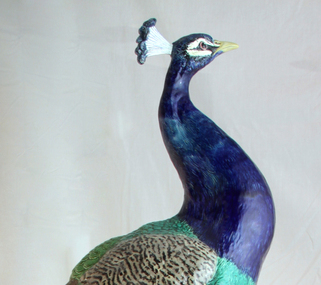
Decorative object - Peacock, Minton Majolica life-size model, Paul Comolera, artist, Designed: c. 1873; Made: c. 1875
... Keys claimed that at the time of the rescue, the head had broken from the body. This account was proven to be true in 1988, following the birds' display in Brisbane. This peacock began its life in Australia, not in the grandeur of an International Exhibition as intended, but in the hallway of a simple domestic house in Geelong. It appears Minton & Co. did not attempt to buy this peacock back. Florence Miller, daughter of James Miller (Loch Ard salvage rights holder...Keys claimed that at the time of the rescue, the head had broken from the body. This account was proven to be true in 1988, following the birds' display in Brisbane. This peacock began its life in Australia, not in the grandeur of an International Exhibition as intended, but in the hallway of a simple domestic house in Geelong. It appears Minton & Co. did not attempt to buy this peacock back. Florence Miller, daughter of James Miller (Loch Ard salvage rights holder ...This majestic peacock embodies the technical achievement, skill and ingenuity of artisans during the 19th century. It is now known as the 'Loch Ard Peacock' and was designed and modelled in 1873 by Paul Comolera (1818-1897) and fired in one piece at the Minton factory at Stoke-on-Trent in the United Kingdom in 1875. The peacock has been portrayed in symbolic motifs and has figured heavily in folktales and fables since antiquity, and many cultures around the world see it as a symbol of beauty, rebirth and power. Wealthy Victorians loved majolica, and the large peacock would have been the ultimate home accessory as a conservatory ornament – combining their desire for nature, the exotic and vibrant colours. The peacock model was listed in catalogues by Minton & Co. for a retail price of 35 guineas or sold as a pair for 90 guineas. Minton & Co. was founded in 1793 by Thomas Minton (1765–1836) and became a famous pottery and porcelain manufacturer. Comolera was a French artist and sculptor, renowned for dramatic naturalistic forms and life-size renditions of birds and animals that won him admiration in public and artistic circles. He was employed by Minton & Co. from 1873 to 1880, and the life-sized peacock became his best-known work. Comolera kept a live peacock loaned from the nearby Duke of Sutherland's Trentham Hall Estate in his studio to create a life-size model of fine buff earthenware model, which was then hand painted in brilliantly coloured green and blue glazes to mimic the peafowl’s dazzling plumage. There are no surviving production records, but according to documents in the Minton Archive, nine peacocks were made by Comolera. However, today, some historians now believe that twelve were fired at the Minton factory; research is ongoing. These peacocks were so admired that Minton & Co. used them as exhibition showpieces at International Exhibitions in London, Paris, and the United States of America, ensuring the company had a worldwide reputation. So, when Melbourne hosted an International Exposition in 1880, Minton & Co. sent out ceramics and tiles, and in particular, this peacock was intended to be part of their exhibit in the British Court in the Exhibition Building, built in the Carlton Gardens. The early dispatch date (1878) indicates that the company may have intended to exhibit their wares, including the peacock, at the 1879 Sydney International Exhibition, but the company did not take up this option. The ship that Minton & Co. used to bring the peacock and their other wares to the Australian colonies was the ill-fated Loch Ard, which sunk after striking Mutton Bird Island near Port Campbell, Victoria, in calm foggy weather in June 1878 on the final leg of the ship's journey to Melbourne. The loss of 52 lives made it one of Victoria’s worst shipwrecks. Therefore, this peacock never made it to the grand exposition in Melbourne, as Minton & Co. had planned. Charles McGillivray dragged this peacock, still in its original packing case, onto the beach in the gorge just two days after the Loch Ard went down. The peacock was rescued unscathed apart from a chip on its beak (only repaired in 1988). After a disagreement with a Melbourne Customs Officer, Joseph Daish, McGillivray stopped his salvage operations, leaving the peacock on the beach. The second salvagers were James Miller and Thomas Keys. Miller was a member of the firm Howarth, Miller and Matthews, Geelong, who had brought the salvage rights to the Loch Ard wreck on 10 June. When Miller and Keys arrived at the wreck site, a storm had washed many of the salvaged goods, including this peacoc,k back into the sea. The two men found the peacock in its case ‘bobbing along in the water’ and pulled it back to the beach. To ensure the peacock wasn't washed out to sea again, Miller and Keys hauled the packing case containing the peacock up the gorge's cliff face to the top, ready to be transported. In an interview in 1928, Keys claimed that at the time of the rescue, the head had broken from the body. This account was proven to be true in 1988, following the birds' display in Brisbane. This peacock began its life in Australia, not in the grandeur of an International Exhibition as intended, but in the hallway of a simple domestic house in Geelong. It appears Minton & Co. did not attempt to buy this peacock back. Florence Miller, daughter of James Miller (Loch Ard salvage rights holder), later remarked that the only item of real value rescued from the wreck had been the peacock and that this had been kept by her father in the family home at Malvern for many years and became a treasured family possession. As such, this 'Loch Ard peacock' was almost forgotten and mistaken with other Minton peacocks around the world. Miss Florence Miller tried to sell the peacock due to financial difficulties in the 1930s but was unsuccessful. While attempting to sell her Loch Ard relic, it was displayed in the window of the old Argus newspaper office, which was at 76 Collins Street, Melbourne; the Argus had relocated to the corner of Elizabeth and La Trobe Streets in 1926. Between 1935 and 1939, the old Argus building was occupied by the Joshua N. McClelland Print Room, which sold not only paintings and prints but also antiques and authentic replicas, as well as hosting exhibitions. Miss Florence Miller loaned her peacock for display at the Victorian Historical Exhibition held in the National Gallery on 1st June 1935, the 57th anniversary of the Loch Ard wreck. As a result, the peacock attracted public attention in books, newspapers and magazine articles that told the story of its survival from a shipwreck. Miss Florence Miller was keen to sell the peacock, even writing overseas to Captain Blain on November 30th, 1938, about the possibility of a sale, but this became no longer possible due to the outbreak of war. Recent information points to the Loch Ard peacock being owned by John S R Heath before its sale to Frank Ridley-Lee in May 1941. Research is ongoing, but it seems likely that John Samuel Robert Heath, a leading Melbourne dentist with a practice in Collins Street, and his wife, a dental mechanic, had purchased Miss Miller’s Loch Ard peacock before its sale in 1941. They were lovers of fine arts, music, wine and food. The peacock in the window of the old Argus building could have attracted their attention as they had already purchased the old stone Presbyterian Church on Warrigal Road, Oakleigh, in 1933 and had converted its interior. The home, renamed The Studio, even included Melbourne’s first all-electric kitchen. The peacock was perfect for display in the Studio’s entrance. A magazine article published after the conversion was completed included photographs of the interior. The picture of the ‘portico’ had a caption below that stated, “Some of her [Mrs Heath’s] finest pottery was salvaged from the Loch Ard Wreck”. In 2025, Heath’s two remaining sons remember running around in the entrance with the peacock standing there, oblivious to its value. Heath was an accomplished artist, studying under Max Meldrum. He painted and exhibited his works at The Studio and in a public exhibition, and he was a finalist eight times in the coveted Archibald Prize portrait competition, including the submission of his self-portrait that is now part of his grandson’s collection. The next owner of the Loch Ard Peacock was Frank Ridley-Lee. He displayed it at his home in Ivanhoe after buying it at an auction in May 1941. The peacock remained in the hands of the Ridley-Lee family until it was offered for sale by auction in 1975 as part of an art collection belonging to Mrs Ridley-Lee's estate. The peacock was not sold at this time, as the reserve price of $4500 was not met. This news was passed on to the board of the newly created Flagstaff Hill Maritime Village. Urgent efforts were made to collect the necessary money through fundraising by the Warrnambool City Council and public donations. The Fletcher Jones Company and the Victorian Government contributed half the cost. On 9 September 1975, the Loch Ard peacock was purchased by Flagstaff Hill Maritime Village, and it found a new home at the maritime museum. Since then, it has only left Warrnambool twice. Firstly, in 1980, at the centenary celebrations of the Royal Exhibition Building in Melbourne, and secondly, in 1988, the peacock was given pride of place at the entrance to the Victorian Pavilion at the Brisbane World Expo, acknowledging that this Minton Majolica peacock is the most significant shipwreck object in Australia. The Minton majolica peacock is considered of historical social and aesthetic significance to Victoria and is one of only a few 'objects' registered on the Victorian Heritage Register (H 2132), as it is a most notable and rare object associated with the Minton factory of the 1870s and works by the celebrated sculptor Paul Comolera along with the wreck of the Loch Ard on the Victorian coastline. This Minton peacock is historically significant for its rarity; it was one of only 9-12 known to exist. The shipwreck of the Loch Ard is also of significance for Victoria and is registered on the Victorian Heritage Register Ref (S 417). Flagstaff Hill has a varied collection of artefacts from Loch Ard and its collection is significant for being one of the largest accumulation of artefacts from this notable Victorian shipwreck. The collections object is to also give us a snapshot into history so we can interpret the story of this tragic event. The collection is also archaeologically significant as it represents aspects of Victoria's shipping history that allows us to interpret Victoria's early social and historical themes. The collection is historically significant is that it is associated, unfortunately with the worst and best-known shipwreck in Victoria's history. The peacock, resplendent in polychrome glaze, stands perched on a rocky plinth decorated with vines, leaves, flowers, blackberries and wild mushrooms. The peacock’s breast is cobalt blue; the wings and legs are in naturalistic colours. The tail is a mass of feathers coloured in green, ochre blue and brown — a fantastic display of artistry and Minton expertise. Inscribed at the base :P Comolera, and a Minton & Co. design number: 2045.flagstaff hill, warrnambool, maritime museum, shipwreck coast, loch ard, loch ard gorge, peacock, paul comolera, victorian heritage register, minton peacock, minton & co., stoke upon trent, bird figures, mintons, ceramics, international expositions, majolica, naturalistic, staffordshire, john samuel robert heath, peacock statue, loch ard peacock, majorca peacock -
Bendigo Historical Society Inc.
Administrative record - Commercial Egg Producers' Association of Victoria (CEPA) Central Council Correspondence, 1992-1999
... No long-term assurance of water supply for entitlement holders, despite ongoing negotiations for bulk entitlements.No compensation for loss of water entitlement, even though such entitlements have significant capital value 8504.48l Coliban Water Investigation Committee Meeting Mar 1996 Agenda and minutes from previous meeting 8504.48m Coliban Water Investigation Committee Meeting Jan 1996 Agenda and minutes from previous meeting 8504.48n Coliban Water Investigation Committee Meeting Jul 1996 Agenda and minutes from previous meeting 8504.48o The document details a special meeting in Aug 1997 convened by C.W.I.C. to address concerns about unsatisfactory water agreements sent to rural users by Coliban Water. Key...No long-term assurance of water supply for entitlement holders, despite ongoing negotiations for bulk entitlements.No compensation for loss of water entitlement, even though such entitlements have significant capital value 8504.48l Coliban Water Investigation Committee Meeting Mar 1996 Agenda and minutes from previous meeting 8504.48m Coliban Water Investigation Committee Meeting Jan 1996 Agenda and minutes from previous meeting 8504.48n Coliban Water Investigation Committee Meeting Jul 1996 Agenda and minutes from previous meeting 8504.48o The document details a special meeting in Aug 1997 convened by C.W.I.C. to address concerns about unsatisfactory water agreements sent to rural users by Coliban Water. Key ...The Commercial Egg Producers' Association of Victoria was active by the 1930s, engaging in industry management and lobbying.The Commercial Egg Producer's Association (CEPA) had branches in Bendigo, South Bendigo, Eaglehawk, Wedderburn, Murrabit and Euroa.CEPA Commercial Egg Producer's Association (Bendigo Region) correspondence, for the years 1992-1999. This item includes the following documents: 8504.48a The document outlines the agenda and minutes for an upcoming meeting of the Coliban Water Investigation Committee. Meeting Details:Scheduled for Tuesday, 28th September 1993 at 8:00 p.m. at the T.A.F.E. College (east side of Chapel Street). 8504.48b Coliban Water Investigation Committee meeting agenda for November 23, 1993. Meeting Scheduled for Tuesday, November 23, 1993, at 8:00 p.m. at the T.A.F.E. College (east side of Chapel St.). 8504.48c Coliban Water Investigation Committee meeting agenda and minutes:Meeting. Tuesday, 25th January 1994 at 8:00 p.m. at the T.A.F.E. College (east side of Chapel). 8504.48d The Coliban Water Investigation Committee meeting agenda for September 27, 1994, and minutes of meeting May 1994 8504.48e CEPA Invoice for Affiliation Fee July 1994-93 to the Coliban Water Investigation Committee 8504.48f Coliban Water Investigation Committee Meeting AgendaMeeting Scheduled for Tuesday, May 24, 1994, at 8 p.m.Location: T.A.F.E. College, West side of Chapel Street, Seminar Room. Agenda and previous minutes 8504.48g The Coliban Water Investigation Committee meeting agenda and notices:Meeting DetailsDate & Time: Tuesday, 22nd November 1994, 8:00 p.m.Location: T.A.F.E. College Seminar Room (Chapel St.), and previous minutes. 8504.48h Annual Meeting of the Coliban Water Investigation Committee held on July 25, 1995. Minutes July 1995 8504.48i From Coliban Water May 1996. The document discusses the initial phase of creating a long-term strategy for water source security in the Coliban system.Several unresolved issues were identified that need solutions for comprehensive water security planning. 8504.48j The Coliban Water Investigation Committee meeting August 27th 1997 focused on rural water supply changes and public engagement. 8504.48k Critique of Coliban Water's Agreement's Second Schedule. The document strongly objects to the second schedule, citing three main issues: No rights or opportunity for holders to transfer water between properties. No long-term assurance of water supply for entitlement holders, despite ongoing negotiations for bulk entitlements.No compensation for loss of water entitlement, even though such entitlements have significant capital value 8504.48l Coliban Water Investigation Committee Meeting Mar 1996 Agenda and minutes from previous meeting 8504.48m Coliban Water Investigation Committee Meeting Jan 1996 Agenda and minutes from previous meeting 8504.48n Coliban Water Investigation Committee Meeting Jul 1996 Agenda and minutes from previous meeting 8504.48o The document details a special meeting in Aug 1997 convened by C.W.I.C. to address concerns about unsatisfactory water agreements sent to rural users by Coliban Water. Key points include:Purpose of Meeting:The meeting was called to discuss the actions of Coliban Water in sending unsatisfactory agreements to rural water users on the Coliban channels. 8504.48p Coliban Water Investigation Committee Meeting March 1997 Agenda and minutes from previous meeting 8504.48q Formal letter from Pat McNamara, Deputy Premier Minister for Agriculture; regarding Coliban Water's future supply arrangementsWater has committed to consulting rural users before finalizing new arrangements in 1998.The Committee's views on future trading arrangements have been acknowledged. 8504.48r Coliban Water Investigation Committee Meeting Oct 1997 Agenda and minutes from previous meeting 8504.48s Key Points of Coliban Water's Rural Supply ReformsConsultative Process and Sub-committee Role. The Rural Users' Sub-committee was formed to assist Coliban Water in improving the Rural Water Supply System.Members, including Steve Lottkowitz and Bernie Mannes, provided feedback on options developed by Coliban Water staff. 8504.48t Spreadsheet - Receipts and Expenditure 1995-96 8504.48u Coliban Water Investigation Committee Meeting Jan 1997 Agenda and minutes from previous meeting 8504.48v Coliban Water Investigation Committee Cancellation of Meeting Sept 1995 8504.48w Coliban Water Investigation Committee Meeting Sept 1996 Agenda and minutes from previous meeting 8504.48x Minutes of CWIC meeting Aug 1995 8504.48y Coliban Water Investigation Committee Meeting Aug 2000 Agenda and minutes from previous meetingegg producer's information, correspondence, cepa, commercial egg producers' association -
 Bendigo Historical Society Inc.
Document - SOROPTIMIST COLLECTION CUTTINGS AND PHOTOS FROM BENDIGO CHAPTER
... Folder contains newspaper articles recording the formation of Soroptimist International Bendigo in1978, office holders, photographs from meetings, newspaper reports on local projects and contributions to international aid, programs and menus for celebratory dinners. Photographs 1978 - 2003 are labelled with names of members. Detailed information on key...Bendigo soroptomist international Folder contains newspaper articles recording the formation of Soroptimist International Bendigo in1978, office holders, photographs from meetings, newspaper reports on local projects and contributions to international aid, programs and menus for celebratory dinners. Photographs 1978 - 2003 are labelled with names of members. Detailed information on key ...Folder contains newspaper articles recording the formation of Soroptimist International Bendigo in1978, office holders, photographs from meetings, newspaper reports on local projects and contributions to international aid, programs and menus for celebratory dinners. Photographs 1978 - 2003 are labelled with names of members. Detailed information on key projects such as Trees for the World is included.bendigo, soroptomist international -
 Bendigo Historical Society Inc.
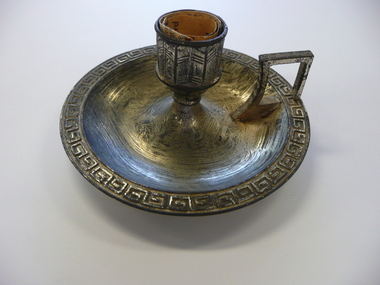
Domestic Object - CANDLE HOLDER
... Britannia metal hand held candle holder, circular base with Greek key pattern around rim and handle....LIGHTING Candle candleholders U4.711 Britannia metal hand held candle holder, circular base with Greek key pattern around rim and handle. ...Britannia metal hand held candle holder, circular base with Greek key pattern around rim and handle.lighting, candle, candleholders, u4.711 -
 Bendigo Historical Society Inc.
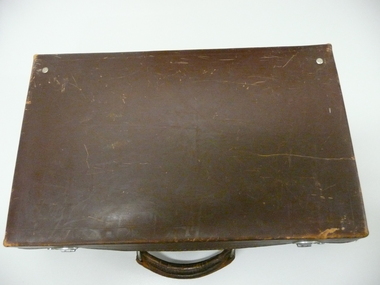
Tool - BILL ASHMAN COLLECTION: SCALEBUOY SAMPLE CASE
... Brown leather case with 2 keys containing 4 scalebuoys of various types and sizes held in a blue velvet holder & a pocket in lid holding 9 publications by W.N.Abbott on the uses of Scalebuoys along with 2 letters attesting to the success of Scalebuoys....Abbott Brown leather case with 2 keys containing 4 scalebuoys of various types and sizes held in a blue velvet holder & a pocket in lid holding 9 publications by W.N.Abbott on the uses of Scalebuoys along with 2 letters attesting to the success of Scalebuoys. ...Leather display case holding scalebuoys belonged to Bill Ashman, who was a salesperson for the Abbott company. A Scalebuoy is a handheld water treatment device, invented by Hartley Abbott and patented under the name of the Bendigo Electronic Company, designed to prevent scale buildup in water vessels and boilers by supposedly "softening" the water. Brown leather case with 2 keys containing 4 scalebuoys of various types and sizes held in a blue velvet holder & a pocket in lid holding 9 publications by W.N.Abbott on the uses of Scalebuoys along with 2 letters attesting to the success of Scalebuoys.scalebuoy, w. abbott -
 Melbourne Tram Museum
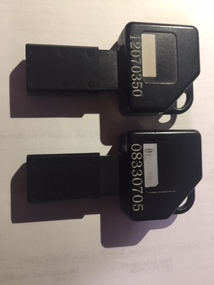
Functional object - Digital memory module, KDM, c1995
... key into the black-coloured terminal (tram driver's keypad - TDKP or bus driver's keypad) to upload the shift data to the vehicle. This was also the method used to transfer the 'blacklist' of periodical passes that had been stolen or misappropriated to each vehicle. IE if an annual Metcard had been stolen, once the holder...key into the black-coloured terminal (tram driver's keypad - TDKP or bus driver's keypad) to upload the shift data to the vehicle. This was also the method used to transfer the 'blacklist' of periodical passes that had been stolen or misappropriated to each vehicle. IE if an annual Metcard had been stolen, once the holder ...Digital Memory module, or Portable Memory Key, equivalent in type to a USB stick, black plastic with sliding mechanism to protect 8 copper contact strips with a digital memory area at one end. Stamped into the memory area part number "109 13858 512K KDM", indicating it had a memory storage of 512Kb. Above the number are the remains of a white bar-code label. Has as key type appearance. .1 - Numbered in white numerals "08330705" .2 - ditto "120703350" Advised by Adam Chandler 20-11-2017: They were used by tram and bus drivers. The PM (portable memory) key was issued to each driver. At the start of a shift, the driver would put it into a cream-coloured terminal at the sign-on point (starter's office in the depot) and transfer their shift information onto the key. Once the driver reached the vehicle, they put the key into the black-coloured terminal (tram driver's keypad - TDKP or bus driver's keypad) to upload the shift data to the vehicle. This was also the method used to transfer the 'blacklist' of periodical passes that had been stolen or misappropriated to each vehicle. IE if an annual Metcard had been stolen, once the holder reported it to Metcard they would blacklist the ticket number and this would be sent out to every depot and piece of equipment. From memory there were 100 slots in the blacklist. When a tram driver was finishing their shift (either being taken or running in) they would transfer all of the validations and ticket sale information to the PM key by inserting it a few minutes before the end of shift and downloading all of this data from the vehicle. They would then be required, on arriving back at the starter's office, to insert the key in the cream coloured terminal once more and copy all of the information across to the main system. Bus drivers also issued tickets from their BDKPs so the black PM key was also used for ensuring the accounting information was copied across to the main system. My memory might be faulty but I recall using them at railway stations with the Booking Office Machines (for starting and finishing shifts). No transfer of ticket issuance data however, as there was a computer equipment cabinet at each railway station with a DSL or cable link back to the OneLink central computers (in the revenue clearing house) I don't know what happened with the MTH cars on the Stony Point rail line but I could presume that there was a cabinet with a TDKP equivalent in it and a similar procedure for start and finish of shift.trams, tramways, ticket machines, metcard -
 City of Melbourne Libraries
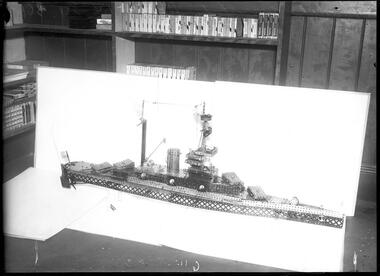
Photograph, Bull, Hugh Jones, 1897-1993, Window display: model warship YiPi
... holders. It wasn't until early 2023 that the photographer's identity was revealed with the help of archivist/librarian at The Age, Michelle Stillman. As for young Barry – what a talent! Meccano was hugely popular at this time. The Melbourne Meccano Club met on a Tuesday at the YMCA building. On 18 August 1933 The Age reported that at their upcoming meeting the model builders “will gain an insight into the oil industry from a lecturer and moving pictures supplied by the Vacuum Oil Co.” Models reflected an interest in rapid technological developments of the time, and also key...holders. It wasn't until early 2023 that the photographer's identity was revealed with the help of archivist/librarian at The Age, Michelle Stillman. As for young Barry – what a talent! Meccano was hugely popular at this time. The Melbourne Meccano Club met on a Tuesday at the YMCA building. On 18 August 1933 The Age reported that at their upcoming meeting the model builders “will gain an insight into the oil industry from a lecturer and moving pictures supplied by the Vacuum Oil Co.” Models reflected an interest in rapid technological developments of the time, and also key ...Teenager’s Meccano model in The Age window Whilst Barry’s model is interesting, and he himself is more than interesting – renowned for his lifelong harmonica playing, vaudeville and stand-up comedy as “Mr Versatility” – it is the location of the photo which intrigued us. Was this the photographer’s office, and would it give us a clue to his identity? We thought he might be “Mr Duke” as some boxes of Kodak slides were so named! But we later deduced they were most likely related to the Duke’s Centenary visit to Melbourne. However, they did lead us to The Age archivist Michelle Stillman, who held the key to unlock the photographer’s identity. Louise McKenzie. Photographer notations on slide: "Model warship YiPi 14-12-34 B61" Published: 14 September 1934 The Age p15 Published title: MECCANO CRUISER Published caption: Barry Sandford (17) of Richmond, recently completed this splendid Meccano model of a modern cruiser. It is fitted with four swivelling turret guns, six quick-firers, searchlight, movable anchor rudder and propeller. This model is on view in "The Age" office window, Collins-street. Trove article identifier: http://nla.gov.au/nla.news-article205072014 Description: Meccano model of cruiser. Wood panelled office walls and boxes of glass slides can be seen in the background. Research by project volunteer, Louise McKenzie: The second slide we scanned, this photo of Barry Sandford’s Meccano model of a cruiser was of particular interest because it appeared to have been taken in the photographer's studio/office. For the bulk of our project, the identity of the photographer was not known, and we delighted in imagining who they were, whether they were amateur or professional, and what else might be stored in those neatly labelled boxes in the background. But the photo had its own story regardless. A photo of Barry Sandford’s meccano model appeared in the Melbourne AGE on Friday 14 December 1934; it was probably the same photo as the one in our collection – now cropped to remove the background office environment. This background shows shelves of Kodak Panochromatic, and archived boxes labelled “DUKE” with various references: D1 – D23, and one labelled ‘DUKE Not Used’. On a shelf there is a stack of wooden glass plate holders. It wasn't until early 2023 that the photographer's identity was revealed with the help of archivist/librarian at The Age, Michelle Stillman. As for young Barry – what a talent! Meccano was hugely popular at this time. The Melbourne Meccano Club met on a Tuesday at the YMCA building. On 18 August 1933 The Age reported that at their upcoming meeting the model builders “will gain an insight into the oil industry from a lecturer and moving pictures supplied by the Vacuum Oil Co.” Models reflected an interest in rapid technological developments of the time, and also key activities. On 2 November 1934 The Age showed Barry with a model of Sir Charles Kingsford Smith’s Lockheed Altair, “Lady Southern Cross”, which Kingsford Smith purchased with the intent to compete in the MacRobertson Air Race as part of the Melbourne Centenary celebrations. He did not participate, but in late 1935 he and co-pilot John Thompson “Tommy” Pethybridge flew Lady Southern Cross from India to Singapore in an attempt to break the England-Australia speed record. Sadly, on the night of 8 November, they disappeared over the Andaman Sea and were never found. The Harmonica Riff Raff blog provides an amazing and comprehensive commentary on Barry Sandford's life. He is described as a Richmond boy of many talents – model making, archery, comedy, kite making, magic and juggling, as well as a harmonica virtuoso. He was particularly renowned for his harmonica playing and the creation of a two-foot long harmonica, and a tiny, hands-free organ which he played fully enclosed in his mouth. He promoted himself as Mr. Versatility and often featured in Melbourne news articles in the 1930s and 1940s. He remained very active in the entertainment business throughout his life, including as a member of the Four Octaves harmonica group, on the Tivoli circuit, and in vaudeville and stand up comedy. He successfully made the move from stage and radio into television. He died in 1992, still saluted by his peers as the gentleman, Mr Versatility. References: MECCANO CRUISER. (1934, December 14). The Age (Melbourne, Vic. : 1854 - 1954), p. 3. Retrieved January 22, 2024, from http://nla.gov.au/nla.news-article205072014 MIMIC MECCANO WARFARE. (1933, July 21). The Age (Melbourne, Vic. : 1854 - 1954), p. 2 (This Supplement is Published Every Friday). Retrieved September 19, 2023, from http://nla.gov.au/nla.news-article204368610 MELBOURNE MECCANO CLUB. (1933, August 18). The Age (Melbourne, Vic. : 1854 - 1954), p. 1 (This Supplement is Published Every Friday). Retrieved September 19, 2023, from http://nla.gov.au/nla.news-article204367564 MECCANO MODEL OF LADY SOUTHERN CROSS. (1934, November 2). The Age (Melbourne, Vic. : 1854 - 1954), p. 3. Retrieved September 19, 2023, from http://nla.gov.au/nla.news-article205083196 Charles Kingsford Smith, Wikipedia, https://en.wikipedia.org/wiki/Charles_Kingsford_Smith 'Mr. Versatility', Harmonica Riff Raff, https://harmonicariffraff.blog/2022/09/05/mr-versatility/ Photographer notations on slide: "Model warship YiPi 14-12-34 B61".ships, models, the age, harmonicas, meccano
