
Showing 74 items matching "kitchen appliance"
-
 Musculoskeletal Health Australia (now held by the Glen Eira Historical Society)
Photograph - Solo photo, November to December 1989
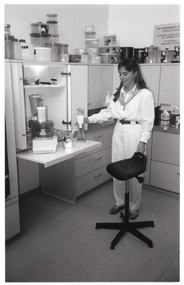
... Through its quarterly newsletters, the Arthritis Foundation of Victoria (AFV), formerly the Rheumatism and Arthritis Association of Victoria (RAAV), was able to inform its members about the latest arthritis-friendly kitchen appliances and aids, and how to use them. ...On top of the shelf are some kitchen appliances, such as a food processor and a hand-held immersion blender. ...On top of the shelf are some kitchen appliances, such as a food processor and a hand-held immersion blender. ...Through its quarterly newsletters, the Arthritis Foundation of Victoria (AFV), formerly the Rheumatism and Arthritis Association of Victoria (RAAV), was able to inform its members about the latest arthritis-friendly kitchen appliances and aids, and how to use them. In this photo, a woman stands beside a Sit-Stand Chair (a high mobile stool on castors) and a pull-out shelf, on which sit various electric kitchen appliances (such as a food processor and an immersion blender). The photo was taken at the Independent Living Centre, which contained a specially designed demonstration kitchen through which innovative designs and aids for people living with arthritis could be showcased. According to an earlier article appearing on page 3 of the No 33, August 1984 edition of RAAV's quarterly newsletter, News Review, the Independent Living Centre was the venue for the launch of Arthritis Week in May 1984.B&W photo of a woman standing beside a pull-out kitchen shelf and a high stool on castors. On top of the shelf are some kitchen appliances, such as a food processor and a hand-held immersion blender. On top of the kitchen cupboards, there are several round plastic food storage containers of various sizes stacked upon one another.[On a yellow sticky note, in blue ink] The aid (crossed out) 'Sit Stand Chair' can be wheeled into position and easily adjusted to a suitable height. [On a yellow sticky note, in blue ink] Joan - Use whichever of these is (crossed out) gives the clearer idea. This one perhaps - Jenny.arthritis foundation of victoria, afv, rheumatism and arthritis association of victoria, raav, independent living centre, demonstration kitchen, arthritic aids, kitchen aids, kitchen gadgets, kitchen appliances, kitchen sink, food processor, blender, immersion blender, stick blender, kitchen canisters, food storage, pantry storage containers, swivel chair, sit-stand chair, pull-out workbench, retractable bench top, sliding bench top, adaptive kitchens, accessible kitchens, disability-friendly kitchens, modified kitchens, yooralla society of victoria, living with arthritis, pain management, arthritis update, news review, 1990, 1984 -
 Wodonga & District Historical Society Inc
Domestic object - Propert's Whistling Egg Timer and egg whisk
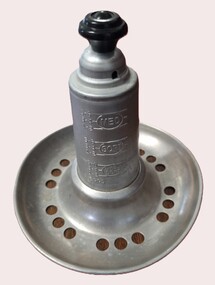
... Two Propert's kitchen appliances - a stainless steel Whistling Egg Timer and a Swift Whisk Beater...Kitchen utensils Propert Kitchen appliances On Egg Beater : A PROPERT PRODUCT MADE IN AUSTRALIA PATENT BALL DRIVE SWIFT WHIP STAINLESS STEEL Two Propert's kitchen appliances - a stainless steel Whistling Egg Timer and a Swift Whisk Beater Propert's Whistling Egg Timer and egg whisk Domestic object Propert's Whistling Egg Timer and egg whisk ...John and Emma Propert emigrated from England in 1877 and settled in New South Wales . Several of their 11 children became talented inventors, designing items ranging from kitchen utensils to coaches and later pop-up caravans. One of the most successful was Charles, who designed and built kitchenware over many decades. His earliest invention was irrigation equipment including patenting the common backyard rose sprinkler. Propert became a household name when he began making a wide range of kitchen implements for decades including flour sifters and chip cutters. By the 1970s Propert was Australia’s leading brand of kitchen and bathroom scales. By far the most successful product was a ball-driven egg beater, trademarked as the Ezy Whisk or Swift Whisk. In the days before electric beaters, the Ezy Whisk and Swift Whisk were market leaders and were exported world-wide. Charles Propert and his son Bertram manufactured more than a quarter of a million egg beaters a year in the early 1950s which explains why so many are still in use today.These items are significant because they were widely used throughout Australia in the 1950s by a major Australian manufacturer.Two Propert's kitchen appliances - a stainless steel Whistling Egg Timer and a Swift Whisk BeaterOn Egg Beater : A PROPERT PRODUCT MADE IN AUSTRALIA PATENT BALL DRIVE SWIFT WHIP STAINLESS STEELkitchen utensils, propert kitchen appliances -
 Flagstaff Hill Maritime Museum and Village
Freezer, circa 1930's
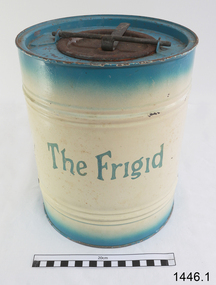
... ...kitchen appliance...(Reference: State Library of South Australia) A Simpson and Son was an early colonial business that has lasted well into the 20th century and the name Simpson is still associated with whitegoods. flagstaff hill warrnambool shipwrecked-coast flagstaff-hill flagstaff-hill-maritime-museum maritime-museum shipwreck-coast flagstaff-hill-maritime-village a. simpson & son limited manufacturer foundry freezer 2 quart freezer portable freezer kitchen appliance the frigid ice cream freezer ice cream maker 1930's Outside of freezer is printed in blue"The Frigid". ...This ice cream freezer, manufactured in South Australia in the 1930's, was advertised to "keep the contents of the cream compartment frozen for many hours". It was promoted for use at picnics to keep salads cool. Its design is very similar to other freezers of The Frigid name which were made in 1939; those freezers were all one colour whereas this one is blue around the top and bottom of the barrel and cream in the centre with blue/green lettering. The process of making ice cream was to pack the outer chamber full with a combination of 3 parts ice cubes of about 1 inch (2.cm) to one part coarse salt, then pour into the chamber about 1 cup of cold water. After this, the ingredients for ice cream or sorbet were poured into the inner chamber, then attach the lid and turn The Frigid freezer upside down for about 40 minutes or until the right consistency is reached. Advice as given to open the freezer every 20 minutes and stir around the contents that were frozen against the sides of the inner chamber. The ingredients for the ice cream could include cream, sugar, vanilla and eggs. The label on the box of The Frigid shows the address of A Simpson and Son to be at Pirie Street, Adelaide. This address was used as early as 1876 and later catalogues, 1931 - 1960 still show this address. Alfred Simpson and his family emigrated from England, arriving in South Australia in 1849. He had already completed his apprenticeship as a tinplate worker but he tried various other occupations, including trying out the gold mines in Victoria, before he established himself as a tinsmith in 1853. His products included many agricultural items. His son, Alfred Muller Simpson, joined the business when he turned 21. In the 1860 Simpson's products included 'explosion proof' safes. In the late 1880's A Simpson and Son manufactured munitions and mines for the war. At the time of Alfred's death in 1891, A Simpson and Son had the largest metal manufacturing plant in Australia. From 1898 the company's reputation grew from the process of enamel plating with porcelain. During the First World War, Simpsons returned to the manufacture of munitions. Alfred M. Simpson's sons (Alfred Allen, known as Allen, and Fredrick Neighbour) joined the company when they finished their schooling. Allen was also associated with the Royal Geological Society over many years and when the CT Madigan surveyed Central Australia in 1929, the Simpson Desert was named in his honour. Cape Simpson in Antarctica is also named after him due to his assistance to Douglas Mawson. A new factory was opened at Dudley Park in the 1940s and the company began the manufacture of whitegoods. In 1963 A. Simpson and Son merged with Pope Industries to form Simpson Pope Holdings. Alfred Simpson became chairman of the board of Simpson Pope Holdings. The Simpson brand, now owned by Electrolux, continues to produce a variety of household appliances. (Reference: State Library of South Australia) A Simpson and Son was an early colonial business that has lasted well into the 20th century and the name Simpson is still associated with whitegoods. Freezer, 2 quart (1.8 litre) capacity, made by A Simpson and Son Ltd, marked "The Frigid". Cylinder shaped, constructed from enamelled sheet metal, has two catches one on the base and one on top. Inner cylinder for holding contents for freezing. Slightly rusted. Freezer is inside original cardboard box with yellow label showing manufacturer details. Circa 1930'sOutside of freezer is printed in blue"The Frigid". Box includes "THE "FRIGID" FREEZER" and branded "S & S" inside a circle.flagstaff hill, warrnambool, shipwrecked-coast, flagstaff-hill, flagstaff-hill-maritime-museum, maritime-museum, shipwreck-coast, flagstaff-hill-maritime-village, a. simpson & son limited, manufacturer, foundry, freezer, 2 quart freezer, portable freezer, kitchen appliance, the frigid, ice cream freezer, ice cream maker 1930's -
 Flagstaff Hill Maritime Museum and Village
Domestic object - Food Mincer, Enterprise Manufacturing Company, circa 1911
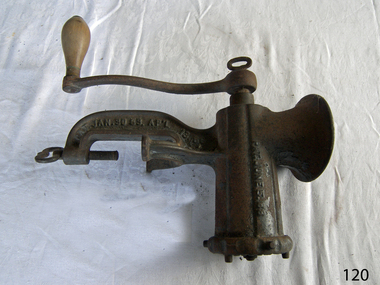
... ...kitchen appliance...They specialised in making kitchen appliances of various types for domestic use and for export. ...This particular food mincer was manufactured by Enterprise Manufacturing Company. Located in Philadelphia, this company specialized in making hardware products. The company was especially known for its cherry pitters, apple peelers, and coffee mills. The company was founded in 1864 and was located on the corner of Dauphin, 3rd, and American Streets. Enterprise Manufacturing Co. remained in business until 1956 when it was bought by Silex Co.A mass produced early domestic item made for home food preparation this item's first patent design was approved in 1897. Manufactured by a well known company in the USA the "Enterprise Manufacturing Company” up until 1956. They specialised in making kitchen appliances of various types for domestic use and for export. Food mincers of the subject items design are still being produced today under the brand name of "Universal" made by Universal Trading Inc USA.Food mincer, metal, clamp on bench style, with rotating wooden handle. Inscriptions stamped on metal.Marked "Enterprise tinned Meat Chopper" "No. 10" "Enterprise MF'G Co. PHILA. USA" "PAT. JAN.30.83" flagstaff hill, warrnambool, flagstaff hill maritime museum, flagstaff hill maritime village, great ocean road, mincer, food mincer, meat mincer, food preparation, kitchen utensil, domestic object, enterprise manufacturing company, kitchen appliance -
 Flagstaff Hill Maritime Museum and Village
Functional object - Water Boiler, Jackson Boilers Ltd, 1920s
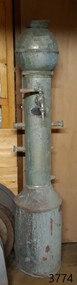
... ...kitchen appliance...Flagstaff Hill Maritime Museum and Village Flagstaff Hill Maritime Museum Flagstaff Hill Maritime Museum Maritime Village Warrnambool Great Ocean Road Leeds Jackson Boilers Ltd Jackson Boilers Henry Jackson brass founders electro platers sheet metal works Patent Water Boilers Leeds manufacturer tube water boiler domestic boiler tube domestic boiler tube boiler water heaters water boilers self-feeding water boilers sheet metal work instantaneous water heaters engineering allied trades metal workers metal trade food machinery hospitality equipment ship equipment ship water boiler ship heater catering boilers café boiler restaurant boiler canteen boiler Catering Equipment Manufacturers’ Association CEMA kitchen equipment kitchen appliance war work World War I WWI picric acid picric acid cases fuse hole plugs electro plated fuse hole plugs Reginald M cargo ship Port Adelaide 1922 John Murch Jackson Boilers Leeds Ltd. ...Jackson Boilers Ltd., brass founders, electro platers and sheet metal works made this tube water boiler. It was a fitting in the vessel Reginald M, a small cargo ship built at Port Adelaide in 1922 and named after her builder and first owner, John Murch. The Reginald M was launched at Largs Bay, South Australia, in 1922 to carry cargo around South Australia that included guano, barley, wool, horses, cattle, timber, explosives, potatoes, shell grit, and gypsum. It passed through numerous owners over the years and primarily maintained its purpose as a cargo vessel. In 1975, the decommissioned Reginald M was purchased by Flagstaff Hill Maritime Museum as an attraction. Although restoration efforts were undertaken and maintained for the craft above the water line, deterioration occurred below the surface and resulted in the ship being unsafe for visitors to board. It was broken up and removed from Flagstaff Hill in 2018, but items such as the historical boiler remain in Flagstaff Hill’s Collection. JACKSON BOILERS LTD.: - In 1911, Henry Jackson was the Managing Director at Jackson Boilers Ltd. He had gained around 30 years’ experience as a tin plate worker, plumber and gas fitter at Ilkey in 1881, then at Leeds by 1901. By 1921, he had changed employment from Jackson Boilers to Managing Director of Patent Water Boilers. During World War I, Jackson Boilers Ltd of Leeds performed war work like many other manufacturers at that time. The firm made cases for the explosive picric acid and electroplated fuse hole plugs. In 1918, the firm employed 15 males and 19 females. Jacksons Boilers became very successful throughout the first half of the twentieth century with showrooms and sales offices in Scotland, the Midlands and Southern England. It also had an office in Dublin, Ireland. In the post-war 1920s, the firm’s production included instantaneous water boilers and coffee machines for cafes, restaurants and canteens. Jackson Boilers also began to supply shipping lines with catering water boilers for their ships. The firm applied for a USA patent for the tube boiler in 1930, for the design which appears to have been invented in 1926. A 1971 advertisement adds the credentials, Members of the Catering Equipment Manufacturers’ Association. The tube water boiler was designed specifically for use in a ship's restaurant or dining area and patented by Jackson Boilers Ltd. of Leeds. The boiler is significant as a patented design, illustrating the evolution of maritime, commercial and domestic water boilers that have led to many innervations and improvements in today's boilers that are used in heating and in producing hot water for domestic and catering use. It is also significant as it is one of the earlier boilers the Jackson company made in the early 1920s before they applied for a US patent on their revised design in 1926.Water boiler, free standing Jackson's Tube boiler. A tall metal cylindrical stand with a metal sphere on top and several pipe fittings on the sides. A brass tap with a lever handle is connected to the front. A plaque with maker's details is attached under the tap. Details are also impressed into the cylinder above the tap.Jackson Boilers Leeds Ltd. "JACKSON'S PATENT" . Other details indecipherable. flagstaff hill maritime museum and village, flagstaff hill maritime museum, flagstaff hill, maritime museum, maritime village, warrnambool, great ocean road, leeds, jackson boilers ltd, jackson boilers, henry jackson, brass founders, electro platers, sheet metal works, patent water boilers, leeds manufacturer, tube water boiler, domestic boiler, tube domestic boiler, tube boiler, water heaters, water boilers, self-feeding water boilers, sheet metal work instantaneous water heaters, engineering, allied trades, metal workers, metal trade, food machinery, hospitality equipment, ship equipment, ship water boiler, ship heater, catering boilers, café boiler, restaurant boiler, canteen boiler, catering equipment manufacturers’ association, cema, kitchen equipment, kitchen appliance, war work, world war i, wwi, picric acid, picric acid cases, fuse hole plugs, electro plated fuse hole plugs, reginald m, cargo ship, port adelaide, 1922, john murch -
 Flagstaff Hill Maritime Museum and Village
Domestic object - Ice Chest, 1927
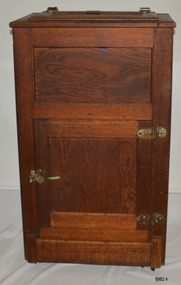
... ...kitchen appliance...Flagstaff Hill Warrnambool Maritime Village Maritime Museum Shipwreck coast Great Ocean Road Dr W R Angus Dr Roy Angus Dr Ryan Doctor Angus Dr Angus Ice chest ice box antique food preservation refrigeration domestic equipment kitchen appliance refrigerator non-electric refrigerator non-mechanical refrigerator W.R. ...This particular small ice chest was once part of the domestic furniture of Dr W.R. Angus and his young family in 1927 when they lived in the Nhill and Ballarat districts. The family relocated to Warrnambool in 1939 and brought the ice chest with them. An ice chest, also called an icebox or refrigerator, was invented by Thomas Moore in 1802 and had become a common home appliance from the mid-1800s until around the 1930s, when electric refrigerators became affordable and safe. The non-mechanical ice chest allowed perishable food to be kept fresh for longer than the food-safe or ‘Coolgardie’ used in colonial days in Australia. It required the use of ice blocks, which were delivered to households by the ‘iceman' and his horse and cart. The ice man would use an ice pick to cut the blocks into the right size for the buyer’s ice chest. The ice came from an ‘ice house’, a factory where the ice was made. The ice chest required a block of ice to be placed into the insulated top section on top of the corrugated iron stand. The ice would cool the air and the cool air would flow downwards through the oval hole under the stand and into the refrigerator compartment below. The water from the melted ice would drain from the sloping floor of the top compartment and into the hooded pipe. The pipe went through the refrigerator and ended below its floor, where the drained water would be collected in the metal bowl placed there for that purpose. The lip on the bowl allowed it to be easily removed and emptied at regular intervals before it overflowed. W.R. Angus Collection- The W R Angus Collection spans from 1885 to the mid-1900s and includes historical medical and surgical equipment and instruments from the doctors Edward and Thomas Ryan of Nhill, Victoria. Dr Angus married Gladys in 1927 at Ballarat, the nearest big city to Nhill where he began as a Medical Assistant. He was also Acting House surgeon at the Nhill hospital where their two daughters were born. He and his family moved to Warrnambool in 1939, where Dr Angus operated his own medical practice. He later added the part-time Port Medical Officer responsibility and was the last person appointed to that position. Dr Angus and his wife were very involved in the local community, including the early planning stages of the new Flagstaff Hill, where they contributed to the layout of the gardens. Dr Angus passed away in March 1970.This ice chest is significant for representing a method of refrigeration and food preservation used in the 19th to mid-20th centuries when people were beginning to afford powered domestic refrigerators. After the second world war, most households replaced their food storage cupboards and ice chests with refrigerator appliances. The ice chest is also significant for its connection with the domestic furniture of Dr W.R. Angus and his family, and its inclusion in the W.R. Angus Collection.Ice chest; single front wooden cabinet with two doors and a flap, and three accessories. The top door is a lid with a metal handle at the front and two metal hinges along the back. The front door has two metal hinges on the right-hand side and has a metal lever catch. A hinged flap fits between the front legs at bottom of the ice chest and swings upwards. The front legs have wheels. The insulated top compartment has a metal lining and its floor slopes towards the centre of the back wall. In the floor are a formed oval air-flow hole and the open end of a pipe that has a hood partly covering it. The front compartment is an insulated metal-lined cupboard with a vertical pipe down the centre of the back wall and horizontal rails in the centre of each side wall. The accessories are a rectangular corrugated iron stand, a rectangular wire grid shelf and a round aluminium bowl with a lip and two sides pushed in. The ice chest was made circa 1927 and is part of the W.R. Angus Collection.flagstaff hill, warrnambool, maritime village, maritime museum, shipwreck coast, great ocean road, dr w r angus, dr roy angus, dr ryan, doctor angus, dr angus, ice chest, ice box, antique, food preservation, refrigeration, domestic equipment, kitchen appliance, refrigerator, non-electric refrigerator, non-mechanical refrigerator, w.r. angus collection -
 Orbost & District Historical Society
cake mixer, circa 1948
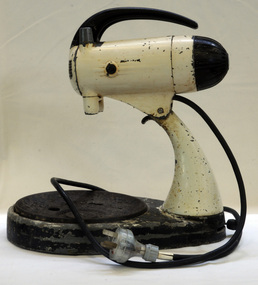
... mixmaster sunbeam kitchen-appliance food-technology...The American-designed Mixmaster 9B was the first Sunbeam appliance manufactured and sold in Australia in 1948. mixmaster sunbeam kitchen-appliance food-technology On the bottom are the words "MODEL 9B". ...The Mixmaster 9B in 1948 was the first Sunbeam appliance to be made in Australia. It was designed in the USA.After years of rationing and shortages, the 1950s were a period of economic prosperity, high employment and great technological development. During this period, Australians enthusiastically adorned their homes with a dazzling range of new domestic appliances. Hire-purchase schemes allowed people to take products home and pay for them in instalments. The American-designed Mixmaster 9B was the first Sunbeam appliance manufactured and sold in Australia in 1948. An early Sunbeam Mixmaster. It is an electronic stand mixer with a black metal base in the shape of a rounded teardrop with two holes for the turntable. It has a cream enameled metal arm, cream coloured metal motor housing with a black plastic handle on the top. On the back of the motor housing is a black plastic knob with ten speed options for the mixer, and the "OFF" position. a black electric cord is attached under the motor housing with a black switch beneath the cord. The motor housing is able to tilt backwards on a hinge which is attached to the top of the stand arm. It is worked on AC or Dc power 240 On the bottom are the words "MODEL 9B". mixmaster sunbeam kitchen-appliance food-technology -
 Flagstaff Hill Maritime Museum and Village
Domestic object - Food Mincer, Landers, Frary & Clark , 1897-2000
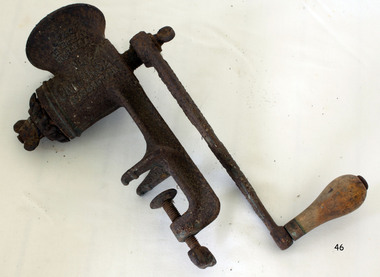
... ...kitchen appliance...An early domestic item its function was for use in the home kitchen that's the original patented design from 1897 is still being produced today under its brand name of Universal by Universal Trading Inc USA. warrnambool flagstaff-hill flagstaff-hill-maritime-museum shipwreck-coast flagstaff-hill-maritime-village shipwrecked-artefact mincer food mincer universal brand kitchen appliance food grinder lander frary & clark Marked "No. 2 Universal". ...Landers, Frary & Clark were a housewares company based in New Britain, Connecticut. It operated from 1865 until its assets were sold to the General Electric company in 1965. They manufactured a wide variety of products over the years, including stainless steel bull-nose rings and electric ranges, kitchen scales and vacuum bottles, window hardware and ice skates, mouse traps and percolators, can openers, corkscrews, cutlery, straight razors, aluminium cookware, and thousands of other products. Many of these items were marketed under the brand Universal. Some of the non-electric kitchenware assets were acquired from G.E. in 1984 by Universal Housewares, Inc./Universal Trading, Inc., who still market "Universal" meat grinders and coffee mills.An early domestic item its function was for use in the home kitchen that's the original patented design from 1897 is still being produced today under its brand name of Universal by Universal Trading Inc USA.Food mincer cast iron with wooden handle & thumbscrew for bench attachment.Marked "No. 2 Universal".warrnambool, flagstaff-hill, flagstaff-hill-maritime-museum, shipwreck-coast, flagstaff-hill-maritime-village, shipwrecked-artefact, mincer, food mincer, universal brand, kitchen appliance, food grinder, lander frary & clark -
 Kiewa Valley Historical Society
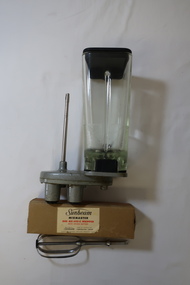
Mixmaster and attachments
... kitchen appliance...See KVHS 1282 kitchen appliance blender vitamiser Mixmaster Sunbeam Ron White Meat Grinder Food Chopper Mixmaster blender box made by Sunbeam, Australia Cat. ...Household item used in the kitchen for mixing food. It belonged to Ron White.Ron White (1920 - 2019) worked for the SECV and was superintendent engineer of the Kiewa Hydro Electric Scheme after its completion. He lived in Mt Beauty and worked until he retired in 1985. See KVHS 1282 Mixmaster blender box made by Sunbeam, Australia Cat. No. AMB-O. It includes a rectangular glass container with a black bakelite lid. It fits onto a steel attachment and is held by 4 black bakelite stands. Second box consists of - Sunbeam / Meat Grinder / and / Food Chopper / Attachment / with Power Transfer Unit / for Sunbeam Mixmaster / Cat No. FC 6 / Made in Australia Attachments are boxed inside.kitchen appliance, blender, vitamiser, mixmaster sunbeam, ron white, meat grinder, food chopper -
 Kiewa Valley Historical Society
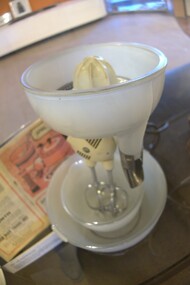
Mix Master
... sunbeam mix master; kitchen appliance; cooking; ron white; kiewa hydro electric scheme; food preparation...Ron was later appointed General Superintendent and then in 1974 to principal Hydro Engineer of the recently titled Hydro Division. sunbeam mix master; kitchen appliance; cooking; ron white; kiewa hydro electric scheme; food preparation 'Sunbeam' (in red) / 'Mix Master' in (black) on gold oblong 'emblem' White electrical food mixer with six parts. 1. ...The Kiewa Hydro Electric Scheme (KHES) produced electricity for the people living in the Kiewa Valley and beyond to many parts of Victoria. The people and their families working on the scheme were encouraged by their employer the State Electricity Commission of Victoria to purchase and use electrical appliances. The mix master was popular for mixing food for baking and for making juice drinks. Ron White owned this 1950s vintage Sunbeam model 9 mixer with stand, milk glass bowls and complete juicer. Ron was a senior member of staff during the construction and operation of the KHES.This mix master was owned by Ron White who was appointed Area Operations Engineer Kiewa in June 1956. Ron was later appointed General Superintendent and then in 1974 to principal Hydro Engineer of the recently titled Hydro Division.White electrical food mixer with six parts. 1. Motor upright - white, on black stand horizontal. Black dial at back with speeds numbered and type of mix eg. mash. Front switch on/off. Black electric cord attached. Long black handle on one side. 2 Two beaters, silver 3. Bowls, white one small and one large. The small one has a spout. 4. Squeezer, white - fits on top for juicing. Parts as with orange juicer and with funnel at the front for juice to flow into a bowl.'Sunbeam' (in red) / 'Mix Master' in (black) on gold oblong 'emblem' sunbeam mix master; kitchen appliance; cooking; ron white; kiewa hydro electric scheme; food preparation -
 Numurkah & District Historical Society
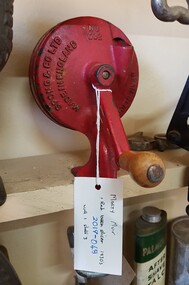
Bean Slicer
... kitchen, appliance, bean slicer,...kitchen, appliance, bean slicer, Spong & Co Made in England No G32 1 x red bean slicer (1930's) Bean Slicer ...1 x red bean slicer (1930's)Spong & Co Made in England No G32kitchen, appliance, bean slicer, -
 Musculoskeletal Health Australia (now held by the Glen Eira Historical Society)
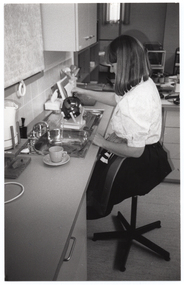
Photograph - Solo photo, Circa November 1989
... Through its quarterly newsletters, the Arthritis Foundation of Victoria (AFV), formerly the Rheumatism and Arthritis Association of Victoria (RAAV), was able to inform its members about the latest arthritis-friendly kitchen appliances and aids, and how to use them. ...There are several miscellaneous kitchen appliances on the bench. There are cupboards and drawers beneath the bench, and one set of cupboards above the sink....Through its quarterly newsletters, the Arthritis Foundation of Victoria (AFV), formerly the Rheumatism and Arthritis Association of Victoria (RAAV), was able to inform its members about the latest arthritis-friendly kitchen appliances and aids, and how to use them. ...Through its quarterly newsletters, the Arthritis Foundation of Victoria (AFV), formerly the Rheumatism and Arthritis Association of Victoria (RAAV), was able to inform its members about the latest arthritis-friendly kitchen appliances and aids, and how to use them. In this photo, a woman demonstrates how to use a kettle pourer. She is sitting on a swivel chair on castors, at the kitchen sink. A similar photo appears in the Vol 3 No 1, Autumn 1990 issue of the Arthritis Foundation of Victoria's quarterly magazine, Arthritis Update. The photo in the magazine is captioned: " 'Sit-Stand Chair' in use at a pull-out workbench. It's [sic] adjustable height makes it a useful piece of household equipment." In the published photo, the woman is depicted sitting on the sit-stand chair, about to cut an apple on a small chopping board. The photo accompanies an article titled, 'Living with Arthritis', with the subtitle 'Independent Living Centre', 'A service of the Yooralla Society of Victoria'. According to an earlier article appearing on page 3 of the No 33, August 1984 edition of RAAV's quarterly newsletter, News Review, the Independent Living Centre was the venue for the launch of Arthritis Week in May 1984.B&W photo of a woman sitting on a swivel chair on castors, at a kitchen sink. She is pouring water from a kettle into the sink. The kettle is sitting on a device which enables her to pour from the kettle without having to lift it. The sink is recessed into an L-shaped kitchen bench, upon which a cup and saucer can be seen sitting near the edge of the sink. There are several miscellaneous kitchen appliances on the bench. There are cupboards and drawers beneath the bench, and one set of cupboards above the sink.[On a yellow sticky note, in blue ink] November - December, 1989 Independent Living Centre?arthritis foundation of victoria, afv, rheumatism and arthritis association of victoria, raav, independent living centre, demonstration kitchen, arthritic aids, kitchen aids, kitchen gadgets, kitchen appliances, kitchen sink, kettle pourer, tea, coffee, hot drinks, swivel chair, sit-stand chair, pull-out workbench, retractable bench top, sliding bench top, adaptive kitchens, accessible kitchens, disability-friendly kitchens, modified kitchens, yooralla society of victoria, living with arthritis, pain management, 1989, arthritis update, 1990, news review, 1984 -
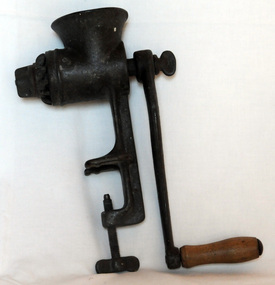 Orbost & District Historical Society
meat mincer, mid 1900's
... food-preparation mincer appliance kitchen domestic...This domestic kitchen appliance is typical of the period when food processing was done at home. ...This mincer was donated to the Slab Hut (Visitor Information Centre) as a display item.This domestic kitchen appliance is typical of the period when food processing was done at home. It would have been before the time of mass food processing factories.A cast iron food mincer with a wooden handle. It has a funnel shaped cup at the top through which the pieces of meat are pushed to come out of the side. The wooden handle is turned to help this action. It has one blade. The mincer clamps to a flat surface by a hand operated vice/screw. MODEL No 2food-preparation mincer appliance kitchen domestic -
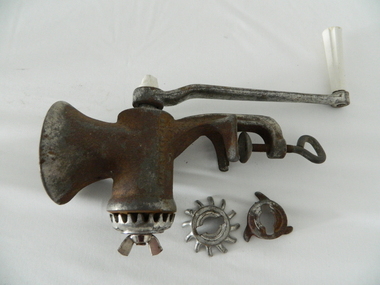 Kiewa Valley Historical Society
Mincer Meat, early to mid 1900's
... This cast iron kitchen appliance was made in England in the early 1900's and shipped to the "colony" Australia. ...This cast iron kitchen appliance was made in England in the early 1900's and shipped to the "colony" Australia. ...This cast iron kitchen appliance was made in England in the early 1900's and shipped to the "colony" Australia. This was before World War II and the "growing up" of a colony to an independent member of "the British Commonwealth". It was a period when most appliances (be they household) where manufactured in England and shipped to Australian ports. It was not until the late 1960's that the Asian manufacturing giant woke up and started to dominate the market palce.This domestic kitchen appliance is very significant to the Kiewa Valley because it highlights the "made at home" period when food processing was made "in house" due to inability to source food from specialised shops e.g. the butcher or slaughter houses. It was a period before mass food processing factories were established and roads constructed up to the standard for distribution to semi remote regions such as Kiewa Valley was in the beginning of the 1900's.This cast iron (malleable iron) mincer for meat products has a large "funnel" to direct "chunks" of meat to the grinding "wheels". These "star" shaped wheels with "teeth" of three different cutting surfaces (fine, medium and coarse) provide for texture types of the final meat product. The meat is placed into the "loading" funnel and push downwards(gravity feed) through the mincing chamber and out through the front side. There is a long "screw worm" which is rotated by turning the handle. The appliance is table mounted by a vice "G" screw on clamp (hand operated). "BEATRICE No. 3" and "MADE IN ENGLAND", "P 3181"household cast iron appliances, food processors -
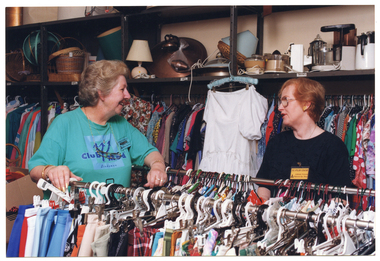 Musculoskeletal Health Australia (now held by the Glen Eira Historical Society)
Photograph - Group photo, 1999
... Above the clothing rack behind them, there are several shelves on the wall containing basketry, electrical kitchen appliances, a lamp shade, and other miscellaneous items....Above the clothing rack behind them, there are several shelves on the wall containing basketry, electrical kitchen appliances, a lamp shade, and other miscellaneous items. ...Two volunteer Arthritis Foundation of Victoria members chat while arranging clothes on the clothes racks at the Arthritis Foundation of Victoria's Malvern Opportunity Shop. The op shop was located at 1428 High Street, Malvern.COL photo of two women standing between several racks of hanging clothes inside a shop. The woman on the left is wearing a jade green Club Med t-shirt, and an aqua name badge with the text, "VOLUNTEER Arthritis Foundation of Victoria". The woman on the right is wearing a plain black t-shirt, and a yellow name badge with the text, "SUPERVISOR Arthritis Foundation of Victoria". Above the clothing rack behind them, there are several shelves on the wall containing basketry, electrical kitchen appliances, a lamp shade, and other miscellaneous items.arthritis foundation of victoria, afv, opportunity shop, op shop, charity shop, thrift store, fundraising, crocheted blanket, clothing, apparel, kitchen appliances, lampshade, baskets, basketry, volunteers, supervisor, members, malvern, 1999 -
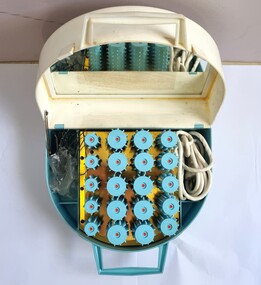 Wodonga & District Historical Society Inc
Domestic object - Hair Styling Set, Braun Electrics (Australia) Pty. Ltd, c1970
... By the 1950s and 1960s the company branched out into electric shavers, kitchen appliances and hair care products. Home hair styling sets and hot rollers became popular in the 1960s and continued to be an important woman's styling appliance throughout the 1970s and 1980s. ...By the 1950s and 1960s the company branched out into electric shavers, kitchen appliances and hair care products. Home hair styling sets and hot rollers became popular in the 1960s and continued to be an important woman's styling appliance throughout the 1970s and 1980s. ...Braun was originally founded in Germany in 1921, making components for radio sets. After World War 2 they extended their range to include audio and camera equipment. By the 1950s and 1960s the company branched out into electric shavers, kitchen appliances and hair care products. Home hair styling sets and hot rollers became popular in the 1960s and continued to be an important woman's styling appliance throughout the 1970s and 1980s. In 1975 this product was advertised at a price of $37.95. From 1984 until 2007, Braun was a wholly owned subsidiary of Gillette, which had purchased a controlling interest in the company in 1967. Braun is now a subsidiary of Procter & Gamble, which acquired Gillette in 2005.Personal grooming items such as this became important personal accessories and grooming tools for women throughout the mid 20th century across Australia.This hair styler set contains 20 hair rollers which were heated by placing them on the 20 heating posts fitted inside the unit in the case. An electric cord supplied was attached to an electric socket. A red dot on top of each posts darkened when the rollers were sufficiently heated. A detailed instruction booklet is included. A mirror is attached to the inside of the lid.On 2 metal plates on back of unit: Plate 1: MANUFACTURED FOR BRAUN ELECTRICS (AUST) PTY. LTD. / 24 JOHNSTON ST., FITZROY, VIC. 650-WATT 240 V. A. C. ONLY 50 CYCLE CAT. NO. B102 Plate 2: VOLT 240 AC ONLY FREQUENCY 50 H Z. 0.66 AMP / RETURN TO SUPPLIER FOR REPAIR Across bottom: PATENTS PENDING / MADE IN HONG KONGbraun electrics, personal appliances, hair styling -
 Wodonga & District Historical Society Inc
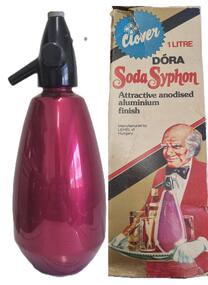
Domestic object - Clover "Dora" Soda Syphon
... Lehel was the largest Hungarian appliance company, focusing on refrigerators and other kitchen appliances. This model was first produced in 1971. ...Lehel was the largest Hungarian appliance company, focusing on refrigerators and other kitchen appliances. This model was first produced in 1971. ...A soda syphon is a device designed to dispense carbonated or soda water. It was also called a Seltzer bottle. The modern syphon was created in 1829 by two Frenchmen. They became very popular in the 1920s and 1930s and although they became less common after World War II there was a later resurgence with the desire for people to produce their own beverages at home. The Dóra soda syphon was manufactured by Lehel of Hungary located in the city of Jászberény. Lehel was the largest Hungarian appliance company, focusing on refrigerators and other kitchen appliances. This model was first produced in 1971. In 1972 Australia became Lehel’s newest market. In Australia they were marketed as Clover soda syphons and distributed by the Lark Trading Co Pty Ltd. In 1991 Lehel was acquired by Electrolux.This item is significant because soda syphons were commonly used through Australia and the Wodonga district from1930s onwards. A carboard box containing an anodised aluminium soda syphon. The box features and image of a soda syphon on one side and another image of a butler serving drinks with a soda syphon on tray on the reverse. It includes a box of 10 replacement soda bulbs and a folded pamphlet of information and instructions.Box Front Clover 1 LITRE DÓRA Soda Syphon Attractive anodised aluminium finish Manufactured by LEHEL of Hungary Box Back Clover DÓRA Soda Syphon High quality Complete 12 month warranty Spare parts and accessories includedsoda syphons, domestic items -
 Wodonga & District Historical Society Inc
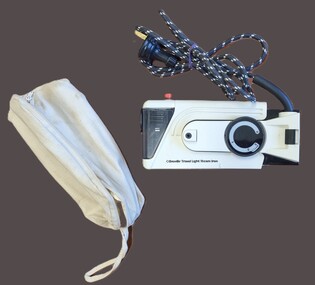
Domestic object - Portable Steam Iron, Breville
... In the 1960s, Breville turned its attention to manufacturing kitchen appliances and other domestic appliances. ...In the 1960s, Breville turned its attention to manufacturing kitchen appliances and other domestic appliances. ...The Breville company was established in Sydney in 1932, by Bill O’Brien and Harry Norville, who combined their two surnames to form the company name. The company originally manufactured radios. During World War II, it made mine detectors. By 1953, the radio business had been taken over by A.W. Jackson Industries Pty. Ltd., which manufactured radiograms and, later, television sets under the Breville brand. In the 1960s, Breville turned its attention to manufacturing kitchen appliances and other domestic appliances. With more people owning cars, caravans and becoming more mobile, a range of lighter appliances were also developed. This included the Breville Travel Light Steam Iron. Breville has now become a global brand which delivers kitchen products to more than 70 countries.This item is representative of an Australian company established in 1962 and its innovations in the electrical appliance industry.A small foldable steam iron manufactured by Breville in Honk KongBreville Travel Light Steam Iron Model details on metal platedomestic appliances, breville irons, travel irons -
 Robin Boyd Foundation
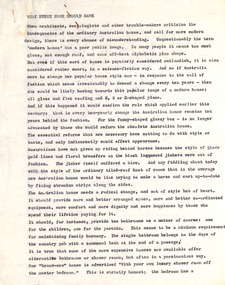
Document - Manuscript, Robin Boyd, What Every Home Should Have, c. 1965
... As examples, he gives two bathrooms (one for parents and one for children), outdoor living, the ability to extend the home as the family gets bigger, kitchens with modern appliances, and central heating and cooling....As examples, he gives two bathrooms (one for parents and one for children), outdoor living, the ability to extend the home as the family gets bigger, kitchens with modern appliances, and central heating and cooling. ...Boyd advocates that the Australian home needs a change of heart to provide more comfort, dignity, and happiness. As examples, he gives two bathrooms (one for parents and one for children), outdoor living, the ability to extend the home as the family gets bigger, kitchens with modern appliances, and central heating and cooling.Typewritten (c copy), quarto, 4 pagesaustralian home, appliances, robin boyd, manuscript -
 Warrnambool and District Historical Society Inc.
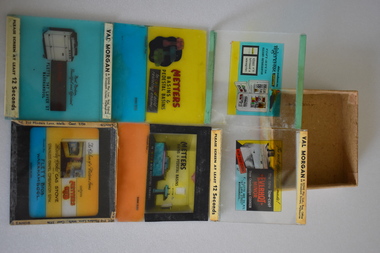
Glass Slides, Alex Gunn & Sons, 1930s-1950s
... Most of the slides advertise Metters and Everhot bathroom and kitchen appliances, obtainable from the Warrnambool firm, going under the various trade names of Flett Brothers, F. ...Most of the slides advertise Metters and Everhot bathroom and kitchen appliances, obtainable from the Warrnambool firm, going under the various trade names of Flett Brothers, F. ...These slides have been made by Alex Gunn and Sons, a 20th century lantern and slide maker based in Melbourne. The slides were produced for Val Morgan and Sons, a cinema advertising slide maker. Val (Valentine) Morgan (1867-1952) established a business in 1894 and by 1914 was making slides for cinemas. By 1921 the business was a company producing slides for movie houses and by the 1930s was the largest business of its type in Victoria. The company also produced the Morgans Street Directory for over 50 years in the 20th century. The company was sold in 1987. It is believed that these slides were shown in the Capitol Theatre in Warrnambool as the advertisements feature a local business, Fletts Plumbing. Most of the slides advertise Metters and Everhot bathroom and kitchen appliances, obtainable from the Warrnambool firm, going under the various trade names of Flett Brothers, F. Flett and Co and Fletts of 147 Lava Street (with ‘Lava’ spelt as ‘Laver’ in one ad). John Flett, boat and bridge builder, settled in Warrnamool in 1868 and it was his son William who first established a tinsmith and plumbing business in Warrnambool in the 1880s in a shop in Timor Street. His sons, Frederick and Charles, continued on the business after the father’s death in a Lava Street site until its demise in the 1950s. These items are of great interest as examples of cinema advertising slides used in cinemas in the mid 20th century and perhaps in the 1930s. The items have local significance as the slides feature advertisements for the business of the Flett family who were local plumbers and fitters. The slides are also of local interest as they are believed to have been used in the Capitol Theatre in Kepler Street, still operating today. These are eleven glass slides produced for cinema advertising in the mid 20th century. Three of the slides are blank and eight contain coloured images and printing advertising the products of kitchen and bathroom items and the local Warrnambool supplier. Four of the slides have thicker glass and four have paper labelling on the top and bottom edges. The slides are held in a cardboard box without a lid.Val Morgan & Sons Pty Ltd Reg. Office 64 Elizabeth Street Melbourne Please screen at least 12 SECONDS Gunn Slide flett family, plumbers, warrnambool, val morgan & sons cinema slides -
 Wodonga & District Historical Society Inc
Domestic object - Electric Toaster, Hecla Electrics Pty Ltd, c1940s
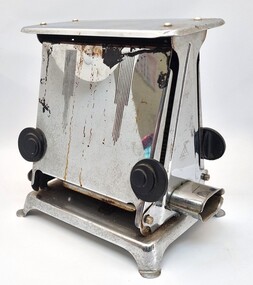
... Hecla produced a wide range of appliances for domestic use, beginning with heaters and later branching out to a wider range of kitchen appliances Hecla was established by Clarence William Marriott, a young Melbourne metal worker. ...Hecla produced a wide range of appliances for domestic use, beginning with heaters and later branching out to a wider range of kitchen appliances Hecla was established by Clarence William Marriott, a young Melbourne metal worker. ...Hecla produced a wide range of appliances for domestic use, beginning with heaters and later branching out to a wider range of kitchen appliances Hecla was established by Clarence William Marriott, a young Melbourne metal worker. He began manufacturing Australia's first carbon filament electric radiators in 1899. He originally worked for his father James Marriott who commenced business in Melbourne as an art metal worker in 1872 and was, in 1907, appointed as the official art metal worker to the Victorian Government producing items including the ornate iron gates and gas lamp standards outside Melbourne's Parliament House. With the invention of nickel chromium wire after 1900, C.W. Marriott began making more efficient heating elements using this new material in 1916. After being influenced by the eruption of Mount Hekla in Iceland, on 19 December 1918, Clarence registered the brand name "HECLA" with an erupting volcano as its logo. The company Hecla Electrics Pty Ltd was officially registered in 1922. In 1928 the company adopted the advertising slogan, 'By Hecla, it's Good'. The Hecla range rapidly expanded to include electric heaters and radiators, electric foot warmers, electric kettles, ceramic & metal electric jugs, immersion hot water elements, electric fans, electric coffee percolators, electric toasters, electric grillers and stoves, electric irons and electric frypans, clocks and curling wands. Electric blankets were introduced shortly after WWII.In 1930, a controlling interest in Hecla Electrics Pty Ltd was acquired by General Electric Corporation. Clarence William Marriott died in June 1967 in Melbourne, Victoria.This item is representative of a common domestic appliance used throughout Australia. It was manufactured by a pioneering Australian company.A small chrome steel toaster manufactured by Hecla Australia. It has a door on either side which flips down to insert or remove a slice of bread on each side, Each door has two black Bakelite knobs. The electric element is placed down the centre of the cavity. A detachable electric cord is included.240 Volts, 600 Watts. Cat. No. T4 Submitted to Electrical Approval Board Ref Application A1/AD01 SECV 240 Volt 600 Watt MANFED. IN AUSTRALIA SOLID BRASSelectrical appliances, hecla corporation australia, clarence william marriott, domestic appliances -
 Flagstaff Hill Maritime Museum and Village
Domestic object - Colander, Kande Kitchenware, Circa 1924
... An appliance made by an early and successful Australian company that manufactured metal kitchen items during the first half of the 20th century. flagstaff hill warrnambool shipwrecked-coast flagstaff-hill-maritime-museum shipwreck-coast flagstaff-hill-maritime-village Colander Kitchen Item Domestic Item Kitchen Strainer Colander enamel rusty holes in base of bowls, 2 handles, bowl shape. ...Kande Kitchenware was established by Patrick Kavanagh and William English (the name Kande was formed from their initials, K and E) in 1922 and had its Sydney factory in Little Collins Street, Surrey Hills. Kavanagh and English, a subsidiary of Kande Kitchenware, became a limited company in 1924, with both founders as directors. Another director was Test cricketer Jack Gregory, an all-rounder who slipped easily into the role of businessman. Gregory enjoyed success in business as on the cricket field, helping the company grow from a tiny operation to a major manufacturer and exporter that employed 80 people in 1931. They managed to survive the Depression and kept manufacturing at least until the late 1960s.An appliance made by an early and successful Australian company that manufactured metal kitchen items during the first half of the 20th century. Colander enamel rusty holes in base of bowls, 2 handles, bowl shape.flagstaff hill, warrnambool, shipwrecked-coast, flagstaff-hill-maritime-museum, shipwreck-coast, flagstaff-hill-maritime-village, colander, kitchen item, domestic item, kitchen strainer -
 Flagstaff Hill Maritime Museum and Village
Domestic object - Can Opener, Bottle Opener & Corkscrew
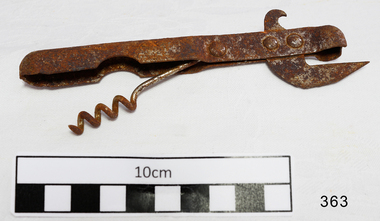
... appliances like can openers today. It took another 25 years for electrically powered can openers to become practical. In the 1950s, Walter Hess Bodle and his daughter, Elizabeth Bodle, developed an electric can opener in the family garage. Walter came up with the opener's blades and motor, and Elizabeth sculpted the outside. Their can opener was a free-standing unit that could sit on the kitchen...appliances like can openers today. It took another 25 years for electrically powered can openers to become practical. In the 1950s, Walter Hess Bodle and his daughter, Elizabeth Bodle, developed an electric can opener in the family garage. Walter came up with the opener's blades and motor, and Elizabeth sculpted the outside. Their can opener was a free-standing unit that could sit on the kitchen ...It took 15 years to invent the can. It took 100 more to invent a standard way to open it. In the 19th century, decades after the invention of canning, there were virtually no can openers. Canned food, such as sardines, came with its own "key" to peel back the tin lid. Birth of the can One of the oddest things about the can opener is that the can predates it by almost 150 years. Though common today, cans were once military-grade technology. In 1795, Napoleon, to whom the phrase "an army marches on its stomach" is attributed, offered 12,000 francs to anyone who could find a way to preserve food. Without any knowledge of bacteria or their role in food spoilage, scientists didn't even know where to begin. It took 15 years before a chef named Nicholas Appert claimed the prize after successfully jarring food. Soon after that, his countryman Philippe de Girard came up with a variant on Appert's method—metal tins—and sold the idea to the British. Spoiled food, and the sickness it caused, was a widespread problem. The public would have benefited from canned food, but for decades cans were almost exclusively for the army and the navy. The canning process, with its hours of boiling and steaming, its scrupulous cleanliness, its heated metal, and its need for a great deal of disposable material, made canned food far too expensive for anyone but the military. No can openers were needed or even possible. The metal of early cans was too thick to make openers practical. Soldiers and sailors had plenty of sharp objects on hand and made ample use of them when they wanted to eat. During the 19th century, the process of canning was refined and mechanised, and the metal wall of the average can slimmed down enough that a civilian could get it open—if that civilian had the right tool. No one had that tool yet, so early cans had to open themselves. In other words, they came with built-in openers. The result was a confusing but pleasing free-for-all, in terms of product engineering. Each type of food came with its own kind of can, and each kind of can came with its own kind of opener. Tinned fish and meat were often sold in rectangular cans. These cans were fitted with a "key" that would roll down the top of the can. Coffee, beans, and other types of meat were packaged in cylinders with metal strips that could be peeled back with their own kinds of built-in keys. Cans of milk, which didn't need to be completely opened, came with puncture devices. As tinned food became more common, its containers became more regular. A nice cylindrical can became the norm, and, as these cans filled kitchens, more engineers put their minds to finding a convenient way to open all of them. The first standalone can opener worked on a simple principle: point, stab, and pull. From the mid-19th century to the end of World War I, the typical can opener looked roughly like a wrench, if the lower 'jaw' of the wrench were replaced with a blade. People used the blade to puncture the top of the can near its edge, push the upper jaw against the side of the can, and drag the blade through the metal along the rim. Because meat was the first and most popular canned substance, these can openers were often shaped to look like cows and given the nickname 'bully beef can openers'. The bully beef can opener, popular in the mid-19th century, resulted in many lost fingers. Later, a corkscrew was added that was seated in the handle, and could be pulled out for use. Bully beef can openers were so common, effective, and sturdy that they are still frequently available on collectors' sites. Some are advertised as “still working,” and every last one of them is, without a doubt, soaked in the blood of our ancestors. Dragging a sharp blade along the edge of a can is certain to cause injury sooner or later. So once people got a reliable can shape and a reliable way to get the can open, the search was on for a reliable way to get a can open without the possibility of losing a finger. The answer came in 1925, from the Star Can Opener Company of San Francisco. This is probably the first can opener that resembles the one people have in their kitchens today. Instead of using a blade to pry open a metal can, buyers could clamp the edge of the can between two wheels and twist the handle of one of the wheels to move the blade around the lip. The Star can openers weren't perfect. Compared to the bully beef model, they were flimsy and breakable, but they probably prevented a few injuries. Six short years after the Star model came to market, the first electric can opener was invented. It was patented in 1931 by the Bunker Clancey Company of Kansas City, who had already been sued by the Star Can Opener Company for trying sell a double-wheeled can opener like the Star model (the case was dismissed). The electric can opener must have seemed like the wave of the future and a sure-fire seller, but it proved to be too far ahead of its time. In 1931 not that many households had electricity, and those that did weren't interested in buying can openers. The Bunker Clancey Company was subsequently bought by the Rival Company, which still makes small appliances like can openers today. It took another 25 years for electrically powered can openers to become practical. In the 1950s, Walter Hess Bodle and his daughter, Elizabeth Bodle, developed an electric can opener in the family garage. Walter came up with the opener's blades and motor, and Elizabeth sculpted the outside. Their can opener was a free-standing unit that could sit on the kitchen counter. The Udico brand of the Union Die Casting Company put it on the market in time for Christmas in 1956 and had great success with it. Over the next few years it came out in different styles and colours, and, like the bully beef can opener, has become a collector's item. Also like the bully beef model, Udico can openers often still work. They don't make 'em like they used to. Although there have been some design changes and refinements over the last sixty years, there have yet to be any more leaps forward in can opener technology. If you're resentfully opening a can, you are almost certainly doing it using the Star design, manually forcing the can between two wheels, or the Bodle design, clamping the can into a free-standing electrical opener. Whether or not you enjoy your holiday meals, at least you can be happy that you are not getting poisoned by your own food or cutting open your hand with the blade you use to get at it. That's something, right?The can opener, Bottle opener and the corkscrew are still very important and essential items in most kitchens.Metal can opener, chromed, with bottle opener, and a corkscrew seated in the handle.None.flagstaff hill, warrnambool, shipwrecked-coast, flagstaff-hill, flagstaff-hill-maritime-museum, maritime-museum, shipwreck-coast, flagstaff-hill-maritime-village, canning, can opener, corkscrew, bottle opener, kitchen equipment -
 Flagstaff Hill Maritime Museum and Village
Domestic object - Can Opener
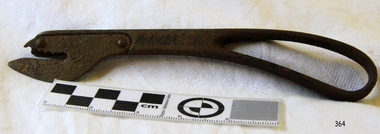
... appliances like can openers today. It took another 25 years for electrically powered can openers to become practical. In the 1950s, Walter Hess Bodle and his daughter, Elizabeth Bodle, developed an electric can opener in the family garage. Walter came up with the opener's blades and motor, and Elizabeth sculpted the outside. Their can opener was a free-standing unit that could sit on the kitchen...appliances like can openers today. It took another 25 years for electrically powered can openers to become practical. In the 1950s, Walter Hess Bodle and his daughter, Elizabeth Bodle, developed an electric can opener in the family garage. Walter came up with the opener's blades and motor, and Elizabeth sculpted the outside. Their can opener was a free-standing unit that could sit on the kitchen ...It took 15 years to invent the can. It took 100 more to invent a standard way to open it. In the 19th century, decades after the invention of canning, there were virtually no can openers. Canned food, such as sardines, came with its own "key" to peel back the tin lid. Birth of the can One of the oddest things about the can opener is that the can predates it by almost 150 years. Though common today, cans were once military-grade technology. In 1795, Napoleon, to whom the phrase "an army marches on its stomach" is attributed, offered 12,000 francs to anyone who could find a way to preserve food. Without any knowledge of bacteria or their role in food spoilage, scientists didn't even know where to begin. It took 15 years before a chef named Nicholas Appert claimed the prize after successfully jarring food. Soon after that, his countryman Philippe de Girard came up with a variant on Appert's method—metal tins—and sold the idea to the British. Spoiled food, and the sickness it caused, was a widespread problem. The public would have benefited from canned food, but for decades cans were almost exclusively for the army and the navy. The canning process, with its hours of boiling and steaming, its scrupulous cleanliness, its heated metal, and its need for a great deal of disposable material, made canned food far too expensive for anyone but the military. No can openers were needed or even possible. The metal of early cans was too thick to make openers practical. Soldiers and sailors had plenty of sharp objects on hand and made ample use of them when they wanted to eat. During the 19th century, the process of canning was refined and mechanised, and the metal wall of the average can slimmed down enough that a civilian could get it open—if that civilian had the right tool. No one had that tool yet, so early cans had to open themselves. In other words, they came with built-in openers. The result was a confusing but pleasing free-for-all, in terms of product engineering. Each type of food came with its own kind of can, and each kind of can came with its own kind of opener. Tinned fish and meat were often sold in rectangular cans. These cans were fitted with a "key" that would roll down the top of the can. Coffee, beans, and other types of meat were packaged in cylinders with metal strips that could be peeled back with their own kinds of built-in keys. Cans of milk, which didn't need to be completely opened, came with puncture devices. As tinned food became more common, its containers became more regular. A nice cylindrical can became the norm, and, as these cans filled kitchens, more engineers put their minds to finding a convenient way to open all of them. The first standalone can opener worked on a simple principle: point, stab, and pull. From the mid-19th century to the end of World War I, the typical can opener looked roughly like a wrench, if the lower 'jaw' of the wrench were replaced with a blade. People used the blade to puncture the top of the can near its edge, push the upper jaw against the side of the can, and drag the blade through the metal along the rim. Because meat was the first and most popular canned substance, these can openers were often shaped to look like cows and given the nickname 'bully beef can openers'. The bully beef can opener, popular in the mid-19th century, resulted in many lost fingers. Bully beef can openers were so common, effective, and sturdy that they are still frequently available on collectors' sites. Some are advertised as “still working,” and every last one of them is, without a doubt, soaked in the blood of our ancestors. Dragging a sharp blade along the edge of a can is certain to cause injury sooner or later. So once people got a reliable can shape and a reliable way to get the can open, the search was on for a reliable way to get a can open without the possibility of losing a finger. The answer came in 1925, from the Star Can Opener Company of San Francisco. This is probably the first can opener that resembles the one people have in their kitchens today. Instead of using a blade to pry open a metal can, buyers could clamp the edge of the can between two wheels and twist the handle of one of the wheels to move the blade around the lip. The Star can openers weren't perfect. Compared to the bully beef model, they were flimsy and breakable, but they probably prevented a few injuries. Six short years after the Star model came to market, the first electric can opener was invented. It was patented in 1931 by the Bunker Clancey Company of Kansas City, who had already been sued by the Star Can Opener Company for trying sell a double-wheeled can opener like the Star model (the case was dismissed). The electric can opener must have seemed like the wave of the future and a sure-fire seller, but it proved to be too far ahead of its time. In 1931 not that many households had electricity, and those that did weren't interested in buying can openers. The Bunker Clancey Company was subsequently bought by the Rival Company, which still makes small appliances like can openers today. It took another 25 years for electrically powered can openers to become practical. In the 1950s, Walter Hess Bodle and his daughter, Elizabeth Bodle, developed an electric can opener in the family garage. Walter came up with the opener's blades and motor, and Elizabeth sculpted the outside. Their can opener was a free-standing unit that could sit on the kitchen counter. The Udico brand of the Union Die Casting Company put it on the market in time for Christmas in 1956 and had great success with it. Over the next few years it came out in different styles and colours, and, like the bully beef can opener, has become a collector's item. Also like the bully beef model, Udico can openers often still work. They don't make 'em like they used to. Although there have been some design changes and refinements over the last sixty years, there have yet to be any more leaps forward in can opener technology. If you're resentfully opening a can, you are almost certainly doing it using the Star design, manually forcing the can between two wheels, or the Bodle design, clamping the can into a free-standing electrical opener. Whether or not you enjoy your holiday meals, at least you can be happy that you are not getting poisoned by your own food or cutting open your hand with the blade you use to get at it. That's something, right?The can opener is still a very important and essential item in most kitchens.Can opener, right handed, metal, upper blade section serrated, inscription 'Peerless Pat.Feb 11-90'.Peerless Pat.Feb 11-90flagstaff hill, warrnambool, shipwrecked-coast, flagstaff-hill, flagstaff-hill-maritime-museum, maritime-museum, shipwreck-coast, flagstaff-hill-maritime-village, cannning, can opener, kitchen equipment -
 Blacksmith's Cottage and Forge
Biscuit Forcer
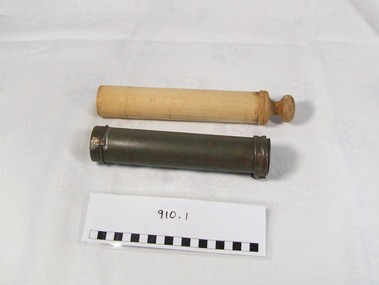
... Representative of kitchen utensils in common use in working class kitchens in 20th century prior to the common availability of packaged biscuits. domestic kitchen food technology biscuit forcer baking woman s work appliances Tin/metal outer cylinder/case/open one end, lid other end, with star pattern (can be removed for washing). ...Dough was put in forcer/case/cylinder and wooden pin pressed down to force dough out as a star-shaped biscuit. In use in a working-class home in the mid 20th century.Representative of kitchen utensils in common use in working class kitchens in 20th century prior to the common availability of packaged biscuits. Tin/metal outer cylinder/case/open one end, lid other end, with star pattern (can be removed for washing). Inner wooden pin or forcer, knob on end to be pushed into metal cylinder to force dough out through patterned disc.domestic, kitchen, food, technology, biscuit, forcer, baking, woman s, work, appliances -
 Flagstaff Hill Maritime Museum and Village
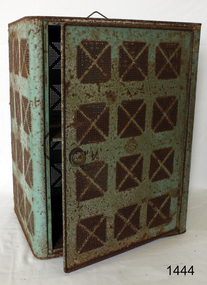
Domestic object - Food Safe, Willow Ware Pty Ltd, 1950s to 70s
... appliances. The maker, Willow, has a name associated with practical and reliable domestic products. flagstaff hill warrnambool flagstaff hill maritime museum shipwreck coast flagstaff hill maritime village great ocean road food storage food preservation Willow Willow Manufacturing Willow Australia kitchen storage food care 19th century 20th century Willow Ware domestic item coolgardie meat safe meat safe food safe coolgardie Marked "Made in Australia" "Willow" Metal kitchen safe with two shelves, a hinged door and latch and a small swivel wire handle at the top. ...This food safe is a mass-produced item made for domestic use by Willow Manufacturing in Australia fin the mid-20th century. Willow started a business in 1887 as a metalworking company based in Melbourne Australia, making tinned biscuit and tea canisters. In the First World War, the company began manufacturing armaments and essential packaging for the war effort. In the early 1920s, Willow produced domestic kitchen bakeware such as tin-plated canisters and baking pans labelled with the well-known Willow brand. Other items at this time include billies, boilers, basins and Coolgardie safes. In the late 1950s, the company ventured into plastics production. and in 1965, the name changed to Willow Ware Pty Ltd, to be more closely linked to its Willow brand. Willow Ware is still in business today.The Australian food safe is an example of domestic food storage and preservation in Australian homes from the mid-19th century and early 20th centuries. It is part of the evolution of food preservation methods leading up to our modern electric appliances. The maker, Willow, has a name associated with practical and reliable domestic products.Metal kitchen safe with two shelves, a hinged door and latch and a small swivel wire handle at the top. Painted light green. Airflow holes have been formed in each side panel. Made by Willow, Australia.Marked "Made in Australia" "Willow"flagstaff hill, warrnambool, flagstaff hill maritime museum, shipwreck coast, flagstaff hill maritime village, great ocean road, food storage, food preservation, willow, willow manufacturing, willow australia, kitchen storage, food care, 19th century, 20th century, willow ware, domestic item, coolgardie meat safe, meat safe, food safe, coolgardie -
 Orbost & District Historical Society
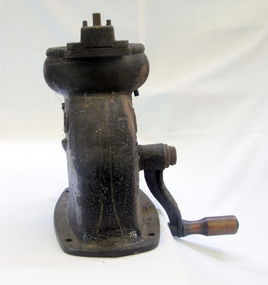
cream separator, 1920s - 1950s
... This domestic kitchen appliance is typical of the period when food processing was done at home. ...This item would have been very common on farms throughout the Orbost area. Prior to bulk milk, cream was the major commodity which was sold to the butter factory. This is a small separator, typical of home use. This domestic kitchen appliance is typical of the period when food processing was done at home. It would have been before the time of mass food processing factoriesHand operated rusted metal cream separator with metal and wood handle.Front - A.O Handle-75.T.PR.MIN Back- (RHS) A.O. (LHS) Co-op in outline of Australia.cream-separator domestic-food-preparation dairy-farming -
 Orbost & District Historical Society
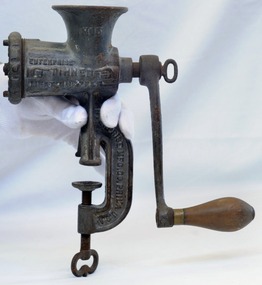
meat grinder, Late 19th century
... This is one of many models of the Enterprise Tinned Meat Chopper No5 This domestic kitchen appliance is typical of the period when food processing was done at home. ...This is one of many models of the Enterprise Tinned Meat Chopper No5This domestic kitchen appliance is typical of the period when food processing was done at home. It would have been before the time of mass food processing factoriesSmall black metal meat grinder with screw down grip for use on bench tops and tables. Still in working order. Carved wooden handle.Enterprise MFG.Co. PH'A, U.S.A. on clamp. Pat.Jan.30.83.June.5.88 on other side. Enterprise-Tinned-Meat-Chopper on barrel.grinder domestic food-preparation enterprise-mfc -
 Orbost & District Historical Society
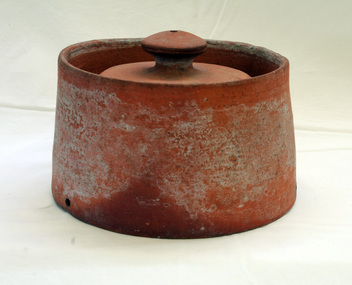
butter cooler
... This domestic kitchen appliance is typical of the period when food processing was done at home. ...This domestic kitchen appliance is typical of the period when food processing was done at home. It would have been before the time of mass food processing factories and before domestic refrigeration was common.Round earthenware butter cooler. Red/orange in colour.Has lid. Small holes at bottom so that butter could breathe. Handle on top for lifting cover. Inside is glazed.butter-cooler ceramics earthenware domestic food-storage food-preservation -
 Orbost & District Historical Society
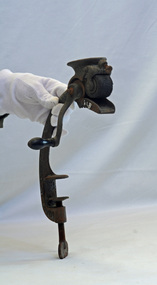
raisin stoner, late 19th century
... This domestic kitchen appliance is typical of the period when food processing was done at home. ...This domestic kitchen appliance is typical of the period when food processing was done at home. It would have been before the time of mass food processing factoriesA cast iron raisin stoner with a clamp. It has a wooden handle on a turning arm.On arm-PAT.APP. Aug 20.95 Oct 5-97 On one side- WET THE RAISINS On other side-ENTERPRISE M.F.C. PHILADELPHIA. P.A. U.S.A. On chute- No. 38raisin-stoner food-preparation
