
Showing 90 items matching "kitchen container"
-
 Flagstaff Hill Maritime Museum and Village
Container - Kitchen Canister set, Late 19th to early 20th century
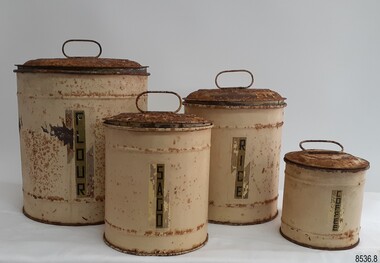
... ...kitchen container...This set of kitchen dry food canisters is made of metal; each container has a different height, width and capacity. ...The empty canisters can fit one inside the other. Container Kitchen Canister set ...This set of kitchen dry food canisters is made of metal; each container has a different height, width and capacity. The rolled thin metal has created a strong, round design with decorative rings on the circumference. The base and close-fitting lid protect the contents from vermin and most insects, and the handle on top aids in the removal of the lid. Metal containers like these are reusable and can be re-purposed, which is advantageous when living in regional or rural areas. The type of manufacture indicates that the set was made in the late 19th to early 20th century. Gradually, colourful and attractive plastic kitchenware began to replace metalware. One of the canisters is labelled 'coffee'; coffee plants and seeds were transported from Brazil into Australia in 1788 when the First Fleet arrived although their growth was unsuccessful. However, by the 1920s, a tenth of the Australian population was drinking readily stored coffee. Large quantities of harvested grains such as maize, wheat and barley were protected from pests by being stored in airy buildings, often raised from the ground. This was an age-old practice used by civilizations such as the ancient Egyptians and early Hebrews. Smaller quantities of food for short-term use in the homes were stored in woven baskets or clay pots.This set of kitchen food containers is an example of colonial food storage used in a domestic setting to store and preserve dry ingredients. These canisters give a snapshot of early domestic life in Australia. Canister set; four cylindrical cream coloured metal canisters with domed lids that have lift-up handles on top. They are made from rolled metal and the bases and lids have a side seam. Each canister is a different size and displays a label for different contents. The adhesive labels are vertical, and a gold colour with black vertical text. The cream paint has brush strokes and small areas have exposed green paint under the cream. The insides of the bases are painted dark grey but the lids have no paint underneath. The empty canisters can fit one inside the other. Labels, in descending order: "FLOUR" "RICE" "SAGO" "COFFEE"flagstaff hill, flagstaff hill maritime museum and village, warrnambool, maritime museum, maritime village, great ocean road, shipwreck coast, canister set, kitchen storage, food storage, metal canisters, dry food storage, food packaging, kitchen container, vintage, flour, rice, sago, coffee, kitchenalia, late 19th to early 20th centuries, nesting canisters -
 Kiewa Valley Historical Society
Tin Biscuit/Tea, Early to mid 1900s
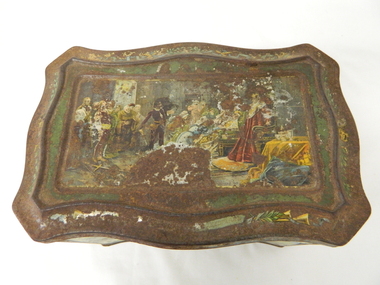
... ...kitchen table container...This biscuit /tea container was however a leveling of the socio-economic playing field of the time. food storage kitchen table container domestic educational storage shakespeare illustrations There are painted scenes from the following Shakespearian plays on each side of the tin; "As you like it", "Hamlet" and on each of the bevelled corners are the portraits of Shakespeare(in the middle), the caricature mask faces of "the theatre" above and on the bottom section the "Director's chair" This biscuit or tea tin, has besides having an outer lid (hinged), it also has an internal lid(with a circular finger grip). ...This biscuit/tea caddy was probably targeting the "theatre going" family or those who liked looking at the colourful shakespearian scenes. This item however demonstrates that the rural (Kiewa Valley) appreciation of classic English plays was, in this time period (early 1900's), just as strong as in the larger towns and cities. This item also presents the period in which the "olde" Elizabethian phrases and words were taught in regional high schools. Although this speech pattern and phraseology was of a specific time period and going out of fashion when Australia was first settled it was an inherited form of communication(higher social/economical level). In the context of the rural Australia "scene" and in this time frame of the elite "boarding school" generation this item was a visual reinforcement of the education level and position of the family who owned this tin.This item is highly significant because it not only presents the social aspects of early life in the Kiewa Valley but also the variety of educational levels and economical variations of the rural population within the Kiewa Valley. The egalitarian perception of the inhabitants of the Kiewa Valley was still at the infancy of early Australian social interactions. This biscuit /tea container was however a leveling of the socio-economic playing field of the time.This biscuit or tea tin, has besides having an outer lid (hinged), it also has an internal lid(with a circular finger grip). Although the shape is rectangular it has a slight concave bulge at each side of the centre of each of its main frame. It is made of pressed light steel and has a raised floor. The corners are bevelled and the outer lid has a bevelled slope ridge in parallel to the extremities of the main tin frame. There are painted scenes from the following Shakespearian plays on each side of the tin; "As you like it", "Hamlet" and on each of the bevelled corners are the portraits of Shakespeare(in the middle), the caricature mask faces of "the theatre" above and on the bottom section the "Director's chair"food storage, kitchen table container, domestic educational storage, shakespeare illustrations -
 Flagstaff Hill Maritime Museum and Village
Container - Tin, W T Rawleigh, Circa 1930s
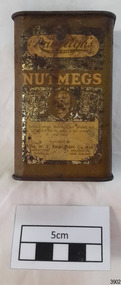
... container...tin...kitchen...kitchens since early days. It gives a snapshot into domestic life and social norms of the pre and post war period in Melbourne The tin is significant for its association with a local family in the 1930s for the preparation of family meals. tin container flagstaff hill warrnambool shipwrecked coast flagstaff hill maritime museum maritime museum shipwreck coast flagstaff hill maritime village great ocean road food container tin kitchen item container cooking ingredient grocery spice container nutmeg rawleigh co. ...This tin once contained Rayleigh's Nutmegs, a cooking ingredient. It was donated with other similar tins that were used by the donor’s mother who was married in 1932. It those times in Australia all manner of household items, including food and drink, were sold by hawkers (salesmen) who travelled from door to door in both suburban and rural areas. The donor remembered the tin on her mother’s pantry shelf. The Rawleigh Nutmegs label stated “Selected whole nutmegs not ground but granulated to preserve full strength and flavour.” The company had operated in Melbourne, Australia, and Wellington, New Zealand. W.T. Rawleigh & Co. was established by William Rawleigh in America in 1889 and later expanded into Australia. The company made a variety of household products in a factory in Collins Place, Melbourne, between 1930 and 1935. It specialised in medicines and remedies, food additives, cleaning products and toiletries. The company in Melbourne expanded into their factory in Dawson Street, Brunswick, in the mid-1930s. Independent salesmen, often referred to as ‘The Rawleigh’s man’, sold Rawleigh products door-to-door between the wars and after the Second World War in the Melbourne suburbs. Rayleigh’s products are still produced today. The tin is significant for its association with W.T Rawleigh, one of Melbourne’s strong growing manufacturers in period particularly between the World Wars. Rawleigh’s was, and still is, well known for its household and cleaning products, medicines, food additives and toiletries. The tin increases in significance for its use as a recognised object found in many Australian kitchens since early days. It gives a snapshot into domestic life and social norms of the pre and post war period in Melbourne The tin is significant for its association with a local family in the 1930s for the preparation of family meals. Rawleigh spice tin, rectangular, tall, used for storing Rawleigh's nutmeg. Tin has a flip-top lid, is coloured gold and comes with directions for use on front, back and sides of container.Text includes “W.T. RAWLEIGH Co. Ltd.”, “MELBOURNE / AUSTRALIA”, WELLINGTON / NEW ZEALAND” “Rawleigh’s / NUTMEGS” Motif: man’s portrait in a circle. Other text includes information about spices.tin container, flagstaff hill, warrnambool, shipwrecked coast, flagstaff hill maritime museum, maritime museum, shipwreck coast, flagstaff hill maritime village, great ocean road, food container, tin, kitchen item, container, cooking ingredient, grocery, spice container, nutmeg, rawleigh co. -
 Glenelg Shire Council Cultural Collection
Container - Tin, n.d
... kitchen... food container...Glenelg Shire Council Cultural Collection History House Cliff Street Portland great-ocean-road Displayed in History House (Cabinet, South wall) domestic item kitchen food container tin Green tin with lid. Pictures on front. ...Displayed in History House (Cabinet, South wall)Green tin with lid. Pictures on front.domestic item, kitchen, food container, tin -
 Flagstaff Hill Maritime Museum and Village
Ceramic - Stoneware Container, 1900 to 1940
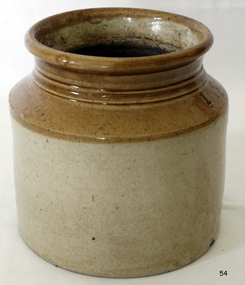
... ...stoneware container...kitchen...Or larger containers for kitchen flour. Items age is difficult to determine given the same techniques for making stoneware are in use today. ...Or larger containers for kitchen flour. Items age is difficult to determine given the same techniques for making stoneware are in use today. ...Stoneware is a rather broad term for pottery or other ceramics that is fired at a relatively high temperature. A modern technical definition is a vitreous or semi-vitreous ceramic made primarily from stoneware clay or non-refractory fire clay. Whether vitrified or not, it is non-porous, it may or may not be glazed. Historically, across the world, it has been developed after earthenware and before porcelain and has often been used for high-quality as well as utilitarian wares. As a rough guide, modern earthen wares are normally fired in a kiln at temperatures in the range of about 1,000°C (1,830 °F) to 1,200 °C (2,190 °F); stoneware's at between about 1,100 °C (2,010 °F) to 1,300 °C (2,370 °F); and porcelains at between about 1,200 °C (2,190 °F) to 1,400 °C (2,550 °F). Historically, reaching high temperatures was a long-lasting challenge, and temperatures somewhat below these were used for a long time. Earthenware can be fired effectively as low as 600°C, achievable in primitive pit firing, but 800 °C was more typical. Stoneware also needs certain types of clays, more specific than those able to make earthenware, but can be made from a much wider range than porcelain. A domestic item used to store food products as glazing makes the container non-porous, often used for pickling. Or larger containers for kitchen flour. Items age is difficult to determine given the same techniques for making stoneware are in use today. Stoneware containers were made by many potteries in Australia and England. They were in common domestic use before plastics were invented around 1940 to store goods so this subject item is probably from around 1900 to the 1940s. Item's significance is difficult to determine given it is not associated with a place, person, historic event, or manufacturer. Its significance lies with its use as a domestic object giving today a view into our social past.Stoneware circular container with wide opening, brown top and off white base glazed finish Marked "1" on brown glazed rimflagstaff hill, warrnambool, shipwrecked coast, flagstaff hill maritime museum, shipwreck coast, flagstaff hill maritime village, great ocean road, container, stoneware container, kitchen storage, kitchen ware -
 Flagstaff Hill Maritime Museum and Village
Ceramic - Stoneware Container, 1900 to 1940
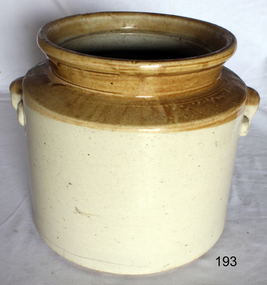
... ...stoneware container...kitchen...Or larger containers for kitchen flour. Items age is difficult to determine given the same techniques for making stoneware are in use today. ...Or larger containers for kitchen flour. Items age is difficult to determine given the same techniques for making stoneware are in use today. ...Stoneware is a rather broad term for pottery or other ceramics that is fired at a relatively high temperature. A modern technical definition is a vitreous or semi-vitreous ceramic made primarily from stoneware clay or non-refractory fire clay. Whether vitrified or not, it is non-porous, it may or may not be glazed. Historically, across the world, it has been developed after earthenware and before porcelain and has often been used for high-quality as well as utilitarian wares. As a rough guide, modern earthen wares are normally fired in a kiln at temperatures in the range of about 1,000°C (1,830 °F) to 1,200 °C (2,190 °F); stoneware's at between about 1,100 °C (2,010 °F) to 1,300 °C (2,370 °F); and porcelains at between about 1,200 °C (2,190 °F) to 1,400 °C (2,550 °F). Historically, reaching high temperatures was a long-lasting challenge, and temperatures somewhat below these were used for a long time. Earthenware can be fired effectively as low as 600°C, achievable in primitive pit firing, but 800 °C was more typical. Stoneware also needs certain types of clays, more specific than those able to make earthenware, but can be made from a much wider range than porcelain. A domestic item used to store food products as glazing makes the container non-porous, often used for pickling. Or larger containers for kitchen flour. Items age is difficult to determine given the same techniques for making stoneware are in use today. Stoneware containers were made by many potteries in Australia and England. They were in common domestic use before plastics were invented around 1940 to store goods so this subject item is probably from around 1900 to the 1940s. Item's significance is difficult to determine given it is not associated with a place, person, historic event, or manufacturer. Its significance lies with its use as a domestic object giving today a view into our social past.Stoneware circular container with wide opening, brown top and off white base. Handholds moulded on each side glazed finish, cracks in base.Noneflagstaff hill, warrnambool, shipwrecked coast, flagstaff hill maritime museum, shipwreck coast, flagstaff hill maritime village, great ocean road, container, stoneware container, kitchen storage, kitchen ware -
 Kiewa Valley Historical Society
Tin Rasawatte Tea, mid 1900's
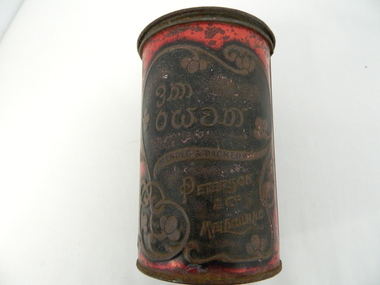
... kitchen storage...tin container...This canister which contained a blend of Rasawatte tea was produced in the early 1900's and for the most of those who acquired it for its contents it was useful (because it was made from solid pressed steel) as a tea caddy or container for other kitchen utensils or loose grains etc. ..."The latest jadgets" took longer to permeate into "isolated or semi isolated rural regions" such as the Kiewa valley kitchen storage tin container cannister/caddy kichen advertising Embossed with the following "Ceylon Flavoured" and in bold large letters "RASAWATTE TEA" and below this in smaller print "ONE POUND NETT" This is encapsulated by Tea plant petals and vines. ...This canister which contained a blend of Rasawatte tea was produced in the early 1900's and for the most of those who acquired it for its contents it was useful (because it was made from solid pressed steel) as a tea caddy or container for other kitchen utensils or loose grains etc. It was also a good advertising item for a general agent W.M. Peterson & Co. in Melbourne. This company along with neighbouring tea importers offices were burnt down in a horrific building fire in Melbourne.This item was used in a period of time when the tea beveridge was the main hot beveridge to accompany meals, and "high tea" was a special treat to enjoy quality teas and "finger" food. In the rural sector of the Kiewa Valley, the favourite hot drink at "smoko" or other rest times was a freshly "brewed" pot or "billy" of tea. The hot drink tea was later in time challenged by the hot cup of coffee. This change occured at a later time in the rural sector than in cities or larger towns. The rural sector in this time frame was a lot more "traditional" in a lot of their day to day learned mores. Life style changes took longer to evolve mainly due to lack of media bombardment (mainly from city based advertisers) within the family home . "The latest jadgets" took longer to permeate into "isolated or semi isolated rural regions" such as the Kiewa valleyThis cylindrical tin container, which originally contained fine Ceylon tea is totally constructed from pressed light steel. It is embossed with content details and the name of the general tea agent. The main body has been fastened by pressed, not soldered connections.Embossed with the following "Ceylon Flavoured" and in bold large letters "RASAWATTE TEA" and below this in smaller print "ONE POUND NETT" This is encapsulated by Tea plant petals and vines. On the opposite side and in script writing "3M" below this in an unfolded banner presentation "BLENDED & PACKED BY" below this "Peterson & co Melbourne" This is also encapsulated by Tea plant petals and vines.kitchen storage, tin container, cannister/caddy, kichen advertising -
 Flagstaff Hill Maritime Museum and Village
Container - Tin, W T Rawleigh, Circa 1930s
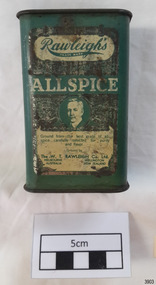
... ...tin container...kitchen...kitchens since early days. It gives a snapshot into domestic life and social norms of the pre and post war period in Melbourne The tin is significant for its association with a local family in the 1930s for the preparation of family meals. flagstaff hill museum container spice container rawleigh company tin container kitchen item tin cooking ingredient food container grocery allspice rawleigh co. ...This tin once contained Rawleigh's Allspice, a cooking ingredient. It was donated with other similar tins that were used by the donor’s mother who was married in 1932. It those times in Australia all manner of household items, including food and drink, were sold by hawkers (salesmen) who travelled from door to door in both suburban and rural areas. The donor remembered the tin on her mother’s pantry shelf. The Rawleigh Nutmegs label stated “Selected whole nutmegs not ground but granulated to preserve full strength and flavour.” The company had operated in Melbourne, Australia, and Wellington, New Zealand. W.T. Rawleigh & Co. was established by William Rawleigh in America in 1889 and later expanded into Australia. The company made a variety of household products in a factory in Collins Place, Melbourne, between 1930 and 1935. It specialised in medicines and remedies, food additives, cleaning products and toiletries. The company in Melbourne expanded into their factory in Dawson Street, Brunswick, in the mid-1930s. Independent salesmen, often referred to as ‘The Rawleigh’s man’, sold Rawleigh products door-to-door between the wars and after the Second World War in the Melbourne suburbs. Rayleigh’s products are still produced today. The tin is significant for its association with W.T Rawleigh, one of Melbourne’s strong growing manufacturers in period particularly between the World Wars. Rawleigh’s was, and still is, well known for its household and cleaning products, medicines, food additives and toiletries. The tin increases in significance for its use as a recognised object found in many Australian kitchens since early days. It gives a snapshot into domestic life and social norms of the pre and post war period in Melbourne The tin is significant for its association with a local family in the 1930s for the preparation of family meals. Rawleigh's rectangular Allspice spice tin, green, with directions for use on back and sides of container.Text “Rawleigh’s ALLSPICE” “The W.T. RAWLEIGH Co. Ltd.” “MELGOURNE / AUSTRALIA” “WELLINGTON / NEW ZEALAND” Motif: Man’s portrait in a circle. Other text includes information about spices.flagstaff hill museum, container, spice container, rawleigh company, tin container, kitchen item, tin, cooking ingredient, food container, grocery, allspice, rawleigh co. -
 Flagstaff Hill Maritime Museum and Village
Container - Tea Container, J Marsh & Sons (Tin Container Fabricators), 1900-1940
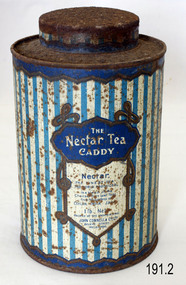
... ...container...kitchen...Flagstaff Hill Maritime Museum and Village 89 Merri Street Warrnambool great-ocean-road Tin, "Choicest Nectar Tea" is an example of retail packaging, for domestic goods, the tin was made by J Marsh and Sons, Melbourne, for John Connell & Co Ltd, Melbourne, Victoria, Australia, 1900-1940 Item at this time cannot be associated with an historical event, person or place, provenance is unknown, item assessed as a collection asset. flagstaff hill warrnambool flagstaff hill maritime museum maritime museum shipwreck coast flagstaff hill maritime village great ocean road tea canister tea caddy tea tin container kitchen storage food storage food nectar tea john connell melbourne J March & Sons John Connell & Co Ltd On label "The Nectar Tea Caddy" and "Nectar, the finest tea the world produces, is a blend of the Choicest Pure Leafed Teas from the Gardens of Ceylon, India, Java" Container; tea caddy for "Nectar Tea" brand, 1 lb. ...Tin, "Choicest Nectar Tea" is an example of retail packaging, for domestic goods, the tin was made by J Marsh and Sons, Melbourne, for John Connell & Co Ltd, Melbourne, Victoria, Australia, 1900-1940Item at this time cannot be associated with an historical event, person or place, provenance is unknown, item assessed as a collection asset.Container; tea caddy for "Nectar Tea" brand, 1 lb. Packed by John Connell and Co Ltd, Melbourne. Blue and white vertical stripe decoration. On label "The Nectar Tea Caddy" and "Nectar, the finest tea the world produces, is a blend of the Choicest Pure Leafed Teas from the Gardens of Ceylon, India, Java"flagstaff hill, warrnambool, flagstaff hill maritime museum, maritime museum, shipwreck coast, flagstaff hill maritime village, great ocean road, tea canister, tea caddy, tea tin, container, kitchen storage, food storage, food, nectar tea, john connell, melbourne, j march & sons, john connell & co ltd -
Flagstaff Hill Maritime Museum and Village
Container - Tin, Fred Walker Cresco Foods, 1910
... ...food container...kitchen...The history of Fred Walker gives insight into how many food brands in Australia now that we take for granted had his involvement in their early beginnings. flagstaff hill warrnambool shipwrecked coast flagstaff hill maritime museum flagstaff hill maritime village great ocean road container food container kitchen ware Flaked Rice Cresco Palm Flaked Rice Tin Fred Walker Dehydrated Food Palm Flaked Rice manufactured by the Cresco Co. ...Fred Walker 1884 – 1935 was an Australian businessman and founder of Fred Walker & Co. first in Hong Kong, then in Melbourne as the Fred Walker Company. He also set up Kraft Walker Cheese Co. in partnership with American businessman James L. Kraft in 1926, to market Kraft's patented method of processing cheese in Australia. Fred Walker & Co. is best known for creating Vegemite, a yeast extract-based food spread and Australian cultural icon. Kraft Walker Cheese Co. Is best known for manufacturing a cheese known as Red Coon around 1931, which later became known as Coon cheese. He founded the Fred Walker Company at 54 William Street and later moving to Flinders Street in 1911. This company specialised in canned foods, especially dairy products, exporting them to Asia. It manufactured Red Feather canned foods including butter and cheese from around 1910. He also went on to created Cresco Food Co. for his younger brother, which was the first factory to manufacture "flaked food" or dehydrated food products in Australia.A significant item that catalogues the start of dehydrated food production and sale in Australia was initiated by an Australian businessman and well-known entrepreneur. The history of Fred Walker gives insight into how many food brands in Australia now that we take for granted had his involvement in their early beginnings. Large cylindrical tin with push on lid, painted label on the sides in maroon, black gold and dark fawn colours with text.Palm Flaked Rice manufactured by the Cresco Co. Limited Melbourne Australiaflagstaff hill, warrnambool, shipwrecked coast, flagstaff hill maritime museum, flagstaff hill maritime village, great ocean road, container, food container, kitchen ware, flaked rice, cresco, palm flaked rice, tin, fred walker, dehydrated food -
 Mordialloc & District Historical Society Inc
Tin, Unknown
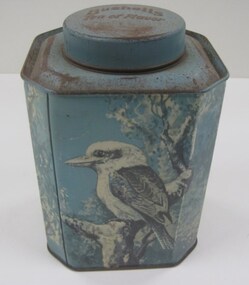
... ...container...kitchen...Mordialloc & District Historical Society Inc Laura and Charles Ferguson Museum Old Bakery Lane Mentone melbourne Represents two important features of Australian culture: tea drinking and unique animals bushells container kitchen Embossed on base: "Bushells/Tea of Flavor/FIRST GRADE/1 LB NET" Embossed on lid: "Bushells/Tea of Flavor" Bushells tea container completely covered with printed paintings of Australian fauna: kangaroo, koala, kookaburra and emu. ...Represents two important features of Australian culture: tea drinking and unique animalsBushells tea container completely covered with printed paintings of Australian fauna: kangaroo, koala, kookaburra and emu. Blue, with figures in grey, black and white. Container held 1 pound. Embossed on base: "Bushells/Tea of Flavor/FIRST GRADE/1 LB NET" Embossed on lid: "Bushells/Tea of Flavor"bushells, container, kitchen -
 Kiewa Valley Historical Society
Tin Tea Pyramids Blend, early 1900's
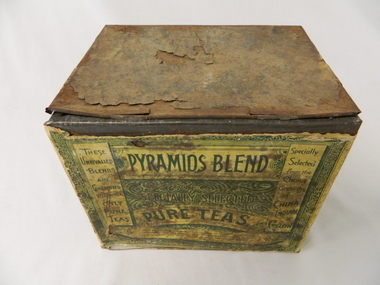
... When emptied, it could also be used as a general kitchen storage container for other bulk consumables....When emptied, it could also be used as a general kitchen storage container for other bulk consumables. ...This early 1900's tin which contained loose leaf blended tea was imported into Australia by those tea merchants who wanted to provide the Australian tea drinkers with quality tea. It could well be early Lipton distributors to both city and rural clients and consumers. This was in a period when most rural families were heavy tea drinkers. It was well before the introduction of coffee as a drink (especially instant) for the early morning, after meals and general "drink any time" pick me up beverage.This relatively large tea tin marks a period in time when loose leaf tea was in great demand and large quantities were not only used by families but also restaurants, workers mess halls and remote large rural families. The ability to obtain a quick tea supply in semi remote rural areas such as the Kiewa Valley was not possible due to the factors of all weather road access and the economics of traders going out of their way. Stocking up with important beverages, such as tea, was a "one of those things" that early rural communities had to endure with. Bulk storage tins such as this item were not only a requirement but also offered storage for other household items. This usefulness was not overlooked by the "canny" rural family.This large metal tin container was specifically manufactured for the kitchens requiring a bulk storage "bin" type of loose leaf tea content. When emptied, it could also be used as a general kitchen storage container for other bulk consumables.On the front side and in the background, there are three sketches of Egyptian pyramids(increasing in size from left to right). At the forefront there is a camel "train" loaded with supplies and handlers, making their way over the sandy desert going towards a large sign(in a freehand script) "PYRAMIDS BLEND". The left side "Specially Selected" and underneath "PURE TEAS" below this and within a circle is the figure of a Geisha clad of Asian appearance (with a fan in a raised hand with boxes(of varying sizes) around her. All these are in (off white design and wording on a green background. On the back in green print on off white background "PYRAMIDS BLEND" and underneath "OF SPECIALLY SELECTED PURE TEAS". On either side are columns of similar print. To the left "THESE UNRIVALLED BLENDS ARE GUARANTEED TO CONTAIN ONLY PURE TEAS".To the right "SPECIALLY SELECTED FROM THE CHOICE GROWTHS OF CHINA INDIAN & CEYLON". Below both columns is "for delicacy & fragrance of flavor, combined with great strength, and are confidently recommended to the public as the best values in teas obtainable" On the last side is a sketch of an " Indian encircled, holding a staph with palm trees in the background and four tea containers on his left, with "PYRAMID BLEND" as a subject heading. There are two Oxen pulling a two wheeled cart with a load of six large boxes. On lid and barely readable "FIVE POUNDS NET"loose leaf tea containers, food storage tins, kitchen tidies -
Port Melbourne Historical & Preservation Society
Container - Kitchen's Coo-ee Cleanser, J Kitchen & Sons Pty Ltd, 1940s
... Green cylindrical container of Kitchen's Coo-ee cleanser (12 oz), circa 1940s...Port Melbourne Historical & Preservation Society Port Melbourne Town Hall 333 Bay Street Port Melbourne melbourne industry - manufacturing business and traders - soaps/candles j kitchen & sons pty ltd coo-ee cleanser Green cylindrical container of Kitchen's Coo-ee cleanser (12 oz), circa 1940s Container Kitchen's Coo-ee Cleanser J Kitchen & Sons Pty Ltd ...Green cylindrical container of Kitchen's Coo-ee cleanser (12 oz), circa 1940sindustry - manufacturing, business and traders - soaps/candles, j kitchen & sons pty ltd, coo-ee cleanser -
 Musculoskeletal Health Australia (now held by the Glen Eira Historical Society)
Photograph - Group photo, 2000
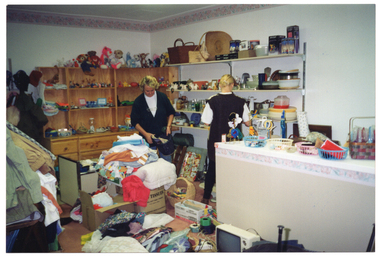
... On the perpendicular wall, there are more shelves with various items, including cane baskets, a large straw hat, bric-a-brac, crockery, glassware, plastic kitchen storage containers, and some boxed items on the top shelf. ...On the perpendicular wall, there are more shelves with various items, including cane baskets, a large straw hat, bric-a-brac, crockery, glassware, plastic kitchen storage containers, and some boxed items on the top shelf. ...At the Arthritis Foundation of Victoria's Malvern Opportunity Shop, two volunteers sort through boxes of donations in the crowded shop.COL photo of two women inside a shop. They are sorting through bags and boxes of donations in a crowded room. Behind them is a large dresser, with drawers at the bottom and a hutch with shelves at the top. There are soft toys across the top shelf, and various other items on the shelves below. On the perpendicular wall, there are more shelves with various items, including cane baskets, a large straw hat, bric-a-brac, crockery, glassware, plastic kitchen storage containers, and some boxed items on the top shelf. The floor is crowded with boxes, baskets, and other miscellaneous items - including a portalbe television set. In the foreground, there are piles of clothing or fabric.[Handwritten in blue ink] Jenni and Missy "in a mess"arthritis foundation of victoria, afv, opportunity shop, op shop, charity shop, thrift store, teddy bear, soft toys, glassware, bric-a-brac, prints, pictures, plastic kitchen storage containers, television, clothing, bedding, volunteers, members, moonee ponds, 2000 -
 Flagstaff Hill Maritime Museum and Village
Ceramic - Stoneware Bottle, 1890-1940
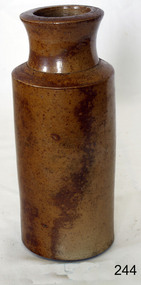
... Or larger containers for kitchen flour. Items age is difficult to determine given the same techniques for making stoneware are in use today. ...Or larger containers for kitchen flour. Items age is difficult to determine given the same techniques for making stoneware are in use today. ...Stoneware is a rather broad term for pottery or other ceramics that is fired at a relatively high temperature. A modern technical definition is a vitreous or semi-vitreous ceramic made primarily from stoneware clay or non-refractory fire clay. Whether vitrified or not, it is non-porous, it may or may not be glazed. Historically, across the world, it has been developed after earthenware and before porcelain and has often been used for high-quality as well as utilitarian wares. As a rough guide, modern earthen wares are normally fired in a kiln at temperatures in the range of about 1,000°C (1,830 °F) to 1,200 °C (2,190 °F); stoneware's at between about 1,100 °C (2,010 °F) to 1,300 °C (2,370 °F); and porcelains at between about 1,200 °C (2,190 °F) to 1,400 °C (2,550 °F). Historically, reaching high temperatures was a long-lasting challenge, and temperatures somewhat below these were used for a long time. Earthenware can be fired effectively as low as 600°C, achievable in primitive pit firing, but 800 °C was more typical. Stoneware also needs certain types of clays, more specific than those able to make earthenware, but can be made from a much wider range than porcelain. A domestic item used to store food products as glazing makes the container non-porous, often used for pickling. Or larger containers for kitchen flour. Items age is difficult to determine given the same techniques for making stoneware are in use today. Stoneware containers were made by many potteries in Australia and England. They were in common domestic use before plastics were invented around 1940 to store goods so this subject item is probably from around 1900 to the 1940s.Item's significance is difficult to determine given it is not associated with a place, person, historic event, or manufacturer. Its significance lies with its use as a domestic object giving today a view into our social past.Brown salt glaze stoneware bottle None (possibly made by Royal Doulton UK)flagstaff hill, warrnambool, flagstaff hill maritime museum, maritime museum, flagstaff hill maritime village, great ocean road, bottle, stoneware bottle, storage, kitchen ware, salt glazed, stoneware, shipwreck coast -
 Flagstaff Hill Maritime Museum and Village
Ceramic - Jug, 1900 - 1940
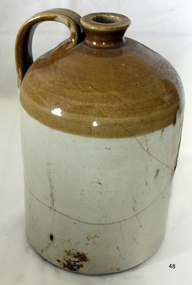
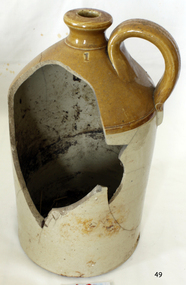
... Or larger containers for kitchen flour. Items age is difficult to determine given the same techniques for making stoneware are in use today. ...Or larger containers for kitchen flour. Items age is difficult to determine given the same techniques for making stoneware are in use today. ...Stoneware is a rather broad term for pottery or other ceramics that is fired at a relatively high temperature. A modern technical definition is a vitreous or semi-vitreous ceramic made primarily from stoneware clay or non-refractory fire clay. Whether vitrified or not, it is non-porous, it may or may not be glazed. Historically, across the world, it has been developed after earthenware and before porcelain and has often been used for high-quality as well as utilitarian wares. As a rough guide, modern earthen wares are normally fired in a kiln at temperatures in the range of about 1,000°C (1,830 °F) to 1,200 °C (2,190 °F); stoneware's at between about 1,100 °C (2,010 °F) to 1,300 °C (2,370 °F); and porcelains at between about 1,200 °C (2,190 °F) to 1,400 °C (2,550 °F). Historically, reaching high temperatures was a long-lasting challenge, and temperatures somewhat below these were used for a long time. Earthenware can be fired effectively as low as 600°C, achievable in primitive pit firing, but 800 °C was more typical. Stoneware also needs certain types of clays, more specific than those able to make earthenware, but can be made from a much wider range than porcelain. A domestic item used to store food products as glazing makes the container non-porous, often used for pickling. Or larger containers for kitchen flour. Items age is difficult to determine given the same techniques for making stoneware are in use today. Stoneware containers were made by many potteries in Australia and England. They were in common domestic use before plastics were invented around 1940 to store goods so this subject item is probably from around 1900 to the 1940s.Item's significance and origin of manufacture is difficult to determine given it is not associated with a place, person, historic event, or manufacturer. Its significance lies with its use as a domestic object giving today a view into our social past. Stoneware jug badly cracked and repaired with handle and short neckNoneflagstaff hill, warrnambool, shipwrecked coast, flagstaff hill maritime museum, maritime museum, shipwreck coast, flagstaff hill maritime village, great ocean road, jug, stoneware jug, earthenware jug, kitchen storage -
 Flagstaff Hill Maritime Museum and Village
Ceramic - Jug, 1920-1940
... Or larger containers for kitchen flour. Items age is difficult to determine given the same techniques for making stoneware are in use today. ...Or larger containers for kitchen flour. Items age is difficult to determine given the same techniques for making stoneware are in use today. ...Stoneware is a rather broad term for pottery or other ceramics that is fired at a relatively high temperature. A modern technical definition is a vitreous or semi-vitreous ceramic made primarily from stoneware clay or non-refractory fire clay. Whether vitrified or not, it is non-porous, it may or may not be glazed. Historically, across the world, it has been developed after earthenware and before porcelain and has often been used for high-quality as well as utilitarian wares. As a rough guide, modern earthenwares are normally fired in a kiln at temperatures in the range of about 1,000°C (1,830 °F) to 1,200 °C (2,190 °F); stoneware's at between about 1,100 °C (2,010 °F) to 1,300 °C (2,370 °F); and porcelains at between about 1,200 °C (2,190 °F) to 1,400 °C (2,550 °F). Historically, reaching high temperatures was a long-lasting challenge, and temperatures somewhat below these were used for a long time. Earthenware can be fired effectively as low as 600°C, achievable in primitive pit firing, but 800 °C was more typical. Stoneware also needs certain types of clays, more specific than those able to make earthenware, but can be made from a much wider range than porcelain. A domestic item used to store food products as glazing makes the container non-porous, often used for pickling. Or larger containers for kitchen flour. Items age is difficult to determine given the same techniques for making stoneware are in use today. Stoneware containers were made by many potteries in Australia and England. They were in common domestic use before plastics were invented around 1940 to store goods so this subject item is probably from around 1900 to the 1940s. Item's significance is difficult to determine given it is not associated with a place, person, historic event, or manufacturer. Its significance lies with its use as a domestic object giving today a view into our social past.Brown Stoneware jug with short neckThe number "1" under neck flagstaff hill, warrnambool, shipwrecked coast, flagstaff hill maritime museum, shipwreck coast, flagstaff hill maritime village, great ocean road, jug, stoneware jug, salt glaze -
 Warrnambool and District Historical Society Inc.
Domestic object - Food Cover, c. 1930
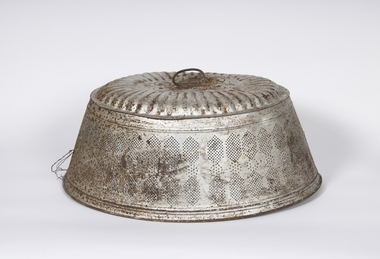
... containers. It usually contained food, mainly meat, to protect it from flies, heat or draught while allowing the air to circulate around it and it could be hung in sheds, kitchens, cellars etc. ...containers. It usually contained food, mainly meat, to protect it from flies, heat or draught while allowing the air to circulate around it and it could be hung in sheds, kitchens, cellars etc. ...This is a food cover, most commonly used in homes in the days before refrigeration and plastic containers. It usually contained food, mainly meat, to protect it from flies, heat or draught while allowing the air to circulate around it and it could be hung in sheds, kitchens, cellars etc. This food cover is retained as a memento of domestic objects used in the past and will be useful for display purposes.This is a food cover made of metal with a circular base and decorative sides, finely pierced to create a mesh pattern. It has a fluted and patterned top with a ring handle. It is rusted.vintage kitchen items, warrnambool & district historical society collection -
 Warrnambool and District Historical Society Inc.
Functional object - Candle stick container, Early 20th century
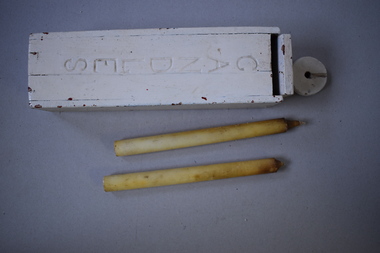
... kitchen where the candles would be accessible and lit from the wood stove or a fireplace. Candles for lighting would have been in widespread use in Warrnambool until the mid 1920s when electric lighting was introduced and would have been used for a couple of decades after this in areas out of towns and cities where there was no electric lighting. This item is retained as an example of a household item from the early 20th century. It will be useful for display and school visits. vintage household goods history of warrnambool candles CANDLES This is a rectangular-shaped wooden container ...This candle holder was probably home made and hung in a kitchen where the candles would be accessible and lit from the wood stove or a fireplace. Candles for lighting would have been in widespread use in Warrnambool until the mid 1920s when electric lighting was introduced and would have been used for a couple of decades after this in areas out of towns and cities where there was no electric lighting. This item is retained as an example of a household item from the early 20th century. It will be useful for display and school visits.This is a rectangular-shaped wooden container with a fitted lid. The container has been painted white but is now peeling in places. The top of the container has an extra wooden piece at the top with a hole in the middle for attaching a cord or string to hang the item on a door or wall. The word ‘candles’ is incised into the side of the container. Inside the container (originally space for six candles) are the remains of three candles with one other candle almost intact and another one intact with a wick. CANDLESvintage household goods, history of warrnambool, candles -
 Kiewa Valley Historical Society
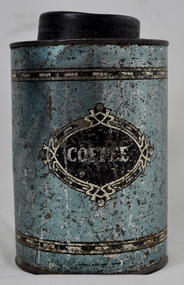
Tin Coffee Cylindrical, circa mid to late 1900's
... This transition was precipitated by the SEC Vic Hydro Scheme of the 1940's to 1960's which increased the valley's population level three fold. kitchen containers domestic food storage bulk stocks of dried condiments "COFFEE" within an elongated spherical "art deco" four pointed banner of silver and black colouring This cylindrical tin has a pull/push lid(for easy access to the contents). ...This "coffee" tin has by the "art deco" appearance its origins in the late 1950's to 1960's. This time period was one of accelerated growth both in the physical (housing) sense and the mental (new ideas and inventions) changes in "attitudes". These occurred more rapidly in cities but had its effects on the rural environment. The drinking of coffee was spurred on by easier distribution of imported food and drinks. Advertising by stronger radio links and then by television brought the variety of foods and drinks to semi isolated rural regions. The accessibility through greater information channels becoming available brought with it unbelievable ranges of goods and foodstuffs. Rural regions still relied on bulk supplies and relatively larger storage containers than those in cities. This "bulk" buying and storage "syndrome" was a lingering result of many years of "drought" periods when road transports met delays from flooded roadways in supplying population centres in the Kiewa Valley. The construction phases in building the SEC Vic Hydro electricity Scheme in the eastern sections of the Victorian Alps brought many changes to the quiet rural regions in the Kiewa Valley. Changes in population and social mores. The influx of a varied , mostly temporary, and "European flavoured cuisine" changes the "cuppa tea only" flavour to the have a "coffee break". The subliminal influence of the "American" films changed those children growing up in the post 1950s from the "English tea" to the "American coffee". This "Americanisation process has influenced not only rural Australia but also other areas throughout the world.This "insignificant" coffee tin is very significant as it demonstrates that the Kiewa Valley was becoming more accessible to reliable coffee supplies and general food items.The container was part of a "set" of containers that included tea, sugar,biscuits,flour, rice and other family condiments. This type of kitchen storage containers was brought about through changing patterns in tea and coffee useage and overall consumption. Household demands for faster "self help" cooking especially beveridges and the greater choice of kitchen "utensils" was brought on by easier access to products due to a lessening of the area's "isolation" by having a reliable (all weather) road system and an ever increasing population growth. The need for travelling goods/merchant supply caravans to service the area became a diminishing factor, as a result of the establishment of grocery stores in Tawonga and Mount Beauty in the supply of previously "hard to get" groceries. This transition was precipitated by the SEC Vic Hydro Scheme of the 1940's to 1960's which increased the valley's population level three fold.This cylindrical tin has a pull/push lid(for easy access to the contents). The container is labelled for "coffee" however it has no commercial manufacturer's label to establish that it was bought with coffee ingredients in it. The majority of the container's external surface has a "metallic" light blue colour with two sets of silver rings confining black (horizontal spotted) rectangles. "COFFEE" within an elongated spherical "art deco" four pointed banner of silver and black colouringkitchen containers, domestic food storage, bulk stocks of dried condiments -
 Kiewa Valley Historical Society
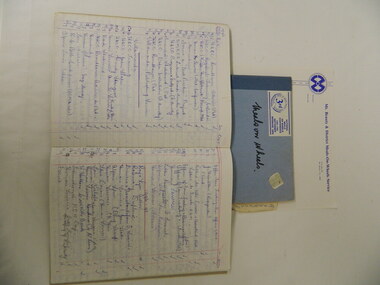
Paper Records for Mt Beauty & District Meals On Wheels, 1960s - 2003
... Kitchen to the elderly and sick members of the community each day including weekends. Eventually the Shire managed the meals and roster until recent times when, in 2016, Alpine Health took over. Members of the Mt Beauty community recognised the need for meals to be delivered to the elderly and sick. They formed a committee and organised the means (rules, meals, containers ...Mt Beauty & District Meals on Wheels committee was formed on 6th Dec. 1967, possibly under the Elderly Citizens Welfare Council News (or Senior Citizens Mt Beauty) with service commencing on 16th July 1968. Volunteers transported meals from the Hospital Kitchen to the elderly and sick members of the community each day including weekends. Eventually the Shire managed the meals and roster until recent times when, in 2016, Alpine Health took over. Members of the Mt Beauty community recognised the need for meals to be delivered to the elderly and sick. They formed a committee and organised the means (rules, meals, containers, roster ) by which they could achieve their goal with volunteers and the Tawonga District Hospital. The first delivery was recorded by the press and was on film by AMV 4 Albury TV station for their local news. The official party included - local member, Tom Mitchell, Shire representatives, Alec McCullough and Dr Jean Hutching who joined the volunteers for a luncheon at the Mt Beauty Chalet.Paper records for the Mt Beauty Meals On Wheels Program includes photos, newspaper cuttings, committee documents, roster, petrol book, minute books 1983 - 1998, correspondence book, stationary and a brief history of the first delivery in 1968.meals on wheels; mt beauty; tawonga district hospital; -
 Kiewa Valley Historical Society
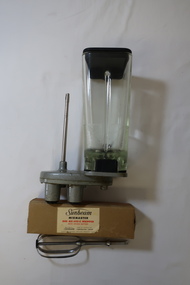
Mixmaster and attachments
... See KVHS 1282 kitchen appliance blender vitamiser Mixmaster Sunbeam Ron White Meat Grinder Food Chopper Mixmaster blender box made by Sunbeam, Australia Cat. No. AMB-O. It includes a rectangular glass container ...Household item used in the kitchen for mixing food. It belonged to Ron White.Ron White (1920 - 2019) worked for the SECV and was superintendent engineer of the Kiewa Hydro Electric Scheme after its completion. He lived in Mt Beauty and worked until he retired in 1985. See KVHS 1282 Mixmaster blender box made by Sunbeam, Australia Cat. No. AMB-O. It includes a rectangular glass container with a black bakelite lid. It fits onto a steel attachment and is held by 4 black bakelite stands. Second box consists of - Sunbeam / Meat Grinder / and / Food Chopper / Attachment / with Power Transfer Unit / for Sunbeam Mixmaster / Cat No. FC 6 / Made in Australia Attachments are boxed inside.kitchen appliance, blender, vitamiser, mixmaster sunbeam, ron white, meat grinder, food chopper -
 Bendigo Military Museum
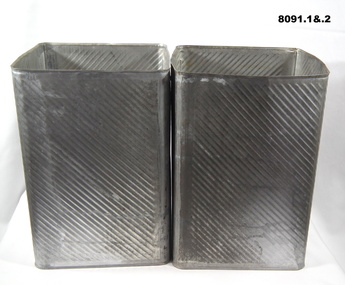
Container - KEROSENE TINS, pre 1990
... kitchen on the side of the building. It was made from Chicory Essence coffee, milk and a small amount of water, a bottle of Rum was added to each when near ready. These were used for many, many years up until about 2006 when new containers...kitchen on the side of the building. It was made from Chicory Essence coffee, milk and a small amount of water, a bottle of Rum was added to each when near ready. These were used for many, many years up until about 2006 when new containers ...These four tins were used to make the ANZAC Day rum and coffee at the Soldiers Memorial Institute Hall to be served after the Dawn Service. (Bendigo RSL Sub - Branch) It was brewed on the electric stoves in the old kitchen on the side of the building. It was made from Chicory Essence coffee, milk and a small amount of water, a bottle of Rum was added to each when near ready. These were used for many, many years up until about 2006 when new containers were used. The old kitchen was removed in the Renovations to SMI in 2016 - 2018 as it was not part of the original building..1) - .4) Kerosene tins, metals, open at one end.brsl, smirsl, rum, coffee -
 Bendigo Military Museum
Photograph - FRAMED WW1 PHOTOGRAPH, Wayne Eels, C.2008/09
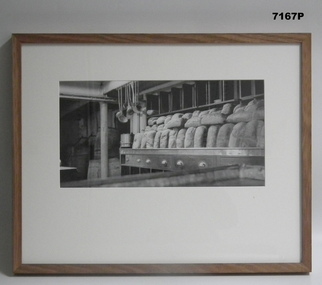
... kitchen area. Jack Grinton. Refer Cat No. 1280 for his service history. Framed Accessories Camera on the Somme WW1 38th Bn Grinton HMAT Karmala "Group 5: Quota 45 - Journey home". "C. Bread for the soldiers". Photograph - framed. Photograph - black and white photograph on paper depicts - interior scene with a large number of loaves of bread stacked on a shelf. Background - storage racks, soup ladles and timber containers ...The Grinton Collection. On board ship in a kitchen area. Jack Grinton. Refer Cat No. 1280 for his service history.Photograph - framed. Photograph - black and white photograph on paper depicts - interior scene with a large number of loaves of bread stacked on a shelf. Background - storage racks, soup ladles and timber containers. Frame - timber, light varnish finish, Perspex front, cardboard backing."Group 5: Quota 45 - Journey home". "C. Bread for the soldiers".framed accessories, camera on the somme, ww1, 38th bn, grinton, hmat karmala -
 Kiewa Valley Historical Society
Dispenser Mustard, 1860's
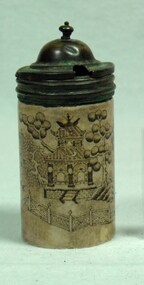
... container and would have been part of a dinner set. This would have been used for special occasions . It is in good condition and is a good example of this type salt storage jar. As this has a brown willow pattern instead of the usual blue it makes this make this salt despenser rare item. This has social and historical significance as it shows what items families used for special dinner occasions. It is the only one our collection and therefore will have good interpretation value for exhibitions . ceramic copper chinese table items kitchen ...This item would have been used as a salt container and would have been part of a dinner set. This would have been used for special occasions . It is in good condition and is a good example of this type salt storage jar. As this has a brown willow pattern instead of the usual blue it makes this make this salt despenser rare item.This has social and historical significance as it shows what items families used for special dinner occasions. It is the only one our collection and therefore will have good interpretation value for exhibitions . Small Ceramic jar with brown willow Chinese pattern. Copper hinged lid with recess for spoon. The spoon is required to dispense the mustard.ceramic, copper, chinese, table items, kitchen, domestic, mustard, willow pattern -
 Kiewa Valley Historical Society
Shaker Spices, after 1895
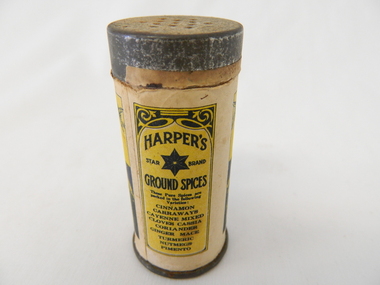
... This spice container was used mainly in domestic kitchen within the Kiewa Valley. ...This item was used at a time when there was a limited range of spices available and sought after by domestic and commercial kitchens. The taste buds of the average Australian diner were limited to the basic English style dishes which had been delivered by the early colonial days. Rural areas where slower in experimenting with Asian and European cuisine. The influx of European cuisine from refugees fleeing both World War I and world War II brought a different appreciation of gourmet food. The increase in Asian spices was brought about by Australians becoming more aware of the Asian "scene" through the conflicts of Korean and Vietnam military action. The "standard" type spices such as Cinnamon, nutmeg and similar spices offered by Robert Harper and later other Food and Spices whole sellers and processors where a direct result of a greater influx of migrants from spices rich societies and resulted in a greater range of "Asian" spices This became more visible after demise of the "White Australian Policy" on immigration and the great media revolution of Televised cooking shows from the 1950s on. The sustainability of containers such as this re-useable tin and cardboard spice holder, which could be replenished and not thrown away after it was empty was it a time period well before the "throw away" society had crept into the Valley.This spice container was used mainly in domestic kitchen within the Kiewa Valley. Those European construction workers of the SEC Kiewa Hydro Electricity Scheme had brought their continental cuisine into the valley and that was the beginning of a new era in highlighting different tastes. This rural valley had a greater interaction with people from other nation's cuisines and by association became more infused with a broader range of spices and food preparations.This item (spice shaker) is constructed by using a thick cardboard cylinder with both ends closed by tin plated light steel lids. The bottom lid is not removable however the top lid is removable to allow the contents (Cinnamon Spice) to be refilled. The lid has thirteen small holes which allow the contents to be shaken out. The outer side of the cylinder has been covered (glued on) by a printed black and yellow label detailing contents , weight, and supplier.On the front side of the printed label outside of the label boundary is "To make a shaker of this tin - take the lid off and remove the paper from inside the lid" Within the marked horse shoe shaped boundary is" HARPER'S ground spices star brand" underneath "CINNAMON" underneath this is printed "1 oz. NET WEIGHT" and under this, within its own frame " ROBERT HARPER COMPANY LIMITED (incorporated in Victoria) AUSTRALIA." On the back within its own box is "HARPER'S star brand GROUND SPICES" and underneath "These Pure Spices are packed in the following Varieties". Below this is a list (going down) "CINNAMON CARRAWAYS CAYENNE MIXED CLOVES CASSIA CORIANDER GINGER MACE TURMERIC NUTMEGS PIMENTO"kitchen spices, spice shakers, food preparation -
 Kiewa Valley Historical Society
Scales Weighing, early 1900's
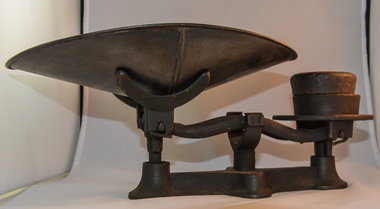
... kitchen scales weighing scales metal scales The smaller disc has a "1 lb" moulded and pressed form within a marked inner circle and a mouled ridge outer circle enclosure. The other weight is slightly larger and has a moulded "1" located on the top within a raised circular edge. Black cast iron, medium weighing scales, with a two arm cradle. On one side of the cradle is a two half circle holding frame for the retention of the metal container ...Although these scales cannot be identified against a historical period of Australian development they are therefore placed in a time frame when commercial markings from manufacurers were not important enough to have domestic kitchen items labeled. These cast iron scales were made for domestic and possibly rural areas and not for cities where demand for known branded utensils was more an issue. These scales are very "basic" and not to the level of weighing detail that commercial scales had to be at. These scales do not show any visible markers for accurate measurement. The "near enough is good enough" principle can be related to these scales.These scales are significant as they identify one of the basic preparation items for the weighing of foodstuff before the televising of "cooking" shows (1960s onward). The meals for which quantity measurements are required for domestic cooking is not exact however the use of cup measurements for large dishes is tedious and these scales offer the capacity for a larger mixture and an easier method for the "cook". As the need for accurate measurements of ingrediants for rural domestic meals has in the past been not been critical the requirement of accuracy that these scales do not provide is of no consequence. Domestic kitchens in the Kiewa Valley and the type of meals produced would not have required the accuracy of ingrediants that "modern " international cuisines of the later 1900's require. These kitchen scale were used whenrecipes had the terms "pinch, dollop, squidge and smidgen" were about as accurate as most recipes needed to be.Black cast iron, medium weighing scales, with a two arm cradle. On one side of the cradle is a two half circle holding frame for the retention of the metal container scoop. This light weight steel scoop/dish allows for the weighing of loose grain or similar type material to be contained and held in place for establish its saleable contents. On the other side of the weighing cradle is a flat circular platform to hold various metal disc. All the disks used on this platform have their weight stamped on them. When the produced filled in the scoop balances with the metal weight on the opposite end of the balance match (visual horizontal appraisal) the appropriate quantity required is obtained. This scale does not have any visual markings on the arms to identify a true balance. It is therefore reasonable to assume that these scales were for domestic use only and not for commercial transactions. There are two weights that are useable with these scales, one is stamped "1 lB"(pound) and one stamped "1" and both are made as a solid round piece of cast metal.The smaller disc has a "1 lb" moulded and pressed form within a marked inner circle and a mouled ridge outer circle enclosure. The other weight is slightly larger and has a moulded "1" located on the top within a raised circular edge.domestic kitchen scales, weighing scales, metal scales -
 Kiewa Valley Historical Society
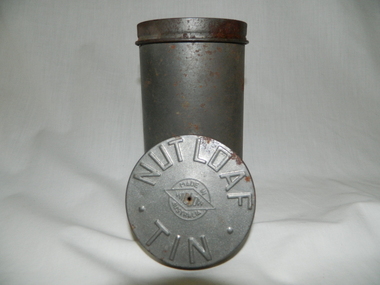
Tin Nut Loaf, early 1900's
... containers started being used). It was a period when "home" cooking(desert & cakes) was the only method of having cakes and other pastry dishes in rural areas. The utensils available for this home cooking had to be strong and reliable and low maintenance. This nut roll can is very significant(in rural Australia) because it highlights a period in time when the majority of cakes and other pastry dishes were cooked in the family kitchen and not purchased from a shop. ...This nut roll tin was used in a period before 1959(when plastic containers started being used). It was a period when "home" cooking(desert & cakes) was the only method of having cakes and other pastry dishes in rural areas. The utensils available for this home cooking had to be strong and reliable and low maintenance. This nut roll can is very significant(in rural Australia) because it highlights a period in time when the majority of cakes and other pastry dishes were cooked in the family kitchen and not purchased from a shop. This was a period of self sufficiency especially in semi remote rural areas such as the Kiewa Valley. This was a time when cooking utensils were either made in Australia or imported from England or Europe. After World War II imports from the USA increased significantly and then followed by cheaper products from Asia.This cylindrical nut loaf tin(mild steel) has a removable lid and base. There are three retaining hooks which stop the spring steel "main body" from being condensed beyond the circumference of both top and bottom "lids" The tin is pliable enough to "open" up and allow the baked nut loaf to be removed.On the outside edge of each lid "NUT LOAF" and the opposite side "TIN"baking tins, kitchen utensils, tins -
 Orbost & District Historical Society
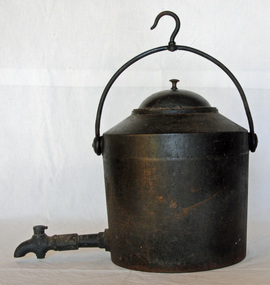
water fountain, Late 19th century
... kitchen of homesteads. Early homes often had an open fire containing a fountain, buckets and kettles that hung from a hook in the fireplace. These containers...kitchen of homesteads. Early homes often had an open fire containing a fountain, buckets and kettles that hung from a hook in the fireplace. These containers ...This type of cast iron kettle was used by pioneer families, mainly rural in the early 1900's upon open fires. It provided a source of boiling water, in or mainly outside the kitchen of homesteads. Early homes often had an open fire containing a fountain, buckets and kettles that hung from a hook in the fireplace. These containers supplied hot water for cooking, washing and cups of tea. The fountain was placed on hob until needed and then hung over fire.This water fountain would have been used by early settlers in Orbost before the connection of electricity.A large cast iron water fountain. It has a hook on the curved swinging handle and a tap at the front. This large cast iron camp pot or cauldron has a long tap connection located at the bottom end at the front. The tap has a simple control swivel at the end to control the water flow.On lid 1934.1 - 3 to 4 On base 1934.2 - A. Kenrick & Sons 4 Gallskettle cast-iron kenrick domestic kitchen -
 Orbost & District Historical Society
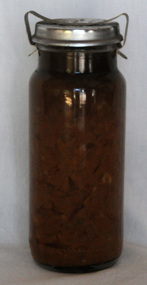
preserving jar, 1915 - 1975
... Fowlers Vacola preserving kits were common in most kitchens. food-preservation Fowlers-Vacola container-glass On lid Fowlers Vacola Size 3 Top of jar- embossed with the words Fowlers Vacola A brown glass Fowler's Vacola preserving jar filled with pickles. ...This preserving jar was used in the first half of the 20th century to preserve cooked food - pickles. Preserving home produce in bottles is a method that applies heat to food in a closed glass home canning jar to stop the natural spoilage that would otherwise take place. It removes air from the jar to create a seal. he bottling process forms an air tight seal between the bottle and the lid. Residents of Orbost have long been self sufficient growing their own fruit and vegetables with earlier market gardeners They preserved their produce for use all year. Fowlers Vacola preserving kits were common in most kitchens.A brown glass Fowler's Vacola preserving jar filled with pickles. It is a No. 27 bottle with a size 3 metal clip. It has an 850ml capacity. The lid has metal tension clips which are secured during the canning process and are removed once a vacuum seal has formed. The lid is tin-plated with a lacquer coating, double-coated on the underside.On lid Fowlers Vacola Size 3 Top of jar- embossed with the words Fowlers Vacola food-preservation fowlers-vacola container-glass
