
Showing 27 items matching "kitchen cutlery"
-
 City of Moorabbin Historical Society (Operating the Box Cottage Museum)
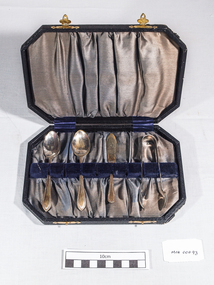
Domestic object - Kitchen Equipment, cutlery
... Kitchen Equipment, cutlery...kitchen equipment...cutlery...Domestic object Kitchen Equipment, cutlery ...Electro Plated Silver cutlery. Part-set comprising of 2 teaspoons, 1 butter-knife and 1 sugar- tongs in an olive coloured cotton-sateen lined, embossed-paper covered box.EPNSkitchen equipment, cutlery, silverplate, early settlers, pioneers, moorabbin, bentleigh, cheltenham, market gardeners -
 City of Moorabbin Historical Society (Operating the Box Cottage Museum)
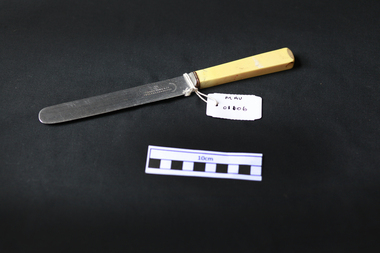
Kitchen Equipment, cutlery, table knife, c1930
... Kitchen Equipment, cutlery, table knife...This Stainless steel knife with a bone handle is typical of the cutlery used by early settlers in Moorabbin shire c1930 cutlery, stainless steel, frank cobb & co sheffield, england, early settlers, market gardeners, moorabbin, cheltenham, bentleigh, FRANK COBB & C0. / CUTLERS SHEFFIELD / FIRTH'S STAINLESS A stainless steel table knife with a bone handle used for the main course of a meal Kitchen Equipment, cutlery, table knife Frank Cobb & Co ...Frank Cobb founded his business in West Street , Sheffield in 1903. The firm specialised in plated goods, but also registered marks for silver with Sheffield Assay Office in 1903, 1905 and 1907. The firm grew steadily and aquired Boardman, Glossop & Co in 1923. By 1927 the workforce numbered 250. The manufacture of stainless steel table knives helped the firm expand further in the 1930s, moving to Howard Works in Broad Street in 1933. Records at Sheffield Assay Office indicate that Frank Cobb registered the firm's mark 'FC' on the 15th November 1934. The Frank Cobb Group of companies continued in business well beyond the death of Cobb himself in 1957, eventually being liquidated in 1986. This Stainless steel knife with a bone handle is typical of the cutlery used by early settlers in Moorabbin shire c1930A stainless steel table knife with a bone handle used for the main course of a mealFRANK COBB & C0. / CUTLERS SHEFFIELD / FIRTH'S STAINLESScutlery, stainless steel, frank cobb & co sheffield, england, early settlers, market gardeners, moorabbin, cheltenham, bentleigh, -
 City of Moorabbin Historical Society (Operating the Box Cottage Museum)
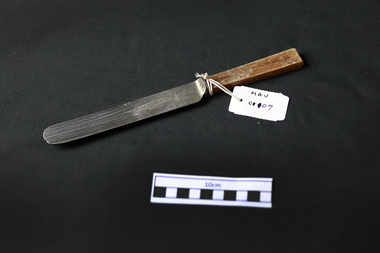
Kitchen Equipment, cutlery knife, 20THC
... Kitchen Equipment, cutlery knife ... table knife with stainless steel blade and bone handle Kitchen Equipment, cutlery knife ...A stainless steel table knife with a bone handle used for main meals by early settlers in Moorabbin Shire c1900. Most early settlers brought their cutlery with them when they traveled from England and Europe.A typical table knife used by settlers in Moorabbin Shire c1900A kitchen table knife with stainless steel blade and bone handle on blade; FL..........& CO. LTD. SHEFFIELD / TRADE 'SHREWSBURY' MARK / STAINLESS / ............cutlery, stainless steel, sheffield, england, early settlers, market gardeners, moorabbin, cheltenham, bentleigh, moorabbin shire, -
 City of Moorabbin Historical Society (Operating the Box Cottage Museum)
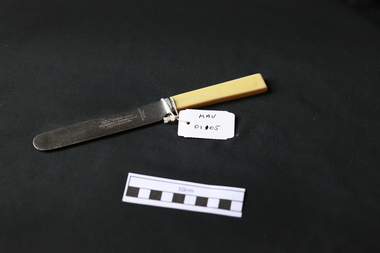
Kitchen Equipment, cutlery butter knife, c1930
... Kitchen Equipment, cutlery butter knife...Per TROVE butter knife sheffield england cheltenham moorabbin bentleigh early settlers pioneers cutlery stainless stell thornhill bednal & co on blade ; TRADE 'ORIS' MARK / THORNHILL, BEDNAL & CO. / SHEFFIELD ENG. / STAINLESS STEEL A butter knife with stainless steel blade and bone handle Kitchen Equipment, cutlery butter knife Thornhill, Bednal & Co ...WALTER THORNHILL SP London The firm established in 1734 by Joseph Gibbs changed its style in early 19th century to Morley & Thornhill. The firm changed to Thornhill & Co (1820), Walter Thornhill (1850), Walter Thornhill & Co (1875) Walter Thornhill & Co Ltd (1895) and Walter Thornhill & Co (1905). Advertisement in The Argus, Saturday January 22 1921 FOY & GIBSON'S Pty Ltd. Smith Street Collingwood Summer Fair Bargains Thornhill. Bednal, and Co.' Ivoride Handle TABLE KNIVES, stainless steel blades, 35/- per ½ dozen. Per TROVE A butter knife with stainless steel blade and bone handle on blade ; TRADE 'ORIS' MARK / THORNHILL, BEDNAL & CO. / SHEFFIELD ENG. / STAINLESS STEELbutter knife, sheffield england, cheltenham, moorabbin, bentleigh, early settlers, pioneers, cutlery, stainless stell, thornhill bednal & co -
 City of Moorabbin Historical Society (Operating the Box Cottage Museum)
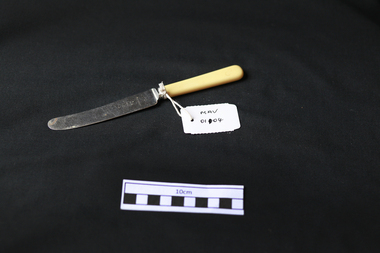
Kitchen Equipment, cutlery butter knife, c1930
... Kitchen Equipment, cutlery butter knife...cutlery Australia wide. It was a friendly take over and the Directors of Rodd [Aust.] Ltd. were appointed to the board of Mytton Rodd [Aust.] Ltd., and some to the Holding Company Mytton’s Ltd. Mytton’s were heavy manufacturing engineers producing a large range of stainless steel products including: kitchen sinks of various design, beer barrels [9 and 18 gallon kegs] for the breweries, milk vats for cooling and storing milk on dairy farms, a large range of dairy and industrial vessels, road transport tanks, LPG tanks, low pressure pre-mix vessels for the soft drink industry. ...McCulloch Rodd Pty Ltd) cutlery stainless steel cheltenham moorabbin bentleigh early settlers rodd aust ltd mytton rodd pty ltd aukland port melbourne on blade; RODD / STAINLESS A butter knife with stainless steel blade and bone handle c1930 Kitchen Equipment, cutlery butter knife RODD (Aust.) ...Rodd's was established by George & Ernest Rodd in Melbourne in 1919.They were manufacturers and wholesalers of precious metal jewellery. Later they began to manufacture high quality silver plated cutlery under the brand name “Rodd”. They then expanded into holloware when they took over Platers Pty. Ltd. who produced a very high quality range of silver plated Sheffield Reproduction Silverware, under the brand name “Hecworth”. Rodd’s established a large factory at 150 Barkly St., St. Kilda, Melbourne. During WW2 with a staff some 200, the factory produced ordnance components to help with the war effort. Rodd’s established sales offices in the main city centres of all States. The company prospered. In December, 1960, Rodd [Australia] Ltd. was merged with Mytton’s Ltd., Melbourne, and became part of the newly formed company Mytton Rodd [Australia] Ltd. Mytton’s were also producers of silver plated cutlery under the brand name “Grosvenor” and were strong competitors to the Rodd brand of cutlery Australia wide. It was a friendly take over and the Directors of Rodd [Aust.] Ltd. were appointed to the board of Mytton Rodd [Aust.] Ltd., and some to the Holding Company Mytton’s Ltd. Mytton’s were heavy manufacturing engineers producing a large range of stainless steel products including: kitchen sinks of various design, beer barrels [9 and 18 gallon kegs] for the breweries, milk vats for cooling and storing milk on dairy farms, a large range of dairy and industrial vessels, road transport tanks, LPG tanks, low pressure pre-mix vessels for the soft drink industry. They also produced a range of domestic bathes, steel railway sleepers, using their 3000 ton hydraulic presses. Mytton’s also had their own non ferrous foundry and rolling mill which produced nickel silver sheet used in the manufacturer of their silver plated cutlery. They also produced copper sheet for their own and industrial use. Mytton’s had factories in York St., South Melbourne and Port Melbourne. Rodd [Aust.] Ltd. set up a manufacturing, distribution plant in Auckland, New Zealand, circa 1960. This company began producing precious metal jewellery in a rented space in the premises of Matthey Garret Ltd., Bullion Merchants, in Drake St., Auckland. Later they moved into their own building in Sale St., Auckland. The company prospered and purchased land and built a factory at 121 Apirana Ave. Glen Innes, Auckland, circa 1964. ( B. McCulloch Rodd Pty Ltd)A butter knife with stainless steel blade and bone handle c1930on blade; RODD / STAINLESScutlery, stainless steel, cheltenham, moorabbin, bentleigh, early settlers, rodd aust ltd, mytton rodd pty ltd, aukland, port melbourne -
 Flagstaff Hill Maritime Museum and Village
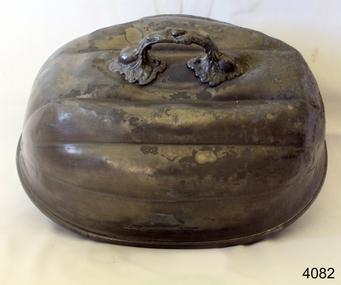
Domestic object - Pewter Dome Cloche, James Dixon & Sons, 1900-1940 as indicated by the design No 399 stamped in the cover
... ...Kitchen Cutlery...These types of products give us a snapshot into domestic and social life during the time it was made. flagstaff hill warrnambool shipwrecked-coast flagstaff-hill-maritime-museum shipwreck-coast flagstaff-hill-maritime-village Pewter Ware James Dixon Silver Ware Kitchen Cutlery Britannia Steel Food Cover Cloche Number 399 inside lid & Dixon & Sons Sheffield. ...James Dixon & Sons were founded in 1806 in Sheffield and were one of the major British manufacturers of the Industrial Revolution. They were manufacturers of pewter ware, electroplated Britannia metal, silverware, and electroplated nickel silver. Their products included hundreds of items for use in the kitchen (e.g. bowls, cutting tools) and the dining room (e.g. tea services, cocktail shakers, and mixers) as well as items such as candlesticks. They were a world leader in manufacturing shooting accessories through the nineteenth century and exported powder flasks in large quantities to America, They were known as whistle makers, which like most of their products were of outstanding quality. They were located first at Silver Street (1806), Cornish Place (1822) Sheffield. Their registered trademark since 1879 was a Trumpet with a Banner hanging from it. Although registered in 1879, the "Trumpet with Banner" logo was used at times before registration and appears on some of their silver plate pieces. They were one of the foremost names in EPNS and sterling silver tableware including silver tea services and hollowware pieces. They also made silverware serving pieces and had a wide catalogue of patterns. Their tea sets and hollowware pieces produced in silver are now very valuable as antiques. The firm continued to be a family-run enterprise until 1976. The patterns are currently owned by another Sheffield firm that exports products mainly to the Middle East.An item made for domestic use late19th to early 20th century by a renowned maker of pewter and silverware products. These types of products give us a snapshot into domestic and social life during the time it was made.Pewter Cloche or cover for food ornate handle at top. Ring on one end. Number 399 inside lid & Dixon & Sons Sheffield.flagstaff hill, warrnambool, shipwrecked-coast, flagstaff-hill-maritime-museum, shipwreck-coast, flagstaff-hill-maritime-village, pewter ware, james dixon, silver ware, kitchen cutlery, britannia steel, food cover, cloche -
 Geoffrey Kaye Museum of Anaesthetic History
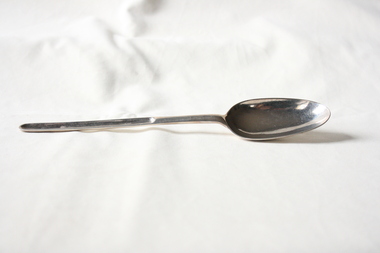
Functional object - Marrow spoon
... ...kitchen utensils...cutlery...sterling silver marrow spoon utensils kitchen utensils cutlery dining utensils spoon George II Inscription stamped into base of spoon. ...A sterling silver George II marrow spoon. Two thirds of the top end of the narrow stem have a trough carved out, and there is no decoration other than the hallmarks stamped into the reverse of the base of the stem.Inscription stamped into base of spoon. "T / R / E".sterling silver, marrow spoon, utensils, kitchen utensils, cutlery, dining utensils, spoon, george ii -
 Mont De Lancey
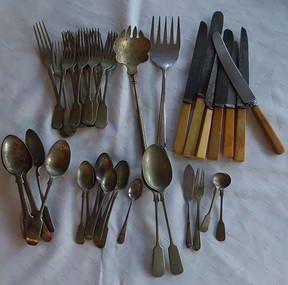
Domestic object - Cutlery, G R Joseph Rodgers & Sons, Unknown
... Cutlery...Kitchenware...Kitchen...Assorted very worn kitchen cutlery for every day use by the family. ...A smaller knife has a 'round symbol shape with a crown on the top - inside is Viner & Hall Sheffield Made Stainless Deluxe' One of the non matching servers has 'Grovesnor Delphic EPNS A1' Assorted very worn kitchen cutlery for every day use by the family. ...The family would have used this cutlery on a daily basis as it is not the 'best' cutlery used for special occasions. Assorted very worn kitchen cutlery for every day use by the family. Most of it has a wide end at the handle with a small scalloped pattern: Forks, one large and one small, seven very rusted knives with bone handles, spoons, two larger serving, six dessert, ten teaspoons, two very small round sugar spoons, one patterned butter knife and two decorative servers.Various makers which are indecipherable. Two knife have 'G R Joseph Rodgers & Sons Cutlers to His Majesty (with a lined star shape and a cross underneath)'. Another knife has 'C J on a flag outline, with C Johnson & Co Sheffield England'. A smaller knife has a 'round symbol shape with a crown on the top - inside is Viner & Hall Sheffield Made Stainless Deluxe' One of the non matching servers has 'Grovesnor Delphic EPNS A1'cutlery, kitchenware, kitchen knives, table spoons, teaspoons, tableware, servers -
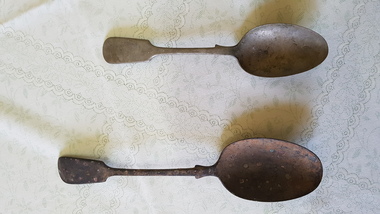 Numurkah & District Historical Society
Kitchen spoons
... kitchen utensils, spoons, cutlery...Found in the dirt at the site of old homestead Invergordon kitchen utensils, spoons, cutlery 1 x large spoon 1 x small spoon Both metal Kitchen spoons ...Found in the dirt at the site of old homestead Invergordon1 x large spoon 1 x small spoon Both metal kitchen utensils, spoons, cutlery -
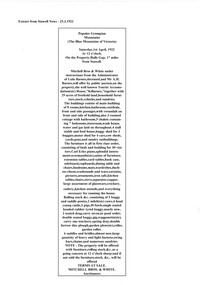 Halls Gap & Grampians Historical Society
Newspaper - Photocopy, C 1922
... Carl Ecko piano, splendid instrument; overmantle (sic) suites of furniture, extension tables, card tables, book case, sideboard, cupboards, dining table and chairs, linoleums, mats, wardrobes, duchess-chests, washstands and ware, curtains, pictures, ornaments, iron safe, kitchen tables, chairs, stove, separator, copper, large assortment of glassware, crockery, cutlery, kitchen utensils, and everything necessary for running the house. ...Carl Ecko piano, splendid instrument; overmantle (sic) suites of furniture, extension tables, card tables, book case, sideboard, cupboards, dining table and chairs, linoleums, mats, wardrobes, duchess-chests, washstands and ware, curtains, pictures, ornaments, iron safe, kitchen tables, chairs, stove, separator, copper, large assortment of glassware, crockery, cutlery, kitchen utensils, and everything necessary for running the house. ...Popular Grampian Mountains (The Blue Mountains of Victoria) Saturday, 1st April, 1922 at 12 o'clock On the property Halls Gap, 17 miles from Stawell Mitchell Bros & White under instructions from the Administrator of Lulu Barnes, deceased, and Mr A. H. Barnes, will offer by public auction on the property, the well known Tourist Accomodation (sic) House, "Killarney" together with 29 acres of freehold land, household furniture, stock, vehicles and sundries. The buildings consist main building of 8 rooms, kitchen, bathroom, vestibule, front and side passages, with verandah on front and side of building, also 3 roomed cottage with bathroom, 5 chalets containing 7 bedrooms, storeroom. wash house, water and gas laid on throughout. 4 cars, cow sheds, yards, pens, and sundry outbuildings. The furniture is all in first class order, consisting of beds and bedding for 30 visitors. Carl Ecko piano, splendid instrument; overmantle (sic) suites of furniture, extension tables, card tables, book case, sideboard, cupboards, dining table and chairs, linoleums, mats, wardrobes, duchess-chests, washstands and ware, curtains, pictures, ornaments, iron safe, kitchen tables, chairs, stove, separator, copper, large assortment of glassware, crockery, cutlery, kitchen utensils, and everything necessary for running the house. Rolling stock and C, consisting of 5 buggy and saddle ponies, 2 milch (sic) cows, 4 head young cattle, 3 pigs, 30 fowls, single seated hooded rubber tyred buggy, nearly new, 2 seated drag, carry seven, in good order; double seated buggy, gig, waggonette (sic), carry one ton; lorry, spring dray, double furrow disc plough, garden plow (sic), roller, garden roller. 6 saddles and bridles, almost new, large quantity of heavy and light harness, swing bars, chains, and numerous sundries. NOTE - The property will be offered with furniture, rolling stock & c., as a going concern at 12 o'clock sharp; and if not sold the furniture, stock, & C., will be offered TERMS AT SALE. MITCHELL BROS. & WHITE. AuctioneersTyped extract of advertisement for auction of Killarney from Stawell News 25-3-1922 later known as Grampians Housemedia, newspaper articles, guesthouses, killarney -
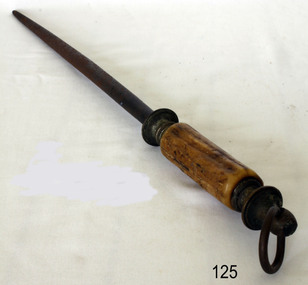 Flagstaff Hill Maritime Museum and Village
Functional object - Knife Sharpener, Johann Friedrich Dick, 1873 to 1900
... cutlery for chefs, the subject item is significant as its manufacture was probably early in the firms beginnings when Friedrich Dick took over in1873 when he specialised in making sharpening steels. The company is still producing these items today as well as other specialised knives for professionals. Early manufactured steels such as the subject item are sought after today by collectors and quite rare. flagstaff hill warrnambool shipwrecked coast flagstaff hill maritime museum flagstaff hill maritime village great ocean road sharpening steel knife sharpener kitchen tool carving kitchen utensil cooking F Dick Marked F Dick Esslingen Sharpening Steel or Knife sharpener with bone handle with ribbed pattern, brass knobs and ring at end of handle Functional object Knife Sharpener Johann Friedrich Dick ...Johann Friedrich Dick founded the company in 1778 to manufacture files, the company continued in the manufacture of files as its main product line until 1873, when Paul Friedrich Dick took over the company and began the production of sharpening steels, with the logo of “F Dick” on their products. One hundred years after the founding of the company, a factory in Esslingen began construction. At that time the company had 20 employees. In 1881, company commissioned Germany's first file production machine. In 1889, Friedrich Dick built a new factory in Kollwitz/Fleischmannstrasse in Esslingen, employing 100 people and expanding the product line to include knives for butchers and chefs, cleavers and other specialized tools. Files manufactured ranged from the smallest watchmaker's file to the largest (over 45 cm in length) square file. In 1997, the F Dick company moved to a new headquarters in Deizisau, Germany. The old factory in Esslingen is now a class listed monument and the town's landmark.An item made by a world class manufacture of cutlery for chefs, the subject item is significant as its manufacture was probably early in the firms beginnings when Friedrich Dick took over in1873 when he specialised in making sharpening steels. The company is still producing these items today as well as other specialised knives for professionals. Early manufactured steels such as the subject item are sought after today by collectors and quite rare. Sharpening Steel or Knife sharpener with bone handle with ribbed pattern, brass knobs and ring at end of handleMarked F Dick Esslingenflagstaff hill, warrnambool, shipwrecked coast, flagstaff hill maritime museum, flagstaff hill maritime village, great ocean road, sharpening steel, knife sharpener, kitchen tool, carving, kitchen utensil, cooking, f dick -
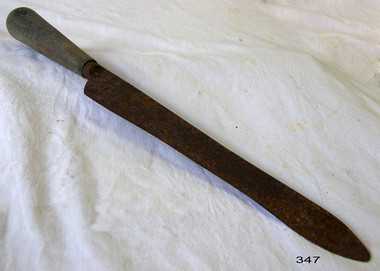 Flagstaff Hill Maritime Museum and Village
Domestic object - Knife
... http://www.eatingutensils.net/history-of-cutlery/knife-history/ The knife is one of the most important items that has enabled the development of civilisation over thousands of years. Flagstaff Hill Warrnambool Shipwrecked-coast Flagstaff-Hill Flagstaff-Hill-Maritime-Museum Maritime-Museum Shipwreck-coast Flagstaff-Hill-Maritime-Village Knife Kitchen Equipment Dining None. ...From the early days of our race, the knife represented one of the first and most important tools that enabled rise of our technology, military, culture, science and all other things that brought us to this point of modern civilisation. As a vital tool for survival, combat, construction and food preparation, the knife quickly became the most basic tool from which all others were born. In those ancient times, 500,000 years ago, sharpened stones started slowly evolving, becoming more and more like their modern counterpart. Before the time when fire enabled the melting of the various metals, and forging them into modern knives, their stone counterparts received several visual upgrades. Double bladed knives were most popular, and their wooden or stone hilts were decorated with animal skins and feathers. Those knives represented a great deal of pride for the warriors and elders who owned them, and that tradition continued to be practised with the arrival of the Bronze Age. The appearance of metallurgy brought the ability to create knives from softer types of metal. Even though knives from bronze did not provide durability over longer periods of time [easily dulled, and susceptible to corrosion), their sharpness and slim designed proved to be superior to any stone knife tool. As the centuries went on, iron and then steel became commonplace across the entire world. Knives created from those materials were much more durable and easier to maintain their sharpness after prolonged use. During medieval times in Europe, steel metallurgy managed to evolve knives from small single or double-bladed edges to larger sizes - swords, spears and axes. Even with all those advancements, the use of knives as an eating utensil continued to be used in some small circles. Even as early as the 15th century, wealthy circles of people started carrying personal knives, intended for double use - both eating and defending against threats. During those times the host were not obliged to provide their guest with any kind of eating utensil in addition to plates, so wealthy males used their eating knives for cutting their own meals, and the meals of nearby female guests. Slim double-bladed knives were good for cutting and piercing foods. As the use of forks became widespread in the whole of Europe by the late 17th century, most people used this kind of small knife on a regular basis (a combination of two knives, one for stabilising and other for cutting the meal). http://www.eatingutensils.net/history-of-cutlery/knife-history/The knife is one of the most important items that has enabled the development of civilisation over thousands of years.Carving knife with wooden handle and rusted slender metal blade.None.flagstaff hill, warrnambool, shipwrecked-coast, flagstaff-hill, flagstaff-hill-maritime-museum, maritime-museum, shipwreck-coast, flagstaff-hill-maritime-village, knife, kitchen equipment, dining -
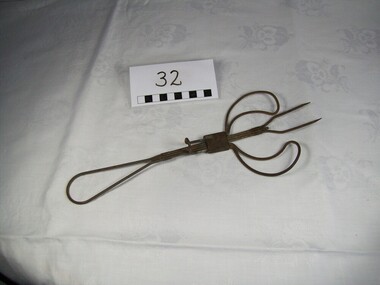 Blacksmith's Cottage and Forge
Fork, toasting
... kitchen...item...food...toast...wire...cutlery...Domestic item that has been hand made for a specific purpose for toasting food over coals or an open flame. domestic kitchen item food toast wire cutlery fork homemade Adjustable two tines/prongs toasting fork with side holding flanges Fork, toasting ...Domestic item that has been hand made for a specific purpose for toasting food over coals or an open flame. Adjustable two tines/prongs toasting fork with side holding flangesdomestic, kitchen, item, food, toast, wire, cutlery, fork, homemade -
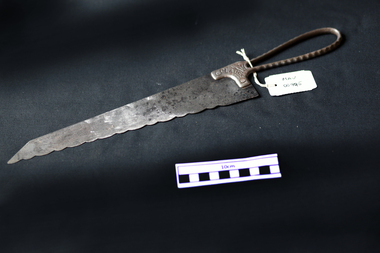 City of Moorabbin Historical Society (Operating the Box Cottage Museum)
Kitchen Equipment, Bread Knife 'Clauss', c1900
... Cutlery’s long and vivid history started in early 1880’s when John Clauss and his younger brother Henrie established Elyria Shear Works in Elyria, Ohio. At one time the company was the largest manufacturer of scissors and shears in the world and was acquired by Acme United Corporation in 2004. John and Henrie Clauss, of German origin, started Elyria Shear Works from a one-room building in Elyria, Ohio Together with five employees, they began manufacturing scissors, shears, straight razors and serrated kitchen knives In August 1887, the Company moved to Fremont, Ohio to be near an accessible, abundant supply of natural gas which had recently been discovered. 1889, disaster struck as the plant was completely destroyed by fire, In 4 months Clauss built a new plant and was back in full operation and changed the company’s name to Clauss Shear Company. 1919 Clauss Shear merged with Henkel Company, to become Henkel-Clauss Company. ...In 2004, Acme United Corporation acquired the Clauss inventory, trademarks and brand names from Alco Industries for approximately $500,000 cutlery, knives, clauss shear company, ohio, freemont, market gardeners, early settlers, moorabbin, cheltenham, Front : CLAUSS Back : FREEMONT / OHIO A large Bread Knife with scalloped / serrated edge and looped handle Kitchen Equipment, Bread Knife 'Clauss' Clauss ...Clauss Cutlery’s long and vivid history started in early 1880’s when John Clauss and his younger brother Henrie established Elyria Shear Works in Elyria, Ohio. At one time the company was the largest manufacturer of scissors and shears in the world and was acquired by Acme United Corporation in 2004. John and Henrie Clauss, of German origin, started Elyria Shear Works from a one-room building in Elyria, Ohio Together with five employees, they began manufacturing scissors, shears, straight razors and serrated kitchen knives In August 1887, the Company moved to Fremont, Ohio to be near an accessible, abundant supply of natural gas which had recently been discovered. 1889, disaster struck as the plant was completely destroyed by fire, In 4 months Clauss built a new plant and was back in full operation and changed the company’s name to Clauss Shear Company. 1919 Clauss Shear merged with Henkel Company, to become Henkel-Clauss Company. Henkel Company was founded in 1906 to manufacture manicure and pedicure files, knives, shears and razors. After World War II, Clauss was unable to compete with European firms producing household scissors and shifted its focus to industrial scissors. In 1967 Clauss was taken over by Alco Standard Corporation who integrated Clauss into its existing structure to manufacture tools for industrial niche markets. Clauss made surgical scissors for eye operations, heavy duty metal cutting shears, poultry shears for gutting chickens and specialty items such as anti-acid, anti-magnetic tweezers for the electronics industry. Clauss had approximately 100 employees and produced about $18 million in annual revenues in the late 1980s, but profits continued to decline. In 2004, Acme United Corporation acquired the Clauss inventory, trademarks and brand names from Alco Industries for approximately $500,000A large Bread Knife with scalloped / serrated edge and looped handle Front : CLAUSS Back : FREEMONT / OHIOcutlery, knives, clauss shear company, ohio, freemont, market gardeners, early settlers, moorabbin, cheltenham, -
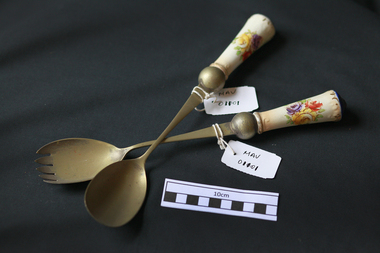 City of Moorabbin Historical Society (Operating the Box Cottage Museum)
Kitchen Equipment, salad servers, c1900
... The Surridge family were early settlers in Moorabbin Shire early settlers pioneers market gardeners moorabbin brighton bentleigh cheltenham cutlery silver plated cutlery porcelain mrs surridge E.P.N.S. A pair of silver plated salad servers with porcelain handles Kitchen Equipment, salad servers Unrecorded ...Tthe key letters “EP”, represent “electroplated” or “electroplating”. The other letters often represent some other metal. For example the most common designation, EPNS, means “electroplated nickel silver”. All these designations indicate that the piece in question is made of silver plate. Electroplating involves placing an extremely thin layer of silver on the surface of the piece. The resulting silver content is very small. The remainder of the piece is made of some more common metal such as copper. The value of such pieces most often is not based on silver content. It’s based more on the design and construction of the piece. The Surridge family were early settlers in Moorabbin ShireA pair of silver plated salad servers with porcelain handlesE.P.N.S.early settlers, pioneers, market gardeners, moorabbin, brighton, bentleigh, cheltenham, cutlery, silver plated cutlery, porcelain, mrs surridge -
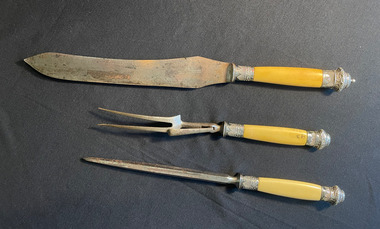 City of Moorabbin Historical Society (Operating the Box Cottage Museum)
Domestic object - Carving Set; knife, fork and knife sharpener, c1900
... cutlery...cast steel...kitchen...This carving set; knife, fork and knife sharpener is typical of the cutlery used by early settlers in Moorabbin Shire c1900 cutlery cast steel kitchen equipment early settlers moorabbin cheltenham ormond bentleigh On Knife: Joseph Elliot & Sons, Cutlers, Sheffield" with the mirror "C"s and Maltese cross mark used after 1825 On knife sharpener: CAST STEEL A set of carving implements with ivory handles with chased and repousse silver plate caps and collars; Knife, Fork and Knife sharpener. ...Early settlers in Moorabbin Shire brought cutlery and other domestic items with them when travelling from England 19thC. This carving set; knife, fork and knife sharpener was used by a pioneer family.This carving set; knife, fork and knife sharpener is typical of the cutlery used by early settlers in Moorabbin Shire c1900 A set of carving implements with ivory handles with chased and repousse silver plate caps and collars; Knife, Fork and Knife sharpener. The Fork has a flip up thumb guard. On Knife: Joseph Elliot & Sons, Cutlers, Sheffield" with the mirror "C"s and Maltese cross mark used after 1825 On knife sharpener: CAST STEELcutlery, cast steel, kitchen equipment, early settlers, moorabbin, cheltenham, ormond, bentleigh -
 City of Moorabbin Historical Society (Operating the Box Cottage Museum)
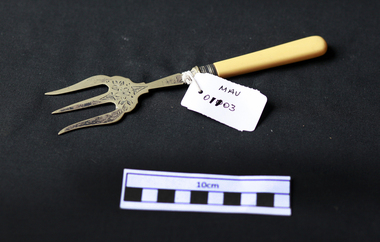
Kitchen Equipment, bread fork, c1900
... More expensive ones would be made from silver and be very ornately decorated. cutlery forks cheltenham moorabbin early settlers bentleigh silver-plate bread forks, victorian etiquette, An engraved, silver-plated Bread fork with a bone handle Kitchen Equipment, bread fork Unrecorded Cutlery Manufacturer ...A Bread fork was mainly used in Victorian times, when touching food was frowned up. Even in common households, you had to have a bread fork to help yourself to the bread from a bread basket in the middle of table. Bread was an important part of any meal, and would be served as a side dish to most dinners, so bread forks were in common to use. More expensive ones would be made from silver and be very ornately decorated. An engraved, silver-plated Bread fork with a bone handle cutlery, forks, cheltenham, moorabbin, early settlers, bentleigh, silver-plate, bread forks, victorian etiquette, -
 City of Moorabbin Historical Society (Operating the Box Cottage Museum)
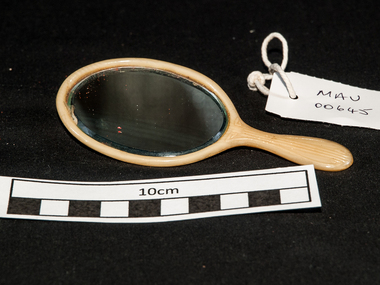
Personal Effects, miniature oval hand mirror, c1900
... It was also used for dressing table sets, dolls, picture frames, charms, hat pins, buttons, buckles, stringed instrument parts, accordions, fountain pens, cutlery handles and kitchen items. The main disadvantage the material had was that it was flammable.. ...It was also used for dressing table sets, dolls, picture frames, charms, hat pins, buttons, buckles, stringed instrument parts, accordions, fountain pens, cutlery handles and kitchen items. The main disadvantage the material had was that it was flammable.. ...Celluloids are a class of compounds created from nitrocellulose and camphor, with added dyes and other agents. Generally considered the first thermoplastic, it was first created as Parkesine in 1856 and as Xylonite in 1869, before being registered as Celluloid in 1870. Celluloid is easily moulded and shaped, and it was first widely used as an ivory replacement. The main use was in movie and photography film industries, which used only celluloid films prior to acetate films that were introduced in the 1950s. Celluloid is highly flammable, difficult and expensive to produce and no longer widely used, although its most common uses today are in table tennis balls, musical instruments and guitar picks. Celluloid was useful for creating cheaper jewellery, jewellery boxes, hair accessories and many items that would earlier have been manufactured from ivory, horn or other expensive animal products. It was often referred to as "Ivorine" or "French Ivory". It was also used for dressing table sets, dolls, picture frames, charms, hat pins, buttons, buckles, stringed instrument parts, accordions, fountain pens, cutlery handles and kitchen items. The main disadvantage the material had was that it was flammable.. It was soon overtaken by Bakelite.A miniature, oval, Ivorine hand mirror with floral engraving on back. An accoutrement for use in a lady's Evening bag c19thCFloral design engraving on back of mirrormoorabbin, brighton, early settlers, pioneers, cheltenham, craft work, mirors, ivorine, evening bags, celluloids, bakelite, plastics, -
 City of Moorabbin Historical Society (Operating the Box Cottage Museum)
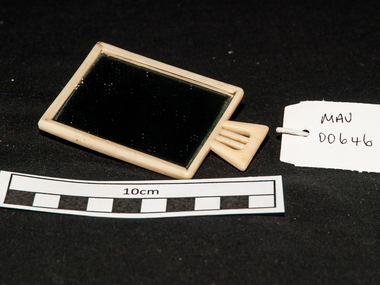
Personal Effects, miniature square hand mirror, c1900
... It was also used for dressing table sets, dolls, picture frames, charms, hat pins, buttons, buckles, stringed instrument parts, accordions, fountain pens, cutlery handles and kitchen items. The main disadvantage the material had was that it was flammable. ...It was also used for dressing table sets, dolls, picture frames, charms, hat pins, buttons, buckles, stringed instrument parts, accordions, fountain pens, cutlery handles and kitchen items. The main disadvantage the material had was that it was flammable. ...Celluloids are a class of compounds created from nitrocellulose and camphor, with added dyes and other agents. Generally considered the first thermoplastic, it was first created as Parkesine in 1856 and as Xylonite in 1869, before being registered as Celluloid in 1870. Celluloid is easily moulded and shaped, and it was first widely used as an ivory replacement. The main use was in movie and photography film industries, which used only celluloid films prior to acetate films that were introduced in the 1950s. Celluloid is highly flammable, difficult and expensive to produce and no longer widely used, although its most common uses today are in table tennis balls, musical instruments and guitar picks. Celluloid was useful for creating cheaper jewellery, jewellery boxes, hair accessories and many items that would earlier have been manufactured from ivory, horn or other expensive animal products. It was often referred to as "Ivorine" or "French Ivory". It was also used for dressing table sets, dolls, picture frames, charms, hat pins, buttons, buckles, stringed instrument parts, accordions, fountain pens, cutlery handles and kitchen items. The main disadvantage the material had was that it was flammable. Items made in celluloid are collectible today and increasingly rare in good condition. It was soon overtaken by Bakelite and Catalin.. A miniature, square, Ivorine hand mirror with bird engraved on back. An accoutrement for use in a lady's Evening bag c 19thCbird engraved on back of mirrormoorabbin, cheltenham, brighton, market gardeners, pioneers early settlers, mirrors, ivorine, celluloids, bakelite, plastics, -
 Flagstaff Hill Maritime Museum and Village
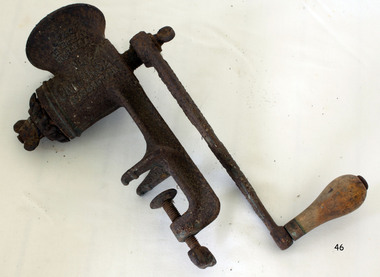
Domestic object - Food Mincer, Landers, Frary & Clark , 1897-2000
... They manufactured a wide variety of products over the years, including stainless steel bull-nose rings and electric ranges, kitchen scales and vacuum bottles, window hardware and ice skates, mouse traps and percolators, can openers, corkscrews, cutlery, straight razors, aluminium cookware, and thousands of other products. ...They manufactured a wide variety of products over the years, including stainless steel bull-nose rings and electric ranges, kitchen scales and vacuum bottles, window hardware and ice skates, mouse traps and percolators, can openers, corkscrews, cutlery, straight razors, aluminium cookware, and thousands of other products. ...Landers, Frary & Clark were a housewares company based in New Britain, Connecticut. It operated from 1865 until its assets were sold to the General Electric company in 1965. They manufactured a wide variety of products over the years, including stainless steel bull-nose rings and electric ranges, kitchen scales and vacuum bottles, window hardware and ice skates, mouse traps and percolators, can openers, corkscrews, cutlery, straight razors, aluminium cookware, and thousands of other products. Many of these items were marketed under the brand Universal. Some of the non-electric kitchenware assets were acquired from G.E. in 1984 by Universal Housewares, Inc./Universal Trading, Inc., who still market "Universal" meat grinders and coffee mills.An early domestic item its function was for use in the home kitchen that's the original patented design from 1897 is still being produced today under its brand name of Universal by Universal Trading Inc USA.Food mincer cast iron with wooden handle & thumbscrew for bench attachment.Marked "No. 2 Universal".warrnambool, flagstaff-hill, flagstaff-hill-maritime-museum, shipwreck-coast, flagstaff-hill-maritime-village, shipwrecked-artefact, mincer, food mincer, universal brand, kitchen appliance, food grinder, lander frary & clark -
 Ringwood and District Historical Society
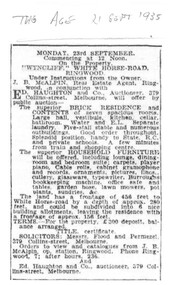
Newspaper - Advertisement, Auction - "Wyncliff", Whitehorse Road, Ringwood, Monday 23 September 1935
... kitchen, cellar, bathroom. Water and E.L. Separate laundry. Five-stall stable and numerous outbuildings. Good order throughout. Splendid position, handy to State, R.C. and private schools. A few minutes from train and shopping centre. The superior household furniture will be offered including lounge, dining room and bedroom suite; carpets, player piano, cable rolls, cabinet gramophone and records, ornaments, pictures, linos, cutlery, glassware, typewriter,Burroughs bookkeeping machine, office safe and tables, garden hose, lawn mowers, pot plants, sundries, &c. ...kitchen, cellar, bathroom. Water and E.L. Separate laundry. Five-stall stable and numerous outbuildings. Good order throughout. Splendid position, handy to State, R.C. and private schools. A few minutes from train and shopping centre. The superior household furniture will be offered including lounge, dining room and bedroom suite; carpets, player piano, cable rolls, cabinet gramophone and records, ornaments, pictures, linos, cutlery, glassware, typewriter,Burroughs bookkeeping machine, office safe and tables, garden hose, lawn mowers, pot plants, sundries, &c. ...Item 5784 - Copy of auction notice appearing in 21 September 1935 edition of The Age newspaper. (Recorded in conjunction with corresponding detailed contents list - item 5783) Transcript: Monday, 23rd September Commencing at 12 Noon on the Property. "WYNCLIFF," White Horse Road Ringwood Under Instructions from the Owner, J.B. McAlpin, Real Estate Abent, Ringwood, in conjunction with Ed Haughton and Co., Auctioneer, 379 Collins Street, Melbourne, will offer by public auction - The superior brick residence and contents of seven spacious rooms, Large hall, vestibule, kitchen, cellar, bathroom. Water and E.L. Separate laundry. Five-stall stable and numerous outbuildings. Good order throughout. Splendid position, handy to State, R.C. and private schools. A few minutes from train and shopping centre. The superior household furniture will be offered including lounge, dining room and bedroom suite; carpets, player piano, cable rolls, cabinet gramophone and records, ornaments, pictures, linos, cutlery, glassware, typewriter,Burroughs bookkeeping machine, office safe and tables, garden hose, lawn mowers, pot plants, sundries, &c. The land has a frontage of 456 feet to White Horse Road by a depth of approx. 280 feet, and could be subdivided into 6 nice building allotments, leaving the residence with a frontage of approx. 156 feet. Terms - For the property, £300 deposit, balance arranged. Title certificate. Solicitors: Messrs. Flood and Permezel, 379 Collins Srtreet, Melbourne. Orders to view and catalogues from J.B. McAlpin, op station, Ringwood. Phone Ringwood 7; after hours, 236. and Ed. Haughton and Co., auctioneer, 379 Collins Street, Melbourne. -
 Kiewa Valley Historical Society
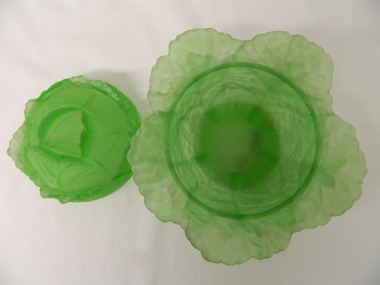
Bowl Covered, circa mid to late 1900's
... It was a time when the Australian economy "rode on the back of sheep" This item has relative significance to the Kiewa Valley as part of the rural and mining(gold) era when the strong return from local gold mining and grazing was demonstrated by the "landed gentry" and significant household cutlery, crockery, etiquette and old English mores, influenced by "Mother Britain" glass bowls kitchen crockery serving etiquette meal presentation Barely visible "VALLERYSTHAL" This green opalescent covered bowl is similar to the French PV cabbage form. ...This covered glass bowl with lid was made in a period when there was a strict discipline in the use a various dishes and accompaniments with respect to the type of crockery used. This was in the English style, especially in well to do rural family estates. This period was part of the early 1900's, when large rural acreage was family owned and the economical return to rural produce was very high. It was a time when the Australian economy "rode on the back of sheep"This item has relative significance to the Kiewa Valley as part of the rural and mining(gold) era when the strong return from local gold mining and grazing was demonstrated by the "landed gentry" and significant household cutlery, crockery, etiquette and old English mores, influenced by "Mother Britain"This green opalescent covered bowl is similar to the French PV cabbage form. When the lid is on the bowl appears as a small cabage with three sets of half peeled leaves. There are five outer leaves, next row are five inner leaves and finally three core leaves. The main bowl has a lip encircling the inside of the bowl for the lid to rest upon with closed. The glass has been pressed to show the leaves with their web like stalks. The inside area of the bowl and lid are smooth. This is to allow the mashed up contents to be easily scraped into a serving ladle.Barely visible "VALLERYSTHAL"glass bowls, kitchen crockery, serving etiquette, meal presentation -
 Bendigo Historical Society Inc.
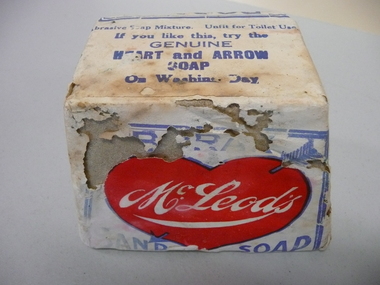
Container - CAKE OF MCLEODS CARBOLIC SAND SOAP
... Pumice sand soap for metals, marble, paint, cutlery, woodwork and kitchen utensils....Pumice sand soap for metals, marble, paint, cutlery, woodwork and kitchen utensils. Container CAKE OF MCLEODS CARBOLIC SAND SOAP ...Cake of McLeod's carbolic sand soap in paper wrappers with red heart & arrow. Pumice sand soap for metals, marble, paint, cutlery, woodwork and kitchen utensils.McLeods concentrated trade mark heart & arrow ammoniated extract of soap McLeod's soap Co Pty Ltd works Geelong, Melbourne and Sydneydomestic equipment, cleaning, soap -
 Bendigo Historical Society Inc.
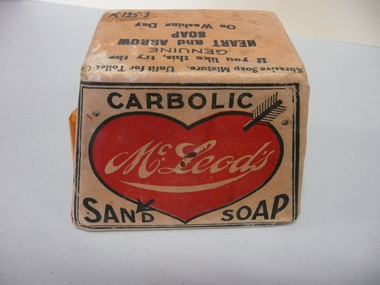
Container - CAKE OF MCLEODS CARBOLIC SAND SOAP
... Pumice sand soap for metals, marble, paint, cutlery, woodwork and kitchen utensils....Pumice sand soap for metals, marble, paint, cutlery, woodwork and kitchen utensils. Container CAKE OF MCLEODS CARBOLIC SAND SOAP ...Cake of McLeod's Carbolic sand soap in paper wrapper with red hearts & arrow. Pumice sand soap for metals, marble, paint, cutlery, woodwork and kitchen utensils.McLeod's concentrated trade mark heart & arrow ammoniated extract of soap McLeod's soap Co Pty Ltd works. Geelong, Melbourne and Sydneydomestic equipment, cleaning, soap -
 Wodonga & District Historical Society Inc
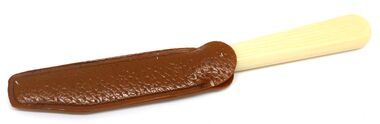
Domestic object - Lady's Fruit Knife
... kitchen/home to peel fruit and provide a cutting instrument for small items. The first true stainless steel was melted on August 13,1913. However, it did not produce blades that held an edge nor could edges be put onto blades easily so its inventor, Harry Brealey soon earned the reputation of being the inventor of the "knife that would not cut". Over the following decade further developments to the composition of stainless steel led to its wide use in the manufacture of cutlery...kitchen/home to peel fruit and provide a cutting instrument for small items. The first true stainless steel was melted on August 13,1913. However, it did not produce blades that held an edge nor could edges be put onto blades easily so its inventor, Harry Brealey soon earned the reputation of being the inventor of the "knife that would not cut". Over the following decade further developments to the composition of stainless steel led to its wide use in the manufacture of cutlery ...This item is from a collection donated by descendants of John Francis Turner of Wodonga. Mr Turner was born on 6 June 1885. He completed all of his schooling at Scots Boarding School in Albury, New South Wales. On leaving school, he was employed at Dalgety’s, Albury as an auctioneer. In 1924 John was promoted to Manager of the Wodonga Branch of Dalgety’s. On 15/03/1900 he married Beatrice Neal (born 7/12/1887 and died 7/2/1953) from Collingwood, Victoria. They had four daughters – Frances (Nancy), Heather, Jessie and Mary. In 1920, the family moved from Albury to Wodonga, purchasing their family home “Locherbie” at 169 High Street, Wodonga. "Locherbie" still stands in Wodonga in 2022. The collection contains items used by the Turner family during their life in Wodonga. This "lady’s" fruit knife was used up to the late 1900's by influential and "well off" ladies, not only as a fashion statement but as a practical tool when away from the kitchen/home to peel fruit and provide a cutting instrument for small items. The first true stainless steel was melted on August 13,1913. However, it did not produce blades that held an edge nor could edges be put onto blades easily so its inventor, Harry Brealey soon earned the reputation of being the inventor of the "knife that would not cut". Over the following decade further developments to the composition of stainless steel led to its wide use in the manufacture of cutlery.A small fruit knife with stainless steel blade. It has an ivory handle and a leather cover for the blade.On blade: Stainless Steel"cutlery, stainless steel, lady's fruit knife -
 Geoffrey Kaye Museum of Anaesthetic History
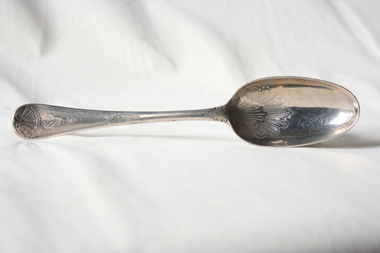
Functional object - Tablespoon
... cutlery...spoon...kitchen...utensils cutlery spoon kitchen utensils dining utensils sterling silver A bright-cut, sterling silver shell-back Hanover patterned George II tablespoon. ...A bright-cut, sterling silver shell-back Hanover patterned George II tablespoon. The spoon is decorated with ornate stippling and engraving on the obverse and reverse of the handle and bowl.utensils, cutlery, spoon, kitchen utensils, dining utensils, sterling silver -
 Geoffrey Kaye Museum of Anaesthetic History
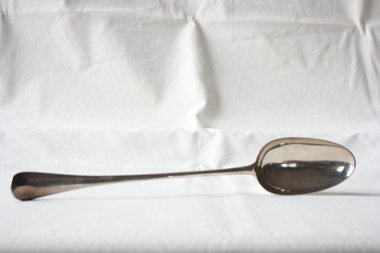
Functional object - Spoon
... cutlery...utensils...spoon...kitchen...George II cutlery utensils spoon kitchen utensils A sterling silver George II basting, stuffing, and hash spoon. ...A sterling silver George II basting, stuffing, and hash spoon. There is a small bird design stamped into the reverse of the handle.george ii, cutlery, utensils, spoon, kitchen utensils
