
Showing 16 items matching "krupp"
-
 Puffing Billy Railway
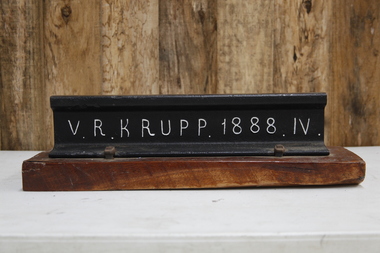
V. R. Krupp 1888. IV. Rail, 1888
... ...krupp...On Alfred Krupp's death in 1887 the company employs 20,200 people. ...Section of VR Krupp 1888 Rail mounted on a piece of varnished wood. ...Krupp...Rail made of iron V. R. Krupp 1888. IV. Rail Krupp ...60lbs rail that was used throughout the Victorian rail network. In 1887 Gibbs, Bright and Co. had a contract with Victorian Railways for railway and canal construction and supply of Krupp Rails. Gibbs, Bright and Co were merchant bankers and shipping agents and merchants who where also Directors of the GWR ( Great Western Railway ) and the Ship The "Great Britain" in England Gibbs, Bright and Company had principally been involved in shipping and trading, mainly in the West Indies, but following the discovery of gold in Victoria they established an office in Melbourne and soon became one of the leading shipping agents and merchants in the Colony. They expanded into passenger shipping and soon established offices in Brisbane, Sydney, Newcastle, Adelaide and Perth as well as launching passenger services between England, Mauritius and New Zealand. Gibbs, Bright also held a number of financial agencies from British mortgage, finance and investment companies as well as representing several British insurance companies in Australia. In addition they conducted a growing import business as well as an export business that included livestock, dairy produce, wool and flour. Also the company played a substantial part in the development of Australia's mineral resources, starting with lead in 1895, and later venturing into tin, gold, copper, cement and super phosphates. In Australia, after WWI, many of the larger companies were managing their own import and export so Gibbs, Bright and Company tended to focus its Agency business on smaller companies while expanding their interest into other markets such as timber, wire netting, zinc, stevedoring, road transport, marine salvage, gold mining as well as mechanical, structural, electrical and marine engineering. The Company's shipping interests continued to grow as well and still formed a major part of its business. In 1948 the parent company in England took the major step from tradition when they changed the business from a partnership into a private limited company. The name was the same, Antony Gibbs and Sons Limited, and in practice the effect of the change was very little. Some of the firm's branches and departments had already become limited companies and the formation of a parent company simplified the structure. The Australian operation was in time changed to Gibbs Bright & Co Pty Ltd in 1963. In 1848 Alfred Krupp becomes the sole proprietor of the company which from 1850 experiences its first major growth surge. In 1849 his equally talented brother Hermann (1814 - 1879) takes over the hardware factory Metallwarenfabrik in Berndorf near Vienna, which Krupp had established together with Alexander Schöller six years earlier. The factory manufactures cutlery in a rolling process developed by the brothers. Krupp's main products are machinery and machine components made of high-quality cast steel, especially equipment for the railroads, most notably the seamless wheel tire, and from 1859 to an increased extent artillery. To secure raw materials and feedstock for his production, Krupp acquires ore deposits, coal mines and iron works. On Alfred Krupp's death in 1887 the company employs 20,200 people. His great business success is based on the quality of the products, systematic measures to secure sales, the use of new cost-effective steel-making techniques, good organization within the company, and the cultivation of a loyal and highly qualified workforce among other things through an extensive company welfare system. From 1878 August Thyssen starts to get involved in processing the products manufactured by Thyssen & Co., including the fabrication of pipes for gas lines. In 1882 he starts rolling sheet at Styrum, for which two years later he sets up a galvanizing shop. The foundation stone for Maschinenfabrik Thyssen & Co. is laid in 1883 with the purchase of a neighboring mechanical engineering company. In 1891 August Thyssen takes the first step toward creating a vertical company at the Gewerkschaft Deutscher Kaiser coal mine in [Duisburg-]Hamborn, which he expands to an integrated iron and steelmaking plant on the River Rhine. Just before the First World War he starts to expand his group internationally (Netherlands, UK, France, Russia, Mediterranean region, Argentina). info from The company thyssenkrupp - History https://www.thyssenkrupp.com/en/company/history/the-founding-families/alfred-krupp.htmlHistoric - Victorian Railways - Track Rail - made by Krupp in 1888Section of VR Krupp 1888 Rail mounted on a piece of varnished wood. Rail made of ironpuffing billy, krupp, rail, victorian railways -
 Royal Australian and New Zealand College of Obstetricians & Gynaecologists (RANZCOG)
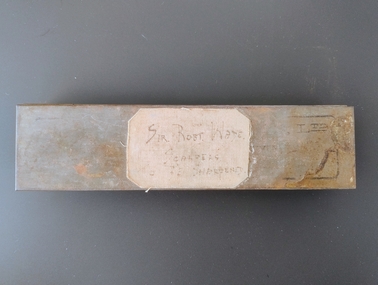
Equipment - Tin containing set of surgical scalpels associated with Sir Robert Wade and Dame Constance D'Arcy, Allen & Hanburys, England
... He subsequently donated much of the material which remained in those rooms to the College. V2A, produced by Krupp (see third scalpel in this box), was the first commercially produced non-rusting steel. ...The third scalpel is engraved with the logo of Krupp (a German instrument maker), 'V2A', and the number '1377.......Krupp...The third scalpel is engraved with the logo of Krupp (a German instrument maker), 'V2A', and the number '1377. ...This item was donated to RANZCOG's historical collection by Dr Ian Cope. In 1958, Dr Cope moved into rooms at 233 Macquarie Street, Sydney, which had previously been occupied by Dr Dame Constance D'arcy. He subsequently donated much of the material which remained in those rooms to the College. V2A, produced by Krupp (see third scalpel in this box), was the first commercially produced non-rusting steel. It was patented in 1912. (Montanstahl) Sir Robert Wade (1874-1954) was an orthopaedic surgeon. He was a Foundation Fellow of the Royal Australian College of Surgeons (RACS), and President of RACS 1935-1937. He was also President of the State (NSW) branch of the British Medical Association, and inaugural president of the orthopaedic section of the Australian Medical Congress.Metal tin containing three scalpels. Section of sticking plaster attached to lid of tin carries hardwriting which reads 'SIR ROBT. WADE/SCALPELS/TO BE SHARPENED'. Traces of an manufacturers label printed on the lid of the tin are visible beside the sticking plaster, resembling an Allen and Hanburys label. The first scalpel is engraved 'J.GRAY & SON/SHEFFIELD' near the base of the handle on one side, with a parital and unreadable engraving relating to a Sydney instrument maker on the other side. The second scalpel is very thin and narrow and is engraved with the text 'ALLEN&HANBURYS LONDON' on one side of the handle. The third scalpel is engraved with the logo of Krupp (a German instrument maker), 'V2A', and the number '1377.dame constance d'arcy, surgery, british medical association, royal australian college of surgeons, australian medical congress -
 Ballarat Tramway Museum
Book, Dipl-Ing Gunter Claus and Krupp Stahl AG, "Structures of Permanent Way for Rail Bound Traffic", 1981
... Written by Dipl-Ing Gunter Claus, shop manager, Krupp Stahl AG Switch department. Has an index, many drawings, photographs, types of track structures, rails, turnouts, points, geometry....Dipl-Ing Gunter Claus and Krupp Stahl AG..."Structures of Permanent Way for Rail Bound Traffic" Book Dipl-Ing Gunter Claus and Krupp Stahl AG ...Book - Foolscap size, approx. 100 pages, duplicated and bound into grey card folders, stapled and binding tape on the left hand side, titled "Structures of Permanent Way for Rail Bound Traffic", published by Krupp - Stahl AG 1981. Published by the University of Alberta, Edmonton, Alberta Canada. Written by Dipl-Ing Gunter Claus, shop manager, Krupp Stahl AG Switch department. Has an index, many drawings, photographs, types of track structures, rails, turnouts, points, geometry.trams, tramways, trackwork, points, tramways, rails -
 Bendigo Military Museum
Newspaper - NEWSPAPER CUTTING, C.WW2
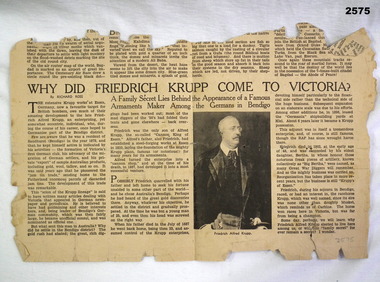
... ...Krupp...Newspaper re Friedrich Krupp & POW's WWII...See Cat No No 2455. documents - newspapers military history - army Krupp Newspaper re Friedrich Krupp & POW's WWII Newspaper NEWSPAPER CUTTING ...See Cat No No 2455.Newspaper re Friedrich Krupp & POW's WWIIdocuments - newspapers, military history - army, krupp -
 Federation University Historical Collection
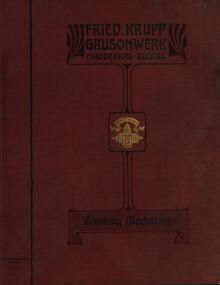
Book, Fried. Krupp Grusonwerk: Crushing Machinery, 1902, 1902
... Fried. Krupp Grusonwerk: Crushing Machinery, 1902...crushing machinery mining Two red covered books with beautiful illustrations of crushing machinery. Fried. Krupp Grusonwerk: Crushing Machinery, 1902 Book Book ...Two red covered books with beautiful illustrations of crushing machinery.crushing machinery, mining -
 Tramways/East Melbourne RSL Sub Branch - RSL Victoria Listing id: 27511
Book, William Manchester et al, The Arms of Krupp 1587-1968(True story of the family dynasty that built the German War Machine)
... The Arms of Krupp 1587-1968(True story of the family dynasty that built the German War Machine)...ISBN: 553-05230-195 The Arms of Krupp 1587-1968(True story of the family dynasty that built the German War Machine) Book William Manchester BANTAM BOOKS ...isbn: 553-05230-195 -
 Red Cliffs Military Museum
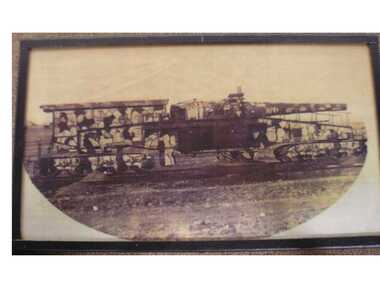
Copied Photos, The Amiens Gun, WW1
... Krupp...The Amiens Gun Copied Photos Krupp ...This 11 inch (28) Railway Gun was captured by the AIF in front of Harbonnieres near Villers Bretonneaux on the 8th of August 1918. It was one of the Guns used by the Germans to shell Amiens from a distance of 15 miles (24km) in an endeavor to destroy the railway centre in the city. However the destruction of the city was prevented by the advance of Allied Troops on the morning of 8th August when 5 Australian, 4 Canadian, 4 British and 9 French Divisions broke the German Front before Amiens./ The Barrel of the Great Gun, 41 feet (12,5m) long and weighing more than 45tons (45-80 tonnes), is exhibited at the Australian War Memorial in Canberra. More information can be found at www.Wikipedia/The Amiens Gun Two copied photos of the Amiens Gun (seperate Frames) and a history of the Amiens Gun in seperate frame.None on Photos, the history frame has a short history and "Presented by the Canberra Services Club 2003"ww1, gun, the, railway, amiens, harbonnieres, villers, bretonneaux -
 Bendigo Military Museum
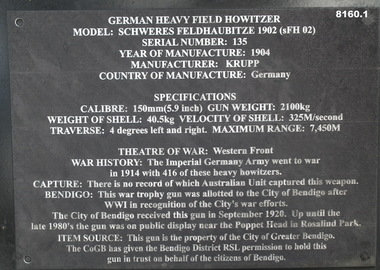
Weapon - HEAVY FIELD HOWITZER, Krupp, Germany, 1904
... Krupp, Germany...Weapon HEAVY FIELD HOWITZER Krupp, Germany ...This item is on display in the gardens of the Bendigo District RSL Sub Branch Havilah Road. Refer photo .1) for details re manufacture, history and use..1) Plaque metal black on a stand with white text re details of the item. .2) Heavy Field Howitzer German 1902 (sFH02) painted green, on two timber/metal wheels, towed weapon .brsl, smirsl, bdrslinc, howitzer, field -
 Running Rabbits Military Museum operated by the Upwey Belgrave RSL Sub Branch
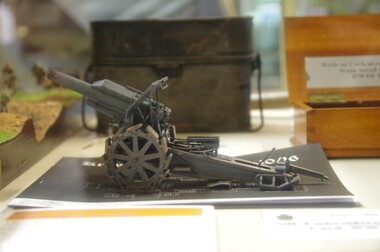
Model Field gun
... Howitser Krupp 21 cm Field Gun...Model WW1 General Howitser Krupp 21 cm Field Gun Model Field gun ...Howitser Krupp 21 cm Field Gunmodel, ww1, general -
 Linton and District Historical Society Inc
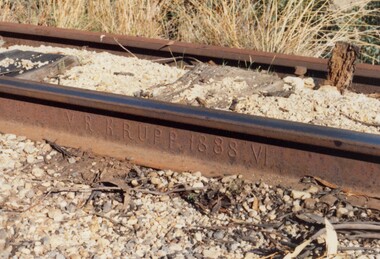
Photograph, Section of Rail Line, Linton circa 1982, 1982
... This part of the track is stamped "5-82 VR Krupp 1888 V1"....This part of the track is stamped "5-82 VR Krupp 1888 V1". Section of Rail Line, Linton circa 1982 Photograph Photograph ...Colour photograph showing lengths of metal track. This part of the track is stamped "5-82 VR Krupp 1888 V1".railway tracks, linton railway -
Tatura Irrigation & Wartime Camps Museum
Document, Eildon Dam
... Written by an engineer to give details of Eildon project and the part played by Ex German POW's in using German produced machinery (Krupp)...Written by an engineer to give details of Eildon project and the part played by Ex German POW's in using German produced machinery (Krupp) eildon damtatura burns f tatura irrigation engineering documents Olive green cover, black spine. ...Written by an engineer to give details of Eildon project and the part played by Ex German POW's in using German produced machinery (Krupp)Olive green cover, black spine. White label on fronteildon damtatura, burns f, tatura, irrigation, engineering, documents -
 Whitehorse Historical Society Inc.
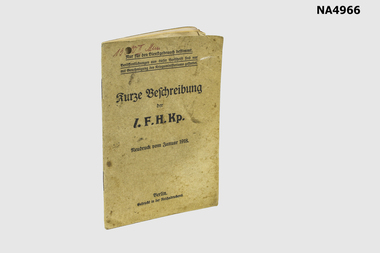
Book - German booklet Kruze Beschreibungder, 1/01/1918
... Kp Short description of L>F> Kp (Krupp 105cm leicht Feldhaubitze 98/09/gun) Neudruck vom Januar1918 Reprint from January 1918 Berlin Printed by Richprinting Headings include Munition, Vehicles, Gun Carriage, Dissamble, Set Up, Trench Warfare, and Mobile Warfare, Leaflet for driving Stamp on inside page 3 & final page reads Royal Prussian Ammunition Equipment Administrator Koniglich Pressische, Etappen,Munitions, V Gerate Verwltz...Kp Short description of L>F> Kp (Krupp 105cm leicht Feldhaubitze 98/09/gun) Neudruck vom Januar1918 Reprint from January 1918 Berlin Printed by Richprinting Headings include Munition, Vehicles, Gun Carriage, Dissamble, Set Up, Trench Warfare, and Mobile Warfare, Leaflet for driving Stamp on inside page 3 & final page reads Royal Prussian Ammunition Equipment Administrator Koniglich Pressische, Etappen,Munitions, V Gerate Verwltz Book German booklet Kruze Beschreibungder ...Collected by Charles Honybun during his service W W IAn example if items souvenired by servicemenA small book of 7 pages in German Kruze Beschreibungder 1 F.P. Kp Short description of L>F> Kp (Krupp 105cm leicht Feldhaubitze 98/09/gun) Neudruck vom Januar1918 Reprint from January 1918 Berlin Printed by Richprinting Headings include Munition, Vehicles, Gun Carriage, Dissamble, Set Up, Trench Warfare, and Mobile Warfare, Leaflet for driving Stamp on inside page 3 & final page reads Royal Prussian Ammunition Equipment Administrator Koniglich Pressische, Etappen,Munitions, V Gerate VerwltzAS Abovebooks, military, ww1, charles henry honybun -
 Federation University Historical Collection
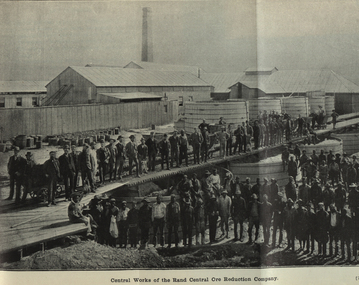
Book, Crosby Lockwood and Son, The Metallurgy of Gold, 1896, 1896
... Contents include: gold mining in California, Gold as a metal; Hydraulic Process; treatment of Gold bearing Ores; Crushing and Amalgamation (Queensland, California); Mills; Buddle; concentrator; Roasting ores; Roasting Pyritic Ores; Hydro-Metallurgy; Chlorination; Electro-Metallurgy; Cyanide; Erection of a Cyanide Plant; Chemistry of the Cyanide Process; Spelting, CupulationCrushing ore; 160 stamp battery; Mill site and battery; causes of failure in gold mining, South African Gold Fields; Gold in Australia (pg 589) Advertisements include: Fraser & Chalmers; Bowes scott & Western Ltd; Fried. Krupp Grusonwerk; Stanley; Humbolt Engineering Works Co., Townson & Mercer....Contents include: gold mining in California, Gold as a metal; Hydraulic Process; treatment of Gold bearing Ores; Crushing and Amalgamation (Queensland, California); Mills; Buddle; concentrator; Roasting ores; Roasting Pyritic Ores; Hydro-Metallurgy; Chlorination; Electro-Metallurgy; Cyanide; Erection of a Cyanide Plant; Chemistry of the Cyanide Process; Spelting, CupulationCrushing ore; 160 stamp battery; Mill site and battery; causes of failure in gold mining, South African Gold Fields; Gold in Australia (pg 589) Advertisements include: Fraser & Chalmers; Bowes scott & Western Ltd; Fried. Krupp Grusonwerk; Stanley; Humbolt Engineering Works Co., Townson & Mercer. ...M. Eissler A.I.M.E. was a member of the Institute of Mining and Metallurgy.Red Hardcovered book of 678 pages with around 250 illustrations and numerous folding plates. Contents include: gold mining in California, Gold as a metal; Hydraulic Process; treatment of Gold bearing Ores; Crushing and Amalgamation (Queensland, California); Mills; Buddle; concentrator; Roasting ores; Roasting Pyritic Ores; Hydro-Metallurgy; Chlorination; Electro-Metallurgy; Cyanide; Erection of a Cyanide Plant; Chemistry of the Cyanide Process; Spelting, CupulationCrushing ore; 160 stamp battery; Mill site and battery; causes of failure in gold mining, South African Gold Fields; Gold in Australia (pg 589) Advertisements include: Fraser & Chalmers; Bowes scott & Western Ltd; Fried. Krupp Grusonwerk; Stanley; Humbolt Engineering Works Co., Townson & Mercer.gold, mining, metallurgy, pyrites, cupel, brook, rand, california, america, gold mining -
 Eltham District Historical Society Inc
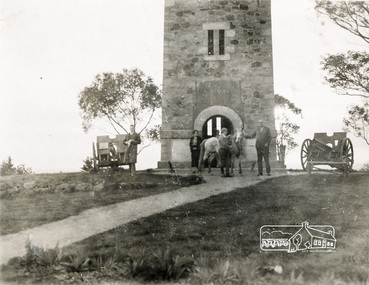
Photograph, Memorial Tower, Kangaroo Ground c.1934, 1934c
... The two field guns have been identified as of German origin, Krupp 77 mm calibre captured on October 4, 1918 at Geneve, France. ...The two field guns have been identified as of German origin, Krupp 77 mm calibre captured on October 4, 1918 at Geneve, France. ...Sepia photograph of Joyce McMahon and 'Tiny' Carroll at the War Memorial Tower, Kangaroo Ground c.1934. The guns were installed in 1934 and removed in 1942. Taken in the early 1930s, the photograph ... shows the Kangaroo Ground Tower of Remembance with Joyce McMahon, daughter-in-law of Mr. P. J.McMahon, the then Shire of Eltham Secretary, her horse and a very tall person patting the horse. He is ex-serviceman W. "Tiny" Caroll who was the council's caretaker of the surrounding War Memorial Park. He lived in the stone cottage which still stands in the park. "Tiny" is seen as the fictional character "Tiny Bourke" who, in author Alan Marshall's book "This is the Grass", "was a giant of a man, well over six feet high, with huge hands that completely encircled the cup of tea". The bronze casting, which shows the 79 names of those who paid the "supremen sacrifice" in World War 1 (1914-1918), was erecfed above the entrance to the Tower in September, 1930. The Monterey cypress trees which now form the windbreak around the park's fenceline, were just knee high in this photograph. They were planted in August 1926, with all the plantings paid for, and done, by the public as the Tower was being erected. The two field guns have been identified as of German origin, Krupp 77 mm calibre captured on October 4, 1918 at Geneve, France. They were removed in 1943/44 as a wartime requirement of the Australian Govenment. A public notice dated October 16, 1926 by Cr. H Rutter, Chairman of the Eltham Soldiers War Memorial League stated: "On the summit of that central and conspicuous landmark, Garden Hill, there is being erected a massive memorial tower which will, for all time, remind every passerby of the part played by the men of the Shire of Eltham in the Great War. The work has been undertaken by the people of the Shire a a tribute of love and admiration for those who were known and dear to use in the days of their youth and early manhood, who went out from amongst us, never to return, and whose self-sacrifice has made us, each and all, thier ever-lasting debtors" Harry Gilham, Eltham District Historical Society Kangaroo Ground Tower of Remembrance, A Journey in Time: a column about Nillumbik's history, Nillumbik Mail, 9th August, 2000 Since that research the following has been sourced from Eltham and Whittlesea Shires Advertiser and Diamond Creek Valley Advocate, April 8, 1921, p. 3 Retrieved April 25, 2020, from http://nla.gov.au/nla.news-article57639687 Eltham Shire Council From Town Clerk, Melbourne, stating that a light machine-gun captured by the 22nd battalion, A.I.F. at La Motte Farm, near Beaurvoir, on Oct. 3rd, 1918, during the operations which won the Beauvoir line and completed the smashing of the great Hindenburg defence-system, has been alloted to the Shire of Eltham. - On the motion of Crs Hubbard and Smedley, it was decided to have the gun placed in the Memorial Park. Sepia Photographgarden hill, gun, joyce mcmahon, kangaroo ground, memorial tower, shire of eltham war memorial tower, tiny carroll, war memorials, war trophy, william carroll -
 Flagstaff Hill Maritime Museum and Village
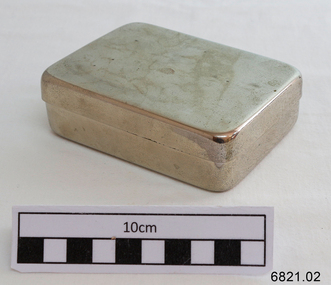
Container - Medical container, Late 19th century or early 20th century
... In 1908 the Germans entered the fray, the Krupp Iron Works in Germany produced a chrome-nickel steel for the hull of the Germania yacht. ...In 1908 the Germans entered the fray, the Krupp Iron Works in Germany produced a chrome-nickel steel for the hull of the Germania yacht. ...THE DISCOVERY OF STAINLESS STEEL Harry Brearley Since the dawn of man colonies have raced against each other to uncover new technologies, to be the first to stamp their names on a discovery, and although we’ve evolved over millions of years, the urge to be the first remains at the very core of our nature. This sense of passion and pride can lead some of the more unscrupulous humans to claim others discoveries as their own. Of course many breakthroughs are genuinely made in tandem, or are simultaneously occurring, but unless you can categorically prove that you were the pioneer of these incredible findings, then the other party involved will always dispute the fact. And so we come to stainless steel. The first point to note is that ‘inventor’ is a very ambiguous term. Is this the first person to think, to document, to patent, or to produce? The second point is that stainless steel wasn’t truly defined until 1911, so are we to cast aside those chromium-iron alloys that don’t quite meet the minimum requirement of 10.5% chromium? It seems like anyone and everyone has a different claim to being labelled the ‘inventor’ of stainless steel; from Britain, Germany, France, Poland, the U.S.A., and even Sweden. The cogs were set in motion by Englishmen Stoddart and Faraday circa 1820 and Frenchman Pierre Berthier in 1821. These scientists, among others, noted that iron-chromium alloys were more resistant to attack by certain acids, but tests were only carried out on low chromium content alloys. Attempts to produce higher chromium alloys failed primarily because of scientists not understanding the importance of low carbon content. In 1872 another pair of Englishmen, Woods and Clark, filed for patent of an acid and weather resistant iron alloy containing 30-35% chromium and 2% tungsten, effectively the first ever patent on what would now be considered a stainless steel. However, the real development came in 1875 when a Frenchman named Brustlein detailed the importance of low carbon content in successfully making stainless steel. Brustlein pointed out that in order to create an alloy with a high percentage of chromium, the carbon content must remain below around 0.15%. Thus ensued two decades of stagnation for the development of stainless steel, and while many scientists attempted to create a low carbon stainless steel, none succeeded. Hans Goldschmidt It wasn’t until 1895, when Hans Goldschmidt of Germany developed the aluminothermic reduction process for producing carbon-free chromium, that development of stainless steels became a reality. In 1904 French Scientist Leon Guillet undertook extensive research on many iron-chromium alloys. Guillet’s work included studies on the composition of what would now be known as 410, 420, 442, 446 and 440-C. In 1906 Guillet went on to analyse iron-nickel-chrome alloys, which would now be considered the basics of the 300 series. However, while noting the chemical composition of his alloys, Guillet failed to acknowledge the potential corrosion resistance of his materials. Albert Portevin In 1909 Englishman Giesen published an in-depth work regarding chromium-nickel steels, while the French national, Portevin, studied what is now regarded as 430 stainless steel. However, it wasn’t until 1911 that the importance of a minimum chromium content was discovered by Germans P. Monnartz and W. Borchers. Monnartz and Borchers discovered the correlation between chromium content and corrosion resistance, stating that there was a significant boost in corrosion resistance when at least 10.5% chromium was present. The pair also published detailed works on the effects of molybdenum on corrosion resistance. It is at this point we introduce Harry Brearley, born in Sheffield, England in 1871, he was appointed lead researcher at Brown Firth Laboratories in 1908. In 1912 Brearley was given a task by a small arms manufacturer who wished to prolong the life of their gun barrels which were eroding away too quickly. Brearley set out to create an erosion resistant steel, not a corrosion resistant one, and began experimenting with steel alloys containing chromium. During these experiments Brearley made several variations of his alloys, ranging from 6% to 15% chromium with differing levels of carbon. On the 13th August 1913 Brearley created a steel with 12.8% chromium and 0.24% carbon, argued to be the first ever stainless steel. The circumstances in which Brearley discovered stainless steel are covered in myth; some enchanted tales of Brearley recite him tossing his steel into the rubbish, only to notice later that the steel hadn’t rusted to the extent of its counterparts, much like Alexander Fleming’s experience 15 years later. Other more plausible, (but less attractive), accounts claim it was necessary for Brearley to etch his steels with nitric acid and examine them under a microscope in order to analyse their potential resistance to chemical attack. Brearley found that his new steel resisted these chemical attacks and proceeded to test the sample with other agents, including lemon juice and vinegar. Brearley was astounded to find that his alloys were still highly resistant, and immediately recognised the potential for his steel within the cutlery industry. The Half Moon Brearley struggled to win the support of his employers, instead choosing to produce his new steel at local cutler R. F. Mosley. He found difficulty producing knife blades in the new steel that did not rust or stain and turned to his old school friend, Ernest Stuart, Cutlery Manager at Mosley’s Portland Works, for help. Within 3 weeks, Stuart had perfected the hardening process for knives. Brearley had initially decided to name his invention ‘Rustless Steel’, but Stuart, dubbed it ‘Stainless Steel’ after testing the material in a vinegar solution, and the name stuck. And that’s how Harry Brearley discovered stainless steel…. well, not quite… During the 5 year period between 1908 and Brearley’s discovery in 1913 many other scientists and metallurgists have potential claims to Brearley’s title. In 1908 the Germans entered the fray, the Krupp Iron Works in Germany produced a chrome-nickel steel for the hull of the Germania yacht. The Half Moon, as the yacht is now known, has a rich history and currently lies on the seabed off the east coast of Florida. Whether the steel contains the minimum 10.5% chromium content remains inconclusive. Employees of the Krupp works, Eduard Maurer and Benno Strauss, also worked from 1912-1914 on developing austenitic steels using <1% carbon, <20% nickel and 15-40% chromium. Not happy with Europe hogging the glory, the USA got in on the act. Firstly, Elwood Haynes, after becoming disenchanted at his rusty razor, set out to create a corrosion resistant steel, which he supposedly succeeded in doing during 1911. Two other Americans, Becket and Dantsizen, worked on ferritic stainless steels, containing 14-16% chromium and 0.07-0.15% carbon, in the years 1911-1914. Elwood Haynes During 1912 Max Mauermann of Poland is rumoured to have created the first stainless steel, which he later presented to the public during the Adria exhibition in Vienna, 1913. Finally, a recently discovered article, which was published in a Swedish hunting and fishing magazine in 1913, discusses a steel used for gun barrels, (sound familiar?), which seems to resemble stainless steel. Although this is purely speculation, the Swedes have still made an audacious claim that they were in fact responsible for the first practical application for stainless steel. That concludes the shambolic discovery of stainless steel! Although there is much mystery and speculation behind the discovery of this wonderful material, there is no question that without the combined effort of all the above scientists and metallurgists, (and all the many more that were not mentioned), we would not have such a rich and versatile metal at our fingertips. https://bssa.org.uk/bssa_articles/the-discovery-of-stainless-steel/#:~:text=On%20the%2013th%20August%201913,the%20first%20ever%20stainless%20steel. This stainless steel container was donated to Flagstaff Hill Maritime Village by the family of Doctor William Roy Angus, Surgeon and Oculist. It is part of the “W.R. Angus Collection” that includes historical medical equipment, surgical instruments and material once belonging to Dr Edward Ryan and Dr Thomas Francis Ryan, (both of Nhill, Victoria) as well as Dr Angus’ own belongings. The Collection’s history spans the medical practices of the two Doctors Ryan, from 1885-1926 plus that of Dr Angus, up until 1969. ABOUT THE “W.R.ANGUS COLLECTION” Doctor William Roy Angus M.B., B.S., Adel., 1923, F.R.C.S. Edin.,1928 (also known as Dr Roy Angus) was born in Murrumbeena, Victoria in 1901 and lived until 1970. He qualified as a doctor in 1923 at University of Adelaide, was Resident Medical Officer at the Royal Adelaide Hospital in 1924 and for a period was house surgeon to Sir (then Mr.) Henry Simpson Newland. Dr Angus was briefly an Assistant to Dr Riddell of Kapunda, then commenced private practice at Curramulka, Yorke Peninsula, SA, where he was physician, surgeon and chemist. In 1926, he was appointed as new Medical Assistant to Dr Thomas Francis Ryan (T.F. Ryan, or Tom), in Nhill, Victoria, where his experiences included radiology and pharmacy. In 1927 he was Acting House Surgeon in Dr Tom Ryan’s absence. Dr Angus had become engaged to Gladys Forsyth and they decided he would take time to further his studies overseas in the UK in 1927. He studied at London University College Hospital and at Edinburgh Royal Infirmary and in 1928, was awarded FRCS (Fellow from the Royal College of Surgeons), Edinburgh. He worked his passage back to Australia as a Ship’s Surgeon on the on the Australian Commonwealth Line’s T.S.S. Largs Bay. Dr Angus married Gladys in 1929, in Ballarat. (They went on to have one son (Graham 1932, born in SA) and two daughters (Helen (died 12/07/1996) and Berenice (Berry), both born at Mira, Nhill ) Dr Angus was a ‘flying doctor’ for the A.I.M. (Australian Inland Ministry) Aerial Medical Service in 1928 . The organisation began in South Australia through the Presbyterian Church in that year, with its first station being in the remote town of Oodnadatta, where Dr Angus was stationed. He was locum tenens there on North-South Railway at 21 Mile Camp. He took up this ‘flying doctor’ position in response to a call from Dr John Flynn; the organisation was later known as the Flying Doctor Service, then the Royal Flying Doctor Service. A lot of his work during this time involved dental surgery also. Between 1928-1932 he was surgeon at the Curramulka Hospital, Yorke Peninsula, South Australia. In 1933 Dr Angus returned to Nhill where he’d previously worked as Medical Assistant and purchased a share of the Nelson Street practice and Mira hospital from Dr Les Middleton one of the Middleton Brothers, the current owners of what was once Dr Tom Ryan’s practice. Dr L Middleton was House Surgeon to the Nhill Hospital 1926-1933, when he resigned. [Dr Tom Ryan’s practice had originally belonged to his older brother Dr Edward Ryan, who came to Nhill in 1885. Dr Edward saw patients at his rooms, firstly in Victoria Street and in 1886 in Nelson Street, until 1901. The Nelson Street practice also had a 2 bed ward, called Mira Private Hospital ). Dr Edward Ryan was House Surgeon at the Nhill Hospital 1884-1902 . He also had occasions where he successfully performed veterinary surgery for the local farmers too. Dr Tom Ryan then purchased the practice from his brother in 1901. Both Dr Edward and Dr Tom Ryan work as surgeons included eye surgery. Dr Tom Ryan performed many of his operations in the Mira private hospital on his premises. He too was House Surgeon at the Nhill Hospital 1902-1926. Dr Tom Ryan had one of the only two pieces of radiology equipment in Victoria during his practicing years – The Royal Melbourne Hospital had the other one. Over the years Dr Tom Ryan gradually set up what was effectively a training school for country general-practitioner-surgeons. Each patient was carefully examined, including using the X-ray machine, and any surgery was discussed and planned with Dr Ryan’s assistants several days in advance. Dr Angus gained experience in using the X-ray machine there during his time as assistant to Dr Ryan. Dr Tom Ryan moved from Nhill in 1926. He became a Fellow of the Royal Australasian College of Surgeons in 1927, soon after its formation, a rare accolade for a doctor outside any of the major cities. He remained a bachelor and died suddenly on 7th Dec 1955, aged 91, at his home in Ararat. Scholarships and prizes are still awarded to medical students in the honour of Dr T.F. Ryan and his father, Dr Michael Ryan, and brother, John Patrick Ryan. ] When Dr Angus bought into the Nelson Street premises in Nhill he was also appointed as the Nhill Hospital’s Honorary House Surgeon 1933-1938. His practitioner’s plate from his Nhill surgery states “HOURS Daily, except Tuesdays, Fridays and Saturday afternoons, 9-10am, 2-4pm, 7-8pm. Sundays by appointment”. This plate is now mounted on the doorway to the Port Medical Office at Flagstaff Hill Maritime Village, Warrnambool. Dr Edward Ryan and Dr Tom Ryan had an extensive collection of historical medical equipment and materials spanning 1884-1926 and when Dr Angus took up practice in their old premises he obtained this collection, a large part of which is now on display at the Port Medical Office at Flagstaff Hill Maritime Village in Warrnambool. During his time in Nhill Dr Angus was involved in the merging of the Mira Hospital and Nhill Public Hospital into one public hospital and the property titles passed on to Nhill Hospital in 1939. In 1939 Dr Angus and his family moved to Warrnambool where he purchased “Birchwood,” the 1852 home and medical practice of Dr John Hunter Henderson, at 214 Koroit Street. (This property was sold in1965 to the State Government and is now the site of the Warrnambool Police Station. ). The Angus family was able to afford gardeners, cooks and maids; their home was a popular place for visiting dignitaries to stay whilst visiting Warrnambool. Dr Angus had his own silk worm farm at home in a Mulberry tree. His young daughter used his centrifuge for spinning the silk. Dr Angus was appointed on a part-time basis as Port Medical Officer (Health Officer) in Warrnambool and held this position until the 1940’s when the government no longer required the service of a Port Medical Officer in Warrnambool; he was thus Warrnambool’s last serving Port Medical Officer. (The duties of a Port Medical Officer were outlined by the Colonial Secretary on 21st June, 1839 under the terms of the Quarantine Act. Masters of immigrant ships arriving in port reported incidents of diseases, illness and death and the Port Medical Officer made a decision on whether the ship required Quarantine and for how long, in this way preventing contagious illness from spreading from new immigrants to the residents already in the colony.) Dr Angus was a member of the Australian Medical Association, for 35 years and surgeon at the Warrnambool Base Hospital 1939-1942, He served as a Surgeon Captain during WWII1942-45, in Ballarat, Victoria, and in Bonegilla, N.S.W., completing his service just before the end of the war due to suffering from a heart attack. During his convalescence he carved an intricate and ‘most artistic’ chess set from the material that dentures were made from. He then studied ophthalmology at the Royal Melbourne Eye and Ear Hospital and created cosmetically superior artificial eyes by pioneering using the intrascleral cartilage. Angus received accolades from the Ophthalmological Society of Australasia for this work. He returned to Warrnambool to commence practice as an ophthalmologist, pioneering in artificial eye improvements. He was Honorary Consultant Ophthalmologist to Warrnambool Base Hospital for 31 years. He made monthly visits to Portland as a visiting surgeon, to perform eye surgery. He represented the Victorian South-West subdivision of the Australian Medical Association as its secretary between 1949 and 1956 and as chairman from 1956 to 1958. In 1968 Dr Angus was elected member of Spain’s Barraquer Institute of Barcelona after his research work in Intrasclearal cartilage grafting, becoming one of the few Australian ophthalmologists to receive this honour, and in the following year presented his final paper on Living Intrasclearal Cartilage Implants at the Inaugural Meeting of the Australian College of Ophthalmologists in Melbourne In his personal life Dr Angus was a Presbyterian and treated Sunday as a Sabbath, a day of rest. He would visit 3 or 4 country patients on a Sunday, taking his children along ‘for the ride’ and to visit with him. Sunday evenings he would play the pianola and sing Scottish songs to his family. One of Dr Angus’ patients was Margaret MacKenzie, author of a book on local shipwrecks that she’d seen as an eye witness from the late 1880’s in Peterborough, Victoria. In the early 1950’s Dr Angus, painted a picture of a shipwreck for the cover jacket of Margaret’s book, Shipwrecks and More Shipwrecks. She was blind in later life and her daughter wrote the actual book for her. Dr Angus and his wife Gladys were very involved in Warrnambool’s society with a strong interest in civic affairs. Their interests included organisations such as Red Cross, Rostrum, Warrnambool and District Historical Society (founding members), Wine and Food Society, Steering Committee for Tertiary Education in Warrnambool, Local National Trust, Good Neighbour Council, Housing Commission Advisory Board, United Services Institute, Legion of Ex-Servicemen, Olympic Pool Committee, Food for Britain Organisation, Warrnambool Hospital, Anti-Cancer Council, Boys’ Club, Charitable Council, National Fitness Council and Air Raid Precautions Group. He was also a member of the Steam Preservation Society and derived much pleasure from a steam traction engine on his farm. He had an interest in people and the community He and his wife Gladys were both involved in the creation of Flagstaff Hill, including the layout of the gardens. After his death (28th March 1970) his family requested his practitioner’s plate, medical instruments and some personal belongings be displayed in the Port Medical Office surgery at Flagstaff Hill Maritime Village, and be called the “W. R. Angus Collection”. The W.R. Angus Collection is significant for still being located at the site it is connected with, Doctor Angus being the last Port Medical Officer in Warrnambool. The collection of medical instruments and other equipment is culturally significant, being an historical example of medicine from late 19th to mid-20th century. Dr Angus assisted Dr Tom Ryan, a pioneer in the use of X-rays and in ocular surgery. Medical box; rectangular stainless steel base and separate lid, from the W.R. Angus Collection.warrnambool, flagstaff hill maritime museum, great ocean road, dr w r angus, dr ryan, surgical instrument, t.s.s. largs bay, warrnambool base hospital, nhill base hospital, mira hospital, flying doctor, medical treatment, stainless steel medical container, medical container, stainless steel -
Federation University Historical Collection
Letter, Inward Correspondence to the Ballarat School of Mines, 1910, 08/1910
... Fairthorne Noyes Brothers Fried Krupp H.G. Taylor W.D. Hill W.E. Humphreys William Nixon Bell Lambert and Nixon R.M. ...Inward Correspondence to the Ballarat School of Mines, October 1910letterhead, education department, telegram, pharmacy board of victoria, launceston, l.f. fairthorne & sons, empire typewriter company, rotary duplicator, n.j. coote, clunes, octavius williams, h.a. taylor, s. radcliffe, bairnsdale, broken hill, frederick e. barclay, incorporated institute of analysts assayers and metallurgists, i.h. davies, j.f. dentry, j. refshauge, ballarat agricultural high school, tinghae, w. jennings, chemistry, gordon and gotch, gordon technical college woolsorting department, v.m. pearson, assaying, felton and grimwade, colac, macquarie steam brick yards, bairnsdale district school of mines, scools of mines, s. radcliff, frederick k. fairthorne, noyes brothers, fried krupp, h.g. taylor, w.d. hill, w.e. humphreys, william nixon, bell lambert and nixon, r.m. lambert
