
Showing 30 items matching "labour force"
-
 University of Melbourne, Burnley Campus Archives
Document - Photocopy, Legislative Assembly, Victorian Parliament, Report of Royal Commission on Mildura, 1896-1897
... ...labour force...Comparisons of labour force....Comparisons of labour force. Report of Royal Commission on Mildura Document Photocopy Legislative Assembly, Victorian Parliament ...Copy of Victorian Parliamentary Papers V66 LtMs 1896 V3 & $ 1897 VI Papers presented to Parliament session 1896 Legislative Assembly Vol. III No 19 Mildura settlement. C. B. Luffmann answering questions about his observations on dried fruit growing in Mildura, his experiences in Europe, comparisons between Europe, America and Australia. His suggestions on what fruit to grow i.e. muscatels and figs. Comparisons of labour force.charles bogue luffman, victorian parliamentary papers, c b luffmann, mildura, mildura settlement, dried fruit growing, muscatels, figs, labour force, overseas experience -
 Kiewa Valley Historical Society
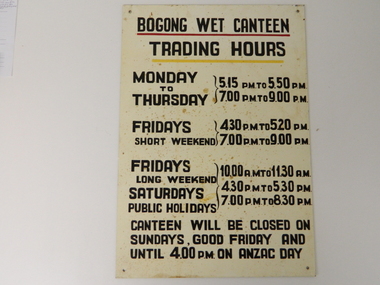
Sign Canteen Painted, Circa 1950
... socialisation of sec vic kiewa hydro scheme labour force...This sign details that all aspects required for a fit and productive labour force were in place, in this remote and demanding work environment. ...This sign is a part of the "human" factor required for remote and difficult, large impact (both labour and other resources) projects. It is one of the "human" factors which was clearly used in the big 1930's to the 1970's "landscape redevelopment" schemes which started in the early 1900's and is highly regarded as lifting the Australian psyche of only primary producers to an industrial level, equal to any in the world.This "Wet Canteen" sign was installed at the entrance of the Bogong "workers" village "provision's hut" detailing the operational times for the SEC Victorian staff and construction workers, involved in the building of the Kiewa Hydro Electricity Scheme to obtain alcoholic beverages. This facility lasted for over the extensive period (1938 to 1961) of the "Schemes" building phase. This large project was the forerunner when industrial legislation provided for the welfare of workers living in the Bogong Village. The provision of facilities such as a "wet canteen" was of the utmost importance not only to ensure that the long running project was both successful, production wise, but also that its employees were not only physically but also mentally healthy. This sign details that all aspects required for a fit and productive labour force were in place, in this remote and demanding work environment. The majority of heavy equipment and machinery used was either made in England or Europe. A section of the specialised workforce came from local and European expertise in dam construction and water management in alpine terrain. The majority of labour came from migrants and some specialists recruited from England and Europe. At this point in time, the quality of the machines used came from England, Europe and the USA and could not be matched from anywhere else in the developed world. With a specialised workforce came the responsibility of providing all the "comforts of home" including alcoholic beverages. On site accommodation for the workforce is still a requirement for some mining areas but high market returns have produced fly in/out labour.This anodised metal sign has been "block" stenciled on. Black lettering and numbers with the main headings underlined with a red and a yellow line(emphasising the headings)In black stenciled type "BOGONG WET CANTEEN" underneath this "TRADING HOURS" Below this "MONDAY TO THURSDAY 5.15 PM TO 5.50 PM, 7.00 PM TO 9.00 PM" "FRIDAYS SHORT WEEKEND 4.30 PM TO 5.20 PM 7.00 PM TO 9.00 PM" Below this "FRIDAYS LONG WEEKEND 10.00AM TO 11.30 AM" Below this "SATURDAYS PUBLIC HOLIDAYS 4.30 PM TO 5.30 PM 7.00 PM TO 8.30 PM" bELOW THIS "CANTEEN WILL BE CLOSED ON SUNDAYS, GOOD FRIDAY AND UNTIL 4.00 PM ON ANZAC DAY"saucer, plate, secv, state electricity commission of victoria, canteen, bogong mess hall, recreational amenities, socialisation of sec vic kiewa hydro scheme labour force -
 Myrtleford and District Historical Society
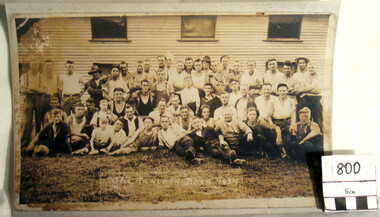
Hop Growers Photograph, "Panlook Boys, 1934"
... The photograph represents the migratory labour force involved in hop growing, the major farm activity on "Panlook's Hop Gardens", Eurobin in 1934. ...The photograph represents the migratory labour force involved in hop growing, the major farm activity on "Panlook's Hop Gardens", Eurobin in 1934. ...The photograph represents the migratory labour force involved in hop growing, the major farm activity on "Panlook's Hop Gardens", Eurobin in 1934. William Panlook a descendant of a Chinese storekeeper on the Buckland Diggings, had originally commenced tobacco growing at the location until devastating frosts and unreliable tobacco prices brought a change in land use. The photograph represents the transition that occurred from tobacco to hops cultivation in the early 1930s. It is now a permanent feature of the farming landscape at Eurobin. It depicts the reliance on migratory seasonal labour and the importance of local expertise, some of Chinese descent. A sepia-coloured photograph of 30 hop pickers.Inscription: "The Panlook Boys, 1934"hop growing. panlooks hop gardens. eurobin -
Unions Ballarat
Correspondence re receipts, printed balance sheet of the London Dock Labourers' Relief fund, 6 September 1889-18 February 189?
... The 1889 London Dock Strike grew from unrest about poor living conditions as a result of the casualised labour force. Money raised across Australia (30,000 pounds) helped to support striking workers to continue the action and feed their families. ...The 1889 London Dock Strike grew from unrest about poor living conditions as a result of the casualised labour force. Money raised across Australia (30,000 pounds) helped to support striking workers to continue the action and feed their families. ...The 1889 London Dock Strike grew from unrest about poor living conditions as a result of the casualised labour force. Money raised across Australia (30,000 pounds) helped to support striking workers to continue the action and feed their families. The strike led to the formation of the General Labourers' Union and strengthened unionism amongst dockers.The London Dock Labourer's Strike correlates with significant National growth in the trade union movement.Includes chequebook, bank deposit slips and rough notebook with Wilson's memoranda. btlc, ballarat trades and labour council, unions, strikes, london dock strike, casualisation, actu, ballarat trades hall -
Unions Ballarat
Independent Report of the Victorian Industrial Relations Taskforce: Part 2 - Statistical Research on the Victorian Labour Market, Ian Watson et al, 08/2000
... Vol 2 - Analysis of labour force data....Vol 2 - Analysis of labour force data. Relevant to history of modern industrial relations in Australia. btlc ballarat trades hall ballarat regional trades and labour council victorian industrial relations taskforce victorian state government statistics labour market - deregulation Front cover: title. ...Commissioned by the Kennett government in 2000. The findings of this report intimate that deregulation of the labour market impacts adversely and inequitably upon workers who are already have unfavourable outcomes from the current system. This is volume 2 of a two volume report. Volume 1 (object B0446) is also held. Vol 1 - survey findings. Vol 2 - Analysis of labour force data.Relevant to history of modern industrial relations in Australia.Paperback. Front cover: background; white lettering.Front cover: title.btlc, ballarat trades hall, ballarat regional trades and labour council, victorian industrial relations taskforce, victorian state government, statistics, labour market - deregulation -
Unions Ballarat
Independent Report of the Victorian Industrial Relations Taskforce: Part 1 - Report and Recommendations, et al, 08/2000
... Vol 2 - Analysis of labour force data....Vol 2 - Analysis of labour force data. Relevant to history of industrial relations in Australia. btlc ballarat trades hall ballarat regional trades and labour council victorian industrial relations taskforce victorian state government statistics labour market - deregulation Paperback - brown cover, title in white lettering. ...Commissioned by the Kennett government in 2000. The findings of this report intimate that deregulation of the labour market impacts adversely and inequitably upon workers who are already have unfavourable outcomes from the current system. This is volume 1 of a two volume report. Volume 1 (object B0446) is also held. Vol 1 - survey findings. Vol 2 - Analysis of labour force data.Relevant to history of industrial relations in Australia.Paperback - brown cover, title in white lettering.btlc, ballarat trades hall, ballarat regional trades and labour council, victorian industrial relations taskforce, victorian state government, statistics, labour market - deregulation -
 Yarrawonga and Mulwala Pioneer Museum
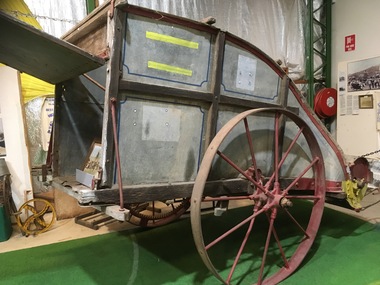
Stripper, The Stripper, 1843
... In the early ays of Colonial South Australia a labour force was essential to harvest the wheat crop quickly before the grain shook out and fell to the ground. ...In the early ays of Colonial South Australia a labour force was essential to harvest the wheat crop quickly before the grain shook out and fell to the ground. ...The Stripper was invented by John Ridley in 1843, while trying to overcome harvest labour shortage. In the early ays of Colonial South Australia a labour force was essential to harvest the wheat crop quickly before the grain shook out and fell to the ground. The stripper solved this problem, as t could strip 10 acres [4 hectares], handling approx. 180 bushels [5 tonnes] per day. This replaced 14 men using scythes.Strippers were used in this area between 1870's to the early 1900's.Then the Stripper Harvestors took over this processprinciple of the stripper----The wheat heads were knocked off the straw by a fat revolving beater ,and the grain, mixed with the husks and short straw, was propelled to the rear tin box. When the box became full, the contents were emptied into a winnower for cleaning. Recorded as Mitchell Stripper -
 Orbost & District Historical Society
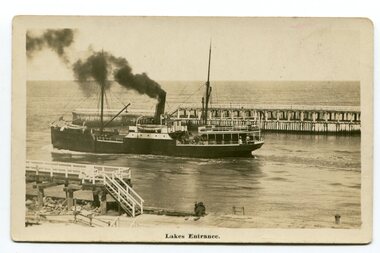
Photograph - Three photographs - Bombala; SS Whyralla; bean picking, Crown Studios ( W Stanley Vogt), c.1920s
... They all appear to be c. 1920s. 2717.1 Bombala was at the terminus of a railway line in NSW, and also road routes. 2717.2 shows the intensive labour force involved with agriculture in the 1920s eg. beans. 2717.3 shows the man-made entrance to Lakes Entrance, with the Steam Ship Wyrallah sailing through. ...They all appear to be c. 1920s. 2717.1 Bombala was at the terminus of a railway line in NSW, and also road routes. 2717.2 shows the intensive labour force involved with agriculture in the 1920s eg. beans. 2717.3 shows the man-made entrance to Lakes Entrance, with the Steam Ship Wyrallah sailing through. ...These 3 photos are of locations in East Gippsland. They all appear to be c. 1920s. 2717.1 Bombala was at the terminus of a railway line in NSW, and also road routes. 2717.2 shows the intensive labour force involved with agriculture in the 1920s eg. beans. 2717.3 shows the man-made entrance to Lakes Entrance, with the Steam Ship Wyrallah sailing through. This ship was a regular coastal trader from Melbourne to Lks. Entrance. She was sunk in 1924 when run down by the SS Dilkerra at Pt Phillip Heads, with a loss of 6 lives.These photographs are significant because they show different aspects of East Gippsland locations c.1920s.3 b/w photographs/postcards 2717.1 shows the street with buildings, some two-storey on both sides of the street. A number of cars and people are in the street. 2717.2 shows a flat paddock with rows of a crop (probably beans), and 20-30 people, men, women and children. Many of them carry baskets or tins and wear hats. In the background is a fence and a shed. 2717.3 shows a steam ship travelling through two embankments made from wood. 2717.1 BOMBALA Crown Studios, Bairnsdale, Victoria 2717.2 on back of card: To dear David and Violet with love and best wishes from father and mother 2717.3 Lakes Entranceagriculture, bombala, lakes entrance, ss wyrallah -
 Bendigo Historical Society Inc.
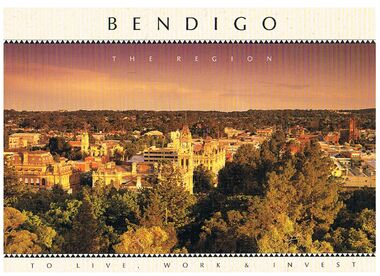
Book - BENDIGO - THE REGION TO LIVE, WORK & INVEST
... Sections in the book are: Live Work & Invest, Lifestyle, Access, Community, Infrastructure, Labour Force, Business, Opportunity, Successes and Information. ...Sections in the book are: Live Work & Invest, Lifestyle, Access, Community, Infrastructure, Labour Force, Business, Opportunity, Successes and Information. ...Pale yellow 12 page book titled 'Bendigo the Region to Live Work & Invest'. On the front cover is a scenic view of Bendigo and on the back cover a picture of some quartz and gold nuggets on a green background. Sections in the book are: Live Work & Invest, Lifestyle, Access, Community, Infrastructure, Labour Force, Business, Opportunity, Successes and Information. Each page has a colour picture, they are:- Hargreaves Mall, Eaglehawk Golf Course, Map of Victoria, La Trobe University, Big Hill, Regional Office Department of Planning & Development, Sandhurst Farms, Construction Activity, Products of the Region, Dr. Ian Macbean, Mr Evan Jones and the Capital Theatre with information on each.book, bendigo, bendigo, bendigo - the region to live, work & invest, bendigo regional development board, dr ian macbean, mr evan jones, kate mildren, richard gibbs, express printers, hargreaves mall, eaglehawk golf course, map of victoria, la trobe university, big hill, regional office department of planning & development, sandhurst farms, construction activity, products of the region, capital theatre -
Unions Ballarat
Minutes of meetings of Building Committee, 29 October 1886-15 May 1889
... The 1889 London Dock Strike grew from unrest about poor living conditions as a result of the casualised labour force. Money raised in Australia (30,000 pounds) helped to support striking workers to continue the action and feed their families. ...The 1889 London Dock Strike grew from unrest about poor living conditions as a result of the casualised labour force. Money raised in Australia (30,000 pounds) helped to support striking workers to continue the action and feed their families. ...The 1889 London Dock Strike grew from unrest about poor living conditions as a result of the casualised labour force. Money raised in Australia (30,000 pounds) helped to support striking workers to continue the action and feed their families. The strike led to the formation of the General Labourers' Union and strengthened unionism amongst dockers. The 1890 Maritime Strike: marine officers walked out because shipowners would not negotiate terms and conditions of employment whilst the Mercantile Marine Officers' Association was affiliated with the Victorian Trades Hall Council. Union officials proposed to disaffiliate on the condition that employers would agree to meet and reach a compromise with union delegates. The shipowners refusal to meet triggered strike action.The London Dock Labourer's Strike correlates with significant National growth in the trade union movement. The Maritime Strike demonstrates an historical example of an employer's attempt to undermine workplace unionism. Parallels (i.e. employers attempting to weaken union power) have been drawn between this and the Australian waterfront dispute of 1998.Bound, paper, 1 volumebuilding committee, maritime strike, mercantile marine officers' association, general labourers' union, london dock strike, casualisation, strikes, unions, ballarat trades hall -
 Federation University Historical Collection
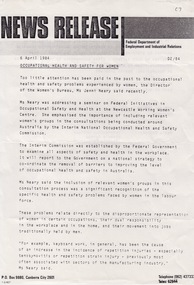
Document - Document - News Release, VIOSH: Federal Department of Employment and Industrial Relations; Occupational Health and Safety for Women, 6 April 1984
... This was a significant recognition of the specific health and safety problems faced by women in the labour force....This was a significant recognition of the specific health and safety problems faced by women in the labour force. viosh victorian institute of occupational safety and health federal department of employment and industrial relations director of the women's bureau newcastle working women's centre jenni neary information officer barbara fergusson consultations Barbara Fergusson A4 page printed both sides VIOSH: Federal Department of Employment and Industrial Relations; Occupational Health and Safety for Women, 6 April 1984 Document Document - News Release ...Victorian Institute of Occupational Safety and Health (VIOSH) Australia is the Asia-Pacific centre for teaching and research in occupational health and safety (OHS) and is known as one of Australia's leaders on the field. VIOSH has a global reputation for its innovative approach within the field of OHS management. VIOSH had its first intake of students in 1979. At that time the Institution was known as the Ballarat College of Advanced Education. In 1990 it became known as Ballarat University College, then in 1994 as University of Ballarat. It was 2014 that it became Federation University. VIOSH Australia students are safety managers, senior advisors and experienced OHS professionals. They come from all over Australia and industry. Students are taught active research and enquiry; rather than textbook learning and a one-size fits all approach. VIOSH accepts people into the Graduate Diploma of Occupational Hazard Management who have no undergraduate degree - on the basis of extensive work experience and knowledge. The Director of the Women's Bureau, Ms Jenni Neary spoke on Federal Initiatives in Occupational Safety and Health at the Newcastle Working Women's Centre. She emphasised the importance of including women's groups in the consultations being held around Australia. This was a significant recognition of the specific health and safety problems faced by women in the labour force.A4 page printed both sidesBarbara Fergusson viosh, victorian institute of occupational safety and health, federal department of employment and industrial relations, director of the women's bureau, newcastle working women's centre, jenni neary, information officer, barbara fergusson, consultations -
 Mission to Seafarers Victoria
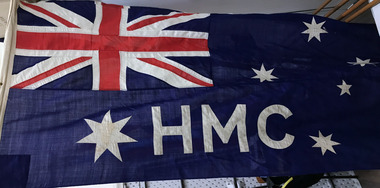
Flag, Australian Border Force, 1909-1988
... Representatives come from the Royal and Merchant Navies, the commercial world, shipping companies, mission and philanthropic societies, veterans’ associations, labour unions, youth and leisure organisations, but anyone is welcome to attend. flag seafarers service australian border force h.m.c. customs Large white rectangular flag with the Australian Blue Ensign and the letters HMC. ...The first Seafarers Service was held on 23 October 1905 in the St Paul's Cathedral in London to celebrate the Centenary of the Battle of Trafalgar and the death of Vice-Admiral Horatio Nelson on 21 October 1805. Reverend Alfred Gurney Goldsmith launched the first Seafarers Service two years later and the first service was held on Sunday 10 November 1907. National and house flags are used during the annual Seafarers Service. The service continue to reflect the full range of the maritime activities in Australia. Representatives come from the Royal and Merchant Navies, the commercial world, shipping companies, mission and philanthropic societies, veterans’ associations, labour unions, youth and leisure organisations, but anyone is welcome to attend.Large white rectangular flag with the Australian Blue Ensign and the letters HMC.flag, seafarers service, australian border force, h.m.c., customs -
 Kiewa Valley Historical Society
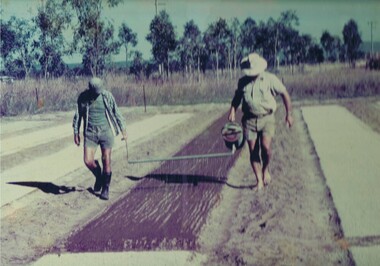
Photograph Tobacco planting, Planting Tobacco seeding, Circa mid to late 1900's
... labour, at that time, and is demonstrated by the bare footed farmer walking next to the seed canister. Some workers did use protective "gum" boots but the majority of farm owners were skeptical of city scientists and their carcinogenic concerns, and it was only after the younger generation of farmers , who had attended Agricultural colleges, encompassed the scientific approach to farm management and began working closely with agricultural scientists. The "she'll be right mate" attitude of the earlier farming/rural community has since mid 1970s, been slowly dissipating. Stricter controls of herbicides and pesticides used in agriculture are now in force ...This promotional photograph by the Tobacco Growers Association was in response to a 1935 meeting of tobacco growers from Victoria, South Australia and Queensland which produced four major resolutions for the industry covering the remainder of the 1900s. These four resolutions were: (1) Adequate tariff protection (2) Control of pests and diseases (3) Orderly marketing (4) The formation of an advisory council of growers. History has produced the following results. (1) adequate tariff protection was never achieved,(2) control of disease through benzol vapour (CSIRO) breakthrough, was later identified as carcinogenic, (3) orderly marketing was achieved through (4) the establishment of the Tobacco Growers Association(1984). In October 2006, by way of Government buy back of tobacco leases from growers, resulted in the end of Tobacco farming in Australia (after 136 years of planting the first crop). It was also significant that the major tobacco companies such as Philip Morris and The British American Tobacco Australasia advised the industry that it would source its tobacco requirements overseas by 2009.The remnants of the Tobacco Industry can still be viewed throughout the Kiewa Valley and adjacent regions on the former tobacco farms which still have the tobacco drying sheds and now converted into hay sheds. The problems from the large quantities of carcinogenic infused soil of farmlands in the region, still remains a problem now and for future generations. This particular photograph shows the lack of understanding by farmers and the contracted labour, at that time, and is demonstrated by the bare footed farmer walking next to the seed canister. Some workers did use protective "gum" boots but the majority of farm owners were skeptical of city scientists and their carcinogenic concerns, and it was only after the younger generation of farmers , who had attended Agricultural colleges, encompassed the scientific approach to farm management and began working closely with agricultural scientists. The "she'll be right mate" attitude of the earlier farming/rural community has since mid 1970s, been slowly dissipating. Stricter controls of herbicides and pesticides used in agriculture are now in force. The death of the tobacco industry(2006) resulted in the expansion of the dairy , sheep, beef cattle, venison and lama wool producers in the Kiewa Valley and surrounding regions.Coloured photograph pasted onto a thick wood chip backing. Two galvanised eyelets at the top of the frame, 50mm from each end, with a twine cord stretch from each, for hanging purposes. See also KVHS 0054(B) to KVHS 0054(F)A sign, which has been removed from the picture at some previous point in time is "The Tobacco seed, being so fine, is suspended in water and sown onto the seed base using a watering can [as in the photo] or similar device - August - Sept."tobacco, farming, rural industry, licences, ollie mould, blue mould, benzol vapour -
 Kiewa Valley Historical Society
Book - Non Fiction History, Australia's Royal Welcome 1954, circa 1954
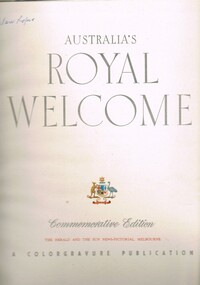
... Labour Party's "White Australian" policy was a hinderance and a barrier towards the Asian and African prospective immigrants. The motto Queen and Country was still very ingrained in the rural population. This period in Australian domestic self reliance, brought about the growing strength and very active trade union movement and their staunch support for the Tariff protection against a growing swell of imported goods. This self reliance psyche was essentially a by product of World War II, and the isolation felt by the Australian People. The Queen (royalty) was the binding force...Labour Party's "White Australian" policy was a hinderance and a barrier towards the Asian and African prospective immigrants. The motto Queen and Country was still very ingrained in the rural population. This period in Australian domestic self reliance, brought about the growing strength and very active trade union movement and their staunch support for the Tariff protection against a growing swell of imported goods. This self reliance psyche was essentially a by product of World War II, and the isolation felt by the Australian People. The Queen (royalty) was the binding force ...This publication covers the mid 1900s and relates to a period where the majority of the Australian population was engrossed with the Queen of Australia, even though her Highness did not reside on this continent. The period covered was before the great immigration insurgence from Europe.The Labour Party's "White Australian" policy was a hinderance and a barrier towards the Asian and African prospective immigrants. The motto Queen and Country was still very ingrained in the rural population. This period in Australian domestic self reliance, brought about the growing strength and very active trade union movement and their staunch support for the Tariff protection against a growing swell of imported goods. This self reliance psyche was essentially a by product of World War II, and the isolation felt by the Australian People. The Queen (royalty) was the binding force holding the British Empire together which was emphasised with her popularity when touring Australia Queen Elizabeth's visited the MCG twice in 1954 1. to attend an assembly of ex-servicemen and women's organisations 2. to attend a Children's Display. She also visited Government House and visited Country Victoria on the Royal train from 24th Feb - 9th March.The Kiewa Valley and all the rural areas in the region were still very much tied to the "mother land" and trade between Britain and Australia was very strong. Trade with Asian manufacturers was minimal and needed the late 1900s to see both the trade and immigration barriers fall. This book was produced during a time when the majority of Australians looked more to England for trade and companionship. The agricultural trade with England and Europe was very high and the motto of the time was "Australia grows on the sheep's back". Late 1900's saw the motto "Australia grows on the miner's back" The Queen was still very popular then which was emphasised by the large crowds which greeted her on tour. Residents of Mt Beauty including Cubs, Brownies, Scouts and Guides travelled to Benalla to see the Queen. Clare Roper was a founding member of the KVHS and attended a garden party at Buckingham Palace representing the local CWA. She has purchased this book and therefore giving this a close historical significance connection, it has good provenance and interpretive capacity. This hard(blue coloured) covered book contains thirty six double sided pages. Both the first and last pages (inside cover included) has the royal crest of Australia (kangaroo and emu) balancing the individual six states crests ,united under the royal crown. The first six double pages, each portraying a coloured free hand sketches of various Australian scenery enclosing the Queen's day by day and State by State itinerary. There are 115 black and white photographs and 25 coloured photographs contained in this book.Third page has free hand penned signature "Clare Roper"1954 royal tour, queen elizabeth ii monarchy, british empire in the 1900s, god save the queen. -
 Bendigo Military Museum
Book, Geoffrey Pharoah Adams, The Thailand to Burma Railway
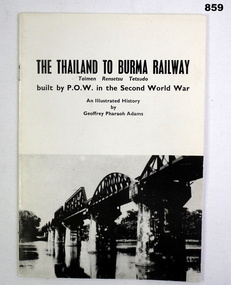
... books military history forced labour Thailand Hellfire Pass Ex POW Project J W Toon VX30397 Ex POW D Force Thailand 1943 Stamp: Fund Sec John W Toon 11 Lloyd Ave, Narre Warren 3805 7046866 Soft cover paper book, black print on white paper. ...Soft cover paper book, black print on white paper. Black & white photos, illustrated, maps, 16 pages.Thailand Hellfire Pass Ex POW Project J W Toon VX30397 Ex POW D Force Thailand 1943 Stamp: Fund Sec John W Toon 11 Lloyd Ave, Narre Warren 3805 7046866books, military, history, forced labour -
 National Vietnam Veterans Museum (NVVM)
Photograph, Gibbons, Denis, Capt West
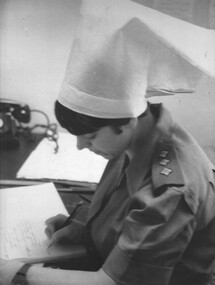
... Force in Nui Dat working as a photographer. For almost five years Gibbons toured with nine Australian infantry battalions, posting compelling war images from within many combat zones before being flown out in late November 1970 after sustaining injuries. The images held within the National Vietnam Veterans Museum make up the Gibbons Collection. Photograph Capt Pam West 1st Australian Field Hospital Vung Tau Gibbons Collection Catalogue Denis Gibbons Photographer Vietnam War Sisters Station A black and white photograph of Capt Pam West in the medical ward Sisters Station at the 1st Australian Field Hospital, Vung Tau, South Vietnam. She labours ...Denis Gibbons (1937 – 2011) Trained with the Australian Army, before travelling to Vietnam in January 1966, Denis stayed with the 1st Australian Task Force in Nui Dat working as a photographer. For almost five years Gibbons toured with nine Australian infantry battalions, posting compelling war images from within many combat zones before being flown out in late November 1970 after sustaining injuries. The images held within the National Vietnam Veterans Museum make up the Gibbons Collection. A black and white photograph of Capt Pam West in the medical ward Sisters Station at the 1st Australian Field Hospital, Vung Tau, South Vietnam. She labours over the completion of the many reports to be noted and brought up to date after each study of a patient in the ward.photograph, capt pam west, 1st australian field hospital, vung tau, gibbons collection catalogue, denis gibbons, photographer, vietnam war, sisters station -
 National Vietnam Veterans Museum (NVVM)
Photograph, Gibbons, Denis, Gough Whitlam 1
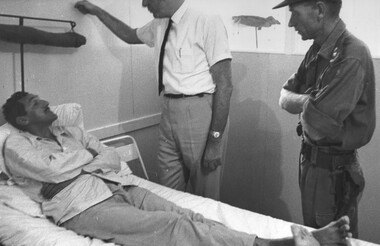
... Force in Nui Dat working as a photographer. For almost five years Gibbons toured with nine Australian infantry battalions, posting compelling war images from within many combat zones before being flown out in late November 1970 after sustaining injuries. The images held within the National Vietnam Veterans Museum make up the Gibbons Collection. Photograph 1st Australian Field Hospital Vung Tau Lt Col Ray Hurley Gough Whitlam Gibbons Collection Catalogue Denis Gibbons Photographer Vietnam War Labour ...Denis Gibbons (1937 – 2011) Trained with the Australian Army, before travelling to Vietnam in January 1966, Denis stayed with the 1st Australian Task Force in Nui Dat working as a photographer. For almost five years Gibbons toured with nine Australian infantry battalions, posting compelling war images from within many combat zones before being flown out in late November 1970 after sustaining injuries. The images held within the National Vietnam Veterans Museum make up the Gibbons Collection. A black and white photograph of the Commanding Officer Lt Col Ray Hurley standing by as the leader of the Labour Opposition in the Australian Parliament, Mr Gough Whitlam, talks with a patient at the 1st Australian Field Hospital, Vung Tau, South Vietnam.photograph, 1st australian field hospital, vung tau, lt col ray hurley, gough whitlam, gibbons collection catalogue, denis gibbons, photographer, vietnam war, labour opposition australian government, wounded serviceman -
 National Vietnam Veterans Museum (NVVM)
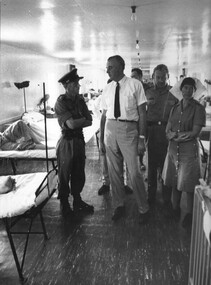
Photograph, Gibbons, Denis, Gough Whitlam 2
... Force in Nui Dat working as a photographer. For almost five years Gibbons toured with nine Australian infantry battalions, posting compelling war images from within many combat zones before being flown out in late November 1970 after sustaining injuries. The images held within the National Vietnam Veterans Museum make up the Gibbons Collection. Photograph 1st Australian Field Hospital Lt Col Ray Hurley Gough Whitlam Vung Tau Gibbons Collection Catalogue Denis Gibbons Labour ...Denis Gibbons (1937 – 2011) Trained with the Australian Army, before travelling to Vietnam in January 1966, Denis stayed with the 1st Australian Task Force in Nui Dat working as a photographer. For almost five years Gibbons toured with nine Australian infantry battalions, posting compelling war images from within many combat zones before being flown out in late November 1970 after sustaining injuries. The images held within the National Vietnam Veterans Museum make up the Gibbons Collection.A black and white photograph of the Commanding Officer at the 1st Australian Field Hospital, Vung Tau, South Vietnam, Lt Col Hurley escorts the Leader of the Opposition Mr Gough Whitlam during a visit. photograph, 1st australian field hospital, lt col ray hurley, gough whitlam, vung tau, gibbons collection catalogue, denis gibbons, labour opposition australian government, nurses -
 National Vietnam Veterans Museum (NVVM)
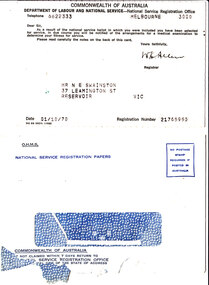
Document - National Service Selection for Service Card, with envelope, NS 69(Rev 1/68), 1960s
... force for full-time duty at home in Australia. National Servicemen in the ARAS received the same pay and conditions as regular soldiers, including three weeks' annual leave. Conscription Call-up Swainston ARAS National Service Perforated pro-forma call-up card from Department of Labour and National Service : National Service Registration Office addressed to Mr N E Swainston, 37 Leamington St, Reservoir Vic, dated 01/10/70 with Registration Number 21765955. ...This item is part of a collection of documents donated by Pte Neil Ernest Swainston (3801127) who was called up for National Service in the Australian Army towards the end of Australia's involvement in the war in Vietnam. He served from 24 Apr 71 to 20 Oct 72 in the Australian Regular Army Supplement (NS). The Australian Regular Army Supplement (ARAS) was a component of the Australian Army specifically designed to incorporate conscripts into the regular force for full-time duty at home in Australia. National Servicemen in the ARAS received the same pay and conditions as regular soldiers, including three weeks' annual leave. Perforated pro-forma call-up card from Department of Labour and National Service : National Service Registration Office addressed to Mr N E Swainston, 37 Leamington St, Reservoir Vic, dated 01/10/70 with Registration Number 21765955. Specific details are typed in black ink, and the document is signed by registrar W K Allen. Back of card advises recipient that he will be given at least 7 days' notice of the time and place for the medical, and that it is his responsibility to notify changes in marital status or address. Envelope is marked O.H.M.S, National Service Registration Papers and torn open at bottomconscription, call-up, swainston, aras, national service -
 National Vietnam Veterans Museum (NVVM)
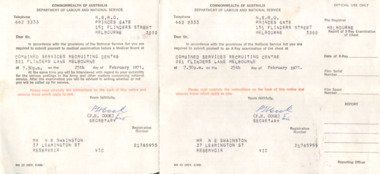
Document - National Service Medical, National Service Medical NS23 (rev 3/69), c.1960s -1970s
... force for full-time duty at home in Australia. National Servicemen in the ARAS received the same pay and conditions as regular soldiers, including three weeks' annual leave. Conscription Call-up Medical Swainston Collection Australian National Serviceman Pte Neil Ernest Swainston 3801127 ARAS Australian Regular Army Supplement Swainston Two-part perforated document from Department of Labour and National Service signed by P H Cook, Secretary, bearing Registration Number 21765955. ...This item is part of a collection of documents donated by Pte Neil Ernest Swainston (3801127) who was called up for National Service in the Australian Army towards the end of Australia's involvement in the war in Vietnam. He served from 24 Apr 71 to 20 Oct 72 in the Australian Regular Army Supplement (NS). The Australian Regular Army Supplement (ARAS) was a component of the Australian Army specifically designed to incorporate conscripts into the regular force for full-time duty at home in Australia. National Servicemen in the ARAS received the same pay and conditions as regular soldiers, including three weeks' annual leave. Two-part perforated document from Department of Labour and National Service signed by P H Cook, Secretary, bearing Registration Number 21765955. Addressed to Mr N E Swainston, 37 Leamington St, Reservoir, Victoria and date stamped 18 Feb 1971. This typed pro-forma document is a call-up notice instructing the receiver to appear at the Combined Services Recruiting Centre, 301 Flinders Lane, Melbourne at 7:30 pm on 25 February 1971 to appear before a medical board. Reverse side of document advises what to take to the appointment, what actions the receiver should take, and advises that failing to comply with the notice is an offence under the National Services Act.conscription, call-up, medical, swainston collection, australian national serviceman, pte neil ernest swainston, 3801127, aras, australian regular army supplement, swainston -
 St Kilda Historical Society
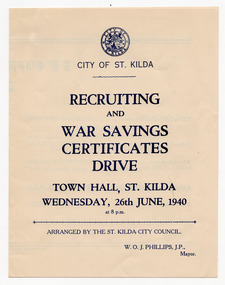
Ephemera - Program, Recruiting and War Savings Certificate Drive, 1940
... Force with the intent of becoming a full-time soldier. He was posted to the 2/4th Field Regiment, holding the rank of gunner. Within three months his brief military career came to an end when three senior government ministers died in a plane crash, an election was called, and he was given leave from the Army to campaign. He was re-elected and then resigned from the Army in October 1940 upon being sworn in as Minister for Labour...Force with the intent of becoming a full-time soldier. He was posted to the 2/4th Field Regiment, holding the rank of gunner. Within three months his brief military career came to an end when three senior government ministers died in a plane crash, an election was called, and he was given leave from the Army to campaign. He was re-elected and then resigned from the Army in October 1940 upon being sworn in as Minister for Labour ...Program for a rally arranged by the City of St Kilda on 26 June 1940 at St Kilda Town Hall to recruit numbers and raise war savings. Includes a detachable application form for War Savings Certificates on the back page. One of the speakers at the rally was Gunner Harold Holt MHR, who later served as Prime Minister in 1966-67. Holt was elected to Parliament in 1935 at the age of 27. He enlisted in the Militia in February 1939, joining a part-time artillery unit for businessmen and professionals and, May 1940, without resigning his seat, he enlisted in the Australian Imperial Force with the intent of becoming a full-time soldier. He was posted to the 2/4th Field Regiment, holding the rank of gunner. Within three months his brief military career came to an end when three senior government ministers died in a plane crash, an election was called, and he was given leave from the Army to campaign. He was re-elected and then resigned from the Army in October 1940 upon being sworn in as Minister for Labour and National Service.Cream coloured paper, printed in blue on both sides, folded and perforated at the fold city of st kilda, world war ii, wwii fund-raising, harold holt, arnold colman -
 Puffing Billy Railway
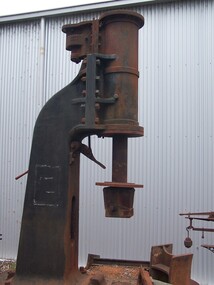
Machine - Steam Hammer, G James, 1841
... Steam hammers, invented by Englishman John Naysmith in 1841, made possible the forging of heavy iron bars and greatly reduced the physical labour required in forging. The hammers could vary in capacity (drop-force) from 400 pounds [lbs.] (181 kg) to 400 Tons (406.3 tonnes) and were once a part of most major engineering works. ...Steam hammers, invented by Englishman John Naysmith in 1841, made possible the forging of heavy iron bars and greatly reduced the physical labour required in forging. The hammers could vary in capacity (drop-force) from 400 pounds [lbs.] (181 kg) to 400 Tons (406.3 tonnes) and were once a part of most major engineering works. ...Steam hammers, invented by Englishman John Naysmith in 1841, made possible the forging of heavy iron bars and greatly reduced the physical labour required in forging. The hammers could vary in capacity (drop-force) from 400 pounds [lbs.] (181 kg) to 400 Tons (406.3 tonnes) and were once a part of most major engineering works. The Victorian Railways, from where the Museum exhibit came, used many hammers of varying sizes, their largest being at Newport Workshops measuring 30 feet (9.1 metres) high by 15 feet (4.6 metres) wide. Steam Hammers have made forging of heavy iron bars possible and has greatly reduced the physical labour required in forging. Historic - Victorian Railways - Industrial Steam Hammer Large metal mechanical steam hammer. made of iron & wrought ironC James Maker Melbournelarge, mechanical, steam, hammer -
 Melton City Libraries
Pamphlet, Thoroughbred Country, c.1985
... labour. Peppercorn trees at the corner of Station and Brooklyn roads have been associated with a horse trough installed there to provide a drink to workhorses carting produce to the chaff mills and railway station south of Melton.20 Breeders, trainers and harness drivers in the area later became such an influential force in the equine industry that this came to be a defining aspect of the district’s identity and reputation.Pioneer of the Victorian horse racing industry and early Rockbank squatter William Cross Yuille was one of the earliest importers of stud racehorses in the district in the 1850s. ...labour. Peppercorn trees at the corner of Station and Brooklyn roads have been associated with a horse trough installed there to provide a drink to workhorses carting produce to the chaff mills and railway station south of Melton.20 Breeders, trainers and harness drivers in the area later became such an influential force in the equine industry that this came to be a defining aspect of the district’s identity and reputation.Pioneer of the Victorian horse racing industry and early Rockbank squatter William Cross Yuille was one of the earliest importers of stud racehorses in the district in the 1850s. ..."Melton has a long and celebrated history of horse breeding and racing. Draught horses were a crucial aspect of life in the early days of European settlement, and were heavily depended upon for both transport and agricultural labour. Peppercorn trees at the corner of Station and Brooklyn roads have been associated with a horse trough installed there to provide a drink to workhorses carting produce to the chaff mills and railway station south of Melton.20 Breeders, trainers and harness drivers in the area later became such an influential force in the equine industry that this came to be a defining aspect of the district’s identity and reputation.Pioneer of the Victorian horse racing industry and early Rockbank squatter William Cross Yuille was one of the earliest importers of stud racehorses in the district in the 1850s. A leading sports editor and writer, Yuille established bloodstock auctioning agency W. C. Yuille & Co. and was involved in the compilation of the first Australian Stud Book, which ensures the integrity of thoroughbred breeding in Australia. According to early Melton chronicler Alexander Cameron, horse races were first organised in the area by Rockbank farmer William Keating. Keating owned racehorses of his own, and many brought horses from Melbourne for the events, which ‘drew large gatherings’.22 Melton Racing Club meetings were held on the Exford Estate with the permission of H. W. Staughton, who built a small wooden grandstand in 1882. Other early races and sports meetings are said to have been held in the vicinity of the current-day Melton golf course.23 An 1884 article reported that Melton’s ‘race programme … equals any put forth by country towns of far greater size’. Ernest Clarke was another important figure in the early horse racing industry in Melton. He established the Melton Stud in 1902, which bred numerous successful racehorses. Perhaps most notably The Welkin, one of the most famous stallions in Australian horse racing in the early twentieth century. The Welkin sired Gloaming, bred by Clarke at the Melton stud in 1915 and one of Australia’s greatest champion racehorses. During a long and prestigious career in both Australia and New Zealand, Gloaming achieved a triumphant 57 wins out of 67 starts and won a record amount of prize money. Ken Cox purchased the Stockwell Stud in Diggers Rest in 1957 and developed it into one of the largest and most renowned thoroughbred breeders in Australia. With its top-class facilities, international design standards and scientific methods, Stockwell became ‘the flagship of the Victorian breeding industry’.26 As well as racing studs, numerous trotting tracks were established on the flat plains around Melton in the 1960s.27 Other studs to play a leading role in the development of Melton as thoroughbred country were Cornwall Park and Merrywood at Toolern Vale, St John’s Lane Stud at Diggers Rest and Birchwood, Teppo Park and Dreelburn in the far north-east of the shire, near Sunbury. By 1985, thoroughbred horse breeding was such big business in Melton that the shire council adopted the slogan ‘The Heart of Thoroughbred Country’, which was used throughout its promotional material.29 But the slogan contained deeper meaning and was not just about Melton’s great equine industry and thoroughbred champions, the council explained: ‘“Thoroughbred Country” should be seen as a new concept of Melton, as a place where people can achieve the “Thoroughbred” ideal, excellence in all aspects of life’. The aim of the council in promoting ‘The Heart of Thoroughbred Country’, was ‘to instil in present and future residents the feeling that this is a place that is better than others. A place to be proud of’. In 1988, Melton’s champion reinsman Gavin Lang won his 176th race of the season, claiming the national harness racing record for the most wins in a single season.The following year, the first Melton Plate was held at Moonee Valley Racecourse, cementing the district’s importance in the harness racing industry. The inaugural winner was Victorys Phil, owned by local Danny Mullan. By the 1990s, Melton had earned the title of the ‘Home of Harness Racing in Victoria’. State-of-the-art, world-class harness racing facility and entertainment complex Tabcorp Park opened in Melton in 2009. In 2011, the Shire of Melton was home to over 140 registered trainers and over 1,200 horses. The municipality’s continuing leadership and influence in the industry today is a testament to the skills, talents and leadership of the local community over its history".Shire of Melton pamphlet of a map and information of the equine industry in Meltoncouncil -
 8th/13th Victorian Mounted Rifles Regimental Collection
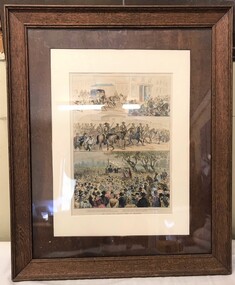
Work on paper - VMR, Labour and Shipping Strike
... force of 1,000 militia and mounted police and another 1,000 special constables were embodied by the time of the meeting. These forces, apart from a troop of mounted police were held in reserve out of the way and the 40,000 who attended the meeting, although enthusiastic, were orderly and the forces were not called in. military strike melbourne maritime vmr Framed coloured artistic work with three works depicting soldiers on horseback in midst of angry crowds. Work on paper VMR, Labour ...Probably originally drawn for publication in Melbourne newspaper showing detachment of Victorian Mounted Rifles on way to establish order at a strike site during the Labour and Shipping Strike of August 1890. During the strike armed troops were deployed to support the police in Melbourne and in Newcastle and a number of other ports around the country. In Melbourne, the announcement that a public meeting was going to be held on 31 August 1890 to support the maritime strikers sent the Victorian government into precautionary mode. On the eve of the meeting, the Victorian Mounted Rifles were briefed by their commanding officer Lieutenant-Colonel Tom Price: 'Men of the Mounted Rifles, one of your obligations imposes on you the duty of resisting invasion by a foreign enemy, but you are also liable to be called upon to assist in preserving law and order in the colony. ... To do your work faintly would be a grave mistake. If it has to be done effectively you will each be supplied with 40 rounds of ammunition, leaden bullets, and if the order is given to fire, don't let me see any rifle pointed in the air; fire low and lay them out so that the duty will not have to be performed again.' Price was quite clear and quite unapologetic about his intentions. He only wanted ′'to hit the strikers in the legs ... not to kill them outright. He explained that the term 'lay them out' was used in his regiment to mean 'temporary disablement'. A force of 1,000 militia and mounted police and another 1,000 special constables were embodied by the time of the meeting. These forces, apart from a troop of mounted police were held in reserve out of the way and the 40,000 who attended the meeting, although enthusiastic, were orderly and the forces were not called in. Framed coloured artistic work with three works depicting soldiers on horseback in midst of angry crowds.military, strike, melbourne, maritime, vmr -
Unions Ballarat
Why You Should be a Socialist, Strachey, John, 1938
... force in the 1930s. Observations about wages and employment. btlc ballarat regional trades and labour council ballarat trades hall socialism politics and government unemployment war economy capitalism wages Front cover: title and author's name. ...The book describes itself as a "terse guide to such questions as, what causes unemployment, what causes war, what makes booms and slumps, what is socialism [and] what is capitalism." Book index: I. The Secret in the Pay Envelope II. How the System Works III. What They Get Out of It IV. What It has Done to Us V. Why It Stops Working VI. Must we Die for It? VII. What can we Put in its Place? VIII. "I have Seen the Future, and It Works" IX. What would Socialism be like Here? X. How to Get There Written and produced in Britain 1938. Pertinent Britain's economy and work force in the 1930s. Observations about wages and employment.Softcover book. Front cover: black and white background, red, white and black lettering. Back cover: white background; black lettering.Front cover: title and author's name. Back cover: advertisement for the Left Book Club, London; International Bookshop Pty Ltd stamp.btlc, ballarat regional trades and labour council, ballarat trades hall, socialism, politics and government, unemployment, war, economy, capitalism, wages -
Unions Ballarat
Don't you worry about that! The Joh Bjelke-Petersen Memoirs (Don Woodward Collection), Bjelke-Petersen, Joh, 1990
... By use of the Queensland police force, he obstructed street demonstrations for a long period of time. Political autobiography - Queensland - National Party. btlc ballarat trades hall ballarat trades and labour council premier - queensland politics national party of australia premiers - bjelke-petersen, joh autobiography senators - bjelke-petersen, florence Book; 259 pages. ...Autobiography - Joh Bjelke-Petersen. Petersen was the longest serving Premier of Queensland from 1968-1987, representing the National Party. His wife, Flo Bjelke-Petersen, served in the federal senate. He is known for the Joh for PM campaign (unsuccessful) and as a participant in the downfall of Prime Minister Gough Whitlam in 1975. By use of the Queensland police force, he obstructed street demonstrations for a long period of time. Political autobiography - Queensland - National Party.Book; 259 pages. Front cover: white text; author's name and title; colour photograph of Sir Joh Bjelke-Petersen.btlc, ballarat trades hall, ballarat trades and labour council, premier - queensland, politics, national party of australia, premiers - bjelke-petersen, joh, autobiography, senators - bjelke-petersen, florence -
Unions Ballarat
It isn't nice (Don Woodward Collection), Wainer, Bertram, 1972
... force of Victoria. He suffered adverse personal consequences for his role. The Royal Commission revealed corruptions that led to some police officers going to gaol. Relevance to law enforcement in Victoria, Australia. btlc ballarat trades hall ballarat trades and labour council wainer, bertram royal commission - police corruption law enforcement Title page: two prices - $8.85 and $5 - in pencil. ...Written by Dr Bertram Wainer who was responsible for the Royal Commission into corruption in the police force of Victoria. He suffered adverse personal consequences for his role. The Royal Commission revealed corruptions that led to some police officers going to gaol.Relevance to law enforcement in Victoria, Australia.Book; 224 pages. Front cover: bookshop sticker - Lake Daylesford Book Barn; white background; black and white illustrations relating to law enforcement and religion; green and black lettering; author's name and title.Title page: two prices - $8.85 and $5 - in pencil.btlc, ballarat trades hall, ballarat trades and labour council, wainer, bertram, royal commission - police corruption, law enforcement -
Unions Ballarat
FBI 100 years: An unofficial history (Don Woodward Collection), Holden, Henry M, 2008
... force -- J. Edgar Hoover : the man with the secrets -- Gangbusters -- Blacklists, blackmail, and McCarthyism -- Civil rights, the KKK, and political unrest -- Bringing down the syndicate : investigating organized crime and political miscreants -- Spybusters -- Standoffs gone bad : confronting Ruby Ridge, Waco, and other disasters -- "Sneak and peak" : domestic surveillance and wiretapping. FBI is responsible for domestic intelligence and security in the USA. History, civil rights, politics - FBI (USA). BTLC Ballarat Trades Hall ballarat trades and labour ...Contents: The "Wild West" years : Teddy's trust-busting detective force -- J. Edgar Hoover : the man with the secrets -- Gangbusters -- Blacklists, blackmail, and McCarthyism -- Civil rights, the KKK, and political unrest -- Bringing down the syndicate : investigating organized crime and political miscreants -- Spybusters -- Standoffs gone bad : confronting Ruby Ridge, Waco, and other disasters -- "Sneak and peak" : domestic surveillance and wiretapping. FBI is responsible for domestic intelligence and security in the USA.History, civil rights, politics - FBI (USA).Book; 252 pages. Dustjacket: black background; Department of Justice FBI insignia; white and gold lettering; author's name and title. Cover: black background; white lettering; author's name and title.btlc, ballarat trades hall, ballarat trades and labour council, federal bureau of investigation (fbi), law enforcement - usa, intelligence - usa, espionage - usa, politics and government - usa, civil rights - usa -
Unions Ballarat
Enemies within : Papua New Guinea, Australia and the Sandline Crisis: the inside story, O'Callaghan, Mary-Louise, 1999
... force. These attempts brought down the Chan government. Relevant to the political history of Papua New Guinea and the region. btlc ballarat trades hall ballarat trades and labour council chan, julian chan, sir julian prime ministers - papua new guinea sandline crisis sandline affair civil wars politics history bougainville civil war papua new guinea Front cover: author name and title. ...Julian Chan's government attempted to resolve the Bougainville Civil War using diplomatic means and eventually by military force. These attempts brought down the Chan government.Relevant to the political history of Papua New Guinea and the region. Paper; book. Front cover: black background; black and white military photograph; black and white text.Front cover: author name and title.btlc, ballarat trades hall, ballarat trades and labour council, chan, julian, chan, sir julian, prime ministers - papua new guinea, sandline crisis, sandline affair, civil wars, politics, history, bougainville civil war, papua new guinea -
 Melbourne Tram Museum
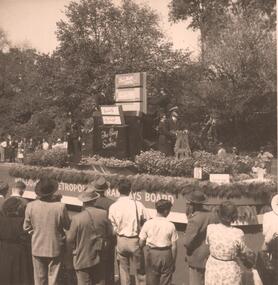
Photograph - MMTB Labour day float - set of 4, 1954
... floral float royal visit 1954" 3 - "Air force (?) - float royal visit 1954" 4 - "Labour Day procession 1954" Has a label on the underside "Labour Day Procession 1954" - large print in an A4 holder....Labour Day floats of 1954. Trams tramways Events Royal Visit Parades MMTB SECV RAAF Parades Conductors On each photo in pencil: 1 - "MMTB floral float royal visit 1954" 2 - "SEC(?) floral float royal visit 1954" 3 - "Air force ...Set of four photographs showing some of the floats used in the 1954 Labour Day Procession. See also item 8544 for another photo of the float, but mislabelled as 1976 : 1 - MMTB float featuring the title - "The Bag of Service" with MMTB name on the side with people alongside, 2 - the SEC float - featuring a house and power lines 3 - RAAF float with a crown and a jet (sabre?) aircraft. 4 - as for 1 showing the people who were on the float. Trove references found by Noelle Jones 27/6/2019 are: https://trove.nla.gov.au/newspaper/page/26680643 https://trove.nla.gov.au/newspaper/article/205702896 https://trove.nla.gov.au/newspaper/article/26595420 https://trove.nla.gov.au/newspaper/article/26595420 https://trove.nla.gov.au/newspaper/page/26680653Yields information about the MMTB Labour Day floats of 1954.Set of four Black and white photographs of floats for the 1954 Royal Visit floral parade - 8 March 1954. Date from The Age 6/3/1954 - see trove references below.On each photo in pencil: 1 - "MMTB floral float royal visit 1954" 2 - "SEC(?) floral float royal visit 1954" 3 - "Air force (?) - float royal visit 1954" 4 - "Labour Day procession 1954" Has a label on the underside "Labour Day Procession 1954" - large print in an A4 holder.trams, tramways, events, royal visit, parades, mmtb, secv, raaf, parades, conductors
