
Showing 13 items matching "lacemaker"
-
 Emerald Museum & Nobelius Heritage Park
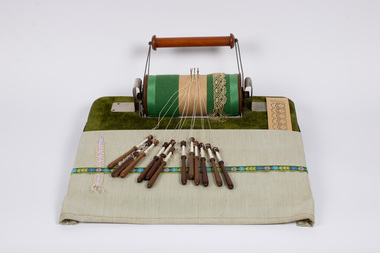
Functional object - Lace Maker, 1900s
... ...lacemaker...This lacemaker was owned by Kallista woman, Beryl Collett (1925-2018) who was a skilled lacemaker from her youth and who used this lacemaker most of her life. ...This lacemaker consists of twelve bobbins which are a tool for carrying the thread which gradually uncoils from the bobbin as it is handled and is then interlocked manually with surrounding threads to create a lacy structure. ...This lacemaker was owned by Kallista woman, Beryl Collett (1925-2018) who was a skilled lacemaker from her youth and who used this lacemaker most of her life. ...This lacemaker was owned by Kallista woman, Beryl Collett (1925-2018) who was a skilled lacemaker from her youth and who used this lacemaker most of her life. It may have first belonged to her mother (Hettie Collett nee Thorn) who was a very talented milliner and from whom Beryl first learnt her handicraft skills. This lacemaker is part of a large and varied range of objects relating to Beryl which has been donated to the Museum. The Dandenongs have been the chosen home of many creative people who, like Beryl, have found inspiration in the natural beauty of the area. Much of Beryl's own handiwork held by the Museum was created by her following her retirement from her accountancy job in 1980 and so epitomises the potential of the retirement phase of people's lives.This hand operated lacemaker enabled women like Beryl and her mother to create beautiful lacework.This lacemaker consists of twelve bobbins which are a tool for carrying the thread which gradually uncoils from the bobbin as it is handled and is then interlocked manually with surrounding threads to create a lacy structure. The bobbins are thin wooden cylinders. At their top, the shaft has been carved away to leave an even thinner cylinder where thread can be stored to be gradually unwound.Inside bodice opening, hand-written: 'H. Collett' which has had a line struck through it. Underneath that inscription is hand-written 'Thorn' beryl collett, 1900s, hettie collett, lacemaker -
 Emerald Museum & Nobelius Heritage Park
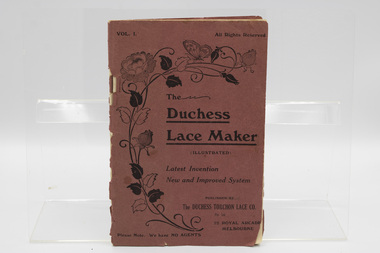
Functional object - Lace Maker Instruction Booklet, 1900s
... ...lacemaker...This lacemaker instruction booklet together with the lacemaker was owned by Kallista woman, Beryl Collett (1925-2018) who was a skilled lacemaker from her youth and who used the lacemaker (and presumably this booklet) most of her life. ...This lacemaker instruction booklet together with the lacemaker was owned by Kallista woman, Beryl Collett (1925-2018) who was a skilled lacemaker from her youth and who used the lacemaker (and presumably this booklet) most of her life. ...This lacemaker instruction booklet together with the lacemaker was owned by Kallista woman, Beryl Collett (1925-2018) who was a skilled lacemaker from her youth and who used the lacemaker (and presumably this booklet) most of her life. Both of these may have first belonged to her mother (Hettie Collett nee Thorn) who was a very talented milliner and from whom Beryl first learnt her handicraft skills. This lacemaker and accompanying booklet are part of a large and varied range of objects relating to Beryl which has been donated to the Museum. The Dandenongs have been the chosen home of many creative people who, like Beryl, have found inspiration in the natural beauty of the area. Much of Beryl's own handiwork held by the Museum was created by her following her retirement from her accountancy job in 1980 and so epitomises the potential of the retirement phase of people's lives.This lacemaker and manual enabled women like Beryl and her mother before her to create beautiful lacework.This booklet has a maroon-color soft cover. Inside is mainly text with some black and white drawn illustrations.On front cover printed: 'Vol. 1 / The / Duchess / Lace Maker / Published by / The Duchess Torchon Lace Co. / 22 Royal Arcade / Melbourne' On back cover in bottom right corner: 'Wilke, Mitchell & Co. / Printers / 7 Flinders Court / Melbourne' beryl collett, 1900s, hettie collett, lacemaker, instruction booklet -
 Embroiderers Guild, Victoria
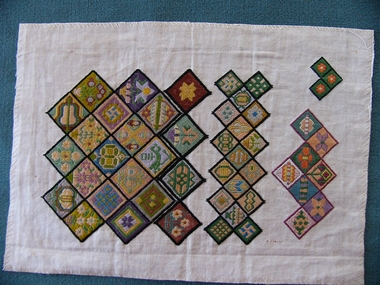
Textile - Counted Thread Embroidery Sampler, Prior in 1992 when purchased
... Donor note - bought (probably at auction) in London by Pat Earnshaw (Lacemaker)....Donor note - bought (probably at auction) in London by Pat Earnshaw (Lacemaker). Embroidery Counted thread India Portugal Rectangle of linen with embroidered diamonds in muted colours and outlined in black, designs are counted work with varied patterns. ...Donor note - bought (probably at auction) in London by Pat Earnshaw (Lacemaker).Rectangle of linen with embroidered diamonds in muted colours and outlined in black, designs are counted work with varied patterns.embroidery, counted thread, india, portugal -
 Sunshine and District Historical Society Incorporated
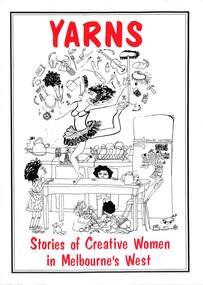
Book - Yarns: Stories of Creative Women in Melbourne's West, Melbourne's Living Museum of the West, 1985
... The women work across various artistic mediums - sculptors, painters, china painters, potters, craftspersons, Maltese lacemakers, jewellers and a silver filigree worker....The women work across various artistic mediums - sculptors, painters, china painters, potters, craftspersons, Maltese lacemakers, jewellers and a silver filigree worker. ...The book chronicles the life stories of 12 creative women living and working in the western suburbs of Melbourne.Paperback book, title in red with an illustration of women on the front cover.non-fictionThe book chronicles the life stories of 12 creative women living and working in the western suburbs of Melbourne.women, melbourne's west, social history -
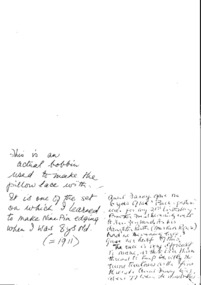 Blacksmith's Cottage and Forge
Bobbins - lace making, Untitled, early 20th century
... 2 wooden lacemaker bobbins, decorated on ends with coloured glass beads attached with wire. ...(approx 1911) bobbins lace wood turning hand craft 2 wooden lacemaker bobbins, decorated on ends with coloured glass beads attached with wire. ...These bobbins were given to donor by her aunt and were part of the set on which the donor learned to make Nine Pin edging when she was 8 years old. (approx 1911) 2 wooden lacemaker bobbins, decorated on ends with coloured glass beads attached with wire. Bobbin one has 4 red beads, 4 clear beads, 2 black beads and 1 white bead with green and red colour band. Bobbin two has 2 brown beads, 2 blue beads, 1 black bead and 1 clear bead. Bobbins have shaped and turned shafts. bobbins lace, wood turning, hand craft -
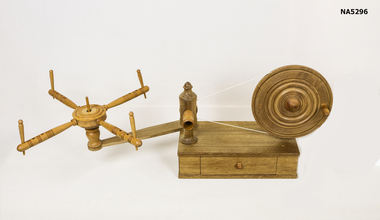 Whitehorse Historical Society Inc.
Equipment - Yarn Winder + Swift + spindles
... The donor was also a lacemaker in the group. Hand turned spindle winders and swifts are also used by weavers and spinners....The donor was also a lacemaker in the group. Hand turned spindle winders and swifts are also used by weavers and spinners. ...The swift winder together with lace pieces was bought in Europe by Nan Warner, who was a retired school teacher and together with her husband Max travelled to Europe and China after they retired. Nan joined a lace making group in the late 1970s who until well into the 1980s and 1990s the group met in each others homes once a month in the eastern suburbs of Melbourne around the Vermont and Ringwood area. The group later became part of the Australian Lace Guild. The donor was also a lacemaker in the group. Hand turned spindle winders and swifts are also used by weavers and spinners.Hand turned wooden wool winder and swift and spindles. It has a wooden base with drawers with a vertical wheel, spindle with winder on an arm with rotating thread holders.spindles, winder, swift, yarn, spinners -
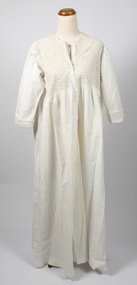 Emerald Museum & Nobelius Heritage Park
Clothing - Nightgown, 1900s
... This nightgown was owned by Kallista woman, Beryl Collett (1925-2018) who was a skilled lacemaker from her youth. It first belonged to her mother (Hettie Collett nee Thorn) who was a very talented milliner and from whom Beryl learnt handicraft skills as a young person. ...This nightgown was owned by Kallista woman, Beryl Collett (1925-2018) who was a skilled lacemaker from her youth. It first belonged to her mother (Hettie Collett nee Thorn) who was a very talented milliner and from whom Beryl learnt handicraft skills as a young person. ...This nightgown was owned by Kallista woman, Beryl Collett (1925-2018) who was a skilled lacemaker from her youth. It first belonged to her mother (Hettie Collett nee Thorn) who was a very talented milliner and from whom Beryl learnt handicraft skills as a young person. The nightgown is part of a large and varied range of objects relating to Beryl which has been donated to the Museum. The Dandenongs have been the chosen home of many creative people who, like Beryl, have found inspiration in the natural beauty of the area. Much of Beryl's own handiwork was created by her following her retirement from her accountancy job in 1980 and so epitomises the potential of the retirement phase of people's lives.This nightgown is a lovely example of women's sleepwear in the early 20th century.Long, white cotton nightgown. Empire line with round neckline, lace inserts in bodice and 4 concealed buttons at bodice. Buttons have been covered with white fabric. Three-quarter length sleeves with lace cuffs. Made with a sewing machine.Inside bodice opening, hand-written: 'H. Collett' which has had a line struck through it. Underneath that first inscription is hand-written 'Thorn' beryl collett, clothing, 1900s -
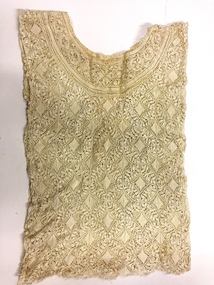 Kew Historical Society Inc
Clothing - Maltese Lace Chemisette, 1900s
... The style was copied by lacemakers in the English Midlands, and it was one of the sources for Bedfordshire lace. ...The style was copied by lacemakers in the English Midlands, and it was one of the sources for Bedfordshire lace. ...The Fashion & Design collection of Kew Historical Society includes examples of textiles dating from the 18th, 19th and 20th centuries. Some of the textiles, were used as items of clothing, others as items of household decoration, or simply as travel souvenirs. These textiles were created both domestically and internationally. Predictably with the growth of an ethnically and culturally more diverse community in Kew after the Second World War, textiles, clothing and objects in the collection inevitably reflected this diversity. This form of bobbin lace is made in Malta. It is a guipure style of lace. Maltese lace is worked as a continuous width tape lace on a tall, thin, upright lace pillow called a "Trajbu" and the Bobbins are called "Combini" . Bigger pieces are made of two or more parts sewn together. Lace made in Malta was originally needle lace, from the 16th to the 19th century, when the economic depression in the islands nearly led to the extinction of lacemaking there. But in the mid 1800s, Lady Hamilton Chichester sent lacemakers from Genoa to Malta. They used the old needle lace patterns and turned them into bobbin lace, which was quicker. It was not long after its introduction that the Maltese lace developed its own style from Genoese lace. Maltese lace was shown at The Great Exhibition of 1851 and it became popular in Britain. The style was copied by lacemakers in the English Midlands, and it was one of the sources for Bedfordshire lace. Characteristics of Maltese lace. Maltese lace usually has the following characteristics which are useful for identification. It is usually made from cream silk. There is often the 8 pointed Maltese cross as part of the pattern, worked in whole or cloth stitch.The pattern may also have closely worked leaves known as “wheat ears” or “oats”. These are plump and rounded in shape, rather than the long narrow leaves of other types of bobbin lace. Camisole, made of silk thread Maltese bobbin lace that is constructed of lengths of lace forming two rectangles with a hole for the neck. Shows the characteristic Maltese cross and wheat ears. Fabric is made of tape lace joined togethercamisoles, maltese lace, bodices -
 Kew Historical Society Inc
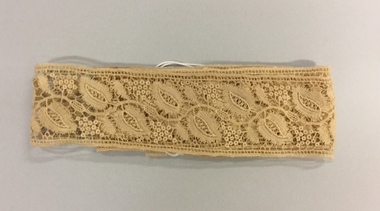
Textile - Lace Edging
... The style was copied by lacemakers in the English Midlands, and it was one of the sources for Bedfordshire lace. ...The style was copied by lacemakers in the English Midlands, and it was one of the sources for Bedfordshire lace. ...The Fashion & Design collection of Kew Historical Society includes examples of textiles dating from the 18th, 19th and 20th centuries. Some of the textiles, were used as items of clothing, others as items of household decoration, or simply as travel souvenirs. These textiles were created both domestically and internationally. Predictably with the growth of an ethnically and culturally more diverse community in Kew after the Second World War, textiles, clothing and objects in the collection inevitably reflected this diversity. This form of bobbin lace is made in Malta. It is a guipure style of lace. Maltese lace is worked as a continuous width tape lace on a tall, thin, upright lace pillow called a "Trajbu" and the Bobbins are called "Combini" . Bigger pieces are made of two or more parts sewn together. Lace made in Malta was originally needle lace, from the 16th to the 19th century, when the economic depression in the islands nearly led to the extinction of lacemaking there. But in the mid 1800s, Lady Hamilton Chichester sent lacemakers from Genoa to Malta. They used the old needle lace patterns and turned them into bobbin lace, which was quicker. It was not long after its introduction that the Maltese lace developed its own style from Genoese lace. Maltese lace was shown at The Great Exhibition of 1851 and it became popular in Britain. The style was copied by lacemakers in the English Midlands, and it was one of the sources for Bedfordshire lace. Maltese lace usually has the following characteristics which are useful for identification: It is usually made from cream silk. There is often the 8 pointed Maltese cross as part of the pattern, worked in whole or cloth stitch.The pattern may also have closely worked leaves known as “wheat ears” or “oats”. These are plump and rounded in shape, rather than the long narrow leaves of other types of bobbin lace. Maltese lace edging. It shows the Wheat ears, characteristic of Maltese lacelace, maltese lace, lace tape -
 Embroiderers Guild, Victoria
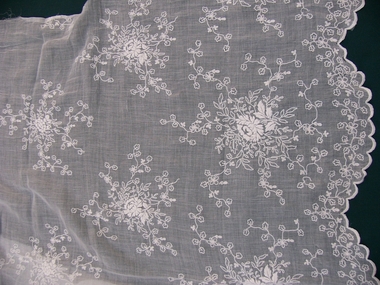
Textile - Coggeshall Lace Flounce, Early 1800
... Today Coggeshall lace is made by some members of the Lacemakers Guild and is taught as part of the City and Guilds course. https://coggeshallmuseum.org.uk/lace1.htm ...The fluctuations in prosperity of the tambour lacemakers were governed by many factors. Fashion requiring flounces and frills gave great encouragement but the invention of chain stitch sewing machines and of machine made laces imitating the hand made article, together with a deterioration in the quality of design meant hard times for the laceworkers. ...Miss Bostock, Foundation member of the EGV, travelled to England and met with The Hon. Rachel Kay-Shuttleworth of Gawthorpe Hall. Rachel "cut" off many pieces from her extensive lace collection which were gifted to the EGV. A Brief History (Information from the work of the late Jean Dudding) About 1812 a French émigré, M. Drago and his two daughters settled in Coggeshall, Essex. Here they hired a room and began to teach the women and small children a method of decorating this net by using a tambour hook. Thus began the making of Coggeshall Lace (sometimes called tambour lace). Tambouring produces a line of chain stitches and originated in the Far East, where the workers used a round frame resembling a tambourine or drum. This they could grip between the knees, thereby releasing both hands for tambouring. Coggeshall workers used a rectangular frame and this type is still used today. Throughout the 19th century this tamboured net lace was made in the tambour rooms and cottages of Coggeshall, and also in the homes of surrounding villages. Lace manufacturers and lace dealers co-ordinated these workers by obtaining orders from London and elsewhere. Sometimes more sophisticated designs were introduced and these would be tamboured by the more proficient workers. Besides the designs, all the necessary net and threads would also be distributed to the lace workers. Liberty & Co., amongst others, were supplied with Coggeshall Lace. The fluctuations in prosperity of the tambour lacemakers were governed by many factors. Fashion requiring flounces and frills gave great encouragement but the invention of chain stitch sewing machines and of machine made laces imitating the hand made article, together with a deterioration in the quality of design meant hard times for the laceworkers. Just after 1900 there was a great improvement in the quality of Coggeshall Lace. This was due largely to the activities of two ladies, the Misses Spurge, who were the chief employers in the district. Their brother William was an art teacher who improved the general standard of design and also introduced some old Italian designs. The First World War resulted in a decline in the making of Coggeshall Lace. The workers found it more profitable to do tambour beading. In the 1930's a determined effort was made to revive the making of Coggeshall Lace, and three handkerchiefs were given to Princess Marina on her marriage (See below). Coggeshall Lace was made into dresses for the Queen, Princess Margaret and Princess Alexandra. This work was undertaken by three very proficient workers in Great Tey. Queen Mary also chose two lace dresses and a teacloth in Coggeshall Lace. It was hoped that this Royal Patronage would encourage a revival of the craft. However the financial return was too meagre and after the Second World War both net and threads disappeared. Today Coggeshall lace is made by some members of the Lacemakers Guild and is taught as part of the City and Guilds course. https://coggeshallmuseum.org.uk/lace1.htm White muslin, with sprays of roses in white satin stitch, surrounded by delicate tambour embroidery known as Coggeshall embroidery. Coggeshall being a town in Essex.embroidery, garments, whitework, england, tambour work, early 18th century -
 Emerald Museum & Nobelius Heritage Park
Decorative object - Two lace doilies mounted on card, Beryl Collett
... Beryl Collett Kallista Victoria Australia doily lace doily Duchess Lacemaker No inscription on VEMU2108.1 On the back of VEMU2108.2 is a sticker on which is printed: 'COMPETITION / Section.....8C / Branch No.....Y / Member's No.....67' Two square lace doilies mounted on cards - one on blue card and one on brown card. ...These doilies were made by Kallista woman, Beryl Collett (1925-2018) and form part of a large and varied body of work by or about Beryl which is held by the Museum. Beryl created lacework in the earlier part of her life using her Duchess Lace Maker which is also in the Museum. Doilies were popular from Victorian times to the mid-20th century and were used to cover glasses and bowls or underneath functional or decorative objects. The Dandenongs have been the chosen home of many creative people who, like Beryl, have found inspiration in the natural beauty of the area. Much of this work was created by Beryl following her retirement from her accountancy job in 1980 and so epitomises the potential of the retirement phase of people's lives.Doilies are symbols of the creativity and care that women have, through history, bestowed on the sphere available, their homes.Two square lace doilies mounted on cards - one on blue card and one on brown card.No inscription on VEMU2108.1 On the back of VEMU2108.2 is a sticker on which is printed: 'COMPETITION / Section.....8C / Branch No.....Y / Member's No.....67'beryl collett, kallista victoria australia, doily, lace doily, duchess lacemaker -
Emerald Museum & Nobelius Heritage Park
Decorative object - Seven doilies, Beryl Collett, mid-20th century
... Doilies are symbols of the creativity and care that women have, through history, bestowed on the sphere available, their homes Beryl Collett Kallista Victoria Australia doily lace doily Duchess Lacemaker No inscription Seven doilies. Six are circular shaped and one is oval shaped. ...Doilies were popular from Victorian times till around the mid-20th century. They were used as a cover for glasses and bowls or underneath decorative and functional objects.These items were made by Kallista woman, Beryl Collett (1925-2018) and form part of a large and varied body of work by or about Beryl which is held by the Museum. Beryl mainly made lacework in the earlier part of her life using her Duchess Lace Maker which is also in the Museum.The Dandenongs have been the chosen home of many creative people who, like Beryl, have found inspiration in the natural beauty of the area. Much of this work was created by Beryl following her retirement from her accountancy job in 1980 and so epitomises the potential of the retirement phase of people's lives.Doilies are symbols of the creativity and care that women have, through history, bestowed on the sphere available, their homesSeven doilies. Six are circular shaped and one is oval shaped. Two are crocheted and the rest are lace. Made by Beryl Collett.No inscriptionberyl collett, kallista victoria australia, doily, lace doily, duchess lacemaker -
Emerald Museum & Nobelius Heritage Park
Decorative object - Four lacework items and one lacework pattern, Beryl Collett, mid-20th century
... Beryl Collett Kallista Victoria Australia doily lace doily Duchess Lacemaker lace collar No inscription Four lacework items and one pattern for making lacework. ...These items of lacework were made by Kallista woman, Beryl Collett (1925-2018) and form part of a large and varied body of work by or about Beryl which is held by the Museum. Doilies were popular from Victorian times to the mid-20th century and were used to cover glasses and bowls or underneath functional or decorative objects. The Dandenongs have been the chosen home of many creative people who, like Beryl, have found inspiration in the natural beauty of the area. Much of this work was created by Beryl following her retirement from her accountancy job in 1980 and so epitomises the potential of the retirement phase of people's lives.Doilies are symbols of the creativity and care that women have, through history, bestowed on the sphere available, their homes. Beryl created lacework in the earlier part of her life using her Duchess Lace Maker which is also in the Museum.Four lacework items and one pattern for making lacework. The items are: one lace-embroidered handkerchief; one oval shaped doily with lace around the edge; one circular shaped doily with lace around a small inner circle; and one Peter Pan style collar in lace. All are in white material. Circa mid-20th century or older.No inscriptionberyl collett, kallista victoria australia, doily, lace doily, duchess lacemaker, lace collar
