
Showing 156 items matching "ladies' garment"
-
 Flagstaff Hill Maritime Museum and Village
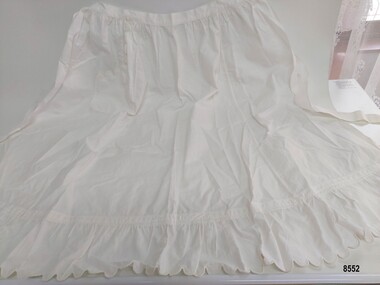
Clothing - Apron, circa late19th to early 20th Century
... ...ladies' garment...This item is an example of clothing worn by working women in the late 19th and early 20th century Warrnambool Great Ocean Road ladies' garment apron half apron waist apron domestic clothing domestic work parlour apron waitress apron handmade sewing Vedmore Foundation Susan Henry OAM Long white cotton apron featuring gathering along the waist band and a gathered frill with scalloped edging along the bottom. ...An apron is an outer protective garment worn over clothes to cover the front of the body. In Victorian and Edwardian times, women were using aprons for both utility (they were easier to wash than dresses) and fashion and women's magazines and pattern companies were offering patterns to allow women to be to sew their own aprons at home. There are different styles of aprons including bib aprons, waist or half aprons, pinafores, tabards and pinner aprons. The word "apron" comes from the old French word "naperon" which means a napkin or small tablecloth. This apron is one of two similar aprons that were donated from the estate of Susan Henry nee Vedmore (1944 - 2021). It is in very good condition and appears to be more decorative (and possibly used only on special occasions) rather than everyday wear. Susan's family (Harold and Gladys Vedmore) immigrated to Australia from Wales in 1955 and settled in Warrnambool. Susan was well known in the Warrnambool community for her work supporting children and families across the district - particular those with disabilities, or those who were homeless, unemployed or isolated. Susan was the founding trustee of the "Vedmore Foundation" - a Warrnambool philanthropic trust set up in 2010 to support a range of charitable and not-for-profit causes by providing grant assistance. In 2021, she was awarded a Medal of the Order of Australia for services to the community.This item is an example of clothing worn by working women in the late 19th and early 20th century Long white cotton apron featuring gathering along the waist band and a gathered frill with scalloped edging along the bottom. The scalloped trim is repeated on the edge of a single pocket on the right hand side. It has ties attached to both ends of the waist band and the main body of the apron is made of of three rectangular pieces of cotton joined with french seams.warrnambool, great ocean road, ladies' garment, apron, half apron, waist apron, domestic clothing, domestic work, parlour apron, waitress apron, handmade, sewing, vedmore foundation, susan henry oam -
 Clunes Museum
Clothing - DRESS, c1940
... ...ladies garment...ladies fashion ladies garment dress Nil Female dress circa 1940, dusty pink crepe, coffee coloured lace insert in top front of bodice and above hemline, bugle bead design on sleeves and bodice. ...Female dress circa 1940, dusty pink crepe, coffee coloured lace insert in top front of bodice and above hemline, bugle bead design on sleeves and bodice. A line skirt with gather at front. Material scroll design on waist.Nilladies fashion, ladies garment, dress -
 Warrnambool and District Historical Society Inc.
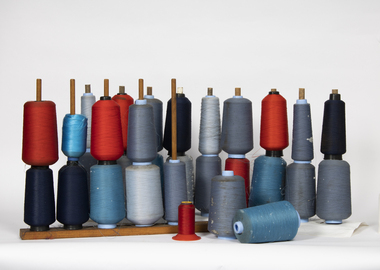
Functional object - Thread Spools, mid 20th century
... They would have been used in the sewing and manufacture of the men's and ladies' garments made at the factory. The Fletcher Jones factory was established by David Fletcher Jones in 1948. ...They would have been used in the sewing and manufacture of the men's and ladies' garments made at the factory. The Fletcher Jones factory was established by David Fletcher Jones in 1948. ...These thread spools come from the Fletcher Jones Factory in Warrnambool. They would have been used in the sewing and manufacture of the men's and ladies' garments made at the factory. The Fletcher Jones factory was established by David Fletcher Jones in 1948. David Fletcher Jones (1895-1977) set up as a travelling hawker selling drapery in the Western District in the 1920s. In the same decade he opened a shop in Warrnambool manufacturing men's clothing, specialising in the production of men's trousers. In 1946 a Fletcher Jones shop was opened in Melbourne and a company, Fletcher Jones and Staff, was established in 1951. The company expanded to manufacturing both men's and women's clothing, opening outlets in all States and becoming well-known Australia-wide. The company was dissolved in 2011 and the Warrnambool factory was sold.These items are of interest as a memento of the Fletcher Jones Factory and the Fletcher Jones company, one of the most important businesses ever established in Warrnambool and certainly one of the most cherished by the local Warrnambool community..1 A wooden stand with upright spikes holding 11 spools containing coloured thread (various colours). The threads are on blue and black plastic reels. .2 A wooden stand with upright spikes holding 16 spools containing coloured thread (various colours). The threads are on blue and black plastic reels.fletcher jones and staff pty ltd, fletcher jones factory warrnambool -
 Bendigo Historical Society Inc.
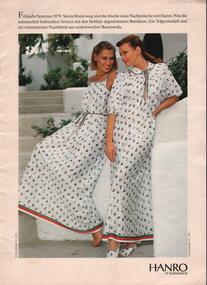
Magazine - HANRO COLLECTION: HANRO ADVERTISING BROCHURE FOR NIGHTWEAR SUMMER 1979, 1979
... The gown is trimmed with green, red and white stripes on the collar and bottom of the garments. Both ladies are leaning against a white cement wall. ...The gown is trimmed with green, red and white stripes on the collar and bottom of the garments. Both ladies are leaning against a white cement wall. ...BHS CollectionHanro Advertising Brochure for Night ware Summer 1979. 8 page brochure on a white back ground with a coloured photo of two models wearing nightwear, pyjamas and dressing gowns. The front page is of two models, on the left the model is wearing a long sleeveless night dress with thin straps and gathered across the chest, the night dress has a thin belt at the waist. The long nightie on the right has three quarter sleeves with a peter pan collar, yoke gathered top and a tie front, she is also wearing slippers with matching material. Both night gowns have a white background with red and yellow flowers with green leaves. The gown is trimmed with green, red and white stripes on the collar and bottom of the garments. Both ladies are leaning against a white cement wall. At bottom left is the number 3676/68468 Fr. 129.-. Bottom right the number is 3676/68488 Fr. 169.-. Bottom right in black print is 'Hanro of Switzerland. At the top of each page is writing in Swedish. Each page shows different styles and colours of the garments together with their item number and Hanro of Switzerland at the bottom of each page. Box 116AHanro AG, CH-4410 Liestal, Schweiz - Printed in Switzerland 79/1hanro, clothing, women's apparel -
 Flagstaff Hill Maritime Museum and Village
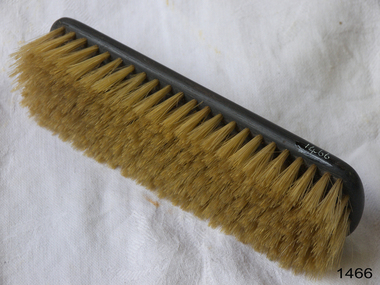
Functional object - Brush, 19th to mid-20th century
... This clothes brush is representative of the equipment used to groom and clean garments in the 19th century and even into today. flagstaff hill warrnambool shipwrecked-coast flagstaff-hill flagstaff-hill-maritime-museum maritime-museum shipwreck-coast flagstaff-hill-maritime-village Clothes brush personal effects grooming toiletries personal item clothes care "REAL EBONY" Clothes brush, ladies' item, rectangular with rounded corners. ...Clothes brushes have been used since the 1700s for keeping clothing clean and presentable. This clothes brush is one of quality, being made from natural bristle and ebony.This clothes brush is representative of the equipment used to groom and clean garments in the 19th century and even into today.Clothes brush, ladies' item, rectangular with rounded corners. Blonde hair bristles and black ebony handle."REAL EBONY"flagstaff hill, warrnambool, shipwrecked-coast, flagstaff-hill, flagstaff-hill-maritime-museum, maritime-museum, shipwreck-coast, flagstaff-hill-maritime-village, clothes brush, personal effects, grooming, toiletries, personal item, clothes care -
 Blacksmith's Cottage and Forge
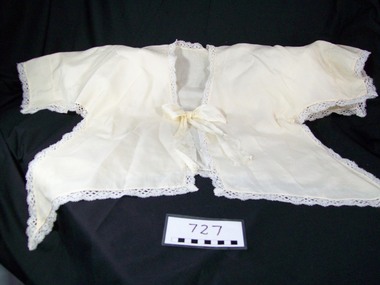
Bed Jacket
... These garments are currently very popular with people who have been hospitalized or recommended bed rest. (Source: http://www.wikipedia.com) home lace female ladies silk bed jacket bow made Pale lemon coloured ladies silk bed jacket with silk lace edging. ...The bed jacket, a woman's garment, is a waist-length robe worn to cover the chest, shoulders and arms while sitting up in bed. Its short length and cape-like cut allowed it to be put on (or removed) while in bed. Often made of sheer or lacy fabrics and displaying very feminine trimmings and details, it was often used more for seduction, rather than warmth or modesty. It was popularized in 1930s Hollywood films featuring glamorous settings and glamorous stars lounging languorously in their silken bedrooms. Ostrich feather tips, swan’s down, pleated tulle and shirred lace were just a few examples of the extravagant materials that could be used in creating these confections. These garments are currently very popular with people who have been hospitalized or recommended bed rest. (Source: http://www.wikipedia.com) Pale lemon coloured ladies silk bed jacket with silk lace edging. Figured silk bow tie at front neck.home, lace, female, ladies, silk, bed, jacket, bow, made -
Marysville & District Historical Society
THE TRIANGLE NEWS-VOL 4 NO 25-10 AUGUST 1979
... marysville victoria australia shire elections police news wirreanda decorated float procession r.s.l. hall marysville community care centre lions dinner meeting christ church ladies guild l.a. meeting birthday greetings reminder triangle news publication m.i.w.a.p.s.a. roster drama group footy news marysville primary school mothers' club indoor bowls all organisations note presentation night bingo buxton red cross branch variety concert letter to marysville football club marysville & buxton district angling club country & western news for sale lost dog wanted lions code of ethics new salamander garments marysville birds THE TRIANGLE NEWS-VOL 4 NO 25-10 AUGUST 1979 ...marysville, victoria, australia, shire elections, police news, wirreanda decorated float procession, r.s.l. hall marysville, community care centre, lions dinner meeting, christ church ladies guild, l.a. meeting, birthday greetings, reminder triangle news publication, m.i.w.a.p.s.a. roster, drama group, footy news, marysville primary school mothers' club, indoor bowls, all organisations note presentation night, bingo, buxton red cross, branch variety concert, letter to marysville football club, marysville & buxton district angling club, country & western news, for sale, lost dog, wanted, lions code of ethics, new salamander garments, marysville birds -
 Flagstaff Hill Maritime Museum and Village
Textile - Overskirt, circa 1910
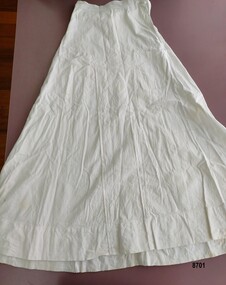
... ladies of the house – Betsy, Ethel and/or Lila. During W.W.2, a local Warrnambool couple (Meryl and Tony Everard) boarded with them – Tony was in the airforce training paratroopers to jump into (and survive) enemy territory and his wife Meryl worked in the Methodist baby Home. The Everards developed a close friendship with the Stephensons and were responsible for clearing out the house (and finding this clothing collection) after Lila died in 1977. This overskirt is an outer protective garment...ladies of the house – Betsy, Ethel and/or Lila. During W.W.2, a local Warrnambool couple (Meryl and Tony Everard) boarded with them – Tony was in the airforce training paratroopers to jump into (and survive) enemy territory and his wife Meryl worked in the Methodist baby Home. The Everards developed a close friendship with the Stephensons and were responsible for clearing out the house (and finding this clothing collection) after Lila died in 1977. This overskirt is an outer protective garment ...This item is one of a collection of clothing items that belonged to the Stephenson family who lived at 22 McCracken Street, Kensington, Melbourne. Matthew Stephenson (1861 – 1943) who had grown up on the Bendigo goldfields and shifted to Melbourne in the early 1900’s was a train driver and later, a fireman with the railways. His wife Elizabeth Jane (Betsy) Wigley (1865 – 1953) also grew up on the goldfields around Majorca and Bendigo. They married in 1885 in Bendigo. They had two daughters – Ethel Evelyn Stephenson (1886 – 1956) and Lillian or Lila (1891 – 1977) who were milliners and dressmakers and who continued to live in the family home after the death of their parents. The family are recorded as living at 22 McCracken Street, Kensington, as early as 1914. It is not known who made or owned the clothing that makes up this collection but as it appears to be from the late Victorian and early Edwardian era, the different pieces were probably made and worn by any of the three ladies of the house – Betsy, Ethel and/or Lila. During W.W.2, a local Warrnambool couple (Meryl and Tony Everard) boarded with them – Tony was in the airforce training paratroopers to jump into (and survive) enemy territory and his wife Meryl worked in the Methodist baby Home. The Everards developed a close friendship with the Stephensons and were responsible for clearing out the house (and finding this clothing collection) after Lila died in 1977. This overskirt is an outer protective garment made of durable cotton and was probably worn over a lady's skirt or dress to protect it whilst they were working. The pockets are large enough for the wearer to keep small items in and there is a loop at the back that would allow the wearer to hang it on a hook, when she finished her work. This item is an example of clothing worn by working women in the late 19th and early 20th centuryA heavy cotton ankle length overskirt made with two wide gored sections containing inset pockets joined to a middle T shaped front band. It has a waistband of grosgrain ribbon and a side opening with 3 pairs of metal snaps (one pair is missing) and a hook and eye at the top. The waistband also has a taped loop (for hanging) and an unusual double fabric overlay with unattached curved ends.flagstaff hill maritime museum and village, great ocean road, shipwreck coast, warrnambool, overskirt, needlework, sewing, protective garment, stephenson family -
 Flagstaff Hill Maritime Museum and Village
Textile - Nightgown, Circa 1900
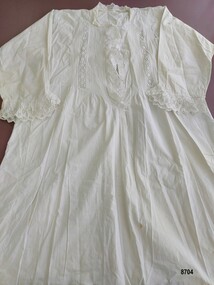
... ladies to wear simple, modest nightgowns. They tended to have a very loose fit and were usually made of linen, cotton or flannel, which had the advantage of providing warmth and also being easy to wash - a necessity for a garment worn next to the skin. ...ladies to wear simple, modest nightgowns. They tended to have a very loose fit and were usually made of linen, cotton or flannel, which had the advantage of providing warmth and also being easy to wash - a necessity for a garment worn next to the skin. ...This item is one of a collection of clothing items that belonged to the Stephenson family who lived at 22 McCracken Street, Kensington, Melbourne. Matthew Stephenson (1861 – 1943) who had grown up on the Bendigo goldfields and shifted to Melbourne in the early 1900’s was a train driver and later, a fireman with the railways. His wife Elizabeth Jane (Betsy) Wigley (1865 – 1953) also grew up on the goldfields around Majorca and Bendigo. They married in 1885 in Bendigo. They had two daughters – Ethel Evelyn Stephenson (1886 – 1956) and Lillian or Lila (1891 – 1977) who were milliners and dressmakers and who continued to live in the family home after the death of their parents. The family are recorded as living at 22 McCracken Street, Kensington, as early as 1914. It is not known who made or owned the clothing that makes up this collection but as it appears to be from the late Victorian and early Edwardian era, the different pieces were probably made and worn by any of the three ladies of the house – Betsy, Ethel and/or Lila. During W.W.2, a local Warrnambool couple (Meryl and Tony Everard) boarded with them – Tony was in the airforce training paratroopers to jump into (and survive) enemy territory and his wife Meryl worked in the Methodist baby Home. The Everards developed a close friendship with the Stephensons and were responsible for clearing out the house (and finding this clothing collection) after Lila died in 1977. This nightgown is machine sewn and has an added detailed design of pintucks and broderie anglaise lace to the front yoke and cuffs as a decorative element. The 1800's bought a shift in attitude towards modesty as the Victorian era progressed and by the mid to late 1800's it had become more acceptable ladies to wear simple, modest nightgowns. They tended to have a very loose fit and were usually made of linen, cotton or flannel, which had the advantage of providing warmth and also being easy to wash - a necessity for a garment worn next to the skin. Although the basic design of the nightgown was fairly simple, the wearer was free to add various types of trim e.g. lace, crochet, pintucks, embroidery etc.This item is an example of the needlework skills of women in the late 19th and early 20th century - combining machine stitching with hand embroidery to personalise and embellish a practical item of clothing. A full length lady's cotton nightgown with long sleeves finished with a diagonal pointed cuff of broderie anglaise. The bodice features a front opening placket with 3 buttons and buttonholes and a broderie anglaise cover. On either side of the placket, the bodice has been decorated with rows of vertical pintucks and a broderie anglaise panel insert. There is also a frill of broderie anglaise lace around the neck. The back of the nightgown is gathered onto a yoke.flagstaff hill maritime museum and village, great ocean road, shipwreck coast, warrnambool, nightgown, lady's nightgown, needlework, sewing, broderie anglaise, pintucks, stephenson family -
 Flagstaff Hill Maritime Museum and Village
Clothing - Riding Habit, Jodhpurs, 1920s
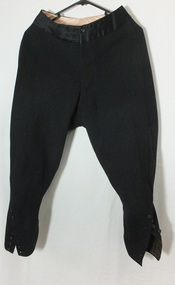
... ladies still had to ride side-saddle with skirts over Jodhpurs. Society of the time regarded women riding astride as unseemly and just not done. This riding habit is particularly significant on a number of levels, it shows the beginnings of change in society's attitudes through women's fashion after the First World War. A change that was to bring a start to a more liberating societal attitude towards women after the successful establishment of the Representation of People Act 1918 that gave women the right to vote. This garments ...The Manifolds were a significant pioneering pastoral family in Western Victoria. The donated riding jodhpurs originally belonged to Mrs Edward Manifold, formally Beatrice Mary Synnot Anderson. Beatrice was Edward Manifold’s cousin once removed whom he married in 1900. Edward, the son of John Manifold, was born on 15 November 1868 and educated at Geelong and Melbourne Grammar schools and at Trinity Hall, Cambridge (B.A., 1891). He chose the Danedite portion of land at Purrumbete, and on the death of his bachelor brother Thomas Peter (1863-1895), after a hunting accident, he took over his allocation, Wiridgil. He also owned Boortkoi, near Hexham and on these properties, he ran merino sheep, a Lincoln stud which dated back to 1870, and Shorthorn cattle. 3000 acres were also leased to dairy farmers. Edward was a member of Hampden Shire Council in 1909-31 and three times president at Camperdown. The town was largely bordered by Manifold land and partly dependent upon the local pastoral dynasties, which benefited the local area from the families’ various business interests. Though an offer to build public baths to commemorate the Queen Victoria Jubilee in 1897 was not proceeded with, the town acquired a hospital, a reserve on Mount Leura, a clock tower and a cricket pavilion, as well as notable donations from the Manifolds to St Paul's Church and the grammar school. Edward was a keen polo player and racing man. He was also a successful owner of steeplechasers and a committeeman of the Victoria Racing Club for many years. He was also a member of many Western District racing clubs. On the 16 July 1900, Edward had married his sixteen-year-old cousin Beatrice Mary Synnot Anderson by whom he had three sons Thomas Peter, Andrew and Robert Edward Manifold. Edwards's estate at his death was valued for probate at nearly £500,000. Edward died following an operation on 14 February 1931 at a private hospital in Yarra Vale Melbourne. Beatrice passed away in 1954, aged 79 in Ballarat where she was born in 1874. Contextual historic Family background: The Manifold brothers Thomas (1809-1875), John (1811-1877) and Peter (1817-1885) were the fourth, fifth and sixth sons of William Manifold and Mary, nee Barnes, of Courthouse Farm, Bromborough, Cheshire, England. The family had decided to emigrate to Van Diemen's Land. Thomas was sent ahead, arriving in Hobart Town on 23rd January 1828 with £1500 and a letter of recommendation from the Colonial Office. Thomas acquired 1280 acres on the west bank of the Tamar River. John and Peter, with their parents and three sisters, arrived on 8th July 1831. Land grants by then had finished but William brought ninety acres next to his son Thomas’ land and on the combined properties the family built Kelso House. The Manifolds’ properties were comparatively poor and when news of the Port Phillip District, in Victoria reached Thomas, he lost no time in coming to see for himself in February 1836. He was impressed with what he saw and hurried back to Tasmania to buy lambs and ewes. With one of his brothers, on July 9th he landed his stores at Point Henry and proceeded to occupy both sides of the Moorabool River. Thomas, at the end of the year, returned to Tasmania and left Peter and John to run the new property. Thomas, however, returned to Victoria for several visits and on one of these visits he, along with his brothers, examined the country near Ballarat. In December 1838 they managed to penetrate the Stony Rises, and Peter and John reached Lake Purrumbete and the Mount Leura country. During this time, on 4th July 1838, Thomas married Jane Elizabeth, eldest daughter of Captain Walter Synnot, formerly of Ballinate, County Armagh, Ireland, and then of Van Diemen's Land. Thomas joined his brothers, and they occupied the Purrumbete run in January 1839. On the journey to Purrumbete they could not take their stock and drays through the Stony Rises, so went north of Lake Corangamite, to the neck of land between it and Lake Gnarpurt. By April the move from Moorabool area was complete. As yet they had no hut and were working day and night, but their delight in their new run was unbounded. John wrote to his mother: “We are at last got to the land we wished for it is a beautiful place, and cannot be surpassed by any I have ever seen”. The three brothers occupied Purrumbete together, breeding both sheep and cattle until Thomas went to Grassmere run on the Merri River near Warrnambool in 1844. John and Peter soon gave up breeding sheep but retained the well-known '3M' brand for the cattle. These were Shorthorns, derived from four bulls originally imported by the Boldon brothers and later improved by further importations, and were renowned for size and quality. By the time of the gold rush in 1851, John and Peter were breeding over 1000 head a year, as well as fattening stores. The diggings at this time had disorganised Grassmere by drawing away Thomas's men, and his wife decided to take her two sons and two daughters to Europe for their education. Thomas gave up the property next year, went to England to join his family, and eventually brought the family back to live in Melbourne. At Purrumbete things were different. The brothers, John and Peter, preferred black stockmen to white, so the discovery of gold upset them very little while providing the very market they required. John was on his second visit to England when the rush started, and Peter went in his turn soon after John returned. On 2 September 1856 John married Marion Thomson, at Cormiston, Van Diemen's Land. They had four daughters and five sons, from three of whom, William Thomson, James Chester and Edward, the later generations of the family descend. Through the years the brothers had to contend with the scab, fluke and footrot, depression, rabbits, bush fires and pleuro-pneumonia. In 1861 they appointed as manager Henry Manifold Matson, their nephew, who had already been with them for five years. Thomas died in Melbourne on 7 November 1875, John at Purrumbete on 3 January 1877 and Peter at Purrumbete on 31 July 1885. Devout members of the Church of England, John and Peter, during their lives, gave generously towards building St Paul's Church, Camperdown, and guaranteed part of the vicar's stipend. Peter was a member of the Hampden and Heytesbury Roads Board from 1859 and carried on into the Hampden Shire Council when it was formed in 1864. However, it was not for public works that they were known, but for their personal example. In a new land where speculators and adventurers were all too common, the Manifold brothers were among those who intended it to be their home and their children's home. Industrious, unpretentious and hospitable, they were respected in their community as men of the highest integrity. This riding habit is a characteristic example of the type and style of riding clothes that well-dressed ladies wore in the 1920s. It highlights the changes that were beginning in society for women. Prior to 1918 ladies still had to ride side-saddle with skirts over Jodhpurs. Society of the time regarded women riding astride as unseemly and just not done. This riding habit is particularly significant on a number of levels, it shows the beginnings of change in society's attitudes through women's fashion after the First World War. A change that was to bring a start to a more liberating societal attitude towards women after the successful establishment of the Representation of People Act 1918 that gave women the right to vote. This garments provenance is linked to one of Victoria's important pioneering families the Manifolds, one of the first families that came from Van Diemen's land to settle the Western District of Victoria in 1844. Originally the garment belonged to the wife of the great-grandson of pioneer William Manifold, Edward Manifold who married Beatrice May Synnot Anderson, Edwards Cousin in 1900. The garment was made by the Mayfair tailors J. Busvine & Co. in the early to mid-1920s (estimate) who at the turn of the century were tailors to the Courts of Europe. Their clothing is highly collectible today and examples can be found in a number of significant museum collections around the world, notably the Metropolitan Museum of Art in New York and the FIDM in Los Angeles. Jodhpurs, part of a three-piece, side saddle riding habit tailored for Mrs Edward Manifold, with four buttons to the front material black woolen twill the legs are cuffed below the knee with 8 buttons holes which are reinforced to the inside with fabric. Cream Satin waistband and removable chamois lining to the seat makers label Busvines Co. tailored for Mrs Edward Manifold.Embroidered in blue on a Satin Cream label to Jodhpurs "Busvine Ltd / 4, Brook St, London. W. No." Hand written in black ink script "523/ Mrs Edward Manifold"flagstaff hill, warrnambool, shipwrecked coast, flagstaff hill maritime museum, maritime museum, side saddle riding habit, side saddle riding outfit, breeches, mrs edward manifold, beatrice manifold, shipwreck coast, flagstaff hill maritime village, great ocean road -
 Flagstaff Hill Maritime Museum and Village
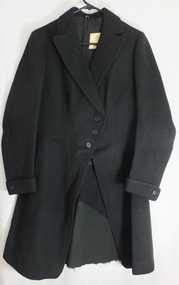
Clothing - Riding Habit, jacket, Early 20th Century
... ladies still had to ride side-saddle with skirts over Jodhpurs. Society of the time regarded women riding astride as unseemly and just not done. This riding habit is particularly significant on a number of levels, it shows the beginnings of change in society's attitudes through women's fashion after the First World War. A change that was to bring a start to a more liberating societal attitude towards women after the successful establishment of the Representation of People Act 1918 that gave women the right to vote. This garments ...The Manifolds were a significant pioneering pastoral family in Western Victoria. The donated riding jacket originally belonged to Mrs Edward Manifold, formally Beatrice Mary Synnot Anderson. Beatrice was Edward Manifold’s cousin once removed whom he married in 1900. Edward, the son of John Manifold, was born on 15 November 1868 and educated at Geelong and Melbourne Grammar schools and at Trinity Hall, Cambridge (B.A., 1891). He chose the Danedite portion of land at Purrumbete, and on the death of his bachelor brother Thomas Peter (1863-1895), after a hunting accident, he took over his allocation, Wiridgil. He also owned Boortkoi, near Hexham and on these properties, he ran merino sheep, a Lincoln stud which dated back to 1870, and Shorthorn cattle. 3000 acres were also leased to dairy farmers. Edward was a member of Hampden Shire Council in 1909-31 and three times president at Camperdown. The town was largely bordered by Manifold land and partly dependent upon the local pastoral dynasties, which benefited the local area from the families’ various business interests. Though an offer to build public baths to commemorate the Queen Victoria Jubilee in 1897 was not proceeded with, the town acquired a hospital, a reserve on Mount Leura, a clock tower and a cricket pavilion, as well as notable donations from the Manifolds to St Paul's Church and the grammar school. Edward was a keen polo player and racing man. He was also a successful owner of steeplechasers and a committeeman of the Victoria Racing Club for many years. He was also a member of many Western District racing clubs. On the 16 July 1900, Edward had married his sixteen-year-old cousin Beatrice Mary Synnot Anderson by whom he had three sons Thomas Peter, Andrew and Robert Edward Manifold. Edwards's estate at his death was valued for probate at nearly £500,000. Edward died following an operation on 14 February 1931 at a private hospital in Yarra Vale Melbourne. Beatrice passed away in 1954, aged 79 in Ballarat where she was born in 1874. Contextual historic Family background: The Manifold brothers Thomas (1809-1875), John (1811-1877) and Peter (1817-1885) were the fourth, fifth and sixth sons of William Manifold and Mary, nee Barnes, of Courthouse Farm, Bromborough, Cheshire, England. The family had decided to emigrate to Van Diemen's Land. Thomas was sent ahead, arriving in Hobart Town on 23rd January 1828 with £1500 and a letter of recommendation from the Colonial Office. Thomas acquired 1280 acres on the west bank of the Tamar River. John and Peter, with their parents and three sisters, arrived on 8th July 1831. Land grants by then had finished but William brought ninety acres next to his son Thomas’ land and on the combined properties the family built Kelso House. The Manifolds’ properties were comparatively poor and when news of the Port Phillip District, in Victoria reached Thomas, he lost no time in coming to see for himself in February 1836. He was impressed with what he saw and hurried back to Tasmania to buy lambs and ewes. With one of his brothers, on July 9th he landed his stores at Point Henry and proceeded to occupy both sides of the Moorabool River. Thomas, at the end of the year, returned to Tasmania and left Peter and John to run the new property. Thomas, however, returned to Victoria for several visits and on one of these visits he, along with his brothers, examined the country near Ballarat. In December 1838 they managed to penetrate the Stony Rises, and Peter and John reached Lake Purrumbete and the Mount Leura country. During this time, on 4th July 1838, Thomas married Jane Elizabeth, eldest daughter of Captain Walter Synnot, formerly of Ballinate, County Armagh, Ireland, and then of Van Diemen's Land. Thomas joined his brothers, and they occupied the Purrumbete run in January 1839. On the journey to Purrumbete they could not take their stock and drays through the Stony Rises, so went north of Lake Corangamite, to the neck of land between it and Lake Gnarpurt. By April the move from Moorabool area was complete. As yet they had no hut and were working day and night, but their delight in their new run was unbounded. John wrote to his mother: “We are at last got to the land we wished for it is a beautiful place, and cannot be surpassed by any I have ever seen”. The three brothers occupied Purrumbete together, breeding both sheep and cattle until Thomas went to Grassmere run on the Merri River near Warrnambool in 1844. John and Peter soon gave up breeding sheep but retained the well-known '3M' brand for the cattle. These were Shorthorns, derived from four bulls originally imported by the Boldon brothers and later improved by further importations, and were renowned for size and quality. By the time of the gold rush in 1851, John and Peter were breeding over 1000 head a year, as well as fattening stores. The diggings at this time had disorganised Grassmere by drawing away Thomas's men, and his wife decided to take her two sons and two daughters to Europe for their education. Thomas gave up the property next year, went to England to join his family, and eventually brought the family back to live in Melbourne. At Purrumbete things were different. The brothers, John and Peter, preferred black stockmen to white, so the discovery of gold upset them very little while providing the very market they required. John was on his second visit to England when the rush started, and Peter went in his turn soon after John returned. On 2 September 1856 John married Marion Thomson, at Cormiston, Van Diemen's Land. They had four daughters and five sons, from three of whom, William Thomson, James Chester and Edward, the later generations of the family descend. Through the years the brothers had to contend with the scab, fluke and footrot, depression, rabbits, bush fires and pleuro-pneumonia. In 1861 they appointed as manager Henry Manifold Matson, their nephew, who had already been with them for five years. Thomas died in Melbourne on 7 November 1875, John at Purrumbete on 3 January 1877 and Peter at Purrumbete on 31 July 1885. Devout members of the Church of England, John and Peter, during their lives, gave generously towards building St Paul's Church, Camperdown, and guaranteed part of the vicar's stipend. Peter was a member of the Hampden and Heytesbury Roads Board from 1859 and carried on into the Hampden Shire Council when it was formed in 1864. However, it was not for public works that they were known, but for their personal example. In a new land where speculators and adventurers were all too common, the Manifold brothers were among those who intended it to be their home and their children's home. Industrious, unpretentious and hospitable, they were respected in their community as men of the highest integrity. This riding habit is a characteristic example of the type and style of riding clothes that well-dressed ladies wore in the 1920s. It highlights the changes that were beginning in society for women. Prior to 1918 ladies still had to ride side-saddle with skirts over Jodhpurs. Society of the time regarded women riding astride as unseemly and just not done. This riding habit is particularly significant on a number of levels, it shows the beginnings of change in society's attitudes through women's fashion after the First World War. A change that was to bring a start to a more liberating societal attitude towards women after the successful establishment of the Representation of People Act 1918 that gave women the right to vote. This garments provenance is linked to one of Victoria's important pioneering families the Manifolds, one of the first families that came from Van Diemen's land to settle the Western District of Victoria in 1844. Originally the garment belonged to the wife of the great-grandson of pioneer William Manifold, Edward Manifold who married Beatrice May Synnot Anderson, Edwards Cousin in 1900. The garment was made by the Mayfair tailors J. Busvine & Co. in the early to mid-1920s (estimate) who at the turn of the century were tailors to the Courts of Europe. Their clothing is highly collectible today and examples can be found in a number of significant museum collections around the world, notably the Metropolitan Museum of Art in New York and the FIDM in Los Angeles. A riding jacket, part of a three-piece, side saddle riding habit tailored for Mrs Edward Manifold. Knee length English woolen jacket black in colour, seamed and fitted to the female client's figure, fastening from the waist with three bone buttons to rather high lapels. The sleeves are long with closely fitted cuffs and one button and lined with cream satin. The jacket is fitted to the waist and flared to below the hips with a 35 cm vent to the back. Lower back to the jacket is reinforced with removable fabric and the jacket is lined with black twill cotton, there is a cream satin label, with makers' emblem Busvine. Circa 1920s Label to Jacket Embroidered in gold with a Royal logo on a Cream Satin label “By Special /Appointment” “To Her Majesty/The Queen”, “Busvine / Ltd / London 4 Brook St. W. / No” “hand written in purple ink 315 / Mrs Edward Manifold”flagstaff hill, warrnambool, shipwrecked coast, flagstaff hill maritime museum, maritime museum, side saddle riding habit, mrs edward manifold, edward manifold, busvines, shipwreck coast, flagstaff hill maritime village, great ocean road -
 Flagstaff Hill Maritime Museum and Village
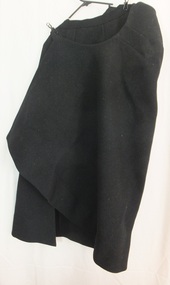
Clothing - Riding Habit, Skirt, 1920s
... ladies still had to ride side-saddle with skirts over Jodhpurs. Society of the time regarded women riding astride as unseemly and just not done. This riding habit is particularly significant on a number of levels, it shows the beginnings of change in society's attitudes through women's fashion after the First World War. A change that was to bring a start to a more liberating societal attitude towards women after the successful establishment of the Representation of People Act 1918 that gave women the right to vote. This garments ...The Manifolds were a significant pioneering pastoral family in Western Victoria. The donated riding skirt originally belonged to Mrs Edward Manifold, formally Beatrice Mary Synnot Anderson. Beatrice was Edward Manifold’s cousin once removed whom he married in 1900. Edward, the son of John Manifold, was born on 15 November 1868 and educated at Geelong and Melbourne Grammar schools and at Trinity Hall, Cambridge (B.A., 1891). He chose the Danedite portion of land at Purrumbete, and on the death of his bachelor brother Thomas Peter (1863-1895), after a hunting accident, he took over his allocation, Wiridgil. He also owned Boortkoi, near Hexham and on these properties, he ran merino sheep, a Lincoln stud which dated back to 1870, and Shorthorn cattle. 3000 acres were also leased to dairy farmers. Edward was a member of Hampden Shire Council in 1909-31 and three times president at Camperdown. The town was largely bordered by Manifold land and partly dependent upon the local pastoral dynasties, which benefited the local area from the families’ various business interests. Though an offer to build public baths to commemorate the Queen Victoria Jubilee in 1897 was not proceeded with, the town acquired a hospital, a reserve on Mount Leura, a clock tower and a cricket pavilion, as well as notable donations from the Manifolds to St Paul's Church and the grammar school. Edward was a keen polo player and racing man. He was also a successful owner of steeplechasers and a committeeman of the Victoria Racing Club for many years. He was also a member of many Western District racing clubs. On the 16 July 1900, Edward had married his sixteen-year-old cousin Beatrice Mary Synnot Anderson by whom he had three sons Thomas Peter, Andrew and Robert Edward Manifold. Edwards's estate at his death was valued for probate at nearly £500,000. Edward died following an operation on 14 February 1931 at a private hospital in Yarra Vale Melbourne. Beatrice passed away in 1954, aged 79 in Ballarat where she was born in 1874. Contextual historic Family background: The Manifold brothers Thomas (1809-1875), John (1811-1877) and Peter (1817-1885) were the fourth, fifth and sixth sons of William Manifold and Mary, nee Barnes, of Courthouse Farm, Bromborough, Cheshire, England. The family had decided to emigrate to Van Diemen's Land. Thomas was sent ahead, arriving in Hobart Town on 23rd January 1828 with £1500 and a letter of recommendation from the Colonial Office. Thomas acquired 1280 acres on the west bank of the Tamar River. John and Peter, with their parents and three sisters, arrived on 8th July 1831. Land grants by then had finished but William brought ninety acres next to his son Thomas’ land and on the combined properties the family built Kelso House. The Manifolds’ properties were comparatively poor and when news of the Port Phillip District, in Victoria reached Thomas, he lost no time in coming to see for himself in February 1836. He was impressed with what he saw and hurried back to Tasmania to buy lambs and ewes. With one of his brothers, on July 9th he landed his stores at Point Henry and proceeded to occupy both sides of the Moorabool River. Thomas, at the end of the year, returned to Tasmania and left Peter and John to run the new property. Thomas, however, returned to Victoria for several visits and on one of these visits he, along with his brothers, examined the country near Ballarat. In December 1838 they managed to penetrate the Stony Rises, and Peter and John reached Lake Purrumbete and the Mount Leura country. During this time, on 4th July 1838, Thomas married Jane Elizabeth, eldest daughter of Captain Walter Synnot, formerly of Ballinate, County Armagh, Ireland, and then of Van Diemen's Land. Thomas joined his brothers, and they occupied the Purrumbete run in January 1839. On the journey to Purrumbete they could not take their stock and drays through the Stony Rises, so went north of Lake Corangamite, to the neck of land between it and Lake Gnarpurt. By April the move from Moorabool area was complete. As yet they had no hut and were working day and night, but their delight in their new run was unbounded. John wrote to his mother: “We are at last got to the land we wished for it is a beautiful place, and cannot be surpassed by any I have ever seen”. The three brothers occupied Purrumbete together, breeding both sheep and cattle until Thomas went to Grassmere run on the Merri River near Warrnambool in 1844. John and Peter soon gave up breeding sheep but retained the well-known '3M' brand for the cattle. These were Shorthorns, derived from four bulls originally imported by the Boldon brothers and later improved by further importations, and were renowned for size and quality. By the time of the gold rush in 1851, John and Peter were breeding over 1000 head a year, as well as fattening stores. The diggings at this time had disorganised Grassmere by drawing away Thomas's men, and his wife decided to take her two sons and two daughters to Europe for their education. Thomas gave up the property next year, went to England to join his family, and eventually brought the family back to live in Melbourne. At Purrumbete things were different. The brothers, John and Peter, preferred black stockmen to white, so the discovery of gold upset them very little while providing the very market they required. John was on his second visit to England when the rush started, and Peter went in his turn soon after John returned. On 2 September 1856 John married Marion Thomson, at Cormiston, Van Diemen's Land. They had four daughters and five sons, from three of whom, William Thomson, James Chester and Edward, the later generations of the family descend. Through the years the brothers had to contend with the scab, fluke and footrot, depression, rabbits, bush fires and pleuro-pneumonia. In 1861 they appointed as manager Henry Manifold Matson, their nephew, who had already been with them for five years. Thomas died in Melbourne on 7 November 1875, John at Purrumbete on 3 January 1877 and Peter at Purrumbete on 31 July 1885. Devout members of the Church of England, John and Peter, during their lives, gave generously towards building St Paul's Church, Camperdown, and guaranteed part of the vicar's stipend. Peter was a member of the Hampden and Heytesbury Roads Board from 1859 and carried on into the Hampden Shire Council when it was formed in 1864. However, it was not for public works that they were known, but for their personal example. In a new land where speculators and adventurers were all too common, the Manifold brothers were among those who intended it to be their home and their children's home. Industrious, unpretentious and hospitable, they were respected in their community as men of the highest integrity. This riding habit is a characteristic example of the type and style of riding clothes that well-dressed ladies wore in the 1920s. It highlights the changes that were beginning in society for women. Prior to 1918 ladies still had to ride side-saddle with skirts over Jodhpurs. Society of the time regarded women riding astride as unseemly and just not done. This riding habit is particularly significant on a number of levels, it shows the beginnings of change in society's attitudes through women's fashion after the First World War. A change that was to bring a start to a more liberating societal attitude towards women after the successful establishment of the Representation of People Act 1918 that gave women the right to vote. This garments provenance is linked to one of Victoria's important pioneering families the Manifolds, one of the first families that came from Van Diemen's land to settle the Western District of Victoria in 1844. Originally the garment belonged to the wife of the great-grandson of pioneer William Manifold, Edward Manifold who married Beatrice May Synnot Anderson, Edwards Cousin in 1900. The garment was made by the Mayfair tailors J. Busvine & Co. in the early to mid-1920s (estimate) who at the turn of the century were tailors to the Courts of Europe. Their clothing is highly collectible today and examples can be found in a number of significant museum collections around the world, notably the Metropolitan Museum of Art in New York and the FIDM in Los Angeles. Safety skirt/apron, part of a three-piece, side saddle riding habit tailored for Mrs Edward Manifold. This side saddle skirt is made from black woolen material fixing at the waist with two metal hooks and three buttons to the front opening. One internal concealed pocket lining to the top part of the apron made of cotton the seat is shaped for side saddle riding and the skirt wraps around the body the longer side draped over the leg that is in the stirrup. flagstaff hill, warrnambool, shipwrecked coast, flagstaff hill maritime museum, maritime museum, side saddle riding habit, side saddle safety skirt, side saddle apron, mrs edward manifold, beatrice manifold, female riding habit 1920s, shipwreck coast, flagstaff hill maritime village, great ocean road -
 Flagstaff Hill Maritime Museum and Village
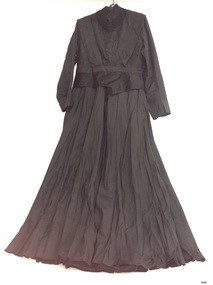
Clothing - Mourning Outfit, Late 19th to early-20th centuries
... Flagstaff Hill Maritime Museum and Village Warrnambool Shipwreck Coast Edwardian era Tailor-made dressmaker mourning outfit handmade garment mourning dress death mourning sunray pleats Western District Victoria Handwritten in ballpoint pen “Jenny” and “Mrs Sheila Handscombe, Wallaura, Jenny” Ladies’ Edwardian mourning outfit; three-piece tailored suit comprising of a black silk long sleeve, short-waist fitted and lined Jacket, a long sunray pleated skirt and long, lined petticoat. ...This Edwardian-era mourning outfit was worn by a wealthy woman from the rural area of Willaura, southeast of the Grampians. It was inherited by the donor from his mother, who had purchased it from a clearing sale in the 1960s. The jacket has a peplum or flounce below the waistline, a fashion that was seen in the 1860s and is still around in the 1900s. The outfit represents the female mourning fashion and wardrobe from the late 19th to early 20th centuries. Such garments were a necessary inclusion as death often occurred to the young, due to illness, accidents and hard work - it was a regular part of life in rural Victoria. Mourning outfits were part of a person’s wardrobe and often passed from one generation to the next. This particular outfit appears to have been adjusted at some stage to allow for a wider waistline. The original skirt may have been replaced by the one that is now part of this outfit; the skirt is all machine-sewn, unlike the jacket and petticoat. The fabric of the skirt may be silk or it could be a synthetic fibre such as artificial silk or rayon; both were available in the 1800s,but nylon wasn’t invented until the 1930s. This skirt has sunray pleating, which was advertised on skirts for sale in the 1890s, and 1909, and was part of a fashionable bridal gown train in the 1930s. The mourning of death was part of both family and community life, particularly in rural and remote areas. People were bonded through work, religion, disasters, tragedy and social activities, supporting one another. They came together from near and far on such an occasion, giving each other the care that was needed and showing respect for the member who had passed away.This three-piece silk Edwardian mourning outfit is significant historically for its connection with rural Victoria and the social and religious customs surrounding the death of a family or community member. The high-quality outfit is also significant for representing the financial management of the times, being tailored by a dressmaker for a person of means and then adjusted to fit at least one different-sized person. Ladies’ Edwardian mourning outfit; three-piece tailored suit comprising of a black silk long sleeve, short-waist fitted and lined Jacket, a long sunray pleated skirt and long, lined petticoat. Items have been machine-sown and hand-sewn by a dressmaker. The skirt has handmade buttons of the same fabric.Handwritten in ballpoint pen “Jenny” and “Mrs Sheila Handscombe, Wallaura, Jenny”flagstaff hill maritime museum and village, warrnambool, shipwreck coast, edwardian era, tailor-made, dressmaker, mourning outfit, handmade garment, mourning dress, death mourning, sunray pleats, western district victoria -
 Flagstaff Hill Maritime Museum and Village
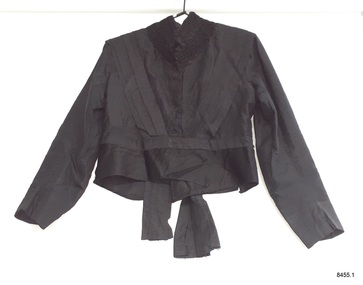
Clothing - Mourning Outfit, jacket, Late 19th to early-20th centuries
... Flagstaff Hill Maritime Museum and Village Warrnambool Shipwreck Coast Edwardian era Tailor-made dressmaker mourning outfit handmade garment mourning dress death mourning sunray pleats sunburst pleats Western District Victoria mourning jacket “Jenny” and “Mrs Sheila Handscombe, Wallaura, Jenny” The black silk tailor-made jacket is one of three pieces of a ladies’ Edwardian mourning outfit. ...This Edwardian era mourning outfit was worn by a wealthy woman from the rural area of Willaura, southeast of the Grampians. It was inherited by the donor from his mother, who had purchased it from a clearing sale in the 1960s. The jacket has a peplum or flounce below the waistline, a fashion that was seen in the 1860s and is still around in the 1900s. The outfit represents the female mourning fashion and wardrobe from the late 19th to early 20th centuries. Such garments were a necessary inclusion as death occurred often to the young, due to illness, accidents and hard work - it was a regular part of life in rural Victoria. Mourning outfits were a part of a person’s wardrobe and often passed from one generation to the next. This particular outfit appears to have been adjusted at some stage to allow for a wider waistline. The original skirt may have been replaced by the one that is now part of this outfit; the skirt is all machine-sewn, unlike the jacket and petticoat. The fabric of the skirt may be silk or it could be a synthetic fibre such as artificial silk or rayon; both were available in the 1800s,but nylon wasn’t invented until the 1930s. This skirt has sunray pleating, which was advertised on skirts for sale in the 1890s, and 1909, and was part of a fashionable bridal gown train in the 1930s. The mourning of death was part of both family and community life, particularly in rural and remote areas. People were bonded through work, religion, disasters, tragedy and social activities, supporting one another. They came together from near and far on such an occasion, giving each other the care that was needed and showing respect for the member who had passed away.This three-piece silk Edwardian mourning outfit is significant historically for its connection with rural Victoria and the social and religious customs surrounding the death of a family or community member. The high-quality outfit is also significant for representing the financial management of the times, being tailored by a dressmaker for a person of means and then adjusted to fit at least one different-sized person. The black silk tailor-made jacket is one of three pieces of a ladies’ Edwardian mourning outfit. It has long sleeves, a stand-up collar trimmed with appliqued black crochet lace, and pleated sashes on the left and right sides from front to back fastened at the shoulder and waist. The jacket has a peplum or flounce below the waistline. The front of the jacket has brass hooks and fabric eye fastenings. The back of the jacket has two tails. The jacket is lined and the shoulders are padded. It has been machine sewn and finished with hand stitching. A white card is tied with a ribbon inside and has an inscription. The poplin skirt on the jacket has been cut up to the waist at the side seams. There is an attached card with an inscription, handwritten in ballpoint pen.“Jenny” and “Mrs Sheila Handscombe, Wallaura, Jenny”flagstaff hill maritime museum and village, warrnambool, shipwreck coast, edwardian era, tailor-made, dressmaker, mourning outfit, handmade garment, mourning dress, death mourning, sunray pleats, sunburst pleats, western district victoria, mourning jacket -
 Flagstaff Hill Maritime Museum and Village
Clothing - Mourning Outfit, skirt, Late 19th to early-20th centuries
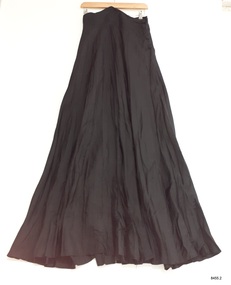
... The full-length black silk tailor-made skirt is one of three pieces of a ladies’ Edwardian mourning outfit. The skirt is made from black silky fabric. The garment has only two seams; at the side closure and the centre back. ...Flagstaff Hill Maritime Museum and Village Warrnambool Shipwreck Coast Edwardian era Tailor-made dressmaker mourning outfit mourning dress death mourning sunray pleats Western District Victoria full-length skirt The full-length black silk tailor-made skirt is one of three pieces of a ladies’ Edwardian mourning outfit. The skirt is made from black silky fabric. The garment has only two seams; at the side closure and the centre back. ...This Edwardian-era mourning outfit was worn by a wealthy woman from the rural area of Willaura, southeast of the Grampians. It was inherited by the donor from his mother, who had purchased it from a clearing sale in the 1960s. The jacket has a peplum or flounce below the waistline, a fashion that was seen in the 1860s and is still around in the 1900s. The outfit represents the female mourning fashion and wardrobe from the late 19th to early 20th centuries. Such garments were a necessary inclusion as death often occurred to the young, due to illness, accidents and hard work - it was a regular part of life in rural Victoria. Mourning outfits were part of a person’s wardrobe and often passed from one generation to the next. This particular outfit appears to have been adjusted at some stage to allow for a wider waistline. The original skirt may have been replaced by the one that is now part of this outfit; the skirt is all machine-sewn, unlike the jacket and petticoat. The fabric of the skirt may be silk or it could be a synthetic fibre such as artificial silk or rayon; both were available in the 1800s, but nylon wasn’t invented until the 1930s. This skirt has sunray pleating, which was advertised on skirts for sale in the 1890s, and 1909, and was part of a fashionable bridal gown train in the 1930s. The mourning of death was part of both family and community life, particularly in rural and remote areas. People were bonded through work, religion, disasters, tragedy and social activities, supporting one another. They came together from near and far on such an occasion, giving each other the care that was needed and showing respect for the member who had passed away.This three-piece silk Edwardian mourning outfit is significant historically for its connection with rural Victoria and the social and religious customs surrounding the death of a family or community member. The high-quality outfit is also significant for representing the financial management of the times, being tailored by a dressmaker for a person of means and then adjusted to fit at least one different-sized person. The full-length black silk tailor-made skirt is one of three pieces of a ladies’ Edwardian mourning outfit. The skirt is made from black silky fabric. The garment has only two seams; at the side closure and the centre back. The whole skirt has sunray pleats; narrow pleats at the waist that fan outwards towards the hem. The top of the skirt is finished with a waistband that is shaped as an upward V shape in the centre. The side seam is closed with four self-fabric buttons with silver metal backing. The shirt has been machine sewn.flagstaff hill maritime museum and village, warrnambool, shipwreck coast, edwardian era, tailor-made, dressmaker, mourning outfit, mourning dress, death mourning, sunray pleats, western district victoria, full-length skirt -
 Flagstaff Hill Maritime Museum and Village
Clothing - Mourning Outfit, petticoat, Late 19th to early-20th centuries
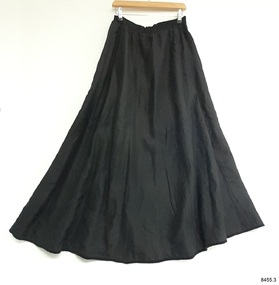
... Flagstaff Hill Maritime Museum and Village Warrnambool Shipwreck Coast Edwardian era Tailor-made dressmaker mourning outfit handmade garment mourning dress death mourning sunray pleats Western District Victoria petticoat undergarment slip The full-length black silk tailor-made petticoat is one of three pieces of a ladies’ Edwardian mourning outfit. ...This Edwardian-era mourning outfit was worn by a wealthy woman from the rural area of Willaura, southeast of the Grampians. It was inherited by the donor from his mother, who had purchased it from a clearing sale in the 1960s. The jacket has a peplum or flounce below the waistline, a fashion that was seen in the 1860s and is still around in the 1900s. The outfit represents the female mourning fashion and wardrobe from the late 19th to early 20th centuries. Such garments were a necessary inclusion as death often occurred to the young, due to illness, accidents and hard work - it was a regular part of life in rural Victoria. Mourning outfits were part of a person’s wardrobe and often passed from one generation to the next. This particular outfit appears to have been adjusted at some stage to allow for a wider waistline. The original skirt may have been replaced by the one that is now part of this outfit; the skirt is all machine-sewn, unlike the jacket and petticoat. The fabric of the skirt may be silk or it could be a synthetic fibre such as artificial silk or rayon; both were available in the 1800s,but nylon wasn’t invented until the 1930s. This skirt has sunray pleating, which was advertised on skirts for sale in the 1890s, and 1909, and was part of a fashionable bridal gown train in the 1930s. The mourning of death was part of both family and community life, particularly in rural and remote areas. People were bonded through work, religion, disasters, tragedy and social activities, supporting one another. They came together from near and far on such an occasion, giving each other the care that was needed and showing respect for the member who had passed away.This three-piece silk Edwardian mourning outfit is significant historically for its connection with rural Victoria and the social and religious customs surrounding the death of a family or community member. The high-quality outfit is also significant for representing the financial management of the times, being tailored by a dressmaker for a person of means and then adjusted to fit at least one different-sized person. The full-length black silk tailor-made petticoat is one of three pieces of a ladies’ Edwardian mourning outfit. The petticoat is made from black silk lined with lightweight cotton. The petticoat and lining are constructed from eight panels each, brought together at the waist and gently gathered into the band. The back seam opening is fastened with brass hooks and fabric eyes. The lining has been reinforced with a heavier-weight hem. The hemline is finished with black velvet ribbon than encloses both the petticoat and lining. flagstaff hill maritime museum and village, warrnambool, shipwreck coast, edwardian era, tailor-made, dressmaker, mourning outfit, handmade garment, mourning dress, death mourning, sunray pleats, western district victoria, petticoat, undergarment, slip -
 Flagstaff Hill Maritime Museum and Village
Clothing - Combination Undergarment, Eliza Towns, Late 19th century
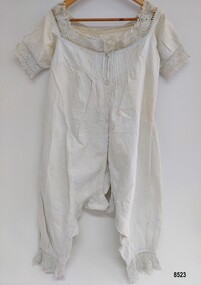
... garments beautiful to look at and wear. Flagstaff Hill Maritime Museum and Village Maritime Museum Maritime Village Warrnambool Great Ocean Road Victorian era combination undergarment all-in-one underwear combination ‘combinations’ one-piece underwear one-piece undergarment chemise and bloomers combination chemise and bloomers divided bifurcated split chemise and drawers women’s underwear ladies’ underwear undergarment women’s clothing women’s fashion lingerie 19th-century undergarment handmade clothing handmade lace crocheted lace Towns family Nhill Eliza Towns Women’s white cotton and lace all-In-one combination undergarment. ...This item of underclothing, called a "combination" is one of several linen and clothing items that were made and belonged to Mrs. Eliza Towns and donated to Flagstaff Hill Maritime Museum and Village. Eliza was born Eliza Gould in 1857 in South Melbourne (Emerald Hill) and in 1879 married Charles Towns. In the early 1880's they moved to Nhill in western Victoria and remained there for the rest of their married life. Charles was a jeweller and later became an accountant and for many years was involved with the Shire Council, the local show committee (A & P Society), the Hospital Committee and the Board of the local newspaper (the Nhill Free Press). They had three children and lived a life that would be regarded as comfortably "middle class". Eliza probably had a treadle sewing machine and would have made many of her own clothes as well as clothes for her children - adding her own handmade embroidered or crocheted decorative trim. Combination undergarments combined the chemise and drawers into one garment. The combination is divided, or bifurcated, from the waist to the crutch for easier urinating. This one-piece type of underwear was worn by females from the 1860s and into the early 1900s. The 19th Century garments had front button closures like this one, and those made in the 1900s more often had back closures. Combination underwear was popular because the all-in-one design had far fewer gathers and bulk, making the other clothing look much smoother. Their primary use was to protect clothing from perspiration and because they were made with cotton or linen, were easy to wash. Although they were worn under the corset, next to the skin (and therefore not meant to be seen), they were often decorated with lace and embroidery. Although these combinations are made with a plain cotton fabric, Eliza Towns has incorporated pin tucks, hand embroidery and crocheted lace to embellish her garment. The collection of women’s late-19th-century undergarments is an example of clothing that women would include in their wardrobes. The garments add to the study of the evolution of women's fashions and practicality for the early Australian settlers. The careful needlework in these handmade garments and hand-worked lace trims reflect the maker’s dedication to making even serviceable garments beautiful to look at and wear.Women’s white cotton and lace all-In-one combination undergarment. The handmade underwear is a combined chemise and bloomers. It has three buttons in the front and a handmade drawstring cord around the square neckline. It is trimmed with crocheted lace (with a floral design) on the neckline, sleeves and pants. It had pintucks and feather stitching on the bodice and the left and right sides are divided from the waist to the crutch. The back of the garment is plain with a gathered section at the lower back.flagstaff hill maritime museum and village, maritime museum, maritime village, warrnambool, great ocean road, victorian era, combination undergarment, all-in-one underwear, combination, ‘combinations’, one-piece underwear, one-piece undergarment, chemise and bloomers, combination chemise and bloomers, divided, bifurcated, split, chemise and drawers, women’s underwear, ladies’ underwear, undergarment, women’s clothing, women’s fashion, lingerie, 19th-century undergarment, handmade clothing, handmade lace, crocheted lace, towns family, nhill, eliza towns -
 Flagstaff Hill Maritime Museum and Village
Clothing - Nightgown, Eliza Towns, circa 1890's
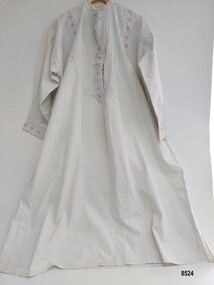
... ladies to wear simple, modest nightgowns. They tended to have a very loose fit and were usually made of linen, cotton or flannel, which had the advantage of providing warmth and also being easy to wash - a necessity for a garment worn next to the skin. ...ladies to wear simple, modest nightgowns. They tended to have a very loose fit and were usually made of linen, cotton or flannel, which had the advantage of providing warmth and also being easy to wash - a necessity for a garment worn next to the skin. ...This nightgown is one of several linen and clothing items that were made and belonged to Mrs. Eliza Towns and donated to Flagstaff Hill Maritime Museum and Village. Eliza was born Eliza Gould in 1857 in South Melbourne (Emerald Hill) and in 1879 married Charles Towns. In the early 1880's they moved to Nhill in western Victoria and remained there for the rest of their married life. Charles was a jeweller and later became an accountant and for many years was involved with the Shire Council, the local show committee (A & P Society), the Hospital Committee and the Board of the local newspaper (the Nhill Free Press). They had three children and lived a life that would be regarded as comfortably "middle class". Eliza probably had a treadle sewing machine and would have made many of her own clothes as well as clothes for her children - adding her own handmade embroidered or crocheted decorative trim. This nightgown is machine sewn by Eliza Towns and she has added a detailed design of pintucks and broderie anglaise lace to the front yoke and cuffs as a decorative element. The 1800's bought a shift in attitude towards modesty as the Victorian era progressed and by the mid to late 1800's it had become more acceptable ladies to wear simple, modest nightgowns. They tended to have a very loose fit and were usually made of linen, cotton or flannel, which had the advantage of providing warmth and also being easy to wash - a necessity for a garment worn next to the skin. Although the basic design of the nightgown was fairly simple, the wearer was free to add various types of trim e.g. lace, crochet, pintucks, embroidery etc.This item is an example of the needlework skills of women in the late 19th century - combining machine stitching with hand embroidery to personalise and embellish a practical item of clothing. It is also significant as an example of a practical solution to the difficulties that women of this era faced with regard to the washing of clothes and household linens.Lady's long, white, cotton nightgown with a V shaped bodice decorated with bands of nine pintucks alternating with strips of broderie anglaise lined with pink ribbon. The opening front placket and neckline are bordered with a simpler broderie anglaise lace. The long sleeves are gathered into cuffs with a matching V shape, pintuck and broderie anglaise design. The front placket fastens with three cream buttons although one is missing. The back of the nightgown has gathered fabric on a plain, narrow V shape yoke. A narrow gusset has been added to the both sides at the bottom of the nightgown.Noneflagstaff hill, flagstaff hill maritime museum and village, warrnambool, great ocean road, shipwreck coast, victorian era clothing, victorian era nightgown, nightgown, nightdress, eliza towns, nhill, wimmera, textiles, clothing, machine sewing, hand sewing, pintucks, broderie anglaise, sewing -
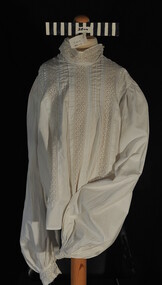 City of Moorabbin Historical Society (Operating the Box Cottage Museum)
Clothing - Clothing, lady's blouse, c1900
... Ladies long-sleeved white cotton blouse with high collar. Pin-tucking to front and back, guipure lace inserts on front of bodice. Significant tear at lower edge of the garment...Ladies long-sleeved white cotton blouse with high collar. Pin-tucking to front and back, guipure lace inserts on front of bodice. Significant tear at lower edge of the garment ...The pioneer settlers and market gardeners of Moorabbin Shire had to be self reliant and made their own clothing and utensils. This is one of many items that exhibit the skill and craftsmanship of the women in these families. This white, cotton Lady's blouse with pin-tucked front and back is and example of the dressmaking skills of the women of the families of the pioneer settlers and market gardeners in the Moorabbin Shire. Ladies long-sleeved white cotton blouse with high collar. Pin-tucking to front and back, guipure lace inserts on front of bodice. Significant tear at lower edge of the garment.clothing, brighton, moorabbin, pioneers, dendy henry, market gardeners, home dressmaker, craft work -
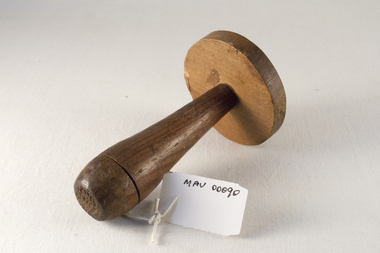 City of Moorabbin Historical Society (Operating the Box Cottage Museum)
Craft - Sewing equipment, darning mushroom, c1880
... Darning 'mushrooms' were used to repair any woollen garment, such as socks, jumpers and ladies cotton or Lyle stockings. ...Darning 'mushrooms' were used to repair any woollen garment, such as socks, jumpers and ladies cotton or Lyle stockings. ...Darning 'mushrooms' were used to repair any woollen garment, such as socks, jumpers and ladies cotton or Lyle stockings. This darning tool was an essential item in pioneer household as the early settlers had to make and repair all their clothing.A timber 'mushroom' shaped darning tool sewing, dressmaking, craftwork, early settlers, pioneers, moorabbin, brighton -
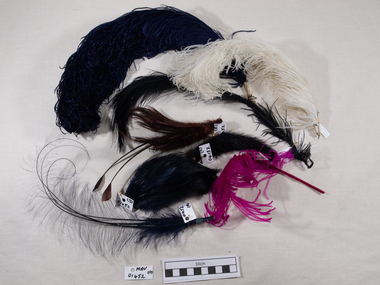 City of Moorabbin Historical Society (Operating the Box Cottage Museum)
Clothing, Hat feathers x 8 c1910, c1910
... ladies adorned their hats with various bird feathers. Although living conditions in Moorabbin Shire c1910, were basic families still held onto their traditional English and European customs and took pride in presenting elements of refined society. Gladys Reed was a member of the Ormond Choral Society c 1950. who performed plays and musicals the City of Moorabbin and she was skilled in craftwork, hand knitting, crochet and dressmaking. Her garments...ladies adorned their hats with various bird feathers. Although living conditions in Moorabbin Shire c1910, were basic families still held onto their traditional English and European customs and took pride in presenting elements of refined society. Gladys Reed was a member of the Ormond Choral Society c 1950. who performed plays and musicals the City of Moorabbin and she was skilled in craftwork, hand knitting, crochet and dressmaking. Her garments ...Victorian and Edwardian ladies adorned their hats with various bird feathers. Although living conditions in Moorabbin Shire c1910, were basic families still held onto their traditional English and European customs and took pride in presenting elements of refined society. Gladys Reed was a member of the Ormond Choral Society c 1950. who performed plays and musicals the City of Moorabbin and she was skilled in craftwork, hand knitting, crochet and dressmaking. Her garments were used by her family and the Ormond Choral Society C1910 Women in Moorabbin Shire followed the fashion from Europe and made their own clothes and accessories using their dressmaking, craftwork and design skills 8 x feathers of various sizes and colours for adorning a Lady's hat c 1910 a) Blue & b) White Ostrich, c) Black Cockerel, d) Black Emu Feathers. e) Brown stripped Coque Diamond Tail f) Pink dyed ostrich, g) Black duck, h) black fur clothing, millinery, hat feathers, haberdashery, crochet, doilies, brighton, moorabbin, pioneers, dressmaking, market gardeners, early settlers, craftwork , bentleigh, lacework, moorabbin shire,reed gladys, clark judy, dairy farms, fruit orchards, footwear, shoes, buckles, clothing, silver, pewter, brass, victorian fashion, edwardian fashion, mckinnon, moorabbin, cheltenham, wedding dresses, evening wear, -
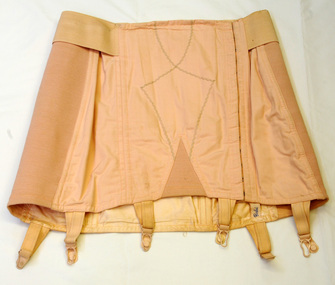 Orbost & District Historical Society
corset, Berlei, c. 1930s-1950s
... ladies corset made from light pink fabric. The corset can be opened out around the body and then closed with a series of metal hooks and eyes which run vertically down the body. It has two large elastic panels positioned on either side of the garment...ladies corset made from light pink fabric. The corset can be opened out around the body and then closed with a series of metal hooks and eyes which run vertically down the body. It has two large elastic panels positioned on either side of the garment ...Worn and owned by Mrs Marjorie McKeown (nee Ford) who lived in the Orbost district A ladies corset made from light pink fabric. The corset can be opened out around the body and then closed with a series of metal hooks and eyes which run vertically down the body. It has two large elastic panels positioned on either side of the garment, and a small "v" shape of elastic in the lower front edge. Six suspenders are attached to the bottom edge.Size 4 H Berleiwomens-undergarment ladies-wear fashion -
 Flagstaff Hill Maritime Museum and Village
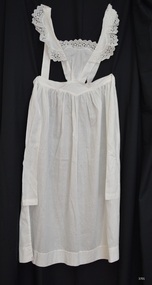
Clothing - Apron, c. 1900
... This items is an example of ladies' clothing worn during the late 19th to early 20th century. flagstaff hill warrnambool shipwrecked coast flagstaff hill maritime museum maritime museum shipwreck coast flagstaff hill maritime village great ocean road ladies garments 19th century cotton garments 19th century apron late 19th century domestic clothing domestic service hospitality service Broderie anglaise ladies’ clothing hospitality clothing Apron, ladies, machine made, cotton, Gathered waist, waist ties, small bodice with Brodery Anglais lace hand stitched onto it, neck ties. ...This apron was donated along with other well kept items of women's clothing. The clothing once belonged to members of a family who migrated from Faversham, Kent, England to Sydney, Australia in the late 19th - early 20th century and was passed down through the family. The items have been worn and have also been well cared for.This items is an example of ladies' clothing worn during the late 19th to early 20th century.Apron, ladies, machine made, cotton, Gathered waist, waist ties, small bodice with Brodery Anglais lace hand stitched onto it, neck ties. Would have been work for 'good' wear. C. 1900. flagstaff hill, warrnambool, shipwrecked coast, flagstaff hill maritime museum, maritime museum, shipwreck coast, flagstaff hill maritime village, great ocean road, ladies garments 19th century, cotton garments 19th century, apron late 19th century, domestic clothing, domestic service, hospitality service, broderie anglaise, ladies’ clothing, hospitality clothing -
 Flagstaff Hill Maritime Museum and Village
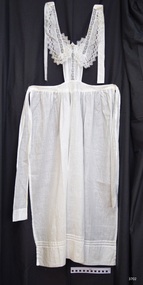
Clothing - Apron, c. 1900
... Flagstaff Hill Warrnambool Shipwrecked coast Flagstaff Hill Maritime Museum Maritime Museum Shipwreck coast Flagstaff Hill Maritime Village Great Ocean Road Ladies garments 19th century Cotton garments 19th century Apron late 19th century Broderie anglaise Handmade lace apron domestic clothing domestic work domestic service Apron, ladies size, cotton, machine made. ...This apron was donated along with other well kept items of women's clothing. The clothing once belonged to members of a family who migrated from Faversham, Kent, England to Sydney, Australia in the late 19th - early 20th century and was passed down through the family. The items have been worn and have also been well cared for.The apron is an example of late 19th century ladies' clothing for use in domestic service or hospitality.Apron, ladies size, cotton, machine made. Bodice has hand made Broderie Anglais lace trim and neck ties, skirt has gathered waist and ties, three pin ticks around hemline. Would have been worn for 'best' wear. C. 1900flagstaff hill, warrnambool, shipwrecked coast, flagstaff hill maritime museum, maritime museum, shipwreck coast, flagstaff hill maritime village, great ocean road, ladies garments 19th century, cotton garments 19th century, apron late 19th century, broderie anglaise, handmade lace, apron, domestic clothing, domestic work, domestic service -
 Flagstaff Hill Maritime Museum and Village
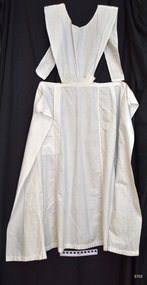
Clothing - Apron, early 1900's
... Flagstaff Hill Warrnambool Shipwrecked coast Flagstaff Hill Maritime Museum Maritime Museum Shipwreck coast Flagstaff Hill Maritime Village Great Ocean Road Ladies garments 19th century Cotton garments 19th century Apron late early 1900’s Ladies work apron domestic service domestic clothing ladies’ clothing hospitality clothing hospitality service Apron, ladies size, plain, heavy cotton. ...This apron is similar to aprons were made for use during war times, perhaps with Red Cross. It was donated along with other well kept items of women's clothing. The clothing once belonged to members of a family who migrated from Faversham, Kent, England to Sydney, Australia in the late 19th - early 20th century and was passed down through the family. The items have been worn and have also been well cared for.This object is significant as an example of an item in common use in the 19th and early 20th centuries.Apron, ladies size, plain, heavy cotton. Full length apron with bodice, shoulder straps and a button closure at waist. Skirt has five panels. There is a small pocket on wearer's right side, inserted into seams. Ca.1900's.flagstaff hill, warrnambool, shipwrecked coast, flagstaff hill maritime museum, maritime museum, shipwreck coast, flagstaff hill maritime village, great ocean road, ladies garments 19th century, cotton garments 19th century, apron late early 1900’s, ladies work apron, domestic service, domestic clothing, ladies’ clothing, hospitality clothing, hospitality service -
 Flagstaff Hill Maritime Museum and Village
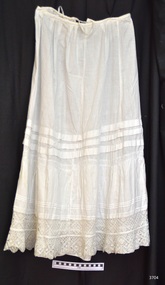
Clothing - Petticoat
... This object is significant as an example of an item in common use in the 19th and early 20th centuries. flagstaff hill warrnambool shipwrecked coast flagstaff hill maritime museum maritime museum shipwreck coast flagstaff hill maritime village great ocean road ladies garments 19th century cotton garments 19th century ladies undergarment petticoat c 1900 ladies' clothing ladies' fashion underwear petticoat Petticoat, ladies size, cotton, waist to floor, drawstring waist closure, bottom lace trim is lined, pin tucks in lower skirt. ...This petticoat was donated along with other well kept items of women's clothing. the pin tucks and lace trim could have been made to give flexibility to the length. The clothing once belonged to members of a family who migrated from Faversham, Kent, England to Sydney, Australia in the late 19th - early 20th century and was passed down through the family. The items have been worn and have also been well cared for.This object is significant as an example of an item in common use in the 19th and early 20th centuries.Petticoat, ladies size, cotton, waist to floor, drawstring waist closure, bottom lace trim is lined, pin tucks in lower skirt. Machine made lace, machine stitched. C. 1900.flagstaff hill, warrnambool, shipwrecked coast, flagstaff hill maritime museum, maritime museum, shipwreck coast, flagstaff hill maritime village, great ocean road, ladies garments 19th century, cotton garments 19th century, ladies undergarment, petticoat c 1900, ladies' clothing, ladies' fashion, underwear, petticoat -
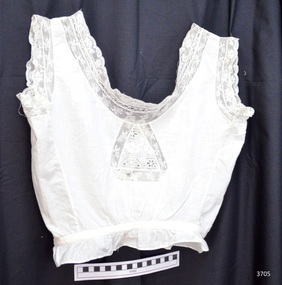 Flagstaff Hill Maritime Museum and Village
Clothing - Camisole, c. 1900
... Flagstaff Hill Warrnambool Shipwrecked coast Flagstaff Hill Maritime Museum Maritime Museum Shipwreck coast Flagstaff Hill Maritime Village Great Ocean Road Ladies garments 19th century Cotton garments 19th century Ladies undergarment Camisole c 1900 handmade lingerie Handwritten in pencil "19428 - - - " Camisole, machine sewn, cotton with lace insert panels and lace trim around armholes and neck. ...This camisole was donated along with other well kept items of women's clothing. The clothing once belonged to members of a family who migrated from Faversham, Kent, England to Sydney, Australia in the late 19th - early 20th century and was passed down through the family. The items have been worn and have also been well cared for.Camisole, machine sewn, cotton with lace insert panels and lace trim around armholes and neck. Drawstring waist tie and button closure on back - 2 buttons. Inscription, handwritten in pencil on back opening "19428 - - - " c. 1900Handwritten in pencil "19428 - - - " flagstaff hill, warrnambool, shipwrecked coast, flagstaff hill maritime museum, maritime museum, shipwreck coast, flagstaff hill maritime village, great ocean road, ladies garments 19th century, cotton garments 19th century, ladies undergarment, camisole c 1900, handmade lingerie -
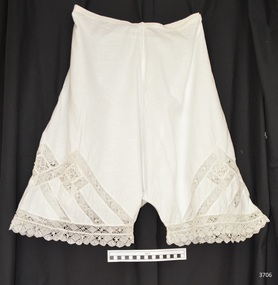 Flagstaff Hill Maritime Museum and Village
Clothing - Bloomers
... This object is significant as an example of an item in common use in the 19th and early 20th centuries. flagstaff hill warrnambool shipwrecked coast flagstaff hill maritime museum maritime museum shipwreck coast flagstaff hill maritime village great ocean road ladies garments 19th century cotton garments 19th century ladies undergarment bloomers c 1900 bloomers underwear ladies' underwear ladies' fashion lace inserts Inscription is illegible Bloomers, cotton, machine made lace inserts and trim around legs. ...This bloomers were donated along with other well kept items of women's clothing. The clothing once belonged to members of a family who migrated from Faversham, Kent, England to Sydney, Australia in the late 19th - early 20th century and was passed down through the family. The items have been worn and have also been well cared for.This object is significant as an example of an item in common use in the 19th and early 20th centuries.Bloomers, cotton, machine made lace inserts and trim around legs. Waist has elastic (no longer stretching). Inscription is illegible. C. 1900. Inscription is illegibleflagstaff hill, warrnambool, shipwrecked coast, flagstaff hill maritime museum, maritime museum, shipwreck coast, flagstaff hill maritime village, great ocean road, ladies garments 19th century, cotton garments 19th century, ladies undergarment, bloomers c 1900, bloomers, underwear, ladies' underwear, ladies' fashion, lace inserts -
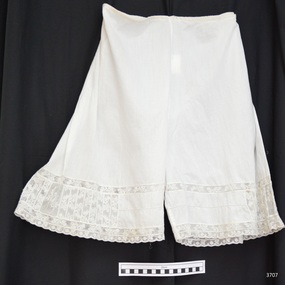 Flagstaff Hill Maritime Museum and Village
Clothing - Bloomers
... This object is significant as an example of an item in common use in the 19th and early 20th centuries. flagstaff hill warrnambool shipwrecked coast flagstaff hill maritime museum maritime museum shipwreck coast flagstaff hill maritime village great ocean road ladies garments 19th century cotton garments 19th century ladies undergarment bloomers c 1900 bloomers ladies' underwear underwear ladies' fashion Victorian fashion ladies' clothing Illegible inscription on waistband Bloomers, cotton, pulled thread embroidery and machine made lace inserts, lace trim around legs. ...This pair of bloomers was donated along with other well kept items of women's clothing. The clothing once belonged to members of a family who migrated from Faversham, Kent, England to Sydney, Australia in the late 19th - early 20th century and was passed down through the family. The items have been worn and have also been well cared for.This object is significant as an example of an item in common use in the 19th and early 20th centuries.Bloomers, cotton, pulled thread embroidery and machine made lace inserts, lace trim around legs. Waist has elastic (no longer stretching). Inscription is illegible. C. 1900Illegible inscription on waistbandflagstaff hill, warrnambool, shipwrecked coast, flagstaff hill maritime museum, maritime museum, shipwreck coast, flagstaff hill maritime village, great ocean road, ladies garments 19th century, cotton garments 19th century, ladies undergarment, bloomers c 1900, bloomers, ladies' underwear, underwear, ladies' fashion, victorian fashion, ladies' clothing -
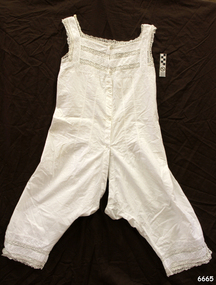 Flagstaff Hill Maritime Museum and Village
Clothing - Combination Undergarment, Late 1800s
... garments beautiful to look at and wear. Flagstaff Hill Maritime Museum and Village Maritime Museum Maritime Village Warrnambool Great Ocean Road Southwest Victoria Victorian era combination undergarment all-in-one underwear combination ‘combinations’ one-piece underwear one-piece undergarment chemise and bloomers combination chemise and bloomers divided bifurcated split chemise and drawers women’s underwear ladies’ underwear undergarment women’s clothing women’s fashion lingerie under-structure 1900s undergarments 19th-century undergarment 20th century handmade clothing handmade lace hand-worked lace Paton family Trefnant Yangery lady's combinations ladies combinations Women’s white cotton and lace all-In-one combination undergarment. ...This handmade women’s combination undergarment features hand-worked lace panels and trim, and fine pintucks. It is one of seven handmade items of white cotton underwear, all made with beautiful needlework and embroidery skill. The lingerie once belonged to the donor’s great-grandmother’s family, the Paton family of ‘Trefnant’, Yangery, in southwest Victoria. The design of this combination undergarment, or ‘combination’, includes a chemise attached to a pair of drawers or bloomers. The combination is divided, or bifurcated, from the waist to the crutch for easier urinating. This one-piece type of underwear was worn by females from the 1860s and into the early 1900s. The 19th Century garments had front button closures like this one, and those made in the 1900s more often had back closures. Combination underwear was popular because the all-in-one design had far fewer gathers and bulk, making the other clothing look much smoother. The collection of women’s late-19th-century undergarments is an example of clothing that women would include in their wardrobes. The garments add to the study of the evolution of women's fashions and practicality for the early Australian settlers. The fine linen fabric and the careful needlework in these handmade garments and hand-worked lace trims reflect the maker’s dedication to making even serviceable garments beautiful to look at and wear. Women’s white cotton and lace all-In-one combination undergarment. The handmade underwear is a combined chemise and bloomers. It has a front button closure and is trimmed with hand-worked lace panels on the bodice and lace edging around armholes, the neck, and the bottom of the legs. The left and right sides are divided from the waist to the crutch.flagstaff hill maritime museum and village, maritime museum, maritime village, warrnambool, great ocean road, southwest victoria, victorian era, combination undergarment, all-in-one underwear, combination, ‘combinations’, one-piece underwear, one-piece undergarment, chemise and bloomers, combination chemise and bloomers, divided, bifurcated, split, chemise and drawers, women’s underwear, ladies’ underwear, undergarment, women’s clothing, women’s fashion, lingerie, under-structure, 1900s undergarments, 19th-century undergarment, 20th century, handmade clothing, handmade lace, hand-worked lace, paton family, trefnant, yangery, lady's combinations, ladies combinations
