
Showing 15 items matching "lady's nightgown"
-
 City of Moorabbin Historical Society (Operating the Box Cottage Museum)
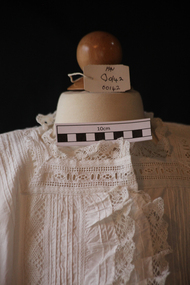
Clothing - Clothing, lady's nightgown, c1900
... Clothing, lady's nightgown...This white, cotton, lady's nightgown with embroidery and feather stitch is a fine example of the dressmaking skills of the women of the families of the pioneer settlers in Moorabbin Shire c1900...A white cotton lady's nightgown with embroidery and feather stitch...This is one of the many items that exhibit the skill and craftsmanship of the women in these families. clothing brighton moorabbin pioneers dressmaking dendy henry market gardeners early settlers blackburn nance craftwork A white cotton lady's nightgown with embroidery and feather stitch Clothing Clothing, lady's nightgown Blackburn family ...This white, cotton, lady's nightgown with embroidery and feather stitch is a fine example of the dressmaking skills of the women of the families of the pioneer settlers in Moorabbin Shire c1900The Blackburn family were early settlers in Moorabbin Shire. The pioneer families had to be self reliant and made their own clothing and utensils. This is one of the many items that exhibit the skill and craftsmanship of the women in these families.A white cotton lady's nightgown with embroidery and feather stitchclothing, brighton, moorabbin, pioneers, dressmaking, dendy henry, market gardeners, early settlers, blackburn nance, craftwork -
 City of Moorabbin Historical Society (Operating the Box Cottage Museum)
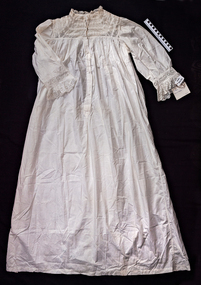
Clothing - Clothing, lady's nightgown, c1920
... Clothing, lady's nightgown...This lady’s long, decorative nightgown was worn c1920 by Mrs Alice Maude Haynes, nee Slew, (1890 – 1978), a member of a Moorabbin Shire early settler family....A long cotton lady's nightgown with pin-tucking, lace and embroidery....Clothing Clothing, lady's nightgown Alice Maude Haynes ...This lady’s long, decorative nightgown was worn c1920 by Mrs Alice Maude Haynes, nee Slew, (1890 – 1978), a member of a Moorabbin Shire early settler family.Early settlers and market gardeners established their families in Moorabbin Shire and this item shows the skill and craftsmanship of the women of these families A long cotton lady's nightgown with pin-tucking, lace and embroidery.clothing, moorabbin, dressmaking, cheltenham, market gardeners, early settlers, craftwork, slew alice, haynes alice -
 City of Moorabbin Historical Society (Operating the Box Cottage Museum)
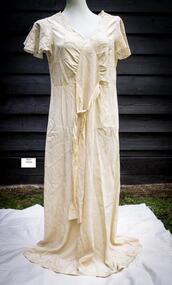
Clothing - Clothing, lady's silk nightgown c1930, c1930
... Clothing, lady's silk nightgown c1930...A lady's beige silk nightgown with a lace bodice and long waist ties c1930. ...Bias cut Clothing Clothing, lady's silk nightgown c1930 Family of Miss Blackburn ...After surviving the Depression Years many market gardeners changed to poultry farming and egg supply to build a multi million dollar industry . Women were able to follow the fashion trends even if they still made the clothes themselves. The City of Moorabbin was declared in 1934. A lady's beige silk nightgown with a lace bodice and long waist ties c1930. Bias cutsilk, machine lace, lingerie, clothing, moorabbin, cheltenham, bentleigh, early settlers, market gardeners, blackburn nance, city of moorabbin, poultry farmers, dairy farmers, -
 City of Moorabbin Historical Society (Operating the Box Cottage Museum)
Clothing, Lady's nightgown c1900, c1900
... Clothing, Lady's nightgown c1900...A lady's white cotton full length nightgown with handmade lacework on yoke and sleeve cuffs...This nightgown is a good example of the dressmaking and craftwork skills of the women Clothing dressmaking craftwork lacework early settlers pioneers Moorabbin Bentleigh Cheltenham cotton lace A lady's white cotton full length nightgown with handmade lacework on yoke and sleeve cuffs Clothing, Lady's nightgown c1900 Family of Miss Stock ...Early settlers were self reliant and made their own clothes. This nightgown is a good example of the dressmaking and craftwork skills of the women A lady's white cotton full length nightgown with handmade lacework on yoke and sleeve cuffsclothing, dressmaking, craftwork, lacework, early settlers, pioneers, moorabbin, bentleigh, cheltenham, cotton, lace -
 City of Moorabbin Historical Society (Operating the Box Cottage Museum)
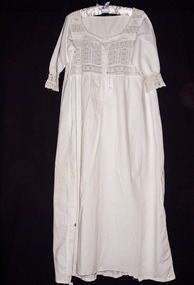
Clothing - Clothing, lady's long cotton nightgown c1900, c1900
... Clothing, lady's long cotton nightgown c1900...This lady’s cotton nightgown is an example of the dressmaking and lacework skills of the women of the early settlers families in Moorabbin Shire in the early 20th C ...Clothing Clothing, lady's long cotton nightgown c1900 ...This lady’s cotton nightgown is an example of the dressmaking and lacework skills of the women of the early settlers families in Moorabbin Shire in the early 20th C Early settlers and market gardeners established their families in Moorabbin Shire c1900 and this item shows the skill and craftsmanship of the women of these families A lady's long white cotton nightdress with long sleeves , heart shaped neckline,and lace bodice.fastened with mother of pearl button. The cuffs have wide lace edging and ribbon insert lace midriff.clothing, crochet, brighton, moorabbin, pioneers, dressmaking, market gardeners, early settlers, craftwork, lacework, moorabbin shire, bentleigh, mckinnon, hunt ailsa, dairy farms, fruit orchards -
 Flagstaff Hill Maritime Museum and Village
Textile - Nightgown, Circa 1900
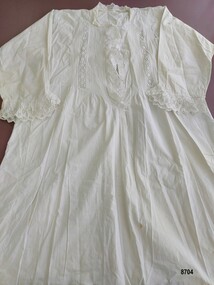
... ...lady's nightgown...A full length lady's cotton nightgown with long sleeves finished with a diagonal pointed cuff of broderie anglaise. ...Flagstaff Hill Maritime Museum and Village Great Ocean Road Shipwreck Coast Warrnambool nightgown lady's nightgown needlework sewing broderie anglaise pintucks Stephenson family A full length lady's cotton nightgown with long sleeves finished with a diagonal pointed cuff of broderie anglaise. ...This item is one of a collection of clothing items that belonged to the Stephenson family who lived at 22 McCracken Street, Kensington, Melbourne. Matthew Stephenson (1861 – 1943) who had grown up on the Bendigo goldfields and shifted to Melbourne in the early 1900’s was a train driver and later, a fireman with the railways. His wife Elizabeth Jane (Betsy) Wigley (1865 – 1953) also grew up on the goldfields around Majorca and Bendigo. They married in 1885 in Bendigo. They had two daughters – Ethel Evelyn Stephenson (1886 – 1956) and Lillian or Lila (1891 – 1977) who were milliners and dressmakers and who continued to live in the family home after the death of their parents. The family are recorded as living at 22 McCracken Street, Kensington, as early as 1914. It is not known who made or owned the clothing that makes up this collection but as it appears to be from the late Victorian and early Edwardian era, the different pieces were probably made and worn by any of the three ladies of the house – Betsy, Ethel and/or Lila. During W.W.2, a local Warrnambool couple (Meryl and Tony Everard) boarded with them – Tony was in the airforce training paratroopers to jump into (and survive) enemy territory and his wife Meryl worked in the Methodist baby Home. The Everards developed a close friendship with the Stephensons and were responsible for clearing out the house (and finding this clothing collection) after Lila died in 1977. This nightgown is machine sewn and has an added detailed design of pintucks and broderie anglaise lace to the front yoke and cuffs as a decorative element. The 1800's bought a shift in attitude towards modesty as the Victorian era progressed and by the mid to late 1800's it had become more acceptable ladies to wear simple, modest nightgowns. They tended to have a very loose fit and were usually made of linen, cotton or flannel, which had the advantage of providing warmth and also being easy to wash - a necessity for a garment worn next to the skin. Although the basic design of the nightgown was fairly simple, the wearer was free to add various types of trim e.g. lace, crochet, pintucks, embroidery etc.This item is an example of the needlework skills of women in the late 19th and early 20th century - combining machine stitching with hand embroidery to personalise and embellish a practical item of clothing. A full length lady's cotton nightgown with long sleeves finished with a diagonal pointed cuff of broderie anglaise. The bodice features a front opening placket with 3 buttons and buttonholes and a broderie anglaise cover. On either side of the placket, the bodice has been decorated with rows of vertical pintucks and a broderie anglaise panel insert. There is also a frill of broderie anglaise lace around the neck. The back of the nightgown is gathered onto a yoke.flagstaff hill maritime museum and village, great ocean road, shipwreck coast, warrnambool, nightgown, lady's nightgown, needlework, sewing, broderie anglaise, pintucks, stephenson family -
 City of Moorabbin Historical Society (Operating the Box Cottage Museum)
Clothing - Clothing, lady's silk nightgown c1930, c1930
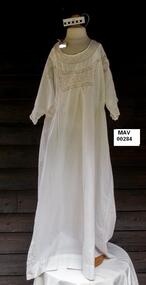
... Clothing, lady's silk nightgown c1930...This lady’s full length cream silk long sleeved nightgown with lace insert around neckline and cuffs is an example of the dressmaking and lacework skills of the women of the early settlers families in Moorabbin Shire in the early 1930's...A lady's full length cream silk long sleeved nightgown with lace insert around neckline and cuffs c1930...This lady’s full length cream silk long sleeved nightgown with lace insert around neckline and cuffs is an example of the dressmaking and lacework skills of the women of the early settlers families in Moorabbin Shire in the early 1930's Early settlers and market gardeners established their families in Moorabbin Shire c1900 and this item shows the skill and craftsmanship of the women of these families clothing petticoats fashion moorabbin bentleigh cheltenham A lady's full length cream silk long sleeved nightgown with lace insert around neckline and cuffs c1930 Clothing Clothing, lady's silk nightgown c1930 ...This lady’s full length cream silk long sleeved nightgown with lace insert around neckline and cuffs is an example of the dressmaking and lacework skills of the women of the early settlers families in Moorabbin Shire in the early 1930'sEarly settlers and market gardeners established their families in Moorabbin Shire c1900 and this item shows the skill and craftsmanship of the women of these families A lady's full length cream silk long sleeved nightgown with lace insert around neckline and cuffs c1930clothing, petticoats, fashion, moorabbin, bentleigh, cheltenham -
 Whitehorse Historical Society Inc.
Domestic object - Fashion Cut Pattern No. 2786, C 1950's
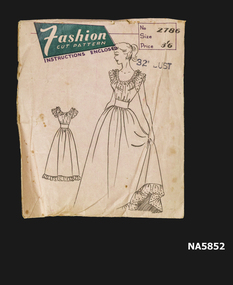
... Fashion Cut Pattern No. 2786 Pattern in a light pink sleeve with picture of lady in a long nightgown. Price 3/6, 32" Bust....Domestic dressmaking for women Dressmaking Ladies wear Nightwear C 1950's Fashion Cut Pattern As above Fashion Cut Pattern No. 2786 Pattern in a light pink sleeve with picture of lady in a long nightgown. Price 3/6, 32" Bust. Domestic object Fashion Cut Pattern No. 2786 ...Domestic dressmaking for womenFashion Cut Pattern No. 2786 Pattern in a light pink sleeve with picture of lady in a long nightgown. Price 3/6, 32" Bust.As abovedressmaking, ladies wear, nightwear, c 1950's, fashion cut pattern -
 Flagstaff Hill Maritime Museum and Village
Clothing - Nightgown, Eliza Towns, circa 1890's
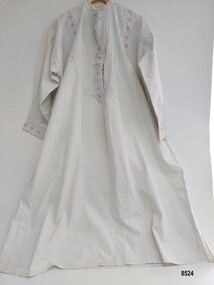
... Lady's long, white, cotton nightgown with a V shaped bodice decorated with bands of nine pintucks alternating with strips of broderie anglaise lined with pink ribbon. ...Flagstaff Hill Flagstaff Hill Maritime Museum and Village Warrnambool Great Ocean Road Shipwreck Coast Victorian era clothing Victorian era nightgown nightgown nightdress Eliza Towns Nhill Wimmera textiles clothing machine sewing hand sewing pintucks broderie anglaise sewing None Lady's long, white, cotton nightgown with a V shaped bodice decorated with bands of nine pintucks alternating with strips of broderie anglaise lined with pink ribbon. ...This nightgown is one of several linen and clothing items that were made and belonged to Mrs. Eliza Towns and donated to Flagstaff Hill Maritime Museum and Village. Eliza was born Eliza Gould in 1857 in South Melbourne (Emerald Hill) and in 1879 married Charles Towns. In the early 1880's they moved to Nhill in western Victoria and remained there for the rest of their married life. Charles was a jeweller and later became an accountant and for many years was involved with the Shire Council, the local show committee (A & P Society), the Hospital Committee and the Board of the local newspaper (the Nhill Free Press). They had three children and lived a life that would be regarded as comfortably "middle class". Eliza probably had a treadle sewing machine and would have made many of her own clothes as well as clothes for her children - adding her own handmade embroidered or crocheted decorative trim. This nightgown is machine sewn by Eliza Towns and she has added a detailed design of pintucks and broderie anglaise lace to the front yoke and cuffs as a decorative element. The 1800's bought a shift in attitude towards modesty as the Victorian era progressed and by the mid to late 1800's it had become more acceptable ladies to wear simple, modest nightgowns. They tended to have a very loose fit and were usually made of linen, cotton or flannel, which had the advantage of providing warmth and also being easy to wash - a necessity for a garment worn next to the skin. Although the basic design of the nightgown was fairly simple, the wearer was free to add various types of trim e.g. lace, crochet, pintucks, embroidery etc.This item is an example of the needlework skills of women in the late 19th century - combining machine stitching with hand embroidery to personalise and embellish a practical item of clothing. It is also significant as an example of a practical solution to the difficulties that women of this era faced with regard to the washing of clothes and household linens.Lady's long, white, cotton nightgown with a V shaped bodice decorated with bands of nine pintucks alternating with strips of broderie anglaise lined with pink ribbon. The opening front placket and neckline are bordered with a simpler broderie anglaise lace. The long sleeves are gathered into cuffs with a matching V shape, pintuck and broderie anglaise design. The front placket fastens with three cream buttons although one is missing. The back of the nightgown has gathered fabric on a plain, narrow V shape yoke. A narrow gusset has been added to the both sides at the bottom of the nightgown.Noneflagstaff hill, flagstaff hill maritime museum and village, warrnambool, great ocean road, shipwreck coast, victorian era clothing, victorian era nightgown, nightgown, nightdress, eliza towns, nhill, wimmera, textiles, clothing, machine sewing, hand sewing, pintucks, broderie anglaise, sewing -
 City of Moorabbin Historical Society (Operating the Box Cottage Museum)
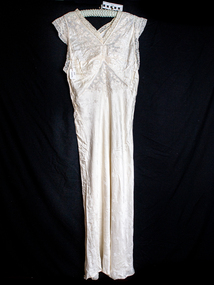
Clothing - Clothing, lady's full length cream silk nightgown c1900, c1900
... This lady’s hand-sewn silk sleeveless nightgown is an example of the dressmaking and lacework skills of the women of the early settlers families in Moorabbin Shire in the early 20th C ...Clothing, lady's hand sewn full length cream silk sleeveless nightgown with lacework insert ...This lady’s hand-sewn silk sleeveless nightgown is an example of the dressmaking and lacework skills of the women of the early settlers families in Moorabbin Shire in the early 20th C Early settlers and market gardeners established their families in Moorabbin Shire and this item shows the skill and craftsmanship of the women of these families clothing crochet brighton moorabbin pioneers dressmaking market gardeners early settlers craftwork bentleigh lacework moorabbin shire fruit orchard mrs l risstrom dairy farms Clothing, lady's hand sewn full length cream silk sleeveless nightgown with lacework insert Clothing Clothing, lady's full length cream silk nightgown c1900 ...This lady’s hand-sewn silk sleeveless nightgown is an example of the dressmaking and lacework skills of the women of the early settlers families in Moorabbin Shire in the early 20th C Early settlers and market gardeners established their families in Moorabbin Shire and this item shows the skill and craftsmanship of the women of these families Clothing, lady's hand sewn full length cream silk sleeveless nightgown with lacework insert clothing, crochet, brighton, moorabbin, pioneers, dressmaking, market gardeners, early settlers, craftwork, bentleigh, lacework, moorabbin shire, fruit orchard, mrs l risstrom, dairy farms -
 Orbost & District Historical Society
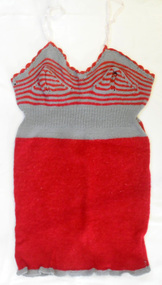
knitted vests/singlets, Burton, Marjorie, WW11
... Clothes rationing ended on 15 March 1949. ww11 knitwear handcraft nightgown sleepwear burton-marjorie Two hand-knitted lady's vests(singlets). ...This was knitted by Marjorie Burton during WW11 in England. She used to knit while in an air raid shelter escaping the bombing with her young daughter. Marjorie Burton ( nee Whiteman), born 12 June, in Birmingham, England came to Orbost in 1995. In England she did office work – typing, shorthand and secretarial work - in accountants’ offices and also trained as a comptometrist with Burroughs in London. She came from middle-class working church-going family. Her mother was a milliner who made most of Marjorie’s clothes, hats and outfits. Marjorie married in 1938 to a salesman who later became a mechanic in the R.A.F. during WW11. Her father served in Civil Defence during the war. Marjorie was in Birmingham during the war and remembered sheltering with her young daughter, Anne (Quaadgras) in the air raid shelter during bombing. This item is an example of a handcrafted item and reflects the handcraft skills of women necessary during WW11 when clothing became scarce. Clothes rationing began on June 1, 1941, two years after food rationing started. Clothes rationing ended on 15 March 1949.Two hand-knitted lady's vests(singlets). Both have been knitted from left over wools. Both have crocheted necklines and ribbon straps and are fitted styles. 2483.12 is red and grey with a V neck. 2483.13 is pink, grey and blue with a V neck.ww11 knitwear handcraft nightgown sleepwear burton-marjorie -
 Bendigo Historical Society Inc.
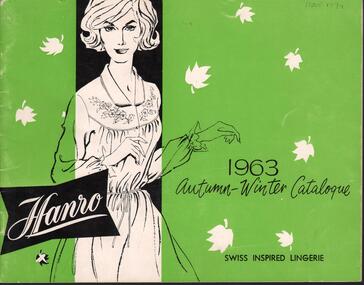
Magazine - HANRO COLLECTION: HANRO AUTUMN-WINTER CATALOGUE 1963, 1963
... lady in a dressing gown that has long sleeves with ruffled edges, draw in the waist with a ribbon decorative bodice with flowers and a collar. On the left in a star shaped banner printed in white on a black back ground is *Hanro*. On the right is *1963 Autumn-Winter Catalogue. Swiss Inspired Lingerie. The catalogue is of gloss paper with advertising inside the first page. Each page has sketches of ladies in nightgowns...lady in a dressing gown that has long sleeves with ruffled edges, draw in the waist with a ribbon decorative bodice with flowers and a collar. On the left in a star shaped banner printed in white on a black back ground is *Hanro*. On the right is *1963 Autumn-Winter Catalogue. Swiss Inspired Lingerie. The catalogue is of gloss paper with advertising inside the first page. Each page has sketches of ladies in nightgowns ...The Hanro company was established in Switzerland in 1884. In 1926 a site in Hargreaves Street Bendigo, behind the School of Mines, was purchased to establish the Bendigo Knitting Mills, a subsidiary of Hanro. The managing director was Charles Handerchin who came from Switzerland. The company was delisted from the Australian Stock Exchange in 1963 when it was taken over by John Brown Industries.Hanro Autumn-Winter Catalogue 1963: On card with a lime green background and in black ink is white autumn leaves scattered across the page. Off to the left is a sketch of a lady in a dressing gown that has long sleeves with ruffled edges, draw in the waist with a ribbon decorative bodice with flowers and a collar. On the left in a star shaped banner printed in white on a black back ground is *Hanro*. On the right is *1963 Autumn-Winter Catalogue. Swiss Inspired Lingerie. The catalogue is of gloss paper with advertising inside the first page. Each page has sketches of ladies in nightgowns, night dressers, Pyjamas, Vests, Panties, Spencers and Children's wear. Each item has an item number, description, size and colour. On the back cover of lime green back ground is white autumn leaves scattered around. In a white star shaped banner is *Hanro in black print and to the side (Aust) Knitting Mills Ltd. Underneath is the sales offices addressed and phone numbers in each state.. At the bottom is *The Quality is a Proud Tradition*. Box 116ACambridge Press, Bendigobook, magazine, catalogue, hanro. catalogue. cambridge press, bendigo -
 Warrnambool and District Historical Society Inc.
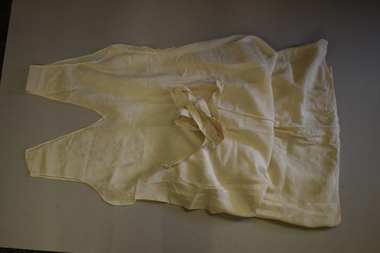
Clothing - Lady's silk underwear, 1930s
... .1 Cream silk lady's panties with hand embroidery on the lower legs. There is an opening on one side with two buttons .2 Cream silk sleeveless nightgown with hand embroidery at the neck and on the front. ...These items are retained as mementos of the type of clothing made and worn by women in the early to mid 20th century vintage women's clothing Silk clothing .1 Cream silk lady's panties with hand embroidery on the lower legs. There is an opening on one side with two buttons .2 Cream silk sleeveless nightgown with hand embroidery at the neck and on the front. ...These items were hand sewn by Annie Beryl Mathieson, the daughter of Alexander and Elizabeth Mathieson who lived at Naringal. The silk came from China, via family connections. Annie Beryl Mathieson married John Harman in 1939, lived at Macarthur and died there in 1983.These items are retained as mementos of the type of clothing made and worn by women in the early to mid 20th century.1 Cream silk lady's panties with hand embroidery on the lower legs. There is an opening on one side with two buttons .2 Cream silk sleeveless nightgown with hand embroidery at the neck and on the front. There are two ties attached to the sides of the front. vintage women's clothing, silk clothing -
 Ararat Gallery TAMA
Clothing, Dorelle of Sydney, Nightgown
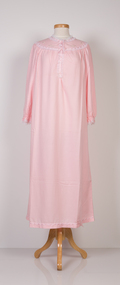
... As the wife of Sir Andrew Grimwade, a prominent businessman, Chairman of several boards and a Trustee of various committees, Lady Grimwade met with royalty, heads of state, politicians, corporate directors, and horse and cattle breeders. Excerpt from 'Hot Pink Summers' catalogue essay, Helen Jackson, 1995. Nightgown ...The Lady Barbara Grimwade Costume Collection is comprised of Lady Barbara Grimwade's personal apparel and includes 145 pieces of clothing, 10 hats, 19 handbags, 66 pairs of shoes and assorted accessories of gloves, belts and scarves. In its breadth, this significant acquisition ranges from the mundane to the memorable, therefore giving a balanced representation of one person's taste. Following Lady Barbara Grimwade’s death in March 1990, Ararat Gallery formally accepted the generous gift of clothing and accessories donated by Lady Grimwade's son, Mr Angus K Grimwade, on 28 August 1991. Subsequent smaller donations in 1995 enhanced the collection. Lady Grimwade's Scottish forebears, the Gaerloch Campbells, first settled in Australia in 1861 in the Ararat-Beaufort district. Her great great grandfather, Mr Henry Campbell, died on the voyage to Australia. His widow, Jane, with 10 of her 13 children, farmed and grazed land, firstly at Stockyard Hill then at Fiery Creek, near Buangor, before leaving the shire in 1873. Lady Grimwade held a privileged position in Melbourne society. As the wife of Sir Andrew Grimwade, a prominent businessman, Chairman of several boards and a Trustee of various committees, Lady Grimwade met with royalty, heads of state, politicians, corporate directors, and horse and cattle breeders. Excerpt from 'Hot Pink Summers' catalogue essay, Helen Jackson, 1995. -
 Royal District Nursing Service (now known as Bolton Clarke)
Photograph, 30 06 1965
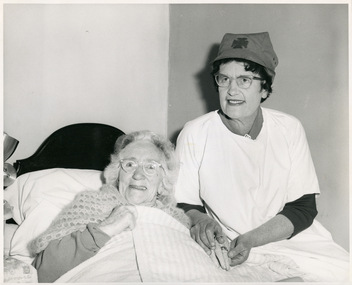
... The Sister has her hands on the left hand of the lady, who is wearing glasses, has white curly hair, and is wearing a crocheted shawl over her grey nightgown. ...The Sister has her hands on the left hand of the lady, who is wearing glasses, has white curly hair, and is wearing a crocheted shawl over her grey nightgown. ...The Melbourne District Nursing Service (MDNS) Sister is massaging the left hand of the patient. The Sister is wearing her grey cotton uniform dress and red cardigan under her white gown. A red Maltese cross emblazoned on her peaked hat. The Trained nurses of the Melbourne District Nursing Society (MDNS), later known as Royal District Nursing Service (RDNS), visited patients in their home and gave best practice care in many fields of nursing, and to people of many cultures, throughout its 130 years of expansion. Initial visits not only assessed the specific nursing situation but the situation as a whole. Their patients ranged in age from babes, children, adults to the elderly and referrals were taken from Hospitals, General Practitioners and allied Health facilities. Some of the care the Sisters provided is as follows: – Post-Natal care given to mother and babe, Wound Care following various types of surgery, accidents, burns, cancer, leg ulcers etc. Supervising and teaching Diabetic Care, including teaching and supervising people with Diabetes to administer their own Insulin, and administering Insulin to those unable to give their own injections. Administering other injections and setting up weekly medication boxes. The Sisters performed Catheterizations on adults suffering from conditions such as Quadriplegia, Paraplegia, Multiple Sclerosis (MS), Motor Neurone Disease (MND) and Guillan-Barre Syndrome, and when required at school on children for e.g. those with Spina Bifida. The Sisters visited those requiring Cystic Fibrosis support and care; those requiring Haemo-Oncology care, including visiting children at school; those requiring Home Enteral Feeding care, and those requiring IV therapy at home and home Dialysis. Palliative Care was given including pain relief with the use of syringe drivers, personal care as needed, and advice and support to both patient and family. The Sisters provided Stoma management to those needing Urostomy, Ileostomy and Colostomy care and those requiring Continence care. HIV/AIDS nursing care was provided; visits to Homeless Persons were made. Personal care was given to patients ranging in age and with varying mobility problems, such as those with MS, MND, Guillan-Barre Syndrome, Poliomyelistis, Quadriplegia, Paraplegia, Acquired Brain Injury, to those following a Cerebrovascular Accident (Stroke), those with severe Arthritis and those with a form of Dementia. When necessary the elderly were assisted with personal care and advice given on safety factors with the use of hand rails, bath or shower seats, and hand showers. Rehabilitation with an aim towards independence remained at the forefront of the Sister’s minds and when possible using aids and instruction on safe techniques enabled the person to become fully independent. All care included giving advice and support to the patient and their Carers. The Sisters liaised with the persons Doctor, Hospital and allied Health personal when necessary.On the left of the black and white photograph is a a lady laying in her bed, and to her right is a Melbourne District Nursing Service, (MDNS), Sister sitting beside her. The Sister is wearing glasses, and has a white gown over her uniform; with the grey collar of her uniform and dark sleeves of her cardigan in view. The Sister is wearing her grey peaked uniform hat, with a Maltese cross emblazoned in the centre front, over her short dark curled hair. The Sister has her hands on the left hand of the lady, who is wearing glasses, has white curly hair, and is wearing a crocheted shawl over her grey nightgown. Her head is resting on the pillow on her bed which has a dark bedhead, .Light coloured bedding covers most of her body.Photographers stamp and 'Quote No. DW 86'mdns, melbourne district nursing service, mdns patient care
