
Showing 125 items matching "lady's skirt"
-
 Flagstaff Hill Maritime Museum and Village
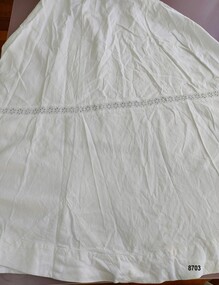
Textile - Skirt, circa 1910
... ...lady's skirt...It is highly likely that the lady who made this skirt brought the lengths of broderie anglaise already made to embellish and personalise her skirt....A full length lady's skirt of heavy textured ribbed twill cotton. ...Flagstaff Hill Maritime Museum and Village Great Ocean Road Shipwreck Coast Warrnambool broderie anglaise needlework sewing Stephenson family skirt lady's skirt A full length lady's skirt of heavy textured ribbed twill cotton. ...This item is one of a collection of clothing items that belonged to the Stephenson family who lived at 22 McCracken Street, Kensington, Melbourne. Matthew Stephenson (1861 – 1943) who had grown up on the Bendigo goldfields and shifted to Melbourne in the early 1900’s was a train driver and later, a fireman with the railways. His wife Elizabeth Jane (Betsy) Wigley (1865 – 1953) also grew up on the goldfields around Majorca and Bendigo. They married in 1885 in Bendigo. They had two daughters – Ethel Evelyn Stephenson (1886 – 1956) and Lillian or Lila (1891 – 1977) who were milliners and dressmakers and who continued to live in the family home after the death of their parents. The family are recorded as living at 22 McCracken Street, Kensington, as early as 1914. It is not known who made or owned the clothing that makes up this collection but as it appears to be from the late Victorian and early Edwardian era, the different pieces were probably made and worn by any of the three ladies of the house – Betsy, Ethel and/or Lila. During W.W.2, a local Warrnambool couple (Meryl and Tony Everard) boarded with them – Tony was in the airforce training paratroopers to jump into (and survive) enemy territory and his wife Meryl worked in the Methodist baby Home. The Everards developed a close friendship with the Stephensons and were responsible for clearing out the house (and finding this clothing collection) after Lila died in 1977. This skirt features broderie anglaise trim. Although broderie anglaise was a lace that could be made by hand, it was very time consuming to make. St Gallen was a city in Switzerland that had become known for producing quality textiles. At the beginning of the 19th century, the first embroidery machines were developed in St Gallen. Factories used embroidery machines but people also had them in their homes. They were able to produce broderie anglaise for export. By the early 20th century, machine made lace, fabric, ribbons etc. were being sold in drapers shops all over England and Wales to women who were making clothes and furnishings for their families. It is highly likely that the lady who made this skirt brought the lengths of broderie anglaise already made to embellish and personalise her skirt.This item is an example of the needlework skills of women in the late 19th century - creating pintucks and adding lace to personalise and embellish a practical item of clothing. A full length lady's skirt of heavy textured ribbed twill cotton. The top of the skirt is made from five pieces of fabric, sewn together and inserted into a simple waistband. It has an opening with room for 6 hook and eyes (but only the middle three remain). The top section of the skirt is separated from the bottom section by a strip of eyelet embroidery that has been inserted in a horizontal line at the back but becomes slightly diagonal at the front causing the two ends to cross in a decorative X fashion. The bottom of the skirt is the same heavy cotton as the top and one seam features a V shaped insert or patch.flagstaff hill maritime museum and village, great ocean road, shipwreck coast, warrnambool, broderie anglaise, needlework, sewing, stephenson family, skirt, lady's skirt -
 City of Moorabbin Historical Society (Operating the Box Cottage Museum)
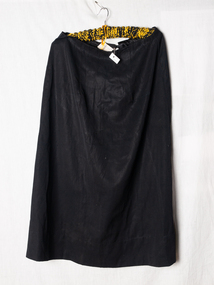
Clothing, Lady's black long crepe skirt with drawstring waist, c1910
... Clothing, Lady's black long crepe skirt with drawstring waist... Lady's black long crepe skirt with drawstring waist and inserted side pockets ...The early settler women were skilled dressmakers and made the clothing for their families Typical day wear skirt worn by women in the early settler families of Moorabbin Shire c1910 The family of Nance Blackburn were early settlers. blackburn nance, early settlers, moorabbin, cheltenham, bentleigh clothing, dressmaking, moorabbin shire Lady's black long crepe skirt with drawstring waist and inserted side pockets Clothing, Lady's black long crepe skirt with drawstring waist Family of Nance Blackburn ...A typical long black crepe skirt worn by women in Moorabbin Shire c1910 whilst doing housework during spring and summer. The early settler women were skilled dressmakers and made the clothing for their familiesTypical day wear skirt worn by women in the early settler families of Moorabbin Shire c1910 The family of Nance Blackburn were early settlers. Lady's black long crepe skirt with drawstring waist and inserted side pockets blackburn nance, early settlers, moorabbin, cheltenham, bentleigh clothing, dressmaking, moorabbin shire -
 City of Moorabbin Historical Society (Operating the Box Cottage Museum)
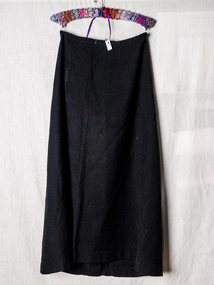
Clothing, Lady's black long woollen skirt, c1910
... Clothing, Lady's black long woollen skirt...Clothing, Lady's black long woollen skirt with a drawstring waist and a side inserted pocket ...skirt worn whilst doing housework by early settler women c1910. The family of Nance Blackburn were early settlers in Moorabbin Shire blackburn nance, early settlers, moorabbin, cheltenham, bentleigh clothing, dressmaking, moorabbin shire Clothing, Lady's black long woollen skirt with a drawstring waist and a side inserted pocket Clothing, Lady's black long woollen skirt Family of Nance Blackburn ...This is a plain black full length woollen skirt that women wore during winter in Moorabbin Shire when working around the house c1910. The early settler women were skilled dressmakers and made the clothing for their familiesA typical day skirt worn whilst doing housework by early settler women c1910. The family of Nance Blackburn were early settlers in Moorabbin ShireClothing, Lady's black long woollen skirt with a drawstring waist and a side inserted pocket blackburn nance, early settlers, moorabbin, cheltenham, bentleigh clothing, dressmaking, moorabbin shire -
 City of Moorabbin Historical Society (Operating the Box Cottage Museum)
Clothing,Lady's black long crepe skirt, c1910
... Clothing,Lady's black long crepe skirt...Clothing,Lady's Black long crepe skirt with pleats, hook and eye fasteners and side inserted pocket ...blackburn nance, early settlers, moorabbin, cheltenham, bentleigh clothing, dressmaking, moorabbin shire Clothing,Lady's Black long crepe skirt with pleats, hook and eye fasteners and side inserted pocket Clothing,Lady's black long crepe skirt Family of Nance Blackburn ...Clothing,Lady's Black long crepe skirt with pleats, hook and eye fasteners and side inserted pocket blackburn nance, early settlers, moorabbin, cheltenham, bentleigh clothing, dressmaking, moorabbin shire -
 City of Moorabbin Historical Society (Operating the Box Cottage Museum)
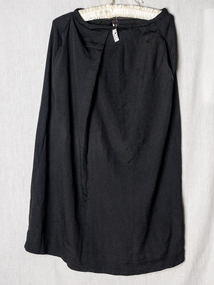
Clothing,Lady's Black long crepe skirt, c1910
... Clothing,Lady's Black long crepe skirt...A typical long black crepe skirt worn by women in Moorabbin Shire c1910 whilst doing housework during spring and summer Typical day wear skirt worn by women in the early settler families of Moorabbin Shire c1910 The family of Nance Blackburn were early settlers blackburn nance, early settlers, moorabbin, cheltenham, bentleigh clothing, dressmaking, moorabbin shire A woman's full length black crepe skirt with side fasteners, pleats and side inserted pockets Clothing,Lady's Black long crepe skirt Family of Nance Blackburn ...A typical long black crepe skirt worn by women in Moorabbin Shire c1910 whilst doing housework during spring and summerTypical day wear skirt worn by women in the early settler families of Moorabbin Shire c1910 The family of Nance Blackburn were early settlersA woman's full length black crepe skirt with side fasteners, pleats and side inserted pockets blackburn nance, early settlers, moorabbin, cheltenham, bentleigh clothing, dressmaking, moorabbin shire -
 Linton and District Historical Society Inc
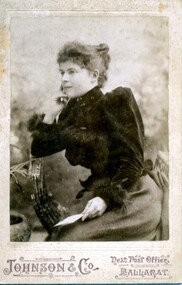
Photograph, Johnson and Co. Ballarat, Eliza Cameron
... Sepia photograph of a young lady wearing skirt and top, seated with head resting on right hand, left hand on lap holding a card....Eliza Cameron Eliza Robertson Sepia photograph of a young lady wearing skirt and top, seated with head resting on right hand, left hand on lap holding a card. ...Eliza Cameron, a daughter of Ewen and Marion Cameron, was born at Linton in 1869. She married Murdoch Robertson in 1899, and died at Surrey Hills in 1957.Sepia photograph of a young lady wearing skirt and top, seated with head resting on right hand, left hand on lap holding a card.eliza cameron, eliza robertson -
 Andrew Ross Museum
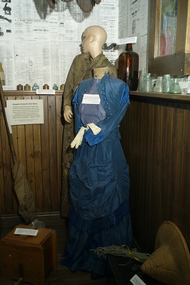
Evening Gown, Circa 1870
... Lady's blue taffeta skirt and jacket trimmed with fringe/tassels/sleeve inserts....Believed to have belonged to Annie Maria Victoria Margareta Bisley, mother of Dorothy Wills, a post mistress/store keeper at Kangaroo Ground during the 1950's-60's Lady's blue taffeta skirt and jacket trimmed with fringe/tassels/sleeve inserts. ...Believed to have belonged to Annie Maria Victoria Margareta Bisley, mother of Dorothy Wills, a post mistress/store keeper at Kangaroo Ground during the 1950's-60'sLady's blue taffeta skirt and jacket trimmed with fringe/tassels/sleeve inserts. -
 Stawell Historical Society Inc
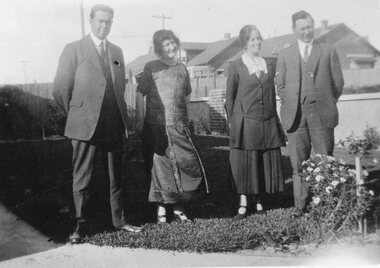
Photograph, 2 Couples
... B/W: 2 couples in yard, men in three piece suits, One Lady in above ankle dress - short sleeved, other lady in Skirt, blouse and Jacket...Ern Martin B/W: 2 couples in yard, men in three piece suits, One Lady in above ankle dress - short sleeved, other lady in Skirt, blouse and Jacket 2 Couples Photograph ...B/W: 2 couples in yard, men in three piece suits, One Lady in above ankle dress - short sleeved, other lady in Skirt, blouse and JacketHarry Rae Martin ? Churice? Ern Martin -
 Federation University Historical Collection
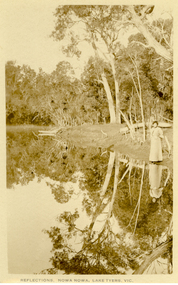
Postcard, Howard D. Bulmer, Reflections, Nowa Nowa, Lake Tyers, Victoria
... Black and white post card showing a lady in long skirt standing on the banks of a river with Australian eucalypts (gum tress) in the background and reflected in the water. ...Nowa Nowa Lake Tyers trees river Black and white post card showing a lady in long skirt standing on the banks of a river with Australian eucalypts (gum tress) in the background and reflected in the water. ...Nowa Nowa is located in Victoria on the Princes Highway between Lakes Entrance & Orbost. Tall eucalypts stand guard as you drive into this small village.The fresh waters of Boggy Creek and the tidal waters of Lake Tyers meet here. In the past its history was of logging. Black and white post card showing a lady in long skirt standing on the banks of a river with Australian eucalypts (gum tress) in the background and reflected in the water. nowa nowa, lake tyers, trees, river -
 Linton and District Historical Society Inc
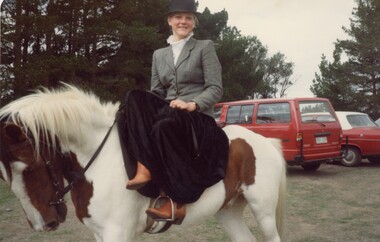
Photograph, Jenny Kerr, Linton Park, 1983, 1983
... Colour photograph of lady wearing dark skirt, white frill necked blouse, grey fitted jacket and hat, riding pony side-saddle....Colour photograph of lady wearing dark skirt, white frill necked blouse, grey fitted jacket and hat, riding pony side-saddle. ...Colour photograph of lady wearing dark skirt, white frill necked blouse, grey fitted jacket and hat, riding pony side-saddle."Jenny Kerr".ldhs activities, ldhs exhibition linton park 1983, jenny kerr -
 Linton and District Historical Society Inc
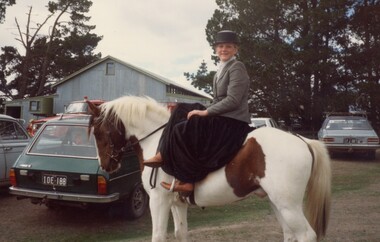
Photograph, Jenny Kerr, Linton Park, 1983, 1983
... Colour photograph showing lady wearing black skirt, white frill-necked blouse, grey fitted jacket and hat, riding horse side-saddle....Colour photograph showing lady wearing black skirt, white frill-necked blouse, grey fitted jacket and hat, riding horse side-saddle. ...Colour photograph showing lady wearing black skirt, white frill-necked blouse, grey fitted jacket and hat, riding horse side-saddle."Jenny Kerr 1983 Linton Park Exhibition".ldhs activities, ldhs exhibition linton park 1983, jenny kerr -
 Linton and District Historical Society Inc
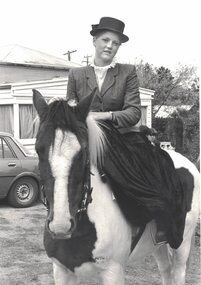
Photograph, Jenny Kerr
... Black and white photograph showing lady wearing black skirt, white frill-necked blouse, grey fitted jacket and hat, riding horse side-saddle....Jenny Kerr Linton Park Exhibition 1983 Wally and Ruth Kerr Black and white photograph showing lady wearing black skirt, white frill-necked blouse, grey fitted jacket and hat, riding horse side-saddle. ...Black and white photograph showing lady wearing black skirt, white frill-necked blouse, grey fitted jacket and hat, riding horse side-saddle.jenny kerr, linton park, exhibition, 1983, wally and ruth kerr -
 Flagstaff Hill Maritime Museum and Village
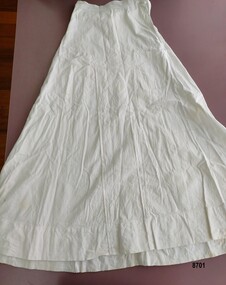
Textile - Overskirt, circa 1910
... This overskirt is an outer protective garment made of durable cotton and was probably worn over a lady's skirt or dress to protect it whilst they were working. ...This overskirt is an outer protective garment made of durable cotton and was probably worn over a lady's skirt or dress to protect it whilst they were working. ...This item is one of a collection of clothing items that belonged to the Stephenson family who lived at 22 McCracken Street, Kensington, Melbourne. Matthew Stephenson (1861 – 1943) who had grown up on the Bendigo goldfields and shifted to Melbourne in the early 1900’s was a train driver and later, a fireman with the railways. His wife Elizabeth Jane (Betsy) Wigley (1865 – 1953) also grew up on the goldfields around Majorca and Bendigo. They married in 1885 in Bendigo. They had two daughters – Ethel Evelyn Stephenson (1886 – 1956) and Lillian or Lila (1891 – 1977) who were milliners and dressmakers and who continued to live in the family home after the death of their parents. The family are recorded as living at 22 McCracken Street, Kensington, as early as 1914. It is not known who made or owned the clothing that makes up this collection but as it appears to be from the late Victorian and early Edwardian era, the different pieces were probably made and worn by any of the three ladies of the house – Betsy, Ethel and/or Lila. During W.W.2, a local Warrnambool couple (Meryl and Tony Everard) boarded with them – Tony was in the airforce training paratroopers to jump into (and survive) enemy territory and his wife Meryl worked in the Methodist baby Home. The Everards developed a close friendship with the Stephensons and were responsible for clearing out the house (and finding this clothing collection) after Lila died in 1977. This overskirt is an outer protective garment made of durable cotton and was probably worn over a lady's skirt or dress to protect it whilst they were working. The pockets are large enough for the wearer to keep small items in and there is a loop at the back that would allow the wearer to hang it on a hook, when she finished her work. This item is an example of clothing worn by working women in the late 19th and early 20th centuryA heavy cotton ankle length overskirt made with two wide gored sections containing inset pockets joined to a middle T shaped front band. It has a waistband of grosgrain ribbon and a side opening with 3 pairs of metal snaps (one pair is missing) and a hook and eye at the top. The waistband also has a taped loop (for hanging) and an unusual double fabric overlay with unattached curved ends.flagstaff hill maritime museum and village, great ocean road, shipwreck coast, warrnambool, overskirt, needlework, sewing, protective garment, stephenson family -
 Linton and District Historical Society Inc
Photograph, Mrs. Bessie Brown and Daughter Vera
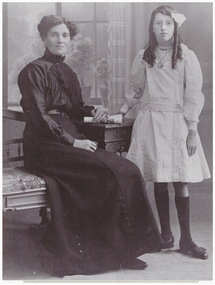
... Black and white copy of original photograph of a seated lady wearing dark skirt and blouse with a high neck and ruffles. ...Black and white copy of original photograph of a seated lady wearing dark skirt and blouse with a high neck and ruffles. ...Elizabeth (Bessie) Mercer, a daughter of Henry Boyd Mercer and Deborah Mercer née Sinclair, was born 23/8/1873 at Spring Hill (near present-day Pittong). She attended Spring Vale State School where she achieved her Merit Certificate. She registered as a teacher in 1891 and completed further training to become a teacher of gymnastics in 1896. Bessie married David Brown of Chepstowe, and they farmed at Pittong. They had two children, Vera and Roy. Bessie Brown died in 1940. Bessie and her sister Emma were very involved with the war effort during World War I, and after the war they were presented with certificates of appreciation by the Linton "Diggers". (Copies of certificates in the LDHS collection.)Black and white copy of original photograph of a seated lady wearing dark skirt and blouse with a high neck and ruffles. Standing beside her is a girl wearing a light coloured knee length dress and black shoes and socks. She is also wearing glasses, a cameo necklace and a white bow in her hair."Mrs Bessie Brown + daughter Vera".elizabeth (bessie) brown née elizabeth mercer, vera brown -
 Linton and District Historical Society Inc
Photograph, Mr and Mrs Tully
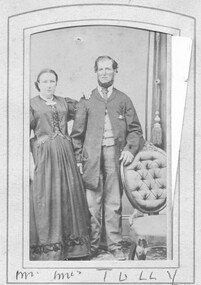
... Sepia photograph of a lady wearing long full skirted gown laced at bodice, with scarf at neckline, standing with left hand on shoulder of bearded man wearing suit with long jacket, wide tie, standing with left arm leaning on back of chair, right arm by side....Sepia photograph of a lady wearing long full skirted gown laced at bodice, with scarf at neckline, standing with left hand on shoulder of bearded man wearing suit with long jacket, wide tie, standing with left arm leaning on back of chair, right arm by side. ...Part of S E Surman collection (album) page 38 left.Sepia photograph of a lady wearing long full skirted gown laced at bodice, with scarf at neckline, standing with left hand on shoulder of bearded man wearing suit with long jacket, wide tie, standing with left arm leaning on back of chair, right arm by side."Mr and Mrs Tully".mr tully, mrs tully, surman collection -
 Glenelg Shire Council Cultural Collection
Decorative object - Embroidered Tablecloth, Unknown
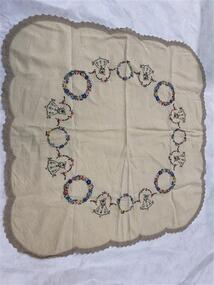
... Embroidery is a large circle pattern of a lady in a full skirt and bonnet under a arch of light and dark pink flowers with yellow centres and dark green foliage, and rings of muli coloured flowers small and large. ...Embroidery is a large circle pattern of a lady in a full skirt and bonnet under a arch of light and dark pink flowers with yellow centres and dark green foliage, and rings of muli coloured flowers small and large. ...Owned by Wilma Harris nee. Bowering resident of Merino Victoria.Small linen hand embroidered tablecloth bordered in decorative crocheted lacework. Embroidery is a large circle pattern of a lady in a full skirt and bonnet under a arch of light and dark pink flowers with yellow centres and dark green foliage, and rings of muli coloured flowers small and large. womens history, ros harris, merino, sewing, embroidery -
Port Melbourne Historical & Preservation Society
Photograph - Miss Congue's Costumier Shop, Bay Street, Port Melbourne, c. 1900
... Miss Gongues is the lady in skirt and blouse on the right; other people unknown....Miss Gongues is the lady in skirt and blouse on the right; other people unknown. ...This laser print is a copy of a photo which has been in the Congues/McKenzie family collection since early this century. Mrs Marie Vernon of Doncaster showed the photo to her cousin, Elva Mason, also of Doncaster but formerly of 35 Cruikshank Street. Elva had the copy done and passed it on to Barbara Gardiner. Mrs Vernon was unable to give us much information but could tell us that her mother, Mrs Mary Jane Congues (known as Ruby) was a tailoress who started her apprecticeship at age 13 and later established the shop which was next to Earl's hardware shop. We think that she was born in the 1880s. The Congues family lived at 36 Cruikshank Street, and their landlord in later years was Mr Sullivan, who supplied horse and drays for rubbish collection for the Council. Simon McKenzie was the loca policeman who patrolled up and down Bay Street and became interested in Ruby. She later visited a fortune teller who told her she would marry a man with numbers on his hat. They married and lived in Brunswick East, Carrum Downs and later Calligee (near Traralgon). LIfe was tough but Mrs Vernon remembers that her talented mother was able to teransform garments and hats so that her daughters always felt that they had a new dress for each special occasion. Mrs Vernon also remembers when a member of the famly needed dental care, they wee put on the train to stay with Grandma at Port Melbourne, who took them to Frost the Dentist (on the corner of Graham and Bay Strees), who pulled teeth for one shilling each. Miss Gongues is the lady in skirt and blouse on the right; other people unknown.Laserprint of four women in entrance to Miss Congue's Costumier shop in Bay Streetbusiness and traders - tailors and clothing, mary jane (ruby) congues, mary jane (ruby) mckenzie, simon mckenzie, mr sullivan, frost the dentist -
 Bendigo Historical Society Inc.
Document - MALONE COLLECTION: GREETING CARDS, 1900
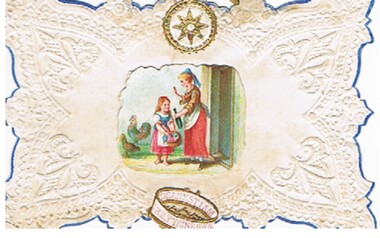
... In the centre is a coloured sticker with a lady and a girl outside their door. The lady has a red skirt, white apron, brown blouse & shoes, and a blue scarf on her head. ...In the centre is a coloured sticker with a lady and a girl outside their door. The lady has a red skirt, white apron, brown blouse & shoes, and a blue scarf on her head. ...Irregular shaped white, embossed card with floral and geometric design. It has a blue edge. In the centre is a coloured sticker with a lady and a girl outside their door. The lady has a red skirt, white apron, brown blouse & shoes, and a blue scarf on her head. She is holding a blue bottle. The girl has a pink skirt, white blouse & apron and a blue vest. She is holding a basket. There is also a hen and a rooster in the picture. Above the picture is a gold circle with an eight pointed star inside it. Below the picture is a gold and white sticker with 'Dearest I am Truly Thine Own' printed in mauve. Inside the card is some dried fern held in place with a sticker . It has a girl wearing a red dress sitting down and a brown and white dog sitting beside her.person, greeting cards, malone collection, malone collection, greeting cards -
 Bendigo Historical Society Inc.
Photograph - HILDA HILL COLLECTION: BLACK AND WHITE PHOTOS, 1922
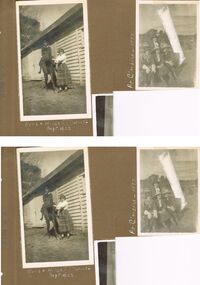
... At Inglewood November 8th 1922, Six males al dressed in dark suits with white shirts and dark ties, also six ladies one in coloured dress others all in white one wearing a tartan like pattern skirt, one lady has dark hat another light coloured. ...At Inglewood November 8th 1922, Six males al dressed in dark suits with white shirts and dark ties, also six ladies one in coloured dress others all in white one wearing a tartan like pattern skirt, one lady has dark hat another light coloured. ...Series of Black & White Photos Total 5 of the Hill Family & Friends during leisure in 1922. Mollie dressed on black with white blouse astride a horse & Hilda wearing a tartan skirt with a white blouse, at the Durvol Property Kyneton Victoria Australia September 1922. Four young ladies all wearing a dark colour dress with white blouse, two are wearing dark hats and two white, sitting on a metal ended wooden slat seat, Castlemaine 1922.Nora Nellie Jonah sitting on a rocky outcrop, two wearing dark clothing with white blouses on in lighter colour wearing hat with white bands on crown. At Inglewood November 8th 1922, Six males al dressed in dark suits with white shirts and dark ties, also six ladies one in coloured dress others all in white one wearing a tartan like pattern skirt, one lady has dark hat another light coloured. Enjoying the Reservoir Inglewood 1922.Hilda Hill Perrsonal Collectionaustralia, history, post war life -
 Bendigo Historical Society Inc.
Photograph - HILDA HILL COLLECTION: BLACK AND WHITE PHOTOS, 1919-1924
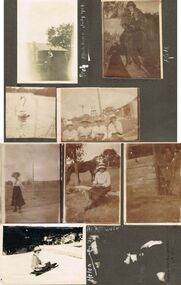
... Four ladies all wearing dark skirts and white blouses, all wearing broad rimmed hats, windmill tank on stand in background, tall post and wire netting, structure to the right, Kilmore October 1919. A Swan on the reservoir unknown place January 1920. lady...Four ladies all wearing dark skirts and white blouses, all wearing broad rimmed hats, windmill tank on stand in background, tall post and wire netting, structure to the right, Kilmore October 1919. A Swan on the reservoir unknown place January 1920. lady ...Series of Black and White Photos Post War Life for Hill Family & Friends. Total 8 Photos. Kath 'The Ranche' Eppalock September 1919. Kath dressed in 20's ? Dark dress, fur stole around neck, cloche hat, corrugated iron fence with wooden rail on top, garden setting. Arch, wearing white shirt waistcoat and dark trousers, gable roofed house in background, brick chimney left, tree at corner of house roof, Monte Video Queensland July 1924. Four ladies all wearing dark skirts and white blouses, all wearing broad rimmed hats, windmill tank on stand in background, tall post and wire netting, structure to the right, Kilmore October 1919. A Swan on the reservoir unknown place January 1920. lady wearing dark skirt and white blouse and hat, holding ball in left hand, right hand maybe swinging a tennis racquet ( not visible), post and rail fence in the far background. Lady sitting on stool wearing a dark skirt and white blouse, high post and wire netting fence, dark coloured horse to left, post and rail fence far right background, holding a camera bag and camera on stool beside her. Flirt the Dog, standing in doorway, door is broken and leaning to the right, shed has wide timber planks for cladding, 'The Ranche' Eppalock November 1919. Helen Mount Buffalo Tobogganing, wearing dark skirt, jacket with striped sleeves, and hat, August 1924.Hilda Hill Personal Collectionaustralia, history, post war life -
 Bendigo Historical Society Inc.
Photograph - HANRO COLLECTION: PHOTOGRAPH OF FOUR HANRO EMPLOYEES
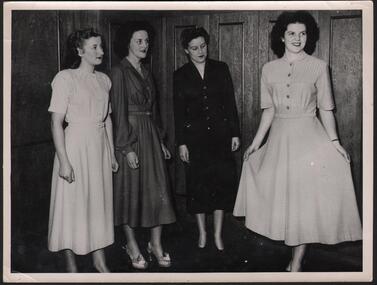
... The third lady is in a dark suit with a long sleeved tailored jacket with padded shoulders, V necked with a collar and five buttons down the centre. Pockets either side are trimmed with buttons. The suit has a straight skirt...The third lady is in a dark suit with a long sleeved tailored jacket with padded shoulders, V necked with a collar and five buttons down the centre. Pockets either side are trimmed with buttons. The suit has a straight skirt ...BHS CollectionPhotograph of four Hanro models: Black and white photo of four ladies modelling Hanro dresses.. Three ladies are wearing Hanro dresses and the fourth is in a tailored suit .On the left the dress is of light material and has short sleeves, padded shoulders, high neck with three darts either side at the next and four buttons down the centre. The dress has darts at the waist and is drawn in with a belt. Second lady from the left is wearing a long sleeve dress with padded shoulders set in sleeves, and gathered at the cuff and secured with a button. The bodice is V necked with a collar, has gathering at the shoulders and is buttoned up with two buttons down the centre, darts under the bust line and a belt is at the waist. The third lady is in a dark suit with a long sleeved tailored jacket with padded shoulders, V necked with a collar and five buttons down the centre. Pockets either side are trimmed with buttons. The suit has a straight skirt. The lady to the right is in a light coloured dress with short set in sleeves and a peter pan collar. At the top half of the bodice the dress has vertical pin tucking with five buttons down the centre. The waist has darts at the bust line and the skirt is of a gored style, there is a belt at the waist. The hem line are all below the knee and are all wearing high heals. The ladies are standing in front of a wall of wood panelling. On the back written in pencil is *Joyce, Yvonne and Clarice. Copyright Bendigo Advertiser. Bendigo Advertiser Photographic Service. For re-order Quote CK242. Box 116ABendigo advertiser Photographic Servicephotograph, person, hanro, hanro. bendigo advertiser photographic service -
 Flagstaff Hill Maritime Museum and Village
Clothing - Evening Outfit, before April 1874
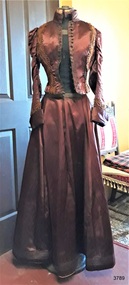
... This lady’s evening outfit is made from amber coloured satin fabric. It comprises a short-waisted, long-sleeved jacket and a long skirt, and it has its own neck-to-floor wooden mannequin on a pedestal. ...These items represent a period of interaction between the native and European peoples, highlighting the cultural exchanges that occurred within the region. flagstaff hill warrnambool shipwrecked coast flagstaff hill maritime museum maritime museum shipwreck coast flagstaff hill maritime village great ocean road evening outfit wedding outfit bridesmaid’ outfit matron of honour outfit clothing female clothing late 19th century clothing wedding late 19th century clothing bridesmaid late 19th century clothing antique clothing ladies women’s clothing women’s fashion alexander russell eliza russell eliza moore isabella mitchell bella mitchell bella russell isabella russell ralph russell ian mccusker ruby akers fredrick william akers ruby mclauchlan margaret jane mclaughlan nee mitchell margaret jane mclaughlan centenarian william mclaughlan robert russell elizabeth russell nee mitchell irish immigrants warrnambool volunteer defence corps 1938-1945 antique satin outfit warrnambool wedding 1874 congregational church warrnambool reverend uriah coombs dennington farmer yarpturk farmer purnim district farmer camperdown resident 1905 dennington bridge indigenous corroboree in dennington corroboree in warrnambool 1880s corroboree in warrnambool lubra and baby indigenous corroboree in warrnambool McCullagh family This lady’s evening outfit is made from amber coloured satin fabric. It comprises a short-waisted, long-sleeved jacket and a long skirt, and it has its own neck-to-floor wooden mannequin on a pedestal. ...This amber satin evening outfit was worn by Mrs Isabella Mitchell (nee Russell, 1840 – 1929) at the wedding of her brother Alexander (c.1846–1938) and Eliza (nee Moore, c.1854–1939). The jacket and skirt attach at the waist by joining the metal rings around the base of the jacket, and the metal hooks on the waistband of the skirt. The outfit was donated with its own mannequin and fits it perfectly. In the colonial days, outer clothing was rarely, if ever, washed, due to the expense of fabrics and the difficulty in careful laundering. Clever methods were employed to reduce the occurrence of soiling. The mannequin included with the donation would also help keep the outfit in good shape and ensure a flattering fit. FAMILIES’ HISTORY The families connected with this wedding, where the outfit was worn, are from Warrnambool’s colonial days. Isabella and Alexander’s parents, Robert Russell and Elizabeth (nee Mitchell), were born in 1808 and married about 1830. They were from farming families in Northern Ireland, where they raised their seven children before migrating to Australia in the early colonial days, around 1857. Their graves are in the Tower Hill Cemetery. Alexander’s wife, Eliza (nee Moore, born in 1854), was also from Northern Ireland and migrated to Australia in 1858 with her parents, Thomas and Nancy Moore, in the last voyage of the sailing ship “Chance”. Isabella (Bella) talked with her granddaughter Ruby Akers about her memories of Alexander and Eliza’s wedding and other events in her life. Ruby recorded these memories in a letter. She says, “They were married in the Warrnambool Congregational Church by a pioneer minister, the Reverend Uriah Coombs. The bride wore a pale blue silk wedding gown, which she made herself. Bella was Matron of Honora, and Ian McCasker was best man. In those days, the transport to the church was usually a carriage – similar to a cab – and a pair of white ponies. They would have the reception at home, go for a drive afterwards, and at night there would be a dance. They did all the catering themselves … Eliza carried on farming in the Dennington, Yarpturk and Purnim districts until they moved to Camperdown around 1905…” Ruby’s letter later mentions “[Isabella] could recall seeing a blackfellows’ corroboree being performed near where the Dennington Bridge now stands. It was rather a terrifying experience; they seemed to be in a warlike mood, and one never knew what they would do next. One lubra came running to Granny, crying, Hide me, bad man kill me. She was bleeding from a wound in the head: probably the result of a blow from a waddy. My mother [Margaret Jane McLaughlan nee Mitchell], coming home from school in the 1800s, often met blackfellows walking ahead with spears and boomerang, the two lubras – they usually had two – following in the rear, carrying the children or any burdens they had.“ Margaret was probably in primary school at the time she saw these things. Alexander and Eliza had ten children. One of their daughters, Margaret Jane, was born in Warrnambool in 1879. She married William McCullagh, and they had eleven children. Margaret made headlines in the Warrnambool newspapers for celebrating her 100th birthday. She had lived in the district for 60 years before moving to Melbourne. Alexander passed away at the age of 92, and Eliza passed away six months later, aged 85. Their graves are in the Colac cemetery. Isabella married Ralph Mitchell, and their daughter Margaret Jane married John McLauchlan in 1891. Margaret and John’s daughter, Ruby Elizabeth Jane, married Fredrick Akers in 1938. Fredrick, born in England, was a Boer War veteran and served in the British Army. He migrated to Queensland, Australia, in 1913, and joined the Australian Army to fight in World War I. In 1935, he moved to Warrnambool, where he served in the Volunteer Defence Corps from 1938 to 1945. Both Ruby and Fredrick are buried in the Tower Hill Cemetery.The evening outfit and its accompanying mannequin serve as notable examples of female fashion from the mid to late 1900s. These items reflect the styles and trends that were prevalent during this period, offering insight into the clothing choices and cultural influences that shaped women's attire. Beyond their representation of period fashion, the outfit and mannequin are significant due to their association with colonial pioneer families from Australia, specifically Victoria and Warrnambool. These families played an important role in the development and history of the region, and the items are linked to their legacy. The evening outfit and mannequin are also notable for their connection to a wedding that united two colonial families originating from Northern Ireland. These families immigrated to Australia in the mid-1850s and became influential figures within the Warrnambool district. The wedding marked a significant event, symbolising the merging of two prominent family lineages. Furthermore, the significance of the evening outfit and mannequin extends to their connection with the colonial families’ contact with the indigenous culture of the district. These items represent a period of interaction between the native and European peoples, highlighting the cultural exchanges that occurred within the region. This lady’s evening outfit is made from amber coloured satin fabric. It comprises a short-waisted, long-sleeved jacket and a long skirt, and it has its own neck-to-floor wooden mannequin on a pedestal. The outfit was worn by Mrs Isabella Mitchell (nee Russell) as the Matron of Honour at the wedding of her brother Alexander Russell and his fiancée Eliza Moore in Warrnambool, 29th April 1874.flagstaff hill, warrnambool, shipwrecked coast, flagstaff hill maritime museum, maritime museum, shipwreck coast, flagstaff hill maritime village, great ocean road, evening outfit, wedding outfit, bridesmaid’ outfit, matron of honour outfit, clothing female, clothing late 19th century, clothing wedding late 19th century, clothing bridesmaid late 19th century, clothing antique, clothing ladies, women’s clothing, women’s fashion, alexander russell, eliza russell, eliza moore, isabella mitchell, bella mitchell, bella russell, isabella russell, ralph russell, ian mccusker, ruby akers, fredrick william akers, ruby mclauchlan, margaret jane mclaughlan nee mitchell, margaret jane mclaughlan centenarian, william mclaughlan, robert russell, elizabeth russell nee mitchell, irish immigrants, warrnambool volunteer defence corps 1938-1945, antique satin outfit, warrnambool wedding 1874, congregational church warrnambool, reverend uriah coombs, dennington farmer, yarpturk farmer, purnim district farmer, camperdown resident 1905, dennington bridge, indigenous corroboree in dennington, corroboree in warrnambool, 1880s corroboree in warrnambool, lubra and baby, indigenous corroboree in warrnambool, mccullagh family -
 Flagstaff Hill Maritime Museum and Village
Clothing - Petticoat, late 19th century to early 20th century
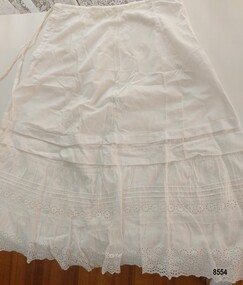
... A petticoat is a lady's undergarment - worn under a skirt or dress. They provided warmth, modesty and shape to the dress. ...A petticoat is a lady's undergarment - worn under a skirt or dress. They provided warmth, modesty and shape to the dress. ...This petticoat was one of several items donated from the estate of Susan Henry OAM nee Vedmore (1944 - 2021). It is in very good condition and appears to be from the Edwardian era - early 20th century. A petticoat is a lady's undergarment - worn under a skirt or dress. They provided warmth, modesty and shape to the dress. In the middle of the 19th century, petticoats were worn over hoops, bustles or in layers. Petticoats varied according to the style of the outside skirt or dress. Plain petticoats tended to be worn with everyday wear whilst better dresses (party dresses or silk gowns) were worn with petticoats that often had more trim and embellishments. Edwardian petticoats had less volume than Victorian era petticoats and they had a "dust ruffle" or lining under a lace flounce. The "dust ruffle" protected the lace flounce and gave the petticoat more flare at the bottom, greater freedom when walking as well as saving the flounce (which was often made of finer material) from everyday wear and tear. Tucks are another feature of Edwardian petticoats - when the lace at the bottom became worn, it could be cut off and the tucks released. This extended the life of the petticoat. This petticoat features an intricate trim of broderie anglaise. Although broderie anglaise was a lace that could be made by hand, it was very time consuming to make. St Gallen was a city in Switzerland that had become known for producing quality textiles. At the beginning of the 19th century, the first embroidery machines were developed in St Gallen. Factories used embroidery machines but people also had them in their homes. They were able to produce broderie anglaise for export. By the early 20th century, machine made lace, fabric, ribbons etc. were being sold in drapers shops all over England and Wales to women who were making clothes and furnishings for their families. It is highly likely that the lady who made this petticoat brought the lengths of broderie anglaise already made to embellish and personalise her petticoat. Susan's family (Harold and Gladys Vedmore) immigrated to Australia from Wales in 1955 and settled in Warrnambool. Susan was well known in the Warrnambool community for her work supporting children and families across the district - particular those with disabilities, or those who were homeless, unemployed or isolated. Susan was the founding trustee of the "Vedmore Foundation" - a Warrnambool philanthropic trust set up in 2010 to support a range of charitable and not-for-profit causes by providing grant assistance. In 2021, she was awarded a Medal of the Order of Australia for services to the community.This item is an example of the needlework skills of women in the late 19th century - creating pintucks and adding lace to personalise and embellish a practical item of clothing. It is also significant as an example of a practical solution to the difficulties that women of this era faced with regard to the washing of clothes and household linens.A white lawn petticoat with a 22.5 cm opening that fastens with 2 small buttons and a drawstring tie. It is decorated with two wide pintucks followed by two gathered frills (or flounces) - one decorated with three rows of narrow pintucks and a single row of broderie anglaise and the bottom frilled hem finished with 3 rows of broderie anglaise in a flower design. The two bottom frills are lined with plain white cotton fabric.flagstaff hill maritime museum and village, great ocean road, petticoat, lady's petticoat, undergarment, lady's undergarment, lingerie, edwardian petticoat, broderie anglaise, lace, machine made lace, hand sewn, machine sewn, draper's shop, susan henry oam, vedmore foundation -
 Flagstaff Hill Maritime Museum and Village
Textile - Petticoat, circa 1900
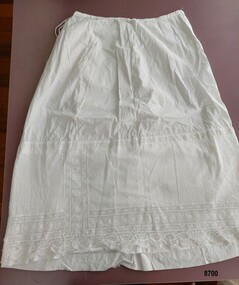
... A petticoat is a lady's undergarment - worn under a skirt or dress. They provided warmth, modesty and shape to the dress. ...A petticoat is a lady's undergarment - worn under a skirt or dress. They provided warmth, modesty and shape to the dress. ...This item is one of a collection of clothing items that belonged to the Stephenson family who lived at 22 McCracken Street, Kensington, Melbourne. Matthew Stephenson (1861 – 1943) who had grown up on the Bendigo goldfields and shifted to Melbourne in the early 1900’s was a train driver and later, a fireman with the railways. His wife Elizabeth Jane (Betsy) Wigley (1865 – 1953) also grew up on the goldfields around Majorca and Bendigo. They married in 1885 in Bendigo. They had two daughters – Ethel Evelyn Stephenson (1886 – 1956) and Lillian or Lila (1891 – 1977) who were milliners and dressmakers and who continued to live in the family home after the death of their parents. The family are recorded as living at 22 McCracken Street, Kensington, as early as 1914. It is not known who made or owned the clothing that makes up this collection but as it appears to be from the late Victorian and early Edwardian era, the different pieces were probably made and worn by any of the three ladies of the house – Betsy, Ethel and/or Lila. During W.W.2, a local Warrnambool couple (Meryl and Tony Everard) boarded with them – Tony was in the airforce training paratroopers to jump into (and survive) enemy territory and his wife Meryl worked in the Methodist baby Home. The Everards developed a close friendship with the Stephensons and were responsible for clearing out the house (and finding this clothing collection) after Lila died in 1977. A petticoat is a lady's undergarment - worn under a skirt or dress. They provided warmth, modesty and shape to the dress. In the middle of the 19th century, petticoats were worn over hoops, bustles or in layers. Petticoats varied according to the style of the outside skirt or dress. Plain petticoats tended to be worn with everyday wear whilst better dresses (party dresses or silk gowns) were worn with petticoats that often had more trim and embellishments. Edwardian petticoats had less volume than Victorian era petticoats and they had a "dust ruffle" or lining under a lace flounce. The "dust ruffle" protected the lace flounce and gave the petticoat more flare at the bottom, greater freedom when walking as well as saving the flounce (which was often made of finer material) from everyday wear and tear. Tucks are another feature of Edwardian petticoats - when the lace at the bottom became worn, it could be cut off and the tucks released. This extended the life of the petticoat. This petticoat features an intricate trim of broderie anglaise. Although broderie anglaise was a lace that could be made by hand, it was very time consuming to make. St Gallen was a city in Switzerland that had become known for producing quality textiles. At the beginning of the 19th century, the first embroidery machines were developed in St Gallen. Factories used embroidery machines but people also had them in their homes. They were able to produce broderie anglaise for export. By the early 20th century, machine made lace, fabric, ribbons etc. were being sold in drapers shops all over England and Wales to women who were making clothes and furnishings for their families. It is highly likely that the lady who made this petticoat brought the lengths of broderie anglaise already made to embellish and personalise her petticoat.This item is an example of the needlework skills of women in the late 19th century - creating pintucks and adding lace to personalise and embellish a practical item of clothing. A lady's fine cotton and lace ankle length petticoat featuring a deep decorative hem made from sheer pinspot fabric and bands of eyelet lace. The top section of the petticoat is made from five sections of fine cotton sewn together with french seams and gathered with pleats and darts into the waistband. The waistband opening has two button holes and one button (the top button is missing) and a front section with a drawstring. The lace hem is lined with the same fine cotton as the top of the petticoat. There are three different lace bands - a narrow one featuring small flowers, a similar wider band with larger flowers and it is finished at the bottom with a broad band of lace with an intricate leaf design.flagstaff hill maritime museum and village, great ocean road, warrnambool, shipwreck coast, petticoat, lady's petticoat, broderie anglaise, decorative petticoat, draw string waist, machine sewn, dressmaker, stephenson family, pintucks, needlework -
 Flagstaff Hill Maritime Museum and Village
Textile - Petticoat, circa 1910
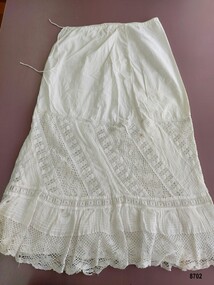
... A petticoat is a lady's undergarment - worn under a skirt or dress. They provided warmth, modesty and shape to the dress. ...A petticoat is a lady's undergarment - worn under a skirt or dress. They provided warmth, modesty and shape to the dress. ...This item is one of a collection of clothing items that belonged to the Stephenson family who lived at 22 McCracken Street, Kensington, Melbourne. Matthew Stephenson (1861 – 1943) who had grown up on the Bendigo goldfields and shifted to Melbourne in the early 1900’s was a train driver and later, a fireman with the railways. His wife Elizabeth Jane (Betsy) Wigley (1865 – 1953) also grew up on the goldfields around Majorca and Bendigo. They married in 1885 in Bendigo. They had two daughters – Ethel Evelyn Stephenson (1886 – 1956) and Lillian or Lila (1891 – 1977) who were milliners and dressmakers and who continued to live in the family home after the death of their parents. The family are recorded as living at 22 McCracken Street, Kensington, as early as 1914. It is not known who made or owned the clothing that makes up this collection but as it appears to be from the late Victorian and early Edwardian era, the different pieces were probably made and worn by any of the three ladies of the house – Betsy, Ethel and/or Lila. During W.W.2, a local Warrnambool couple (Meryl and Tony Everard) boarded with them – Tony was in the airforce training paratroopers to jump into (and survive) enemy territory and his wife Meryl worked in the Methodist baby Home. The Everards developed a close friendship with the Stephensons and were responsible for clearing out the house (and finding this clothing collection) after Lila died in 1977. A petticoat is a lady's undergarment - worn under a skirt or dress. They provided warmth, modesty and shape to the dress. In the middle of the 19th century, petticoats were worn over hoops, bustles or in layers. Petticoats varied according to the style of the outside skirt or dress. Plain petticoats tended to be worn with everyday wear whilst better dresses (party dresses or silk gowns) were worn with petticoats that often had more trim and embellishments. Edwardian petticoats had less volume than Victorian era petticoats and they had a "dust ruffle" or lining under a lace flounce. The "dust ruffle" protected the lace flounce and gave the petticoat more flare at the bottom, greater freedom when walking as well as saving the flounce (which was often made of finer material) from everyday wear and tear. Tucks are another feature of Edwardian petticoats - when the lace at the bottom became worn, it could be cut off and the tucks released. This extended the life of the petticoat. This petticoat features an intricate trim of broderie anglaise. Although broderie anglaise was a lace that could be made by hand, it was very time consuming to make. St Gallen was a city in Switzerland that had become known for producing quality textiles. At the beginning of the 19th century, the first embroidery machines were developed in St Gallen. Factories used embroidery machines but people also had them in their homes. They were able to produce broderie anglaise for export. By the early 20th century, machine made lace, fabric, ribbons etc. were being sold in drapers shops all over England and Wales to women who were making clothes and furnishings for their families. It is highly likely that the lady who made this petticoat brought the lengths of broderie anglaise already made to embellish and personalise her petticoat.This item is an example of the needlework skills of women in the late 19th century - creating pintucks and adding lace to personalise and embellish a practical item of clothing.A lady's ankle length petticoat made in three sections. The top section is made from three rectangles of fine cotton (batiste) joined into a round with narrow french seams and inserted into a simple drawstring waistband with a small opening. The second section is made with rows of alternating strips of fine pin tucked lawn, white cotton cut work embroidery and a wider cotton lace design all joined in a diagonal pattern and lined with fine lawn. The bottom section of the petticoat has a horizontal strip of eyelet lace followed by a wider strip of fine pin tucked lawn and is finished with a deep hem of white cotton crocheted lace fabric and has the same lawn lining as the section above.flagstaff hill maritime museum and village, great ocean road, shipwreck coast, warrnambool, petticoat, lady's petticoat, needlework, sewing, broderie anglaise, stephenson family, drawstring waistband -
 City of Moorabbin Historical Society (Operating the Box Cottage Museum)
Clothing - Clothing, lady's full length black dress, c1910
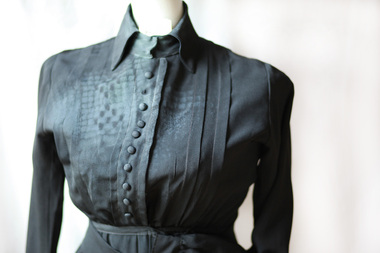
... A lady’s ankle length, black dress with a pleated skirt, buttoned bodice, a self belt and long sleeves... ankle length, black dress with a pleated skirt, buttoned bodice, a self belt and long sleeves Clothing Clothing, lady's full length black dress Blackburn family ...This ankle length black dress with pleated skirt , buttoned bodice, self belt and long sleeves is an example of the dressmaking skills of the women of the families of the pioneer settlers and market gardeners of the Moorabbin Shire c1910The Blackburn family were early settlers in Moorabbin Shire. The pioneer settlers and market gardeners of Moorabbin Shire had to be self reliant and made their own clothing and utensils. This is one of many items that exhibit the skill and craftsmanship of the women in these familiesA lady’s ankle length, black dress with a pleated skirt, buttoned bodice, a self belt and long sleevesclothing, brighton, moorabbin, pioneers, dressmaking, dendy henry, market gardeners, craft work, blackburn nance -
 City of Moorabbin Historical Society (Operating the Box Cottage Museum)
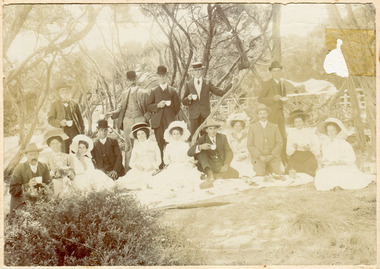
Photograph, The Cheltenham Market Gardner's Picnic, The Gardner's Picnic pre 1914-18 War, pre 1914-18
... Most of the ladies are wearing white dresses, one lady has a dark coloured skirt with a white frilly blouse, and all have large wide brimmed fashionably decorated hats . ...Most of the ladies are wearing white dresses, one lady has a dark coloured skirt with a white frilly blouse, and all have large wide brimmed fashionably decorated hats . ...The photograph is pre 1914-18. It is showing Cheltenham Market Gardeners having a picnic. The Market Gardeners gave Moorabbin it's first industry, which was to prove the most durable and resilient. The ladies and gentlemen are dressed in very fine clothes. All of the men are wearing suits with waistcoats and white shirts with neck ties. One man has a Boater hat , 4 have Bowler hats and 5 have Stetson hats. 5 men are standing and 4 men are kneeling or sitting with the ladies. The ladies are seated on the ground around a table runner on which items of food are seen. Most of the ladies are wearing white dresses, one lady has a dark coloured skirt with a white frilly blouse, and all have large wide brimmed fashionably decorated hats . They all seem to be dressed in their best clothes.The photograph depicts a group of men and women, 16 altogether, having a picnic pre World War 1 1914-1918 . They are surrounded by trees and bushes outside.Front of mount : R. McGeehan Photograph, Beechworth. Back of Mount Address Balaclava / C Whitehead / Gardeners Picnic / Pre World War 11914-18, moorabbin. picnic, market gardeners, early settlers, pioneers, moorabbin shire, cheltenham, fashion, dressmaking, bowler hats, boater hats, stetson hats, bonnets, chapeau, menswear, neckties, beechworth mcgeehan r, photographs, -
 City of Moorabbin Historical Society (Operating the Box Cottage Museum)
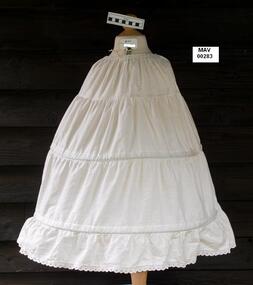
Clothing - Clothing, lady's 1/2 petticoat hooped, c1950
... Hooped cotton petticoats were used to support a polished cotton gathered calf length skirt during the RockNRoll era in the 1950,s Typical petticoat during the 1950,s clothing petticoats fashion moorabbin bentleigh cheltenham A lady's white cotton 1/2 petticoat with elasticised waist and 3 rows of inserted hoops. ...Hooped cotton petticoats were used to support a polished cotton gathered calf length skirt during the RockNRoll era in the 1950,s Typical petticoat during the 1950,sA lady's white cotton 1/2 petticoat with elasticised waist and 3 rows of inserted hoops. clothing, petticoats, fashion, moorabbin, bentleigh, cheltenham -
 Flagstaff Hill Maritime Museum and Village
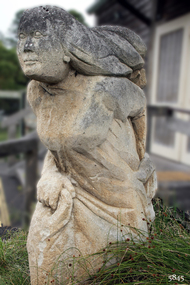
Sculpture - Limestone, Lady in the Wind
... Lady in the Wind" by Robert Ulmann. Subject is a robed woman moving forward, long hair streaming behind her, clutching fabric of skirt in each hand. ...Lady in the Wind" by Robert Ulmann. Subject is a robed woman moving forward, long hair streaming behind her, clutching fabric of skirt in each hand. ...The late Robert Ulmann (1927-1999) was a well-known local Warrnambool artist, creating murals, sculptures and art works. The sculpture 'Lady in the Wind' was presented to Flagstaff Hill Maritime Village by Dr Ivor (Ivor Philip Quentin Scott 16-08/1928 - 1/11/2016) and his wife Deirdre Scott (dec.). This sculpture is significant for being a creation of Robert Ulmann, well known local Warrnambool artist. The sculpture titled "Lady in the Wind" by Robert Ulmann. Subject is a robed woman moving forward, long hair streaming behind her, clutching fabric of skirt in each hand. Created in 1975. Made of Mount Gambier stone. Plaque describing the sculpture is on a nearby wall. The sculpture was presented to Flagstaff hill by Ivor and Deirdre Scott."Robert Ulmann / "LADY IN THE WIND " ' Sculpture, Mt Gambier Stone, 1975. / Presented by Ivor and Deirdre Scott "flagstaff hill, warrnambool, shipwrecked-coast, flagstaff-hill, flagstaff-hill-maritime-museum, maritime-museum, shipwreck-coast, flagstaff-hill-maritime-village, robert ulmann, sculpture in warrnambool, lady in the wind sculpture, warrnambool artist, flagstaff hill maritime village sculpture, ivor philip quentin scott, deirdre scott, ivor scott, lady in the wind -
 Orbost & District Historical Society
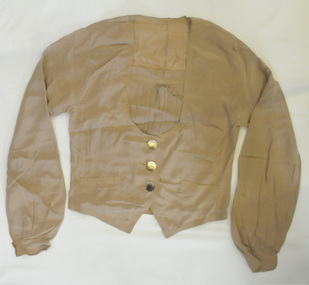
blouse, Early 20th century
... skirt when she worked in Brittannia Insurance as a comptometrist earning 12/6 per week. She stopped working when she was married in 1938 to a salesman who later became a mechanic in the R.A.F. during WW11 . This item is an example of a home-made item and reflects the handcraft skills of women during the first half of the 20th century. women's-clothing blouse burton-marjorie A lady's blouse - probably silk. ...Marjorie Burton ( nee Whiteman), born 12 June, in Birmingham, England came to Orbost in 1995 This item was made by Mrs Whiteman, Marjorie Burton's mother. Her mother was a milliner who made most of Marjorie’s clothes, hats and outfits.Marjorie Burton wore it to work with a skirt when she worked in Brittannia Insurance as a comptometrist earning 12/6 per week. She stopped working when she was married in 1938 to a salesman who later became a mechanic in the R.A.F. during WW11 . This item is an example of a home-made item and reflects the handcraft skills of women during the first half of the 20th century.A lady's blouse - probably silk. It has a square neckline, long sleeves with press studs on the cuffs. An pleated inset is attached with press studs. There are 3 large brown buttons to open the front.women's-clothing blouse burton-marjorie
