
Showing 109 items matching "lady best"
-
 Scout Heritage Victoria Centre and Archives
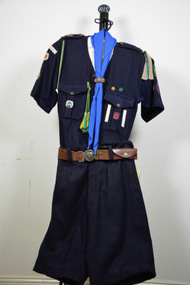
Uniform - Patrol Leader's Sea Scout uniform, c. 1920
... ...Lady Best...Shirt has Tenderfoot Badge, City of Camberwell District badge, Patrol Leaders Stripes, 1st/3rd Canterbury - Lady Best's Own/6th City of Camberwell tape. Shoulder Knot. 1st Class badge, King's Scout badge, Green All-Round Cord, 1 cub and 1 scout Service Star, plus proficiency badges:- 1st Aid (2), Designer, Carpenter, Cook, Jobman, Cyclist, Guide plus one unidentified. ...Scouts Lady Best Camberwell 6th City of Camberwell 1st City of Camberwell Sea Scouts Sea Scouts uniform 6th City of Camberwell Woollen Navy uniform. ...Woollen Navy uniform. Shirt has Tenderfoot Badge, City of Camberwell District badge, Patrol Leaders Stripes, 1st/3rd Canterbury - Lady Best's Own/6th City of Camberwell tape. Shoulder Knot. 1st Class badge, King's Scout badge, Green All-Round Cord, 1 cub and 1 scout Service Star, plus proficiency badges:- 1st Aid (2), Designer, Carpenter, Cook, Jobman, Cyclist, Guide plus one unidentified. The uniform also has Victorian Scarf with Wooden Woggle (1124), navy shorts, brown belt with pouch. Uniform for 16 year old.6th City of Camberwellscouts, lady best, camberwell, 6th city of camberwell, 1st city of camberwell, sea scouts, sea scouts uniform -
 Wangaratta Art Gallery
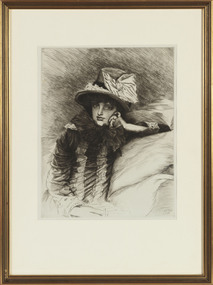
Print, James Jacques Joseph Tissot, Berthe, 1883
... A rectangular portrait etching of a 19th century European young lady dressed in her best attire seated in a fashionable manner, printed in black ink on white paper. ...This print was made using the printmaking technique of etching, which allowed Tissot to make multiply prints of a particular artwork to sell on mass at a more affordable price to the general population who wished to emulate the bourgeoisie lifestyle of the wealthy. james tissot 19th century print etching portrait tissot wangaratta art gallery Obverse: J J Tissot/ 1883 (Artist's signature and date - located in the bottom right corner of the print) A rectangular portrait etching of a 19th century European young lady dressed in her best attire seated in a fashionable manner, printed in black ink on white paper. ...James Tissot is most famous for his artwork that depicts the European bourgeois society of the late 19th century. This societal period is often referred to as La Belle Époque, where affluent bourgeoisie living created a complicated mode of manners and dress. This subject matter used in his art made Tissot popular with the bourgeois society, however it made him unpopular with critics who deemed his works as of loose morals due to his subject matter. Tissot’s art style of Realism also put him at odds with his fellow artists and friends such as Degas and Manet who were greats of the European Impressionist movement. This print was made using the printmaking technique of etching, which allowed Tissot to make multiply prints of a particular artwork to sell on mass at a more affordable price to the general population who wished to emulate the bourgeoisie lifestyle of the wealthy.RealismRural City of Wangaratta Collection, Purchased with funds from the Wangaratta Art CouncilA rectangular portrait etching of a 19th century European young lady dressed in her best attire seated in a fashionable manner, printed in black ink on white paper. Obverse: J J Tissot/ 1883 (Artist's signature and date - located in the bottom right corner of the print)james tissot, 19th century, print, etching, portrait, tissot, wangaratta art gallery -
 Bendigo Historical Society Inc.
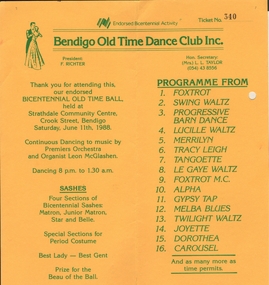
Document - BENDIGO OLD TIME DANCE CLUB PROGRAMME, JUNE 11TH, 1988
... Sashes: four sections of Bicentennial Sashes, Matron, Junior Matron, Star and Belle. Best Lady - Best Gent. Prize for the Beau of the Ball. ...Sashes: four sections of Bicentennial Sashes, Matron, Junior Matron, Star and Belle. Best Lady - Best Gent. Prize for the Beau of the Ball. ...Bendigo Old Time Dance Club Inc. President F. Richter, Hon Secretary Mrs L.L. Taylor. Printed on yellow paper with green letters. Top right hand side: ticket No. 340. Under the heading on the left: thank you for attending this, our endorsed Bicentennial Old Time Ball held at Strathdale Community Centre, Bendigo Saturday, June 11th, 1988. Continuous dancing to music by Premiers Orchestra and Organist Leon McGlashen. Dancing 8 pm to 1.30 am. Sashes: four sections of Bicentennial Sashes, Matron, Junior Matron, Star and Belle. Best Lady - Best Gent. Prize for the Beau of the Ball. On the right hand side the Programme from: Foxtrot, Swing Waltz, Progressive Barn Dance, Lucille Waltz, Merrylin, Tracy Leigh, Tangoette, Le Gaye Waltz, Foxtrot M.C., Alpha, Gypsy Tap, Melba Blues, Twilight Waltz, Joyette, Dorothea, Carousel.entertainment, dance, bendigo old time dance club -
 Orbost & District Historical Society
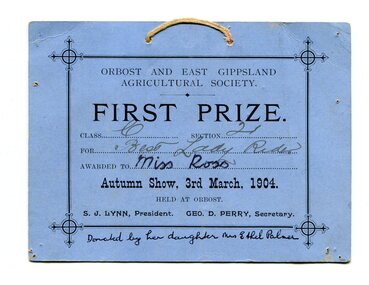
certificate/award, 1904
... First Prize in Class C Section 21 fot Best Lady Ridrer was awarded to Miss Ross. Orbost and East Gippsland Agricultural, Pastoral & Horticultural Society held their annual show in the Mechanics' Institute hall in Orrbost on November 16, 1894. ...First Prize in Class C Section 21 fot Best Lady Ridrer was awarded to Miss Ross. Orbost and East Gippsland Agricultural, Pastoral & Horticultural Society held their annual show in the Mechanics' Institute hall in Orrbost on November 16, 1894. ...Orbost & East Gippsland Agricultural Society held an Autumn Show on 3rd March, 1904. First Prize in Class C Section 21 fot Best Lady Ridrer was awarded to Miss Ross. Orbost and East Gippsland Agricultural, Pastoral & Horticultural Society held their annual show in the Mechanics' Institute hall in Orrbost on November 16, 1894. First Prize in Class F Section C was awarded to Elsie Price for "six buttonholes (children under 14)". At this time C.N. Henderson was President and Lauchlan Ross was Secretary. The first meeting to form an Agricultural society in Orbost was convened by the then Orbost Progress Association and held in the Mechanics Hall on Saturday, 10th October 1891. Its first show was held on 3rd March 1904, on a site alongside the Bonang Road where the present Golf Club stands. It is currently held at the Recreation Reserve at Newmerella. Ref: In Times Gone By-Deborah Hall Prior to the Orbost Agricultural Society 's Annual Show these smaller shows were held in the Mechanics' Institute hall.This item is associated with the Orbost Agricultural Society 's Annual Show which has been a major event in Orbost for over a century.A rectangular, blue card certificate with yellow cord threaded through two small holes at the top centre. Text is black inside a frame. Details of the award are hand-written.On front - "Donated by her daughter Mrs Ethel Palmer" -
 Flagstaff Hill Maritime Museum and Village
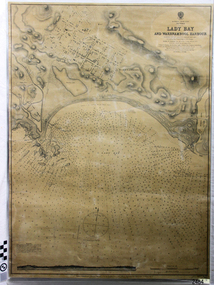
Document - Navigation Chart, Admiralty Office, Lady Bay and Warrnambool Harbour, 03/04/1871
... Lady Bay, Warrnambool Harbour. These are "Vessels entering Warrnambool Harbour must bring the Red Light in sight and steer in with it in line with the upper white Light bearing North, until the Green Light on the Jetty is opened, when steer towards it and anchor. The best...Lady Bay, Warrnambool Harbour. These are "Vessels entering Warrnambool Harbour must bring the Red Light in sight and steer in with it in line with the upper white Light bearing North, until the Green Light on the Jetty is opened, when steer towards it and anchor. The best ...This Chart titled “Lady Bay and Warrnambool Harbour” was surveyed by Nav. Lieut. H.J. Stanley, of Britain's Royal Navy, in 1870 and printed in April 1871. The chart was made before the Warrnambool Breakwater was built (construction had begun in 1874 and was completed in 1890). The chart includes Directions for entering Lady Bay, Warrnambool Harbour. These are "Vessels entering Warrnambool Harbour must bring the Red Light in sight and steer in with it in line with the upper white Light bearing North, until the Green Light on the Jetty is opened, when steer towards it and anchor. The best anchorage is in 2 ¼ fms [fathoms)] of water, about a cable from ledge off Breakwater rock. Or where convenient, according to draught of water, only endeavouring to anchor as close as possible to Breakwater rock. It is not safe to enter or leave the Harbour in south westerly or Southerly gales.” This chart is significant for its strong connection to the maritime history of Warrnambool Harbour and Lady Bay, and eventually to the Warrnambool Breakwater. The Warrnambool Breakwater is registered as a place of significance on the Victorian Heritage Database (VHR H2024). A copy of the same chart was used to plan several submissions for future changes to the jetty and breakwater. The chart is a historical record of structures existing in 1870; the Warrnambool Jetties, Lady Bay, the leading lights (lighthouses), streets, roads, bridges and many buildings. It also shows the lay of the land and seabed.Canvas chart of Australia, South Coast, Victoria Title: Lady Bay and Warrnambool Harbour Surveyed by Nav. Lieut. H.J. Stanley, R.N., 1870. Magnet Variation, 1870 Published April 3, 1871, by the Admiralty, London. Directions for vessels entering Warrnambool Harbour are printed on the chart. The chart has a lacquer or seal over it.Top of chart has logo "HYDROGRAPHER OFFICE" "Price Eighteen Pence". "Engraved by Edward Weller" Along bottom of Chart: “London… Published at the Admiralty, 3rd April 1871, under the Superintendence of Rear Admiral G.H. Richards, F.R.S. Hydrographer, Corrections July 71” Bottom of chart “Australia South Coast Victoria Lady Bay and Warrnambool Harbour. 2494”flagstaff hill, warrnambool, chart of lady bay warrnambool 1870, warrnambool harbour, cartography, navigation, warrnambool breakwater, 1871, australia – south coast / victoria, lady bay, 1870, nav. lieut. h.j. stanley, r.n, directions for entering warrnambool harbour, hydrographer office, rear admiral g.h. richards, edward weller, port of warrnambool, flagstaff hill maritime museum & village, maritime museum, maritime village, shipwreck coast, map, chart, navigation chart, admiralty chart, breakwater, jetty, pier, vhr h2024 -
 Federation University Historical Collection
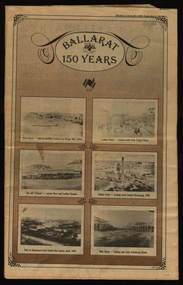
Newspaper, Ballarat 150 Years: Supplement to the Ballarat Courier, 1988, 17/03/1988
... Articles include: 1838-the pastoral period begins; First White Settlers arrive (Anderson, Winter, Yuille, Kirkland, Learmonth); Learmonths - Pioneer Settlers; The Rush to Ballarat; Last of the Aborigines; Eureka Affair Gains New Importance; Mining-After the rush; SMB - First Technical School; Clubs Play their Part; Ballarat Yuilles had Wealthy Ancestors; Town, Country Share a Close Relationship; Many Sides to Metals Industry; True Victorian City; Five Severe Recessions; Financiers to the Fore; Ready for War; City Rich in Sport Facilities; Visitors to most exciting place; No Place for a Nervous Lady; Theatres Provide Welcome Diversion for Mines; Might Achievers Among famous Citizens; Life Seemed Different After the War; Ballarat School of Mines Eastern Station Hotel; Memorial (Her Majesty's) Last of Many Theatres; Art Gallery at its Best; Pilgrimage to Yuille Cairn at Sebastopol Images include: Jelbart tractor; Sunshine Harvester; Bailey's Mansion; Pennyweight Hotel; Bridge Mall; Blue Riband Mine, Black Hill, Burrumbeet Shooting party; A wendouree rowing club; Motor Cycle Racing; Women bowlers, Queen Elizabeth; Gong Gong Methodist Church; Arbour day at Waterloo Farm, Smythes Rd; Gold panners (1890s); Ballarat Cricket Team (1902); William Peart; D'Angri's store; Sturt St Advertisements include: Rehfisch and Co.; UFS Dispensaries; Deutscher Mower Sales and Service; Haymes Paint; Cincotta's; Abraham's Sportscene; McK's; McKay Macleod; St John of God Hospital; Benjamins Real Estate; Ballarat Water Board; Cornell's Pharmacy; Laminex Industries; Coltman Mitre 10; Lal Lal Iron Mine; Heinz Bros; Crockers; Frank ford travel; S.J. ...Articles include: 1838-the pastoral period begins; First White Settlers arrive (Anderson, Winter, Yuille, Kirkland, Learmonth); Learmonths - Pioneer Settlers; The Rush to Ballarat; Last of the Aborigines; Eureka Affair Gains New Importance; Mining-After the rush; SMB - First Technical School; Clubs Play their Part; Ballarat Yuilles had Wealthy Ancestors; Town, Country Share a Close Relationship; Many Sides to Metals Industry; True Victorian City; Five Severe Recessions; Financiers to the Fore; Ready for War; City Rich in Sport Facilities; Visitors to most exciting place; No Place for a Nervous Lady; Theatres Provide Welcome Diversion for Mines; Might Achievers Among famous Citizens; Life Seemed Different After the War; Ballarat School of Mines Eastern Station Hotel; Memorial (Her Majesty's) Last of Many Theatres; Art Gallery at its Best; Pilgrimage to Yuille Cairn at Sebastopol Images include: Jelbart tractor; Sunshine Harvester; Bailey's Mansion; Pennyweight Hotel; Bridge Mall; Blue Riband Mine, Black Hill, Burrumbeet Shooting party; A wendouree rowing club; Motor Cycle Racing; Women bowlers, Queen Elizabeth; Gong Gong Methodist Church; Arbour day at Waterloo Farm, Smythes Rd; Gold panners (1890s); Ballarat Cricket Team (1902); William Peart; D'Angri's store; Sturt St Advertisements include: Rehfisch and Co.; UFS Dispensaries; Deutscher Mower Sales and Service; Haymes Paint; Cincotta's; Abraham's Sportscene; McK's; McKay Macleod; St John of God Hospital; Benjamins Real Estate; Ballarat Water Board; Cornell's Pharmacy; Laminex Industries; Coltman Mitre 10; Lal Lal Iron Mine; Heinz Bros; Crockers; Frank ford travel; S.J. ...A supplement to celebrate 150 since the establishment of the Port Phillip Colony (Victoria).40 page newspaper published to celebrate the Sesquicentenary of Ballarat. Articles include: 1838-the pastoral period begins; First White Settlers arrive (Anderson, Winter, Yuille, Kirkland, Learmonth); Learmonths - Pioneer Settlers; The Rush to Ballarat; Last of the Aborigines; Eureka Affair Gains New Importance; Mining-After the rush; SMB - First Technical School; Clubs Play their Part; Ballarat Yuilles had Wealthy Ancestors; Town, Country Share a Close Relationship; Many Sides to Metals Industry; True Victorian City; Five Severe Recessions; Financiers to the Fore; Ready for War; City Rich in Sport Facilities; Visitors to most exciting place; No Place for a Nervous Lady; Theatres Provide Welcome Diversion for Mines; Might Achievers Among famous Citizens; Life Seemed Different After the War; Ballarat School of Mines Eastern Station Hotel; Memorial (Her Majesty's) Last of Many Theatres; Art Gallery at its Best; Pilgrimage to Yuille Cairn at Sebastopol Images include: Jelbart tractor; Sunshine Harvester; Bailey's Mansion; Pennyweight Hotel; Bridge Mall; Blue Riband Mine, Black Hill, Burrumbeet Shooting party; A wendouree rowing club; Motor Cycle Racing; Women bowlers, Queen Elizabeth; Gong Gong Methodist Church; Arbour day at Waterloo Farm, Smythes Rd; Gold panners (1890s); Ballarat Cricket Team (1902); William Peart; D'Angri's store; Sturt St Advertisements include: Rehfisch and Co.; UFS Dispensaries; Deutscher Mower Sales and Service; Haymes Paint; Cincotta's; Abraham's Sportscene; McK's; McKay Macleod; St John of God Hospital; Benjamins Real Estate; Ballarat Water Board; Cornell's Pharmacy; Laminex Industries; Coltman Mitre 10; Lal Lal Iron Mine; Heinz Bros; Crockers; Frank ford travel; S.J. Weir; Ludbrook Plumbing Service; Mars; Robert Sim Building Supplies, Frank Day; Sectrol Systems; Thornton Richardsballarat, anniversary, sydney abraham, cincotta, eureka, ballarat school of mines, mining, ballarat club, lal lal iron mine, ballarat rangers, victorian rifles, 3rd battalion victorian rifles, ballarat militia, white flat, celia scott, adelphi theatre, victoria theatre, montezuma theatre, charlie napier, juliamatthews, royal theatre, dick richards, henry sutton, eleanor lucus, martin hosking, newington estate, saleyards, g. gay & co, ballarat books, old benev' alleviated distress on goldfields -
 Flagstaff Hill Maritime Museum and Village
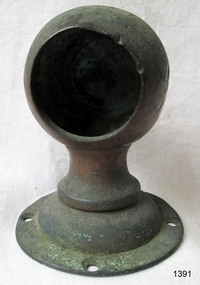
Functional object - Rail holder, About 1893, when the ship was made
... best documented of all sailing ships owned in New Zealand”. Her record books, ship logs, correspondence and supporting papers are still available. At the time of the tragedy, she was owned by Messers David C.Turnbull and Co. of Timaru, New Zealand timber merchants and shipping agents, who had purchased her on 13th December 1901. A detailed account of the last journey of La Bella can be read in “Leonard Robertson, the Whangaroa & La Bella” written by Jack Churchouse, published in 1982 by Millwood Press Ltd, Wellington, NZ. Some 15 – 17 ships are believed to have sunk in Lady...best documented of all sailing ships owned in New Zealand”. Her record books, ship logs, correspondence and supporting papers are still available. At the time of the tragedy, she was owned by Messers David C.Turnbull and Co. of Timaru, New Zealand timber merchants and shipping agents, who had purchased her on 13th December 1901. A detailed account of the last journey of La Bella can be read in “Leonard Robertson, the Whangaroa & La Bella” written by Jack Churchouse, published in 1982 by Millwood Press Ltd, Wellington, NZ. Some 15 – 17 ships are believed to have sunk in Lady ...This brass rail holder fixture would have been used to hold the end of a rail in place. There is no information as to where the fitting or rail would have been placed on the ship; sailing ships had many brass fittings. It was recovered from the wreck of the La Bella, which lies at the bottom of the Warrnambool Harbour. Some 15 ships are believed to have been wrecked in Lady Bay, but only two have been discovered on the sea floor; the La Bella and the Edinburgh Castle. Both wrecks are popular diving sites and are preserved as significant historical marine and marine archaeological sites. The story of the final voyage of the La Bella is summarised as follows … The ship from which the sailors were rescued was the three-masted, iron and steel barquentine the La Bella, built in Norway in 1893. She was one of two iron and steel ships by Johan Smith, the company being one of the leading shipping families in Tvedestrand, Norway. She was significant to Norwegian shipping, being one of only 27 iron and steel ships ever built in Norway. She was registered in New Zealand and engaged from 1902 in inter-colonial trading of timber in the pacific, between New Zealand and Australia and was often in Port Phillip Bay, Victoria. On 5th October, 1905, the twelve year old La Bella left Lyttleton, New Zealand carrying a cargo of timber bound for Warrnambool, Australia . She was manned by a crew of twelve: the Master, (Captain Mylius, previously 1st Mate of La Bella, appointed Captain to La Bella on 6th February 1903) 2 Mates, Cook, six able seamen, one ordinary seaman and a boy. . Bad weather en route caused her to shelter at Burnie on Tasmania's North West coast. On November 10th, the 37th day of her journey, La Bella approached Warrnambool. Captain Mylius steered her towards Lady Bay Channel in heavy south-west seas and evening mist. He ordered the helmsman to steer for the light. As the ship came round, a tremendous sea struck her on the port quarter, causing her to breach broadside in a north-westerly direction into breakers. The helm was brought round twice more, but each time heavy seas broke over her, the third time throwing the La Bella on to a submerged reef in Lady Bay now known as La Bella Reef (about 100 yards from the Warrnambool breakwater). The sea was so rough that it even wrenched a one-and-a-half ton anchor from its fastenings and into the sea. As Captain Mylius headed to the steel wheelhouse, intending to send up a rocket flare, a huge sea slammed the steel door into him (resulting in massive bruising front and back) Despite his injuries he still managed to set off a blue light, which he held up in his hands. La Bella’s lifeboats were filled with sea water and broke up on their chocks. The blue light was the first indication to people on shore that there was a ship in distress. The Harbour Master, Captain Roe (who lived in the Harbour Master’s House opposite Flagstaff Hill), organised a group of volunteers to crew the lifeboat because the trained crew was unavailable; the crewmen were working on a steamer in Port Fairy at the time. He then poured oil onto the water to try and smooth the sea. At around 11pm three of the crew took shelter in the steel forecastle but the sea crashed into it and broke it up. While the rest of the crew and onlookers watched helplessly in the moonlight the bodies were washed away into the sea, never to be seen again. Some of the crew lashed themselves to the weather rail to keep from being washed away. Watson, the ordinary seaman, became tangled in the rigging lines and was too weak to move, so the 2nd Mate, Robertson, put a line onto him so that he wouldn’t wash off. Around 11pm three of the crew were unconscious from exhaustion. The situation on La Bella was becoming dangerous. The 2nd Mate moved to the ‘house’ and soon afterwards the ship slipped in the heavy sea. The lashings of the 1st Mate and the ‘boy’ Denham had kept them safe until about 2am when they were washed overboard; no one was able to help. One by one, the exhausted crew were being washed overboard, too weak to hold on any longer. During the night the La Bella had broken into two and the deckhouse ran out towards the sea. Two more men drowned when trying to reach the lifeboat. By sunrise the only survivors of the twelve were the Master, 2nd Mate and three seamen. Early in the morning Captain Roe used the rocket apparatus on shore to try and shoot a line to the ship for a safer rescue but each attempt fell short of the target. Several attempts were made by the lifeboat to rescue the stricken sailors, but the rough conditions made this difficult for the boat to get close enough to the ship and the lifeboat had to return to shore. During a final attempt to reach the ship Captain Mylius ordered his men to jump into the sea. Leonard Robertson, 2nd mate, jumped and swam towards the lifeboat, taking hold of the boat hook offered to him. Oscar Rosenholme managed to reach the boat floating on a piece of timber from the ship’s load and a third survivor, Noake, also made the boat. Along with the lifeboat rescue crew, 25 year old William Ferrier rowed his small dingy through the heavy seas and managed to rescue the Captain, whom he landed on the breakwater. Ferrier then returned to the ship to attempt a final rescue, losing his oars and rowlocks into the high sea. Using just a spare paddle he skulled towards the La Bella, reaching her stern in time to cut loose the lone surviving sailor, Payne, from the lashing that held him to the ship; the terrified sailor dropped from the ship and into the dingy. Shortly after the last man was rescued, the La Bella was lifted by a huge wave and crashed back down on the reef; she broke up and sank. The ordeal had lasted ten hours. The survivors were taken to the nearby Bay View Hotel and gratefully received warm food and clothing, medical attention and a place to sleep. In the following days an unidentified body of a young person was washed ashore; it was either Watson or Denham. The body was buried in the Warrnambool cemetery with an appropriate gravestone and inscription. William Ferrier became a national hero as news of the daring rescue spread. In recognition of his bravery in the two daring rescues he was awarded the Silver Medal for Bravery by the Royal Humane Society and was honoured in the letter from the Prime Minister and the Parliament of the Commonwealth, telegrams and a cheque for £20 from the Governor General, over £150 subscribed by the public, including Warrnambool and district and readers of The Argus, and a gold medal from the Glenelg Dinghy Club of South Australia. Ferrier’s rescue efforts are one of the most heroic in Victoria’s shipwreck history. (William Ferrier’s son, Frank, received a similar award almost fifty years later, when he helped rescue four members of the crew on the yacht Merlan, after it ran on to a reef near the Point Lonsdale Lighthouse. ) The wreck of La Bella now lies on her port side in 13 metres of sheltered water inside the reef she struck. The bow section is relatively intact and part of the stern has drifted north-easterly towards the mouth of the Hopkins River. The reef the La Bella struck now bears its name. Those five rescued from the La Bella were Captain George Mylius, Leonard Robertson (2nd Mate, 21 years old), R. Payne, Oscar Rosenholme and Jack Noake. Those seven who lost their lives were Mr Coulson (1st mate), Charles Jackman (cook) Gustave Johnson, Pierre Johann and Robert Gent (all able seamen), Harry Watson (ordinary seaman) and Jack Denham (ship’s boy), Captain Mylius was found guilty of careless navigation; he had sailed into the bay without the services of a pilot. His Master Certificate was suspended for twelve months. Later he was also charged with manslaughter of one of the crew who had died when the La Bella was wrecked, but found not guilty. The event’s adverse publicity and damage to his career took a toll on his health and he died of a heart attack six months after the wreck; he was only thirty-seven. His body was buried in the Melbourne General Cemetery. The La Bella was “the best documented of all sailing ships owned in New Zealand”. Her record books, ship logs, correspondence and supporting papers are still available. At the time of the tragedy, she was owned by Messers David C.Turnbull and Co. of Timaru, New Zealand timber merchants and shipping agents, who had purchased her on 13th December 1901. A detailed account of the last journey of La Bella can be read in “Leonard Robertson, the Whangaroa & La Bella” written by Jack Churchouse, published in 1982 by Millwood Press Ltd, Wellington, NZ. Some 15 – 17 ships are believed to have sunk in Lady Bay, but only two have been discovered on the seafloor; the “La Bella” and the “Edinburgh Castle”. Both wrecks are popular diving sites and are preserved as significant historical marine and marine archaeological sites. As well as this letter, Flagstaff Hill’s La Bella Collection includes a photograph of the wrecked La Bella, a brass rail holder and a postcard of William Ferrier with four of the survivors. This original congratulatory letter sent to William Ferrier by the Prime Minister and Government of Australia demonstrates the importance attached to his efforts for Victoria and to Australia. The letter is part of the La Bella Collection and is significant at both a local and state level. Its connection to the La Bella shipwreck and the rescue of five survivors highlights the dangers of Victoria’s Shipwreck Coast. The letter to William Ferrier from the Australian Government acknowledges the bravery of ordinary Australians who risked their lives to save victims of shipwrecks along the coast. The letter is significant to the history of Warrnambool as it honours William Ferrier, a local fisherman whose descendants continue to live in the area. It highlights the way of life of people who lived in coastal towns in 19th century Victoria and the effects of shipwrecks upon them. The letter connects to the postcard of William Ferrier with four of the five rescued crew, the photograph of the wreck of the La Bella and the artefact from the wreck, the rail holder. This item is significant because of its association with the sailing ship “La Bella” . the “La Bella” is of local and state and national significance. It is one of the only two shipwrecks discovered in Lady Bay, Warrnambool, out of the 15-17 shipwrecks in the bay. Brass rail holder from the wreck "La Bella". This rail holder would have been used as a fitting for the end of a rail. It is made up of two parts and looks a little like a goblet in shape. The top is a hollow spherical shape with a circular hole cut out on one side, into which the end of a round rail would fit. There are two gouge marks close to each other on one side of the hole, about one centimetre apart, at 1 and 2 o’clock position. The sphere has a hollow pipe-like stem with a screw thread turned into the outside of the lower section and the bottom of the stem has been flared out after having the base fitted. The base is round and has a mound in the centre. The edge has four evenly spaced fixture holes around its edge. The metal shows signs of pitting and has mild encrustation. The fitting of the base is loose, allowing it to swivel in a complete circle. The top of the sphere is rough and has a dent in it. Underneath the base there is verdigris; some has flaked off and reveals a bright golden colour underneath. rail holder, brass rail holder, la bella, lady bay, norway, 1893, new zealand, captain mylius, william ferrier, flagstaff hill, warrnambool, shipwrecked coast, flagstaff hill maritime museum, maritime museum, shipwreck coast, flagstaff hill maritime village -
 Blacksmith's Cottage and Forge
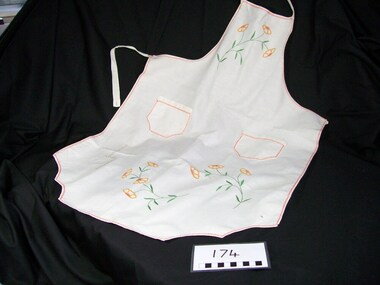
Apron, Costume Domestic
... The 'Sunday Best' status helped to present a civilised look to the one day of No work and Church in a family's weekly life. embroidery hand domestic linen silk crafted apron sunday best stranded ties A lady's linen, hand embroidered full apron. ...An item of Local significance for women in use of decorating their Domestic life in the mid 1920's. Usually these items were constructed with the use of their own handicrafts. The 'Sunday Best' status helped to present a civilised look to the one day of No work and Church in a family's weekly life.A lady's linen, hand embroidered full apron. Orange Flowers(Button hole stitch), green leaves (satin stitch) Featherstitch on pockets and edges of the garment.1 Tie is missing meaning that the apron cannot be worn.embroidery, hand, domestic, linen, silk, crafted, apron, sunday best, stranded, ties -
 The Beechworth Burke Museum
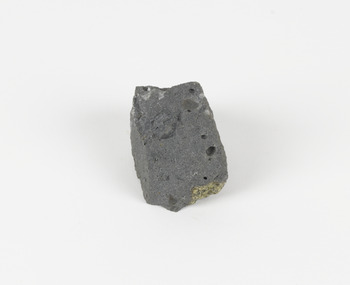
Geological specimen - Basalt (igneous-volcanic) containing Olivine, unknown
... best in the world. During his years spent in Australia, Selwyn collected numerous significant geological specimens, examples of which are held in collections such as the Burke Museum. This geological specimen is an example of basalt and olivine which shows the volcanic lava activity and geographical specific nature of Mt Franklin as a significant volcanic site. According to Agriculture Victoria 'The crater is one of the deepest in the Central Highlands area. It is a major megacryst site with some of the largest known Victorian examples of megacrysts of augite and an orthoclase. The small parasitic mound of Lady ...This particular geological specimen was found in Mount Franklin or Lalgambook in Djadjawurrung, located between Daylesford and Newstead, approximately ninety minutes drive from Melbourne. The mountain is an example of a breached scoria cone (a steep conical hill of loose pyroclastic fragments) which was created by a volcanic eruption about 470,000 years ago, a date which may indicate the age of this geological specimen. The volcanic eruptions of Mount Franklin were most likely witnessed by members of the Dja Dja Wurrung Aboriginal tribe, who referred to this country as the 'smoking grounds'. Mount Franklin and the surrounding area appears to have been a place of considerable religious significance to Aboriginal people, there is evidence which indicates that frequent large ceremonial gatherings took place in the area. Basalt is the most common rock on Earth’s surface, more than 90% of all volcanic rock on Earth is basalt. Basalt is an aphanitic extrusive igneous rock formed from the rapid cooling of low-viscosity lava exposed at or very near the surface of a rocky planet or moon. Specimens are black in colour and weather to dark green or brown. Basalt is rich in iron and magnesium and is mainly composed of olivine, pyroxene, and plagioclase. Olivine is the name of a group of rock-forming silicate minerals with compositions ranging between Mg2SiO4 and Fe2SiO4. Unlike other minerals, Olivine has a very high crystallisation temperature which makes it the first of the minerals to crystallise from magma. As magma cools, the crystals begin to form and settle on the bottom of the lava and form basalts that are abnormally enriched in olivine in the lower part of lava flows. According to H. M. King (on geology.com) "Olivine is thought to be an important mineral in Earth's mantle. Its presence as a mantle mineral has been inferred by a change in the behaviour of seismic waves as they cross the boundary between Earth's crust and mantle". Lava from Mount Franklin and other volcanoes in the area filled valleys and buried the gold bearing streams that became the renowned ‘deep leads’ of the gold mining era. In 1852, as part of the Victorian gold rush, gold was discovered in the immediate area, this gold was created by lava flows during the Newer Volcanic period, which were mined intensively during the nineteenth century. Around 1865 the presence of a deep lead in Mount Franklin was established. Deep lead mining was initially unsuccessful, and it was not until the late 1870s that the Franklinford Gold Mining Company mined at Mount Franklin on a significant scale. A few years later the Mount Franklin Estate Gold Mining Company also struck gold, followed by the Shakespeare and Great Western companies in the mid-1880s. By the late 1880s, however, deep lead mining had ceased in the area. Soon after gold was discovered in 1851, Victoria’s Governor La Trobe wrote to the Colonial Office in London, urging ‘the propriety of selecting and appointing as Mineral Surveyor for this Colony a gentleman possessed of the requisite qualifications and acquaintance with geological science and phenomena’. Alfred Selwyn was appointed geological surveyor in Australia in 1852 which began the Geological Survey of Victoria. In 1853-69 the Geological Survey issued under Selwyn's direction sixty-one geological maps and numerous reports; they were of such high standard that a writer in the Quarterly Journal of the Geological Society of London bracketed the survey with that of the United States of America as the best in the world. During his years spent in Australia, Selwyn collected numerous significant geological specimens, examples of which are held in collections such as the Burke Museum.This geological specimen is an example of basalt and olivine which shows the volcanic lava activity and geographical specific nature of Mt Franklin as a significant volcanic site. According to Agriculture Victoria 'The crater is one of the deepest in the Central Highlands area. It is a major megacryst site with some of the largest known Victorian examples of megacrysts of augite and an orthoclase. The small parasitic mound of Lady Franklin on the western flanks adds to the geological interest of the site'. This specimen also highlights the locality as a significant place for both indigenous activity and Victorian gold rush era mining practices. This specimen is part of a larger collection of geological and mineral specimens collected from around Australia (and some parts of the world) and donated to the Burke Museum between 1868-1880. A large percentage of these specimens were collected in Victoria as part of the Geological Survey of Victoria that begun in 1852 (in response to the Gold Rush) to study and map the geology of Victoria. Collecting geological specimens was an important part of mapping and understanding the scientific makeup of the earth. Many of these specimens were sent to research and collecting organisations across Australia, including the Burke Museum, to educate and encourage further study.An angular, solid hand-sized piece of grey volcanic Basalt with green/brown Olivine phenocrysts along one flat edge.Olivine in basalt / - label is probably / correct. / C. Willman / 15/4/21burke museum, beechworth, indigo shire, beechworth museum, geological, geological specimen, mineralogy, basalt, igneous rock, igneous-volcanic, volcanic geology, volcanic, olivine, olivine specimen, basaltoid -
 Marysville & District Historical Society
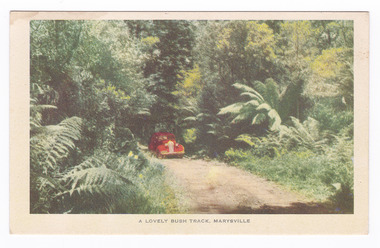
Postcard (item) - Colour postcard, Nucolorvue Productions, A Lovely Bush Track, Marysville, 1950's
... Lady Sarah Elizabeth, the wife of Sir Reginald Talbot, who was the Governor of Victoria from 25th April, 1904 to 6th July 1908. This road was originally constructed as a corduroy road (or log road) is a type of road or timber trackway made by placing logs, perpendicular to the direction of the road over a low or swampy area. The result is an improvement over impassable mud or dirt roads, yet rough in the best ...An early colour photograph of a car travelling along Lady Talbot Drive in Marysville in Victoria.An early colour photograph of a car traveling along Lady Talbot Drive in Marysville in Victoria. Lady Talbot Drive a 24 kilometer scenic rainforest car journey which passes a number of walks and waterfalls in the Yarra Ranges National Park. Lady Talbot Drive is named after Lady Sarah Elizabeth, the wife of Sir Reginald Talbot, who was the Governor of Victoria from 25th April, 1904 to 6th July 1908. This road was originally constructed as a corduroy road (or log road) is a type of road or timber trackway made by placing logs, perpendicular to the direction of the road over a low or swampy area. The result is an improvement over impassable mud or dirt roads, yet rough in the best of conditions and a hazard to horses due to shifting loose logs. This postcard was produced by Nucolorvue Productions in Elwood, Victoria as a souvenir of Marysville.POST CARD NUCOLORVUE PRODUCTIONS, ELWOOD, VICTORIAmarysville, victoria, nucolorvue productions, postcard, souvenir, lady talbot drive, lady talbot forest drive, sir reginald talbot, lady sarah elizabeth talbot, corduroy road -
 Marysville & District Historical Society
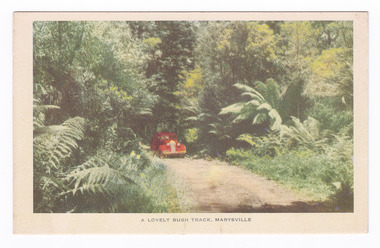
Postcard (item) - Colour postcard, Nucolorvue Productions, A Lovely Bush Track, Marysville, 1950's
... Lady Sarah Elizabeth, the wife of Sir Reginald Talbot, who was the Governor of Victoria from 25th April, 1904 to 6th July 1908. This road was originally constructed as a corduroy road (or log road) is a type of road or timber trackway made by placing logs, perpendicular to the direction of the road over a low or swampy area. The result is an improvement over impassable mud or dirt roads, yet rough in the best ...An early colour photograph of a car traveling along Lady Talbot Drive in Marysville in Victoria.An early colour photograph of a car traveling along Lady Talbot Drive in Marysville in Victoria. Lady Talbot Drive a 24 kilometer scenic rainforest car journey which passes a number of walks and waterfalls in the Yarra Ranges National Park. Lady Talbot Drive is named after Lady Sarah Elizabeth, the wife of Sir Reginald Talbot, who was the Governor of Victoria from 25th April, 1904 to 6th July 1908. This road was originally constructed as a corduroy road (or log road) is a type of road or timber trackway made by placing logs, perpendicular to the direction of the road over a low or swampy area. The result is an improvement over impassable mud or dirt roads, yet rough in the best of conditions and a hazard to horses due to shifting loose logs. This postcard was produced by Nucolorvue Productions in Elwood, Victoria as a souvenir of Marysville.POST CARD NUCOLORVUE PRODUCTIONS, ELWOOD, VICTORIAmarysville, victoria, nucolorvue productions, postcard, souvenir, lady talbot drive, lady talbot forest drive, sir reginald talbot, lady sarah elizabeth talbot, corduroy road -
 Marysville & District Historical Society
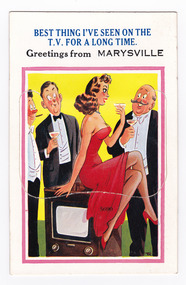
Postcard (item) - Novelty postcard, Valentine Publishing Co. Pty. Ltd, BEST THING I'VE SEE ON THE T.V. FOR A LONG TIME.-Greetings from MARYSVILLE, 1940's-1960's
... lady is also drinking a glass of wine whilst sitting on the top of a television. The title of the postcard is across the top edge of the postcard.There is a lift-up flap in the middle with a pull-out strip of 9 miniature photographs of places of interest in and around Marysville. BEST ...A novelty postcard with pull-out strip of 9 miniature photographs that was produced by the Valentine Publishing Co as a souvenir of Marysville.A novelty postcard with pull-out strip of 9 miniature photographs that was produced by the Valentine Publishing Co as a souvenir of Marysville.BEST THING I'VE SEEN ON THE/ T.V. FOR A LONG TIME./ Greetings from MARYSVILLE 5690 PRINTED PAPER MAILING NOVELTY TO OPEN RAISE FLAP From VALENTINE'S "MAIL NOVELTY" POST CARD COPYRIGHT Printed in Great Britain Tomarysville, victoria, postcard, souvenir, valentine publishing co, crossways cabaret (image 1), taggerty river (image 2), acheron way (image 3), blacks spur road (image 4), nicholl's lookout (image 5), main street marysville (image 6), sugarloaf bay eildon (image 7), steavenson falls (image 8), cumberland falls (image 9) -
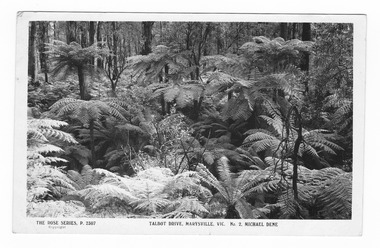 Marysville & District Historical Society
Postcard (item) - Black and white postcard, Rose Stereograph Company, Talbot Drive, Marysville, Vic. No. 2, Michael Dene, 1913-1967
... Lady Talbot Drive is named after Lady Sarah Elizabeth, the wife of Sir Reginald Talbot, who was the Governor of Victoria from 25th April, 1904 to 6th July 1908. marysville victoria michael dene michael dene track p. 2307 walking track rose series postcard postcard souvenir lady talbot drive sarah elizabeth talbot sir reginald talbot REAL PHOTO POST CARD THE "ROSE"SERIES DE LUXE PRODUCED IN AUSTRALIA Published by the Rose Stereographs Armadale, Victoria. Tomorrow is your Official day/ I believe. So Very Very many happy/ returns, & best ...A postcard in a series produced by the Rose Stereograph Company in Victoria, Australia as a souvenir of Marysville.A black and white photograph showing trees and tree ferns, taken along the Michaeldene Trail near Lady Talbot Drive in Marysville in Victoria. The Michaeldene Trail is a level two loop that leads to the Taggerty River Lookout and may be undertaken as either as a Short (2.7 km) Loop, or a Long (4.3 km) Loop - 30 minutes to one hour and a half. The attractive bushland linking the Steavenson and Taggerty Rivers allows walkers and cyclists to step back in time to Marysville’s historic logging past. Sections of this mostly flat circuit follow old tramline alignments, which in places reveal the original timber sleepers on which the big logs were transported to the nearby sawmill.The Taggerty River Lookout offers views over the Taggerty River. The Trestle Bridge was built to span a small gully and provide access to the timber on Red Hill. Lady Talbot Drive is a 24 kilometer scenic rainforest car journey which passes a number of walks and waterfalls in the Yarra Ranges National Park. Lady Talbot Drive is named after Lady Sarah Elizabeth, the wife of Sir Reginald Talbot, who was the Governor of Victoria from 25th April, 1904 to 6th July 1908.REAL PHOTO POST CARD THE "ROSE"SERIES DE LUXE PRODUCED IN AUSTRALIA Published by the Rose Stereographs Armadale, Victoria. Tomorrow is your Official day/ I believe. So Very Very many happy/ returns, & best of luck & good/ wishes from/ your May I rec'd this on/ 1st. (illegible)/ thought it a good snap of our ferns.marysville, victoria, michael dene, michael dene track, p. 2307, walking track, rose series postcard, postcard, souvenir, lady talbot drive, sarah elizabeth talbot, sir reginald talbot -
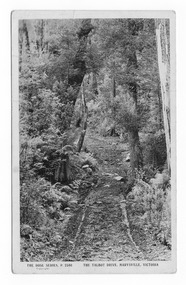 Marysville & District Historical Society
Postcard (item) - Black and white postcard, Rose Stereograph Company, The Talbot Drive, Marysville, Victoria, 1913-1967
... Lady Sarah Elizabeth, the wife of Sir Reginald Talbot, who was the Governor of Victoria from 25th April, 1904 to 6th July 1908. This road was originally constructed as a corduroy road (or log road) is a type of road or timber trackway made by placing logs, perpendicular to the direction of the road over a low or swampy area. The result is an improvement over impassable mud or dirt roads, yet rough in the best ...A postcard in a series produced by the Rose Stereograph Company in Victoria, Australia as a souvenir of Marysville.Lady Talbot Drive (Talbot Drive) is a 24 kilometer scenic rainforest car journey which passes a number of walks and waterfalls in the Yarra Ranges National Park. Lady Talbot Drive is named after Lady Sarah Elizabeth, the wife of Sir Reginald Talbot, who was the Governor of Victoria from 25th April, 1904 to 6th July 1908. This road was originally constructed as a corduroy road (or log road) is a type of road or timber trackway made by placing logs, perpendicular to the direction of the road over a low or swampy area. The result is an improvement over impassable mud or dirt roads, yet rough in the best of conditions and a hazard to horses due to shifting loose logs.POST CARD REAL PHOTO THE "ROSE" SERIES DE LUXE PRODUCED IN AUSTRALIA PUBLISHED BY "THE ROSE STEREOGRAPHS"/ Armadale, Victoria.talbot drive, lady talbot drive, lady talbot forest drive, sir reginald talbot, lady sarah elizabeth talbot, rainforest, marysville, victoria, rose stereograph company, p. 2340, postcard, souvenir, corduroy road -
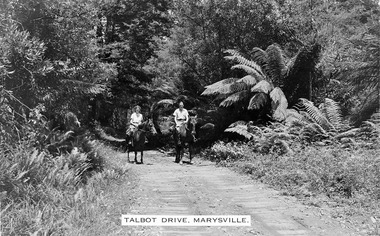 Marysville & District Historical Society
Photograph (item) - Black and white photograph, Talbot Drive, Marysville, Unknown
... Lady Sarah Elizabeth, the wife of Sir Reginald Talbot, who was the Governor of Victoria from 25th April, 1904 to 6th July 1908. This road was originally constructed as a corduroy road (or log road) is a type of road or timber trackway made by placing logs, perpendicular to the direction of the road over a low or swampy area. The result is an improvement over impassable mud or dirt roads, yet rough in the best ...An early black and white photograph of Lady Talbot Drive in Marysville in Victoria.Lady Talbot Drive a 24 kilometer scenic rainforest car journey which passes a number of walks and waterfalls in the Yarra Ranges National Park. Lady Talbot Drive is named after Lady Sarah Elizabeth, the wife of Sir Reginald Talbot, who was the Governor of Victoria from 25th April, 1904 to 6th July 1908. This road was originally constructed as a corduroy road (or log road) is a type of road or timber trackway made by placing logs, perpendicular to the direction of the road over a low or swampy area. The result is an improvement over impassable mud or dirt roads, yet rough in the best of conditions and a hazard to horses due to shifting loose logs.lady talbot drive, lady talbot forest drive, marysville, victoria, sir reginald talbot, lady sarah elizabeth talbot, corduroy road -
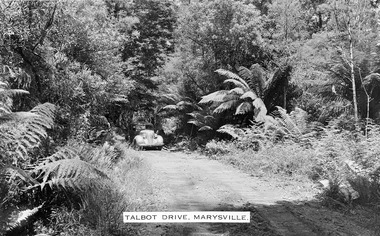 Marysville & District Historical Society
Photograph (item) - Black and white photograph, Talbot Drive, Marysville, Unknown
... Lady Sarah Elizabeth, the wife of Sir Reginald Talbot, who was the Governor of Victoria from 25th April, 1904 to 6th July 1908. This road was originally constructed as a corduroy road (or log road) is a type of road or timber trackway made by placing logs, perpendicular to the direction of the road over a low or swampy area. The result is an improvement over impassable mud or dirt roads, yet rough in the best ...An early black and white photograph of Lady Talbot Drive in Marysville in Victoria.An early black and white photograph of a car traveling along Lady Talbot Drive in Marysville in Victoria. Lady Talbot Drive a 24 kilometer scenic rainforest car journey which passes a number of walks and waterfalls in the Yarra Ranges National Park. Lady Talbot Drive is named after Lady Sarah Elizabeth, the wife of Sir Reginald Talbot, who was the Governor of Victoria from 25th April, 1904 to 6th July 1908. This road was originally constructed as a corduroy road (or log road) is a type of road or timber trackway made by placing logs, perpendicular to the direction of the road over a low or swampy area. The result is an improvement over impassable mud or dirt roads, yet rough in the best of conditions and a hazard to horses due to shifting loose logs.marysville, victoria, lady talbot drive, lady talbot forest drive, sir reginald talbot, lady sarah elizabeth talbot, corduroy road -
 Marysville & District Historical Society
THE TRIANGLE NEWS-VOL 39 NO 18-MAY 18 2012
... best upcoming young traditional group...marysville golf & bowls club...marysville cultural community...cafe culture services 2012...what's on when in may...the committee of management of the gallipoli park precinct...marysville & district chamber of commerce agm...creative triangle...triangle bushwalkers...marysville fire brigade...home based child care annual conference agm...advertisements...mayor's chair...church notices...marysville lady...marysville victoria australia string theory best upcoming young traditional group marysville golf & bowls club marysville cultural community cafe culture services 2012 what's on when in may the committee of management of the gallipoli park precinct marysville & district chamber of commerce agm creative triangle triangle bushwalkers marysville fire brigade home based child care annual conference agm advertisements mayor's chair church notices marysville lady golfers win at mansfield marysville beer & platter garden maryton park b & b cathedral ranges people & parks foundation marysville pharmacy marysville medical centre draft budget and council plan submissions reminder sesquicentenary meeting 150th anniversary local history centre councillor comment men's big breakfast b.u.i.l.t marysville & district historical society meeting working bee activities notice of application for planning permit sample wines dalrymples guest cottages official opening marysville & triangle community recovery committee marysville villains lunch with lindy & bill bill o'shea lindy burns australian centre for grief & bereavement alexandra annual truck ute & rod show real estate john bertrand gary pert terry and sharen donovon rebuild dalrymples comedy festival road show marysville community centre australian red cross acoustic concert narbethong hall planning & environmental act 1987 murrindindi planning scheme buxton hotel social club restoring sense of place pathways bushfire recovery program THE TRIANGLE NEWS-VOL 39 NO 18-MAY 18 2012 ...marysville, victoria, australia, string theory, best upcoming young traditional group, marysville golf & bowls club, marysville cultural community, cafe culture services 2012, what's on when in may, the committee of management of the gallipoli park precinct, marysville & district chamber of commerce agm, creative triangle, triangle bushwalkers, marysville fire brigade, home based child care annual conference agm, advertisements, mayor's chair, church notices, marysville lady golfers win at mansfield, marysville beer & platter garden, maryton park b & b, cathedral ranges, people & parks foundation, marysville pharmacy, marysville medical centre, draft budget and council plan submissions reminder, sesquicentenary meeting 150th anniversary, local history centre, councillor comment, men's big breakfast, b.u.i.l.t, marysville & district historical society meeting, working bee activities, notice of application for planning permit, sample wines, dalrymples guest cottages official opening, marysville & triangle community recovery committee, marysville villains lunch with lindy & bill, bill o'shea, lindy burns, australian centre for grief & bereavement, alexandra annual truck ute & rod show, real estate, john bertrand, gary pert, terry and sharen donovon, rebuild dalrymples, comedy festival road show, marysville community centre, australian red cross, acoustic concert, narbethong hall, planning & environmental act 1987, murrindindi planning scheme, buxton hotel social club, restoring sense of place, pathways bushfire recovery program -
 Flagstaff Hill Maritime Museum and Village
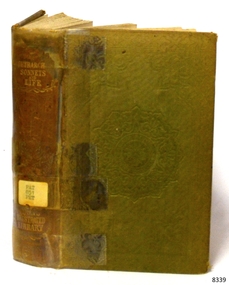
Book - Book of Poetry, Thomas Campbell, The Sonnets Triumphs and Other Poems of Petrarch, 1873
... It compiles the best historical translations available at the time (by writers like Spenser, Lady Mary Wortley Montagu, and others). ...It compiles the best historical translations available at the time (by writers like Spenser, Lady Mary Wortley Montagu, and others). ...This volume compiles the core poetic works of Petrarch. It is anchored by his Canzoniere (Songbook), which features his famous sonnets and poems dedicated to his unrequited muse, Laura. It also includes his Triumphs (Trionfi), an allegorical series of poems exploring human life, love, death, and time. Collectively, these works shaped the course of Renaissance literature and popularized the "Petrarchan sonnet" structure across Europe.The Sonnets Triumphs and Other Poems of Petrarch Author: Francesco Petrarca (Petrarch) Publisher: Bell & Daldy Date: 1873 Olive hardcover with a brown spine and lettering in gold. The spine has a label with an inscription. Further Information: First completely Translated into English Verse by various hands, with a life of the poet by Thomas CampbellfictionThis volume compiles the core poetic works of Petrarch. It is anchored by his Canzoniere (Songbook), which features his famous sonnets and poems dedicated to his unrequited muse, Laura. It also includes his Triumphs (Trionfi), an allegorical series of poems exploring human life, love, death, and time. Collectively, these works shaped the course of Renaissance literature and popularized the "Petrarchan sonnet" structure across Europe.flagstaff hill, warrnambool, shipwrecked coast, flagstaff hill maritime museum, maritime museum, shipwreck coast, flagstaff hill maritime village, great ocean road, book, pattison collection, warrnambool library, warrnambool mechanics’ institute, ralph eric pattison, corangamite regional library service, warrnambool city librarian, mechanics’ institute library, victorian library board, warrnambool books and records, warrnambool children’s library, the sonnets triumphs and other poems of petrarch, petrarch, thomas campbell -
 City of Moorabbin Historical Society (Operating the Box Cottage Museum)
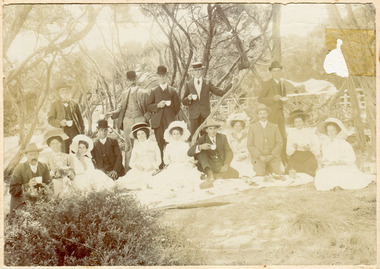
Photograph, The Cheltenham Market Gardner's Picnic, The Gardner's Picnic pre 1914-18 War, pre 1914-18
... Most of the ladies are wearing white dresses, one lady has a dark coloured skirt with a white frilly blouse, and all have large wide brimmed fashionably decorated hats . They all seem to be dressed in their best...Most of the ladies are wearing white dresses, one lady has a dark coloured skirt with a white frilly blouse, and all have large wide brimmed fashionably decorated hats . They all seem to be dressed in their best clothes. 1914-18 moorabbin. picnic market gardeners, early settlers, pioneers, moorabbin shire, cheltenham, fashion, dressmaking, bowler hats, boater hats, stetson hats, bonnets, chapeau, menswear, neckties, beechworth mcgeehan r, photographs, Front of mount : R. ...The photograph is pre 1914-18. It is showing Cheltenham Market Gardeners having a picnic. The Market Gardeners gave Moorabbin it's first industry, which was to prove the most durable and resilient. The ladies and gentlemen are dressed in very fine clothes. All of the men are wearing suits with waistcoats and white shirts with neck ties. One man has a Boater hat , 4 have Bowler hats and 5 have Stetson hats. 5 men are standing and 4 men are kneeling or sitting with the ladies. The ladies are seated on the ground around a table runner on which items of food are seen. Most of the ladies are wearing white dresses, one lady has a dark coloured skirt with a white frilly blouse, and all have large wide brimmed fashionably decorated hats . They all seem to be dressed in their best clothes.The photograph depicts a group of men and women, 16 altogether, having a picnic pre World War 1 1914-1918 . They are surrounded by trees and bushes outside.Front of mount : R. McGeehan Photograph, Beechworth. Back of Mount Address Balaclava / C Whitehead / Gardeners Picnic / Pre World War 11914-18, moorabbin. picnic, market gardeners, early settlers, pioneers, moorabbin shire, cheltenham, fashion, dressmaking, bowler hats, boater hats, stetson hats, bonnets, chapeau, menswear, neckties, beechworth mcgeehan r, photographs, -
 Flagstaff Hill Maritime Museum and Village
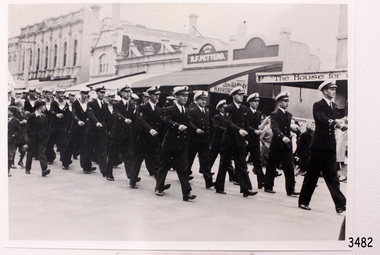
Photograph - Ship's crew, HMAS Warrnambool J202, 1941
... best’ clothes, are marching alongside the crew. The HMAS Warrnambool was one of 60 Bathurst class corvette vessels built during World War II for the Royal Australian Navy (RAN) as armed minesweepers. The namesake of the City of Warrnambool, Victoria, was launched in Sydney in 1941. The HMAS Warrnambool began service with patrols off Bass Strait in 1941. In December the ship docked in the Warrnambool harbour at Lady...best’ clothes, are marching alongside the crew. The HMAS Warrnambool was one of 60 Bathurst class corvette vessels built during World War II for the Royal Australian Navy (RAN) as armed minesweepers. The namesake of the City of Warrnambool, Victoria, was launched in Sydney in 1941. The HMAS Warrnambool began service with patrols off Bass Strait in 1941. In December the ship docked in the Warrnambool harbour at Lady ...This photograph shows the crew of the first HMAS Warrnambool (J202) marching east along Timor Street in Warrnambool, just opposite the Post Office on the corner of Gillies Street. People are watching the parade from the footpath and two boys, dressed in their ‘best’ clothes, are marching alongside the crew. The HMAS Warrnambool was one of 60 Bathurst class corvette vessels built during World War II for the Royal Australian Navy (RAN) as armed minesweepers. The namesake of the City of Warrnambool, Victoria, was launched in Sydney in 1941. The HMAS Warrnambool began service with patrols off Bass Strait in 1941. In December the ship docked in the Warrnambool harbour at Lady Bay. The crew came ashore and performed a march for the city. The Mayor, Cr. John R Astbury presented them with a plaque of the City of Warrnambool’s Coat of Arms and the Warrnambool Patriotic Fund gave them a gift of 110 books for the crew’s library. The Warrnambool served in Darwin during the time it was bombed, it was involved in several rescues and carried troops to New Guinea, it carried out escort and patrol duties on Australia's east coast, then at Fremantle and back to Darwin. The ship was at Timor when the Japanese surrendered in 1945. It performed mine clearance work around the Solomon Islands and New Guinea after the war. In 1947 the HMAS Warrnambool was at the Great Barrier Reef, off the Queensland coast, to clear the defensive British mines previously laid to protect Australia’s boarders. The ship hit a mine near Cockburn Reef, exploded and sank shortly afterwards. One of the 70 or so men on board was killed and three died later. The rescued men were transferred by boats to the nearby HMAS Swan II, which took the survivors to Cairns. The four deceased were Victorian seamen. In May 1948 the Royal Australian Navy divers recovered a number of items from the wreck, including the ship’s bell and the City of Warrnambool plaque. In 1949 the RAN returned the plaque to the Warrnambool City Council, and donated the ship’s bell to the Australian War Memorial. Further objects were recovered in 1972-75 by Southern Cross Diving and Salvage. A memorial plaque was erected in Warrnambool on September 13, 1995 in honour of all who served on HMAS Warrnambool. NOTE: (1)- HMAS Warrnambool II (FCPB204 was built in 1980 in Cairns, with a compliment of 22 personnel. It was decommissioned in 2005. (2)- SS Warrnambool, a steam and sail ship, was built in 1892 in London and broken up in 1926. [A more detailed history can be found in our Collection Record 3477.]This photograph is significant for its association with the lifesaving rescue of the crew and the sinking Royal Australian Navy vessel, HMAS Warrnambool (J202). The HMAS Warrnambool played a nationally significant role in overturning Australia’s Immigration Restriction Act 1901 (colloquially known as the White Australia policy). The ship rescued, and brought to Australia, Samuel and Annie Jacob and their family after they evacuated Dutch East India. The family was threatened with deportation and made the first successful appeal to High Court regarding that Act. The HMAS Warrnambool has - Local significance for being the namesake of the City of Warrnambool - Local significance, having docked in Warrnambool Harbour - Local significance, the crew having paraded in Timor Street, Warrnambool - State significance for its first patrol being in Bass Strait. - National significance, being present in Timor at the Japanese surrender - National significance, shown by the significance of the ship’s bell being curated as Military Heritage and Technology at the Australian War Memorial. - National significance as part of Australia’s defence force history, being one of only four Bathurst class corvettes lost while in Australian service, the only Bathurst class corvette lost after World War II, the only RAN vessel to be sunk by a mine, and associated with the last four Navy deaths of WWIIPhotograph of the crew of HMAS Warrnambool J202. This black and white image shows the crew marching east along Timor Street in Warrnambool. People are watching from the footpath and two formally dressed boys are marching alongside the sailors. Inscription on the reverse.(PRIVATE details - See Notes)flagstaff hill, maritime village, maritime museum, warrnambool, shipwreck coast, mort's dock & engineering co ltd, h.m.a.s. warrnambool, hmas warrnambool, hmas warrnambool i, hmas warrnambool j202, hmas swan ii, j202, world war ii, bathurst class corvette, royal australian navy, ran, sydney built ship, bass strait patrol, sea mine patrol, mine sweeper, mine clearance, navy divers, great barrier reef, cockburn reef, southern cross diving and salvage, warrnambool city council, cr j r astbury, mayor j r astbury, warrnambool patriotic fund, seal, coat of arms, dedicatory plaque, hmas warrnambool 1941, shipwreck by sea mine 1947, sinking ship, sunk ship, marching, parade, timor street warrnambool, minesweeper -
 City of Moorabbin Historical Society (Operating the Box Cottage Museum)
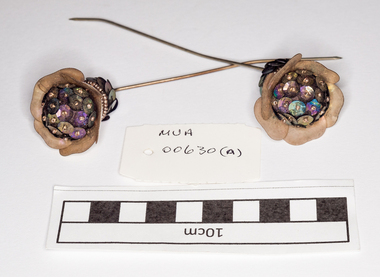
Jewellery, 2 lady's hat pins mauve, c1900
... The women of the pioneer families liked to dress up in their best hand made dresses and fashionable hats for Church gatherings and special occasions as a relief from the daily chores of hand washing, ironing with flat irons and cooking over open fires. bonnets hats veils scarves moorabbin bentleigh brighton cheltenham early settlers pioneers clasps hairdressing combs steel pins jewellery 2 lady's long steel hat pins with sequents in a flower design on mauve material Jewellery, 2 lady's hat pins mauve, early settler ...A hat pin is a decorative pin for holding a hat to the head, usually by the hair that was styled in a Chignon or French Roll style and usually worn in a pair. They are typically around 20 cm in length, with the pinhead being the most decorated part. The hatpin was invented to hold veils in place, and was handmade. Birmingham, England was the centre of production when demand eventually outgrew the number that could be supplied by hand-making and they also began to be imported from France. In 1832, an American machine was invented to manufacture the pins, and they became much more affordable. During the 1880s, bonnets gave way to hats, some of which were very large and the popularity of hatpins soared. In the Victorian era, when appearance was everything, it just wouldn't do for a fashionable lady's hat to blow off in the wind. They remained a standard women's' accessory through the 1910s and were produced in a vast range of materials and types. Hat pin holder boxes were also produced. One of the most well-known makers of hatpins is silversmith Charles Horner, of Halifax, whose turn of the century jewellery company became a leader in the market by creating a series of mass-produced pins that were still of exceptional quality. As a result, thousands of Horner's pins are still on the market and on display in museums worldwide. Women of the 1920’s used hat pins as decoration on their Cloche hats that fitted snugly to their heads. The women of the pioneer families liked to dress up in their best hand made dresses and fashionable hats for Church gatherings and special occasions as a relief from the daily chores of hand washing, ironing with flat irons and cooking over open fires.2 lady's long steel hat pins with sequents in a flower design on mauve material bonnets, hats, veils, scarves, moorabbin, bentleigh, brighton, cheltenham, early settlers, pioneers, clasps, hairdressing, combs, steel pins, jewellery -
 City of Moorabbin Historical Society (Operating the Box Cottage Museum)
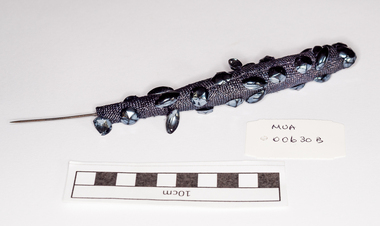
Jewellery, 1 lady's hat pin black, c1900
... The women of the pioneer families liked to dress up in their best hand made dresses and fashionable hats for Church gatherings and special occasions as a relief from the daily chores of hand washing, ironing with flat irons and cooking over open fires. bonnets hats veils scarves moorabbin bentleigh brighton cheltenham early settlers pioneers clasps hairdressing combs steel pins jewellery 1 long, lady's, steel, hat pin , padded and covered in black linen decorated with spherical shaped black sequins Jewellery, 1 lady's hat pin black. ...A hat pin is a decorative pin for holding a hat to the head, usually by the hair that was styled in a Chignon or French Roll style and usually worn in a pair. They are typically around 20 cm in length, with the pinhead being the most decorated part. The women of the pioneer families liked to dress up in their best hand made dresses and fashionable hats for Church gatherings and special occasions as a relief from the daily chores of hand washing, ironing with flat irons and cooking over open fires. 1 long, lady's, steel, hat pin , padded and covered in black linen decorated with spherical shaped black sequins bonnets, hats, veils, scarves, moorabbin, bentleigh, brighton, cheltenham, early settlers, pioneers, clasps, hairdressing, combs, steel pins, jewellery -
 City of Moorabbin Historical Society (Operating the Box Cottage Museum)
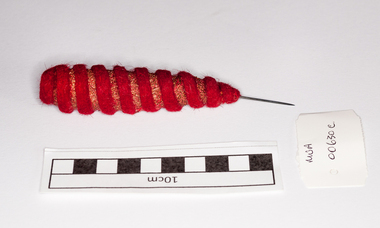
Jewellery, 1 lady's hat pin, c1900
... The women of the pioneer families liked to dress up in their best hand made dresses and fashionable hats for Church gatherings and special occasions as a relief from the daily chores of hand washing, ironing with flat irons and cooking over open fires. bonnets hats veils scarves moorabbin bentleigh brighton cheltenham early settlers pioneers clasps hairdressing combs steel pins jewellery A short, lady's steel hat pin, padded and covered in red and gold felt in a spiral pattern Jewellery, 1 lady's hat pin Unrecorded early settler ...See 00630 A A hat pin is a decorative pin for holding a hat to the head, usually by the hair that was styled in a Chignon or French Roll style and usually worn in a pair. They are typically around 20 cm in length, with the pinhead being the most decorated part. The women of the pioneer families liked to dress up in their best hand made dresses and fashionable hats for Church gatherings and special occasions as a relief from the daily chores of hand washing, ironing with flat irons and cooking over open fires. A short, lady's steel hat pin, padded and covered in red and gold felt in a spiral patternbonnets, hats, veils, scarves, moorabbin, bentleigh, brighton, cheltenham, early settlers, pioneers, clasps, hairdressing, combs, steel pins, jewellery -
 City of Moorabbin Historical Society (Operating the Box Cottage Museum)
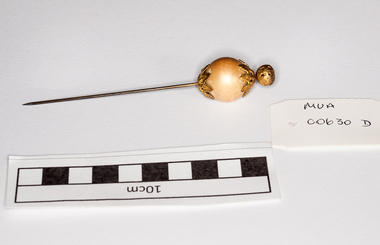
Jewellery, 1 lady's hat pin, c1900
... They are typically around 20 cm in length, with the pinhead being the most decorated part The women of the pioneer families liked to dress up in their best hand made dresses and fashionable hats for Church gatherings and special occasions as a relief from the daily chores of hand washing, ironing with flat irons and cooking over open fires. bonnets hats veils scarves moorabbin bentleigh brighton cheltenham early settlers pioneers clasps hairdressing combs steel pins jewellery A short steel lady's hat pin with a gold coloured metal ball at top with filigree decoration Jewellery, 1 lady's hat pin Unrecorded early settler ...See 00630 A A hat pin is a decorative pin for holding a hat to the head, usually by the hair that was styled in a Chignon or French Roll style and usually worn in a pair. They are typically around 20 cm in length, with the pinhead being the most decorated part The women of the pioneer families liked to dress up in their best hand made dresses and fashionable hats for Church gatherings and special occasions as a relief from the daily chores of hand washing, ironing with flat irons and cooking over open fires.A short steel lady's hat pin with a gold coloured metal ball at top with filigree decorationbonnets, hats, veils, scarves, moorabbin, bentleigh, brighton, cheltenham, early settlers, pioneers, clasps, hairdressing, combs, steel pins, jewellery -
 City of Moorabbin Historical Society (Operating the Box Cottage Museum)
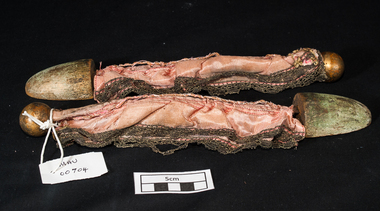
Clothing, shoe stretchers, 20thC
... Shoe stretchers work best for suede, leather, and other natural materials. boots, shoes, footwear, bootmakers, leatherworkers, early settlers, pioneers, market gardeners, moorabbin, bentleigh, cheltemham, shoe stretchers, A pair of lady's wooden shoe stretchers, decorated with pink lace Clothing, shoe stretchers Unrecorded bootmaker ...Shoe stretchers can expand the width and the length of shoes. Shoes can shrink, feet can swell and bunions, corns or other foot imperfections can make the shoes hurt.. Shoe stretchers work best for suede, leather, and other natural materials. A pair of lady's wooden shoe stretchers, decorated with pink laceboots, shoes, footwear, bootmakers, leatherworkers, early settlers, pioneers, market gardeners, moorabbin, bentleigh, cheltemham, shoe stretchers, -
 Bendigo Military Museum
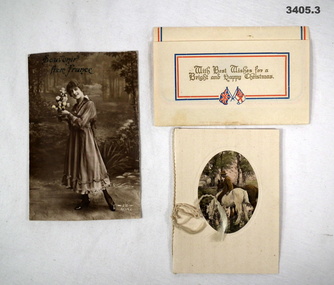
Card - CARDS WW1, c.1915 - 1918
... N Graham No 551, refer Cat No 266 for his service details. cards letters 38th .1) Printing: "Souvenir from France" Handwriting: "To Maude form N Graham" .2) Printing: "Wish Best Wishes for a Bright & Happy Christmas" Handwriting: "To all at Minmindie with best Xmas wishes" .3) Handwriting: "To Maude with sincere good wishes for a Merry Christmas and a Bright & Happy New Year From her old teacher N Graham" .1) Brown post card of lady holding flowers. .2) Cream greeting card with red & blue border with gold coloured Rising Sun. .3) Cream greeting card with coloured illustration of a man on a horse. ...N Graham No 551, refer Cat No 266 for his service details..1) Brown post card of lady holding flowers. .2) Cream greeting card with red & blue border with gold coloured Rising Sun. .3) Cream greeting card with coloured illustration of a man on a horse..1) Printing: "Souvenir from France" Handwriting: "To Maude form N Graham" .2) Printing: "Wish Best Wishes for a Bright & Happy Christmas" Handwriting: "To all at Minmindie with best Xmas wishes" .3) Handwriting: "To Maude with sincere good wishes for a Merry Christmas and a Bright & Happy New Year From her old teacher N Graham"cards, letters, 38th -
 Bendigo Military Museum
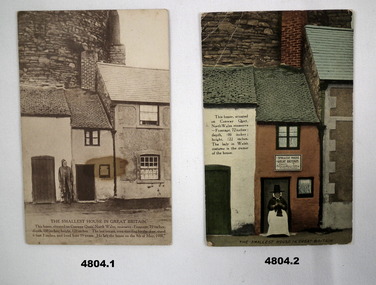
Postcard - POSTCARDS - Scenic postcards from Wales, J.Jones et al
... Best love Joe". 2. 3. & 4. Nil on rear. 1. Sepia coloured photo of small house in Great Britain, located at Conway Quay, North Wales. The house is 6 feet wide. 2. Colourised picture of smallest house in Great Britain, Conway Quay. There is Lady ...WW!, Tourist cards sent home by Joe Stuart.1. Sepia coloured photo of small house in Great Britain, located at Conway Quay, North Wales. The house is 6 feet wide. 2. Colourised picture of smallest house in Great Britain, Conway Quay. There is Lady in National dress, seated at the door doing knitting. 3. Colourised photo of kitchen of above. 4. Colourised photo of bedroom of above. The house size frontage 72 inches. Back to front 100 inches, Height 122 inches.1. On the rear Is addressed to "Dear Susie - Best love Joe". 2. 3. & 4. Nil on rear.wales, small housing -
 Warrnambool and District Historical Society Inc.
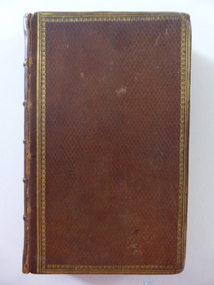
Book, The Lady of the Lake, 1810
... Lady of the Lake’. It is notable for its illustrations of the drawings of Richard Westall (1765-1836), an English painter and illustrator and Queen Victoria’s drawing master. Westall is best...Lady of the Lake’. It is notable for its illustrations of the drawings of Richard Westall (1765-1836), an English painter and illustrator and Queen Victoria’s drawing master. Westall is best ...This book is an 1810 third edition copy of Walter Scott’s poem, ‘The Lady of the Lake’. It is notable for its illustrations of the drawings of Richard Westall (1765-1836), an English painter and illustrator and Queen Victoria’s drawing master. Westall is best-known for his portraits of Lord Byron. There is no information available on the original owner, the Reverend Matthew West. Tis book is important because: 1. It is an 1810 edition and of antiquarian interest 2. It belonged to Louise Mack, the cousin of Sir Ronald Mack, an important Warrnambool Parliamentarian. Miss Mack was well-known in the Warrnambool area as the Secretary of the Warrnambool Technical School in the 1930s, 40s and 50s. The Macks were prominent early settlers in the Warrnambool area. This is a hard cover leather bound book of 433 pages (poem, ‘The Lady of the Lake’ by Walter Scott). The cover is brown leather with a gold ornamental border. The inside cover has a tan and blue mottled pattern. The book has illustrations with engravings from the designs of Richard Westall. The illustrations have a piece of tissue paper in front of them. The first page has a stamp of the Warrnambool & District Historical Society and there is a loose sheet indicating that the book was published in 1810 and that it belonged to Miss L.A. Mack.‘The Revd. Matthew West, Vicar’s Hall, Clane’. sir walter scott, richard westall, history of warrnambool, rev. matthew west, louise mack -
 Eltham District Historical Society Inc
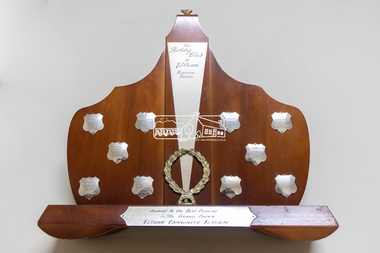
Award - Trophy, The Rotary Club of Eltham Perpetual Trophy, Awarded to the Best Display in the Grand Parade, Eltham Community Festival, 1979-1986
... Individual shields attached to trophy inscribed with annual Grand Parade winners: 1979 - Cubs of the Eltham District 1980 - Montmorency South Primary School 1981 - Co Winner, Eltham Primary School Dalton Street 1981 - Co Winner, Our Lady Help of Christians 1982 - Cubs of the Eltham District 1983 - Research Primary School 1984 - Montmorency South Primary School 1985 - Montmorency Garden Club 1986 - Shire of Eltham Historical Society and one blank shield It appears the trophy was replaced in 1987 with a Best Display award which again was won by the Society, and again in 1988 ...Individual shields attached to trophy inscribed with annual Grand Parade winners: 1979 - Cubs of the Eltham District 1980 - Montmorency South Primary School 1981 - Co Winner, Eltham Primary School Dalton Street 1981 - Co Winner, Our Lady Help of Christians 1982 - Cubs of the Eltham District 1983 - Research Primary School 1984 - Montmorency South Primary School 1985 - Montmorency Garden Club 1986 - Shire of Eltham Historical Society and one blank shield It appears the trophy was replaced in 1987 with a Best Display award which again was won by the Society, and again in 1988 Award Eltham Community Festival Eltham Festival Trophy Shire of Eltham Historical Society Eltham District Historical Society Victorian Folk Music Club Rotary Club of Eltham Perpetual Trophy 1986 Grand Parade 1979 1980 1981 1982 1983 1984 1985 Cubs of the Eltham District Eltham Primary School Montmorency Garden Club Montmorency South Primary School Our Lady Help of Christians Primary School Research primary school The Rotary Club of Eltham Perpetual Trophy Awarded to the Best Display In the Grand Parade Eltham Community Festival Polished wooden trophy with gold plastic wreath, inscribed metal plaques and ten inscribed metal shields. ...1986 Grand Parade, 8 November. The Society's entry in the Eltham Community Festival parade included Ben Hall's Cobb and Co. coach and was awarded the major prize for the parade. This involves a perpetual trophy which the Society holds for one year. Individual shields attached to trophy inscribed with annual Grand Parade winners: 1979 - Cubs of the Eltham District 1980 - Montmorency South Primary School 1981 - Co Winner, Eltham Primary School Dalton Street 1981 - Co Winner, Our Lady Help of Christians 1982 - Cubs of the Eltham District 1983 - Research Primary School 1984 - Montmorency South Primary School 1985 - Montmorency Garden Club 1986 - Shire of Eltham Historical Society and one blank shield It appears the trophy was replaced in 1987 with a Best Display award which again was won by the Society, and again in 1988 Polished wooden trophy with gold plastic wreath, inscribed metal plaques and ten inscribed metal shields. Gold plastic ornament sitting on top (broken off)The Rotary Club of Eltham Perpetual Trophy Awarded to the Best Display In the Grand Parade Eltham Community Festivalaward, eltham community festival, eltham festival, trophy, shire of eltham historical society, eltham district historical society, victorian folk music club, rotary club of eltham, perpetual trophy, 1986, grand parade, 1979, 1980, 1981, 1982, 1983, 1984, 1985, cubs of the eltham district, eltham primary school, montmorency garden club, montmorency south primary school, our lady help of christians primary school, research primary school -
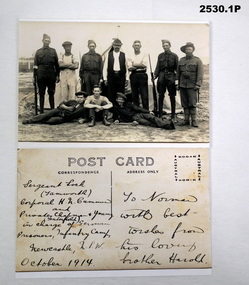 Bendigo Military Museum
Postcard - POSTCARDS WW1, c.1914
... best wishes from his loving brother Harold. .2) Dated 5.10.1917 Dear Norman, .... 17 lines .... Your loving brother Harold. .3) To Frau A Muxfeldt Niendorf (Kr Tinneberg) Gaustedterueg No 19, Gesebrieben d 18 Juli 1918. Absender Hugu Muxfeldt No 252 15 Prisoner of War Coy France C/o GPO London England .1) Photo of 4 armed Australian Soldiers with 6 civilians, verso postcard has hand written description. .2) Generic postcard from Egypt to a brother, verso letter from Harold to Norman. .3) Photo of 2 WWI German Servicemen with no headgear, verso addressed to a German lady - see Inscriptions & Markings. ....1) H.N.Cummin. Harold Nesbit Cummin had prior Military service (unclear) to joining the AIF. No 1239 he enlisted on 17.8.1915 in the 6th reinforcements to the 11th Light Horse Regt age 20 years. Embark for Egypt 27.10.1915, hospital 3.1.1916 with Bronvhitis, rejoin unit 15.1.1916, over some 7 months from 4.4.1916 he transfers 4 times until 2.11.1916 and listed as 4th Australian Camel Regt, by 16.2.1917 he is classed as being with 11th Coy 3rd Anzac Batt 1st Camel Brigade, WIA 1.12.1917 GSW’s, DOW’s at 2nd L.H.Brigade Field Ambulance 1.12.1917 in Jaffa. Refer 2535P re his brother Alexander Norman. The photo obviously refers to his previous service as the photo is dated “Oct 1914”. The Germans are possibly people interned after outbreak of the war. .1) Photo of 4 armed Australian Soldiers with 6 civilians, verso postcard has hand written description. .2) Generic postcard from Egypt to a brother, verso letter from Harold to Norman. .3) Photo of 2 WWI German Servicemen with no headgear, verso addressed to a German lady - see Inscriptions & Markings. .1) SGT LOCK (Tamworth), CPL H N CUMMIN & PTES CHAPMAN & YOUNG (Tenterfield) in charge of German prisoners, Infantry Camp, Newcastle, NSW, October 1914. Address: To Norman with best wishes from his loving brother Harold. .2) Dated 5.10.1917 Dear Norman, .... 17 lines .... Your loving brother Harold. .3) To Frau A Muxfeldt Niendorf (Kr Tinneberg) Gaustedterueg No 19, Gesebrieben d 18 Juli 1918. Absender Hugu Muxfeldt No 252 15 Prisoner of War Coy France C/o GPO London Englandpostcards, photographs, 38th
