
Showing 186 items matching "large belts"
-
 Melbourne Tram Museum
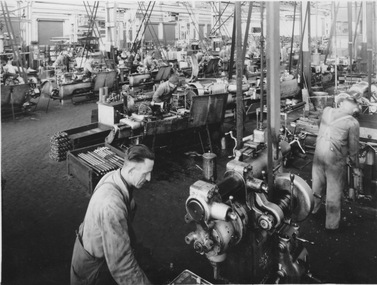
Photograph - Machine shop Preston Workshops - set of 2, Melbounre and Metropolitan Tramways Board, early 1970s
... ...large belts...They appear to show different years as only one shows machines driven by large belts. While neither carries accreditation, both appear to be in the style of official M&MTB photographs....Preston Workshops workmen overalls large belts official M&MTB Handwritten "4 Machine Shop" Black and white photographs, one with note on rear. ...Both photographs show numerous workmen in overalls working at machines in a large building. They appear to show different years as only one shows machines driven by large belts. While neither carries accreditation, both appear to be in the style of official M&MTB photographs.Yields information about the impact on W class trams of a major traffic collision and fire. Also the history or W5 class 743. Black and white photographs, one with note on rear. Handwritten "4 Machine Shop"preston workshops, workmen, overalls, large belts, official m&mtb -
 Linton and District Historical Society Inc
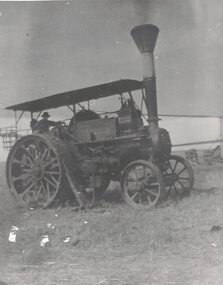
Photograph, Traction Engine
... Black and white copy of original photograph showing an old traction engine with steel wheels and a large belt attached by a pulley at the side....Tractor farm Kerr Steam engine Chaff cutter Black and white copy of original photograph showing an old traction engine with steel wheels and a large belt attached by a pulley at the side. Traction Engine Photograph ...Black and white copy of original photograph showing an old traction engine with steel wheels and a large belt attached by a pulley at the side.tractor, farm, kerr, steam engine, chaff cutter -
 Maldon Vintage Machinery Museum Inc
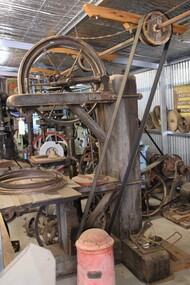
Bandsaw
... Large belt driven bandsaw with wooden frame. Metal upper and lower driving wheels for bandsaw. ...trades carpenttry Large belt driven bandsaw with wooden frame. Metal upper and lower driving wheels for bandsaw. ...Large belt driven bandsaw with wooden frame. Metal upper and lower driving wheels for bandsaw. Upper brass and lower cast iron. Wooden work table and saw guard. In poor working order and blade not fitted.trades, carpenttry -
 Wangaratta RSL Sub Branch
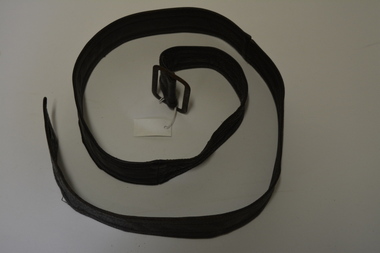
Leather Belt with Large Buckle
... Leather Belt with Large Buckle...Dark brown leather belt with large rusted buckle. Belt is made up of three bits of leather, sewn together....leather metal belt Nil Dark brown leather belt with large rusted buckle. Belt is made up of three bits of leather, sewn together. ...Dark brown leather belt with large rusted buckle. Belt is made up of three bits of leather, sewn together.Nilleather, metal, belt -
 Bendigo Historical Society Inc.
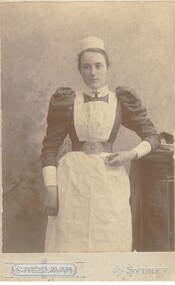
Photograph - ELMA WINSLADE WELLS COLLECTION: NURSE MABEL ANDERSON
... Nurse uniform puffed sleeves, large belt buckle. At the front foot the name Creelman, Sydney. ...Nurse uniform puffed sleeves, large belt buckle. At the front foot the name Creelman, Sydney. ...Photograph - black and white. A photo of a friend of Elma Wells, a nurse named Mabel Anderson. Nurse uniform puffed sleeves, large belt buckle. At the front foot the name Creelman, Sydney. On the back Creelman & Co. Art Photographers, Burlington Galleries, Sydney ArcadeCreelman, Sydney.person, individual, nurse, mabel anderson. elma wells collection. nurse.outfit. -
 Bendigo Historical Society Inc.
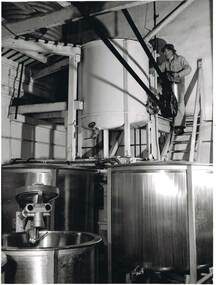
Photograph - COHN BROTHERS COLLECTION: STORAGE/MIXING TANKS
... The higher vat has an agitator which is driven by a large belt and pulley. A man holding a bucket is standing on a stairway beside it. ...The higher vat has an agitator which is driven by a large belt and pulley. A man holding a bucket is standing on a stairway beside it. ...Photograph. Cohn Bros. Collection. Black & white photo of three steel vats and one other vat above them. The higher vat has an agitator which is driven by a large belt and pulley. A man holding a bucket is standing on a stairway beside it. ML45/6 (written on the back).organization, business, cohn bros, cohn bros. collection, brewers, cordial & aerated water manufacturers -
 B-24 Liberator Memorial Restoration Australia Inc
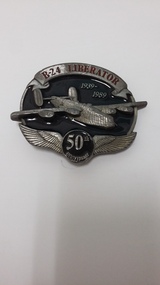
Accessory - Belt Buckle
... Large Forged Iron embossed belt buckle....B-24 LIBERATOR Origin: Consolidated Vultee Aircraft Co Type: Long-range bomber with normal crew of 10 History: First flight(xb 24) December 29 1939 Withdraw from service 1955-56 It was built in bigger numbers than any other American aircraft in history and served on every front in WW11 and with15 allied nations. Large Forged Iron embossed belt buckle. Accessory Belt Buckle ...Large Forged Iron embossed belt buckle.B-24 LIBERATOR, 1939-1989, 50th ANNIVERSARY (on front) LIMITED EDITION 50th ANNIVERSARY ISSUE,B-24 LIBERATOR, 1989 BUCKLE CONNECTION, SERIAL 0612 OF 1939. B-24 LIBERATOR Origin: Consolidated Vultee Aircraft Co Type: Long-range bomber with normal crew of 10 History: First flight(xb 24) December 29 1939 Withdraw from service 1955-56 It was built in bigger numbers than any other American aircraft in history and served on every front in WW11 and with15 allied nations. -
 Bendigo Military Museum
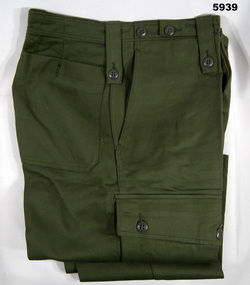
Uniform - TROUSERS, Conway Bros Pty Ltd, 1969
... There are five large belt loops around waistline, held shut with buttons. ...There are five large belt loops around waistline, held shut with buttons. ...See Cat 5852 Patterson.These are cotton, green, long trousers. Pockets = it has 2 rear pockets held shut with green buttons. It has two plain side pockets. It has a cargo pocket on each leg held shut with 2 buttons. There are five large belt loops around waistline, held shut with buttons. The fly is held shut with 4 buttons. The bottom of the legs are cuffless.uniform, aust army -
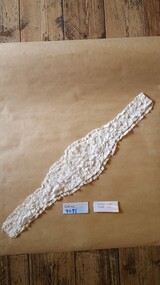 Coal Creek Community Park & Museum
Lace belt
... Lace belt with larger central panel. Silk backing...Lace belt with larger central panel. Silk backing Lace belt ...Lace belt with larger central panel. Silk backing -
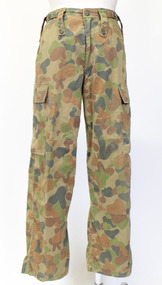 Beechworth RSL Sub-Branch
Trousers, c. 1980s
... Two pockets on either hip, two pockets on both thighs fastened by two plastic buttons and one pocket on the back right side, fastened by a single button. Five large belt loops encircle waist, held in place with a dark green khaki button. ...Two pockets on either hip, two pockets on both thighs fastened by two plastic buttons and one pocket on the back right side, fastened by a single button. Five large belt loops encircle waist, held in place with a dark green khaki button. ...The item is a representative example of previously standard issue uniform and is in excellent condition. As a set alongside 0040.1, the uniform has aesthetic significance in its design, incorporating the Disruptive Pattern style of camouflage which has its roots in the 1980s and continues to be adapted into uniform design by the Defence Force.Field trousers in disruptive pattern colours of green, khaki and browns. Two pockets on either hip, two pockets on both thighs fastened by two plastic buttons and one pocket on the back right side, fastened by a single button. Five large belt loops encircle waist, held in place with a dark green khaki button. Trousers fastened with a zipper and button, and adjustable tabs around hip bones. camouflage, uniform, australian defence force, disruptive pattern -
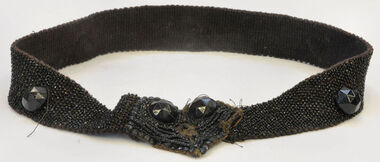 Orbost & District Historical Society
Clothing - belt, 1890-1910
... Jet beaded belt . Large and small beads. Large jet bead fastener (Paris Jet)....It is highly decorative. belt beads costume-accessories jewelry jet-beads temple-george Jet beaded belt . Large and small beads. Large jet bead fastener (Paris Jet). ...This item is from the Temple estate. George Temple (1832-1916) started Temple's store opposite Post Office. Packed stores to Bendoc area gold fields.This item is significant because it represents part of a woman's costume worn c. late 19th Century to 1910. It is highly decorative.Jet beaded belt . Large and small beads. Large jet bead fastener (Paris Jet).belt beads costume-accessories jewelry jet-beads temple-george -
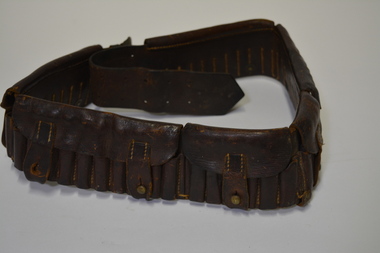 Wangaratta RSL Sub Branch
Uniform - Ammunition Belt
... Brown leather ammunition belt with large metal buckle. Belt consists of 6 compartments. ...Belt worn for carriage of ammunition. ammuniton belt cartridge belt leather metal Nil Brown leather ammunition belt with large metal buckle. Belt consists of 6 compartments. ...Belt worn for carriage of ammunition.Brown leather ammunition belt with large metal buckle. Belt consists of 6 compartments. Four compartments have pockets for 10 cartridges, one compartment has pocket for 6 cartridges and one compartment has room for 4 cartridges. Nilammuniton belt, cartridge belt, leather, metal -
 Glenelg Shire Council Cultural Collection
Functional object - Holster belt, n.d
... Wide leather belt with large metal buckle and leather holder for pistol...weapon pistol holder Wide leather belt with large metal buckle and leather holder for pistol Functional object Holster belt ...Wide leather belt with large metal buckle and leather holder for pistolweapon, pistol, holder -
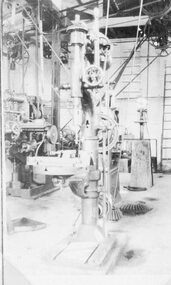 Stawell Historical Society Inc
Photograph, Stawell Technical School's Large Vertical Drill, Belt driven Lathes & Electric generator plant -- 3 Photos
... Stawell Technical School's Large Vertical Drill, Belt driven Lathes & Electric generator plant -- 3 Photos...Stawell Technical School Three photos. Large Vertical Drill. Belt driven Lathes. Electric generator plant....Stawell Technical School Three photos. Large Vertical Drill. Belt driven Lathes. Electric generator plant. ...Stawell Technical School Three photos. Large Vertical Drill. Belt driven Lathes. Electric generator plant.stawell education -
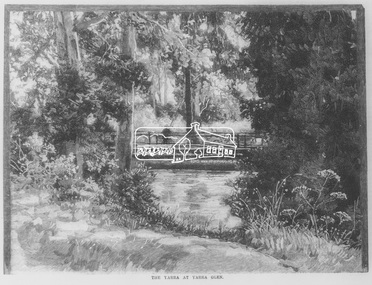 Eltham District Historical Society Inc
Negative - Photograph, Australasian Sketcher, The Yarra at Yarra Glen, 1889
... "As the train on its journey from Melbourne to Healesville crosses the Yarra-flats, many glimpses are caught of the Yarra, sometimes between large belts of gumtrees, and splashing over boulders with is bosum covered with bubbles, dancing with sunlight, and racing each other until lost in the dark shadows of the wattles. ..."As the train on its journey from Melbourne to Healesville crosses the Yarra-flats, many glimpses are caught of the Yarra, sometimes between large belts of gumtrees, and splashing over boulders with is bosum covered with bubbles, dancing with sunlight, and racing each other until lost in the dark shadows of the wattles. ..."As the train on its journey from Melbourne to Healesville crosses the Yarra-flats, many glimpses are caught of the Yarra, sometimes between large belts of gumtrees, and splashing over boulders with is bosum covered with bubbles, dancing with sunlight, and racing each other until lost in the dark shadows of the wattles. Another turn catches it in a sombre mood, stealing slowly beneath some rustic bridge, whereon stands a patient fisherman waiting for a fish, which if the bait be correct, comes pretty frequently. Our illustration depicts one of these pretty nooks, and a very good idea is given of our picturesque river before it is polluted and turned into a sewer at Prince's Bridge."This photo forms part of a collection of photographs gathered by the Shire of Eltham for their centenary project book,"Pioneers and Painters: 100 years of the Shire of Eltham" by Alan Marshall (1971). The collection of over 500 images is held in partnership between Eltham District Historical Society and Yarra Plenty Regional Library (Eltham Library) and is now formally known as the 'The Shire of Eltham Pioneers Photograph Collection.' It is significant in being the first community sourced collection representing the places and people of the Shire's first one hundred years.Digital image 35mm Negativesepp, shire of eltham pioneers photograph collection, yarra glen, steels creek, cave hill -
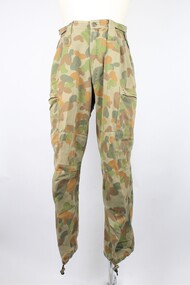 Warrnambool RSL Sub Branch
Trousers, Australian Defence Apparel, 2015
... Pants take a straight leg style and bears several pockets: two thigh level pockets with zippered horizontal opening, two open hip pockets on the front, one open pocket on the reverse right hand side with blue plastic button fastener. Five large belt loops encircle the waist and there is a zippered fly, secured at the top with a blue plastic button....Pants take a straight leg style and bears several pockets: two thigh level pockets with zippered horizontal opening, two open hip pockets on the front, one open pocket on the reverse right hand side with blue plastic button fastener. Five large belt loops encircle the waist and there is a zippered fly, secured at the top with a blue plastic button. ...These trousers are part of a Disruptive Pattern Combat Uniform issued by the Australian Airforce to Bernard Farley during service. This uniform type was used in base and field activities and was replaced in 2014 by the General Purpose Uniform as the uniform worn during general base duties and in non-warlike environments.This item has social significance, as an item of uniform worn by Warrnambool RSL community member and Secretary (2019), Bernard Farley during service with the Australian Airforce. The item is a representative example of previously standard issue Airforce uniform and is in excellent condition. As a set, the uniform has aesthetic significance in it’s design, incorporating the Disruptive Pattern style of camouflage which has its roots in the 1980s and continues to be adapted into uniform design by the Defence Force.Disruptive Pattern trousers in five colours of green and brown. Long pants with elasticised drawstring fastener at ankle and velcro adjustment fasteners at the waist. Pants take a straight leg style and bears several pockets: two thigh level pockets with zippered horizontal opening, two open hip pockets on the front, one open pocket on the reverse right hand side with blue plastic button fastener. Five large belt loops encircle the waist and there is a zippered fly, secured at the top with a blue plastic button.Label on interior front right of trousers reads: “A13/ADA/VICTORIA 2008/(broad arrow)/SPECIFICATION ARMY (AUST)6542/NSN: 8415 66 152 1059/SIZE: 95 S/NAME/SERVICE NO/75% COTTON 25% POLYESTER/WARM MACHINE WASH 40*C/RINSE WELL, WARM IRON/DO NOT IRON OVER HOOK AND PILE/DO NOT BLEACH/DO NOT STARCH/MAY BE TUMBLE DRY 40*C/MADE IN AUSTRALIA” The name “FARLEY” is also handwritten on the back interior waist band of the trousers. camouflage, general purpose uniform, airforce, uniform, australian defence force -
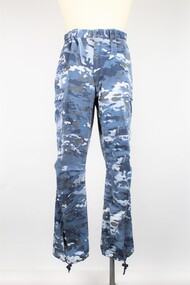 Warrnambool RSL Sub Branch
Trousers, Australian Defence Apparel, 2015
... Pants take a straight leg style and bears several pockets: two thigh level pockets with zippered horizontal opening, two open hip pockets on the front, one open pocket on the reverse right hand side with blue plastic button fastener. Five large belt loops encircle the waist and there is a zippered fly, secured at the top with a blue plastic button....Pants take a straight leg style and bears several pockets: two thigh level pockets with zippered horizontal opening, two open hip pockets on the front, one open pocket on the reverse right hand side with blue plastic button fastener. Five large belt loops encircle the waist and there is a zippered fly, secured at the top with a blue plastic button. ...These trousers are part of a General Purpose Uniform issued by the Australian Airforce to Bernard Farley during service. This uniform type was developed in 2014 and replaced camouflage as the uniform worn during general base duties and in non-warlike environments. Although a camouflage pattern, this design is not intended for use as camouflage. This item has social significance, as an item of uniform worn by Warrnambool RSL community member and Secretary (2019), Bernard Farley during service with the Australian Airforce. The item is a representative example of current Airforce General Purpose Uniform and is in excellent condition. As a set, the uniform has aesthetic significance in it’s design, incorporating GPU uniform design from the Army alongside the colours and motifs of the Australian Airforce. General Purpose Uniform (GPU) trousers in Airforce colours of blue and grey in camouflage pattern. Long pants with elasticised drawstring fastener at ankle and velcro adjustment fasteners at the waist. Pants take a straight leg style and bears several pockets: two thigh level pockets with zippered horizontal opening, two open hip pockets on the front, one open pocket on the reverse right hand side with blue plastic button fastener. Five large belt loops encircle the waist and there is a zippered fly, secured at the top with a blue plastic button.Label on interior front right of trousers reads: “A193/ADA/MADE IN AUSTRALIA/JUL 2015/ PO: CC2X91/NSN: 8415 66 161 4017/SIZE: 95 R/(broad arrow)/NAME:............/PM KEYS NO:............./75% COTTON 25% POLYESTER/WARM MACHINE WASH 40*C/RINSE WELL, WARM IRON/DO NOT IRON OVER HOOK AND PILE/DO NOT BLEACH/DO NOT STARCH/MAY BE TUMBLE DRY 40*C/DRYCLEANABLE (P)”camouflage, general purpose uniform, airforce, uniform, australian defence force -
 Melbourne Tram Museum
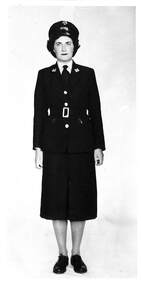
Photograph - Black & White Photograph/s, late 1940's
... Black and white photograph - Conductress - cap badge 4584, the uniform has a very large buckle waist belt - and interesting due the MMTB badge on apel's. - could be late 40' into the 1950s. ...Trams tramways Personnel Uniforms Conductresses Black and white photograph - Conductress - cap badge 4584, the uniform has a very large buckle waist belt - and interesting due the MMTB badge on apel's. - could be late 40' into the 1950s. ...Black and white photograph - Conductress - cap badge 4584, the uniform has a very large buckle waist belt - and interesting due the MMTB badge on apel's. - could be late 40' into the 1950s. Needs more investigation.trams, tramways, personnel, uniforms, conductresses -
 Kyneton RSL Sub Branch
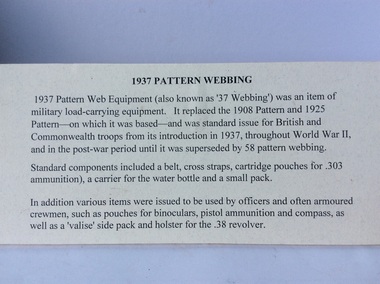
Belt and Pouches
... Webbing belt and shoulder straps which cross at back, with 3 pouches on the belt, two large and one small. There is descriptive information displayed with the item. ...Webbing belt and shoulder straps which cross at back, with 3 pouches on the belt, two large and one small. There is descriptive information displayed with the item. ...Typical equipment issued to Bombadier command.Webbing belt and shoulder straps which cross at back, with 3 pouches on the belt, two large and one small. There is descriptive information displayed with the item. Bdr Wilson is written on the belt of the webbing.ww2 issue -
 Bendigo Military Museum
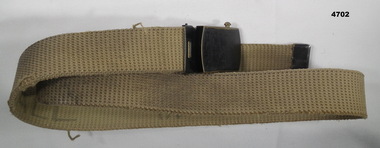
Uniform - BELT, WEBBING, C.1968
... Belt webbing light khaki colour, black metal buckle with sliding section for length adjustment, inside belt has large stamped military details some very faint plus name in texta....On metal buckle, “Lion metal goods” In texta, “Ball” Belt webbing light khaki colour, black metal buckle with sliding section for length adjustment, inside belt has large stamped military details some very faint plus name in texta. ...Belt for summer issue Polyester uniform trousers. Peter Ball collection, refer Cat No 4704Belt webbing light khaki colour, black metal buckle with sliding section for length adjustment, inside belt has large stamped military details some very faint plus name in texta.Military details, “........(arrow up) 1968 ........66-012-6304.40”. On metal buckle, “Lion metal goods” In texta, “Ball”belts, webbing, polyesters, uniform -
 Mont De Lancey
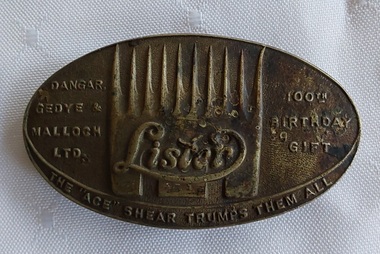
Accessory - Belt Buckle, Lister, 1900's
... In the 1970s and 1980s, large, solid-brass belt buckles became a popular fashion statement and collectible. ...In the 1970s and 1980s, large, solid-brass belt buckles became a popular fashion statement and collectible. ...Dangar, Gedye and Malloch (DGM) was an historic Australian agricultural machinery and merchant company established in 1838 and became associated with Lister in 1909. Based in Sydney, it was famous for distributing farm equipment like Lister shearing machines designed by Australian Jim Davidson. In the 1970s and 1980s, large, solid-brass belt buckles became a popular fashion statement and collectible. Companies like Lister used them as promotional merchandise and customer giveaways for farmers, agricultural mechanics, and shearing gangs.An oval shaped brass and metal Lister belt buckle with the name, a symbol of shears and the manufacturing details stamped on the front. There is a rusted metal attachment on the back. Stamped on the front of the buckle is: 'Dangar Gedye & Malloch' 'Lister' '100th Birthday Gift' 'The Ace Shear Trumps Them All'belts, clothing - accessories, buckles, belt - accessories -
 Ringwood RSL Sub-Branch
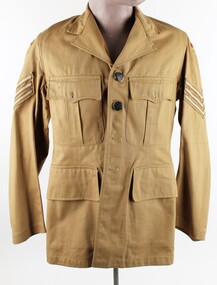
Uniform - Uniform, Army Jacket, Khaki Drill, 3 stripes and red flash insignia, Christopher Roberts & Co., Ltd, 1955
... Army Jacket, Khaki Drill O.A, 1949 pattern, Two plastic buttons, Three Seargant Cheverons, Red Air force wings flash, Two large breast pockets, Two large lower pockets, Waiste belt with brass buckle attatched, ...Army Jacket, Khaki Drill O.A, 1949 pattern, Two plastic buttons, Three Seargant Cheverons, Red Air force wings flash, Two large breast pockets, Two large lower pockets, Waiste belt with brass buckle attatched, Uniform Uniform, Army Jacket, Khaki Drill, 3 stripes and red flash insignia. ...Army Jacket, Khaki Drill O.A, 1949 pattern, Two plastic buttons, Three Seargant Cheverons, Red Air force wings flash, Two large breast pockets, Two large lower pockets, Waiste belt with brass buckle attatched, -
 Bendigo Historical Society Inc.
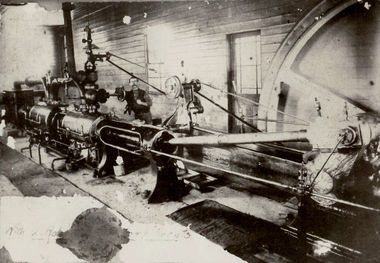
Photograph - COMPOUND AIR COMPRESSOR
... One male with right hand on wheel of control valve in the compressed air pipe outlet of a two stage or compound air compressor with con rod and crank shaft to a large flywheel. Two belts to a vertical governor. Outgoing air pipe vertical to ceiling of enclosing building. ...One male with right hand on wheel of control valve in the compressed air pipe outlet of a two stage or compound air compressor with con rod and crank shaft to a large flywheel. Two belts to a vertical governor. Outgoing air pipe vertical to ceiling of enclosing building. ...Black and white photograph. One male with right hand on wheel of control valve in the compressed air pipe outlet of a two stage or compound air compressor with con rod and crank shaft to a large flywheel. Two belts to a vertical governor. Outgoing air pipe vertical to ceiling of enclosing building. Inscriptions: Nameplate or bed plate 'A Roberts and sons, Engineers, Bendigo' Lower left corner handwritten 'with A Rob. Compliments' On back - 'Compound Air Compressor'.machinery, compressors, compound air compressor, worker, male -
 Linton and District Historical Society Inc
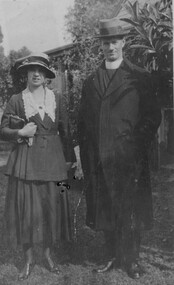
Postcard - Photograph, The Reverend and Mrs. Horner
... Dress has large lace collar and belt at waist. Woman is standing with right arm around handbag, left arm by her side, next to a taller man wearing long overcoat, clerical collar and hat standing with left hand in coat pocket, right arm by his side....Dress has large lace collar and belt at waist. Woman is standing with right arm around handbag, left arm by her side, next to a taller man wearing long overcoat, clerical collar and hat standing with left hand in coat pocket, right arm by his side. ...The Reverend Horner was vicar at St Paul's Church, Linton, between 1922 and 1926.Sepia postcard photograph of a woman wearing two-piece mid-calf-length costume and hat. Dress has large lace collar and belt at waist. Woman is standing with right arm around handbag, left arm by her side, next to a taller man wearing long overcoat, clerical collar and hat standing with left hand in coat pocket, right arm by his side."Rev. and Mrs Horner Vicar of St Pauls Linton June 1922 - October 1926". st paul's church of england linton, rev. albert george horner, mrs horner -
 Bendigo Military Museum
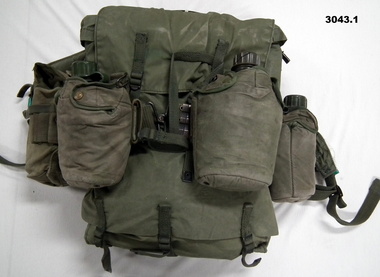
Equipment - WEBBING KIT, post 1960
... belt. 2. Basic pouches, ammunition x 2. 3. Water bottle carriers x 3. 4. Water bottles x 3. 5. Cup, canteen steel, inside water bottle carrier. 6. Webbing harness. 7. Toggle rope. 8. Machete. 9. Machete scabbard. 10. Bayonet US M16. ) 1608.2 11. Bayonet Scabbard.) .2) Vietnam era basic webbing kit worn on waist with shoulder harness. 1. Back pack large...belt. 2. Basic pouches, ammunition x 2. 3. Water bottle carriers x 3. 4. Water bottles x 3. 5. Cup, canteen steel, inside water bottle carrier. 6. Webbing harness. 7. Toggle rope. 8. Machete. 9. Machete scabbard. 10. Bayonet US M16. ) 1608.2 11. Bayonet Scabbard.) .2) Vietnam era basic webbing kit worn on waist with shoulder harness. 1. Back pack large ...Items made up with full weight for use with school groups to show what carried & weight in Vietnam era.Complete kit green colour. .1) Vietnam era main back pack with webb belt, water bottles & basic pouch. 1. Webb belt. 2. Basic pouches, ammunition x 2. 3. Water bottle carriers x 3. 4. Water bottles x 3. 5. Cup, canteen steel, inside water bottle carrier. 6. Webbing harness. 7. Toggle rope. 8. Machete. 9. Machete scabbard. 10. Bayonet US M16. ) 1608.2 11. Bayonet Scabbard.) .2) Vietnam era basic webbing kit worn on waist with shoulder harness. 1. Back pack large. 2. Webb belt. 3. Water bottles x 3. 4. Wattle bottle carriers x 3. 5. Basic pouch, ammunition.military equipment - army, webbing -
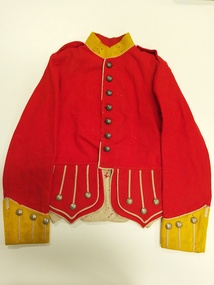 The 5th/6th Battalion Royal Victoria Regiment Historical Collection
Uniform - VSR OR scarlet doublet, c 1898-1912
... Seven large buttons at front of tunic (one missing), and two at back waist. Two large brass belt hooks at side waist of doublet. ...Seven large buttons at front of tunic (one missing), and two at back waist. Two large brass belt hooks at side waist of doublet. ...Scarlet wool doublet with yellow stand collar and cuffs and Inverness skirts. Lower edge of collar, left front of doublet, cuffs and Inverness skirts all edged with white piping. Cuffs and skirts are decorated with three rows of doubled, twisted white wool braid; each row completed with a large whitemetal coloured metal "King Edward VII Australian Commonwealth" button of the period 1901-1911. Shoulder straps are scarlet wool with MISSING whitemetal 'VSR' title, a MISSING whitemetal 'letter' title, a small ERVII Australian Commonwealth button on left shoulder, and a small silver coloured metal Victorian Military Forces button on the right shoulder. Seven large buttons at front of tunic (one missing), and two at back waist. Two large brass belt hooks at side waist of doublet. Lower front skirt flaps have welt pockets lined with linen. Body of tunic lined with a white wool mixture, lightly padded around the underarms. Lower skirt flaps lined with a medium weight cream wool twill and upper smaller flaps lined with a finer cream wool twill. Sleeves lined with cream cotton twill and printed in black ink on the centre back lining is '5/8 38'. Collar lined with red wool and neck fastened with a single brass hook and eye over a black patent leather tab.Printed in black ink on the centre back lining is '5/8 38' -
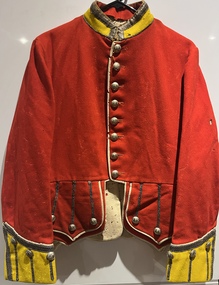 The 5th/6th Battalion Royal Victoria Regiment Historical Collection
Uniform - Victorian Scottish Regiment Officers Scarlet Full Dress Doublet c. 1898, c1901-1911
... Eight large buttons at front of tunic, and two at back waist. Two large brass belt hooks at side waist of doublet. ...Eight large buttons at front of tunic, and two at back waist. Two large brass belt hooks at side waist of doublet. ...The Victorian Scottish Regiment was an infantry unit of the Colony of Victoria Australia raised in 1898. It became part of the Australian Commonwealth Military forces in 1901 and was later renamed the 5th Battalion, Victorian Scottish Regiment. In 1960 the Victorian Scottish Regiment became the Royal Victoria Regiment and the present 5th/6th Battalion, Royal Victoria Regiment is today the custodian of its Australian-Scottish customs and traditions. Officer's full dress scarlet wool doublet with yellow stand collar and cuffs, and Inverness skirts. Left front of doublet, cuffs and Inverness skirts all edged with white piping. Lower edge of collar, cuffs and skirts are decorated with three rows of doubled, 1/8” silver Russian braid; each row completed with a large whitemetal coloured metal "King Edward VII Australian Commonwealth" button of the period 1901-1911. 5/8” silver lace around top of collar, and top and seam of gauntlet cuff. Silver braid shoulder straps and screw buttons MISSING. Eight large buttons at front of tunic, and two at back waist. Two large brass belt hooks at side waist of doublet. Lower front skirt flaps have welt pockets lined with linen. Body of tunic lined with a white wool mixture, lightly padded around the underarms. Lower skirt flaps lined with a medium weight cream wool twill and upper smaller flaps lined with a finer cream wool twill. Sleeves lined with cream cotton twill and written in blue ink on lotter right opening lining is '5-7 37'. Collar lined with red wool and neck fastened with two brass hook and eyes. No black patent leather tab at collar.blue ink on lotter right opening lining is '5-7 37'vsr, victorian scottish regiment, australian army, 5th battalion, 5th battalion victorian scottish regiment, royal australian infantry corps, rainf, 5/6 rvr, 5th/6th battalion, royal victoria regiment, pipes and drums, officer, full dress, doublet, scottish dress -
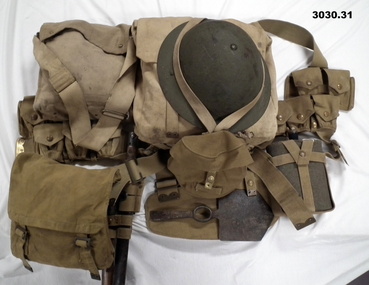 Bendigo Military Museum
Equipment - WEBBING KIT, 1911; Post 1911
... Refer attached sheet. .1) Waist belt with brass buckles & keepers. .2) Braces x 2, connects to waist belt & large pack. .3) Bayonet. .4) Bayonet carrier. .5) Bayonet scabbard. .6) Entrenching tool carrier [fits to .5)]. .7) Entrenching tool handle, wood & metal [fits to .6)]. .8) Entrenching tool, metal, combination shovel & pick. .9) Entrenching tool carrier [fits inside .8)]. .10) Cartridge carriers x 2, 1 left hand, 1 right hand. .11) Water bottle, metal, blue colour. .12) Water bottle cover, khaki wool. .13) Water bottle carrier. .14) Pack, large. .15) Great coat, wool, [inside .14)]. .16) Helmet, steel with inside liner & chin strap. .17) Mess tin carrier, replica. .18) Haversack, side pack. .19) Carry all, white cotton, for personnel hygiene items [inside .18)]. .20) Razor, cut throat [inside .19)]. .21) Comb [inside .19)]. .22) Toothbrush [inside .19)]. .23) Shaving brush [inside .19)]. .24) Laces, leather, not original, [inside .19)]. .25) Soap [inside .19)]. .26) Tin bully beef x 2, replicas, [inside .18)]. .27) Tin stew, replica, [inside .18)]. .28) Pair socks, khaki wool, not original, [inside .18)]. .29) Field dressing, WWII issue, [inside .18)]. .30) Towel, brown colour, not original, [inside .18)]. .31) Gas mask carrier bag & straps. ...Refer attached sheet. .1) Waist belt with brass buckles & keepers. .2) Braces x 2, connects to waist belt & large pack. .3) Bayonet. .4) Bayonet carrier. .5) Bayonet scabbard. .6) Entrenching tool carrier [fits to .5)]. .7) Entrenching tool handle, wood & metal [fits to .6)]. .8) Entrenching tool, metal, combination shovel & pick. .9) Entrenching tool carrier [fits inside .8)]. .10) Cartridge carriers x 2, 1 left hand, 1 right hand. .11) Water bottle, metal, blue colour. .12) Water bottle cover, khaki wool. .13) Water bottle carrier. .14) Pack, large. .15) Great coat, wool, [inside .14)]. .16) Helmet, steel with inside liner & chin strap. .17) Mess tin carrier, replica. .18) Haversack, side pack. .19) Carry all, white cotton, for personnel hygiene items [inside .18)]. .20) Razor, cut throat [inside .19)]. .21) Comb [inside .19)]. .22) Toothbrush [inside .19)]. .23) Shaving brush [inside .19)]. .24) Laces, leather, not original, [inside .19)]. .25) Soap [inside .19)]. .26) Tin bully beef x 2, replicas, [inside .18)]. .27) Tin stew, replica, [inside .18)]. .28) Pair socks, khaki wool, not original, [inside .18)]. .29) Field dressing, WWII issue, [inside .18)]. .30) Towel, brown colour, not original, [inside .18)]. .31) Gas mask carrier bag & straps. ...The 1908 pattern was used during WWI, made from woven cotton & water proofed. The kit is used for school groups.Webbing kit complete including 1908 pattern webbing, gas mask haversack, personnel items, rations. Refer attached sheet. .1) Waist belt with brass buckles & keepers. .2) Braces x 2, connects to waist belt & large pack. .3) Bayonet. .4) Bayonet carrier. .5) Bayonet scabbard. .6) Entrenching tool carrier [fits to .5)]. .7) Entrenching tool handle, wood & metal [fits to .6)]. .8) Entrenching tool, metal, combination shovel & pick. .9) Entrenching tool carrier [fits inside .8)]. .10) Cartridge carriers x 2, 1 left hand, 1 right hand. .11) Water bottle, metal, blue colour. .12) Water bottle cover, khaki wool. .13) Water bottle carrier. .14) Pack, large. .15) Great coat, wool, [inside .14)]. .16) Helmet, steel with inside liner & chin strap. .17) Mess tin carrier, replica. .18) Haversack, side pack. .19) Carry all, white cotton, for personnel hygiene items [inside .18)]. .20) Razor, cut throat [inside .19)]. .21) Comb [inside .19)]. .22) Toothbrush [inside .19)]. .23) Shaving brush [inside .19)]. .24) Laces, leather, not original, [inside .19)]. .25) Soap [inside .19)]. .26) Tin bully beef x 2, replicas, [inside .18)]. .27) Tin stew, replica, [inside .18)]. .28) Pair socks, khaki wool, not original, [inside .18)]. .29) Field dressing, WWII issue, [inside .18)]. .30) Towel, brown colour, not original, [inside .18)]. .31) Gas mask carrier bag & straps. (Cowley) .32) Water bottle, metal, blue colour, [inside .31)].Items 1 - 13, there are numerous markings all stamped on from, “A.A.O.D”, “L”, “R”, “S”, “M.E.C.O”, “49th INF”, Years examples, “8.12”, “1.13”, “1911”military history - equipment / army, medicine-first aid, personal effects - containers, toilet requisites - shaving -
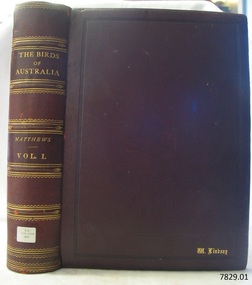 Flagstaff Hill Maritime Museum and Village
Book - Reference, The Birds of Australia Vol 1
... It was heavily timbered, mostly blackwood, with large belts of wattle and honeysuckle. Much of the heavy native was ringbarked and cleared; much more was swept away by bushfire. ...It was heavily timbered, mostly blackwood, with large belts of wattle and honeysuckle. Much of the heavy native was ringbarked and cleared; much more was swept away by bushfire. ...The Birds of Australia is a 12 volume work, in a total of 14 books. The books were used as an ornithological handbook. They contain scientific text as well as over 600 hand-coloured lithographed plates by J.G. Keulemans, H. Grönvold, Roland Green, H. Goodchild and G.E. Lodge. The work was written, sponsored and organised by Gregory M. Matthews, F.R.S.C. Erc. who were a wealthy Australian and an amateur ornithologist? His titles included – -Fellow of the Linnean and Zoological Societies of London -Member of the British Ornithologists’ Union -Corresponding Fellow of the American Ornithologists’ Union The volumes in our collection were originally donated to the Warrnambool Mechanics’ Institute and Free Library by William Lindsay. THE LINDSAYS (quoted from the book Of Many Things – A History of Warrnambool Shire by C.E. Sayers) The Lindsays were amongst the most prominent families in the Shire of Warrnambool, as pastoralists, sportsmen, municipal councillors, community leaders. The first of the family William arrived in Melbourne in 1841 and started a business as a livestock agent. The gold rushes sent him to the central Victoria diggings dealing in cattle. This was a business that boomed in the early 1850s, and he prospered. In 1859 he took over the Quamby run near Woolsthrope from Paul de Castella, the Yarra Valley Swiss vigneron who had brought the leasehold and improvements in 1853 from George You, who had pioneered the run. Quamby was originally 25,000 acres. It was heavily timbered, rough country, much of it swampy, a characteristic of the district. Lindsay used it to fatten cattle which gave large returns with the booming gold diggings towns paying high prices for beef. In 1862 purchases at auction made Quamby a freehold. In the next six years, a further 20,000 acres of Crown land were brought at auction to make the run one of the largest in the south-west district. The great profits from his cattle trading enabled Lindsay to make improvements to the holding, and to Union which was added in 1864. Much of the thick timber was cleared and the worst of the swamps drained. Union was 15,000 acres of freehold land when Kennedy sold it to Lindsay. It was heavily timbered, mostly blackwood, with large belts of wattle and honeysuckle. Much of the heavy native was ringbarked and cleared; much more was swept away by bushfire. It was expensive work, but Lindsay’s bank passbook was heavy with credit, and he did not spare money to make both Quamby and Union heavily developed stock runs. He was as lavish in social living; the bluestone Quamby homestead was one of the most hospitable in the district when William Lindsay was host there; its paddocks carried high-quality thoroughbreds: its stables housed steeplechasers and flat racers which won many races on Warrnambool and other courses; its coach houses were filled with carriages which took his guests to the great racing carnivals of the district. After William Lindsay died in 1897, in his eighty-fifth year, his two sons, William and James, managed Union and Quamby as a joint venture. This partnership ended in 1906 when William took over Union and James kept Quamby. The following year 10,000 acres of Union was subdivided and sold in lots of 100 acres to 700 acres for dairying and general farming. It was well-improved country, much of it alluvial flats. By then many of the paddocks were sheltered with blue gum belts, and they carried good pastures. The three Lindsays, father and two sons, gave many years of service to the Shire, and to many charitable, sporting, social and community organisations in the Warrnambool district. William Lindsay senior, was a Shire councillor for 15 years, and President several times. James Lindsay followed his father as a north riding councillor. He served nineteen years, from 1887 until his death in March 1908. He was President four times. Jimmy Lindsay was one of the most popular men in the south-west of Victoria. He was a fine sportsman: horse breeder, owner and a dashing amateur rider. He lived lavishly and played hard. For many years he guarded a herd of kangaroos, as many as 100 head, at Quamby. Descendants of the Lindsay kangaroos are still in the district. James Lindsay’s wife, Margaret Esther was a daughter of Samuel Shaw Parker, the first engineer of the Shire. Nell Lindsay, a daughter, lives in the Bluestone Quamby homestead. Only a little more than 60 acres of the original run still belongs to the property. William Lindsay junior succeeded his brother as a Shire councillor. He served for 25 years from 1908 until his death in 1934. So, the Lindsays, father and two sons, served as Shite councillors for an unbroken period of sixth-five years. William Lindsay junior had a life-long interest in horse racing, as breeder, owner and enthusiastic amateur steeplechase rider. He was elected a member of the Warrnambool racing club in 1901 and was president of the club for thirty-two years. He raced and rode horses for the love of the sport. He won the Villiers and Heytesbury Hunt Cup in the 1870s on his own horse, Ventura. In the year he died his horse Flavedo won the Warrnambool Grand Annual steeplechase. It was a sensational race. All of the contestants fell or lost their riders. When Flavedo baulked at a jump, its jockey R. Sweetman, remounted and completed the course to win the race. All of the Lindsays were passionately fond of the thoroughbred horse. Nell Lindsay talking to the author in the drawing-room of Quamby homestead - with many memories for her of its lavish years – said of a brother that he was put on a horse when he was two years old and never got off. William Lindsay junior made Union into a fine, high-producing property, breeding cattle and horses. He added to the bluestone house that David Kennedy started, established plantations of pines and gums, and made an attractive garden. WARRNAMBOOL MECHANICS’ INSTITUTE Warrnambool's Mechanics' Institute (or Institution as it was sometimes called) was one of the earliest in Victoria. On 17th October 1853, a meeting was held where it was resolved to request the Lieutenant Governor of the Colony to grant land for the erection of a Mechanics' Institutes building. A committee was formed at the meeting and Richard Osburne chaired the first meeting of this committee. The land on the North West corner of Banyan and Merri Streets was granted but there were no funds to erect the building. The Formal Rights of the Warrnambool Mechanics' Institute's encompassed its aims and these were officially adopted in1859; "This Institution has for its object the diffusion of literary, scientific, and other useful knowledge amongst its members, excluding all controversial subjects, religious or political. These objects are sought to be obtained by means of a circulating library, a reading room, the establishment of classes, debates, and the occasional delivery of lectures on natural and experimental philosophy, mechanics, astronomy, chemistry, natural history, literature, and the useful and ornamental arts, particularly those which have a more immediate reference to the colony." The Warrnambool Mechanics' Institute opened its first meeting room in November 1854 in the National School building at the corner of Banyan and Timor Streets. The Institute was funded by member subscription, payable on a quarterly, half-yearly or yearly basis. Samuel Hannaford, the Manager of the Warrnambool Bank of Australasia, was the first Honorary Secretary of the Mechanics' Institutes, and an early President and Vice-President. He also gave several of the early lectures in the Reading Room. Another early Secretary, Librarian and lecturer was Marmaduke Fisher, the teacher at the National School. Lecture topics included The Poets and Poetry of Ireland', 'The Birth and Development of the Earth', 'The Vertebrae - with Remarks on the pleasures resulting from the study of Natural History' and 'Architecture'. In 1856 the Reading Room was moved to James Hider's shop in Timor Street, and by 1864 it was located in the bookshop of Davies and Read. In the 1860's the Mechanics' Institute struggled as membership waned but in 1866, after a series of fund raising efforts, the committee was able to purchase land in Liebig Street, on a site then called Market Square, between the weighbridge and the fire station. A Mechanics' Institute building was opened at this site in August 1871. The following year four more rooms were added to the main Reading Room and in 1873 the Artisan School of Design was incorporated into the Institute. The same year Joseph Archibald established a Museum; however, it deteriorated when he was transferred to Bendigo in 1877. In 1880, with Archibald's return to Warrnambool, the Museum was re-established, and in 1885 a new building was built at the back of the Institute to accommodate the re-created School of Design, the Art Gallery and the Museum. In 1887 the Museum section was moved to the former court house in Timor Street (for some time the walls of the building formed part of the TAFE cafeteria but all is now demolished)). In 1911 the Museum was transferred back to the original building and the management of the Mechanics' Institute was handed over to the Warrnambool City Council. The Museum and Art Gallery became one and housed many fine works of art, and the Library continued to grow. The building was well patronised, with records showing that at the beginning of the 20th century there were between 500 and 800 visitors. During World War One the monthly figures were in the thousands, with 3,400 people visiting in January 1915. The Museum was a much-loved Institution in Warrnambool until the contents of the Museum and Art Gallery were removed to make room for the Warrnambool City Council Engineers' Department. The contents were stored but many of the items were scattered or lost. When the original building was demolished the site became occupied by the Civic Centre, which included the new City Library. (The library was temporarily located in the old Palais building in Koroit Street.) In the process of reorganisation the Collection was distributed amongst the community groups: -The new City Library took some of the historic books and some important documents, historic photographs and newspapers. -The Art Gallery kept the 19th Century art collection and some of the artefacts from the museum. -The Historic Society has some items -The State Museum has some items -Some items were destroyed -Flagstaff Hill Maritime Village has old newspapers, Government Gazettes, most of the Mechanics' Institute Library, ledgers and documents connected to the Mechanics' Institute Library, some framed and unframed artworks and some photographs. The Warrnambool Mechanics' Institute Library book collection is deemed to be of great importance because it is one of the few collections in an almost intact state, and many of the books are now very rare and of great value. THE PATTISON COLLECTION This book is also part of the ‘Pattison Collection’, a collection of books and records that was originally owned by the Warrnambool Mechanics’ Institute, which was founded in Warrnambool in 1853. In 1935 Ralph Pattison was appointed as City Librarian to establish and organise the Warrnambool Library, as the Warrnambool Mechanics’ Institute was then called. When the Warrnambool Mechanics’ Institute building was pulled down in 1963 a new civic building was erected on the site and the new Warrnambool Library, on behalf of the City Council, took over all the holdings of the Warrnambool Mechanics’ Institute. At this time some of the items were separated and identified as the ‘Pattison Collection’, named after Ralph Pattison. Eventually, the components of the Warrnambool Mechanics’ Institute were distributed from the Warrnambool Library to various places, including the Art Gallery, Historical Society and Flagstaff Hill. Later some were even distributed to other regional branches of Corangamite Regional Library and passed to and fro. It is difficult now to trace just where all of the items have ended up. The books at Flagstaff Hill Maritime Village generally display stamps and markings from Pattison as well as a variety of other institutions including the Mechanics’ Institute itself. RALPH ERIC PATTISON Ralph Eric Pattison was born in Rockhampton, Queensland, in 1891. He married Maude Swan from Warrnambool in 1920 and they set up home in Warrnambool. In 1935 Pattison accepted a position as City Librarian for the Warrnambool City Council. His huge challenge was to make a functional library within two rooms of the Mechanics’ Institute. He tirelessly cleaned, cleared and sorted a disarrayed collection of old books, jars of preserved specimens and other items reserved for exhibition in the city’s museum. He developed and updated the library with a wide variety of books for all tastes, including reference books for students; a difficult task to fulfil during the years following the Depression. He converted all of the lower areas of the building into a library, reference room and reading room for members and the public. The books were sorted and stored using a cataloguing and card index system that he had developed himself. He also prepared the upper floor of the building and established the Art Gallery and later the Museum, a place to exhibit the many old relics that had been stored for years for this purpose. One of the treasures he found was a beautiful ancient clock, which he repaired, restored and enjoyed using in his office during the years of his service there. Ralph Pattison was described as “a meticulous gentleman whose punctuality, floorless courtesy and distinctive neat dress were hallmarks of his character, and ‘his’ clock controlled his daily routine and his opening and closing of the library’s large heavy doors to the minute.” Pattison took leave from 1942 to 1945 to serve in the Royal Australian Navy, Volunteer Reserve as Lieutenant. A few years later he converted one of the Museum’s rooms into a Children’s Library, stocking it with suitable books for the younger generation. This was an instant success. In the 1950’s he had the honour of being appointed to the Victorian Library Board and received more inspiration from the monthly conferences in Melbourne. He was sadly retired in 1959 after over 23 years of service, due to the fact that he had gone over the working age of council officers. However, he continued to take a very keen interest in the continual development of the Library until his death in 1969. The Birds of Australia by Gregory M. Matthews is now considered a rare and valuable scientific and historic work on its own. These 12 volumes were donated in 1934 to The Warrnambool Mechanics’ Institute and were included as part of the Pattison Collection. The Warrnambool Mechanics’ Institute Collection is primarily significant in its totality, rather than for the individual objects it contains. Its contents are highly representative of the development of Mechanics' Institute libraries across Australia, particularly Victoria. A diversity of publications and themes has been amassed, and these provide clues to our understanding of the nature of and changes in the reading habits of Victorians from the 1850s to the middle of the 20th century. The collection also highlights the Warrnambool community’s commitment to the Mechanics’ Institute, reading, literacy and learning in the regions, and proves that access to knowledge was not impeded by distance. These items help to provide a more complete picture of our community’s ideals and aspirations. The Warrnambool Mechanics Institute book collection has historical and social significance for its strong association with the Mechanics Institute movement and the important role it played in the intellectual, cultural and social development of people throughout the latter part of the nineteenth century and the early twentieth century. The collection of books is a rare example of an early lending library and its significance is enhanced by the survival of an original collection of many volumes. The Warrnambool Mechanics' Institute’s publication collection is of both local and state significance. The Birds of Australia Vol 1 Author: Gregory M Mathews Publisher: Witherby & Co, 326 HIGH HOLBORN LONDON Date: 1910-1911 Tan, leather bound illustrated workLabel on spine cover with typed text RA 598.2994 MAT Pastedown front endpaper has sticker from Warrnambool Mechanics Institute that reads Presented by W Lindsay Esq, “Union”, Woolsthorpe. Accession Number 15232 Date Received: 3-34 “W. Lindsay” embossed in gold on front cover, bottom right of bookflagstaff hill, warrnambool, shipwrecked coast, flagstaff hill maritime museum, maritime museum, shipwreck coast, flagstaff hill maritime village, great ocean road, the birds of australia, gregory m. matthews, witherby & co., h.f. & g. witherby, w lindsay, william lindsay, pattison collection, the birds of australia vol 1, union station, woolsthrope, quamby station, warrnambool mechanics’ institute and free library -
 Flagstaff Hill Maritime Museum and Village
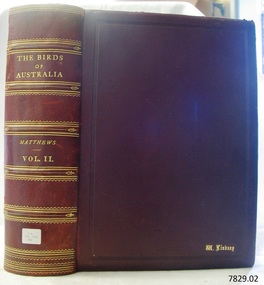
Book - Reference, The Birds of Australia Vol 2
... It was heavily timbered, mostly blackwood, with large belts of wattle and honeysuckle. Much of the heavy native was ringbarked and cleared; much more was swept away by bushfire. ...It was heavily timbered, mostly blackwood, with large belts of wattle and honeysuckle. Much of the heavy native was ringbarked and cleared; much more was swept away by bushfire. ...The Birds of Australia is a 12 volume work, in a total of 14 books. The books were used as an ornithological handbook. They contain scientific text as well as over 600 hand-coloured lithographed plates by J.G. Keulemans, H. Grönvold, Roland Green, H. Goodchild and G.E. Lodge. The work was written, sponsored and organised by Gregory M. Matthews, F.R.S.C. Erc. who was a wealthy Australian and an amateur ornithologist. His titles included – -Fellow of the Linnean and Zoological Societies of London -Member of the British Ornithologists’ Union -Corresponding Fellow of the American Ornithologists’ Union The volumes in our collection were originally donated to the Warrnambool Mechanics’ Institute and Free Library by William Lindsay. THE LINDSAYS (quoted from the book Of Many Things – A History of Warrnambool Shire by C.E. Sayers) The Lindsays were amongst the most prominent families in the Shire of Warrnambool, as pastoralists, sportsmen, municipal councillors, community leaders. The first of the family William arrived in Melbourne in 1841 and started business as a livestock agent. The gold rushes sent him to the central Victoria diggings dealing in cattle. This was a business that boomed in the early 1850s, and he prospered. In 1859 he took over the Quamby run near Woolsthrope from Paul de Castella, the Yarra Valley Swiss vigneron who had brought the leasehold and improvements in 1853 from George Youl, who had pioneered the run. Quamby was originally 25,000 acres. It was heavily timbered, rough country, much of it swampy, a characteristic of the district. Lindsay used it to fatten cattle which gave large returns with the booming gold diggings towns paying high prices for beef. In 1862 purchases at auction made Quamby a freehold. In the next six years a further 20,000 acres of Crown land were brought at auction to make the run one of the largest in the south-west district. The great profits from his cattle trading enabled Lindsay to make improvements to the holding, and to Union which was added in 1864. Much of the thick timber was cleared and the worst of the swamps drained. Union was 15,000 acres of freehold when Kennedy sold it to Lindsay. It was heavily timbered, mostly blackwood, with large belts of wattle and honeysuckle. Much of the heavy native was ringbarked and cleared; much more was swept away by bushfire. It was expensive work, but Lindsay’s bank passbook was heavy with credit, and he did not spare money to make both Quamby and Union heavily developed stock runs. He was as lavish in social living; the bluestone Quamby homestead was one of the most hospitable in the district when William Lindsay was host there; its paddocks carried high quality thoroughbreds: its stables housed steeplechasers and flat racers which won many races on Warrnambool and other courses; its coach houses were filled with carriages which took his guests to the great racing carnivals of the district. After William Lindsay died in 1897, in his eighty-fifth year, his two sons, William and James, managed Union and Quamby as a joint venture. This partnership ended in 1906 when William took over Union and James kept Quamby. The following year 10,000 acres of Union were subdivided and sold in lots of 100 acres to 700 acres for dairying and general farming. It was well improved country, much of it alluvial flats. By then many of the paddocks were sheltered with blue gum belts, and they carried good pastures. The three Lindsays, father and two sons, gave many years of service to the Shire, and to many charitable, sporting, social and community organisations in the Warrnambool district. William Lindsay senior, was a Shire councillor for 15 years, and President several times. James Lindsay followed his father as a north riding councillor. He served nineteen years, from 1887 until his death in March 1908. He was President four times. Jimmy Lindsay was one of the most popular men in the south-west of Victoria. He was a fine sportsman: horse breeder, owner and a dashing amateur rider. He lived lavishly and played hard. For many years he guarded a herd of kangaroos, as many as 100 head, at Quamby. Descendants of the Lindsay kangaroos are still in the district. James Lindsay’s wife, Margaret Esther was a daughter of Samuel Shaw Parker, the first engineer of the Shire. Nell Lindsay, a daughter, lives in the Bluestone Quamby homestead. Only a little more than 60 acres of the original run still belongs to the property. William Lindsay junior succeeded his brother as a Shire councillor. He served for 25 years from 1908 until his death in 1934. So, the Lindsays, father and two sons, served as Shite councillors for an unbroken period of sixth-five years. William Lindsay junior had a life-long interest in horse racing, as breeder, owner and enthusiastic amateur steeplechase rider. He was elected a member of the Warrnambool racing club in 1901 and was president of the club for thirty-two years. He raced and rode horses for the love of the sport. He won the Villiers and Heytesbury Hunt Cup in the 1870s on his own horse, Ventura. In the year he died his horse Flavedo won the Warrnambool Grand Annual steeplechase. It was a sensational race. All of the contestants fell, or lost their riders. When Flavedo baulked at a jump, its jockey R. Sweetman, remounted and completed the course to win the race. All of the Lindsays were passionately fond of the thoroughbred horse. Nell Lindsay talking to the author in the drawing room of Quamby homestead - with many memories for her of its lavish years – said of a brother that he was put on a horse when he was two years old and never got off. William Lindsay junior made Union into a fine, high-producing property, breeding cattle and horses. He added to the bluestone house that David Kennedy started, established plantations of pines and gums, and made an attractive garden. WARRNAMBOOL MECHANICS’ INSTITUTE Warrnambool's Mechanics' Institute (or Institution as it was sometimes called) was one of the earliest in Victoria. On 17th October 1853 a meeting was held where it was resolved to request the Lieutenant Governor of the Colony to grant land for the erection of a Mechanics' Institutes building. A committee was formed at the meeting and Richard Osburne chaired the first meeting of this committee. The land on the North West corner of Banyan and Merri Streets was granted but there were no funds to erect the building. The Formal Rights of the Warrnambool Mechanics' Institute's encompassed its aims and these were officially adopted in1859; "This Institution has for its object the diffusion of literary, scientific, and other useful knowledge amongst its members, excluding all controversial subjects, religious or political. These objects are sought to be obtained by means of a circulating library, a reading room, the establishment of classes, debates, and the occasional delivery of lectures on natural and experimental philosophy, mechanics, astronomy, chemistry, natural history, literature, and the useful and ornamental arts, particularly those which have a more immediate reference to the colony." The Warrnambool Mechanics' Institute opened its first meeting room in November1854 in the National School building at the corner of Banyan and Timor Streets. The Institute was funded by member subscription, payable on a quarterly, half yearly or yearly basis. Samuel Hannaford, the Manager of the Warrnambool Bank of Australasia, was the first Honorary Secretary of the Mechanics' Institutes, and an early President and Vice-President. He also gave several of the early lectures in the Reading Room. Another early Secretary, Librarian and lecturer was Marmaduke Fisher, the teacher at the National School. Lecture topics included The Poets and Poetry of Ireland', 'The Birth and Development of the Earth', 'The Vertebrae - with Remarks on the pleasures resulting from the study of Natural History' and 'Architecture'. In 1856 the Reading Room was moved to James Hider's shop in Timor Street, and by 1864 it was located in the bookshop of Davies and Read. In the 1860's the Mechanics' Institute struggled as membership waned but in 1866, after a series of fund raising efforts, the committee was able to purchase land in Liebig Street, on a site then called Market Square, between the weighbridge and the fire station. A Mechanics' Institute building was opened at this site in August 1871. The following year four more rooms were added to the main Reading Room and in 1873 the Artisan School of Design was incorporated into the Institute. The same year Joseph Archibald established a Museum; however it deteriorated when he was transferred to Bendigo in 1877. In 1880, with Archibald's return to Warrnambool, the Museum was re-established, and in 1885 a new building was built at the back of the Institute to accommodate the re-created School of Design, the Art Gallery and the Museum. In 1887 the Museum section was moved to the former court house in Timor Street (for some time the walls of the building formed part of the TAFE cafeteria but all is now demolished)). In 1911 the Museum was transferred back to the original building and the management of the Mechanics' Institute was handed over to the Warrnambool City Council. The Museum and Art Gallery became one and housed many fine works of art, and the Library continued to grow. The building was well patronised, with records showing that at the beginning of the 20th century there were between 500 and 800 visitors. During World War One the monthly figures were in the thousands, with 3,400 people visiting in January 1915. The Museum was a much loved Institution in Warrnambool until the contents of the Museum and Art Gallery were removed to make room for the Warrnambool City Council Engineers' Department. The contents were stored but many of the items were scattered or lost. When the original building was demolished the site became occupied by the Civic Centre, which included the new City Library. (The library was temporarily located in the old Palais building in Koroit Street.) In the process of reorganisation the Collection was distributed amongst the community groups: -The new City Library took some of the historic books and some important documents, historic photographs and newspapers. -The Art Gallery kept the 19th Century art collection and some of the artefacts from the museum. -The Historic Society has some items -The State Museum has some items -Some items were destroyed -Flagstaff Hill Maritime Village has old newspapers, Government Gazettes, most of the Mechanics' Institute Library, ledgers and documents connected to the Mechanics' Institute Library, some framed and unframed art works and some photographs. The Warrnambool Mechanics' Institute Library book collection is deemed to be of great importance because it is one of the few collections in an almost intact state, and many of the books are now very rare and of great value. THE PATTISON COLLECTION This book is also part of the ‘Pattison Collection’, a collection of books and records that was originally owned by the Warrnambool Mechanics’ Institute, which was founded in Warrnambool in 1853. In 1935 Ralph Pattison was appointed as City Librarian to establish and organise the Warrnambool Library, as the Warrnambool Mechanics’ Institute was then called. When the Warrnambool Mechanics’ Institute building was pulled down in 1963 a new civic building was erected on the site and the new Warrnambool Library, on behalf of the City Council, took over all the holdings of the Warrnambool Mechanics’ Institute. At this time some of the items were separated and identified as the ‘Pattison Collection’, named after Ralph Pattison. Eventually the components of the Warrnambool Mechanics’ Institute were distributed from the Warrnambool Library to various places, including the Art Gallery, Historical Society and Flagstaff Hill. Later some were even distributed to other regional branches of Corangamite Regional Library and passed to and fro. It is difficult now to trace just where all of the items have ended up. The books at Flagstaff Hill Maritime Village generally display stamps and markings from Pattison as well as a variety of other institutions including the Mechanics’ Institute itself. RALPH ERIC PATTISON Ralph Eric Pattison was born in Rockhampton, Queensland, in 1891. He married Maude Swan from Warrnambool in 1920 and they set up home in Warrnambool. In 1935 Pattison accepted a position as City Librarian for the Warrnambool City Council. His huge challenge was to make a functional library within two rooms of the Mechanics’ Institute. He tirelessly cleaned, cleared and sorted a disarrayed collection of old books, jars of preserved specimens and other items reserved for exhibition in the city’s museum. He developed and updated the library with a wide variety of books for all tastes, including reference books for students; a difficult task to fulfil during the years following the Depression. He converted all of the lower area of the building into a library, reference room and reading room for members and the public. The books were sorted and stored using a cataloguing and card index system that he had developed himself. He also prepared the upper floor of the building and established the Art Gallery and later the Museum, a place to exhibit the many old relics that had been stored for years for this purpose. One of the treasures he found was a beautiful ancient clock, which he repaired, restored and enjoyed using in his office during the years of his service there. Ralph Pattison was described as “a meticulous gentleman whose punctuality, floorless courtesy and distinctive neat dress were hallmarks of his character, and ‘his’ clock controlled his daily routine, and his opening and closing of the library’s large heavy doors to the minute.” Pattison took leave during 1942 to 1945 to serve in the Royal Australian Navy, Volunteer Reserve as Lieutenant. A few years later he converted one of the Museum’s rooms into a Children’s Library, stocking it with suitable books for the younger generation. This was an instant success. In the 1950’s he had the honour of being appointed to the Victorian Library Board and received more inspiration from the monthly conferences in Melbourne. He was sadly retired in 1959 after over 23 years of service, due to the fact that he had gone over the working age of council officers. However he continued to take a very keen interest in the continual development of the Library until his death in 1969.The Birds of Australia by Gregory M. Matthews is now considered a rare and valuable scientific and historic work on its own. These 12 volumes were donated in 1934 to The Warrnambool Mechanics’ Institute and were included as part of the Pattison Collection. The Warrnambool Mechanics’ Institute Collection is primarily significant in its totality, rather than for the individual objects it contains. Its contents are highly representative of the development of Mechanics' Institute libraries across Australia, particularly Victoria. A diversity of publications and themes has been amassed, and these provide clues to our understanding of the nature of and changes in the reading habits of Victorians from the 1850s to the middle of the 20th century. The collection also highlights the Warrnambool community’s commitment to the Mechanics’ Institute, reading, literacy and learning in the regions, and proves that access to knowledge was not impeded by distance. These items help to provide a more complete picture of our community’s ideals and aspirations. The Warrnambool Mechanics Institute book collection has historical and social significance for its strong association with the Mechanics Institute movement and the important role it played in the intellectual, cultural and social development of people throughout the latter part of the nineteenth century and the early twentieth century. The collection of books is a rare example of an early lending library and its significance is enhanced by the survival of an original collection of many volumes. The Warrnambool Mechanics' Institute’s publication collection is of both local and state significance. The Birds of Australia Vol 2 Author: Gregory M Mathews Publisher: Witherby & Co 326 HIGH HOLBORN LONDON Date: 1912-1913 Tan leather bound illustrated work. Label on spine cover with typed text RA 598.2994 MAT Pastedown front endpaper has sticker from Warrnambool Mechanics Institute and Free Library that reads “Presented by W. Lindsay Esq. ‘Union’ Woolsthrope” Accession Number: 15233 Date Received: 3-34 “W. Lindsay” embossed in gold on front cover, bottom right of book flagstaff hill, warrnambool, shipwrecked coast, flagstaff hill maritime museum, maritime museum, shipwreck coast, flagstaff hill maritime village, great ocean road, the birds of australia, gregory m. matthews, witherby & co., h.f. & g. witherby, w lindsay, william lindsay, quamby woolsthorpe, union woolsthorpe, pattison collection, warrnambool library, warrnambool art gallery, joseph archibald, warrnambool mechanics’ institute and free library, ralph eric pattison, warrnambool city librarian, mechanics’ institute library, victorian library board, warrnambool books and records, warrnambool children’s library, the birds of australia vol 2, quamby station, union station, woolsthrope
