
Showing 5 items matching "laundry accessory"
-
 Clunes Museum
Domestic object - DOMESTIC WASHING BOARD
... LAUNDRY ACCESSORY...LAUNDRY ACCESSORY WASHBOARD Nil WOODEN FRAMED BOARD WITH A GLASS INSERT Domestic object DOMESTIC WASHING BOARD ...WOODEN FRAMED BOARD WITH A GLASS INSERTNillaundry accessory, washboard -
 City of Moorabbin Historical Society (Operating the Box Cottage Museum)
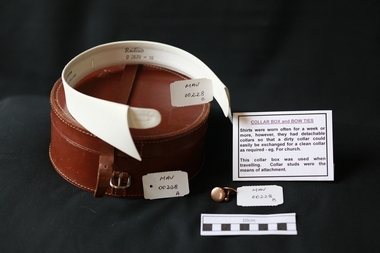
Accessory - Clothing, menswear 4 x collars and studs with leather box, early 20thC
... The Blackburn family were early settlers in Moorabbin Shire menswear clothing shirts collars early settlers fashion cheltenham moorabbin dairy farmers market gardeners Inside collar : a) Radiac / 0 2639 - 16 / ALL COTTON / MADE IN IRELAND; b) LAUNDRY / FOR BEST RESULT DIP / IN THIN COOKED STARCH/ Semi / 161/2 ; c) nil d) nil 4 x mens white, stiffly starched, detachable collars and 2 x brass studs with the leather box used for storage and transport of these items. Each collar has 3 button holes - 2 at neck and 1 centre back for attachment to the shirt. The Leather box has saddle stitching and a strap with a metal buckle for securing Accessory ...In the 19thC and early 20thC men often wore their shirts for a week or more. However the collars were detachable so that they could be changed when they became dirty or for special occasions eg Church on Sundays Collar studs were used to attach the collar to the shirt. The leather box was used for storage and when travelling. The collars were very stiffly starched so as to maintain their shape.The Blackburn family were early settlers in Moorabbin Shire4 x mens white, stiffly starched, detachable collars and 2 x brass studs with the leather box used for storage and transport of these items. Each collar has 3 button holes - 2 at neck and 1 centre back for attachment to the shirt. The Leather box has saddle stitching and a strap with a metal buckle for securingInside collar : a) Radiac / 0 2639 - 16 / ALL COTTON / MADE IN IRELAND; b) LAUNDRY / FOR BEST RESULT DIP / IN THIN COOKED STARCH/ Semi / 161/2 ; c) nil d) nilmenswear, clothing, shirts, collars, early settlers, fashion, cheltenham, moorabbin, dairy farmers, market gardeners -
 Orbost & District Historical Society
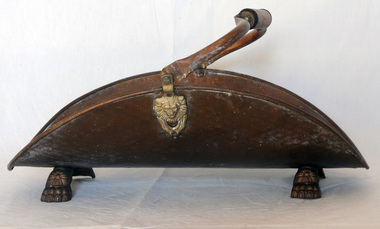
kindling holder, 1880's -1890's
... A fireplace was the most commonly used form of heating a dwelling, cooking, and heating water for laundry and domestic uses.Fireplace accessories were an important part of the decor of houses as well as being useful items. copper fireplace domestic kindling-holder A curved copper pan. ...A fireplace was the most commonly used form of heating a dwelling, cooking, and heating water for laundry and domestic uses.Fireplace accessories were an important part of the decor of houses as well as being useful items.A curved copper pan. The handle is copper tubing with a wooden handle grip. It has 4 feet in the shape of animal paws (lion?). The handle is attached with lion faces. The paws and feet are brass and attached to the pan with screws.copper fireplace domestic kindling-holder -
 Warrnambool and District Historical Society Inc.
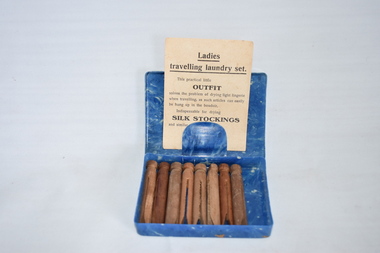
Household, Travelling Peg Set, 1930-1940
... This laundry set is retained as an example of a woman’s laundry set from the past. women’s accessories history of warrnambool ‘Ladies travelling laundry set. ...This laundry box would have been used by a woman who was travelling to hang up in a bedroom small items of clothing that had been laundered. Different types of laundry sets have been available for travellers for many years and sets of a more modern nature are in use today. This laundry set is retained as an example of a woman’s laundry set from the past. This is a mottled blue container made of Bakelite. The box contains eight small wooden pegs. This set is incomplete as originally there would have been ten pegs and some string to use as a small clothesline. The box also has a slip of paper with printed material indicating the use and value of the laundry set. The top of the container has had some cloth material pasted on but this is largely worn off. ‘Ladies travelling laundry set. This practical little outfit solves the problem of drying light lingerie when travelling, as such articles can easily be hung up in the boudoir. Indispensable for drying silk stockings and similar articles.’ women’s accessories, history of warrnambool -
 National Wool Museum
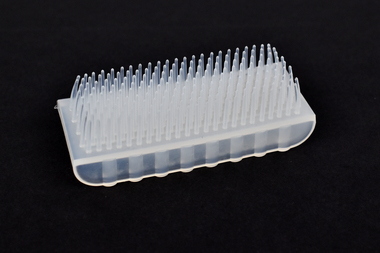
Tool - Garment Brush, c.1953-1962
... laundry...garment care...nylon brush...accessory...Their legacy forms an integral part of both Australian social and manufacturing history. brush garment brush brushed wool laundry garment care nylon brush accessory [Printed on plastic packaging] CARE OF BRUSHED FABRICS To obtain original condition brush garment frequently between wearing and after washing. ...Sample of Kathryn Knitwear Collection. This brush was included with a brushed wool leginette suit (NWM-08916), in order to maintain the fluffy finish of the garment after wear and washing. Kathryn Knitwear, founded by Robert Blake, manufactured high quality children’s knitwear in Melbourne from the 1940s – 1980s. Robert Blake began manufacturing children’s knitwear in his bedroom in Strathmore using a hand powered machine in the late 1940s. The operation moved to Ascot Vale and Essendon, before eventually establishing a factory in Moonee Ponds in the early 1950s. The business continued to expand, necessitating a move to a new factory in Broadmeadows. By 1962, the Broadmeadows factory was producing an average of 20,000 garments per month, which increased to 24,000 by 1964. Robert Blake’s Son, Brendan recalls that “The Kathryn brand was famous around Australia, anywhere children needed to keep warm and dress smartly. It also won a number of wool fashion awards”, including the 1969 Wool Awards, which was held by the Australian Wool Bureau and published in Women’s Weekly. The Kathryn range was designed for durability, comfort and care, without sacrificing style. They used patterning techniques that increase stretchiness, comfort and fit, as well as integrating decorative elements into the fabric to prevent them from being bulky, uncomfortable or tight. Making longevity of style a priority, Brendan Blake remembers that “there was one particular garment that was in the range for at least thirty years”. He also recalls “In the past, when women have found out that I was associated with Kathryn Knitwear, they would often relate to me the story of a garment they had purchased or received as a gift and, when their child had grown out of it, they would hand it on to another child. Several ladies have told me of purchasing garments for their daughters’ glory box, or saving a particular garment after their daughter had grown out of it. Brendan Blake: “At the peak of their operation they employed approximately two hundred people, mainly women and girls. A family would often seek to send their daughter to work in this company because they knew they would be looked after and safe. One lady wrote to me telling me that working at the Moonee Ponds Factory prior to getting married was the happiest time of her life.” In 1963, workers at the Kathryn factory earned £13 per week, which was 8 shillings and 8 pence higher than the minimum weekly wage for female workers in the textile manufacturing industry (£12 11s 4d). By 1970, the Kathryn Knitwear brand expanded from children’s knitwear into womenswear under the brand name ‘Lady Kathryn’, and for boys and men under ‘Robert Blake’. Continuing to diversify their distribution, they also began exporting ‘Kathryn’ garments to New Zealand, the Pacific Islands, and Japan. ‘Kathryn Knitwear’ was well-known for their early adoption of modern materials and techniques that had broad appeal to their customer base. This is shown in their early use of the acrylic fibre ‘Orlon’ in the 50s and 60s and ‘Superwash’ wool in the 1970s. Many of Kathryn Knitwear’s styles, particularly those that were long running staples of the brand, were available in both wool and Orlon to suit the consumer’s preference. Far from the humble origins of one man in his bedroom with a hand-cranked machine; at its closure in 1980, the Broadmeadows factory of ‘Kathryn’ housed more than 100 machines, including 53 sewing machines and 45 knitting machines. Robert Blake was “a passionate advocate for wool and Australian Made” throughout his whole life. A strong thread that ties through the lifespan of Robert Blake and Kathryn Knitwear is a balance between adopting new innovations without sacrificing the core values of durability, comfort, care and style that had made the brand so well known. Their legacy forms an integral part of both Australian social and manufacturing history.Transleucent nylon brush with rows of thin bristles mounted in an offset pattern[Printed on plastic packaging] CARE OF BRUSHED FABRICS To obtain original condition brush garment frequently between wearing and after washing. Follow laundering instructions on swing ticket.brush, garment brush, brushed wool, laundry, garment care, nylon brush, accessory
