
Showing 6 items matching "lay treasurer"
-
 Uniting Church Archives - Synod of Victoria
Photograph
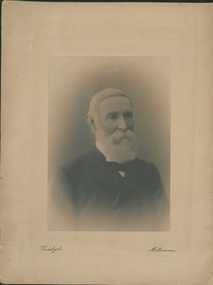
... ...Lay Treasurer...James Jamieson was a member of the Nicholson Street Wesleyan Church, Lay Treasurer of Conference and a Fellow of the Society of Science, Letters and Arts, London....Jamieson J. Lay Treasurer Methodist Matte, sepia, head and shoulders, portrait image of Mr. ...Mr. James Jamieson was a member of the Nicholson Street Wesleyan Church, Lay Treasurer of Conference and a Fellow of the Society of Science, Letters and Arts, London.Matte, sepia, head and shoulders, portrait image of Mr. James Jamieson on card.jamieson j., lay treasurer, methodist -
 Uniting Church Archives - Synod of Victoria
Photograph, C. 1940s
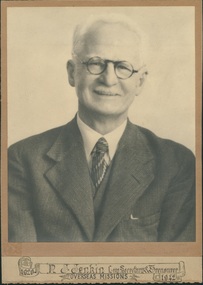
... Malvern. He was Lay Secretary & Treasurer for Methodist Overseas Missions from 1920 - 1942....J. Jenkin Lay Secretary & Treasurer OVERSEAS MISSIONS 1920 - 1942"...Malvern. He was Lay Secretary & Treasurer for Methodist Overseas Missions from 1920 - 1942. ...N. J. Jenkin lived in Elizabeth St. Malvern. He was Lay Secretary & Treasurer for Methodist Overseas Missions from 1920 - 1942.Matte sepia toned studio portrait of Nicholas J. Jenkin tipped on to buff card with handwritten script at the bottom front. The cardboard has a deckle edge at the bottom. The picture appears to be an enlargement as the focus is not sharp."N. J. Jenkin Lay Secretary & Treasurer OVERSEAS MISSIONS 1920 - 1942"nicholas j jenkin, methodist overseas missions, methodism -
 Uniting Church Archives - Synod of Victoria
Ceremonial object - Commemorative Trowel
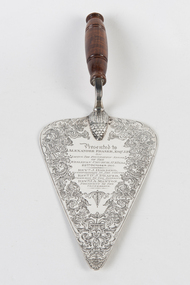
... treasurer of the supernumerary fund, which he helped Rev. Daniel Draper to found. Dour and pious, Fraser was conscientious in fulfilling his political duties. He presided at numerous meetings and laid countless foundation stones. wesleyan church st kilda fraser, alexander draper, daniel Presented to Alexander Fraser Esq J.P. on laying the foundation stone of the Wesley Church St Kilda 22nd October 1857. ...Commemorative trowel from Wesley Church St Kilda, 22 October 1857. Alexander Fraser (1802-1888), businessman and politician. Fraser lived at St Kilda and in 1857 was elected to its first Municipal Council; in 1859 he became chairman and mayor in 1864-65. An active churchman, he held most important offices in the Wesleyan Church and for thirty years was treasurer of the supernumerary fund, which he helped Rev. Daniel Draper to found. Dour and pious, Fraser was conscientious in fulfilling his political duties. He presided at numerous meetings and laid countless foundation stones.Silver trowel with polished wooden handle. Trowel decorated around the edges and with an inscription.Presented to Alexander Fraser Esq J.P. on laying the foundation stone of the Wesley Church St Kilda 22nd October 1857. Rev. J. Harding Superintendent of the church. Rev. D.J. Draper Chairman of the District. Rev. J.A. Manton President of the Conference.wesleyan church st kilda, fraser, alexander, draper, daniel -
 Uniting Church Archives - Synod of Victoria
BW photo, December 1987
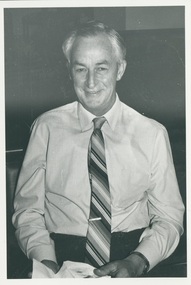
... lay workers. There are many in the church who have had cause to be grateful for his financial input which added to their well being. But his work was not all with financial matters – as the Financial Secretary for the State, Alex was ex-offficio a member of the Presbytery of Maroondah where he was not the Treasurer and although as an ex officio member he was not expected to take that much part in the Presbytery’s activities – but Alex did, he took part in the strategy and pastoral care committees which showed his depth of concern for others in his church life. ...lay workers. There are many in the church who have had cause to be grateful for his financial input which added to their well being. But his work was not all with financial matters – as the Financial Secretary for the State, Alex was ex-offficio a member of the Presbytery of Maroondah where he was not the Treasurer and although as an ex officio member he was not expected to take that much part in the Presbytery’s activities – but Alex did, he took part in the strategy and pastoral care committees which showed his depth of concern for others in his church life. ...Eulogy by John McArthur t seems trite to say that it is a privilege to be able to speak about Alex’s work in the Church, but having known Alex for over 50 years and our various activities having been inextricably intertwined it is indeed an honour as well as a privelge. I first met Alex in the late 1950s when we were members of the PFA State Council – they were halcyon days for the young people in the church with very strong youth groups in most congregations. Alex was the state Treasurer. John Anderson was the President with Maureen Hancock, the secretary, Maureen, who with many others from that Council are here today. Alex was also very active in his local church at Canterbury in all aspects of its life and witness as we have heard from his children, Barrie and Jo, earlier in this service Alex who had trained as an accountant, applied for and been appointed to a position with the PCV and upon the retirement of his mentor, S. K. Williams, was appointed the Financial Secretary of the Church. When I was appointed as a member of the Trusts Corporation, I was very glad to see that Alec was the secretary – most members were nearly twice my age and it waas comforting to be with an old friend of somewhat similar age. The meetings were reasonably formal as one would expect from a gathering of some of the very senior business men in our State. Alex’s records were immaculate – not only did his agendas have the business arising from the previous meeting but there on the side were a list of matters that in Alex’s opinion had not been satisfactorily finalised over the past year. But one matter has stuck in my memory - only the correspondence that required action was considered, many other letters were left to be formally minuted. This time there was a letter from the Government advising that a building on the south side of Collins Street originally owned by the Free Presbyterian Church in the 1800s was to be placed on the Historic Register and this was our first intimation of the matter. One trustee, a knight of the realm, whose chin was always down on his chest, ( I wondered whether he was asleep or something) raised his head and said “If one just stood still in Collins Street for five minutes they would slap a historic citation on you” and back down went his head. I was not sure what would happen next when I looked at Alex and slowly, that recognisable smile appeared on his face – not really a smile , more like a grin as Barrie and Jo said earlier, one that would appear time and time again over the years at meetings which were meant to be quite formal. Alex had an encyclopaedic memory – for example, ask him about bequest funds, say, the W. S. Godfrey Perpetual Bequest, his answer would be, “Ah yes, donated by the man who founded the Grocery business in Carlton, the capital now would be about 53, 250 dollars, been no call on it for 2 ½ years”. If a new project was thought appropriate and needed funding, he would be able to find a fund or a bequest that, with a little tweaking, could be used to seed the programme. His financial presentations at meetings contained all the information one could want – he would choose his words carefully, and one would sometimes think – get on with it Alex - but his purpose was to make it quite clear what funds were available and what was their correct use. He took this financial acumen into other committees of the church, the Stipend Committee dealing with Ministers’ salaries, the Beneficiary Committee, the superannuation fund for both ministers and lay workers. There are many in the church who have had cause to be grateful for his financial input which added to their well being. But his work was not all with financial matters – as the Financial Secretary for the State, Alex was ex-offficio a member of the Presbytery of Maroondah where he was not the Treasurer and although as an ex officio member he was not expected to take that much part in the Presbytery’s activities – but Alex did, he took part in the strategy and pastoral care committees which showed his depth of concern for others in his church life. But I believe it was around this time that Alex produced some of his greatest work for the church – Church Union, not all Presbyterians wanted to be part of the Uniting Church – so a Statutory Commision was established on a national level, to divide the assets of the Church between those desiring to form part of the Uniting Church and those wanting to remain Presbyterian. Each State produced detailed records and submissions for the Commission – and Victoria was always the first to have its documents to the Commission – although Alex had made it quite clear that he would be with the Uniting Church, his work was meticulous, impartial and assisted greatly the work of the Commission relating to Victoria. And this in addition to his normal day to day work which continued over a period of some four or five years. The inauguration of the Uniting Church did present Alex, and indeed the rest of us, with some challenges. There were the financial records of three churches to be merged, properties to be considered, new community programmes required, new administrative structures to be put in place. Alex took these all in his stride – although after the initial planning, his role was to concentrate on financial matters only, the other activities had to be financed. As the chairperson of the Finance Division and the Resources Commission for a large portion of the early years of the Uniting Church, I was more than pleased to have Alex again by my side, reports were prepared, queries answered, it was just like old times. The Rev. Allan Stuart, now retired and living closer to his family in NSW was one on those young people from the Canterbury congregation – emailed me recently “Alex has been a faithful servant of the Church, at all levels from the National Assembly to the local congregation. But times are changing, and Alex had rightly passed the torch onto others” Allan was right but I also think that words of that great Scottish poet, Robert Louis Stevenson, sum up Alex’s life: “A man is a success when he has lived well, laughed often and loved much. One who has gained the respect of intelligent men and the love of children; who has filled his niche and accomplished his task; who leaves the world better than he found it, whether by work, relationships, one who looked for the best in others and gave the best he had.” To me, that is our friend who we remember today - Alexander Robert Gillespie. BW photo of Alex Gillespie dressed in shirt sleaves and tie, upper body.C&N 11/2/1987, p. 33alex gillespie (29/2/1928–1/9/2009) worked for the presbyterian church as its managing treasurer for many years before then moving to the uniting church as the synod treasurer. -
 Harcourt Valley Heritage & Tourist Centre
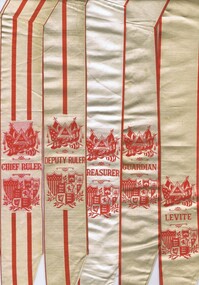
A set of seven decorative white silk IOR sashes with red embossing
... . ; The Independent order of Rechabites, a temperance and social organsiation, was particularly strong in the Harcourt, Barkers Creek district, due to the high proportion of Methodists in the population, a demographic phenomenon resulting from the courage, prevalence and influence of Wesleyan lay preachers on the Mount Alexander Goldfields. "CHIEF RULER"," DEPUTY RULER", "TREASURER", "GUARDIAN", "LEVITE" plus IOR triangle - "Truth, Fortitude, Justice" plus three heraldic shields with background foliage, Plus "Independant Order of Rechabites" plus a further decorative sheild surmounting a swage-like motto " Peace & Plenty the reward of Temperance" and "Rechabites Salford Unity" all in red on white background Ribbon/collar sashes,white, with red longitudinal stripe (Chief Ruler & Deputy Ruler only) and red border, red machine embroidery, angle stitched at lower front to form a fitted collar. ...The Independant order of Rechabites "Hope of Australia Tent No. 109" was formed in Harcourt in July 1869 and celebrated its centenary in 1969. With a strong -minded core of Methodists and members of the Church of Christ the group provided moral leadership and social framework to a wide area for a long time. At first they met in a small hall but, the lodge having inflamed partisan passions, the hall was deliberately burnt down in 1877. Undeterred the Lodge rebuilt the hall in the same year and thus provided the only district public hall. The Hall was sold by the lodge in 1937.; The Independent order of Rechabites, a temperance and social organsiation, was particularly strong in the Harcourt, Barkers Creek district, due to the high proportion of Methodists in the population, a demographic phenomenon resulting from the courage, prevalence and influence of Wesleyan lay preachers on the Mount Alexander Goldfields. Ribbon/collar sashes,white, with red longitudinal stripe (Chief Ruler & Deputy Ruler only) and red border, red machine embroidery, angle stitched at lower front to form a fitted collar."CHIEF RULER"," DEPUTY RULER", "TREASURER", "GUARDIAN", "LEVITE" plus IOR triangle - "Truth, Fortitude, Justice" plus three heraldic shields with background foliage, Plus "Independant Order of Rechabites" plus a further decorative sheild surmounting a swage-like motto " Peace & Plenty the reward of Temperance" and "Rechabites Salford Unity" all in red on white background -
 Old Colonists' Association of Ballarat Inc.
Ceremonial object - Trowel, William Bennett, Silver Trowel, c1887
... Treasurer; John Fraser, Secretary. Committee—J. W. Graham, J. W. Lee, James M'Merkin, Andrew Lister, James Ward. Trustees—J. W. Graham, Wm. Irwin, John M'Cafferty ” Mr Murray said he was proud to lay...Treasurer; John Fraser, Secretary. Committee—J. W. Graham, J. W. Lee, James M'Merkin, Andrew Lister, James Ward. Trustees—J. W. Graham, Wm. Irwin, John M'Cafferty ” Mr Murray said he was proud to lay ...The silver trowel was used for the laying of the foundation stone of the Ballarat Old Colonists' Hall. It was donated to the Old Colonists' Associaiton in 1906. The Old Colonists' Association minutes noted 'Mrs Murray handed to the Secretary the silver trowel presented to the late President on the occasion of the laying of the foundation stone of the Hall.' The silver trowel was used for the laying of the foundation stone of the Ballarat Old Colonists' Hall. It was donated to the Old Colonists' Associaiton in 1906. The Old Colonists' Association minutes noted 'Mrs Murray handed to the Secretary the silver trowel presented to the late President on the occasion of the laying of the foundation stone of the Hall.' "THE OLD COLONISTS' HALL. The foundation-stone of the building to be erected by the Old Identities’ Association, in Lydiard street, was next laid with the usual ceremonies. This was immediately adjoining the foundation-stone of the Mining Exchange building. Mr J. Graham presented Mr Murray with a silver trowel, bearing the following inscription:—“ Queen Victoria’s Jubilee. Presented to J. P. Murray, Esq., president of the Old Colonists’ Association, on the occasion of his laying the foundation stone of their new hall, Ballarat, 21st June, 1887.” Mr Graham said he thought the pioneers of such a city were quite right in erecting a building that would be a home for them while they lived, and a memorial of them when they were no more. Mr J. Fraser, secretary, read the followin'- report:— “Mr Chairman, ladies, and gentlemen,—The bottle about to be deposited under this foundation contains documents in which are written particulars of the founding of the Old Colonists' Association at Ballarat; its financial and numerical position at the present time, the names of its officers and committee of management for the current term: a complete list of the names of its members, a copy of the rules and regulations of the association: copies of The Star, Evening Star, Courier, and Ballarat Advertiser newspapers, programme of to-day's proceedings as far as they relate to the laying of the foundation-stone, together with a brief summary of the aims and objects of this philanthropic institution. That the nature of these objects are considered worthy of encouragement and support is amply proved when we see on the Association's roll of membership the names of so many of our most prominent citizens and public men, "and from the fact that the Government of the colony have recognised the just claim of the old colonists'of Ballarat to be placed in possession of this valuable and central site, upon which to erect a building that will, be a credit to them and an ornament to the city, and which will enable them to still further extend the sphere of their benevolence and usefulness iu this district. The following is a copy of the signed and sealed memorial document:—*The foundation-stone of the hall of the Old Colonists’ Association of Ballarat; was laid on Her Majesty Queen Victoria's Jubilee Day,- Tuesday, 21st June, 1887, by John Paul Murray, Esq., J.P., president of the association. Under the foundation stone is deposited a copy of the constitution and rules of the association, the names of the officers, and a complete list of the names of ail the members to date; also a copy each of The Star, Courier, Evening Post, and the Advertiser, local newspapers. At this date the association numbers 319 members—accumulated funds, £203 10s 3d. The land upon which the hall is to he erected was granted by the Government to the association for that, purpose. (Signed) John P. Murray, President; W. B. Perry, Samuel Delpratt, Vice-presidents; Daniel Fern, Treasurer; John Fraser, Secretary. Committee—J. W. Graham, J. W. Lee, James M'Merkin, Andrew Lister, James Ward. Trustees—J. W. Graham, Wm. Irwin, John M'Cafferty ” Mr Murray said he was proud to lay the foundation stone of this building. The association was started in I883, and he might say they were a purely philanthropic institution. They formed an association whose creed was to assist one another in every shape and form. They had now 319 members, and were daily increasing in number.-. They were very fairly off as regarded their financial position. With respect to the objects of the association, they were to form a bond of brotherhood among those whose past experience in commercial or in mining pursuits so intimately associated them with the early history of the goldfields; men, to whose indomitable energy and perseverance Ballarat and other mining centres in the colony were so largely indebted for their development and commercial prosperity. Some of whose names were also closely identified with the memorable and sanguinary struggle 'for freedom and constitutional liberty in 1883. Their object was, further, to gather together within one fold those who survive those stirring times, to meet occasionally in friendly and social intercourse; to relieve their brethren who were overtaken by sickness or affliction; to provide the shelter of a home for those Pioneers of the goldfields whom the reverses of fortune had deprived of the means of procuring the comforts of life in their declining years; to assist the widow and succor the orphan; to mutually cheer and support each other in their temporary troubles and vicissitudes as they journeyed onward to the grave; and lastly, to tender a tribute of respect to the memory of a departed brother, by following his remains to their final resting place. Such were some of the principal objects of the “ Old Colonists' Association.” It was an institution for the good of their fellow man, and he hoped it would be successful, he hoped that the young people who came after them would appreciate what the Old Colonists had left them. He hoped they would all assist in making the institution one that would he worthy of the place. He would hand a small donation to the secretary, and hoped others would do the same. (Cheers.) The secretary, amid cheering, announced that the cheque handed over by Mr Murray was for £2O. Archdeacon Julius, who was asked to speak, said nothing could have been more fitting than the laying of the foundation-stone of the Old Identities’ Association on the Queen's Jubilee. They were a link between the past of 50 years gone by and today. Many of them remembered well enough perhaps the time when it took a man five and twenty minutes to light his pipe with tinder and steel, and when the small boys went, up the chimneys to sweep them. (Laughter.) They were building something now that people would look upon in years to come, and speak of in connection with the Old Colonists, if the young men were' half as good as their fathers they would be uncommon good fellows, and he did not think they would be. (Laughter, and interjection.) ''An old fellow said it was very true, and he knew it. (Laughter.) The Old Identities would agree with him to a man. (Laughter.) If the young men walked in their steps Ballarat in another 50 years would be 50 percent, better than it was now. There was not a man there that wished that more strongly, than 'he’ did. The Old Identities were laying this stone on the jubilee day of Her Majesty, and there never sat on the throne a worthier or nobler Queen than she who held her jubilee that day. There was not a man present, whatever his views of government may be, who did not say “God bless our Queen.” (Cheers.) The proceedings closed with the singing of the National Anthem and cheers for the Queen. (Ballarat Star, 23 June 1887)Silver trowel used during the laying of a foundation Stone for the Ballarat Old Colonists' Association building in Lydiard Street North, Ballarat.ballarat old colonists' association, ballarat old colonists' club, trowel, silver trowel, foundation stone, mrs j. murray, william bennett, j. fraser, john murray, w. lee, william irwin, john m'cafferty, john mccafferty
