
Showing 78 items matching "leather gaiters"
-
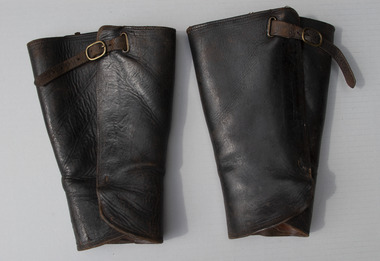 University of Melbourne, Burnley Campus Archives
Clothing - Leather Gaiters, Alex Morrison, Leather gaiters worn by students, c. 1930
... Leather Gaiters...Leather gaiters worn by students....Pair of brown leather gaiters worn by students at Burnley College. ...Pair of brown leather gaiters worn by students at Burnley College. ...Gaiters worn by students. Given to Archives by Alice Tucker (née Glascodine) who graduated in 1933.Pair of brown leather gaiters worn by students at Burnley College. Makers name "Alex Morrison, Melbourne. W.E Melb" Stamped into leather at side. The top is fastened by buckle and strap. At bottom there is a hook fastening. Worn - top and bottom stitching and binding in need of repair.Makers name "Alex Morrison, Melbourne. W.E Melb" Stamped into leather at side.gaiters, students, alice tucker (née glascodine), 1933, artifact -
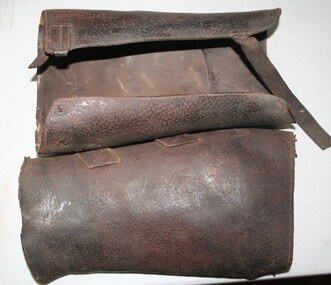 Trafalgar Holden Museum
Functional object - Leather gaiters, Circa 1900
... Leather gaiters...Gaiters...Leather...Leather gaiters manufactured by Holden and Frost Circa 1900...Pair leather gaiters used for leg protection...Leather gaiters manufactured by Holden and Frost Circa 1900 Used by bushmen in the 1900's and made and sold by Holden and Frost Gaiters Leather Pair leather gaiters used for leg protection Functional object Leather gaiters ...Leather gaiters manufactured by Holden and Frost Circa 1900Used by bushmen in the 1900's and made and sold by Holden and FrostPair leather gaiters used for leg protectiongaiters, leather -
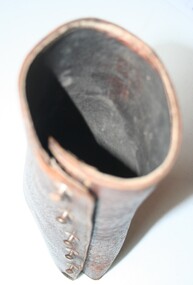 Trafalgar Holden Museum
Functional object - Leather gaiters, New Market Gaiter
... Leather gaiters...Leather...Gaiters...Brown leather gaiters with six studs to close...Used to protect legs in the 19th and 20th centuries and manufactured by Holden and Frost Manufactured and sold by Holden and Frost Leather Gaiters Brown leather gaiters with six studs to close New Market Gaiter Functional object Leather gaiters ...Used to protect legs in the 19th and 20th centuries and manufactured by Holden and FrostManufactured and sold by Holden and FrostBrown leather gaiters with six studs to closeleather, gaiters -
 Bendigo Military Museum
Uniform - LEATHER GAITERS, A.J. OAKMAN, 1928
... LEATHER GAITERS......Leather gaiters...One pair of lower leg leather gaiters, both left and right....One pair of lower leg leather gaiters, both left and right. Uniform LEATHER GAITERS A.J. ...Collection James Knopp Reg No. 15151. & 2. One pair of lower leg leather gaiters, both left and right.1. On inside “A0030” On outside “A.J. OAKMAN, MAKER ^RG 16/91” 2. On inside “A0030” On outside “A.J. OAKMAN, MAKER 16 ^ RG 1928”passchendaele barracks trust, james knopp, leather gaiters, pbt 101 102 -
 Trafalgar Holden Museum
Functional object - Belted Leather Gaiter
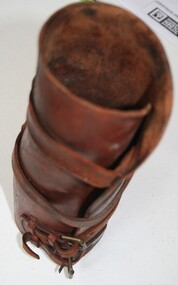
... Belted Leather Gaiter...Leather...Gaiters...Leather gaiter manufactured and sold by Holden and Frost ...Brown leather gaiter with straps to close with brass buckle...Leather gaiter manufactured and sold by Holden and Frost Used for military, agricultural and civilian purposes to protect legs Leather Gaiters Brown leather gaiter with straps to close with brass buckle Functional object Belted Leather Gaiter ...Leather gaiter manufactured and sold by Holden and Frost Used for military, agricultural and civilian purposes to protect legsBrown leather gaiter with straps to close with brass buckleleather, gaiters -
 Bendigo Military Museum
Uniform - LEATHER GAITERS, C- 1914 - 1930’s
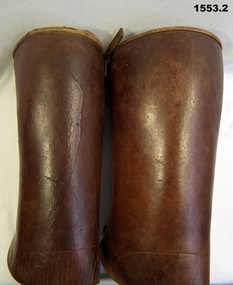
... LEATHER GAITERS...1553.1)Leather Gaiter Metal Tongue for joining Bottom Section 1553.2) Leather Gaiter Metal Tongue for joining Bottom Section Both are made of Brown Leather...uniforms - army military-equipment Gaiters 1553.1)Leather Gaiter Metal Tongue for joining Bottom Section 1553.2) Leather Gaiter Metal Tongue for joining Bottom Section Both are made of Brown Leather Uniform LEATHER GAITERS ...1553.1)Leather Gaiter Metal Tongue for joining Bottom Section 1553.2) Leather Gaiter Metal Tongue for joining Bottom Section Both are made of Brown Leatheruniforms - army, military-equipment, gaiters -
 National Vietnam Veterans Museum (NVVM)
Uniform - A Pair of Gaiters
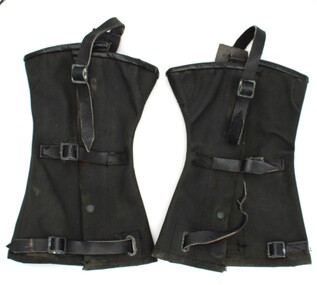
... ...Leather Gaiters...A pair of black leather gaiters, fastened by three straps with metal buckles, black stitching....Standard issue item as used by Australian servicemen during the conflict in Vietnam (1962-1972). Gaiters Leather Gaiters Clothing ULC/1907/size 31R ULC/1907/size 31L A pair of black leather gaiters, fastened by three straps with metal buckles, black stitching. ...Standard issue item as used by Australian servicemen during the conflict in Vietnam (1962-1972).A pair of black leather gaiters, fastened by three straps with metal buckles, black stitching.ULC/1907/size 31R ULC/1907/size 31Lgaiters, leather gaiters, clothing -
 Ringwood RSL Sub-Branch
Uniform - leather gaiters, Circa 1915
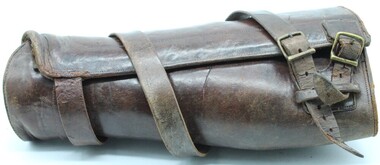
... leather gaiters...AT Walker Leather legging with brass fittings and leather straps Uniform leather gaiters ...Leather legging with brass fittings and leather strapsAT Walker -
 Kew Historical Society Inc
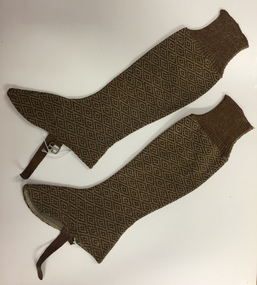
Clothing - Gaiters, Woven Wool, Leather & Metal Gaiters, Twentieth Century
... Woven Wool, Leather & Metal Gaiters...Pair of knee-high tweed woollen gaiters with attached leather straps and metal buckles to tie around each foot...costume accessories - gaiters Pair of knee-high tweed woollen gaiters with attached leather straps and metal buckles to tie around each foot Woven Wool, Leather & Metal Gaiters Clothing Gaiters ...Pair of knee-high tweed woollen gaiters with attached leather straps and metal buckles to tie around each footcostume accessories - gaiters -
 Trafalgar Holden Museum
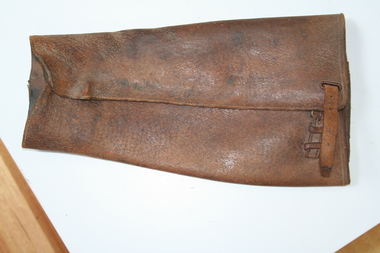
Functional object - Buckle Gaiter, Ca 1900
... Gaiter...Leather...Leather gaiter used by both military and civilian persons whilst riding or walking...Plain brown leather gaiter top buckle for fastening onto leg in place, lower buckle missing...Leather gaiter used by both military and civilian persons whilst riding or walking Manufactured and distributed by GMH Gaiter Leather Plain brown leather gaiter top buckle for fastening onto leg in place, lower buckle missing Functional object Buckle Gaiter ...Leather gaiter used by both military and civilian persons whilst riding or walkingManufactured and distributed by GMHPlain brown leather gaiter top buckle for fastening onto leg in place, lower buckle missinggaiter, leather -
 Kiewa Valley Historical Society
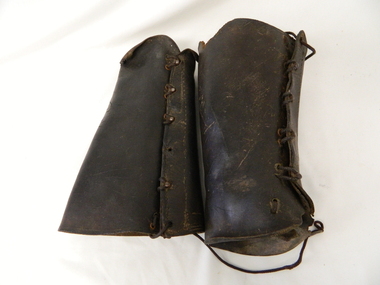
Gaiters Riding, Late 19th Century
... ...leather...gaiters...Thick leather tapered gaiters with six metal Hooks and Leather lacing through metal eyelets. ...Horse riding preceded the modern trail bikes and other recreational vehicles of the late 1900s. horse country leather gaiters high grazing cattlemen laces studs Thick leather tapered gaiters with six metal Hooks and Leather lacing through metal eyelets. ...These gaiters where used circa 1800's to mid 1900's, by horse riders "cattle men" to protect their shins and long trousers against wear and tear. They were used rather than having expensive boots damaged. Gaiters were a lot easier to fasten and clean than boots. They were used in the Kiewa Valley and the High Plains grazing areas.These gaiters were part of a cattleman's "out fit". The Gaiters were easily cleaned and did away with expensive riding boots. They were used throughout the valley and high plains areas both by horse riders herding cattle and the recreational rider of both sexes. After the 1950s more recreational riders from Melbourne ventured onto the high plains and not so rugged mountain slopes. Small settlements such as Mount Beauty, Bogong village and Falls Creek provided a secure backdrop for short term horse back adventures. The increasing pressure of city life provided a greater flow of stressed out city dweller to find the peace and quiet that city life does not have. Horse riding preceded the modern trail bikes and other recreational vehicles of the late 1900s. Thick leather tapered gaiters with six metal Hooks and Leather lacing through metal eyelets. All bar two eyelets have a metal reinforced punch holes. Left gaiter missing most of lacing.horse, country, leather, gaiters, high, grazing, cattlemen, laces, studs -
 Bendigo Military Museum
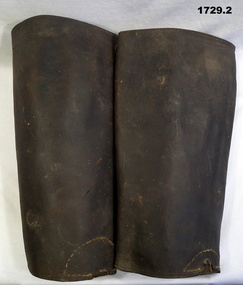
Uniform - GAITERS, C. WWI
... Pair of leather gaiters with metal buckle fasteners....Leggings gaiters uniform Pair of leather gaiters with metal buckle fasteners. Uniform GAITERS ...Pair of leather gaiters with metal buckle fasteners.leggings, gaiters, uniform -
 Kiewa Valley Historical Society
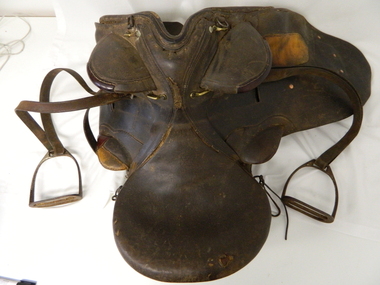
Saddle Horse Stock, Circa 1950
... ...leather...gaiters...A scientific study started in 1947 to study the impact of grazing cattle on the natural Alpine and sub Alpine vegetation found grazing cattle had an adverse affect on the natural Alpine and sub alpine vegetation, and grazing on the plains was stopped by the Victorian Government in 2005.This "camp draft" in the High Plains could take up to six weeks. horse country leather gaiters high grazing cattlemen laces studs This all leather "stock horse" saddle shows plenty of wear. ...This stock horse saddle was probably used in the mid 1900's. This was the period when cattle mustering was at its prime. The movement of cattle was by mounted stock horse only and not by other methods. Northern territory cattle stations in the late 1900's started to use helicopters for "cattle control". In the KIEWA Valley/Bogong High Plains and other rural cattle producing areas required well trained stock horses and stockmen for cattle control. It is only in the later 1900's that motor bikes and four wheeled quad-bikes have taken over, in part, from the mounted stockman.This horse saddle is very significant to the Kiewa Valley because of the early introduction of cattle stations in what initially was regarded as a semi remote location. The maintenance of cattle in the Kiewa Valley is and was an important requirement. A good stock horse saddle as and is important, especially during the period when cattle were grazed on the Bogong High Plains. The mustering and and moving cattle from the valley pastures to the high country was a demanding and dangerous exercise requiring "sure footed" stock horses.The "good" saddle was a vital part of this cattle mustering. A scientific study started in 1947 to study the impact of grazing cattle on the natural Alpine and sub Alpine vegetation found grazing cattle had an adverse affect on the natural Alpine and sub alpine vegetation, and grazing on the plains was stopped by the Victorian Government in 2005.This "camp draft" in the High Plains could take up to six weeks.This all leather "stock horse" saddle shows plenty of wear. It is in "full harness" configaration with stirrups and leg protectors horse, country, leather, gaiters, high, grazing, cattlemen, laces, studs -
 Kiewa Valley Historical Society
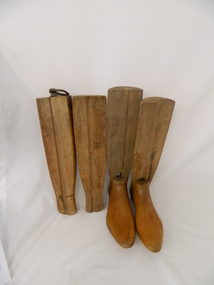
Stocks for Riding Boots, Late 1800's to early 1900's
... horse. country. leather. gaiters. High Plains. grazing. cattlemen. laces. studs. stocks. ...Therefore these boots and stocks would date from 1880's to 1920's and are a good representation of the style of boots worn during this period. horse. country. leather. gaiters. High Plains. grazing. cattlemen. laces. studs. stocks. ...These wooden trees for riding stocks are a concept that was brought to early colonial days from "mother" England. Gentle folk of wealth and status used these trees from early 1800's to keep and maintain their riding boots in their correct form. This form of maintaining the tall riding boot structure was maintained in Australia by the rural "elite" both on cattle properties and smaller cattle stations in the early 1900's. Good riding boots were a status symbol in rural and outback Australia. The riding stocks "wooden trees" are very significant in the Kiewa Valley because they were used by members of some of the original grazing cattle families to settle there. Both cattle and sheep properties occupied large areas of the Kiewa Valley and they also herded their flock and herd on the Bogong High Plains region. These stocks and boots were worn by Fred Roper whose great grand daughter donated them to KVHS. Therefore these boots and stocks would date from 1880's to 1920's and are a good representation of the style of boots worn during this period. This pair of wooden stocks for riding boots trees has been manufactured to a very high standard. Each of the four boot tree parts fit snugly together and maintain their form, and that of the boot that they occupy. The groove channels and foot forms (tongue and groove) are exact and once snapped together become very solid. There is a brass ring, attached by a small brass "peg" on each of the thin "sliding" middle uprights. See KVHS 0177 - Riding boots.On top "L" (for left boot), "R" (for right boot)horse. country. leather. gaiters. high plains. grazing. cattlemen. laces. studs. stocks. roper family. bogong high plains. -
 Emerald Museum & Nobelius Heritage Park
Uniform - Gaiters, World War 1
... Leather Naval Uniform Gaiters - Leather...Later served in the Merchant Navy for many years Emerald Victoria Australia Farms Joy and Eric Barker Leather Naval Uniform Gaiters - Leather Uniform Gaiters ...Eric Barker was a Naval man throughout World War . Later served in the Merchant Navy for many yearsLeather Naval Uniform Gaiters - Leatheremerald, victoria, australia, farms, joy and eric barker -
 Kiewa Valley Historical Society
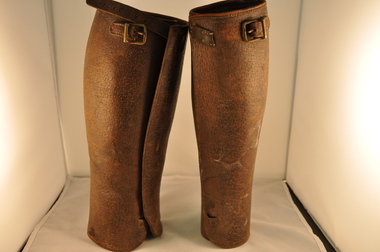
Gaiters, Estimated 1914; Early 20th Century
... One pair of brown leather gaiters with buckle at top. Seam at ankel. ...Therefore they are representative of gaiters from the LHR and have excellent interpretive capacity as KVHS have a photo of Henry Higginson wearing his uniform which clearly shows his gaiters similar to these ones. military army horse gaiters One pair of brown leather gaiters with buckle at top. Seam at ankel. ...These type of gaiters were used by soldiers who would have been attached to the Light Horse Regiments. No other men other than soldiers in the Light Horse Regiments wore these gaiters as they were part of their uniform and added protection of their lower legs when riding their horses. All levels for AIF people wore these gaiter from Privates to Officers. There seems to be several types of gaiters which were lace ups or had straps over the outside of the gaiters or some were just done up with the buckles at the top. It is unknown it the ones we have would have had straps on the outside or if this was a choice of the wearer. Towards the end of WWI many of the light horse regiments combined with each other as their numbers became less and eventually with the advancement of military weapons the use of horses in war battles become less and were not needed in consequent world wars. These gaiters are historical significant to world war one and the light horse regiments especially the 4th and 13th Regiments. Men from the the Kiewa Valley went off to war and fought with the these regiments. Henry Higginson fought with both the 4th and 13th LHR in France. Sydney Stewart fought with the 4th LHR in France and was killed in France aged 20 years of age. A few of the young men that left from Tawonga in the Kiewa Valley went into the Light Horse Regiments as they were farmers that had experience with horse. Even though the AIF said they just did not automatically put country men into the LHR . Despite not having provenance of these gaiters the fact that men from Tawonga were in the light horse regiments, and only men from the LHR wore these gaiters it would be safe to say they would have been from some one in the local area that fought in WWI who owned these. Therefore they are representative of gaiters from the LHR and have excellent interpretive capacity as KVHS have a photo of Henry Higginson wearing his uniform which clearly shows his gaiters similar to these ones.One pair of brown leather gaiters with buckle at top. Seam at ankel. Left gaiter has strap missingmilitary, army, horse, gaiters -
 Kiewa Valley Historical Society
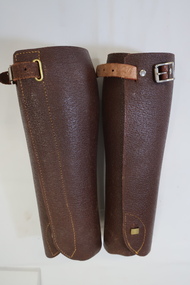
Gaiters Riding - Army
... One pair of brown leather gaiters with short strap and buckle at the top (wide end). ...See KVHS 0267, KVHS 1366, KVHS 1367 horse riding military army horse riding gaiters One pair of brown leather gaiters with short strap and buckle at the top (wide end). ...Used by the cavalry in WW1. While horse riding they improved grip and lower leg stability and protected the rider against pinches and bruising. See KVHS 0267 and KVHS 1366, KVHS 1367Men from the Kiewa Valley fought in WW1 some of whom were in the cavalry. See KVHS 0267, KVHS 1366, KVHS 1367One pair of brown leather gaiters with short strap and buckle at the top (wide end). Vertical clip at the bottom near ankle.horse riding, military army, horse riding gaiters -
 Kiewa Valley Historical Society
Bridle Horse, circa mid to late 1900's
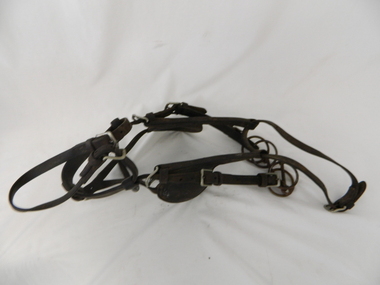
... ...leather bridle...gaiters...A scientific study started in 1947 to study the impact of grazing cattle/sheep on the natural Alpine and sub Alpine vegetation found grazing cattle had an adverse affect on the natural Alpine and sub alpine vegetation, and grazing on the plains was stopped by the Victorian Government in 2005.This "camp draft" on the Bogong High Plains could take up to six weeks. horse country leather bridle gaiters high country grazing cattlemen laces studs This harness bridle includes "blinders, winklers or blinkers" and would therefore be used on a pack or "working" horse. ...This stock horse bridle was probably used in the mid 1900's. This was the period when cattle and sheep mustering was at its prime. The movement of cattle and sheep was by mounted stock horse only and not by other methods. Northern territory cattle stations in the late 1900's started to use helicopters for "cattle control". In the KIEWA Valley/Bogong High Plains and other rural cattle/sheep producing areas required well trained stock horses and stockmen for cattle/sheep control. It is only in the later 1900's that motor bikes and four wheeled quad-bikes have taken over, in part, from the mounted stockman.This horse bridle is very significant to the Kiewa Valley because of the early introduction of cattle and sheep stations in what initially was regarded as a semi remote valley location. The maintenance of cattle and sheep in the Kiewa Valley was, and still is an important requirement of livestock management. A good stock horse bridle is important, especially during the period when cattle and sheep were grazed on the Bogong High Plains. The mustering and and moving cattle/sheep from the valley pastures to the high country was a demanding and dangerous exercise requiring "sure footed" stock horses.The "good specialised" bridle was a vital part of this cattle/sheep mustering. A scientific study started in 1947 to study the impact of grazing cattle/sheep on the natural Alpine and sub Alpine vegetation found grazing cattle had an adverse affect on the natural Alpine and sub alpine vegetation, and grazing on the plains was stopped by the Victorian Government in 2005.This "camp draft" on the Bogong High Plains could take up to six weeks.This harness bridle includes "blinders, winklers or blinkers" and would therefore be used on a pack or "working" horse. This bridle has rings on each end of the browband. The bridle is one used by a horse working in a team configuration pulling a heavy cart or wagon. The bridle has ten adjustable straps to allow it to accommodate a variety of horse sizes. See KVHS 0495 for a stock horse saddle.horse, country, leather bridle, gaiters, high country grazing, cattlemen, laces, studs -
 Mt Dandenong & District Historical Society Inc.
Photograph
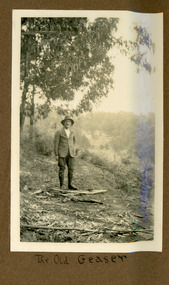
... Black and white photograph showing a man wearing a jacket, jodhpur like trousers, leather gaiters and a wide brimmed hat standing in a bush setting....The photographs remain in their original state in the album with individual copies made. ted child arthur edward child Written below the photograph in the album: The Old Geaser Black and white photograph showing a man wearing a jacket, jodhpur like trousers, leather gaiters and a wide brimmed hat standing in a bush setting. ...The man in the photograph is Arthur Edward (Ted) Child. The photograph is from the album of his daughter, Ivy Child. Ivy May Child (1910 – 1989) was the daughter of Arthur Edward (Ted) Child (1878 – 1964) and Ethel May Madden (1888 – 1970). Ted Child was the son of Matthew Francis Child (1839 – 1933) and Martha Jeeves (1857 – 1926). He was the grandson of one of the early pioneers Francis Child. Ivy grew up on the family property on Childs Road and took many photographs. Most of these are glued into her photo album. The album covered the years from c1927 – 1932. Ivy married Henry William Burgess (1906 – 1968) in 1944. The photographs remain in their original state in the album with individual copies made. Black and white photograph showing a man wearing a jacket, jodhpur like trousers, leather gaiters and a wide brimmed hat standing in a bush setting.Written below the photograph in the album: The Old Geaserted child, arthur edward child -
 University of Melbourne, Burnley Campus Archives
Photograph - Black and white print, Herald Feature Service, Mervyn Davis Milking, 1945
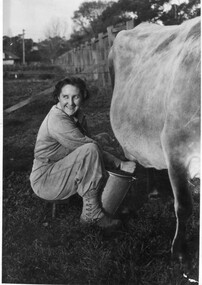
... Note she is wearing leather gaiters....Note she is wearing leather gaiters. Mervyn Davis Milking Photograph Black and white print Herald Feature Service Daphne pearson ...Black and white photograph. C.R.T.S. Student, Mervyn Davis (1946), seated on a low stool with a metal bucket milking a Jersey cow by hand. Note she is wearing leather gaiters.On reverse, "Burnley Horticultural School Mervyn Davis milking - on the course. 1945," several signatures of fellow students and, "Copyright Not for Reproduction Herald Feature Service Melbourne, Australia."crts, students, mervyn davis, milking, burnley horticultural school, commonwealth reconstruction training scheme, jersey cow, gaiters -
 Nagambie Historical Society Inc
Uniform - miltary gaiters, J. Oakman, WWII military gaiters, 1939
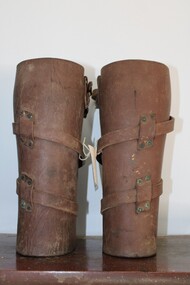
... 1 pair brown leather gaiters, or leggings, with leather straps and two brass buckles on each. ...Oakman (maker) 1 pair brown leather gaiters, or leggings, with leather straps and two brass buckles on each. ...WWII soldier's uniform. Australian Light Horse1 pair brown leather gaiters, or leggings, with leather straps and two brass buckles on each. Yellow stitching on tabs which secure winding strap. Metal pins securing strap guidesImpressed in tops: 1939, 16, J. Oakman (maker) -
 Mt Dandenong & District Historical Society Inc.
Photograph
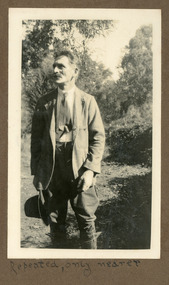
... He is wearing a suit jacket. tie, jodhpur type trousers and leather gaiters. He is holding a wide brimmed hat in his right hand....He is wearing a suit jacket. tie, jodhpur type trousers and leather gaiters. He is holding a wide brimmed hat in his right hand. ...The man in the photograph is Ted Child. Photo (KAL0258) shows Ted wearing the same outfit standing in the cut at Silvan Dam so this is probably taken at the same place. This photograph is from the album of Ivy Child. Ivy May Child (1910 – 1989) was the daughter of Arthur Edward (Ted) Child (1878 – 1964) and Ethel May Madden (1888 – 1970). Ted Child was the son of Matthew Francis Child (1839 – 1933) and Martha Jeeves (1857 – 1926). He was the grandson of one of the early pioneers Francis Child. Ivy grew up on the family property on Childs Road and took many photographs. Most of these are glued into her photo album. The album covered the years from c1927 – 1932. Ivy married Henry William Burgess (1906 – 1968) in 1944. The photographs remain in their original state in the album with individual copies made. Black and white photograph with man in foreground in front of bushes. He is wearing a suit jacket. tie, jodhpur type trousers and leather gaiters. He is holding a wide brimmed hat in his right hand.Written below photograph in album: Repeated, only nearer.ted child, arthur edward child, ivy child, silvan dam -
 Mt Dandenong & District Historical Society Inc.
Photograph
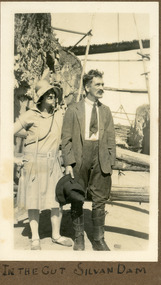
... The man is wearing a jacket and jodhpur like trousers with leather gaiters. He is holding a wide brimmed hat....The man is wearing a jacket and jodhpur like trousers with leather gaiters. He is holding a wide brimmed hat. ...The photograph shows Ivy May Child standing with her father Ted Child at the Silvan Dam worksite. The construction of Silvan Dam took place between 1926 and the 1932 opening. Ivy May Child (1910 – 1989) was the daughter of Arthur Edward (Ted) Child (1878 – 1964) and Ethel May Madden (1888 – 1970). Ted Child was the son of Matthew Francis Child (1839 – 1933) and Martha Jeeves (1857 – 1926). He was the grandson of one of the early pioneers Francis Child. Ivy grew up on the family property on Childs Road and took many photographs. Most of these are glued into her photo album. The album covered the years from c1927 – 1932. Ivy married Henry William Burgess (1906 – 1968) in 1944. The photographs remain in their original state in the album with individual copies made. Black and white photograph showing a man and woman standing in a cutting. The woman is in a dress and wearing a shady hat. The man is wearing a jacket and jodhpur like trousers with leather gaiters. He is holding a wide brimmed hat.Written below photo in album: IN THE CUT SILVAN DAMivy child, ted child, silvan dam -
 Ambulance Victoria Museum
Gaiters, Uniform, Ambulance officer
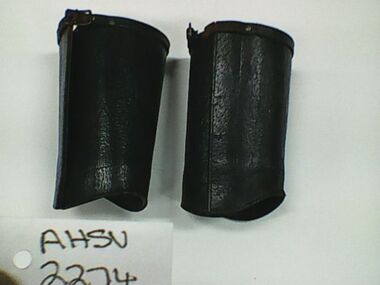
... Pair of dark brown leather gaiters with metal clips to fasten the side and a small brass buckle and strap at the top. ...Wally’s son Jon, later joined Ambulance Victoria, became a paramedic and now holds a senior role in the organisation. gaiters uniform wally byrne Pair of dark brown leather gaiters with metal clips to fasten the side and a small brass buckle and strap at the top. ...When he died in 2007, Wally Byrne, left a legacy of public service that many would be proud to emulate. Having served in the Royal Australian Navy in the Pacific during the Second War World War, Wally later joined the Victorian Civil Ambulance as an ambulance officer. In a career that spanned more than 35 years, Wally was based at Lonsdale Street, Latrobe Street and Fairfield. He became Station Officer at the busy Latrobe Street before moving into the Mobile Intensive Care Ambulance (MICA) system. Promoted to District Officer he became officer in charge of communications and served in this role until his retirement. Chas Martin, one of Wally’s communications staff at Latrobe Street, recalled that Wally was an efficient and well liked manager. He was also a very social person. Having purchased a block of land at Christmas Hills, Wally and his family hosted regular weekend BBQ’s there for his communications staff, other ambulance officers, and their families. Wally’s son Jon, later joined Ambulance Victoria, became a paramedic and now holds a senior role in the organisation.Pair of dark brown leather gaiters with metal clips to fasten the side and a small brass buckle and strap at the top. The gaiters are marked in ink on the inside surface 'Left' and 'Right' and are both inscribed with the owners name ' W.BYRNE'. gaiters, uniform, wally byrne -
 Whitehorse Historical Society Inc.
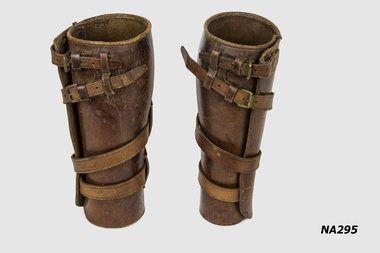
Clothing - Riding, Gaiters
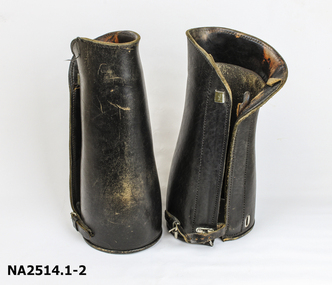
... Pair long black leather riding gaiters/leggings with buckles and straps at top and a metal clasp on bottom edge....costume male footwear Pair long black leather riding gaiters/leggings with buckles and straps at top and a metal clasp on bottom edge. ...Pair long black leather riding gaiters/leggings with buckles and straps at top and a metal clasp on bottom edge.costume, male footwear -
 Whitehorse Historical Society Inc.
Clothing - Riding, Gaiters
... Brown leather riding leggings/gaiters with two straps and buckles....costume accessories footwear accessories Brown leather riding leggings/gaiters with two straps and buckles. ...Brown leather riding leggings/gaiters with two straps and buckles.costume accessories, footwear accessories -
 Bendigo Military Museum
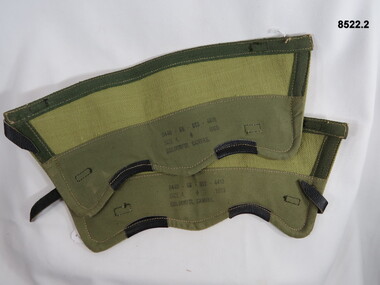
Equipment - GAITERS, Colourful Canvas, 1969
... A pair of Khaki cotton gaiters, two leather straps, two brass buckles, leather support bottom of gaiters....A pair of Khaki cotton gaiters, two leather straps, two brass buckles, leather support bottom of gaiters. ...1. & 2. A pair of Khaki cotton gaiters, two leather straps, two brass buckles, leather support bottom of gaiters.1. " 8440-66-013-4410, Size 4, 1969, Colourful Canvas".passchendaele barracks trust, pair gaiters, ankle style -
 Kiewa Valley Historical Society
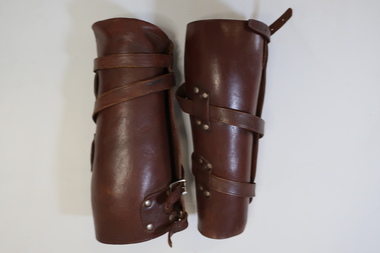
Gaiters Riding - Army
... One pair of brown leather gaiters with one strap attached at the top. ...See KVHS 0267, 1365,1366 military horse riding gaiters army One pair of brown leather gaiters with one strap attached at the top. ...Used by the calvary in WW1. While horse riding they improved grip and lower leg stability and protected against pinches and bruising when riding. See KVHS 0267, KVHS 1365, KVHS 1366Men from the Kiewa Valley fought in WW1 some of whom were in the calvary. See KVHS 0267, 1365,1366One pair of brown leather gaiters with one strap attached at the top. It is a short strap. The buckle below is long enabling it to be wound around the leg 3 times having been attached at the ankle. At the back 2 loops are attached to keep the long strap in place. The long strap has 4 holes for adjusting how tight it is. military, horse riding gaiters, army -
 Lilydale RSL Sub Branch
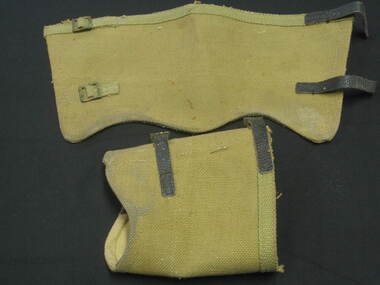
Gaiters
... Canvas gaiters with leather straps (pair) - possibly WWII...Believed WWII issue Canvas gaiters with leather straps (pair) - possibly WWII Gaiters ...Army webbing. Believed WWII issueCanvas gaiters with leather straps (pair) - possibly WWII -
 Department of Energy, Environment and Climate Action
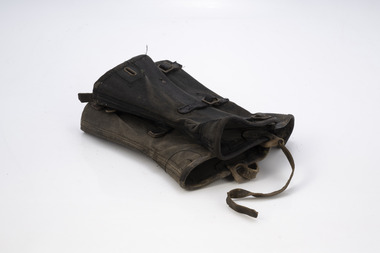
Canvas Gaiters
... Canvas protective gaiters with leather straps (ex-army)...Used to protect ankles from sticks in thick scrub as well as from snake bites Forests Commission Victoria (FCV) Protective Clothing Bushfire Canvas protective gaiters with leather straps (ex-army) Canvas Gaiters ...Used to protect ankles from sticks in thick scrub as well as from snake bitesCanvas protective gaiters with leather straps (ex-army)forests commission victoria (fcv), protective clothing, bushfire
