
Showing 111 items matching "leather industries"
-
 Flagstaff Hill Maritime Museum and Village
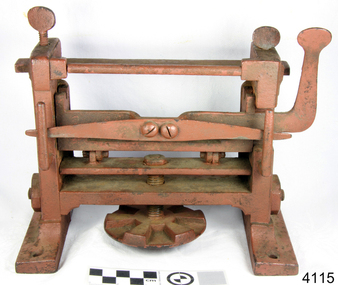
Lap Skiver, J Dixon, 1900s
... ...Leather industries...The company started in 1843 and has continued to produce tools for the leather industries up and till August 2017 when the company was dissolved....A vintage item used in the leather working industries see additional notes at end of document for clarity on how the item was used and it's importance in making leather goods. flagstaff hill warrnambool shipwrecked-coast flagstaff-hill flagstaff-hill-maritime-museum maritime-museum shipwreck-coast flagstaff-hill-maritime-village lap skiver Leather industries Leather making tools Tools J Dixon J Dixon Lap Skiver has a roller missing. ...Walsall in England was regarded as the world`s greatest centre of the saddlery trade. The town's craftsmen began to specialise in making bits, stirrups and spurs in the Middle Ages, developing into fully-fledged makers of saddlery and harness, by the end of the nineteenth century. As a result, over a hundred firms were exporting their products throughout the British Empire and beyond. The Walsall firms flourished as horses were so vital to everyday life in Victorian Britain and the colonies. The Walsall area emerged as a major supplier of military saddlery and harnesses, with one company supplying an astonishing 100,000 saddles for the British army in the First World War. The twentieth century saw the rise of light leather goods, such as handbags, cases and gloves. With the coming of the motor car, these products became the mainstay of the Walsall leather industry. Many companies supplied this trade and Dixon tools was one, as a commercial and industrial equipment supplier to the trade. The company started in 1843 and has continued to produce tools for the leather industries up and till August 2017 when the company was dissolved.A vintage item used in the leather working industries see additional notes at end of document for clarity on how the item was used and it's importance in making leather goods.Lap Skiver has a roller missing. Painted reddish brown J Dixonflagstaff hill, warrnambool, shipwrecked-coast, flagstaff-hill, flagstaff-hill-maritime-museum, maritime-museum, shipwreck-coast, flagstaff-hill-maritime-village, lap skiver, leather industries, leather making tools, tools, j dixon -
 Department of Energy, Environment and Climate Action
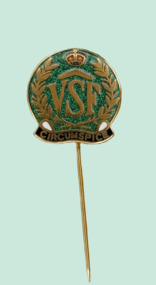
Victorian School of Forestry (VSF) Regalia
... The plant in the design is acacia mollissima (black wattle) the bark of which was used extensively as a source of tannin used in the leather industry at the time. The boomerang beneath the crown was incorporated as another Australian element. ...The plant in the design is acacia mollissima (black wattle) the bark of which was used extensively as a source of tannin used in the leather industry at the time. The boomerang beneath the crown was incorporated as another Australian element. ...The colours and emblem for the Victorian School of Forestry (VSF) were designed in 1916 when Charlie Carter became the Principal. The school opened only a few years earlier in 1910 and he remained as Principal until 1926. The design was a joint effort with the students. The motto "circumspice", which is Latin for “look around you”, was suggested by Mr Carter who believed that foresters should always be observant. The plant in the design is acacia mollissima (black wattle) the bark of which was used extensively as a source of tannin used in the leather industry at the time. The boomerang beneath the crown was incorporated as another Australian element. Lapel pin date unknown.Metal lapel pin with Victorian School of Forestrty emblemCIRCUMSPICEvictorian school of forestry (vsf) -
 Flagstaff Hill Maritime Museum and Village
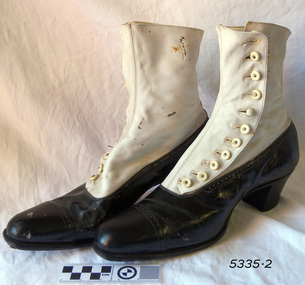
Clothing - Boots, Tony Lama, Early 20th century
... Tony Lama began work at age 11 years in the leather trade industry, serving an apprenticeship as a shoemaker. ...Tony Lama began work at age 11 years in the leather trade industry, serving an apprenticeship as a shoemaker. ...The inscription "T L" on these early 20th century ladies button-up boots lead to the maker likely to be Tony Lama, a famous USA boot manufacturer, son of Italian immigrants. The "Rome" is the style of boot. The "6" is likely to be the soot size. Tony Lama began work at age 11 years in the leather trade industry, serving an apprenticeship as a shoemaker. He joined the US Cavalry when he was 16, after lying about his age, working as a cobbler to make boots for the soldiers. His workmanship became popular, particularly for the 'Western' style of boot. TONY LAMA boots In 1911 Lama established a company in Texas, first repairing boots, then adapting his shop to manufacture boots in order to meet the many orders he was receiving. He married and he and his wife Esther brought up six children who also went on to work in the family business. The business continued to grow through WWII. Part of the business included custom boot making and Tony's eldest son Joseph presented President Truman with a pair of kangaroo skin boots. The prosperous business became a company and eventually, in 1990, was sold to Justin Industries.This pair of boots is an example of women's footwear dating around the early 20th century. Pair of ladies leather button-up boots. Two-tone style: black bottom strong leather bottom and white, soft kid leather top. Boots have a curved fly fastened by 11 white buttons with metal shanks. Boots are constructed with cork filling. Inscriptions of both boots. "6 101" "TL" " Rome" "Cork Filled"flagstaff hill, warrnambool, maritime-museum, shipwreck-coast, flagstaff hill maritime museum & village, ladies button up boots, footwear, victorian era, granny boots, tony lama, ladie's boots, ladies' fashion, women's clothing, rome, kid leather, two-tone boots, leather boots, button-up boots -
 City of Melbourne Libraries
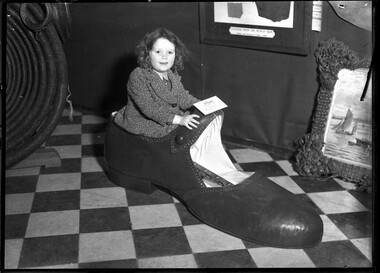
Photograph, Bull, Hugh Jones, 1897-1993, Leather Exhibition, Melbourne Town Hall
... leather...children...shoes...1930-1939...industry...It gives a quick history and overview of the Australian leather industry and its unprecedented, and possibly unexpected, development and success, and states with pride: “Though Victoria is the largest leather producer in the Commonwealth all tanners in the Commonwealth can look back with pride on the long march of progress.” ...It gives a quick history and overview of the Australian leather industry and its unprecedented, and possibly unexpected, development and success, and states with pride: “Though Victoria is the largest leather producer in the Commonwealth all tanners in the Commonwealth can look back with pride on the long march of progress.” ...Photographer notations on slide: At the Leather Exhib. at T. Hall Melb 1933 Age Published: Age (Melbourne, Vic.: 1854- ), 1933 THE EXHIBITS. (1933, September 20). The Age (Melbourne, Vic. : 1854 - 1954), p. 16. Retrieved January 25, 2026, from http://nla.gov.au/nla.news-article205109730 Published title: THE EXHIBITS. A COMPREHENSIVE RANGE. Curios, Novelties, Working Displays Published Caption: ONE OF THE NOVELTIES – AN OUTSIZE IN SHOES Research by Project Volunteer, Louise McKenzie: Our photo is dated 20 September 1933, and shows a happy, chubby-faced young girl sitting in a very over-sized girl’s shoe. It is labelled – “Shoe, An Out Size, loaned by Messrs Blackman & Rose”. (1) It is an effective way to capture the attention of the readership and alert them to the Melbourne Leather Show 1933. This show was designed to be a drawcard of extraordinary proportion, and there is no doubt that this leather exhibition was a really big deal for Melbourne. It completely took over the Melbourne Town Hall, and was open from 10.30 am until 10.30 pm. It seemed to contain something for everyone – the military, the man about town, the home handyman, the housewife, the child, the sporting types, the domestic workers, the outdoor enthusiasts, the horseracing fans, car enthusiasts, those wishing to show off the latest fashion – both men and women - and those just intrigued by a lot of fascinating and wide ranging exhibits. One of the most comprehensive descriptions of the Exhibition accompanies the photograph, and is worth quoting in full: “PROMINENT among exhibits which first attract attention in the foyer of the Town Hall is a comprehensive display of leather articles used by the defence forces. A conspicuous legend states that leather plays an important part in national defence, being used for saddlery, tool containers, holdalls, range-finding, surveying and signalling equipment, explosives factories, harness accoutrement, bandsmen's equipment and clothing. Three models of horses and several figures of soldiers wearing leather equipment illustrate the lesson, and a great range of leather goods used in military training and work variegate the display. Nearby are Texas cowboy, buckjumping and breaking-in saddles; whips, a walking stick, made of leather and numerous other curios. The general exhibition occupies the whole floor space of the main Town Hall, and is subdivided by partitions running most of the length of the hall. A bewildering variety, of leather goods presses for close and leisured inspection. Here and there operatives in charge of working machinery give practical demonstrations of factory processes in the production of footwear. Polishing materials are well represented. One attractive exhibit includes two bush huts constructed of leather, with wattle bark for roofing. Opossums, rosellas and a kookaburra add touches of bush realism. Adjacent exhibits include bags, fishing boots, leggings, leather covers in all colours. Factory Processes. One exhibitor has installed an automatic cinema apparatus and screen, which projects various factory processes in making a shoe, the operator being shown at work. Elsewhere an interesting exhibit depicts the five stages in the manufacture of sole leather, and the tanning materials employed. "Very handsome effects are achieved in the interior appointments of motor cars, which are attended by figures of smart chauffeurs in leather coats. Motor-trimming leather is said to be more durable and hygienic than fabric materials, and cheaper. The neat finish of the material, its excellent appearance, certainly make a very favourable impression. It takes the hides of three beasts to cover the cushions, squabs and door panels of a full-sized sedan, while to finish the entire interior, including quarter-panels and head linings would take four or even five. Special Exhibits. Amongst the special sections the display arranged by the handicrafts and home industries- committee of the Country Women's Association of Victoria is a notable one. In all there are about 130 entries which are in four classifications, viz., hand-tooled or embossed leathers, suede, hand-made gloves and undecorated leather. The glove section attracted the most numerous entries, a number being the work of members and craft subscribers of the Country Women's Association. In the leathercraft competition, organised by the Country Women's Association, the judges yesterday awarded the first prize for bookbinding (the only prize given in this division) to Miss M. Alston, of South Yarra. There is also a creditable display of exhibits submitted by boys of the orthopaedic section of the Children's Hospital at Frankston. Amongst the novelties on view in other portions of the exhibition were the following: — Leather coats worn by Sir C. Kingsford Smith on his Atlantic flight. Model Wellington boot, Phar Lap's saddle. Melbourne Cup winner's saddle. Longest whip in world, 108 feet long. (33 metres) [See our photo, to left of Girl in Shoe] Diminutive shoes. Pair of shoes 65 years old. Pair of men's working boots 75 years old. Larwood's, Tate’s and Pataudi’s cricket boots. [Three internationally revered cricketers of the day] (2) Picture frame made of leather bought 63 years ago. [See our photo, to right of Girl in Shoe] Leather frame, powder bowl, &c. Saddle used by world's champion buckjumper in U.S.A. Mexican cowboy outfit. Miniature saddle and bridle. A fireman's helmet made of sole leather. (3) Sample of the leather hat worn by porters at the Billingsgate Fish Market, London. (4) From South Australia there have been obtained sets of harness for donkeys, goats and camels, the equipment being displayed to good advantage on stuffed representations of the animals mentioned. Close to the platform is a glass case containing snow shoes and coats which have been used in Antarctic exploration work. Trade Display. Amongst the trade exhibits may be seen in operation a slipper turn shoe sewing machine, with heeling and channelling facilities, and the various stages in the production of ladies' sandals are shown. There is a wide contrast between sole leather of varying degrees of thickness on view in one stall and the choice samples of ladies' footwear in another — footwear, by the way, which could almost be used as ornaments, so dainty in colour and production are they. Again, there are displays of upholstering leathers of such soft texture that they could he readily mistaken for some of the finest cloth. Those who may be particularly interested in the production of chamois leather may gain an insight into the materials and chemicals used in the "working up” of this variety of leather. Supplies of glace kid (5) are tastefully arranged, and there may also be seen bags of all shapes and sizes, including satchels, suit cases and "sporting" cases, and bags for tennis players and golfers. Further variety is given to the exhibition by the display of antique hides, brightly coloured, with punching balls, boxing gloves and batsman's pads. There are crocodile skins and snake skins so cleverly "Worked up" that one could be almost pardoned for betraying an affection for such unpopular creatures.” “ Another wonderful article on this Exhibition, published the same day in one of the opposition daily newspapers, The Argus, is in the weekly article “Women to Women”, entitled “A Great Victorian Industry: Many Uses for Leather”. This weekly column was penned by Vesta, and she writes, with much purpose: “Yesterday afternoon I paid a hurried visit to the Leather Exhibition now being held in the Melbourne Town Hall and I was disappointed to find that the early visitors to the main exhibition were almost all men. Women, I think, should make a point of seeing every exhibition of our great industries, for women are the buyers of household requisites and goods for their own use and their tastes, and opinion influence also, to a large extent, the purchases of men. So, the welfare of industries is more or less in their hands and it becomes a duty for them to inform themselves fully of the extent and the quality of the manufacturing that is done here. The value of the output of the Australian boot and shoe factories alone was in 1930-31, the latest year for which the figures are given, Stg 3,750,000. Fully two thirds of that amount must have been spent by women on boots and shoes for themselves and their children. In a host of other directions, in the purchase of handbags, travelling bags, belts and straps, cushions, furniture coverings, purses, notebooks, spectacle cases, their annual expenditure must be very high. Their interest, therefore, in this industry is practical, and their support of it should be governed by knowledge of comparable values and qualities of the goods they buy. From the point of view of women, however, the exhibition itself is rather disappointing. There is an amazing collection of good stuff on show, but most of it is not displayed in a fashion that attracts attention. I was surprised, for example, at the range and quality of the leathers displayed, the suppleness of the finer qualities, and the varied range of colours and designs. But they are shown in such a fashion that if one set out deliberately to look for them it would be quite easy to miss most of them.” …It was surprising, too, that no one seemed to have taken advantage of the present fashion of wearing coloured gloves, or the cult of glove making, which the Country Women’s Association has fostered so successfully. Outside the collection of chamois leathers I saw no skins which were suitable to glove making. (6) However, it is perhaps a little unfair to be highly critical of the exhibition, inasmuch as it is the first of its kind. The material is there, undoubtedly, for a splendid show of every phase of this enterprising industry, and I am confident that experience will prove to those concerned that it will be worth while next time to devote a great deal of attention of the method of display.” With further research, it transpires that “Vera” is in fact NZ born Stella May Allen (nee Henderson) (1871-1962), a journalist, the first woman in NZ to begin a law course, in 1890-91). She later worked at a law firm while she completed her degree. Study of the law had always been open to women in NZ, but its practice was still barred to them. Her case “…led to amending legislation in 1896 allowing women to practise as barristers or solicitors. However, on gaining her LL.B. in November 1897 she did not apply for admission to the Bar. Instead, she became the Wellington-based correspondent and leader-writer for the Lyttelton Times. Her appointment, the first for a woman, was not welcomed by the all-male Press Gallery, and special permission had to be obtained from a subcommittee of the House before her presence was accepted. In 1900 she married Edwin Allen, a senior leader-writer for the Wellington Evening Post, and they moved to Australia in 1903 when Edwin Allen took up the post of foreign affairs leader-writer and parliamentary man for the Melbourne Argus. As Patricia Keep notes in her excellent entry of Stella Allan in the Australian Dictionary of Biography: “In 1907 The Argus commissioned her to write a series of articles on the first Australian Women's Work Exhibition held in October. They aroused much interest and next year The Argus invited her to join its full-time staff and begin a weekly section on the particular interests of women. She adopted the nom de plume 'Vesta' and called the column 'Women to Women'. Her work was unique in an Australian daily paper at that time. Her pages extended to cover every aspect of women's affairs, children's interests and community welfare, and 'Vesta' became a household word for authoritative information and advice on such matters. An excellent needlewoman and first-rate cook herself, she thoroughly tutored her staff in the work and needs of women in both country and city, as well as providing the usual training for cadet journalists. She conducted interviews and also visited the country to see at first hand the results of bushfires, mouse plagues, droughts and floods. In 1910 she was one of three women foundation members of the Australian Journalists' Association. “…she found time to become deeply involved in community affairs. She was an original committee-member of the Victorian Association of Crèches and of the Free Kindergarten Union of Victoria, and had much to do with the early days of the Victorian Bush Nursing Association, the Baby Health Centres Association and the Queen Victoria Hospital. She was a member of the National Council of Women, first in New Zealand and then in Melbourne, and of the Country Women's Association from its inception. … in 1924 she was appointed substitute delegate for Australia to the fifth assembly of the League of Nations at Geneva and was a delegate to the second Pan Pacific Women's Conference in Hawaii in 1930. A meeting held in the Melbourne Town Hall in 1938 by representatives of all the main Victorian women's organizations paid special tribute to her work and influence. She retired next year to England where she continued to write for the Argus, contributing articles on the experiences of women and children in wartime.” It is little wonder that “Vesta” was unafraid to take to task both the women of Victoria, and those who created the exhibition! One item which appears to have gone unnoticed, or at least unreported, is a framed article in the background of the photo of the chubby girl in the shoe. The display frame is labelled “Leather from the Human Skin, Tanned and Dressed by French artists.” The exhibition was certainly a cabinet of curiosities! A charming article in The Argus is a nice note on which to end. It gives a quick history and overview of the Australian leather industry and its unprecedented, and possibly unexpected, development and success, and states with pride: “Though Victoria is the largest leather producer in the Commonwealth all tanners in the Commonwealth can look back with pride on the long march of progress.” Footnotes: (1) “Blackman and Rose”. Messrs Blackman and Rose were shoe manufacturers, from 1927 located at 200 Noone Street, Clifton Hill. The Melbourne Circle describes their building as a “fine-looking building in the Federation ‘blood and bandage’ style.” It was built around 1912 for Puttifoot and Bloom, boot manufacturers, and today the building is apartments. (2) These cricketers were household names in the day: Tate: Maurice Tate, “English cricketer of the 1920s and 1930s, and leader of England’s Test bowling attack for a long time during this period. The founder of modern seam bowling. “ Larwood: Harold Larwood, “English right-arm fast bowler and the main exponent of the bowling style known as “bodyline”. Used to considerable effect in the 1932-33 Test series in Australia. Pataudi: Iftikhar A K Pataudi, “an Indian prince who in the 1930s played Test cricket for England, and in the 1940s played Test cricket for India (as Captain) – the only test cricketer to have played for both India and England. (3) “sole” leather “… is the thickest and most resistant material existing in the tanning industry … made from vegetable tanned leathers, usually bovine butts, processed in a special way to make them the hardest type of leather in existence.” (4) The hats worn by porters at Billingsgate Fish Market were also known as a “Bobbin” and look quite squat and rather unsophisticated. They were made of wood and tarred leather, with a “flat, hardened top designed to support large rectangular boxes of fish. The upturned brim protected the porter’s head against fish juice draining from the boxes of fish which would be carried on top of the hat. Some hats featured a small drain hole at the rear to allow this collected juice to drain down the back of the carrier. The hats were made using the ‘cuir bouilli’ technique. The leather was immersed in water which was heated until the leather began to shrink. It was then removed and put on a wooden former. The leather was stitched together to make the hat while still wet, and then held in place until dry.” (See article and photo on the London Museum website) (5) Glace kid – described on the Boston Museum of Fine Arts’ Cameo database as “A smooth glossy leather originally prepared from goat or sheepskin. Early glace kid had a shiny surface that was originally prepared by tawing the skin in a mixture of alum, table salt, flour, and egg yolk. Today, glace kid is prepared from many types of vegetable or chrome tanned leathers. The smooth polished surface is obtained mechanically by shaving, glazing, ironing, and/or rolling the dry leather.” (6) In the 1930s, Melbourne’s glovemaking industry was characterised by local manufacturing, with key producers like Simpson’s Gloves Pty Ltd in Richmond and the Stagg Glove Company in Clifton Hill leading the market. These factories produced high-quality leather gloves, handbags, and specialty gear, often employing a clear gendered division of labour and training young, local women. Museum Victoria holds the Simpson’s Gloves Collection, comprising over 1200 items, and the University of Melbourne Archives holds the company’s business records. References: THE EXHIBITS. (1933, September 20). The Age (Melbourne, Vic. : 1854 - 1954), p. 16. Retrieved January 25, 2026, from http://nla.gov.au/nla.news-article205109730 EXPORT LEATHER. (1929, September 17). The Argus (Melbourne, Vic. : 1848 - 1957), p. 17. Retrieved January 19, 2026, from http://nla.gov.au/nla.news-article4037647 LEATHER EXHIBITION (1933, September 18). The Argus (Melbourne, Vic. : 1848 - 1957), p. 10. Retrieved January 19, 2026, from http://nla.gov.au/nla.news-article11693362 (1933, September 23). The Argus (Melbourne, Vic. : 1848 - 1957), p. 21. Retrieved January 19, 2026, from http://nla.gov.au/nla.news-page522766 WOMEN TO WOMEN (1933, September 20). The Argus (Melbourne, Vic. : 1848 - 1957), p. 13. Retrieved January 19, 2026, from http://nla.gov.au/nla.news-article11694034 Australian Dictionary of Biography, Stella May Allan (1871–1962) https://adb.anu.edu.au/biography/allan-stella-may-4998 WOMEN TO WOMEN (1930, January 22). The Argus (Melbourne, Vic. : 1848 - 1957), p. 13. Retrieved January 19, 2026, from http://nla.gov.au/nla.news-article4063888 Museums Victoria, Simpson’s Gloves, 486-496 Victoria Street, North Richmond, VIC, Australia https://collections.museumsvictoria.com.au/articles/2702 The Argus. (1927, October 31). The Argus (Melbourne, Vic. : 1848 - 1957), p. 20. Retrieved February 7, 2026, from http://nla.gov.au/nla.news-article3888451 Melbourne Circle: stories from the suburbs: “Boots and all in Clifton Hill” https://melbournecircle.net/2015/11/20/bootmakers-of-clifton-hill/ Wikipedia, Maurice Tate, https://en.wikipedia.org/wiki/Maurice_Tate Wikipedia, Harold Larwood, https://en.wikipedia.org/wiki/Harold_Larwood Wikipedia, Iftikhar Ali Khan Pataudi, https://en.wikipedia.org/wiki/Iftikhar_Ali_Khan_Pataudi Buy Leather Online Italy, Sole leather: https://buyleatheronline.com/en/blog/outsole-and-insole-leather-n7 London Museum, Porters hats, https://www.londonmuseum.org.uk/collections/v/object-731122/hat-porters-hat/ Cameo Database, Museum of Fine Arts, Boston, Glace Kid, https://cameo.mfa.org/wiki/Glac%C3%A9_kid VICTORIAN LEATHER HAS WON RENOWN (1937, September 22). The Argus (Melbourne, Vic. : 1848 - 1957), p. 31 (March of Progress Supplement). Retrieved February 7, 2026, from http://nla.gov.au/nla.news-article1108704 Photographer notations on slide: "At the Leather Exhib. at T. Hall Melb 1933 Age B5".displays, melbourne town hall, leather, children, shoes, 1930-1939, industry, hats, gloves -
 Federation University Historical Collection
Booklet, The Ballarat School of Mines and Industries 1870-1920 Jubilee Booklet, 1920 (estimated)
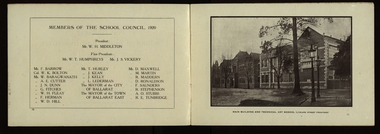
... Leather work. The Trade Classes give instruction in Telephone Mechanics, telegraphy, Carpentry, Cabinet Making, Plumbing, Blacksmithing, Fitting, Electric Wiring, and Printing. Numerous Scholarships are offered every year, and altogether students will find few places to equal the Ballarat School of Mines and Industries as a training place for their life's work. ...Leather work. The Trade Classes give instruction in Telephone Mechanics, telegraphy, Carpentry, Cabinet Making, Plumbing, Blacksmithing, Fitting, Electric Wiring, and Printing. Numerous Scholarships are offered every year, and altogether students will find few places to equal the Ballarat School of Mines and Industries as a training place for their life's work. ...The first school of Mines in Australia was established at Ballarat in 1870. At the time of its jubilee (1930) the following people were members of the School Council: W.H. Middleton (President), W.T. Humphreys (VP), J.S. Vickery (VP), F. Barrow, Col. W.K. Bolton, William Baragwanath, A.E. Cutter, J.N. Dunn, G. Fitches, W.H. Fleay, F. Herman. W.D. Hill, T. Hurley, K. Kean. J. Kelly, L. Lederman, Mayor of Ballarat, Mayour of Ballarat East, D. Maxwell, M. Martin, R. Maddern, D. Ronaldson, F. Saunders, R. Stephenson, A.O. Stubbs, R.E. Tunbridge. The School Staff in 1920 comprised: Herbert H. Smith, Walter Rowbotham, Reginald L. Cutter, M.C. Young, Hilda Wardle, M. Wiliamson, P.S. Richards, L.H. Archibald, J. Woods, Ken Moss, W. Kenneth, Mrs McIlvena. B. Robinson, S. Rowe, E. Hope-Jones, Miss Abrams, L.St.G.P. Austin, Alfred Mica Smith, J.R. Pound, Herbert R. Murphy, N.H. Junner, Maurice Copland, L.H. Archibald, E.J.A. McConnon, Newton King, D.m. Hull, T.R. Gordon, John M. Sutherland, T.K. Jebb, Dick Richards, C. Tonkin, A.W. Steane, J. Paterson, H.W. Malin, R.V. Maddison, S.M. Mayo, F.A. King, W.H. Steane, T.R. Gordon, T.A. Williams, H. Waldron, G. Black, E.J. McConnon, R.V. Duncan. R. Cutter, E.G. Vawdrey, Hilda WardleWhite stapled booklet - landscape format - 20pp + soft covers with blue writing. Includes an historical sketch of the Ballarat School of Mines. Contains images of the school from around 1920. The history outlined in the booklet follows: 'Ballarat has helped to influence the life and destinies of Australia in many ways, the recital of which would perhaps prove tedious to the citizens of less favoured localities! However, it can be said, without much fear of contradiction, that only less known thought Australia than its fame as a gold field is the reputation won for it by its school of Mines, ... Ballarat was still quite a new place when the School was founded, but a very propserous and popular place all the same, with a go-ahead lot of citizens brim full of the spirit of enterprise which seemsto animate mining populations generally. Money was plentiful, and they launched out into ventures, which later, were to develop and take the place of the gold mines, while what is more to the point, they understood the value of education. the old digging days were passing away. So far as Ballarat itself was concerned the day of the cradle and tin dish had already passed into an antiquity "as dead and distant as the age of the Tubal Caon," said dir redmond Barry on declaring the School open. Mining had become a serious business, and the mining engineer, the metallurgist, and the geologist had become a power in the land. In these circumstances the suggestions to found a School of Mines met with ready acceptance. The late Mr James M. Bickett had the honor of bringing forward the proposition at a meeting of the Ballarat Mining Board in October, 1869. it was agreed to, and the Government, having been approached for assistance, granted a lease of the old Supreme Court buildings at a nominal reantal. A modest sum, including 100 pounds from the Borough Council of Ballarat West, was subscribed by a number of sympathisers, and on the 26th October, 1870, the inaugural address was delivered by Sir Redmond Barry, the first President of the School. Classes were commenced on the 23rd January, 1871. The students at first were mostly adults. They were chiefly men emloyed at the mines, who had the wisdom and energy to devote their spare time to study, and, though their attendance was somewhat irregular, they made very good progress. Old prints which have been preserved show them at work at furnaces, big bearded men of the old-fashioned type of miner. It is interesting to note that among those who gave evidence and encouragement was Sir Roderick Murchison, who many years before had advised Cornish miners to emigrate to Australia to search for gold, and who in 1848 was in possession of gold ore sent from this country. Sir Roderick sent a parcel of books for the library, and gave useful advice as to the curriculum which should be adopted. The Museum, which now contains a most valuable collection of minerals, was one of the first things attended to, and the reports presented to the Council from time to time speak of additions being made from all parts of the world. New equipment was constantly being added to the School, a good deal of assay work was done, and some specimens were sent from the East Indies for examination as far back as 1873. By this time there was a difficulty in providing accomodation for the students who wished to enrol, and the number of instructors had grown from two to four. In 1882 the first building was being erected on what was then part of the gaol reserve. A little more than ten years afterwards a buildnig formerly serving as a Methodist Church was absorbed, while later on, the demand for accomodation increasing, the attack upon the gaol was renewed. The School continued to grow in reputation and size, and became the science centre of the district, and in 1889 a learge new building was opened by Sir Alexander Peacock. Students came from over seas as well as from all the States of Australia, and after going through their courses they took with them the name and fame of the old School to all parts of the globe. School of Mines boys have played a great part in developing the mining fields of Western Australia, South Australia, and africa, while old students who have made a name in their profession are constantly dropping in to see how the old place is getting along. It was not to be expected, however, that the Ballarat School would be left without rivals, its very success inspiring competition. Mining Schools were started in other parts of Australia, and, at the same time, Victoria ceased to hold first place as a mining state. On the other hand there was a great advance in manufacturing, and the demand for technicaly trained men became a great and as insistent as ever it had been for trained mining men. The Council was quick to adapt the school to the new conditions, and the result is seen in the institution, which is one of Ballarat's proudest possession. Instruction is given in all branches of technical work, and the classes are filled with students who are building up for Ballarat a reputation as an industrial centre, which promises to equal that which it formerly held as a mining town. Owing to its bracing climate, its abundant opportunities for recreations, and its accessibilty, Ballarat as a city is an ideal place for educational purposed, and is yearly becoming more and more appreciated throughout the State. The chairman of one of Ballarat's biggests industries claims that the workman can do twice the day's work here that he can do in Melbourne. he was a little enthusiastic over it, perhaps, but it is a well-known fact that the healthy and invigourating Ballarat climate is conducive to both physical and mental activity, and the records of the School provide ample proof of it. One of the most interesting and successful branches of the School of Mines and Industries - if the name be enlarged with the enlargement of its scope - is the Technical Art School. "The City of Statues" has from its earliest days been a stronghold of art. Art schools have flourised here, and in 1905 the Education Department came to the conclusion that the best thing to do with them was to place them under the management of the School of Mines Council. A magnificent new Technical Art School was built at a cost of some 12,000 pounds on the site of the old Supreme Court building, and was formally opened on the 23rd July, 1915. The results have not only been justified but surpassed all anticipations. The most comprehensive list of subjects is taught, and this list is constantly added to. Students have flocked to the art School, which may be said to occupy a unique position in Australia, and its record of success is really astonishing. Its students supply art teachers for the newer schools that are being built, and many occupy leading positinos in important business houses. So well is its reputation known that orders are constantly being received, not only from Victoria, but from other States, for honor boards and challenge shields to be designed and made. The most recent addition to the School of Mines and Industries is the Junior Technical School, for which a new building is now being erected on a portion of the gaol site, transferred to the School of Mines Counci by the Government. At the present moment temporary quarters are being occupied. Some students after passing through the Junior School go straight to employment, continuing perhaps to attend the evening trade classes, while others move on to the senior School. In a review of the work of the School of Mines mention must be made of a series of industrial research carried out under supervision of the Principal. One in particular, regarding the suitability of the local ores for the manufacture of pigments attracted much attention, while the experiemtns on the manufacture of white potery from Victorian clayes were considered of sufficient importance by the Federal Advisory Council of Science and Industry to warrant the appointment of a special investigator. The results of these have been most encouraging, and may have far-reaching consequences. The vocational training of returned soldiers also should not be overlooked. The work was taken in hand from the first, before the Repatriation Department gave assistance, and now with the help of the department of the School has become one of the largest vocational training centres in Victoria outside of Melbourne. The soldiers, trained in a variety of occupations, have made remarkable progress, and already considerable numbers have found employment in local workshops and factories. To sum up, the School is divided into the following departments, each well staffed and equipped: - The School of Mines, science, and Engineering; the Techncial Art School, the Boys' Junior Technical School, the Girl's Preparatory Technical Classes, Trade Classes, and the Commercial School. The school of Mines, science and Engineering, comprises the following branches: - Mining, Metallurgy, Geology, Electrical Engineering, Civil Engineering, Mechanical Engineering, Applied Chemistry, and Pharmacy. Battery treatments, Cyanide Testing, Smelting, Assays, and Clay Testing from a regular part of the School's work. Students gaining qualifications obtain concession in their courses at the university, should they proceed there to continue their studies. The technical Art school curriculum includes training in all branches of pictorial and applied art, an Architectural Diploma Course, a Draughtman's Course, technical Art teachers' Course, Photography,Ticket Writing, Art Metal Work, Woodcarving, Needlework, and Leather work. The Trade Classes give instruction in Telephone Mechanics, telegraphy, Carpentry, Cabinet Making, Plumbing, Blacksmithing, Fitting, Electric Wiring, and Printing. Numerous Scholarships are offered every year, and altogether students will find few places to equal the Ballarat School of Mines and Industries as a training place for their life's work. One of the first in the continent to be established, its Jubilee finds it still in the front rank, keeping pace with the times, and offering to the youths of this country the means of taking advantage of Australia's teeming opportunities. william, battery, smith, herbert, drawing from the antique, ballarat school of mines botanical gardens, ballarat school of mines, redmond barry, alfred mica smith, james bickett, museum, dick richards, ballarat junior technical school, s m b, ballarat school of mines and industries, ballarat technical art school, model mine, james m bickett, j m bickett, roderick murchison, vocational training rooms, wesley church, methodist church, alexander peacock, lathes, repatriation, repatriatin department, war service, school council, baragwanath, gold mining, mining laboratory, plaster cast, r.w. richards, anniversary, jubilee -
 Federation University Historical Collection
Equipment - Scientific Instrument, Nobel Explosives Co. Ltd, Nobel's Explosives Co Galvanometer, Between 1877 and 1926
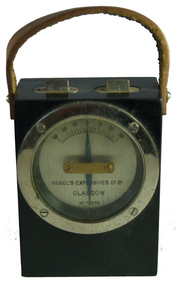
... Nobel Industries continued as the ICI Nobel division of the company. nobel ballarat school of mines scientific instruments Galvanometer No 10070 Small black timber box with small screw holding back on, and leather handle on top. ...Nobel Industries Limited was founded in 1870 by Swedish chemist and industrialist Alfred Nobel for the production of the new explosive dynamite in the United Kingdom. Ardeer, on the coast at Ayrshire, was chosen for the company's first factory. Between 1877 amd 1926 it was known as Nobel’s Explosives Company Limited. The business later diversified into the production of blasting gelatine, gelignite, ballistite, guncotton, and cordite. At its peak, the factory employed nearly 13,000 men and women. In 1926, the firm merged with Brunner, Mond & Company, the United Alkali Company, and the British Dyestuffs Corporation, creating a new group, Imperial Chemical Industries, then one of Britain's largest firms. Nobel Industries continued as the ICI Nobel division of the company. Small black timber box with small screw holding back on, and leather handle on top. A pivoted needle remains vertical as box angle changes. Graded scale behing top end of needle. Two adjusting points at top.No 10070nobel, ballarat school of mines, scientific instruments, galvanometer -
 Federation University Historical Collection
Equipment - Camera, Thornton-Pickard, Thornton Pickard Triple Imperial Extension Camera, c1901
... industry. Camera extension camera Photographic Equipment Thornton Pickard Triple Imperial Extension half plate camera nos 529946 and 529947. The camera has leather ...Thornton-Pickard was a famous British camera manufacturer established in 1888. The company was based in Altrincham, near Manchester, and was an early pioneer in the development of the camera industry.Thornton Pickard Triple Imperial Extension half plate camera nos 529946 and 529947. The camera has leather bellows, and was originally mounted on a tripod.camera, extension camera, photographic equipment -
 Upper Yarra Museum
Tennis Racket, Racquet, Brewers.Started manufacturing in 1928 in Newport and later in Mitcham
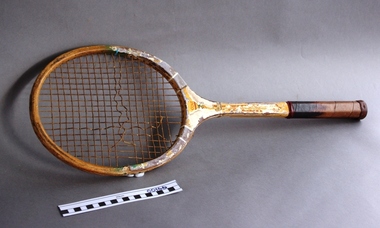
... According to legend, string makers of the 17th century deliberately misled people to believe that the strings were made of cat intestines in order to protect their industry, as any association with cats was superstitiously believed to be extremely bad luck, and to be avoided at all cost ball sport leather game racquet racket colt cat gut strings young players brewer handle grip Colt. ...File sizes Review ideal file sizes for photos http://www.tennishistory.com.au/equipment/vintage-racquets/racquet-retailing.html Extract - Born in Bendigo in 1905, Albert Brewer came to Melbourne in 1920 to commence work as a furniture factory machinist at Rojos Pty.Ltd. in Little Lonsdale Street Melbourne . http://en.wikipedia.org/wiki/Catgut Catgut is a type of cord[1] that is prepared from the natural fiber in the walls of animal intestines.[2] Usually sheep or goat intestines are used, but it is occasionally made from the intestines of a hog, horse, mule, pig or donkey. The name neither implies nor derives from any association with cats. The word catgut may have been an abbreviation of the word "cattlegut". Alternatively, it may have derived by folk etymology from kitgut or kitstring -- the word kit, meaning fiddle, having at some point been confused with the word kit for little cat. According to legend, string makers of the 17th century deliberately misled people to believe that the strings were made of cat intestines in order to protect their industry, as any association with cats was superstitiously believed to be extremely bad luck, and to be avoided at all costRacket or Racqet. A teardrop shaped wooden frame with tight interlaced network of strings. The strings are made of Cat-gut, several are broken. See narrative on Cat gut.The racket is branded Colt at the base of the tear drop and Designed for Young Players. Made by Brewer Australia. Maker of the Worlds famous style,is printed on the handle on both sides. The frame is made of laminated wood. The paint is in poor condition.The racket has a leather grip, the grip is is worn and stained. .Powerhouse Museum Collection Thesaurus Light bats consisting of a network of cord or nylon stretched in an elliptical frame, used chiefly in playing ball games like tennis, badminton, etc.Colt. Made by Brewers Australia. Maker of the Worlds Famous style leader. Designed for young playersball, sport, leather, game, racquet, racket, colt, cat gut, strings, young players, brewer, handle, grip -
 The Beechworth Burke Museum
Photograph, Between 1946 and 1961
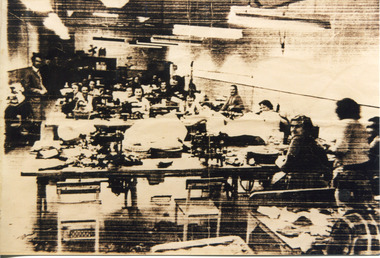
... industry...shoe factory...shoemaking...working women...post-war migration...factory...white australia policy...mid-twentieth century women's working conditions...twentieth-century working conditions...Pitman...Elgin...shoe...sewing machine...leather...Pitman Shoe Factory Elgin Shoe Company industry shoe factory shoemaking working women post-war migration factory white australia policy mid-twentieth century women's working conditions twentieth-century working conditions Pitman Elgin shoe sewing machine leather Pittman Reverse: 14 / AFGA / 6982 / Sepia rectangular photograph printed on matte photographic paper Photograph Photograph ...Elgin Shoes Pty., Ltd., established a branch shoe factory in Beechworth in 1946. Managing director, Mr T Nagle Pitman, selected Beechworth as a suitable location for the factory due to the availability of labour in the town, particularly girls under sixteen years of age. At its peak, the shoe factory employed thirty six women and girls, which also included post-war migrants. After the Second World War, Australia admitted increasing numbers of immigrants in order to fulfil labour requirements for a rapidly inflating demand of consumer goods. These migrants were largely from European Countries in line with the ‘White Australia Policy’. In 1954 Beechworth had 170 migrants from the UK, 102 from Hungary, and 63 from Germany. The factory closed in 1961 as increased centralisation of both populations and industry in the larger nearby towns of Wangaratta and Wodonga lead to the closure of many factories in small towns in the 1960s and 1970s. This photograph is historically significant as it shows the working conditions in a factory primarily staffed by women at some point between the late 1940s and early 1960s. Sepia rectangular photograph printed on matte photographic paperReverse: 14 / AFGA / 6982 / pitman shoe factory, elgin shoe company, industry, shoe factory, shoemaking, working women, post-war migration, factory, white australia policy, mid-twentieth century women's working conditions, twentieth-century working conditions, pitman, elgin, shoe, sewing machine, leather, pittman -
Federation University Historical Collection
Booklet, The Ballarat School of Mines and Industries 1870-1920 Jubilee Booklet, 1920 (estimated)
... Leather work. The Trade Classes give instruction in Telephone Mechanics, telegraphy, Carpentry, Cabinet Making, Plumbing, Blacksmithing, Fitting, Electric Wiring, and Printing. Numerous Scholarships are offered every year, and altogether students will find few places to equal the Ballarat School of Mines and Industries as a training place for their life's work. ...Leather work. The Trade Classes give instruction in Telephone Mechanics, telegraphy, Carpentry, Cabinet Making, Plumbing, Blacksmithing, Fitting, Electric Wiring, and Printing. Numerous Scholarships are offered every year, and altogether students will find few places to equal the Ballarat School of Mines and Industries as a training place for their life's work. ...The first school of Mines in Australia was established at Ballarat in 1870. At the time of its jubilee (1930) the following people were members of the School Council: W.H. Middleton (President), W.T. Humphreys (VP), J.S. Vickery (VP), F. Barrow, Col. W.K. Bolton, William Baragwanath, A.E. Cutter, J.N. Dunn, G. Fitches, W.H. Fleay, F. Herman. W.D. Hill, T. Hurley, K. Kean. J. Kelly, L. Lederman, Mayor of Ballarat, Mayour of Ballarat East, D. Maxwell, M. Martin, R. Maddern, D. Ronaldson, F. Saunders, R. Stephenson, A.O. Stubbs, R.E. Tunbridge. The School Staff in 1920 comprised: Herbert H. Smith, Walter Rowbotham, Reginald L. Cutter, M.C. Young, Hilda Wardle, M. Wiliamson, P.S. Richards, L.H. Archibald, J. Woods, Ken Moss, W. Kenneth, Mrs McIlvena. B. Robinson, S. Rowe, E. Hope-Jones, Miss Abrams, L.St.G.P. Austin, Alfred Mica Smith, J.R. Pound, Herbert R. Murphy, N.H. Junner, Maurice Copland, L.H. Archibald, E.J.A. McConnon, Newton King, D.m. Hull, T.R. Gordon, John M. Sutherland, T.K. Jebb, Dick Richards, C. Tonkin, A.W. Steane, J. Paterson, H.W. Malin, R.V. Maddison, S.M. Mayo, F.A. King, W.H. Steane, T.R. Gordon, T.A. Williams, H. Waldron, G. Black, E.J. McConnon, R.V. Duncan. R. Cutter, E.G. Vawdrey, Hilda WardleWhite stapled booklet - landscape format - 20pp + soft covers with blue writing. Includes an historical sketch of the Ballarat School of Mines. Contains images of the school from around 1920. The history outlined in the booklet follows: 'Ballarat has helped to influence the life and destinies of Australia in many ways, the recital of which would perhaps prove tedious to the citizens of less favoured localities! However, it can be said, without much fear of contradiction, that only less known thought Australia than its fame as a gold field is the reputation won for it by its school of Mines, ... Ballarat was still quite a new place when the School was founded, but a very propserous and popular place all the same, with a go-ahead lot of citizens brim full of the spirit of enterprise which seemsto animate mining populations generally. Money was plentiful, and they launched out into ventures, which later, were to develop and take the place of the gold mines, while what is more to the point, they understood the value of education. the old digging days were passing away. So far as Ballarat itself was concerned the day of the cradle and tin dish had already passed into an antiquity "as dead and distant as the age of the Tubal Caon," said dir redmond Barry on declaring the School open. Mining had become a serious business, and the mining engineer, the metallurgist, and the geologist had become a power in the land. In these circumstances the suggestions to found a School of Mines met with ready acceptance. The late Mr James M. Bickett had the honor of bringing forward the proposition at a meeting of the Ballarat Mining Board in October, 1869. it was agreed to, and the Government, having been approached for assistance, granted a lease of the old Supreme Court buildings at a nominal reantal. A modest sum, including 100 pounds from the Borough Council of Ballarat West, was subscribed by a number of sympathisers, and on the 26th October, 1870, the inaugural address was delivered by Sir Redmond Barry, the first President of the School. Classes were commenced on the 23rd January, 1871. The students at first were mostly adults. They were chiefly men emloyed at the mines, who had the wisdom and energy to devote their spare time to study, and, though their attendance was somewhat irregular, they made very good progress. Old prints which have been preserved show them at work at furnaces, big bearded men of the old-fashioned type of miner. It is interesting to note that among those who gave evidence and encouragement was Sir Roderick Murchison, who many years before had advised Cornish miners to emigrate to Australia to search for gold, and who in 1848 was in possession of gold ore sent from this country. Sir Roderick sent a parcel of books for the library, and gave useful advice as to the curriculum which should be adopted. The Museum, which now contains a most valuable collection of minerals, was one of the first things attended to, and the reports presented to the Council from time to time speak of additions being made from all parts of the world. New equipment was constantly being added to the School, a good deal of assay work was done, and some specimens were sent from the East Indies for examination as far back as 1873. By this time there was a difficulty in providing accomodation for the students who wished to enrol, and the number of instructors had grown from two to four. In 1882 the first building was being erected on what was then part of the gaol reserve. A little more than ten years afterwards a buildnig formerly serving as a Methodist Church was absorbed, while later on, the demand for accomodation increasing, the attack upon the gaol was renewed. The School continued to grow in reputation and size, and became the science centre of the district, and in 1889 a learge new building was opened by Sir Alexander Peacock. Students came from over seas as well as from all the States of Australia, and after going through their courses they took with them the name and fame of the old School to all parts of the globe. School of Mines boys have played a great part in developing the mining fields of Western Australia, South Australia, and africa, while old students who have made a name in their profession are constantly dropping in to see how the old place is getting along. It was not to be expected, however, that the Ballarat School would be left without rivals, its very success inspiring competition. Mining Schools were started in other parts of Australia, and, at the same time, Victoria ceased to hold first place as a mining state. On the other hand there was a great advance in manufacturing, and the demand for technicaly trained men became a great and as insistent as ever it had been for trained mining men. The Council was quick to adapt the school to the new conditions, and the result is seen in the institution, which is one of Ballarat's proudest possession. Instruction is given in all branches of technical work, and the classes are filled with students who are building up for Ballarat a reputation as an industrial centre, which promises to equal that which it formerly held as a mining town. Owing to its bracing climate, its abundant opportunities for recreations, and its accessibilty, Ballarat as a city is an ideal place for educational purposed, and is yearly becoming more and more appreciated throughout the State. The chairman of one of Ballarat's biggests industries claims that the workman can do twice the day's work here that he can do in Melbourne. he was a little enthusiastic over it, perhaps, but it is a well-known fact that the healthy and invigourating Ballarat climate is conducive to both physical and mental activity, and the records of the School provide ample proof of it. One of the most interesting and successful branches of the School of Mines and Industries - if the name be enlarged with the enlargement of its scope - is the Technical Art School. "The City of Statues" has from its earliest days been a stronghold of art. Art schools have flourised here, and in 1905 the Education Department came to the conclusion that the best thing to do with them was to place them under the management of the School of Mines Council. A magnificent new Technical Art School was built at a cost of some 12,000 pounds on the site of the old Supreme Court building, and was formally opened on the 23rd July, 1915. The results have not only been justified but surpassed all anticipations. The most comprehensive list of subjects is taught, and this list is constantly added to. Students have flocked to the art School, which may be said to occupy a unique position in Australia, and its record of success is really astonishing. Its students supply art teachers for the newer schools that are being built, and many occupy leading positinos in important business houses. So well is its reputation known that orders are constantly being received, not only from Victoria, but from other States, for honor boards and challenge shields to be designed and made. The most recent addition to the School of Mines and Industries is the Junior Technical School, for which a new building is now being erected on a portion of the gaol site, transferred to the School of Mines Counci by the Government. At the present moment temporary quarters are being occupied. Some students after passing through the Junior School go straight to employment, continuing perhaps to attend the evening trade classes, while others move on to the senior School. In a review of the work of the School of Mines mention must be made of a series of industrial research carried out under supervision of the Principal. One in particular, regarding the suitability of the local ores for the manufacture of pigments attracted much attention, while the experiemtns on the manufacture of white potery from Victorian clayes were considered of sufficient importance by the Federal Advisory Council of Science and Industry to warrant the appointment of a special investigator. The results of these have been most encouraging, and may have far-reaching consequences. The vocational training of returned soldiers also should not be overlooked. The work was taken in hand from the first, before the Repatriation Department gave assistance, and now with the help of the department of the School has become one of the largest vocational training centres in Victoria outside of Melbourne. The soldiers, trained in a variety of occupations, have made remarkable progress, and already considerable numbers have found employment in local workshops and factories. To sum up, the School is divided into the following departments, each well staffed and equipped: - The School of Mines, science, and Engineering; the Techncial Art School, the Boys' Junior Technical School, the Girl's Preparatory Technical Classes, Trade Classes, and the Commercial School. The school of Mines, science and Engineering, comprises the following branches: - Mining, Metallurgy, Geology, Electrical Engineering, Civil Engineering, Mechanical Engineering, Applied Chemistry, and Pharmacy. Battery treatments, Cyanide Testing, Smelting, Assays, and Clay Testing from a regular part of the School's work. Students gaining qualifications obtain concession in their courses at the university, should they proceed there to continue their studies. The technical Art school curriculum includes training in all branches of pictorial and applied art, an Architectural Diploma Course, a Draughtman's Course, technical Art teachers' Course, Photography,Ticket Writing, Art Metal Work, Woodcarving, Needlework, and Leather work. The Trade Classes give instruction in Telephone Mechanics, telegraphy, Carpentry, Cabinet Making, Plumbing, Blacksmithing, Fitting, Electric Wiring, and Printing. Numerous Scholarships are offered every year, and altogether students will find few places to equal the Ballarat School of Mines and Industries as a training place for their life's work. One of the first in the continent to be established, its Jubilee finds it still in the front rank, keeping pace with the times, and offering to the youths of this country the means of taking advantage of Australia's teeming opportunities. william, battery, smith, herbert, drawing from the antique, ballarat school of mines botanical gardens, ballarat school of mines, redmond barry, alfred mica smith, james bickett, museum, dick richards, ballarat junior technical school, s m b, ballarat school of mines and industries, ballarat technical art school, model mine, james m bickett, j m bickett, roderick murchison, vocational training rooms, wesley church, methodist church, alexander peacock, lathes, repatriation, repatriatin department, war service, school council, baragwanath, gold mining, mining laboratory, plaster cast, r.w. richards, anniversary, jubilee -
Federation University Historical Collection
Book, John Drinkwater, Outline of Literature, c1940
... Ballarat School of Mines library literature homer Book of the dead first books Bible Sacred books of the East greek mythology roman renaissance William Shakespeare john milton marvill walton john bunyan pepys john dryden Samuel dryden pierre corneille charles Perrault Alexander pope daniel defoe samuel richardson henry fielding tobias smollett maria edgeworth samuel johnson edmund burke jean mielot Edward Gibbon Robert Burns james hogg French revolution Goethe schiller lessing wordsworth southey coleridge hood Thomas Moore William Blake Byron Shelley keats Walter scott Aleandre Dumas victor hugo charles lamb alfred Tennyson william morris edward fitzgerald charles dickens William Thackeray Anthony trollope edward lytton wilkie collins charles read charles Kinglsey Bronte george eliot charlott yonge mark rutherford ralph emerson nathaniel hawthorne edgar Allan Poe mark Twain George Sand balzac James Froude george borrow richard jeffereis winston churchill nietsche hans anderson lewis carroll may sinclair Inside front "Office No 71" Stamped The School of Miens Industries and Science Ballarat Red cloth covered book with red leather spline and marbled papers. ...Red cloth covered book with red leather spline and marbled papers.non-fictionballarat school of mines library, literature, homer, book of the dead, first books, bible, sacred books of the east, greek mythology, roman, renaissance, william shakespeare, john milton, marvill, walton, john bunyan, pepys, john dryden, samuel dryden, pierre corneille, charles perrault, alexander pope, daniel defoe, samuel richardson, henry fielding, tobias smollett, maria edgeworth, samuel johnson, edmund burke, jean mielot, edward gibbon, robert burns, james hogg, french revolution, goethe, schiller, lessing, wordsworth, southey, coleridge, hood, thomas moore, william blake, byron, shelley, keats, walter scott, aleandre dumas, victor hugo, charles lamb, alfred tennyson, william morris, edward fitzgerald, charles dickens, william thackeray, anthony trollope, edward lytton, wilkie collins, charles read, charles kinglsey, bronte, george eliot, charlott yonge, mark rutherford, ralph emerson, nathaniel hawthorne, edgar allan poe, mark twain, george sand, balzac, james froude, george borrow, richard jeffereis, winston churchill, nietsche, hans anderson, lewis carroll, may sinclair -
 Federation University Historical Collection
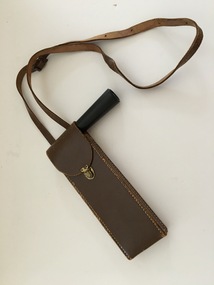
Equipment - Equipment - Hydrometer, VIOSH: Humidity Hydrometer; Wet/Dry and Sling Psychrometer
... industry. Students are taught active research and enquiry; rather than textbook learning and a one-size fits all approach. VIOSH accepts people into the Graduate Diploma of Occupational Hazard Management who have no undergraduate degree - on the basis of extensive work experience and knowledge. Instrument used to determine the humidity in a location. Made in England by Brannan. Established in 1913, Brannan are a global manufacturer of thermometers, pressure gauges & associated instrumentation products viosh victorian institute of occupational safety and health brannan england thermometers pressure gauges humidity hydrometer Made in England. Brannan Brown leather ...Victorian Institute of Occupational Safety and Health (VIOSH) Australia is the Asia-Pacific centre for teaching and research in occupational health and safety (OHS) and is known as one of Australia's leaders on the field. VIOSH has a global reputation for its innovative approach within the field of OHS management. VIOSH had its first intake of students in 1979. At that time the Institution was known as the Ballarat College of Advanced Education. In 1990 it became known as Ballarat University College, then in 1994 as University of Ballarat. It was 2014 that it became Federation University. VIOSH Australia students are safety managers, senior advisors and experienced OHS professionals. They come from all over Australia and industry. Students are taught active research and enquiry; rather than textbook learning and a one-size fits all approach. VIOSH accepts people into the Graduate Diploma of Occupational Hazard Management who have no undergraduate degree - on the basis of extensive work experience and knowledge. Instrument used to determine the humidity in a location. Made in England by Brannan. Established in 1913, Brannan are a global manufacturer of thermometers, pressure gauges & associated instrumentation productsBrown leather case with brass clip. Wooden frame with thermometer tubes. Black handle used to swing meter around. Gauge for temperature scale Made in England. Brannanviosh, victorian institute of occupational safety and health, brannan, england, thermometers, pressure gauges, humidity hydrometer -
 Ballarat Clarendon College
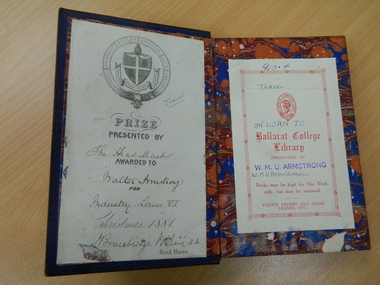
Book, A voyage round the world
... It is an excellent example of the community spirit which carried the school through periods of financial hardship. walter-armstrong w-m-u-armstrong geelong-grammar Book plate inside front cover: Geelong Grammar crest / PRIZE / PRESENTED BY / The Headmaster / AWARDED TO / Walter Armstrong / FOR / Industry - Lower VI / Christmas 1881 / Bracebridge Wilson M A / Headmaster Book plate on right side of end paper: Ballarat College crest / Ballarat College / Library / PRESENTED BY / W M U Armstrong / W M Armstrong 1942 / Books may be kept for one week / only but may be renewed / PLEASE REPORT ANY LOOSE / LEAVES, ETC. Dark royal blue leather ...This book was awarded by Geelong Grammar to Walter Armstrong in 1881. It was donated to the Ballarat College library by his grandson W Mick U Armstrong (1944). Mick attended Ballarat College 1937 - 1942. In 1936 the Weatherly Library was established at Ballarat College and a community book drive resulted in personal copies of books owned by members of the school community being donated to the library over the next 10-20 years. Mick Armstrong donated this book (amongst others) to the school library during his final year at the school. It is an excellent example of the community spirit which carried the school through periods of financial hardship. Dark royal blue leather bound book with gold crest, borders and spine detail. Spine has 6 decorative compartments with raised bands and red leather and gold lettering in the title compartment; Geelong Grammar crest embossed in gold on front cover and gold border to front and back cover; marbled endpapers and edges; black and white frontispiece and illustrations throughout book; book plates inside front cover.Book plate inside front cover: Geelong Grammar crest / PRIZE / PRESENTED BY / The Headmaster / AWARDED TO / Walter Armstrong / FOR / Industry - Lower VI / Christmas 1881 / Bracebridge Wilson M A / Headmaster Book plate on right side of end paper: Ballarat College crest / Ballarat College / Library / PRESENTED BY / W M U Armstrong / W M Armstrong 1942 / Books may be kept for one week / only but may be renewed / PLEASE REPORT ANY LOOSE / LEAVES, ETC.walter-armstrong, w-m-u-armstrong, geelong-grammar -
 Lara RSL Sub Branch
Uniform - Russian paratrooper red beret
... In April 1930, Soviet industry produced its first run of domestic parachutes, not surprisingly patterned on the Irvin style. russian front 1918-1919 russian paratroopers history of russian paratroopers history of change in aircraft to cater for paratroopers fabric informatiion labelt i.e. dry clean Red felted wool beret withblack leather hat trim Uniform Russian paratrooper red beret ...The Soviet Union was one of the first countries to realize the unique potential of parachute forces. As early as 1927 there were reports of parachute troops being used against bandits in Central Asia. Within the next two to three years Leonid G. Minov began to organize the first military parachute units. He traveled to the United States to study parachute strategy and techniques employed in air rescue missions. He returned to his country with a supply of American-made Irvin parachutes. In April 1930, Soviet industry produced its first run of domestic parachutes, not surprisingly patterned on the Irvin style.Red felted wool beret withblack leather hat trimfabric informatiion labelt i.e. dry cleanrussian front 1918-1919, russian paratroopers history of russian paratroopers, history of change in aircraft to cater for paratroopers -
 Ballarat Clarendon College
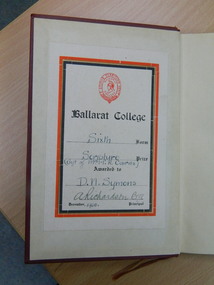
Book, Charles George Gordon
... He became a Clothing industry leader and was Fletcher Jones' distinguished successor as chief executive of the FJ organisation, and a prominent advocate for the Australian textile and clothing industries, decentralised industry and government support of employee share ownership schemes. donald-neil-symons fletcher-jones cairns Book plate inside front covers: school crest / Ballarat College / Sixth Form / Scripture Prize / (Gift of Mrs T R Cairns) / Awarded to / D N Symons / A Richardson, BA / December 1930 Principal Small, maroon leather-bound book with gold title and detailing on spine and gold school crest on front cover; plain endpapers; bookplate inside front cover. ...Awarded to Donald Neil Symons for excellence in Scripture during his final year at Ballarat College. Neil was educated at Ballarat College (Dux 1933) and Ormond College, Melbourne University. He became a Clothing industry leader and was Fletcher Jones' distinguished successor as chief executive of the FJ organisation, and a prominent advocate for the Australian textile and clothing industries, decentralised industry and government support of employee share ownership schemes. Small, maroon leather-bound book with gold title and detailing on spine and gold school crest on front cover; plain endpapers; bookplate inside front cover.Book plate inside front covers: school crest / Ballarat College / Sixth Form / Scripture Prize / (Gift of Mrs T R Cairns) / Awarded to / D N Symons / A Richardson, BA / December 1930 Principaldonald-neil-symons, fletcher-jones, cairns -
 Ballarat Clarendon College
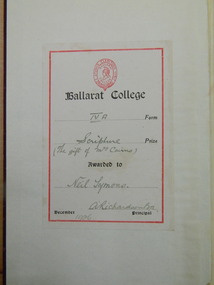
Book, Paul the ambassador: the life story of the great apostle re-told for young people
... He became a Clothing industry leader and was Fletcher Jones' distinguished successor as chief executive of the FJ organisation, and a prominent advocate for the Australian textile and clothing industries, decentralised industry and government support of employee share ownership schemes. donald-neil-symons cairns scripture book prize Bookplate inside front cover:School crest / Ballarat College / IVA Form / Scripture Prize / (The gift of Mrs Cairns) / Awarded to / Neil Symons / A Richardson BA / December 1926 Principal Thick, maroon leather-bound book with gold lettering on spine, black wording and detail and gold school crest on front cover; bookplate inside front cover Paul the ambassador: the life story of the great apostle re-told for young people Book ...Awarded to Donald Neil Symons for excellence in Scripture during 1926 at Ballarat College. Neil was educated at Ballarat College (Dux 1933) and Ormond College, Melbourne University. He became a Clothing industry leader and was Fletcher Jones' distinguished successor as chief executive of the FJ organisation, and a prominent advocate for the Australian textile and clothing industries, decentralised industry and government support of employee share ownership schemes.Thick, maroon leather-bound book with gold lettering on spine, black wording and detail and gold school crest on front cover; bookplate inside front coverBookplate inside front cover:School crest / Ballarat College / IVA Form / Scripture Prize / (The gift of Mrs Cairns) / Awarded to / Neil Symons / A Richardson BA / December 1926 Principaldonald-neil-symons, cairns, scripture, book prize -
 Ballarat Clarendon College
Book, The land that is desolate: an account of a tour in Palestine
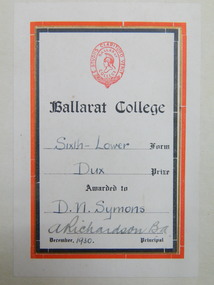
... He became a Clothing industry leader and was Fletcher Jones' distinguished successor as chief executive of the FJ organisation, and a prominent advocate for the Australian textile and clothing industries, decentralised industry and government support of employee share ownership schemes. donald-neil-symons dux 1930s fletcher jones Bookplate inside front cover: School crest / Ballarat College / Sixth-Lower Form / Dux Prize / Awarded to / D N Symons / A Richardson BA / December 1930 Principal Medium-sized, maroon, leather-bound book with gold-lettering and decoration on spine and gold school crest on front cover; bookplate inside front cover The land that is desolate: an account of a tour in Palestine Book ...Awarded to Donald Neil Symons for excellence in Scripture during 1926 at Ballarat College. Neil was educated at Ballarat College (Dux 1933) and Ormond College, Melbourne University. He became a Clothing industry leader and was Fletcher Jones' distinguished successor as chief executive of the FJ organisation, and a prominent advocate for the Australian textile and clothing industries, decentralised industry and government support of employee share ownership schemes.Medium-sized, maroon, leather-bound book with gold-lettering and decoration on spine and gold school crest on front cover; bookplate inside front coverBookplate inside front cover: School crest / Ballarat College / Sixth-Lower Form / Dux Prize / Awarded to / D N Symons / A Richardson BA / December 1930 Principaldonald-neil-symons, dux, 1930s, fletcher jones -
 Ballarat Clarendon College
Book, Redgauntlet
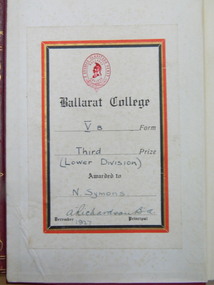
... He became a Clothing industry leader and was Fletcher Jones' distinguished successor as chief executive of the FJ organisation, and a prominent advocate for the Australian textile and clothing industries, decentralised industry and government support of employee share ownership schemes. donald-neil-symons fletcher jones 1920s book prize Book plate inside front cover: School crest / Ballarat College / Third Prize / (Lower division) / Awarded to / N Symons / A Richardson BA / December 1927 Principal Small, maroon, leather-bound book with gold lettering and detail on spine and gold crest on front cover; book plate inside front cover Redgauntlet Book ...Awarded to Donald Neil Symons for excellence in Scripture during 1926 at Ballarat College. Neil was educated at Ballarat College (Dux 1933) and Ormond College, Melbourne University. He became a Clothing industry leader and was Fletcher Jones' distinguished successor as chief executive of the FJ organisation, and a prominent advocate for the Australian textile and clothing industries, decentralised industry and government support of employee share ownership schemes.Small, maroon, leather-bound book with gold lettering and detail on spine and gold crest on front cover; book plate inside front coverBook plate inside front cover: School crest / Ballarat College / Third Prize / (Lower division) / Awarded to / N Symons / A Richardson BA / December 1927 Principaldonald-neil-symons, fletcher jones, 1920s, book prize -
 Federation University Historical Collection
Letter, Ballarat School of Mines, 1908, 1908
... rand south africa kalgoorlie school of mines and industries, bendigo certification of mine managers bendigo school of mines telegram ballarat school of mines battery roneo co., melbourne j. donald york chambers cochran & co thames school of mines, new zealand james chamberseducation department circular f.w. calaby * f.w. silberberg & co crucibles new black horse mining company e. howell * australasian institute of mining engineers john f. paterson welcome stranger dredging company, dunolly w.j. parker nevett and nevett john barker h. barbour brearley lyndhurst commonwealth minerals co a. o'mara j.h. davidson 'terascoa' port kembla w.s. macartney thomas williams australasian institute of mining engineers excursion toongabbie walhalla d.l. stirling george brearley lyndhurst via scottsdale berry united deep leads limited, ulina embossed leather classes for coachwork s. mee clunes the lord nelson north gold mning company no liability edward h. shackell may consolidated gold mining company, transvaal jason hawthorne northern assurance company james lidgett "braelands" myrniong gordon sides fraser & chalmers ltd mining machinery w.r. caithness examiners ballarat east school of design edward reid ballarat public library school of design a. gallenkamp and co. creswick advertiser john brittain telescope victorian railways e.b. jones ballarat east town clerk's office elliott, maclean and co. dressmaking j.h. wright ausimm berry united school of mines and industries bendigo lyndhurst tasmania may consolidated gold co germiston transvaal transvaal germiston roneo thames school of mines schools of mines welcome stranger dredging co cowley copper development syndicate ltd department of mines maryborough school pharmacy board of victoria tongalla survey camp ballarat fine art gallery association central microscopical October inwards correspondence for the Ballarat School of Mines. * School of Mines and Industries, Bendigo (certification of Mine Managers) * Telegram - examination papers * Commonwealth telegram - Ballarat School of Mines battery availability for crushing ten tons. * Letterhead from the Roneo Co., Melbourne * J. ...October inwards correspondence for the Ballarat School of Mines. * School of Mines and Industries, Bendigo (certification of Mine Managers) * Telegram - examination papers * Commonwealth telegram - Ballarat School of Mines battery availability for crushing ten tons. * Letterhead from the Roneo Co., Melbourne * J. Donald of Wallace St, Toorak * Letterhead from York Chambers, 49 Queen Street, Melbourne - signed J. Kaufmann * Letterhead from Cochran & Co - re Cocnran boilers * Letterhead of Thames School of Mines, New Zealand * Letter re James Chambers missing school from his father James Chambers Snr of Talbot * Education Department Circular * letter signed by F.W. Calaby * F.W. Silberberg & Co re crucibles * Letterhead of New Black Horse Mining Company - signed E. Howell * Australasian Institute of Mining Engineers, 57-59 Swanston Street, Melbourne - signed D.L. Stirling * Letterhead of John F. Paterson * Letterhead of the Welcome Stranger Dredging Company, Dunolly - W.J. Parker manager * Letterhead of Nevett and Nevett Barristers and Solicitors, Lydiard Street, Ballaarat * John Barker, H. Barbour * Telegram re Brearley Lyndhurst * Letterhead of the Commonwealth Minerals Co - John F. Paterson, Legal Manager * Query re courses at the Ballarat School of Mines - A. O'Mara * Stone to be crushed, Egerton from J.H. Davidson * Letterhead from 'Terascoa' Port Kembla signed by W.S. Macartney * Letter from Thomas Williams * Letterhead from Australian Institute of Mining Engineers regarding excursion to Toongabbie and Walhalla - Signed D.L. Stirling * Assay from George Brearley of Lyndhurst via Scottsdale * Letterhead of Berry United Deep Leads Limited, Ulina * Embossed leather classes for coachwork from S. Mee of Clunes * The Lord Nelson North Gold Mning Company No Liability signed by Edward H. Shackell * Correspondence from May Consolidated Gold Mining Company, Transvaal signed by Jason Hawthorne * Letterhead of the Northern Assurance Company, 448 Collins St, Melbourne * Letter fom James Lidgett of "Braelands" Myrniong * Gordon sides asking for a reference * Letterhead of Fraser & Chalmers Ltd, Manufacturersw of mining machinery, steam engines, boilers and machinery for systematic milling, smelting and concentration of ores, signed by W.R. Caithness * Letterhead of the Board of Examiners for Engine-Drivers, signed by R. Birrell * Letter concerning outstanding amount due to theBallarat East School of Design, signed by Edward Reid, Manager * Letterhead of the Ballarat Public Library concerning an outstanding amount in the School of Design Account. * Letterhead of the A. Gallenkamp and Co. regarding their new catalogue * Letterhead from the Creswick Advertiser, Albert Street, Creswick * Handwritten letter from John Brittain inviting Ballarat School of Mines students to join him at the telescope weather permitting * Letterhead of Victorian Railways, signed by E.B. Jones * Letterhead of the Ballarat East Town Clerk's Office * Letterhead of Elliott, Maclean and Co. Handwritten letter re Dressmaking from J.H. Wrightrand, south africa, kalgoorlie, school of mines and industries, bendigo, certification of mine managers, bendigo school of mines, telegram, ballarat school of mines battery, roneo co., melbourne, j. donald, york chambers, cochran & co, thames school of mines, new zealand, james chamberseducation department circular, f.w. calaby, * f.w. silberberg & co, crucibles, new black horse mining company, e. howell, * australasian institute of mining engineers, john f. paterson, welcome stranger dredging company, dunolly, w.j. parker, nevett and nevett, john barker, h. barbour, brearley lyndhurst, commonwealth minerals co, a. o'mara, j.h. davidson, 'terascoa' port kembla, w.s. macartney, thomas williams, australasian institute of mining engineers, excursion, toongabbie, walhalla, d.l. stirling, george brearley, lyndhurst via scottsdale, berry united deep leads limited, ulina, embossed leather classes for coachwork, s. mee, clunes, the lord nelson north gold mning company no liability, edward h. shackell, may consolidated gold mining company, transvaal, jason hawthorne, northern assurance company, james lidgett, "braelands" myrniong, gordon sides, fraser & chalmers ltd, mining machinery, w.r. caithness, examiners, ballarat east school of design, edward reid, ballarat public library, school of design, a. gallenkamp and co., creswick advertiser, john brittain, telescope, victorian railways, e.b. jones, ballarat east town clerk's office, elliott, maclean and co., dressmaking, j.h. wright, ausimm, berry united, school of mines and industries bendigo, lyndhurst tasmania, may consolidated gold co germiston transvaal, transvaal, germiston, roneo, thames school of mines, schools of mines, welcome stranger dredging co, cowley copper development syndicate ltd, department of mines, maryborough school, pharmacy board of victoria, tongalla survey camp, ballarat fine art gallery association, central microscopical -
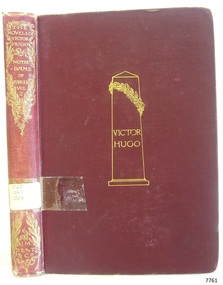 Flagstaff Hill Maritime Museum and Village
Book - Fictional Novel, Victor Hugo, Notre Dame of Paris Vol 2, 1899
... leather bindings. A few years after this book was printed, Dent went on to launch the incredibly famous 'Everyman’s Library' series in 1906, which revolutionised the publishing industry by providing cheap, pocket-sized classics. ...leather bindings. A few years after this book was printed, Dent went on to launch the incredibly famous 'Everyman’s Library' series in 1906, which revolutionised the publishing industry by providing cheap, pocket-sized classics. ...The novel is better known today by its English title, The Hunchback of Notre-Dame. This grand historical novel is set in 1482 Paris and revolves around the doomed gypsy dancer Esmeralda, the tortured archdeacon Claude Frollo, the dashing but shallow captain Phoebus, and the fiercely loyal, deformed bell-ringer Quasimodo. By the time you reach the final volume, the narrative is driving toward its intense, tragic climax. Beyond the human drama, the book is a love letter to Gothic architecture; Hugo famously wrote it to spark a preservation movement to save the crumbling Notre-Dame Cathedral from neglect and modernisation.Notre Dame of Paris Vol 2 Author: Victor Hugo Publisher: J M Dent & Co Date: 1899 Further Information: Translated by J. Carroll Beckwith Vol. 1 is 7072, Vol. 3 is 7073, Vol.4 is 8036fictionThe novel is better known today by its English title, The Hunchback of Notre-Dame. This grand historical novel is set in 1482 Paris and revolves around the doomed gypsy dancer Esmeralda, the tortured archdeacon Claude Frollo, the dashing but shallow captain Phoebus, and the fiercely loyal, deformed bell-ringer Quasimodo. By the time you reach the final volume, the narrative is driving toward its intense, tragic climax. Beyond the human drama, the book is a love letter to Gothic architecture; Hugo famously wrote it to spark a preservation movement to save the crumbling Notre-Dame Cathedral from neglect and modernisation.flagstaff hill, warrnambool, shipwrecked coast, flagstaff hill maritime museum, maritime museum, shipwreck coast, flagstaff hill maritime village, great ocean road, book, pattison collection, warrnambool library, warrnambool mechanics’ institute, ralph eric pattison, corangamite regional library service, warrnambool city librarian, mechanics’ institute library, victorian library board, warrnambool books and records, warrnambool children’s library, notre dame of paris vol 4, victor hugo, j. carroll beckwith -
Glenelg Shire Council Cultural Collection
Photograph - Photograph - Mr Vivian at work, Portland, n.d
... industry Black and white photo of Mr. H.L. Vivian at work in his saddlery. Close up shot, he is working on a piece of leather, the depiction of Mr. ...Black and white photo of Mr. H.L. Vivian at work in his saddlery. Close up shot, he is working on a piece of leather, the depiction of Mr. Vivian in the memorial plaque (7902) is based on this photo.vivian, saddlery, leatherwork, trade, industry -
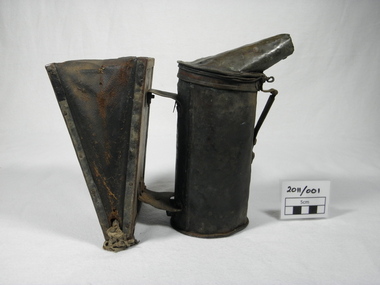 Dunkeld Museum Inc.
Bee Smoker
... industry in Dunkeld and surrounding districts. It is believed that there were nearly twenty apiarists operating in the area. Honey in large quantities was railed to Melbourne for sale. Homemade bee smoker consisting of a copper cylindrical firebox and rectangular bellows constructed of wood and leather. ...Many farming families in the district kept bees as a source of honey for home consumption. This item was made for use on the family farm. Most of the equipment used in the local industry was homemade.During the early to mid 20th century bee keeping was a significant rural industry in Dunkeld and surrounding districts. It is believed that there were nearly twenty apiarists operating in the area. Honey in large quantities was railed to Melbourne for sale.Homemade bee smoker consisting of a copper cylindrical firebox and rectangular bellows constructed of wood and leather. Components are assembled with rivets, scrap wire, sheet metal, nuts and bolts and nails. -
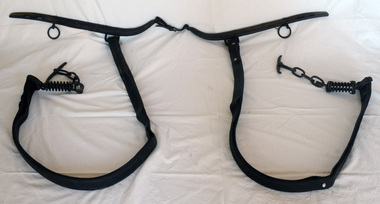 Orbost & District Historical Society
hames and traces, late 19th century - first half 20th century
... industry in Orbost before the mechanisation of farm machinery. This item is associated with that time. equestrian rural farming harness traces Wooden hames with leather traces which have chains and springs (to absorb shock) on each end. hames and traces ...Hames are attached to a horse collar used to distribute the load around a horse's neck and shoulders when pulling a wagon or plough. The collar often supports and pads a pair of curved metal or wood pieces, called hames, to which the traces, which attach to the wagon or plough, of the harness are attached. The collar allows the horse to use its full strength when pulling. This pair of hames would have been used on a farm in the Orbost district for pulling ploughs or other farm implements.Horses were a vital part of the agricultural industry in Orbost before the mechanisation of farm machinery. This item is associated with that time.Wooden hames with leather traces which have chains and springs (to absorb shock) on each end.equestrian rural farming harness traces -
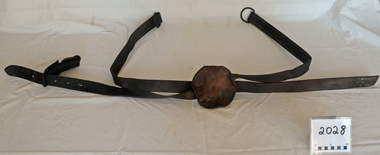 Orbost & District Historical Society
harness, late 19th century-mid 20th century
... Horses were a vital part of the agricultural industry in Orbost before the mechanisation of farm machinery. This item is associated with that time. equestrian harness rural farming Part of leather harness. ...Horses were a vital part of the agricultural industry in Orbost before the mechanisation of farm machinery. This item is associated with that time.Part of leather harness. Brown leather straps with buckles.equestrian harness rural farming -
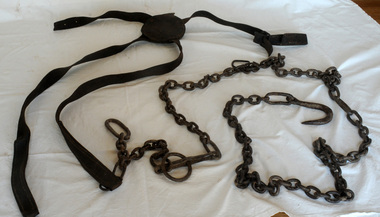 Orbost & District Historical Society
harness, late 19th century - mid 20th century
... Horses were a vital part of the agricultural industry in Orbost before the mechanisation of farm machinery. This item is associated with that time. harness equestrian rural farming horse A brown leather harness (spider) with a chain on one side and a heavy hook at the end. harness ...Horses were a vital part of the agricultural industry in Orbost before the mechanisation of farm machinery. This item is associated with that time.A brown leather harness (spider) with a chain on one side and a heavy hook at the end.harness equestrian rural farming horse -
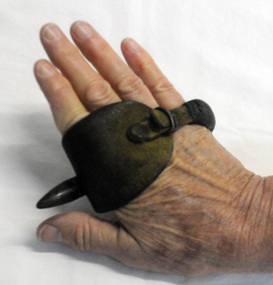 Orbost & District Historical Society
Tool - Maize tool
... industry. This item is rare. maize growing agriculture Orbost district A small hand-held metal and leather tool. ...This small hand-held tool was used in the maize industry in Murrungowar and Orbost district during 1900-1960s. Prior to machine harvesting coming about in the 1960s, each cob of maize had to picked by hand using this tool. Maize growing was a huge industry in the Orbost district and the job of picking the maize involved hand labour by many employees. This small hand-tool would have been common, but is now rare. This particular tool was owned and used by Nelson Northrope (from Orbost) in the early 20th Century and used at Murrungowar by Frances Eilman (nee Somerville). A highly significant small hand tool associated with the maize industry. This item is rare. A small hand-held metal and leather tool. A metal 'knife' has a curved shape and is attached to 2 leather straps which are connected by a small buckle. maize growing, agriculture, orbost district -
 Orbost & District Historical Society
needle
... Used for closing sacks - probably corn or wheat sacks. needle rural-industry horticulture A large metal needle with leather thonging and hole through the middle. ...Used for closing sacks - probably corn or wheat sacks.A large metal needle with leather thonging and hole through the middle. Used for sewing up wheat, corn bags.needle rural-industry horticulture -
 Orbost & District Historical Society
harness
... Horses were a vital part of the agricultural industry in Orbost before the mechanisation of farm machinery. This item is associated with that time. equestrian agriculture farming harness A leather spider harness with chains. ...Horses were a vital part of the agricultural industry in Orbost before the mechanisation of farm machinery. This item is associated with that time.A leather spider harness with chains. It has a wooden pole for display purposes. It was used for a large working horse.equestrian agriculture farming harness -
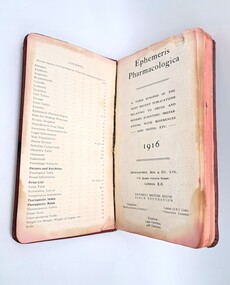 Glenelg Shire Council Cultural Collection
Book, Oppenheimer Son & Co., Ltd, Ephemeris Pharmacologica, 1916
... industry. Medical pharmacy pharmacists Doctor An reference book of medications and their uses as well as section for patient information and visits made. Title Page - A terse synopsis of the most recent publications relating to drugs and modern scientific preparations with references and notes etc,. / 1916 Red leather-bound book containing medications, how to administer them and what they are for. ...An reference book of medications and their uses as well as section for patient information and visits made.Red leather-bound book containing medications, how to administer them and what they are for. At the back of the book there is a section for notes - a Visiting List with places to add information on the patient as well as treatments administered.non-fictionAn reference book of medications and their uses as well as section for patient information and visits made.medical, pharmacy, pharmacists, doctor -
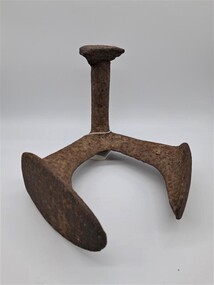 Glenelg Shire Council Cultural Collection
Tool - Cobblers Shoe Last, Early 1900s
... There were several significant leather makers and workers in the Glenelg Shire region. This would have been an important industry in the early days of European settlement. ...These tools were used by cobblers to steady the shoes whilst they were working on them.There were several significant leather makers and workers in the Glenelg Shire region. This would have been an important industry in the early days of European settlement. This demonstrates the development of the show making and leatherworking industryCast iron object. Two prongs with shoe shaped ends of differing sizes. Noneportland, industry, cobbler, shoe making, leatherwork, glenelg shire
