
Showing 32 items matching "lemon juicer"
-
![Kitchenware, Clever Dick [citrus juicer], 1960c](/media/collectors/4f729f5697f83e03086015b8/items/52e204ef2162ef13b081f8fd/item-media/52e207372162ef13b0820492/item-fit-380x285.jpg?cb=6) Greensborough Historical Society
Greensborough Historical SocietyKitchenware, Clever Dick [citrus juicer], 1960c
... ...lemon juicer...juicing citrus fruits, clear plastic with yellow plastic lid. In original cellophane package with instructions attached. The label claims that the product will keep lemons fresh until all juice is removed or seal is broken....An example of mid 20th century kitchen gadget. clever dick juicer lemon juicer Small funnel for juicing citrus fruits, clear plastic with yellow plastic lid. ...The 'Clever Dick' is a small funnel for juicing citrus fruits, clear plastic with yellow plastic lid. In original cellophane package with instructions attached. The label claims that the product will keep lemons fresh until all juice is removed or seal is broken.An example of mid 20th century kitchen gadget.Small funnel for juicing citrus fruits, clear plastic with yellow plastic lid. In original cellophane package with instructions attached.clever dick, juicer, lemon juicer -
 Coal Creek Community Park & Museum
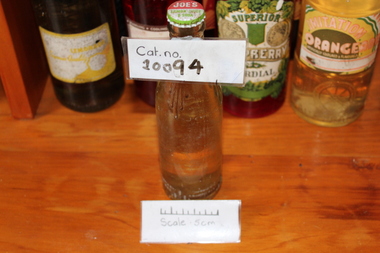
Joe's Lemon Juice & Soda
... Joe's Lemon Juice & Soda...Joe's Lemon Juice & Soda Joe's...Joe's Lemon Juice & Soda Joe's Red & White lid with a Green border Joe's Lemon Juice & Soda ...Red & White lid with a Green borderJoe's Lemon Juice & Soda Joe's -
 Greensborough Historical Society
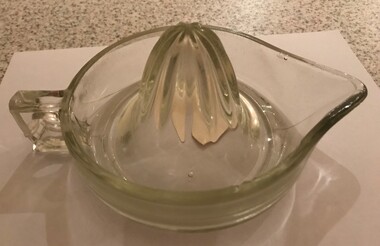
Domestic object - Juicer, Citrus juicer, 1930s
... lemon juicer...Commonly used for squeezing juice from oranges and lemons...Commonly used for squeezing juice from oranges and lemons lemon juicer juicer Clear moulded glass juicer with small handle. ...Commonly used for squeezing juice from oranges and lemonsClear moulded glass juicer with small handle.lemon juicer, juicer -
 Coal Creek Community Park & Museum
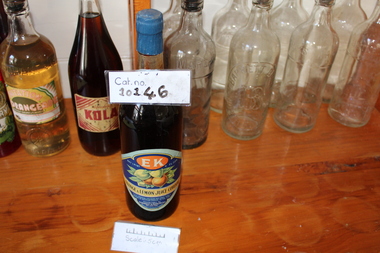
orange & Lemon juice Cordial
... orange & Lemon juice Cordial...E.K Orange & Lemon Juice Cordial Manufactured by Eckersley & Sons Melbourne Net | Pint G FL. ...E.K Orange & Lemon Juice Cordial Manufactured by Eckersley & Sons Melbourne Net | Pint G FL. ...Blue seal label has orange and a lemon on it Liquid seems to be still insideE.K Orange & Lemon Juice Cordial Manufactured by Eckersley & Sons Melbourne Net | Pint G FL. OZS This cordial contains no more than 2 grans of sulphur dioxide to the pint -
 Coal Creek Community Park & Museum
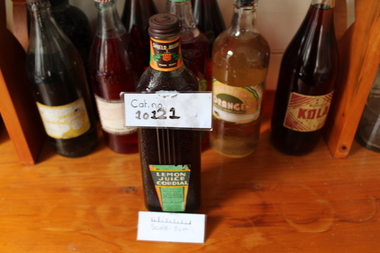
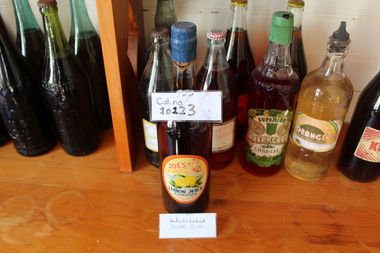
Lemon Juice Cordial
... Lemon Juice Cordial...Shield Brand Fort una fortes jubat trade mark artificially coloured lemon juice cordial NETT 20 FL.OZS. Contains not more than two grains sulphur dioxide to the pint...Shield Brand Fort una fortes jubat trade mark artificially coloured lemon juice cordial NETT 20 FL.OZS. Contains not more than two grains sulphur dioxide to the pint Square Bottle Rusted Lid Green, red, yellow and black label Lemon Juice Cordial ...Square Bottle Rusted Lid Green, red, yellow and black labelShield Brand Fort una fortes jubat trade mark artificially coloured lemon juice cordial NETT 20 FL.OZS. Contains not more than two grains sulphur dioxide to the pint -
 Coal Creek Community Park & Museum
Lemon Juice Cordial
... Lemon Juice Cordial...Joe's This food contains not more than 2 grains of salphur Dioxide to the pint Lyre Bird Brand Lemon Juice Cordial Contains appox 1 pint GGFL.OZS Manufactured by south gippsland cordial co kumburra`...Joe's This food contains not more than 2 grains of salphur Dioxide to the pint Lyre Bird Brand Lemon Juice Cordial Contains appox 1 pint GGFL.OZS Manufactured by south gippsland cordial co kumburra` Metal seal that covers the Cork Seal Orange Label with 1 and a half lemon's with a man holding a glass on it Lemon Juice Cordial ...Metal seal that covers the Cork Seal Orange Label with 1 and a half lemon's with a man holding a glass on itJoe's This food contains not more than 2 grains of salphur Dioxide to the pint Lyre Bird Brand Lemon Juice Cordial Contains appox 1 pint GGFL.OZS Manufactured by south gippsland cordial co kumburra` -
 Bendigo Historical Society Inc.
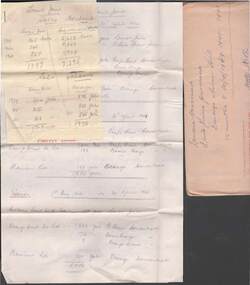
Memorabilia - COHN BROTHERS COLLECTION: VARIOUS DOCUMENTS
... [a] Cohns printed manilla envelope with handwritten captions, 'Lemons Processed, 'Fruit Juices Purchased, ' Bendigo Swan Hill , 12 months to 30/4/1939,1940,1941. ...BENDIGO Industry cohn bros brewery [a] Cohns printed manilla envelope with handwritten captions, 'Lemons Processed, 'Fruit Juices Purchased, ' Bendigo Swan Hill , 12 months to 30/4/1939,1940,1941. ...[a] Cohns printed manilla envelope with handwritten captions, 'Lemons Processed, 'Fruit Juices Purchased, ' Bendigo Swan Hill , 12 months to 30/4/1939,1940,1941. No 12 [No 143 crossed out] [b] Blue lined folded A3 sheet with handwritten items re years 1939,1940, 1941, for lemons processed and lemon juice purchased. [c] Three stapled notepaper with pencilled entries relating to fruit juice sales.bendigo, industry, cohn bros brewery -
 Warrnambool and District Historical Society Inc.
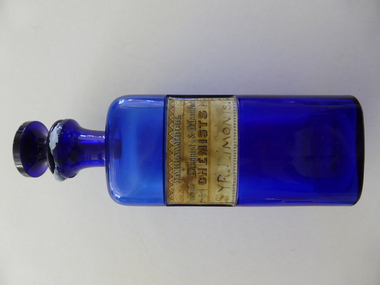
Bottle Blue, Druggist and Manufacturer, 1889
... It is made by steeping lemon juice and skin in a sugar syrup and alcohol. ...It is made by steeping lemon juice and skin in a sugar syrup and alcohol. ...This bottle was made by Whitall and Tatum who manufactured bottles from the early 1800's through to the 1930's. They specialised in producing chemist bottles and this particular cobalt blue bottle is on of the more rarely produced bottles. This syrup forms a cooling and pleasant addition to beverages for patients with febrile complaints, and serves to conceal the taste of saline purgatives in solution. It is made by steeping lemon juice and skin in a sugar syrup and alcohol. We are unsure of the particular chemist to whom it belonged.A fine example of a late 19th century bottle which was used and owned by a Warrnambool business.Square cobalt blue glass bottle with rounded neck and lip with round stopper with narrow section in the middle.Printed paper label with red and gold border and mainly black text, is attached to rectangular section which is indented on one side.It has a fine line through the centre of the bottle from the process of manufacturing.Label: Warrnambool Wholesale Druggists & manufacturi chemist. handwritten on label Syr Limonis. On bottom of bottle: Pat apr2 1889 W T & Co.warrnambool, warrnambool chemist, chemist bottle -
 Robin Boyd Foundation
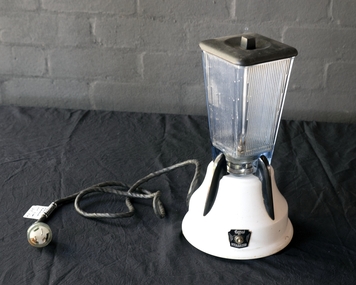
Functional object - Appliance, "Semak" Vitamiser
... "It made everything from milkshakes for us to mayonnaise, stuffing for chicken, soups, but especially I remember Robin in the kitchen using it to make daiquiris, endless ice, rum and lemon juice crushed and blended in the good old Vitamiser. ..."It made everything from milkshakes for us to mayonnaise, stuffing for chicken, soups, but especially I remember Robin in the kitchen using it to make daiquiris, endless ice, rum and lemon juice crushed and blended in the good old Vitamiser. ...The Boyds brought this vitamiser from their Camberwell home. Mandie Boyd, Robin and Patricia's eldest daughter, has very vivid memories of this gadget. "It made everything from milkshakes for us to mayonnaise, stuffing for chicken, soups, but especially I remember Robin in the kitchen using it to make daiquiris, endless ice, rum and lemon juice crushed and blended in the good old Vitamiser. He was wearing an amazing pale grey suit. American fabric beautifully cut, must have been synthetic, and had flecks of a darker grey through it, sounds hideous and was “of the time”. His American cotton business shirts were also beautifully tailored, with loads of room to move your arms unlike the daggy Aussie shirts." "Semak" Vitamiser, with a white plastic base, with 'on/off' switch at front of base. 4 black holders. Glass jug with black plastic lid. Black power cord. 3 black rubber stoppers at base.SN 7-81. 50 CYCLE 240v 120Wcookware, walsh st appliances, robin boyd -
 Flagstaff Hill Maritime Museum and Village
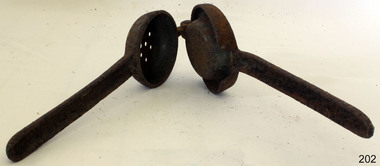
Domestic object - Fruit Press, 1890-1900
... The fruit juice or lemon squeezer is a small kitchen utensil designed to extract juice from lemons or other citrus fruit such as oranges, grapefruit, or lime. ...Vintage lemon/citrus fruits squeezer cast iron juicer with two sections hinged together strainer on one section has holes for letting liquid escape....The fruit juice or lemon squeezer is a small kitchen utensil designed to extract juice from lemons or other citrus fruit such as oranges, grapefruit, or lime. ...The fruit juice or lemon squeezer is a small kitchen utensil designed to extract juice from lemons or other citrus fruit such as oranges, grapefruit, or lime. It is designed to separate and crush the pulp of the fruit in a way that is easy to operate. Lemon squeezers can be made from any solid, acid-resistant material, such as plastic, glass, metal (usually aluminum) or ceramic. The oldest known lemon squeezers were found in Kütahya, Turkey and date to the first quarter of the 18th century. These ceramic presses are in the traditional style of Turkish pottery of the 18th century and have a superficial resemblance to today's press equipment with cones, though they are designed differently. These examples were individually made, and specially designed for making the then popular citrus drink sorbet. Lemons are not native to northern Turkey, though during the 17th and 18th centuries they were imported in bulk to Constantinople.The fruit juice press is an example of early 20th century kitchen utensils and is not associated with an historical event, person or place, provenance is unable to be determined at this time and the item is believed to have been made around 1900. This item is currently being used in Flagstaffs Hill village display and regarded as significant as it demonstrates domestic kitchen utensils used around the turn of the 19th century and today is a collectable item. Vintage lemon/citrus fruits squeezer cast iron juicer with two sections hinged together strainer on one section has holes for letting liquid escape.Noneflagstaff hill, warrnambool, shipwrecked coast, flagstaff hill maritime museum, flagstaff hill maritime village, great ocean road, food press, food preparation, fruit juice press, kitchen utensil -
 Melbourne Tram Museum
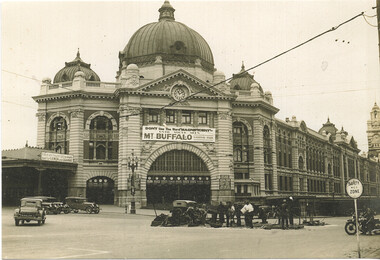
Photograph - Trackwork at Flinders and Swanston Sts, c1930
... The ad for the Orange and Lemon fruit juice indicates that the photo was taken between Nov 1926 and 1935 – when the fruit juice bar on the concourse of the station was rebranded as the Health Drink Stall – that was when they broadened the offerings from just freshly squeezed Lemon or Orange juice to coffee and other beverages. ...The ad for the Orange and Lemon fruit juice indicates that the photo was taken between Nov 1926 and 1935 – when the fruit juice bar on the concourse of the station was rebranded as the Health Drink Stall – that was when they broadened the offerings from just freshly squeezed Lemon or Orange juice to coffee and other beverages. ...Black and white photograph showing a group of men working on the tracks at the corner of Flinders and Swanston Sts, c1930. In the background is the Flinders St station building advertising the Mt Bufalo chalet. The railways took over the operation of the chalet in Oct. 1924, see reference. Notes from RJ 1/8/2027 T'he motorcycle on the right is a BSA single 1928-32 – this was the most popular type of motorcycle in Melbourne at this time. The car turning left into St Kilda Rd is a Ford Model A coupe 1928-31. The safety zone sign was introduced by the MCC circa 1927. The ad for the Orange and Lemon fruit juice indicates that the photo was taken between Nov 1926 and 1935 – when the fruit juice bar on the concourse of the station was rebranded as the Health Drink Stall – that was when they broadened the offerings from just freshly squeezed Lemon or Orange juice to coffee and other beverages. Nowadays it would be a Boost Juice. Unfortunately, the detail isn’t good enough for the large American saloon in front of the station – all I can tell is that it is American. If there was more detail of the grille I could do better – it might be a Dodge, though I can’t say for certain – but I’m not sure it would give a narrower date range. Therefore, the date range is 1928-35, but I would plump for 1929 or 1930, primarily due to the lack of newer cars. Thus, the maintenance work is just maintenance work – not involved with the conversion from cable to electric traction. My guess it is a Sunday morning (11:10 am) due to the lack of traffic and trams and people – Sunday morning trams weren’t brought in until 4 Oct 1936 – and any other day there would be hordes of people at this time of day. It also makes sense from a work perspective, as this would be the least disruptive time to perform maintenance on the H crossing at this location." Yields information about track work at the intersection of Flinders and Swanston Sts, c1926?Black and white photograph with a plain back, copy print.tramways, swanston st, flinders st, track work -
 Eltham District Historical Society Inc
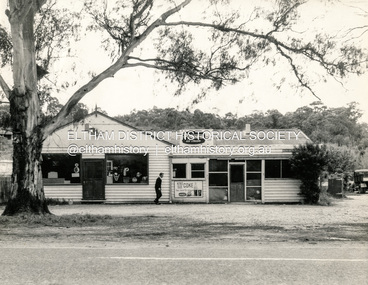
Photograph, George W. Bell, Eltham South Milk Bar, opposite Eltham Lower Park, c.1960
... Locals also fondly recall their chicken schnitzel with lemon juice. It is remembered as one of the best takeaway food shops, fresh food and fast service with great parking. ...Locals also fondly recall their chicken schnitzel with lemon juice. It is remembered as one of the best takeaway food shops, fresh food and fast service with great parking. ...Site of original tea rooms opposite what was then Eltham Park, now Eltham Lower Park on Main Road, present-day 573 Main Road since early 1970s, immediately prior to which it was 271 Main Road. It is believed a Mrs M Willoughby operated the tea rooms around October 1919. Arthur James McDonald became proprietor of the Eltham Park Tea Rooms some time between 1942 and 1945. In the 1942 Electoral Roll he was recorded living in Moonee Ponds as an aircraft fitter and was then recorded as a tea-room proprietor at Main Road, Eltham in the 1946 Electoral Roll. By 1949 he had moved to Leongatha where he was a café proprietor. A picture of the 1934 floods (EDHS_00103) shows the tea rooms surrounded by waist height flood waters. This building was a different structure. It is not known whether the building was demolished and rebuilt because of this flood event or sometime later to the building seen in this photograph, however it appears to be of a mid-1950s style. During the 1950s it was a milk bar as seen in this photograph and served Devonshire teas in the late 1950s, open only on weekends to service the park and miniature railway opposite. Locals who were children of the late 1950s on recall buying bags of lollies and drinks such as Blue Heaven Spider (ice cream float) and crackers for cracker night. At one point the shop also had pinball machines. It is believed the section of the building to the right was a residence. By the time the Shire of Eltham celebrated its centenary in 1971, the Eltham South Milk Bar was under new management. During the 1980s the shop was operated by Ansell and Muir and they offered takeaway fast food, such as spring rolls and especially hot chicken and chips. Locals also fondly recall their chicken schnitzel with lemon juice. It is remembered as one of the best takeaway food shops, fresh food and fast service with great parking. The residence section to the right was developed as an art, pottery and crafts gallery, Bimbadeen, run by Don Brown, then a local artist. It was taken over in the late 1980s as River Clay run by Leo Haanappel and Coeny Dommers. Unfortunately, the store stood within the 1934 flood zone and the property was unable to be redeveloped. The former Shire of Eltham acquired the land, and the building was subsequently demolished. In December 1993 company registration for Ansell and Muir Prestige Catering was cancelled and the business dissolved. The location is now the site of the current Fleur de Feliss flower stall tent. 17 December 1993 company registration cancelled for Ansell and Muir Prestige Catering Pty. Ltd. [CORPORATIONS LAW Subsection 574(1) (1994, January 12). Commonwealth of Australia Gazette. Periodic (National : 1977 - 2011), p. 20. Retrieved May 24, 2026, from http://nla.gov.au/nla.news-article238039370]Black and white photograph of Eltham South Store later Ansell & Muir c.1960573 main road eltham, 1960, a.j. mcdonald, ansell, ansell and muir, arthur james mcdonald, bimbadeen gallery, eltham, eltham park tea rooms, eltham south, george w. bell collection, main road eltham, milk bar, muir, riverclay craft gallery, shops, take away food -
 Flagstaff Hill Maritime Museum and Village
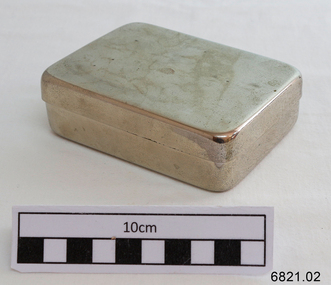
Container - Medical container, Late 19th century or early 20th century
... Brearley found that his new steel resisted these chemical attacks and proceeded to test the sample with other agents, including lemon juice and vinegar. Brearley was astounded to find that his alloys were still highly resistant, and immediately recognised the potential for his steel within the cutlery industry. ...Brearley found that his new steel resisted these chemical attacks and proceeded to test the sample with other agents, including lemon juice and vinegar. Brearley was astounded to find that his alloys were still highly resistant, and immediately recognised the potential for his steel within the cutlery industry. ...THE DISCOVERY OF STAINLESS STEEL Harry Brearley Since the dawn of man colonies have raced against each other to uncover new technologies, to be the first to stamp their names on a discovery, and although we’ve evolved over millions of years, the urge to be the first remains at the very core of our nature. This sense of passion and pride can lead some of the more unscrupulous humans to claim others discoveries as their own. Of course many breakthroughs are genuinely made in tandem, or are simultaneously occurring, but unless you can categorically prove that you were the pioneer of these incredible findings, then the other party involved will always dispute the fact. And so we come to stainless steel. The first point to note is that ‘inventor’ is a very ambiguous term. Is this the first person to think, to document, to patent, or to produce? The second point is that stainless steel wasn’t truly defined until 1911, so are we to cast aside those chromium-iron alloys that don’t quite meet the minimum requirement of 10.5% chromium? It seems like anyone and everyone has a different claim to being labelled the ‘inventor’ of stainless steel; from Britain, Germany, France, Poland, the U.S.A., and even Sweden. The cogs were set in motion by Englishmen Stoddart and Faraday circa 1820 and Frenchman Pierre Berthier in 1821. These scientists, among others, noted that iron-chromium alloys were more resistant to attack by certain acids, but tests were only carried out on low chromium content alloys. Attempts to produce higher chromium alloys failed primarily because of scientists not understanding the importance of low carbon content. In 1872 another pair of Englishmen, Woods and Clark, filed for patent of an acid and weather resistant iron alloy containing 30-35% chromium and 2% tungsten, effectively the first ever patent on what would now be considered a stainless steel. However, the real development came in 1875 when a Frenchman named Brustlein detailed the importance of low carbon content in successfully making stainless steel. Brustlein pointed out that in order to create an alloy with a high percentage of chromium, the carbon content must remain below around 0.15%. Thus ensued two decades of stagnation for the development of stainless steel, and while many scientists attempted to create a low carbon stainless steel, none succeeded. Hans Goldschmidt It wasn’t until 1895, when Hans Goldschmidt of Germany developed the aluminothermic reduction process for producing carbon-free chromium, that development of stainless steels became a reality. In 1904 French Scientist Leon Guillet undertook extensive research on many iron-chromium alloys. Guillet’s work included studies on the composition of what would now be known as 410, 420, 442, 446 and 440-C. In 1906 Guillet went on to analyse iron-nickel-chrome alloys, which would now be considered the basics of the 300 series. However, while noting the chemical composition of his alloys, Guillet failed to acknowledge the potential corrosion resistance of his materials. Albert Portevin In 1909 Englishman Giesen published an in-depth work regarding chromium-nickel steels, while the French national, Portevin, studied what is now regarded as 430 stainless steel. However, it wasn’t until 1911 that the importance of a minimum chromium content was discovered by Germans P. Monnartz and W. Borchers. Monnartz and Borchers discovered the correlation between chromium content and corrosion resistance, stating that there was a significant boost in corrosion resistance when at least 10.5% chromium was present. The pair also published detailed works on the effects of molybdenum on corrosion resistance. It is at this point we introduce Harry Brearley, born in Sheffield, England in 1871, he was appointed lead researcher at Brown Firth Laboratories in 1908. In 1912 Brearley was given a task by a small arms manufacturer who wished to prolong the life of their gun barrels which were eroding away too quickly. Brearley set out to create an erosion resistant steel, not a corrosion resistant one, and began experimenting with steel alloys containing chromium. During these experiments Brearley made several variations of his alloys, ranging from 6% to 15% chromium with differing levels of carbon. On the 13th August 1913 Brearley created a steel with 12.8% chromium and 0.24% carbon, argued to be the first ever stainless steel. The circumstances in which Brearley discovered stainless steel are covered in myth; some enchanted tales of Brearley recite him tossing his steel into the rubbish, only to notice later that the steel hadn’t rusted to the extent of its counterparts, much like Alexander Fleming’s experience 15 years later. Other more plausible, (but less attractive), accounts claim it was necessary for Brearley to etch his steels with nitric acid and examine them under a microscope in order to analyse their potential resistance to chemical attack. Brearley found that his new steel resisted these chemical attacks and proceeded to test the sample with other agents, including lemon juice and vinegar. Brearley was astounded to find that his alloys were still highly resistant, and immediately recognised the potential for his steel within the cutlery industry. The Half Moon Brearley struggled to win the support of his employers, instead choosing to produce his new steel at local cutler R. F. Mosley. He found difficulty producing knife blades in the new steel that did not rust or stain and turned to his old school friend, Ernest Stuart, Cutlery Manager at Mosley’s Portland Works, for help. Within 3 weeks, Stuart had perfected the hardening process for knives. Brearley had initially decided to name his invention ‘Rustless Steel’, but Stuart, dubbed it ‘Stainless Steel’ after testing the material in a vinegar solution, and the name stuck. And that’s how Harry Brearley discovered stainless steel…. well, not quite… During the 5 year period between 1908 and Brearley’s discovery in 1913 many other scientists and metallurgists have potential claims to Brearley’s title. In 1908 the Germans entered the fray, the Krupp Iron Works in Germany produced a chrome-nickel steel for the hull of the Germania yacht. The Half Moon, as the yacht is now known, has a rich history and currently lies on the seabed off the east coast of Florida. Whether the steel contains the minimum 10.5% chromium content remains inconclusive. Employees of the Krupp works, Eduard Maurer and Benno Strauss, also worked from 1912-1914 on developing austenitic steels using <1% carbon, <20% nickel and 15-40% chromium. Not happy with Europe hogging the glory, the USA got in on the act. Firstly, Elwood Haynes, after becoming disenchanted at his rusty razor, set out to create a corrosion resistant steel, which he supposedly succeeded in doing during 1911. Two other Americans, Becket and Dantsizen, worked on ferritic stainless steels, containing 14-16% chromium and 0.07-0.15% carbon, in the years 1911-1914. Elwood Haynes During 1912 Max Mauermann of Poland is rumoured to have created the first stainless steel, which he later presented to the public during the Adria exhibition in Vienna, 1913. Finally, a recently discovered article, which was published in a Swedish hunting and fishing magazine in 1913, discusses a steel used for gun barrels, (sound familiar?), which seems to resemble stainless steel. Although this is purely speculation, the Swedes have still made an audacious claim that they were in fact responsible for the first practical application for stainless steel. That concludes the shambolic discovery of stainless steel! Although there is much mystery and speculation behind the discovery of this wonderful material, there is no question that without the combined effort of all the above scientists and metallurgists, (and all the many more that were not mentioned), we would not have such a rich and versatile metal at our fingertips. https://bssa.org.uk/bssa_articles/the-discovery-of-stainless-steel/#:~:text=On%20the%2013th%20August%201913,the%20first%20ever%20stainless%20steel. This stainless steel container was donated to Flagstaff Hill Maritime Village by the family of Doctor William Roy Angus, Surgeon and Oculist. It is part of the “W.R. Angus Collection” that includes historical medical equipment, surgical instruments and material once belonging to Dr Edward Ryan and Dr Thomas Francis Ryan, (both of Nhill, Victoria) as well as Dr Angus’ own belongings. The Collection’s history spans the medical practices of the two Doctors Ryan, from 1885-1926 plus that of Dr Angus, up until 1969. ABOUT THE “W.R.ANGUS COLLECTION” Doctor William Roy Angus M.B., B.S., Adel., 1923, F.R.C.S. Edin.,1928 (also known as Dr Roy Angus) was born in Murrumbeena, Victoria in 1901 and lived until 1970. He qualified as a doctor in 1923 at University of Adelaide, was Resident Medical Officer at the Royal Adelaide Hospital in 1924 and for a period was house surgeon to Sir (then Mr.) Henry Simpson Newland. Dr Angus was briefly an Assistant to Dr Riddell of Kapunda, then commenced private practice at Curramulka, Yorke Peninsula, SA, where he was physician, surgeon and chemist. In 1926, he was appointed as new Medical Assistant to Dr Thomas Francis Ryan (T.F. Ryan, or Tom), in Nhill, Victoria, where his experiences included radiology and pharmacy. In 1927 he was Acting House Surgeon in Dr Tom Ryan’s absence. Dr Angus had become engaged to Gladys Forsyth and they decided he would take time to further his studies overseas in the UK in 1927. He studied at London University College Hospital and at Edinburgh Royal Infirmary and in 1928, was awarded FRCS (Fellow from the Royal College of Surgeons), Edinburgh. He worked his passage back to Australia as a Ship’s Surgeon on the on the Australian Commonwealth Line’s T.S.S. Largs Bay. Dr Angus married Gladys in 1929, in Ballarat. (They went on to have one son (Graham 1932, born in SA) and two daughters (Helen (died 12/07/1996) and Berenice (Berry), both born at Mira, Nhill ) Dr Angus was a ‘flying doctor’ for the A.I.M. (Australian Inland Ministry) Aerial Medical Service in 1928 . The organisation began in South Australia through the Presbyterian Church in that year, with its first station being in the remote town of Oodnadatta, where Dr Angus was stationed. He was locum tenens there on North-South Railway at 21 Mile Camp. He took up this ‘flying doctor’ position in response to a call from Dr John Flynn; the organisation was later known as the Flying Doctor Service, then the Royal Flying Doctor Service. A lot of his work during this time involved dental surgery also. Between 1928-1932 he was surgeon at the Curramulka Hospital, Yorke Peninsula, South Australia. In 1933 Dr Angus returned to Nhill where he’d previously worked as Medical Assistant and purchased a share of the Nelson Street practice and Mira hospital from Dr Les Middleton one of the Middleton Brothers, the current owners of what was once Dr Tom Ryan’s practice. Dr L Middleton was House Surgeon to the Nhill Hospital 1926-1933, when he resigned. [Dr Tom Ryan’s practice had originally belonged to his older brother Dr Edward Ryan, who came to Nhill in 1885. Dr Edward saw patients at his rooms, firstly in Victoria Street and in 1886 in Nelson Street, until 1901. The Nelson Street practice also had a 2 bed ward, called Mira Private Hospital ). Dr Edward Ryan was House Surgeon at the Nhill Hospital 1884-1902 . He also had occasions where he successfully performed veterinary surgery for the local farmers too. Dr Tom Ryan then purchased the practice from his brother in 1901. Both Dr Edward and Dr Tom Ryan work as surgeons included eye surgery. Dr Tom Ryan performed many of his operations in the Mira private hospital on his premises. He too was House Surgeon at the Nhill Hospital 1902-1926. Dr Tom Ryan had one of the only two pieces of radiology equipment in Victoria during his practicing years – The Royal Melbourne Hospital had the other one. Over the years Dr Tom Ryan gradually set up what was effectively a training school for country general-practitioner-surgeons. Each patient was carefully examined, including using the X-ray machine, and any surgery was discussed and planned with Dr Ryan’s assistants several days in advance. Dr Angus gained experience in using the X-ray machine there during his time as assistant to Dr Ryan. Dr Tom Ryan moved from Nhill in 1926. He became a Fellow of the Royal Australasian College of Surgeons in 1927, soon after its formation, a rare accolade for a doctor outside any of the major cities. He remained a bachelor and died suddenly on 7th Dec 1955, aged 91, at his home in Ararat. Scholarships and prizes are still awarded to medical students in the honour of Dr T.F. Ryan and his father, Dr Michael Ryan, and brother, John Patrick Ryan. ] When Dr Angus bought into the Nelson Street premises in Nhill he was also appointed as the Nhill Hospital’s Honorary House Surgeon 1933-1938. His practitioner’s plate from his Nhill surgery states “HOURS Daily, except Tuesdays, Fridays and Saturday afternoons, 9-10am, 2-4pm, 7-8pm. Sundays by appointment”. This plate is now mounted on the doorway to the Port Medical Office at Flagstaff Hill Maritime Village, Warrnambool. Dr Edward Ryan and Dr Tom Ryan had an extensive collection of historical medical equipment and materials spanning 1884-1926 and when Dr Angus took up practice in their old premises he obtained this collection, a large part of which is now on display at the Port Medical Office at Flagstaff Hill Maritime Village in Warrnambool. During his time in Nhill Dr Angus was involved in the merging of the Mira Hospital and Nhill Public Hospital into one public hospital and the property titles passed on to Nhill Hospital in 1939. In 1939 Dr Angus and his family moved to Warrnambool where he purchased “Birchwood,” the 1852 home and medical practice of Dr John Hunter Henderson, at 214 Koroit Street. (This property was sold in1965 to the State Government and is now the site of the Warrnambool Police Station. ). The Angus family was able to afford gardeners, cooks and maids; their home was a popular place for visiting dignitaries to stay whilst visiting Warrnambool. Dr Angus had his own silk worm farm at home in a Mulberry tree. His young daughter used his centrifuge for spinning the silk. Dr Angus was appointed on a part-time basis as Port Medical Officer (Health Officer) in Warrnambool and held this position until the 1940’s when the government no longer required the service of a Port Medical Officer in Warrnambool; he was thus Warrnambool’s last serving Port Medical Officer. (The duties of a Port Medical Officer were outlined by the Colonial Secretary on 21st June, 1839 under the terms of the Quarantine Act. Masters of immigrant ships arriving in port reported incidents of diseases, illness and death and the Port Medical Officer made a decision on whether the ship required Quarantine and for how long, in this way preventing contagious illness from spreading from new immigrants to the residents already in the colony.) Dr Angus was a member of the Australian Medical Association, for 35 years and surgeon at the Warrnambool Base Hospital 1939-1942, He served as a Surgeon Captain during WWII1942-45, in Ballarat, Victoria, and in Bonegilla, N.S.W., completing his service just before the end of the war due to suffering from a heart attack. During his convalescence he carved an intricate and ‘most artistic’ chess set from the material that dentures were made from. He then studied ophthalmology at the Royal Melbourne Eye and Ear Hospital and created cosmetically superior artificial eyes by pioneering using the intrascleral cartilage. Angus received accolades from the Ophthalmological Society of Australasia for this work. He returned to Warrnambool to commence practice as an ophthalmologist, pioneering in artificial eye improvements. He was Honorary Consultant Ophthalmologist to Warrnambool Base Hospital for 31 years. He made monthly visits to Portland as a visiting surgeon, to perform eye surgery. He represented the Victorian South-West subdivision of the Australian Medical Association as its secretary between 1949 and 1956 and as chairman from 1956 to 1958. In 1968 Dr Angus was elected member of Spain’s Barraquer Institute of Barcelona after his research work in Intrasclearal cartilage grafting, becoming one of the few Australian ophthalmologists to receive this honour, and in the following year presented his final paper on Living Intrasclearal Cartilage Implants at the Inaugural Meeting of the Australian College of Ophthalmologists in Melbourne In his personal life Dr Angus was a Presbyterian and treated Sunday as a Sabbath, a day of rest. He would visit 3 or 4 country patients on a Sunday, taking his children along ‘for the ride’ and to visit with him. Sunday evenings he would play the pianola and sing Scottish songs to his family. One of Dr Angus’ patients was Margaret MacKenzie, author of a book on local shipwrecks that she’d seen as an eye witness from the late 1880’s in Peterborough, Victoria. In the early 1950’s Dr Angus, painted a picture of a shipwreck for the cover jacket of Margaret’s book, Shipwrecks and More Shipwrecks. She was blind in later life and her daughter wrote the actual book for her. Dr Angus and his wife Gladys were very involved in Warrnambool’s society with a strong interest in civic affairs. Their interests included organisations such as Red Cross, Rostrum, Warrnambool and District Historical Society (founding members), Wine and Food Society, Steering Committee for Tertiary Education in Warrnambool, Local National Trust, Good Neighbour Council, Housing Commission Advisory Board, United Services Institute, Legion of Ex-Servicemen, Olympic Pool Committee, Food for Britain Organisation, Warrnambool Hospital, Anti-Cancer Council, Boys’ Club, Charitable Council, National Fitness Council and Air Raid Precautions Group. He was also a member of the Steam Preservation Society and derived much pleasure from a steam traction engine on his farm. He had an interest in people and the community He and his wife Gladys were both involved in the creation of Flagstaff Hill, including the layout of the gardens. After his death (28th March 1970) his family requested his practitioner’s plate, medical instruments and some personal belongings be displayed in the Port Medical Office surgery at Flagstaff Hill Maritime Village, and be called the “W. R. Angus Collection”. The W.R. Angus Collection is significant for still being located at the site it is connected with, Doctor Angus being the last Port Medical Officer in Warrnambool. The collection of medical instruments and other equipment is culturally significant, being an historical example of medicine from late 19th to mid-20th century. Dr Angus assisted Dr Tom Ryan, a pioneer in the use of X-rays and in ocular surgery. Medical box; rectangular stainless steel base and separate lid, from the W.R. Angus Collection.warrnambool, flagstaff hill maritime museum, great ocean road, dr w r angus, dr ryan, surgical instrument, t.s.s. largs bay, warrnambool base hospital, nhill base hospital, mira hospital, flying doctor, medical treatment, stainless steel medical container, medical container, stainless steel -
 Glenelg Shire Council Cultural Collection
Functional object - Bottle Label - Jeffrey Bros, n.d
... juice cordial, paper bottle label. Green and yellow background, black and yellow print, depiction of oranges and lemons....juice cordial, paper bottle label. Green and yellow background, black and yellow print, depiction of oranges and lemons. ...Jeffreys Bros. Casterton; orange fruit juice cordial, paper bottle label. Green and yellow background, black and yellow print, depiction of oranges and lemons.jeffrey bros, casterton, cordial factory -
Glenelg Shire Council Cultural Collection
Memorabilia - Label, n.d
... juice cordial, paper bottle label. Green and yellow background, black and yellow print, depiction of oranges and lemons....juice cordial, paper bottle label. Green and yellow background, black and yellow print, depiction of oranges and lemons. ...Jeffreys Bos, Casterton. Orange fruit juice cordial, paper bottle label. Green and yellow background, black and yellow print, depiction of oranges and lemons. -
 Flagstaff Hill Maritime Museum and Village
Citrus Squeezer
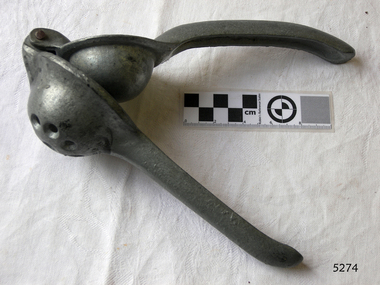
... Cast Aluminium lemon squeezer with holes in bowl to allow juice to run through. ...flagstaff hill warrnambool shipwrecked-coast flagstaff-hill flagstaff-hill-maritime-museum maritime-museum shipwreck-coast flagstaff-hill-maritime-village Cast Aluminium lemon squeezer with holes in bowl to allow juice to run through. ...Cast Aluminium lemon squeezer with holes in bowl to allow juice to run through. Length 8 "flagstaff hill, warrnambool, shipwrecked-coast, flagstaff-hill, flagstaff-hill-maritime-museum, maritime-museum, shipwreck-coast, flagstaff-hill-maritime-village -
 Warrnambool and District Historical Society Inc.
Artefact, Citrus Juicer - glass & metal. Williams, Late 19th century
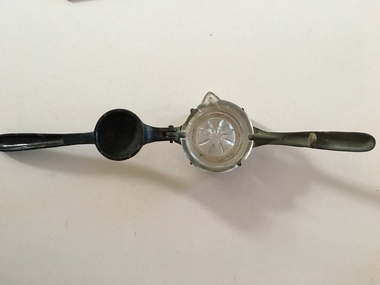
... juice extractor has a brass ring with a handle. Sitting in the ring is a heavy glass container with a concave base and a ridge inner base moulded in a shape to fit a whole or a half of a lemon or orange or other fruit or vegetable. ...juice extractor has a brass ring with a handle. Sitting in the ring is a heavy glass container with a concave base and a ridge inner base moulded in a shape to fit a whole or a half of a lemon or orange or other fruit or vegetable. ...This is an early model of a hand-held juice extractor. It is a household item that is probably over 100 years old.This juice extractor has no known local provenance but it is an interesting item and useful for display. This juice extractor has a brass ring with a handle. Sitting in the ring is a heavy glass container with a concave base and a ridge inner base moulded in a shape to fit a whole or a half of a lemon or orange or other fruit or vegetable. The rim of the glass has two pieces broken off. Attached to the brass base is a metal scoop-shaped dish with a handle. The handle pushes up and down into the glass container to put pressure on the object in the glass container to extract the juice. The scoop section has the maker’s name on the front. ‘Williams’ history of warrnambool, social history, hand held juicer -
 Bendigo Historical Society Inc.
Ephemera - SHOWBAGS COLLECTION: REED'S LEMON AND ORANGES SHOWBAG
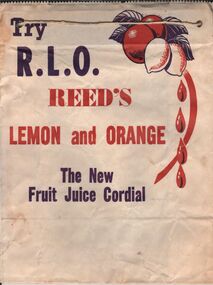
... On one side Try R.L.O. reed's Lemon and Orange. the new fruit juice cordial. there is a picture of two oranges and two lemons on the right hand side. ...On one side Try R.L.O. reed's Lemon and Orange. the new fruit juice cordial. there is a picture of two oranges and two lemons on the right hand side. on the other side the same picture and the words: reed Bros. ...Reed's showbag. The design is in blue and red on a white background. On one side Try R.L.O. reed's Lemon and Orange. the new fruit juice cordial. there is a picture of two oranges and two lemons on the right hand side. on the other side the same picture and the words: reed Bros. Bendigo Lemonade, three times winner at Royal Melb. Show. Tomato sauce 14 1st prizes, 3 Championships, 3 gold medal. Phone: Bendigo 471. There are three identical bags.business, retail, advertising, business advertising usually found at agricultural shows and other promotional activities. -
Clunes Museum
Domestic object - LEMON SQUEEZER - DOMESTIC
... JUICER KITCHEN TOOL Nil Wooden hinged with enamel bowl that has 5 holes in it. Domestic object LEMON SQUEEZER - DOMESTIC ...Wooden hinged with enamel bowl that has 5 holes in it.Niljuicer, kitchen tool -
Clunes Museum
Memorabilia - LABELS, JOHNSTONE O'SHANNESSY & CO
... .1 PHOTOGRAPH OF ROBERT NICHOL 1834-1900 AND ANN NICHOL 1830-1903 . .2 7 LEMON CORDIEAL LABELS EBERHARD & CO CLUNES .3 5 LIME JUICE CORDIAL LABELS EBERHARD & CO CLUNES .4 3 SARSAPARILLA LABELS EBERHARD & CO CLUNES .5 2 HOT PUNCH LABELS EBERHARD & CO CLUNES...ROBERT AND ANN NICHOL EBERHARD & SON LABELS .1 PHOTOGRAPH OF ROBERT NICHOL 1834-1900 AND ANN NICHOL 1830-1903 . .2 7 LEMON CORDIEAL LABELS EBERHARD & CO CLUNES .3 5 LIME JUICE CORDIAL LABELS EBERHARD & CO CLUNES .4 3 SARSAPARILLA LABELS EBERHARD & CO CLUNES .5 2 HOT PUNCH LABELS EBERHARD & CO CLUNES Memorabilia LABELS JOHNSTONE O'SHANNESSY & CO ....1 PHOTOGRAPH OF ROBERT NICHOL 1834-1900 AND ANN NICHOL 1830-1903 . .2 7 LEMON CORDIEAL LABELS EBERHARD & CO CLUNES .3 5 LIME JUICE CORDIAL LABELS EBERHARD & CO CLUNES .4 3 SARSAPARILLA LABELS EBERHARD & CO CLUNES .5 2 HOT PUNCH LABELS EBERHARD & CO CLUNESrobert and ann nichol, eberhard & son, labels -
 Whitehorse Historical Society Inc.
Machine - Food Mixer, Lemon Squeezer
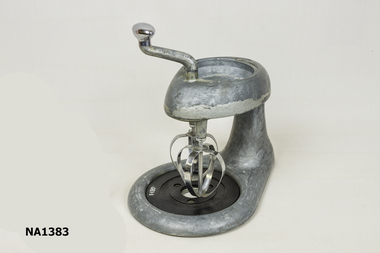
... lemon squeezer. Bowl to mix in missing. Has five small rubber legs.Has a planetary action and is hand driven. Beats eggs, cream and potatoes. The juice...lemon squeezer. Bowl to mix in missing. Has five small rubber legs.Has a planetary action and is hand driven. Beats eggs, cream and potatoes. The juice ...Hinged food mixer with egg beater blades of chrome plated steel. Brass handle, chromed. Base worked steel painted with hammertone paint. White plastic base to hold missing lemon squeezer. Bowl to mix in missing. Has five small rubber legs.Has a planetary action and is hand driven. Beats eggs, cream and potatoes. The juice can run down into the basin when lemon is squeezed.domestic items, food preparation -
 Whitehorse Historical Society Inc.
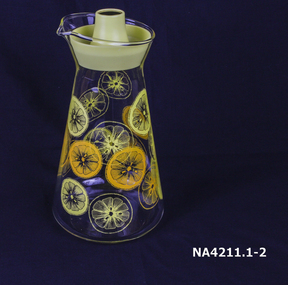
Domestic object - Glass Jug, 1970s
... Pyrex Juice jug with orange & lemon print & yellow lid with gold tip....Pyrex Juice jug with orange & lemon print & yellow lid with gold tip. ...Donated by Don , who grew up in Blackburn. Our Society did an Oral History ( NK 6057 ) on his life. The tape is held in our files.Pyrex Juice jug with orange & lemon print & yellow lid with gold tip.PYREX R U.S.A.domestic items, food & drink consumption -
 Whitehorse Historical Society Inc.
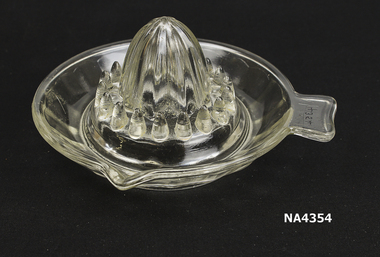
Domestic object - Lemon Squeezer
... lemon squeezer. Raised centre surrounded by about 20 spikes before a type of moat to catch juice. ...lemon squeezer. Raised centre surrounded by about 20 spikes before a type of moat to catch juice. ...Circular glass lemon squeezer. Raised centre surrounded by about 20 spikes before a type of moat to catch juice. Has spout - for pouring and small extension to hold the squeezer while pouring.domestic items, appliances -
 Mont De Lancey
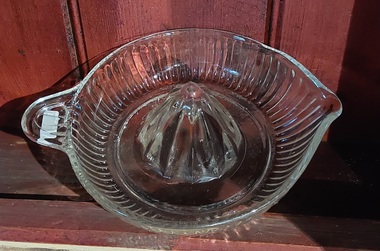
Domestic object - Citrus Juicer, Unknown
... There is a ridged pointed dome in the middle to extract the juice of a grapefruit or large orange or lemon when pushed hard against the fruit. ...There is a ridged pointed dome in the middle to extract the juice of a grapefruit or large orange or lemon when pushed hard against the fruit. ...A large vintage clear glass citrus juicer with decorative lined ridges around the sides of the bowl where the juice is collected. There is a ridged pointed dome in the middle to extract the juice of a grapefruit or large orange or lemon when pushed hard against the fruit. It has a pouring lip and a small handle. vintage juicers like this were used in the kitchen to extract juice from large citrus fruits. -
 Mont De Lancey
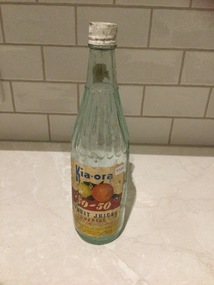
Container - Glass bottle
... On the label: "Kia-ora 50 - 50 Fruit Juice Cordial, made from oranges and lemons. 26 FL. OZ NET. Preservatives: This food contains not more than 2 grains of sulphur dioxide to the pint. ...Containers Bottles On the label: "Kia-ora 50 - 50 Fruit Juice Cordial, made from oranges and lemons. 26 FL. OZ NET. Preservatives: This food contains not more than 2 grains of sulphur dioxide to the pint. ...Pale green glass bottle with white, metal, screw-on lid. It has a beige-coloured label with red and blue writing, and a picture of an orange and a lemon, green leaves and one white flower.On the label: "Kia-ora 50 - 50 Fruit Juice Cordial, made from oranges and lemons. 26 FL. OZ NET. Preservatives: This food contains not more than 2 grains of sulphur dioxide to the pint. Kia-ora Industries Limited, Melbourne - Sydney - Australia".containers, bottles -
 Mont De Lancey
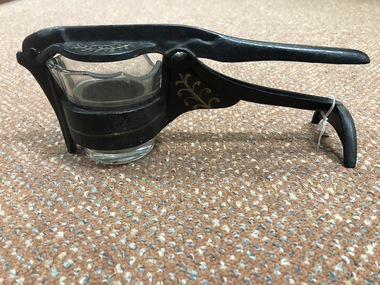
Lemon Squeezer, William B. Dean, Circa 1882
... Dean Juicers Dean's Cast iron and glass lemon squeezer, with gold design on iron. ...Invented and made by William B. DeanCast iron and glass lemon squeezer, with gold design on iron.Dean'sjuicers -
 Mont De Lancey
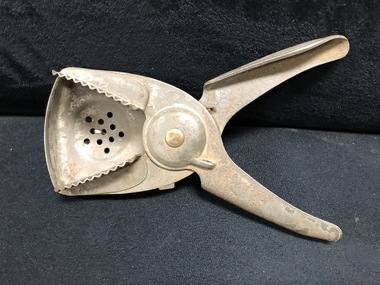
Lemon Squeezer, Circa 1922
... Juicers Heavy tinplate, scissor action lemon squeezer. Lemon Squeezer ...Heavy tinplate, scissor action lemon squeezer.juicers -
 Mont De Lancey
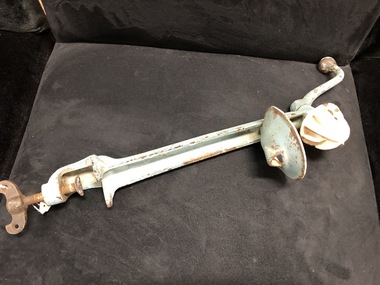
Lemon Squeezer, Circa 1910
... Juicers Enamelled blue, cast iron lemon squeezer. Lemon Squeezer ...Enamelled blue, cast iron lemon squeezer.juicers -
 Mont De Lancey
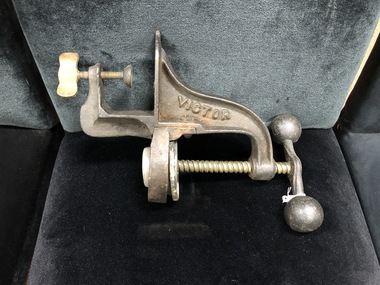
Lemon Squeezer, McMillan & Co, Circa 1912
... Juicers 'Victor' Cast iron, screw type lemon squeezer Lemon Squeezer McMillan & Co.. ...Cast iron, screw type lemon squeezer'Victor'juicers -
 Mont De Lancey
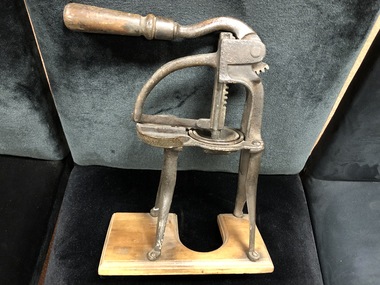
Lemon Cutter and Squeezer, F.F. Adams & Co, Circa 1888
... Juicers 'Acme' cast iron lemon cutter and squeezer, hand operated with a wooden handle, on a wooden base. ...'Acme' cast iron lemon cutter and squeezer, hand operated with a wooden handle, on a wooden base.juicers
