
Showing 41 items matching "life as a recruit"
-
 National Vietnam Veterans Museum (NVVM)
Document
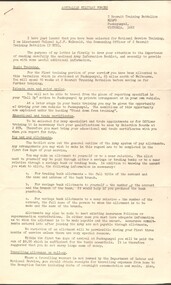
... ...Life as A Recruit...Australian Military Forces 2 Recruit Training Battalion Regular Army Lette Ordnance Corps Vietnam Life as A Recruit Australian Military Forces/Introduction To Recruit Training A two page typed document on issued by the Australian Military Forces on the Introduction to Recruit Training. ...Standard issue document to Australian servicemen Pte. Allen Doran Lette Service No. 3795490. Ordnance Corps.A two page typed document on issued by the Australian Military Forces on the Introduction to Recruit Training. Australian Military Forces/Introduction To Recruit Trainingaustralian military forces, 2 recruit training battalion, regular army, lette, ordnance corps, vietnam, life as a recruit -
 Bendigo Military Museum
Poster - POSTER, ARMY, 9 April, 1962
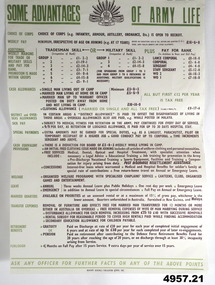
... "SOME ADVANTAGES OF ARMY LIFE" this is a recruiting poster listing "CHOICE OF CORPS" WEEKLY PAY, CASH ALLOWANCES and other payments, allowances etc....Recruiting Poster .1) - .21) Poster paper cream, plain, green and black print listing "SOME ADVANTAGES OF ARMY LIFE" with the centre top in black print Rising Sun Emblem. ..."SOME ADVANTAGES OF ARMY LIFE" this is a recruiting poster listing "CHOICE OF CORPS" WEEKLY PAY, CASH ALLOWANCES and other payments, allowances etc. ..."SOME ADVANTAGES OF ARMY LIFE" this is a recruiting poster listing "CHOICE OF CORPS" WEEKLY PAY, CASH ALLOWANCES and other payments, allowances etc.Recruiting Poster .1) - .21) Poster paper cream, plain, green and black print listing "SOME ADVANTAGES OF ARMY LIFE" with the centre top in black print Rising Sun Emblem. Background colour to poster - creamposters, military -
 Federation University Historical Collection
Poster, Fed Pride Poster, 2022
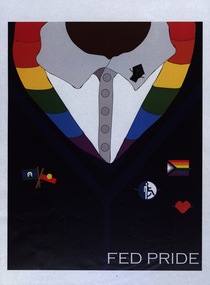
... FedPride 2021-2024 is a comprehensive strategy, aimed at achieving best inclusive practice in every area of university life: from recruitment and enrolment, to our culture, campuses, how we engage with the communities where our campuses are located and importantly through our curriculum and research. ...FedPride 2021-2024 is a comprehensive strategy, aimed at achieving best inclusive practice in every area of university life: from recruitment and enrolment, to our culture, campuses, how we engage with the communities where our campuses are located and importantly through our curriculum and research. ...FedPride 2021-2024 is a comprehensive strategy, aimed at achieving best inclusive practice in every area of university life: from recruitment and enrolment, to our culture, campuses, how we engage with the communities where our campuses are located and importantly through our curriculum and research. We know that diversity – having access to and embracing difference in backgrounds, perspectives, knowledge and skills – gives our university a breadth that supports innovation and the highest quality of thinking. It enriches us as individuals and as a community. FedPride has a particular focus on our staff and students being able to bring their whole selves to university life. When we feel safe, included and celebrated, we contribute freely and with enthusiasm and bring the best of ourselves to work and study. FedPride is an intersectional strategy, in that the rights, inclusion and access of people from diverse cultural backgrounds, people with disability and Aboriginal and Torres Strait Islander Peoples are held as core to every impact area. FedPride 2021–2024 has been developed with consultation across the University. The strategy is led by the FedPride Steering Group and implemented and monitored by the Implementation Group. Reports to measure progress will be provided annually for the Vice-Chancellor’s Senior Team. FedPride is endorsed by the Vice-Chancellor and the Vice-Chancellor’s Senior Team.A3 poster publicising Fed Pride. This poster was displayed at all Federation University posters in 2022.fed pride, equity -
 Flagstaff Hill Maritime Museum and Village
Functional object - Ditty Bag, Late 19th century
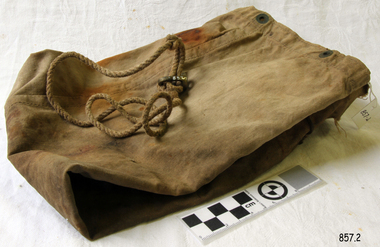
... recruits and contains a sewing kit, toiletry articles and personal items such as writing paper and pens. Another source says a Ditty Box or Ditty Bag is possibly from the Saxon word “dite”, meaning tidy or from the English word “dittis”, a type of canvas material. A small box or bag in which a sailor kept his valuables such as letters, small souvenirs and sewing supplies. An item that is socially significant as it gives insight into a sailors life ...A Ditty Bag (or box) was originally called “ditto bag” because it contained at least two of everything, two needles, two spools of thread, two buttons, etc. With the passing of years, the “ditto” was dropped in favour of "ditty" and remains so today. Before World War I, the Navy issued ditty boxes made of wood and styled after footlockers. These carried the personal gear and some clothes of the sailor. Today, the ditty bag is still issued to recruits and contains a sewing kit, toiletry articles and personal items such as writing paper and pens. Another source says a Ditty Box or Ditty Bag is possibly from the Saxon word “dite”, meaning tidy or from the English word “dittis”, a type of canvas material. A small box or bag in which a sailor kept his valuables such as letters, small souvenirs and sewing supplies.An item that is socially significant as it gives insight into a sailors life aboard ship and is another part of marine history. Items such as these although they were regarded at the time as everyday objects help us now to map various aspects of marine archaeology thorough the ages.Sailors Ditty Bag, canvas bag for holding all the sail making and roping tools, with tie and brass clasp. Holed.Noneflagstaff hill, warrnambool, shipwrecked-coast, flagstaff-hill, flagstaff-hill-maritime-museum, maritime-museum, shipwreck-coast, flagstaff-hill-maritime-village -
 Flagstaff Hill Maritime Museum and Village
Domestic object - Razor, John Clarke Ltd, 1930s
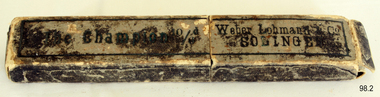
... life he was indenture and apprenticed to Octavius Twigg, a razor maker. Clarke was granted his Freedom in 1856 and began using the trademark 'NEVA'. By the 1860s, Thomas Clarke's son by his wife Elizabeth had joined the firm. When John Clarke died at his home at Augusta Place, Rock Street, Sheffield on 25 July 1873 (aged 68), he only employed six workmen. By 1881, Thomas had expanded this number to twenty. He sold a wide range of cutlery and was also an ‘emigration agent’, the Sheffield Independent, of 7th September in 1886 had an article published stating Thomas helped to recruit...life he was indenture and apprenticed to Octavius Twigg, a razor maker. Clarke was granted his Freedom in 1856 and began using the trademark 'NEVA'. By the 1860s, Thomas Clarke's son by his wife Elizabeth had joined the firm. When John Clarke died at his home at Augusta Place, Rock Street, Sheffield on 25 July 1873 (aged 68), he only employed six workmen. By 1881, Thomas had expanded this number to twenty. He sold a wide range of cutlery and was also an ‘emigration agent’, the Sheffield Independent, of 7th September in 1886 had an article published stating Thomas helped to recruit ...In 1848, 43-year-old John Clarke launched a cutlery business in Harvest Lane in Neepsend, Sheffield UK. Clarke entered the trade late in life he was indenture and apprenticed to Octavius Twigg, a razor maker. Clarke was granted his Freedom in 1856 and began using the trademark 'NEVA'. By the 1860s, Thomas Clarke's son by his wife Elizabeth had joined the firm. When John Clarke died at his home at Augusta Place, Rock Street, Sheffield on 25 July 1873 (aged 68), he only employed six workmen. By 1881, Thomas had expanded this number to twenty. He sold a wide range of cutlery and was also an ‘emigration agent’, the Sheffield Independent, of 7th September in 1886 had an article published stating Thomas helped to recruit personnel from England for cutlery centers in America. In 1893 Clarke’s showroom displayed miniature knives from '5/16ths-inch long to the most expensive sportsman's knives, that were gold and silver mounted. Table knives and carvers were also manufactured (or factored). Agencies were opened in London, New York, and Melbourne. Besides ‘NEVA, the ‘EXPRESS’ and ‘RING’ marks were used on razors; and Clarke’s marketed the American ‘GEM’ safety razor. By 1901, the firm had moved to Mowbray Street, where its Mowbray Works overlooked the River Don. Thomas Clarke died at Harrogate on 26 April 1902, aged 62, and was buried in the same Burngreave cemetery as his parents. Thomas’s sons, John Roome Clarke (1860-1925) and Thomas Edward Clarke, were directors, another son George William Clarke was a shareholder. John Roome Clarke died on 3 February 1925, aged 64 his son, John Clarke, of Crimicar Lane, remained as the senior partner. Clarke’s was one of the last producers of hand-made pocket knives and it also produced a large output of sheath knives for scouting associations. The firm was liquidated in 1964, but the company name was resurrected and Its last address after 1980 was at 65 Garden Street Sheffield. The company trademark passed on to Meteor Industries and then to Egginton Ltd. Weber & Co: The Clarke company purchased or (factored) many of its blades for razors and knives from Weber & Co of Solingen Germany. The full name of the firm originally was Jowika Stahlwarenfabrik Eugen Weber & Altenbach KG. It was founded in Solingen prior to 1928, under the name Johann & Wilhelm Kleinewefers GMBH, Messerfabrik. JWK for short, hence JoWiKa. The company was sold to Eugen Weber in the 1930s. Weber was married to a woman named Altenbach, from a family that manufactured innovative low-priced pocketknives, as well as other cutlery items. In 1960 Weber opened a branch factory in Listowel Ireland. It was sold to Albert M. Baer of Imperial Schrade in 1978. The Listowel factory was closed about a year and a half before the U.S. Schrade factory closed in 2004 and the Jowika factory in Solingen had closed in 1984.An item with an interesting manufacturing history from the 1930s showing how one man can grow a business into a successful concern that made quality products that stand the test of time.Razor metal folding blade with horn handle in its original cardboard box Inscription Made by John Clarke and Son England. "Champion" razor. On box " The Champion 10/6d" and "Weber Lohmann & Co SOLINGEN".flagstaff hill, warrnambool, shipwrecked-coast, flagstaff-hill, flagstaff-hill-maritime-museum, maritime-museum, shipwreck-coast, flagstaff-hill-maritime-village -
 Lara RSL Sub Branch
Photograph, Colin Arthur Goldberg, A37084
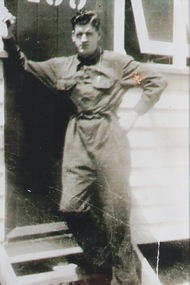
... recruit training at Laverton. From there he went to the ground and air radio school in Ballarat. After his training Colin was placed in the RAAF reserve. Colin was on the list for Korea for 9 years although did not serve. Colin said of his training: "My National Service Training showed me purpose & a discipline that turned my life...recruit training at Laverton. From there he went to the ground and air radio school in Ballarat. After his training Colin was placed in the RAAF reserve. Colin was on the list for Korea for 9 years although did not serve. Colin said of his training: "My National Service Training showed me purpose & a discipline that turned my life ...Colin A Goldberg b 13 November 1932 - D 2February 2013. Colin attended several primary schools in Victoria leaving school aged 13 years. Working hard at various jobs Colin studied at RMIT qualifying as builder /carpenter in 1961. Colin was called up for National Service on 30 July, 1951. He was allotted to the RAAF, and underwent recruit training at Laverton. From there he went to the ground and air radio school in Ballarat. After his training Colin was placed in the RAAF reserve. Colin was on the list for Korea for 9 years although did not serve. Colin said of his training: "My National Service Training showed me purpose & a discipline that turned my life somewhat around for the good & for all time". Colin first joined the family of R S L at WARRAGUL in 1992 transferring to Lara in 1996. Elizabeth, Colin's wife, says that he was probably working with members of the RSL and that talk at work about the branch made him think that it was a good place to connect and make friends, and this was part of the reason why they continued at Lara. Colin. And wife Elizabeth came to live in Lara in 1994 there being a warm welcome for us both by the members of Lara RSL in 1996. Colin & Elizabeth found friendship & a whole wide window to the consequence of warfare. Indeed history written through the suffering of so many . Colin & Elizabeth were married for 57 years when Colin died. Colin and Elizabeth had two daughters, three grandchildren, and three great grandchildren however he never met them. Personal Story A willingness to put oneself in readiness for the call to arm oneself in the defence of family and Nation .Sepia image of Telegraphist A37084 Colin A Goldberg Cream Mount Black Frame. Colin is standing on the steps of hut number 199 at Ground and Air Radio School RAAF Ballarat A37084 Telegraphist Colin Arthu Goldberg. 1st National Service Intake. RAAF. 1932-2013.sepia photograph, korea, 1951, laverton, ballarat, raaf reserves -
 Federation University Historical Collection
Book - Report, 'gettin em n keepin em': Report of the Indigenous Nursing Education Working Group, 2002, 09/2002
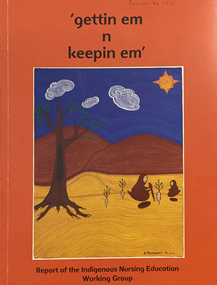
... sue turale nursing indigenous nursing aboriginal indigenous nursing education recruitment retention population health remote area nurses royal commission ito Aboriginal Deaths in Custody life expectency national aboriginal health strategy Soft covered book with an indigenous artwork featuring ochre, blue and yellow. ...Soft covered book with an indigenous artwork featuring ochre, blue and yellow.non-fictionsue turale, nursing, indigenous nursing, aboriginal, indigenous nursing education, recruitment, retention, population, health, remote area nurses, royal commission ito aboriginal deaths in custody, life expectency, national aboriginal health strategy -
 The Beechworth Burke Museum
Photograph
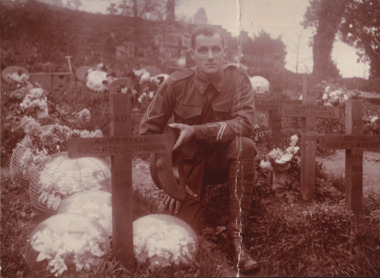
... life and the greatest repatriation of casualties in the country's history. Australia’s involvement in the First World War began when the Australian government established the Australian Imperial Force (AIF) in August 1914. Immediately, men were recruited ...Taken on an unknown date, depicted is a portrait of a young, unidentified male soldier kneeling beside a grave in a cemetery. He is dressed in an Australian military uniform. The cemetery pictured is the Arnos Vale Cemetery in Bristol, United Kingdom. There are multiple crosses marking graves in this photograph, all marked in memory of different soldiers who fought with the Australian Imperial Force (AIF) during World War I. It is believed that the soldier who is kneeling was also part of the Australian Imperial Force. This can be inferred by the chevron rank insignia visible on the uniform. The placement of this insignia on the sleeve of the right arm suggests that this soldier was either a Warrant Officer or a Non-Commissioned Officer (NCO). Another signifier of the Australian Imperial Force uniform are the three inverted chevron stripes positioned on the lower part of the left sleeve, near the wrist. These are called Good Conduct Stripes and were worn by Warrant Officers and NCOs. This patch consisted of a single chevron stripe for each year of military service meeting certain requirements of good conduct. Additionally, the man in this photograph is also wearing a 'Rising Sun' collar badge on his coat. Australia, unlike most other Commonwealth countries, did not adopt metal regimental badges during the First World War. All units were issued with the Australian Army General Service Badge, better known as the 'Rising Sun’ badge. This insignia is almost always identified with the Australian Imperial Force. Furthermore, the grave that this unidentified soldier is kneeling next to is the resting place of Private John James (J. J.) Simpson. He was born in Stanley, Victoria in 1883. He enlisted in the Australian Imperial Force in Melbourne, Victoria on 12 July, 1915, with the service number 4909. John James Simpson was then posted to the 60th Company Depot at Seymour for military recruit training. John James Simpson was reported wounded in action in France on 19 July, 1916. He was admitted to 13th General Hospital, France with gunshot wounds to his legs. From Boulogne, France, he traveled to the United Kingdom aboard the Hospital Ship 'St. Denis' for medical care. Upon arrival, he was admitted to 2nd Southern General Hospital, Bristol, England on 27 July, 1916. John James Simpson passed away from his wounds on 1 August, 1916. He was 33 years old.The record is historically significant due to its connection to World War I. This conflict is integral to Australian culture as it was the single greatest loss of life and the greatest repatriation of casualties in the country's history. Australia’s involvement in the First World War began when the Australian government established the Australian Imperial Force (AIF) in August 1914. Immediately, men were recruited to serve the British Empire in the Middle East and on the Western Front. The first significant Australian action of the war was the Australian Naval and Military Expeditionary Force’s (ANMEF) landing on Rabaul on 11 September 1914. The ANMEF took possession of German New Guinea at Toma on 17 September 1914 and of the neighbouring islands of the Bismarck Archipelago in October 1914. On 25 April 1915, members of the AIF landed on Gallipoli in Turkey with troops from New Zealand, Britain, and France. This specific event holds very strong significance within Australian history. The record has strong research potential. This is due to the ongoing public and scholarly interest in war, history, and especially the ANZAC legend, which is commemorated annually on 25 April, known as ANZAC Day.Sepia rectangular photograph printed on matte photographic paper mounted on card.Obverse: A.I.F. / AUSTRALIA / 441, PTE.T. / T (?) / 26B (?) / 6.1.17 / (?) / LANGTON RD. / ST. ANNES PK. / BRISTOL / A.I.F. / AUSTRALIA. / 708, GNR B.L.CRAWFORD. / FR / 5 D.A.C. / 13.2.17 / A.I.F. / AUSTRALIA. / 4481, P (?) D.MORRIS. / (?) / 31.12.(?) / A.I.F. / AUSTRALIA. / 4909, PTE J.J.SIMPSON. / 608(?) / 1.8.16 / Winchester / LANGTON RD. / ST. ANNES PK / BRISTOL / Reverse: 2641 /military album, military, war, world war i, wwi, australian imperial force, aif, j. j. simpson, uniform, cemetery -
 National Vietnam Veterans Museum (NVVM)
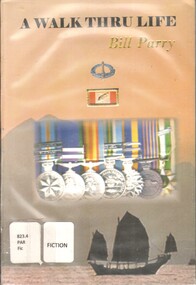
Book, Parry, Bill, A Walk Thru Life
... recruit training to a battalion and then to the steamy massage parlours and jungle. On the inside of the cover reads "To the Vietnam Veterans Museum, San Remo, Victoria. complimentary Copy. Signed by Bill Parry on the 09.03.04 A Walk Thru Life ...Enjoy the humour and relive the era of the "Sixties", as you follow him from recruit training to a battalion and then to the steamy massage parlours and jungle.fictionEnjoy the humour and relive the era of the "Sixties", as you follow him from recruit training to a battalion and then to the steamy massage parlours and jungle.vietnam war, 1961-1975 - fiction -
 Croatian-Australian Immigration Museum
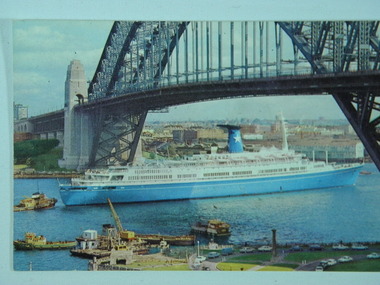
Photograph of postcard, Original postcard made before 1967
... recruiting labourers from Europe. The family left Croatia along with many other immigrants looking for a better life in Australia....recruiting labourers from Europe. The family left Croatia along with many other immigrants looking for a better life in Australia. ...Postcard written by Slavica Risek at 11 years of age to her grandmother on arrival to Australia from Croatia. She was travelling on the Angelina Lauro passenger ship with her brother, mother and father c.1969. She describes her cabin is located at the first windows at the bow of the ship. The postcard was never posted. This was during a time that Australia was recruiting labourers from Europe. The family left Croatia along with many other immigrants looking for a better life in Australia.This item is of historical significance as a representative example of a young girl immigrating to Australia during the time when Australia was recruiting labourers from overseas.Image of Postcard with photo on front of ship named Angelina Lauro sailing under the Sydney Harbour Bridge. On reverse side is a written message and address in Croatianimmigration, sydney harbour bridge, croatia, labourers, angelino lauro ship, postcard -
 Port Melbourne Historical & Preservation Society
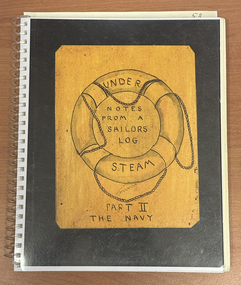
Document - James CONDER Journal, James Brycanne Conder, NOTES FROM A SAILORS LOG - UNDER STEAM - PART II THE NAVY
... recruits. He later served on ‘HMS Challenger’ and ‘HMS Psyche’ which included voyages to Fiji, the New Hebrides, Singapore and New Zealand as well as regular cruises to Australian ports. In 1909, CONDER left the Navy and undertook shored-based civilian work until 1913 when he joined the Royal Australian Naval College at Osborne House in Geelong. He remained with the Naval College until 1937 through its moves to Jervis Bay, NSW and then to Crib Point, Victoria training midshipmen according to the practices of the Royal Navy. In later life...recruits. He later served on ‘HMS Challenger’ and ‘HMS Psyche’ which included voyages to Fiji, the New Hebrides, Singapore and New Zealand as well as regular cruises to Australian ports. In 1909, CONDER left the Navy and undertook shored-based civilian work until 1913 when he joined the Royal Australian Naval College at Osborne House in Geelong. He remained with the Naval College until 1937 through its moves to Jervis Bay, NSW and then to Crib Point, Victoria training midshipmen according to the practices of the Royal Navy. In later life ...James Bryance CONDER (aka James Brycanne CONDER) Artist, poet and four-navy veteran, 1872 - 1954. In 1889 he served in the Merchant Marine Service sailing on the ships ‘Ellora’ and ‘Avenger’. in 1891, aged 19, he joined the Royal Navy in Australia serving on the flagship of the Australian Station, ‘HMS Orlando’, when it escorted ships of the new Australasian Auxiliary Squadron in coastal voyages. After serving 6 months he returned to family in Melbourne rather than sign on for 12 years. Instead he joined the Victorian Colonial Navy and was posted, in succession, to the ‘HMVS Cerberus’, ‘HMVS Nelson’ and the gunboat ‘HMVS Albert’. In 1896 he left the navy, married Victoria Agnes NIHILL and joined the Victorian Police Force. In 1904 CONDOR returned to the sea as part of the Commonwealth Naval Forces, an amalgamation of the colonial navies formed after federation and later becoming the Royal Australian Navy. On his first ship, ‘HMS Katoomba’, as bosun yeoman, he helped train new recruits. He later served on ‘HMS Challenger’ and ‘HMS Psyche’ which included voyages to Fiji, the New Hebrides, Singapore and New Zealand as well as regular cruises to Australian ports. In 1909, CONDER left the Navy and undertook shored-based civilian work until 1913 when he joined the Royal Australian Naval College at Osborne House in Geelong. He remained with the Naval College until 1937 through its moves to Jervis Bay, NSW and then to Crib Point, Victoria training midshipmen according to the practices of the Royal Navy. In later life, CONDER produced two handwritten journals for his family illustrated with his own paintings and drawings. Two original sets were made. One remains in the family while the other is held by the Australian National Maritime Museum in Sydney. PMHPS hold several items relating to James CONDER including photocopies of his journals ‘Notes from a Sailors Log - Under Canvas - Part I The Merchant Service’ (Cat No 2700.01) and ‘Notes from a Sailors Log - Under Steam - Part II The Navy’ (Cat No 2700.02), a photocopy of his Certificate of Service (Cat No 2700.03), a booklet of his life story (Cat No 2700.04) and several digital items (Cat No 2476.01 - 2476.09).A spiral bound photocopy of a sailor's log; dark red marbled covers; front cover has tan inset with title in and around a sketch of a lifebuoy. Under Steam - Part II The Navy. See Under Canvas - Part I The Merchant Service (Cat No 2700.01)transport - shipping, hmvs cerberus, james bryance conder, armed services - navy, ran - royal australian navy -
 Port Melbourne Historical & Preservation Society
Booklet, Robert Murphy, James Conder - A Maritime Life - 1872-1954, c. 2000
... recruits. He later served on ‘HMS Challenger’ and ‘HMS Psyche’ which included voyages to Fiji, the New Hebrides, Singapore and New Zealand as well as regular cruises to Australian ports. In 1909, CONDER left the Navy and undertook shored-based civilian work until 1913 when he joined the Royal Australian Naval College at Osborne House in Geelong. He remained with the Naval College until 1937 through its moves to Jervis Bay, NSW and then to Crib Point, Victoria training midshipmen according to the practices of the Royal Navy. In later life...recruits. He later served on ‘HMS Challenger’ and ‘HMS Psyche’ which included voyages to Fiji, the New Hebrides, Singapore and New Zealand as well as regular cruises to Australian ports. In 1909, CONDER left the Navy and undertook shored-based civilian work until 1913 when he joined the Royal Australian Naval College at Osborne House in Geelong. He remained with the Naval College until 1937 through its moves to Jervis Bay, NSW and then to Crib Point, Victoria training midshipmen according to the practices of the Royal Navy. In later life ...James Bryance CONDER (aka James Brycanne CONDER) Artist, poet and four-navy veteran, 1872 - 1954. In 1889 he served in the Merchant Marine Service sailing on the ships ‘Ellora’ and ‘Avenger’. in 1891, aged 19, he joined the Royal Navy in Australia serving on the flagship of the Australian Station, ‘HMS Orlando’, when it escorted ships of the new Australasian Auxiliary Squadron in coastal voyages. After serving 6 months he returned to family in Melbourne rather than sign on for 12 years. Instead he joined the Victorian Colonial Navy and was posted, in succession, to the ‘HMVS Cerberus’, ‘HMVS Nelson’ and the gunboat ‘HMVS Albert’. In 1896 he left the navy, married Victoria Agnes NIHILL and joined the Victorian Police Force. In 1904 CONDOR returned to the sea as part of the Commonwealth Naval Forces, an amalgamation of the colonial navies formed after federation and later becoming the Royal Australian Navy. On his first ship, ‘HMS Katoomba’, as bosun yeoman, he helped train new recruits. He later served on ‘HMS Challenger’ and ‘HMS Psyche’ which included voyages to Fiji, the New Hebrides, Singapore and New Zealand as well as regular cruises to Australian ports. In 1909, CONDER left the Navy and undertook shored-based civilian work until 1913 when he joined the Royal Australian Naval College at Osborne House in Geelong. He remained with the Naval College until 1937 through its moves to Jervis Bay, NSW and then to Crib Point, Victoria training midshipmen according to the practices of the Royal Navy. In later life, CONDER produced two handwritten journals for his family illustrated with his own paintings and drawings. Two original sets were made. One remains in the family while the other is held by the Australian National Maritime Museum in Sydney. PMHPS hold several items relating to James CONDER including photocopies of his journals ‘Notes from a Sailors Log - Under Canvas - Part I The Merchant Service’ (Cat No 2700.01) and ‘Notes from a Sailors Log - Under Steam - Part II The Navy’ (Cat No 2700.02), a photocopy of his Certificate of Service (Cat No 2700.03), a booklet of his life story (Cat No 2700.04) and several digital items (Cat No 2476.01 - 2476.09). 'James Conder - A Maritime Life - 1872-1954', A5 booklet 20 pp incl cover, 'developed by Robert Murphy for the many family members descended from James Conder'.armed services - navy, transport - shipping, police, arts and entertainment - visual arts, hmvs cerberus, james bryance conder, ran - royal australian navy, victorian colonial navy, victoria police, royal australian naval college, robert murphy, painting, royal naval squadron -
 Port Melbourne Historical & Preservation Society
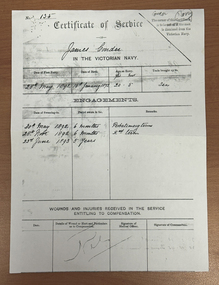
Certificate - Photocopy, Certificate of Service, James Condor, Navy, 1904 - 1959
... recruits. He later served on ‘HMS Challenger’ and ‘HMS Psyche’ which included voyages to Fiji, the New Hebrides, Singapore and New Zealand as well as regular cruises to Australian ports. In 1909, CONDER left the Navy and undertook shored-based civilian work until 1913 when he joined the Royal Australian Naval College at Osborne House in Geelong. He remained with the Naval College until 1937 through its moves to Jervis Bay, NSW and then to Crib Point, Victoria training midshipmen according to the practices of the Royal Navy. In later life...recruits. He later served on ‘HMS Challenger’ and ‘HMS Psyche’ which included voyages to Fiji, the New Hebrides, Singapore and New Zealand as well as regular cruises to Australian ports. In 1909, CONDER left the Navy and undertook shored-based civilian work until 1913 when he joined the Royal Australian Naval College at Osborne House in Geelong. He remained with the Naval College until 1937 through its moves to Jervis Bay, NSW and then to Crib Point, Victoria training midshipmen according to the practices of the Royal Navy. In later life ...James Bryance CONDER (aka James Brycanne CONDER) Artist, poet and four-navy veteran, 1872 - 1954. In 1889 he served in the Merchant Marine Service sailing on the ships ‘Ellora’ and ‘Avenger’. in 1891, aged 19, he joined the Royal Navy in Australia serving on the flagship of the Australian Station, ‘HMS Orlando’, when it escorted ships of the new Australasian Auxiliary Squadron in coastal voyages. After serving 6 months he returned to family in Melbourne rather than sign on for 12 years. Instead he joined the Victorian Colonial Navy and was posted, in succession, to the ‘HMVS Cerberus’, ‘HMVS Nelson’ and the gunboat ‘HMVS Albert’. In 1896 he left the navy, married Victoria Agnes NIHILL and joined the Victorian Police Force. In 1904 CONDOR returned to the sea as part of the Commonwealth Naval Forces, an amalgamation of the colonial navies formed after federation and later becoming the Royal Australian Navy. On his first ship, ‘HMS Katoomba’, as bosun yeoman, he helped train new recruits. He later served on ‘HMS Challenger’ and ‘HMS Psyche’ which included voyages to Fiji, the New Hebrides, Singapore and New Zealand as well as regular cruises to Australian ports. In 1909, CONDER left the Navy and undertook shored-based civilian work until 1913 when he joined the Royal Australian Naval College at Osborne House in Geelong. He remained with the Naval College until 1937 through its moves to Jervis Bay, NSW and then to Crib Point, Victoria training midshipmen according to the practices of the Royal Navy. In later life, CONDER produced two handwritten journals for his family illustrated with his own paintings and drawings. Two original sets were made. One remains in the family while the other is held by the Australian National Maritime Museum in Sydney. PMHPS hold several items relating to James CONDER including photocopies of his journals ‘Notes from a Sailors Log - Under Canvas - Part I The Merchant Service’ (Cat No 2700.01) and ‘Notes from a Sailors Log - Under Steam - Part II The Navy’ (Cat No 2700.02), a photocopy of his Certificate of Service (Cat No 2700.03), a booklet of his life story (Cat No 2700.04) and several digital items (Cat No 2476.01 - 2476.09). Photocopy of James CONDER's Certificate of Servicearmed services - navy, transport - shipping, james bryance conder, ran - royal australian navy, royal naval squadron, victorian colonial navy, merchant navy, victoria police, police -
 Port Melbourne Historical & Preservation Society
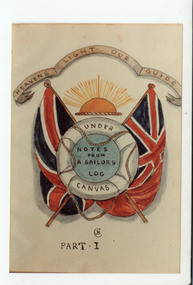
Photograph - Title page drawing from James Conder Journal Part I
... recruits. He later served on ‘HMS Challenger’ and ‘HMS Psyche’ which included voyages to Fiji, the New Hebrides, Singapore and New Zealand as well as regular cruises to Australian ports. In 1909, CONDER left the Navy and undertook shored-based civilian work until 1913 when he joined the Royal Australian Naval College at Osborne House in Geelong. He remained with the Naval College until 1937 through its moves to Jervis Bay, NSW and then to Crib Point, Victoria training midshipmen according to the practices of the Royal Navy. In later life...recruits. He later served on ‘HMS Challenger’ and ‘HMS Psyche’ which included voyages to Fiji, the New Hebrides, Singapore and New Zealand as well as regular cruises to Australian ports. In 1909, CONDER left the Navy and undertook shored-based civilian work until 1913 when he joined the Royal Australian Naval College at Osborne House in Geelong. He remained with the Naval College until 1937 through its moves to Jervis Bay, NSW and then to Crib Point, Victoria training midshipmen according to the practices of the Royal Navy. In later life ...James Bryance CONDER (aka James Brycanne CONDER) Artist, poet and four-navy veteran, 1872 - 1954. In 1889 he served in the Merchant Marine Service sailing on the ships ‘Ellora’ and ‘Avenger’. in 1891, aged 19, he joined the Royal Navy in Australia serving on the flagship of the Australian Station, ‘HMS Orlando’, when it escorted ships of the new Australasian Auxiliary Squadron in coastal voyages. After serving 6 months he returned to family in Melbourne rather than sign on for 12 years. Instead he joined the Victorian Colonial Navy and was posted, in succession, to the ‘HMVS Cerberus’, ‘HMVS Nelson’ and the gunboat ‘HMVS Albert’. In 1896 he left the navy, married Victoria Agnes NIHILL and joined the Victorian Police Force. In 1904 CONDOR returned to the sea as part of the Commonwealth Naval Forces, an amalgamation of the colonial navies formed after federation and later becoming the Royal Australian Navy. On his first ship, ‘HMS Katoomba’, as bosun yeoman, he helped train new recruits. He later served on ‘HMS Challenger’ and ‘HMS Psyche’ which included voyages to Fiji, the New Hebrides, Singapore and New Zealand as well as regular cruises to Australian ports. In 1909, CONDER left the Navy and undertook shored-based civilian work until 1913 when he joined the Royal Australian Naval College at Osborne House in Geelong. He remained with the Naval College until 1937 through its moves to Jervis Bay, NSW and then to Crib Point, Victoria training midshipmen according to the practices of the Royal Navy. In later life, CONDER produced two handwritten journals for his family illustrated with his own paintings and drawings. Two original sets were made. One remains in the family while the other is held by the Australian National Maritime Museum in Sydney. PMHPS hold several items relating to James CONDER including photocopies of his journals ‘Notes from a Sailors Log - Under Canvas - Part I The Merchant Service’ (Cat No 2700.01) and ‘Notes from a Sailors Log - Under Steam - Part II The Navy’ (Cat No 2700.02), a photocopy of his Certificate of Service (Cat No 2700.03), a booklet of his life story (Cat No 2700.04) and several digital items (Cat No 2476.01 - 2476.09).Colour digital photograph of the title page handdrawn by James GONDER from ‘Notes from a Sailors Log - Under Canvas - Part I The Merchant Service’ (Cat No 2700.01).armed services - navy, transport - shipping, james bryance conder, ran - royal australian navy, victorian colonial navy, royal australian naval college, merchant navy, royal naval squadron -
 Port Melbourne Historical & Preservation Society
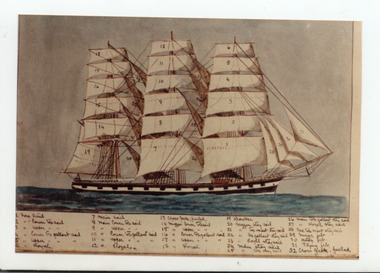
Photograph - Sailing ship showing sail configuration
... recruits. He later served on ‘HMS Challenger’ and ‘HMS Psyche’ which included voyages to Fiji, the New Hebrides, Singapore and New Zealand as well as regular cruises to Australian ports. In 1909, CONDER left the Navy and undertook shored-based civilian work until 1913 when he joined the Royal Australian Naval College at Osborne House in Geelong. He remained with the Naval College until 1937 through its moves to Jervis Bay, NSW and then to Crib Point, Victoria training midshipmen according to the practices of the Royal Navy. In later life...recruits. He later served on ‘HMS Challenger’ and ‘HMS Psyche’ which included voyages to Fiji, the New Hebrides, Singapore and New Zealand as well as regular cruises to Australian ports. In 1909, CONDER left the Navy and undertook shored-based civilian work until 1913 when he joined the Royal Australian Naval College at Osborne House in Geelong. He remained with the Naval College until 1937 through its moves to Jervis Bay, NSW and then to Crib Point, Victoria training midshipmen according to the practices of the Royal Navy. In later life ...James Bryance CONDER (aka James Brycanne CONDER) Artist, poet and four-navy veteran, 1872 - 1954. In 1889 he served in the Merchant Marine Service sailing on the ships ‘Ellora’ and ‘Avenger’. in 1891, aged 19, he joined the Royal Navy in Australia serving on the flagship of the Australian Station, ‘HMS Orlando’, when it escorted ships of the new Australasian Auxiliary Squadron in coastal voyages. After serving 6 months he returned to family in Melbourne rather than sign on for 12 years. Instead he joined the Victorian Colonial Navy and was posted, in succession, to the ‘HMVS Cerberus’, ‘HMVS Nelson’ and the gunboat ‘HMVS Albert’. In 1896 he left the navy, married Victoria Agnes NIHILL and joined the Victorian Police Force. In 1904 CONDOR returned to the sea as part of the Commonwealth Naval Forces, an amalgamation of the colonial navies formed after federation and later becoming the Royal Australian Navy. On his first ship, ‘HMS Katoomba’, as bosun yeoman, he helped train new recruits. He later served on ‘HMS Challenger’ and ‘HMS Psyche’ which included voyages to Fiji, the New Hebrides, Singapore and New Zealand as well as regular cruises to Australian ports. In 1909, CONDER left the Navy and undertook shored-based civilian work until 1913 when he joined the Royal Australian Naval College at Osborne House in Geelong. He remained with the Naval College until 1937 through its moves to Jervis Bay, NSW and then to Crib Point, Victoria training midshipmen according to the practices of the Royal Navy. In later life, CONDER produced two handwritten journals for his family illustrated with his own paintings and drawings. Two original sets were made. One remains in the family while the other is held by the Australian National Maritime Museum in Sydney. PMHPS hold several items relating to James CONDER including photocopies of his journals ‘Notes from a Sailors Log - Under Canvas - Part I The Merchant Service’ (Cat No 2700.01) and ‘Notes from a Sailors Log - Under Steam - Part II The Navy’ (Cat No 2700.02), a photocopy of his Certificate of Service (Cat No 2700.03), a booklet of his life story (Cat No 2700.04) and several digital items (Cat No 2476.01 - 2476.09).Colour digital photograph of a drawing by James CONDER showing the sail configuration for a sailing ship.armed services - navy, transport - shipping, james bryance conder, ran - royal australian navy, victorian colonial navy, royal australian naval college, merchant navy, royal naval squadron -
 Port Melbourne Historical & Preservation Society
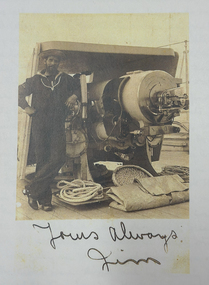
Photograph - James CONDER in uniform, c. 1905
... recruits. He later served on ‘HMS Challenger’ and ‘HMS Psyche’ which included voyages to Fiji, the New Hebrides, Singapore and New Zealand as well as regular cruises to Australian ports. In 1909, CONDER left the Navy and undertook shored-based civilian work until 1913 when he joined the Royal Australian Naval College at Osborne House in Geelong. He remained with the Naval College until 1937 through its moves to Jervis Bay, NSW and then to Crib Point, Victoria training midshipmen according to the practices of the Royal Navy. In later life...recruits. He later served on ‘HMS Challenger’ and ‘HMS Psyche’ which included voyages to Fiji, the New Hebrides, Singapore and New Zealand as well as regular cruises to Australian ports. In 1909, CONDER left the Navy and undertook shored-based civilian work until 1913 when he joined the Royal Australian Naval College at Osborne House in Geelong. He remained with the Naval College until 1937 through its moves to Jervis Bay, NSW and then to Crib Point, Victoria training midshipmen according to the practices of the Royal Navy. In later life ...James Bryance CONDER (aka James Brycanne CONDER) Artist, poet and four-navy veteran, 1872 - 1954. In 1889 he served in the Merchant Marine Service sailing on the ships ‘Ellora’ and ‘Avenger’. in 1891, aged 19, he joined the Royal Navy in Australia serving on the flagship of the Australian Station, ‘HMS Orlando’, when it escorted ships of the new Australasian Auxiliary Squadron in coastal voyages. After serving 6 months he returned to family in Melbourne rather than sign on for 12 years. Instead he joined the Victorian Colonial Navy and was posted, in succession, to the ‘HMVS Cerberus’, ‘HMVS Nelson’ and the gunboat ‘HMVS Albert’. In 1896 he left the navy, married Victoria Agnes NIHILL and joined the Victorian Police Force. In 1904 CONDOR returned to the sea as part of the Commonwealth Naval Forces, an amalgamation of the colonial navies formed after federation and later becoming the Royal Australian Navy. On his first ship, ‘HMS Katoomba’, as bosun yeoman, he helped train new recruits. He later served on ‘HMS Challenger’ and ‘HMS Psyche’ which included voyages to Fiji, the New Hebrides, Singapore and New Zealand as well as regular cruises to Australian ports. In 1909, CONDER left the Navy and undertook shored-based civilian work until 1913 when he joined the Royal Australian Naval College at Osborne House in Geelong. He remained with the Naval College until 1937 through its moves to Jervis Bay, NSW and then to Crib Point, Victoria training midshipmen according to the practices of the Royal Navy. In later life, CONDER produced two handwritten journals for his family illustrated with his own paintings and drawings. Two original sets were made. One remains in the family while the other is held by the Australian National Maritime Museum in Sydney. PMHPS hold several items relating to James CONDER including photocopies of his journals ‘Notes from a Sailors Log - Under Canvas - Part I The Merchant Service’ (Cat No 2700.01) and ‘Notes from a Sailors Log - Under Steam - Part II The Navy’ (Cat No 2700.02), a photocopy of his Certificate of Service (Cat No 2700.03), a booklet of his life story (Cat No 2700.04) and several digital items (Cat No 2476.01 - 2476.09).Sepia digital photograph of James CONDER in uniform, sent to family with greeting 'Yours Always, Jim'. This photo is included in the early pages of CONDER's journal ‘Notes from a Sailors Log - Under Steam - Part II The Navy’ (Cat No 2700.02)."Yours always / Jim"armed services - navy, transport - shipping, james bryance conder, ran - royal australian navy, victorian colonial navy -
 Port Melbourne Historical & Preservation Society
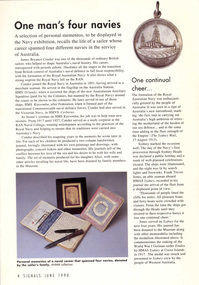
Magazine - Article, One Man's Four Navies
... recruits. He later served on ‘HMS Challenger’ and ‘HMS Psyche’ which included voyages to Fiji, the New Hebrides, Singapore and New Zealand as well as regular cruises to Australian ports. In 1909, CONDER left the Navy and undertook shored-based civilian work until 1913 when he joined the Royal Australian Naval College at Osborne House in Geelong. He remained with the Naval College until 1937 through its moves to Jervis Bay, NSW and then to Crib Point, Victoria training midshipmen according to the practices of the Royal Navy. In later life...recruits. He later served on ‘HMS Challenger’ and ‘HMS Psyche’ which included voyages to Fiji, the New Hebrides, Singapore and New Zealand as well as regular cruises to Australian ports. In 1909, CONDER left the Navy and undertook shored-based civilian work until 1913 when he joined the Royal Australian Naval College at Osborne House in Geelong. He remained with the Naval College until 1937 through its moves to Jervis Bay, NSW and then to Crib Point, Victoria training midshipmen according to the practices of the Royal Navy. In later life ...James Bryance CONDER (aka James Brycanne CONDER) Artist, poet and four-navy veteran, 1872 - 1954. In 1889 he served in the Merchant Marine Service sailing on the ships ‘Ellora’ and ‘Avenger’. in 1891, aged 19, he joined the Royal Navy in Australia serving on the flagship of the Australian Station, ‘HMS Orlando’, when it escorted ships of the new Australasian Auxiliary Squadron in coastal voyages. After serving 6 months he returned to family in Melbourne rather than sign on for 12 years. Instead he joined the Victorian Colonial Navy and was posted, in succession, to the ‘HMVS Cerberus’, ‘HMVS Nelson’ and the gunboat ‘HMVS Albert’. In 1896 he left the navy, married Victoria Agnes NIHILL and joined the Victorian Police Force. In 1904 CONDOR returned to the sea as part of the Commonwealth Naval Forces, an amalgamation of the colonial navies formed after federation and later becoming the Royal Australian Navy. On his first ship, ‘HMS Katoomba’, as bosun yeoman, he helped train new recruits. He later served on ‘HMS Challenger’ and ‘HMS Psyche’ which included voyages to Fiji, the New Hebrides, Singapore and New Zealand as well as regular cruises to Australian ports. In 1909, CONDER left the Navy and undertook shored-based civilian work until 1913 when he joined the Royal Australian Naval College at Osborne House in Geelong. He remained with the Naval College until 1937 through its moves to Jervis Bay, NSW and then to Crib Point, Victoria training midshipmen according to the practices of the Royal Navy. In later life, CONDER produced two handwritten journals for his family illustrated with his own paintings and drawings. Two original sets were made. One remains in the family while the other is held by the Australian National Maritime Museum in Sydney. PMHPS hold several items relating to James CONDER including photocopies of his journals ‘Notes from a Sailors Log - Under Canvas - Part I The Merchant Service’ (Cat No 2700.01) and ‘Notes from a Sailors Log - Under Steam - Part II The Navy’ (Cat No 2700.02), a photocopy of his Certificate of Service (Cat No 2700.03), a booklet of his life story (Cat No 2700.04) and several digital items (Cat No 2476.01 - 2476.09).Article, 'One Man's Four Navies', about James CONDER from National Maritime Museum's 'Signals' magazine, Issue 12, 1 June 1990. armed services - navy, transport - shipping, james bryance conder, ran - royal australian navy, royal naval squadron, victorian colonial navy -
 Port Melbourne Historical & Preservation Society
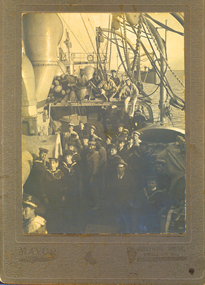
Photograph - Crew of the Katoomba, 1904
... recruits. He later served on ‘HMS Challenger’ and ‘HMS Psyche’ which included voyages to Fiji, the New Hebrides, Singapore and New Zealand as well as regular cruises to Australian ports. In 1909, CONDER left the Navy and undertook shored-based civilian work until 1913 when he joined the Royal Australian Naval College at Osborne House in Geelong. He remained with the Naval College until 1937 through its moves to Jervis Bay, NSW and then to Crib Point, Victoria training midshipmen according to the practices of the Royal Navy. In later life...recruits. He later served on ‘HMS Challenger’ and ‘HMS Psyche’ which included voyages to Fiji, the New Hebrides, Singapore and New Zealand as well as regular cruises to Australian ports. In 1909, CONDER left the Navy and undertook shored-based civilian work until 1913 when he joined the Royal Australian Naval College at Osborne House in Geelong. He remained with the Naval College until 1937 through its moves to Jervis Bay, NSW and then to Crib Point, Victoria training midshipmen according to the practices of the Royal Navy. In later life ...James Bryance CONDER (aka James Brycanne CONDER) Artist, poet and four-navy veteran, 1872 - 1954. In 1889 he served in the Merchant Marine Service sailing on the ships ‘Ellora’ and ‘Avenger’. in 1891, aged 19, he joined the Royal Navy in Australia serving on the flagship of the Australian Station, ‘HMS Orlando’, when it escorted ships of the new Australasian Auxiliary Squadron in coastal voyages. After serving 6 months he returned to family in Melbourne rather than sign on for 12 years. Instead he joined the Victorian Colonial Navy and was posted, in succession, to the ‘HMVS Cerberus’, ‘HMVS Nelson’ and the gunboat ‘HMVS Albert’. In 1896 he left the navy, married Victoria Agnes NIHILL and joined the Victorian Police Force. In 1904 CONDOR returned to the sea as part of the Commonwealth Naval Forces, an amalgamation of the colonial navies formed after federation and later becoming the Royal Australian Navy. On his first ship, ‘HMS Katoomba’, as bosun yeoman, he helped train new recruits. He later served on ‘HMS Challenger’ and ‘HMS Psyche’ which included voyages to Fiji, the New Hebrides, Singapore and New Zealand as well as regular cruises to Australian ports. In 1909, CONDER left the Navy and undertook shored-based civilian work until 1913 when he joined the Royal Australian Naval College at Osborne House in Geelong. He remained with the Naval College until 1937 through its moves to Jervis Bay, NSW and then to Crib Point, Victoria training midshipmen according to the practices of the Royal Navy. In later life, CONDER produced two handwritten journals for his family illustrated with his own paintings and drawings. Two original sets were made. One remains in the family while the other is held by the Australian National Maritime Museum in Sydney. PMHPS hold several items relating to James CONDER including photocopies of his journals ‘Notes from a Sailors Log - Under Canvas - Part I The Merchant Service’ (Cat No 2700.01) and ‘Notes from a Sailors Log - Under Steam - Part II The Navy’ (Cat No 2700.02), a photocopy of his Certificate of Service (Cat No 2700.03), a booklet of his life story (Cat No 2700.04) and several digital items (Cat No 2476.01 - 2476.09). Digital copy of b&w photograph of the crew of the 'Katoomba'armed services - navy, hms katoomba, james bryance conder, ran - royal australian navy -
 Port Melbourne Historical & Preservation Society
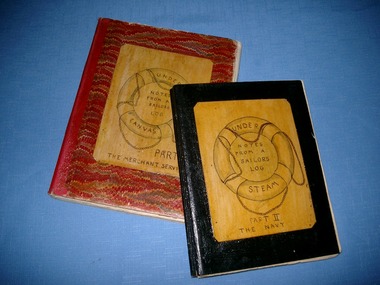
Photograph - James CONDER's journals, Glen Stuart, Aug 2008
... recruits. He later served on ‘HMS Challenger’ and ‘HMS Psyche’ which included voyages to Fiji, the New Hebrides, Singapore and New Zealand as well as regular cruises to Australian ports. In 1909, CONDER left the Navy and undertook shored-based civilian work until 1913 when he joined the Royal Australian Naval College at Osborne House in Geelong. He remained with the Naval College until 1937 through its moves to Jervis Bay, NSW and then to Crib Point, Victoria training midshipmen according to the practices of the Royal Navy. In later life...recruits. He later served on ‘HMS Challenger’ and ‘HMS Psyche’ which included voyages to Fiji, the New Hebrides, Singapore and New Zealand as well as regular cruises to Australian ports. In 1909, CONDER left the Navy and undertook shored-based civilian work until 1913 when he joined the Royal Australian Naval College at Osborne House in Geelong. He remained with the Naval College until 1937 through its moves to Jervis Bay, NSW and then to Crib Point, Victoria training midshipmen according to the practices of the Royal Navy. In later life ...James Bryance CONDER (aka James Brycanne CONDER) Artist, poet and four-navy veteran, 1872 - 1954. In 1889 he served in the Merchant Marine Service sailing on the ships ‘Ellora’ and ‘Avenger’. in 1891, aged 19, he joined the Royal Navy in Australia serving on the flagship of the Australian Station, ‘HMS Orlando’, when it escorted ships of the new Australasian Auxiliary Squadron in coastal voyages. After serving 6 months he returned to family in Melbourne rather than sign on for 12 years. Instead he joined the Victorian Colonial Navy and was posted, in succession, to the ‘HMVS Cerberus’, ‘HMVS Nelson’ and the gunboat ‘HMVS Albert’. In 1896 he left the navy, married Victoria Agnes NIHILL and joined the Victorian Police Force. In 1904 CONDOR returned to the sea as part of the Commonwealth Naval Forces, an amalgamation of the colonial navies formed after federation and later becoming the Royal Australian Navy. On his first ship, ‘HMS Katoomba’, as bosun yeoman, he helped train new recruits. He later served on ‘HMS Challenger’ and ‘HMS Psyche’ which included voyages to Fiji, the New Hebrides, Singapore and New Zealand as well as regular cruises to Australian ports. In 1909, CONDER left the Navy and undertook shored-based civilian work until 1913 when he joined the Royal Australian Naval College at Osborne House in Geelong. He remained with the Naval College until 1937 through its moves to Jervis Bay, NSW and then to Crib Point, Victoria training midshipmen according to the practices of the Royal Navy. In later life, CONDER produced two handwritten journals for his family illustrated with his own paintings and drawings. Two original sets were made. One remains in the family while the other is held by the Australian National Maritime Museum in Sydney. PMHPS hold several items relating to James CONDER including photocopies of his journals ‘Notes from a Sailors Log - Under Canvas - Part I The Merchant Service’ (Cat No 2700.01) and ‘Notes from a Sailors Log - Under Steam - Part II The Navy’ (Cat No 2700.02), a photocopy of his Certificate of Service (Cat No 2700.03), a booklet of his life story (Cat No 2700.04) and several digital items (Cat No 2476.01 - 2476.09).Colour digital photograph of of of the original two sets of James CONDER's handwritten and illustrated journals made for his family, '‘Notes from a Sailors Log - Under Canvas - Part I The Merchant Service’ (Cat No 2700.01) and ‘Notes from a Sailors Log - Under Steam - Part II The Navy’ (Cat No 2700.02). Displayed in 'Navy in Port' exhibition Aug/Sept 2008armed services - navy, transport - shipping, james bryance conder, merchant navy, royal naval squadron, victorian colonial navy, ran - royal australian navy -
 Port Melbourne Historical & Preservation Society
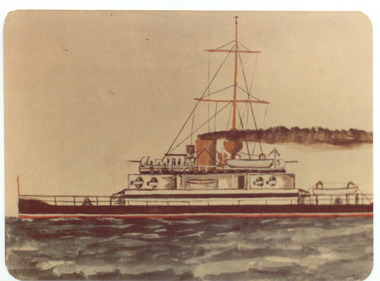
Photograph - HMVS Cerberus by James CONDER
... recruits. He later served on ‘HMS Challenger’ and ‘HMS Psyche’ which included voyages to Fiji, the New Hebrides, Singapore and New Zealand as well as regular cruises to Australian ports. In 1909, CONDER left the Navy and undertook shored-based civilian work until 1913 when he joined the Royal Australian Naval College at Osborne House in Geelong. He remained with the Naval College until 1937 through its moves to Jervis Bay, NSW and then to Crib Point, Victoria training midshipmen according to the practices of the Royal Navy. In later life...recruits. He later served on ‘HMS Challenger’ and ‘HMS Psyche’ which included voyages to Fiji, the New Hebrides, Singapore and New Zealand as well as regular cruises to Australian ports. In 1909, CONDER left the Navy and undertook shored-based civilian work until 1913 when he joined the Royal Australian Naval College at Osborne House in Geelong. He remained with the Naval College until 1937 through its moves to Jervis Bay, NSW and then to Crib Point, Victoria training midshipmen according to the practices of the Royal Navy. In later life ...James Bryance CONDER (aka James Brycanne CONDER) Artist, poet and four-navy veteran, 1872 - 1954. In 1889 he served in the Merchant Marine Service sailing on the ships ‘Ellora’ and ‘Avenger’. in 1891, aged 19, he joined the Royal Navy in Australia serving on the flagship of the Australian Station, ‘HMS Orlando’, when it escorted ships of the new Australasian Auxiliary Squadron in coastal voyages. After serving 6 months he returned to family in Melbourne rather than sign on for 12 years. Instead he joined the Victorian Colonial Navy and was posted, in succession, to the ‘HMVS Cerberus’, ‘HMVS Nelson’ and the gunboat ‘HMVS Albert’. In 1896 he left the navy, married Victoria Agnes NIHILL and joined the Victorian Police Force. In 1904 CONDOR returned to the sea as part of the Commonwealth Naval Forces, an amalgamation of the colonial navies formed after federation and later becoming the Royal Australian Navy. On his first ship, ‘HMS Katoomba’, as bosun yeoman, he helped train new recruits. He later served on ‘HMS Challenger’ and ‘HMS Psyche’ which included voyages to Fiji, the New Hebrides, Singapore and New Zealand as well as regular cruises to Australian ports. In 1909, CONDER left the Navy and undertook shored-based civilian work until 1913 when he joined the Royal Australian Naval College at Osborne House in Geelong. He remained with the Naval College until 1937 through its moves to Jervis Bay, NSW and then to Crib Point, Victoria training midshipmen according to the practices of the Royal Navy. In later life, CONDER produced two handwritten journals for his family illustrated with his own paintings and drawings. Two original sets were made. One remains in the family while the other is held by the Australian National Maritime Museum in Sydney. PMHPS hold several items relating to James CONDER including photocopies of his journals ‘Notes from a Sailors Log - Under Canvas - Part I The Merchant Service’ (Cat No 2700.01) and ‘Notes from a Sailors Log - Under Steam - Part II The Navy’ (Cat No 2700.02), a photocopy of his Certificate of Service (Cat No 2700.03), a booklet of his life story (Cat No 2700.04) and several digital items (Cat No 2476.01 - 2476.09).Colour digital photograph of a drawing of HMVS Cerberus by James CONDER.armed services - navy, transport - shipping, james bryance conder, ran - royal australian navy, victorian colonial navy, royal australian naval college, merchant navy, hmvs cerberus, royal naval squadron -
 Port Melbourne Historical & Preservation Society
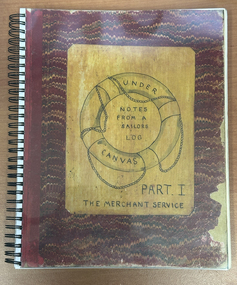
Document - James CONDER Journal, James Brycanne Conder, NOTES FROM A SAILORS LOG - UNDER CANVAS - PART I THE MERCHANT SERVICE
... recruits. He later served on ‘HMS Challenger’ and ‘HMS Psyche’ which included voyages to Fiji, the New Hebrides, Singapore and New Zealand as well as regular cruises to Australian ports. In 1909, CONDER left the Navy and undertook shored-based civilian work until 1913 when he joined the Royal Australian Naval College at Osborne House in Geelong. He remained with the Naval College until 1937 through its moves to Jervis Bay, NSW and then to Crib Point, Victoria training midshipmen according to the practices of the Royal Navy. In later life...recruits. He later served on ‘HMS Challenger’ and ‘HMS Psyche’ which included voyages to Fiji, the New Hebrides, Singapore and New Zealand as well as regular cruises to Australian ports. In 1909, CONDER left the Navy and undertook shored-based civilian work until 1913 when he joined the Royal Australian Naval College at Osborne House in Geelong. He remained with the Naval College until 1937 through its moves to Jervis Bay, NSW and then to Crib Point, Victoria training midshipmen according to the practices of the Royal Navy. In later life ...James Bryance CONDER (aka James Brycanne CONDER) Artist, poet and four-navy veteran, 1872 - 1954. In 1889 he served in the Merchant Marine Service sailing on the ships ‘Ellora’ and ‘Avenger’. in 1891, aged 19, he joined the Royal Navy in Australia serving on the flagship of the Australian Station, ‘HMS Orlando’, when it escorted ships of the new Australasian Auxiliary Squadron in coastal voyages. After serving 6 months he returned to family in Melbourne rather than sign on for 12 years. Instead he joined the Victorian Colonial Navy and was posted, in succession, to the ‘HMVS Cerberus’, ‘HMVS Nelson’ and the gunboat ‘HMVS Albert’. In 1896 he left the navy, married Victoria Agnes NIHILL and joined the Victorian Police Force. In 1904 CONDOR returned to the sea as part of the Commonwealth Naval Forces, an amalgamation of the colonial navies formed after federation and later becoming the Royal Australian Navy. On his first ship, ‘HMS Katoomba’, as bosun yeoman, he helped train new recruits. He later served on ‘HMS Challenger’ and ‘HMS Psyche’ which included voyages to Fiji, the New Hebrides, Singapore and New Zealand as well as regular cruises to Australian ports. In 1909, CONDER left the Navy and undertook shored-based civilian work until 1913 when he joined the Royal Australian Naval College at Osborne House in Geelong. He remained with the Naval College until 1937 through its moves to Jervis Bay, NSW and then to Crib Point, Victoria training midshipmen according to the practices of the Royal Navy. In later life, CONDER produced two handwritten journals for his family illustrated with his own paintings and drawings. Two original sets were made. One remains in the family while the other is held by the Australian National Maritime Museum in Sydney. PMHPS hold several items relating to James CONDER including photocopies of his journals ‘Notes from a Sailors Log - Under Canvas - Part I The Merchant Service’ (Cat No 2700.01) and ‘Notes from a Sailors Log - Under Steam - Part II The Navy’ (Cat No 2700.02), a photocopy of his Certificate of Service (Cat No 2700.03), a booklet of his life story (Cat No 2700.04) and several digital items (Cat No 2476.01 - 2476.09).A spiral bound photocopy of a sailor's log; dark red marbled covers; front cover has tan inset with title in and around a sketch of a lifebuoy. Under Canvas - Part I The Merchant Service. See Under Steam - Part II The Navy (Cat No 2700.02)transport - shipping, james bryance conder, merchant navy -
 Western Bulldogs
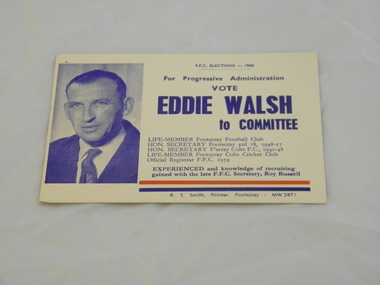
Election card, R. S. Smith, 1960
... Secretary F'scray Colts F.C., 1940-48/Life-Member Footscray Colts Cricket Club/Official Registrar F.F.C. 1959/Experienced and knowledge of recruiting gained with the late F.F.C. ...Secretary F'scray Colts F.C., 1940-48/Life-Member Footscray Colts Cricket Club/Official Registrar F.F.C. 1959/Experienced and knowledge of recruiting gained with the late F.F.C. ...An election card for Eddie Walsh, used in the Footscray Football Club committee elections of 1960. The card outlines his credentials, including his associations with the senior and junior football club and the Footscray Colts Cricket Club. The card refers to Roy Russell, the late Secretary of the Footscray Football Club. See Supplementary Information for related information on the election campaign in the Footscray Advertiser.This item of ephemera is highly significant as only two copies of this election card are known to exist.A single-sided election card with blue text and image of Eddie Walsh'F.F.C Elections - 1960/For Progressive Administration Vote Eddie Walsh to Committee/Life Member Footscray Football Club/Hon. Secretary Footscray 3rd 18, 1948-57/Hon. Secretary F'scray Colts F.C., 1940-48/Life-Member Footscray Colts Cricket Club/Official Registrar F.F.C. 1959/Experienced and knowledge of recruiting gained with the late F.F.C. Secretary, Roy Russell/R. S. Smith, Printer, Footscray - MW 2871.'footscray football club, election, 1960 -
 Vision Australia
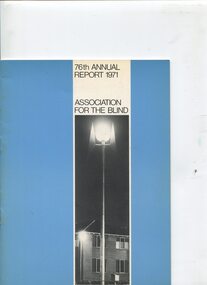
Administrative record - Text, 76th Annual Report 1971 Association for the Blind of Victoria, 1972
... life governors, building of Katharine Rose wing at Bendigo, donation by G.W. Vowell of a 20 acre farm at Mt Eliza, new auxiliaries formed at Brighton, Kooyong, Bendigo and Mt Eliza with Guiding Light Group comprised of solely men, thanks to Flora Douglas for use of her home at Frankston and Audrey Moffat accepting responsibility for volunteer recruitment, and John Watson, a resident of Elanora, turned 100. ...life governors, building of Katharine Rose wing at Bendigo, donation by G.W. Vowell of a 20 acre farm at Mt Eliza, new auxiliaries formed at Brighton, Kooyong, Bendigo and Mt Eliza with Guiding Light Group comprised of solely men, thanks to Flora Douglas for use of her home at Frankston and Audrey Moffat accepting responsibility for volunteer recruitment, and John Watson, a resident of Elanora, turned 100. ...Articles in annual report include: branch committees, President's report, finance report, balance sheet, auxiliaries, volunteer service groups, in answer to your questions, senior staff, life governors, building of Katharine Rose wing at Bendigo, donation by G.W. Vowell of a 20 acre farm at Mt Eliza, new auxiliaries formed at Brighton, Kooyong, Bendigo and Mt Eliza with Guiding Light Group comprised of solely men, thanks to Flora Douglas for use of her home at Frankston and Audrey Moffat accepting responsibility for volunteer recruitment, and John Watson, a resident of Elanora, turned 100. 1 volume of text, photographs and illustrationsassociation for the blind, john watson, sir rohan delacombe, h.m. lightfoot, mirridong home (bendigo), kelaston home (ballarat), elanora home (brighton), annual reports -
 Geelong Football Club
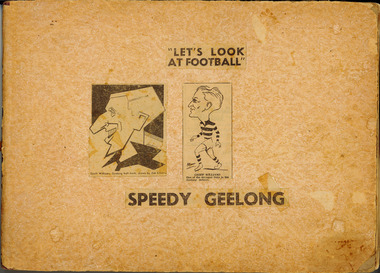
Geoff Williams Scrapbook
... Total Brownlow Medal votes: 22 Premiership team selection: 1952 Club Best & Fairest: 1952, 1955 GFC Hall of Fame inductee (2002) GFC Life Membership (1959) Career span: 1952-59 Total matches: Premiership 121, Night/Pre-Season Series 4 Total goals: Premiership 1, Night/Pre-Season Series 0 Finals matches: 9 Finals goals: 0 Last senior match: Round 5, 1959 v Essendon at Windy Hill Information provided by Mr Col Hutchinson GFC Historian geoff williams half back premiership player geelong cats Scrapbook detailing the recruitment and career of Geelong Champion Geoff Williams. 54 pages in total Geoff Williams Scrapbook ...Loaned to the Geelong Football Club by Mr Geoff Williams for the purposes of digitisation. Geoff Williams Born: 18/11/1930 From: East Geelong via Warragul Height: 183cm Weight: 83kg Natural kicking foot: Right Guernsey number: 21 First senior match: Round 1, 1952 v Melbourne at the MCG The fast mover quickly established himself as a top half-back flanker. His ball-winning skill, judgment and ability to concentrate were obvious. He always played the game fairly but strongly, and no player tried harder to perform well. His kicking wasn’t stylish but generally it was effective. He liked to knock the ball clear of opponents and shoot after it at great speed. He won the club Best and Fairest award in his first season – an outstanding achievement in a Premiership year. Total Brownlow Medal votes: 22 Premiership team selection: 1952 Club Best & Fairest: 1952, 1955 GFC Hall of Fame inductee (2002) GFC Life Membership (1959) Career span: 1952-59 Total matches: Premiership 121, Night/Pre-Season Series 4 Total goals: Premiership 1, Night/Pre-Season Series 0 Finals matches: 9 Finals goals: 0 Last senior match: Round 5, 1959 v Essendon at Windy Hill Information provided by Mr Col Hutchinson GFC Historian Scrapbook detailing the recruitment and career of Geelong Champion Geoff Williams. 54 pages in totalgeoff williams, half back, premiership player, geelong cats -
 Kew Historical Society Inc
Journal, Kewriosity : August 1990
... Urban women have a taste for country life [Kew/Balwyn Country Women's Association CWA] / p3. Your community bus needs you / p3. Recruiting ...Council assistance available to maintain homes / p1. Rates reminder / p1. No elections / p1. Dates for August / p2. Breast information session / p2. One act plays [Track Players] / p2. Strategies for success / p2. Rotary changeover [Kew Rotary Club] / p2. Kew's kindergartens to open doors / p3. Budget to take care of basics / p3. Urban women have a taste for country life [Kew/Balwyn Country Women's Association CWA] / p3. Your community bus needs you / p3. Recruiting drive [Meals on Wheels] / p3. Notices / p4. Major donation to St George's [Hospital] [Kew Rotary Club] / p4. Carey's new head / p4. Library corner / p4. Update on traffic / p4. Family day care / p5. Centenary celebrations for Kew East [Primary School] / p5. Courses, coffee and a chat [ Kew Community House] / p5. Govt amends Kew Planning Scheme [Willsmere] / p5. Backyard burning banned / p5. Kew Community House [courses] / p6. Clean up for Studley Park [Boroondara Bushwalkers] / p6. Council re-assesses proposal [skateboard bowl at Victoria Park] / p6. Meetings promote care giver act / p7. Council seeks community reps / p7. Kew Primary promotes its assets / p7. Recipe for success [Children's International Summer Villages] / p8. Special paper collection / p8. "Kew is for Living" [Kew Festival] / p8.Kewriosity was a local newsletter combining Kew Council and community news. It was published between November 1983 and June 1994, replacing an earlier Kewriosity [broad] Sheet (1979-84). In producing Kewriosity, Council aimed to provide a range of interesting and informative articles covering its deliberations and decision making, together with items of general interest and importance to the Kew community and information not generally available through daily media outlets.non-fictionCouncil assistance available to maintain homes / p1. Rates reminder / p1. No elections / p1. Dates for August / p2. Breast information session / p2. One act plays [Track Players] / p2. Strategies for success / p2. Rotary changeover [Kew Rotary Club] / p2. Kew's kindergartens to open doors / p3. Budget to take care of basics / p3. Urban women have a taste for country life [Kew/Balwyn Country Women's Association CWA] / p3. Your community bus needs you / p3. Recruiting drive [Meals on Wheels] / p3. Notices / p4. Major donation to St George's [Hospital] [Kew Rotary Club] / p4. Carey's new head / p4. Library corner / p4. Update on traffic / p4. Family day care / p5. Centenary celebrations for Kew East [Primary School] / p5. Courses, coffee and a chat [ Kew Community House] / p5. Govt amends Kew Planning Scheme [Willsmere] / p5. Backyard burning banned / p5. Kew Community House [courses] / p6. Clean up for Studley Park [Boroondara Bushwalkers] / p6. Council re-assesses proposal [skateboard bowl at Victoria Park] / p6. Meetings promote care giver act / p7. Council seeks community reps / p7. Kew Primary promotes its assets / p7. Recipe for success [Children's International Summer Villages] / p8. Special paper collection / p8. "Kew is for Living" [Kew Festival] / p8. publications -- city of kew (vic.), kewriosity, council newsletters, community newsletters -
 Wodonga & District Historical Society Inc
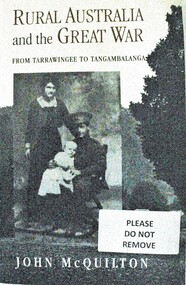
Book - Rural Australia and the Great War - From Tarrawingee to Tangambalanga, John McQuilton, 2001
... World War 1 Rural Conditions Australia 1914 World War 1 Social Conditions Australia Tangambalanga World War 1 This publication covers common issues of life in Australia during World War 1, such as recruitment, fundraising, conscription, homecomings and the construction of memorials. ...This publication covers common issues of life in Australia during World War 1, such as recruitment, fundraising, conscription, homecomings and the construction of memorials. However it is unique in that these aspects of war are examined through a focus on rural communities in North Eastern Victoria. The first chapter describes the region and its towns at the outbreak of war, then discusses the fracturing impact of war on different groups within these communities. It paints an interesting social history at a critical time in Australia's development. John Quilton is a native of North Eastern Victoria, having been born in Yackandandah and educated in Tangambalanga and Wodonga. He was a senior member of the Bicentennial History Project at the University of New South Wales, and head of the History and Politics Program at the University of Wollongong.This book consists of 275 pages including photos and a map, as well as an extensive bibliography. The cover depicts a soldier and his family and a country town streetscape on the back.This publication covers common issues of life in Australia during World War 1, such as recruitment, fundraising, conscription, homecomings and the construction of memorials. However it is unique in that these aspects of war are examined through a focus on rural communities in North Eastern Victoria. The first chapter describes the region and its towns at the outbreak of war, then discusses the fracturing impact of war on different groups within these communities. It paints an interesting social history at a critical time in Australia's development. John Quilton is a native of North Eastern Victoria, having been born in Yackandandah and educated in Tangambalanga and Wodonga. He was a senior member of the Bicentennial History Project at the University of New South Wales, and head of the History and Politics Program at the University of Wollongong.world war 1, rural conditions australia 1914, world war 1 social conditions australia, tangambalanga world war 1 -
 Melbourne Tram Museum
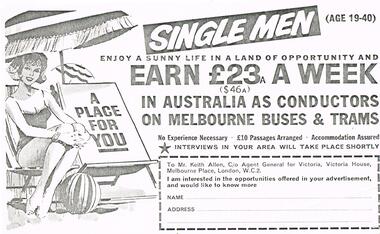
Newspaper, "Single Men - enjoy a sunny life in a land of opportunity and Earn L23 a week in Australia as Conductors on Melbourne Buses and Trams", mid 1960's
... life in a land of opportunity and Earn L23 a week in Australia as Conductors on Melbourne Buses and Trams". Has a lady sitting on a beach chair under an umbrella. Gives contact details for the Agent General in London at Victoria House. Not dated - mid 1960's - based on the $ figure provided as well. Demonstrates a MMTB advertisement for crews in UK papers; Trams tramways Recruitment ...Advertising for Single Men to come to Australia, titled "Single Men - enjoy a sunny life in a land of opportunity and Earn L23 a week in Australia as Conductors on Melbourne Buses and Trams". Has a lady sitting on a beach chair under an umbrella. Gives contact details for the Agent General in London at Victoria House. Not dated - mid 1960's - based on the $ figure provided as well.Demonstrates a MMTB advertisement for crews in UK papers;Photocopy of an advertisement that would have appeared in UK newspapers.trams, tramways, recruitment, conductors, advertisements, immigration -
 The Beechworth Burke Museum
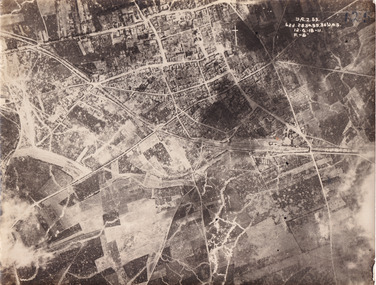
Photograph
... life and the greatest repatriation of casualties in the country's history. Australia’s involvement in the First World War began when the Australian government established the Australian Imperial Force (AIF) in August 1914. Immediately, men were recruited ...Taken some time between 1914-18, the photograph depicts an aerial view of Villers-Bretonneux in France, a region which was part of the Western Front during World War I. The image mostly shows rural landscape. The Western Front was the main theatre of war during World War I. Following the outbreak of war in August 1914, the German Army opened the Western Front by invading Luxembourg and Belgium, then gaining military control of important industrial regions in France. The German advance was halted with the Battle of the Marne. Following the Race to the Sea, both the French-British and German armies dug in along a meandering line of fortified trenches, stretching from the North Sea to the Swiss frontier with France. The First Battle of Villers-Bretonneux occurred between 30 March - 5 April 1918. It took place during Operation Michael, part of the German Spring Offensive on the Western Front. The offensive began against the British Fifth Army and the Third Army on the Somme, and pushed back the British and French reinforcements on the north side of the Somme. The capture of Villers-Bretonneux, close to Amiens, a strategically important road and rail-junction, would have brought the Germans within artillery-range. In late March, troops from the Australian Imperial Force were brought south from Belgium as reinforcements to help shore up the line. In early April, the Germans launched an attack to capture Villers-Bretonneux. After a determined defence by British and Australian troops, the attackers were close to success until a counter-attack by the 9th Australian Infantry Brigade and British troops late in the afternoon of 4 April restored the situation and halted the German advance on Amiens. The Second Battle of Villers-Bretonneux occurred between 24 - 27 April 1918, during the German Spring Offensive to the east of Amiens. It is notable for being the first occasion on which tanks fought against each other. A counter-attack by two Australian brigades and a British brigade during the night of 24 April partly surrounded Villers-Bretonneux, and on 25 April, the town was recaptured. On 26 April, the role of the Moroccan division of the French army was crucial in pushing back German units. Australian, British and French troops nearly restored the original front line by 27 April.The record is historically significant due to its connection to World War I. This conflict is integral to Australian culture as it was the single greatest loss of life and the greatest repatriation of casualties in the country's history. Australia’s involvement in the First World War began when the Australian government established the Australian Imperial Force (AIF) in August 1914. Immediately, men were recruited to serve the British Empire in the Middle East and on the Western Front. Additionally, the record's significance is enhanced by its depiction of Villers-Bretonneux. The battles that occurred in this town during World War I are especially historically significant to Australia as this is where the Australian Imperial Force had one their greatest World War I victories. An Australian flag still flies over Villers-Bretonneux in the present. Furthermore, a plaque outside the Villers-Bretonneux Town Hall recounts the battles fought to save the town in 1918. Kangaroos feature over the entrance to the Town Hall, and the main street is named Rue de Melbourne. More officially, recognition of the significance of the battle in Villers-Bretonneux is found at the Australian National Memorial, which was built just outside the town. It commemorates all Australians who fought in France and Belgium and includes the names of 10,772 who died in France and have no known grave. Each year, a small ceremony is held at the memorial to mark the sacrifice made by the soldiers. Lastly, the record has strong research potential. This is due to the ongoing public and scholarly interest in war, history, and especially the ANZAC legend, which is commemorated annually on 25 April, known as ANZAC Day.Sepia rectangular photograph printed on matte photographic paper.Obverse: yAE.2.35. / 125 / 62d.2834.35.36.VA.5. / 12.G.18-11 / F.-(?)" /military album, wwi, world war i, villers-bretonneux, australian imperial force, aif, france, war, army, conflict, germany, 1918, battle -
 The Beechworth Burke Museum
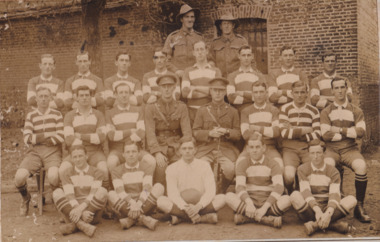
Photograph
... Recruiting Committee in Victoria attempted to shame young men into enlisting by juxtaposing the image of an Australian soldier standing guard over his deceased mate with a photograph of a Victorian Football League match. Another poster, produced in 1917, features vignettes of different sports including cricket, bowling, boxing, kayaking and golf. Its slogan reads, "Join Together - Train Together - Embark Together - Fight Together: Enlist in the Sportman's 1000". The record is historically significant due to its connection to World War I. This conflict is integral to Australian culture as it was the single greatest loss of life ...Taken some time between 1914-18, depicted is a large group of unidentified males. Four of them are dressed in Australian military uniforms. The remaining 19 men are dressed in striped uniforms. The male in the centre of the front row is cradling a football, suggesting that the group was part of a football or rugby league team. It is believed that the soldiers in this photograph were part of the Australian Imperial Force. This can be inferred by the chevron rank insignia visible on their uniforms. The placement of this insignia on the sleeve of the right arm suggests that this soldier was either a Warrant Officer or a Non-Commissioned Officer (NCO). Additionally, they are also wearing 'Rising Sun' collar badges on their coats. Australia, unlike most other Commonwealth countries, did not adopt metal regimental badges during the First World War. All units were issued with the Australian Army General Service Badge, better known as the 'Rising Sun’ badge. This insignia is almost always identified with the Australian Imperial Force. Sport has always been entwined with war. Both sport and war demand peak physical fitness, camaraderie, strategy, and allegiance to a team collaboratively working towards a common goal: to win. The connection between sport and war is especially strong in Australia since these two concepts form the basis of our national identity. The Australian War Memorial has a number of World War I recruitment posters linking war and sport in its collection. One of the posters produced in 1915 by the State Parliamentary Recruiting Committee in Victoria attempted to shame young men into enlisting by juxtaposing the image of an Australian soldier standing guard over his deceased mate with a photograph of a Victorian Football League match. Another poster, produced in 1917, features vignettes of different sports including cricket, bowling, boxing, kayaking and golf. Its slogan reads, "Join Together - Train Together - Embark Together - Fight Together: Enlist in the Sportman's 1000".The record is historically significant due to its connection to World War I. This conflict is integral to Australian culture as it was the single greatest loss of life and the greatest repatriation of casualties in the country's history. Australia’s involvement in the First World War began when the Australian government established the Australian Imperial Force (AIF) in August 1914. Immediately, men were recruited to serve the British Empire in the Middle East and on the Western Front. The record has strong research potential. This is due to the ongoing public and scholarly interest in war, history, and especially the ANZAC legend, which is commemorated annually on 25 April, known as ANZAC Day. Additionally, the record presents a unique opportunity to further explore the relationship between the arts, sport and war. This statement of significance has already established that war is integral to Australia's national identity - and sport is of equal importance. Specifically, the record begs to question how the peak physical fitness and camaraderie valued in team sports were creatively translated into military recruitment campaigns during World War I. Evidently, this record and its historic context demonstrates that there is potential here, and if further research is completed on this topic, it may provide insight into Australian military recruitment tactics used in the past and present, and into the future.Sepia rectangular photograph printed on matte photographic paper mounted on card.Reverse: 6529 / hyossest (?) / (?)1/11/1 /military album, army, military, war, wwi, world war i, sport, football, rugby, aif, australian imperial force -
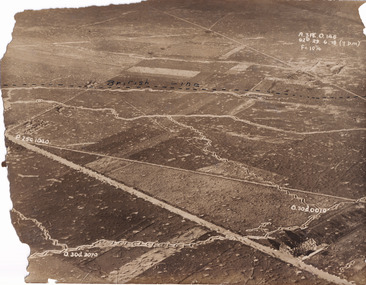 The Beechworth Burke Museum
Photograph
... life and the greatest repatriation of casualties in the country's history. Australia’s involvement in the First World War began when the Australian government established the Australian Imperial Force (AIF) in August 1914. Immediately, men were recruited ...Taken some time between 1914-18, the photograph depicts an aerial view of trenches in France. The image mostly shows rural landscape, although there is a house in the bottom right corner. A dotted line has been drawn across the photograph, marking the section of trenches that belonged to British forces during World War I. It is believed that the line marking on this record denotes a section of the Western Front. The Western Front was the main theatre of war during World War I. Following the outbreak of war in August 1914, the German Army opened the Western Front by invading Luxembourg and Belgium, then gaining military control of important industrial regions in France. The German advance was halted with the Battle of the Marne. Following the Race to the Sea, both the French-British and German armies dug in along a meandering line of fortified trenches, stretching from the North Sea to the Swiss frontier with France. Between 1915 and 1917 there were several offensives along the Western Front. The attacks employed massive artillery bombardments and massed infantry advances. Entrenchments, machine gun emplacements, barbed wire and artillery repeatedly inflicted severe casualties during attacks and counter-attacks and no significant advances were made. Among the most notable of these offensives were the Battle of Verdun (1916), the Battle of the Somme (1916), and the Battle of Passchendaele (1917).The record is historically significant due to its connection to World War I. This conflict is integral to Australian culture as it was the single greatest loss of life and the greatest repatriation of casualties in the country's history. Australia’s involvement in the First World War began when the Australian government established the Australian Imperial Force (AIF) in August 1914. Immediately, men were recruited to serve the British Empire in the Middle East and on the Western Front. The record has strong research potential. This is due to the ongoing public and scholarly interest in war, history, and especially the ANZAC legend, which is commemorated annually on 25 April, known as ANZAC Day.Sepia rectangular photograph printed on matte photographic paper.Obverse: A.3FE.O.146 / G2R 29 . 6 . 18 (Y p.m) / F= 10 1/4 / British Line / ------------------------------------------ / P. 250 1040 / 0. 30d. 0010 / 0. 30d. 3070 /military album, military, war, wwi, world war i, france, great britain, trenches, village, rural, western front
