
Showing 141 items matching "life ring"
-
 Lara RSL Sub Branch
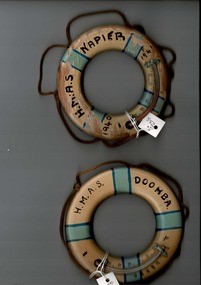
Round Woode Life Saving Ring 2 off, 1. Wooden Life Saving Ring with Temprature Gauge H.M.A.S. Napier 1940 -1941 2. Wooden Life Saving Ring with Temprature Gauge H.M.A.S. Doomba 1940 -1941
... Round Woode Life Saving Ring 2 off...1. Wooden Life Saving Ring with Temprature Gauge H.M.A.S. Napier 1940 -1941 2. ...1. Wooden Life Saving Ring with Temperature Gauge H.M.A.S. ...Round Wooden life Saving Rings 1. H.M.A.S. Napier 1940 - 1941 white with Blue color ribbon painted Top, Bottom, Left and right Temperature Gauge in Fahrenheit 20 to 120 Degrees. 2. ...Wooden Life Saving Ring with Temprature Gauge H.M.A.S. Doomba 1940 -1941 Round Woode Life Saving Ring 2 off ...Souvenirs of service in RAN Naval Vessels.Souvenirs of service in RAN Naval Vessels.HMAS Napier and HMAS Doomba1. Wooden Life Saving Ring with Temperature Gauge H.M.A.S. Napier 1940 -194. Signed by ship mates on reverse. 2. Wooden Life Saving Ring with Temperature Gauge H.M.A.S. Doomba 1940 -1941 Round Wooden life Saving Rings 1. H.M.A.S. Napier 1940 - 1941 white with Blue color ribbon painted Top, Bottom, Left and right Temperature Gauge in Fahrenheit 20 to 120 Degrees. 2. H.M.A.S.Doomba white with Blue color ribbon painted Top, Bottom, Left and right, Temperature Gauge in Fahrenheit 20 to 120 Degrees.hmas napier souvenir, hmas dooma souvenir -
 Royal Brighton Yacht Club
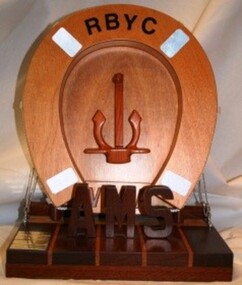
Life Ring, Vega Trophy (Mounted Wooden Life Ring)
... Life Ring...Vega Trophy (Mounted Wooden Life Ring)...Vega Trophy (Mounted Wooden Life Ring) Donor: Graham Noel During World War II when the Germans occupied the Channel Islands the local people went through very severe food rationing and were on the verge of starvation. ...The locals had a well refined news system for the dissemination of news of what was happening in the outside world. vega graham noel ams combined division aggregate Vega Trophy (Mounted Wooden Life Ring) Life Ring ...Vega Trophy (Mounted Wooden Life Ring) Donor: Graham Noel During World War II when the Germans occupied the Channel Islands the local people went through very severe food rationing and were on the verge of starvation. Near the end of the war, the Swedish ship Vega was allowed by the Germans to deliver several shipments of food to the civilian population, easing the critical shortages of food on the islands. Further background detail can be found below. Graham Noel was born on the Islands and lived there during this harsh period. The trophy is awarded to the winner of the Combined Division AMS Aggregate Series. First Winner: Under Capricorn, P. Bedlington 2005/06 Vega – Further historical background Early in the Second World War Jersey was declared “unarmed” and the German military took over, taking quite a few lives in the process, through strafing the main harbour and a few other places which they needlessly considered threatening. A considerable number of locals evacuated to England before the Germans arrived, but more than 60% of the population remained and endured 5 years of very strict and difficult conditions. Not only was the population unable to contact relatives in the UK or elsewhere, but very quickly they found themselves subject to harsh curfews, strictly rationed foodstuffs, no fuel for vehicles, radios confiscated, and homes and hotels commandeered by the military. The military demanded first pick of all foodstuffs and kept meticulous records of all livestock forcing farmers even to show newborn calves and piglets to them, then claiming the new arrivals for their dinner tables. However there are many stories of farmers outwitting their masters when twin calves or suchlike arrived! Lawbreakers were quickly dealt with, mostly with lengthy prison terms in Jersey, but the more serious crimes were punished by being sent to some horrible French prisons, or even some of the notorious German concentration camps. All local Jews were dispatched to concentration camps, and even English born families were similarly shipped through France and on to Germany. Sadly, a considerable number of those deported did not make it back safely to Jersey. In June 1944 the locals were delighted to hear that the Allies had invaded Normandy and very soon they could hear the battles as the Allies worked their way along the French coast. Little did they know they would still have to wait another 11 months for freedom, having to put up with a very demanding German occupation force which was still determined to obey Hitler’s order to “Defend the Channel Islands to the death”. Now that France was in Allied Hands the local military commanders were unable to supplement their food supplies from France and even harsher demands were made on the local population to ensure that all branches of their still very substantial military force were reasonably well fed. As well as the military, Jersey farmers had to provide food for the Allied POWs and the many “forced labourers”, mainly of Russian, Polish and Italian backgrounds who had been directed to the island to build all the concrete bunkers. This included an underground hospital, all this complying with Hitler’s orders to ensure that the Channel Islands would never again be part of Britain. Many requests by the Jersey authorities for Red Cross assistance were rejected, but finally in December 1944 they agreed and on 30th December the Red Cross vessel “Vega” (Swedish Registry) arrived and delivered parcels to the civilian population. These parcels contained a variety of foodstuffs supplied mainly by Canadian authorities, desperately needed medical supplies, flour, oils and soaps, as well as tobacco from New Zealand. Vega made a further 3 or 4 trips and most certainly eased the desperate situation being faced by the locals. In fact, it resulted in the locals having slightly better food supplies than the military and many local farmers tell stories of having to protect their stock from marauding soldiers. Understandably Churchill was reluctant to send in an invading force to retake the Channel Islands, but by May 1945 it was clear that the Third Reich was finished and on May 9th the German Military surrendered, without a fight, to a large British landing force. On a slightly lighter note … in January 1945 Jersey stonemasons were seen in the main town square repairing flagstones … the Germans had never noticed that the name “Vega” had been formed in those flagstones! As a side note Vega is the name of the brightest star in the universe. Furthermore, throughout the occupation, despite German law that demanded confiscation of all radio sets, punishable by long prison terms or deportation to Germany, there were still many sets being listened to. The locals had a well refined news system for the dissemination of news of what was happening in the outside world. vega, graham noel, ams, combined division, aggregate -
 Victorian Maritime Centre
Life Ring, circa 1982
... Life Ring...The souvenir Life Ring was purchased sometime during a cruise by an unknown person. ...A hand painted souvenir Life Ring...The souvenir Life Ring was purchased sometime during a cruise by an unknown person. ...The souvenir Life Ring was purchased sometime during a cruise by an unknown person. It is part of a cruise liner collection by D. Benson and Family over a period of years. D. Benson sold part of the collection to the V.M.C who purchased the remaining part. It is a great source of information to visitors to the V.M.C. At the time of ocean liner holiday cruising, many people purchased these souvenirs to keep or give away as gifts.A hand painted souvenir Life RingHimalaya P&O Orient Line, London, 1982souvenir, cruise liners, s.s himalaya -
Victorian Maritime Centre
Life Ring
... Life Ring...The souvenir life ring was purchased sometime during a cruise by an unknown person. ...Hand painted souvenir life ring from the Orient Line, Orcades, London, 1964. ...The souvenir life ring was purchased sometime during a cruise by an unknown person. ...The souvenir life ring was purchased sometime during a cruise by an unknown person. It is part of a cruise liner collection by D. Benson and Family over a period of years. D. Benson sold part of the collection to the V.M.C who purchased the remaining part. It is a great source of information to visitors to the V.M.C. At the time of ocean liner holiday cruising, many people purchased these souvenirs to keep or give away as gifts.Hand painted souvenir life ring from the Orient Line, Orcades, London, 1964. It is coloured in red, white and blue.Orient Line '1964' Orcades - Londonsouvenir, cruise liners, s.s orcades -
Victorian Maritime Centre
Life Ring, 1969
... Life Ring...A hand-painted souvenir life ring from the S.S Himalaya. Coloured in red and white with a cord around it....Life Ring ...The souvenir life buoy was purchased sometime during a cruise by an unknown person. It is part of a cruise liner collection by D. Benson and Family over a period of years. D. Benson sold part of the collection to the V.M.C who purchased the remaining part. It is a great source of information to visitors to the V.M.C. At the time of ocean liner holiday cruising, many people purchased these souvenirs to keep or give away as gifts.A hand-painted souvenir life ring from the S.S Himalaya. Coloured in red and white with a cord around it.S.S Himalayasouvenir, cruise liners, s.s himalaya -
Victorian Maritime Centre
Life Ring, 1961
... Life Ring...A hand-painted souvenir life ring from the S.S Himalaya. Coloured blue and white with a cord around it....Life Ring ...The souvenir life buoy was purchased sometime during a cruise by an unknown person. It is part of a cruise liner collection by D. Benson and Family over a period of years. D. Benson sold part of the collection to the V.M.C who purchased the remaining part. It is a great source of information to visitors to the V.M.C. At the time of ocean liner holiday cruising, many people purchased these souvenirs to keep or give away as gifts.A hand-painted souvenir life ring from the S.S Himalaya. Coloured blue and white with a cord around it.S.S Himalayasouvenir, cruise liners, s.s himalaya -
Victorian Maritime Centre
Life Ring, 1982
... Life Ring...A hand-painted souvenir Life Ring from the S.S Canberra. Coloured in red and white with a cord around it....Life Ring ...The souvenir life buoy was purchased sometime during a cruise by an unknown person. It is part of a cruise liner collection by D. Benson and Family over a period of years. D. Benson sold part of the collection to the V.M.C who purchased the remaining part. It is a great source of information to visitors to the V.M.C. At the time of ocean liner holiday cruising, many people purchased these souvenirs to keep or give away as gifts.A hand-painted souvenir Life Ring from the S.S Canberra. Coloured in red and white with a cord around it.S.S Canberra, P&O, 1982, Londonsouvenir, cruise liners, s.s canberra -
Victorian Maritime Centre
Life Ring
... Life Ring...A hand-painted souvenir Life Ring from S.S Kreuzer, Koln. It is coloured red, with a cord around it. ...There is a photo in the centre. Life Ring ...The souvenir life buoy was purchased sometime during a cruise by an unknown person. It is part of a cruise liner collection by D. Benson and Family over a period of years. D. Benson sold part of the collection to the V.M.C who purchased the remaining part. It is a great source of information to visitors to the V.M.C. At the time of ocean liner holiday cruising, many people purchased these souvenirs to keep or give away as gifts.A hand-painted souvenir Life Ring from S.S Kreuzer, Koln. It is coloured red, with a cord around it. There is a photo in the centre.Kreuzer, Kolnsouvenir, cruise liners, s.s kreuzer -
Victorian Maritime Centre
Life Ring, 1937 - 1969
... Life Ring...A hand-painted life ring with P&O Stratheden - London written on and P&O emblems and flags. ...Circled by a white coloured cord. Life Ring ...The souvenir life buoy was purchased sometime during a cruise by an unknown person. It is part of a cruise liner collection by D. Benson and Family over a period of years. D. Benson sold part of the collection to the V.M.C who purchased the remaining part. It is a great source of information to visitors to the V.M.C. At the time of ocean liner holiday cruising, many people purchased these souvenirs to keep or give away as gifts.A hand-painted life ring with P&O Stratheden - London written on and P&O emblems and flags. Circled by a white coloured cord.S.S Strathedensouvenir, cruise liners, s.s stratheden -
Victorian Maritime Centre
Life Ring, 1954 - 1974
... Life Ring...Coloured red and white with string (cord) around it. Life Ring ...The souvenir life buoy was purchased sometime during a cruise by an unknown person. It is part of a cruise liner collection by D. Benson and Family over a period of years. D. Benson sold part of the collection to the V.M.C who purchased the remaining part. It is a great source of information to visitors to the V.M.C. At the time of ocean liner holiday cruising, many people purchased these souvenirs to keep or give away as gifts.A hand-painted souvenir Life Buoy from the S.S Orsova. Coloured red and white with string (cord) around it.S.S Orsovasouvenir, cruise liners, s.s orsova -
 Bendigo Military Museum
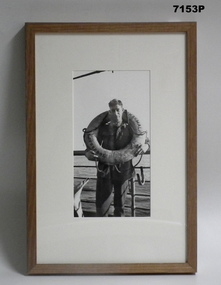
Photograph - FRAMED WW1 PHOTOGRAPH, Wayne Eels, C.2008/2009
... Photograph - black and white photograph on paper depicting a soldier, wearing a ship's life ring, standing against a ship's rail. Background - water. ..."E. Jack Grinton - life ring 2"...."E. Jack Grinton - life ring 2". Photograph framed. Photograph - black and white photograph on paper depicting a soldier, wearing a ship's life ring, standing against a ship's rail. ...The Grinton Collection. Jack Grinton on HMAT Kamala coming home. Refer Cat No. 1280 for his service details.Photograph framed. Photograph - black and white photograph on paper depicting a soldier, wearing a ship's life ring, standing against a ship's rail. Background - water. Frame - timber, light varnish finish, Perspex front, cardboard backing."Group 5: Quota 45 - Journey Home". "E. Jack Grinton - life ring 2".framed accessories, camera on the somme, ww1, 38th bn, hmat karmala -
 Bay Steamers Maritime Museum
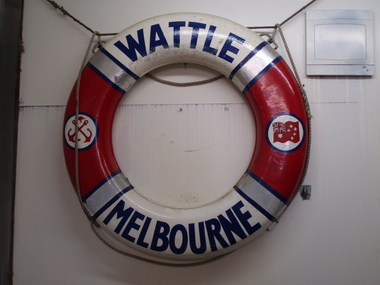
Life Buoy
... ...life ring...This life saving device was on the steam tug Wattle to be thrown to a person if they fell overboard. This ring...Ring of buoyant material painted in white, red and blue with metal inner rim and metal outer rim with loops for attaching throwing rope. The life... has either been repainted since Wattle moved from Sydney to Melbourne or was part of the new equipment installed when Wattle was transferred to Melbourne in 1971 melbourne wattle insignia rope life buoy life ring life saving floating floatation steam tug Printed on ring "WATTLE / MELBOURNE" Ring of buoyant material painted in white, red and blue with metal inner rim and metal outer rim with loops for attaching throwing rope. ...This life saving device was on the steam tug Wattle to be thrown to a person if they fell overboard. This ring has either been repainted since Wattle moved from Sydney to Melbourne or was part of the new equipment installed when Wattle was transferred to Melbourne in 1971Ring of buoyant material painted in white, red and blue with metal inner rim and metal outer rim with loops for attaching throwing rope. The life buoy is constructed of a foam centre and outer coating of fiberglass. An inner metal rim reinforces the construction while the outer metal rim assists with reinforcement but also provides 4 loops at 2pm, 4pm, 8pm and 10pm locations on the face of a clock. These loops have rope threaded through them to provide hand hold and grips and a method of attaching the life buoy to the boat. Decorated with red and blue lettering and insigniaPrinted on ring "WATTLE / MELBOURNE"melbourne, wattle, insignia, rope, life buoy, life ring, life saving, floating, floatation, steam tug -
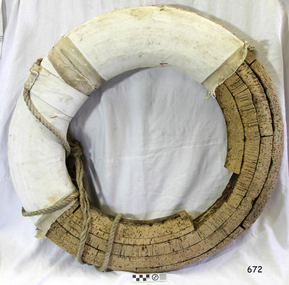 Flagstaff Hill Maritime Museum and Village
Equipment - Lifebuoy, late 19th to early 20th century
... Life rings...Safety ring...The strips of cork wood have been joined together to make the ring shape. A lifebuoy, or life-preserver, is used as a buoyancy device to keep a person afloat in the. ...There were many lives lost in Australia’s colonial period, particularly along the coast of South West Victoria. flagstaff hill warrnambool shipwrecked-coast flagstaff-hill flagstaff-hill-maritime-museum maritime-museum shipwreck-coast flagstaff-hill-maritime-village Lifebuoy Life rings Safety ring Life-saving buoy Ring buoy Life preserver Personal floating device Floatation device Safety equipment Lifebuoy, round cork object covered with white stiffened material wound around it. ...This lifebuoy is part of the lifesaving equipment that would be carried on vessels in the late 19th and early 20th century. The strips of cork wood have been joined together to make the ring shape. A lifebuoy, or life-preserver, is used as a buoyancy device to keep a person afloat in the. It is usually connected by a rope to a person in a safe area such a nearby vessel or on shore. The lifebuoy is thrown to a person in distress in the water, allowing the rescuer to pull the person to safety. The lifebuoy is a made from a buoyant material such as cork or rubber and is usually covered with canvas for protection and to make it easy to grip. The first use of life saving devices in recent centuries was by the Nordic people, who used light weight wood or cork blocks to keep afloat. From the early 20th century Kapok fibre was used as a filling for buoys. Light weight balsa wood was used as a filler after WW1. In 1928 Peter Markus invented and patented the first inflatable life-preserver. By WW2 foam was combined with Kapok. Laws were passed over time that has required aeroplanes and water going-vessels to carry life-preservers on board. The lifebuoy is an example of equipment carried on vessels in the late 19th and early 20th century to help preserve life. There were many lives lost in Australia’s colonial period, particularly along the coast of South West Victoria.Lifebuoy, round cork object covered with white stiffened material wound around it. flagstaff hill, warrnambool, shipwrecked-coast, flagstaff-hill, flagstaff-hill-maritime-museum, maritime-museum, shipwreck-coast, flagstaff-hill-maritime-village, lifebuoy, life rings, safety ring, life-saving buoy, ring buoy, life preserver, personal floating device, floatation device, safety equipment -
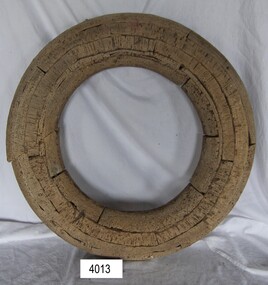 Flagstaff Hill Maritime Museum and Village
Equipment - Lifebuoy, late 19th to early 20th century
... Life rings...Safety ring...There were many lives lost in Australia’s colonial period, particularly along the coast of South West Victoria. flagstaff hill warrnambool shipwrecked-coast flagstaff-hill flagstaff-hill-maritime-museum maritime-museum shipwreck-coast flagstaff-hill-maritime-village lifebuoy cork lifebuoy flotation device safety equipment Life rings Safety ring Life-saving buoy Ring buoy Life preserver Personal floating device Floatation device Lifebuoy, round cork inner only, no canvas covering. ...Lifebuoys are flotation devices used to rescue and save people whose lives are at risk in the water. They are part of a ship's safety equipment. The cork material is very buoyant. The first use of life saving devices in recent centuries was by the Nordic people, who used light weight wood or cork blocks to keep afloat. From the early 20th century Kapok fibre was used as a filling for buoys. Light weight balsa wood was used as a filler after WW1. In 1928 Peter Markus invented and patented the first inflatable life-preserver. By WW2 foam was combined with Kapok. Laws were passed over time that has required aeroplanes and water going-vessels to carry life-preservers on board. The lifebuoy is an example of equipment carried on vessels in the late 19th and early 20th century to help preserve life. There were many lives lost in Australia’s colonial period, particularly along the coast of South West Victoria.Lifebuoy, round cork inner only, no canvas covering.flagstaff hill, warrnambool, shipwrecked-coast, flagstaff-hill, flagstaff-hill-maritime-museum, maritime-museum, shipwreck-coast, flagstaff-hill-maritime-village, lifebuoy, cork lifebuoy, flotation device, safety equipment, life rings, safety ring, life-saving buoy, ring buoy, life preserver, personal floating device, floatation device -
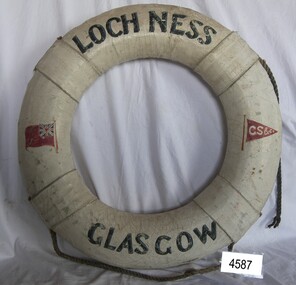 Flagstaff Hill Maritime Museum and Village
Equipment - Lifebuoy, Loch Ness, 1869-1909
... Life rings...Safety ring...ring shape then covered in canvas and sealed usually with white paint. Four evenly spaced canvas reinforcing bands would be added for strength and for a place to thread a rope or line. A lifebuoy, or life...The lifebuoy is significant for its connection to the ship Loch Ness on which William Carmichael, brother of Eva Carmichael, travelled to lay a memorial to their parents and all of their other siblings who lost their lives in the Loch Ard disaster of 1878 near Peterborough, Victoria. flagstaff hill warrnambool shipwrecked-coast flagstaff-hill flagstaff-hill-maritime-museum maritime-museum shipwreck-coast flagstaff-hill-maritime-village Loch Ness Loch Ard William Carmichael Eva Carmichael lifebuoy Glasgow sailing ship Loch Ness of Glasgow Life rings Safety ring Life-saving buoy Ring buoy Life preserver Personal floating device Floatation device Safety equipment G S C Glasgow Shipping Company HMAS Melbourne Cruiser Melbourne "LOCH NESS", "GLASGOW" "G S Co" Lifebuoy, round, cork filling inside canvas cover, painted white, with rope attached. ...This lifebuoy bears the name of the ship, its origin, the shipping company and the red ensign. These details mean that the lifebuoy was part of the lifesaving equipment on the sailing ship the Loch Ness, part of the Glasgow Shipping Company’s Loch Line (G.S.C. on the red pennant) and a British-registered ship (the red flag with the Union Jack on it). Lifebuoys were part of the emergency lifesaving equipment carried on vessels in the late 19th and early 20th century. The ring was made of strips of cork wood joined together to make the ring shape then covered in canvas and sealed usually with white paint. Four evenly spaced canvas reinforcing bands would be added for strength and for a place to thread a rope or line. A lifebuoy, or life-preserver, is used as a buoyancy device often thrown to an endangered or distressed person in the water to keep them afloat while they receive help. It is usually connected by a rope to a person in a safe area such a nearby vessel or on shore. Lifebuoys is a made from a buoyant materials such as cork or foam and ae usually covered with canvas for protection and to make it easy to grip. The first use of life saving devices in recent centuries was by the Nordic people, who used light weight wood or cork blocks to keep afloat. Cork lifebuoys were used from the late 19th to early 20th century. Kapok fibre was then used as a filling for buoys but wasn’t entirely successful. Light weight balsa wood was used as a filler after WW1. In 1928 Peter Markus invented and patented the first inflatable life-preserver. By WW2 foam was combined with Kapok. Laws were passed over time that has required aeroplanes and water going-vessels to carry life-preservers on board. The ship LOCH NESS 1869-1922 … The ship Loch Ness, of Glasgow, was the same ship what William Carmichael sailed on to Australia when he laid the commemoration stone on behalf of his sister Eva and himself, dedicated to their parents, brothers and sisters. The family members lost their lives on June 1, 1878, when their ship, the Loch Ard, was wrecked at Mutton Bird Island in south west Victoria. Eva Carmichael was one of the two survivors from that shipwreck, the other 52 tragically lost their lives. The ship Loch Ness was a three-masted sailing ship built in 1869 for the Loch Line owned by the Glasgow Shipping Company. The line transported cargo and passengers from Glasgow, Scotland, to Australian ports. The Loch Ness was sold in 1908 to Stevedore & Shipping Co, Sydney for use as a coal hulk. In 1914 the Australian Government took over the ship for naval defence purposeless. In 1926 the ship was sunk during gunfire practice by the 1922 built, light cruiser HMAS Melbourne, near Fremantle, Western Australia. The lifebuoy is an example of equipment carried on vessels in the late 19th and early 20th century to help preserve life. There were many lives lost in Australia’s colonial period, particularly along the coast of South West Victoria. The lifebuoy is significant for its connection to the ship Loch Ness on which William Carmichael, brother of Eva Carmichael, travelled to lay a memorial to their parents and all of their other siblings who lost their lives in the Loch Ard disaster of 1878 near Peterborough, Victoria. Lifebuoy, round, cork filling inside canvas cover, painted white, with rope attached. Lifebuoy has printed name of vessel Loch Ness, Glasgow. Symbols of red flag with white initials G S Co. There is also a red ensign."LOCH NESS", "GLASGOW" "G S Co"flagstaff hill, warrnambool, shipwrecked-coast, flagstaff-hill, flagstaff-hill-maritime-museum, maritime-museum, shipwreck-coast, flagstaff-hill-maritime-village, loch ness, loch ard, william carmichael, eva carmichael, lifebuoy, glasgow sailing ship, loch ness of glasgow, life rings, safety ring, life-saving buoy, ring buoy, life preserver, personal floating device, floatation device, safety equipment, g s c, glasgow shipping company, hmas melbourne, cruiser melbourne -
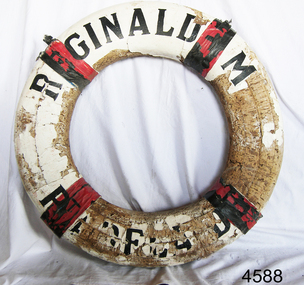 Flagstaff Hill Maritime Museum and Village
Equipment - Lifebuoy, John Murch, 1922
... Life rings...Safety ring...ring shape then covered in canvas and sealed usually with white paint. Four evenly spaced canvas reinforcing bands would be added for strength and for a place to thread a rope or line. A lifebuoy, or life...The lifebuoy is significant for its connection with the Australian built, 1922 coastal trader, Reginald M. flagstaff hill warrnambool shipwrecked-coast flagstaff-hill flagstaff-hill-maritime-museum maritime-museum shipwreck-coast flagstaff-hill-maritime-village lifebuoy lifesaving ship equipment reginald m Life rings Safety ring Life-saving buoy Ring buoy Life preserver Personal floating device Floatation device Safety equipment coastal trader john murch reg webb "REGINALD M / Pt ADELAIDE". ...Lifebuoy is from the ketch Reginald M, built in Port Adelaide by John Murch in 1922. Lifebuoys were part of the emergency lifesaving equipment carried on vessels in the late 19th and early 20th century. The ring was made of strips of cork wood joined together to make the ring shape then covered in canvas and sealed usually with white paint. Four evenly spaced canvas reinforcing bands would be added for strength and for a place to thread a rope or line. A lifebuoy, or life-preserver, is used as a buoyancy device often thrown to an endangered or distressed person in the water to keep them afloat while they receive help. It is usually connected by a rope to a person in a safe area such a nearby vessel or on shore. Lifebuoys is a made from a buoyant materials such as cork or foam and ae usually covered with canvas for protection and to make it easy to grip. The first use of life saving devices in recent centuries was by the Nordic people, who used light weight wood or cork blocks to keep afloat. Cork lifebuoys were used from the late 19th to early 20th century. Kapok fibre was then used as a filling for buoys but wasn’t entirely successful. Light weight balsa wood was used as a filler after WW1. In 1928 Peter Markus invented and patented the first inflatable life-preserver. By WW2 foam was combined with Kapok. Laws were passed over time that has required aeroplanes and water going-vessels to carry life-preservers on board. The Reginald M 1922- The two-masted coastal trading ketch Reginald M was built by John (Jack) Murch in Port Adelaide, South Australia, in 1922 and it was launched there in Largs Bay in the same year. It is thought that the keel was hewn from two telegraph poles - its owner was a regular visitor to salvage yards. Its cargo at times included Guano, Barley, Wool, Horses, Cattle, Timber, Explosives, Potatoes, Shell Grit and Gypsum. At one time the vessel was used as a customs boat, renamed 'HMC No. 3, Pt Adelaide'. In 1969 she was used by a mining and railway company as a barge to carry explosives. In 1972 the vessel was renamed 'T.S. Macquarie' and planned to be used for sea cadet training.; this did not eventuate. It was sold again and went to Melbourne to be used for pleasure sailing, and again sold for use as a ferry. Late in 1975 Flagstaff Hill purchased the vessel to be used as an exhibit at the Maritime Village where many visitors enjoyed being able to board and explore a real ship with a long history. Sadly, in late 2016, the decision was made to 'decommission' the vessel due to the continuing high cost of maintenance and the risk to public safety. Many of the components of the vessel are held as part of Flagstaff Hill's collection.The lifebuoy is an example of equipment carried on vessels in the late 19th and early 20th century to help preserve life. There were many lives lost in Australia’s colonial period, particularly along the coast of South West Victoria. The lifebuoy is significant for its connection with the Australian built, 1922 coastal trader, Reginald M. Lifebuoy, round , cork, filled, white canvas cover with four red tabs. Text is printed in black on quarters 1 and 3. This lifebuoy once belonged to the vessel 'Reginald M' , Pt Adelaide. "REGINALD M / Pt ADELAIDE".flagstaff hill, warrnambool, shipwrecked-coast, flagstaff-hill, flagstaff-hill-maritime-museum, maritime-museum, shipwreck-coast, flagstaff-hill-maritime-village, lifebuoy, lifesaving, ship equipment, reginald m, life rings, safety ring, life-saving buoy, ring buoy, life preserver, personal floating device, floatation device, safety equipment, coastal trader, john murch, reg webb -
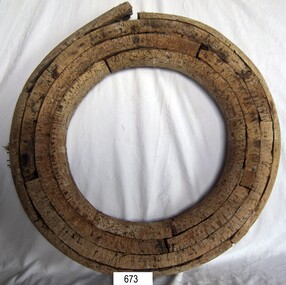 Flagstaff Hill Maritime Museum and Village
Equipment - Lifebuoy, late 19th to early 20th century
... ...Life-saving buoy...Ring...The strips of cork wood have been joined together to make the ring shape. A lifebuoy, or life-preserver, is used as a buoyancy device to keep a person afloat in the. ...Flagstaff Hill Warrnambool Shipwrecked-coast Flagstaff-Hill Flagstaff-Hill-Maritime-Museum Maritime-Museum Shipwreck-coast Flagstaff-Hill-Maritime-Village Life rings Lifebuoy Safety ring Life-saving buoy Ring buoy Life preserver Personal floating device Floatation device Safety equipment Lifebuoy, round cork object with no covering. ...This lifebuoy is part of the lifesaving equipment that would be carried on vessels in the late 19th and early 20th century. The strips of cork wood have been joined together to make the ring shape. A lifebuoy, or life-preserver, is used as a buoyancy device to keep a person afloat in the. It is usually connected by a rope to a person in a safe area such a nearby vessel or on shore. The lifebuoy is thrown to a person in distress in the water, allowing the rescuer to pull the person to safety. The lifebuoy is a made from a buoyant material such as cork or rubber and is usually covered with canvas for protection and to make it easy to grip. The first use of life saving devices in recent centuries was by the Nordic people, who used light weight wood or cork blocks to keep afloat. From the early 20th century Kapok fibre was used as a filling for buoys. Light weight balsa wood was used as a filler after WW1. In 1928 Peter Markus invented and patented the first inflatable life-preserver. By WW2 foam was combined with Kapok. Laws were passed over time that has required aeroplanes and water going-vessels to carry life-preservers on board. The lifebuoy is an example of equipment carried on vessels in the late 19th and early 20th century to help preserve life. There were many lives lost in Australia’s colonial period, particularly along the coast of South West Victoria.Lifebuoy, round cork object with no covering. flagstaff hill, warrnambool, shipwrecked-coast, flagstaff-hill, flagstaff-hill-maritime-museum, maritime-museum, shipwreck-coast, flagstaff-hill-maritime-village, life rings, lifebuoy, safety ring, life-saving buoy, ring buoy, life preserver, personal floating device, floatation device, safety equipment -
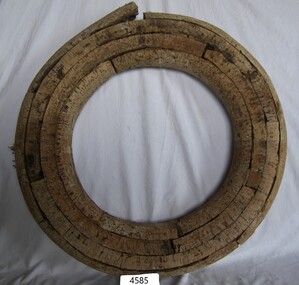 Flagstaff Hill Maritime Museum and Village
Equipment - Lifebuoy, late 19th to early 20th century
... ...Life-saving buoy...Ring...The strips of cork wood have been joined together to make the ring shape. A lifebuoy, or life-preserver, is used as a buoyancy device to keep a person afloat in the. ...Flagstaff Hill Warrnambool Shipwrecked-coast Flagstaff-Hill Flagstaff-Hill-Maritime-Museum Maritime-Museum Shipwreck-coast Flagstaff-Hill-Maritime-Village Life rings Lifebuoy Safety ring Life-saving buoy Ring buoy Life preserver Personal floating device Floatation device Safety equipment Lifebuoy; round, cork filling of lifebuoy. ...This lifebuoy is part of the lifesaving equipment that would be carried on vessels in the late 19th and early 20th century. The strips of cork wood have been joined together to make the ring shape. A lifebuoy, or life-preserver, is used as a buoyancy device to keep a person afloat in the. It is usually connected by a rope to a person in a safe area such a nearby vessel or on shore. The lifebuoy is thrown to a person in distress in the water, allowing the rescuer to pull the person to safety. The lifebuoy is a made from a buoyant material such as cork or rubber and is usually covered with canvas for protection and to make it easy to grip. The first use of life saving devices in recent centuries was by the Nordic people, who used light weight wood or cork blocks to keep afloat. From the early 20th century Kapok fibre was used as a filling for buoys. Light weight balsa wood was used as a filler after WW1. In 1928 Peter Markus invented and patented the first inflatable life-preserver. By WW2 foam was combined with Kapok. Laws were passed over time that has required aeroplanes and water going-vessels to carry life-preservers on board. The lifebuoy is an example of equipment carried on vessels in the late 19th and early 20th century to help preserve life. There were many lives lost in Australia’s colonial period, particularly along the coast of South West Victoria.Lifebuoy; round, cork filling of lifebuoy. The nails joining the layers are visible. flagstaff hill, warrnambool, shipwrecked-coast, flagstaff-hill, flagstaff-hill-maritime-museum, maritime-museum, shipwreck-coast, flagstaff-hill-maritime-village, life rings, lifebuoy, safety ring, life-saving buoy, ring buoy, life preserver, personal floating device, floatation device, safety equipment -
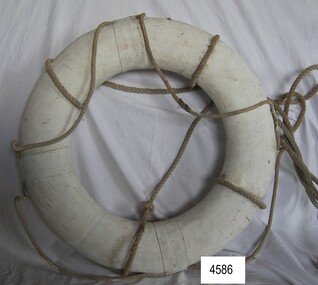 Flagstaff Hill Maritime Museum and Village
Equipment - Lifebuoy, late 19th to early 20th century
... ...Life-saving buoy...Ring...The strips of cork wood have been joined together to make the ring shape. A lifebuoy, or life-preserver, is used as a buoyancy device to keep a person afloat in the. ...Flagstaff Hill Warrnambool Shipwrecked-coast Flagstaff-Hill Flagstaff-Hill-Maritime-Museum Maritime-Museum Shipwreck-coast Flagstaff-Hill-Maritime-Village Life rings Lifebuoy Safety ring Life-saving buoy Ring buoy Life preserver Personal floating device Floatation device Safety equipment Lifebuoy, round cork filling inside white canvas cover with four reinforced bands. ...This lifebuoy is part of the lifesaving equipment that would be carried on vessels in the late 19th and early 20th century. The strips of cork wood have been joined together to make the ring shape. A lifebuoy, or life-preserver, is used as a buoyancy device to keep a person afloat in the. It is usually connected by a rope to a person in a safe area such a nearby vessel or on shore. The lifebuoy is thrown to a person in distress in the water, allowing the rescuer to pull the person to safety. The lifebuoy is a made from a buoyant material such as cork or rubber and is usually covered with canvas for protection and to make it easy to grip. The first use of life saving devices in recent centuries was by the Nordic people, who used light weight wood or cork blocks to keep afloat. From the early 20th century Kapok fibre was used as a filling for buoys. Light weight balsa wood was used as a filler after WW1. In 1928 Peter Markus invented and patented the first inflatable life-preserver. By WW2 foam was combined with Kapok. Laws were passed over time that has required aeroplanes and water going-vessels to carry life-preservers on board. The lifebuoy is an example of equipment carried on vessels in the late 19th and early 20th century to help preserve life. There were many lives lost in Australia’s colonial period, particularly along the coast of South West Victoria.Lifebuoy, round cork filling inside white canvas cover with four reinforced bands. Four ropes are attached.flagstaff hill, warrnambool, shipwrecked-coast, flagstaff-hill, flagstaff-hill-maritime-museum, maritime-museum, shipwreck-coast, flagstaff-hill-maritime-village, life rings, lifebuoy, safety ring, life-saving buoy, ring buoy, life preserver, personal floating device, floatation device, safety equipment -
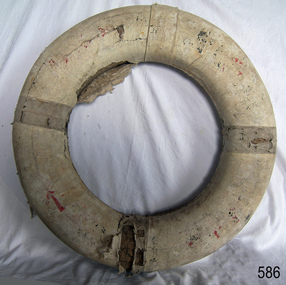 Flagstaff Hill Maritime Museum and Village
Equipment - Lifebuoy
... ...Life-saving buoy...Ring...ring shape. The broad arrow symbol indicates that it was once the property of the British or Australian defence force. A lifebuoy, or life...The lifebuoy was once the property of the British or Australian defence force. flagstaff hill warrnambool shipwrecked-coast flagstaff-hill flagstaff-hill-maritime-museum maritime-museum shipwreck-coast flagstaff-hill-maritime-village Life rings Lifebuoy Safety ring Life-saving buoy Ring buoy Life preserver Personal floating device Floatation device Safety equipment government lifebuoy broad arrow Symbol of broad arrow. indecipherable markings. ...This lifebuoy is part of the lifesaving equipment that would be carried on vessels in the late 19th and early 20th century. The strips of cork wood have been joined together to make the ring shape. The broad arrow symbol indicates that it was once the property of the British or Australian defence force. A lifebuoy, or life-preserver, is used as a buoyancy device to keep a person afloat in the. It is usually connected by a rope to a person in a safe area such a nearby vessel or on shore. The lifebuoy is thrown to a person in distress in the water, allowing the rescuer to pull the person to safety. The lifebuoy is a made from a buoyant material such as cork or rubber and is usually covered with canvas for protection and to make it easy to grip. The first use of life saving devices in recent centuries was by the Nordic people, who used light weight wood or cork blocks to keep afloat. From the early 20th century Kapok fibre was used as a filling for buoys. Light weight balsa wood was used as a filler after WW1. In 1928 Peter Markus invented and patented the first inflatable life-preserver. By WW2 foam was combined with Kapok. Laws were passed over time that has required aeroplanes and water going-vessels to carry life-preservers on board. The lifebuoy is an example of equipment carried on vessels in the late 19th and early 20th century to help preserve life. There were many lives lost in Australia’s colonial period, particularly along the coast of South West Victoria. The lifebuoy was once the property of the British or Australian defence force.Lifebuoy, round cork object with canvas wrapped around it and rope attached to one side. Broad arrow mark and other red marks indecipherable. Painted white.Symbol of broad arrow. indecipherable markings.flagstaff hill, warrnambool, shipwrecked-coast, flagstaff-hill, flagstaff-hill-maritime-museum, maritime-museum, shipwreck-coast, flagstaff-hill-maritime-village, life rings, lifebuoy, safety ring, life-saving buoy, ring buoy, life preserver, personal floating device, floatation device, safety equipment, government lifebuoy, broad arrow -
 Flagstaff Hill Maritime Museum and Village
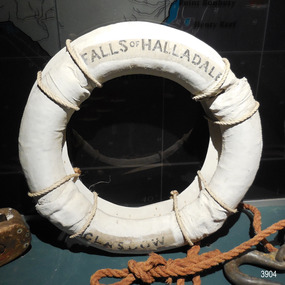
Equipment - Lifebuoy
... ...Life-saving buoy...Ring...The wreck is protected as a Historic Shipwreck under the Commonwealth Historic Shipwrecks Act (1976). flagstaff hill warrnambool shipwrecked coast flagstaff hill maritime museum maritime museum shipwreck coast flagstaff hill maritime village great ocean road Life rings Lifebuoy Safety ring Life-saving buoy Ring buoy Life preserver Personal floating device Floatation device Safety equipment Falls of Halladale Glasgow Falls Line rocket crew lifeboat peterborough “FALLS OF HALLADALE” “GLASGOW” Lifebuoy; round white canvas ring, joined with hand stitching. ...This lifebuoy is part of the lifesaving equipment from the sailing ship the Falls of Halladale. It is filled with cork and covered with canvas and reinforcing bands. The name of the ship and its origin is printed on the lifebuoy. It has been sealed with several coats of white paint. A lifebuoy, or life-preserver, is used as a buoyancy device to keep a person afloat in the. It is usually connected by a rope to a person in a safe area such a nearby vessel or on shore. The lifebuoy is thrown to a person in distress in the water, allowing the rescuer to pull the person to safety. The lifebuoy is a made from a buoyant material such as cork or rubber and is usually covered with canvas for protection and to make it easy to grip. The first use of life saving devices in recent centuries was by the Nordic people, who used light weight wood or cork blocks to keep afloat. From the early 20th century Kapok fibre was used as a filling for buoys. Light weight balsa wood was used as a filler after WW1. In 1928 Peter Markus invented and patented the first inflatable life-preserver. By WW2 foam was combined with Kapok. Laws were passed over time that has required aeroplanes and water going-vessels to carry life-preservers on board. The Falls of Halladale 1886-1908 The vessel ‘Falls of Halladale’ was a four-masted iron-hulled barque, launched in July 1886, by Russell & Co of Greenock, Scotland and owned by the Glasgow Falls Line, which named its ships after Scottish waterfalls. The ship was built for long distance cargo trade. The Falls of Halladale was one of the last windjammers that sailed the Trade Route. The ship was on its way from New York to Melbourne via the Cape of Good Hope when, after 102 days at sea, its journey suddenly ended. During the night of November 14, 1908, in calm seas with some coastal fog, an ocean swell raised the vessel up then let it down on a submerged reef wrecked at Curdies Inlet, Peterborough. The ship was stranded and the Port Campbell Rocket Crew were sent for, to perform a rescue. However by the time they arrived, all on board had already travelled by lifeboat to the nearby beach at the Bay of Islands. The sight of the slowly disintegrating ship on the rocks attracted many sightseers. This lifebuoy is significant for its association with the famous ship the Falls of Halladale. It is significant for its association with lifesaving equipment used on board vessels in the early 20th century. The Falls of Halladale shipwreck is listed on the Victorian Heritage Register (No. S255). She was one of the last ships to sail the Trade Routes. She is one of the first vessels to have fore and aft lifting bridges. She is an example of the remains of an International Cargo Ship and also represents aspects of Victoria’s shipping industry. The wreck is protected as a Historic Shipwreck under the Commonwealth Historic Shipwrecks Act (1976).Lifebuoy; round white canvas ring, joined with hand stitching. Stencil with inscription is printed in black on first and third quadrant. The canvas has been repainted in white but avoiding the inscription in the lifebuoy. A hanging board for display is attached with white rope. Lifesaving equipment from the Falls of Halladale.“FALLS OF HALLADALE” “GLASGOW”flagstaff hill, warrnambool, shipwrecked coast, flagstaff hill maritime museum, maritime museum, shipwreck coast, flagstaff hill maritime village, great ocean road, life rings, lifebuoy, safety ring, life-saving buoy, ring buoy, life preserver, personal floating device, floatation device, safety equipment, falls of halladale, glasgow falls line, rocket crew, lifeboat, peterborough -
 St Kilda Historical Society
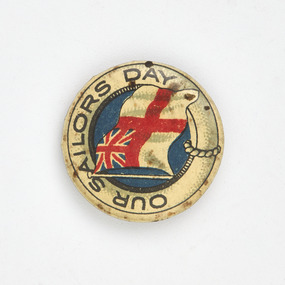
Memorabilia - Badge, Our Sailors Day, 1917
... Picture of the navy ensign on a blue background, inside a white life ring, on which is printed "Our Sailors Day"...Picture of the navy ensign on a blue background, inside a white life ring, on which is printed "Our Sailors Day" Our Sailors Day Memorabilia Badge ...Badges like this were sold in trams, buses, at railways stations and at rallies during World War I to raise money for different patriotic and charitable causes including the Australian, British and French Red Cross, Hospitals, allied countries, current serving men and women, discharged, wounded and disabled servicemen and women, and their families. The Commonwealth Button Fund was established in mid-1915 and, over the next 6 years, 33 Button Days were held. "Our Sailors Day" button day was held on March 23 1917. It was the first to be dedicated to Australia's naval forces and proceeds were given to The Navy League.Small round badge made from printed paper between a tin base and celluloid cover. Picture of the navy ensign on a blue background, inside a white life ring, on which is printed "Our Sailors Day"Our Sailors Daywwi fund-raising -
 Kiewa Valley Historical Society
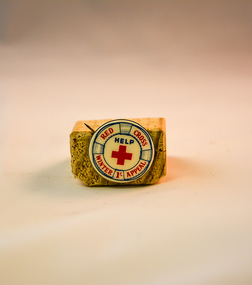
Badge Red Cross, circa 1968
... This badge has an enamel front with red and blue lettering and the circumference is marked to represent a 'life ring, life buoy, life belt' which has all of the red lettering with in its boundary. ...In the middle of the badge is printed a red cross and above that "HELP" This badge has an enamel front with red and blue lettering and the circumference is marked to represent a 'life ring, life buoy, life belt' which has all of the red lettering with in its boundary. ...When this winter appeal badge was produced the Australian economy was in recession (financial down turn) and the ability of some of the unemployed sectors of the community required but could not purchase warm clothes. The Australian recessions of 1945 and 1961 left their mark on the economy and accounted for a long and slow recovery in the 1960's and 1970's. The Red Cross was one of a few benevolent agencies/organisations that provided those more affluent in society to donate money to these types of appeals for financial donations. the money collected was used in obtaining warm close for those in need.In the Kiewa Valley the lingering recessional consequences (high interest rates, slowdown in Australian manufacturing) had an effect upon those whose produce was consumed by large towns and cities. The manufacturing industries including textile and clothing industries were feeling the start of the invasion of cheaper imports. Unemployment was beginning to be an ongoing major political and social issue. The need for support for the financial strapped city and country towns was on the increase and this Red Cross Badge (Winter Appeal) was one of several appeals to help those financially disenfranchised families to overcome the severe clothing shortages in both country and city environments.This badge has an enamel front with red and blue lettering and the circumference is marked to represent a 'life ring, life buoy, life belt' which has all of the red lettering with in its boundary. The fastening mechanism is a "stick" pin made from mild steel (fashioned as a semi circular spring contained within the back rim of the badge. The "stick" protrudes beyond the badge allowing it to be fastened onto clothing.At the top of the badge and in red print "RED CROSS" and at the bottom "WINTER APPEAL" with a"1/-" (one shilling coin - modern equivalent to 10 cents). In the middle of the badge is printed a red cross and above that "HELP"societies, red cross appeals, apparel badges, numismatics badges -
 Parks Victoria - Gabo Island Lightstation
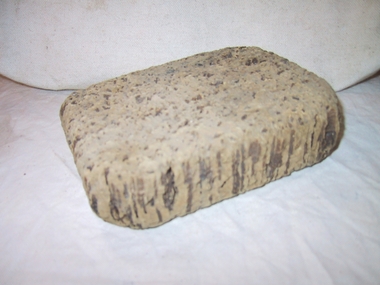
Cork fragments
... From accompanying interpretive sign,"Early life jackets and life- rings were made using cork for bouyancy. ...From accompanying interpretive sign,"Early life jackets and life- rings were made using cork for bouyancy. ...From accompanying interpretive sign,"Early life jackets and life- rings were made using cork for bouyancy. A poignant reminder of the risks facing seafarers". Triangular and rectangular pieces of cork are from old life jackets. Curved piece with canvas remnant and white paint is a section of an old life ring. The piece with hole and split is a float off a fishing net. As cork is also used to provide buoyancy to fishing nets, further information on these fragments, such as their degree of rarity, and the historic use of cork for buoyancy in relation to lightstations and rescue equipment would be helpful. They will have second level contributory significance if it can be established that they are historically associated with the functions of the lightstation. 1. Triangular shaped piece of cork, has holes and cracks. 2. Rectangular shaped piece of cork, has large holes through piece. Remains of white textile covering on two sides (long sides). Piece is slightly convex. 3. Rectangular pieceof cork. Corners are rounded . Rough pitted surface. 4. Tube shaped section of cork. Has hole through middle with split in one side extending to hole. Around outside there are even lines extending horizontally. -
 Ithacan Historical Society
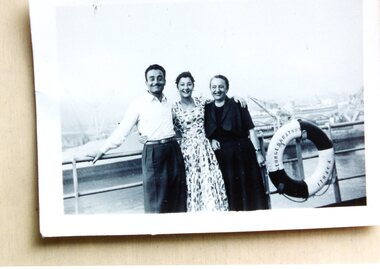
Photograph, Visit of the SS George D. Gratsos, 1951
... A print of a black and white photograph of a man and two ladies on a ship's deck. A life buoy ring with the words ' George D. Gratsos - Ithaca' is on the rails on the left of the group. ...Gratsos (1870–1931) bought the ship Odysseus, in partnership with the Dracoulis family, of which Gratsos' wife was a member. irini pappas ithacan ferries A print of a black and white photograph of a man and two ladies on a ship's deck. A life buoy ring with the words ' George D. Gratsos - Ithaca' is on the rails on the left of the group. ...Irini Pappas and her husband Paul Anagnostou are photographed with the captain's wife (right), Irini's father's first cousin during the visit of the SS Gratsos ship. She was one of only two women ever qualified as first mate. At the time the Women's Weekly ran a double page spread featuring her. in Greece on board a ship travelling to or from Ithaca.'George D. Gratsos - Ithaca' printed on the buoy indicates that the ship was part of the Gratsos shipping company. The shipping activities of the Gratsos family from Ithaca began in 1902, when Georgios D. Gratsos (1870–1931) bought the ship Odysseus, in partnership with the Dracoulis family, of which Gratsos' wife was a member. A print of a black and white photograph of a man and two ladies on a ship's deck. A life buoy ring with the words ' George D. Gratsos - Ithaca' is on the rails on the left of the group. irini pappas, ithacan ferries -
 Mission to Seafarers Victoria
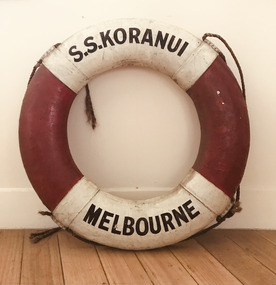
Equipment - Lifebuoy, S.S. Koranui, Melbourne
... ring buoy...lifering...lifesaver...life...Ring shaped life preserver from SS Koranui divided into four sections alternating between red and white colourings....KORANUI/MELBOURNE" Ring shaped life preserver from SS Koranui divided into four sections alternating between red and white colourings. ...According to the shipslist.com, the Union Steam Ship Company of New Zealand had 3 ships called Koranui. Koranui (1) 1883 1885 taken over with Black Diamond Line fleet, 1889 wrecked Blind Bay. 448 Koranui (2) 1914 ex- Cleopatra (A.Kirsten, Hamburg), 1920 war reparations and renamed, 1953 to J. Hagen, Noumea, renamed Neo Hebridais II. 1,266 Koranui (3) 1956 1976 sold to Maldives, renamed South Pacific. 3,722 The buoy is most likely coming from one of the last two on te list.The lifebuoy is a essential piece of equipment on a ship; as it has the name of the ship written on it it is often a memorabilia kept after the ship has changed name or has been broken up.Ring shaped life preserver from SS Koranui divided into four sections alternating between red and white colourings.Black writing on white sections of buoy: "S.S. KORANUI/MELBOURNE"buoy, safety wheel, lifebelt, water wheely, ring buoy, lifering, lifesaver, life donut, life preserver, perry buoy, mission to seafarers, seamen's mission, ss koranui, new zeaaland, union steam ship company of new zealand, rescue, life saving equipment -
Glenelg Shire Council Cultural Collection
Functional object - Life Buoy, n.d
... Life buoy, circular ring, canvas covered cork, rope loop fixed to 4 points on the outside edge. ...Front: 'SS Casino' 'Port Fairy' Back: - Life buoy, circular ring, canvas covered cork, rope loop fixed to 4 points on the outside edge. ...Purchased by Glenelg Shire from Kurtze's Museum. The Casino commenced West Coast Trade in 1882 after being purchased by the Belfast and Koroit Steam Navigation Co. The Casino came to an end in 10.7.1932 when it rolled over and sank at Apollo Bay. Casino built at Dundee Scotland 425 reg. tons.Life buoy, circular ring, canvas covered cork, rope loop fixed to 4 points on the outside edge. Painted white "SS CASINO" and "PORT FAIRY" lettered in black. 2 images of flags painted opposite sides of the 'front' of buoy. Ex SS CASINO wrecked 10.7.1932.Front: 'SS Casino' 'Port Fairy' Back: - -
Yarrawonga and Mulwala Pioneer Museum
Functional object - Horse measuring stick
... Measuring stick belonging to the late Kath Connell. Life member and past Ring Master of the Yarrawonga Show, also founder member of the Yarrawonga Mulwala pony Club. ...Measuring stick belonging to the late Kath Connell. Life member and past Ring Master of the Yarrawonga Show, also founder member of the Yarrawonga Mulwala pony Club. ...Measuring stick belonging to the late Kath Connell. Life member and past Ring Master of the Yarrawonga Show, also founder member of the Yarrawonga Mulwala pony Club. Donated to the A and P Association by M and B Gorman and family after Kath's death and loaned to the Historical Society for display. Long bamboo stick with hook end. Fitted with a sliding metal measure with inch and cm markingsnoneagricultural shows, pony club, horse measure -
 Flagstaff Hill Maritime Museum and Village
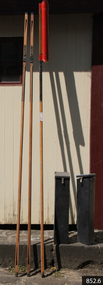
Equipment - Rocket set, John Dennett, ca. 1860s
... ringing bells and foghorns. Some became local heroes but all served an important role. By the end of the 1950s the lifeboat and rescue equipment had become obsolete. Rocket Rescue Method - The first use of a lifesaving rocket rescue system is often credited to Captain Manby and his invention of a life mortar, first used in 1808 to fire a line onto a ship to rescue lives. ...ringing bells and foghorns. Some became local heroes but all served an important role. By the end of the 1950s the lifeboat and rescue equipment had become obsolete. Rocket Rescue Method - The first use of a lifesaving rocket rescue system is often credited to Captain Manby and his invention of a life mortar, first used in 1808 to fire a line onto a ship to rescue lives. ...This rescue line-throwing rocket set was made for the Dennett rocket system, which was used by the Rocket Rescue crews in South West Victoria from around the 1860s to the 1890s. John Dennett - John Dennett was from Carisbrooke, in the Ilse of Wight, UK. In 1826 he invented, patented and demonstrated an improved method of rocket powered, line firing rescue equipment for saving lives. The rockets had a longer range than the mortars being used, they were lighter, needed less preparation time, only needed one line for repeated shots, and fewer people were needed to move the equipment. Very favourable reports of Dennett’s rockets were received by those in charge of His Majesty’s Naval and Military services. In 1832, Dennett’s rocket-thrown line was sent out to the wreck of the ‘Bainbridge’, and was responsible for nineteen survivors coming ashore in two boatloads, along the fired line. Dennett’s rocket received national fame, and a one-year contract to supply rockets to the Coastguards. He became known as ‘Rocket Man’ and his rockets were used in rescues at least until 1890, when his son Horatio was running the business. A rocket weighing 23 lb would have a range of about 250 yards (228 metres), on average. Saving lives in Warrnambool – The coastline of South West Victoria has had over 600 shipwrecks and many lost lives; even in Warrnambool’s Lady Bay there were around 16 known shipwrecks between 1850 and 1905, with eight lives lost. In 1859 the first Government-built lifeboat arrived at Warrnambool Harbour and a shed was soon built to house it, followed in 1864 by a rocket house to safely store the Rocket Rescue equipment. In 1878 the buildings were moved to the Breakwater area, and in 1910 the new Lifeboat Warrnambool arrived with its ‘self-righting’ design. For almost one hundred years the lifeboat and rocket crews, mostly local volunteers, trained regularly to maintain and improve their skills, summoned when needed by alarms, gunshots, ringing bells and foghorns. Some became local heroes but all served an important role. By the end of the 1950s the lifeboat and rescue equipment had become obsolete. Rocket Rescue Method - The first use of a lifesaving rocket rescue system is often credited to Captain Manby and his invention of a life mortar, first used in 1808 to fire a line onto a ship to rescue lives. Henry Trengrouse’s invention of 1820 was the first to use a sky rocket’s power to throw a line, and his invention included a chair for carrying the shipwrecked victims to shore. In 1832 John Dennett invented a rocket specifically for shore to ship rescue. It had an iron case and an 8 foot pole attached and could shoot the line as far as 250 yards (about 230 metres). From the 1860s the rocket rescue apparatus was in use. It comprised a breeches buoy and traveller block that was suspended on a line and manually pulled to and from the distressed vessel carrying passengers and items. Colonel Boxer, who had invented an early line-thrower, designed a rocket in 1865 with a range from 300 to 470 yards. It was the first two-stage rocket, with two rockets placed one in front of the other in a tube that carried the rescue line. The hemp line was faked, or coiled, in a particular way in a faking box to prevent twists and tangles when fired, and the angle of firing the rocket was measured by a quadrant-type instrument on the side of the rocket machine. Schermuly invented the line-throwing pistol around 1920, which used a small cartridge to fire the rocket. Victoria’s Government adopted lifesaving methods based on Her Majesty’s Coast Guard in Great Britain, which used Colonel Boxer’s rocket apparatus rescue method. The British Board of Trade published instructions in 1850 for both the beach rescue crew and ship’s crew. It involved setting up the rocket launcher on shore at a particular angle measured by the quadrant, inserting a rocket that had a light-weight line attached, then firing it across the stranded vessel. A tally board was then sent out with instructions in four languages. The ship’s crew would haul on the line to bring out the continuous whip line and attach the whip block to a mast or sturdy part the ship. The rescue crew on shore then hauled out a heavier hawser line, which the ship’s crew fixed above the whip block. The hawser is then tightened using the block on the shore end of the whip. The breeches buoy and endless whip are then attached to the traveller block on the hawser, allowing the shore crew to haul the buoy to and from the vessel, rescuing the stranded crew one at a time. The rocket system could also be used from one ship to another.The Dennett rocket set is quite rare - there are not many examples in existence and little information is available. This Dennett's rocket set is significant for its connection with local history, maritime history and marine technology. Lifesaving has been an important part of the services performed from Warrnambool's very early days, supported by State and Local Government, and based on the methods and experience of Great Britain. Hundreds of shipwrecks along the coast are evidence of the rough weather and rugged coastline. Ordinary citizens, the Harbour employees, and the volunteer boat and rescue crew, saved lives in adverse circumstances. Some were recognised as heroes, others went unrecognised. In Lady Bay, Warrnambool, there were around 16 known shipwrecks between 1850 and 1905. Many lives were saved but tragically, eight lives were lost.A Dennett rocket set in six parts; the rocket head, three shafts (poles) and two rocket-head toting boxes. The rocket head, mounted on one of the shafts, is a long, red painted, iron tube with rounded ends and a protruding fitting around each end. The wooden rocket shafts are octagonal, with a metal sheath at the ends, carved elongated slots towards each end, and a scribed channel above the black foot. The rocket head toting boxes are thick timber, covered in fabric and painted black. They have a hinged wooden lid that slants downwards from back to front, and a metal closure. Small deliberate holes, in groups of four, on the box’s sides, indicate missing attachments, likely to have been handles. Impressed one a shaft "8"flagstaff hill maritime museum & village, flagstaff hill, maritime museum, maritime village, warrnambool, great ocean road, shipwreck, life-saving, lifesaving, rescue crew, rescue, rocket rescue, maritime accidents, shipwreck victim, rocket crew, beach rescue, line rescue, rescue equipment, rocket firing equipment, rocket rescue equipment, rocket apparatus, beach apparatus, petticoat breeches, breeches buoy, rocket house, rocket shed, lifeboat men, rocket equipment, rocket machine, rocket head, rocket launcher, rocket line, marine technology, william schermuly, line-firing pistol, line throwing gun, schermuly pistol, pistol rocket apparatus, beach rescue set, traveller, block, running block, pulley, hawser, faking, faking box, faked line, rescue boat, lifeboat, lady bay, warrnambool harbour, port of warrnambool, tramway jetty, volunteer lifesavers, volunteer crew, breakwater, lifeboat warrnambool, rocket rescue method, rocket rescue apparatus, captain manby, mortar, henry trengrouse, sky rocket, john dennett, shore to ship, colonel boxer, two-stage rocket, italian hemp, quadrant, schermuly, line-throwing pistol, line throwing cartridge, rocket apparatus rescue, stranded vessel, tally board, light line, whip line, endless whip, petticoat buoy, traveller chair, traveller block, her majesty’s coast guard, harbour board, line thrower, line throwing, beach cart, hand barrow, sand anchor, hawser cutter, life jacket, faking board, irish hand barrow, rocket head toting box, explosives, rocket shaft, rocket pole -
 Flagstaff Hill Maritime Museum and Village
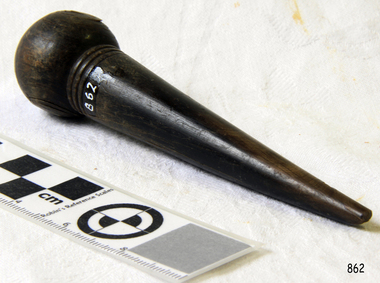
Tool - Fid, Late 19th- early 20th Century
... life was like for sailors on board sailing ships for hundreds of years. The tool in its original design is still in regular use today by recreational sailors all over the world to splice and join lengths of rope. flagstaff hill warrnambool shipwrecked-coast flagstaff-hill flagstaff-hill-maritime-museum maritime-museum shipwreck-coast flagstaff-hill-maritime-village None Wooden Fid with 3 rings around base of knob at the top of fid. ...A Fid is a conical tapered wooden tool used for separating the strands of rope for splicing. They were a tool traditionally made of wood or bone used to work with rope and canvas in marlinespike seamanship. A Fid differs from a marlinspike in material and purposes. A marlinspike is used in working with wire rope, natural and synthetic lines also may be used to open shackles, and is made of metal. A Fid is used to hold open knots and holes in the canvas, and to separate the "lays" (or strands) of synthetic or natural rope for splicing. A variation of the Fid, the gripfid, is used for ply-split braiding. The gripfid has a jamming cleat to pull a cord back through the cord split by the fid's point. Modern fid's are typically made of aluminium, steel, or plastic. In addition to holding rope open to assist the creation of a rope splice, modern push fid's have markings for precise measurements in a variety of sizes of rope. The length of these fid's is typically 21 or 22 times the diameter of rope to be spliced. Fids have been used since sailing vessels were first used to travel the worlds seas the tool was invented to be used to splice rope and with working with canvas sails. A Fid is a sailors tool that has maintained its general design for hundreds of years and gives a snapshot into what the working life was like for sailors on board sailing ships for hundreds of years. The tool in its original design is still in regular use today by recreational sailors all over the world to splice and join lengths of rope.Wooden Fid with 3 rings around base of knob at the top of fid. Noneflagstaff hill, warrnambool, shipwrecked-coast, flagstaff-hill, flagstaff-hill-maritime-museum, maritime-museum, shipwreck-coast, flagstaff-hill-maritime-village
