
Showing 86 items matching "light armoured vehicle"
-
 4th/19th Prince of Wales's Light Horse Regiment Unit History Room
Document, Department of Defence, The Australian Light Armoured Vehicle, 18 Feb 2006
... The Australian Light Armoured Vehicle...Light Armoured Vehicle...Light Armoured Vehicle A single page. The article gives a brief description of the vehicle and its capability. ...A single page. The article gives a brief description of the vehicle and its capability. Six photographs and the badges of 2/14 Light Horse and 2 Cavalry Regimentslight armoured vehicle -
4th/19th Prince of Wales's Light Horse Regiment Unit History Room
Information Sheet, Paul D Handel, ASLAV - The Australian Light Armoured Vehicle Programme, 18 Feb 2006
... ASLAV - The Australian Light Armoured Vehicle Programme...ASLAV - The Australian Light Armoured Vehicle Programme Information Sheet Paul D Handel ...A ten page article on the ASLAV-25 reconnaissance vehicle - covering the trials, description, and the variants.aslav-25, paul handel -
 Bendigo Military Museum
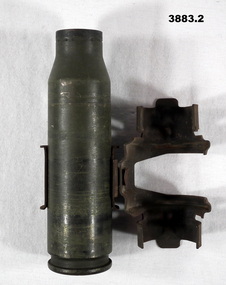
Weapon - CARTRIDGE CASE AND LINK
... 25mm cartridge case and link section from a M242 25mm Bushmaster Chain Gun mounted on an Australian Light Armoured vehicle (ASLAV). Item souvenired by Mathew Redwood. ...25mm cartridge case and link section from a M242 25mm Bushmaster Chain Gun mounted on an Australian Light Armoured vehicle (ASLAV). Item souvenired by Mathew Redwood. ...25mm cartridge case and link section from a M242 25mm Bushmaster Chain Gun mounted on an Australian Light Armoured vehicle (ASLAV). Item souvenired by Mathew Redwood. Refer Cat No 3891 for his service details. .1) M 25 cartridge case. .2) Link belt section for .1)On the link belt, “M28 ALK O7F 620 - 009”cartridge case, link belt, m 242 -
4th/19th Prince of Wales's Light Horse Regiment Unit History Room
Booklet, RAAC Training Vol 2 Firing Techniques Pam 4: The Application of Fire from Light Armoured fighting Vehicles, 1972
... A soft covered booklet dealing with the application of fire from the light AFV's in use at the time (M113 family -including Light Reconnaissance Vehicle, Armoured Personnel Carrier and Fire Support Vehicle)...Light AFV application of fire DSN 7610-66-049-4468 A soft covered booklet dealing with the application of fire from the light AFV's in use at the time (M113 family -including Light Reconnaissance Vehicle, Armoured Personnel Carrier and Fire Support Vehicle) RAAC Training Vol 2 Firing Techniques Pam 4: The Application of Fire from Light Armoured fighting Vehicles Booklet ...A soft covered booklet dealing with the application of fire from the light AFV's in use at the time (M113 family -including Light Reconnaissance Vehicle, Armoured Personnel Carrier and Fire Support Vehicle)DSN 7610-66-049-4468light afv, application of fire -
4th/19th Prince of Wales's Light Horse Regiment Unit History Room
Decorative Australian National Flag, 2007
... SECDET was based on an Australian Army combined arms combat team consisting of an infantry company group and a troop of cavalry which operated the Australian Light Armoured (ASLAV) vehicles. The force's duties included static security guarding at the Australian Embassy in Baghdad and the protection of Australian diplomats and vehicle convoys. ...SECDET was based on an Australian Army combined arms combat team consisting of an infantry company group and a troop of cavalry which operated the Australian Light Armoured (ASLAV) vehicles. The force's duties included static security guarding at the Australian Embassy in Baghdad and the protection of Australian diplomats and vehicle convoys. ...The Security Detachment Iraq (SECDET Iraq) was the final component of Australia's contribution to coalition operations in Iraq. SECDET was based on an Australian Army combined arms combat team consisting of an infantry company group and a troop of cavalry which operated the Australian Light Armoured (ASLAV) vehicles. The force's duties included static security guarding at the Australian Embassy in Baghdad and the protection of Australian diplomats and vehicle convoys. SECDET was withdrawn in August 2011, with the firm Unity Resources Group becoming responsible for providing security for Australia's diplomatic presence in Iraq. SECDET XII 2007 • D Company, 6 RAR • Troop, 2/14 LHR (QMI) • Elements, 1st MP Bn • Combat Service Support Element Some members of 4/19 Prince of Wales's light Horse Regiment were deployed to SECDETMiniature Australian flag as souvenir of SECDET XI service - Operation Catalyst. Gold coloured material edgingVIID embroidered in lower right quadrant -
 Flagstaff Hill Maritime Museum and Village
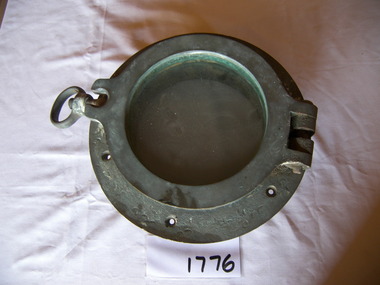
Functional object - Porthole, First half of the 20th century
... light and air. Though the term is of maritime origin, it is also used to describe round windows on armoured vehicles and aircraft. ...light and air. Though the term is of maritime origin, it is also used to describe round windows on armoured vehicles and aircraft. ...A porthole, sometimes called bull's-eye window or bull's-eye, is a generally circular window used on the hull of ships to admit light and air. Though the term is of maritime origin, it is also used to describe round windows on armoured vehicles and aircraft. On a ship, the function of a porthole, when open, is to permit light and fresh air to enter the dark and often damp below-deck quarters of the vessel. It also affords below-deck occupants a limited view to the outside world. When closed, the porthole provides a strong water-tight, weather-tight and sometimes light-tight barrier.The porthole is an example of a ships fittings and is not associated with an historical event, person or place, provenance is unable to be determined at this time and the item is believed to have been made in the first half of the 20th century.Porthole and cover, brass and glass with one screw dog fitting to secure hinged cover. Marked 6" on hinge and ringflagstaff hill, warrnambool, maritime museum, maritime village, great ocean road, shipwreck coast, porthole, ship fitting, ship window -
 Flagstaff Hill Maritime Museum and Village
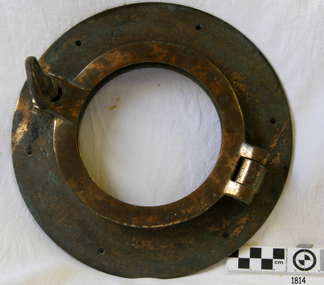
Functional object - Porthole, First half of the 20th century
... light and air. Though the term is of maritime origin, it is also used to describe round windows on armoured vehicles and aircraft. ...light and air. Though the term is of maritime origin, it is also used to describe round windows on armoured vehicles and aircraft. ...A porthole, sometimes called bull's-eye window or bull's-eye, is a generally circular window used on the hull of ships to admit light and air. Though the term is of maritime origin, it is also used to describe round windows on armoured vehicles and aircraft. On a ship, the function of a porthole, when open, is to permit light and fresh air to enter the dark and often damp below-deck quarters of the vessel. It also affords below-deck occupants a limited view to the outside world. When closed, the porthole provides a strong water-tight, weather-tight and sometimes light-tight barrier.The porthole is an example of a ships fittings and is not associated with an historical event, person or place, provenance is unable to be determined at this time and the item is believed to have been made in the first half of the 20th century.Porthole and cover, brass and no glass with screw dog to secure hinged cover.Marked 6" on hinge and ringflagstaff hill, warrnambool, shipwrecked-coast, flagstaff-hill, flagstaff-hill-maritime-museum, maritime-museum, shipwreck-coast, flagstaff-hill-maritime-village, porthole, marine window -
 Flagstaff Hill Maritime Museum and Village
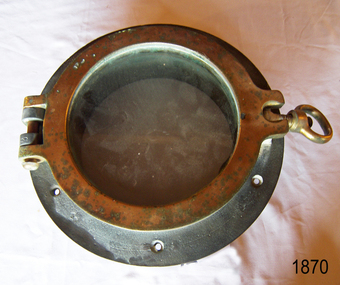
Functional object - Porthole, First half of the 20th century
... light and air. Though the term is of maritime origin, it is also used to describe round windows on armoured vehicles and aircraft. ...light and air. Though the term is of maritime origin, it is also used to describe round windows on armoured vehicles and aircraft. ...A porthole, sometimes called bull's-eye window or bull's-eye, is a generally circular window used on the hull of ships to admit light and air. Though the term is of maritime origin, it is also used to describe round windows on armoured vehicles and aircraft. On a ship, the function of a porthole, when open, is to permit light and fresh air to enter the dark and often damp below-deck quarters of the vessel. It also affords below-deck occupants a limited view to the outside world. When closed, the porthole provides a strong water-tight, weather-tight and sometimes light-tight barrier.The porthole is an example of a ships fittings and is not associated with an historical event, person or place, provenance is unable to be determined at this time and the item is believed to have been made in the first half of the 20th century.Porthole and cover, brass and glass with 1 screw dog to secure hinged cover. Marked 6" on ringflagstaff hill, warrnambool, shipwrecked-coast, flagstaff-hill, flagstaff-hill-maritime-museum, maritime-museum, shipwreck-coast, flagstaff-hill-maritime-village, porthole -
 Flagstaff Hill Maritime Museum and Village
Functional object - Lightwell Cover, Charles Connell & Co / Barclay, Curdie & Co, 1873
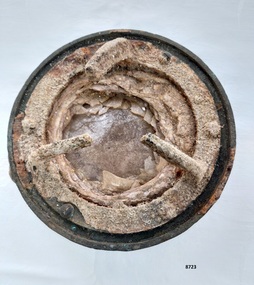
... light and air.) Though the term is of maritime origin, it is also used to describe round windows on armoured vehicles and aircraft. ...light and air.) Though the term is of maritime origin, it is also used to describe round windows on armoured vehicles and aircraft. ...This artifact was recovered from the wreck of the Loch Ard, on the southwest coast of Victoria and donated by a friend of the diver. It appears to be a "Lightwell" cover as distinguished from a porthole as there is no sign of a hinge that would allow it to open and let in fresh air. (Nb a porthole, sometimes called bull's-eye window or bull's-eye, is a generally circular window used on the hull of ships to admit light and air.) Though the term is of maritime origin, it is also used to describe round windows on armoured vehicles and aircraft. On a ship, the function of a porthole, when open, is to permit light and fresh air to enter the dark and often damp below-deck quarters of the vessel. It also affords below-deck occupants a limited view to the outside world. When closed, the porthole provides a strong water-tight, weather-tight and sometimes light-tight barrier. A "Lightwell "cover would allow light into the lower decks but would remain watertight. The ship Loch Ard was built on the River Clyde in Scotland in 1873 for the prestigious Loch Line of colonial clipper ships, designed for the Australian run. It sailed from England on 1st March 1878 carrying 37 crew, 17 passengers and a load of cargo. The general cargo reflected the affluence of Melbourne at the time. On board were straw hats, umbrellas, perfumes, clay pipes, pianos, clocks, confectionary, linen and candles, as well as a heavier load of railway irons, cement, lead and copper. There were items included that were intended for display in the Melbourne International Exhibition in 1880 - a diverse general cargo ranging from luxury items to bulk railway iron. On 1 June 1878, emerging from fog and hearing too late the sound of breakers against the tall limestone cliffs, the vessel struck the southern foot of Mutton Bird Island and sank in 23 metres of water. Of the fifty-four people on board only two survived, one young male crewman, Tom Pearce, and one young female passenger, Eva Carmichael. Ten days after the Loch Ard tragedy, salvage rights to the wreck were sold at auction for £2,120. Cargo valued at £3,000 was salvaged and placed on the beach, but most washed back into the sea when another storm developed. The wreck of Loch Ard still lies at the base of Mutton Bird Island. Much of the cargo has now been salvaged and some was washed up into what is now known as Loch Ard Gorge. Cargo and artefacts have also been illegally salvaged over many years before protective legislation was introduced. One of the most unlikely pieces of cargo to have survived the shipwreck was a Minton porcelain peacock - one of only seven in the world. The peacock was destined for the Melbourne International Exhibition in 1880. It had been well packed, which gave it adequate protection during the violent storm. Today, the Minton peacock can be seen at the Flagstaff Hill Maritime Museum in Warrnambool. From Australia's most dramatic shipwreck it has now become Australia's most valuable shipwreck artefact and is one of very few 'objects' on the Victorian State Heritage Register. Flagstaff Hill’s collection of artefacts from LOCH ARD is significant for being one of the largest collections of artefacts from this shipwreck in Victoria. It is significant for its association with the shipwreck, which is on the Victorian Heritage Register (VHR S417). The collection is significant because of the relationship between the objects, as together they have a high potential to interpret the story of the LOCH ARD. The LOCH ARD collection is archaeologically significant as the remains of a large international passenger and cargo ship. The LOCH ARD collection is historically significant for representing aspects of Victoria’s shipping history and its potential to interpret sub-theme 1.5 of Victoria’s Framework of Historical Themes (living with natural processes). The collection is also historically significant for its association with the LOCH ARD, which was one of the worst and best known shipwrecks in Victoria’s history.A circular metal and glass lightwell cover that is heavily encrusted with sea sediment. There is a circular outer frame with screws that attach to an inner frame. The inner frame has three curved lugs and encase thick domed (and flaking) glass.flagstaff hill maritime museum and village, warrnambool, great ocean road, shipwreck coast, loch ard, wreck of the loch ard, salvage, loch ard gorge, lightwell, lightwell cover -
 Australian Commando Association - Victoria
Book - 6th Div, Shawn OLeary, To The Green Fields Beyond:The story of the 6th Division Cavalry Commandos
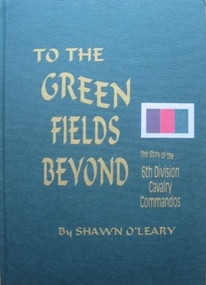
... Armoured Brigade, supported the attack. Tobruk was the next Italian fort to be captured, with the regiment again in support and covering the 19th Brigade’s advance. The regiment, though, was under-equipped and without its full compliment of vehicles, using only machine gun carriers. To compensate for this, A Squadron was parity re-equipped with captured Italian light ...The comprehensive history of the 6th Australian Division Cavalry Commandos – a (now out of print) reprint of one of the rarer Armoured unit history books. This is the story of one of Australia’s most famous fighting regiments during World War II. As an armoured cavalry unit it fought the Italians and Germans in the sands of the African desert and the Vichy French in the mountains of Syria. Later as a dismounted commando unit it fought the Japanese in the terrifying jungles of New Guinea. The heroism of the men in its ranks and the actions in which they engaged are portrayed in a way which makes battle deeds leap realistically from the pages. “To The Green Fields Beyond” is a documented and detailed book which is of value to everyone who is interested in Australia’s story. Seldom before has such a contribution been made to record of our national history. The book has been approved and sponsored by the Australian War Memorial. The 6th Division Cavalry Regiment was formed in November 1939 and, just two months later, was sent overseas to the Middle East in January 1940. Arriving in Egypt, the regiment immediately went to Palestine, where it joined the rest of the 6th Division and trained using machine-gun carriers and, from October, six old Vickers light tanks. At the end of the year the regiment moved into the Western Desert, where it joined British forces ready for the major offensive to commence on 9 December. Two days later the regiment became the first unit of the 2nd Australian Imperial Force (AIF) to go into action when one of its squadron fought a sharp action against the Italians holding Garn el Grein and Fort Maddalina on 11 and 12 December. By 21 December British forces had captured Sidi Barrrani and the desert was now open for the 6th Division’s advance along the Libyan coast. On 3 January 1941 the division attacked and captured the Italian fort of Bardia. The regiment’s A Squadron, under the command of Major Denzil Macarthur-Onslow, who went on to command the 4th Armoured Brigade, supported the attack. Tobruk was the next Italian fort to be captured, with the regiment again in support and covering the 19th Brigade’s advance. The regiment, though, was under-equipped and without its full compliment of vehicles, using only machine gun carriers. To compensate for this, A Squadron was parity re-equipped with captured Italian light tanks, which had large kangaroos painted on the hulls and turrets to distinguish them from enemy vehicles. After Tobruk, the regiment was used as part of the advance guard in the capture of Derna and then Benghazi. In April the unit moved to Helwan, where it was equipped with Vickers light tanks and machine-gun carriers, and operated with British troops in capturing Sollum. Towards the end of May the regiment moved to Palestine, where it came under the command of the 7th Division for the imminent invasion of Syria. The regiment experienced its heaviest fighting during the Syrian campaign, which began on 7 June. A Squadron was attached to the 21st Brigade and advanced along the coast, where the rugged hills made it difficult to manoeuvre the tanks and carriers. The squadron was relieved by one of the 9th Division Cavalry Regiment’s squadrons on 13 and 14 June. C Squadron, meanwhile, was with the 25th Brigade, and advanced along the Rosh Pinna road, engaging strong enemy defences at Fort Khirbe. C Squadron was relieved by B Squadron, which was later attacked by Vichy French tanks that were supported by heavy artillery and machine-gun fire, which forced the Australians to withdrawal. Always willing or needing to improvise during the campaign, A and B Squadrons both operated three captured French R35 Renault light tanks, while C Squadron provided personnel for a horse troop, quickly nicknamed the “Kelly Gang”, to patrol the high, rugged hills near the Mardjayoun–Banis Road. The regiment remained in Syria as part of the occupation force and returned to Australia in March 1942. It was sent to the Adelaide River, in the Northern Territory, and then later to Murgon, in Queensland. In 1943 and 1944 divisional cavalry regiments were reorganised into cavalry (commando) regiments. In January 1944 the 6th Division Cavalry Regiment became the 2/6th Cavalry (Commando) Regiment. The regiment lost its vehicles and became the administrative headquarters for the 2/7th, 2/9th, and 2/10th Commando Squadrons. The regiment remained with the 6th Division and participated in the Aitpae–Wewak campaign, in New Guinea, during 1945. Includes Nominal Rollnon-fictionThe comprehensive history of the 6th Australian Division Cavalry Commandos – a (now out of print) reprint of one of the rarer Armoured unit history books. This is the story of one of Australia’s most famous fighting regiments during World War II. As an armoured cavalry unit it fought the Italians and Germans in the sands of the African desert and the Vichy French in the mountains of Syria. Later as a dismounted commando unit it fought the Japanese in the terrifying jungles of New Guinea. The heroism of the men in its ranks and the actions in which they engaged are portrayed in a way which makes battle deeds leap realistically from the pages. “To The Green Fields Beyond” is a documented and detailed book which is of value to everyone who is interested in Australia’s story. Seldom before has such a contribution been made to record of our national history. The book has been approved and sponsored by the Australian War Memorial. The 6th Division Cavalry Regiment was formed in November 1939 and, just two months later, was sent overseas to the Middle East in January 1940. Arriving in Egypt, the regiment immediately went to Palestine, where it joined the rest of the 6th Division and trained using machine-gun carriers and, from October, six old Vickers light tanks. At the end of the year the regiment moved into the Western Desert, where it joined British forces ready for the major offensive to commence on 9 December. Two days later the regiment became the first unit of the 2nd Australian Imperial Force (AIF) to go into action when one of its squadron fought a sharp action against the Italians holding Garn el Grein and Fort Maddalina on 11 and 12 December. By 21 December British forces had captured Sidi Barrrani and the desert was now open for the 6th Division’s advance along the Libyan coast. On 3 January 1941 the division attacked and captured the Italian fort of Bardia. The regiment’s A Squadron, under the command of Major Denzil Macarthur-Onslow, who went on to command the 4th Armoured Brigade, supported the attack. Tobruk was the next Italian fort to be captured, with the regiment again in support and covering the 19th Brigade’s advance. The regiment, though, was under-equipped and without its full compliment of vehicles, using only machine gun carriers. To compensate for this, A Squadron was parity re-equipped with captured Italian light tanks, which had large kangaroos painted on the hulls and turrets to distinguish them from enemy vehicles. After Tobruk, the regiment was used as part of the advance guard in the capture of Derna and then Benghazi. In April the unit moved to Helwan, where it was equipped with Vickers light tanks and machine-gun carriers, and operated with British troops in capturing Sollum. Towards the end of May the regiment moved to Palestine, where it came under the command of the 7th Division for the imminent invasion of Syria. The regiment experienced its heaviest fighting during the Syrian campaign, which began on 7 June. A Squadron was attached to the 21st Brigade and advanced along the coast, where the rugged hills made it difficult to manoeuvre the tanks and carriers. The squadron was relieved by one of the 9th Division Cavalry Regiment’s squadrons on 13 and 14 June. C Squadron, meanwhile, was with the 25th Brigade, and advanced along the Rosh Pinna road, engaging strong enemy defences at Fort Khirbe. C Squadron was relieved by B Squadron, which was later attacked by Vichy French tanks that were supported by heavy artillery and machine-gun fire, which forced the Australians to withdrawal. Always willing or needing to improvise during the campaign, A and B Squadrons both operated three captured French R35 Renault light tanks, while C Squadron provided personnel for a horse troop, quickly nicknamed the “Kelly Gang”, to patrol the high, rugged hills near the Mardjayoun–Banis Road. The regiment remained in Syria as part of the occupation force and returned to Australia in March 1942. It was sent to the Adelaide River, in the Northern Territory, and then later to Murgon, in Queensland. In 1943 and 1944 divisional cavalry regiments were reorganised into cavalry (commando) regiments. In January 1944 the 6th Division Cavalry Regiment became the 2/6th Cavalry (Commando) Regiment. The regiment lost its vehicles and became the administrative headquarters for the 2/7th, 2/9th, and 2/10th Commando Squadrons. The regiment remained with the 6th Division and participated in the Aitpae–Wewak campaign, in New Guinea, during 1945. Includes Nominal Rollww2, australian commandos, australian special forces, world war 2 -
4th/19th Prince of Wales's Light Horse Regiment Unit History Room
Transmission Assembly, Ferret Scout Car, Daimler, c 1950
... The Ferret is a light armoured car, intended for light reconnaissance work, they are very mobile and were well suited to their role. The vehicle...The Ferret is a light armoured car, intended for light reconnaissance work, they are very mobile and were well suited to their role. The vehicle ...The Ferret Scout Car , was developed by the British Army in the late 1940s and came into production in the 1950s. The Ferret first saw service in the British Army in 1952, and a little later in Australia. There were many series and Marks of the Ferret. In Australia two were primarily used. The Mark1, which had no turret and a crew of three, and the Mark2, with a turret and a crew of two. The Australian Army used the Ferrets as scout cars until the 1960s, they were disposed of by public auction in the early 1970s. The Ferret is a light armoured car, intended for light reconnaissance work, they are very mobile and were well suited to their role. The vehicle was designed by Daimler, as a further development on the successful Daimler Dingo of WW2. The Ferret is fully armoured and the standard model of the Ferret Mk2 was further strengthened shortly after its design and became the Mk2/3 (this is the usual model referred as the Mk2). The motor was Roll Royce B60 motor, giving the vehicle a power to weight ratio of 29.35 break horse power per tonne, the vehicle weighs 3.6 tonnes, although a combat weight would be 4.3 tonnes. It is four wheel drive, constant, and has a top speed of 93 k.p.h. (approx 50 m.p.h.). Fuel consumption is only about 34 litres per kilometer. The Ferret is 3.8 metres long by 1.9 metres wide and is 1.9 metres high, not including radio aerials. The ground clearance is .33 of a metre and the track width is 1.5 metres.Ferret Scout Car - B60 No 1 Mk 6A transmission assembly incorporating engine, fluid coupling, gear box and transfer box.Engine Number 12993 List Number 35418 Modification plate marked to Mod 3. ferret scout car, transmission -
4th/19th Prince of Wales's Light Horse Regiment Unit History Room
Transmission Assembly, Ferret Scout Car
... The Ferret is a light armoured car, intended for light reconnaissance work, they are very mobile and were well suited to their role. The vehicle...The Ferret is a light armoured car, intended for light reconnaissance work, they are very mobile and were well suited to their role. The vehicle ...The Ferret Scout Car Mark 2, was developed by the British Army in the late 1940s and came into production in the 1950s. The Ferret first saw service in the British Army in 1952, and a little later in Australia. There were many series and Marks of the Ferret. In Australia two were primarily used. The Mark1, which had no turret and a crew of three, and the Mark2, with a turret and a crew of two. The Australian Army used the Ferrets as scout cars until the 1960s, they were disposed of by public auction in the early 1970s. The Ferret is a light armoured car, intended for light reconnaissance work, they are very mobile and were well suited to their role. The vehicle was designed by Daimler, as a further development on the successful Daimler Dingo of WW2. The Ferret is fully armoured and the standard model of the Ferret Mk2 was further strengthened shortly after its design and became the Mk2/3 (this is the usual model referred as the Mk2). The motor was Roll Royce B60 motor, giving the vehicle a power to weight ratio of 29.35 break horse power per tonne, the vehicle weighs 3.6 tonnes, although a combat weight would be 4.3 tonnes. It is four wheel drive, constant, and has a top speed of 93 k.p.h. (approx 50 m.p.h.).Fuel consumption is only about 34 litres per kilometer. The Ferret is 3.8 metres long by 1.9 metres wide and is 1.9 metres high, not including radio aerials. The ground clearance is .33 of a metre and the track width is 1.5 metres.ferret scout car, transmission -
4th/19th Prince of Wales's Light Horse Regiment Unit History Room
Booklet, Royal Australian Armoured Corps Training Vol 2 Firing Techniques Pam No 4. The Application of Fire from Light Armoured Fighting Vehicles, 1972
... The Application of Fire from Light Armoured Fighting Vehicles Booklet ...Soft covered booklet.DSN 7610-66-049-4468firing techniques, afv's -
4th/19th Prince of Wales's Light Horse Regiment Unit History Room
Document (3 copies), Royal Australian Armoured Corps. Corps Training Notes Vol 2 Firing Techniques and Armaments. Pam No 6 Light AFV Armament. Application of Fire, 1993
... A loose leaf interim publication to provide the information necessary for instructors and vehicle commanders to conduct initial and continued training for crews Royal Australian Armoured Corps. Corps Training Notes Vol 2 Firing Techniques and Armaments. Pam No 6 Light ...A loose leaf interim publication to provide the information necessary for instructors and vehicle commanders to conduct initial and continued training for crews -
 4th/19th Prince of Wales's Light Horse Regiment Unit History Room
Decorative object - Scale Model, M577A1 Armoured Command Vehicle
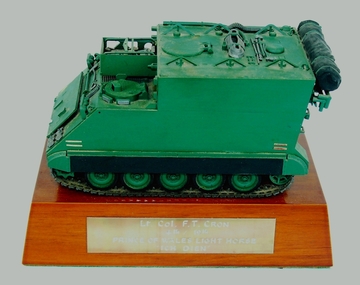
... model m577a1 armoured command vehicle cron Lt Col F T Cron 4th/19th Prince of Wales's Light Horse "Ich Dien" 1:35 scale model of M577A1 ACV, mounted on wooden base Decorative object Scale Model, M577A1 Armoured Command Vehicle ...1:35 scale model of M577A1 ACV, mounted on wooden baseLt Col F T Cron 4th/19th Prince of Wales's Light Horse "Ich Dien"model, m577a1, armoured command vehicle, cron -
4th/19th Prince of Wales's Light Horse Regiment Unit History Room
Post cards, set, Royal Armoured Corps Tank Museum, 1980's
... The vehicles are Charioteer Tank, Tortoise SP Gun,Vickers Medium and Light Tanks, Sherman Tanks, Churchill VII Tank, Grant Tank, and three armoured cars - an Austin, Rolls-Royce and Crossley Mk1....The vehicles are Charioteer Tank, Tortoise SP Gun,Vickers Medium and Light Tanks, Sherman Tanks, Churchill VII Tank, Grant Tank, and three armoured cars - an Austin, Rolls-Royce and Crossley Mk1. ...A set of seven post cards, each with photograph of vehicles in the Tank Museum at Bovington, UK. The vehicles are Charioteer Tank, Tortoise SP Gun,Vickers Medium and Light Tanks, Sherman Tanks, Churchill VII Tank, Grant Tank, and three armoured cars - an Austin, Rolls-Royce and Crossley Mk1.post cards, tank museum, bovington -
4th/19th Prince of Wales's Light Horse Regiment Unit History Room
Servicing Schedule, Crew Maintenance Staghound Armoured Car T17E1, 1945
... Staghound Armoured Car Servicing A light cardboard covered booklet covering the various maintenance tasks to be carried out on the components of the vehicle Crew Maintenance Staghound Armoured Car T17E1 Servicing Schedule ...A light cardboard covered booklet covering the various maintenance tasks to be carried out on the components of the vehiclestaghound armoured car, servicing -
 Geelong Naval and Maritime Museum
Tool - Porthole, Unsure
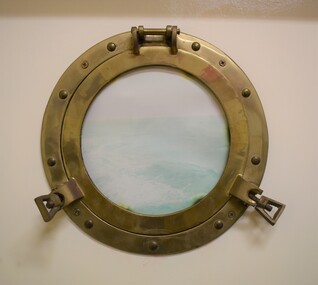
... light and air. Though the term is of maritime origin, it is also used to describe round windows on armoured vehicles, aircraft, automobiles (the Ford Thunderbird a notable example) and even spacecraft. ...light and air. Though the term is of maritime origin, it is also used to describe round windows on armoured vehicles, aircraft, automobiles (the Ford Thunderbird a notable example) and even spacecraft. ...A porthole, sometimes called bull's-eye window or bull's-eye, is a circular window used on the hull of ships to admit light and air. Though the term is of maritime origin, it is also used to describe round windows on armoured vehicles, aircraft, automobiles (the Ford Thunderbird a notable example) and even spacecraft. On a ship, the function of a porthole, when open, is to permit light and fresh air to enter the dark and often damp below-deck quarters of the vessel. It also affords below-deck occupants a limited view to the outside world. When closed, the porthole provides a strong water-tight, weather-tight and sometimes light-tight barrier (not in the case however). A porthole on a ship may also be called a side scuttle (side hole), as officially termed in the International Convention for the Safety of Life at Sea. This term is used in the U.S. Code of Federal Regulations. It is also used in related rules and regulations for the construction of ships. The use of the word "side scuttle" instead of "porthole" is meant to be broad, including any covered or uncovered hole in the side of the vessel. This porthole is a useful demonstration of naval technology to give people an insight into life at see. Small windows such as this example could be all people would see on long see voyage across rough seas. Commanding officers scuttle made of brass with glass opening windowmaritime technology -
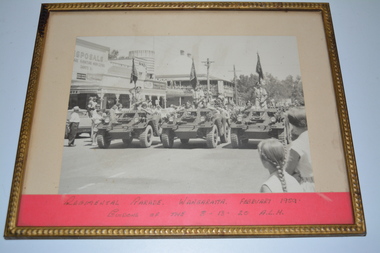 Wangaratta RSL Sub Branch
Memorabilia - Photograph, Regimental Parade, 1959
... Black and white image of three armoured vehicles each with soldier escorting large guidon/flags of the 8th/13th/20th Australian Light Horse regiments on parade through township of Wangaratta in February 1959 ...Black and white image of three armoured vehicles each with soldier escorting large guidon/flags of the 8th/13th/20th Australian Light Horse regiments on parade through township of Wangaratta in February 1959 1959 guidons wangaratta 8/13/20 ALH Regimental Parade Wangaratta February 1959 Guidons of the 8th/13th/20th ALH Black and white photograph depicting three armoured vehicles each with soldier standing holding a guidon/flag Regimental Parade Memorabilia Photograph ...Black and white image of three armoured vehicles each with soldier escorting large guidon/flags of the 8th/13th/20th Australian Light Horse regiments on parade through township of Wangaratta in February 1959 Black and white photograph depicting three armoured vehicles each with soldier standing holding a guidon/flag Regimental Parade Wangaratta February 1959 Guidons of the 8th/13th/20th ALH1959, guidons, wangaratta, 8/13/20 alh -
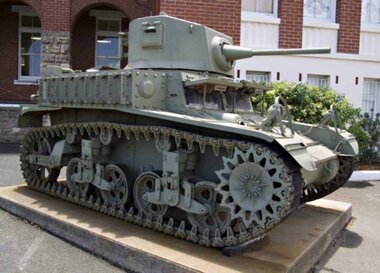 Australian Army Museum of Western Australia
Armoured Fighting Vehicle
... Stuart (Honey) Light Tank Armoured Fighting Vehicle ...Stuart (Honey) Light Tank -
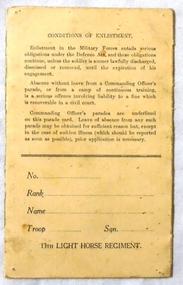 8th/13th Victorian Mounted Rifles Regimental Collection
Parade card, 1939
... 13th (Gippsland) Light Horse Regiment was a unit of the Citizen Military Forces or Militia with its Headquarters in Sale Victoria and depots throughout Gippsland. The regiment in 1939 was still horse mounted but converted to armoured vehicles soon after becoming the 13th Armoured Regiment....13th (Gippsland) Light Horse Regiment was a unit of the Citizen Military Forces or Militia with its Headquarters in Sale Victoria and depots throughout Gippsland. The regiment in 1939 was still horse mounted but converted to armoured vehicles soon after becoming the 13th Armoured Regiment. ...13th (Gippsland) Light Horse Regiment was a unit of the Citizen Military Forces or Militia with its Headquarters in Sale Victoria and depots throughout Gippsland. The regiment in 1939 was still horse mounted but converted to armoured vehicles soon after becoming the 13th Armoured Regiment.Fine example of a document setting out the program of parades and training obligations for a citizen soldier in the immediate pre-Second World War period.White three fold card being Programme of Parades for Half-Year ending 31st dec 1939 for 13th (Gippsland0 Light Horse Regiment, 3rd Cavalry Brigade, 2nd Cavalry Division. Commanding Officer Lieut Col WG Hopkins13th light horse, gippsland, hopkins wg lieutenant colonel, parade card -
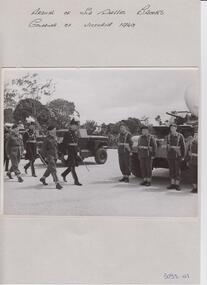 8th/13th Victorian Mounted Rifles Regimental Collection
Photograph
... Black and white photograph of Sir Dallas Brooks and Party inspecting an Escort from 4/19th Prince of Wales's Light Horse. Vehicles are Staghound Armoured Car and Doodlebug Scout Car....See description in "Hooves, Wheels & Tracks: A History of the 4th/19th Prince of Wales's Light Horse and its predecessors" by David Holloway, 1990, p.455 Black and white photograph of Sir Dallas Brooks and Party inspecting an Escort from 4/19th Prince of Wales's Light Horse. Vehicles are Staghound Armoured Car and Doodlebug Scout Car. ...See description in "Hooves, Wheels & Tracks: A History of the 4th/19th Prince of Wales's Light Horse and its predecessors" by David Holloway, 1990, p.455Black and white photograph of Sir Dallas Brooks and Party inspecting an Escort from 4/19th Prince of Wales's Light Horse. Vehicles are Staghound Armoured Car and Doodlebug Scout Car. -
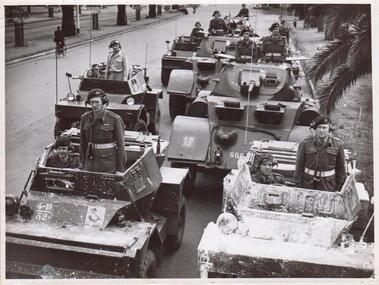 8th/13th Victorian Mounted Rifles Regimental Collection
Photograph
... See description in "Hooves, Wheels & Tracks: A History of the 4th/19th Prince of Wales's Light Horse and its predecessors" by David Holloway, 1990, p.455 Black and white photograph of escort in armoured vehicles assembled awaiting the arrival of Governor Sir Dallas Brooks cars.. ...See description in "Hooves, Wheels & Tracks: A History of the 4th/19th Prince of Wales's Light Horse and its predecessors" by David Holloway, 1990, p.455Black and white photograph of escort in armoured vehicles assembled awaiting the arrival of Governor Sir Dallas Brooks cars.. Vehicles Doodlebug Scout Cars and Staghound Armoured Car. -
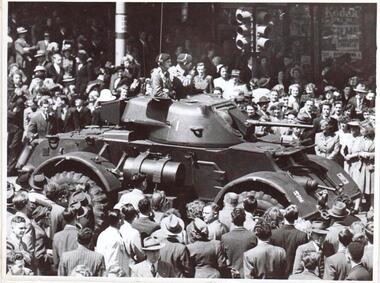 8th/13th Victorian Mounted Rifles Regimental Collection
Photograph
... Black and white photograph of Staghound Armoured Car in crowded street, Vehicle is part of escort of Governor Sir Dallas Brooks, October 1949. Escort provided by 4/19th Prince of Wales's Light Horse....See description in "Hooves, Wheels & Tracks: A History of the 4th/19th Prince of Wales's Light Horse and its predecessors" by David Holloway, 1990, p.455 Black and white photograph of Staghound Armoured Car in crowded street, Vehicle is part of escort of Governor Sir Dallas Brooks, October 1949. ...See description in "Hooves, Wheels & Tracks: A History of the 4th/19th Prince of Wales's Light Horse and its predecessors" by David Holloway, 1990, p.455Black and white photograph of Staghound Armoured Car in crowded street, Vehicle is part of escort of Governor Sir Dallas Brooks, October 1949. Escort provided by 4/19th Prince of Wales's Light Horse. -
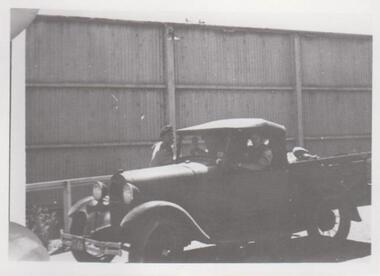 8th/13th Victorian Mounted Rifles Regimental Collection
Photograph, 1950 circa
... Light Horse forming the VMR Squadron of that regiment. Alan Cunningham joined the regiment as a trooper in 1948 and went on to command the regiment as a Lieutenant Colonel 1962-65. The use of civilian vehicles was not uncommon inn early days of the regiment especially for activities such as radio training. Unique collection of photographs showing the first years of an armoured ...The 8th/13th Victorian Mounted Rifles was raised as a regiment of the Royal Australian Armoured Corps on 1 May 1948 with Headquarters in Melbourne and squadrons in Sale, Benalla/Wangaratta and Albury. In 1955 Regimental Headquarters moved to Wangaratta and a second squadron was located at Albury. The Sale squadron transferred to 4th/19th Prince of Wales’s Light Horse. In 1977 8/13 VMR Regiment was reduced to an independent squadron A Squadron 8th/13th Victorian Mounted Rifles and in 1991 was linked with 4th/19th Prince of Wales’s Light Horse forming the VMR Squadron of that regiment. Alan Cunningham joined the regiment as a trooper in 1948 and went on to command the regiment as a Lieutenant Colonel 1962-65. The use of civilian vehicles was not uncommon inn early days of the regiment especially for activities such as radio training.Unique collection of photographs showing the first years of an armoured regiment of the post-Second World War era Citizen Military Forces showing equipment, uniforms, training and social activity and some personalities.Black and white photograph of T-model Ford utility vehicle and two soldiers. One of a collection of photographs of 8th/13th Victorian Mounted Rifles Regiment between 1948 and 1951." Alan Cunningham's Staff Car - Ron Braddy Bonnet, Alan Cunningham Driver"8th/13th victorian mounted rifles, cunningham alan lieutenant ciolonel, braddy ronald -
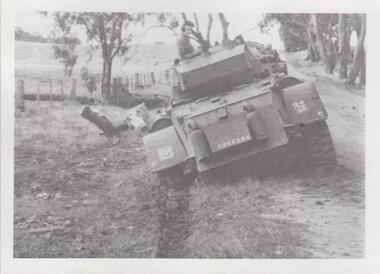 8th/13th Victorian Mounted Rifles Regimental Collection
Photograph - Staghound
... Light Horse forming the VMR Squadron of that regiment. Unique collection of photographs showing the first years of an armoured regiment of the post-Second World War era Citizen Military Forces showing equipment, uniforms, training and social activity and some personalities. cmf vmr staghound training " Staghound bogged " Black and white photograph of Staghound Armoured Car bogged on side of road. Vehicle ...The 8th/13th Victorian Mounted Rifles was raised as a regiment of the Royal Australian Armoured Corps on 1 May 1948 with Headquarters in Melbourne and squadrons in Sale, Benalla/Wangaratta and Albury. In 1955 Regimental Headquarters moved to Wangaratta and a second squadron was located at Albury. The Sale squadron transferred to 4th/19th Prince of Wales’s Light Horse. In 1977 8/13 VMR Regiment was reduced to an independent squadron A Squadron 8th/13th Victorian Mounted Rifles and in 1991 was linked with 4th/19th Prince of Wales’s Light Horse forming the VMR Squadron of that regiment.Unique collection of photographs showing the first years of an armoured regiment of the post-Second World War era Citizen Military Forces showing equipment, uniforms, training and social activity and some personalities.Black and white photograph of Staghound Armoured Car bogged on side of road. Vehicle markings indicate negative has been printer in reverse. One of a collection of photographs of 8th/13th Victorian Mounted Rifles Regiment between 1948 and 1951." Staghound bogged "cmf, vmr, staghound, training -
 8th/13th Victorian Mounted Rifles Regimental Collection
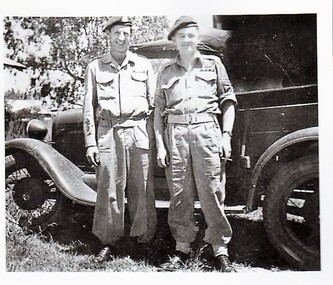
Photograph - 8/13 VMR soldiers
... Light Horse forming the VMR Squadron of that regiment. Unique collection of photographs showing the first years of an armoured regiment of the post-Second World War era Citizen Military Forces showing equipment, uniforms, training and social activity and some personalities. McKay Veitch 8/13 VMR military uniform Nulla " Sgt. Alan Vietch, Sgt. Kilty McKay" Black and white photograph of two soldiers standing beside civilian utility vehicle ...The 8th/13th Victorian Mounted Rifles was raised as a regiment of the Royal Australian Armoured Corps on 1 May 1948 with Headquarters in Melbourne and squadrons in Sale, Benalla/Wangaratta and Albury. In 1955 Regimental Headquarters moved to Wangaratta and a second squadron was located at Albury. The Sale squadron transferred to 4th/19th Prince of Wales’s Light Horse. In 1977 8/13 VMR Regiment was reduced to an independent squadron A Squadron 8th/13th Victorian Mounted Rifles and in 1991 was linked with 4th/19th Prince of Wales’s Light Horse forming the VMR Squadron of that regiment.Unique collection of photographs showing the first years of an armoured regiment of the post-Second World War era Citizen Military Forces showing equipment, uniforms, training and social activity and some personalities.Black and white photograph of two soldiers standing beside civilian utility vehicle, one wearing a long sleeved khaki drill workdress uniform. Other has sleeves rolled up and is wearing web belt. Both are wearing berets.One of a collection of photographs of 8th/13th Victorian Mounted Rifles Regiment between 1948 and 1951." Sgt. Alan Vietch, Sgt. Kilty McKay"mckay, veitch, 8/13 vmr, military, uniform, nulla -
 8th/13th Victorian Mounted Rifles Regimental Collection
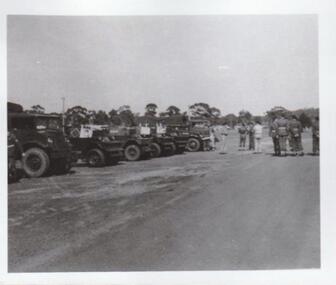
Photograph
... Armoured Corps on 1 May 1948 with Headquarters in Melbourne and squadrons in Sale, Benalla/Wangaratta and Albury. In 1955 Regimental Headquarters moved to Wangaratta and a second squadron was located at Albury. The Sale squadron transferred to 4th/19th Prince of Wales’s Light Horse. In 1977 8/13 VMR Regiment was reduced to an independent squadron A Squadron 8th/13th Victorian Mounted Rifles and in 1991 was linked with 4th/19th Prince of Wales’s Light Horse forming the VMR Squadron of that regiment. " A Squadron at Puckapunyal Camp 1950 Black and white photograph of wheeled vehicles drawn up at Puckapunyal. ...The 8th/13th Victorian Mounted Rifles was raised as a regiment of the Royal Australian Armoured Corps on 1 May 1948 with Headquarters in Melbourne and squadrons in Sale, Benalla/Wangaratta and Albury. In 1955 Regimental Headquarters moved to Wangaratta and a second squadron was located at Albury. The Sale squadron transferred to 4th/19th Prince of Wales’s Light Horse. In 1977 8/13 VMR Regiment was reduced to an independent squadron A Squadron 8th/13th Victorian Mounted Rifles and in 1991 was linked with 4th/19th Prince of Wales’s Light Horse forming the VMR Squadron of that regiment.Black and white photograph of wheeled vehicles drawn up at Puckapunyal. Group of men in uniform on right of photo. One of a collection of photographs of 8th/13th Victorian Mounted Rifles Regiment between 1948 and 1951." A Squadron at Puckapunyal Camp 1950 -
 8th/13th Victorian Mounted Rifles Regimental Collection
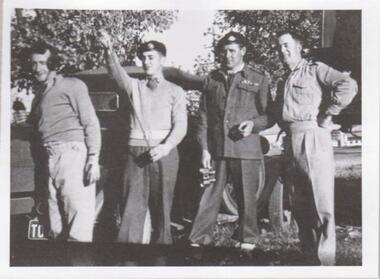
Photograph
... Light Horse forming the VMR Squadron of that regiment. Unique collection of photographs showing the first years of an armoured regiment of the post-Second World War era Citizen Military Forces showing equipment, uniforms, training and social activity and some personalities. " Cunningham Alternative Command Vehicle. ...The 8th/13th Victorian Mounted Rifles was raised as a regiment of the Royal Australian Armoured Corps on 1 May 1948 with Headquarters in Melbourne and squadrons in Sale, Benalla/Wangaratta and Albury. In 1955 Regimental Headquarters moved to Wangaratta and a second squadron was located at Albury. The Sale squadron transferred to 4th/19th Prince of Wales’s Light Horse. In 1977 8/13 VMR Regiment was reduced to an independent squadron A Squadron 8th/13th Victorian Mounted Rifles and in 1991 was linked with 4th/19th Prince of Wales’s Light Horse forming the VMR Squadron of that regiment.Unique collection of photographs showing the first years of an armoured regiment of the post-Second World War era Citizen Military Forces showing equipment, uniforms, training and social activity and some personalities.Black and white photograph of four soldiers in variety of uniforms standing beside civilian utility vehicle. One is wearing winter service dress, one in khaki drill uniform, two are wearing V neck Army jumpers. One is wearing headphones, one haslength of radio aerial. One of a collection of photographs of 8th/13th Victorian Mounted Rifles Regiment between 1948 and 1951." Cunningham Alternative Command Vehicle. No. 1 Set Training. John Neale, George Atkinson, Bill Purcell, Ron Braddy. " -
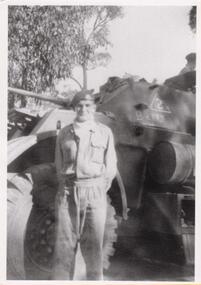 8th/13th Victorian Mounted Rifles Regimental Collection
Photograph - soldier and AFV
... In 1977 8/13 VMR Regiment was reduced to an independent squadron A Squadron 8th/13th Victorian Mounted Rifles and in 1991 was linked with 4th/19th Prince of Wales’s Light Horse forming the VMR Squadron of that regiment.The 8th/13th Unique collection of photographs showing the first years of an armoured regiment of the post-Second World War era Citizen Military Forces showing equipment, uniforms, training and social activity and some personalities. military uniform VMR citizen soldier staghound armour vehicle " Tpr. ...Victorian Mounted Rifles was raised as a regiment of the Royal Australian Armoured Corps on 1 May 1948 with Headquarters in Melbourne and squadrons in Sale, Benalla/Wangaratta and Albury. In 1955 Regimental Headquarters moved to Wangaratta and a second squadron was located at Albury. The Sale squadron transferred to 4th/19th Prince of Wales’s Light Horse. In 1977 8/13 VMR Regiment was reduced to an independent squadron A Squadron 8th/13th Victorian Mounted Rifles and in 1991 was linked with 4th/19th Prince of Wales’s Light Horse forming the VMR Squadron of that regiment.The 8th/13th Unique collection of photographs showing the first years of an armoured regiment of the post-Second World War era Citizen Military Forces showing equipment, uniforms, training and social activity and some personalities.Black and White photograph of soldier standing beside Staghound Armoured Car, wearing long sleeved khaki drill jackrt and trousers.beret and cravat. One of a collection of photographs of 8th/13th Victorian Mounted Rifles Regiment between 1948 and 1951." Tpr. Keith Neale "military, uniform, vmr, citizen soldier, staghound, armour, vehicle
