
Showing 192 items matching "light music"
-
 Tatura Irrigation & Wartime Camps Museum
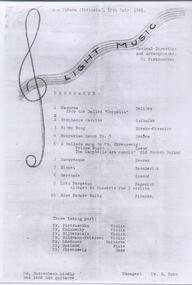
Programme, Light Music, 1941
... Light Music......light music...A cleft symbol with 5 music lines in a curve across the upper part of the programme Light Music Programme Programme ...Dr. Leonhard Adam studied both anthropology and jurisdiction as a young manOne sheet of programme for a concert held at Tatura on 15 July 1941. A cleft symbol with 5 music lines in a curve across the upper part of the programmeprogramme, light music, adam l, adam murvitz mc, camp 2, tatura, ww2 camp 2, documents, programmes -
 8th/13th Victorian Mounted Rifles Regimental Collection
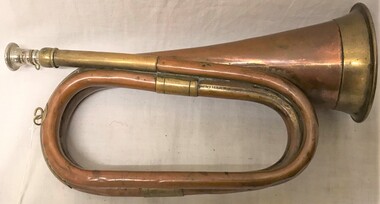
Instrument - bugle
... ...light horse...music...The bugle was used by Light Horse to relay instructions to dispersed troops. Music...The bugle was used by Light Horse to relay instructions to dispersed troops. Music bugle light horse music Brass bugle with many minor indentations. ...The bugle was used by Light Horse to relay instructions to dispersed troops. MusicBrass bugle with many minor indentations. No markings of any kind visible.bugle, light horse, music -
 St Kilda Historical Society
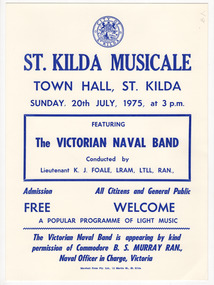
Ephemera - Poster, St Kilda Musicale featuring the Victorian Naval Band, 1975
... Part of a program of light music presented by the City of St Kilda to the public for free....Part of a program of light music presented by the City of St Kilda to the public for free. ...Poster for St Kilda Musicale at St Kilda Town Hall on 20 July 1975, featuring the Victorian Naval Band. Part of a program of light music presented by the City of St Kilda to the public for free.Buff coloured card printed in blue on one sidest kilda musicales, city of st kilda, victorian naval band -
 St Kilda Historical Society
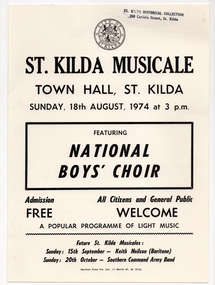
Ephemera - Poster, St Kilda Musicale featuring National Boys' Choir, 1974
... Part of a program of light music presented by the City of St Kilda to the public for free....Part of a program of light music presented by the City of St Kilda to the public for free. ...Poster for St Kilda Musicale at St Kilda Town Hall on 18 August 1974, featuring the National Boys' Choir. Part of a program of light music presented by the City of St Kilda to the public for free.Buff coloured card printed in black on one sidest kilda musicales, city of st kilda, national boys' choir -
 Federation University Historical Collection
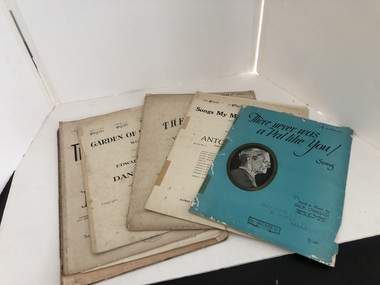
Book, Music Books from Suttons Music
... public examinations in music...light...Henry Sutton taught Applied Electricity at the Ballarat School of Mines in 1883 to 1886. music books suttons music Calvary henry vaughan paul rodney enoch and sons herzelied gustav lange j.t. trekell hanover edition the desert song one alone kathryn grayson gordon mcrae otto harbach oscar hammerstein frank mandel sigmund romberg the link divine alfred h. hyatt piccolomini one fine day aria madame butterfly opera r.h elkin giacomo puccini garden of happiness edward lockton daniel wood there never was a pal like you jack o'hagan the bridge vocal duet miss m lindsay mrs j worthington bliss songs my mother taught me anton dvorak blue danube suttons brass band journal johann strauss macushla josephine v rowe dermot macmurrough boosey and co allans music candle in the wind elton john bernie taupin treasure chest of stephen foster songs eddie fisher song folio cindy oh cindy oh my pa-pa anytime I need you now then i'll be happy sweet heartaches dungaree doll im in the mood for love what a wonderful world it would be hermann lohr i heard you singing royden barrie eric coates when you come home fred e weatherly w.h squire lay down your arms anne shelton leon land ake gerhard john m williams and shaylor turners vey first piano book i went to your wedding jessie may robinson patti page mercury records he's got the whole world in his hands geoff love sway quien sera pablo beltran ruiz paul lombard norman gimbel just because the violets kennedy russell edwin ashdown ltd friends of my youth mr w burton christy's minstrels george barker ideal music books poet and peasant melody in f spring song love and devotion the storm nachtstuck rondoletto blue danube waltzes over the waves waltzes nearer my god to thee mignon gavotte warum miss clara butt idle words stephen adams menuetin no. 2 the mill liebestraum tarantelle la matinee menuet la paloma the dove gipsy rondo crescendo chanson triste romance tocatta in a thora john mccormack john harrison ivor foster preclude c# minor beautiful star of heaven sirens song marche militaire fifth nocturne sweet bye and bye turkish patrol valse des fleurs melody of love traumerei a fragment just for to-day sybil f partridge blanche ebert seaver australian music examinations board pianoforte-grade III the chappell wonder album of music slave song the lass with the delicate air the bandolero chorus gentlemen i'll sing thee songs of araby jest her way venetian song gray days god's garden folie bergere weymouth chimes un peu d'amour you'll love me yet s. coleridge taylor george sutton happy-go-lucky pete a very happy foxtrot i know the rose fred hall the prisoners child waltz ballad russ johnston pilgrim's cross h.l d'arcy jaxone frederic n. lohr harper kearton marie vagnolini suttons manuscript music book pianoforte studies public examinations in music light cavalry marche hongroise rondo alla turca moonlight sonata witches flight home sweet home narcissus wedding march sehnsucht joyful peasant les adieux love the pedlar caryl battersby edward german where will the dimple be rosemary clooney bob merrill al hoffman buttons and bows jay livingstone ray evans bob hope glen williams british songs cyril scott cherry ripe the minstrel boy blythe and merry she was by yon bonnie banks all through the night coming thro the rye i'll bid my heart be still classical fragments beethoven's adieu w. millward wake up a calendar of song harold simpson montague f. phillips ain't misbehavin' andy razaf thomas waller harry brooks robert a nelson the ideal manuscript book the riff song it one flower grows alone in your garden ebb tide carl sigman robert maxwell i'm in the mood for love jimmy mchugh dorothy fields muskat ramble edward ory night of stars and night of love tales of hoffmann offenbach the great pretender jimmy parkinson jerry duanne barry frank stan freberg the platters bert visser love is a golden ring rich dehr frank miller terry gilkyson ernie sigley d. trickey four musical cameos gavotte lullaby goblins when children play frank hutchens just a closer walk with thee jimie rodgers west of the wall wayne shanklin toni fisher Collection of music books that were available for purchase at Sutton's Music Music Books from Suttons Music Book ...Henry Sutton is a talented world-wide accepted inventor with inventions relating to the telephone, photography, wireless, cars, motorcycles, and bicycles as well as many more inventions. Henry was also one of four brothers that ran the Sutton's Music Store after the death of their Father Richard Sutton. Henry Sutton taught Applied Electricity at the Ballarat School of Mines in 1883 to 1886.Collection of music books that were available for purchase at Sutton's Musicmusic books, suttons music, calvary, henry vaughan, paul rodney, enoch and sons, herzelied, gustav lange, j.t. trekell, hanover edition, the desert song, one alone, kathryn grayson, gordon mcrae, otto harbach, oscar hammerstein, frank mandel, sigmund romberg, the link divine, alfred h. hyatt, piccolomini, one fine day, aria, madame butterfly opera, r.h elkin, giacomo puccini, garden of happiness, edward lockton, daniel wood, there never was a pal like you, jack o'hagan, the bridge, vocal duet, miss m lindsay, mrs j worthington bliss, songs my mother taught me, anton dvorak, blue danube, suttons brass band journal, johann strauss, macushla, josephine v rowe, dermot macmurrough, boosey and co, allans music, candle in the wind, elton john, bernie taupin, treasure chest of stephen foster songs, eddie fisher song folio, cindy oh cindy, oh my pa-pa, anytime, i need you now, then i'll be happy, sweet heartaches, dungaree doll, im in the mood for love, what a wonderful world it would be, hermann lohr, i heard you singing, royden barrie, eric coates, when you come home, fred e weatherly, w.h squire, lay down your arms, anne shelton, leon land, ake gerhard, john m williams and shaylor turners vey first piano book, i went to your wedding, jessie may robinson, patti page, mercury records, he's got the whole world in his hands, geoff love, sway, quien sera, pablo beltran ruiz, paul lombard, norman gimbel, just because the violets, kennedy russell, edwin ashdown ltd, friends of my youth, mr w burton, christy's minstrels, george barker, ideal music books, poet and peasant, melody in f, spring song, love and devotion, the storm, nachtstuck, rondoletto, blue danube waltzes, over the waves waltzes, nearer my god to thee, mignon gavotte, warum, miss clara butt, idle words, stephen adams, menuetin no. 2, the mill, liebestraum, tarantelle, la matinee, menuet, la paloma, the dove, gipsy rondo, crescendo, chanson triste, romance, tocatta in a, thora, john mccormack, john harrison, ivor foster, preclude c# minor, beautiful star of heaven, sirens song, marche militaire, fifth nocturne, sweet bye and bye, turkish patrol, valse des fleurs, melody of love, traumerei, a fragment, just for to-day, sybil f partridge, blanche ebert seaver, australian music examinations board, pianoforte-grade iii, the chappell wonder album of music, slave song, the lass with the delicate air, the bandolero, chorus gentlemen, i'll sing thee songs of araby, jest her way, venetian song, gray days, god's garden, folie bergere, weymouth chimes, un peu d'amour, you'll love me yet, s. coleridge taylor, george sutton, happy-go-lucky pete a very happy foxtrot, i know the rose, fred hall, the prisoners child, waltz ballad, russ johnston, pilgrim's cross, h.l d'arcy jaxone, frederic n. lohr, harper kearton, marie vagnolini, suttons manuscript music book, pianoforte studies, public examinations in music, light cavalry, marche hongroise, rondo alla turca, moonlight sonata, witches flight, home sweet home, narcissus, wedding march, sehnsucht, joyful peasant, les adieux, love the pedlar, caryl battersby, edward german, where will the dimple be, rosemary clooney, bob merrill, al hoffman, buttons and bows, jay livingstone, ray evans, bob hope, glen williams, british songs, cyril scott, cherry ripe, the minstrel boy, blythe and merry she was, by yon bonnie banks, all through the night, coming thro the rye, i'll bid my heart be still, classical fragments, beethoven's adieu, w. millward, wake up, a calendar of song, harold simpson, montague f. phillips, ain't misbehavin', andy razaf, thomas waller, harry brooks, robert a nelson, the ideal manuscript book, the riff song, it, one flower grows alone in your garden, ebb tide, carl sigman, robert maxwell, i'm in the mood for love, jimmy mchugh, dorothy fields, muskat ramble, edward ory, night of stars and night of love, tales of hoffmann, offenbach, the great pretender, jimmy parkinson, jerry duanne, barry frank, stan freberg, the platters, bert visser, love is a golden ring, rich dehr, frank miller, terry gilkyson, ernie sigley, d. trickey, four musical cameos, gavotte, lullaby, goblins, when children play, frank hutchens, just a closer walk with thee, jimie rodgers, west of the wall, wayne shanklin, toni fisher -
 St Kilda Historical Society
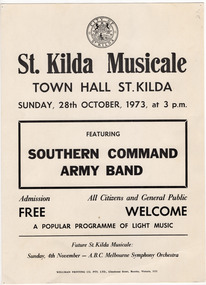
Ephemera - Poster, St Kilda Musicale featuring Southern Command Army Band, 1973
... Part of a program of light music presented by the City of St Kilda to the public for free....Part of a program of light music presented by the City of St Kilda to the public for free. ...Poster for St Kilda Musicale at St Kilda Town Hall on 28 October 1973, featuring the Southern Command Army Band. Part of a program of light music presented by the City of St Kilda to the public for free.Buff coloured card printed in black on one sidest kilda musicales, city of st kilda, southern command army band -
 St Kilda Historical Society
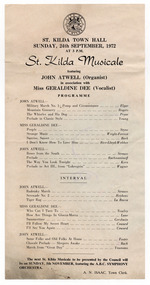
Ephemera - Concert program, St Kilda Musicale featuring John Atwell (Organist) in association with Miss Geraldine Dee (Vocalist), 1972
... Part of a program of light music presented by the City of St Kilda to the public for free....Part of a program of light music presented by the City of St Kilda to the public for free. ...Program for St Kilda Musicale at St Kilda Town Hall on 24 September 1972, featuring organist John Atwell and vocalist Geraldine Dee. Part of a program of light music presented by the City of St Kilda to the public for free.White paper, discoloured with age, printed in black on one sidest kilda musicales, city of st kilda, john atwell, geraldine dee -
 Flagstaff Hill Maritime Museum and Village
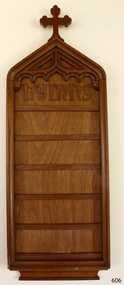
Furniture - Hymn Board, 1944-1966
... light guild...missions to seamen victoria...mission to seafarers...st nicholas seaman’s church williamstown...st nicholas mission to seamen church williamstown...mission to seamen williamstown...st nicholas seamen’s church flagstaff hill...139 nelson place williamstown...church furniture...religious furniture...anglican church...flying angel club...hymn board...song board...religious worship...worship service...worship music...Kerr Johnston, a Church of England clergyman, and operated from a hulk moored in Hobson’s Bay; later the Mission occupied buildings in Williamstown and Port Melbourne. flagstaff hill warrnambool shipwrecked-coast flagstaff-hill flagstaff-hill-maritime-museum maritime-museum shipwreck-coast flagstaff-hill-maritime-village religion religious service sailors rest bethel sailors’ church bethel floating church ladies harbour light guild missions to seamen victoria mission to seafarers st nicholas seaman’s church williamstown st nicholas mission to seamen church williamstown mission to seamen williamstown st nicholas seamen’s church flagstaff hill 139 nelson place williamstown church furniture religious furniture anglican church flying angel club hymn board song board religious worship worship service worship music Carved into the wood "hymns" Hymn board; arch-shaped wooden board with relief decorative wood and decorative cross on top of the peak. ...This hymn board is attached to the wall. Numbers referring to the hymn or hymns for the current religious service would have been placed onto the rails and would be visible to the congregation. It is used for showing the hymn number or numbers that will be sung during the service. This hymn board was part of the original furnishings of the St Nicholas' Mission to Seamen's Church at 139 Nelson Place, Williamstown, Victoria. THE MISSIONS TO SEAMEN (Brief History: for more, see our Reg. No. 611, Set of Pews) The Missions to Seamen, an Anglican charity, has served seafarers of the world since 1856 in Great Britain. It symbol is a Flying Angel, inspired by a Bible verse. Today there are centr4es in over 200 ports world-wide where seamen of all backgrounds are offered a warm welcome and provided with a wide range of facilities. In Victoria the orgainsation began in Williamstown in 1857. It was as a Sailors’ Church, also known as ‘Bethel’ or the ‘Floating Church’. Its location was an old hulk floating in Hobson’s Bay, Port of Melbourne. It soon became part of the Missions to Seamen, Victoria. In the year 2000 the organisation, now named Mission to Seafarers, still operated locally in Melbourne, Portland, Geelong and Hastings. The Ladies’ Harbour Lights Guild was formed in 1906 to support the Missions to Seamen in Melbourne and other centres such as Williamstown. Two of the most significant ladies of the Guild were founder Ethel Augusta Godfrey and foundation member Alice Sibthorpe Tracy (who established a branch of the Guild in Warrnambool in 1920). The Guild continued its work until the 1960s. In 1943 a former Williamstown bank was purchased for the Missions to Seaman Club. The chapel was named St Nicholas’ Seamen’s Church and was supported by the Ladies’ Harbour Lights Guild, the Williamstown Lightkeepers’ Auxiliary and the League of Soldiers’ and Sailors’ Friends. It ceased operation in 1966. A Missions to Seamen Chapel and Recreation Room was a significant feature of ports during the late 1800s and into the 1900s. It seemed appropriate for Flagstaff Hill to include such a representation within the new Maritime Village, so the Melbourne Board of Management of Missions to Seamen Victoria gave its permission on 21st May 1979 for the entire furnishings of the Williamstown chapel to be transferred to Flagstaff Hill. The St Nicholas Seamen’s Church was officially opened on October 11, 1981 and closely resembles the Williamstown chapel. This hymn board is significant through its association with the St Nicholas' Mission to Seamen Church in Williamstown, Melbourne, established in 1857. The items in our collection from the Missions to Seamen in Williamstown, Victoria, have historical and social significance. They show that people of the 1800s and 1900s cared about the seafarers’ religious, moral, and social welfare, no matter what the religion, social status or nationality. It had its origins in Bristol, England when a Seamen's Mission was formed in 1837. The first Australian branch was started in 1856 by the Rev. Kerr Johnston, a Church of England clergyman, and operated from a hulk moored in Hobson’s Bay; later the Mission occupied buildings in Williamstown and Port Melbourne. Hymn board; arch-shaped wooden board with relief decorative wood and decorative cross on top of the peak. The word 'hymns' is raised in decorative wood on the top. The board has six rails. This is one of the original items in our ‘St Nicholas Seamen's Church Williamstown Collection’.Carved into the wood "hymns"flagstaff hill, warrnambool, shipwrecked-coast, flagstaff-hill, flagstaff-hill-maritime-museum, maritime-museum, shipwreck-coast, flagstaff-hill-maritime-village, religion, religious service, sailors rest, bethel sailors’ church, bethel floating church, ladies harbour light guild, missions to seamen victoria, mission to seafarers, st nicholas seaman’s church williamstown, st nicholas mission to seamen church williamstown, mission to seamen williamstown, st nicholas seamen’s church flagstaff hill, 139 nelson place williamstown, church furniture, religious furniture, anglican church, flying angel club, hymn board, song board, religious worship, worship service, worship music -
 Federation University Historical Collection
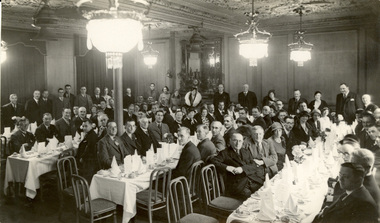
Photograph - Photograph - black and white, Press & Publicity, Photographic Co, Florence Restaurant, Piccadilly, London, 1933, 1933
... The Frank Wright Medal at the Royal South Street competition is awarded to an individual recognized as making an outstanding contribution to brass music in Australia. frank wright florence restaurant piccadilly london Written in pencil on the back - 'Dinner at Florence Restaurant Piccadilly London after Crystal Palace 1933' Black and white photograph of a large ornate room with men and women seated at four long tables, set with flatware, silverware and ornately folded napkins. Other men and women are standing around the edges of the room. They are all formally dressed. The room has ornate cornice, ceilings and light ...This photograph was one of Frank Wright's collection. Frank Wright was a renown resident of Smeaton, where he was born. He lived at Laura Villa, and attended Smeaton State School. His father William was a gold miner and his mother's name was Sarah. Their family won many singing and instrumental awards. Frank was tutored by Percy Code and became the Australian Open Cornet Champion by the age of eighteen. A year later, Frank conducted the City of Ballarat Band, and later the Ballarat Soldiers’ Memorial Band. He formed the Frank Wright Frisco Band and Frank Wright and his Coliseum Orchestra. These bands won many South Street awards, and Frank as conductor won many awards in the Australian Band Championship contest. In 1933 Frank Wright sailed to England to conduct the famous St Hilda’s Band and was later appointed Musical Director of the London County Council, where he organized many amazing concerts in parks, in and around the London district. He was made Professor of Brass and Military Band Scoring and conducted at the Guildhall of Music and Drama. Frank was often invited to adjudicate Brass Band Championships around Europe, in Australia, including South Street and in New Zealand. The Frank Wright Medal at the Royal South Street competition is awarded to an individual recognized as making an outstanding contribution to brass music in Australia.Black and white photograph of a large ornate room with men and women seated at four long tables, set with flatware, silverware and ornately folded napkins. Other men and women are standing around the edges of the room. They are all formally dressed. The room has ornate cornice, ceilings and light fixtures and a large mirror on the back wall. The place is the Florence Restaurant, Piccadilly London.Written in pencil on the back - 'Dinner at Florence Restaurant Piccadilly London after Crystal Palace 1933'frank wright, florence restaurant piccadilly london -
 Federation University Historical Collection
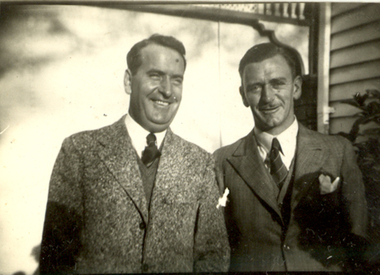
Photograph - Photograph - Black and White, Frank Wright and Friend, 03/1940
... The Frank Wright Medal at the Royal South Street competition is awarded to an individual recognized as making an outstanding contribution to brass music in Australia. frank wright vernon holt conductor brass band Written in pencil on back - March 1940 Small black and white photograph of the torsos of two men dressed in light suits. ...Frank Wright was a renown resident of Smeaton, where he was born on 2 August 1901. He lived at Laura Villa, and attended Smeaton State School. His father William was a gold miner and his mother's name was Sarah. Their family won many singing and instrumental awards. Frank was tutored by Percy Code and was awarded a gold medal for the highest marks in the ALCM examinations in the British Colonies at the age of seventeen years. He became the Australian Open Cornet Champion by the age of eighteen. A year later, Frank conducted the City of Ballarat Band, and later the Ballarat Soldiers’ Memorial Band. He formed the Frank Wright Frisco Band and Frank Wright and his Coliseum Orchestra. These bands won many South Street awards, and Frank as conductor won many awards in the Australian Band Championship contest. In 1933 Frank Wright sailed to England to conduct the famous St Hilda’s Band and was later appointed Musical Director of the London County Council, where he organized many amazing concerts in parks, in and around the London district. He was made Professor of Brass and Military Band Scoring and conducted at the Guildhall of Music and Drama. Frank was often invited to adjudicate Brass Band Championships around Europe, in Australia, including South Street and in New Zealand. The Frank Wright Medal at the Royal South Street competition is awarded to an individual recognized as making an outstanding contribution to brass music in Australia.Small black and white photograph of the torsos of two men dressed in light suits. They are standing outside a weatherboard house. The man on the left is Frank Wright and the man on the right is possibly his friend Vernon Holt.Written in pencil on back - March 1940frank wright, vernon holt, conductor, brass band -
 Federation University Historical Collection
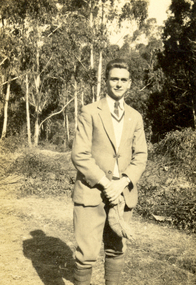
Photograph - Black and White, Vernon Holt, 1920s?
... The Frank Wright Medal at the Royal South Street competition is awarded to an individual recognized as making an outstanding contribution to brass music in Australia. vernon holt frank wright Black and white photograph of a young man dressed in a light coloured suit with long socks pulled over his trouser legs to the knee. ...Vernon Holt was a boyhood friend of Frank Wright. Frank Wright was a renown resident of Smeaton, where he was born on 2 August 1901. He lived at Laura Villa, and attended Smeaton State School. His father William was a gold miner and his mother's name was Sarah. Their family won many singing and instrumental awards. Frank was tutored by Percy Code and was awarded a gold medal for the highest marks in the ALCM examinations in the British Colonies at the age of seventeen years. He became the Australian Open Cornet Champion by the age of eighteen. A year later, Frank conducted the City of Ballarat Band, and later the Ballarat Soldiers’ Memorial Band. He formed the Frank Wright Frisco Band and Frank Wright and his Coliseum Orchestra. These bands won many South Street awards, and Frank as conductor won many awards in the Australian Band Championship contest. In 1933 Frank Wright sailed to England to conduct the famous St Hilda’s Band and was later appointed Musical Director of the London County Council, where he organized many amazing concerts in parks, in and around the London district. He was made Professor of Brass and Military Band Scoring and conducted at the Guildhall of Music and Drama. Frank was often invited to adjudicate Brass Band Championships around Europe, in Australia, including South Street and in New Zealand. The Frank Wright Medal at the Royal South Street competition is awarded to an individual recognized as making an outstanding contribution to brass music in Australia.Black and white photograph of a young man dressed in a light coloured suit with long socks pulled over his trouser legs to the knee. He is carrying a cap and is standing in a clearing with trees and bush behind. The man is Vernon Holt.vernon holt, frank wright -
 Federation University Historical Collection
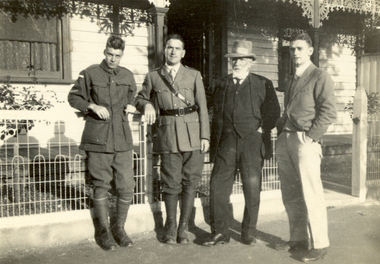
Frank and William Wright and friends, early 1930s
... music in Australia. frank wright william wright 71st infantry band Black and white photograph of four men standing beside the fence of a weatherboard and lacework house. The left hand man is dressed in a soldier's uniform, the middle, left hand man is dressed in the 71st Infantry Band uniform, the man to his right is an older man with a beard and dressed in a dark suit and the fouth man is dressed in a jacket and light trousers. ...Frank Wright was a renown resident of Smeaton, where he was born on 2 August 1901. He lived at Laura Villa, and attended Smeaton State School. His father William was a gold miner and his mother's name was Sarah. Their family won many singing and instrumental awards. Frank was tutored by Percy Code and was awarded a gold medal for the highest marks in the ALCM examinations in the British Colonies at the age of seventeen years. He became the Australian Open Cornet Champion by the age of eighteen. A year later, Frank conducted the City of Ballarat Band, and later the Ballarat Soldiers’ Memorial Band. He formed the Frank Wright Frisco Band and Frank Wright and his Coliseum Orchestra. These bands won many South Street awards, and Frank as conductor won many awards in the Australian Band Championship contest. In 1933 Frank Wright sailed to England to conduct the famous St Hilda’s Band and was later appointed Musical Director of the London County Council, where he organized many amazing concerts in parks, in and around the London district. He was made Professor of Brass and Military Band Scoring and conducted at the Guildhall of Music and Drama. Frank was often invited to adjudicate Brass Band Championships around Europe, in Australia, including South Street and in New Zealand. The Frank Wright Medal at the Royal South Street competition is awarded to an individual recognized as making an outstanding contribution to brass music in Australia.Black and white photograph of four men standing beside the fence of a weatherboard and lacework house. The left hand man is dressed in a soldier's uniform, the middle, left hand man is dressed in the 71st Infantry Band uniform, the man to his right is an older man with a beard and dressed in a dark suit and the fouth man is dressed in a jacket and light trousers. The middle, left hand man is Frank Wright and the man to his right is his father William Wright.frank wright, william wright, 71st infantry band -
 Federation University Historical Collection
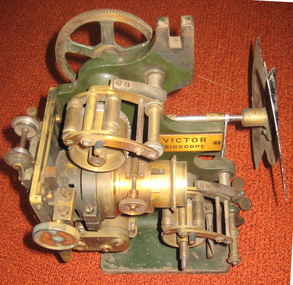
Equipment - Projector, Victor Bioscope, c1910
... Music Hall Strike of 1907 in London, bioscope operators set up a trade union to represent them. There were about seventy operators in London at this point. (http://en.wikipedia.org/wiki/Bioscope_show) The Projector was a rather unreliable piece of apparatus, powered by a variety of light sources, including Calcium Oxide (Lime-Light). ...Music Hall Strike of 1907 in London, bioscope operators set up a trade union to represent them. There were about seventy operators in London at this point. (http://en.wikipedia.org/wiki/Bioscope_show) The Projector was a rather unreliable piece of apparatus, powered by a variety of light sources, including Calcium Oxide (Lime-Light). ...A Bioscope show was a fairground attraction consisting of a travelling cinema. The heyday of the Bioscope was from the late 1890s until World War I. Bioscope shows were fronted by the largest fairground organs, and these formed the entire public face of the show . A stage was usually in front of the organ, and dancing girls would entertain the crowds between film shows. Films shown in the Bioscope were primitive, and the earliest of these were made by the showmen themselves. Later, films were commercially produced. Bioscope shows were integrated, in Britain at least, into the Variety shows in the huge Music Halls which were built at the end of the nineteenth century. After the Music Hall Strike of 1907 in London, bioscope operators set up a trade union to represent them. There were about seventy operators in London at this point. (http://en.wikipedia.org/wiki/Bioscope_show) The Projector was a rather unreliable piece of apparatus, powered by a variety of light sources, including Calcium Oxide (Lime-Light). A Calcium Carbide Burner, or the rather more superior Carbon Arc. All these methods were highly unpredictable & quite frankly...dangerous! Often resulting in explosions, burning down the entire Show! (which is probably why NO original Shows still exist. Alfred Ball's Bioscope, pictured below, built in 1905 was struck by lightning, shortly after the picture was taken! (http://www.circus-entertainer.co.uk/heritage.htm) In 1909 the first bioscopes pictures were shown at the Ballaarat Mechanics' Institute.Brass and green painted metal film projectorbioscope, vector, entertainment, projector, film, theatre, movie -
 Federation University Historical Collection
Document, Anne Beggs Sunter, Henry Sutton the Eureka Man, 2005
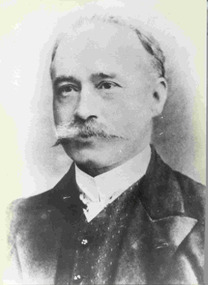
... light built just 16 days after Edison. Sutton built and drove the first motor car in Australia and conceived and built what is thought to be the world's first four-wheel drive. Anne Beggs Sunter is an historian who lectures in Australian History and Heritage at the University of Ballarat Henry Sutton Sutton Beggs Sunter autocar telephane Balllarat. Sutton Music ...Henry Sutton was an Australian born, self-taught inventor. He invented 23 different types of telephone, a proto-type helicopter, the world's first portable wireless radio, a colour-printing process and a carbon-filament light built just 16 days after Edison. Sutton built and drove the first motor car in Australia and conceived and built what is thought to be the world's first four-wheel drive. Anne Beggs Sunter is an historian who lectures in Australian History and Heritage at the University of BallaratThree page article on Henry Sutton from Australian Heritage Nov 05 (http://www.heritageaustralia.com.au/pdfs/Heritage1105_Henry%20Sutton.pdf) The article includes a picture of the Sutton Autocar, the Telephane System, Illuminated Address present to Henry Sutton by the Citizens of Ballarat and his grave in the Brighton Cemetery. henry sutton, sutton, beggs sunter, autocar, telephane, balllarat. sutton music, richard sutton, mary sutton, -
 Federation University Historical Collection
Equipment - Cassette Tape Recorder, Sanyo, Sanyo Cassette Tape Recorder
... music applications. Although pre-recorded cassettes were widely available, many users would combine (dub) songs from their vinyl records or cassettes to make a new custom mixtape cassette. (http://en.wikipedia.org/wiki/Cassette_deck) electronics cassetter recorder recording tape recorder Black and silver electric or battery powered plastic tape recorder wit 5 black and 1 red push button to operate and record on the equipment. The recorder also has a counter and a rec.batter light ...Early recorders were intended for dictation and journalists, and were typically hand-held battery-powered devices with built-in microphones and automatic gain control on recording. Tape recorder audio-quality had improved by the mid-1970s, and a cassette deck with manual level controls and VU meters became a standard component of home high-fidelity systems.[1] Eventually the reel-to-reel recorder was completely displaced, in part because of the usage constraints presented by their large size, expense, and the inconvenience of threading and rewinding the tape reels - cassettes are more portable and can be stopped and immediately removed in the middle of playback without rewinding. Cassettes became extremely popular for automotive and other portable music applications. Although pre-recorded cassettes were widely available, many users would combine (dub) songs from their vinyl records or cassettes to make a new custom mixtape cassette. (http://en.wikipedia.org/wiki/Cassette_deck) Black and silver electric or battery powered plastic tape recorder wit 5 black and 1 red push button to operate and record on the equipment. The recorder also has a counter and a rec.batter light. electronics, cassetter recorder, recording, tape recorder -
 Federation University Historical Collection
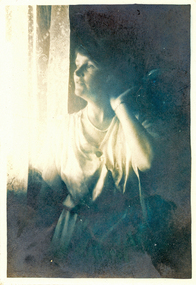
Photograph - Black and White, Frank Wright, Laura Wright, 1924, 2/1/1924
... music in Australia. Laura married Mr W.M. Ritchie and lived in Ballarat laura wright frank wright cornet conductor Written in pen on the back - Laura Wright, 2/1/24, F.W. Black and white photograph of a woman standing beside a net curtained window. The sunlight illuminates the face and torso. There is a marked contrast between the light ...Laura Wright was the sister of Frank Wright who was a renown resident of Smeaton, where they was born. They lived at Laura Villa, and attended Smeaton State School with their siblings. Their father William was a gold miner and their mother's name was Sarah. Their family won many singing and instrumental awards. Frank was tutored by Percy Code and was awarded a gold medal for the highest marks in the ALCM examinations in the British Colonies at the age of seventeen years. He became the Australian Open Cornet Champion by the age of eighteen. A year later, Frank conducted the City of Ballarat Band, and later the Ballarat Soldiers’ Memorial Band. He formed the Frank Wright Frisco Band and Frank Wright and his Coliseum Orchestra. These bands won many South Street awards, and Frank as conductor won many awards in the Australian Band Championship contest. In 1933 Frank Wright sailed to England to conduct the famous St Hilda’s Band and was later appointed Musical Director of the London County Council, where he organized many amazing concerts in parks, in and around the London district. He was made Professor of Brass and Military Band Scoring and conducted at the Guildhall of Music and Drama. Frank was often invited to adjudicate Brass Band Championships around Europe, in Australia, including South Street and in New Zealand. The Frank Wright Medal at the Royal South Street competition is awarded to an individual recognized as making an outstanding contribution to brass music in Australia. Laura married Mr W.M. Ritchie and lived in BallaratBlack and white photograph of a woman standing beside a net curtained window. The sunlight illuminates the face and torso. There is a marked contrast between the light and the darkened room. The woman is Laura WrightWritten in pen on the back - Laura Wright, 2/1/24, F.W.laura wright, frank wright, cornet, conductor -
 Federation University Historical Collection
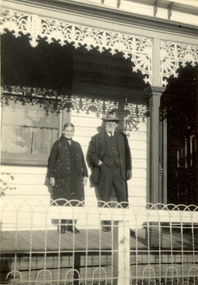
Photograph - Photograph - Black and White, William and Sarah Wright, The first half of the 20th Century
... The Frank Wright Medal at the Royal South Street competition is awarded to an individual recognized as making an outstanding contribution to brass music in Australia. william wright sarah wright frank wright cornet laura villa smeaton Three photos showing the same couple and cottage taken at the same time - .1) Close up black and white photograph of a man wearing a dark suit and light hat and a woman in a dark skirt and cardigan standing beside a car in front of two weatherboard cottages. ...William Wright was a gold miner and his wife's name was Sarah. They lived at Laura Villa, Smeaton. Their family won many singing and instrumental awards. Frank Wright their son was born and attended Smeaton State School and was a renown resident of Smeaton. Frank was tutored by Percy Code and was awarded a gold medal for the highest marks in the ALCM examinations in the British Colonies at the age of seventeen years. He became the Australian Open Cornet Champion by the age of eighteen. A year later, Frank conducted the City of Ballarat Band, and later the Ballarat Soldiers’ Memorial Band. He formed the Frank Wright Frisco Band and Frank Wright and his Coliseum Orchestra. These bands won many South Street awards, and Frank as conductor won many awards in the Australian Band Championship contest. In 1933 Frank Wright sailed to England to conduct the famous St Hilda’s Band and was later appointed Musical Director of the London County Council, where he organized many amazing concerts in parks, in and around the London district. He was made Professor of Brass and Military Band Scoring and conducted at the Guildhall of Music and Drama. Frank was often invited to adjudicate Brass Band Championships around Europe, in Australia, including South Street and in New Zealand. The Frank Wright Medal at the Royal South Street competition is awarded to an individual recognized as making an outstanding contribution to brass music in Australia. Three photos showing the same couple and cottage taken at the same time - .1) Close up black and white photograph of a man wearing a dark suit and light hat and a woman in a dark skirt and cardigan standing beside a car in front of two weatherboard cottages. The man is William Wright and the woman is his wife Sarah. .2) Black and white photograph of a man wearing a dark suit and light hat and a woman in a dark skirt and cardigan standing beside a car in front of two weatherboard cottages. The man is William Wright and the woman is his wife Sarah. .3) Black and white photograph of a man wearing a dark suit and light hat and a woman in a dark skirt and cardigan standing on the front verandah of a weatherboard cottage. The man is William Wright and the woman is his wife Sarah. william wright, sarah wright, frank wright, cornet, laura villa, smeaton -
 Federation University Historical Collection
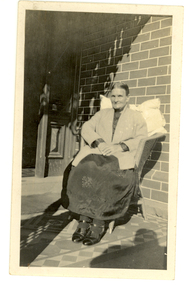
Photograph - Photograph - Black and White, Sarah Wright at 214 Armstrong (North) Street, 1928, 1928
... music in Australia. Laura Ritchie was his sister. sarah wright. frank wright laura ritchie armstrong street ballarat Written in pen on the back May 1928. Written in pencil 214 Armstrong St North Black and white photograph of a woman in a long dark skirt and light cardigan sitting on a chair with a pillow behind her back. ...Sarah Wright was married to a gold miner named William. They lived at Laura Villa, Smeaton. Their family won many singing and instrumental awards. Frank Wright their son was born and attended Smeaton State School and was a renown resident of Smeaton. Frank was tutored by Percy Code and was awarded a gold medal for the highest marks in the ALCM examinations in the British Colonies at the age of seventeen years. He became the Australian Open Cornet Champion by the age of eighteen. A year later, Frank conducted the City of Ballarat Band, and later the Ballarat Soldiers’ Memorial Band. He formed the Frank Wright Frisco Band and Frank Wright and his Coliseum Orchestra. These bands won many South Street awards, and Frank as conductor won many awards in the Australian Band Championship contest. In 1933 Frank Wright sailed to England to conduct the famous St Hilda’s Band and was later appointed Musical Director of the London County Council, where he organized many amazing concerts in parks, in and around the London district. He was made Professor of Brass and Military Band Scoring and conducted at the Guildhall of Music and Drama. Frank was often invited to adjudicate Brass Band Championships around Europe, in Australia, including South Street and in New Zealand. The Frank Wright Medal at the Royal South Street competition is awarded to an individual recognized as making an outstanding contribution to brass music in Australia. Laura Ritchie was his sister.Black and white photograph of a woman in a long dark skirt and light cardigan sitting on a chair with a pillow behind her back. The chair is on the verandah of a brick house. The woman is Sarah Wright and the house belongs to her daughter Laura Ritchie at 214 Armstrong St Nth, Ballarat.Written in pen on the back May 1928. Written in pencil 214 Armstrong St Northsarah wright. frank wright, laura ritchie, armstrong street, ballarat -
 Federation University Historical Collection
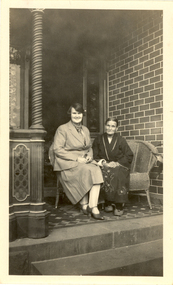
Photograph - Photograph - Black and White, Laura Ritchie and Sarah Wright at 214 Armstrong (Nth) Street, Ballarat, late 1920's
... music in Australia. Laura Ritchie was his sister and lived in Ballarat with her family. sarah wright laura ritchie frank wright cornet ballarat Written in pencil 214 Armstrong St Nth, Laura and Sarah Wright A black and white photo of two women sitting on a wicker couch on the verandah of a brick house. The older woman is wearing a dressing gown and slippers and the younger woman is wearing a light ...Sarah Wright was married to a gold miner named William. They lived at Laura Villa, Smeaton. Their family won many singing and instrumental awards. Frank Wright their son was born and attended Smeaton State School and was a renown resident of Smeaton. Frank was tutored by Percy Code and was awarded a gold medal for the highest marks in the ALCM examinations in the British Colonies at the age of seventeen years. He became the Australian Open Cornet Champion by the age of eighteen. A year later, Frank conducted the City of Ballarat Band, and later the Ballarat Soldiers’ Memorial Band. He formed the Frank Wright Frisco Band and Frank Wright and his Coliseum Orchestra. These bands won many South Street awards, and Frank as conductor won many awards in the Australian Band Championship contest. In 1933 Frank Wright sailed to England to conduct the famous St Hilda’s Band and was later appointed Musical Director of the London County Council, where he organized many amazing concerts in parks, in and around the London district. He was made Professor of Brass and Military Band Scoring and conducted at the Guildhall of Music and Drama. Frank was often invited to adjudicate Brass Band Championships around Europe, in Australia, including South Street and in New Zealand. The Frank Wright Medal at the Royal South Street competition is awarded to an individual recognized as making an outstanding contribution to brass music in Australia. Laura Ritchie was his sister and lived in Ballarat with her family. A black and white photo of two women sitting on a wicker couch on the verandah of a brick house. The older woman is wearing a dressing gown and slippers and the younger woman is wearing a light coloured suit. The women are Sarah Wright and her daughter Laura Ritchie. The house is Laura's home at 214 Armstrong Street Nth, BallaratWritten in pencil 214 Armstrong St Nth, Laura and Sarah Wrightsarah wright, laura ritchie, frank wright, cornet, ballarat -
 Federation University Historical Collection
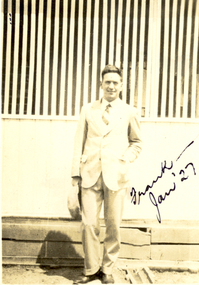
Photograph - Black and White, Frank Wright, 1927, January 1927
... The Frank Wright Medal at the Royal South Street competition is awarded to an individual recognized as making an outstanding contribution to brass music in Australia. frank wright cornet conductor ballarat st hilda's band Written in pen on front - Frank - Jan '27 Black and white photograph of a man in a light suit, holding a hat. ...Frank Wright was a renown resident of Smeaton, where he was born. He lived at Laura Villa, and attended Smeaton State School. His father William was a gold miner and his mother's name was Sarah. Their family won many singing and instrumental awards. Frank was tutored by Percy Code and was awarded a gold medal for the highest marks in the ALCM examinations in the British Colonies at the age of seventeen years. He became the Australian Open Cornet Champion by the age of eighteen. A year later, Frank conducted the City of Ballarat Band, and later the Ballarat Soldiers’ Memorial Band. He formed the Frank Wright Frisco Band and Frank Wright and his Coliseum Orchestra. These bands won many South Street awards, and Frank as conductor won many awards in the Australian Band Championship contest. In 1933 Frank Wright sailed to England to conduct the famous St Hilda’s Band and was later appointed Musical Director of the London County Council, where he organized many amazing concerts in parks, in and around the London district. He was made Professor of Brass and Military Band Scoring and conducted at the Guildhall of Music and Drama. Frank was often invited to adjudicate Brass Band Championships around Europe, in Australia, including South Street and in New Zealand. The Frank Wright Medal at the Royal South Street competition is awarded to an individual recognized as making an outstanding contribution to brass music in Australia.Black and white photograph of a man in a light suit, holding a hat. He is standing in front of a wall containing a window which appears to be barred. The man is Frank Wright.Written in pen on front - Frank - Jan '27frank wright, cornet, conductor, ballarat, st hilda's band -
 Federation University Historical Collection
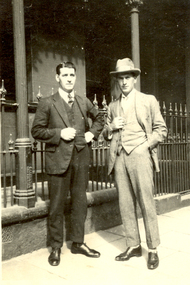
Photograph - Black and White, Alex Wright, Frank and E.N. Wright in Sydney, 1923, 1923
... The Frank Wright Medal at the Royal South Street competition is awarded to an individual recognized as making an outstanding contribution to brass music in Australia. frank wright alex wright e.n.wright cornet ballarat cast iron fence Written in pen on the back - E.N.Wright (left), Frank Wright (right), Sydney (Easter 1923), Taken by Alex Wright (Au) Black and white photograph of two men in three piece suits (one dark, one light with a hat), standing on the footpath in front of a building with a cast iron fence. ...Frank Wright was a renown resident of Smeaton, where he was born. He lived at Laura Villa, and attended Smeaton State School. His father William was a gold miner and his mother's name was Sarah. Their family won many singing and instrumental awards. Frank was tutored by Percy Code and was awarded a gold medal for the highest marks in the ALCM examinations in the British Colonies at the age of seventeen years. He became the Australian Open Cornet Champion by the age of eighteen. A year later, Frank conducted the City of Ballarat Band, and later the Ballarat Soldiers’ Memorial Band. He formed the Frank Wright Frisco Band and Frank Wright and his Coliseum Orchestra. These bands won many South Street awards, and Frank as conductor won many awards in the Australian Band Championship contest. In 1933 Frank Wright sailed to England to conduct the famous St Hilda’s Band and was later appointed Musical Director of the London County Council, where he organized many amazing concerts in parks, in and around the London district. He was made Professor of Brass and Military Band Scoring and conducted at the Guildhall of Music and Drama. Frank was often invited to adjudicate Brass Band Championships around Europe, in Australia, including South Street and in New Zealand. The Frank Wright Medal at the Royal South Street competition is awarded to an individual recognized as making an outstanding contribution to brass music in Australia.Black and white photograph of two men in three piece suits (one dark, one light with a hat), standing on the footpath in front of a building with a cast iron fence. The men are E.N. Wright and Frank Wright.Written in pen on the back - E.N.Wright (left), Frank Wright (right), Sydney (Easter 1923), Taken by Alex Wright (Au)frank wright, alex wright, e.n.wright, cornet, ballarat, cast iron fence -
 Federation University Historical Collection
Photograph - Black and White, Frank Wright, circa 1930's
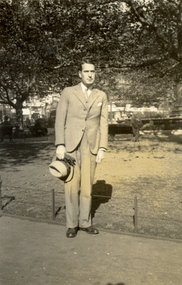
... The Frank Wright Medal at the Royal South Street competition is awarded to an individual recognized as making an outstanding contribution to brass music in Australia. frank wright cornet conductor ballarat st hilda's band parkland Printed on back - Velox Black and white photograph of a man in a light coloured suit, holding a hat and gloves. ...Frank Wright was a renown resident of Smeaton, where he was born. He lived at Laura Villa, and attended Smeaton State School. His father William was a gold miner and his mother's name was Sarah. Their family won many singing and instrumental awards. Frank was tutored by Percy Code and was awarded a gold medal for the highest marks in the ALCM examinations in the British Colonies at the age of seventeen years. He became the Australian Open Cornet Champion by the age of eighteen. A year later, Frank conducted the City of Ballarat Band, and later the Ballarat Soldiers’ Memorial Band. He formed the Frank Wright Frisco Band and Frank Wright and his Coliseum Orchestra. These bands won many South Street awards, and Frank as conductor won many awards in the Australian Band Championship contest. In 1933 Frank Wright sailed to England to conduct the famous St Hilda’s Band and was later appointed Musical Director of the London County Council, where he organized many amazing concerts in parks, in and around the London district. He was made Professor of Brass and Military Band Scoring and conducted at the Guildhall of Music and Drama. Frank was often invited to adjudicate Brass Band Championships around Europe, in Australia, including South Street and in New Zealand. The Frank Wright Medal at the Royal South Street competition is awarded to an individual recognized as making an outstanding contribution to brass music in Australia.Black and white photograph of a man in a light coloured suit, holding a hat and gloves. He is standing on a path within a park, with trees in the middle distance.Printed on back - Veloxfrank wright, cornet, conductor, ballarat, st hilda's band, parkland -
 Federation University Historical Collection
Photograph - Black and White, Frank Wright, circa 1930's
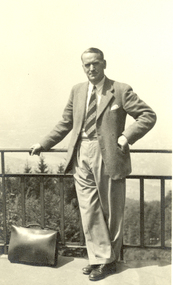
... The Frank Wright Medal at the Royal South Street competition is awarded to an individual recognized as making an outstanding contribution to brass music in Australia. frank wright cornet conductor ballarat st hilda's band wrought iron fence Black and white photograph of a man in a light coloured suit, leaning against a wrought iron fence with pine trees in the background. ...Frank Wright was a renown resident of Smeaton, where he was born. He lived at Laura Villa, and attended Smeaton State School. His father William was a gold miner and his mother's name was Sarah. Their family won many singing and instrumental awards. Frank was tutored by Percy Code and was awarded a gold medal for the highest marks in the ALCM examinations in the British Colonies at the age of seventeen years. He became the Australian Open Cornet Champion by the age of eighteen. A year later, Frank conducted the City of Ballarat Band, and later the Ballarat Soldiers’ Memorial Band. He formed the Frank Wright Frisco Band and Frank Wright and his Coliseum Orchestra. These bands won many South Street awards, and Frank as conductor won many awards in the Australian Band Championship contest. In 1933 Frank Wright sailed to England to conduct the famous St Hilda’s Band and was later appointed Musical Director of the London County Council, where he organized many amazing concerts in parks, in and around the London district. He was made Professor of Brass and Military Band Scoring and conducted at the Guildhall of Music and Drama. Frank was often invited to adjudicate Brass Band Championships around Europe, in Australia, including South Street and in New Zealand. The Frank Wright Medal at the Royal South Street competition is awarded to an individual recognized as making an outstanding contribution to brass music in Australia.Black and white photograph of a man in a light coloured suit, leaning against a wrought iron fence with pine trees in the background. Beside him is a briefcase. The man is Frank Wright.frank wright, cornet, conductor, ballarat, st hilda's band, wrought iron fence -
 Federation University Historical Collection
Photograph, Tesla Studios, Maurice Wright, 11/1919
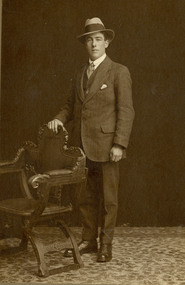
... The Frank Wright Medal at the Royal South Street competition is awarded to an individual recognized as making an outstanding contribution to brass music in Australia. maurice wright frank wright new zealand Hand written on back - With best wishes from Maurice Nov. 1919 Printed on back - The 'Tesla Studios', Wanganui, N.Z. Black and white photograph of a man standing in a formal pose holding the back of an ornate chair. The backdrop is a dark curtain and the man is standing on a floral carpet. The man is wearing a suit and light ...Maurice Wright was the brother of Frank Wright. Frank Wright was a renown resident of Smeaton, where he was born. He lived at Laura Villa, and attended Smeaton State School. His father William was a gold miner and his mother's name was Sarah. Their family won many singing and instrumental awards. Frank was tutored by Percy Code and became the Australian Open Cornet Champion by the age of eighteen. A year later, Frank conducted the City of Ballarat Band, and later the Ballarat Soldiers’ Memorial Band. He formed the Frank Wright Frisco Band and Frank Wright and his Coliseum Orchestra. These bands won many South Street awards, and Frank as conductor won many awards in the Australian Band Championship contest. In 1933 Frank Wright sailed to England to conduct the famous St Hilda’s Band and was later appointed Musical Director of the London County Council, where he organized many amazing concerts in parks, in and around the London district. He was made Professor of Brass and Military Band Scoring and conducted at the Guildhall of Music and Drama. Frank was often invited to adjudicate Brass Band Championships around Europe, in Australia, including South Street and in New Zealand. The Frank Wright Medal at the Royal South Street competition is awarded to an individual recognized as making an outstanding contribution to brass music in Australia.Black and white photograph of a man standing in a formal pose holding the back of an ornate chair. The backdrop is a dark curtain and the man is standing on a floral carpet. The man is wearing a suit and light coloured hat with a dark hat band. The man is Maurice Wright.Hand written on back - With best wishes from Maurice Nov. 1919 Printed on back - The 'Tesla Studios', Wanganui, N.Z.maurice wright, frank wright, new zealand -
 Federation University Historical Collection
Photograph - black and white, Frank Wright on the S.S. Babranals, 1933, 09/1933
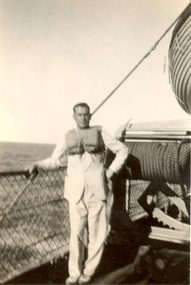
... The Frank Wright Medal at the Royal South Street competition is awarded to an individual recognized as making an outstanding contribution to brass music in Australia. babranals, red sea Written in pencil on the back of the photo is "With a life belt on boat S.S. Babranals Sept. 1933 Red Sea A black and white photograph of a man in a light coloured suit standing on a boast with a life belt on. ...Frank Wright was a renown resident of Smeaton, where he was born. He lived at Laura Villa, and attended Smeaton State School. His father William was a gold miner and his mother's name was Sarah. Their family won many singing and instrumental awards. Frank was tutored by Percy Code and was awarded a gold medal for the highest marks in the ALCM examinations in the British Colonies at the age of seventeen years. He became the Australian Open Cornet Champion by the age of eighteen. A year later, Frank conducted the City of Ballarat Band, and later the Ballarat Soldiers’ Memorial Band. He formed the Frank Wright Frisco Band and Frank Wright and his Coliseum Orchestra. These bands won many South Street awards, and Frank as conductor won many awards in the Australian Band Championship contest. In 1933 Frank Wright sailed to England to conduct the famous St Hilda’s Band and was later appointed Musical Director of the London County Council, where he organized many amazing concerts in parks, in and around the London district. He was made Professor of Brass and Military Band Scoring and conducted at the Guildhall of Music and Drama. Frank was often invited to adjudicate Brass Band Championships around Europe, in Australia, including South Street and in New Zealand. The Frank Wright Medal at the Royal South Street competition is awarded to an individual recognized as making an outstanding contribution to brass music in Australia.A black and white photograph of a man in a light coloured suit standing on a boast with a life belt on. The man is Frank WrightWritten in pencil on the back of the photo is "With a life belt on boat S.S. Babranals Sept. 1933 Red Seababranals, red sea -
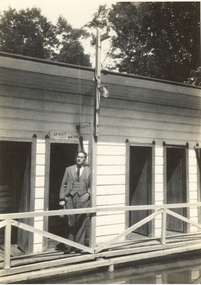 Federation University Historical Collection
Photograph - Photograph - Black and White, A black and white photograph of Frank Wright
... music in Australia. Frank Wright spout bath A black and white photograph of a man leaning on a light pole while standing on a timber deck over water.There is a timber building behind him, on the building is a sign "Spout Bath". ...Frank Wright was a renown resident of Smeaton, where he was born. He lived at Laura Villa, and attended Smeaton State School. His father William was a gold miner and his mother's name was Sarah. Their family won many singing and instrumental awards. Frank was tutored by Percy Code and was awarded a gold medal for the highest marks in the ALCM examinations in the British Colonies at the age of seventeen years. He became the Australian Open Cornet Champion by the age of eighteen. A year later, Frank conducted the City of Ballarat Band, and later the Ballarat Soldiers’ Memorial Band. He formed the Frank Wright Frisco Band and Frank Wright and his Coliseum Orchestra. These bands won many South Street awards, and Frank as conductor won many awards in the Australian Band Championship contest. In 1933 Frank Wright sailed to England to conduct the famous St Hilda’s Band and was later appointed Musical Director of the London County Council, where he organized many amazing concerts in parks, in and around the London district. He was made Professor of Brass and Military Band Scoring and conducted at the Guildhall of Music and Drama. Frank was often invited to adjudicate Brass Band Championships around Europe, in Australia, including South Street and in New Zealand. The Frank Wright Medal at the Royal South Street competition is awarded to an individual recognized as making an outstanding contribution to brass music in Australia.A black and white photograph of a man leaning on a light pole while standing on a timber deck over water.There is a timber building behind him, on the building is a sign "Spout Bath". The man is Frank Wright.frank wright, spout, bath -
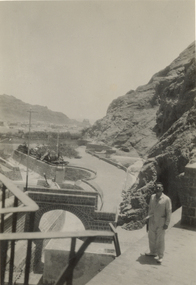 Federation University Historical Collection
Photograph - Black and White, Dr Rob Piachaud, Frank Wright at Aden, Arabia
... The Frank Wright Medal at the Royal South Street competition is awarded to an individual recognized as making an outstanding contribution to brass music in Australia. frank wright dr rob piachaud aden tanks at aden Written in pencil on back - Frank Wright at tanks in Aden (Arabia) which were built by the Persians in 600 B.C., Photo taken by Dr Rob Piachaud (from Ceylon) Black and Wright photograph of a man in a light coloured suit standing on a flat platform (probably stone work). ...Frank Wright was a renown resident of Smeaton, where he was born on 2 August 1901. He lived at Laura Villa, and attended Smeaton State School. His father William was a gold miner and his mother's name was Sarah. Their family won many singing and instrumental awards. Frank was tutored by Percy Code and was awarded a gold medal for the highest marks in the ALCM examinations in the British Colonies at the age of seventeen years. He became the Australian Open Cornet Champion by the age of eighteen. A year later, Frank conducted the City of Ballarat Band, and later the Ballarat Soldiers’ Memorial Band. He formed the Frank Wright Frisco Band and Frank Wright and his Coliseum Orchestra. These bands won many South Street awards, and Frank as conductor won many awards in the Australian Band Championship contest. In 1933 Frank Wright sailed to England to conduct the famous St Hilda’s Band and was later appointed Musical Director of the London County Council, where he organized many amazing concerts in parks, in and around the London district. He was made Professor of Brass and Military Band Scoring and conducted at the Guildhall of Music and Drama. Frank was often invited to adjudicate Brass Band Championships around Europe, in Australia, including South Street and in New Zealand. The Frank Wright Medal at the Royal South Street competition is awarded to an individual recognized as making an outstanding contribution to brass music in Australia.Black and Wright photograph of a man in a light coloured suit standing on a flat platform (probably stone work). In the background can be seen a water system with what appears to be a dam, surrounded by mountains . The man is Frank Wright and the place is Aden in Abrabia (Yemen).Written in pencil on back - Frank Wright at tanks in Aden (Arabia) which were built by the Persians in 600 B.C., Photo taken by Dr Rob Piachaud (from Ceylon)frank wright, dr rob piachaud, aden, tanks at aden -
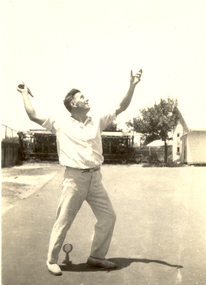 Federation University Historical Collection
Photograph - black and white, Frank Wright Playing Tennis, 10/1928
... The Frank Wright Medal at the Royal South Street competition is awarded to an individual recognized as making an outstanding contribution to brass music in Australia. frank wright conductor tennis tennis racquet 1). Black and white photograph of a man dressed in light coloured trousers and a white short sleeve shirt, serving a tennis ball. ...Frank Wright was a renown resident of Smeaton, where he was born. He lived at Laura Villa, and attended Smeaton State School. His father William was a gold miner and his mother's name was Sarah. Their family won many singing and instrumental awards. Frank was tutored by Percy Code and was awarded a gold medal for the highest marks in the ALCM examinations in the British Colonies at the age of seventeen years. He became the Australian Open Cornet Champion by the age of eighteen. A year later, Frank conducted the City of Ballarat Band, and later the Ballarat Soldiers’ Memorial Band. He formed the Frank Wright Frisco Band and Frank Wright and his Coliseum Orchestra. These bands won many South Street awards, and Frank as conductor won many awards in the Australian Band Championship contest. In 1933 Frank Wright sailed to England to conduct the famous St Hilda’s Band and was later appointed Musical Director of the London County Council, where he organized many amazing concerts in parks, in and around the London district. He was made Professor of Brass and Military Band Scoring and conducted at the Guildhall of Music and Drama. Frank was often invited to adjudicate Brass Band Championships around Europe, in Australia, including South Street and in New Zealand. The Frank Wright Medal at the Royal South Street competition is awarded to an individual recognized as making an outstanding contribution to brass music in Australia.1). Black and white photograph of a man dressed in light coloured trousers and a white short sleeve shirt, serving a tennis ball. Situated on a tennis court with buildings in the background. The man is Frank Wright. 2). Black and white photograph of a young man dressed in tennis whites and a jacket, holding a tennis racquet and leaning against the net on a tennis court. In the background is a hedge topped timber fence with the roof of a house behind. The man is perhaps Frank Wright or a friend.frank wright, conductor, tennis, tennis racquet -
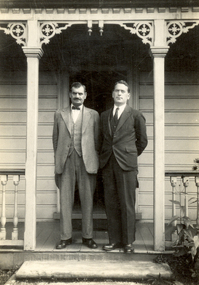 Federation University Historical Collection
Photograph - Black and White, Frank Wright (right), 1950s?
... The Frank Wright Medal at the Royal South Street competition is awarded to an individual recognized as making an outstanding contribution to brass music in Australia. frank wright conductor timber house Black and white photograph of two men dressed in suits, one light and the other dark. ...Frank Wright was a renown resident of Smeaton, where he was born. He lived at Laura Villa, and attended Smeaton State School. His father William was a gold miner and his mother's name was Sarah. Their family won many singing and instrumental awards. Frank was tutored by Percy Code and was awarded a gold medal for the highest marks in the ALCM examinations in the British Colonies at the age of seventeen years. He became the Australian Open Cornet Champion by the age of eighteen. A year later, Frank conducted the City of Ballarat Band, and later the Ballarat Soldiers’ Memorial Band. He formed the Frank Wright Frisco Band and Frank Wright and his Coliseum Orchestra. These bands won many South Street awards, and Frank as conductor won many awards in the Australian Band Championship contest. In 1933 Frank Wright sailed to England to conduct the famous St Hilda’s Band and was later appointed Musical Director of the London County Council, where he organized many amazing concerts in parks, in and around the London district. He was made Professor of Brass and Military Band Scoring and conducted at the Guildhall of Music and Drama. Frank was often invited to adjudicate Brass Band Championships around Europe, in Australia, including South Street and in New Zealand. The Frank Wright Medal at the Royal South Street competition is awarded to an individual recognized as making an outstanding contribution to brass music in Australia.Black and white photograph of two men dressed in suits, one light and the other dark. They are standing outside the front door, on the verandah of a timber house with ornate scroll work at the top of the posts supporting the verandah roof. The man on the right is Frank Wright.frank wright, conductor, timber house -
 Federation University Historical Collection
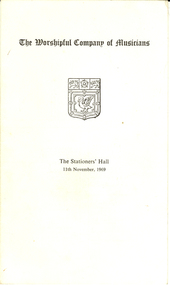
Booklet, The Worshipful Company of Musicians, 1969, 11 November, 1969
... music in Australia. In the 1960's Frank became 'The Senior Warden' of The Worshipful Company of Musicians. frank wright stationers' hall worshipful company of musicians Printed with the title and emblem, place and date and the list of participant names, plus an index. This is a folded, light ...Frank Wright was a renown resident of Smeaton, where he was born on 2 August 1901. He lived at Laura Villa, and attended Smeaton State School. His father William was a gold miner and his mother's name was Sarah. Their family won many singing and instrumental awards. Frank was tutored by Percy Code and was awarded a gold medal for the highest marks in the ALCM examinations in the British Colonies at the age of seventeen years. He became the Australian Open Cornet Champion by the age of eighteen. A year later, Frank conducted the City of Ballarat Band, and later the Ballarat Soldiers’ Memorial Band. He formed the Frank Wright Frisco Band and Frank Wright and his Coliseum Orchestra. These bands won many South Street awards, and Frank as conductor won many awards in the Australian Band Championship contest. In 1933 Frank Wright sailed to England to conduct the famous St Hilda’s Band and was later appointed Musical Director of the London County Council, where he organized many amazing concerts in parks, in and around the London district. He was made Professor of Brass and Military Band Scoring and conducted at the Guildhall of Music and Drama. Frank was often invited to adjudicate Brass Band Championships around Europe, in Australia, including South Street and in New Zealand. The Frank Wright Medal at the Royal South Street competition is awarded to an individual recognized as making an outstanding contribution to brass music in Australia. In the 1960's Frank became 'The Senior Warden' of The Worshipful Company of Musicians.This is a folded, light card programme of the table seating for The Worshipful Company of Musicians celebration held at The Stationers' Hall on the 11th November 1969. Gift of Frank Ritchie, Nephew of Frank WrightPrinted with the title and emblem, place and date and the list of participant names, plus an index.frank wright, stationers' hall, worshipful company of musicians
