
Showing 94 items matching "lighting - domestic"
-
 Flagstaff Hill Maritime Museum and Village
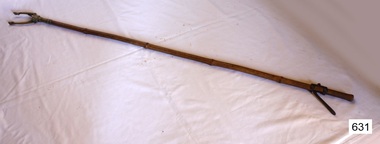
Tool - Candle Snuffer, Harris and Sheldon, circa 1840
... ...lighting...domestic...It is also significant as a rare religious service harris and sheldon ltd birmingham manufacturer sydney harris sailors rest ladies harbour light guild mission to seamen williamstown library tool flagstaff hill warrnambool shipwrecked coast flagstaff hill maritime museum maritime museum shipwreck coast flagstaff hill maritime village great ocean road religion bethel sailors’ church bethel floating church joy club for fighters ladies lightkeepers’ auxiliary mission to seafarers flying angel’s club st nicholas seamen’s church williamstown st nicholas seamen’s church flagstaff hill candle snuffer candle extinguisher flame snuffer flame extinguisher lighting domestic lighting extinguisher "HARRIS & SHELDON LTD.", "BIRMINGHAM" Candle snuffer tool. ...This mechanical candle snuffer tool was made in Birmingham, England, by Harris and Sheldon Ltd. The candle snuffer was part of the original furnishings of the St Nicholas' Mission to Seamen's Church at 139 Nelson Street, Williamstown, Victoria. It was donated to Flagstaff Hill and is part of the St Nicholas Seamen's Church Collection The enterprise of Harris and Sheldon was established in 1880 by Sydney Harris. They made shop fittings such as cabinets, shelving, cupboards, tables and stationery. During WWII, they made aircraft parts, ammunition boxes and pumps. THE MISSIONS TO SEAMEN (Brief History): - The Missions to Seamen was an Anglican charity in Great Britain that has served the world's seafarers since 1856. Its symbol is a Flying Angel, inspired by a Bible verse. Today, there are centres in over 200 ports worldwide where seamen of all backgrounds are offered a warm welcome and provided with a wide range of facilities. In Victoria, the organisation began in Williamstown in 1857 as a Sailors’ Church, also known as ‘Bethel’ or the ‘Floating Church’ in an old hulk floating in Hobson’s Bay, Port of Melbourne. It soon became part of the Missions to Seamen, Victoria. In 2000, the organisation, now named Mission to Seafarers, still operated locally in Melbourne, Portland, Geelong and Hastings. The Ladies’ Harbour Lights Guild was formed in 1906 to support the Missions to Seamen in Melbourne and other centres, such as Williamstown. Two of the most significant ladies of the Guild were founder Ethel Augusta Godfrey and foundation member Alice Sibthorpe Tracy (who established a branch of the Guild in Warrnambool in 1920). The Guild continued its work until the 1960s. In 1943, a former Williamstown bank was purchased for the Missions to Seamen Club. The chapel was named St Nicholas’ Seamen’s Church and was supported by the Ladies’ Harbour Lights Guild, the Williamstown Lightkeepers’ Auxiliary and the League of Soldiers’ and Sailors’ Friends. It ceased operation in 1966. A Missions to Seamen Chapel and Recreation Room was a significant feature of ports during the late 1800s and 1900s. It seemed appropriate for Flagstaff Hill to include such a representation within the new Maritime Village, and the Melbourne Board of Management of Missions to Seamen Victoria gave its permission on 21st May 1979 for the entire furnishings of the Williamstown chapel to be transferred to Flagstaff Hill. The St Nicholas Seamen’s Church was officially opened on October 11, 1981, and resembles the Williamstown chapel. This candle snuffing tool is significant historically for its origin in the St Nicholas Mission to Seamen's Church in Williamstown, established in 1857 to cater for the physical, social, and spiritual needs of seafarers. It originated in Bristol, England when a Seamen's Mission was formed in 1837. It is also significant as a rare Candle snuffer tool. A bamboo and brass pole with a spring-action handle that operates a brass pinching mechanism at the other end. The mechanism has been inserted into the hollow bamboo handle. Maker's inscription on the pinching mechanism. Made in Birmingham, England, by Harris & Sheldon Ltd. This is one of the original items in our st Nicholas Seamen's Church Collection."HARRIS & SHELDON LTD.", "BIRMINGHAM"religious service, harris and sheldon ltd, birmingham manufacturer, sydney harris, sailors rest, ladies harbour light guild, mission to seamen williamstown, library tool, flagstaff hill, warrnambool, shipwrecked coast, flagstaff hill maritime museum, maritime museum, shipwreck coast, flagstaff hill maritime village, great ocean road, religion, bethel sailors’ church, bethel floating church, joy club for fighters, ladies lightkeepers’ auxiliary, mission to seafarers, flying angel’s club, st nicholas seamen’s church williamstown, st nicholas seamen’s church flagstaff hill, candle snuffer, candle extinguisher, flame snuffer, flame extinguisher, lighting, domestic lighting, extinguisher -
 Flagstaff Hill Maritime Museum and Village
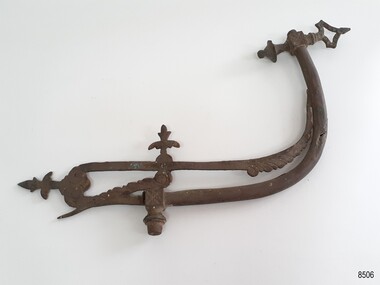
Functional object - Lamp Fitting, circa 1869
... ...lighting...domestic...Flagstaff Hill Warrnambool Maritime Village Maritime Museum Flagstaff Hill Maritime Museum and Village Shipwreck coast Great Ocean Road Shipwreck artefact wreck dive McCulloch Collection Bruce McCulloch Victorian Heritage Register sailing ship lamp fitting gas lamp fitting ship’s fitting ship’s lamp brass lamp fitting lighting domestic lighting ship’s lighting southwest coast Victoria Victoria Tower 1869 Torquay diver Evans Liverpool clipper ship iron hull migrant ship cargo ship 1869 shipwreck Brass decorative gas lamp fitting. ...The brass lamp fitting was one of a group of artefacts in the McCulloch Collection that were recovered from the shipwreck Victoria Tower. The jar could have been from the ship's cargo or amongst the passengers' personal effects. The object is now one of the shipwreck artefacts in Flagstaff Hill’s McCulloch Collection, which includes other items recovered from the Victoria Tower, built in Liverpool by Evans in 1969, and wrecked the same year near Torquay, Victoria, on its maiden voyage. A diver salvaged the objects in the early 1970s while working along the southwest coast of Victoria. Advanced marine technology had enabled divers to explore the depths of the ocean and gather its treasures before the Government introduced protective legislation. The artefacts were donated to the Queensland Department of Environment and Heritage Protection (EHP) by a passionate shipwreck lover. Bruce McCulloch verified their locations. In 2017, the Department repatriated them to Flagstaff Hill, where they joined our vast collection of artefacts from Victoria’s Shipwreck Coast. The artefact is an example of cargo or personal items on board a ship in 1869. It provides a reference point for classifying and dating similar items. This artefact is significant for its association with the British-built, iron clipper ship Victoria Tower, a commercial and immigrant sailing ship constructed to carry cargo and passengers to colonial Australia. The vessel is recorded on the Victoria Heritage Database, VHR S698. Brass decorative gas lamp fitting. Two flat arms of different lengths are joined on either side of a fitting that has a fleur-de-lis-like design. The shorter arm has a J-shaped brass pipe fitted to it with a decorative threaded cube joint partway along, and ends with a triangular tap and knob. The longer arm is also J-shaped and ends with a feather design. There are remnants of green paint on the cube fittings and the knob. Recovered from the wreck of the Victoria Tower.flagstaff hill, warrnambool, maritime village, maritime museum, flagstaff hill maritime museum and village, shipwreck coast, great ocean road, shipwreck artefact, wreck dive, mcculloch collection, bruce mcculloch, victorian heritage register, sailing ship, lamp fitting, gas lamp fitting, ship’s fitting, ship’s lamp, brass lamp fitting, lighting, domestic lighting, ship’s lighting, southwest coast victoria, victoria tower, 1869, torquay, diver, evans, liverpool, clipper ship, iron hull, migrant ship, cargo ship, 1869 shipwreck -
 Orbost & District Historical Society
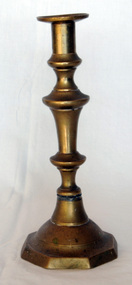
candlestick, late 19th century
... candlestick brass Victorian lighting domestic-lighting candle...Before the advent of electricity candlesticks were a necessity in every household. candlestick brass Victorian lighting domestic-lighting candle A tall and thin brass candlestick on a hexagonal base.The candlestick has a decorative shape with several raised bands and engraved lines encircling the body horizontally. ...Brass is an alloy made of two-thirds copper and one-third zinc, although the ratio varies.Before the advent of electricity candlesticks were a necessity in every household.A tall and thin brass candlestick on a hexagonal base.The candlestick has a decorative shape with several raised bands and engraved lines encircling the body horizontally. It has two concentric circles decorating the foot. candlestick brass victorian lighting domestic-lighting candle -
 Orbost & District Historical Society
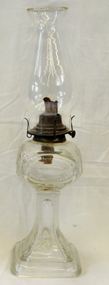
Lamp - kerosene, first half of 20th century
... ...lighting - domestic...It has historical significance in demonstrating lighting devices used before the widespread use of electricity. lamp kerosene lamp lighting - domestic Ornate clear glass kerosene lamp. ...This lamp pattern was originally made in USA between 1880 and 1900. The pattern is called Feathered Cartouche and generally had a painted motif on each of the panels on the front. This lamp is probably a copy of the American lamp and made in Australia sometime in the first half of the 20th century. The lamp has an English style collar rather than an American one and the pattern is not as crisp as the American ones. There were several lamp patterns made here that were copies of American patterns and that style of collar was used on most of them. (ref Oil Lamp Antiques)This item is an important example of the early technology of artificial light. It has historical significance in demonstrating lighting devices used before the widespread use of electricity.Ornate clear glass kerosene lamp. Glass chimney is missing. Base is square and patterned with raised oval shapes, as is the stem. Both base and stem are hollow. At the top, the kerosene holder is squarish with round corners.. The wick holder is of brass and has a small wick adjustor.lamp, kerosene lamp, lighting - domestic -
 Glenelg Shire Council Cultural Collection
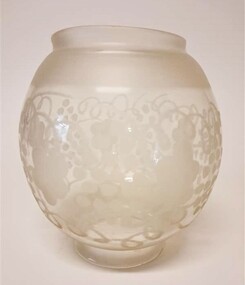
Functional object - Lamp Shade - oil or gas, 1850-1920
... ...Lighting...domestic...This lamp shade is part of a large collection of different types of lamps and burners and provides interpretive context to the history of lighting and its development as a decorative item. Lamp Lighting domestic item Glass Etching Glass domed lampshade. ...Etched glass shades provided a decorative way to enhance oil or kerosene lamps. Decorative shades became popular in the 1700s and the etched glass shade reached peak popularity in the Victorian era.This lamp shade is part of a large collection of different types of lamps and burners and provides interpretive context to the history of lighting and its development as a decorative item.Glass domed lampshade. It has an opening at the top and the bottom. The top opening is larger than the bottom opening. The glass is etched with floral motifs and patterns.lamp, lighting, domestic item, glass etching -
 Friends of Westgarthtown
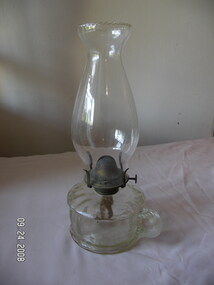
Domestic object - Lamp, paraffin
... lighting...domestic...lighting domestic glass lamp lighting. "Victor" embossed on gallery. ...Clear glass fuel reservoir with radial ribbed design and handle. Glass chimney."Victor" embossed on gallery.lighting, domestic, glass, lamp, lighting. -
 Kiewa Valley Historical Society
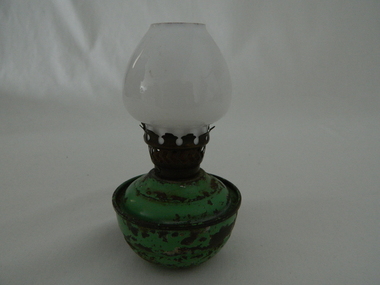
Lamp Small Kerosene, circa early 1900s
... ...domestic lighting...lighting. The transition phase to "modern" outdoor and domestic lighting lingered on the rural areas where the electrical reticulation suffered from reliable constant supply....lighting. The transition phase to "modern" outdoor and domestic lighting lingered on the rural areas where the electrical reticulation suffered from reliable constant supply. ...The period when kerosene was extensively used for indoor lighting was before electrical reticulation was installed in rural areas. In remote areas this was up to the mid 1900's. The kerosene lantern however was still in use, for camping and outdoor activities, well beyond this period and was eventually replaced by LPG and battery powered lighting. The transition phase to "modern" outdoor and domestic lighting lingered on the rural areas where the electrical reticulation suffered from reliable constant supply.In the Kiewa Valley, being a rural region, had reliable electrical domestic and farm supply only after the Kiewa Hydro Electricity Scheme had been fully operational. The supply was relative to how close the homestead was to the major electricity substation. This kerosene lamp was in use during the period when it was the only reliable source of domestic night time lighting. The strength of refractive light produced by this lantern/lamp hinged upon the size of the lamp(wick and glass bowl). The small size of this lamp suggests that it was for use in a small room(children's bedroom) or as providing a light for a safe walk to the outside ablutions (toilet) area. This small kerosene lamp has an enclosed "cup" body which would have contained the kerosene fuel. The top wick holder, made from brass, has an extended enclosed spout which raises the wick approximately 20mm from the bottom of the holder. The wick holder screws into the the top of the kerosene reservoir bowl and has a wick adjustment screw (light control) at one side. The small white glass light reflector bulb nestles securely onto the wick holder and is kept snug by snap designed extending "fingers". The section between the bottom of the refractive glass "light" bowl and the top of the kerosene bowl has perforations to allow air passage to feed directly to the wick.The light refracting bulb is open at the top to allow heat and smoke from the burning wick to escape upwards.On the wick control screw "CWB BRITISH MADE"kerosene reading lamp, domestic lighting, bedside light -
 Flagstaff Hill Maritime Museum and Village
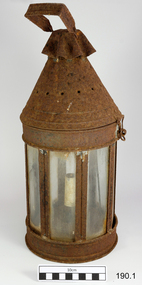
Functional object - Lamp, After 1950
... lighting...candle lamp...domestic...It is currently not associated with a historical event, person or place at this time and is being used to augment Flagstaff's village display. flagstaff hill warrnambool shipwrecked coast flagstaff hill maritime museum maritime museum shipwreck coast flagstaff hill maritime village great ocean road lighting candle lamp domestic lighting ship lamp Metal lamp with circular base, 8-sided glass section and conical lid topped by a frilled metal cone and handle made from a strip of metal bent into a 'u' shape and attached so that it can swing back and forth..Cone hinges to side to give access to candle, which is seated in a short ring in the centre of the base. ...The lamp has been manufactured for decorative used, representing lamps of the late 19th and early 20th century used for lighting.The lamp is an example of a 19th century ships lamp. It is currently not associated with a historical event, person or place at this time and is being used to augment Flagstaff's village display.Metal lamp with circular base, 8-sided glass section and conical lid topped by a frilled metal cone and handle made from a strip of metal bent into a 'u' shape and attached so that it can swing back and forth..Cone hinges to side to give access to candle, which is seated in a short ring in the centre of the base. There is a ring of air holes around the circumference of the cone, about half way up the height of it. A shard of glass missing from one of the glass panels and the metal parts are corroded.flagstaff hill, warrnambool, shipwrecked coast, flagstaff hill maritime museum, maritime museum, shipwreck coast, flagstaff hill maritime village, great ocean road, lighting, candle lamp, domestic lighting, ship lamp -
 Flagstaff Hill Maritime Museum and Village
Domestic object - Candle stick holder, ca. 19th century
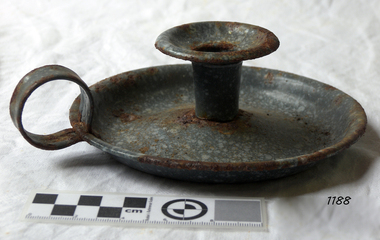
... ...domestic lighting...They were used before commonly in domestic situations before lighting from kerosene, gas and electricity was freely available and affordable....This is an example of lighting used commonly before the late 19th century. flagstaff hill warrnambool shipwrecked-coast flagstaff-hill flagstaff-hill-maritime-museum maritime-museum shipwreck-coast flagstaff-hill-maritime-village domestic lighting candle candlestick candle holder light Candle stick holder enamel grey speckled with dish base, side handle and fixture for holding candle. ...Candle stick holders were used to hold and display candles for light. They were used before commonly in domestic situations before lighting from kerosene, gas and electricity was freely available and affordable.This is an example of lighting used commonly before the late 19th century.Candle stick holder enamel grey speckled with dish base, side handle and fixture for holding candle.flagstaff hill, warrnambool, shipwrecked-coast, flagstaff-hill, flagstaff-hill-maritime-museum, maritime-museum, shipwreck-coast, flagstaff-hill-maritime-village, domestic lighting, candle, candlestick, candle holder, light -
 Cheese World Museum
Gaslight Holder
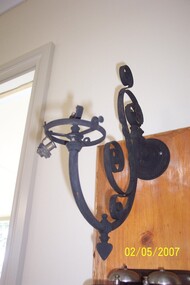
... lighting...uebergang...allansford...domestic...lighting uebergang allansford domestic items gaslight gaslight holder Pressed steel black ornate gaslight holder with two swirls- one above and below each other and cast iron flowers attached to the upper support. valve to turn the gas on and off. ...Pressed steel black ornate gaslight holder with two swirls- one above and below each other and cast iron flowers attached to the upper support. valve to turn the gas on and off.lighting, uebergang, allansford, domestic items, gaslight, gaslight holder -
 Clunes Museum
domestic object - GAS LIGHT
... ...Domestic lighting...Gas light fitting Domestic lighting Home decor Nil Four armed brass gas light, four clear light fluted light shades 3 x etched with flowers and leaves 1 x ruby lines at top Glass bowl in centre 4 x chains 2/3rd up shaft 4 x chains holding light domestic object GAS LIGHT ...Four armed brass gas light, four clear light fluted light shades 3 x etched with flowers and leaves 1 x ruby lines at top Glass bowl in centre 4 x chains 2/3rd up shaft 4 x chains holding lightNilgas light fitting, domestic lighting, home decor -
 Whitehorse Historical Society Inc.
Functional object - Candle holder, C 1930's
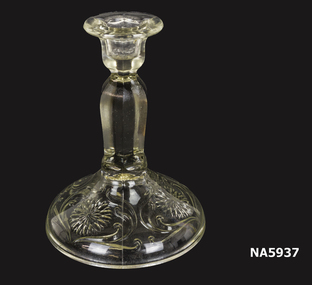
... Domestic lighting...Belonged to donor's grandmother. Domestic lighting Candle Nil - Pressed glass candle holder - Clear glass Functional object Candle holder ...Belonged to donor's grandmother.- Pressed glass candle holder - Clear glassNildomestic lighting, candle -
Ballarat Tramway Museum
Administrative record - SECV Ballarat Power Stations, State Electricity Commission of Victoria (SECV), "Units Book", 1949 to 1956
... For each month records power generated, load factors, maximum demands, traction power, public lighting, domestic, industrial, and commercial, and total sales excluding that power used by the SECV themselves in offices, workshops, stores, and for auxiliary equipment at the power stations. ...For each month records power generated, load factors, maximum demands, traction power, public lighting, domestic, industrial, and commercial, and total sales excluding that power used by the SECV themselves in offices, workshops, stores, and for auxiliary equipment at the power stations. ...Contains entries for the monthly records of Units generated and consumed in the Ballarat SECV district from Nov. 1949 to June 1956. For each month records power generated, load factors, maximum demands, traction power, public lighting, domestic, industrial, and commercial, and total sales excluding that power used by the SECV themselves in offices, workshops, stores, and for auxiliary equipment at the power stations. First entry for Ballarat B Power Station Sept, 1953. See item 9543 for the July 1956 to Dec. 1962.Demonstrates record keeping of the units generated and sent out (sold) of the two Ballarat Power stations.Printed as a Minute book - 136 ruled pages + heavy card cover, red tape binding on the outside, six sections, bound, with additional red and blue ink columns. tramways, ballarat power supply, ballarat a power station, ballarat b power station, secv, electricity generation -
Ballarat Tramway Museum
Administrative record - SECV Ballarat Power Stations, State Electricity Commission of Victoria (SECV), "Units Book", 1956 to 1962
... For each month to July 1960, records power generated, load factors, maximum demands, traction power, public lighting, domestic, industrial, and commercial, and total sales and for auxiliary equipment at the power stations. ...For each month to July 1960, records power generated, load factors, maximum demands, traction power, public lighting, domestic, industrial, and commercial, and total sales and for auxiliary equipment at the power stations. ...Contains entries for monthly records of Units generated and consumed in the Ballarat SECV district from July 1956. For each month to July 1960, records power generated, load factors, maximum demands, traction power, public lighting, domestic, industrial, and commercial, and total sales and for auxiliary equipment at the power stations. From August 1960 to Dec. 1962 duplicated sheets titled "Energy Statistics" that do not give data for sales. See item 9542 for data from Nov. 1949 to June 1956. Ballarat A Power Station not recorded generating during Dec. 1956 then not every month during 1957. Some use during the winter of 1958. Last recorded used was during June 1959.Demonstrates record keeping of the units generated and sent out (sold) of the two Ballarat Power stations.Printed as an Account book - approx 136 ruled pages + heavy card cover, blue tape binding on the outside, five sections, bound, with additional red and blue ink columns with many loose duplicated foolscap sheets.tramways, ballarat power supply, ballarat a power station, ballarat b power station, secv, electricity generation -
 Flagstaff Hill Maritime Museum and Village
Functional object - Lamp Light, late 19th - early-20th century
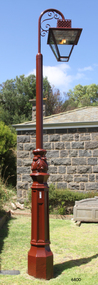
... The Warrnambool gasworks supplied all street and shop lighting and most domestic lighting until 1923 when electricity was available for lighting. ...The Warrnambool gasworks supplied all street and shop lighting and most domestic lighting until 1923 when electricity was available for lighting. ...This gas lamp light and stand came from the original manufacturer in Melbourne. Gas street lights such as this one were used in Melbourne from the mid-19th century. The lights enabled safer after-dark travel for pedestrians and vehicles and were a deterrent to crime. A lamp lighter was employed to keep the lamps lit, sometimes with little success due to weather conditions and the pranks of youths. WARRNAMBOOL Gasworks In Warrnambool prior to 1874 there were about twenty rare, individually lit street lights in Warrnambool, each with its own supply of kerosene. These lamps were in the central business area of Timor, Koroit and Liebig Streets. The Warrnambool Gas Company Ltd. was registered as an incorporated company in 1873. It was a private, locally owned business. It was located at 209-215 Merri Street, Warrnambool, on the land, which is just west of the later-built railway station. The first managers of the Gas Company lived in a substantial stone house on site, but later the managers lived in a residence in Henna Street between Merri and Timor Streets. The original home, which still stands, became a residence for the Railway Station Master from about 1890. In August 1874 the construction of the gasworks was complete and at the end of that month gas was supplied to all of the existing lamps in Warrnambool for the first time. The Warrnambool Gas Company wound up in 1880-1881 and was purchased by the Warrnambool Borough Council with money raised by a loan – the Borough’s first ‘loan transaction’. The Council established a piped network to supply gas to other street connections. The gasworks were privatised and upgraded in 1952. In 1972 the town supply was converted to liquid petroleum gas and by the early 1980s the gasworks were closed down. In 1986 Warrnambool was supplied with natural gas from a site near Port Campbell. The Warrnambool gasworks supplied all street and shop lighting and most domestic lighting until 1923 when electricity was available for lighting. Bromfield Street in Warrnambool was named after the director of the gasworks, James Astley Bromfield (1823-1903). He arrived in Warrnambool from Worcestershire, England, in 1852 and was very active in the local council and community. Cockman Street was named after the first secretary of the gasworks in 1874, Walter Cockman (c.1821-1892). He was a Mayor and businessman. The second Manager, Luther Rodgers, worked for the gas company for about twenty years and both Rodger Place and Rodgers Road in Warrnambool have been named after him. LAMP LIGHTS IN MELBOURNE In the 1820s Melbourne's innkeepers were legally required to have a lamp light outside their premises from sunset to sunrise. This was the first instance of street lamps being used in Melbourne. In 1847 the first oil lamp was used in the city. In 1849 a gas lamp was installed on the Swanston Street Bridge and much of the city had oil lamps installed by then. In August 1857 the installation of street gas lamps began in Melbourne. They were welcomed for the much brighter illumination they gave. By 1860 there were 414 lamp pillars. The phrase was quoted often - "A light was as good as a policeman". The first gas burners used for street lighting were called 'fishtail' gas burners. These were replaced in the early 1900s by gas mantles. The City of Melbourne Gas Coke Company was formed in 1850 but due to the Gold Rush the manufacture and distribution of the gas supply was delayed until January 1856. By the 1890s the gas supplying the lights was supplied by three companies in Melbourne. In 1879 a football match was played at the MCG under electric lighting and gradually electric arc lights were installed inside and outside buildings in the city. Lamp lights such as the one in Flagstaff Hill’s collection were no longer needed. (References: John Lindsay re Lamp Light history 2019-01-29, Former Warrnambool Gas Company Limited, Victorian Heritage Database Report, Heritage Number 149746 https://vhd.heritagecouncil.vic.gov.au/places/149746/download-report ) The lamp light is representative of the lamps used in Melbourne from the mid-nineteenth century to light the streets at night and make Melbourne a safer city. The lamp is also representative of the gas street lighting in Warrnambool from the mid-1870s-1920s.Lamp light or gas light. Street light, one of the last gas street lights removed from Melbourne. (Reconditioned by Friends of Flagstaff Hill, 2013)flagstaff hill, warrnambool, shipwrecked coast, flagstaff hill maritime museum, maritime museum, shipwreck coast, flagstaff hill maritime village, great ocean road, lamp light, gas light, gas lamp, street lamp, street light, gas street light, melbourne street lighting, warrnambool street lighting, melbourne gas street light, warrnambool gas company, warrnambool gasworks, james bromfield, walter cockman, luther rodgers, city of melbourne gas coke company -
 Flagstaff Hill Maritime Museum and Village
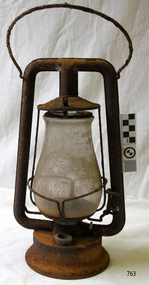
Domestic object - Lamp, Bradley & Hubbard, Early 20th century
... The lamp was given away to customers of Kerosene oil as a means of increasing the Standard Oil Company sales of Kerosene during the late19th to early 20th century. flagstaff hill warrnambool shipwrecked-coast flagstaff-hill-maritime-museum shipwreck-coast flagstaff-hill-maritime-village Kerosene Lamp Lighting Hurricane Lamp Storm Lamp Rayo Ltd Inscribed "Rayo" and "Made in the USA" Kerosene Lamp, side lifting arm to light. Domestic ...One of the most common centre draft kerosene lamps one can find in the USA and Canada is the Rayo. Large and sturdy, simple to use, but also notorious for being a fuel hog. This lamp was made by Bradley and Hubbard Metalworks in Chicago also Bradley and Hubbard made the “Perfection” brand lamps that look like the Rayo and are pretty much the same lamp with all parts interchangeable. The Rayo was given away to customers for free as a promotional item by the Standard Oil Company. The lamp’s huge appetite for fuel meant a hefty increase in sales of kerosene for the company and increased profits. The Rayo is a classic centre draft lamp that uses a widely available tubular wick that measures 62mm flat. It employs a simple and reliable mechanism for securing wicks in the burner along with a brass tube with many small teeth at its end. The tube is attached to the toothed rack that’s moved up and down by the adjuster knob. This type of lamp was used in most households and on rural properties before the introduction of electricity and is an early example of a promotional. The lamp was given away to customers of Kerosene oil as a means of increasing the Standard Oil Company sales of Kerosene during the late19th to early 20th century.Kerosene Lamp, side lifting arm to light.Inscribed "Rayo" and "Made in the USA"flagstaff hill, warrnambool, shipwrecked-coast, flagstaff-hill-maritime-museum, shipwreck-coast, flagstaff-hill-maritime-village, kerosene lamp, lighting, hurricane lamp, storm lamp, rayo ltd -
 Flagstaff Hill Maritime Museum and Village
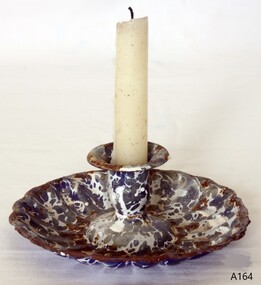
Domestic object - Candle stick holder, Early 20th century
... None currently available Item at this time cannot be associated with an historical event, person or place, provenance is unknown, item assessed as a collection asset. flagstaff hill warrnambool shipwrecked coast flagstaff hill maritime museum flagstaff hill maritime village great ocean road candle holder candle stick holder lighting enamelled candle holder Blue and white abstract mottle pattern Candle stick holder, enamel corrugated bowl shaped dish with no handle Domestic object Candle stick holder ...None currently availableItem at this time cannot be associated with an historical event, person or place, provenance is unknown, item assessed as a collection asset.Candle stick holder, enamel corrugated bowl shaped dish with no handleBlue and white abstract mottle patternflagstaff hill, warrnambool, shipwrecked coast, flagstaff hill maritime museum, flagstaff hill maritime village, great ocean road, candle holder, candle stick holder, lighting, enamelled candle holder -
 Flagstaff Hill Maritime Museum and Village
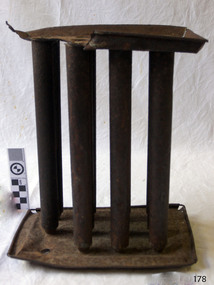
Domestic object - Candle Mould
... lighting candles tallow beeswax bayberry wax spermaceti was whale oil candlelight Candle mould of tinplate for one dozen (12) candles. The tubular moulds stand upright, three rows of four, in a fitted tray. Another concave tray fits over the top ends of the moulds and has a hole above each of the candles, which is used for filling the moulds with melted wax. Ends have wire-reinforced edges. Domestic ...Candles were the main source of lighting during the Colonial era. The candles were made at home from tallow, or animal fat, which was readily available and inexpensive. The tallow was soft, often had an unpleasant smell, band burned with a low, quickly fading light. Beeswax candles could be bought ready-made and lasted longer when lit. Bayberry wax could also be made into candles but was the process was labour intensive and time consuming. Spermaceti was from whale oil, a growing industry in the late 1800's, made firmer candles. Around this time wooden candle moulds were invented and uniform size and shape candles could be produced using the spermaceti wax. The candle mould is significant in the evolution of household lighting. It was an asset to the 19th century homemakers, allowing the production of their own candles in a uniform size. Candlelight allowed for the extension of time available for duties.Candle mould of tinplate for one dozen (12) candles. The tubular moulds stand upright, three rows of four, in a fitted tray. Another concave tray fits over the top ends of the moulds and has a hole above each of the candles, which is used for filling the moulds with melted wax. Ends have wire-reinforced edges.flagstaff hill, warrnambool, shipwrecked coast, flagstaff hill maritime museum, maritime museum, shipwreck coast, flagstaff hill maritime village, great ocean road, candle mould, candle making, lighting, candles, tallow, beeswax, bayberry wax, spermaceti was, whale oil, candlelight -
 Flagstaff Hill Maritime Museum and Village
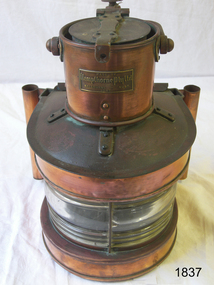
Functional object - Marine Lamp, Kempthorne Pty Ltd, 1941
... They manufactured lighting fixtures and fittings including oil lamps for marine use as well as for the domestic market. ...They manufactured lighting fixtures and fittings including oil lamps for marine use as well as for the domestic market. ...Kempthorne Lighting Pty. was established as Coffey Lanterns in East Malvern, Melbourne Victoria in 1931 by brothers Selwyn and Owen Coffey. They manufactured lighting fixtures and fittings including oil lamps for marine use as well as for the domestic market. In early 1936 two other brothers, Erle and Terence had joined the company which was renamed Kempthorne Lantern Works Pty., Ltd. In 1946 Kempthorne joined with a small design team who had developed a domestic fan to form the subsidiary, Mistral fans. The company previously known as Kempthorne Holding Ltd was listed on the stock exchange in 1968. In 1977-1979 Kempthorne Mistral Ltd. Was a holding company comprising of Kempthorne Lighting Pty., Ltd. & Mistral Fans Pty., Ltd. An early Australian made marine lamp by a significant manufacturer that is still in business today making electrical equipment. The item is an important artefact that was made by an early Australian business that started in the 1930s. Over the years this company has demonstrated many innovations to the manufacturer of electrical items. Marine copper Lamp, round with brass makers lozenge and rounded hollow lugs set on either side of the lamp. Heavy metal handle with brass locking pin. Lid with catch on top. Made by Kempthorne Pty Ltd Melb. 1941flagstaff hill, warrnambool, shipwrecked-coast, flagstaff-hill, flagstaff-hill-maritime-museum, maritime-museum, shipwreck-coast, flagstaff-hill-maritime-village, lamp, copper ship lamp, ship lamp, kempthorne pty ltd -
 Flagstaff Hill Maritime Museum and Village
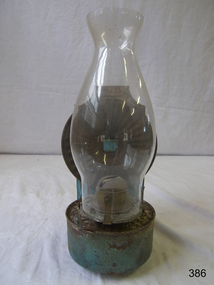
Domestic object - Lamp, Valor Co. Ltd, 1920-1936
... Ltd V inside a clover Veritas British made lamp reflector lighting lamp The Valor Company Ltd Trademark; "[clover symbol] surrounding a "V" Stamp: "BRITISH MADE" Marked on adjusting device: "English Made 1 in w" Marked on support of deflector shield - "British Made" and symbol Kerosene lamp; blue painted metal fuel can and metal rear reflector support. and a round corrugated reflector at the rear. The mid-section wick is made of brass. The glass cover or chimney is bulbous in shape. Inscriptions include a trademark "V" inside a clover. It is British-made in Birmingham by either Veritas Efsca Works or Veritas Valor. Domestic ...This trade mark (V inside a clover) was German. It was used by the lamp makers Veritas Efsca Works in Birmingham, and for a time by Valor Co. Ltd. which took over Veritas. Valor Co. Ltd. was established in Birmingham in 1890 and produced oil containers for the Anglo-American Oil Com. In 1901 the firm advertised themselves as Stampers And Pieces. Later it was named 'The Valor Co. and was associated with the Aston Brass Co., and advertised as makers of oil lamps and stoves. Valor became a maker of oil heaters cookers and many other products that were fueled by oil. Later it sold gas heaters and ovens. In 1936 Valor Co. Ltd. was made a Public Company and operated under the name The Velor Company Ltd. The company changed names over the years and it was still operating under Velor Fires in January 2002.Oil or kerosene lamps were the means of lighting for homes, farms and industry in the late 19th and early-to-mid 20th centuries. Lamps like these were important as Lighthouse Keepers and Assistant Keepers' equipment. They were in common use in until the lighting was powered by gas and electricity. The reflector at the back of the lamp makes it of greater significance as most lamps don't have this feature. The logo is also interesting as it originated in Germany and was used with permission by a British company and the company that brought it out for a short time. Similar lamps are still available today, usually with gas for fuel. Kerosene lamp; blue painted metal fuel can and metal rear reflector support. and a round corrugated reflector at the rear. The mid-section wick is made of brass. The glass cover or chimney is bulbous in shape. Inscriptions include a trademark "V" inside a clover. It is British-made in Birmingham by either Veritas Efsca Works or Veritas Valor.Trademark; "[clover symbol] surrounding a "V" Stamp: "BRITISH MADE" Marked on adjusting device: "English Made 1 in w" Marked on support of deflector shield - "British Made" and symbolwarrnambool, shipwreck coast, flagstaff hill, flagstaff hill maritime museum, flagstaff hill maritime village, oil lamp, table lamp, kerosene lamp, valor co. ltd, v inside a clover, veritas, british made, lamp reflector, lighting, lamp, the valor company ltd -
 Greensborough Historical Society
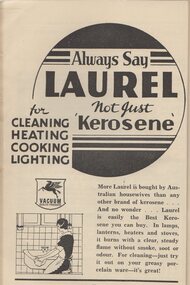
Document - Advertisement - Digital Image, NSW Cookery Teachers' Association, Laurel Kerosene: in Domestic Science Handbook, 1942_
... domestic science schools". An example of 1940s advertising through cooking and homemaker books. In this book, instructions are given for many aspects of household management, interspersed with advertisements for useful items. This Laurel Kerosene advertisement claims that Lauren Kerosene is good for cleaning, heating, cooking and lighting...domestic science schools". An example of 1940s advertising through cooking and homemaker books. In this book, instructions are given for many aspects of household management, interspersed with advertisements for useful items. This Laurel Kerosene advertisement claims that Lauren Kerosene is good for cleaning, heating, cooking and lighting ...Advertisement for Laurel Kerosene from "Domestic Science Handbook: for use by the pupils of domestic science schools". An example of 1940s advertising through cooking and homemaker books. In this book, instructions are given for many aspects of household management, interspersed with advertisements for useful items. This Laurel Kerosene advertisement claims that Lauren Kerosene is good for cleaning, heating, cooking and lighting.An example of mid 20th century advertising through 'how-to' books.Digital copy of advertisement from a bookhistoric advertisements, domestic science, nsw cookery teachers association, laurel kerosene, kerosene -
 Flagstaff Hill Maritime Museum and Village
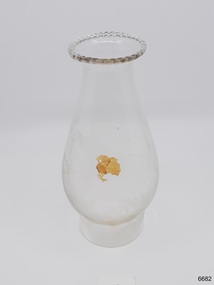
Domestic object - Lamp Glass, 1886-1908
... lighting Lamp glass, scalloped pattern around top lip, bulbous body. Slight encrustation on body. Glass has ripples in base area. Inside body is opaque in about a 1/5 ofr the area. Domestic ...The lamp glass was recovered from the wreck of the Falls of Halladale. It was blown into a mould, as evidenced by ripples in the base of the glass. The frosted inside area is likely to be from abrasive sediment inside the glass on the sea bed. The encrustations has also come from the sea. The Falls of Halladale was an iron-hulled, four-masted barque, used as a bulk carrier of general cargo. She left New York in August 1908 bound for Melbourne and Sydney. In her hold was general cargo consisting of roofing tiles, barb wire, stoves, oil, and benzene as well as many other manufactured items. After three months at sea and close to her destination, a navigational error caused the Falls of Halladale to be wrecked on a reef off the Peterborough headland on the 15th of November, 1908. The captain and 29 crew members survived, but her cargo was largely lost, despite two salvage attempts in 1908-09 and 1910. The Court of Marine Inquiry in Melbourne ruled that the foundering of the ship was entirely due to Captain David Wood Thomson's navigational error, not too technical failure of the Clyde-built ship. The Falls of Halladale was built in 1886 by Russell & Co., at Greenock shipyards on the River Clyde, Scotland for Wright, Breckenridge & Co of Glasgow. She was one of several designs of Falls Line of ships named after waterfalls in Scotland. The company had been founded between 1870- 1873 as a partnership between Joseph Russell, Anderson Rodger, and William Todd Lithgow. During the period 1882-92 Russell & Co. standardised designs, which sped up their building process so much that they were able to build 271 ships during that time. The Falls of Halladale had a sturdy construction built to carry maximum cargo and able to maintain full sail in heavy gales, one of the last of the 'windjammers' that sailed the Trade Route. She and her sister ship, the Falls of Garry, were the first ships in the world to include fore and aft lifting bridges. Previous to this, heavily loaded vessels could have heavy seas break along the full length of the deck, causing serious injury or even death to those on deck. The new, raised catwalk-type decking allowed the crew to move above the deck in stormy conditions. The Falls of Halladale shipwreck is listed on the Victorian Heritage (No. S255). She was one of the last ships to sail the Trade Routes from Europe and the Americas. Also of significance is that the vessel was one of the first ships to have fore and aft lifting bridges as a significant safety feature still in use on modern vessels today. The subject model is an example of an International Cargo Ship used during the 19th and early 20th centuries to transport goods around the world and representing aspects of Victoria’s shipping industry. Lamp glass, scalloped pattern around top lip, bulbous body. Slight encrustation on body. Glass has ripples in base area. Inside body is opaque in about a 1/5 ofr the area.flagstaff hill, warrnambool, flagstaff-hill, flagstaff-hill-maritime-museum, maritime-museum, shipwreck-coast, flagstaff-hill-maritime-village, falls of halladale, glass, russell & co., wreck, artifact, lamp glass, kerosene lamp, lighting -
 Flagstaff Hill Maritime Museum and Village
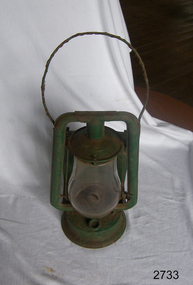
Domestic object - Lamp, Bradley & Hubbard, Early 20th century
... The lamp was given away to customers of Kerosene oil as a means of increasing the Standard Oil Company sales of Kerosene during the late19th to early 20th century. flagstaff hill warrnambool shipwrecked-coast flagstaff-hill-maritime-museum shipwreck-coast flagstaff-hill-maritime-village kerosene lamp lighting hurricane lamp storm lamp rayo ltd Inscribed "Rayo" and "Made in the USA" Kerosene Lamp, side lifting arm to light. Domestic ...One of the most common centre draft kerosene lamps one can find in the USA and Canada is the Rayo. Large and sturdy, simple to use, but also notorious for being a fuel hog. This lamp was made by Bradley and Hubbard Metalworks in Chicago also Bradley and Hubbard made the “Perfection” brand lamps that look like the Rayo and are pretty much the same lamp with all parts interchangeable. The Rayo was given away to customers for free as a promotional item by the Standard Oil Company. The lamp’s huge appetite for fuel meant a hefty increase in sales of kerosene for the company and increased profits. The Rayo is a classic centre draft lamp that uses a widely available tubular wick that measures 62mm flat. It employs a simple and reliable mechanism for securing wicks in the burner along with a brass tube with many small teeth at its end. The tube is attached to the toothed rack that’s moved up and down by the adjuster knob. This type of lamp was used in most households and on rural properties before the introduction of electricity and is an early example of a promotional. The lamp was given away to customers of Kerosene oil as a means of increasing the Standard Oil Company sales of Kerosene during the late19th to early 20th century.Kerosene Lamp, side lifting arm to light.Inscribed "Rayo" and "Made in the USA"flagstaff hill, warrnambool, shipwrecked-coast, flagstaff-hill-maritime-museum, shipwreck-coast, flagstaff-hill-maritime-village, kerosene lamp, lighting, hurricane lamp, storm lamp, rayo ltd -
 Flagstaff Hill Maritime Museum and Village
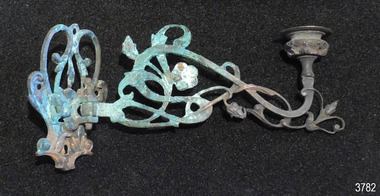
Domestic object - Candle Bracket, c. 1878
... lighting ship hardware Candle bracket, bronze with fancy floral design. Bracket has been hand wrought with varying widths of flat iron. Bracket’s arm swivels on a pin front of bracket. Bracket was recovered from the wreck of the Loch Ard. Domestic ...This candle bracket was recovered from the wreck of the sailing ship Loch Ard after the to the disaster in 1878. The bracket has been hand forged into a pleasing shape and design. The candle holder on the arm of the bracket cn swivel from side to side allowing the light to be adjusted. LOCH ARD 1873-1878 – The Scottish-built clipper ship Loch Ard was bound for Melbourne in 1878 with 54 people on board. The mixed cargo it carried included items for the 1880 International Exhibition in Melbourne, one of which was the now famous Majorca ware Minton ‘Peacock’ statue. The Loch Ard was wrecked on June 1st when the ship crashed into Mutton Bird Island, east of Port Campbell. The only survivors were Tom Pearce, a crew member, and Eva Carmichael, a young passenger who was rescued by Pearce. The Gibsons, owners of nearby Glenample Homestead, cared for Tom, and for Eva who stayed longer before returning to Ireland. The wreck of the Loch Ard was discovered in 1967, before the introduction of the Victorian historic shipwreck legislation. In 1969 it was decided that all recovered material should be lodged with the Receiver of Wrecks. In 1980 Flagstaff Hill Maritime Museum Divers received a permit to recover artefacts from the wreck to safeguard them from looters. In 1982 the site was listed as a Historic Shipwreck, and the Maritime Archaeology Unit recovered loose artefact material. The candle bracket is an example of light fittings from the ship ‘Loch Ard’ or from part of the ship’s cargo, imported for use in Colonial Victoria in the 19th to early 20th century. Flagstaff Hill’s collection of artefacts from LOCH ARD is significant for being one of the largest collections of artefacts from this shipwreck in Victoria. It is significant for its association with the shipwreck, which is on the Victorian Heritage Register (VHR S417). The collection is significant because of the relationship between the objects, as together they have a high potential to interpret the story of the LOCH ARD. The LOCH ARD collection is archaeologically significant as the remains of a large international passenger and cargo ship. The LOCH ARD collection is historically significant for representing aspects of Victoria’s shipping history and its potential to interpret sub-theme 1.5 of Victoria’s Framework of Historical Themes (living with natural processes). The collection is also historically significant for its association with the LOCH ARD, which was one of the worst and best known shipwrecks in Victoria’s history. Candle bracket, bronze with fancy floral design. Bracket has been hand wrought with varying widths of flat iron. Bracket’s arm swivels on a pin front of bracket. Bracket was recovered from the wreck of the Loch Ard. flagstaff hill, warrnambool, shipwrecked coast, flagstaff hill maritime museum, maritime museum, shipwreck coast, flagstaff hill maritime village, great ocean road, shipwreck artefact, loch ard, victoria, eva carmichael, tom pearce, antique, candle holder, candle bracket, candlestick holder, lighting, ship lighting, ship hardware -
 Flagstaff Hill Maritime Museum and Village
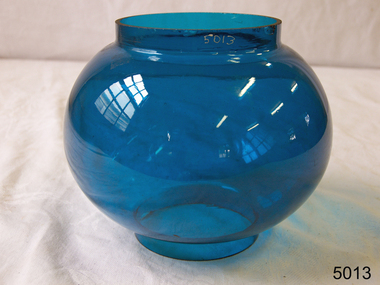
Functional object - Lamp Shade
... domestic situation. Flagstaff Hill Warrnambool Flagstaff-Hill-Maritime-Museum Maritime-Museum Shipwreck-coast Flagstaff-Hill-Maritime-Village Kerosene Lamp Replacement Glass Glass Lamp Shade blue glass lighting Blue glass lamp shade with bulbous body Functional object Lamp Shade ...A lamp shade in the design used in the late 19th and early 20th centuries for a decorative kerosene lamp.The glass lamp shade was made as an example of the design used for late 19th and early 20th-century decorative glass used on kerosene lamps in a domestic situation. Blue glass lamp shade with bulbous bodyflagstaff hill, warrnambool, flagstaff-hill-maritime-museum, maritime-museum, shipwreck-coast, flagstaff-hill-maritime-village, kerosene lamp, replacement glass, glass lamp shade, blue glass, lighting -
 City of Moorabbin Historical Society (Operating the Box Cottage Museum)
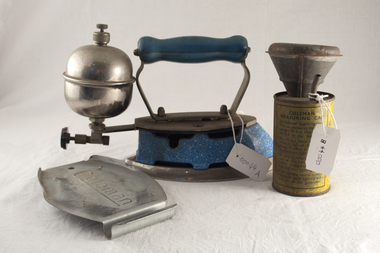
Domestic object - Kitchen equipment, spirit-fuelled sad iron, c1920
... IRON/ with printed instructions A) spirit- fuelled, sad iron with chrome plated sole c1920, and metal trivet The iron is blue enamel with a white speckled body, with a hemispherical tank for the Coleman 'Lighting Petrol' that provided the heat for smoothing the material B) Coleman Fuel measuring can and funnell Domestic object Kitchen equipment, spirit-fuelled sad iron Coleman Lamp Stove Company Ltd. ...Sad-irons or "solid" irons were made by blacksmiths and used to smooth out material by pressing the hot iron over it. A piece of sheet -iron was placed over the kitchen fire and the irons placed on it could be heated whilst remaining clean of ash.. The women used 2 irons - one heating while the other was used. Thick cloth or gloves protected their hands from the hot irons. The handle was removed from the cool iron and re- attached to remove the hot iron from the fire. The cool iron was replaced on the fire or stove to heat again. These irons were cleaned with steel wool to prevent them marking the material. If the iron was too hot the material would scorch. Most homes set aside one day for ironing and some large households had an ironing room with a special stove designed to heat irons. However, most women had to work with a heavy, hot iron close to the fireplace even in summer. Late in the 19thC designers experimented with heat retaining fillings for these irons. William Coleman began selling Kerosene lanterns in 1900 in Kingfisher, Oklahoma, USA. He moved to Wichita, Kansas in 1902 and the company became world wide. The company also produced a range of cooking stoves and domestic irons. This spirit- fuelled flat iron was very popular in 1920s - 30s These sad irons remind us of the difficult circumstances experienced in their daily routines by the pioneers and early settlers of Moorabbin Shire The family of Miss M Curtis were early settlers in Moorabbin ShireA) spirit- fuelled, sad iron with chrome plated sole c1920, and metal trivet The iron is blue enamel with a white speckled body, with a hemispherical tank for the Coleman 'Lighting Petrol' that provided the heat for smoothing the material B) Coleman Fuel measuring can and funnellMetal Trivet/stand " COLEMAN" ; Petrol can " COLEMAN" / MEASURING CAN / for INSTANT LIGHTING IRON/ with printed instructionssad iron, kitchen equipment, coleman william, kansas, oklahoma, pioneers, early settlers, market gardeners, sewing, craftwork, clothing, moorabbin, brighton, bentleigh, fireplaces, stoves, petrol fuelled irons, spirit flat irons, coleman lamp stove co. ltd. -
 City of Moorabbin Historical Society (Operating the Box Cottage Museum)
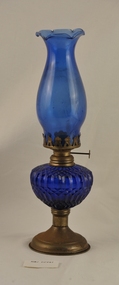
Domestic object - Lights, kerosene lamp, blue glass, Unrecorded, c1900
... lighting lamps kerosene paraffin oil A flat wick kerosene lamp. The knob protruding to the right adjusts the wick, and hence the flame size. This lamp has a plain blue glass shade -chimney with a fluted rim, blue glass geometrically engraved reservoir and a circular brass base Domestic object Lights, kerosene lamp, blue glass Unrecorded ...Early Settlers used candles and lamps as their source of light after sunset. This lamp, uses a flat wick immersed in kerosene or oil, contained in the bulbous reservoir, with a side screw to adjust the flame enclosed in a glass, open top shield.A flat wick kerosene lamp. The knob protruding to the right adjusts the wick, and hence the flame size. This lamp has a plain blue glass shade -chimney with a fluted rim, blue glass geometrically engraved reservoir and a circular brass base early settlers, pioneers, market gardeners, moorabbin, brighton, bentleigh, ormond, mckinnon, lighting, lamps, kerosene, paraffin, oil -
 City of Moorabbin Historical Society (Operating the Box Cottage Museum)
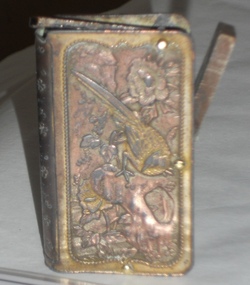
Domestic object - Personal Effects, Vesta case tin, c1860
... lighting fires, lamps, cigarettes or pipes. The tin case has been embossed with a Japanese type bird design on the front and back and then coated with copper and brass to decorate and highlight different parts of the design. Domestic ...A Vesta case is a small, portable box / safe to carry matches and came into use around the 1830s and were produced extensively between 1890 and 1920. During this period, almost everyone carried strike anywhere matches, so they could light stoves, lanterns and other devices. Early matches were unreliable and prone to ignite from rubbing on one another or spontaneously. Accordingly, most people carried a match safe / box to house their matches. Wealthy people had match safes made of gold or silver, while common folk had ones made of tin or brass.c1860 A small tin Japanesque vesta case, with a roughened strike plate, to hold matches for lighting fires, lamps, cigarettes or pipes. The tin case has been embossed with a Japanese type bird design on the front and back and then coated with copper and brass to decorate and highlight different parts of the design.Embossed with a Japanese type bird design on the front and back . jewellery, personal effects, craftwork, vesta case, lights, candles, safety matches, moorabbin, brighton, bentleigh, cheltenham, early settlers, pioneers -
 City of Moorabbin Historical Society (Operating the Box Cottage Museum)
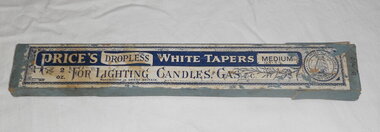
Domestic object - Kitchen Equipment, box of white wax tapers, c1900
... lighting candles and gas fires". Makers mark is a sailing ship, set in an oval with the words "Ship Brand". Around the circumference of the oval are the words " London, Liverpool, Price's Candle Company Limited. A narrow and shallow, cardboard box with blue and white label on the top. Domestic ...Wax tapers were used by early settlers in Moorabbin Shire to light fires, candles and gas lamps. A narrow and shallow, cardboard box with blue and white label on the top. "Price's Dropless White tapers" " Medium" 2ounces "for lighting candles and gas fires". Makers mark is a sailing ship, set in an oval with the words "Ship Brand". Around the circumference of the oval are the words " London, Liverpool, Price's Candle Company Limited.kitchen equipment, lights, candles, fireplaces, early settlers, pioneers, moorabbin, bentleigh, cheltenham, market gardeners -
 City of Moorabbin Historical Society (Operating the Box Cottage Museum)
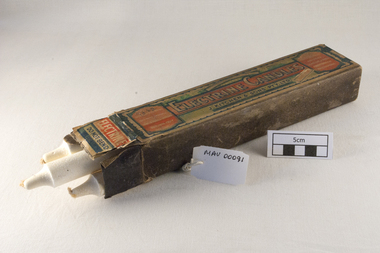
Domestic object - Kitchen Equipment, candles 'Electrine', c1900
... Prior to the installation of gas and electric light pioneers used candles for lighting after sunset. kitchen equipment lights candles fireplaces early settlers pioneers moorabbin bentleigh cheltenham market gardeners 6 candles, in original box, made by 'Electrine' Co. 2 candles broken when brush tailed possum entered Cottage via chimney 27/4/2014 Domestic object Kitchen Equipment, candles 'Electrine' J. ...Prior to the installation of gas and electric light pioneers used candles for lighting after sunset.6 candles, in original box, made by 'Electrine' Co. 2 candles broken when brush tailed possum entered Cottage via chimney 27/4/2014kitchen equipment, lights, candles, fireplaces, early settlers, pioneers, moorabbin, bentleigh, cheltenham, market gardeners
