
Showing 84 items matching "lights at night"
-
 Moorabbin Air Museum
Book - Pilot training - general aviation, The Pilot's Night Flying Handbook
... ...Lights at night...Pilot training - general aviation Outfitting the aircraft Lights at night Vision & vertigo Weather after sunset First night flight Nighttime navigation Cross country after dark Electrical failures Guide to techniques & safety procedures of night flying for private pilot, circa 1976 The Pilot's Night Flying Handbook Book Pilot training - general aviation ...Guide to techniques & safety procedures of night flying for private pilot, circa 1976non-fictionGuide to techniques & safety procedures of night flying for private pilot, circa 1976outfitting the aircraft, lights at night, vision & vertigo, weather after sunset, first night flight, nighttime navigation, cross country after dark, electrical failures -
 Ballarat Heritage Services
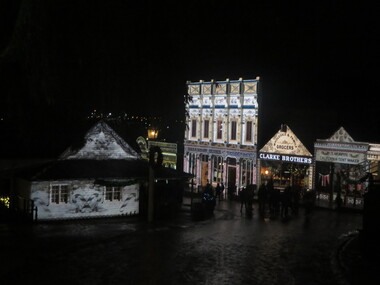
Photograph - Photograph - Colour, Clare Gervasoni, Sovereign Hill Winter Wonderland, 2018, 19/07/2018
... Colour photographs of Sovereign night lights on a rainy night. ...sovereign hill lighting winter wonderland Colour photographs of Sovereign night lights on a rainy night. Sovereign Hill Winter Wonderland, 2018 Photograph Photograph - Colour Clare Gervasoni ...Colour photographs of Sovereign night lights on a rainy night. sovereign hill, lighting, winter wonderland -
 Victorian Interpretive Projects Inc.
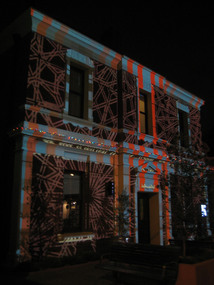
photograph- colour, Clare Gervasoni, Former Kew Court House - Light Show, 24/03/2012
... For the 2012 Kew Community Festival the former Kew Court House was lit with changing coloured lights each night. ...For the 2012 Kew Community Festival the former Kew Court House was lit with changing coloured lights each night. Former Kew Court House - Light Show photograph- colour Clare Gervasoni ...The former Kew Court House is now home to the Kew Historical Society.A colour photo in digital format, showing a lit building. For the 2012 Kew Community Festival the former Kew Court House was lit with changing coloured lights each night. kew, court house, lighting, -
 Ballarat Heritage Services
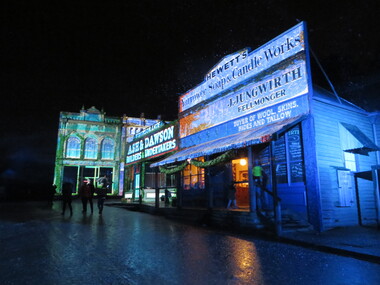
Photograph - Colour, Clare Gervasoni, Winter Wonderland at Sovereign Hill, 2018, 19/07/2019
... Colour photograph of the night lights at Sovereign Hill known as Winter Wonderland. ...sovereign hill main road winter wonderland Colour photograph of the night lights at Sovereign Hill known as Winter Wonderland. ...Colour photograph of the night lights at Sovereign Hill known as Winter Wonderland. sovereign hill, main road, winter wonderland -
 Ballarat Tramway Museum
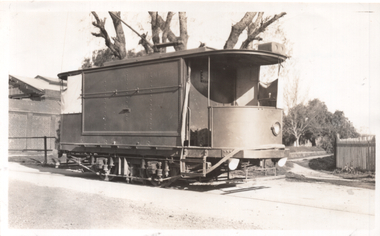
Photograph - ESCo Bendigo Sprinkler or scrubber tram, 1930s
... Shows the equipment provided on the tram and the lights for night working. The tram was replaced in 1954 by cross bench tram No. 17, converted for this purpose. ...Shows the equipment provided on the tram and the lights for night working. The tram was replaced in 1954 by cross bench tram No. 17, converted for this purpose. ...Photograph of Bendigo sprinkler or scrubber tram taken at the depot. Shows the equipment provided on the tram and the lights for night working. The tram was replaced in 1954 by cross bench tram No. 17, converted for this purpose. One of a series of 7 photos (items 9108 to 9114) possibly taken at the time of the SEC takeover in 1934 to illustrate the type of tram that was being used at Bendigo. Possibly an SEC report photo. Based on the book Destination Eaglehawk, most likely from the Basil Miller collection.Yields information about Bendigo scrubber of sprinkler tram during the early 1930s.Photograph, black and white with notes on rear.In ink on rear "Scrubber car and water tank (as at present 1947)", and Ken Magor stamp.tramways, trams, bendigo, esco, scrubber, sprinkler tram, bendigo tramway -
 Ballarat Tramway Museum
Photograph - Black & White Photograph/s - set of 3, W.C. Meyer and Photographer, 1955
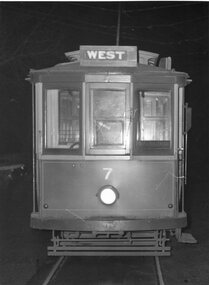
... Note all lights illuminated in the night photo. Destination Eaglehawk, page 44, notes tram 4 as being fitted with dash canopy lighting and zebra stripes in 1955. ...East Geelong, Phone 3289" and on rear of photos in dark blue ink, handwriting, 1872.1 - Night - with 'flash' photo. 1872.2 - Daylight 1872.3 - Night - with 'flash' photo. This tram has supplementary lights ...Note all lights illuminated in the night photo. Destination Eaglehawk, page 44, notes tram 4 as being fitted with dash canopy lighting and zebra stripes in 1955. ...Set of three photographs of Geelong single trams, one of the same type of tram (No. 7) prior to fitting with marker lights and No. 4 after fitting with marker lights, one during daylight and one at night. Three photographs taken by W.C. Meyer, Photographer, 333 Myers St. East Geelong, Phone 3289. Photo of one end of the tram only. Note top marker lights, not repeated on any other cars shown in photographs in Destination Eaglehawk. Shows as well, arrangements for tow bars, mirror and handrails. 1872.1 - Before fitting with additional lights, at night with 'flash' - showing destination 'West' - tram No. 7 1872.2 - after fitting with lights and stripes, during daylight - showing destination 'CITY' - tram No. 4 1872.3 - ditto at night, showing destination of 'CITY'. - tram No. 4 1872i4 - close up of the mirror and light on the roof - right hand side of i2. Note all lights illuminated in the night photo. Destination Eaglehawk, page 44, notes tram 4 as being fitted with dash canopy lighting and zebra stripes in 1955. No mention of No. 7 being so fitted. For date of photograph, assumed early 1955 at this time (14/11/2001) See Destination EaglehawkAll stamped with black ink stamp " W.C. Meyer, Photographer, 333 Myers St. East Geelong, Phone 3289" and on rear of photos in dark blue ink, handwriting, 1872.1 - Night - with 'flash' photo. 1872.2 - Daylight 1872.3 - Night - with 'flash' photo. This tram has supplementary lights trams, tramways, geelong, dash canopy lights, lights, mirrors, tram 7, tram 4 -
Melbourne Tram Museum
Letter - Alf Twentyman - Frank Shennen, Alf Twentyman et al, 12/1970
... Response from Frank to Alf dated 6/4/1971, his work, tramcar colours when Frank lived in Richmond, Alf's forthcoming trip to Hawaii, and the use of lights on cars at night....Response from Frank to Alf dated 6/4/1971, his work, tramcar colours when Frank lived in Richmond, Alf's forthcoming trip to Hawaii, and the use of lights on cars at night. Demonstrates a set of letters between Alf Twentyman and Frank Shennen re Melbourne cable cars etc. tramcars tramways cable trams Personal Papers Records Set of two letters, one hand written on ruled quarto sheets, the other typed on pink quarto paper. ...Set of two letters - Alf Twentyman to Frank Shennen dated 14/12/1970 regarding travels by Alf, work at Northcote, John Keating, car fleet numbers, and article about horse buses. Response from Frank to Alf dated 6/4/1971, his work, tramcar colours when Frank lived in Richmond, Alf's forthcoming trip to Hawaii, and the use of lights on cars at night.Demonstrates a set of letters between Alf Twentyman and Frank Shennen re Melbourne cable cars etc.Set of two letters, one hand written on ruled quarto sheets, the other typed on pink quarto paper.tramcars, tramways, cable trams, personal papers, records -
 Falls Creek Historical Society
Booklet - Falls Creek Information Winter 2010
... The full length of Wombats Ramble was also lined with lights to provide night skiing and boarding on Wednesday and Saturday nights throughout the season. ...The full length of Wombats Ramble was also lined with lights to provide night skiing and boarding on Wednesday and Saturday nights throughout the season. ...Falls Creek featured several new programs and activities in 2010. Australia's ultimate skiing tour was launched with Back Country Tours guided by Steve Lee, Falls Creek's most famous local and Australian Olympian. The full length of Wombats Ramble was also lined with lights to provide night skiing and boarding on Wednesday and Saturday nights throughout the season. Pete the Big Blue Dragon was also a Falls Creek celebrity and had his own weekly stage show at the Village Bowl and often frequented the Fox Trail Terrain Park. He also had his own website full of games, stories, merchandise and a snow safety video. 2010 also saw the introduction of the Snow Rewards Loyalty Program. Members had access to cheaper Lift Passes and a range of exclusive discounts at both Falls Creek and Hotham. Corporate sponsors in 2010 included ANZ Bank, Milo, Ten TV, Snow Australia and Where IS maps.This booklet is significant because it documents seasonal activities at Falls Creek in 2010.A booklet of 56 pages promoting Falls Creek for the Winter season 2010. It includes text, images and advertising printed on glossy paper with a heavier card cover.falls creek marketing, back country tours, wombats ramble -
 Puffing Billy Railway
Train Destination Disc
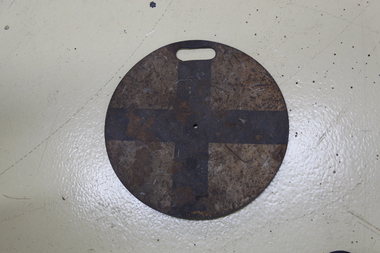
... Train Destination Disc Until the 1980s Melbourne suburban trains used a system of discs by day, and illuminated market lights by night, to indicate their destination. ...Train Destination Disc Until the 1980s Melbourne suburban trains used a system of discs by day, and illuminated market lights by night, to indicate their destination. ...Train Destination Disc Until the 1980s Melbourne suburban trains used a system of discs by day, and illuminated market lights by night, to indicate their destination. Placed on the front of trains to advise a Signalman in the Signal Box the destination of the train. This disk was used on NK1 the Whitfield Motor when it was used by Puffing Billy Railway Info from the diagrams from the 1953 Victorian Railways General Appendix. Black + is Lilydale, Belgrave other Destination Disks were Disks Williamstown Black II Newport Workshops Red = Changed in 76 to Black + Newport-Altona shuttle Red X Werribee Red X St Albans Black X Upfield Black = Broadmeadows Originally Red X changed in 1976 to Red = Epping Black II Hurstbridge Red X Lilydale, Belgrave Black + Alamein Black X Glen Waverley Black = Dandenong Black II Frankston Red = Sandringham Red X St Kilda Originally Black II changed in 1976 to Red X Port Melbourne Red X changed in 1976 to Black X Flinders St - Spencer St Local Red II Showgrounds Red = plus extra white disk on opposite front disk bracket; if only one event, Display Large White 1 and yellow side disk with set number. If two events, second event special trains flip this disk and show large Black Disk with white numeral 2 Race Special Red = plus extra white disk on opposite front disk bracket; if only one event, Display Large White 1 and yellow side disk with set number. If two events, second event special trains flip this disk and show large Black Disk with white numeral 2 For example, Flemington Race trains and Caulfield Race trains on the same day. Flemington carries Red = and White 1 and yellow set number on the side Caulfield carries Red = and Black 2 with yellow set number disc on the side. There was one disc which was never to be used in normal traffic, that was the "Red Cross"; it was reserved for Red Cross trains only.Historic - Victorian Railways - Destination Disk - Black cross - Lilydale, Belgrave Lines This disk was used on NK1 the Whitfield Motor when it was used by Puffing Billy Railway Train Destination Disc Round tin sign painted white with a black cross on white background and a mounting bracket on the rear. Placed on the front of trains prior to the mid 1970s to advise a Signalman in the Signal Box the destination of the train. Black Cross puffing billy, destination disc, victorian railways, lilydale, belgrave lines -
 Surrey Hills Historical Society Collection
Photograph, Bonfire, Beckett Park, Balwyn, c1937/8, 1937
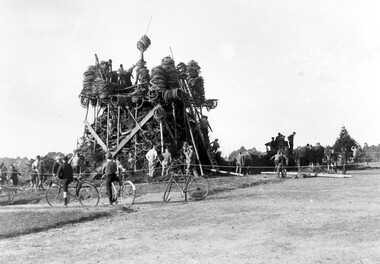
... A volunteer fire-watcher had his caravan close by until lights-up time on Saturday night. From glass negative taken by Ian Barkla's father, Frank Leslie Barkla of 37 Grovedale Road, who was a keen photographer and a member of the Melbourne Camera Club....A volunteer fire-watcher had his caravan close by until lights-up time on Saturday night. From glass negative taken by Ian Barkla's father, Frank Leslie Barkla of 37 Grovedale Road, who was a keen photographer and a member of the Melbourne Camera Club. parks and reserves 1937 beckett park bicycles crowds empire day bonfires alex walker frank leslie barkla Image depicting the building of a large bonfire made primarily from rubber tyres, supported by a wooden frame c1937/8. ...The bonfire at Beckett Park was the culmination of the EMPIRE DAY/CELEBRATIONS in Surrey Hills in 1935 and 1936. In 1937 vandals lit the fire prematurely but residents hastily rebuilt it - about/100 tons including old tyres. A volunteer fire-watcher had his caravan close by until lights-up time on Saturday night. From glass negative taken by Ian Barkla's father, Frank Leslie Barkla of 37 Grovedale Road, who was a keen photographer and a member of the Melbourne Camera Club.Image depicting the building of a large bonfire made primarily from rubber tyres, supported by a wooden frame c1937/8. There is a significant crowd of people watching the erection of the pyre from ground level. Several members of the crowd are seated or holding bicycles. There are multiple persons situated on the pyre or on a ladder propped up against the mound of tyres. The area containing the pyre has been fenced off with rope (?). A young boy in the image (second from left with bike) has been identified as Alex Walker.Black and white, W 25.3 cm x H 20.4 cm, landscapeparks and reserves, 1937, beckett park, bicycles, crowds, empire day, bonfires, alex walker, frank leslie barkla -
 Surrey Hills Historical Society Collection
Photograph, Bonfire, Beckett Park, Balwyn (Surrey Hills), c1937/8, 1937
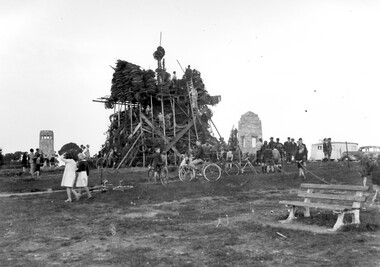
... A volunteer fire-watcher had his caravan close by until lights-up time on Saturday night. / Courtesy Ian Barkla. / see 180 (handwritten on backing board)." / "BONFIRE BUILDING at BECKETT PARK/EMPIRE DAY CELEBRATIONS IN 1930s/ The celebrations were centred on the/ shopping centres in Surrey Hills and/Mont Albert to boost local business (and/ the spirits of residents) after the Depression./ - from a glass negative - Mr Ian Barkla."...A volunteer fire-watcher had his caravan close by until lights-up time on Saturday night. / Courtesy Ian Barkla. / see 180 (handwritten on backing board)." / "BONFIRE BUILDING at BECKETT PARK/EMPIRE DAY CELEBRATIONS IN 1930s/ The celebrations were centred on the/ shopping centres in Surrey Hills and/Mont Albert to boost local business (and/ the spirits of residents) after the Depression./ - from a glass negative - Mr Ian Barkla." parks and reserves beckett park balwyn bicycles crowds empire day depression 1929-1939 economic depression frank leslie barkla bonfires Image depicting the building of a large bonfire made primarily from rubber tyres, supported by a wooden frame c1937/8. ..."The bonfire at Beckett Park was the culmination of the EMPIRE DAY/CELEBRATIONS in Surrey Hills in 1935 and 1936. In 1937 vandals lit the fire prematurely but residents hastily rebuilt it - about / 100 tons including old tyres. A volunteer fire-watcher had his caravan close by until lights-up time on Saturday night. / Courtesy Ian Barkla. / see 180 (handwritten on backing board)." / "BONFIRE BUILDING at BECKETT PARK/EMPIRE DAY CELEBRATIONS IN 1930s/ The celebrations were centred on the/ shopping centres in Surrey Hills and/Mont Albert to boost local business (and/ the spirits of residents) after the Depression./ - from a glass negative - Mr Ian Barkla."Image depicting the building of a large bonfire made primarily from rubber tyres, supported by a wooden frame c1937/8. There is a significant crowd of people watching the erection of the pyre from ground level. Several members of the crowd are seated or holding bicycles. There are multiple persons situated on the pyre or on a ladder propped up against the mound of tyres. The area containing the pyre has been fenced off with rope (?). A white coloured caravan in situated to the right (facing) of the bonfire in close proximity to a dark coloured car. Two stone towers and a park bench are also visible in the image.Black and white, W 25.3 cm x H 20.3 cm, landscapeparks and reserves, beckett park, balwyn, bicycles, crowds, empire day, depression 1929-1939, economic depression, frank leslie barkla, bonfires -
 Flagstaff Hill Maritime Museum and Village
Photograph - Historical, building, Late 19th to early 20th century
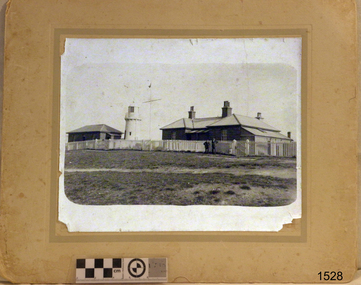
... Vessels entering Lady Bay align the Upper and Lower Lighthouse towers during the day and the lights at night. The Upper Lighthouse is a round tower, and the Lower Light is square. ...Vessels entering Lady Bay align the Upper and Lower Lighthouse towers during the day and the lights at night. The Upper Lighthouse is a round tower, and the Lower Light is square. ...The black and white photograph depicts the Lady Bay Lighthouse Complex at Flagstaff Hill, Warrnambool. It was opened on this site in 1871. From left to right, the Chartroom (previously named the Store), Upper Lighthouse, Flagstaff, Lighthouse Keeper's Quarters. The bluestone buildings are facing North on Merri Street. The Harbour Pilot's Lodgings were on the east of the Complex. There are two unknown male figures standing in front of the light-coloured picket fence that encompasses the Complex. The photograph is mounted on card. WARRNAMBOOL'S LADY BAY LIGHTHOUSES In the 1800s ships sailing from England to Australia began to use Bass Strait as a faster route to Melbourne. Small navigation errors led to many tragic shipwrecks. From 1848 lighthouses were operating along Victoria’s southern coast as a guide for sailors. Coastal towns such as Warrnambool grew and the exchange of trade and passengers was of great benefit. However, the uncertain weather changes, relatively shallow waters and treacherous, hidden rocky reefs were not really suitable for a Harbour and in the 1840s and 1850s, there were many shipwrecks in the area, with some even stranded in its Lady Bay harbour. A jetty was built in 1850 and a flagstaff to guide seafarers was placed up high on what became known now as Flagstaff Hill. In November 1857 the Victorian Government recommended that Warrnambool Harbour had beacons and two lighthouses to guide vessels into and out of the Harbour safely. The white light of the Middle Island lighthouse was to be used for the first time on September 1, 1859. The red light of the Beach Lighthouse, a wooden obelisk structure, was first operated on March 25, 1860, but in 1868 this light was ‘discontinued’ due to it being too low. Melbourne’s Department of Public Works decided to relocate the Middle Island Lighthouse Complex - Lighthouse, Keeper’s Quarters, Privy, Store Room and even water tanks - to Flagstaff Hill. The lower obelisk was shortened, and a protruding gallery, railing, and external ladder were added, and the light from the Beach Lighthouse. A green guiding light was erected on the end of the jetty. The transfer of the Complex began in March 1871. Each shaped stone of the lighthouse was carefully numbered, removed then reassembled on Flagstaff Hill. In 1872 the well was sunk behind the Lighthouse Keeper’s Cottage. The Keepers and families had left Middle Island in April and moved to Flagstaff Hill in October 1871. Vessels entering Lady Bay align the Upper and Lower Lighthouse towers during the day and the lights at night. The Upper Lighthouse is a round tower, and the Lower Light is square. The Lighthouses were categorised as harbour lights rather than coastal lights, so they remain under the control of the Victorian Government’s Ports and Harbours section. The lights were originally powered by oil, then acetylene gas, later by electricity, and then converted to solar power in 1988. In 1993 the solar panel was replaced by a battery charger. A decision was made in 1936 to replace the lighthouses’ lights with unattended lights that no longer required Keepers and Assistants. At least 29 Keepers had attended to the lighthouse from its opening in 1859 to when the last official Lightkeepers left In April 1916. The Warrnambool Harbour Board rented out the Quarters from 1916 to 1936. The Board closed down but the rentals continued with other unknown landlords. In the 1970s the Flagstaff Hill Planning Board was set up under the chairmanship of John Lindsay. The Board was to make recommendations to the Warrnambool City Council regarding using the buildings and the rest of the Crown Land on the site. The Flagstaff Hill Maritime Village opened in 1975 and began renovating the Cottage in stages, during which time evidence of a 1920s fire was found in the eastern section of the cottage. Additions of a porch on the west and a washroom on the east were made in the 1980s. The western part of the building is now a Shipwreck Museum and the east has returned to a late 19th-century Lighthouse Keeper’s cottage and includes the screen made by Assistant Lighthouse Keeper Thomas Hope in the late 19th century. He served as Assistant Keeper in Warrnambool for two periods.The Warrnambool Lighthouse Complex is now listed on the Victorian Heritage Register, H1520, for being of historical, scientific (technological) and architectural significance to the State of Victoria. The Complex is significant as an example of early colonial development. The buildings are significant for their connection with the important navigational function of the Lighthouses, a function still being performed to this day. The buildings are also significant as an example of structures designed and works carried out by the Public Works Department in Victoria in the mid-to-late 19th century. The structures still stand strong. Photograph; Warrnambool Lighthouse Keeper's cottage, lighthouse, flagstaff and chartroom at Flagstaff Hill, and a light-coloured picket fence with gate. Two male figures are in front of the fence. Black and white print glued to a yellow card. The inscription is indecipherable. The right side of the cottage has a built-in, enclosed addition.Ink stamped in lower right hand corner, too faded to be legible.flagstaff hill, flagstaff hill maritime museum, flagstaff hill maritime village, warrnambool, maritime museum, shipwreck coast, lighthouse keeper's cottage, lighthouse residence, lighthouse, chart room, quarters, privy, middle island, beach lighthouse, obelisk, lighthouse complex, lady bay complex, warrnambool port, warrnambool harbour, lady bay, keepers, lighthouse keeper, upper lighthouse, lower lighthouse, assistant keeper, ports and harbours, cottage, light keeper -
 Flagstaff Hill Maritime Museum and Village
Document - Plans, Lighthouse Keeper's Quarters Warrnambool, 1858-1909
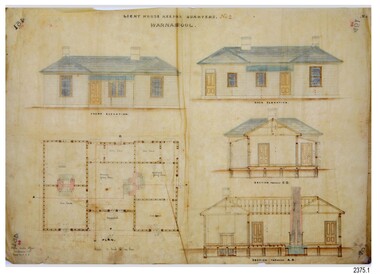
... Vessels entering Lady Bay align the Upper and Lower Lighthouse towers during the day and the lights at night. The Upper Lighthouse is a round tower, the Lower Light is square. ...Vessels entering Lady Bay align the Upper and Lower Lighthouse towers during the day and the lights at night. The Upper Lighthouse is a round tower, the Lower Light is square. ...The set of seven 1858 plans shows proposed plans for the original Lighthouse Complex that was built on Middle Island in 1858-1859. The whole complex was then transferred to Flagstaff Hill in 1871. The plan, dated 1909, is for proposed additions and repairs to the Quarters at Flagstaff Hill. The plan 'Alterations and Additions' shows alternate plans for changes to the quarters at the Flagstaff Hill location. This plan has no date. The Complex comprised the Lighthouse, the Lighthouse Keepers’ Quarters, the Store (now called the Chart Room) and a Privy, which was not included in these plans. The Keeper’s bluestone Quarters was a cottage divided into two compartments, one for each keeper and his family. The bluestone Store was divided into three; a store, a workshop an oil store (or office). The Privy comprised of a small building also divided into two separate, back-to-back toilets, one for each Keeper and his family. The Flagstaff Hill Keeper's Quarters have had extensions and additions at various times, and these have also been removed at various other times. THE PLANS - *Dec. 1858 (12/58) ‘Lighthouse Keepers Quarters No.2 Warrnambool’ (2375.01)* Public Works Office Melbourne – Front and Back elevations, sections, and floor plan. The drawing shows timber walls. [The floor plan is the closest plan to the current building, however, the walls are timber in this plan.] *Nov. 1858 – No.3 ‘Lighthouse Keepers Quarters Warrnambool’ (2375.02)* Office of Public Works, Melbourne – Back and End elevations and section through. The drawing shows stone walls. One side; Senior Keeper’s bedroom, living room and kitchen with storeroom. Another side; is the Assistant’s bedroom, living room and storeroom. *Nov. 1858 - No.4 ‘Lighthouse Stores Warrnambool’ (2375.03)* Office of Public Works – Front, Side and end elevations, centre section. The drawing shows stone walls. *Nov. 1858 – No.4, ‘Lighthouse Stores No. 2 Warrnambool’ (2375.04)* Office of Public Works – Front, side and end elevations, centre section. The drawing shows timber walls. *Nov. 1858 – ‘Details Lighthouse Keepers Quarters No. 2 Warrnambool’ (2375.05)* Public Works Office Melbourne. The plan shows the foundations, joists and eaves. The drawing shows timber walls. (Nov. 1858 – ‘No.4 ‘Lighthouse No. 2 – Warrnambool’ (2375.06)* Public Works Melbourne (Part of the paper is missing). This plan shows an octagonal tower, internal stairs, a balcony landing, and a weather vane on top. *November 1858 – No. 1, ‘Lighthouse – Warrnambool’ (2375.07)* Office of Public Works Melbourne. This plan shows a round tower, including the stairs, windows on the tower and the weather vane on the top. *4/3/9 [1909] – ‘Additions and Repairs, Lighthouse Quarters, Warrnambool, General Plan’ (2375.8)* Department of Public Works Melbourne’s official stamp is signed by Croft. It shows the floor plans of the Store, Upper Lighthouse and the Quarters. The Store building has three sections; a Store, Work-Shop and Office, with an internal wall between them and separate entries. The Quarters are divided into two dwellings. The Senior Keeper’s side on the left has fireplaces in two of the three bedrooms and there is a pantry and wash house. The Assistant’s side has no fireplaces in the bedrooms and there’s no pantry or washhouse. These plans include proposed changes to the buildings. The Senior Keeper’s Quarters would have a partition on bedroom 2, a bath with plumbing and drainage, a wall moved and a built-in side porch. The Store would also have a built-in porch. The undated plan 'Additions and Alterations' (2375.9) shows alternative arrangements for water tanks, plumbing and such. WARRNAMBOOL'S LADY BAY LIGHTHOUSES- In the 1800s ships sailing from England to Australia began to use Bass Strait as a faster route to Melbourne. Small navigation errors led to many tragic shipwrecks. From 1848 lighthouses were operating along Victoria’s southern coast as a guide for sailors. Coastal towns such as Warrnambool grew and the exchange of trade and passengers were of great benefit. However, the uncertain weather changes, relatively shallow waters and treacherous, hidden rocky reefs were not suitable for a Harbour and in the 1840s and 1850s there were many shipwrecks in the area, with some even stranded in its Lady Bay harbour. A jetty was built in 1850 and a flagstaff to guide seafarers was placed up high on what became known now as Flagstaff Hill. In November 1857 the Victorian Government recommended that Warrnambool Harbour had beacons and two lighthouses to guide vessels into and out of the Harbour safely. The white light of the Middle Island lighthouse was to be used for the first time on September 1, 1859. The red light of the Beach Lighthouse, a wooden obelisk structure, was first operated on March 25, 1860, but in 1868 this light was ‘discontinued’ due to it being too low. Melbourne’s Department of Public Works decided to relocate the Middle Island Lighthouse Complex - Lighthouse, Keeper’s Quarters, Privy, Store Room and even water tanks - to Flagstaff Hill. The lower obelisk was shortened, and a protruding gallery, railing, and external ladder were added, as well as the light from the Beach Lighthouse. A green guiding light was erected on the end of the jetty. The transfer of the Complex began in March 1871. Each shaped stone of the lighthouse was carefully numbered, removed then reassembled on Flagstaff Hill. In 1872 the well was sunk behind the Lighthouse Keeper’s Cottage. The Keepers and families had left Middle Island in April and moved to Flagstaff Hill in October 1871. Vessels entering Lady Bay align the Upper and Lower Lighthouse towers during the day and the lights at night. The Upper Lighthouse is a round tower, the Lower Light is square. The Lighthouses were categorised as harbour lights rather than coastal lights, so they remain under the control of the Victorian Government’s Ports and Harbours section. The lights were originally powered by oil, then acetylene gas, later by electricity, and then converted to solar power in 1988. In 1993 the solar panel was replaced by a battery charger. A decision was made in 1936 to replace the lighthouses’ lights with unattended lights that no longer required Keepers and Assistants. At least 29 Keepers had attended to the lighthouse from its opening in 1859 to when the last official Lightkeepers left In April 1916. The Warrnambool Harbour Board rented out the Quarters from 1916 to 1936. The Board closed down but the rentals continued with other unknown landlords. In the 1970s the Flagstaff Hill Planning Board was set up under the chairmanship of John Lindsay. The Board was to make recommendations to the Warrnambool City Council regarding the use of the buildings and the rest of the Crown Land on the site. The Flagstaff Hill Maritime Village opened in 1975 and began renovating the Cottage in stages, during which time evidence of a 1920s fire was found in the eastern section of the cottage. Additions of a porch on the west and a washroom on the east were made in the 1980s. The western part of the building is now a Shipwreck Museum and the east has returned to a late 19th-century Lighthouse Keeper’s cottage and includes the screen made by Assistant Lighthouse Keeper Thomas Hope during one of his two periods of service there. THE LIGHTHOUSE KEEPERS Lighthouse Keepers were responsible for keeping their Lighthouse’s lights shining at night. They kept a lookout for passing vessels and changes in weather. They were expected to clean, polish and maintain the equipment and buildings. They kept regular and detailed records of who was on watch, and the time the light was lit, trimmed and extinguished. They kept a journal about other events that occurred. They keep regular, accurate Meteorological Logs. It was expected that they were competent in Morse code signalling. They would be called to help in times of disasters and shipwrecks, and to give official statements about these events. Many Lighthouse Keepers also volunteered as members of the lifeboat crew. The Lady Bay lighthouses were officially classified as small, so the Keepers had the official titles of Senior Assistant Lighthouse Keeper and Assistant Lighthouse Keeper. They were employed by the Public Service and paid rent to live in the Lighthouse Quarters. They were compulsorily retired at the age of 60, with most receiving a superannuation payment. Despite their time-consuming duties, there was time to follow hobbies and crafts such as growing vegetables, playing musical instruments, making models of buildings including lighthouses, and crafting furniture pieces. An example of a keeper’s skills is the carved fire screen made by /assistant Keeper Thomas Hope in the early 20th century and displayed in the Lighthouse Keeper’s cottage at Flagstaff Hill. The last occupants of the Middle Island Complex were Senior Keeper Robert Deverell, his Assistant Keeper, Andrew Farncombe, and their families. They all became the first occupants at the Lady Bay Lighthouse Keepers’ Quarters on Merri Street. The Warrnambool Lighthouse Complex plans are the origin of what is now the Lady Bay Lighthouse Complex. They are a record of the people, process and departments involved in bringing the complex into fruition. The plans are significant to the Complex, which is now listed on the Victorian Heritage Register, H1520, for being of historical, scientific (technological) and architectural significance to the State of Victoria. The Complex is significant as an example of early colonial development. The plan are significant for their connection with the important navigational function of the Lighthouses, a function still being performed to this day. The plans are also significant as an example of a product from the Public Works Department in Victoria in the mid-to-late 19th century. The structures built to these plans still stand strong. Plans for the Lighthouse Complex in Warrnambool, including Lighthouses, Keeper's Quarters and Stores. Seven of the plans are on thin fragile paper, one is on thicker, stronger paper. The drawings have been made in pens coloured red and black. They originate from Public Works in Melbourne. Seven were drawn in 1858, one in 1904, the other is not dated.Dec. 1858 - Lighthouse Keepers Quarters No.2 Warrnambool. Public Works Office Melbourne. Nov. 1858 - No.3 ‘Lighthouse Keepers Quarters Warrnambool. Public Works Office Melbourne. Nov. 1858 - No.4 ‘Lighthouse Stores Warrnambool. Office of Public Works. Nov. 1858 - No.4, ‘Lighthouse Stores No. 2 Warrnambool. Office of Public Works. Nov. 1858 - Details Lighthouse Keepers Quarters No. 2 Warrnambool. Public Works Office Melbourne. Nov. 1858 - No.4 ‘Lighthouse No. 2 – Warrnambool. Public Works Melbourne. Nov. 1858 - No. 1, Lighthouse - Warrnambool. Office of Public Works Melbourne. 4/3/9 [1909] - Additions and Repairs, Lighthouse Quarters, Warrnambool, General Plan. Department of Public Works Melbourne. SIGNED "Croft" "15A" on reverse [no date] - Lighthouse Quarters Warrnambool, Additions and Alterations. "9A" on reverseflagstaff hill, warrnambool, lighthouse keeper's cottage, lighthouse residence, lighthouse, plans, public works, melbourne, flagstaff hill maritime museum, maritime museum, shipwreck coast, flagstaff hill maritime village, chart room, quarters, privy, middle island, beach lighthouse, obelisk, lighthouse keeper, assistant keeper, lighthouse complex, lady bay, lady bay complex, keepers, upper lighthouse, lower lighthouse, ports and harbours, cottage, harbour board, flagstaff hill planning board, meteorological record, robert deverell, andrew farncombe, warrnambool port, warrnambool harbour, residence, alterations, repairs, department of works, light keeper -
 Flagstaff Hill Maritime Museum and Village
Photograph - Scene - Warrnambool, C. 1854-1871
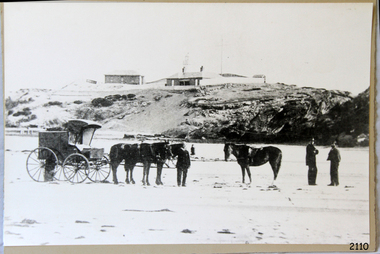
... THE LIGHTHOUSE KEEPERS Lighthouse Keepers were responsible for keeping their Lighthouse’s lights shining at night. They kept a lookout for passing vessels and changes in weather. ...THE LIGHTHOUSE KEEPERS Lighthouse Keepers were responsible for keeping their Lighthouse’s lights shining at night. They kept a lookout for passing vessels and changes in weather. ...This is an image of the Warrnambool Lighthouse Complex on Middle Island in 1854. The Store, Lighthouse Keeper's Quarters, Lighthouse and Flagstaff are in the background. The foreground shows a covered buggy drawn by two horses and a person in attendance, and another wheeled vehicle behind it with a figure nearby. There is a saddled horse to the right with two males in conversation nearby. The ground is soft, perhaps the riverbed or sandy shore. THE LIGHTHOUSE KEEPERS Lighthouse Keepers were responsible for keeping their Lighthouse’s lights shining at night. They kept a lookout for passing vessels and changes in weather. They were expected to clean, polish and maintain the equipment and buildings. They kept regular and detailed records of who was on watch, and the time the light was lit, trimmed and extinguished. They kept a journal about other events that occurred. They keep regular, accurate Meteorological Logs. It was expected that they were competent in Morse code signalling. They would be called to help in times of disasters and shipwrecks and to give official statements about these events. Many Lighthouse Keepers also volunteered as members of the lifeboat crew. The Lady Bay lighthouses were officially classified as small, so the Keepers had the official titles of Senior Assistant Lighthouse Keeper and Assistant Lighthouse Keeper. They were employed by the Public Service and paid rent to live in the Lighthouse Quarters. They were compulsorily retired at the age of 60, with most receiving a superannuation payment. Despite their time-consuming duties, there was time to follow hobbies and crafts such as growing vegetables, playing musical instruments, making models of buildings including lighthouses, and crafting furniture pieces. An example of a keeper’s skills is the carved fire screen made by /assistant Keeper Thomas Hope in the late 19th century and displayed in the Lighthouse Keeper’s cottage at Flagstaff Hill. Both Alexander and Farncombe had served under Senior Keeper Robert Deverell, who was the first and only Senior Lighthouse Keeper at the Middle Island Complex. John Alexander was the Assistant Keeper in the 1850s. Andrew Farncombe was the last Assistant Keeper at Middle Island, serving there with his family from 1864 to 1871. During 1871 and 1872 the Lighthouse Complex was moved to Flagstaff Hill on Merri Street. Farncombe and Deverell then became the first Keepers and occupants of the Lady Bay Lighthouse Complex at Flagstaff Hill. They continued their service together; overall, Deverell served from 1859 to 1885 and Farncombe from 1864 to 1974. WARRNAMBOOL'S LADY BAY LIGHTHOUSE COMPLEX - The original Lighthouse Complex was built on Middle Island in 1858-1859 then transferred stone-by-stone to Flagstaff Hill in 1871. The Complex comprised the Lighthouse, the Lighthouse Keepers’ Quarters and a Privy. The bluestone Keeper’s Quarters was a cottage divided into two compartments, one for the Senior Keeper and his family, the other for the Assistant Keeper and his family. The bluestone Store was divided into three; a store, a workshop, and an oil store (or office). The Privy comprised a small building also divided into two separate, back-to-back toilets, one for each Keeper and his family. In the 1970s the Flagstaff Hill Planning Board was set up under the chairmanship of John Lindsay. The Board was to make recommendations to the Warrnambool City Council regarding the use of the buildings and the rest of the Crown Land on the site. The Flagstaff Hill Maritime Village opened in 1975 and began renovating the Cottage in stages, during which time evidence of a 1920s fire was found in the eastern section of the cottage. Additions of a porch on the west and a washroom on the east were made in the 1980s. The western part of the building is now a Shipwreck Museum and the east has returned to a late 19th-century Lighthouse Keeper’s cottage and includes the screen made by Assistant Lighthouse Keeper Thomas Hope in the late 19th century. Hope served two periods of time at the Lighthouse. This photograph is significant as a visual record of the original Warrnambool Lighthouse Complex on Middle Island, the origin of what is now the Lady Bay Lighthouse Complex. The photograph is significant for its connection to the Complex, which is now listed on the Victorian Heritage Register, H1520, for being of historical, scientific (technological) and architectural significance to the State of Victoria. The Complex is significant as an example of early colonial development. The photograph is significant for its connection with the important navigational function of the Lighthouses, a function still being performed to this day. The photograph is also significant as it shows an example of buildings organised by the Public Works Department in Victoria in the mid-to-late 19th century. The structures tare still stand strong. Photograph of horses, a buggy and three gentlemen in the foreground and the background shows a lighthouse and accompanying buildings. Printed in black and white. (Another two horse-drawn vehicles are partially visible). The subject is the Lighthouse Complex on Middle Island, Warrnambool, dated between 1854 and 1871.An inscription is handwritten in black pen on the back of the mounting board."The lighthouse and accompanying buildings were / established on Middle Island in 1854, as this / picture shows. In 1871 they were moved to their / present site on Flagstaff Hill."flagstaff hill, flagstaff hill maritime museum, flagstaff hill maritime village, warrnambool, maritime museum, shipwreck coast, lighthouse keeper's cottage, lighthouse residence, lighthouse, chart room, quarters, privy, middle island, beach lighthouse, obelisk, lighthouse complex, lady bay complex, warrnambool port, warrnambool harbour, lady bay, keepers, lighthouse keeper, upper lighthouse, lower lighthouse, assistant keeper, ports and harbours, cottage, meteorological record, 1854, 1871, light keeper -
 Flagstaff Hill Maritime Museum and Village
Equipment - Navigation Lamp, W. T George and Co. Ltd, ca 1941
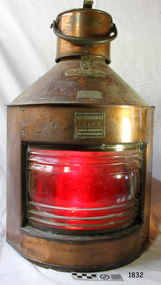
... Countries began passing laws and regulations in the 1830s that required ships to show navigation lights at night or in poor weather. From the late 1840s colours were standardised; red for portside of the vessel and green for starboard, a white masthead light, and a white light at anchor. ...William Thomas George was born in Birmingham in 1884 and was a tin plate worker. He and his wife Ellene had a son Leslie Thomas George. The firm W T George & Co was formed sometime later. In 1939 his firm produced ship lamps. The Patent Number GB546575 on the lamp's plate was assigned to Leslie Thomas George in 1941 for improvements in, or relating to, ships' lanterns. From that time the patent number was affixed to their namufactured Meteorite lights. The ship navigation lamp is important as an example of the evolution of marine safety technology. Countries began passing laws and regulations in the 1830s that required ships to show navigation lights at night or in poor weather. From the late 1840s colours were standardised; red for portside of the vessel and green for starboard, a white masthead light, and a white light at anchor. By 1914 the International Convention for the Safety of Life at Sea was formed and continues, with decisions and notifications on improvements and changes.. Lamp; Portside ship's lamp is rounded in the front with two flat sides coming to a point at the rear. Glass has circular ridging. Metal handle with lid and clasp. The reflector has red colouring. Inscribed on fixed plates on the front, with maker's details and Patent number. This Meteorite lantern was made by W T George and Co Ltd, of Birmingham. "Port" "W T George and Co Ltd" "Sherlock Street Birmingham" "Meteorite 68990 Patented No 546575 and others pending"warrnambool, shipwreck coast, flagstaff hill, flagstaff hill maritime museum, flagstaff hill maritime village, portside ships lamp, portside, port lamp, ship's lamp, marine lamp, navigation lamp, w t george & co, coloured lens, red lens, ship fitting, marine technology, navigation light, signal lamp, leslie thomas george, gb546575, patent gb546575, meteorite, lantern, lamp, light -
 Mission to Seafarers Victoria
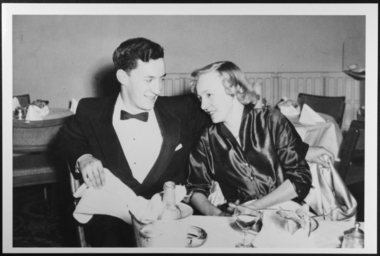
Photograph - Photograph, copy, David Conolly and Catherine Herron dining out
... night on the town. David Conolly, Stipendiary Lay Reader at the mission, dining out with Harbour Lights Guild member Cathy Herron - a practice frowned on at the time. ...night on the town. David Conolly, Stipendiary Lay Reader at the mission, dining out with Harbour Lights Guild member Cathy Herron - a practice frowned on at the time. ...Small rectangular (landscape orientation) monochrome photograph depicting a gentleman and lady sitting informally at a restaurant table.'Another night on the town. David Conolly, Stipendiary Lay Reader at the mission, dining out with Harbour Lights Guild member Cathy Herron - a practice frowned on at the time. Circa 1957.' david conolly, lay reader, catherine herron, lhlg -
 Marysville & District Historical Society
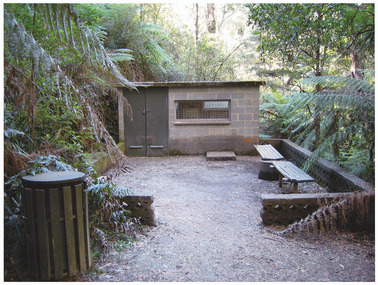
Photograph (item) - Colour photograph, Pre 2009
... night between sundown and 11.00pm. The Steavenson Falls is named after the Victoria Assistant Commissioner of Roads and Bridges, John Steavenson who arrived in Victoria in the early 1860's. pumping station steavenson falls marysville victoria flood lights john steavenson A colour photograph of the pumping station at Steavenson Falls in Marysville in Victoria. ...A colour photograph of the pumping station at Steavenson Falls in Marysville in VictoriaA colour photograph of the pumping station which is situated at Steavenson Falls in Marysville in Victoria. The pumping station provides power to the floodlights which then lillumniate the falls every night between sundown and 11.00pm. The Steavenson Falls is named after the Victoria Assistant Commissioner of Roads and Bridges, John Steavenson who arrived in Victoria in the early 1860's.pumping station, steavenson falls, marysville, victoria, flood lights, john steavenson -
 Federation University Historical Collection
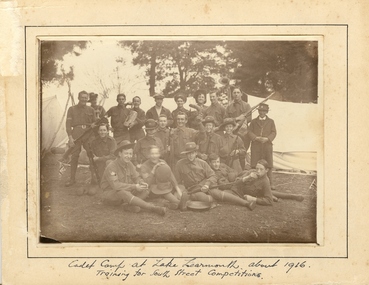
Photograph - Photograph - Sepia, Ballarat School of Mines Cadets, 1916, c1916
... That night we had a "Sing-a-long" in C Tent until "Lights out" sounded at 9.30. ...That night we had a "Sing-a-long" in C Tent until "Lights out" sounded at 9.30. ...Field Marshal Viscount Kitchener of Great Britain was invited by Prime Minister Deakin in 1909 to visit Australia and advise on the best way to provide Australia with a land defence. Kitchener’s report echoed the bill, introduced to Parliament in 1909 and supported by the Opposition Labor Party at its 1908 conference, to introduce compulsory military training in peace time (referred to as universal training). On 1 January 1911, the Commonwealth Defence Act 1911 (Cth) was passed as law and all males aged 12 to 26 were required to receive military training. Men were divided according to age, with junior cadets comprising boys 12-14 years of age, senior cadets comprising boys 14-18, and young men aged 18-26 assigned to the home militia defence. The support of schools was vital to the success of the scheme, since the system of cadet training began in the primary schools, with physical training prescribed by military authorities. Junior cadet training was entirely in the hands of school teachers, who had first been trained by military officers. This early training was less military in nature than focused on physical drill and sport. It also acted to inculcate boys with the notions of loyalty to country and empire. At this age, uniforms were not worn, although there were schools with pre-existing uniformed cadet units, who continued to do so. Senior Cadets were organised by Training Areas, administered by Area Officers. If a school had at least 60 senior cadets, they could form their own units. Unlike their junior counterparts, Senior Cadets were issued uniforms, a rifle, and learned the foundations necessary for service in any arm of the defence forces. Boys and men could be exempted from compulsory training if they lived more than five miles from the nearest training site, or were passed medically unfit. Those who failed to register for training were punished with fines or jail sentences, and the severity of this punishment generated some of the strongest opposition to the scheme. While institutions such as the political parties and most churches generally supported universal training, some in the broader labour movement were less enthusiastic, as evidenced in the Daily Herald newspaper’s editorials and letters. Universal military training persisted after the conclusion of World War 1, with the Junior Cadet scheme the first to go, in 1922. Senior cadets and service with the militia was suspended in November 1929. (http://guides.slsa.sa.gov.au/content.php?pid=575383&sid=4788359, accessed 29/10/2015) According to Neil Leckie, Manager of the Ballarat Ranger Military Museum: * Originally 12 – 14 year olds went to Junior Cadets attached to their school. * From age 14 – 17 they were Senior Cadets attached to the local militia unit. * After 1 July of the year a Cadet turned 18, the Cadet left the Senior Cadets and became a member of the Citizen Military Force. * In October 1918 the AIF, Militia and Cadets were renamed to give some connection to the AIF battalion raised in the area. Ballarat saw: 8th Australian Infantry Regiment comprising: * 8th Battalion AIF renamed 1st Battalion 8th Australian Infantry Regiment * 70th Infantry Militia renamed 2nd Battalion 8th Australian Infantry Regiment * 70th Infantry Cadets renamed 3rd B, 8th Australian Infantry. 39th Australian Infantry Regiment comprising: * 39th Battalion AIF renamed 1st Battalion 39th Australian Regiment * 71st Infantry Militia renamed 2nd Bn, 39th Australian Infantry Regiment * 71st Infantry Cadets renamed 3rd Bn, 39th Australian Infantry Regiment Prior to the reorganisation in 1918 the 18th Brigade was the 70th, 71st and 73rd Infantry. It is thought that the 18th Brigade Cadet units in 1920 were those that came from the old: * 69th Infantry (Geelong/Queenscliff) * 70th Infantry (Ballarat/Colac) * 71st Infantry (Ballarat West) * 72nd Infantry Warrnambool) * 73rd Infantry (NW Vic) The next name change came in 1921!Mounted sepia photograph of 21 young males. They are the Ballarat School of Mines Cadets on a training camp at Lake Learmonth. Back row left to right: Harold Wakeling; ? ; T. Wasley; H. Witter; H.V. Maddison (staff); Lieutenant S.J. Proctor, Joe ? ; ? ; B.C. Burrows. Centre left to right: Howard Beanland; ? ; F.N. Gibbs; H. Siemering; P. Riley; ? : E. Adamthwaite. Front row left to right: Albert E. Williams; Francis Davis (RAAF Dec.); A. Miller; W. Shattock; T. Rees From the Ballarat School of Mines Magazine, 1916 "Our Competition Team, 1916 At a parade, held on the 25th August competition teams were called from from the three colleges - Ballarat College, St Patrick's College, and the School of Mines. In each case, a large muster was obtained, twenty-nine volunteering fro the School of Mines. On account of the number in a team being limited to 21, some had to be weeded out. The team decided to have a camp at Learmonth in the vacation for the benefit of training for the coming competitions. The tents, within our baggage, were brought to the Junior Technical School at 10 a.m. on Monday, 11 September. Everything was carted to the station on a lorry, which was very kindly lent by Mr C. Burrow. ... Arriving at our camp, which was in the Park, we first raised the tents. This was done in record time. Three large tents, A.B.C., were pitched one behind the other. We also pitched a smaller one to act as a provisions tent. The provisions supplied by each cadet were placed in this tent. Dinner was ready by 3.30, and was prepared by the three senior non-coms., who also acted as orderlies. Things went alright Monday night, the two senior non-coms. acting as sentries for the first two hours. On Tuesday morning Reville sounded at 7. There was no need for it, however, as nearly all the cadets were up before daylight, owing to their beds being too hard. After physical exercises were gone through we had breakfast. We then had rifle exercises until Messrs A.W. Steane and F.N. King arrived. The former put the team through the table of physical exercises set down for competition work, many valuable points being obtained. The visitors remained for dinner, afterwards returning to Ballarat. Wednesday was uneventful, until the soldiers arrived at about 11 a.m., stopping at the park for lunch. As we handed over the coppers, etc., to them, our lunch was delayed. Two more visitors arrived after lunch, and after taking a few photos returned home. That night we had a "Sing-a-long" in C Tent until "Lights out" sounded at 9.30. After physical exercises ad breakfast on Thursday, we went for a six mile route march round the lake, doing skirmishing on the way. In the afternoon we practised rifle exercises and the march past. A concert was arranged for that night, the chief singers being cadets H. Siemering and W. Shattock. Supper was served at the end of the entertainment. On Friday, Reveille sounded at 6.30 instead of 7, and, as usual, we had physical exercises before breakfast, after which the team went through skirmishing at the reserve. In the afternoon, section drill and the march past were practised. Friday night, being our last night in camp, leave was granted until 10 p.m., "lights out" sounding at 11. Reveille sounded on Saturday at 4.30, the reason being that all kits, tents, etc., had to be packed away ready to catch the 8.15 train to Balalrat. At 7.30 we were all ready to leave for the station. We had a very enjoyable time in the train, each cadet having a chip in at the patriotic songs. On arriving at Ballarat, we found the lorry awaiting us. The luggage was carted to the Junior Technical School, the team following. The team were here dismissed, everyone feeling that he had had a very good time. F.G. Davis"Written in ink on front 'cadet camp at Lake Learmonth about 1916. Training for South Street Competitions. ballarat school of mines, cadets, ballarat school of mines cadets, lake learmonth, world war one, boomerang, camp, cadet camp, h.g. wakeling, harold wakeling, f.g. davis, albert w. steane, f.n. king, h. siermering, w. shattock, francis davis, harold wakeling, t. wasley, h. witter, h.v. maddison, s.j. proctor, b.c. burrows, howard beanland, f.n. gibbs, h. siemering, p. riley, e. adamthwaite, albert e. williams; francis davis, a. miller, w. shattock, t. rees, photography, foto, boxing gloves -
Marysville & District Historical Society
THE TRIANGLE NEWS-VOL 40 NO 49-DECEMBER 20 2013
... lights competition...marysville region really long lunch...mindfulness in marysville...yea community bus...kinglake library welcomes special storytime visitors...black spur inn pizza and beer night...marysville victoria australia marysville & district lions club friends of lions thanks triangle helpers what's on when in december the committee of management of the gallipoli park precinct australia day celebrations marysville community market creative triangle el kanah nye council recognises valuable work of ses church notices local carol services mayor's chair councillor comment yea arts carnivale 2014 advertisements real estate council adopts code red policy murrindindi shire council nye at crossways tender drainage upgrade-yea township half day closure council offices marysville golf report triangle christmas lights competition marysville region really long lunch mindfulness in marysville yea community bus kinglake library welcomes special storytime visitors black spur inn pizza and beer night cafe culture series 2014 council services over christmas/ny period 2013-2014 st john's parish hall dance alexandra resource recovery centres timetable THE TRIANGLE NEWS-VOL 40 NO 49-DECEMBER 20 2013 ...marysville, victoria, australia, marysville & district lions club, friends of lions, thanks triangle helpers, what's on when in december, the committee of management of the gallipoli park precinct, australia day celebrations, marysville community market, creative triangle, el kanah nye, council recognises valuable work of ses, church notices, local carol services, mayor's chair, councillor comment, yea arts carnivale 2014, advertisements, real estate, council adopts code red policy, murrindindi shire council, nye at crossways, tender drainage upgrade-yea township, half day closure council offices, marysville golf report, triangle christmas lights competition, marysville region really long lunch, mindfulness in marysville, yea community bus, kinglake library welcomes special storytime visitors, black spur inn pizza and beer night, cafe culture series 2014, council services over christmas/ny period 2013-2014, st john's parish hall dance alexandra, resource recovery centres timetable -
Marysville & District Historical Society
THE TRIANGLE NEWS-VOL 5 NO 6-MARCH 14 1980
... night...steavensons falls lights operating...marysville victoria australia new anglican church rector & family chariots at ballerat begonia festival eildon explorer night steavensons falls lights operating bowling club red cross door knock rodeo report betty's competition community care centre tupperware party think it over red cross street stall success marysville cricket club presentation night kindergarten roster vestry meeting christ church building fund marysville primary school sports fire brigade footy club annual meeting moomba art show bingo notice to all supporters anglican church news stuart smith honours at maryborough THE TRIANGLE NEWS-VOL 5 NO 6-MARCH 14 1980 ...marysville, victoria, australia, new anglican church rector & family, chariots at ballerat begonia festival, eildon explorer night, steavensons falls lights operating, bowling club, red cross door knock, rodeo report, betty's competition, community care centre, tupperware party, think it over, red cross street stall success, marysville cricket club presentation night, kindergarten roster, vestry meeting, christ church building fund, marysville primary school sports, fire brigade, footy club, annual meeting, moomba art show, bingo, notice to all supporters, anglican church news, stuart smith honours at maryborough -
Federation University Historical Collection
Magazine, Ballarat School of Mines Students' Magazine, Vol. 12, No. 2., Second Term, 1909, 1909
... night...t. adam...alfred mica smith...h.m. murphy...a.e.c. kerr...mine ventilation...f. howells...j.w. gregory...search lights...ballarat school of mines ballarat school of mines students' magazine open night t. adam alfred mica smith h.m. murphy a.e.c. kerr mine ventilation f. howells j.w. gregory search lights on port phillip heads military searchlights ministerial visit a.a. bilson frank tate ponsonby carew-smyth r.t. vale photography albert brun walking engine military traction engine caterpllar no 1. fireless locomotives martin mitchell william geldard nipporium c. corrie william baragwanath a.c. hesselmann Grey soft covered magazine on 17 pages. ...Grey soft covered magazine on 17 pages. Contents include: Mines Ventilation, resistance, photography composition, walking engine, fireless locomotives.ballarat school of mines, ballarat school of mines students' magazine, open night, t. adam, alfred mica smith, h.m. murphy, a.e.c. kerr, mine ventilation, f. howells, j.w. gregory, search lights on port phillip heads, military searchlights, ministerial visit, a.a. bilson, frank tate, ponsonby carew-smyth, r.t. vale, photography, albert brun, walking engine, military traction engine, caterpllar no 1., fireless locomotives, martin mitchell, william geldard, nipporium, c. corrie, william baragwanath, a.c. hesselmann -
 Flagstaff Hill Maritime Museum and Village
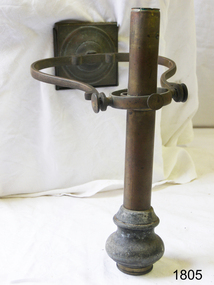
Functional object - Carbide Lamp, Powell & Hanmer, Late 19th to early 20th century
... night. Thick concave mirrors combined with magnifying lenses projected the acetylene flame light. These type of lights were used until reliable batteries and dynamos became available, and manufacturers switched to electric lights. ...Francis Powell (1861-) and Francis Hanmer (1858-1925) founded Powell and Hanmer Ltd in the Summer of 1885 for the manufacturer of bike and carriage lamps. Their first advertisements began to appear in November of 1885. In 1890 they lodged a Patent for “velocipede” lamps to be used by lightweight wheeled vehicles propelled by a rider, such as a bike, tricycle and railroad handcar. In April of 1913, they were selling headlamps for cars and in 1914 built their second factory manufacturing dynamo lighting sets in Rocky Lane Birmingham, also for the production of dynamos for motor cars. Then in 1929 Powell and Hanmer Ltd, was acquired by the Lucas company which was at that time the main competitor for the manufacture of non-electrical equipment for cycles and motorcycles. When a director of Powell and Hanmer joined the board of Austin motor cars, Lucas feared that Austins might encourage Powell and Hanmer to start to produce electrical equipment for supply to the company and as a result this association might affect Lucas's business with other large vehicle manufacturers. As a result, Lucas made an offer to Powell & Hanmer and purchased the business for £500,000. Carbide lighting was used in rural and urban areas of Australia which were not served by electrification. Its use began shortly after 1900 in many countries and continued past the 1950s. Calcium carbide pellets were placed in a container outside the home, with water piped to the container and allowed to drip on the pellets releasing acetylene. This gas was piped to lighting fixtures inside the house, where it was burned, creating a very bright flame. Carbide lighting was inexpensive but was prone to gas leaks and explosions. Early models of the automobile, motorbike and bicycles used carbide lamps as headlamps. Acetylene gas, derived from carbide, enabled early automobiles to drive safely at night. Thick concave mirrors combined with magnifying lenses projected the acetylene flame light. These type of lights were used until reliable batteries and dynamos became available, and manufacturers switched to electric lights. Acetylene lamps were also used on riverboats for night navigation. The National Museum of Australia has a lamp made in about 1910 that was used onboard the PS Enterprise, an 1878 Australian paddle steamer, currently owned by the National Museum of Australia in Canberra. It is still operational, and one of the oldest working paddle steamers in the world, listed on the Australian Register of Historic Vehicles.Acetylene Carbide lamp, marine pattern burner housing and reflector missing Carbide Lamp, metal. Has plate for attaching to wall, & gimbal to allow lamp to remain vertical. Noneflagstaff hill, warrnambool, flagstaff-hill-maritime-museum, maritime-museum, shipwreck-coast, flagstaff-hill-maritime-village, carbide lamp, motor vehicle, bike lamp, lighting, vehicle lighting, powell, hanmer, acetylene gas lamp, early lighting, marine lighting -
 Orbost & District Historical Society
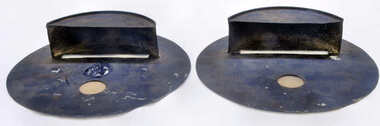
shields - blackout, Swan, Wally, WW11
... lights had to be turned down, including car headlights that had to be covered to minimize light exposure. In Australia more relaxed regulations led to the Australian air raid precautions being dubbed the “brownout”. These shields limited the amount of light emitted by a vehicle. To drive at night...lights had to be turned down, including car headlights that had to be covered to minimize light exposure. In Australia more relaxed regulations led to the Australian air raid precautions being dubbed the “brownout”. These shields limited the amount of light emitted by a vehicle. To drive at night ...By 1941, the threat of Japanese invasion caused restrictions to daily life. Blackouts became the norm. To prevent identification from enemy planes all lights had to be turned down, including car headlights that had to be covered to minimize light exposure. In Australia more relaxed regulations led to the Australian air raid precautions being dubbed the “brownout”. These shields limited the amount of light emitted by a vehicle. To drive at night without them was an offence; however, the increase in road accidents led to the removal of headlight masks everywhere in Australia south of Rockhampton from 15 February 1943.These shields, though not rare, evoke a period of restrictions, fear, rationing and confinement.Pair of handmade car light blackout shields. Black round metal with scoop at front as well as small glass partition.shields-blackout ww11 transport-motor-vehicles -
 Orbost & District Historical Society
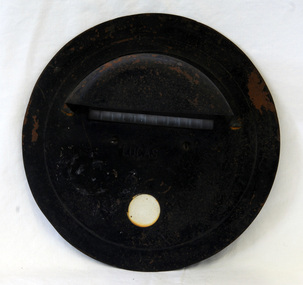
blackout shield, Lucas Industries, WW 11
... lights had to be turned down, including car headlights that had to be covered to minimize light exposure. In Australia more relaxed regulations led to the Australian air raid precautions being dubbed the “brownout”. These shields limited the amount of light emitted by a vehicle. To drive at night...lights had to be turned down, including car headlights that had to be covered to minimize light exposure. In Australia more relaxed regulations led to the Australian air raid precautions being dubbed the “brownout”. These shields limited the amount of light emitted by a vehicle. To drive at night ...By 1941, the threat of Japanese invasion caused restrictions to daily life. Blackouts became the norm. To prevent identification from enemy planes all lights had to be turned down, including car headlights that had to be covered to minimize light exposure. In Australia more relaxed regulations led to the Australian air raid precautions being dubbed the “brownout”. These shields limited the amount of light emitted by a vehicle. To drive at night without them was an offence; however, the increase in road accidents led to the removal of headlight masks everywhere in Australia south of Rockhampton from 15 February 1943. These shields, though not rare, evoke a period of restrictions, fear, rationing and confinement.A circular metal disc painted black - car light blackout shield. It has a small glass slot in front and a scooped out front to cover the light.ww11 blackout-shield -
 Mission to Seafarers Victoria
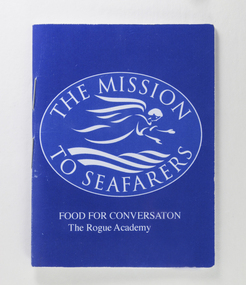
Booklet - Booklet, Recipes, The Rogue Academy, Food for Conversation-The Rogue Academy, 2017
... For Opening Night, they will host a casual dinner for Mission volunteers and their families, offering a hearty meal that would be the envy of the Ladies of the Harbour Lights Guild. ...For Opening Night, they will host a casual dinner for Mission volunteers and their families, offering a hearty meal that would be the envy of the Ladies of the Harbour Lights Guild. ...From the Rogue Academy website: Over the last 100 years, volunteering has been the mainstay of the Mission To Seafarers. We were invited to create an artwork for the MTS centennial celebration, which was held in September 2107 In highlighting the essential nature of volunteering to the organisation, we further explored the richness and vitality of the MTS volunteer community by gathering information about the volunteer. We initiated conversations that sought individual stories, their role within the organisation and heir feelings, opinions and ideas about the generous act of giving time. This information was being used to create further artworks in the leadup to the September that highlight the impact and importance of your role at the Mission and the changes in these roles after the introduction of shipping containers. Food for Conversation recipe booklets which show old recipes that may have been served by the famous Ladies Harbour Lights Guild at their many functions, sea shanty evenings and volunteer BBQs accompanied the main even – a diiner at the exhibiion.The Rogue Academy is a social and participatory agency run by artists Amanda Shone and Fiona Lee that is working with the Mission’s volunteers to rethink the capacity of volunteering as a form of social engagement and unpaid labour in the 21st century. For Opening Night, they will host a casual dinner for Mission volunteers and their families, offering a hearty meal that would be the envy of the Ladies of the Harbour Lights Guild. As seats become available seafarers and members of the public will be invited to join in the conversation, and adding to the atmosphere will be three seafaring knotters.PerformanceSmall blue booklet with the Flying Angel logo in cover.mission to seafarers, 2017, 100th anniversary, sounding histories, the rogue academy, food for conversation, lhlg, ladies harbour lights guild, recipes, centenary, flinders street, cameron bishop, anne wilson, maree clarke, artworks, deakin university, fiona lee, amanda shone, dinner, volunteers, michael needham, catherine bell, bishop and reis, michael graeve, anne scott wilson, performance, installation, community, cultural events -
 The Cyril Kett Optometry Museum
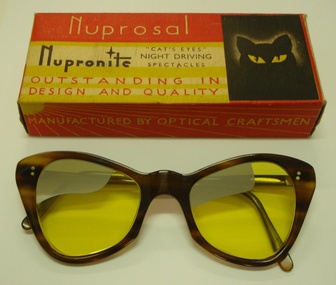
Spectacles, Nupro, 1950 (estimated)
... night driving spectacles. Yellow flat plano glass lenses with silver mirror finish in wearer's upper right field of each lens (to minimise glare of oncoming lights). ...night driving spectacles. Yellow flat plano glass lenses with silver mirror finish in wearer's upper right field of each lens (to minimise glare of oncoming lights). ...These night driving spectacles are in a shape of frame fashionable for ladies in the 1950's. The position of the lens silvering shows that these are designed for use in right hand drive cars. These were an expensive item in their day. Their excellent condition and original cardboard box suggest that they may be unsold new old stock.No other example of these Nupronite night driving spectacles is known in any Australian collection.Boxed Nupronite night driving spectacles. Yellow flat plano glass lenses with silver mirror finish in wearer's upper right field of each lens (to minimise glare of oncoming lights). Tortoise-shell look cat's eye frame. In original cardboard box.On box:'Nuprosal/ Nupronite/ "CAT'S EYES" NIGHT DRIVING SPECTACLES OUTSTANDING IN DESIGN AND QUALITY/ MANUFACTURED BY OPTICAL CRAFTSMEN/ MADE IN ENGLAND BY NUPRO LONDON/ MODEL:CAT'S EYES/ LENSES:SUPER/ COLOUR:AUTUMN LEAF'. Price added by hand '2 pound 17/6'spectacles, glare, night driving, eye protection -
 Flagstaff Hill Maritime Museum and Village
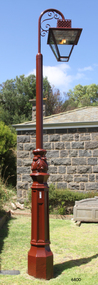
Functional object - Lamp Light, late 19th - early-20th century
... lights such as the one in Flagstaff Hill’s collection were no longer needed. (References: John Lindsay re Lamp Light history 2019-01-29, Former Warrnambool Gas Company Limited, Victorian Heritage Database Report, Heritage Number 149746 https://vhd.heritagecouncil.vic.gov.au/places/149746/download-report ) The lamp light is representative of the lamps used in Melbourne from the mid-nineteenth century to light the streets at night and make Melbourne a safer city. ...This gas lamp light and stand came from the original manufacturer in Melbourne. Gas street lights such as this one were used in Melbourne from the mid-19th century. The lights enabled safer after-dark travel for pedestrians and vehicles and were a deterrent to crime. A lamp lighter was employed to keep the lamps lit, sometimes with little success due to weather conditions and the pranks of youths. WARRNAMBOOL Gasworks In Warrnambool prior to 1874 there were about twenty rare, individually lit street lights in Warrnambool, each with its own supply of kerosene. These lamps were in the central business area of Timor, Koroit and Liebig Streets. The Warrnambool Gas Company Ltd. was registered as an incorporated company in 1873. It was a private, locally owned business. It was located at 209-215 Merri Street, Warrnambool, on the land, which is just west of the later-built railway station. The first managers of the Gas Company lived in a substantial stone house on site, but later the managers lived in a residence in Henna Street between Merri and Timor Streets. The original home, which still stands, became a residence for the Railway Station Master from about 1890. In August 1874 the construction of the gasworks was complete and at the end of that month gas was supplied to all of the existing lamps in Warrnambool for the first time. The Warrnambool Gas Company wound up in 1880-1881 and was purchased by the Warrnambool Borough Council with money raised by a loan – the Borough’s first ‘loan transaction’. The Council established a piped network to supply gas to other street connections. The gasworks were privatised and upgraded in 1952. In 1972 the town supply was converted to liquid petroleum gas and by the early 1980s the gasworks were closed down. In 1986 Warrnambool was supplied with natural gas from a site near Port Campbell. The Warrnambool gasworks supplied all street and shop lighting and most domestic lighting until 1923 when electricity was available for lighting. Bromfield Street in Warrnambool was named after the director of the gasworks, James Astley Bromfield (1823-1903). He arrived in Warrnambool from Worcestershire, England, in 1852 and was very active in the local council and community. Cockman Street was named after the first secretary of the gasworks in 1874, Walter Cockman (c.1821-1892). He was a Mayor and businessman. The second Manager, Luther Rodgers, worked for the gas company for about twenty years and both Rodger Place and Rodgers Road in Warrnambool have been named after him. LAMP LIGHTS IN MELBOURNE In the 1820s Melbourne's innkeepers were legally required to have a lamp light outside their premises from sunset to sunrise. This was the first instance of street lamps being used in Melbourne. In 1847 the first oil lamp was used in the city. In 1849 a gas lamp was installed on the Swanston Street Bridge and much of the city had oil lamps installed by then. In August 1857 the installation of street gas lamps began in Melbourne. They were welcomed for the much brighter illumination they gave. By 1860 there were 414 lamp pillars. The phrase was quoted often - "A light was as good as a policeman". The first gas burners used for street lighting were called 'fishtail' gas burners. These were replaced in the early 1900s by gas mantles. The City of Melbourne Gas Coke Company was formed in 1850 but due to the Gold Rush the manufacture and distribution of the gas supply was delayed until January 1856. By the 1890s the gas supplying the lights was supplied by three companies in Melbourne. In 1879 a football match was played at the MCG under electric lighting and gradually electric arc lights were installed inside and outside buildings in the city. Lamp lights such as the one in Flagstaff Hill’s collection were no longer needed. (References: John Lindsay re Lamp Light history 2019-01-29, Former Warrnambool Gas Company Limited, Victorian Heritage Database Report, Heritage Number 149746 https://vhd.heritagecouncil.vic.gov.au/places/149746/download-report ) The lamp light is representative of the lamps used in Melbourne from the mid-nineteenth century to light the streets at night and make Melbourne a safer city. The lamp is also representative of the gas street lighting in Warrnambool from the mid-1870s-1920s.Lamp light or gas light. Street light, one of the last gas street lights removed from Melbourne. (Reconditioned by Friends of Flagstaff Hill, 2013)flagstaff hill, warrnambool, shipwrecked coast, flagstaff hill maritime museum, maritime museum, shipwreck coast, flagstaff hill maritime village, great ocean road, lamp light, gas light, gas lamp, street lamp, street light, gas street light, melbourne street lighting, warrnambool street lighting, melbourne gas street light, warrnambool gas company, warrnambool gasworks, james bromfield, walter cockman, luther rodgers, city of melbourne gas coke company -
 Flagstaff Hill Maritime Museum and Village
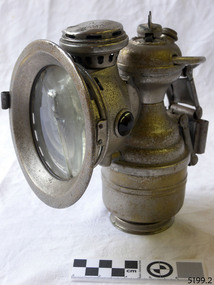
Functional object - Carbide Lamp, Powell & Hanmer, 1920s
... night. Thick concave mirrors combined with magnifying lenses projected the acetylene flame light. These type of lights were used until reliable batteries and dynamos became available, and manufacturers switched to electric lights. ...Francis Powell (1861-) and Francis Hanmer (1858-1925) founded Powell and Hanmer Ltd in the Summer of 1885 for the manufacturer of bike and carriage lamps. Their first advertisements began to appear in November of 1885. In 1890 they lodged a Patent for “velocipede” lamps to be used by lightweight wheeled vehicles propelled by a rider, such as a bike, tricycle and railroad handcar. In April of 1913, they were selling headlamps for cars and in 1914 built their second factory manufacturing dynamo lighting sets in Rocky Lane Birmingham, also for the production of dynamos for motor cars. Then in 1929 Powell and Hanmer Ltd, was acquired by the Lucas company which was at that time the main competitor for the manufacture of non-electrical equipment for cycles and motorcycles. When a director of Powell and Hanmer joined the board of Austin motor cars, Lucas feared that Austins might encourage Powell and Hanmer to start to produce electrical equipment for supply to the company and as a result this association might affect Lucas's business with other large vehicle manufacturers. As a result, Lucas made an offer to Powell & Hanmer and purchased the business for £500,000. Carbide lighting was used in rural and urban areas of Australia which were not served by electrification. Its use began shortly after 1900 in many countries and continued past the 1950s. Calcium carbide pellets were placed in a container outside the home, with water piped to the container and allowed to drip on the pellets releasing acetylene. This gas was piped to lighting fixtures inside the house, where it was burned, creating a very bright flame. Carbide lighting was inexpensive but was prone to gas leaks and explosions. Early models of the automobile, motorbike and bicycles used carbide lamps as headlamps. Acetylene gas, derived from carbide, enabled early automobiles to drive safely at night. Thick concave mirrors combined with magnifying lenses projected the acetylene flame light. These type of lights were used until reliable batteries and dynamos became available, and manufacturers switched to electric lights. Acetylene lamps were also used on riverboats for night navigation. The National Museum of Australia has a lamp made in about 1910 that was used onboard the PS Enterprise, an 1878 Australian paddle steamer, currently owned by the National Museum of Australia in Canberra. It is still operational, and one of the oldest working paddle steamers in the world, listed on the Australian Register of Historic Vehicles.Acetylene Carbide lamp, Model “Panther” distinct patterned side red and green lenses. These lamps were also known as acetylene gas lamps. They work off a chemical reaction between calcium carbide and water.Model 75flagstaff hill, warrnambool, flagstaff-hill-maritime-museum, maritime-museum, shipwreck-coast, flagstaff-hill-maritime-village, carbide lamp, motor vehicle, bike lamp, lighting, vehicle lighting, powell, hanmer, acetylene gas lamp, early lighting -
 Orbost & District Historical Society
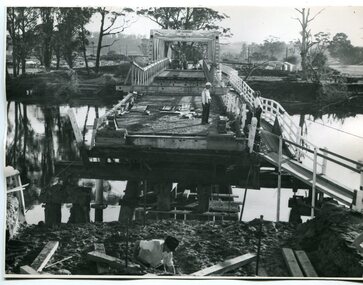
black and white photographs, February 17 1971
... They worked late into the night under flood lights to ensure the link from the Orbost township to the Princes Freeway would be open to traffic as soon as possible....They worked late into the night under flood lights to ensure the link from the Orbost township to the Princes Freeway would be open to traffic as soon as possible. ...After the damage from the February 1971 floods at Orbost when the abutment to the Snowy River road bridge was washed away a Bailey bridge, portable, pre-fabricated, truss bridge, was put into place to ensure town access, the C.R.B. rebuilt the approach to the bridge driving new piles and constructing the Bailey bridge. They worked late into the night under flood lights to ensure the link from the Orbost township to the Princes Freeway would be open to traffic as soon as possible.These photographs are pictorial records of a significant event in the history of Orbost.Three black / white photographs of a Bailey bridge being erected across a river. 3245.1 and 3245.2 are the same. bailey-bridge orbost-snowy-river-bridge bridge-orbost -
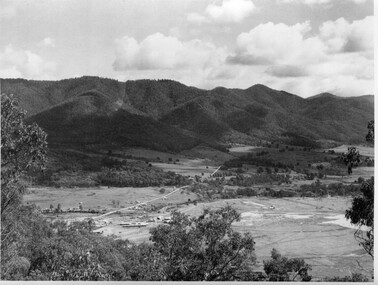 Kiewa Valley Historical Society
16 Photos - A.N. Barnes Collection
... Aerial photo of Tawonga South; Aerial photo of Tawonga South Aerial view of upper Kiewa Valley Clover P{ower Station / No. 3 Power Station Bogong High Country with snow Bogong Village / Lake Guy Lake Guy dam wall spilling with Bogong Village in background The interior of Lake Guy dam wall Bogong Village at night with lights reflecting in Lake Guy Bogong dam wall overflowing Pretty Valley Camp BHP Road to Rocky Valley The workers' camp at Clover Flat Unknown Two unknown men with a vehicle at the top of the Bright Gap note distance and elevations on sign posts and Royal auto signs on arrows SEC Workmen's Camp ...Kiewa Hudro Electric Scheme A.N.Barnes Aerial photo of Tawonga South; Aerial photo of Tawonga South Aerial view of upper Kiewa Valley Clover P{ower Station / No. 3 Power Station Bogong High Country with snow Bogong Village / Lake Guy Lake Guy dam wall spilling with Bogong Village in background The interior of Lake Guy dam wall Bogong Village at night with lights reflecting in Lake Guy Bogong dam wall overflowing Pretty Valley Camp BHP Road to Rocky Valley The workers' camp at Clover Flat Unknown Two unknown men with a vehicle at the top of the Bright Gap note distance and elevations on sign posts and Royal auto signs on arrows SEC Workmen's Camp 16 Photos - A.N. ...The State Electricity Commission of Victoria constructed the Kiewa Hydro Electric Scheme which included the townships of Bogong and Mount Beauty - from the late 1940s until 1961 The KHES changed the Kiewa Valley from a rural community to a construction community.Aerial photo of Tawonga South; Aerial photo of Tawonga South Aerial view of upper Kiewa Valley Clover P{ower Station / No. 3 Power Station Bogong High Country with snow Bogong Village / Lake Guy Lake Guy dam wall spilling with Bogong Village in background The interior of Lake Guy dam wall Bogong Village at night with lights reflecting in Lake Guy Bogong dam wall overflowing Pretty Valley Camp BHP Road to Rocky Valley The workers' camp at Clover Flat Unknown Two unknown men with a vehicle at the top of the Bright Gap note distance and elevations on sign posts and Royal auto signs on arrows SEC Workmen's Camp kiewa hudro electric scheme, a.n.barnes
