
Showing 132 items matching "lindsay family"
-
 Buninyong & District Historical Society
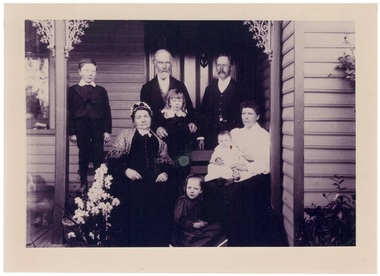
Photograph - Photograph of Original Photograph, Lindsay family, of "Marybank" Grenville, 1898, 1994
... Lindsay family, of "Marybank" Grenville, 1898......Lindsay family...Lindsay family, of "Marybank" Grenville, 1898, on veranda of family townhouse at 1313 Dana St. ...Family Buninyong Lindsay family Grenville Dana St. Marybank Identification on reverse. ...FamilyLindsay family, of "Marybank" Grenville, 1898, on veranda of family townhouse at 1313 Dana St. BallaratIdentification on reverse.buninyong, lindsay family, grenville, dana st., marybank -
 Warrnambool and District Historical Society Inc.
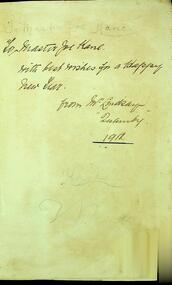
Book, Unwin Brothers Limited, The Empire Annual for Australian Boys, 1911
... ...lindsay family...This book is kept as an example of children's literature in the early twentieth century and for the inscription which shows a connection the Lindsay family of "Quamby", Woolsthorpe. joe kane lindsay family woolsthorpe quamby This is a collection of 37 short stories for boys presented as an annual collection. ...This is a collection of 37 short stories for boys presented as an annual collection.This is a hard cover book of 39 short stories. The cover is faded and worn at the edges. The title is reliefed in a gold rectangle with a crown surrounded by couchant royal lion and unicorn. There is a central illustration of a kangaroo with a hunter in the distance framed by rope around a colonnade. There is an arrangement of sporting equipment at the base of the colonnade. There are inscriptions in black ink which have been re written in grey lead in a child's hand.fictionThis is a collection of 37 short stories for boys presented as an annual collection. joe kane, lindsay family, woolsthorpe, quamby -
 Creswick Museum
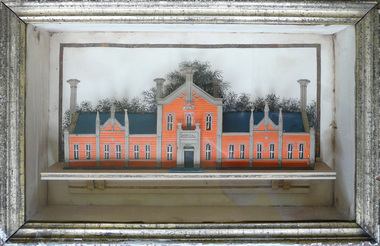
Model Building, circa 1869
... ...Lindsay family...Model Creswick Hospital Rev T. Williams Lindsay family Model of Creswick Hospital before rendering. ...Rev. Thomas Williams was grandfather of the Lindsay children. He is credited with encouraging his grandchildren in their artistic talents. Both Lionel and Normam learnt their model making skills from him. Creswick Hospital was foundation stone was laid in 1863. It operated as a hospital until 1911 when it was sold to the government as part of the School of Forestry (now University of Melbourne). The model shows it as a red brick building. In the 1870s it was painted as a white building. The Museum has b/w photos of the building taken prior to rendering. The people of Creswick collected fund for the project and obtained a government grant. The 1857 survey map of the proposed township shows the area at Eastern Hills reserved for a hospital and Benevolent SocietyThe model's unique association with the Lindsay Artist of Creswick. Model of Creswick Hospital before rendering. Made of paper with painted background and framed.model, creswick hospital, rev t. williams, lindsay family -
 Hymettus Cottage & Garden Ballarat
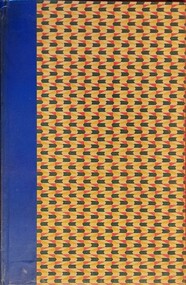
Work on paper - Book, Festival Preludes
... ...Lindsay Family...Private Press Lindsay Family Art Rainbow Studio Stephensen Festival Preludes by Gordon Bottomley, published by Jack Lindsay at Fanfrolico Press London. ...Festival Preludes by Gordon Bottomley, published by Jack Lindsay at Fanfrolico Press London.fictionFestival Preludes by Gordon Bottomley, published by Jack Lindsay at Fanfrolico Press London.private press, lindsay family, art, rainbow studio, stephensen -
 Hymettus Cottage & Garden Ballarat
Work on paper - Book, The Parlement of Pratlers
... ...Lindsay Family...Jack Lindsay Lindsay Family Eliot Fanfrolico Press No 27 of 75 special copies of this sixteenth century bound in vellum with top edge gilt and signed by the illustrator Hal Collins. ...No 27 of 75 special copies of this sixteenth century bound in vellum with top edge gilt and signed by the illustrator Hal Collins. It contains a series of Elizabethan dialogues about the life of a gentleman on the Grand Tour. This copy has its original dust-wrapper.fictionNo 27 of 75 special copies of this sixteenth century bound in vellum with top edge gilt and signed by the illustrator Hal Collins. It contains a series of Elizabethan dialogues about the life of a gentleman on the Grand Tour. This copy has its original dust-wrapper.jack lindsay, lindsay family, eliot, fanfrolico press -
Hymettus Cottage & Garden Ballarat
Work on paper - Book, Manfred
... ...Lindsay Family...Jack Lindsay Lindsay Family Expatriates. Fanfrolico Manfred Work on paper Book ...fictionjack lindsay, lindsay family, expatriates., fanfrolico -
 Hymettus Cottage & Garden Ballarat
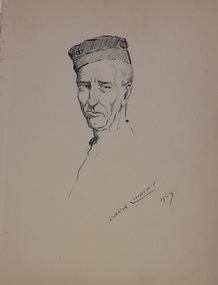
Work on paper - Drawing, German Prisoner of War
... ...Lindsay Family...Prisoner of War World War I Lindsay Family Drawing German German Prisoner of War Work on paper Drawing ...prisoner of war, world war i, lindsay family, drawing, german, -
Ringwood and District Historical Society
Envelope, Packet: Brain Family biographical notes
... Biographical; Brain Family; History from Des Lindsay. +Additional Keywords: Brain Family / Lindsay, Des....Biographical; Brain Family; History from Des Lindsay. +Additional Keywords: Brain Family / Lindsay, Des. ...Biographical; Brain Family; History from Des Lindsay. +Additional Keywords: Brain Family / Lindsay, Des. -
Tatura Irrigation & Wartime Camps Museum
Book - Family History, A Family History - Park and Lindsay families, 2004
... A Family History - Park and Lindsay families...park and lindsay families...dr j park...family...Produced for a reunion of the Park and Lindsay families, 2004...Produced for a reunion of the Park and Lindsay families, 2004 park and lindsay families dr j park family reunions A Family History - Park and Lindsay families Book - Family History ...Compiled to record family trees and history of the Park and Lindsay families. Chapters on local connections of Park families. Produced for a reunion of the Park and Lindsay families, 2004park and lindsay families, dr j park, family reunions -
 Creswick Museum
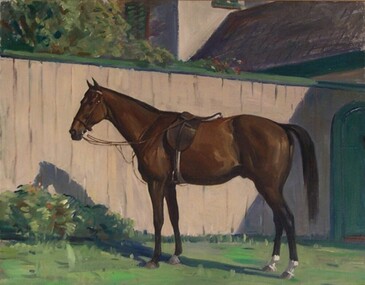
oil painting, Pompey, Circa 1930
... Daryl Lindsay was born and grew up in Creswick, one of the famous Lindsay family of artists. He had a love of horses and this was his favourite. ...Daryl Lindsay was born and grew up in Creswick, one of the famous Lindsay family of artists. He had a love of horses and this was his favourite. ...Daryl Lindsay was born and grew up in Creswick, one of the famous Lindsay family of artists. He had a love of horses and this was his favourite. He often did portraits of horses for famous owners.Daryl Lindsay became a noted international artist and the Director of the National Gallery of Victoria. He had a very considerable influence on Australian art, particularly from the 1940s to the 1970s.Oil painting on canvas by Daryl Lindsay of his favourite horse, "Pompey".Signed Daryl Lindsay on front. On the back is written "Daryl Lindsay painted his favourite horse Pompey c. 1930 at Mulberry Hill, Baxter. Presented to the Creswick Museum by Joan Lindsay May 1977.daryl lindsay, painting, horse, pompey, creswick, ngv -
 Eltham District Historical Society Inc
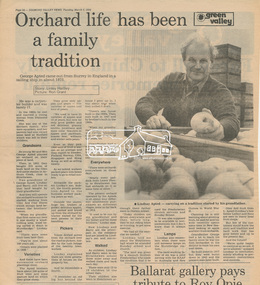
Newsclipping, Orchard life has been a family tradition, Diamond Valley News, 6 March 1984, p24, 1984
... Arthurs Creek, Barry Apted, Beryl Bradbury (nee Stokes) Collection, George Apted, Glen Ard cattle station, Glen Ard Cool Stores, Herbert family, Lindsay Apted, Nutfield...Story: Linley Hartley Photo: Ron Grant Apted Orchard Arthurs Creek, Barry Apted, Beryl Bradbury (nee Stokes) Collection, George Apted, Glen Ard cattle station, Glen Ard Cool Stores, Herbert family, Lindsay Apted, Nutfield Digital file only - Digitised by EDHS from a scrapbook on loan from Beryl Bradbury (nee Stokes), daughter of Frank Stokes. ...Story: Linley Hartley Photo: Ron Grant Apted OrchardDigital file only - Digitised by EDHS from a scrapbook on loan from Beryl Bradbury (nee Stokes), daughter of Frank Stokes.arthurs creek, barry apted, beryl bradbury (nee stokes) collection, george apted, glen ard cattle station, glen ard cool stores, herbert family, lindsay apted, nutfield -
 Glenelg Shire Council Cultural Collection
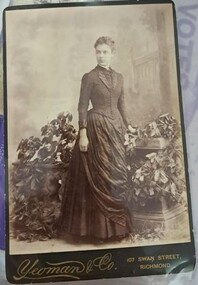
Photograph, Studio Portrait of Vida Goldstein, n.d
... From Mrs Helen Lindsay Mc Donald, family descendant. Vida Goldstein was a strong advocate for women's rights and equality. ...From Mrs Helen Lindsay Mc Donald, family descendant. Vida Goldstein was a strong advocate for women's rights and equality. ...From Mrs Helen Lindsay Mc Donald, family descendant. Vida Goldstein was a strong advocate for women's rights and equality. She was the first woman to stand for parliament in the British Empire.Black and white studio photographic portrait of a woman in late 19th century dress. She is central in the photo, standing next to balustrade and greenery, and in the background is a painted backdrop.Front: Front- Yeoman and Co 107 Swan Street, Richmond Back- 'Vida Goldstein' - Printed in texta on stellotape.portrait photography, vida goldstein, suffragette, equality -
 Ballarat Heritage Services
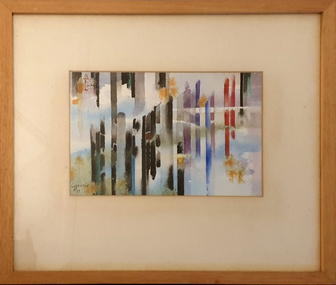
Painting - Artwork - Painting, Capriccio #11 by Arthur Lindsay
... Arthur LINDSAY (1912-1990) Born Melbourne Arthur Lindsay, a relative of the Lindsay family of Creswick, studied informally under Rupert Bunny, and John Munro in 1933, and held his first Exhibition in 1938, with Peter Cox, at Riddell Galleries. ...Arthur LINDSAY (1912-1990) Born Melbourne Arthur Lindsay, a relative of the Lindsay family of Creswick, studied informally under Rupert Bunny, and John Munro in 1933, and held his first Exhibition in 1938, with Peter Cox, at Riddell Galleries. ...Arthur LINDSAY (1912-1990) Born Melbourne Arthur Lindsay, a relative of the Lindsay family of Creswick, studied informally under Rupert Bunny, and John Munro in 1933, and held his first Exhibition in 1938, with Peter Cox, at Riddell Galleries. In 1939, he left Australia to tour Japan, but stayed on, accepting a position with a publishing company in Hong Kong. He served with the Hong Kong Medical Corp during World War Two and was interned at Pootung Camp, Shanghai, from 1941 – 45. He held an exhibition of his internment paintings in Melbourne in 1946. Lindsay returned to Hong Kong after the War, and supervised an Advertising Agency in Singapore, Kuala Lumpar, and Bangkok. In the 1950’s he travelled to Europe, United Kingdom, Spain and France. Returning to Australia Lindsay moved to Castlemaine in 1969. A Retrospective of his Art was held at Castlemaine Art Gallery in 1991.Framed abstract painting by Arthur Boydarthur lindsay, painting, abstract -
 Ballarat Heritage Services
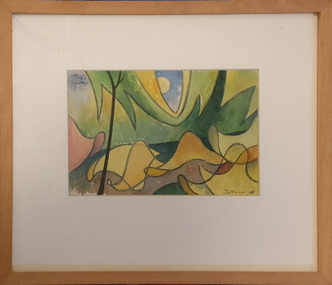
Painting - Artwork - Painting, Capriccio #29 by Arthur Lindsay, 1979
... Arthur LINDSAY (1912-1990) Born Melbourne Arthur Lindsay, a relative of the Lindsay family of Creswick, studied informally under Rupert Bunny, and John Munro in 1933, and held his first Exhibition in 1938, with Peter Cox, at Riddell Galleries. ...Arthur LINDSAY (1912-1990) Born Melbourne Arthur Lindsay, a relative of the Lindsay family of Creswick, studied informally under Rupert Bunny, and John Munro in 1933, and held his first Exhibition in 1938, with Peter Cox, at Riddell Galleries. ...Arthur LINDSAY (1912-1990) Born Melbourne Arthur Lindsay, a relative of the Lindsay family of Creswick, studied informally under Rupert Bunny, and John Munro in 1933, and held his first Exhibition in 1938, with Peter Cox, at Riddell Galleries. In 1939, he left Australia to tour Japan, but stayed on, accepting a position with a publishing company in Hong Kong. He served with the Hong Kong Medical Corp during World War Two and was interned at Pootung Camp, Shanghai, from 1941 – 45. He held an exhibition of his internment paintings in Melbourne in 1946. Lindsay returned to Hong Kong after the War, and supervised an Advertising Agency in Singapore, Kuala Lumpar, and Bangkok. In the 1950’s he travelled to Europe, United Kingdom, Spain and France. Returning to Australia Lindsay moved to Castlemaine in 1969. A Retrospective of his Art was held at Castlemaine Art Gallery in 1991.AbstractFramed abstract painting by Arthur Boydarthur lindsay, painting, abstract -
![Painting - Artwork - Painting, [Coastal Scene] by Arthur Lindsay, 1948](/media/collectors/57a00a4fd0cdd1210422a51e/items/5f549f48d2212501f0e3480e/item-media/5f54a5dad2212501f0e358c8/item-fit-380x285.jpg?cb=6) Ballarat Heritage Services
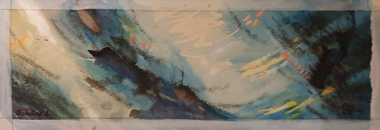
Ballarat Heritage ServicesPainting - Artwork - Painting, [Coastal Scene] by Arthur Lindsay, 1948
... Arthur LINDSAY (1912-1990) Born Melbourne Arthur Lindsay, a relative of the Lindsay family of Creswick, studied informally under Rupert Bunny, and John Munro in 1933, and held his first Exhibition in 1938, with Peter Cox, at Riddell Galleries. ...Arthur LINDSAY (1912-1990) Born Melbourne Arthur Lindsay, a relative of the Lindsay family of Creswick, studied informally under Rupert Bunny, and John Munro in 1933, and held his first Exhibition in 1938, with Peter Cox, at Riddell Galleries. ...Arthur LINDSAY (1912-1990) Born Melbourne Arthur Lindsay, a relative of the Lindsay family of Creswick, studied informally under Rupert Bunny, and John Munro in 1933, and held his first Exhibition in 1938, with Peter Cox, at Riddell Galleries. In 1939, he left Australia to tour Japan, but stayed on, accepting a position with a publishing company in Hong Kong. He served with the Hong Kong Medical Corp during World War Two and was interned at Pootung Camp, Shanghai, from 1941 – 45. He held an exhibition of his internment paintings in Melbourne in 1946. Lindsay returned to Hong Kong after the War, and supervised an Advertising Agency in Singapore, Kuala Lumpar, and Bangkok. In the 1950’s he travelled to Europe, United Kingdom, Spain and France. Returning to Australia Lindsay moved to Castlemaine in 1969. A Retrospective of his Art was held at Castlemaine Art Gallery in 1991.Framed watercolour of a Coastal Scene by Arthur Lindsay.arthur lindsay, watercolour, painting, townscape -
 Ballarat Heritage Services
Painting - Artwork - Painting, Arthur Lindsay, SchG 20 by Arthur Lindsay
... Arthur LINDSAY (1912-1990) Born Melbourne Arthur Lindsay, a relative of the Lindsay family of Creswick, studied informally under Rupert Bunny, and John Munro in 1933, and held his first Exhibition in 1938, with Peter Cox, at Riddell Galleries. ...Arthur LINDSAY (1912-1990) Born Melbourne Arthur Lindsay, a relative of the Lindsay family of Creswick, studied informally under Rupert Bunny, and John Munro in 1933, and held his first Exhibition in 1938, with Peter Cox, at Riddell Galleries. ...Arthur LINDSAY (1912-1990) Born Melbourne Arthur Lindsay, a relative of the Lindsay family of Creswick, studied informally under Rupert Bunny, and John Munro in 1933, and held his first Exhibition in 1938, with Peter Cox, at Riddell Galleries. In 1939, he left Australia to tour Japan, but stayed on, accepting a position with a publishing company in Hong Kong. He served with the Hong Kong Medical Corp during World War Two and was interned at Pootung Camp, Shanghai, from 1941 – 45. He held an exhibition of his internment paintings in Melbourne in 1946. Lindsay returned to Hong Kong after the War, and supervised an Advertising Agency in Singapore, Kuala Lumpar, and Bangkok. In the 1950’s he travelled to Europe, United Kingdom, Spain and France. Returning to Australia Lindsay moved to Castlemaine in 1969. A Retrospective of his Art was held at Castlemaine Art Gallery in 1991.abstractUnframed abstract painting by Arthur Boydarthur lindsay, painting, abstract -
 Ballarat Heritage Services
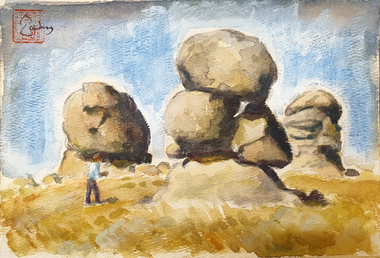
Painting - Artwork - Painting, [Balancing Rocks] by Arthur Lindsay
... Arthur LINDSAY (1912-1990) Born Melbourne Arthur Lindsay, a relative of the Lindsay family of Creswick, studied informally under Rupert Bunny, and John Munro in 1933, and held his first Exhibition in 1938, with Peter Cox, at Riddell Galleries. ...Arthur LINDSAY (1912-1990) Born Melbourne Arthur Lindsay, a relative of the Lindsay family of Creswick, studied informally under Rupert Bunny, and John Munro in 1933, and held his first Exhibition in 1938, with Peter Cox, at Riddell Galleries. ...Arthur LINDSAY (1912-1990) Born Melbourne Arthur Lindsay, a relative of the Lindsay family of Creswick, studied informally under Rupert Bunny, and John Munro in 1933, and held his first Exhibition in 1938, with Peter Cox, at Riddell Galleries. In 1939, he left Australia to tour Japan, but stayed on, accepting a position with a publishing company in Hong Kong. He served with the Hong Kong Medical Corp during World War Two and was interned at Pootung Camp, Shanghai, from 1941 – 45. He held an exhibition of his internment paintings in Melbourne in 1946. Lindsay returned to Hong Kong after the War, and supervised an Advertising Agency in Singapore, Kuala Lumpar, and Bangkok. In the 1950’s he travelled to Europe, United Kingdom, Spain and France. Returning to Australia Lindsay moved to Castlemaine in 1969. A Retrospective of his Art was held at Castlemaine Art Gallery in 1991.Unframed lansdcape by Arthur Boydarthur lindsay, painting, rocks, landscape -
 Ballarat Heritage Services
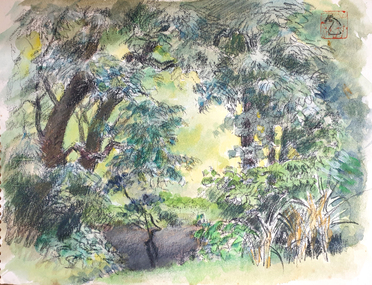
Painting - Artwork - Painting, Arthur Lindsay, [Landscape] by Arthur Lindsay
... Arthur LINDSAY (1912-1990) Born Melbourne Arthur Lindsay, a relative of the Lindsay family of Creswick, studied informally under Rupert Bunny, and John Munro in 1933, and held his first Exhibition in 1938, with Peter Cox, at Riddell Galleries. ...Arthur LINDSAY (1912-1990) Born Melbourne Arthur Lindsay, a relative of the Lindsay family of Creswick, studied informally under Rupert Bunny, and John Munro in 1933, and held his first Exhibition in 1938, with Peter Cox, at Riddell Galleries. ...Arthur LINDSAY (1912-1990) Born Melbourne Arthur Lindsay, a relative of the Lindsay family of Creswick, studied informally under Rupert Bunny, and John Munro in 1933, and held his first Exhibition in 1938, with Peter Cox, at Riddell Galleries. In 1939, he left Australia to tour Japan, but stayed on, accepting a position with a publishing company in Hong Kong. He served with the Hong Kong Medical Corp during World War Two and was interned at Pootung Camp, Shanghai, from 1941 – 45. He held an exhibition of his internment paintings in Melbourne in 1946. Lindsay returned to Hong Kong after the War, and supervised an Advertising Agency in Singapore, Kuala Lumpar, and Bangkok. In the 1950’s he travelled to Europe, United Kingdom, Spain and France. Returning to Australia Lindsay moved to Castlemaine in 1969. A Retrospective of his Art was held at Castlemaine Art Gallery in 1991.Unframed landscape by Arthur Boydarthur lindsay, painting, landscape -
 Bendigo Military Museum
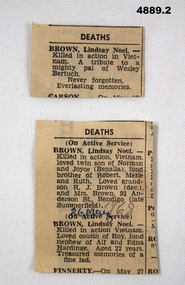
Article - NEWSPAPER ARTICLE, C.May 1968
... .1) Notice was placed in the newspaper by Wesley BERTUCH. .2) Both notices were placed by the family. Lindsay Noel Brown, National Serviceman, No 3790530, 3RAR 28.12.1967 - 26.5.1968 Wesley BERTUCH collection, refer catalogue No 1664.2....1) Notice was placed in the newspaper by Wesley BERTUCH. .2) Both notices were placed by the family. Lindsay Noel Brown, National Serviceman, No 3790530, 3RAR 28.12.1967 - 26.5.1968 Wesley BERTUCH collection, refer catalogue No 1664.2 Articles newspapers KIA Vietnam .1) “Brown Lindsay Noel” .2) (“On Active service”) In blue pen, “26 May”, In black pencil “1968” .1) News paper death Notice, print in black relating to the death of Lindsay Noel Brown KIA Vietnam .2) Newspaper death notice , two on one piece relating to the death of Lindsay Noel Brown KIA Vietnam, has blue and black hand written on. ....1) Notice was placed in the newspaper by Wesley BERTUCH. .2) Both notices were placed by the family. Lindsay Noel Brown, National Serviceman, No 3790530, 3RAR 28.12.1967 - 26.5.1968 Wesley BERTUCH collection, refer catalogue No 1664.2.1) News paper death Notice, print in black relating to the death of Lindsay Noel Brown KIA Vietnam .2) Newspaper death notice , two on one piece relating to the death of Lindsay Noel Brown KIA Vietnam, has blue and black hand written on..1) “Brown Lindsay Noel” .2) (“On Active service”) In blue pen, “26 May”, In black pencil “1968”articles, newspapers, kia, vietnam -
 Greensborough Historical Society
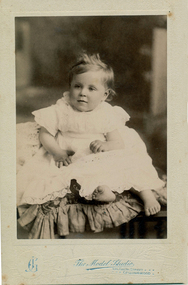
Photograph - Photograph - Digital Image, Betty Black, 1902c
... Studio photograph of Elizabeth (Betty) Black, sister of Lindsay Black. The Black family were early landowners in Watsonia, from Grimshaw Street to Lambourn Road. ...Studio photograph of Elizabeth (Betty) Black, sister of Lindsay Black. The Black family were early landowners in Watsonia, from Grimshaw Street to Lambourn Road. ...Studio photograph of Elizabeth (Betty) Black, sister of Lindsay Black. The Black family were early landowners in Watsonia, from Grimshaw Street to Lambourn Road. The Model Studio operated from 330 Smith Street Collingwood from 1902-1904.Digital copy of black and white studio photograph.betty black, black family, elizabeth black, watsonia -
 Ararat Gallery TAMA
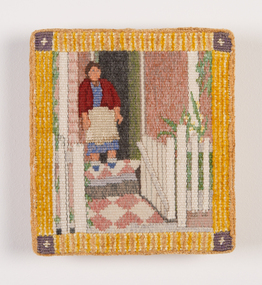
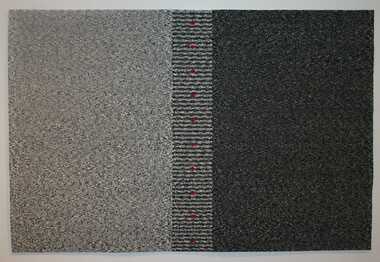
Sara Lindsay, Rosa, 1978
... The artwork exhibited here is part of body of work exploring Lindsay’s family’s historical ties to Sri Lanka. Her British grandfather managed a tea plantation in Ceylon’s hill country during the 1920s and 30s, where her mother was born before returning to England after his early death in 1937. ...The artwork exhibited here is part of body of work exploring Lindsay’s family’s historical ties to Sri Lanka. Her British grandfather managed a tea plantation in Ceylon’s hill country during the 1920s and 30s, where her mother was born before returning to England after his early death in 1937. ...Sara Lindsay is a Melbourne-based artist, curator and educator. She worked as a weaver at the Victorian Tapestry Workshop (now the Australian Tapestry Workshop) from its foundation in 1976 until 1990. Alongside her art practice, Lindsay has lectured at the Tasmanian School of Art, held the role of Curator of Textiles at the Tasmanian Museum and Art Gallery, then the position of Production Manager at the Australian Tapestry Workshop. Since 2013 she has mentored three Karen refugee women from Myanmar, assisting in their professional development and furthering their tapestry skills. In 2023 Lindsay began the Ararat New Settlement Weaving Program, teaching and mentoring culturally diverse settlers from refugee and migrant backgrounds in the Ararat region. The artwork exhibited here is part of body of work exploring Lindsay’s family’s historical ties to Sri Lanka. Her British grandfather managed a tea plantation in Ceylon’s hill country during the 1920s and 30s, where her mother was born before returning to England after his early death in 1937. After her first visit to Sri Lanka in 2005, Lindsay developed works that responded to this journey. She chose a quiet, contemplative approach to reflect on the complexity of colonial histories. Research into her family history led her to delve deeper into Sri Lanka’s complex history as a trading nation and to expand her materials to speak to this layered past. The use of cinnamon in this work connects to the story of 17th-century weavers from Southern India who were displaced from the Kingdom of Kandy and sent to the southwest coast to become cinnamon peelers under Portuguese and later Dutch rule. The finely woven ticking strips seen here reference the thick cotton fabric once used to cover mattresses and pillows aboard cargo ships transporting spices from Sri Lanka - a subtle reminder of the human stories woven into trade routes and colonial histories. -
 Ararat Gallery TAMA
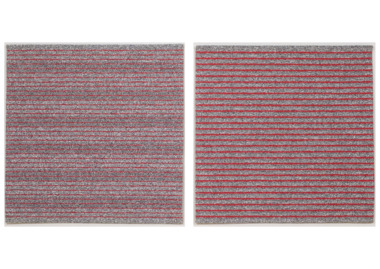
Sara Lindsay, In-Between #2, 1999
... The artwork exhibited here is part of body of work exploring Lindsay’s family’s historical ties to Sri Lanka. Her British grandfather managed a tea plantation in Ceylon’s hill country during the 1920s and 30s, where her mother was born before returning to England after his early death in 1937. ...The artwork exhibited here is part of body of work exploring Lindsay’s family’s historical ties to Sri Lanka. Her British grandfather managed a tea plantation in Ceylon’s hill country during the 1920s and 30s, where her mother was born before returning to England after his early death in 1937. ...Sara Lindsay is a Melbourne-based artist, curator and educator. She worked as a weaver at the Victorian Tapestry Workshop (now the Australian Tapestry Workshop) from its foundation in 1976 until 1990. Alongside her art practice, Lindsay has lectured at the Tasmanian School of Art, held the role of Curator of Textiles at the Tasmanian Museum and Art Gallery, then the position of Production Manager at the Australian Tapestry Workshop. Since 2013 she has mentored three Karen refugee women from Myanmar, assisting in their professional development and furthering their tapestry skills. In 2023 Lindsay began the Ararat New Settlement Weaving Program, teaching and mentoring culturally diverse settlers from refugee and migrant backgrounds in the Ararat region. The artwork exhibited here is part of body of work exploring Lindsay’s family’s historical ties to Sri Lanka. Her British grandfather managed a tea plantation in Ceylon’s hill country during the 1920s and 30s, where her mother was born before returning to England after his early death in 1937. After her first visit to Sri Lanka in 2005, Lindsay developed works that responded to this journey. She chose a quiet, contemplative approach to reflect on the complexity of colonial histories. Research into her family history led her to delve deeper into Sri Lanka’s complex history as a trading nation and to expand her materials to speak to this layered past. The use of cinnamon in this work connects to the story of 17th-century weavers from Southern India who were displaced from the Kingdom of Kandy and sent to the southwest coast to become cinnamon peelers under Portuguese and later Dutch rule. The finely woven ticking strips seen here reference the thick cotton fabric once used to cover mattresses and pillows aboard cargo ships transporting spices from Sri Lanka - a subtle reminder of the human stories woven into trade routes and colonial histories. -
 Ararat Gallery TAMA
Sara Lindsay, Pulse (diptych), 2001-2002
... The artwork exhibited here is part of body of work exploring Lindsay’s family’s historical ties to Sri Lanka. Her British grandfather managed a tea plantation in Ceylon’s hill country during the 1920s and 30s, where her mother was born before returning to England after his early death in 1937. ...The artwork exhibited here is part of body of work exploring Lindsay’s family’s historical ties to Sri Lanka. Her British grandfather managed a tea plantation in Ceylon’s hill country during the 1920s and 30s, where her mother was born before returning to England after his early death in 1937. ...Sara Lindsay is a Melbourne-based artist, curator and educator. She worked as a weaver at the Victorian Tapestry Workshop (now the Australian Tapestry Workshop) from its foundation in 1976 until 1990. Alongside her art practice, Lindsay has lectured at the Tasmanian School of Art, held the role of Curator of Textiles at the Tasmanian Museum and Art Gallery, then the position of Production Manager at the Australian Tapestry Workshop. Since 2013 she has mentored three Karen refugee women from Myanmar, assisting in their professional development and furthering their tapestry skills. In 2023 Lindsay began the Ararat New Settlement Weaving Program, teaching and mentoring culturally diverse settlers from refugee and migrant backgrounds in the Ararat region. The artwork exhibited here is part of body of work exploring Lindsay’s family’s historical ties to Sri Lanka. Her British grandfather managed a tea plantation in Ceylon’s hill country during the 1920s and 30s, where her mother was born before returning to England after his early death in 1937. After her first visit to Sri Lanka in 2005, Lindsay developed works that responded to this journey. She chose a quiet, contemplative approach to reflect on the complexity of colonial histories. Research into her family history led her to delve deeper into Sri Lanka’s complex history as a trading nation and to expand her materials to speak to this layered past. The use of cinnamon in this work connects to the story of 17th-century weavers from Southern India who were displaced from the Kingdom of Kandy and sent to the southwest coast to become cinnamon peelers under Portuguese and later Dutch rule. The finely woven ticking strips seen here reference the thick cotton fabric once used to cover mattresses and pillows aboard cargo ships transporting spices from Sri Lanka - a subtle reminder of the human stories woven into trade routes and colonial histories. -
 Ararat Gallery TAMA
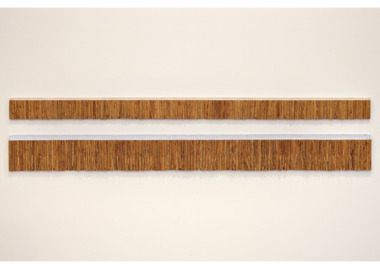
Sara Lindsay, Cinnamon and Ticking #9, 2008
... The artwork exhibited here is part of body of work exploring Lindsay’s family’s historical ties to Sri Lanka. Her British grandfather managed a tea plantation in Ceylon’s hill country during the 1920s and 30s, where her mother was born before returning to England after his early death in 1937. ...The artwork exhibited here is part of body of work exploring Lindsay’s family’s historical ties to Sri Lanka. Her British grandfather managed a tea plantation in Ceylon’s hill country during the 1920s and 30s, where her mother was born before returning to England after his early death in 1937. ...Sara Lindsay is a Melbourne-based artist, curator and educator. She worked as a weaver at the Victorian Tapestry Workshop (now the Australian Tapestry Workshop) from its foundation in 1976 until 1990. Alongside her art practice, Lindsay has lectured at the Tasmanian School of Art, held the role of Curator of Textiles at the Tasmanian Museum and Art Gallery, then the position of Production Manager at the Australian Tapestry Workshop. Since 2013 she has mentored three Karen refugee women from Myanmar, assisting in their professional development and furthering their tapestry skills. In 2023 Lindsay began the Ararat New Settlement Weaving Program, teaching and mentoring culturally diverse settlers from refugee and migrant backgrounds in the Ararat region. The artwork exhibited here is part of body of work exploring Lindsay’s family’s historical ties to Sri Lanka. Her British grandfather managed a tea plantation in Ceylon’s hill country during the 1920s and 30s, where her mother was born before returning to England after his early death in 1937. After her first visit to Sri Lanka in 2005, Lindsay developed works that responded to this journey. She chose a quiet, contemplative approach to reflect on the complexity of colonial histories. Research into her family history led her to delve deeper into Sri Lanka’s complex history as a trading nation and to expand her materials to speak to this layered past. The use of cinnamon in this work connects to the story of 17th-century weavers from Southern India who were displaced from the Kingdom of Kandy and sent to the southwest coast to become cinnamon peelers under Portuguese and later Dutch rule. The finely woven ticking strips seen here reference the thick cotton fabric once used to cover mattresses and pillows aboard cargo ships transporting spices from Sri Lanka - a subtle reminder of the human stories woven into trade routes and colonial histories. -
 Melton City Libraries
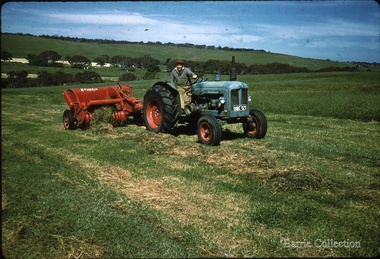
Photograph, Harvesting, 1960-1961
... family property Melton 1911. He was the brother of Ernest Wesley Bon, Charles Edgar, Thomas Lindsay. ...family property Melton 1911. He was the brother of Ernest Wesley Bon, Charles Edgar, Thomas Lindsay. ...Jim was the youngest child of Charles Ernest Ernie Barrie “Darlingsford” of the farming family property Melton 1911. He was the brother of Ernest Wesley Bon, Charles Edgar, Thomas Lindsay. The family connection with this original property remained until the last part of the E W Barrie section was sold in 1982. Jim’s parents were Charles (Ernie) and Jessie Barrie of Darlingsford Melton. Tom farmed the family property with his father and brothers, and later the Ferris Road property which continued with his son Ian. His childhood interest in horses began with the draft horses kept at the bluestone stable and barn at Darlingsford. When the stables were empty in the late 1980s visit, he vividly recalled the names of the horses he had handled in his youth. When the draft horse became obsolete with the introduction of tractors and trucks this interest continued with the breeding and training of harness racersTom Barrie's harvest and Jim Barrie at Shelfordlocal identities, agriculture -
 Eltham District Historical Society Inc
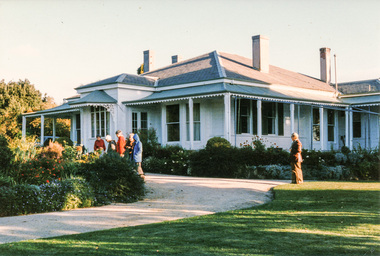
Photograph, Mulberry Hill, Golf Links Road, Baxter; Spring Excursion to The Briars and Mulberry Hill, 27 October 1991, 27/10/1991
... "Mulberry Hill" was the home of Sir Darryl Lindsay and his wife Joan. Darryl (1889-1976) was a member of the famous art family of Lindsays and was a prominent artist in his own right. ..."Mulberry Hill" was the home of Sir Darryl Lindsay and his wife Joan. Darryl (1889-1976) was a member of the famous art family of Lindsays and was a prominent artist in his own right. ...[from EDHS Newsletter No. 80, September 1991:] SPRING EXCURSION: As usual for October we have arranged a bus tour outside the local area. We will leave from the Eltham Shire Offices at 9.00 am on Sunday 27th October and travel to "The Briars" at Mornington and "Mulberry Hill" at Baxter. The cost will be $16.00 for adults and $8.00 for children. This includes admission to each of the houses and afternoon tea at "Mulberry Hill". Bring your own lunch to eat at "The Briars" and something for morning tea if you wish. "The Briars" is one of the oldest pastoral stations on the Mornington Peninsula. It has historical associations with the early settlement of the district and with Alexander Balcombe who settled in the area about 1843. Near the house is a wetland wildlife reserve with walking paths and bird observation hides. "Mulberry Hill" was the home of Sir Darryl Lindsay and his wife Joan. Darryl (1889-1976) was a member of the famous art family of Lindsays and was a prominent artist in his own right. He was also a noted art administrator, being appointed Director of the National Gallery of Victoria in 1942. Joan Lindsay (1896-1984) was an important writer. Her best known work was "Picnic at Hanging Rock". Members may find it interesting to read her autobiography "Time Without Clocks" prior to this trip. Members are welcome to bring their friends. Bookings will only be confirmed on payment. Please complete the attached form and return with payment to the September meeting or to our post office box. The trip is still some time off but there is no further Newsletter before then. Note the date in your diary how. As this will probably be the first day of daylight saving you will need to remember that in organizing yourself on the day. Please arrive at 8.45 am ready for a prompt start at 9.00 am.Two colour photographsactivities, mulberry hill, the briars -
Eltham District Historical Society Inc
Document - Folder, Mann, John and Violet and family
... A grandson of John Mann, James Mann, lived in Henry Street, Greensborough and had given a talk at the Whittlesea Historical Society in 1983 on his family. Descendant Lindsay Mann was part of a creative writing group that published a book including a short story "The Mountain Tramway" is loosely based on his childhood and stories he was told then but was planning to write his family story. ...A grandson of John Mann, James Mann, lived in Henry Street, Greensborough and had given a talk at the Whittlesea Historical Society in 1983 on his family. Descendant Lindsay Mann was part of a creative writing group that published a book including a short story "The Mountain Tramway" is loosely based on his childhood and stories he was told then but was planning to write his family story. ...John Mann arrived from Forfar, Scotland, on the clipper packet "Ellen Stuart" in 1857 and rented a farm "Overton" at Janefield. Soon after he met Melbourne-born Violet McKimmie, whose parents had a property near Darebin Creek. They married on 25 September 1862, John 26 and Violet 19. In 1874 John selected a block on Arthurs Creek and built a slab and bark hut (still standing in 1984) and called their farm "Carseburn" after John's parish in Scotland. They had seven children: John, Jane, Christine, David, Walter, James and Violet. John was drowned in the Yarra in May 1875 and Violet struggled to meet the lease commitment. She wrote to her brother-in-law David Mann in New Zealand who came to her aid, and on 10 September 1876, they married at the Victorian Free church, Smith Street, Collingwood. They improved the farm and built a three-room house. in July 1883 they bought neighbouring land from Ann Welsh. With David, Violet had four more children: Robert, William and twins Thomas and Henry. In 1883, David died and was buried in the same grave as his brother in Preston Cemetery. The twins also died, Thomas just before and Henry just after their father. the children assisted with the farm and orchard, the business including crops, a dairy herd, Carseburne sheep, and breeding horses. Violet died at Yan Yean in 1925, aged 83. A grandson of John Mann, James Mann, lived in Henry Street, Greensborough and had given a talk at the Whittlesea Historical Society in 1983 on his family. Descendant Lindsay Mann was part of a creative writing group that published a book including a short story "The Mountain Tramway" is loosely based on his childhood and stories he was told then but was planning to write his family story. Contents Newspaper article: "Tragedy couldn't stop this pioneer", Diamond Valley News, 31 January 1984, story of Mann family. Newspaper article: "Tracing the history of ordinary. people," Diamond Valley News, 29 July 1986, story of Mann family, researched by descendant Lindsay Mann who grew up at the Mann property She-Oak at Yan Yean and has numerous family records. Newspaper article: "A realist who captures light," Diamond Valley News, 29 July 1986, David Moore, a realist painter had been working from a studio at Montsalvat and his exhibition of work from that period was to open 1 August 1986 at the Victorian Artists Society Galleries.Newspaper clippings, A4 photocopies, etcjohn manan, violet mann nee mckimmie, clipper packet "ellen stuart", forfar scotland, darebin creek victoria, arthurs creek victoria, "overton" at janefield, "carseburn" at arthurs creek, jane mann, christine mann, david mann, walter mann, james mann, violet mann, victorian free church smith street collingwood, ann welsh, robert mann, william mann, thomas mann, henry mann, preston cemetery, carseburne sheep, yan yean cemetery, lindsay mann, david moore, montsalvat -
 Flagstaff Hill Maritime Museum and Village
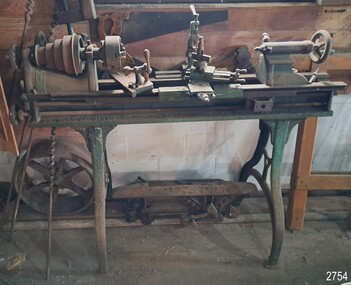
Machine - Lathe, W F & John Barnes, early 1900s
... Flagstaff Hill’s founding director, John Lindsay, recalled that Briggs Marine’s family members gave personal assistance in setting up the displays in the original village shops, particularly the ‘Brass Foundry’ building, around the time the Maritime Museum opened in 1975. ...Flagstaff Hill’s founding director, John Lindsay, recalled that Briggs Marine’s family members gave personal assistance in setting up the displays in the original village shops, particularly the ‘Brass Foundry’ building, around the time the Maritime Museum opened in 1975. ...This woodworking lathe, connected to both a pulley and a flywheel, demonstrates its historical operation with a steam engine. Such a configuration reflects manufacturing practices from the late 1800s and early 1900s, when steam power was the predominant source for driving workshop and factory machinery. Large machine shops often utilised a single power source, distributing power via roof-mounted belts and pulleys to operate several machines simultaneously. Over time, petrol-driven motors were introduced, and eventually, electricity became the standard power source. Conversion kits were made available in the late 19th and early 20th centuries to adapt older lathes to these newer, cleaner fuels. Manufacturer's History: W.F. & J. Barnes was a renowned maker of hand- and foot-powered treadle woodworking and metalworking machinery, established in 1869. The partnership between William F. Barnes and John Barnes was formalised in 1872, and the firm was incorporated in 1884. Their machines were used for both ‘farm’ applications and professional engineering. By 1881, the company began producing electrically powered machinery. By 1937, W.F. & J. Barnes expanded into manufacturing machinery for automotive assembly. The business closed in 1983, and in 1998, LeBlond Ltd. of Ohio acquired the firm. The lathe was donated by Briggs Marine, Melbourne: In Flagstaff Hill’s formative years, 1972-1975, Briggs Marine, Melbourne (Briggs Brass Foundry), donated equipment and objects used or made at their premises. The foundry was established in 1912 by Herbert Harrison Briggs. In 1965, the firm was owned by partners Cyril Briggs and Frank Lee: Cyril died in 1967, and Frank died in 1971, so the foundry was then run by his son and daughter-in-law, Les and Eva Lee. Briggs Marine’s Warrnambool Branch closed in 1972 after the death of Frank Lee in 1971. Flagstaff Hill’s founding director, John Lindsay, recalled that Briggs Marine’s family members gave personal assistance in setting up the displays in the original village shops, particularly the ‘Brass Foundry’ building, around the time the Maritime Museum opened in 1975. Briggs Marine still exists today, but the Briggs family is no longer involved. This early 1900s lathe marks a significant stage in the evolution of machinery, positioned between the era of hand-operated machines and the advent of electrically powered equipment. Its presence exemplifies the progression of industrial technology and craftsmanship during this period. The lathe is particularly notable for its association with the Briggs Brass Foundry. The foundry was known for developing a specialised brass alloy composed of non-ferrous metals, a formulation that resulted in durable products built to withstand the demanding conditions of marine environments. This focus on resilience and longevity made Briggs Brass Foundry’s goods highly sought after within the maritime sector. Briggs Maine, a long-established business, utilised the foundry’s capabilities to create cast goods tailored to the needs of the marine industry. The facility was equipped to deliver both custom-designed and mass-produced items, ensuring versatility in meeting various requirements. Many of Briggs Foundry’s products found their place on sailing and steam vessels throughout Victoria’s coastline, including in the port town of Warrnambool, where there was once a brancy of Briggs Marine. In addition to general marine fittings, Briggs Marine earned recognition for its expertise in bell-founding. The foundry’s reputation is closely linked to the restoration of the Schomberg Bell at Flagstaff Hill, a small but historically significant bell from a luxury migrant vessel dating back to the mid-19th century. The successful restoration of the Schomberg Bell demonstrates Briggs Brass Foundry’s commitment to preserving craftsmanship and maritime heritage.The lathe is a green, bench-type, steam-powered woodworking machine. Its bench is supported by decorative posts at each end, with each post dividing into arched legs. The lathe is mechanically connected to both a pulley and a flywheel, designed to be operated in conjunction with a steam engine. Included with the lathe is a range of accessories. Across the front of the machine, an inscription is cast, and a stamped, metal lathe pulley guide is attached to the drive mechanism. The lathe was manufactured by W. F. and J. Barnes, Rockford, Illinois, USA, during the 1900s.“W F and J Barnes, Rockford, USA” "1820" "1887"flagstaff hill, flagstaff hill maritime museum and village, warrnambool, maritime museum, maritime village, great ocean road, shipwreck coast, lathe, steam-operated lathe, steam-operated pulley, steam power, steam engine, machine, steam operated machine, metal work, foundry work, metal working trade, tool, pulley driven, metalworking, woodworking, barnes lathe, briggs marine, belt driven, wordworking lathe, free standing lathe, bench lathe, steam powered, vintage lathe, woodturning lathe, w. f. and j. barnes, illanois, early 20th century, briggs, briggs brass foundry, briggs marine foundry, briggs marine products, herbert harrison briggs, george edward briggs, cyril falkiner mckinnon briggs, collingwood, moorabbin, frank lee, les lee, eva lee, briggs marine warrnambool, non-ferrous founders, bell specialists, ship bell specialists, sand cast, marine equipment, marine fittings, foundry, brass foundry, founders -
 Federation University Historical Collection
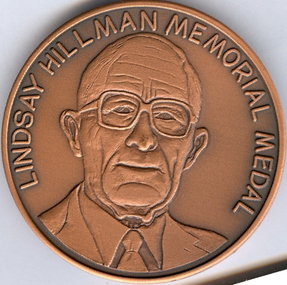
Medal, Ballarat School of Mines Hillman Award (medal), c1992
... In 1975 Lindsay Hillman was appointed to the Council of the Ballarat School of Mines and played an active role in school affairs.As Vice-President of Council from 1981 until his death in 1991 Hillman took a leading part in the implementation of many of the major building projects on the Lydiard Street Campus. The L.F.J. Hillman Award was established by the Ballarat School of Mines Council in conjunction with and through the generosity of the Hillman family...In 1975 Lindsay Hillman was appointed to the Council of the Ballarat School of Mines and played an active role in school affairs.As Vice-President of Council from 1981 until his death in 1991 Hillman took a leading part in the implementation of many of the major building projects on the Lydiard Street Campus. The L.F.J. Hillman Award was established by the Ballarat School of Mines Council in conjunction with and through the generosity of the Hillman family ...Lindsay F.J. Hillman was born in Ballarat in 1910, and attended the Ballarat Junior Technical School. He became a cadet in Electrical Engineering Laboratory at the Ballarat School of Mines where he gained eventually gained a student Teachership for diploma studies at the School. Hillman was particularly active and excelled in a wide range of sporting interests and in student activities. In 1928 and 1928 he was awarded the Ballarat School of Mines Honour blazer by the Old Boys' association for all round athletic ability, leadership and scholarship. After spending two years with the Melbourne City Council Electric Supply Department gaining industrial experience Hillman was awarded his Diploma of electrical engineering in 1931, returning to the School in 1932 to teach apprentices and senior students. Hillman was appointed lecturer in Engineering Design and Graphics in 1937, lecturer in Engineering Design and Civil Engineering in 1944, Lecturer-in-Charge of Mechanical and Civil Engineering in 1948 and Head of the Electrical Engineering Department in 1949, a position he held until his retirement in 1973. In 1975 Lindsay Hillman was appointed to the Council of the Ballarat School of Mines and played an active role in school affairs.As Vice-President of Council from 1981 until his death in 1991 Hillman took a leading part in the implementation of many of the major building projects on the Lydiard Street Campus. The L.F.J. Hillman Award was established by the Ballarat School of Mines Council in conjunction with and through the generosity of the Hillman family in honour of the late Lindsay Frederick John Hillman. The bronze medal was presented annually to an enrolled student in an accredited course in the field of electrical/electronics studies at the Ballarat School of Mines. specific Criteria for the Award consisted of a balance of academic performance, leadership qualities, commitment to further study and involvement in sporting and/or community groups. Bronze medal designed depicting the portrait of Lindsay Hillman. The medal has a copper finish, and is presented in a blue hinged box. The first Hillman Award was presented in 1992. The recipients are: 1992 - Brett A. Hovey 1993 - Nil 1994 - Brent L. Ferguson 1995 - Kirsty McKenzie 1996 - Peter J. White 2000 - Roger Bush 2001 - Thomas Edward George 2002 - Mark William Holden 2003 - David James Hopwood 2004 - Leighton Dunn 2005 - Donald Pirouet 2006 - Mark Irvin 2007 - Ricky Wilson 2008 - Luther Dean 2009 - Daniel Thatcher 2010 - Craig Coulter 2011 - Sarah Draper 2012 - Rhys Hendrickson 2013 - Jayden Hooper "Lindsay Hillman Memorial Medal" Verso: "The School of Mines and Industries Ballarat, Est. 1870 Presented to "ballarat school of mines, hillman, lindsay hillman, medal, numismatics, honour blazer, electrical engineering, electronics, hillman medal, hillman award -
 Federation University Historical Collection
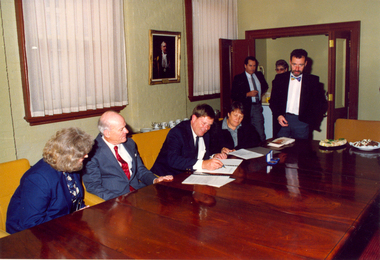
Photographs - Colour, Hillman Award Agreement and Presentation, 1991, 1991
... In 1975 Lindsay Hillman was appointed to the Council of the Ballarat School of Mines and played an active role in school affairs.As Vice-President of Council from 1981 until his death in 1991 Hillman took a leading part in the implementation of many of the major building projects on the Lydiard Street Campus. The L.F.J. Hillman Award was established by the Ballarat School of Mines Council in conjunction with and through the generosity of the Hillman family...In 1975 Lindsay Hillman was appointed to the Council of the Ballarat School of Mines and played an active role in school affairs.As Vice-President of Council from 1981 until his death in 1991 Hillman took a leading part in the implementation of many of the major building projects on the Lydiard Street Campus. The L.F.J. Hillman Award was established by the Ballarat School of Mines Council in conjunction with and through the generosity of the Hillman family ...Lindsay F.J. Hillman was born in Ballarat, and attended the Ballarat Junior Technical School. He became a cadet in Electrical Engineering Laboratory at the Ballarat School of Mines where he gained eventually gained a student Teachership for diploma studies at the School. Hillman was particularly active and excelled in a wide range of sporting interests and in student activities. In 1928 and 1928 he was awarded the Ballarat School of Mines Honour blazer by the Old Boys' association for all round athletic ability, leadership and scholarship. After spending two years with the Melbourne City Council Electric Supply Department gaining industrial experience Hillman was awarded his Diploma of electrical engineering in 1931, returning to the School in 1932 to teach apprentices and senior students. Hillman was appointed lecturer in Engineering Design and Graphics in 1937, lecturer in Engineering Design and Civil Engineering in 1944, Lecturer-in-Charge of Mechanical and Civil Engineering in 1948 and Head of the Electrical Engineering Department in 1949, a position he held until his retirement in 1973. In 1975 Lindsay Hillman was appointed to the Council of the Ballarat School of Mines and played an active role in school affairs.As Vice-President of Council from 1981 until his death in 1991 Hillman took a leading part in the implementation of many of the major building projects on the Lydiard Street Campus. The L.F.J. Hillman Award was established by the Ballarat School of Mines Council in conjunction with and through the generosity of the Hillman family in honour of the late Lindsay Frederick John Hillman. The bronze medal was presented annually to an enrolled student in an accredited course in the field of electrical/electronics studies at the Ballarat School of Mines. specific Criteria for the Award consisted of a balance of academic performance, leadership qualities, commitment to further study and involvement in sporting and/or community groups. The first Hillman Award was presented in 1991. The recipients are: 1991: Paul Donald 1992 - Brett A. Hovey 1994 - Brent L. Ferguson 1995 - Kirsty McKenzie 1996 - Peter J. WhiteEighteen colour photographs of the signing of the Hillman award agreement and the first presentation of the award in 1991 to Paul Donald . .2) Gregor Hillman, Judith Tinney and Caroline Bethune .4) Judith Tinney or Caroline Bethune and Bill Gribble sign the agreement .8) Gregor Hillman, Judith Tinney and Caroline Bethune sign the agreement, along with President of the Ballarat School of Mines, Bill Gribble. .10) Paul Donald with his L.F.J. Hillman Award, 1991 .11) Ballarat School of Mines Principal, Peter Shiells, speaks at the lectern watched on by members of the Hillman family.ballarat school of mines, hillman, lindsay hillman, medal, numismatics, electrical engineering, electronics, gregor hillman. judith tinney, caroline bethune, tinney, bethune, hovey, ferguson, mckenzie, white, paul donald, donald
