
Showing 99 items matching "little flower"
-
 Ballaarat Mechanics' Institute (BMI Ballarat)
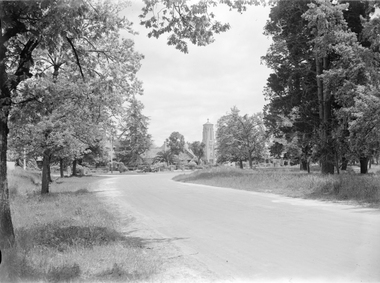
Wendouree Pde looking toward Church of the little flower
... Wendouree Pde looking toward Church of the little flower......little flower...Ballarat Wendouree Pde Church little flower Wendouree Pde looking toward Church of the little flower ...This photograph is from the Max Harris Collection held by the Ballaraat Mechanics' Institute. Please contact BMI for all print and usage inquiries.ballarat, wendouree pde, church, little flower -
 Bendigo Historical Society Inc.
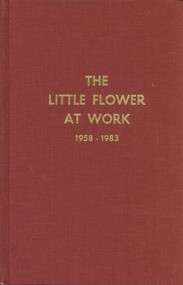
Book - THE LITTLE FLOWER AT WORK 1958 - 1983, 1983
... THE LITTLE FLOWER AT WORK 1958 - 1983...The Little Flower at work 1958 - 1983. A History of St. ...Keith House The Little Flower at work 1958 - 1983. A History of St. ...The Little Flower at work 1958 - 1983. A History of St. Therese's Parish Kennington. 128 pages with photographs, illustrations. Prepared for Monsignor Francis Owens, Parish Priest.Keith Housecottage, miners, bendigo, churches, st. therese's, catholic. keith house, monsignor f. owens. priest, parish. -
 Ballaarat Mechanics' Institute (BMI Ballarat)
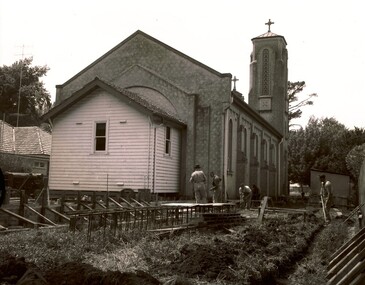
Church Unknown possibly Little Flower
... Church Unknown possibly Little Flower...1960s ballarat church unknown Church Unknown possibly Little Flower ...1960s, ballarat, church, unknown -
 Bendigo Historical Society Inc.
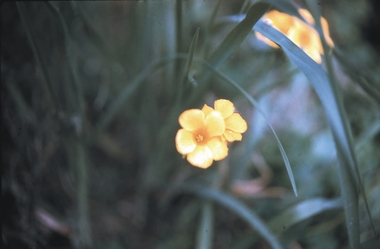
Slide - GARDEN (FLOWERS) 12 HOPE STREET, Nov 1960
... Slide, Garden (Flowers) 12 Hope Street.A little yellow flower....Slide, Garden (Flowers) 12 Hope Street.A little yellow flower. Slide GARDEN (FLOWERS) 12 HOPE STREET. ...Slide, Garden (Flowers) 12 Hope Street.A little yellow flower.slide, bendigo, garden (flowers) 12 hope street., garden (flowers) 12 hope street. -
 Lakes Entrance Historical Society
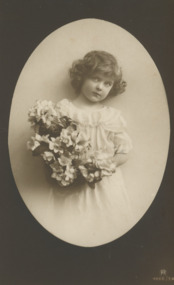
Postcard - Charles Sands to Dorothy Davidson - WW1 AIF Correspondence c1916, R4666/3A right corner
... Black and white photograph of little girl holding flowers, image in oval frame dark background on postcard France...I will say goodbye now little Dorothy with best wishes from Charlie World War 1914-1918 Communications Black and white photograph of little girl holding flowers, image in oval frame dark background on postcard France Postcard Charles Sands to Dorothy Davidson - WW1 AIF Correspondence c1916 R4666/3A right corner ...Sent from France by Charles Sands June 17/17 Dear Little Dorothy I suppose you have been wondering if I am ever going to write to you wee little Dorothy. I was so pleaseed to get the pretty card that you sent me it made me long to be back with you again and I think I will some day. I am pleased you have a lady school teacher. I will say goodbye now little Dorothy with best wishes from CharlieBlack and white photograph of little girl holding flowers, image in oval frame dark background on postcard Franceworld war 1914-1918, communications -
 Ballarat Tramway Museum
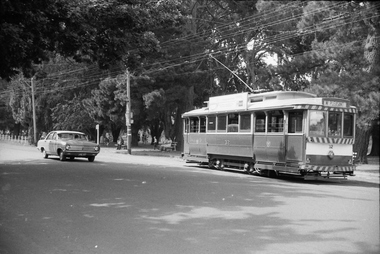
Negative - Set of 5, Campbell Duncan, 28/02/1971 12:00:00 AM
... Tram has Bliss Bombs (To read pack: Tilt Tram") and SEC electric cooking roof advertisement .3 - ditto in Wendouree Parade. .4 - 31 at ditto, with the gates of the St Therese of the Little Flower catholic church in the foreground. .5 - 32 in the Gardens area with the destination of Mt. ...Tram has Bliss Bombs (To read pack: Tilt Tram") and SEC electric cooking roof advertisement .3 - ditto in Wendouree Parade. .4 - 31 at ditto, with the gates of the St Therese of the Little Flower catholic church in the foreground. .5 - 32 in the Gardens area with the destination of Mt. ...Yields information about tram operations in Wendouree Parade and the Carlton St area in early 1971.Set of 5 photographs taken on 28/2/1971 by Campbell Duncan of trams in Wendouree Parade. .1 - 32 leaving Gardens Loop .2 - 28 near Carlton St with the Lake in the background. Tram has Bliss Bombs (To read pack: Tilt Tram") and SEC electric cooking roof advertisement .3 - ditto in Wendouree Parade. .4 - 31 at ditto, with the gates of the St Therese of the Little Flower catholic church in the foreground. .5 - 32 in the Gardens area with the destination of Mt. Pleasant.trams, tramways, wendouree parade, gardens loop, carlton st, tram 32 tram 28 tram 31 -
 Ballarat Tramway Museum
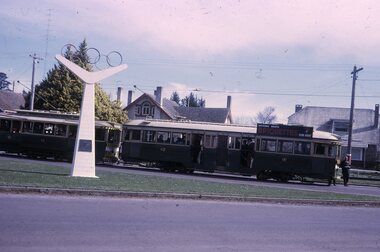
Slide - 35mm slide/s - set of 2, Peter Moses, 21/08/1971 12:00:00 AM
... No. 42 has a SEC briquette roof advertisement. .2 - 42 ditto with the St Therese of the Little Flower catholic church in the background. ...No. 42 has a SEC briquette roof advertisement. .2 - 42 ditto with the St Therese of the Little Flower catholic church in the background. ...Photo of SEC Ballarat trams No. 42 and 11 during a photo stop in Wendouree Parade adjacent to the 1956 Olympic rings monument during the ARHS/TMSV tours prior to closure of the Ballarat Tramway system. .1 - 42 and 11 with monument in the foreground. No. 42 has a SEC briquette roof advertisement. .2 - 42 ditto with the St Therese of the Little Flower catholic church in the background. Kodak cardboard mount slide, taken by Peter Moses 21 August 1971.On the rear of the slides in black ink .1 - "N42, N11 / Ballarat/ Hamilton Ave." and "P. Moses" in the bottom left hand corner. .2 - "Ballarat / ARHS Special Hamilton Ave" and "P. Moses" in the bottom left hand corner.tramways, trams, wendouree parade, tram tour, olympics, tram 42, tram 11 -
 Bendigo Historical Society Inc.
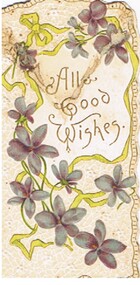
Document - MALONE COLLECTION: GREETING CARDS
... Behind the flowers & ribbon is a raised crazed pattern in white with some scattered little white flowers. ...Behind the flowers & ribbon is a raised crazed pattern in white with some scattered little white flowers. ...Small shaped whitish card with gold border. Purple flowers and green ribbon on the front. Behind the flowers & ribbon is a raised crazed pattern in white with some scattered little white flowers. Near the top in a plain area is printed in gold: 'All Good Wishes'. Inside is a verse by Charlotte Murray.person, greeting cards, malone collection, malone collection, greeting cards, charlotte murray -
 Tatura Irrigation & Wartime Camps Museum
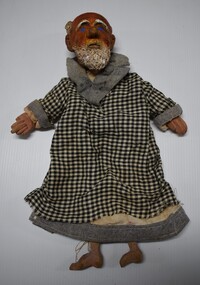
Puppet, The Scribe, WW2
... Wearing a long black and white dress with a grey collar and cuffs over a cream with little red flower skirt which is trimmed in grey. ...Wearing a long black and white dress with a grey collar and cuffs over a cream with little red flower skirt which is trimmed in grey. ...The puppets were made by German POW's in camp 13 and sent to internment camp 3 as gifts for the children at Christmas time.Hand painted orange paper mache head with goatie beard, blue eyes and white eyebrows. Wearing a long black and white dress with a grey collar and cuffs over a cream with little red flower skirt which is trimmed in grey. Legs are cream material with wooden feet. Hands are wood. Hair is white with bald head.pow puppets, pow handcrafts, hand puppets, sharon lohe, ww2 camp puppet theatre -
 Bendigo Historical Society Inc.
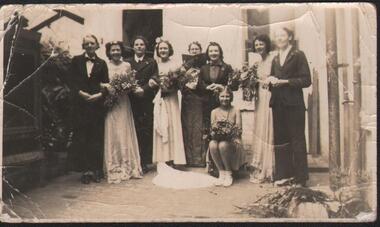
Photograph - HANRO COLLECTION: PHOTOGRAPH OF GROUP OF LADIES AT KITCHEN TEA, 16/09/39
... flowers and the men are in suits. * On the back the names hand written in black ink are: *Joyce Martin, Elsie Boyd, Isobel Thompson, Margaret Shepheard, Elaine Horne, Vi Morgan, Joyce Davidson, Phyliss Brerton. Little...flowers and the men are in suits. * On the back the names hand written in black ink are: *Joyce Martin, Elsie Boyd, Isobel Thompson, Margaret Shepheard, Elaine Horne, Vi Morgan, Joyce Davidson, Phyliss Brerton. Little ...BHS CollectionPhotograph of a group of ladies: The black and white photo is of a group of ladies in fancy wedding dress for her kitchen tea. Dressed up as a wedding party with the bride groom, marriage celebrant, flower girl, brides maids and groomsman. Nine people in the photo. The wedding party are carrying flowers, the bride has a vale with flowers and the men are in suits. * On the back the names hand written in black ink are: *Joyce Martin, Elsie Boyd, Isobel Thompson, Margaret Shepheard, Elaine Horne, Vi Morgan, Joyce Davidson, Phyliss Brerton. Little Nellie flower girl. The date 16/09/39. Hand written in blue ink *At Alma Pemb's Kitchen Tea. Estelle Dole, 1 Farrell St., Bendigo* Box 116Aphotograph, person, female, bendigo. estelle dole -
 Bendigo Historical Society Inc.
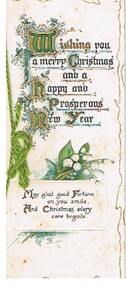
Document - MALONE COLLECTION: GREETING CARDS
... There are little sprays of flowers. Underneath is a spray of small white flowers and some small blue ones and blue shading. ...There are little sprays of flowers. Underneath is a spray of small white flowers and some small blue ones and blue shading. ...Document. Malone Collection. Small white card with an irregular fine line gold border. At the top is: Wishing you a merry Christmas and a Happy and Prosperous New Year. Two fine lines underline the words. The capital letter are decorated in gold and blue shading. There are little sprays of flowers. Underneath is a spray of small white flowers and some small blue ones and blue shading. In front is a embossed rectangle with: May glad good Fortune on you smile, And Christmas, every care beguile. The capital letters are printed in gold with black edging. On the insert is a sketch in blue and black of a yacht with a gold & black irregular border. Card and insert held together with a bright green cord.Raphael Tuck & Sons Ltdperson, greeting cards, malone collection, malone collection, greeting cards -
 Melton City Libraries
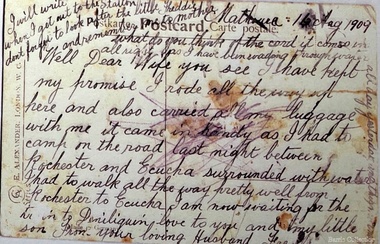
Postcard, Postcards from Fred and Mattie Myers, 1909-1914
... little. We are going to start Cobran via Deniliquin. Post Card: three scenes of Mathoura 10/9/1914 EB on a photo copy 10/9/12 ? Mathoura Thursday Dear Mattie, Just a line to let you know I got up here all right. I rode the seat out of my trousers. I have done 100 miles on the bike. I met none of the old hands this time so will go out on my own… Your loving husband Fred, did Marjie miss me at all. Post Card: Cobran 15th Sept 1912 Hearts and intertwined flowers...little. We are going to start Cobran via Deniliquin. Post Card: three scenes of Mathoura 10/9/1914 EB on a photo copy 10/9/12 ? Mathoura Thursday Dear Mattie, Just a line to let you know I got up here all right. I rode the seat out of my trousers. I have done 100 miles on the bike. I met none of the old hands this time so will go out on my own… Your loving husband Fred, did Marjie miss me at all. Post Card: Cobran 15th Sept 1912 Hearts and intertwined flowers ...Post Card: Melton Railway Station 1909 Mattie to Fred My Dear Fred I received your letter and the L2 10/- I was very pleased to hear that I could write again. You say you will come home after the last shead. I should think so. I had a letter from E Jenkins so I am going down to see her next week we call the baby Fernie now I hope you will agree. Dear Fern has got the whooping cough. Written on the side: I suppose you will be away four weeks yet. Love from Mattie will write on Sunday. This letter appears to be connected with the post card Barwonleigh Saturday October 1908 handwriting My Dear Mattie I received your letter and was sorry to hear of our dear little babys misfortune how did it happen do you know what was the cause of it Mrs Watts must be a blind old fool not to have known what it was when you took him to her the first time poor dear you must be worried to death with all this trouble tell me what the doctor thinks of the rupture. I do hope dear he will get over this all right you must be nearly dead going without sleep for so long I had a bit of misfortune myself on Thursday the machine locked and jumped out of my hand and stuck in my bone I kept on working but it was very painful as all the holding is done with the..next page ..knee the boss also has been chipping a good deal this week he says the next time he has occasion to speak to me I will have to go he is very particular. I would like to go through if possible even if I do a lot less. I have about sixteen hundred done up to now and would get another nine hundred if I was let alone but I suppose we will live lovie even if I go do you know if they are full handed at Eynesbury if I thought I could get a week there I would cut myself out here quick. Well dear lovie I am sending you a couple of pounds as I suppose you will want it to get a truss. I don’t think they are very expensive and hope things will find this better with you. Well my dear love I must close with fond love for you and baby from your loving Husband Fred Post Card: 16 Aug 1909 - Mathoura The card depicts a small sailing boat laden with blue flowers. Well Dear Wife you see I have kept my promise. I rode all the way up here and also carried all my luggage with me it came in handy as I had to camp on the road last night between Rochester and Echuca surrounded by water. I had to walk all the way pretty well from Rochester to Echuca. I am now waiting for the train to Deniliquin. Love to you and my little son Fred. From you loving Husband Fred Written along the top and side of the card. what do you think if the card comes in all right as I have been wading through water all day yesterday and this might be …? will write when I get to the Station, don’t forget to look after the little Freddie and remember me to mother. Post Card: 1909 - view across the Flat from the Creek looking to the Presbyterian Church in the distance with some small dwellings in the foreground. To Mr Fred Myers Wandook Stn Denniliquin NSW Dear Fred, received your letter I am sorry to hear you are having such wet weather I will write a letter tomorrow baby is better With Love from M Post Card: 1910 Postmark Stamp 1d Aug 12 1910 Moama NSW Melton postmark stamped Aug 25? Hare Street, looking south Echuca Mrs F Myers, Melton P O Vic Dear Mattie, Just a line to let you know I got here all right I go to Pericotta tonight and to Cobran to morrow best love to all from yours Fred Letter Cobran Stn Via Deniliquin N.S.W. Sunday 21st Aug extract I am having a good time here, a good cook and the best of everything no fires to light or kettles to boil just get up and wire in… plenty hard work the sheep are pretty tough but much better than Wandook. I am well among them here we had a little rain on Friday but not enough to stop us so we have got one full week in .. the weather is lovely. I have been basking in the sunshine mainly in the morning and feel strong and fit a as fiddle, they are a grand lot of men here I only knew one out of the lots but know them all pretty well now, we have a bit of a concert here every nights almost there are a few good singers here and we also had a phonograph up from the station with all the latest records we have two dancers among ourselves very boisterous affairs indeed thy do make the dust fly. I have not ventured to take part in it and don’t think I will either. I get enough dancing all day long and besides I have to furnish the music you ought to see them going when I rattle up the concertina. Letter Cobran Stn via Deniliquin Thursday Sept 1st 1910 [abbreviated] My Dear Mattie, I received your welcome letter today. I though I was never going to get one as it was Sunday fortnight when I wrote to you but we only the mail here twice a week so it takes a long time to write and get an answer. I also got a reply from Eynesbury and a favourable reply it starts on the 13th Oct. …. I have 800 sheep shorn up to date and am fifth among about 30 men. I am sending two more [Ls] this time which I drew on Saturday. I don’t like sending too much more this time as there is a chance of it going astray and it is not very easily earned…. Things must be humming in Melton with all them babies coming and people getting married… I suppose we will be having new neighbours soon. If Mr Watts is selling out he was getting more property then he could keep. I hope you will soon have rain…. you will have to watch our little boy the dear little rascal he must be getting very cute opening the gates he will be tumbling into the tank …. I love to think of the happy times we have had together and hope that we will love one another to the end .. the mail will not leave here until Monday Love to you dear wife and baby Fred Post Card: – I Cling to you like Ivy Cobran September 18th 1910 Fred awaits a letter from Mattie I still have three weeks here yet.. I am sending L2 tell if you got the other 1L 1911 Letters Fred to Mattie October Spring Plains Oct 1911 Mia Mia Post Office I had a great job to catch the train at Diggers Rest as after I turned off the Keilor Rd it was very way and muddy and I had to walk a lot of the way and got there just in time. I came right into Redesdale by the train and stopped there last night… they had heavy rain on thursday up here and a tremendous fall of hail which covered the ground over a foot deep. There are only 4 shearers here yet.. I saw some of the sheep they look very rough and big so there will be no big tallies done, the men are saying he is giving 2s per hundred extra, so that will help a little. We are going to start Cobran via Deniliquin. Post Card: three scenes of Mathoura 10/9/1914 EB on a photo copy 10/9/12 ? Mathoura Thursday Dear Mattie, Just a line to let you know I got up here all right. I rode the seat out of my trousers. I have done 100 miles on the bike. I met none of the old hands this time so will go out on my own… Your loving husband Fred, did Marjie miss me at all. Post Card: Cobran 15th Sept 1912 Hearts and intertwined flowers and little envelope he has written Marjorie …just a line to let you know I will cut out here Friday next in find, we have had two falls of rain since I wrote and it has bean blowing a hurricane for couple of days and may blow up again however if we are delayed I will send you a card Wednesday I am longing to see you and the two little kiddies again…. Fred Copy only Golf Hill Sep 26th Cut out 31 Oct Total 2332 1913 Post Card: Scene View Street, Bendigo August 1913 Mathoura Tuesday My Dear Mattie Just a line to let you know I got up here all right. Teddy Ginger and another couple of chaps on the way ……. Letter Cobran Sunday Aug 7th 1913 My Dear Mattie Just a line to let you know that weather permitting we will cut out here about Thursday morning….I have not got any more shearing here. I have not heard from the other place…. Expect me about Friday …. I suppose Freddie and Marjie will be glad to see me, Marjie will climb all over me. I will be glad to se you all again you will have a fortnight before Golf Hill starts. I see in the Express you sent that Annie McPherson of (Dunvegan) is engaged to Len Farrell, she appears to be going to take no risks with him she wont let him slip through her hands like the banker did…… Fred Post Card: 1914 Garland of roses Warrambeen Stn Shelford PO October 14th 1914 Birthday wishes. Post Card: Love’s Golden Chain Golf Hill Tuesday Oct 17 1914 Birthday wishes [ this one might be a different year] Letter Cobran Wed 2nd Sept 1914 My Dear Mattie, I received your welcome letter today and also the papers which were very acceptable as we don’t get many papers here we only get see one at odd times as we get none for the hut this year.. I have not seen a bit of butter since I left home as it is too dear for us for sinners here. Poor Marjie had a cold.. so the little kid wants to go to the war, she must think it is good like a picnic. We had light rain on Monday as usual only half a day’s shearing in the shed so that is all we done this week, we took a vote 9 to 6 no shearing so nothing till to morrow morning Thursday so there is still a good fortnights shearing to do, will do nothing Saturday polling day as we have to go 13 miles is near Services where I was last year so we will want the full day 50 men to vote and some will probably have to walk to get there, all solid for Labour. I have just had an interval for lunch, pudding, yeast buns and rock cakes… We are doing nothing but eating and sleeping this week. Fred I am sending L1 in this which will do you till I come back if I keep drawing up I will have none when I finish so make the most of it. Post Card: Two doves with violets 1915 Cobran Wed 18th Sept [could be 1912] Sorry to tell you we are delayed with rain so will not be home till next week… only 3 days of shearing to do…. expect me about the middle of next week….I wish I was with you now and the dear little ones Fred Post Card: Iris Flowers Barwonleigh Stn Tuesday Oct 14th 1918 Happy birthday greetings from Fred Post Card: Irrigation channel Swan Hill 5 Year not shown Swan Hill Tuesday night Just a few lines to let you know I got this far all right. I had to walk nearly all the way to Gisborne and got there last night and took the train here today. It has been raining all the way between Gisborne and here. Moulamein tomorrow. I think it will be another case of walking as it is wet here no metal roads all mud. best love to yourself and the little ones and also mother. will write Sunday Post Card: The White Man’s Burden.The writing on the back rubbed out Mattie has written, I was weighed and I am 8 stone 10 pounds. 14 Post Cards, some have the original dates, others have the date added later by Martha. Two envelopes, one with addressed to Melton postmark Moule, stamp torn off, the other Cards from my dear Fred. The letters and the notebooks can be cross checked according the their contents. Italics show the dates added by Mattie local identities -
 The Beechworth Burke Museum
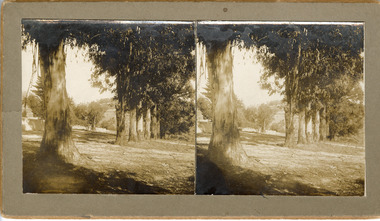
Photograph - Stereoscopic Photograph
... flower gardens. Patients could enjoy the view from a rotunda. The section photographed was known as 'Little Canada', and an isolation ward was added there in 1890. ...flower gardens. Patients could enjoy the view from a rotunda. The section photographed was known as 'Little Canada', and an isolation ward was added there in 1890. ...This stereoscopic photograph depicts the grounds and mature trees of the Former Ovens District Hospital. Started in 1857, it was Beechworth's first hospital and the only hospital between Melbourne and New South Wales. It was a philanthropic institution catering to the poor. In 1874, the sweeping gardens were laid out by Dr. Jenkyns and featured over 200 species of trees including fruit trees, shrubs and vegetable and flower gardens. Patients could enjoy the view from a rotunda. The section photographed was known as 'Little Canada', and an isolation ward was added there in 1890. Since the hospital's closure in 1940, only the front facade and gardens remain. The gardens are now known as Centennial Park and retain many of the original mature trees.This stereoscopic photograph has aesthetic significance as it beautifully captures the sanitorium-like restorative atmosphere of the hospital gardens. It also has historical significance as it depicts the grounds of the Ovens District Hospital and the nature of hospital gardens in the nineteenth and early twentieth century.Sepia square stereoscopic photograph printed on matte photographic paper mounted on card.Reverse: 1997.2687/A02687/Trees in Hospital Grounds/(Little Canada)/Beechworth Note: Trees in the O+D hospital grounds/(Little Canada)/A02687/1997.2687former ovens district hospital, ovens district hospital, little canada, hospital garden, jenkyns, centennial park -
 Mission to Seafarers Victoria
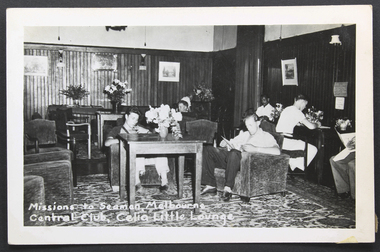
Postcard - Postcard, Black and white, KODAK, The Mission to Seamen, Melbourne - Central Hall, Celia Little Lounge, c. 1950
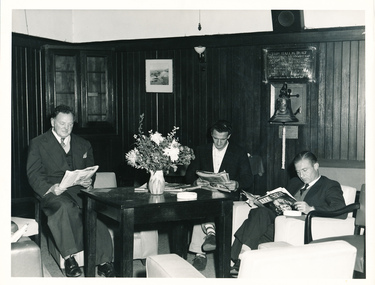
... Black and white gloss postcard depicts the Celia Little room furnished with several chairs, tables with flowers, and five seamen or club members sitting reading or writing....Stamp location is top right and is indicated by the word 'KODAK' on four sides Black and white gloss postcard depicts the Celia Little room furnished with several chairs, tables with flowers, and five seamen or club members sitting reading or writing. ...One of a series of Mission to Seamen postcards produced in the immediate post-war and post WW2 period. The other reason for creation could be the 1956 MTS centenary celebrations. The photograph was take before 1957 as the bell from the SS Morton Bay is not on the wall yet.Visual record of the club area of Mission to Seafarers, 717 Flinders Street, Melbourne mid 20th C.Black and white gloss postcard depicts the Celia Little room furnished with several chairs, tables with flowers, and five seamen or club members sitting reading or writing.Printed on back: 'POST CARD/CORRESPONDENCE ADDRESS ONLY/' . Stamp location is top right and is indicated by the word 'KODAK' on four sidesclub, celia little room, sailors, literature, armchairs, flowers, artworks, magazines, reading, seamen, mission to seamen, mission to seafarers, seamen's mission -
 Mission to Seafarers Victoria
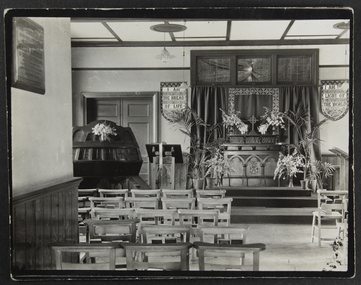
Photograph - Photograph (2 copies), Easter Sunday in Siddeley Street chapel, c.1913
... Little" room at the Flinders Street Mission. In the "Jottings from our log" number 30, dated from Easter 1913, it is written: "Miss Tracy kindly did The Easter decorations with white flowers and palms in pots, all in beautiful keeping with the glad thoughts of Easter." ...Little" room at the Flinders Street Mission. In the "Jottings from our log" number 30, dated from Easter 1913, it is written: "Miss Tracy kindly did The Easter decorations with white flowers and palms in pots, all in beautiful keeping with the glad thoughts of Easter." ...The photograph depicts the interior of the chapel located on the east wing of the Siddeley Street Mission.The chapel is decorated for Easter service. The altar, the pulpit were reused in the St Peter's chapel of the Flinders Street Mission. On the wall hangs the plaque erected to Celia Little, another plaque in memory of Celia Little is now in the "Celia Little" room at the Flinders Street Mission. In the "Jottings from our log" number 30, dated from Easter 1913, it is written: "Miss Tracy kindly did The Easter decorations with white flowers and palms in pots, all in beautiful keeping with the glad thoughts of Easter." Maybe the picture was taken on that occasion.The chapel was built in 1909. Celia Little (1822-1895), was the Reverend Alfred Gurney Goldsmith's aunt. Some funds from her estate were used to build the chapel. Small monochrome photograph, inside chapel, Siddeley Street Institute, decorated with white flowers and palms.'Stevedore's Bldg Siddeley St Easter Sunday in the Chapel old Institute' siddeley street institute, chapel, easter, pulpit, reverend w.f. haire, celia little, plaque, alfred gurney goldsmith -
 Mission to Seafarers Victoria
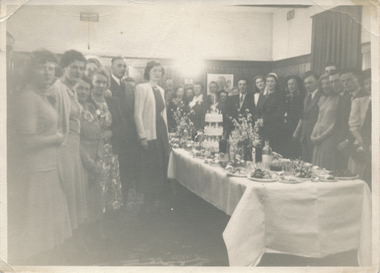
Photograph, c.13 August 1948
... She was also a ember of the Harbour Lights Guild. celia little room beverley oliver frank leslie oliver 1897-1986 21st birthday birthday cake flowers Photograph Photograph ...Padre Oliver settled in the Mission with his family in 1930. His daughter, Beverley, born 13 August 1927, lived with them in the Mission for many years, was married and her children were baptised in the St Peter Chapel. She was also a ember of the Harbour Lights Guild. celia little room, beverley oliver, frank leslie oliver 1897-1986, 21st birthday, birthday cake, flowers -
 The Beechworth Burke Museum
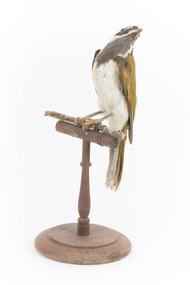
Animal specimen - Blue-faced Honeyeater, Trustees of the Australian Museum, 1860-1880
... flowers of the banana in northern Queensland, this species is colloquially known as the "Bananabird". These birds commonly reside in pairs, family groups or small flocks. They can often be found socialising with other species including the yellow-throated miner and the Little Friarbird. ...flowers of the banana in northern Queensland, this species is colloquially known as the "Bananabird". These birds commonly reside in pairs, family groups or small flocks. They can often be found socialising with other species including the yellow-throated miner and the Little Friarbird. ...The Blue-faced Honeyeater is commonly located in northern and eastern mainland Australia. It is also found in Papua New Guinea. This species prefer to reside in tropical locations or those which are sub-tropical and wetter temperate or semi-arid zones. It can be located in open forests and woodlands close to water. Due to these locations along with it's propensity for feeding on the fruit and flowers of the banana in northern Queensland, this species is colloquially known as the "Bananabird". These birds commonly reside in pairs, family groups or small flocks. They can often be found socialising with other species including the yellow-throated miner and the Little Friarbird. The Blue-faced Honeyeater feed on insects and invertebrates, but also may eat nectar and fruit from native and exotic plants. This specimen is part of a collection of almost 200 animal specimens that were originally acquired as skins from various institutions across Australia, including the Australian Museum in Sydney and the National Museum of Victoria (known as Museums Victoria since 1983), as well as individuals such as amateur anthropologist Reynell Eveleigh Johns between 1860-1880. These skins were then mounted by members of the Burke Museum Committee and put-on display in the formal space of the Museum’s original exhibition hall where they continue to be on display. This display of taxidermy mounts initially served to instruct visitors to the Burke Museum of the natural world around them, today it serves as an insight into the collecting habits of the 19th century.This specimen is part of a significant and rare taxidermy mount collection in the Burke Museum. This collection is scientifically and culturally important for reminding us of how science continues to shape our understanding of the modern world. They demonstrate a capacity to hold evidence of how Australia’s fauna history existed in the past and are potentially important for future environmental research. This collection continues to be on display in the Museum and has become a key part to interpreting the collecting habits of the 19th century.The blue-faced Honeyeater is large in size with bright white and black colouring. The bird also has golden olive-green colouring on it's rear, tail and wings. Around the eyes is strikingly blue coloured skin which has faded significantly on this particular specimen. It also has a pair of glass eyes to replace the original which do not survive the taxidermy process. There is a patch of dark colouring on the plumage of the stomach and neck of the bird. This dark batch is surrounded by white plumage which also forms a white band across the back of the neck. This specimen is stylized placed on a wooden mount. The bird's feet are attached to a thin stick and the stick attached to the mount.taxidermy mount, taxidermy, animalia, burke museum, beechworth, australian museum, skin, reynell eveleigh johns, honeyeater, blue-faced honeyeater -
 Orbost & District Historical Society
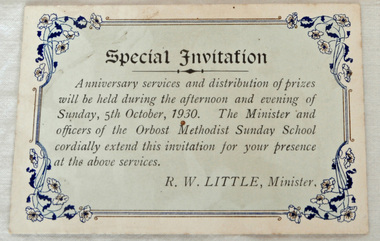
invitation, 1930
... little room at the back of the church or in Locksley House (near the state school). Sunday School at that time involved a lot of commitment on the part of the teachers towards the children and this was reflected in the efforts they went to to make Sunday School an interesting and enjoyable event. The Sunday School Anniversaries were always a big community event and children usually dressed up for the occasion. The children spent weeks practising hymns and choruses for the occasion and on the Saturday before picked armfuls of flowers...little room at the back of the church or in Locksley House (near the state school). Sunday School at that time involved a lot of commitment on the part of the teachers towards the children and this was reflected in the efforts they went to to make Sunday School an interesting and enjoyable event. The Sunday School Anniversaries were always a big community event and children usually dressed up for the occasion. The children spent weeks practising hymns and choruses for the occasion and on the Saturday before picked armfuls of flowers ...The Orbost Methodist Church began services in April 1910, the Rev. E. Hooper as the first minister. Reverend R.W. Little was minister in 1930-31.Ministers at that time batched either in a little room at the back of the church or in Locksley House (near the state school). Sunday School at that time involved a lot of commitment on the part of the teachers towards the children and this was reflected in the efforts they went to to make Sunday School an interesting and enjoyable event. The Sunday School Anniversaries were always a big community event and children usually dressed up for the occasion. The children spent weeks practising hymns and choruses for the occasion and on the Saturday before picked armfuls of flowers from Mrs Hocking's garden ( may blossoms) to decorate the church hall. (ref. Pioneers and Pilgrims Revd Peter Gador-White).For many years the Methodist people of Orbost enjoyed the fellowship of the church and the children, in particular, were socially and spiritually involved. This item is reminiscent of that time.A rectangular cardboard invitation to a service and prize-giving at the Orbost Methodist Sunday School. The print is black on a pale blue background with a black frame and floral decorations in each cornerSpecial Invitation R.W. Little, Ministerorbost-methodist-church sunday-school -
 Ringwood and District Historical Society
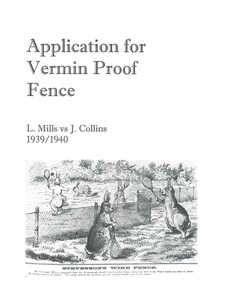
Document - Department of Lands and Survey, Wire Netting Branch, Melbourne, Victoria, Application for Vermin-Proof Fence Certificate - L.J. Mills vs John Collins, Grandview Grove, Ringwood, Victoria - 1939
... flowers. He showed me a bed of carnations which he stated were being damaged by rabbits. There was evidence of some leaves being nipped off, but I am unable to say whether this is due to rabbits or grubs. Very little...flowers. He showed me a bed of carnations which he stated were being damaged by rabbits. There was evidence of some leaves being nipped off, but I am unable to say whether this is due to rabbits or grubs. Very little ...Photocopied file of corresponence and documentation relating to a claim by L.J. Mills, Nurseryman, that adjoining property owner, J. Collins, Farmer, assists with replacement of a vermin proof wire netting dividing fence destroyed by 1939 bushfire. File includes 1939 and 1940 detailed property inspection reports by Vermin and Noxious Weeds Branch, Lands Department, Lilydale, describing land use in the area and signs of vermin activity. Application approved 18th April, 1940. Appeal lodged by Mr Collins disallowed in May, 1940. File closed June, 1940 with Departmental suggesion that Mr Mills consider further legal action through a Solicitor as fence had still not been wire-netted. TRANSCRIPTS: Vermin & Noxious Weeds Inspection Reports "19/9/1939 (To) Superintendent (Department of Lands and Survey, Melbourne) Re L.J. Mills application for Vermin Proof Fence. I called on Mr Mills yesterday 18th instant in connection with this matter. Mr Mills has a flower farm and claims that rabbits and hares are damaging his flowers. He showed me a bed of carnations which he stated were being damaged by rabbits. There was evidence of some leaves being nipped off, but I am unable to say whether this is due to rabbits or grubs. Very little if any real damage is being done. The property is netted on the east and south boundary and on half the north and west boundary. The surrounding country is undlating and fairly steep in places. The land to the east across Grandview Avenue (sic) is all planted out in old established orchards and well cultivated. Cleared grass land adjoins the south boundary and bush land adjoins the north and west boundaries. I walked over a large area surrounding Mr Mills land and never saw any rabbits or hares or any indications of rabbits. This locality is not rabbit infested and very little wire netting is being used. I do not consider that a vermin proof fence is necessary between these allotments. - Jas H Allison (Inspector, Vermin and Noxious Weeds Branch, Lands Department, Lilydale)." Follow up report following renewal of application for Certificate by Mr Mills, citing rabbits causing considerable damage to his flowers. He laid poison and obtained 9 carcases and stated that there is evidence of rabbit infestation from the adjoing land. "19/3/1940 (To) Mr Hannah (Superintendant, Department of Lands and Survey, Melbourne) Re L.J. Mills, Grandview Grove Ringwood, Lot 4 Grandview Estate Pt CG20 Ph of Warrandyte. I interviewed Mr Mills at his home on 15th inst. He showed me carcases of rabbits which he stated had been poisoned on his land. In places young plants had been nipped off apparently by rabbits. I made an inspection of adjoining properties and found one live burrow close to Mr Mills northern boundary. There were scratches and other evidence of rabbits on land north and west of Mr Mills property. In view of the present evidence of rabbits I consider that a vermin proof fence is now necessary to protect the flowers grown by Mr Mills. His land is netted on whole of east and south boundary and half way on west and north boundary. The adjoining land on west and north boundaries is owned by Mrs Linda Collins and John Collins resp of Brysons Road East Ringwood. - Jas H Allison (Inspector, Vermin and Noxious Weeds Branch, Lands Department, Lilydale)." -
 Ringwood and District Historical Society
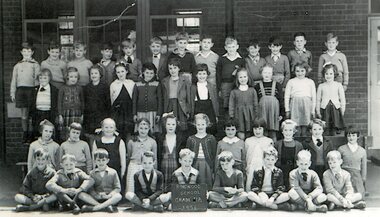
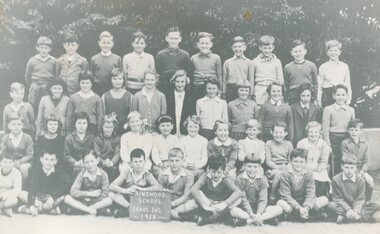
Photograph, Ringwood State School -Class photograph - Grade 11A- 1956
... Flowers, Jimmy Page, ?, Peter Pavey, John Carpenter, ?, Robert McCulloch, Ross Warne. 2nd Row L-R : ?, Annette Wright, Meridith Brown, ?, Julie Little...Flowers, Jimmy Page, ?, Peter Pavey, John Carpenter, ?, Robert McCulloch, Ross Warne. 2nd Row L-R : ?, Annette Wright, Meridith Brown, ?, Julie Little ...Black and white photograph - Grade 2A, 1956"Attached to photograph" List of student names (Incomplete) Back Row L-R : Rod Roach, ?, ?, ?, Russell Goodall, David Flowers, Jimmy Page, ?, Peter Pavey, John Carpenter, ?, Robert McCulloch, Ross Warne. 2nd Row L-R : ?, Annette Wright, Meridith Brown, ?, Julie Little, Jean Ritch, Elaine Evans, Rosaline Busby, Margaret Nelson, ?, Barbara Ryan(?) 3rd Row L-R : Betty Jacobs, Diane Deuter, Ruth Reeves, Lynette (?), Laurel Adams, Lois Clark, Madeleine (?), (?) Williams, Barbara Gordon, Margaret Doak, Irene Bennett. Seated Front Row L-R : ?, Robert Caywood, Philip Decini, John Reid, ?, ?, ?, Chris Harding. Teacher : -
 Ringwood and District Historical Society
Photograph, Ringwood State School -Class photograph - Grade 4C, 1958
... "Attached to photograph" Back Row- L to R: Brian Witchurch, Evan Pataullock, David Flower, Robert Neave, Peter Gluyas, Robert Gluyas, Gary Cat, Russell Goodall, Douglas Swarbrick, Albert Jones. 2nd Row - L to R: Andrew Radford, Julie Little, Marilyn John, Glenda Bruce, Ruth Reeves, Lois Clark, Carol Regan, Christine Mehannan, Beverley World, Margaret Doak, Susan Appleby, Grant Austin. 3rd Row - L to R: Lester Coulthard, Jennifer Wilford, Elizabeth (?)..."Attached to photograph" Back Row- L to R: Brian Witchurch, Evan Pataullock, David Flower, Robert Neave, Peter Gluyas, Robert Gluyas, Gary Cat, Russell Goodall, Douglas Swarbrick, Albert Jones. 2nd Row - L to R: Andrew Radford, Julie Little, Marilyn John, Glenda Bruce, Ruth Reeves, Lois Clark, Carol Regan, Christine Mehannan, Beverley World, Margaret Doak, Susan Appleby, Grant Austin. 3rd Row - L to R: Lester Coulthard, Jennifer Wilford, Elizabeth (?) ...Black and white photograph - Grade 4C,1958"Attached to photograph" Back Row- L to R: Brian Witchurch, Evan Pataullock, David Flower, Robert Neave, Peter Gluyas, Robert Gluyas, Gary Cat, Russell Goodall, Douglas Swarbrick, Albert Jones. 2nd Row - L to R: Andrew Radford, Julie Little, Marilyn John, Glenda Bruce, Ruth Reeves, Lois Clark, Carol Regan, Christine Mehannan, Beverley World, Margaret Doak, Susan Appleby, Grant Austin. 3rd Row - L to R: Lester Coulthard, Jennifer Wilford, Elizabeth (?), Alison Clutterbuck, Ruth Reeves, Elaine Evans, Barbara Austin, Helen Taylor, Beverley World, ?, Robyn McLeish, Neil Miller. Front Row - L to R: ?, Dragon Milotic, David Beith, Robert McCulloch, Peter Pavey, ?, Geoff Davis, Gary Addicot, ?. Teacher: Mr Treloar. -
 Flagstaff Hill Maritime Museum and Village
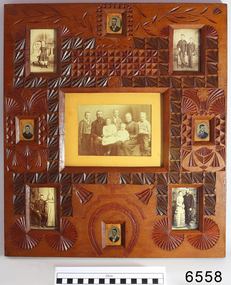
Photograph - Portraits, c. 1904
... Carving includes leaves, flowers, a horseshoe and a ribbon with the words "GOOD LUCK" Photographs are of the Lees family of Wangoom, from the 'Chamberlain Dale Lees Collection’ Made by Thomas Lees for his sister, Ann. The little...Carving includes leaves, flowers, a horseshoe and a ribbon with the words "GOOD LUCK" Photographs are of the Lees family of Wangoom, from the 'Chamberlain Dale Lees Collection’ Made by Thomas Lees for his sister, Ann. The little ...Ann Dale (nee Lees) was given this frame by her younger brother Thomas Chamberlain Lees, who was eighteen at that time. Thomas was the youngest son and seventh child of Lees and Sarah (nee Chamberlain) Lees. Ann loved her little brother’s artistic talents, which are demonstrated in this frame he designed and carefully carved for her. Thomas had cleverly finished the back with timber pieces around the images, and a section of a 1904 calendar. His “GOOD LUCK” is below the image of Ann, her husband Ellis Dale and their five children, c 1900. Sadly, Thomas died in 1911, aged 25. Ellis Dale’s father, William, was a quarryman who sailed from Yorkshire to Australia in 1852. He later bought land for Dale’s Quarries on the edge of Warrnambool in the area of Dale and Aberline roads. From the age of about eleven, Ellis and his brother worked in the quarry beside their father. In 1890 Ellis Dale married Ann Lees. Ann had lived nearby at Wangoom with her parents, Lees and Sarah Lees, who had had her photograph taken when she was a little girl, wearing her black dress. Ellis built a bluestone cottage for himself and Ann on his father’s land in Dales Road. He later added weatherboard rooms, and they named their finished home “Latrigg”. Early in their marriage Ellis recycled some empty dynamite boxes from their quarry to build a cupboard with drawers for Ann’s flat irons and other ironing equipment. The cupboard was used by future generations until recently, when Ann’s granddaughter, Betty Stone, donated it as part of the Chamberlain Dale Lees Collection. It is now in the kitchen of the Port Medical Office. Chamberlain Dale Lees family – local Colonial Pioneers Centre: Ellis Dale and Ann (nee Lees) and their five children - c 1900. Sons lvor William, Robert Ellis, Alfred John, and daughters - Elsie Mary Dale, and Daisy Elvena Dale. Top Left: Ann Lees - c 1868, (the little girl in the black dress) Top Right: William Dale Jnr. and Ellis Dale - c 1871 Lower Left: Ellis Dale and Ann (nee Lees), married 22 Jan. 1890 Lower Right: William Dale Jnr. and Agnes (nee Gillies), married 1883 Oval Photographs: unidentified but presumed to be family members [NB Spelling of Ann Dale – The spelling of Ann’s name has been confirmed by Betty Stone as being “Ann” (Not Anne), by phone conversation with Flagstaff Hill Maritime Village, K P 14th April 2014] (Note: For additional information please refer to Betty Stone’s book “Pioneers and Places - A History of three Warrnambool Pioneering Families” ie. Chamberlain, Dale and Lees Families)This item is associated with the families of Chamberlain, Dale and Lees. These families are listed in the "Pioneers' Register" for Warrnambool Township and Shire, 1835-1900, published by A.I.G.S. Warrnambool Branch. The handmade frame is a unique example of clever craftsmanship and carving skills used by early pioneers with limited access to materials.Family photographs, nine, set into carved, solid wood frame, stained and lacquered. Carving includes leaves, flowers, a horseshoe and a ribbon with the words "GOOD LUCK" Photographs are of the Lees family of Wangoom, from the 'Chamberlain Dale Lees Collection’ Made by Thomas Lees for his sister, Ann. The little girl with black boots on is Betty Stone's grandmother. The back of the frame has a London calendar dated 1904.Words in carved ribbon "GOOD LUCK" Calendar for the year 1904flagstaff hill, warrnambool, shipwrecked coast, flagstaff hill maritime museum, maritime museum, shipwreck coast, flagstaff hill maritime village, great ocean road, chamberlain, dale, lees, stone, betty stone, warrnambool pioneers, thomas lees, wangoom, ann dale, ellis dale, flagstaff hill, warrnambool, shipwrecked coast, flagstaff hill maritime museum, maritime museum, shipwreck coast, flagstaff hill maritime village, great ocean road, chamberlain, dale, lees, stone, betty stone, warrnambool pioneers, thomas lees, wangoom, ann dale, ellis dale, thomas chamberlain lees, handmade photograph frame, carved photograph frame, dynamite -
 Orbost & District Historical Society
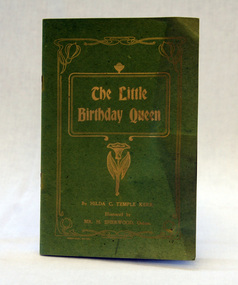
Book - The Little Birthday Queen, C. 1906
... The title 'The Little Birthday Queen' is in gold print within a small frame above a stylised gold flower. ...The title 'The Little Birthday Queen' is in gold print within a small frame above a stylised gold flower. ...Daughter of George Temple and Mary McAuslane of Castlemaine, Hilda married James Kerr in 1893 and lived at Lincluden, Raymond Street, Orbost. Her husband was a Scot who had come to Australia as a ship's doctor and practised in NSW before visiting Orbost on a government vaccination programme. He liked Orbost and returned there, its first doctor, until his death in 1928. Hilda was sometimes referred to as 'Mrs Dr Kerr.' She and her sisters Mabel Stewart Temple and Margaret Ferrie Temple were all talented writers and musicians.This book is an example of the talent of Hilda Temple Kerr. Hilda Temple Kerr (1874-1956) grew up in Orbost. She was very talented and published several books. It is reflective of the style of poetry in the early 20th century. A small green covered book of children's poetry. The title 'The Little Birthday Queen' is in gold print within a small frame above a stylised gold flower. Below in gold print - "Hilda C. Temple Kerr" and "Illustrated by Mr H. Sherwood, Orbost". There is an ornate border around this.On front cover: The Little Birthday Queen. By Hilda C Temple Kerr Illustrated by Mr H Sherwood, Orbost temple-hilda kerr-hilda poetry book-the-little-birthday-queen literature -
 Flagstaff Hill Maritime Museum and Village
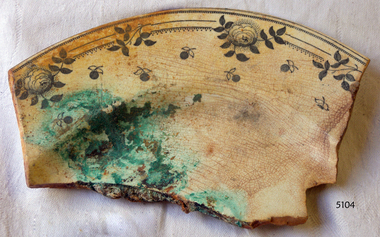
Ceramic - Plate Shard, Before 1878
... White plate with black flower design and border around edge. Verdigris stain on plate. Little encrustation on broken edge. ...White plate with black flower design and border around edge. Verdigris stain on plate. Little encrustation on broken edge. ...History of the Loch Ard: The Loch Ard got it’s name from ”Loch Ard” a loch which lies to the west of Aberfoyle, and to the east of Loch Lomond. It means "high lake" in Scottish Gaelic.The vessel belonged to the famous Loch Line which sailed many vessels from England to Australia. The Loch Ard was built in Glasgow by Barclay, Curdle and Co. in 1873, the vessel was a three-masted square-rigged iron sailing ship that measured 79.87 meters in length, 11.58 m in width, and 7 m in depth with a gross tonnage of 1693 tons with a mainmast that measured a massive 45.7 m in height. Loch Ard made three trips to Australia and one trip to Calcutta before its fateful voyage. Loch Ard left England on March 2, 1878, under the command of 29-year-old Captain Gibbs, who was newly married. The ship was bound for Melbourne with a crew of 37, plus 17 passengers. The general cargo reflected the affluence of Melbourne at the time. Onboard were straw hats, umbrella, perfumes, clay pipes, pianos, clocks, confectionery, linen and candles, as well as a heavier load of railway irons, cement, lead and copper. There were other items included that were intended for display in the Melbourne International Exhibition of 1880. The voyage to Port Phillip was long but uneventful. Then at 3 am on June 1, 1878, Captain Gibbs was expecting to see land. But the Loch Ard was running into a fog which greatly reduced visibility. Captain Gibbs was becoming anxious as there was no sign of land or the Cape Otway lighthouse. At 4 am the fog lifted and a lookout aloft announced that he could see breakers. The sheer cliffs of Victoria's west coast came into view, and Captain Gibbs realised that the ship was much closer to them than expected. He ordered as much sail to be set as time would permit and then attempted to steer the vessel out to sea. On coming head-on into the wind, the ship lost momentum, the sails fell limp and Loch Ard's bow swung back towards land. Gibbs then ordered the anchors to be released in an attempt to hold its position. The anchors sank some 50 fathoms - but did not hold. By this time the ship was among the breakers and the tall cliffs of Mutton Bird Island rose behind. Just half a mile from the coast, the ship's bow was suddenly pulled around by the anchor. The captain tried to tack out to sea, but the ship struck a reef at the base of Mutton Bird Island, near Port Campbell. Waves subsequently broke over the ship and the top deck became loosened from the hull. The masts and rigging came crashing down knocking passengers and crew overboard. When a lifeboat was finally launched, it crashed into the side of Loch Ard and capsized. Tom Pearce, who had launched the boat, managed to cling to its overturned hull and shelter beneath it. He drifted out to sea and then on the flood tide came into what is now known as Loch Ard Gorge. He swam to shore, bruised and dazed, and found a cave in which to shelter. Some of the crew stayed below deck to shelter from the falling rigging but drowned when the ship slipped off the reef into deeper water. Eva Carmichael a passenger had raced onto the deck to find out what was happening only to be confronted by towering cliffs looming above the stricken ship. In all the chaos, Captain Gibbs grabbed Eva and said, "If you are saved Eva, let my dear wife know that I died like a sailor". That was the last Eva Carmichael saw of the captain. She was swept off the ship by a huge wave. Eva saw Tom Pearce on a small rocky beach and yelled to attract his attention. He dived in and swam to the exhausted woman and dragged her to shore. He took her to the cave and broke the open case of brandy which had washed up on the beach. He opened a bottle to revive the unconscious woman. A few hours later Tom scaled a cliff in search of help. He followed hoof prints and came by chance upon two men from nearby Glenample Station three and a half miles away. In a complete state of exhaustion, he told the men of the tragedy. Tom then returned to the gorge while the two men rode back to the station to get help. By the time they reached Loch Ard Gorge, it was cold and dark. The two shipwreck survivors were taken to Glenample Station to recover. Eva stayed at the station for six weeks before returning to Ireland by steamship. In Melbourne, Tom Pearce received a hero's welcome. He was presented with the first gold medal of the Royal Humane Society of Victoria and a £1000 cheque from the Victorian Government. Concerts were performed to honour the young man's bravery and to raise money for those who lost family in the disaster. Of the 54 crew members and passengers on board, only two survived: the apprentice, Tom Pearce and the young woman passenger, Eva Carmichael, who lost her family in the tragedy. Ten days after the Loch Ard tragedy, salvage rights to the wreck were sold at auction for £2,120. Cargo valued at £3,000 was salvaged and placed on the beach, but most washed back into the sea when another storm developed. The wreck of Loch Ard still lies at the base of Mutton Bird Island. Much of the cargo has now been salvaged and some items were washed up into Loch Ard Gorge. Cargo and artefacts have also been illegally salvaged over many years before protective legislation was introduced in March 1982. One of the most unlikely pieces of cargo to have survived the shipwreck was a Minton majolica peacock- one of only nine in the world. The peacock was destined for the Melbourne 1880 International Exhibition in. It had been well packed, which gave it adequate protection during the violent storm. Today the Minton peacock can be seen at the Flagstaff Hill Maritime Museum in Warrnambool. From Australia's most dramatic shipwreck it has now become Australia's most valuable shipwreck artifact and is one of very few 'objects' on the Victorian State Heritage Register.The shipwreck of the Loch Ard is of significance for Victoria and is registered on the Victorian Heritage Register ( S 417). Flagstaff Hill has a varied collection of artefacts from Loch Ard and its collection is significant for being one of the largest accumulation of artefacts from this notable Victorian shipwreck. The collections object is to also give us a snapshot into history so we are able to interpret the story of this tragic event. The collection is also archaeologically significant as it represents aspects of Victoria's shipping history that allows us to interpret Victoria's social and historical themes of the time. The collections historically significance is that it is associated unfortunately with the worst and best-known shipwreck in Victoria's history. Fragment of ceramic plate. White plate with black flower design and border around edge. Verdigris stain on plate. Little encrustation on broken edge. Recovered from the wreck of the Loch Ard.flagstaff hill, warrnambool, shipwrecked coast, flagstaff hill maritime museum, maritime museum, shipwreck coast, flagstaff hill maritime village, great ocean road, loch line, loch ard, captain gibbs, eva carmichael, tom pearce, glenample station, mutton bird island, loch ard gorge, ceramic plate, plate, shard, cream with black roses -
 Mission to Seafarers Victoria
Article, A Woman's Melbourne Letter
... No one appreciates flowers like a sailor, and the earliest and most beautiful may always be seen adorning the tables and rooms. Teas are served and lectures are held in the "Celia Little Hall," one of the most beautiful portions of the institute. ...No one appreciates flowers like a sailor, and the earliest and most beautiful may always be seen adorning the tables and rooms. Teas are served and lectures are held in the "Celia Little Hall," one of the most beautiful portions of the institute. ...A detailed description of the Mission and its activities written by a woman: Western Mail (Perth, WA : 1885 - 1954), Friday 13 December 1918, page 34 A WOMAN'S MELBOURNE LETTER. Melbourne, Dec. 4. There is an idea abroad, which as regards Melbourne, at any rate, is quite erroneous, that our sailors are not as well looked after as our soldiers, and that the noble men of the Mercantile Marine are much neglected ! For once, perhaps, my readers will pardon a letter dealing with only one subject, but the steady, unostentatious work done by the Ladies' Harbour Light Guild, in connection with the mission to seamen in Melbourne could not be adequately explained if dismissed in the usual short paragraph. Some of the most prominent names in Melbourne are associated with this guild and with the Mission Chaplain, and Mrs. Gurney Goldsmith, the members have made the Seamen's Institute a real home for those sailors of the Mercantile Marine, who touch our port. What we as a community owe to those men by their heroism in recent hostilities is certainly more understood by this band of enthusiastic workers than by the community generally. By using their unflagging energies, and influence on the sailor's behalf they endeavour to discharge a debt to which in some way or other we could and should all contribute. Even the most casual person can, if he thinks at all, sum up a few of the things our sailors - other than those belonging to our glorious navy - have done for us. On the spur of the moment we remember that those of the Mercantile Marine, are the men who manned our transports, who carried our wheat and wool, to oversea markets; who kept us in touch with our loved ones abroad; who kept the fires going in the furnaces of the great leviathans, bringing our wounded soldiers home again; who never flinched when self-sacrifice was demanded; who cared, with that tenderness, innate in all sailors, for the women and children, when the passenger ships were struck a dastardly blow by the wicked enemy; who, mocking death, gave up life with a heroism all the more heroic because it was always taken as a matter of course! Is it any wonder, then, that the members of the Ladies' Harbour Light Guild make it their business to provide a bright, homelike, spot in Melbourne, where the sailors are always certain of a cherry welcome ashore? The members of the guild are admirably drafted! The 360 non-workers each pay £1 1s. per annum. The workers, of whom there are between 700 and 800, donate 2s. 6d. and school members - it is confidently hoped that gradually all the schools will take an active interest in the mission - 1s. a year. The knights of the guild - as the men members are designated - are responsible for any sum they wish to name, from 5s. a year upwards. Everything is paid for out of these revenues, with the exception of a small grant from the Home Mission Fund - and such is the organisation, and management, that the entire concern is quite free from debt. The Seamen's Church and Institute, where the "Harbour Lights" gleam so brightly, is situated right in the midst of all the bustle and turmoil of the wharves, at the end of Flinders-street. The building, comprising chapel, and institute under the one red tiled roof, is grey stuccoed, with a small tower, from which flaunts the flag of 'The Flying Angel" - the badge of the guild. A visit to the institute makes one fully appreciate the boon the place must be to the voyage worn, weary, sailor. The atmosphere is eminently social in its best sense. While the architecture imparts an elegance, and quiet dignity which soothes by the very subtlety of its charm. With its comfortable furniture, its wealth of flowers, and the happy, wholesome, feminine influence which prevails everywhere, the quality which stands for the magic word "home" abounds. The Chaplain in the course of conversation said: -"We try to make this really a free club for sailors." But the habitues would probably tell you it was far more than that to them. The Institute is excellently appointed, and every little corner seems to have its particular history. It was built after the model of one of the old mission churches in California, and retains something of the old world attraction, while yet it combines all the advantages of modern, practical, conveniences. On entering the door the first thing, one notices is a huge compass, inlaid upon the floor, evidently to indicate one's proper bearings for it points due north - to the chapel! Only one other seamen's mission in the world boasts such a compass. As the sailor swings through the entrance he finds the office on his right, and there is, here, always a smiling face to welcome the shy, or timid, new comer. Quite a real post office is staffed by members of the guild, and all the letters received are listed alphabetically. Therefore, the expectant sailor has just to run his eye down the list, and he can immediately see whether there is a letter for him or not. If he is fortunate, he comes up to the member in charge, who unlocks the box, and produces the longed for missive. The boys are always encouraged to answer letters - and to write them. Often a few words about their mother, and their own home, will provoke a sleeping memory into activity. The writing room is well stocked with paper, envelopes, pens, and ink. The tables are so divided to ensure the utmost privacy, and through a calculated chain of circumstances, many an anxious mother receives a letter from her sailor lad, who, perhaps, might not have written but for these kindly inducements. The central hall - where social evenings are held every other night besides two special concerts a week - is inviting in the extreme. A handsome piano affords opportunity for those musically inclined. The tables are strewn with papers. The walls are bright with pictures, and here, and there, is a carved model, of a ship. One, of especial interest, is a model of "The Roon" carved, and presented by a French sailor. This German vessel will always be remembered in Australia. For it was across her bows that the first hostile shot was ever fired in Australian waters. In the corner is the canteen. It was fitted up entirely from the proceeds of a quotation calendar compiled by one of the members. The sailors may at any time, get a teapot of tea, or a tray of eatables, at a nominal cost. Before the canteen was in existence they had to go out for refreshments! - and sometimes they did not come back! Groups of sailors sit chatting at the tables. Half a dozen Swedes laugh and talk among themselves, for the simple reason they know no other language than their own. Several British sailors cluster about a dark-eyed Welsh lad - a perfect Celtic type - who, although only about twenty years of age, has been the victim of the Hun five times. Mines and torpedoes sank the ships he was in, either in the Channel or off the English coast, four times; and it is to his fifth experience, when the Inverness was wrecked, that everyone is eagerly listening. "We were in the boats eight days," he was saying, "I was pretty well mangled when they picked me up. The sufferings we endured were awful. At last we managed to reach Rapa, a Hawaiian island. The natives thought we were Germans, and came at us with spears. When they found we were British, they were awfully good to us. They even cried when we left, and the day before the rescue boat arrived they begged us to go into the hills and hide." At another table a Canadian lad - once a sailor - then a soldier, who trained at the Broadmeadows camp - was telling his experiences : - "The voyage which will always stick in my memory," he said, "was to a place which must be nameless. We left the United States not knowing whether we were bound, or what we were going to do. After some weeks we sighted a group of wonderfully beautiful islands, and we headed for the most remote and most lovely of them all. Then, and only then, we learned our mission from the skipper. We were taking their year's supply to a leprosy station! Oh no! I don't blame the skipper for not telling us ! Someone has to do these things, you know. A naval guard saw they didn't come near - and we all got sixty dollars extra. When the job was over we were quarantined on another island for two months, and one little chap - the baby of the crew, not eighteen - developed leprosy, and died before we left. Yes! I'll never forget that voyage, mates! Sometimes, I seem to see Leper's Island yet, with its lavish tropical vegetation and the gorgeous sunsets which stained all the water with blood. Then, too" - here the voice deepened - "there was an English girl - a leper - there. We heard she used to be an actress, and she contracted the disease somehow or other. She was always alone, and always watching us. In the distance we could see her come to the water's edge, and from there she would watch. Just watch . .. . watch . . .watch. ..." "Here come a couple of North Sea chaps," broke in an elderly man after pause. "One of them wounded, too, poor lad." It is not strange that all the sailors flock to the Institute. It is so comfortable, and essentially inviting, besides being full of human interest. The men's quarters comprise reading, writing and dressing rooms - hot and cold baths are always available - billiard room, and a special baggage room, where any sailor may leave his kit for as long as he likes. The payment of 3d. covers its complete insurance. Upstairs are the officers' quarters. These also have their own billiard room, writing and reading rooms, bath and dressing rooms. Just close are the apprentices' quarters - "The Half Deck," as popular parlance has it! The lads also have a billiard room of their own, and indulge in an easy armchair - amongst others - which was a donation from the Milverton School branch of the Guild. It is hoped by the committee to some day utilise the huge empty rooms, which run the length of the whole building. Their ultimate intention is to fit them up as cubicles, or "cabins," as they are to be called. They trust these "cabins" will be donated, either in memory, or in honour, of someone dear to the donor. Another forward movement soon to be put in hand, now that materials are available, is the establishment of "Norla Gymnasium." In a sailors' club such facility for exercise is absolutely essential. The men both need, and miss, exertion. As one boy, who had been backsliding, once said pathetically : -"If only there was something to do to get me into a good sweat, I would be all right." Soon such an one will be helped to swing from the trapese of the Norla Gymnasium into the right track! Sunday is always a fete day at the Institute, for 40 or 50 sailors generally come into tea. The up-to-date kitchen, which is fitted with every labour-saving appliance - all paid for out of working members' half crowns - is then a hive of animation, and methodical order. A formidable row of teapots await filling. Mrs. Goldsmith -, the chaplain's wife - rightly thinks it is far more homely to pour out the tea from a pot, than to serve it straight from the urns. So tea is poured out by a member, who sits at the head of a table gay with flowers, and chats to the guests. These latter are of all nationalities. But the French, the Spanish, Scandinavian, Norwegian - or any other sailor is equally welcome with the British. Two enthusiasts belonging to the Guild actually learnt Norwegian, so that men of this nation would have someone to talk to, and so be less lonely when they reached this, to them, foreign port ! The members of the Guild have their own private suite where they arrange the flow-err and do other necessary odds and ends undisturbed. No one appreciates flowers like a sailor, and the earliest and most beautiful may always be seen adorning the tables and rooms. Teas are served and lectures are held in the "Celia Little Hall," one of the most beautiful portions of the institute. It was erected by the chaplain in memory of his aunt from whom the hall takes its name. The Gothic windows open upon the cloisters, where, in the hot weather, the sailors enjoy their meals out of doors. The cloisters, indeed, form an exquisite spot. They are between a series of sweeping arches which lead to the chapel, and are sheltered by the open balcony of the chaplain's quarters. Grace of contour marks the architecture on every turn. Just around the corner is the chaplain's garden - a patch of green and colour, transformed from a desert waste, by a well-known woman horticulturist. The book room is a department especially valued by the sailors. There are two secretaries, one for home and the other for foreign literature. Books in French, English, Spanish, Scandinavian, Norwegian, and German may be found on the shelves. Each week about 36 convenient parcels of reading stuff are made up. These contain illustrated papers, books in various languages, and magazines. These parcels are eagerly accepted by the sailor with a long monotonous voyage before him. But complete as is every corner of the institute, no part is so well equipped as the memorial chapel erected by the Ladies' Harbour Light Guild, in memory of the officers and men, who have lost their lives during the war. St Peter's - for it is called after the sailor's patron saint - with its hallowed gentle dignity is a veritable sanctuary of peace, perhaps all the more so because it sprang out of war. The fittings are entirely of Australian wood. The pews, given in memory of some loved one by one of the members, are of Tasmanian hardwood. The reredos and altar chairs of carved blackwood. The rich carpet was provided by the members' magical half-crowns. Already this chapel holds memorials of peculiar historical interest. The altar lectern was given in memory of Commander Elwell, who, it will be remembered, was killed at Rabaul, in the early part of the war. The font commemorates two heroes - Nigel Hockley and Fred Hyde, who lost their lives at the hands of the Germans, although they survived the actual torpedoing of their ships, the Galgorn Castle off the coast of Ireland. The mother of one of them wrote out that her son had died as an Englishman should - fighting for the right. This noble sentiment is suitably paraphrased upon the inscription engraved upon the font. Practically every-hing enshrined in the chapel has its own sentimental value. The alms salver of beaten copper, studded with agate, is fragrant with the memory of a saintly woman.The eye of the sailor is caught and held by the pulpit, which is fashioned like a ship's hull and only a twist of rope guides the chaplain up the steps. For the last 13 years the Rev. A. Gurney Goldsmith, M.A., has acted as chaplain to the Seamen's Mission in Melbourne. Before that he and his wife worked in China. Mr Goldsmith visits all the boats and gets in touch personally with the sailor, over whom he has great influence. He is not only their chaplain and friend, but, amongst a wide range of other things, their banker besides. An exchange system exists between the various Missions, and the sailor who has "banked" his money with the chaplain, upon going away, receives a cheque which is cashed - minus exchange - by the chaplain of the next port. Mr. Goldsmith will tell you he has a soft spot in his heart for on old sailor he calls "Paddy." This ancient mariner has been wrecked ten times. It was a long time before the chaplain prevailed upon "Paddy" to partake of the spiritual and secular advantages afforded by the institute. He would not come, he said, until he could do so "with a good heart." Finally he frankly admitted that he had no "friends like those of 'the Flying Angel,' " and that he eventually proved his own "good heart" will be shown in this story. One day he came in to the chaplain and said bluffly, "Well, sir, I've been payin' off some old scores up Carlton way, an' I tells yer, plain, sir, not one of 'em would have seen a penny of their money but for the Mission." The Ladies' Harbour Light Guild has over thirty working suburban branches, and the excellent results achieved at the Institute now will no doubt be considerably augmented in the future. The practical actions of the members do more than anything else to convey the subtle meaning of the name of the Guild. To the visiting sailors the word "ladies" signifies the bread givers; "harbour" safety ; "lights" welcome; "guild" the welding of fraternity, and they one and all tell you the ideals thus embodied are unselfishly carried out by all the ladies who have banded together to care for the sailors' welfare.The article describes the Mission and the use of several spaces a year after its opening and gives details about the daily activities.Digital copy of an article published in the Western Mail on the 13th of December 1918. 717 flinders street, seamen's mission, norla dome, lhlg, reverend alfred gurney goldsmith, celia little room, garden, frederica godfrey -
 Mission to Seafarers Victoria
Photograph - Digital copy, Black and white, Melbourne Harbour Trust, 1959
... Little Room at Mission to Seafarers. Man on left is in a suit, sitting on the arm of a chair, reading a newspaper. There is a coffee table with flowers separating him from the second man, also sitting reading a newspaper. ...Photograph displays the way in which the Celia Little Room, and by extension the Mission to Seafarers, was used by those who utilised the facility during this period. armchairs reading newspapers wainscoting ashtray robin kent life magazine mission to seafarers mission to seamen celia little room coffee table bell moreton bay flowers seamen sailors memorial plaque Black and white photograph of three men sitting in Celia Little Room at Mission to Seafarers. ...Photograph taken in the Celia Little Room at Mission to Seafarers Melbourne. The Celia Little Room was named in honour of the aunt of one of the serving (and resident) chaplains. The room is a multi-function room, being used at times for banquets or, as the photograph shows, for relaxation, by visiting seafarers. The magazine read by the man on the right is the International version of the Life magazine published dated from 24 November 1958, with actress Kim Novak holding a black cat on cover. This photograph was published in the Port of Melbourne Quarterly (July-September 1959) held in the Mission's archives. It was probably donated by the trust to Padre Oliver.Photograph displays the way in which the Celia Little Room, and by extension the Mission to Seafarers, was used by those who utilised the facility during this period.Black and white photograph of three men sitting in Celia Little Room at Mission to Seafarers. Man on left is in a suit, sitting on the arm of a chair, reading a newspaper. There is a coffee table with flowers separating him from the second man, also sitting reading a newspaper. The third man is seated in an armchair reading a copy of Life International magazine, with an ashtray resting on the arm of the chair.armchairs, reading, newspapers, wainscoting, ashtray, robin kent, life magazine, mission to seafarers, mission to seamen, celia little room, coffee table, bell, moreton bay, flowers, seamen, sailors, memorial plaque -
 Mission to Seafarers Victoria
Photograph - Photograph, Sepia, Just married, Harry and Dora, 14 February 1928
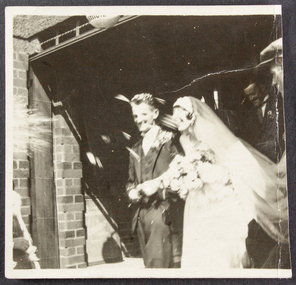
... flowers for the occasion. The article in the Herald of the day describes the event: "WEDDING AT SEAMEN'S CHAPEL Reception at Hotel Windsor The pretty little chapel at the Sea men's Institute was packed with interested friends this afternoon, when Miss Dora Walker, one of the Mission's most enthusiastic and efficient voluntary helpers, chose it as the setting for her marriage with Mr H. ...flowers for the occasion. The article in the Herald of the day describes the event: "WEDDING AT SEAMEN'S CHAPEL Reception at Hotel Windsor The pretty little chapel at the Sea men's Institute was packed with interested friends this afternoon, when Miss Dora Walker, one of the Mission's most enthusiastic and efficient voluntary helpers, chose it as the setting for her marriage with Mr H. ...The Marriage Register lists Harold Priestley Simpson and Amy Dora Walker as the bride and groom, and the wedding date as 14th of February 1928. The photograph uses the personal Harry and Dora, instead of the formal Harold and Amy. In the Register, Amy started signing her name as Dora. before correcting it. The photograph shows that weddings took place at the Chapel during the late 1920's, and the style of weddings at the time. This includes the type of outfits worn, such as the length of the veil and the type of bouquet carried. Dora's Bridesmaids are depicted in 2 other images in the MTSV collection also an image of the chapel decked with flowers for the occasion. The article in the Herald of the day describes the event: "WEDDING AT SEAMEN'S CHAPEL Reception at Hotel Windsor The pretty little chapel at the Sea men's Institute was packed with interested friends this afternoon, when Miss Dora Walker, one of the Mission's most enthusiastic and efficient voluntary helpers, chose it as the setting for her marriage with Mr H. P. Simpson, son of Mr and Mrs J. H. Simpson, of Mornington. A group of her fellow workers decorated the chapel with lovely pink and white gladioli, carnations and roses. The ceremony was performed by the Rev. J. R. Weller, chaplain of the Mission, and the bride was given away by her father, Mr A. W. Walker, of Manning road, East Malvern. She wore a lovely ivory georgette frock, the finely tucked skirt being fashioned with a deep transparent hem of Chantilly lace. Over it fell a beautiful Honiton lace veil mounted on tulle and arranged to give the ef fect of a train. Fragrant white roses composed her bouquet. Two attendants followed her down the aisle — her sister, Miss Molly Walker, and Miss Ella Kendall — both wearing dainty shrimp pink georgette frocks and large crinoline straw hats in the same shade with a dainty edging of tulle. They carried bouquets of pink cactus dahlias nnd delphiniums. Mr Louis Buscombe was best man, and Mr George Thompson grooms man. After the ceremony Mr and Mrs Walker entertained about 50 guests at the Hotel Windsor."The photograph shows St. Peter chapel was being used for weddings in 1928. The Anglican church has been used for weddings since being finished in 1917. The Marriage Register shows that these weddings were legal in the Commonwealth of Australia, and lists Church of England as the denomination for this wedding. Miss Amy Dora Simpson (nee Walker) had a long association with the Mission, first as a young Volunteer with the Ladies Harbour Light Guild circa WW1, and through to her wedding in early 1928 and beyond. Square sepia, glossy photograph of a bride and groom, taken as they leave a building. Guests are throwing rice at the newlywed. The groom is turned towards the camera, while the bride is looking ahead, carrying a bouquet. There is a white border around top, bottom and left edges, the photograph seems to have been cut in half along the right edge.On the reverse: handwritten in blue pen JUST MARRIED!/DORA & HARRY/28/2/28. 618 is stamped in blue ink . (date is incorrect as wedding took place on 14/2/28)bride, wedding, groom, 1928, dora simpson, dora walker, st peter chapel, harry simpson, lhlg, flinders street, harold priestley simpson, valentine's day, amy dora walker, ladies harbour lights guild, mr and mrs a.w. walker, malvern, manning road, reverend j.r weller, molly walker, ella kendall, david simpson -
 Halls Gap & Grampians Historical Society
Postcard - B/W
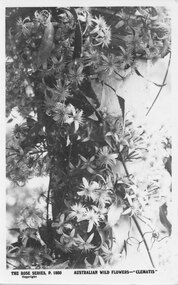
... little Ida" from "Aunt". See photo stored in "Adittional Images" for full text. NATURAL HISTORY Flora "The Rose Series, P. 1800 Australian Wild Flowers - "Clematis"" written on bottom border of postcard. ...Period unknown. A postcard depicting "Clematis". mkThe postcard is written on the back to "My dear little Ida" from "Aunt". See photo stored in "Adittional Images" for full text.The postcard depicts wildflowers (Clematis) climbing up a tree/stump."The Rose Series, P. 1800 Australian Wild Flowers - "Clematis"" written on bottom border of postcard. There is a letter written in black ink on the rear of the postcard - see "Additional Images".natural history, flora -
 The Beechworth Burke Museum
Animal specimen - Regent Parrot, Trustees of the Australian Museum, 1880-1860
... little duller than the other. There are, however, other differences between the two populations, especially in how they have fared: eastern populations are endangered, while the western population is thought to be increasing. The Regent Parrot eats seeds of grasses and plants and cereal crops, especially wheat. It also eats buds and flowers...little duller than the other. There are, however, other differences between the two populations, especially in how they have fared: eastern populations are endangered, while the western population is thought to be increasing. The Regent Parrot eats seeds of grasses and plants and cereal crops, especially wheat. It also eats buds and flowers ...This specimen is part of a collection of almost 200 animal specimens that were originally acquired as skins from various institutions across Australia, including the Australian Museum in Sydney and the National Museum of Victoria (known as Museums Victoria since 1983), as well as individuals such as amateur anthropologist Reynell Eveleigh Johns between 1860-1880. These skins were then mounted by members of the Burke Museum Committee and put-on display in the formal space of the Museum’s original exhibition hall where they continue to be on display. This display of taxidermy mounts initially served to instruct visitors to the Burke Museum of the natural world around them, today it serves as an insight into the collecting habits of the 19th century. The Regent Parrot has two separate populations separated by the Nullarbor Plain: one in the Mallee regions of eastern Australia, and the other in the Wheatbelt region of southern Western Australia. Though the populations are widely separated, the birds of each region do not appear especially different, one being a little duller than the other. There are, however, other differences between the two populations, especially in how they have fared: eastern populations are endangered, while the western population is thought to be increasing. The Regent Parrot eats seeds of grasses and plants and cereal crops, especially wheat. It also eats buds and flowers, insect larvae, psyllids and lerps. It forages in pairs or small parties, usually on the ground, but also in the canopy of trees or in spilled grain on the ground. The Regent parrot is endangered in NSW and Vulnerable in VIC This Particular specimen has been mounted correctly.This specimen is part of a significant and rare taxidermy mount collection in the Burke Museum. This collection is scientifically and culturally important for reminding us of how science continues to shape our understanding of the modern world. They demonstrate a capacity to hold evidence of how Australia’s fauna history existed in the past and are potentially important for future environmental research. This collection continues to be on display in the Museum and has become a key part to interpreting the collecting habits of the 19th century.A slim parrot with a long, dusky tapering tail and back-swept wings. It is mostly yellow, with blue-black wings and tail. There is a prominent yellow shoulder patch and red patches in the wings. The bill is deep pink. It is mounted on a thin wooden branch that is attached to a wooden mount with the scientific name located Label: T.L. 430MM / W.S. 540MM / WT. 200GMS / SEX [female symbol] Mount: Polytelis / Anthopeplus / Regent Parrot taxidermy mount, regent parrot, taxidermy, animalia, burke museum, bird, parrot -
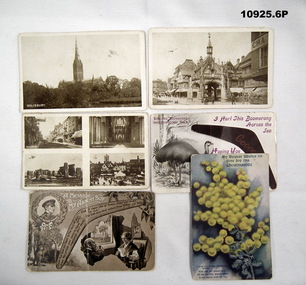 Bendigo Military Museum
Postcard - PHOTOGRAPHIC POSTCARDS, WW1, c. 1914-18
... In the boomerang is a little nostalgic poem. 6. Postcard. Painted on front is an image of some wattle flowers. ...In the boomerang is a little nostalgic poem. 6. Postcard. Painted on front is an image of some wattle flowers. ...Refers to the service of "Albert Boldiston" See Cat 747 and 10924.1. Black and white image of Salisbury Cathedral. A pond in the foreground. 2. Black and white image of Salisbury town. On back in green ink is printed "Souvenir of Salisbury". There is a red 1 penny stamp. 3. Bifold postcard. One side has an image of a bridge and a building with a clocktower. Tghe otgher side has 4 smaller images of Sailsbury buildings. When opened up the word 'Salisbury' is printed in green ink. 4. Postcard front has an image of an Emu and a Boomerang. There is a poem at bottom centre, titled "Hoping you will come back to me'. 5. A postcard with drawings of a soldier, Aussie bushland, an elderley couple and a boomerang. In the boomerang is a little nostalgic poem. 6. Postcard. Painted on front is an image of some wattle flowers. Bottom left corner has a small poem. Subject is Christmas tide. 1. Someone has pencilled in a biplane. On rear St Leonards Private Hospital, Don Street. 2. Someone has drawn a small image of a kid on a bike. Address for received: Mrs J.J. Boldiston, Colbinabbin, Victoria, Aust. Colbinabbin is crossed out - written in green pencil is Junortoun P.O. via Bendigo. 3. Someone has drawn on photos - a small biplane. this is a letter to his mother. 6 lines. 4. Printed on back in light brown ink is the Manufacturers detail. 5. Written on back is a letter addressed to "Dear Bert" from J. Boldiston, 4 lines. Address Junortoun via Bendigo 23/7/18. 6. Written on the back is a letter addressed to "Dear Bert". It's from his aunt. 7 lines, senders address was Stoney Green. 5/9/18. postcards, ww1, albert boldiston, christmas
