
Showing 44 items matching "long ash"
-
 Whitehorse Historical Society Inc.
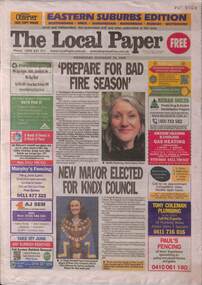
Newspaper, The Local Paper, 26/11/2025
... ...Long Ash...Editor Ash Long has entered his 56th year of newspaper work. ...Long, Ash Editor...Editor Ash Long has entered his 56th year of newspaper work. ...An edition of The Local Paper which has been in production throughout Melbourne since 201656 page tabloid publication dated 26/11/2025 plus an A4 descriptionnon-fictionAn edition of The Local Paper which has been in production throughout Melbourne since 2016the local papar, newspapers, long ash -
 Eltham District Historical Society Inc
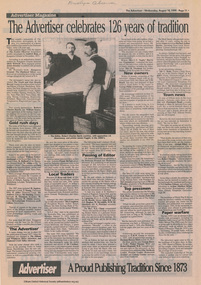
Newspaper article, Advertiser Magazine, The Advertiser celebrates 126 years of tradition, 18/08/1999
... A brief history of the Evelyn Observer local newspapers established at Kangaroo Ground in 1873, from "Advertiser Magazine", forerunner of "The Local Paper" published by Ash Long....A brief history of the Evelyn Observer local newspapers established at Kangaroo Ground in 1873, from "Advertiser Magazine", forerunner of "The Local Paper" published by Ash Long. harry gilham collection evelyn observer community newspaper Kangaroo Ground Andrew Ross Robert Charles harris Newspaper article The Advertiser celebrates 126 years of tradition Newspaper article Advertiser Magazine ...A brief history of the Evelyn Observer local newspapers established at Kangaroo Ground in 1873, from "Advertiser Magazine", forerunner of "The Local Paper" published by Ash Long.Newspaper articleharry gilham collection, evelyn observer, community newspaper, kangaroo ground, andrew ross, robert charles harris -
 Eltham District Historical Society Inc
Document - Folder, Roberts, Nese
... Contents Newspaper article: "Award to Diamond Creek's Nese," Ash Long's Advertiser, 3 December 1996. Nese Roberts awarded for service to the community by the Rotary Club of Diamond Creek....Contents Newspaper article: "Award to Diamond Creek's Nese," Ash Long's Advertiser, 3 December 1996. Nese Roberts awarded for service to the community by the Rotary Club of Diamond Creek. ...Diamond Creek resident Nese Roberts was awarded the Rotary Club of Diamond Creek's fourth courtesy and kindness award for service to the community. Contents Newspaper article: "Award to Diamond Creek's Nese," Ash Long's Advertiser, 3 December 1996. Nese Roberts awarded for service to the community by the Rotary Club of Diamond Creek.Newspaper clippings, A4 photocopies, etcnese roberts, rotary club of diamond creek, terry wade, eileen rainsbury, ern wardell, st vincent de paul, diamond valley interchurch group, red cross, sacred heart church, save the children fund, wattle glen nursing home, steve kennedy, mark pittle, john puls, very molinaro, doug blakie, mick hall, ken nettleton, jill pittle, michael hannan, maurie roadley, moya roadley, dawnville nursing home -
Eltham District Historical Society Inc
Document - Folder, Roberts, Nese
... Contents Newspaper article: "Award to Diamond Creek's Nese," Ash Long's Advertiser, 3 December 1996. Nese Roberts awarded for service to the community by the Rotary Club of Diamond Creek....Contents Newspaper article: "Award to Diamond Creek's Nese," Ash Long's Advertiser, 3 December 1996. Nese Roberts awarded for service to the community by the Rotary Club of Diamond Creek. ...Diamond Creek resident Nese Roberts was awarded the Rotary Club of Diamond Creek's fourth courtesy and kindness award for service to the community. Contents Newspaper article: "Award to Diamond Creek's Nese," Ash Long's Advertiser, 3 December 1996. Nese Roberts awarded for service to the community by the Rotary Club of Diamond Creek.Newspaper clippings, A4 photocopies, etcnese roberts, rotary club of diamond creek, terry wade, eileen rainsbury, ern wardell, st vincent de paul, diamond valley interchurch group, red cross, sacred heart church, save the children fund, wattle glen nursing home, steve kennedy, mark pittle, john puls, very molinaro, doug blakie, mick hall, ken nettleton, jill pittle, michael hannan, maurie roadley, moya roadley, dawnville nursing home -
 Ballarat Heritage Services
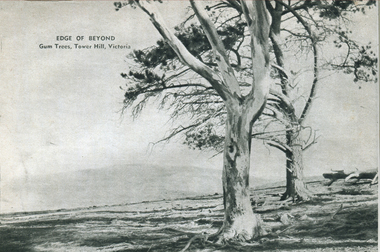
Photograph - Image - Black and White, Gum Trees on Tower Hill, Victoria, c1950, c1950
... Tower hill is a dormant volcano, with associated conical hills, large and small craters, basalt outcrops from lava flows and layers of Ash from long ago eruptions. ...Tower hill is a dormant volcano, with associated conical hills, large and small craters, basalt outcrops from lava flows and layers of Ash from long ago eruptions. gum trees tower hill A black and white image of two trees in a barron landscape at tower Hill,Victoria Gum Trees on Tower Hill, Victoria, c1950 Photograph Image - Black and White ...Tower Hill is 18km west of Warrnambool and is accessed from the Princes Highway. Tower hill is a dormant volcano, with associated conical hills, large and small craters, basalt outcrops from lava flows and layers of Ash from long ago eruptions. A black and white image of two trees in a barron landscape at tower Hill,Victoriagum trees, tower hill -
 Ballarat Heritage Services
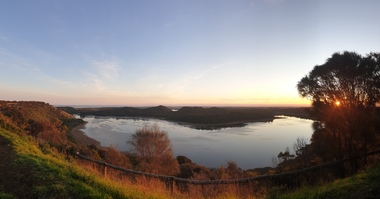
Photograph, Clare Gervasoni, Tower Hill Crater, 11/09/2020
... Tower hill is a dormant volcano, with associated conical hills, large and small craters, basalt outcrops from lava flows and layers of Ash from long ago eruptions. ...Tower hill is a dormant volcano, with associated conical hills, large and small craters, basalt outcrops from lava flows and layers of Ash from long ago eruptions. Tower Hill crater volcano Panorama of the crater at Tower Hill Tower Hill Crater Photograph Clare Gervasoni ...Tower Hill is 18km west of Warrnambool and is accessed from the Princes Highway. Tower hill is a dormant volcano, with associated conical hills, large and small craters, basalt outcrops from lava flows and layers of Ash from long ago eruptions. Panorama of the crater at Tower Hilltower hill, crater, volcano -
 Ballarat Heritage Services
Photograph, Clare Gervasoni, Tower Hill Crater, 11/09/2020
... Tower hill is a dormant volcano, with associated conical hills, large and small craters, basalt outcrops from lava flows and layers of Ash from long ago eruptions. ...Tower hill is a dormant volcano, with associated conical hills, large and small craters, basalt outcrops from lava flows and layers of Ash from long ago eruptions. Tower Hill crater volcano Panorama of the crater at Tower Hill Tower Hill Crater Photograph Clare Gervasoni ...Tower Hill is 18km west of Warrnambool and is accessed from the Princes Highway. Tower hill is a dormant volcano, with associated conical hills, large and small craters, basalt outcrops from lava flows and layers of Ash from long ago eruptions. Panorama of the crater at Tower Hilltower hill, crater, volcano -
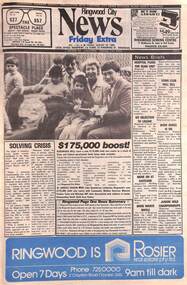 Ringwood and District Historical Society
Newspaper - Printed, Ringwood City News Vol. 1 No. 8
... Free. Publisher Ash Long....Free. Publisher Ash Long. Ringwood City News Vol. 1 No. 8 Newspaper Printed ...10-page Ringwood City News volume 1, number 8, 24th August 1984. Weekly circulation of 30,000 when combined with Croydon City News. Ringwood local office: Rossprint, 1st floor, 23 Ringwood St, Ringwood, 870-3666. 1 Devon St, Croydon - phone 725-2555. Free. Publisher Ash Long. -
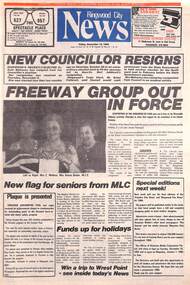 Ringwood and District Historical Society
Newspaper - Printed, Ringwood City News Vol. 1 No. 24
... Croydon City News Vol. 2 No. 49. Publisher Ash Long....Croydon City News Vol. 2 No. 49. Publisher Ash Long. Ringwood City News Vol. 1 No. 24 Newspaper Printed ...10-page Ringwood City News volume 1, number 24, 14th December 1984. Weekly circulation of 30,000 when combined with Croydon City News. Ringwood local office: Rossprint, 1st floor, 23 Ringwood St, Ringwood, 870-3666. 1 Devon St, Croydon - phone 725-2555. Free. Croydon City News Vol. 2 No. 49. Publisher Ash Long. -
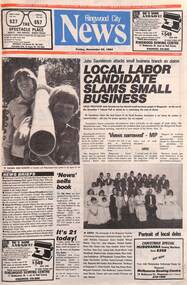 Ringwood and District Historical Society
Newspaper - Printed, Ringwood City News Vol. 1 No. 21
... Croydon City News Vol. 2 No. 46. Publisher Ash Long....Croydon City News Vol. 2 No. 46. Publisher Ash Long. Ringwood City News Vol. 1 No. 21 Newspaper Printed ...16-page Ringwood City News volume 1, number 21, 23rd November 1984. Weekly circulation of 30,000 when combined with Croydon City News. Ringwood local office: Rossprint, 1st floor, 23 Ringwood St, Ringwood, 870-3666. 1 Devon St, Croydon - phone 725-2555. Free. Croydon City News Vol. 2 No. 46. Publisher Ash Long. -
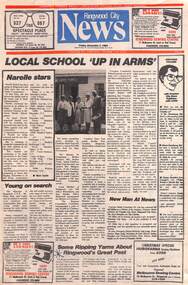 Ringwood and District Historical Society
Newspaper - Printed, Ringwood City News Vol. 1 No. 23
... Croydon City News Vol. 2 No. 48. Publisher Ash Long....Croydon City News Vol. 2 No. 48. Publisher Ash Long. Ringwood City News Vol. 1 No. 23 Newspaper Printed ...16-page Ringwood City News volume 1, number 23, 7th November 1984. Weekly circulation of 30,000 when combined with Croydon City News. Ringwood local office: Rossprint, 1st floor, 23 Ringwood St, Ringwood, 870-3666. 1 Devon St, Croydon - phone 725-2555. Free. Croydon City News Vol. 2 No. 48. Publisher Ash Long. -
 Eltham District Historical Society Inc
Journal - Newsletter, Newsletter, No. 282 June 2025
... by Jim Connor • Next meeting – 2:00pm Saturday 14th June 2025 • Excursion – Saturday 5th July – Kangaroo Ground War Memorial Park • Vale – Diana Bassett-Smith by Liz Pidgeon • Sweeney Family History by Liz Pidgeon • Lost Then Found by Liz Pidgeon (drawing of "Culla Hill" house) • Honorary Life Memberships – Peter and Liz Pidgeon • Recollections Of A Young Journalist by Ash Long • Annual General Meeting – Saturday 12th April 2025 • Greg Burgess, Guest Speaker – Annual General Meeting – 2025...by Jim Connor • Next meeting – 2:00pm Saturday 14th June 2025 • Excursion – Saturday 5th July – Kangaroo Ground War Memorial Park • Vale – Diana Bassett-Smith by Liz Pidgeon • Sweeney Family History by Liz Pidgeon • Lost Then Found by Liz Pidgeon (drawing of "Culla Hill" house) • Honorary Life Memberships – Peter and Liz Pidgeon • Recollections Of A Young Journalist by Ash Long • Annual General Meeting – Saturday 12th April 2025 • Greg Burgess, Guest Speaker – Annual General Meeting – 2025 The Shire of Eltham Historical Society was formed in October 1967. ...Contents: • Why a table? by Jim Connor • Next meeting – 2:00pm Saturday 14th June 2025 • Excursion – Saturday 5th July – Kangaroo Ground War Memorial Park • Vale – Diana Bassett-Smith by Liz Pidgeon • Sweeney Family History by Liz Pidgeon • Lost Then Found by Liz Pidgeon (drawing of "Culla Hill" house) • Honorary Life Memberships – Peter and Liz Pidgeon • Recollections Of A Young Journalist by Ash Long • Annual General Meeting – Saturday 12th April 2025 • Greg Burgess, Guest Speaker – Annual General Meeting – 2025The Shire of Eltham Historical Society was formed in October 1967. The first newsletter of the Society was issued May 1978 and has been published continuously ever since on a bi-monthly basis. With the cessation of the Shire of Eltham in late 1994, the Society's name was revised to Eltham District Historical Society and this name first appeared with issue No. 103, July 1995. The collection of the Society's newsletters provides a valuable resource on the history of the Society's activities, office bearers and committee members, guest speakers and subjects of historical interest pertinent to the former Shire of Eltham and the Eltham District.A4 newsletter distributed to members (Digital and A4 photocopy)newsletter, eltham district historical society -
 Flagstaff Hill Maritime Museum and Village
Functional object - Floor ash Tray, 1900 to 1960s
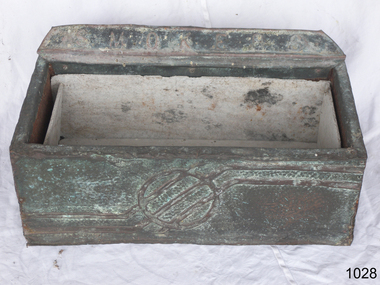
... ash from cigarettes and cigars and are typically made of fire retardant material such as glass, heat resistant plastic, pottery, metal, or stone. The most common ashtray design is a shallow cylinder with a flat base, designed to rest on a table. Other ashtrays, particularly in public places, are either wall or floor mounted. While simple, utilitarian forms of ashtrays existed long...ash from cigarettes and cigars and are typically made of fire retardant material such as glass, heat resistant plastic, pottery, metal, or stone. The most common ashtray design is a shallow cylinder with a flat base, designed to rest on a table. Other ashtrays, particularly in public places, are either wall or floor mounted. While simple, utilitarian forms of ashtrays existed long ...The word ashtray came into use around the 1920 and is a receptacle for ash from cigarettes and cigars and are typically made of fire retardant material such as glass, heat resistant plastic, pottery, metal, or stone. The most common ashtray design is a shallow cylinder with a flat base, designed to rest on a table. Other ashtrays, particularly in public places, are either wall or floor mounted. While simple, utilitarian forms of ashtrays existed long before the 19th century, it was during the start of the 20th century that the design, aesthetics and their popularity took off. As more women began to smoke. in the early 1900s, the ashtray went closer to being an art form as many women avoided the use of the traditional ashtray as it failed to reflect their feminine values, regarded as an item rather basic in design the general societal through of the time was that smoking was an activity exclusive to men. What emerged were detailed, often very fancy ashtrays acceptable to women depicting either pastoral scenes or vibrantly coloured landscapes. As time went on, and the onset of women smoking both cigars and cigarettes became less of a departure from the average person, ashtrays saw a decline in design and aesthetics beginning more of a shift towards practicality. The subject item is a primitive form of ashtray used in public spaces any time from the 1920-1960s and is not associated with an historic person or event. However the item could have come from the Warrnambool Town Hall given the inscription on the base of the item.Ash tray-large rectangular floor model with cement sheet lining. Made from a wooden box covered with textured metal on the outsideThe metal has a relief design embossed at the top back "smokers" and "Town Hall" printed on bottom.flagstaff hill, warrnambool, flagstaff-hill-maritime-museum, maritime-museum, shipwreck-coast, flagstaff-hill-maritime-village, ash tray, town hall, cigarette tray, smoker's ash tray -
 The Beechworth Burke Museum
Geological specimen - Thunderegg agates, Unknown
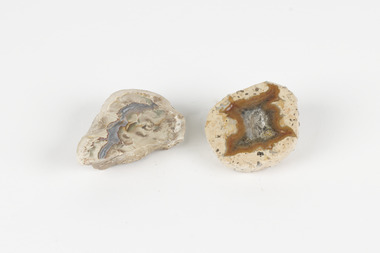
... ash layers. They are rough spherical shapes, varying in size from less than an inch to over a metre long. ...ash layers. They are rough spherical shapes, varying in size from less than an inch to over a metre long. ...Thunderegg Agates are formed within rhyolite volcanic ash layers. They are rough spherical shapes, varying in size from less than an inch to over a metre long. Thundereggs usually contain centres of chalcedony which may have been fractured followed by deposition of agate, jasper or opal, either uniquely or in combination. A unique characteristic that these specimens have is the fact that they often look like ordinary rocks on the outside, but slicing them in half and polishing them may reveal intricate patterns and colours. These particular specimens are examples of thunderegg agates. Agate is a variety of chalcedony, a cryptocrystalline form of quartz. The agate component contributes to the intriguing internal patterns of the specimens. The specific locality of these specimens is unknown but they can be found in flows of rhyolite lava. They are formed in gas pockets in the lava, which act as moulds. These specimens can be found globally, with specific locations in Germany being particularly abundant. This specimen is part of a larger collection of geological and mineral specimens collected from around Australia (and some parts of the world) and donated to the Burke Museum between 1868-1880. A large percentage of these specimens were collected in Victoria as part of the Geological Survey of Victoria that begun in 1852 (in response to the Gold Rush) to study and map the geology of Victoria. Collecting geological specimens was an important part of mapping and understanding the scientific makeup of the earth. Many of these specimens were sent to research and collecting organisations across Australia, including the Burke Museum, to educate and encourage further study.Two small solid specimens with pale, sandy-coloured exteriors and fractured internal patterns. burke museum, beechworth, geological, geological specimen, thundereggs, thundereggs agate, agate, rhyolite, rhyolite lava, volcanic ash, chalcedony, cryptocrystalline -
 Flagstaff Hill Maritime Museum and Village
Functional object - Floor ash Tray, 1900 to 1960s
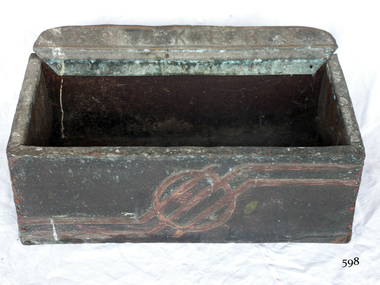
... ash from cigarettes and cigars and are typically made of fire retardant material such as glass, heat resistant plastic, pottery, metal, or stone. The most common ashtray design is a shallow cylinder with a flat base, designed to rest on a table. Other ashtrays, particularly in public places, are either wall or floor mounted. While simple, utilitarian forms of ashtrays existed long...ash from cigarettes and cigars and are typically made of fire retardant material such as glass, heat resistant plastic, pottery, metal, or stone. The most common ashtray design is a shallow cylinder with a flat base, designed to rest on a table. Other ashtrays, particularly in public places, are either wall or floor mounted. While simple, utilitarian forms of ashtrays existed long ...The word ashtray came into use around the 1920 and is a receptacle for ash from cigarettes and cigars and are typically made of fire retardant material such as glass, heat resistant plastic, pottery, metal, or stone. The most common ashtray design is a shallow cylinder with a flat base, designed to rest on a table. Other ashtrays, particularly in public places, are either wall or floor mounted. While simple, utilitarian forms of ashtrays existed long before the 19th century, it was during the start of the 20th century that the design, aesthetics and their popularity took off. As more women began to smoke. in the early 1900s, the ashtray went closer to being an art form as many women avoided the use of the traditional ashtray as it failed to reflect their feminine values, regarded as an item rather basic in design the general societal through of the time was that smoking was an activity exclusive to men. What emerged were detailed, often very fancy ashtrays acceptable to women depicting either pastoral scenes or vibrantly coloured landscapes. As time went on, and the onset of women smoking both cigars and cigarettes became less of a departure from the average person, ashtrays saw a decline in design and aesthetics beginning more of a shift towards practicality. The subject item is a primitive form of ashtray used in public spaces any time from the 1900 -1960s and is not associated with an historic person or event. However the item could have come from the Warrnambool Town Hall given the inscription on the base of the item.Ash tray-large rectangular floor model made from a wooden box covered with textured metal on the outsideThe metal has a relief design embossed at the top back "smokers" and "Town Hall" printed on bottom.flagstaff hill, warrnambool, flagstaff-hill-maritime-museum, maritime-museum, shipwreck-coast, flagstaff-hill-maritime-village, ash tray -
 City of Moorabbin Historical Society (Operating the Box Cottage Museum)
Tools, hammer upholstering, c1900
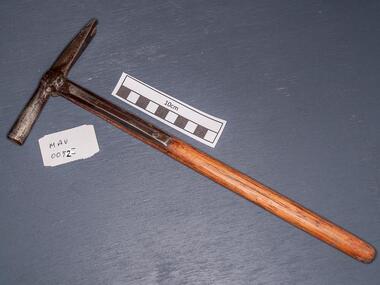
... If wood is used for the handle, it is often ash or hickory, which are tough and long lasting materials that can dissipate shock waves from the hammer head. ...If wood is used for the handle, it is often ash or hickory, which are tough and long lasting materials that can dissipate shock waves from the hammer head. ...A hammer is a tool with a heavy head and a handle, often made of shock absorbent wood or fibreglass, that is used to strike an object. The most common use for hammers are to drive nails, fit parts, forge metal and break apart objects. Hammers vary in size, shape and structure, depending on their uses. Hammers are basic tools in many trades. A hammer is composed of a head, most often made of steel and handle also called a helve or haft. Most hammers are hand tools. A traditional hand-held hammer consists of a separate head and handle, fastened together by means of a special wedge made for the purpose, or by glue, or by both . This 2 piece design is often used to combine a dense metallic striking head with a non-metallic mechanical shock absorbing handle - to reduce user fatigue from repeated strikes. If wood is used for the handle, it is often ash or hickory, which are tough and long lasting materials that can dissipate shock waves from the hammer head. This upholsterer’s hammer has one end of the steel head rounded for knocking nails into wood furniture. The other end is divided to form a 2 pronged claw for withdrawing nails. . An upholsterer's hammer with a steel head and wooden handle, The steel head has one rounded end and a clawed endpioneers, early settlers, market gardeners, moorabbin, bentleigh, cheltenham, brighton, tools, craftsman, carpenters, cabinet makers, blacksmiths, builders, woodwork -
 City of Moorabbin Historical Society (Operating the Box Cottage Museum)
Tools, wooden hammer with steel head, c1900
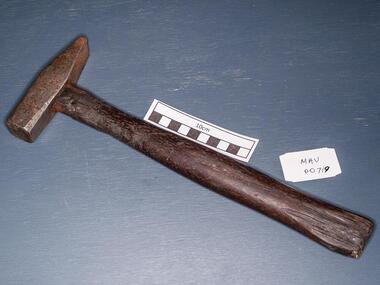
... If wood is used for the handle, it is often hickory or ash, which are tough and long-lasting materials that can dissipate shock waves from the hammer head. ...If wood is used for the handle, it is often hickory or ash, which are tough and long-lasting materials that can dissipate shock waves from the hammer head. pioneers, early settlers, market gardeners, moorabbin, brighton, cheltenham, tools, craftsman, carpenters, blacksmiths, builders, woodwork, A well used hammer with wooden handle and steel head Tools, wooden hammer with steel head Early settler ...A hammer is a tool with a heavy head and a handle, often made of shock-absorbent wood or fiberglass that is used to strike an object. The most common uses for hammers are to drive nails, fit parts, forge metal, and break apart objects. Hammers vary in shape, size, and structure, depending on their uses. Hammers are basic tools in many trades. A hammer is composed of a head most often made of steel and a handle also called a helve or haft. Most hammers are hand tools. A traditional hand-held hammer consists of a separate head and a handle, fastened together by means of a special wedge made for the purpose, or by glue, or both. This two-piece design is often used, to combine a dense metallic striking head with a non-metallic mechanical-shock-absorbing handle -to reduce user fatigue from repeated strikes. If wood is used for the handle, it is often hickory or ash, which are tough and long-lasting materials that can dissipate shock waves from the hammer head. A well used hammer with wooden handle and steel headpioneers, early settlers, market gardeners, moorabbin, brighton, cheltenham, tools, craftsman, carpenters, blacksmiths, builders, woodwork, -
 The Beechworth Burke Museum
Animal specimen - Squirrel, Trustees of the Australian Museum, 1860-1880
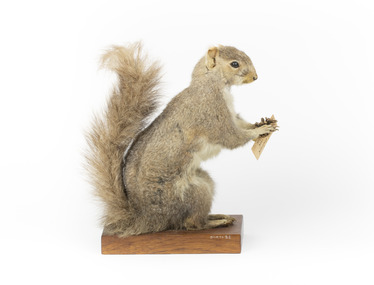
... It has grey/ash coloured fur with a pale belly and dark coloured glass eyes. It has a long and bushy tail that stands along its back in an arched shape. ...It has grey/ash coloured fur with a pale belly and dark coloured glass eyes. It has a long and bushy tail that stands along its back in an arched shape. ...The Squirrel is a small to medium sized member of the rodent family Sciuridae. They are commonly located in America, Eurasia and Africa. The Squirrel was introduced to Australia by humans. Interestingly, the tail of the Squirrel serves the purpose of keeping the rain, wind or cold off the body of the animal, to help it cool off in hot weather, to counterbalance when moving and can be utilized as a parachute when jumping from one location to the next. Squirrels consume foods that are rich in protein, carbohydrates and fats. They eat nuts, seeds. fruits and vegetation. This specimen is part of a collection of almost 200 animal specimens that were originally acquired as skins from various institutions across Australia, including the Australian Museum and the National Museum of Victoria, as well as individuals such amateur anthropologist Reynell Eveleigh Johns between 1860-1880. These skins were then mounted by members of the Burke Museum Committee and put-on display in the formal space of the Museum’s original exhibition hall where they continue to be on display. This display of taxidermy mounts initially served to instruct visitors to the Burke Museum of the natural world around them, today it serves as an insight into the collecting habits of the 19th century.This specimen is part of a significant and rare taxidermy mount collection in the Burke Museum. This collection is scientifically and culturally important for reminding us of how science continues to shape our understanding of the modern world. They demonstrate a capacity to hold evidence of how Australia’s fauna history existed in the past and are potentially important for future environmental research. This collection continues to be on display in the Museum and has become a key part to interpreting the collecting habits of the 19th century.Grey Squirrel standing on a wooden platform. The small sized specimen holds a pinecone between its hands and has a paper identification tag tied to one of its arms. It has grey/ash coloured fur with a pale belly and dark coloured glass eyes. It has a long and bushy tail that stands along its back in an arched shape. It has tiny hands and feet.40. ash-coloured / Squirrel / Catalogue, Page, 49. / A.4484 / BMM 75 32 /taxidermy mount, taxidermy, animalia, burke museum, beechworth, australian museum, skin, reynell eveleigh johns, squirrel -
Queenscliffe Maritime Museum
Leisure object - Model- PS Hygeia
... long, she was an enormous paddler, outclassing the luxurious Ozone and surviving in service until 1930. In 1932 her stripped shell was scuttled off Barwon Head. The PS ‘Hygeia’ was a paddle steamer, built by Napier, Shanks & Bell, in Glasgow, Scotland, in 1890. When the paddle steamer PS ‘Hygeia’ was built, in 1890, she was considered the largest and fastest bay steamer afloat. She was capable of carrying up to 2,000 passengers and crew and was finished to the highest of standards. The state rooms were lavishly adorned in polished Oak, Hungarian Ash...long, she was an enormous paddler, outclassing the luxurious Ozone and surviving in service until 1930. In 1932 her stripped shell was scuttled off Barwon Head. The PS ‘Hygeia’ was a paddle steamer, built by Napier, Shanks & Bell, in Glasgow, Scotland, in 1890. When the paddle steamer PS ‘Hygeia’ was built, in 1890, she was considered the largest and fastest bay steamer afloat. She was capable of carrying up to 2,000 passengers and crew and was finished to the highest of standards. The state rooms were lavishly adorned in polished Oak, Hungarian Ash ...Hygeia Built in 1890 by Napier, Shanks & Bell of Yoker, Scotland (yard no 49). At 300 ft (92 m) long, she was an enormous paddler, outclassing the luxurious Ozone and surviving in service until 1930. In 1932 her stripped shell was scuttled off Barwon Head. The PS ‘Hygeia’ was a paddle steamer, built by Napier, Shanks & Bell, in Glasgow, Scotland, in 1890. When the paddle steamer PS ‘Hygeia’ was built, in 1890, she was considered the largest and fastest bay steamer afloat. She was capable of carrying up to 2,000 passengers and crew and was finished to the highest of standards. The state rooms were lavishly adorned in polished Oak, Hungarian Ash, Walnut and Sycamore – decorated with gilded pilasters. She would carry some 3,000,000 passengers around Port Phillip Bay in Victoria, during her career of 41 years. The PS ‘Hygeia’ was considered far too young to be scuttled and sent to an early grave – just outside Port Phillip Heads . . .Scale model of PS Hygeia -
 Warrnambool and District Historical Society Inc.
Promotion, Olympic games Melb 1956, 1956
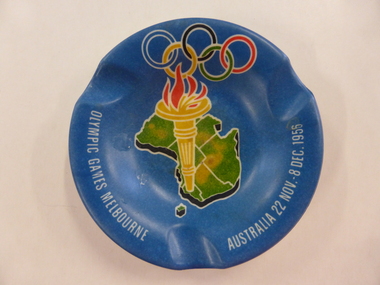
... longer socially and medically acceptable. It will be useful for display. olympic games melbourne 1956 olympics ‘Olympic Games Melbourne Australia 22 Nov. - 8 Dec. 1956’ ‘British Plastics Pty Ltd Melbourne Reg. Des.’ This is a plastic circular ash ...This ash tray is a souvenir of the Olympic Games held in Melbourne in 1956. This was an important event in post World War Two Australia and the first time the Olympic Games had been held in the Southern Hemisphere. The Opening and Closing Ceremonies, the athletics events and some other events were held at the Melbourne Cricket Ground. These were the first televised Olympic Games. To mark the occasion many souvenir items were produced for tourists and collectors.This item is kept as a memento of the 1956 Melbourne Olympic Games, an event that interested and affected all Australians as it made Melbourne and Australia via press and television coverage etc. the centre of attention in the world at the time. It is also a memento that would no longer be made or sold today as cigarette smoking in general is no longer socially and medically acceptable. It will be useful for display.This is a plastic circular ash tray. It has a blue base with a multi-coloured image in the centre of the base of a map of Australia, an Olympic Games torch and the Olympic Games ring motifs. The printing is in white and the name of the maker is embossed on the back of the tray. There are three indents around the base for stubbing out the cigarettes. ‘Olympic Games Melbourne Australia 22 Nov. - 8 Dec. 1956’ ‘British Plastics Pty Ltd Melbourne Reg. Des.’ olympic games melbourne, 1956 olympics -
 Bendigo Historical Society Inc.
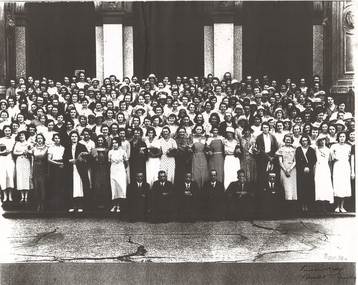
Document - LONG GULLY HISTORY GROUP COLLECTION: PHOTO HANRO STAFF & WORKERS APPROX 1933
... Long Gully History Group - Photo Hanro Staff & Workers approx 1933... Vincent Kelly... Hanro Mills Bendigo... Allan Crossley... G Evely... T Hall... M ?sen... M Owens... I Hutchinson... L Ash...BENDIGO History long gully history group The Long Gully History Group - Photo Hanro Staff & Workers approx 1933 Vincent Kelly Hanro Mills Bendigo Allan Crossley G Evely T Hall M ?sen M Owens I Hutchinson L Ash ...The Hanro company was established in Switzerland in 1884. In 1926 a site in Hargreaves Street Bendigo, behind the School of Mines, was purchased to establish the Bendigo Knitting Mills, a subsidiary of Hanro. The managing director was Charles Handerchin who came from Switzerland. The company was delisted from the Australian Stock Exchange in 1963 when it was taken over by John Brown Industries.Photocopy of a photo by Vincent Kelly of the Hanro Staff and Workers taken on the steps of Bendigo Post Office appros 1933. Names on the back are: Allan Crossley, G Evely,T Hall, M ?sen, M Owens, I Hutchinson, L Ash, C Tyers, L Thornton, R Dixon, I Newson, Phill Ipson, E Kent, L Comte, D Pinnell, M Thomas, C Washington, K Bowman, M Kelly, M Tussup, R Shaw, ? Henson, C Washington, E Rodgers, S Brown, P Pearce, D Thornton, L Rielly, L Truscott, R Brereton, P Taylor, Norris, D Miller, C Enderlin, D Harward, J Lockyer, D Butters, Marc Curnow, B Organ, E Lindsay, L Smart, E Ogilvie, G Crossley, M Newwand, Newmand, Truscott, C Ildae, O Richards, B Richards, C Kingsley, ?, F Mylon, Z Wallen, J Thom, P Trehair, E Crawford, F Chandler, E Hogan, G Blandthorn, J Thom, L Henson, E Stephens, J Gerrand, L Doney, M Williams, C Brauman, R Shaw, L Rushmeyer, R F Wr, L Wright, L - R, A McCormack, S Swalling, I West, J Bolger, L Swalling,B Patterson, T Williams, M Shepherd, J Aitken, A Phillips, M Smith, M Williams, S Ross, J Punch, S Dunne, P Warren, E Keck, J Pinder, W Stock, V Akers, J Neate, M Doyle, M Neate, M Marchingo, C Collard, Iris Dobie, M Irvine, D Nalder, M McPherson, Marg, Alma Rank, D Edwards, Z Excell, M McGuiness, A Christie, ? Beer, Male R. J Preston, J Mueller, F Harris, T Robertson, R Hiscock and T Lund. Names by Moreen Betts (Marchingo). Two pages are the same and one only has part of a photo on it. Written beside it is: Hanro Mills, Bendigo. Photo of Staff & Employers. Approx 1933 - 34. Picture with Allan Crossley. x On last page is Alans Sister.Vincent Kellybendigo, history, long gully history group, the long gully history group - photo hanro staff & workers approx 1933, vincent kelly, hanro mills bendigo, allan crossley, g evely, t hall, m ?sen, m owens, i hutchinson, l ash, c tyers, l thornton, r dixon, i newson, phill ipson, e kent, l comte, d pinnell, m thomas, c washington, k bowman, m kelly, m tussup, r shaw, ? henson, c washington, e rodgers, s brown, p pearce, d thornton, l rielly, l truscott, r brereton, p taylor, norris, d miller, c enderlin, d harward, j lockyer, d butters, marc curnow, b organ, e lindsay, l smart, e ogilvie, g crossley, m newwand, newmand, truscott, c ildae, o richards, b richards, c kingsley, ?, f mylon, z wallen, j thom, p trehair, e crawford, f chandler, e hogan, g blandthorn, j thom, l henson, e stephens, j gerrand, l doney, m williams, c brauman, r shaw, l rushmeyer, r f wr, l wright, l - r, a mccormack, s swalling, i west, j bolger, l swalling, b patterson, t williams, m shepherd, j aitken, a phillips, m smith, m williams, s ross, j punch, s dunne, p warren, e keck, j pinder, w stock, v akers, j neate, m doyle, m neate, m marchingo, c collard, iris dobie, m irvine, d nalder, m mcpherson, marg, alma rank, d edwards, z excell, m mcguiness, a christie, ? beer, male r. j preston, j mueller, f harris, t robertson, r hiscock, t lund, moreen betts (marchingo), bendigo post office -
 Bendigo Historical Society Inc.
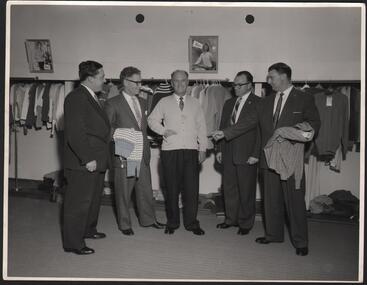
Photograph - HANRO COLLECTION: PHOTOGRAPH OF FIVE MEN IN THE SAMPLE ROOM AT HANRO'S
... long rack of sample clothing. On the wall above the racks are two picture frames with women modelling a cardigan. On the back, handwritten in blue ink is *Hanro Mills*. Typed in black ink is: *Left to Right: J. Batten, L. Ash...long rack of sample clothing. On the wall above the racks are two picture frames with women modelling a cardigan. On the back, handwritten in blue ink is *Hanro Mills*. Typed in black ink is: *Left to Right: J. Batten, L. Ash ...Photograph of Five staff in the sample room at Hanno's: Four staff members looking at one modelling a Hanro cardigan. Two of the staff hold knitwear. At the back of the men is a long rack of sample clothing. On the wall above the racks are two picture frames with women modelling a cardigan. On the back, handwritten in blue ink is *Hanro Mills*. Typed in black ink is: *Left to Right: J. Batten, L. Ash, E. Stewart, J. Price, N Stapleton. A cream sticker with blue strip. In the strip is *Reg. V. Brook* top, and bottom in a blue strip *Of Bendigo*. In the middle No. *H1216. Pos. B* Additional copies may be obtained at any time by quoting this number. Also handwritten in pencil is *CRV. Sept. D/C Charge: John Higgins Publicity, 42 William Street. Melbourne. At the top of the photo are two holes 7.3cm apart for storing in a folder. Box 116Ahanro, bendigo businesses -
 Warrnambool and District Historical Society Inc.
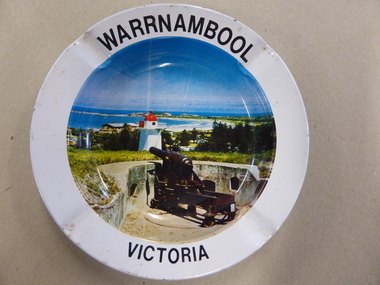
Ashtray, Mid 20th century
... ash tray sold to tourists as a souvenir of a visit to Warrnambool. It would have been relatively cheap to buy. Souvenirs such as this were mass-produced for the tourist market and a relevant photograph inserted on the base to suit the town or settlement where they were sold. As cigarette-smoking is no longer...ash tray sold to tourists as a souvenir of a visit to Warrnambool. It would have been relatively cheap to buy. Souvenirs such as this were mass-produced for the tourist market and a relevant photograph inserted on the base to suit the town or settlement where they were sold. As cigarette-smoking is no longer ...This is an ash tray sold to tourists as a souvenir of a visit to Warrnambool. It would have been relatively cheap to buy. Souvenirs such as this were mass-produced for the tourist market and a relevant photograph inserted on the base to suit the town or settlement where they were sold. As cigarette-smoking is no longer so socially acceptable, items such as this one are no longer sold as tourist souvenirs. This item is of interest as an example of the type of souvenir sold to tourists in Australia in the first half of the 20th century, probably in the 1940s or 1950s. It is of particular local interest because it contains a photograph of Warrnambool during that time. This is a souvenir tin ash tray circular in shape. It has a colour photograph of Warrnambool inserted into the base of the dish (Flagstaff Hill showing part of the fortifications, the Lower Lighthouse, a camping ground and Warrnambool Bay). The ash tray has three lips on the side of the dish for resting a cigarette. The base is gold-coloured and is slightly tarnished. ‘Warrnambool Victoria’ tourism in warrnambool -
 Warrnambool and District Historical Society Inc.
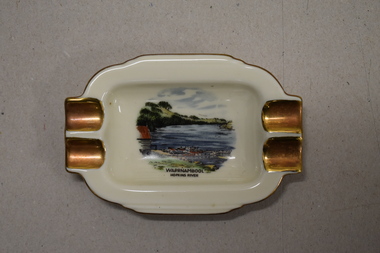
Ashtray, Alka Kunst, Warrnambool Hopkins River, c. 1960
... The boatshed is no longer there with sections of the building being relocated to a site in Henna Street and used for indoor recreational purposes. This ash ...This item was bought as a souvenir of Warrnambool in the mid 20th century when cigarette smoking was more widespread and was socially acceptable. Tourism in Warrnambool has been an important industry for over 100 years. In the late 19th century Warrnambool was promoted as a spa resort with its mild climate, sea bathing and its hot and cold sea water baths complex. Today visitors come in winter for the May Racing Carnival and to see the Southern Right whales at Logans Beach and in summer they come for a beach holiday. The image on the dish shows the Warrnambool Hopkins River near its mouth. The boatshed is no longer there with sections of the building being relocated to a site in Henna Street and used for indoor recreational purposes.This ash tray is retained as an example of a local tourist souvenir sold to tourists in the 1960s. This is a small white china dish made in an oval shape and slightly raised from the surface on which it sits. The ends of the dish have four gold coloured indents for stubbing cigarettes. There is a gold rim around the edge of the dish and a coloured image of the old boat shed and jetty on the Hopkins River in Warrnambool. On the base of the dish is the logo of the maker and printed details.Warrnambool Hopkins River Alka Kunst Bavaria tourism in warrnambool, history of warrnambool -
 National Wool Museum
Tool - Stencil, c.2018
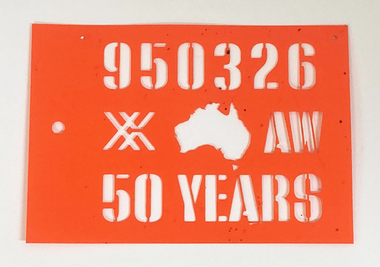
... long career classing wool. In the early 1980s, when Denis was leasing two properties including his father’s, things were going well until drought struck. February 1983 was the date of the Ash...long career classing wool. In the early 1980s, when Denis was leasing two properties including his father’s, things were going well until drought struck. February 1983 was the date of the Ash ...The story of 90 years of wool classing between father & son begins in 1936, when a young boy by the name of Stanley James Hucker walked through the doors of the Gordon Technical School in Geelong. Born in 1921, Stanley was 15 years of age when he began his 3-year course in Wool Classing. 30 years later, Stanley’s second son Denis completed the same 3-year wool classing course. Beginning in 1966, Denis attended the same Gordon Technical School and walked the same halls as his father before him. Stanley finished his course in 1938. He went back to the family farm in Lake Bolac for a brief period before enrolling in the Second World War. At the completion of the war, Stanley returned home and married before gaining a soldier settler allotment, north of Willaura. This enabled Stan to use his wool classing knowledge. He ran between 1,500 and 2,000 sheep for many years, while his wool classer stencil also allowed him to go out and class at various sheds around the area. He held his stencil from 1938 until he retired at the age of 60 in 1981. On retirement, his second son Denis was working in the district, managing a local property while also leasing land himself. Upon his father’s retirement, Denis had the opportunity to lease his father’s farm, an opportunity he could not refuse. Denis had finished his wool classing course at the Gordon Technical School in 1968, graduating dux of his class. He began working with a local contractor and started classing wool in his team. Denis gained a great deal of experience working as part of this team in big sheds of up to 8 stands servicing between 10 & 20,000 sheep. It was not all smooth sailing for Denis however, and he soon learnt an important lesson. Class wool the way you’re taught, don’t listen to the owner standing over your shoulder. At a clip of Corriedales near Casterton, Denis was pushing too many fleeces into the line of fine wool. This resulted in a notice from the Australian Wool Exchange (AWEX) “mixing counts too much, submit three clips for inspection”. Denis was able to submit 3 clips with no further complaints, however, this proved a valuable lesson he would never forget over his long career classing wool. In the early 1980s, when Denis was leasing two properties including his father’s, things were going well until drought struck. February 1983 was the date of the Ash Wednesday bushfires, and saw Melbourne have three days over 40 °C for only the second time on record. This period saw Denis give away farming, turning towards contracting work instead. After the difficult times of the early 1980s, the next two decades were a good time for the sheep industry. 15 micron wool was selling for prices between 4 to 5,000 cents per kilo, double what you’d expect for the same wool in 2022. In 1995 a single bale of wool sold for a million dollars. This was a good time for Denis too. His contracting work saw him employing local shearers and shed staff. His team was involved with the shearing and classing of more than 130,000 sheep. After 20 years of contracting, it was time for Denis to transition into the next phase of his life. He gave up independent contracting, preferring instead to return to being a member of someone else’s team. In 2018, having completed 50 years of wool classing, it was time to call it a day and retire completely. At the annual Gordon Wool School Old Students Association dinner held in 2018, Denis was presented with his 50 years as a registered wool classer stencil awarded by the Australian Wool Exchange (AWEX). This is a rare honour achieved by few. As of February 2020, a total of 430 wool classers had achieved this 50-year milestone. For Denis however, his proudest achievement is achieving 90 years of wool classing with his father. The National Wool Museum is proud to share the collection of objects gained from 90 years in the wool classing industry by Stanley and Denis. This ranges from Stanley’s first stencil and Wool Sample book, started when he first attended the Gordon in 1936. The collection concludes 90 years later with Denis’ 50 years of wool classing Stencil. The collection contains many more objects, all telling the story of these 90 years, and the hard work invested by this dedicated father and son duo. Thin sheet of orange plastic with letters and numbers moulded to produce a consistent pattern for the surface below through the application of ink. This wool classing stencil once belonged to Denis Hucker. The top number is Denis’ Wool Classing Stencil Number. On the next line is the emblem of the Australian Wool Exchange, followed by an image of Australia, and finally the letters AW. The final line reads 50 years, indicating Denis’ experience in the profession of wool classing. This stencil is reserved for wool classers who have held their stencil and been actively classing wool in Australia for more than 50 years. Wool classers sort, classify, and grade wool into various lines so that it can be sold at best market price. They also manage and supervise wool-handling teams. The stencil is used in the final step of preparing a bale of wool for sale. It is branded across the front of a wool bale to indicate the quality of the wool, with the classers number used as a seal of approval. Accompanying the stencil are two sheets of white A4 paper with printing in gold and black ink. The first sheet was presented by the Australian Council of Wool Exporters & Processors to Denis Hucker for achieving 50 years of wool classing. Surrounded by a thin gold boarder, the page is made up of black text with gold headings. In the top right corner, an image of a sheep with an outline of Australia is found. The second piece of paper was presented by the Australian Wool Exchange to Denis Hucker for achieving 50 years of wool classing. Two thirds of the page is made up of a gold stencil which reads “50 years”. Accompanying the stencil is black text. Moulded letters, numbers, emblem, and imagery. “950326 / (emblem AWEX) (Image Australia) AW / 50 Years” A4 Paper. Printed. See Multimedia A4 Paper. Printed See Multimedia wool classing, stencil, 90 years wool classing between father & son -
 National Wool Museum
Tool - Stencil, 1983
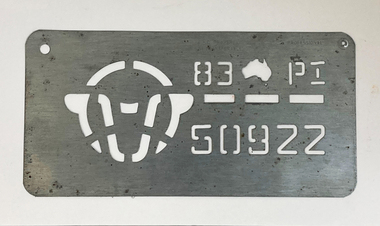
... long career classing wool. In the early 1980s, when Denis was leasing two properties including his father’s, things were going well until drought struck. February 1983 was the date of the Ash...long career classing wool. In the early 1980s, when Denis was leasing two properties including his father’s, things were going well until drought struck. February 1983 was the date of the Ash ...The story of 90 years of wool classing between father & son begins in 1936, when a young boy by the name of Stanley James Hucker walked through the doors of the Gordon Technical School in Geelong. Born in 1921, Stanley was 15 years of age when he began his 3-year course in Wool Classing. 30 years later, Stanley’s second son Denis completed the same 3-year wool classing course. Beginning in 1966, Denis attended the same Gordon Technical School and walked the same halls as his father before him. Stanley finished his course in 1938. He went back to the family farm in Lake Bolac for a brief period before enrolling in the Second World War. At the completion of the war, Stanley returned home and married before gaining a soldier settler allotment, north of Willaura. This enabled Stan to use his wool classing knowledge. He ran between 1,500 and 2,000 sheep for many years, while his wool classer stencil also allowed him to go out and class at various sheds around the area. He held his stencil from 1938 until he retired at the age of 60 in 1981. On retirement, his second son Denis was working in the district, managing a local property while also leasing land himself. Upon his father’s retirement, Denis had the opportunity to lease his father’s farm, an opportunity he could not refuse. Denis had finished his wool classing course at the Gordon Technical School in 1968, graduating dux of his class. He began working with a local contractor and started classing wool in his team. Denis gained a great deal of experience working as part of this team in big sheds of up to 8 stands servicing between 10 & 20,000 sheep. It was not all smooth sailing for Denis however, and he soon learnt an important lesson. Class wool the way you’re taught, don’t listen to the owner standing over your shoulder. At a clip of Corriedales near Casterton, Denis was pushing too many fleeces into the line of fine wool. This resulted in a notice from the Australian Wool Exchange (AWEX) “mixing counts too much, submit three clips for inspection”. Denis was able to submit 3 clips with no further complaints, however, this proved a valuable lesson he would never forget over his long career classing wool. In the early 1980s, when Denis was leasing two properties including his father’s, things were going well until drought struck. February 1983 was the date of the Ash Wednesday bushfires, and saw Melbourne have three days over 40 °C for only the second time on record. This period saw Denis give away farming, turning towards contracting work instead. After the difficult times of the early 1980s, the next two decades were a good time for the sheep industry. 15 micron wool was selling for prices between 4 to 5,000 cents per kilo, double what you’d expect for the same wool in 2022. In 1995 a single bale of wool sold for a million dollars. This was a good time for Denis too. His contracting work saw him employing local shearers and shed staff. His team was involved with the shearing and classing of more than 130,000 sheep. After 20 years of contracting, it was time for Denis to transition into the next phase of his life. He gave up independent contracting, preferring instead to return to being a member of someone else’s team. In 2018, having completed 50 years of wool classing, it was time to call it a day and retire completely. At the annual Gordon Wool School Old Students Association dinner held in 2018, Denis was presented with his 50 years as a registered wool classer stencil awarded by the Australian Wool Exchange (AWEX). This is a rare honour achieved by few. As of February 2020, a total of 430 wool classers had achieved this 50-year milestone. For Denis however, his proudest achievement is achieving 90 years of wool classing with his father. The National Wool Museum is proud to share the collection of objects gained from 90 years in the wool classing industry by Stanley and Denis. This ranges from Stanley’s first stencil and Wool Sample book, started when he first attended the Gordon in 1936. The collection concludes 90 years later with Denis’ 50 years of wool classing Stencil. The collection contains many more objects, all telling the story of these 90 years, and the hard work invested by this dedicated father and son duo. Thin sheet of metal with letters and numbers cut to produce a consistent pattern for the surface below through the application of ink. In small text on the top edge of the stencil two separate phrases are engraved.” A.W.C. PROPERTY NOT TRANSFERABLE” and “PROFESSIONAL“. This wool classing stencil belonged to Stanley Hucker. It was his last Wool Classing Stencil. Dated to 1983, it is 45 years older than his first stencil. The role of a Wool Classer is to sort, classify, and grade wool into various ‘lines’ so that it can be sold for best market price. Wool Classers are typically also tasked with the managing and supervising of wool-handling teams. The stencil is used in the final step of preparing a bale of wool for sale. It is branded across the front of a wool bale to indicate the quality of the wool, with the classers number used as a seal of guarantee.Engraved letters. “A.W.C. PROPERTY / NOT TRANSFERABLE” Engraved letters. “PROFESSIONAL“. Cut imagery. Sheep’s head Cut letters, numbers, and imagery. “83 (Image Australia) P I / 50922”wool classing, stencil, 90 years wool classing between father & son -
 National Wool Museum
Book - Wool Classing Exercise Book, 1936-38
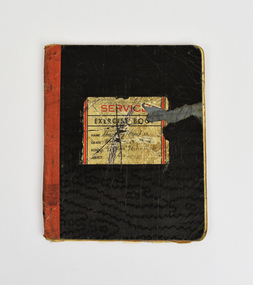
... long career classing wool. In the early 1980s, when Denis was leasing two properties including his father’s, things were going well until drought struck. February 1983 was the date of the Ash...long career classing wool. In the early 1980s, when Denis was leasing two properties including his father’s, things were going well until drought struck. February 1983 was the date of the Ash ...The story of 90 years of wool classing between father & son begins in 1936, when a young boy by the name of Stanley James Hucker walked through the doors of the Gordon Technical School in Geelong. Born in 1921, Stanley was 15 years of age when he began his 3-year course in Wool Classing. 30 years later, Stanley’s second son Denis completed the same 3-year wool classing course. Beginning in 1966, Denis attended the same Gordon Technical School and walked the same halls as his father before him. Stanley finished his course in 1938. He went back to the family farm in Lake Bolac for a brief period before enrolling in the Second World War. At the completion of the war, Stanley returned home and married before gaining a soldier settler allotment, north of Willaura. This enabled Stan to use his wool classing knowledge. He ran between 1,500 and 2,000 sheep for many years, while his wool classer stencil also allowed him to go out and class at various sheds around the area. He held his stencil from 1938 until he retired at the age of 60 in 1981. On retirement, his second son Denis was working in the district, managing a local property while also leasing land himself. Upon his father’s retirement, Denis had the opportunity to lease his father’s farm, an opportunity he could not refuse. Denis had finished his wool classing course at the Gordon Technical School in 1968, graduating dux of his class. He began working with a local contractor and started classing wool in his team. Denis gained a great deal of experience working as part of this team in big sheds of up to 8 stands servicing between 10 & 20,000 sheep. It was not all smooth sailing for Denis however, and he soon learnt an important lesson. Class wool the way you’re taught, don’t listen to the owner standing over your shoulder. At a clip of Corriedales near Casterton, Denis was pushing too many fleeces into the line of fine wool. This resulted in a notice from the Australian Wool Exchange (AWEX) “mixing counts too much, submit three clips for inspection”. Denis was able to submit 3 clips with no further complaints, however, this proved a valuable lesson he would never forget over his long career classing wool. In the early 1980s, when Denis was leasing two properties including his father’s, things were going well until drought struck. February 1983 was the date of the Ash Wednesday bushfires, and saw Melbourne have three days over 40 °C for only the second time on record. This period saw Denis give away farming, turning towards contracting work instead. After the difficult times of the early 1980s, the next two decades were a good time for the sheep industry. 15 micron wool was selling for prices between 4 to 5,000 cents per kilo, double what you’d expect for the same wool in 2022. In 1995 a single bale of wool sold for a million dollars. This was a good time for Denis too. His contracting work saw him employing local shearers and shed staff. His team was involved with the shearing and classing of more than 130,000 sheep. After 20 years of contracting, it was time for Denis to transition into the next phase of his life. He gave up independent contracting, preferring instead to return to being a member of someone else’s team. In 2018, having completed 50 years of wool classing, it was time to call it a day and retire completely. At the annual Gordon Wool School Old Students Association dinner held in 2018, Denis was presented with his 50 years as a registered wool classer stencil awarded by the Australian Wool Exchange (AWEX). This is a rare honour achieved by few. As of February 2020, a total of 430 wool classers had achieved this 50-year milestone. For Denis however, his proudest achievement is achieving 90 years of wool classing with his father. The National Wool Museum is proud to share the collection of objects gained from 90 years in the wool classing industry by Stanley and Denis. This ranges from Stanley’s first stencil and Wool Sample book, started when he first attended the Gordon in 1936. The collection concludes 90 years later with Denis’ 50 years of wool classing Stencil. The collection contains many more objects, all telling the story of these 90 years, and the hard work invested by this dedicated father and son duo. This is the first in a series of 5 wool classing exercise books. They were written by Stanley Hucker in his time at the Gordon Technical College from 1936-1938. This book begins in a cover of black vinyl with a strip of red tape on the spine to give added support. Some of the vinyl has been removed on the cover, revealing blue card beneath. A sticker label is also found on the front cover. It has been damaged. Part of the sticker has been removed, while blue ink can also be found obscuring the text below. Internally, the book is handwritten on yellowed pages with blue lines for the assistance in clarity of handwriting. The pages are also surrounded by a margin of red pen. The exercise book’s content is about veterinary studies relating to the diseases, injuries, and treatment of sheep. It is handwritten and accompanied by an occasional hand drawn diagram. A selection of pages have been photographed to give an impression of the information taught in classes, 90 years ago. This includes information about a sheep’s heart, hind limbs, and reproduction system in ewes. Front Cover. Wording, printed and handwritten “SERVICE / EXERCISE BOOK / NAME Stanley Hucker / GRADE wool classing / SCHOOL Gordon Technical / SUBJECT Veterinary”gordon institute geelong, wool classing, 1930s sheep farming, 90 years wool classing between father & son -
 National Wool Museum
Book - Wool Classing Exercise Book, 1936-38
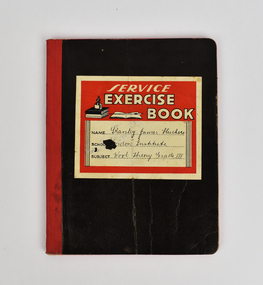
... long career classing wool. In the early 1980s, when Denis was leasing two properties including his father’s, things were going well until drought struck. February 1983 was the date of the Ash...long career classing wool. In the early 1980s, when Denis was leasing two properties including his father’s, things were going well until drought struck. February 1983 was the date of the Ash ...The story of 90 years of wool classing between father & son begins in 1936, when a young boy by the name of Stanley James Hucker walked through the doors of the Gordon Technical School in Geelong. Born in 1921, Stanley was 15 years of age when he began his 3-year course in Wool Classing. 30 years later, Stanley’s second son Denis completed the same 3-year wool classing course. Beginning in 1966, Denis attended the same Gordon Technical School and walked the same halls as his father before him. Stanley finished his course in 1938. He went back to the family farm in Lake Bolac for a brief period before enrolling in the Second World War. At the completion of the war, Stanley returned home and married before gaining a soldier settler allotment, north of Willaura. This enabled Stan to use his wool classing knowledge. He ran between 1,500 and 2,000 sheep for many years, while his wool classer stencil also allowed him to go out and class at various sheds around the area. He held his stencil from 1938 until he retired at the age of 60 in 1981. On retirement, his second son Denis was working in the district, managing a local property while also leasing land himself. Upon his father’s retirement, Denis had the opportunity to lease his father’s farm, an opportunity he could not refuse. Denis had finished his wool classing course at the Gordon Technical School in 1968, graduating dux of his class. He began working with a local contractor and started classing wool in his team. Denis gained a great deal of experience working as part of this team in big sheds of up to 8 stands servicing between 10 & 20,000 sheep. It was not all smooth sailing for Denis however, and he soon learnt an important lesson. Class wool the way you’re taught, don’t listen to the owner standing over your shoulder. At a clip of Corriedales near Casterton, Denis was pushing too many fleeces into the line of fine wool. This resulted in a notice from the Australian Wool Exchange (AWEX) “mixing counts too much, submit three clips for inspection”. Denis was able to submit 3 clips with no further complaints, however, this proved a valuable lesson he would never forget over his long career classing wool. In the early 1980s, when Denis was leasing two properties including his father’s, things were going well until drought struck. February 1983 was the date of the Ash Wednesday bushfires, and saw Melbourne have three days over 40 °C for only the second time on record. This period saw Denis give away farming, turning towards contracting work instead. After the difficult times of the early 1980s, the next two decades were a good time for the sheep industry. 15 micron wool was selling for prices between 4 to 5,000 cents per kilo, double what you’d expect for the same wool in 2022. In 1995 a single bale of wool sold for a million dollars. This was a good time for Denis too. His contracting work saw him employing local shearers and shed staff. His team was involved with the shearing and classing of more than 130,000 sheep. After 20 years of contracting, it was time for Denis to transition into the next phase of his life. He gave up independent contracting, preferring instead to return to being a member of someone else’s team. In 2018, having completed 50 years of wool classing, it was time to call it a day and retire completely. At the annual Gordon Wool School Old Students Association dinner held in 2018, Denis was presented with his 50 years as a registered wool classer stencil awarded by the Australian Wool Exchange (AWEX). This is a rare honour achieved by few. As of February 2020, a total of 430 wool classers had achieved this 50-year milestone. For Denis however, his proudest achievement is achieving 90 years of wool classing with his father. The National Wool Museum is proud to share the collection of objects gained from 90 years in the wool classing industry by Stanley and Denis. This ranges from Stanley’s first stencil and Wool Sample book, started when he first attended the Gordon in 1936. The collection concludes 90 years later with Denis’ 50 years of wool classing Stencil. The collection contains many more objects, all telling the story of these 90 years, and the hard work invested by this dedicated father and son duo. This is the second in a series of 5 wool classing exercise books. They were written by Stanley Hucker in his time at the Gordon Technical College from 1936-1938. This book begins in a cover of black vinyl with a strip of red tape on the spine. A sticker label is also found on the front cover. It has been damaged with part of the sticker removed. Internally, the book is handwritten on yellowed pages with blue lines for the assistance in clarity of handwriting. The pages are also surrounded by a margin of red pen. The exercise book’s content is about the wool industry. It is handwritten and accompanied by an occasional hand drawn table. A selection of pages have been photographed to give an impression of the information taught in classes, 90 years ago. This includes information about: - Matching wool terminologies in different countries i.e. England, USA, France, and Germany - Charges deducted in the selling of wool i.e. insurance & commission - The duties of a Wool Classer - The history of Merino Sheep - Wool Selling figures from 1925-1932 - Statistics on the breed of sheep in Australia (as of 31st December 1929) - Australia’s portion of the global wool clip in 1934 gordon institute geelong, wool classing, 1930s sheep farming, 90 years wool classing between father & son -
 National Wool Museum
Book - Wool Classing Exercise Book, 1936-38
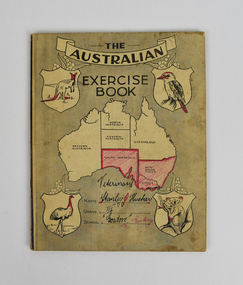
... long career classing wool. In the early 1980s, when Denis was leasing two properties including his father’s, things were going well until drought struck. February 1983 was the date of the Ash...long career classing wool. In the early 1980s, when Denis was leasing two properties including his father’s, things were going well until drought struck. February 1983 was the date of the Ash ...The story of 90 years of wool classing between father & son begins in 1936, when a young boy by the name of Stanley James Hucker walked through the doors of the Gordon Technical School in Geelong. Born in 1921, Stanley was 15 years of age when he began his 3-year course in Wool Classing. 30 years later, Stanley’s second son Denis completed the same 3-year wool classing course. Beginning in 1966, Denis attended the same Gordon Technical School and walked the same halls as his father before him. Stanley finished his course in 1938. He went back to the family farm in Lake Bolac for a brief period before enrolling in the Second World War. At the completion of the war, Stanley returned home and married before gaining a soldier settler allotment, north of Willaura. This enabled Stan to use his wool classing knowledge. He ran between 1,500 and 2,000 sheep for many years, while his wool classer stencil also allowed him to go out and class at various sheds around the area. He held his stencil from 1938 until he retired at the age of 60 in 1981. On retirement, his second son Denis was working in the district, managing a local property while also leasing land himself. Upon his father’s retirement, Denis had the opportunity to lease his father’s farm, an opportunity he could not refuse. Denis had finished his wool classing course at the Gordon Technical School in 1968, graduating dux of his class. He began working with a local contractor and started classing wool in his team. Denis gained a great deal of experience working as part of this team in big sheds of up to 8 stands servicing between 10 & 20,000 sheep. It was not all smooth sailing for Denis however, and he soon learnt an important lesson. Class wool the way you’re taught, don’t listen to the owner standing over your shoulder. At a clip of Corriedales near Casterton, Denis was pushing too many fleeces into the line of fine wool. This resulted in a notice from the Australian Wool Exchange (AWEX) “mixing counts too much, submit three clips for inspection”. Denis was able to submit 3 clips with no further complaints, however, this proved a valuable lesson he would never forget over his long career classing wool. In the early 1980s, when Denis was leasing two properties including his father’s, things were going well until drought struck. February 1983 was the date of the Ash Wednesday bushfires, and saw Melbourne have three days over 40 °C for only the second time on record. This period saw Denis give away farming, turning towards contracting work instead. After the difficult times of the early 1980s, the next two decades were a good time for the sheep industry. 15 micron wool was selling for prices between 4 to 5,000 cents per kilo, double what you’d expect for the same wool in 2022. In 1995 a single bale of wool sold for a million dollars. This was a good time for Denis too. His contracting work saw him employing local shearers and shed staff. His team was involved with the shearing and classing of more than 130,000 sheep. After 20 years of contracting, it was time for Denis to transition into the next phase of his life. He gave up independent contracting, preferring instead to return to being a member of someone else’s team. In 2018, having completed 50 years of wool classing, it was time to call it a day and retire completely. At the annual Gordon Wool School Old Students Association dinner held in 2018, Denis was presented with his 50 years as a registered wool classer stencil awarded by the Australian Wool Exchange (AWEX). This is a rare honour achieved by few. As of February 2020, a total of 430 wool classers had achieved this 50-year milestone. For Denis however, his proudest achievement is achieving 90 years of wool classing with his father. The National Wool Museum is proud to share the collection of objects gained from 90 years in the wool classing industry by Stanley and Denis. This ranges from Stanley’s first stencil and Wool Sample book, started when he first attended the Gordon in 1936. The collection concludes 90 years later with Denis’ 50 years of wool classing Stencil. The collection contains many more objects, all telling the story of these 90 years, and the hard work invested by this dedicated father and son duo. This is the third in a series of 5 wool classing exercise books. They were written by Stanley Hucker in his time at the Gordon Technical College from 1936-1938. This book begins in a white cover with black ink illustrations and writing. These illustrations have been added to with Pink ink. Internally, the book is handwritten on yellowed pages with blue lines for the assistance in clarity of handwriting. The pages are also surrounded by a margin of red pen. The exercise book’s content is about veterinary studies relating to the diseases, injuries, and treatment of sheep. It is handwritten. A selection of pages have been photographed to give an impression of the information taught in classes, 90 years ago. This includes information about blow fly and bacterial diseases.Front Cover. Wording, printed and handwritten “THE / AUSTRALIAN / EXERCISE / BOOK / Veterinary / NAME Stanley J Hucker / GRADE III / School “Gordon” Geelong” Front Cover. Illustrations, printed. Kangaroo, kookaburra / Map of Australia with state names / Emu, Koalagordon institute geelong, wool classing, 1930s sheep farming, 90 years wool classing between father & son -
 National Wool Museum
Book - Wool Classing Exercise Book, 1937-38
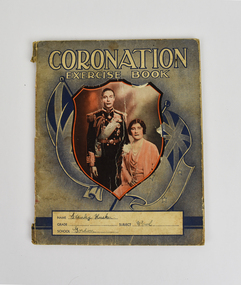
... long career classing wool. In the early 1980s, when Denis was leasing two properties including his father’s, things were going well until drought struck. February 1983 was the date of the Ash...long career classing wool. In the early 1980s, when Denis was leasing two properties including his father’s, things were going well until drought struck. February 1983 was the date of the Ash ...The story of 90 years of wool classing between father & son begins in 1936, when a young boy by the name of Stanley James Hucker walked through the doors of the Gordon Technical School in Geelong. Born in 1921, Stanley was 15 years of age when he began his 3-year course in Wool Classing. 30 years later, Stanley’s second son Denis completed the same 3-year wool classing course. Beginning in 1966, Denis attended the same Gordon Technical School and walked the same halls as his father before him. Stanley finished his course in 1938. He went back to the family farm in Lake Bolac for a brief period before enrolling in the Second World War. At the completion of the war, Stanley returned home and married before gaining a soldier settler allotment, north of Willaura. This enabled Stan to use his wool classing knowledge. He ran between 1,500 and 2,000 sheep for many years, while his wool classer stencil also allowed him to go out and class at various sheds around the area. He held his stencil from 1938 until he retired at the age of 60 in 1981. On retirement, his second son Denis was working in the district, managing a local property while also leasing land himself. Upon his father’s retirement, Denis had the opportunity to lease his father’s farm, an opportunity he could not refuse. Denis had finished his wool classing course at the Gordon Technical School in 1968, graduating dux of his class. He began working with a local contractor and started classing wool in his team. Denis gained a great deal of experience working as part of this team in big sheds of up to 8 stands servicing between 10 & 20,000 sheep. It was not all smooth sailing for Denis however, and he soon learnt an important lesson. Class wool the way you’re taught, don’t listen to the owner standing over your shoulder. At a clip of Corriedales near Casterton, Denis was pushing too many fleeces into the line of fine wool. This resulted in a notice from the Australian Wool Exchange (AWEX) “mixing counts too much, submit three clips for inspection”. Denis was able to submit 3 clips with no further complaints, however, this proved a valuable lesson he would never forget over his long career classing wool. In the early 1980s, when Denis was leasing two properties including his father’s, things were going well until drought struck. February 1983 was the date of the Ash Wednesday bushfires, and saw Melbourne have three days over 40 °C for only the second time on record. This period saw Denis give away farming, turning towards contracting work instead. After the difficult times of the early 1980s, the next two decades were a good time for the sheep industry. 15 micron wool was selling for prices between 4 to 5,000 cents per kilo, double what you’d expect for the same wool in 2022. In 1995 a single bale of wool sold for a million dollars. This was a good time for Denis too. His contracting work saw him employing local shearers and shed staff. His team was involved with the shearing and classing of more than 130,000 sheep. After 20 years of contracting, it was time for Denis to transition into the next phase of his life. He gave up independent contracting, preferring instead to return to being a member of someone else’s team. In 2018, having completed 50 years of wool classing, it was time to call it a day and retire completely. At the annual Gordon Wool School Old Students Association dinner held in 2018, Denis was presented with his 50 years as a registered wool classer stencil awarded by the Australian Wool Exchange (AWEX). This is a rare honour achieved by few. As of February 2020, a total of 430 wool classers had achieved this 50-year milestone. For Denis however, his proudest achievement is achieving 90 years of wool classing with his father. The National Wool Museum is proud to share the collection of objects gained from 90 years in the wool classing industry by Stanley and Denis. This ranges from Stanley’s first stencil and Wool Sample book, started when he first attended the Gordon in 1936. The collection concludes 90 years later with Denis’ 50 years of wool classing Stencil. The collection contains many more objects, all telling the story of these 90 years, and the hard work invested by this dedicated father and son duo. This is the fourth in a series of 5 wool classing exercise books. They were written by Stanley Hucker in his time at the Gordon Technical College from 1936-1938. This book begins in a white cover with blue ink illustrations and writing. It has a centrepiece-coloured emblem of King George VI & Queen Elizabeth with flags of the Union Jack & Australia in background. Internally, the book is handwritten on yellowed pages with blue lines for the assistance in clarity of handwriting. The pages are also surrounded by a margin of red pen. The exercise book’s content is about wool studies relating to the health and productivity of wool sheep. It is handwritten. A selection of pages have been photographed to give an impression of the information taught in classes, 90 years ago. This includes information about: - Wool scouring - Shearing - Lamb marking - Breeding - Fellmongering - Comparison between wool and artificial fibres - Characteristics of good wool - Wool selling methods - Established studs in Victoria - Award rates (1937-38)Front Cover. Wording, printed and handwritten. “CORONATION / EXERCISE BOOK / NAME Stanley Hucker / GRADE SUBJECT Wool / SCHOOL Gordon Front Cover. Illustration’s colour, printed. King George VI & Queen Elizabeth with flags of the Union Jack & Australia in background.gordon institute geelong, wool classing, 1930s sheep farming, 90 years wool classing between father & son
