
Showing 137 items matching "m davis"
-
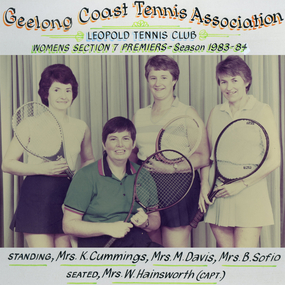 Leopold Tennis Club
Photograph, Robert Pockley Studios, Geelong Coast Tennis Association Leopold Tennis Club Womens Section 7 Premiers - Season 1983-84, 1984
... ...M Davis...Standing, Mrs K. Cummings, Mrs M. Davis, Mrs B. Sofio Seated, Mrs W. Hainsworth (Capt.)...Leopold Tennis Club Geelong Coast Tennis Association M Davis Wendy Hainsworth Biddy (Olga) Sofio Kathleen Cummings Standing, Mrs K. ...Image taken of the Geelong Coast Tennis Association Womens Section 7 Premiers for Season 1983-84.1 photograph of Premiership tennis teamStanding, Mrs K. Cummings, Mrs M. Davis, Mrs B. Sofio Seated, Mrs W. Hainsworth (Capt.)leopold tennis club, geelong coast tennis association, m davis, wendy hainsworth, biddy (olga) sofio, kathleen cummings -
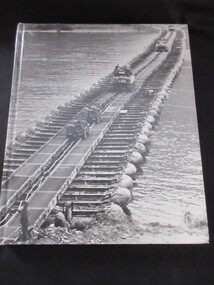 Lilydale RSL Sub Branch
Book, Franklin M. Davis Jr, World War 11 - Across the Rhine, 1980 revised 1981
... Franklin M. Davis Jr....Book World War 11 - Across the Rhine Book Book Franklin M. Davis Jr. Time-Life Books ...Book -
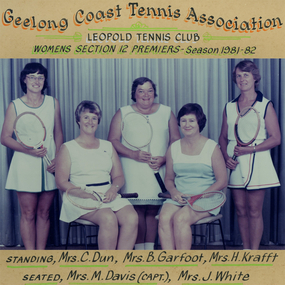 Leopold Tennis Club
Photograph, Robert Pockley Studios, Geelong Coast Tennis Association Leopold Tennis Club Womens Section 12 Premiers - Season 1981-82, 1982
... ...M Davis...Krafft Seated, Mrs M. Davis (Capt.), Mrs J. White...Leopold Tennis Club Geelong Coast Tennis Association C Dun Betty Garfoot H Krafft M Davis Joan White Standing, Mrs C. Dun, Mrs B. ...Image taken of the Geelong Coast Tennis Association Womens Section 12 Premiers for Season 1981-82.1 photograph of Premiership tennis teamStanding, Mrs C. Dun, Mrs B. Garfoot, Mrs H. Krafft Seated, Mrs M. Davis (Capt.), Mrs J. Whiteleopold tennis club, geelong coast tennis association, c dun, betty garfoot, h krafft, m davis, joan white -
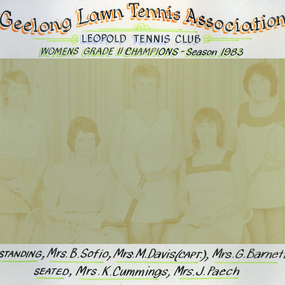 Leopold Tennis Club
Photograph, Robert Pockley Studios, Geelong Lawn Tennis Association Leopold Tennis Club Women Grade 11 Champions - Season 1983, 1983
... ...M Davis...Standing, Mrs B. Sofio, Mrs M. Davis (Capt.), Mrs G. Barnett Seated, Mrs K. ...Sofio, Mrs M. Davis (Capt.), Mrs G. Barnett Seated, Mrs K. ...Image taken of the Geelong Lawn Tennis Association Womens Grade 11 Champions for Season 1983.1 photograph of Premiership tennis teamStanding, Mrs B. Sofio, Mrs M. Davis (Capt.), Mrs G. Barnett Seated, Mrs K. Cummings, Mrs J. Paechleopold tennis club, geelong lawn tennis association, m davis, j paech, gweneth barnett, biddy (olga) sofio, kathleen cummings -
 Leopold Tennis Club
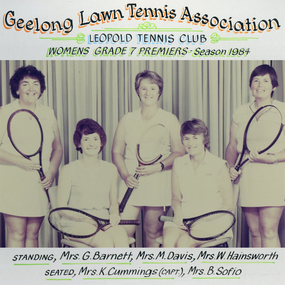
Photograph, Robert Pockley Studios, Geelong Lawn Tennis Association Leopold Tennis Club Womens Grade 7 Premiers - Season 1984, 1984
... ...M Davis...Standing, Mrs G. Barnett, Mrs M. Davis, Mrs W. Hainsworth Seated, Mrs K. Cummings (Capt.), Mrs B. ...Barnett, Mrs M. Davis, Mrs W. Hainsworth Seated, Mrs K. Cummings (Capt.), Mrs B. ...Image taken of the Geelong Lawn Tennis Association Womens Grade 7 Premiers for Season 1984.1 photograph of Premiership tennis teamStanding, Mrs G. Barnett, Mrs M. Davis, Mrs W. Hainsworth Seated, Mrs K. Cummings (Capt.), Mrs B. Sofioleopold tennis club, geelong lawn tennis association, m davis, gweneth barnett, wendy hainsworth, biddy (olga) sofio, kathleen cummings -
 Nhill and District Historical Society Inc.
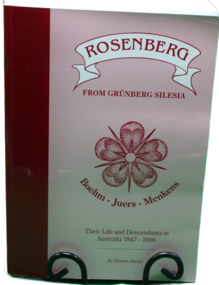
Book - Rosenburg: From Grünberg Silesia: Boehm - Juers - Menkens, Their Life and descendants in Australia 1847 - 2006 by Doreen Davis, 2006
... Pink cover with burgandy colored text, illustration and spine binding: Warradale, S. Aust. : Doreen M. Davis, [2006] 718 p. : ill., coat of arms, facsims., geneal. tables, maps, ports. ; 30 cm....Rosenburg: From Grünberg Silesia: Boehm - Juers - Menkens - Their Life and descendants in Australia 1847 - 2006 by Doreen M. Davis...Aust. : Doreen M. Davis, [2006] 718 p. : ill., coat of arms, facsims., geneal. tables, maps, ports. ; 30 cm. ...History of the five Rosenburg children in AustraliaPink cover with burgandy colored text, illustration and spine binding: Warradale, S. Aust. : Doreen M. Davis, [2006] 718 p. : ill., coat of arms, facsims., geneal. tables, maps, ports. ; 30 cm.non-fictionHistory of the five Rosenburg children in Australiarosenburg -, family history, poland, south australia, boehm, juers, menkens, johann gottlob schlz, julianne christiane peitz -
 University of Melbourne, Burnley Campus Archives
Work on paper - File, Mervyn Davis, 1969? - 1993
... File including notes from talk by Jane Shepherd on women in horticulture, Newspaper article "Landscape Design at Air Terminal" (Design by M. Davis for Perth Airport), "Women in Horticulture - Focus on Burnley", Article by M. ...Mervyn Davis Perth Airport Jane Shepherd women in horticulture Some hand-written notes in different hands File including notes from talk by Jane Shepherd on women in horticulture, Newspaper article "Landscape Design at Air Terminal" (Design by M. Davis for Perth Airport), "Women in Horticulture - Focus on Burnley", Article by M. ...File including notes from talk by Jane Shepherd on women in horticulture, Newspaper article "Landscape Design at Air Terminal" (Design by M. Davis for Perth Airport), "Women in Horticulture - Focus on Burnley", Article by M. Davis for International Society for Horticultural ScienceSome hand-written notes in different handsmervyn davis, perth airport, jane shepherd, women in horticulture -
Bendigo Historical Society Inc.
Document - ROYAL PRINCESS THEATRE COLLECTION: BENDIGO ORCHESTRAL SOCIETY & YMCA CHOIR. MARITANA, 7 Aug, 1933
... ... M Davis...Contraltos: Miss F Bertuch, Mrs D Campbell, Miss I De Ravin, M Davis, P Elliot, Mrs J Greenhill, Mess N Irving, I James, J Seers, J Shepherd, G Stephens. ...Contraltos: Miss F Bertuch Mrs D Campbell Miss I De Ravin M Davis P Elliot Mrs J Greenhill Mess N Irving I James J Seers J Shepherd G Stephens. ...Princess Theatre, Bendigo. Bendigo Orchestral Society & YMCA Choir. Maritana, Souvenir Programme 6d. Mon. Tues. Wed. August 7, 8, 9. Opera Produced by Mr E A Parker. Musical Director, Mr Oscar Flight. Deputy Director, Mr Alfred Sayer. Leader of Orchestra Mrs McKinnon. Chorus trained by Mr Wilfred Taylor. Chairman of Committee, Mr W Spencer Lake. Business Manager, Mr C J Greenhill. Pictures of artists: Miss Paulyne Bindley, Mr E A Parker, Miss Gwen De Ravin, Mr Wilfred Taylor, Miss Alva Stewart, Mr H H Turner, Mr Oscar Flight. Group photo of Ballet dancers. Argument - Maritana, a handsome Gitana, whilst singing to a crowd of people in a square in Madrid, attracts the admiration of the King. Don Jose, and unscrupulous courtier, observing this, determines to satisfy the . . . Characters: Paulyne Bindley, Gwenneth De Ravin, E A Parker, Wilfred Taylor, Lyell Shepherd, J W Smith, H H Turner, Lindsay Wright. Court Ballet: Miss Mercia Wright. Solo Dancer: Miss Fay Drummond. Chorus of Soldiers, Gypsies, and Populace. Deputy Principals: Alva Stewart, Frieda Bertuch, H J Allen. Costumes: Madame Tettrazini, Miss Ada Colton, Mrs E A Parker. Orchestra. Violins: Mrs C Adams, Miss J Anderson, Mr R Bright, Mr O Flight (jnr), Mrs S A Grant Mrs H Hillman, Miss J Houston, Mr G Krost, Mrs S McKinnon, Miss A McKinnon, Miss A McNair, A Sayer, Mrs L Shepherd, A Swift, H Timms. Viola: Mr P Coope. 'Cellos: Miss R Giudice, Mr W S Lake. Bass: Mr J Ditchburn. Flute: Mr A E Sayer. Clarinets: Mr B Smith, Mr P Waterman. Harpiste: Miss Whitelock. Cornets: Mr W Norman, Mr P Smith Mr A Swift, Mr F Taylor. Horns: Mr W Green, Mr N McPherson. Trombones: Mr Les Bishop, Mr E J Meagher. Drums: Me J McLaughlin. Piano: Miss I Benson, Miss E Flight. Chorus. Sopranos: Miss D Broome, S Brown, Mrs R Burland, Miss Betty Cant, E Colclough, E Collins, Bessie Davis, P Dunn, G Farmont, M Heyes, D Hoking, B Harpin, M Kitto, D Kirkwood, E Parker, L Simpson, Ida Stephenson, M Stephenson, L Smalley, Mrs W Taylor, V Thorpe, Miss Myrtle Taylor, Annie Thomas, Mrs C Walk, Miss R Wallent. Contraltos: Miss F Bertuch, Mrs D Campbell, Miss I De Ravin, M Davis, P Elliot, Mrs J Greenhill, Mess N Irving, I James, J Seers, J Shepherd, G Stephens. Tenors: J Cotton, G English, D Finery, Alec Jones, E Jeffery, D Parker, J Sims. Basses: D Doran, J Finerty, J H Hardie, A B Kirkwood, W L Macauley, S C Powell, R Prigg, W Reed, Les Spencely, Cyril Taylor, Ken Taylor. Mr Ron Hovenden, Scenic Artist. Ballet: Misses Clarice Harry, Rita Lansell, Thelma McKenzie, Mena Bailey, Dorothy Roberts, Fay Drummond, Kath Dungey, Jean Wright. Dance Mistress Miss Mercia Wright. Photo of dance group on rear cover. Printed down right side: Mr W. Reed - With Compliments from ''Maritana'' Committee. Sep 5/33. Signed: W Spencer Lake. Very decorative cover. B/ Envelope addressed to Mr W Reed, Lily St, Bendigo. 2 pieces of white tape on left side one top and one at bottom, stamp gone post mark Bendigo.Reed & Co., Printers, Bendigotheatre, opera, bendigo orchestral society:ymca cho, princess theatre. bendigo orchestral society & ymca choir. maritana. august 7, 8, 9. opera by mr e a parker. musical director, mr oscar flight. deputy director, mr alfred sayer. leader of orchestra mrs mckinnon. chorus trained: mr wilfred taylor. chairman of committee, mr w spencer lake. business manager, mr c j greenhill. photos of: miss paulyne bindley, mr e a parker, miss gwen de ravin, mr wilfred taylor, miss alva stewart, mr h h turner, mr oscar flight. group photo of ballet dancers. argument - maritana, a handsome gitana, whilst singing to a crowd of people in a square in madrid, attracts. . . characters: paulyne bindley, gwenneth de ravin, e a parker, wilfred taylor, lyell shepherd, j w smith, h h turner, lindsay wright. court ballet: miss mercia wright. solo dancer: miss fay drummond. chorus of soldiers, gypsies, and populace. deputy principals: alva stewart, frieda bertuch, h j allen. costumes: madame tettrazini, miss ada colton, mrs e a parker. orchestra. violins: mrs c adams, miss j anderson, mr r bright, mr o flight (jnr), mrs s a grant mrs h hillman, miss j houston, mr g krost, mrs s mckinnon, miss a mckinnon, miss a mcnair, a sayer, mrs l shepherd, a swift, h timms. viola: mr p coope. 'cellos: miss r giudice, mr w s lake. bass: mr j ditchburn. flute: mr a e sayer. clarinets: mr b smith, mr p waterman. harpiste: miss whitelock. cornets: mr w norman, mr p smith mr a swift, mr f taylor. horns: mr w green, mr n mcpherson. trombones: mr les bishop, mr e j meagher. drums: me j mclaughlin. piano: miss i benson, miss e flight. chorus. sopranos: miss d broome, s brown, mrs r burland, miss betty cant, e colclough, e collins, bessie davis, p dunn, g farmont, m heyes, d hoking, b harpin, m kitto, d kirkwood, e parker, l simpson, ida stephenson, m stephenson, l smalley, mrs w taylor, v thorpe, miss myrtle taylor, annie thomas, mrs c walk, miss r wallent. contraltos: miss f bertuch, mrs d campbell, miss i de ravin, m davis, p elliot, mrs j greenhill, mess n irving, i james, j seers, j shepherd, g stephens. tenors: j cotton, g english, d finery, alec jones, e jeffery, d parker, j sims. basses: d doran, j finerty, j h hardie, a b kirkwood, w l macauley, s c powell, r prigg, w reed, les spencely, cyril taylor, ken taylor. mr ron hovenden, scenic artist. ballet: misses clarice harry, rita lansell, thelma mckenzie, mena bailey, dorothy roberts, fay drummond, kath dungey, jean wright. dance mistress miss mercia wright. photo of dance group. -
 Dandenong/Cranbourne RSL Sub Branch
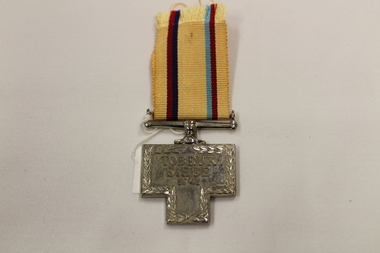
Medal - Tobruk Siege Medal, 1941
... M. Davis (recipient) on reverse of medal. Obverse side Tobruk Siege 1941....Control of the Port of Tobruk was of great importance to not only North Africa but to the entire war. M. Davis (recipient) on reverse of medal. Obverse side Tobruk Siege 1941. ...The Tobruk Siege medal - known as the "T'' Medal was issued to Australian, British, Indian, New Zealand and Polish troops who saw action at Tobruk. The siege lasted for 242 days from April to December 1941. The medal was commissioned and issued by the Rats of Tobruk Association in 1977. Control of the Port of Tobruk was of great importance to not only North Africa but to the entire war. T shaped Silver Medal with Tobruk Seige 1941. The ribbon is khaki with light blue and maroon stripes. The medal is issued by the Rats of Tobruk Association. That makes it un-official. It is however recognised. M. Davis (recipient) on reverse of medal. Obverse side Tobruk Siege 1941. -
Glen Eira Historical Society
Document - ST JAMES PARADE, 33, ELSTENRWICK, ‘AVALON’
... M... Davis Mrs Annice F....St James Parade Elsternwick ‘Avalon’ House names Spanish Mission Architectural features ‘O’Neill Estate’ fireplaces lead lights plaster moulds Geer Clfrd. M Davis Mrs Annice F. Document ST JAMES PARADE, 33, ELSTENRWICK, ‘AVALON’ ...Contains 2 items about this property: 1/Two property advertisementss, dated 15/06/2002 on forth coming sale of property, including 4 photographs. 2/Handwritten research on occupiers of property by Claire Barton from Sands and McDougall on 15/03/2013.st james parade, elsternwick, ‘avalon’, house names, spanish mission, architectural features, ‘o’neill estate’, fireplaces, lead lights, plaster moulds, geer clfrd. m, davis mrs annice f. -
 Eltham District Historical Society Inc
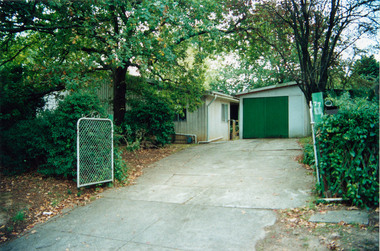
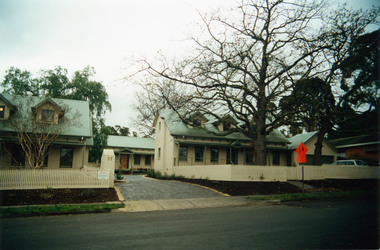
Photograph, Margaret Ball, 77 Dalton Street, Eltham, c.1999, 1999
... Owner 1930s: Mrs M. Davis. Bought by Joe Mason in 1940s; demolished 2002 and five units built 2004...Owner 1930s: Mrs M. Davis. Bought by Joe Mason in 1940s; demolished 2002 and five units built 2004 The Margaret Ball (Pre 1960s Houses) Collection was a personal project initiated to mark the year 2000 and arose as a result of the disappearance of many pre-1960s parts of Eltham due to development. ...Owner 1930s: Mrs M. Davis. Bought by Joe Mason in 1940s; demolished 2002 and five units built 2004The Margaret Ball (Pre 1960s Houses) Collection was a personal project initiated to mark the year 2000 and arose as a result of the disappearance of many pre-1960s parts of Eltham due to development. Approximately 200 pre-1960s style houses that were left in Eltham between Main Road and east to Bible Street, between Cecil Street to the north and south to Dalton Street were photographed in late 1999. Not all of the houses could be photographed; some because the garden or trees blocked the view of the house, others because of rubbish or cars were in the way, some because people were working on the house or in the gardens at the time.Colour photographic printeltham, houses, streets, margaret ball (pre 1960s houses) collection, dalton street -
 Eltham District Historical Society Inc
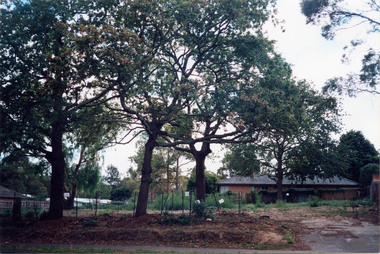
Photograph, Margaret Ball, 77 Dalton Street, Eltham, c.2004, 1999
... Owner 1930s: Mrs M. Davis. Bought by Joe Mason in 1940s; demolished 2002 and five units built 2004...Owner 1930s: Mrs M. Davis. Bought by Joe Mason in 1940s; demolished 2002 and five units built 2004 The Margaret Ball (Pre 1960s Houses) Collection was a personal project initiated to mark the year 2000 and arose as a result of the disappearance of many pre-1960s parts of Eltham due to development. ...Owner 1930s: Mrs M. Davis. Bought by Joe Mason in 1940s; demolished 2002 and five units built 2004The Margaret Ball (Pre 1960s Houses) Collection was a personal project initiated to mark the year 2000 and arose as a result of the disappearance of many pre-1960s parts of Eltham due to development. Approximately 200 pre-1960s style houses that were left in Eltham between Main Road and east to Bible Street, between Cecil Street to the north and south to Dalton Street were photographed in late 1999. Not all of the houses could be photographed; some because the garden or trees blocked the view of the house, others because of rubbish or cars were in the way, some because people were working on the house or in the gardens at the time.Colour photographic printeltham, houses, streets, margaret ball (pre 1960s houses) collection, dalton street -
 Eltham District Historical Society Inc
Photograph, Margaret Ball, 77 Dalton Street, Eltham, c.2002, 1999
... Owner 1930s: Mrs M. Davis. Bought by Joe Mason in 1940s; demolished 2002 and five units built 2004...Owner 1930s: Mrs M. Davis. Bought by Joe Mason in 1940s; demolished 2002 and five units built 2004 The Margaret Ball (Pre 1960s Houses) Collection was a personal project initiated to mark the year 2000 and arose as a result of the disappearance of many pre-1960s parts of Eltham due to development. ...Owner 1930s: Mrs M. Davis. Bought by Joe Mason in 1940s; demolished 2002 and five units built 2004The Margaret Ball (Pre 1960s Houses) Collection was a personal project initiated to mark the year 2000 and arose as a result of the disappearance of many pre-1960s parts of Eltham due to development. Approximately 200 pre-1960s style houses that were left in Eltham between Main Road and east to Bible Street, between Cecil Street to the north and south to Dalton Street were photographed in late 1999. Not all of the houses could be photographed; some because the garden or trees blocked the view of the house, others because of rubbish or cars were in the way, some because people were working on the house or in the gardens at the time.Colour photographic printeltham, houses, streets, margaret ball (pre 1960s houses) collection, dalton street -
Tarnagulla History Archive
Telegram, 1862
... Telegram sent from Sandy Creek / Tarnagulla Telegraph Office from WIlliam M. Davis to Mr R.W. Nutt, 40 Elizabeth St, Melbourne. ...Telegram sent from Sandy Creek / Tarnagulla Telegraph Office from WIlliam M. Davis to Mr R.W. Nutt, 40 Elizabeth St, Melbourne. ...A large lot of papers, including this and many other telegrams, were apparently found in the ceiling cavity of the Sandy Creek/Tarnagulla Post and Telegraph Office in the later 20th Century, during building works. Donald Clark Collection. Telegram sent from Sandy Creek / Tarnagulla Telegraph Office from WIlliam M. Davis to Mr R.W. Nutt, 40 Elizabeth St, Melbourne. Text reads 'Just received letter dated 6th inst. Send answers on Monday'. * 'inst.' means of current month. -
 Federation University Historical Collection
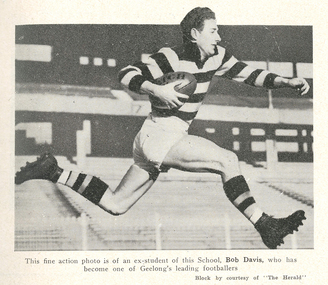
Booklet, Ballarat School of Mines Students' Magazine, 1950, 1950
... ...m. stevens...bob davis...Baseball, Tennis, Science School, Television in Australia,The Apprentices, Commercial Notes, The Girls Association, Preps and Dressmakers, The Art School, Junior School, List of Full Course Students, Students doing Trade Apprenticeship courses, Junior Technical School Roll Call ballarat school of mines magazine k. e. scull g.w. barrel e. j. tippett j. harriott lindsay hillman a. e. watson (nee jeanette perkins n. andrews j. peyton c.g. fairbank s. jones f. benjamin b. flavel f. heath v. jolly h. browning m. troon w. archibald r. gay s. ross d. cotton b. bryan rodney t. sheppard m. j. mccarthy shirley ross george m. hetherington john k. ballinger roberta gay lois pedrazzi robert tantau joyce eberhardt louise hamilton joy lyons john f. swain d. mullins g. cornell arthur burrow j. watts w. carlyon a. kinnane j. boag r. ingleton b. schreenan s. deans j. tinney r. campbell j. vernon j. jopling d. durant j. ballinger j. swain k. treloar t. duncan j. bethune j. hines l. owen c. livitsanso m. stevens bob davis e. boschen j. sawyer c. restarick r. archer m. tunbridge j. carmichael a. brokenshire m. barker a. mccallum l. searle p. richards r. simpson n. ludbrook r. sheppard nigel fitzclarence j. m. blackburn m. m. phillips w. k. holmes william rodgers barry pearce e. sobey norma taylor pat lavery heather browning anne wright barbara wilson lynette klein margaret winberg pearl monds d. searle heather harris glenys nolan dorothy wilkie mary gleeson phyllis dellaca valerie jolly anne turnley lynette bromley n. taylor n. hooker g. mainwaring barbara symons wm. j. paterson j. jenkin r. l. whitla pastor r. m. hunting r. phillips r. f. bawden l. b. doull g. graham s. hoffman j. mulrooney g. stimson c. lockhart b. kennedy d. irish l. dow s. saw m. winberg h. clark f. case r. braybrook g. holmes e. mackie j. collier a. johnstone n. newey f. young b. baldock b. graham n. caldow c. hay e. carter g. delaland r. millar r. kennedy g. wittingslow h. flack r. quayle g. ditchfield j. parrot a. brogden m. hodder r. satchell r. lyons j. gilmer f. andrewartha b. tozer d. jones l. fuhrmeister r. furlong j. twaits c. hocking n. andres d. quick g. vickers b. mann s. kellett b. matthews g. gilbert afl vfl White soft covered magazine with green and gold font. ...School Council, Members of Staff, Editorial, Principal's Page, News and Notes, Prize Presentation, Magazine Committee 1950, Prominent Personalities, The Literary Society, Retirements, Boys Sport, Annual Sports, Football. Baseball, Tennis, Science School, Television in Australia,The Apprentices, Commercial Notes, The Girls Association, Preps and Dressmakers, The Art School, Junior School, List of Full Course Students, Students doing Trade Apprenticeship courses, Junior Technical School Roll CallWhite soft covered magazine with green and gold font.ballarat school of mines, magazine, k. e. scull, g.w. barrel, e. j. tippett, j. harriott, lindsay hillman, a. e. watson (nee jeanette perkins, n. andrews, j. peyton, c.g. fairbank, s. jones, f. benjamin, b. flavel, f. heath, v. jolly, h. browning, m. troon, w. archibald, r. gay, s. ross, d. cotton, b. bryan, rodney t. sheppard, m. j. mccarthy, shirley ross, george m. hetherington, john k. ballinger, roberta gay, lois pedrazzi, robert tantau, joyce eberhardt, louise hamilton, joy lyons, john f. swain, d. mullins, g. cornell, arthur burrow, j. watts, w. carlyon, a. kinnane, j. boag, r. ingleton, b. schreenan, s. deans, j. tinney, r. campbell, j. vernon, j. jopling, d. durant, j. ballinger, j. swain, k. treloar, t. duncan, j. bethune, j. hines, l. owen, c. livitsanso, m. stevens, bob davis, e. boschen, j. sawyer, c. restarick, r. archer, m. tunbridge, j. carmichael, a. brokenshire, m. barker, a. mccallum, l. searle, p. richards, r. simpson, n. ludbrook, r. sheppard, nigel fitzclarence, j. m. blackburn, m. m. phillips, w. k. holmes, william rodgers, barry pearce, e. sobey, norma taylor, pat lavery, heather browning, anne wright, barbara wilson, lynette klein, margaret winberg, pearl monds, d. searle, heather harris, glenys nolan, dorothy wilkie, mary gleeson, phyllis dellaca, valerie jolly, anne turnley, lynette bromley, n. taylor, n. hooker, g. mainwaring, barbara symons, wm. j. paterson, j. jenkin, r. l. whitla, pastor r. m. hunting, r. phillips, r. f. bawden, l. b. doull, g. graham, s. hoffman, j. mulrooney, g. stimson, c. lockhart, b. kennedy, d. irish, l. dow, s. saw, m. winberg, h. clark, f. case, r. braybrook, g. holmes, e. mackie, j. collier, a. johnstone, n. newey, f. young, b. baldock, b. graham, n. caldow, c. hay, e. carter, g. delaland, r. millar, r. kennedy, g. wittingslow, h. flack, r. quayle, g. ditchfield, j. parrot, a. brogden, m. hodder, r. satchell, r. lyons, j. gilmer, f. andrewartha, b. tozer, d. jones, l. fuhrmeister, r. furlong, j. twaits, c. hocking, n. andres, d. quick, g. vickers, b. mann, s. kellett, b. matthews, g. gilbert, afl, vfl -
 Bendigo Historical Society Inc.
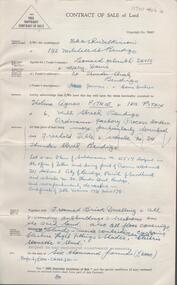
Document - H. A. & S. R. WILKINSON COLLECTION: CONTRACT OF SALE
... Contract of sale of land dated 5th November 1955 between Mr. L. H. & Mrs. M Davis (vendor) and Misses T. A. & I. Pithie (purchaser). .... & s.r wilkinson real estate Contract of sale of land dated 5th November 1955 between Mr. L. H. & Mrs. M Davis (vendor) and Misses T. A. & I. Pithie (purchaser). ...Contract of sale of land dated 5th November 1955 between Mr. L. H. & Mrs. M Davis (vendor) and Misses T. A. & I. Pithie (purchaser). Solicitor for vendor: H. E. Every. Solicitor for purchaser: Neal Woodward. Property: Lot 4 on plan of subdivision No.21517 lodged in the office of titles being part of Crown allotment 351 section E, land described in certificate of title volume 7731 folio 178, together with 5 room brick dwelling also all floor coverings, blinds, curtains, electric light fittings and shades, electric stovette and stand. Price: 6,000 pounds.organization, business, h.a. & s.r wilkinson real estate -
 Warrnambool RSL Sub Branch
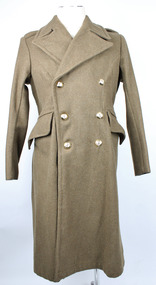
Great Coat, Bradley's Industries N.S.W, 1951
... ./1951" Handwritten on label, "M J Davis"..../1951" Handwritten on label, "M J Davis" Long khaki coloured heavy coat. Thick, sharp angled collars. ...Long khaki coloured heavy coat. Thick, sharp angled collars. Right collar has a hook and eye attached in the lapel split. Collar has zig zag stitching and two plastic buttons on each the left and right sides. Each shoulder has a lapel that is fastened with a plastic button. The coat is double breasted. Three buttons on the right side, held in place by metal loops on the interior rather than stiches; mirrored on the left side. Left interior has oval shaped fabric buttoned to the interior with two brown (possibly bakelite) buttons. A larger brown button sits atop the smaller as a means of closing the jacket from the inside. There are two pockets on the front that are angled with the highest point near the centre and the lowest point near the hips. The arms, underarm and upper back section contains an inside khaki coloured lining of thinner, most likely cotton fabric. Above this there is a thin strip of fabric attached at either short end to use for hanging the coat on a hook. At the back of the coat there is a single pleat stretching from the base of the neck to the base of the coat. Approximately half way down the pleat there is a split in the fabric that is fastened with two plastic buttons. At the waist there are two fabric flaps that fasten together at the back with three buttons, also held in place with metal loops on the reverse.Label on interior back lining reads "REGIMENTAL No./NAME" Label on interior of the right "GREATCOATS. G.S. 1946 Patt/SIZE 1/HEIGHT 5'3"/CHEST 34"-36"/BRADLEY'S INDUSTRIES N.S.W./1951" Handwritten on label, "M J Davis"post war, army uniform, great coat, inter war, uniform, military uniform, wool, greatcoats, bradley's industries -
 Stanley Athenaeum & Public Room
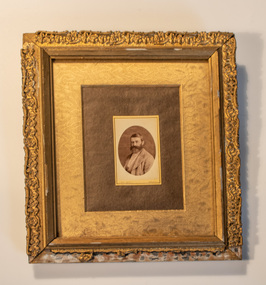
Photograph - J. Corey Davis, Picture
... Davis. Identified as such by Mrs Eva Boswell (nee Breustedt), Mrs Annie Crawford ( nee Skinner). Presented by Mrs Goodyer 30/11/1973. Beechworth 24th April 1937. John Corby Davies. O&M...Davis. Identified as such by Mrs Eva Boswell (nee Breustedt), Mrs Annie Crawford ( nee Skinner). Presented by Mrs Goodyer 30/11/1973. Beechworth 24th April 1937. John Corby Davies. O&M ...Original photograph in Gilded Frame - 2.5cm floral edged, 2cm internal gold rim, molding floral plaster edging. Gold internal matte approximately 5cm. Internal mounted photo 6cm black/white - sepia? Timber covered Back - 2 central screws and hanging wire.'Photograph is of Mr. J.Corby Davis. Identified as such by Mrs Eva Boswell (nee Breustedt), Mrs Annie Crawford ( nee Skinner). Presented by Mrs Goodyer 30/11/1973. Beechworth 24th April 1937. John Corby Davies. O&M Paper.' Davis was an auditor for the Athenaeum in the 1900's. -
 Lakes Entrance Historical Society
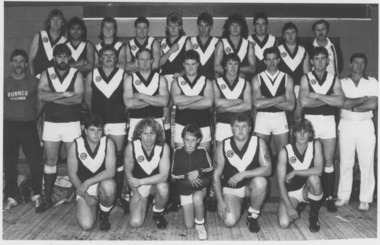
Photograph - Lakes Football Club Reserves Team 1990, Lakes Post Newspaper
... Black and white photograph of Lakes Football Club Reserves Team members Back: J Forrester, J Lamanna, G Gudgin, P White, S Smythe, L Somerville, P Forrester, D Armistead, P Marsden, Les Prout trainer Middle: D O'Donell runner, C Dostine, T Wykes, R Yates, S Greer, A Adams, S Campisi, D Veal, D Conduit, Front: S Cox, D Svetlik, T Brickle mascot, M McInnes, C Davis premiers 1990 taken after defeating Orbost Lakes Entrance Victoria...Clubs Sports Black and white photograph of Lakes Football Club Reserves Team members Back: J Forrester, J Lamanna, G Gudgin, P White, S Smythe, L Somerville, P Forrester, D Armistead, P Marsden, Les Prout trainer Middle: D O'Donell runner, C Dostine, T Wykes, R Yates, S Greer, A Adams, S Campisi, D Veal, D Conduit, Front: S Cox, D Svetlik, T Brickle mascot, M McInnes, C Davis premiers 1990 taken after defeating Orbost Lakes Entrance Victoria Photograph Lakes Football Club Reserves Team 1990 Lakes Post Newspaper ...Black and white photograph of Lakes Football Club Reserves Team members Back: J Forrester, J Lamanna, G Gudgin, P White, S Smythe, L Somerville, P Forrester, D Armistead, P Marsden, Les Prout trainer Middle: D O'Donell runner, C Dostine, T Wykes, R Yates, S Greer, A Adams, S Campisi, D Veal, D Conduit, Front: S Cox, D Svetlik, T Brickle mascot, M McInnes, C Davis premiers 1990 taken after defeating Orbost Lakes Entrance Victoriaclubs, sports -
 Bendigo Historical Society Inc.
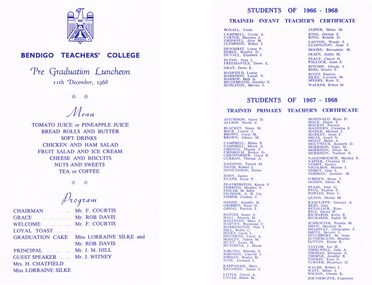
Document - LA TROBE UNIVERSITY BENDIGO COLLECTION: BENDIGO TEACHERS' COLLEGE PRE GRADUATION LUNCHEON 1968
... Curran, Tanyth M. Dainton, Robert J. Davis, Elaine Duncanson, Janice Eddy, Joyce P. ...Curran, Tanyth M. Dainton, Robert J. Davis, Elaine Duncanson, Janice Eddy, Joyce P. ...A white document titled Bendigo Teachers' College. Pre Graduation Luncheon. 11th December, 1968. Below the title is a copy of the Menu being offered and an outline of the Program: Chairman - Mr. F. Courtis. Grace - Mr. Rob Davis. Welcome - Mr. F. Courtis. Loyal Toast and Graduation cake - Miss Lorraine Silke and Mr. Rob Davis. Principal - Mr. J. M. Hill. Guest Speaker Mr. J. Witney. Also included Mrs. H. Chatfield and Miss Lorraine Silke. On the back of the card is a list of the Students of 1966 - 1968. Trained Infant Teacher's Certificate: Linda Boxall, Carole A. Campbell, Maureen J. Carter, Alice M. Chiswell, Robyn J. Clemson, Lynn F. Dewhurst, Rosslyn D. Doble, Elizabeth J. Duvall, Nola L. Flynn, Dawn E. Freemantle, Dawn E. Gray, Louise Hadfield, Laurel Y. Harrison, Beth A. Harrop, Jennifer N. Hildebrand, Merren J. Hurlston, Helen M. Jasper, Glenise F. King, Rosalie D. King, Wendy J. Lanyon, Anne T. Luddington, Bernadette M. Moore, Judith M. Olsen, Cheryl D. Peace, Janet E. Pollock, Glenda J. Ritchie, Sandra F. Ross, Patricia Scott, Lorraine M. Silke, Kaye E. Speers and Robyn M. Walker. Students of 1967 - 1968. Trained Primary Teacher's Certificate: Garry D. Aitchison, David C. Allsop, Susan M. Blacket, Leonie J. Bock, Coral M. Brown, Glenys M. Brown, Helen E. Campbell, Merril A. Campbell, Dianne J. Cheong, Roslyn O. Chisholm, Lloyd R. Christopher, Therese A. Curran, Tanyth M. Dainton, Robert J. Davis, Elaine Duncanson, Janice Eddy, Joyce P. Evans, Kerrie F. Featherston, Heather F. Fehring, M. Selby Fidler, E. R. Lia Filisone, Lindsay J. Fisher, Jennifer K. Goode, Kaye D. Gribben, Patricia J. Grigg, Susan A. Haines, Rhonda M. Hall, Mary J. Hallinan, Raymond C. Harvey, Neil J. Harrington, Robin C. Hill, Gayle L. Hinks, Carol A. Hitchens, Aileen M. Hooley, Susan M. Hunt, J. Maree Hutchins, Rhonda E. Jobling, Cherrill J. Johnson, Roslyn M. Jordan, Leonard J. Jude, Mary Kappadais, James C. Kennedy, Cheryl A. Little, Helen M. Lynas, Brian D. McDonald, Elaine T. Mace, Patricia Mackin, Christine E. Maddern, Michael J. Maher, Janet F. Markey, Averil N. Miles, Helen A. Moait, Kenneth D. Molyneux, Edna M. Morrison, Jillian M. Morrison, Noelene E. Morrison, Marilyn F. Nadenbousch, Christine D. Napier, Sandra Nesbit, Maxine J. Nicolson, Jane L. Nisbet, Jeanette M. Norman, Shane J. O'Brien, Jillian R. Ogden, John G. Pease, Pauline E. Peck, Peter C. Powles, Denise M. Quinn, Georgia A. Radcliffe, John Reid, Kaye Retallick, Glenice W. Rice, Kirtis R. Richards, Judith H. Richards, Pamela M. Schroeter, Marjorie R. Shaw, Christopher F. Sharpley,Beverly L. Smith, M. Anne Stuchbery, Heather Sutherland, Elaine R. Sutton, Ian H. Taylor, Julie A. Thirwell, Margaret A. Thomas, Jennifer R. Thorne, Faye E. Tonkin, Rosemary D. Turner, Robert R. Walsh, Helen J. Watt, Glenda K. Wilson and Eugeniusz Zolnieczyk.bendigo, education, bendigo teachers' college, la trobe university bendigo collection, collection, bendigo teachers' college, bendigo, education, teaching, teachers, students, menu, graduation luncheon, lunceon, tertiary education, graduates, graduands, graduation, bendigo teachers' college staff, bendigo teachers' college students -
 Flagstaff Hill Maritime Museum and Village
Functional object - Ship's Wheel, 1871 or earlier
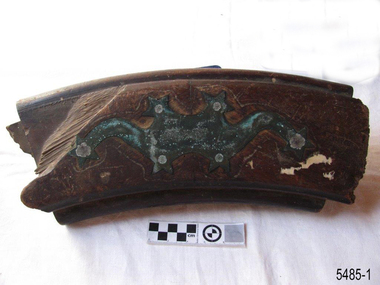
... Newman, W. Paul, J. Davis, M. Horenleng, J. Ogduff, T. W. Drew, R. ...Newman, W. Paul, J. Davis, M. Horenleng, J. Ogduff, T. W. Drew, R. ...The ship building company E. & A. Sewall, from Bath, Maine, USA, built many ships that had wheels with the same decorative, starburst pattern on them as this particular wheel segment, including the Eric the Red. The wheel was manufactured by their local Bath foundry, Geo. Moulton & Co. and sold to the Sewall yard for $100, according to the construction accounts of the vessel. Eric the Red was a wooden, three masted clipper ship. She had 1,580 tons register and was the largest full-rigged ship built at Bath, Maine, USA in 1871. She was built and registered by Arthur Sewall, later to become the partnership E. & A. Sewall, and was the 51st ship built by this company. The annually-published List of Merchant Vessels of the U.S. shows that Bath was still the home port of Eric the Red in 1880. The vessel was named after the Viking discoverer, Eric the Red, who was the first European to reach the shores of North America (in 980AD). The ship Eric the Red at first traded in coal between America and Britain, and later traded in guano nitrates from South America. In 1879 she was re-metalled and was in first class condition. On 10th June 1880 (some records say 12th June) Eric the Red departed New York for Melbourne and then Sydney. She had been commissioned by American trade representatives to carry a special cargo of 500 exhibits (1400 tons) - about a quarter to a third of America’s total exhibits - from America for the U.S.A. pavilion at Melbourne’s first International Exhibition. The exhibits included furniture, ironmongery, wines, chemicals, dental and surgical instruments, paper, cages, bronze lamp trimmings, axles, stamped ware, astronomical and time globes, samples of corn and the choicest of leaf tobacco. Other general cargo included merchandise such as cases of kerosene and turpentine, brooms, Bristol's Sarsaparilla, Wheeler and Wilson sewing machines, Wheeler’s thresher machine, axe handles and tools, cases of silver plate, toys, pianos and organs, carriages and Yankee notions. The Eric the Red left New York under the command of Captain Z. Allen (or some records say Captain Jacques Allen) and 24 other crew including the owner’s son third mate Ned Sewall. There were 2 saloon passengers also. On 4th September 1880 the ship had been sailing for an uneventful 85 days and the voyage was almost at its end. Eric the Red approached Cape Otway in a moderate north-west wind and hazy and overcast atmosphere. Around 1:30am Captain Allen sighted the Cape Otway light and was keeping the ship 5-6 miles offshore to stay clear of the hazardous Otway Reef. However he had badly misjudged his position. The ship hit the Otway Reef about 2 miles out to sea, south west of the Cape Otway light station. Captain Allen ordered the wheel to be put ‘hard up’ thinking that she might float off the reef. A heavy sea knocked the man away from the wheel, broke the wheel ropes and carried away the rudder. The sea swamped the lifeboats, the mizzenmast fell, with all of its rigging, then the mainmast fell and the ship broke in two. Some said that the passenger Vaughan, who was travelling for his health and not very strong, was washed overboard and never seen again. The ship started breaking up. The forward house came adrift with three of the crew on it as well as a longboat, which the men succeeded in launching and keeping afloat by continually bailing with their sea boots. The captain, the third mate (the owner’s son) and others clung to the mizzenmast in the sea. Then the owner’s son was washed away off the mast. Within 10 minutes the rest of the ship was in pieces, completely wrecked, with cargo and wreckage floating in the sea. The captain encouraged the second mate to swim with him to the deckhouse where there were other crew but the second mate wouldn’t go with him. Eventually the Captain made it to the deckhouse and the men pulled him up. At about 4:30am the group of men on the deckhouse saw the lights of a steamer and called for help. At the same time they noticed the second mate and the other man had drifted nearby, still on the spur, and pulled them both onto the wreck. The coastal steamer Dawn was returning to Warrnambool from Melbourne, its sailing time different to its usual schedule. Cries were heard coming from out of the darkness. Captain Jones sent out two life boats, and fired off rockets and blue lights to illuminate the area. They picked up the three survivors who were in the long boat from Eric the Red. Two men were picked up out of the water, one being the owner’s son who was clinging to floating kerosene boxes. At daylight the Dawn then rescued the 18 men from the floating portion of the deckhouse, which had drifted about 4 miles from where they’d struck the reef. Shortly after the rescue the deckhouse drifted onto breakers and was thrown onto rocks at Point Franklin, about 2 miles east of Cape Otway. Captain Jones had signalled to Cape Otway lighthouse the number of the Eric the Red and later signalled that there was a wreck at Otway Reef but there was no response from the lighthouse. The captain and crew of the Dawn spent several more hours searching unsuccessfully for more survivors, even going back as far as Apollo Bay. On board the Dawn the exhausted men received care and attention to their needs and wants, including much needed clothing. Captain Allen was amongst the 23 battered and injured men who were rescued and later taken to Warrnambool for care. Warrnambool’s mayor and town clerk offered them all hospitality, the three badly injured men going to the hospital and others to the Olive Branch Hotel, then on to Melbourne. Captain Allen’s leg injury prevented him from going ashore so he and three other men travelled on the Dawn to Portland. They were met by the mayor who also treated them all with great kindness. Captain Allen took the train back to Melbourne then returned to America. Those saved were Captain Z. Allen (or Jacques Allen), J. Darcy chief mate, James F. Lawrence second mate, Ned Sewall third mate and owner’s son, John French the cook, C. Nelson sail maker, Clarence W. New passenger, and the able seamen Dickenson, J. Black, Denis White, C. Herbert, C. Thompson, A. Brooks, D. Wilson, J. Ellis, Q. Thompson, C. Newman, W. Paul, J. Davis, M. Horenleng, J. Ogduff, T. W. Drew, R. Richardson. Four men had lost their lives; three of them were crew (Gus Dahlgreen ship’s carpenter, H. Ackman steward, who drowned in his cabin, and George Silver seaman) and one a passenger (J. B. Vaughan). The body of one of them had been found washed up at Cape Otway and was later buried in the lighthouse cemetery; another body was seen on an inaccessible ledge. Twelve months later the second mate James F. Lawrence, from Nova Scotia, passed away in the Warrnambool district; an obituary was displayed in the local paper. The captain and crew of the Dawn were recognised by the United States Government in July 1881 for their humane efforts and bravery, being thanked and presented with substantial monetary rewards, medals and gifts. Neither the ship, nor its cargo, was insured. The ship was worth about £15,000 and the cargo was reportedly worth £40,000; only about £2,000 worth had been recovered. Cargo and wreckage washed up at Apollo Bay, Peterborough, Port Campbell, Western Port and according to some reports, even as far away as the beaches of New Zealand. The day after the wreck the government steam ship Pharos was sent from Queenscliff to clear the shipping lanes of debris that could be a danger to ships. The large midship deckhouse of the ship was found floating in a calm sea near Henty Reef. Items such as an American chair, a ladder and a nest of boxes were all on top of the deckhouse. As it was so large and could cause danger to passing ships, Captain Payne had the deckhouse towed towards the shore just beyond Apollo Bay. Between Apollo Bay and Blanket Bay the captain and crew of Pharos collected Wheeler and Wilson sewing machines, nests of boxes, bottles of Bristol’s sarsaparilla, pieces of common American chairs, axe handles, a Wheelers’ Patent thresher and a sailor’s trunk with the words “A. James” on the front. A ship’s flag-board bearing the words “Eric the Red” was found on the deckhouse; finally those on board the Pharos had the name of the wrecked vessel. During this operation Pharos came across the government steamer Victoria and also a steamer S.S. Otway, both of which were picking up flotsam and wreckage. A whole side of the hull and three large pieces of the other side of the hull, with some of the copper sheathing stripped off, had floated on to Point Franklin. Some of the vessels yards and portions of her masts were on shore. The pieces of canvas attached to the yards and masts confirmed that the vessel had been under sail. The beach there was piled with debris several feet high. There were many cases of Diamond Oil kerosene, labelled R. W. Cameron and Company, New York. There were also many large planks of red pine, portions of a small white boat and a large, well-used oar. Other items found ashore included sewing machines (some consigned to ‘Long and Co.”) and notions, axe and scythe handles, hay forks, wooden pegs, rolls of wire (some branded “T.S” and Co, Melbourne”), kegs of nails branded “A.T. and Co.” from the factory of A. Field and Son, Taunton, Massachusetts, croquet balls and mallets, buggy fittings, rat traps, perfumery, cutlery and Douay Bibles, clocks, bicycles, chairs, a fly wheel, a cooking stove, timber, boxes, pianos, organs and a ladder. (Wooden clothes pegs drifted in for many years). There seemed to be no personal luggage or clothing. The Pharos encountered a long line, about one and a half miles, of floating wreckage about 10 miles off land, south east of Cape Otway, and in some places about 40 feet wide. It seemed that more than half of it was from Eric the Red. The ship’s crew rescued 3 cases that were for the Melbourne Exhibition and other items from amongst the debris. There were also chairs, doors, musical instruments, washing boards, nests of trunks and fly catchers floating in the sea. Most of the goods were saturated and smelt of kerosene. A section of the hull lies buried in the sand at Parker River Beach. An anchor with chain is embedded in the rocks east of Point Franklin and a second anchor, thought to be from Eric the Red, is on display at the Cape Otway light station. (There is a photograph of a life belt on the verandah of Rivernook Guest House in Princetown with the words “ERIC THE RED / BOSTON”. This is rather a mystery as the ship was registered in Bath, Maine, USA.) Parts of the ship are on display at Bimbi Park Caravan Park and at Apollo Bay Museum. Flagstaff Hill Maritime Village also has part of the helm (steering wheel), a carved wooden sword (said to be the only remaining portion of the ship’s figurehead; further research is currently being carried out), a door, a metal rod, samples of wood and a medal for bravery. Much of the wreckage was recovered by the local residents before police and other authorities arrived at the scene. Looters went to great effort to salvage goods, being lowered down the high cliff faces to areas with little or no beach to collect items from the wreckage, their mates above watching out for dangerous waves. A Tasmanian newspaper reports on a court case in Stawell, Victoria, noting a man who was caught 2 months later selling tobacco from the wreckage of Eric the Red. Some of the silverware is still treasured by descendants of Mr Mackenzie who was given these items by officials for his help in securing the cargo. The gifts included silver coffee and tea pots, half a dozen silver serviette rings and two sewing machines. The wreck and cargo were sold to a Melbourne man who salvaged a quantity of high quality tobacco and dental and surgical instruments. Timbers from the ship were salvaged and used in the construction of houses and sheds around Apollo Bay, including a guest house, Milford House (since burnt down in bushfires), which had furniture, fittings and timber on the dining room floor from the ship. A 39.7 foot long trading ketch, the Apollo, was also built from its timbers by Mr Burgess in 1883 and subsequently used in Tasmanian waters. It was the first attempt at ship building in Apollo bay. In 1881 a red light was installed about 300 feet above sea level at the base of the Cape Otway lighthouse to warn ships when they were too close to shore; It would not be visible unless a ship came within 3 miles from it. This has proved to be an effective warning. The State Library of Victoria has a lithograph in its collection depicting the steamer Dawn and the shipwrecked men, titled. "Wreck of the ship Eric the Red, Cape Otway: rescue of the crew by the Dawn". “The Eric the Red is historically significant as one of Victoria's major 19th century shipwrecks. (Heritage Victoria Eric the Red; HV ID 239) The wreck led to the provision of an additional warning light placed below the Cape Otway lighthouse to alert mariners to the location of Otway Reef. The site is archaeologically significant for its remains of a large and varied cargo and ship's fittings being scattered over a wide area. The site is recreationally and aesthetically significant as it is one of the few sites along this coast where tourists can visit identifiable remains of a large wooden shipwreck, and for its location set against the background of Cape Otway, Bass Strait, and the Cape Otway lighthouse.“ (Victorian Heritage Database Registration Number S239, Official Number 8745 USA) Segment of a ship's wheel, or helm, from the wreck of the sailing ship Eric the Red. The wheel part is an arc shape from the outer rim of the wheel and is made up of three layers of timber. The centre layer is a dark, dense timber and is wider than the two outer layers, which are less dense and lighter in colour. The wheel segment has a vertically symmetrical, decorative copper plate inlaid on the front. The plate has a starburst pattern; six stars decorate it, each at a point where there is a metal fitting going through the three layers of timber to the rear side of the wheel. On the rear each of the six fittings has an individual copper star around it. The edges of the helm are rounded and bevelled, polished to a shine in a dark stain. Around each of the stars, front and back, the wood is a lighter colour, as though the metal in that area being polished frequently. The length of the segment suggests that it has probably come from a wheel or helm that had ten spokes. (Ref: F.H.M.M. 16th March 1994, 239.6.610.3.7. Artefact Reg No ER/1.)flagstaff hill, warrnambool, shipwrecked-coast, flagstaff-hill, flagstaff-hill-maritime-museum, maritime-museum, shipwreck-coast, flagstaff-hill-maritime-village, ship's-wheel, eric-the-red, helm, shei's wheel, ship's steering wheel -
 Flagstaff Hill Maritime Museum and Village
Furniture - Door, 1871 or earlier
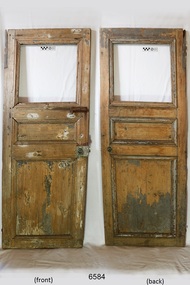
... Newman, W. Paul, J. Davis, M. Horenleng, J. Ogduff, T. W. Drew, R. ...Newman, W. Paul, J. Davis, M. Horenleng, J. Ogduff, T. W. Drew, R. ...The wooden door was salvaged from the wreck of the sailing ship Eric the Red, which was a wooden, three masted clipper ship. Eric the Red was the largest full-rigged ship built at Bath, Maine, USA in 1871, having had a 1,580 tons register. She was built and registered by Arthur Sewall, later to become the partnership E. & A. Sewall, the 51st ship built by this company. The annually-published List of Merchant Vessels of the U.S. shows Bath was still the home port of Eric the Red in 1880. The vessel was named after the Viking discoverer, Eric the Red, who was the first European to reach the shores of North America (in 980AD). The ship Eric the Red at first traded in coal between America and Britain, and later traded in guano nitrates from South America. In 1879 she was re-metalled and was in first class condition. On 10th June 1880 (some records say 12th June) Eric the Red departed New York for Melbourne and then Sydney. She had been commissioned by American trade representatives to carry a special cargo of 500 exhibits (1400 tons) – about a quarter to a third of America’s total exhibits - from America for the U.S.A. pavilion at Melbourne’s first International Exhibition. The exhibits included furniture, ironmongery, wines, chemicals, dental and surgical instruments, paper, cages, bronze lamp trimmings, axles, stamped ware, astronomical and time globes, samples of corn and the choicest of leaf tobacco. Other general cargo included merchandise such as cases of kerosene and turpentine, brooms, Bristol's Sarsaparilla, Wheeler and Wilson sewing machines, Wheeler’s thresher machine, axe handles and tools, cases of silver plate, toys, pianos and organs, carriages and Yankee notions. The Eric the Red left New York under the command of Captain Z. Allen (or some records say Captain Jacques Allen) and 24 other crew including the owner’s son third mate Ned Sewall. There were 2 saloon passengers also. The ship had been sailing for an uneventful 85 days and the voyage was almost at its end. On 4th September 1880 the Eric the Red approached Cape Otway with a moderate north-west wind and hazy and overcast atmosphere. Around 1:30am Captain Allen sighted the Cape Otway light and was keeping the ship 5-6 miles offshore to stay clear of the hazardous Otway Reef. However he had badly misjudged his position. The ship hit the Otway Reef about 2 miles out to sea, south west of the Cape Otway light station. He ordered the wheel to be put ‘hard up’ thinking that she might float off the reef. A heavy sea knocked the man away from the wheel, broke the wheel ropes and carried away the rudder. The sea swamped the lifeboats. The mizzenmast fell, with all of its rigging, then the mainmast also fell and the ship broke in two. Some said that the passenger Vaughan, who was travelling for his health and not very strong, was washed overboard and never seen again. The ship started breaking up. The forward house came adrift with three of the crew on it as well as a longboat, which the men succeeded in launching and keeping afloat by continually bailing with their sea boots. The captain, the third mate (the owner’s son) and others clung to the mizzenmast in the sea. Then the owner’s son was washed away off the mast. Within 10 minutes the rest of the ship was in pieces, completely wrecked, with cargo and wreckage floating in the sea. The captain encouraged the second mate to swim with him to the deckhouse where there were other crew but the second mate wouldn’t go with him. Eventually the Captain made it to the deckhouse and the men pulled him up. At about 4:30am the group of men on the deckhouse saw the lights of a steamer and called for help. At the same time they noticed the second mate and the other man had drifted nearby, still on the spur, and pulled them both onto the wreck. The coastal steamer Dawn was returning to Warrnambool from Melbourne, its sailing time different to its usual schedule. Captain Jones sent out two life boats, and fired off rockets and blue lights to illuminate the area. They picked up the three survivors who were in the long boat from Eric the Red. Two men were picked up out of the water, one being the owner’s son who was clinging to floating kerosene boxes. At daylight the Dawn then rescued the 18 men from the floating portion of the deckhouse, which had drifted about 4 miles from where they’d struck the reef. Shortly after the rescue the deckhouse drifted onto breakers and was thrown onto rocks at Point Franklin, about 2 miles east of Cape Otway. Captain Jones had signalled to Cape Otway lighthouse the number of the Eric the Red and later signalled that there was a wreck at Otway Reef but there was no response from the lighthouse. The captain and crew of the Dawn spent several more hours searching unsuccessfully for more survivors, even going back as far as Apollo Bay. On board the Dawn the exhausted men received care and attention to their needs and wants, including much needed clothing. Captain Allen was amongst the 23 battered and injured men who were rescued and later taken to Warrnambool for care. Warrnambool’s mayor and town clerk offered them all hospitality, the three badly injured men going to the hospital for care and others to the Olive Branch Hotel, then on to Melbourne. Captain Allen’s leg injury prevented him from going ashore so he and three other men travelled on the Dawn to Portland. They were met by the mayor who also treated them all with great kindness. Captain Allen took the train back to Melbourne then returned to America. Those saved were Captain Z. Allen (or Jacques Allen), J. Darcy chief mate, James F. Lawrence second mate, Ned Sewall third mate and owner’s son, John French the cook, C. Nelson sail maker, Clarence W. New passenger, and the able seamen Dickenson, J. Black, Denis White, C. Herbert, C. Thompson, A. Brooks, D. Wilson, J. Ellis, Q. Thompson, C. Newman, W. Paul, J. Davis, M. Horenleng, J. Ogduff, T. W. Drew, R. Richardson. Four men had lost their lives; three of them were crew (Gus Dahlgreen ship’s carpenter, H. Ackman steward, who drowned in his cabin, and George Silver seaman) and one a passenger (J. B. Vaughan). The body of one of them had been found washed up at Cape Otway and was later buried in the lighthouse cemetery; another body was seen on an inaccessible ledge. Twelve months later the second mate James F. Lawrence, from Nova Scotia, passed away in the Warrnambool district; an obituary was displayed in the local paper. The captain and crew of the Dawn were recognised by the United States Government in July 1881 for their humane efforts, being thanked and presented with substantial monetary rewards, medals and gifts. Neither the ship, nor its cargo, was insured. The ship was worth about £15,000 and the cargo was reportedly worth £40,000; only about £2,000 worth had been recovered. Cargo and wreckage washed up at Apollo Bay, Peterborough, Port Campbell, Western Port and according to some reports, even as far away as the beaches of New Zealand. The day after the wreck the government steam ship Pharos was sent from Queenscliff to clear the shipping lanes of debris that could be a danger to ships. The large midship deckhouse of the ship was found floating in a calm sea near Henty Reef. Items such as an American chair, a ladder and a nest of boxes were all on top of the deckhouse. As it was so large and could cause danger to passing ships, Captain Payne had the deckhouse towed towards the shore just beyond Apollo Bay. Between Apollo Bay and Blanket Bay the captain and crew of Pharos collected Wheeler and Wilson sewing machines, nests of boxes, bottles of Bristol’s sarsaparilla, pieces of common American chairs, axe handles, a Wheelers’ Patent thresher and a sailor’s trunk with the words “A. James” on the front. A ship’s flag-board bearing the words “Eric the Red” was found on the deckhouse; finally those on board the Pharos had the name of the wrecked vessel. During this operation Pharos came across the government steamer Victoria and also a steamer S.S. Otway, both of which were picking up flotsam and wreckage. A whole side of the hull and three large pieces of the other side of the hull, with some of the copper sheathing stripped off, had floated on to Point Franklin. Some of the vessels yards and portions of her masts were on shore. The pieces of canvas attached to the yards and masts confirmed that the vessel had been under sail. The beach there was piled with debris several feet high. There were many cases of Diamond Oil kerosene, labelled R. W. Cameron and Company, New York. There were also many large planks of red pine, portions of a small white boat and a large, well-used oar. Other items found ashore included sewing machines (some consigned to ‘Long and Co.”) and notions, axe and scythe handles, hay forks, wooden pegs, rolls of wire (some branded “T.S” and Co, Melbourne”), kegs of nails branded “A.T. and Co.” from the factory of A. Field and Son, Taunton, Massachusetts, croquet balls and mallets, buggy fittings, rat traps, perfumery, cutlery and Douay Bibles, clocks, bicycles, chairs, a fly wheel, a cooking stove, timber, boxes, pianos, organs and a ladder. (Wooden clothes pegs drifted in for many years). There seemed to be no personal luggage or clothing. The Pharos encountered a long line, about one and a half miles, of floating wreckage about 10 miles off land, south east of Cape Otway, and in some places about 40 feet wide. It seemed that more than half of it was from Eric the Red. The ship’s crew rescued 3 cases that were for the Melbourne Exhibition and other items from amongst the debris. There were also chairs, doors, musical instruments, washing boards, nests of trunks and fly catchers floating in the sea. Most of the goods were saturated and smelt of kerosene. A section of the hull lies buried in the sand at Parker River Beach. An anchor with chain is embedded in the rocks east of Point Franklin and a second anchor, thought to be from Eric the Red, is on display at the Cape Otway light station. (There is a photograph of a life belt on the verandah of Rivernook Guest House in Princetown with the words “ERIC THE RED / BOSTON”. This is rather a mystery as the ship was registered in Bath, Maine, USA.) Parts of the ship are on display at Bimbi Park Caravan Park and at Apollo Bay Museum. Flagstaff Hill Maritime Village also has part of the helm (steering wheel), a carved wooden sword (said to be the only remaining portion of the ship’s figurehead; further research is currently being carried out), a door, a metal rod and samples of wood. Much of the wreckage was recovered by the local residents before police and other authorities arrived at the scene. Looters went to great effort to salvage goods, being lowered down the high cliff faces to areas with little or no beach to collect items from the wreckage, their mates above watching out for dangerous waves. A Tasmanian newspaper reports on a court case in Stawell, Victoria, noting a man who was caught 2 months later selling tobacco from the wreckage of Eric the Red. Some of the silverware is still treasured by descendants of Mr Mackenzie who was given these items by officials for his help in securing the cargo. The gifts included silver coffee and tea pots, half a dozen silver serviette rings and two sewing machines. The wreck and cargo were sold to a Melbourne man who salvaged a quantity of high quality tobacco and dental and surgical instruments. Timbers from the ship were salvaged and used in the construction of houses and sheds around Apollo Bay, including a guest house, Milford House (since burnt down in bushfires), which had furniture, fittings and timber on the dining room floor from the ship. A 39.7 foot long trading ketch, the Apollo, was also built from its timbers by Mr Burgess in 1883 and subsequently used in Tasmanian waters. It was the first attempt at ship building in Apollo bay. In 1881 a red light was installed about 300 feet above sea level at the base of the Cape Otway lighthouse to warn ships when they were too close to shore; It would not be visible unless a ship came within 3 miles from it. This has proved to be an effective warning. The State Library of Victoria has a lithograph in its collection depicting the steamer Dawn and the shipwrecked men, titled. "Wreck of the ship Eric the Red, Cape Otway: rescue of the crew by the Dawn". “The Eric the Red is historically significant as one of Victoria's major 19th century shipwrecks. (Heritage Victoria Eric the Red; HV ID 239) The wreck led to the provision of an additional warning light placed below the Cape Otway lighthouse to alert mariners to the location of Otway Reef. The site is archaeologically significant for its remains of a large and varied cargo and ship's fittings being scattered over a wide area. The site is recreationally and aesthetically significant as it is one of the few sites along this coast where tourists can visit identifiable remains of a large wooden shipwreck, and for its location set against the background of Cape Otway, Bass Strait, and the Cape Otway lighthouse.“ (Victorian Heritage Database Registration Number S239, Official Number 8745 USA) Door from the wreck of the ship Eric the Red. The wooden singular rectangular door includes three insert panel sections. The top section is square shaped and is missing its panel or glass. The centre timber panel is about a third of the height of the top panel and the bottom timber panel is approximately equal in height to the total height of the two upper panels. The door fastenings include both a metal door latch and traditional door bolt. They are both attached to the front right hand side of the door. The bolt is just below the top panel, and the door latch is in approximately the centre of that side. The door latch has a round mark where a handle could have been attached. The wood of the door has scraping marks in a semi-circle around the door latch where the latch has swung around on its one remaining fastening and grazed the surface. There is a metal hinge at the top section of the door on the opposite side to the latch. The painted surface has been scraped back to expose the wood. The door is shorter than the average height of a person. On the reverse of the door there are lines on the panels, just inside their edges, is what appears to be pencil. The door is not aligned straight but is skew to centre.warrnambool, flagstaff hill, flagstaff hill maritime village, maritime museum, shipwreck coast, great ocean road, shipwreck artefact, eric the red, jaques allen, sewall, 1880, melbourne exhibition 1880, cape otway, otway reef, victorian shipwreck, bass strait, eric-the-red, door -
 Flagstaff Hill Maritime Museum and Village
Decorative object - Sword, 1871 or earlier
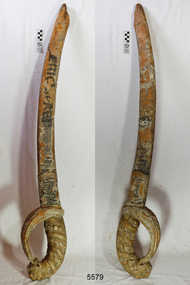
... Newman, W. Paul, J. Davis, M. Horenleng, J. Ogduff, T. W. Drew, R. ...Newman, W. Paul, J. Davis, M. Horenleng, J. Ogduff, T. W. Drew, R. ...This wooden sword is said to “possibly be the only remaining part of the figurehead from the sailing ship Eric the Red.” It was previously part of the collection of the old Warrnambool Museum and the entry in its inventory says “Wooden sword, portion of the figurehead, held by “Eric the Red” at the bow.” A large part of the ship’s hull was found on the rocks and a figurehead may have been attached or washed up on the shore. The shipping records for E. & A. Sewall, the builders, owners and managers of Eric the Red, are now preserved in the Maine Maritime Museum. There is no photograph on record of Eric the Red but photographs of other ships built around that time by the same company show that these did not have figureheads, and there is no record found of a figurehead for Eric the Red being ordered or paid for. Further research is being carried out. The ship building company E. & A. Sewall, from Bath, Maine, USA, built Eric the Red, a wooden, three masted clipper ship. She had 1,580 tons register and was the largest full-rigged ship built at Bath, Maine, USA in 1871. She was built and registered by Arthur Sewall, later to become the partnership E. & A. Sewall, and was the 51st ship built by this company. The annually-published List of Merchant Vessels of the U.S. shows that Bath was still the home port of Eric the Red in 1880. The vessel was named after the Viking discoverer, Eric the Red, who was the first European to reach the shores of North America (in 980AD). The ship Eric the Red at first traded in coal between America and Britain, and later traded in guano nitrates from South America. In 1879 she was re-metalled and was in first class condition. On 10th June 1880 (some records say 12th June) Eric the Red departed New York for Melbourne and then Sydney. She had been commissioned by American trade representatives to carry a special cargo of 500 exhibits (1400 tons) - about a quarter to a third of America’s total exhibits - from America for the U.S.A. pavilion at Melbourne’s first International Exhibition. The exhibits included furniture, ironmongery, wines, chemicals, dental and surgical instruments, paper, cages, bronze lamp trimmings, axles, stamped ware, astronomical and time globes, samples of corn and the choicest of leaf tobacco. Other general cargo included merchandise such as cases of kerosene and turpentine, brooms, Bristol's Sarsaparilla, Wheeler and Wilson sewing machines, Wheeler’s thresher machine, axe handles and tools, cases of silver plate, toys, pianos and organs, carriages and Yankee notions. The Eric the Red left New York under the command of Captain Z. Allen (or some records say Captain Jacques Allen) and 24 other crew including the owner’s son third mate Ned Sewall. There were 2 saloon passengers also. On 4th September 1880 the ship had been sailing for an uneventful 85 days and the voyage was almost at its end. Eric the Red approached Cape Otway in a moderate north-west wind and hazy and overcast atmosphere. Around 1:30am Captain Allen sighted the Cape Otway light and was keeping the ship 5-6 miles offshore to stay clear of the hazardous Otway Reef. However he had badly misjudged his position. The ship hit the Otway Reef about 2 miles out to sea, south west of the Cape Otway light station. Captain Allen ordered the wheel to be put ‘hard up’ thinking that she might float off the reef. A heavy sea knocked the man away from the wheel, broke the wheel ropes and carried away the rudder. The sea swamped the lifeboats, the mizzenmast fell, with all of its rigging, then the mainmast fell and the ship broke in two. Some said that the passenger Vaughan, who was travelling for his health and not very strong, was washed overboard and never seen again. The ship started breaking up. The forward house came adrift with three of the crew on it as well as a longboat, which the men succeeded in launching and keeping afloat by continually bailing with their sea boots. The captain, the third mate (the owner’s son) and others clung to the mizzenmast in the sea. Then the owner’s son was washed away off the mast. Within 10 minutes the rest of the ship was in pieces, completely wrecked, with cargo and wreckage floating in the sea. The captain encouraged the second mate to swim with him to the deckhouse where there were other crew but the second mate wouldn’t go with him. Eventually the Captain made it to the deckhouse and the men pulled him up. At about 4:30am the group of men on the deckhouse saw the lights of a steamer and called for help. At the same time they noticed the second mate and the other man had drifted nearby, still on the spur, and pulled them both onto the wreck. The coastal steamer Dawn was returning to Warrnambool from Melbourne, its sailing time different to its usual schedule. Cries were heard coming from out of the darkness. Captain Jones sent out two life boats, and fired off rockets and blue lights to illuminate the area. They picked up the three survivors who were in the long boat from Eric the Red. Two men were picked up out of the water, one being the owner’s son who was clinging to floating kerosene boxes. At daylight the Dawn then rescued the 18 men from the floating portion of the deckhouse, which had drifted about 4 miles from where they’d struck the reef. Shortly after the rescue the deckhouse drifted onto breakers and was thrown onto rocks at Point Franklin, about 2 miles east of Cape Otway. Captain Jones had signalled to Cape Otway lighthouse the number of the Eric the Red and later signalled that there was a wreck at Otway Reef but there was no response from the lighthouse. The captain and crew of the Dawn spent several more hours searching unsuccessfully for more survivors, even going back as far as Apollo Bay. On board the Dawn the exhausted men received care and attention to their needs and wants, including much needed clothing. Captain Allen was amongst the 23 battered and injured men who were rescued and later taken to Warrnambool for care. Warrnambool’s mayor and town clerk offered them all hospitality, the three badly injured men going to the hospital and others to the Olive Branch Hotel, then on to Melbourne. Captain Allen’s leg injury prevented him from going ashore so he and three other men travelled on the Dawn to Portland. They were met by the mayor who also treated them all with great kindness. Captain Allen took the train back to Melbourne then returned to America. Those saved were Captain Z. Allen (or Jacques Allen), J. Darcy chief mate, James F. Lawrence second mate, Ned Sewall third mate and owner’s son, John French the cook, C. Nelson sail maker, Clarence W. New passenger, and the able seamen Dickenson, J. Black, Denis White, C. Herbert, C. Thompson, A. Brooks, D. Wilson, J. Ellis, Q. Thompson, C. Newman, W. Paul, J. Davis, M. Horenleng, J. Ogduff, T. W. Drew, R. Richardson. Four men had lost their lives; three of them were crew (Gus Dahlgreen ship’s carpenter, H. Ackman steward, who drowned in his cabin, and George Silver seaman) and one a passenger (J. B. Vaughan). The body of one of them had been found washed up at Cape Otway and was later buried in the lighthouse cemetery; another body was seen on an inaccessible ledge. Twelve months later the second mate James F. Lawrence, from Nova Scotia, passed away in the Warrnambool district; an obituary was displayed in the local paper. The captain and crew of the Dawn were recognised by the United States Government in July 1881 for their humane efforts and bravery, being thanked and presented with substantial monetary rewards, medals and gifts. Neither the ship, nor its cargo, was insured. The ship was worth about £15,000 and the cargo was reportedly worth £40,000; only about £2,000 worth had been recovered. Cargo and wreckage washed up at Apollo Bay, Peterborough, Port Campbell, Western Port and according to some reports, even as far away as the beaches of New Zealand. The day after the wreck the government steam ship Pharos was sent from Queenscliff to clear the shipping lanes of debris that could be a danger to ships. The large midship deckhouse of the ship was found floating in a calm sea near Henty Reef. Items such as an American chair, a ladder and a nest of boxes were all on top of the deckhouse. As it was so large and could cause danger to passing ships, Captain Payne had the deckhouse towed towards the shore just beyond Apollo Bay. Between Apollo Bay and Blanket Bay the captain and crew of Pharos collected Wheeler and Wilson sewing machines, nests of boxes, bottles of Bristol’s sarsaparilla, pieces of common American chairs, axe handles, a Wheelers’ Patent thresher and a sailor’s trunk with the words “A. James” on the front. A ship’s flag-board bearing the words “Eric the Red” was found on the deckhouse; finally those on board the Pharos had the name of the wrecked vessel. During this operation Pharos came across the government steamer Victoria and also a steamer S.S. Otway, both of which were picking up flotsam and wreckage. A whole side of the hull and three large pieces of the other side of the hull, with some of the copper sheathing stripped off, had floated on to Point Franklin. Some of the vessels yards and portions of her masts were on shore. The pieces of canvas attached to the yards and masts confirmed that the vessel had been under sail. The beach there was piled with debris several feet high. There were many cases of Diamond Oil kerosene, labelled R. W. Cameron and Company, New York. There were also many large planks of red pine, portions of a small white boat and a large, well-used oar. Other items found ashore included sewing machines (some consigned to ‘Long and Co.”) and notions, axe and scythe handles, hay forks, wooden pegs, rolls of wire (some branded “T.S” and Co, Melbourne”), kegs of nails branded “A.T. and Co.” from the factory of A. Field and Son, Taunton, Massachusetts, croquet balls and mallets, buggy fittings, rat traps, perfumery, cutlery and Douay Bibles, clocks, bicycles, chairs, a fly wheel, a cooking stove, timber, boxes, pianos, organs and a ladder. (Wooden clothes pegs drifted in for many years). There seemed to be no personal luggage or clothing. The Pharos encountered a long line, about one and a half miles, of floating wreckage about 10 miles off land, south east of Cape Otway, and in some places about 40 feet wide. It seemed that more than half of it was from Eric the Red. The ship’s crew rescued 3 cases that were for the Melbourne Exhibition and other items from amongst the debris. There were also chairs, doors, musical instruments, washing boards, nests of trunks and fly catchers floating in the sea. Most of the goods were saturated and smelt of kerosene. A section of the hull lies buried in the sand at Parker River Beach. An anchor with chain is embedded in the rocks east of Point Franklin and a second anchor, thought to be from Eric the Red, is on display at the Cape Otway light station. (There is a photograph of a life belt on the verandah of Rivernook Guest House in Princetown with the words “ERIC THE RED / BOSTON”. This is rather a mystery as the ship was registered in Bath, Maine, USA.) Parts of the ship are on display at Bimbi Park Caravan Park and at Apollo Bay Museum. Flagstaff Hill Maritime Village also has part of the helm (steering wheel), a carved wooden sword (said to be the only remaining portion of the ship’s figurehead; further research is currently being carried out), a door, a metal rod, samples of wood and a medal for bravery. Much of the wreckage was recovered by the local residents before police and other authorities arrived at the scene. Looters went to great effort to salvage goods, being lowered down the high cliff faces to areas with little or no beach to collect items from the wreckage, their mates above watching out for dangerous waves. A Tasmanian newspaper reports on a court case in Stawell, Victoria, noting a man who was caught 2 months later selling tobacco from the wreckage of Eric the Red. Some of the silverware is still treasured by descendants of Mr Mackenzie who was given these items by officials for his help in securing the cargo. The gifts included silver coffee and tea pots, half a dozen silver serviette rings and two sewing machines. The wreck and cargo were sold to a Melbourne man who salvaged a quantity of high quality tobacco and dental and surgical instruments. Timbers from the ship were salvaged and used in the construction of houses and sheds around Apollo Bay, including a guest house, Milford House (since burnt down in bushfires), which had furniture, fittings and timber on the dining room floor from the ship. A 39.7 foot long trading ketch, the Apollo, was also built from its timbers by Mr Burgess in 1883 and subsequently used in Tasmanian waters. It was the first attempt at ship building in Apollo bay. In 1881 a red light was installed about 300 feet above sea level at the base of the Cape Otway lighthouse to warn ships when they were too close to shore; It would not be visible unless a ship came within 3 miles from it. This has proved to be an effective warning. The State Library of Victoria has a lithograph in its collection depicting the steamer Dawn and the shipwrecked men, titled. "Wreck of the ship Eric the Red, Cape Otway: rescue of the crew by the Dawn".The Eric the Red is historically significant as one of Victoria's major 19th century shipwrecks. (Heritage Victoria Eric the Red; HV ID 239) The wreck led to the provision of an additional warning light placed below the Cape Otway lighthouse to alert mariners to the location of Otway Reef. The site is archaeologically significant for its remains of a large and varied cargo and ship's fittings being scattered over a wide area. The site is recreationally and aesthetically significant as it is one of the few sites along this coast where tourists can visit identifiable remains of a large wooden shipwreck, and for its location set against the background of Cape Otway, Bass Strait, and the Cape Otway lighthouse. (Victorian Heritage Database Registration Number S239, Official Number 8745 USA)This carved wooden sword, recovered from the Eric the Red, is possibly the only portion of the figurehead recovered after the wreck. There are spirals carved from the base of the handle to the top of the sword. The hilt of the sword is a lion’s head holding its tail in its mouth, the tail forming the handle. The blade of the sword has engraved patterns on it. Tiny particles of gold leaf and dark blue paint fragments can be seen between the carving marks. There are remnants of yellowish-orange and crimson paint on the handle. At some time after the sword was salvaged the name of the ship was hand painted on the blade in black paint. The tip of the sword has broken or split and the remaining part is charcoal in appearance. On both the tip and the base of the handle are parts made where the sword could have been joined onto the figurehead There is a white coating over some areas of the sword, similar to white lead putty used in traditional shipbuilding. The words “ERIC the RED” have been hand painted on the blade of the sword in black paint sometime after it was salvaged.flagstaff hill, flagstaff hill maritime museum and village, warrnambool, maritime museum, maritime village, great ocean road, shipwreck coast, sword, wooden sword, eric the red, carved sword, figurehead, snake head on sword -
 Flagstaff Hill Maritime Museum and Village
Wood Sample, about 1871
... Newman, W. Paul, J. Davis, M. Horenleng, J. Ogduff, T. W. Drew, R. ...Newman, W. Paul, J. Davis, M. Horenleng, J. Ogduff, T. W. Drew, R. ...This piece of timber from the ship Eric the Red has been eaten through by the marine animals called Teredo Worms, sometimes called sea worms or ‘termites of the sea’. The worms bore holes into wood that is immersed in sea water and bacteria inside the worms digest the wood. Shipbuilders tried to prevent this problem by using coatings of tar, wax, lead or pitch. In the 18th and 19th centuries the outside of their ships were sheathed in copper or a combination of copper and zinc (called Muntz metal) and would be re-metalled periodically to ensure the sheathing would remain effective. In more recent times the ships are protected with a toxic coating. The American ship Eric the Red was a wooden, three masted clipper ship. She had 1,580 tons register and was the largest full-rigged ship built at Bath, Maine, USA in 1871. She was built and registered by Arthur Sewall, later to become the partnership E. & A. Sewall, the 51st ship built by this company. The annually-published List of Merchant Vessels of the U.S. shows Bath was still the home port of Eric the Red in 1880. The vessel was named after the Viking discoverer, Eric ‘the Red-haired’ Thorvaldsson , who was the first European to reach the shores of North America (in 980AD). The ship Eric the Red at first traded in coal between America and Britain, and later traded in guano nitrates from South America. In 1879 she was re-metalled and was in first class condition. On 10th June 1880 (some records say 12th June) Eric the Red departed New York for Melbourne and then Sydney. She had been commissioned by American trade representatives to carry a special cargo of 500 exhibits (1400 tons) – about a quarter to a third of America’s total exhibits - for the U.S.A. pavilion at Melbourne’s first International Exhibition. The exhibits included furniture, ironmongery, wines, chemicals, dental and surgical instruments, paper, cages, bronze lamp trimmings, axles, stamped ware, astronomical and time globes, samples of corn and the choicest of leaf tobacco. Other general cargo included merchandise such as cases of kerosene and turpentine, brooms, Bristol's Sarsaparilla, Wheeler and Wilson sewing machines, Wheeler’s thresher machine, axe handles and tools, cases of silver plate, toys, pianos and organs, carriages and Yankee notions. The Eric the Red left New York under the command of Captain Zaccheus Allen (or some records say Captain Jacques Allen) and 24 other crew including the owner’s son third mate Ned Sewall. There were also 2 saloon passengers on board. The ship had been sailing for an uneventful 85 days and the voyage was almost at its end. As Eric the Red approached Cape Otway there was a moderate north-west wind and hazy and overcast atmosphere. On 4th September 1880 at about 1:30am Captain Allen sighted the Cape Otway light and was keeping the ship 5-6 miles offshore to stay clear of the hazardous Otway Reef. However he had badly misjudged his position. The ship hit the Otway Reef about 2 miles out to sea, south west of the Cape Otway light station. Captain Allen ordered the wheel to be put ‘hard up’ thinking that she might float off the reef. The sea knocked the helmsman away from the wheel, broke the wheel ropes and carried away the rudder. The lifeboats were swamped, the mizzenmast fell, with all of its rigging, then the mainmast also fell and the ship broke in two. Some said that the passenger Vaughan, who was travelling for his health and not very strong, was washed overboard and never seen again. The ship started breaking up. The forward house came adrift with three of the crew on it as well as a longboat, which the men succeeded in launching and keeping afloat by continually bailing with their sea boots. The captain, the third mate (the owner’s son) and others clung to the mizzenmast in the sea. Then the owner’s son was washed away off the mast. Within 10 minutes the rest of the ship was in pieces, completely wrecked, with cargo and wreckage floating in the sea. The captain encouraged the second mate to swim with him to the deckhouse where there were other crew but the second mate wouldn’t go with him. Eventually the Captain made it to the deckhouse and the men pulled him up. At about 4:30am the group of men on the deckhouse saw the lights of a steamer and called for help. At the same time they noticed the second mate and the other man had drifted nearby, still on the spur, and pulled them both onto the wreck. The coastal steamer SS Dawn was returning to Warrnambool from Melbourne, its sailing time different to its usual schedule. She was built in 1876 and bought by the Portland and Belfast Steam Navigation Co. in 1877. At the time of this journey she was commanded by Captain Jones, and was sailing between Melbourne and Portland via Warrnambool. The provedore of the Dawn, Benjamin Lear, heard cries of distress coming through the portholes of the saloon. He gave the alarm and the engines were stopped. Cries could be heard clearly, coming from the land. Captain Jones sent out crew in two boats, and fired off rockets and blue lights to illuminate the area. They picked up the three survivors who were in the long boat from Eric the Red. Two men were picked up out of the water, one being the owner’s son who was clinging to floating kerosene boxes. At daylight the Dawn then rescued the 18 men from the floating portion of the deckhouse, which had drifted about 4 miles from where they’d struck the reef. Shortly after the rescue the deckhouse drifted onto breakers and was thrown onto rocks at Point Franklin, about 2 miles east of Cape Otway. Captain Jones had signalled to Cape Otway lighthouse the number of the Eric the Red and later signalled that there was a wreck at Otway Reef but there was no response from the lighthouse. The captain and crew of the Dawn spent several more hours searching unsuccessfully for more survivors, even going back as far as Apollo Bay. On board the Dawn the exhausted men received care and attention to their needs and wants, including much needed clothing. Captain Allen was amongst the 23 battered and injured men who were rescued and later taken to Warrnambool for care. Warrnambool’s mayor and town clerk offered them all hospitality, the three badly injured men going to the hospital for care and others to the Olive Branch Hotel, then on to Melbourne. Captain Allen’s leg injury prevented him from going ashore so he and three other men travelled on the Dawn to Portland. They were met by the mayor who also treated them all with great kindness. Captain Allen took the train back to Melbourne then returned to America. Those saved were Captain Zaccheus Allen (or Jacques Allen), J. Darcy chief mate, James F. Lawrence second mate, Ned Sewall third mate and owner’s son, John French the cook, C. Nelson sail maker, Clarence W. New passenger, and the able seamen Dickenson, J. Black, Denis White, C. Herbert, C. Thompson, A. Brooks, D. Wilson, J. Ellis, Q. Thompson, C. Newman, W. Paul, J. Davis, M. Horenleng, J. Ogduff, T. W. Drew, R. Richardson. Four men had lost their lives; three of them were crew (Gus Dahlgreen ship’s carpenter, H. Ackman steward, who drowned in his cabin, and George Silver seaman) and one a passenger (J. B. Vaughan). The body of one of them had been found washed up at Cape Otway and was later buried in the lighthouse cemetery; another body was seen on an inaccessible ledge. Twelve months later the second mate James F. Lawrence, from Nova Scotia, passed away in the Warrnambool district; an obituary was displayed in the local paper. Neither the ship, nor its cargo, was insured. The ship was worth about £15,000 and the cargo was reportedly worth £40,000; only about £2,000 worth had been recovered. Cargo and wreckage washed up at Apollo Bay, Peterborough, Port Campbell, Western Port and according to some reports, even as far away as the beaches of New Zealand. The day after the wreck the government steam ship Pharos was sent from Queenscliff to clear the shipping lanes of debris that could be a danger to ships. The large midship deckhouse of the ship was found floating in a calm sea near Henty Reef. Items such as an American chair, a ladder and a nest of boxes were all on top of the deckhouse. As it was so large and could cause danger to passing ships, Captain Payne had the deckhouse towed towards the shore just beyond Apollo Bay. Between Apollo Bay and Blanket Bay the captain and crew of Pharos collected Wheeler and Wilson sewing machines, nests of boxes, bottles of Bristol’s sarsaparilla, pieces of common American chairs, axe handles, a Wheelers’ Patent thresher and a sailor’s trunk with the words “A. James” on the front. A ship’s flag-board bearing the words “Eric the Red” was found on the deckhouse; finally those on board the Pharos had the name of the wrecked vessel. During this operation Pharos came across the government steamer Victoria and also a steamer S.S. Otway, both of which were picking up flotsam and wreckage. A whole side of the hull and three large pieces of the other side of the hull, with some of the copper sheathing stripped off, had floated on to Point Franklin. Some of the vessels yards and portions of her masts were on shore. The pieces of canvas attached to the yards and masts confirmed that the vessel had been under sail. The beach there was piled with debris several feet high. There were many cases of Diamond Oil kerosene, labelled R. W. Cameron and Company, New York. There were also many large planks of red pine, portions of a small white boat and a large, well-used oar. Other items found ashore included sewing machines (some consigned to ‘Long and Co.”) and notions, axe and scythe handles, hay forks, wooden pegs, rolls of wire (some branded “T.S” and Co, Melbourne”), kegs of nails branded “A.T. and Co.” from the factory of A. Field and Son, Taunton, Massachusetts, croquet balls and mallets, buggy fittings, rat traps, perfumery, cutlery and Douay Bibles, clocks, bicycles, chairs, a fly wheel, a cooking stove, timber, boxes, pianos, organs and a ladder. (Wooden clothes pegs drifted in for many years). There seemed to be no personal luggage or clothing. The Pharos encountered a long line, about one and a half miles, of floating wreckage about 10 miles off land, south east of Cape Otway, and in some places about 40 feet wide. It seemed that more than half of it was from Eric the Red. The ship’s crew rescued 3 cases that were for the Melbourne Exhibition and other items from amongst the debris. There were also chairs, doors, musical instruments, washing boards, nests of trunks and fly catchers floating in the sea. Most of the goods were saturated and smelt of kerosene. A section of the hull lies buried in the sand at Parker River Beach. An anchor with chain is embedded in the rocks east of Point Franklin and a second anchor, thought to be from Eric the Red, is on display at the Cape Otway light station. (There is a photograph of a life belt on the verandah of Rivernook Guest House in Princetown with the words “ERIC THE RED / BOSTON”. This is rather a mystery as the ship was registered in Bath, Maine, USA.) Parts of the ship are on display at Bimbi Park Caravan Park and at Apollo Bay Museum. Flagstaff Hill Maritime Village also has part of the helm (steering wheel), a carved wooden sword (said to be the only remaining portion of the ship’s figurehead; further research is currently being carried out), a door, a metal rod, several samples of wood and a medal for bravery, awarded to Nelson Johnson, a crew member of the S.S. Dawn by the U.S. President, for the rescue of the crew. Much of the wreckage was recovered by the local residents before police and other authorities arrived at the scene. Looters went to great effort to salvage goods, being lowered down the high cliff faces to areas with little or no beach to collect items from the wreckage, their mates above watching out for dangerous waves. A Tasmanian newspaper reports on a court case in Stawell, Victoria, noting a man who was caught 2 months later selling tobacco from the wreckage of Eric the Red. Some of the silverware is still treasured by descendants of Mr Mackenzie who was given these items by officials for his help in securing the cargo. The gifts included silver coffee and tea pots, half a dozen silver serviette rings and two sewing machines. A Mr G.W. Black has in his possession a medal and a purse that were awarded to his father, another Dawn crew member who was part of the rescue team. The medal is inscribed and named “To John Black ….” (from “Shipwrecks” by Margaret E. Mackenzie, 3rd edition, published 1964). The wreck and cargo were sold to a Melbourne man who salvaged a quantity of high quality tobacco and dental and surgical instruments. Timbers from the ship were salvaged and used in the construction of houses and sheds around Apollo Bay, including a guest house, Milford House (since burnt down in bushfires), which had furniture, fittings and timber on the dining room floor from the ship. A 39.7 foot long trading ketch, the Apollo, was also built from its timbers by Mr Burgess in 1883 and subsequently used in Tasmanian waters. It was the first attempt at ship building in Apollo bay. In 1881 a red light was installed about 300 feet above sea level at the base of the Cape Otway lighthouse to warn ships when they were too close to shore; It would not be visible unless a ship came within 3 miles from it. This has proved to be an effective warning. Nelson Johnson, recipient of the medal for bravery, married Elizabeth Howard in 1881 and they had 10 children. They lived in South Melbourne, Victoria. Nelson died in 1922 in Fitzroy Victoria, age 66. In 1895 the owners of the S.S. Dawn, the Portland and Belfast Steam Navigation Co., wound up and sold out to the Belfast Company who took over the Dawn for one year before selling her to Howard Smith. She was condemned and sunk in Suva in 1928. The State Library of Victoria has a lithograph in its collection depicting the steamer Dawn and the shipwrecked men, titled. "Wreck of the ship Eric the Red, Cape Otway: rescue of the crew by the Dawn".The wood (timber) sample is listed on the Collections Australia Database, Heritage Victoria, number 239 00010 A “The Eric the Red is historically significant as one of Victoria's major 19th century shipwrecks. (Heritage Victoria Eric the Red; HV ID 239) The wreck led to the provision of an additional warning light placed below the Cape Otway lighthouse to alert mariners to the location of Otway Reef. The site is archaeologically significant for its remains of a large and varied cargo and ship's fittings being scattered over a wide area. The site is recreationally and aesthetically significant as it is one of the few sites along this coast where tourists can visit identifiable remains of a large wooden shipwreck, and for its location set against the background of Cape Otway, Bass Strait, and the Cape Otway lighthouse.“ (Victorian Heritage Database Registration Number S239, Official Number 8745 USA) Wood sample from the wreck of the ship Eric the Red. Triangular shaped, full of sea worm (Teredo worm) holes. The wood is dark in colour and is very light in weight.flagstaff hill, warrnambool, shipwrecked-coast, flagstaff-hill, flagstaff-hill-maritime-museum, maritime-museum, shipwreck-coast, flagstaff-hill-maritime-village, shipwreck-artefact, eric-the-red, zaccheus-allen, sewall, 1880, melbourne-exhibition, cape-otway, otway-reef, wood-sample, s.s.-dawn -
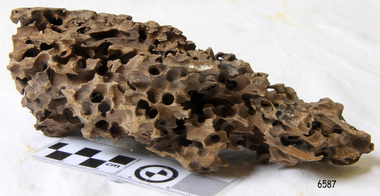 Flagstaff Hill Maritime Museum and Village
Wood Sample, About 1871
... Newman, W. Paul, J. Davis, M. Horenleng, J. Ogduff, T. W. Drew, R. ...Newman, W. Paul, J. Davis, M. Horenleng, J. Ogduff, T. W. Drew, R. ...This piece of timber from the ship Eric the Red has been eaten through by the marine animals called Teredo Worms, sometimes called sea worms or ‘termites of the sea’. The worms bore holes into wood that is immersed in sea water and bacteria inside the worms digest the wood. Shipbuilders tried to prevent this problem by using coatings of tar, wax, lead or pitch. In the 18th and 19th centuries the outside of their ships were sheathed in copper or a combination of copper and zinc (called Muntz metal) and would be re-metalled periodically to ensure the sheathing would remain effective. In more recent times the ships are protected with a toxic coating. The American ship Eric the Red was a wooden, three masted clipper ship. She had 1,580 tons register and was the largest full-rigged ship built at Bath, Maine, USA in 1871. She was built and registered by Arthur Sewall, later to become the partnership E. & A. Sewall, the 51st ship built by this company. The annually-published List of Merchant Vessels of the U.S. shows Bath was still the home port of Eric the Red in 1880. The vessel was named after the Viking discoverer, Eric ‘the Red-haired’ Thorvaldsson , who was the first European to reach the shores of North America (in 980AD). The ship Eric the Red at first traded in coal between America and Britain, and later traded in guano nitrates from South America. In 1879 she was re-metalled and was in first class condition. On 10th June 1880 (some records say 12th June) Eric the Red departed New York for Melbourne and then Sydney. She had been commissioned by American trade representatives to carry a special cargo of 500 exhibits (1400 tons) – about a quarter to a third of America’s total exhibits - for the U.S.A. pavilion at Melbourne’s first International Exhibition. The exhibits included furniture, ironmongery, wines, chemicals, dental and surgical instruments, paper, cages, bronze lamp trimmings, axles, stamped ware, astronomical and time globes, samples of corn and the choicest of leaf tobacco. Other general cargo included merchandise such as cases of kerosene and turpentine, brooms, Bristol's Sarsaparilla, Wheeler and Wilson sewing machines, Wheeler’s thresher machine, axe handles and tools, cases of silver plate, toys, pianos and organs, carriages and Yankee notions. The Eric the Red left New York under the command of Captain Zaccheus Allen (or some records say Captain Jacques Allen) and 24 other crew including the owner’s son third mate Ned Sewall. There were also 2 saloon passengers on board. The ship had been sailing for an uneventful 85 days and the voyage was almost at its end. As Eric the Red approached Cape Otway there was a moderate north-west wind and hazy and overcast atmosphere. On 4th September 1880 at about 1:30am Captain Allen sighted the Cape Otway light and was keeping the ship 5-6 miles offshore to stay clear of the hazardous Otway Reef. However he had badly misjudged his position. The ship hit the Otway Reef about 2 miles out to sea, south west of the Cape Otway light station. Captain Allen ordered the wheel to be put ‘hard up’ thinking that she might float off the reef. The sea knocked the helmsman away from the wheel, broke the wheel ropes and carried away the rudder. The lifeboats were swamped, the mizzenmast fell, with all of its rigging, then the mainmast also fell and the ship broke in two. Some said that the passenger Vaughan, who was travelling for his health and not very strong, was washed overboard and never seen again. The ship started breaking up. The forward house came adrift with three of the crew on it as well as a longboat, which the men succeeded in launching and keeping afloat by continually bailing with their sea boots. The captain, the third mate (the owner’s son) and others clung to the mizzenmast in the sea. Then the owner’s son was washed away off the mast. Within 10 minutes the rest of the ship was in pieces, completely wrecked, with cargo and wreckage floating in the sea. The captain encouraged the second mate to swim with him to the deckhouse where there were other crew but the second mate wouldn’t go with him. Eventually the Captain made it to the deckhouse and the men pulled him up. At about 4:30am the group of men on the deckhouse saw the lights of a steamer and called for help. At the same time they noticed the second mate and the other man had drifted nearby, still on the spur, and pulled them both onto the wreck. The coastal steamer SS Dawn was returning to Warrnambool from Melbourne, its sailing time different to its usual schedule. She was built in 1876 and bought by the Portland and Belfast Steam Navigation Co. in 1877. At the time of this journey she was commanded by Captain Jones, and was sailing between Melbourne and Portland via Warrnambool. The provedore of the Dawn, Benjamin Lear, heard cries of distress coming through the portholes of the saloon. He gave the alarm and the engines were stopped. Cries could be heard clearly, coming from the land. Captain Jones sent out crew in two boats, and fired off rockets and blue lights to illuminate the area. They picked up the three survivors who were in the long boat from Eric the Red. Two men were picked up out of the water, one being the owner’s son who was clinging to floating kerosene boxes. At daylight the Dawn then rescued the 18 men from the floating portion of the deckhouse, which had drifted about 4 miles from where they’d struck the reef. Shortly after the rescue the deckhouse drifted onto breakers and was thrown onto rocks at Point Franklin, about 2 miles east of Cape Otway. Captain Jones had signalled to Cape Otway lighthouse the number of the Eric the Red and later signalled that there was a wreck at Otway Reef but there was no response from the lighthouse. The captain and crew of the Dawn spent several more hours searching unsuccessfully for more survivors, even going back as far as Apollo Bay. On board the Dawn the exhausted men received care and attention to their needs and wants, including much needed clothing. Captain Allen was amongst the 23 battered and injured men who were rescued and later taken to Warrnambool for care. Warrnambool’s mayor and town clerk offered them all hospitality, the three badly injured men going to the hospital for care and others to the Olive Branch Hotel, then on to Melbourne. Captain Allen’s leg injury prevented him from going ashore so he and three other men travelled on the Dawn to Portland. They were met by the mayor who also treated them all with great kindness. Captain Allen took the train back to Melbourne then returned to America. Those saved were Captain Zaccheus Allen (or Jacques Allen), J. Darcy chief mate, James F. Lawrence second mate, Ned Sewall third mate and owner’s son, John French the cook, C. Nelson sail maker, Clarence W. New passenger, and the able seamen Dickenson, J. Black, Denis White, C. Herbert, C. Thompson, A. Brooks, D. Wilson, J. Ellis, Q. Thompson, C. Newman, W. Paul, J. Davis, M. Horenleng, J. Ogduff, T. W. Drew, R. Richardson. Four men had lost their lives; three of them were crew (Gus Dahlgreen ship’s carpenter, H. Ackman steward, who drowned in his cabin, and George Silver seaman) and one a passenger (J. B. Vaughan). The body of one of them had been found washed up at Cape Otway and was later buried in the lighthouse cemetery; another body was seen on an inaccessible ledge. Twelve months later the second mate James F. Lawrence, from Nova Scotia, passed away in the Warrnambool district; an obituary was displayed in the local paper. Neither the ship, nor its cargo, was insured. The ship was worth about £15,000 and the cargo was reportedly worth £40,000; only about £2,000 worth had been recovered. Cargo and wreckage washed up at Apollo Bay, Peterborough, Port Campbell, Western Port and according to some reports, even as far away as the beaches of New Zealand. The day after the wreck the government steam ship Pharos was sent from Queenscliff to clear the shipping lanes of debris that could be a danger to ships. The large midship deckhouse of the ship was found floating in a calm sea near Henty Reef. Items such as an American chair, a ladder and a nest of boxes were all on top of the deckhouse. As it was so large and could cause danger to passing ships, Captain Payne had the deckhouse towed towards the shore just beyond Apollo Bay. Between Apollo Bay and Blanket Bay the captain and crew of Pharos collected Wheeler and Wilson sewing machines, nests of boxes, bottles of Bristol’s sarsaparilla, pieces of common American chairs, axe handles, a Wheelers’ Patent thresher and a sailor’s trunk with the words “A. James” on the front. A ship’s flag-board bearing the words “Eric the Red” was found on the deckhouse; finally those on board the Pharos had the name of the wrecked vessel. During this operation Pharos came across the government steamer Victoria and also a steamer S.S. Otway, both of which were picking up flotsam and wreckage. A whole side of the hull and three large pieces of the other side of the hull, with some of the copper sheathing stripped off, had floated on to Point Franklin. Some of the vessels yards and portions of her masts were on shore. The pieces of canvas attached to the yards and masts confirmed that the vessel had been under sail. The beach there was piled with debris several feet high. There were many cases of Diamond Oil kerosene, labelled R. W. Cameron and Company, New York. There were also many large planks of red pine, portions of a small white boat and a large, well-used oar. Other items found ashore included sewing machines (some consigned to ‘Long and Co.”) and notions, axe and scythe handles, hay forks, wooden pegs, rolls of wire (some branded “T.S” and Co, Melbourne”), kegs of nails branded “A.T. and Co.” from the factory of A. Field and Son, Taunton, Massachusetts, croquet balls and mallets, buggy fittings, rat traps, perfumery, cutlery and Douay Bibles, clocks, bicycles, chairs, a fly wheel, a cooking stove, timber, boxes, pianos, organs and a ladder. (Wooden clothes pegs drifted in for many years). There seemed to be no personal luggage or clothing. The Pharos encountered a long line, about one and a half miles, of floating wreckage about 10 miles off land, south east of Cape Otway, and in some places about 40 feet wide. It seemed that more than half of it was from Eric the Red. The ship’s crew rescued 3 cases that were for the Melbourne Exhibition and other items from amongst the debris. There were also chairs, doors, musical instruments, washing boards, nests of trunks and fly catchers floating in the sea. Most of the goods were saturated and smelt of kerosene. A section of the hull lies buried in the sand at Parker River Beach. An anchor with chain is embedded in the rocks east of Point Franklin and a second anchor, thought to be from Eric the Red, is on display at the Cape Otway light station. (There is a photograph of a life belt on the verandah of Rivernook Guest House in Princetown with the words “ERIC THE RED / BOSTON”. This is rather a mystery as the ship was registered in Bath, Maine, USA.) Parts of the ship are on display at Bimbi Park Caravan Park and at Apollo Bay Museum. Flagstaff Hill Maritime Village also has part of the helm (steering wheel), a carved wooden sword (said to be the only remaining portion of the ship’s figurehead; further research is currently being carried out), a door, a metal rod, several samples of wood and a medal for bravery, awarded to Nelson Johnson, a crew member of the S.S. Dawn by the U.S. President, for the rescue of the crew. Much of the wreckage was recovered by the local residents before police and other authorities arrived at the scene. Looters went to great effort to salvage goods, being lowered down the high cliff faces to areas with little or no beach to collect items from the wreckage, their mates above watching out for dangerous waves. A Tasmanian newspaper reports on a court case in Stawell, Victoria, noting a man who was caught 2 months later selling tobacco from the wreckage of Eric the Red. Some of the silverware is still treasured by descendants of Mr Mackenzie who was given these items by officials for his help in securing the cargo. The gifts included silver coffee and tea pots, half a dozen silver serviette rings and two sewing machines. A Mr G.W. Black has in his possession a medal and a purse that were awarded to his father, another Dawn crew member who was part of the rescue team. The medal is inscribed and named “To John Black ….” (from “Shipwrecks” by Margaret E. Mackenzie, 3rd edition, published 1964). The wreck and cargo were sold to a Melbourne man who salvaged a quantity of high quality tobacco and dental and surgical instruments. Timbers from the ship were salvaged and used in the construction of houses and sheds around Apollo Bay, including a guest house, Milford House (since burnt down in bushfires), which had furniture, fittings and timber on the dining room floor from the ship. A 39.7 foot long trading ketch, the Apollo, was also built from its timbers by Mr Burgess in 1883 and subsequently used in Tasmanian waters. It was the first attempt at ship building in Apollo bay. In 1881 a red light was installed about 300 feet above sea level at the base of the Cape Otway lighthouse to warn ships when they were too close to shore; It would not be visible unless a ship came within 3 miles from it. This has proved to be an effective warning. Nelson Johnson, recipient of the medal for bravery, married Elizabeth Howard in 1881 and they had 10 children. They lived in South Melbourne, Victoria. Nelson died in 1922 in Fitzroy Victoria, age 66. In 1895 the owners of the S.S. Dawn, the Portland and Belfast Steam Navigation Co., wound up and sold out to the Belfast Company who took over the Dawn for one year before selling her to Howard Smith. She was condemned and sunk in Suva in 1928. The State Library of Victoria has a lithograph in its collection depicting the steamer Dawn and the shipwrecked men, titled. "Wreck of the ship Eric the Red, Cape Otway: rescue of the crew by the Dawn".The wood (timber) sample is listed on the Collections Australia Database, Heritage Victoria, number 239 00010 A “The Eric the Red is historically significant as one of Victoria's major 19th century shipwrecks. (Heritage Victoria Eric the Red; HV ID 239) The wreck led to the provision of an additional warning light placed below the Cape Otway lighthouse to alert mariners to the location of Otway Reef. The site is archaeologically significant for its remains of a large and varied cargo and ship's fittings being scattered over a wide area. The site is recreationally and aesthetically significant as it is one of the few sites along this coast where tourists can visit identifiable remains of a large wooden shipwreck, and for its location set against the background of Cape Otway, Bass Strait, and the Cape Otway lighthouse.“ (Victorian Heritage Database Registration Number S239, Official Number 8745 USA) Wood sample from the wreck of the ship Eric the Red. Oblong shaped, full of sea worm (Teredo worm) holes. The wood is dark in colour and is very light in weight. flagstaff hill, warrnambool, shipwrecked-coast, flagstaff-hill, flagstaff-hill-maritime-museum, maritime-museum, shipwreck-coast, flagstaff-hill-maritime-village, shipwreck-artefact, eric-the-red, zaccheus-allen, sewall, 1880, melbourne-exhibition, cape-otway, otway-reef, wood-sample, s.s.-dawn -
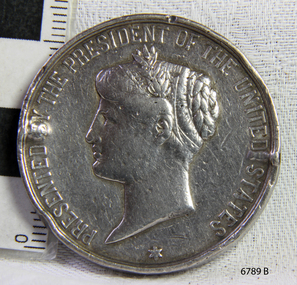 Flagstaff Hill Maritime Museum and Village
Award - Medal, Nelson Johnson, November 1880
... Newman, W. Paul, J. Davis, M. Horenleng, J. Ogduff, T. W. Drew, R. ...Newman, W. Paul, J. Davis, M. Horenleng, J. Ogduff, T. W. Drew, R. ...This medal for bravery, for rescue of the crew from the shipwreck “Eric the Red” on 4th September 1880, was awarded to one of the crew of the steamer S.S. Dawn by the President of the United States in July 1881. The medal is engraved with the name “Nelson Johnson” (the anglicised version of his Swedish name Neils Frederick Yohnson). It was donated to Flagstaff Hill Maritime Village in 2013 by Nelson’s granddaughter. Nelson had migrated from Sweden to Sydney in 1879. The next year in 1880, aged 24, he was a seaman on the steamship Dawn and involved in the rescue of the survivors of the Eric the Red. Nelson Johnson was a crew member of the S.S. Dawn and was one of the rescue team in the dinghy in the early morning of September 4th 1880. Medals were awarded to the Captain and crew of the S.S. Dawn by the President of the United States, through the Consul-general (Mr Oliver M. Spencer), in July 1881 “ … in recognition of their humane efforts in rescuing the 23 survivors of the American built wooden sailing ship, the Eric the Red, on 4th September 1880.” The men were also presented with substantial monetary rewards and gifts. The city of Warrnambool’s care of the survivors was also mentioned by the President at the presentation, saying that “the city hosted and supported the crew ‘most graciously’. Previously, a week after the shipwreck, the Australian Government had also conveyed its thanks to the Captain and crew of the S.S. Dawn “Captain Griffith Jones, S.S. Dawn, The Hon. Mr Clark desires that the thanks of the Government should be conveyed to you for the prompt, persevering and seamanlike qualities displayed by you, your officers and crew in saving the number of lives you did on the occasion referred to. The hon. The Commissioner has also been pleased to award you a souvenir in commemoration of the occasion, and a sum of 65 pounds to be awarded to your officers and crew according to annexed scale. I am, &c, W Collins Rees, for and in the absence of the Chief Harbour Master.” The Awards are as follows: - Crew of DAWN'S lifeboat-Chief Officer, Mr G. Peat, 15 pounds; boat's crew-G. Sterge, A.B., 5 pounds; T. Hammond, A.B., 5 pounds; J. Black, A.B., 5 pounds; H. Edwards, A.B., 5 pounds. Dinghy's Crew-Second Officer, Mr Christie, 10 pounds; boat's crew -F. Lafer, A.B., 5 pounds; W. Johnstone, A.B., 5 pounds; Mr Lear, provedore, 5 pounds; Mr Dove, purser, 5 pounds. Captain Jones receives a piece of plate. (from “Wreck of the ship Eric the Red” by Jack Loney) The medal’s history, according to the Editor of ‘E-Sylum’ (the newsletter of The Numismatic Bibliomania Society “… appears to be an example of an 1880 State Department medal, catalogued as LS-3 (page 322 of R. W. Julian's book, Medals of the United States Mint: The First Century 1792-1892). The reverse is mostly blank for engraving, surrounded by a thin wreath. It was designed by George Morgan, chief engraver for the Philadelphia Mint, and struck in gold, silver and bronze. The one pictured here (in The Standard newspaper, 2nd July 2013) appears to be silver.” The following is an account of the events which led to the awarding of this medal. The American ship Eric the Red was a wooden, three-masted clipper ship. She had 1,580 tons register and was the largest full-rigged ship built at Bath, Maine, USA in 1871. She was built and registered by Arthur Sewall, later to become the partnership E. & A. Sewall, the 51st ship built by this company. The annually-published List of Merchant Vessels of the U.S. shows Bath was still the home port of Eric the Red in 1880. The vessel was named after the Viking discoverer, Eric ‘the Red-haired’ Thorvaldsson, who was the first European to reach the shores of North America (in 980AD). The ship Eric the Red at first traded in coal between America and Britain, and later traded in guano nitrates from South America. In 1879 she was re-metalled and was in first-class condition. On 10th June 1880 (some records say 12th June) Eric the Red departed New York for Melbourne and then Sydney. She had been commissioned by American trade representatives to carry a special cargo of 500 exhibits (1400 tons) – about a quarter to a third of America’s total exhibits - for the U.S.A. pavilion at Melbourne’s first International Exhibition. The exhibits included furniture, ironmongery, wines, chemicals, dental and surgical instruments, paper, cages, bronze lamp trimmings, axles, stamped ware, astronomical and time globes, samples of corn and the choicest of leaf tobacco. Other general cargo included merchandise such as cases of kerosene and turpentine, brooms, Bristol's Sarsaparilla, Wheeler and Wilson sewing machines, Wheeler’s thresher machine, axe handles and tools, cases of silver plate, toys, pianos and organs, carriages and Yankee notions. The Eric the Red left New York under the command of Captain Zaccheus Allen (or some records say Captain Jacques Allen) and 24 other crew including the owner’s son third mate Ned Sewall. There were also 2 saloon passengers on board. The ship had been sailing for an uneventful 85 days and the voyage was almost at its end. As Eric the Red approached Cape Otway there was a moderate north-west wind and a hazy and overcast atmosphere. On 4th September 1880 at about 1:30 am Captain Allen sighted the Cape Otway light and was keeping the ship 5-6 miles offshore to stay clear of the hazardous Otway Reef. However, he had badly misjudged his position. The ship hit the Otway Reef about 2 miles out to sea, southwest of the Cape Otway light station. Captain Allen ordered the wheel to be put ‘hard up’ thinking that she might float off the reef. The sea knocked the helmsman away from the wheel, broke the wheel ropes and carried away the rudder. The lifeboats were swamped, the mizzenmast fell, with all of its riggings, then the mainmast also fell and the ship broke in two. Some said that the passenger Vaughan, who was travelling for his health and not very strong, was washed overboard and never seen again. The ship started breaking up. The forward house came adrift with three of the crew on it as well as a longboat, which the men succeeded in launching and keeping afloat by continually bailing with their sea boots. The captain, the third mate (the owner’s son) and others clung to the mizzenmast in the sea. Then the owner’s son was washed away off the mast. Within 10 minutes the rest of the ship was in pieces, completely wrecked, with cargo and wreckage floating in the sea. The captain encouraged the second mate to swim with him to the deckhouse where there were other crew but the second mate wouldn’t go with him. Eventually, the Captain made it to the deckhouse and the men pulled him up. At about 4:30 am the group of men on the deckhouse saw the lights of a steamer and called for help. At the same time, they noticed the second mate and the other man had drifted nearby, still on the spur, and pulled them both onto the wreck. The coastal steamer SS Dawn was returning to Warrnambool from Melbourne, and its sailing time was different to its usual schedule. She was built in 1876 and bought by the Portland and Belfast Steam Navigation Co. in 1877. At the time of this journey, she was commanded by Captain Jones and was sailing between Melbourne and Portland via Warrnambool. The provedore the Dawn, Benjamin Lear, heard cries of distress coming through the portholes of the saloon. He gave the alarm and the engines were stopped. Cries could be heard clearly, coming from the land. Captain Jones sent out crew in two boats and fired off rockets and blue lights to illuminate the area. They picked up the three survivors who were in the long boat from Eric the Red. Two men were picked up out of the water, one being the owner’s son who was clinging to floating kerosene boxes. At daylight, the Dawn then rescued the 18 men from the floating portion of the deckhouse, which had drifted about 4 miles from where they’d struck the reef. Shortly after the rescue the deckhouse drifted onto breakers and was thrown onto rocks at Point Franklin, about 2 miles east of Cape Otway. Captain Jones had signalled to Cape Otway lighthouse the number of the Eric the Red and later signalled that there was a wreck at Otway Reef but there was no response from the lighthouse. The captain and crew of the Dawn spent several more hours searching unsuccessfully for more survivors, even going back as far as Apollo Bay. On board the Dawn the exhausted men received care and attention to their needs and wants, including much-needed clothing. Captain Allen was amongst the 23 battered and injured men who were rescued and later taken to Warrnambool for care. Warrnambool’s mayor and town clerk offered them all hospitality, the three badly injured men going to the hospital for care and others to the Olive Branch Hotel, then on to Melbourne. Captain Allen’s leg injury prevented him from going ashore so he and three other men travelled on the Dawn to Portland. They were met by the mayor who also treated them all with great kindness. Captain Allen took the train back to Melbourne then returned to America. Those saved were Captain Zaccheus Allen (or Jacques Allen), J. Darcy chief mate, James F. Lawrence second mate, Ned Sewall third mate and owner’s son, John French the cook, C. Nelson sail maker, Clarence W. New passenger, and able seamen Dickenson, J. Black, Denis White, C. Herbert, C. Thompson, A. Brooks, D. Wilson, J. Ellis, Q. Thompson, C. Newman, W. Paul, J. Davis, M. Horenleng, J. Ogduff, T. W. Drew, R. Richardson. Four men had lost their lives; three of them were crew (Gus Dahlgreen ship’s carpenter, H. Ackman steward, who drowned in his cabin, and George Silver seaman) and one a passenger (J. B. Vaughan). The body of one of them had been found washed up at Cape Otway and was later buried in the lighthouse cemetery; another body was seen on an inaccessible ledge. Twelve months later the second mate James F. Lawrence, from Nova Scotia passed away in the Warrnambool district; an obituary was displayed in the local paper. Neither the ship nor its cargo was insured. The ship was worth about £15,000 and the cargo was reportedly worth £40,000; only about £2,000 worth had been recovered. Cargo and wreckage washed up at Apollo Bay, Peterborough, Port Campbell, Western Port and according to some reports, even as far away as the beaches of New Zealand. The day after the wreck the government steamship Pharos was sent from Queenscliff to clear the shipping lanes of debris that could be a danger to ships. The large midship deckhouse of the ship was found floating in a calm sea near Henty Reef. Items such as an American chair, a ladder and a nest of boxes were all on top of the deckhouse. As it was so large and could cause danger to passing ships, Captain Payne had the deckhouse towed towards the shore just beyond Apollo Bay. Between Apollo Bay and Blanket Bay, the captain and crew of Pharos collected Wheeler and Wilson sewing machines, nests of boxes, bottles of Bristol’s sarsaparilla, pieces of common American chairs, axe handles, a Wheelers’ Patent thresher and a sailor’s trunk with the words “A. James” on the front. A ship’s flag-board bearing the words “Eric the Red” was found on the deckhouse; finally, those on board the Pharos had the name of the wrecked vessel. During this operation, Pharos came across the government steamer Victoria and also a steamer S.S. Otway, both of which were picking up flotsam and wreckage. A whole side of the hull and three large pieces of the other side of the hull, with some of the copper sheathing stripped off, had floated onto Point Franklin. Some of the vessels' yards and portions of her masts were on shore. The pieces of canvas attached to the yards and masts confirmed that the vessel had been under sail. The beach there was piled with debris several feet high. There were many cases of Diamond Oil kerosene, labelled R. W. Cameron and Company, New York. There were also many large planks of red pine, portions of a small white boat and a large, well-used oar. Other items found ashore included sewing machines (some consigned to ‘Long and Co.”) and notions, axe and scythe handles, hay forks, wooden pegs, rolls of wire (some branded “T.S” and Co, Melbourne”), kegs of nails branded “A.T. and Co.” from the factory of A. Field and Son, Taunton, Massachusetts, croquet balls and mallets, buggy fittings, rat traps, perfumery, cutlery and Douay Bibles, clocks, bicycles, chairs, a fly wheel, a cooking stove, timber, boxes, pianos, organs and a ladder. (Wooden clothes pegs drifted in for many years). There seemed to be no personal luggage or clothing. The Pharos encountered a long line, about one and a half miles, of f locating wreckage about 10 miles off land, southeast of Cape Otway, and in some places about 40 feet wide. It seemed that more than half of it was from Eric the Red. The ship’s crew rescued 3 cases that were for the Melbourne Exhibition and other items from amongst the debris. There were also chairs, doors, musical instruments, washing boards, nests of trunks and flycatchers floating in the sea. Most of the goods were saturated and smelt of kerosene. A section of the hull lies buried in the sand at Parker River Beach. An anchor with a chain is embedded in the rocks east of Point Franklin and a second anchor, thought to be from Eric the Red, is on display at the Cape Otway light station. (There is a photograph of a life belt on the verandah of Rivernook Guest House in Princetown with the words “ERIC THE RED / BOSTON”. This is rather a mystery as the ship was registered in Bath, Maine, USA.) Parts of the ship are on display at Bimbi Park Caravan Park and at Apollo Bay Museum. Flagstaff Hill Maritime Village also has part of the helm (steering wheel), a carved wooden sword (said to be the only remaining portion of the ship’s figurehead; further research is currently being carried out), a door, a metal rod, samples of wood and this medal awarded for the rescue of the crew. Much of the wreckage was recovered by the local residents before police and other authorities arrived at the scene. Looters went to great effort to salvage goods, being lowered down the high cliff faces to areas with little or no beach to collect items from the wreckage, their mates above watching out for dangerous waves. A Tasmanian newspaper reports on a court case in Stawell, Victoria, noting a man who was caught 2 months later selling tobacco from the wreckage of Eric the Red. Some of the silverware is still treasured by descendants of Mr Mackenzie who was given these items by officials for his help in securing the cargo. The gifts included silver coffee and teapots, half a dozen silver serviette rings and two sewing machines. A Mr G.W. Black has in his possession a medal and a purse that was awarded to his father, another Dawn crew member who was part of the rescue team. The medal is similarly inscribed and named “To John Black ….” (from “Shipwrecks” by Margaret E. Mackenzie, 3rd edition, published 1964). The wreck and cargo were sold to a Melbourne man who salvaged a quantity of high-quality tobacco and dental and surgical instruments. Timbers from the ship were salvaged and used in the construction of houses and shed around Apollo Bay, including a guest house, Milford House (since burnt down in bushfires), which had furniture, fittings and timber on the dining room floor from the ship. A 39.7-foot-long trading ketch, the Apollo, was also built from its timbers by Mr Burgess in 1883 and subsequently used in Tasmanian waters. It was the first attempt at shipbuilding in Apollo Bay. In 1881 a red light was installed about 300 feet above sea level at the base of the Cape Otway lighthouse to warn ships when they were too close to shore; It would not be visible unless a ship came within 3 miles from it. This has proved to be an effective warning. Nelson Johnson married Elizabeth Howard in 1881 and they had 10 children, the father of the medal’s donor being the youngest. They lived in 13 Tichbourne Place, South Melbourne, Victoria. Nelson died in 1922 in Fitzroy Victoria, age 66. In 1895 the owners of the S.S. Dawn, the Portland and Belfast Steam Navigation Co., wound up and sold out to the Belfast Company who took over the Dawn for one year before selling her to Howard Smith. She was condemned and sunk in Suva in 1928. The State Library of Victoria has a lithograph in its collection depicting the steamer Dawn and the shipwrecked men, titled. "Wreck of the ship Eric the Red, Cape Otway: rescue of the crew by the Dawn". The medal for bravery is associated with the ship the “The Eric the Red which is historically significant as one of Victoria's major 19th century shipwrecks. (Heritage Victoria Eric the Red; HV ID 239) The wreck led to the provision of an additional warning light placed below the Cape Otway lighthouse to alert mariners to the location of Otway Reef. The site is archaeologically significant for its remains of a large and varied cargo and ship's fittings being scattered over a wide area. The site is recreationally and aesthetically significant as it is one of the few sites along this coast where tourists can visit identifiable remains of a large wooden shipwreck, and for its location set against the background of Cape Otway, Bass Strait, and the Cape Otway lighthouse.“ (Victorian Heritage Database Registration Number S239, Official Number 8745 USA) This medal was awarded to Nelson Johnson by the U.S. President for bravery in the rescue of the Eric the Red crew. The obverse of the round, solid silver medal has an inscription around the rim. In the centre of the medal is the head of Liberty to the left, hair in a bun, with a sprig of leaves in the top left of a band around her head. There is a 6-pointed star below the portrait, between the start and end of the inscription. There are two raised areas on the rim, horizontally opposite each other, from the edge to just below the lettering and coinciding with the holes drilled in the edge. Slightly right of the top is a round indentation in the rim. The reverse has a wreath of leaves as a border, joined at the bottom by a ribbon bow. In the centre of the medal is an inscription, decorated with 3-pronged design and dots. The edge is plain with 2 small, rough and uneven holes horizontally opposite to each other, as though they had been used for mounting the medal at some stage. The medal has a matte finish on both sides and is slightly pitted and scratched.“PRESENTED BY THE PRESIDENT OF THE UNITED STATES” around the perimeter of the obverse of the medal. “TO / Nelson Johnson, / seaman of the British, / str “Dawn”, for bravery, / at risk of life, / in / rescuing the crew of / the American Ship / “Eric the Red.” “M” on obverse, truncation of the portraitwarrnambool, flagstaff hill, flagstaff hill maritime village, maritime museum, shipwreck coast, great ocean road, shipwreck artefact, eric the red, zaccheus allen, sewall, 1880, melbourne exhibition, cape otway, otway reef, victorian shipwreck, medal, nelson johnson, neils frederick yohnson, s.s. dawn, george morgan, hero -
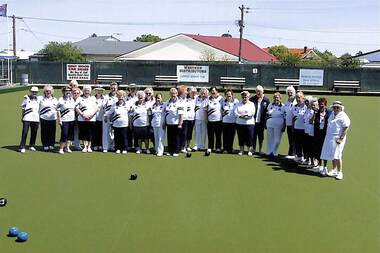 Sunshine and District Historical Society Incorporated
Photograph - Sunshine City Ladies Bowling Club Celebrating 25 years, 2003
... M. McDonald 2144.12 - Sunshine City Ladies Bowling Club Celebrating 25 years - Myrtle Baylis 2144.13 - Sunshine City Ladies Bowling Club Celebrating 25 years - L. Gust, B. Davis...M. McDonald 2144.12 - Sunshine City Ladies Bowling Club Celebrating 25 years - Myrtle Baylis 2144.13 - Sunshine City Ladies Bowling Club Celebrating 25 years - L. Gust, B. Davis ...Sunshine City Ladies Bowling Club Celebrating 25 years 12/10/2003 2144.01 - Sunshine City Ladies Bowling Club Celebrating 25 years - Ladies On Bowling Green 2144.02 - Sunshine City Ladies Bowling Club Celebrating 25 years - Club Rooms 2144.03 - Sunshine City Ladies Bowling Club Celebrating 25 years - Bowlers On Green 2144.04 - Sunshine City Ladies Bowling Club Celebrating 25 years - Bowlers On Green 2144.05 - Sunshine City Ladies Bowling Club Celebrating 25 years - May Sherwood 2144.06 - Sunshine City Ladies Bowling Club Celebrating 25 years - Norma Mill 2144.07 - Sunshine City Ladies Bowling Club Celebrating 25 years - Marion Norris 2144.08 - Sunshine City Ladies Bowling Club Celebrating 25 years - VIP Table Setting 2144.09 - Sunshine City Ladies Bowling Club Celebrating 25 years - VIP Table 2144.10 - Sunshine City Ladies Bowling Club Celebrating 25 years - M. Dickson, M. Norris, J. Adams, E. Stafford, V. Coughlan 2144.11 - Sunshine City Ladies Bowling Club Celebrating 25 years - E. Brennan, E. MacKender, M. McDonald 2144.12 - Sunshine City Ladies Bowling Club Celebrating 25 years - Myrtle Baylis 2144.13 - Sunshine City Ladies Bowling Club Celebrating 25 years - L. Gust, B. Davis, M. Sherwood 2144.14 - Sunshine City Ladies Bowling Club Celebrating 25 years - D. Vines, J. Whelan, E. MacKender, B. McIntyre 2144.15 - Sunshine City Ladies Bowling Club Celebrating 25 years - Linda Mullin 2144.26 - Sunshine City Ladies Bowling Club Celebrating 25 years - Gloria Mathers 2144.27 - Sunshine City Ladies Bowling Club Celebrating 25 years - Carol Pidwell, Joan Lamont 2144.28 - Sunshine City Ladies Bowling Club Celebrating 25 years - J. Adams, V. Coughlan, J. Sutton, J. Lamont, Pidwell, G. Mathers, L. Maxwell 2144.29 - Sunshine City Ladies Bowling Club Celebrating 25 years - Joan Sutton 2144.30 - Sunshine City Ladies Bowling Club Celebrating 25 years - Bowlers Enjoying The Meal 2144.31 - Sunshine City Ladies Bowling Club Celebrating 25 years - J. Sutton, Joan Lamont, Joan Adams 2144.32 - Sunshine City Ladies Bowling Club Celebrating 25 years - Joan Sutton 2144.33 - Sunshine City Ladies Bowling Club Celebrating 25 years - Barb Davis 2144.34 - Sunshine City Ladies Bowling Club Celebrating 25 years - Elsie Brennan Doing Table Inspection 2144.35 - Sunshine City Ladies Bowling Club Celebrating 25 years - Groups Sitting At Tables 2144.36 - Sunshine City Ladies Bowling Club Celebrating 25 years - June Whelan, Gwen Carpenter, Jan Haygarth 2144.37 - Sunshine City Ladies Bowling Club Celebrating 25 years - M. Dickson, J. Vanatti, B. Duncan, D. Williams, J. Borg 2144.38 - Sunshine City Ladies Bowling Club Celebrating 25 years - Groups Sitting At Tables 2144.39 - Sunshine City Ladies Bowling Club Celebrating 25 years - Groups Sitting At Tables 2144.40 - Sunshine City Ladies Bowling Club Celebrating 25 years - Groups Sitting At Tables 2144.41 - Sunshine City Ladies Bowling Club Celebrating 25 years - Joyce Williams, Glad Dawsonm Thelma McMaster 2144.42 - Sunshine City Ladies Bowling Club Celebrating 25 years - Diane Monks, Elise Brennan, Joan Treloar 2144.43 - Sunshine City Ladies Bowling Club Celebrating 25 years - Mavis Baddeley 2144.44 - Sunshine City Ladies Bowling Club Celebrating 25 years - Nina Caruana, Judith Casey, Enid MacKender, Judy Pimblott 2144.45 - Sunshine City Ladies Bowling Club Celebrating 25 years - Norma Mill 2144.46 - Sunshine City Ladies Bowling Club Celebrating 25 years - Ellen Fleming, Glendys Azzopardi 2144.47 - Sunshine City Ladies Bowling Club Celebrating 25 years - Glendys Azzopardi, Maude Cameron, Adele Brown 2144.48 - Sunshine City Ladies Bowling Club Celebrating 25 years - Enid MacKender 2144.49 - Sunshine City Ladies Bowling Club Celebrating 25 years - Joan Treloar, Nina Caruana 2144.50 - Sunshine City Ladies Bowling Club Celebrating 25 years - Jessie Shears 2144.51 - Sunshine City Ladies Bowling Club Celebrating 25 years - Ladies standing At Tables 2144.52 - Sunshine City Ladies Bowling Club Celebrating 25 years - Dot Voss, Adele Brown, Carmel Keating 2144.53 - Sunshine City Ladies Bowling Club Celebrating 25 years - Lorna Stainer 2144.54 - Sunshine City Ladies Bowling Club Celebrating 25 years - Adele Brown 2144.55 - Sunshine City Ladies Bowling Club Celebrating 25 years - Dor Voss, Marj 2144.56 - Sunshine City Ladies Bowling Club Celebrating 25 years - B. Duncan, C. Keating, J. Vanotti, J. Haygarth 2144.57 - Sunshine City Ladies Bowling Club Celebrating 25 years - Dor Williams, Mary 2144.58 - Sunshine City Ladies Bowling Club Celebrating 25 years - Joyce Cleeve, Maureen McDonald 2144.59 - Sunshine City Ladies Bowling Club Celebrating 25 years - Joan Aitken, Wendy Dyson 2144.60 - Sunshine City Ladies Bowling Club Celebrating 25 years - Elsie Brennan, Joyce Cleeve 2144.61 - Sunshine City Ladies Bowling Club Celebrating 25 years - Gwen Carpenter 2144.62 - Sunshine City Ladies Bowling Club Celebrating 25 years - Diane Monks 2144.63 - Sunshine City Ladies Bowling Club Celebrating 25 years - Ian Bowler 2144.64 - Sunshine City Ladies Bowling Club Celebrating 25 years - Clive Brown 2144.65 - Sunshine City Ladies Bowling Club Celebrating 25 years - Brenda Peace 2144.66 - Sunshine City Ladies Bowling Club Celebrating 25 years - Joan Treloar 2144.67 - Sunshine City Ladies Bowling Club Celebrating 25 years - Nina Caruana 2144.68 - Sunshine City Ladies Bowling Club Celebrating 25 years - Doreen Vines 2144.69 - Sunshine City Ladies Bowling Club Celebrating 25 years - Elsie Brennan 2144.70 - Sunshine City Ladies Bowling Club Celebrating 25 years - Genid Arnastauskas 2144.71 - Sunshine City Ladies Bowling Club Celebrating 25 years - Terry Norris, Ian Bowker, Clive Brown 2144.72 - Sunshine City Ladies Bowling Club Celebrating 25 years - Barry Warburton, Veronica Coughlan, George Bryce 2144.73 - Sunshine City Ladies Bowling Club Celebrating 25 years - T. Beachley, A. Gust, B. Brooking, D. Mill, J. Bayana 2144.74 - Sunshine City Ladies Bowling Club Celebrating 25 years - Ernie Mullin, Joan Sutton, Jack Pidwell 2144.75 - Sunshine City Ladies Bowling Club Celebrating 25 years - Judy Pimblott, Judith Veering 2144.76 - Sunshine City Ladies Bowling Club Celebrating 25 years - Bowlers On Green 2144.77 - Sunshine City Ladies Bowling Club Celebrating 25 years - Lorraine Kutcher 2144.78 - Sunshine City Ladies Bowling Club Celebrating 25 years - Group Shot At Table 2144.79 - Sunshine City Ladies Bowling Club Celebrating 25 years - Carol Hawkins 2144.80 - Sunshine City Ladies Bowling Club Celebrating 25 years - Mavis Baddeley, Mary De Haas 2144.81 - Sunshine City Ladies Bowling Club Celebrating 25 years - Cake 2144.82 - Sunshine City Ladies Bowling Club Celebrating 25 years - Margaret Dickson's Orchids 2144.83 - Sunshine City Ladies Bowling Club Celebrating 25 years - Table Setups 2144.84 - Sunshine City Ladies Bowling Club Celebrating 25 years - Club Rooms 2144.85 - Sunshine City Ladies Bowling Club Celebrating 25 years - Ladies On Bowling Green 2144.86 - Sunshine City Ladies Bowling Club Celebrating 25 years - VIP Table Decorations 2144.87 - Sunshine City Ladies Bowling Club Celebrating 25 years - Cake 2144.88 - Sunshine City Ladies Bowling Club Celebrating 25 years - Cutting The Cake 2144.89 - Sunshine City Ladies Bowling Club Celebrating 25 years - Marion Norris 2144.90 - Sunshine City Ladies Bowling Club Celebrating 25 years - Group Shot At VIP Table 2144.91 - Sunshine City Ladies Bowling Club Celebrating 25 years - V.L.B.A. President 2144.92 - Sunshine City Ladies Bowling Club Celebrating 25 years - Joan Adams, Elaine Stafford 2144.93 - Sunshine City Ladies Bowling Club Celebrating 25 years - Margaret Dickson 2144.94 - Sunshine City Ladies Bowling Club Celebrating 25 years - Joan Sutton, Joan Lamont, Carol Pidwell, Gloria Mathers, Linda Mullin, Joan Adams 2144.95 - Sunshine City Ladies Bowling Club Celebrating 25 years - Marion Norris, Joan Adams 2144.96 - Sunshine City Ladies Bowling Club Celebrating 25 years - Marion Norris, Elaine Stafford 2144.97 - Sunshine City Ladies Bowling Club Celebrating 25 years - Marion Norris 2144.98 - Sunshine City Ladies Bowling Club Celebrating 25 years - Ladies On Bowling Green 2144.99 - Sunshine City Ladies Bowling Club Celebrating 25 years - Table Setupssunshine bowling club, club, memento -
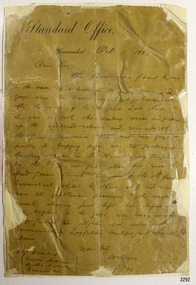 Flagstaff Hill Maritime Museum and Village
Letter, Henry Davis, Editor, Warrnambool Standard, 11-10-1883
... [my] capture in the Gorge, you may imagine [m]y feelings on alighting upon, under such circumstances, Longfellow’s beautiful and sympathetic poem. Yours truly, H.W. Davis...[my] capture in the Gorge, you may imagine [m]y feelings on alighting upon, under such circumstances, Longfellow’s beautiful and sympathetic poem. Yours truly, H.W. Davis ...This letter was written by Henry Davis, editor of the Warrnambool Standard, to Joseph Archibald, curator of the Warrnambool Museum. Dated 11 October 1883, it refers to Davis’s recovery of a saturated volume of ‘Longfellow’s Poems’ from the sea at Loch Ard Gorge. The retrieval of this book, and its possible connection with one of the survivors from the LOCH ARD shipwreck in 1878, prompted Archibald’s letter of 1 December 1883 to Eva Carmichael, and Eva’s reply of 21 January 1884 (No, it was not her book). Miss Carmichael’s reply to Archibald’s inquiry (2290.4) and the water-damaged book itself (541) are both in the Flagstaff Hill collection along with this letter from Davis, which connects the two. The Davis letter reads: “Dear Sir, ― This book was found by me in the waves which broke on the sands [….] the Gorge where Tom Pearce rescued Miss Carmichael after the wreck of the ill-fated ‘Loch Ard’. I ran in with the receding waves and picked up the soddened volume, and, coincidentally, the first illustrations that met my gaze, on parting its dripping pages, was that portraying the fair maiden in the ‘Wreck of the [Hersperus’.] On the Bluff, 200 feet above me, were the dead forms of Mrs and one of the Misses Carmichael, whilst [by] them, stiff and [….] were two gentlemen passengers [by] the wreck[ed] [v]essel]. Having just left them before [….] [my] capture in the Gorge, you may imagine [m]y feelings on alighting upon, under such circumstances, Longfellow’s beautiful and sympathetic poem. Yours truly, H.W. Davis.” The book referred to here is The Poetical Works of Henry Wadsworth Longfellow, 1877, Nimmo, London. It is on display under glass in the Great Circle Gallery at the Maritime Village, alongside a typed transcript of the Davis letter. A 1996 audit of the rare book collection at Flagstaff Hill notes: “Inscribed ‘Loch Ard June 1 1878’ in pencil within ― believed to be a salvage from the shipwreck”. The letter is connected to the salvaged items from the 1878 LOCH ARD shipwreck, which is of State significance ― Victorian Heritage Number S417Letter from H. Davis, editor of the Warrnambool Standard, to J. Archibald, curator of the Warrnambool Museum. It was handwritten in ink on “Standard Office, Warrnambool” letterhead note paper, and dated 11 October 1883. The cursive script appears carelessly written and the original single sheet of paper is in poor condition (torn and creased). At some stage the original document has been backed with stiff cardboard and then sealed in a clear plastic cover.flagstaff hill, warrnambool, shipwrecked-coast, flagstaff-hill, flagstaff-hill-maritime-museum, maritime-museum, shipwreck-coast, flagstaff-hill-maritime-village, loch ard, longfellow’s poems, eva carmichael, joseph archibald, henry davis, warrnambool standard -
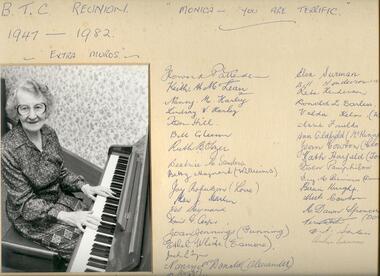 Federation University Historical Collection
Photograph, Monica Miller photograph, BTC Reunion 1947 - 1982
... M. Sanders...Betty Maynard (Williams)...Joy Anderson (Love)...Stan J Marlen...Wal Maynard...David G. Cooper...Joan Jennings (Gunning)...Etherl White (Esmore)...Jack ......Nancy McDonald (Alexander)...Pat Watts (Knight)...Lorna Davis...M. Sanders Betty Maynard (Williams) Joy Anderson (Love) Stan J Marlen Wal Maynard David G. Cooper Joan Jennings (Gunning) Etherl White (Esmore) Jack ... Nancy McDonald (Alexander) Pat Watts (Knight) Lorna Davis ...Monica was a well-loved music teacher at the Ballarat Teachers' College.Black and white photograph in cream matte board. Monica Miller sits at the piano. Those who attended the BTC Reunion 1947 - 1982 signed the mountballarat teachers' college, monica miller, lynette vickery (lynch), beth stutterd (leslie), howard pattender, keith h. m. lean, nancy m. harley, lindsay w. harley, jon hill, bill gleeson, ruth b gozer, beatrice m. sanders, betty maynard (williams), joy anderson (love), stan j marlen, wal maynard, david g. cooper, joan jennings (gunning), etherl white (esmore), jack ..., nancy mcdonald (alexander), pat watts (knight), lorna davis (welsh), joyce fraser (mathison), hugh fraser, margaret alexander (palmer), maurene canter (merlin), elva surman, bill henderson, reta henderson, ronald l. earless, valda kelm (witney), marie faulds, ann oldfield (mckinnen), jean cowton (clode), kath harfield (tobin), groen pamphilon, inez m bemirs (domascheng), bernie kurght, mick cowton, m. dawn spencer (doney), vern white, n.t. sanders, arther ..., -
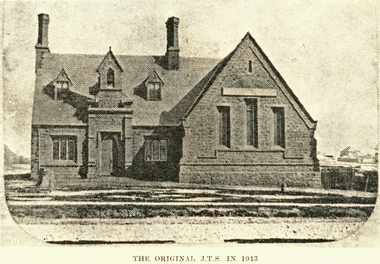 Federation University Historical Collection
Magazine - Booklet, F.W. Niven, Ballarat School of Mines Students' Magazine, 1957, 1957
... M. Hewitt...G. Higgins...C. Ludbrook...J. Simpson...Glenys Spielvogel...Norma Davies...Dawn Ridgeway...Carmel Dobbyn...Beverley Davis...M. Hewitt G. Higgins C. Ludbrook J. Simpson Glenys Spielvogel Norma Davies Dawn Ridgeway Carmel Dobbyn Beverley Davis J. ...The Ballarat School of Mines produced an annual students' magazine from 1899 - 1966. Contents include, School Council, Members of Staff, 1st Corbould Scholarship, Australian Speech, Art Lending Library, Literary Society, football, Boys' Junior Technical School, Bullarto Camp Reunion, John Leckie, Stan Hillman, Girls' Junior Technical School, Parliament House, Ballarat North Junior Technical School Images include: Craig's Royal Hotel, Peter Robinson, John Thomas Huyton Clelland, John Wolfe, Bernie Gallagher, Nelson Hails, John Gowan, Beverley Selkirk, Pat Collier, Barry Singleton Mara Jekabsons, Bill Widdop, Neil Brogden, frank Pomeroy, Laurence Trevan, Neville Bunning, Jim McKay, Malcolm Hausler, Josephine Young, George Lewis, Alan Clarke, Norman Leckie, Andrew Atkins, Lorette Davey, Noel Flood, Denis Bryan, SMB Football Team, SMB Athletics Team, SMB Baseball Team, SMB Basketball Team, SMB Tennis Team, Athletic Champions, R. Ross, I. Beaumont, R. Parker, G. Waller, John Rash, J. Sarah, J. Walters, P. Rowe, L. Drummond, R. Whitcher, ATC Flight No 24, BJTS Football Team, BJTS Swimming Team, BJTS Tennis Team, BJTS Athletics Squad, BJTS Cricket Team, BJTS Softball team and coach, W. Sawall, L. McDonald, K. Penna, J. Clarke, K. Rogers, Mr Wilson, F. Holmes, graham Manning, Andrew Brumby, Kevin Rogers, Graham Walters, Yellow soft covered students' magazine of 92 pages. keith alexander, brian bellingham, neil brogden, bernie gallagher, john gowan, francis hunting, teng hor khoo, teng seong khoo, norman leckie, boon thiam lu, brian mclennan, peter russell, chookiate sirivingse, laurie trean, john wolfe, ballarat school of mines, peter robinson, john thomas huyton clelland, d. w. brown, n. bunning, jim mckay, barry singleton, malcolm hausler, josephine young, george lewis, alan clarke, andrew atkins, lorette davey, noel flood, denis bryans, john mckenzie, robert skewes, ian fraser, walter reimann, pat collier, ralph hepburn, peter m. robinson, a. bethune, j. lane, d. colbourn, w. etty, b. bellingham, n. hails, t. white, p. agrums, w. widdop, f. pomeroy, b. singleton, j. mckay, j. pollock, r. cutter, d. vendy, j. wolfe, p. collier, w. bowtell, r. hepburn, w. wynd, p. menz, b. dunstan, j. gowan, l. groat, g. westwood, j. erdmanis, a. rock, k. alexander, p. walker, w. reimann, n. delosa, b. mclennan, a. clarke, g. wilson, t. coad, j. caldwell, d. chung, r. champneys, j. mckenzie, b. paterson, j. cowan, somnam nandhabiwat, w. spencer, p. schoutens, d. treller, gayle peterson, denise lockett, carmel dobbyn, margaret ayars, raymond jenkin, l. nester, w. eyers, r. ross, g. dreever, r. ross, i. beaumont, r. parker, g. waller, j. rash, j. sarah, j. walters, p. rowe, l. drummond, r. whitcher, r. ingle, i. pollock, p. bilney, i. collier, l. thomas, g. leslie, p. schoutens, a. morris, g. wells, b. mcgregor, j. bedggood, k. spencer, j. vincent, j. elliott, j. whitten, g. higgins, g. le couteur, h. mcdougall, g. wise, m. allen, d. pattie, i. collinson, c. kearns, g. severino, g. smith, n. smith, f. tolliday, r. williams, d. coldicott, m. hewitt, g. higgins, c. ludbrook, j. simpson, glenys spielvogel, norma davies, dawn ridgeway, carmel dobbyn, beverley davis, j. crouch, kathleen harris, j. walters, jan hunter, j. carroll, c. jenkins, lesley cutts, h. vagg, irene horgan, graham manning, andrew brumby, kevin rogers, graham walters, k. howell, n. malthouse, l. deppler, g. manning, n. nugent, b. antonio, r. mccarthy, mr morrison, r. mckenzie, w. wakeling, j. clarke, l. mayne, n. bromley, a. brumby, a. abrams, k. penna, r. button, p. linane, f. holmes, n. yean, mr love, miss atkins, p. cochrane, i. quick, mr mitchell, b. flynn, r. brown, k. penna, j. mcmahon, g. turnbull, n. skewes, d. vowles, d. blake, mr nuttall, g. borchers, i. greenbank, d. evans, j. whelan, j. milne, w. sawall, d. ward, r. rundell, mr ellerton, m. foy, l. reed, c. tilgals, peter agrums
