
Showing 109 items matching "macpherson"
-
 Mission to Seafarers Victoria
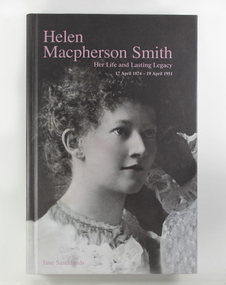
Book, Jane Sandilands, Helen Macpherson Smith: Her Life and Lasting Legacy, 17 April 1874-19 April 1951, 2011
... Helen Macpherson Smith: Her Life and Lasting Legacy, 17 April 1874-19 April 1951...This book describes the life and times of Helen Macpherson Smith, Australian Philanthropist, and her lasting legacy The Helen Macpherson Smith Trust. ...The mainly black cover features a photograph of Helen Macpherson Smith as a young woman. The title is printed in pink. ......Helen Macpherson Smith Trust...This book describes the life and times of Helen Macpherson Smith, Australian Philanthropist, and her lasting legacy The Helen Macpherson Smith Trust. ...Helen Macpherson Schutt (née Smith) was a remarkable woman for her time. Born in 1874 to a prosperous Scottish-Australian family, Helen lived comfortably in the financial and social legacy of her family in Melbourne, Victoria. She was also an active supporter of, and donor to, organisations including the Victorian Missions to Seamen (now Mission to Seafarers), the RSPCA, the Royal District Nursing Service, the Royal Children’s Hospital and the Royal Victorian Institute for the Blind.Hard cover book of 145 pages; Apps A-F, Acknowledgements, Bibliography and Index, by Jane Sandilands. The mainly black cover features a photograph of Helen Macpherson Smith as a young woman. The title is printed in pink. non-fictionHelen Macpherson Schutt (née Smith) was a remarkable woman for her time. Born in 1874 to a prosperous Scottish-Australian family, Helen lived comfortably in the financial and social legacy of her family in Melbourne, Victoria. She was also an active supporter of, and donor to, organisations including the Victorian Missions to Seamen (now Mission to Seafarers), the RSPCA, the Royal District Nursing Service, the Royal Children’s Hospital and the Royal Victorian Institute for the Blind.helen macpherson smith (1874-1951), philanthropy, jane sandilands, benefactor, hmst, helen mcpherson smith trust -
 Dandenong & District Historical Society
Document - Macpherson and Kelley, Articles Concerning Macpherson and Kelley
... Articles Concerning Macpherson and Kelley...Macpherson and Kelley, Newspaper Article, History...Articles concerning Macpherson and Kelley...Macpherson and Kelley, Newspaper Article, History Articles concerning Macpherson and Kelley Articles Concerning Macpherson and Kelley Document Macpherson and Kelley ...Macpherson and Kelley, Newspaper Article, History -
Dandenong & District Historical Society
Document - Macpherson and Kelly, Articles Concerning Macpherson and Kelly
... Articles Concerning Macpherson and Kelly...Macpherson and Kelly - Pics, Newspaper Article, History...Articles concerning Macpherson and Kelly...Macpherson and Kelly - Pics, Newspaper Article, History Articles concerning Macpherson and Kelly Articles Concerning Macpherson and Kelly Document Macpherson and Kelly ...Macpherson and Kelly - Pics, Newspaper Article, History -
 Ballan Shire Historical Society
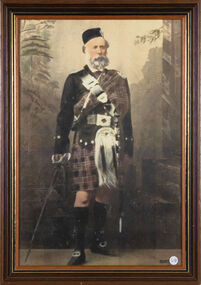
Photograph - Macpherson, Dugald, Portrait of Dugald Macpherson
... Portrait of Dugald Macpherson...Full length coloured photograph of Dugald Macpherson of Bungeeltap in traditional Highland regalia, mounted under glass in a light brown wooden frame with black and gold trim....Dugald Macpherson original owner of Bungeeltap....Macpherson Dugald Ballan Bungeeltap Dugald Macpherson original owner of Bungeeltap. ...Full length coloured photograph of Dugald Macpherson of Bungeeltap in traditional Highland regalia, mounted under glass in a light brown wooden frame with black and gold trim.Dugald Macpherson original owner of Bungeeltap.macpherson dugald, ballan, bungeeltap -
Moorabbin Air Museum
Book (Item) - Pilot's Log Book , Laurence Leonard MacPherson Commercial Class No.1805
... Pilot's Log Book , Laurence Leonard MacPherson Commercial Class No.1805...Laurence Leonard MacPherson , 23 Charlotte St Glen Waverley Vic....Laurence Leonard MacPherson , 23 Charlotte St Glen Waverley Vic. ...Laurence Leonard MacPherson , 23 Charlotte St Glen Waverley Vic. -
 Stawell Historical Society Inc
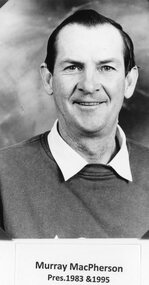
Photograph, Stawell Athletic Club President Mr Murray Macpherson 1983 1995
... Stawell Athletic Club President Mr Murray Macpherson 1983 1995...Stawell Athletic Club President Murray Macpherson 1983 1995...Stawell Athletic Club President Murray Macpherson 1983 1995 Stawell Sport Gift Stawell Athletic Club President Mr Murray Macpherson 1983 1995 Photograph ...Stawell Athletic Club President Murray Macpherson 1983 1995stawell sport gift -
Moorabbin Air Museum
Document (Item) - F/A-18 Program Report Regarding Structural Assembly, Overseas Visit by: D. MacPherson 14th March to 8th April 1983 Structural Assembly Specialist
... Overseas Visit by: D. MacPherson 14th March to 8th April 1983 Structural Assembly Specialist...Report relates to D. MacPherson's visit, regarding manufacturing the F/A-18's Structural Assembly Specialist....Report relates to D. MacPherson's visit, regarding manufacturing the F/A-18's Structural Assembly Specialist. ...Report relates to D. MacPherson's visit, regarding manufacturing the F/A-18's Structural Assembly Specialist. -
 Stawell Historical Society Inc
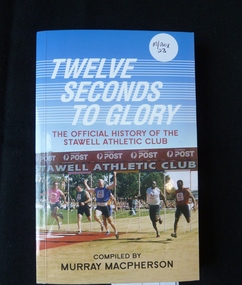
Book, Murray Macpherson, Twelve Seconds to Glory - Previously Cat No 3623, 2010
... Twelve Seconds to Glory The Official History of the Stawell Athletic Club Compiled By Murray MacPherson...Murray Macpherson...Twelve Seconds to Glory - Previously Cat No 3623 Book Murray Macpherson Brolga Publishing Pty Ltd ...Card Cover with Colour Photograph of runners finishing a sprint race.Twelve Seconds to Glory The Official History of the Stawell Athletic Club Compiled By Murray MacPhersonstawell athletic sport -
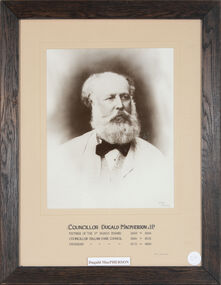 Ballan Shire Historical Society
Photograph - Macpherson, Dugald J.P, Framed portrait of Councillor Dugald Macpherson J.P
... Framed portrait of Councillor Dugald Macpherson J.P....Councillor Dugald Macpherson J.P. Member of the Road Board 1862 - 1864 Councillor Ballan Shire Council 1864 -1873 President 1875 - 1880 Colart - Melbourne Merv Quinn 1992...Ballan Shire Councillor •Ballan Shire President •Ballan Road Board Macpherson Dugald Councillor Dugald Macpherson J.P. ...Sepia photograph, mounted on fawn cardboard in a very dark timber frameCouncillor Dugald Macpherson J.P. Member of the Road Board 1862 - 1864 Councillor Ballan Shire Council 1864 -1873 President 1875 - 1880 Colart - Melbourne Merv Quinn 1992ballan shire councillor, •ballan shire president, •ballan road board, macpherson dugald -
University of Melbourne, Burnley Campus Archives
Document - Email, Grace Fraser, 2019
... Email sent by Jenny MacPherson on 19.03.2019 enquiring about Archive records of Grace Fraser former student and staff member. ...Jenny MacPherson...Grace Fraser Document Email Jenny MacPherson ...grace fraser, staff, student, burnley horticultural college -
 Ringwood and District Historical Society
Mixed media - Video, RDHS Guest Speaker Presentation - "From Nail Can to Knighthood" The Life of Sir Macpherson Robertson, KBE, FRGS - presented by David Thompson, Royal Historical Society of Victoria
... RDHS Guest Speaker Presentation - "From Nail Can to Knighthood" The Life of Sir Macpherson Robertson, KBE, FRGS - presented by David Thompson, Royal Historical Society of Victoria...David curated the RHSV's most successful exhibition "Nail Can to Knighthood: the Life of Sir Macpherson Robertson" in 2015, and presents this talk on the Australian philanthropist, entrepeneur and founder of chocolate and confectionery company, MacRobertson's....David curated the RHSV's most successful exhibition "Nail Can to Knighthood: the Life of Sir Macpherson Robertson" in 2015, and presents this talk on the Australian philanthropist, entrepeneur and founder of chocolate and confectionery company, MacRobertson's. ...Digitised video (4.46GB). Duration: 62 minutes. Recorded November, 2017. (Video is available for viewing at Ringwood & District Historical Society Archives by appointment)Presenter - David Thompson, RHSV Archivist and contributor as curator or assistant to the curator of successive exhibitions. David curated the RHSV's most successful exhibition "Nail Can to Knighthood: the Life of Sir Macpherson Robertson" in 2015, and presents this talk on the Australian philanthropist, entrepeneur and founder of chocolate and confectionery company, MacRobertson's. -
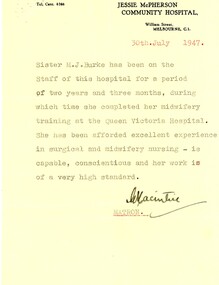 Greensborough Historical Society
Document - Professional reference, Jessie Macpherson Community Hospital, Professional reference for Marjorie Jean Burke, 30/07/1947
... Professional reference for Marjorie Jean Burke issued by the matron of Jessie Macpherson Community Hospital in Melbourne....Jessie Macpherson Community Hospital...Professional reference for Marjorie Jean Burke issued by the matron of Jessie Macpherson Community Hospital in Melbourne. Miss Burke was a nurse, midwife and infant welfare sister. ...Professional reference for Marjorie Jean Burke issued by the matron of Jessie Macpherson Community Hospital in Melbourne.Miss Burke was a nurse, midwife and infant welfare sister. This collection covers her many qualifications throughout Australia and Great Britain, including references both professional and personal. When Miss Burke returned to Australia, she was employed at Diamond Valley Community Hospital as a nurse in 1953 and as Deputy Matron 1954-1971.Reference typed on cream letterhead.marjorie jean burke, nurses, diamond valley community hospital, jessie macpherson community hospital -
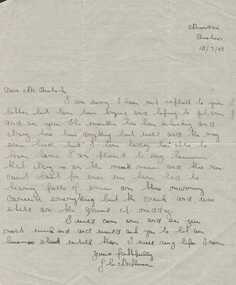 Warrnambool and District Historical Society Inc.
Letter, J C MacPherson to Mr Bostock
... J C MacPherson to Mr Bostock...White lined paper. J C MacPherson to Mr Bostock Letter ...One of a number of documents relating to the Bostock family. Unsure to which Mr Bostock this letter relates. Generally speaks of the weather and his wife’s illness.One of a number of items relating to the Bostock family and is indicative of letters of the time. One page hand written letter in black pen. White lined paper.Addressed to Mr Bostock from J C McPherson. Dated 13/07/52 ?bostock, warrnambool -
Kew Historical Society Inc
Book, Jane Sandilands, Helen Macpherson Schutt Philanthropist 17 April 1874-19 April 1951, 2001
... Helen Macpherson Schutt Philanthropist 17 April 1874-19 April 1951...Melbourne : Helen M Schutt Trust , 2001 36 p. : ill., ports ; 30 cm. Helen Macpherson Schutt Philanthropist 17 April 1874-19 April 1951 Book Jane Sandilands Helen M Schutt Trust ...Melbourne : Helen M Schutt Trust , 2001 36 p. : ill., ports ; 30 cm. non-fictionschutt family, schutt helen macpherson, helen m. schutt trust, philanthropists -- australia -- biography, women in philanthropy. -
 Bendigo Historical Society Inc.
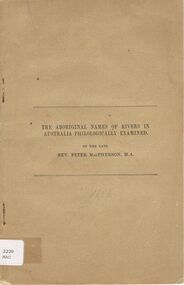
Book - ALEC H CHISHOLM COLLECTION: BOOK ''THE ABORIGINAL NAMES OF RIVERS IN AUSTRALIA'' BY PETER MACPHERSON
... A 29 page soft cover booklet by the Rev. Peter MacPherson M.A. A philological examination of the Aboriginal names of rivers in Australia. ...Peter MacPherson...BOOKS Collections place names ALEC H CHISHOLM COLLECTION ABORIGINAL NAMES AUSTRALIAN RIVERS REV. PETER MACPHERSON Peter MacPherson Booklet. ALEC H CHISHOLM COLLECTION. ...Booklet. ALEC H CHISHOLM COLLECTION. A 29 page soft cover booklet by the Rev. Peter MacPherson M.A. A philological examination of the Aboriginal names of rivers in Australia. Read before the Royal Society of N.S.W. on 4 August 1886. Printed in 1887 by Charles Potter, Government Printer, Sydney. Catalogue sticker ''2229 MAC'' on front cover. ''1886'' written in pencil on front cover.Peter MacPhersonbooks, collections, place names, alec h chisholm collection, aboriginal names, australian rivers, rev. peter macpherson -
 Victorian Interpretive Projects Inc.
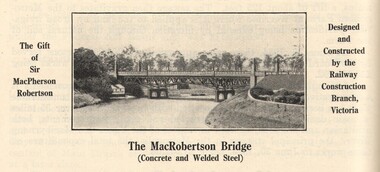
Image, MacRobertson's Bridge, 1934
... Confectionery king MacPherson Robertson personally funded the £19 000 cost of the steel arch MacRobertson or Grange Road Bridge (1934) as a gift to Victoria for its centenary. ...The bridge was funded by MacPherson Robertson....The bridge was funded by MacPherson Robertson. MacRobertson's Bridge, 1934 Image ...Confectionery king MacPherson Robertson personally funded the £19 000 cost of the steel arch MacRobertson or Grange Road Bridge (1934) as a gift to Victoria for its centenary. (http://www.emelbourne.net.au/biogs/EM00234b.htm)A steel bridge over the Yarra River, Melbourne. The bridge was funded by MacPherson Robertson.macrobertson, bridge -
 Mission to Seafarers Victoria
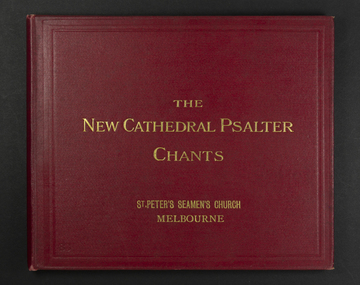
Book - Prayer Book, Novello and Company, Limited, The New Cathedral Psalter Chants - For Village Church Use - St Peter's Seamen Church, Melbourne, 1909
... ...Charles MacPherson...Embossed red hardcover book of chants, gold titling, multiple pages The New Cathedral Psalter Chants - For Village Church Use - St Peter's Seamen Church, Melbourne Book Prayer Book Novello and Company, Limited Charles MacPherson ...Book of Chants of the early 20th century, possibly produced as a commemorative gift from or issued by the Anglican diocese / archbishopric.Embossed red hardcover book of chants, gold titling, multiple pagesnon-fictionBook of Chants of the early 20th century, possibly produced as a commemorative gift from or issued by the Anglican diocese / archbishopric. psalter, music, chants, choral music -
 National Vietnam Veterans Museum (NVVM)
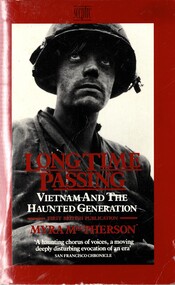
Book, MacPherson, Myra, Long Time Passing: Vietnam And The Haunted Generation
... MacPherson, Myra...Long Time Passing: Vietnam And The Haunted Generation Book Book MacPherson, Myra ...It was 'the different war,' the one America couldn't agree on - and can't forget. Here is the first 'emotional history' of the Vietnam war, told by the generation that was asked to fight. In over 500 stunningly candid interviews, we hear from those who went and those who stayed at home. They are soldiers and protesters, officers and privates, black and white, guitly and proud.It was 'the different war,' the one America couldn't agree on - and can't forget. Here is the first 'emotional history' of the Vietnam war, told by the generation that was asked to fight. In over 500 stunningly candid interviews, we hear from those who went and those who stayed at home. They are soldiers and protesters, officers and privates, black and white, guitly and proud. 1961-1975 - united states, vietnamese conflict, 1961-1975 - psychological aspects -
Moorabbin Air Museum
Book - THE BLACK BOX, MALCOLM MACPHERSON, 1998
... MALCOLM MACPHERSON...THE BLACK BOX Book THE BLACK BOX MALCOLM MACPHERSON HARPER COLLINS PUBLISHERS ... -
Moorabbin Air Museum
Book, MALCOLM MACPHERSON, THE BLACK BOX, 1998
... MALCOLM MACPHERSON...THE BLACK BOX Book MALCOLM MACPHERSON ... -
Lakes Entrance Historical Society
Book, Stuartfield House Consulting Group, Macpherson Paul, Immigrant Arrivals, 1998
... Stuartfield House Consulting Group, Macpherson Paul...Immigrant Arrivals Book Stuartfield House Consulting Group, Macpherson Paul ...A report of the archives working group of the Cultural Ministers Council, listing records of immigrant arrivals to the States and Territories of Australia, and the availability of these records to researchers.migrants, settlement -
Lakes Entrance Historical Society
Book, Macpherson Paul, Indigenous Australians, 1997
... Macpherson Paul...Aboriginals Government Guide to records of Indigenous Australians held in over fifty-five institutions, Australia wide, including addresses of these archives and organisations Indigenous Australians Book Macpherson Paul ...Guide to records of Indigenous Australians held in over fifty-five institutions, Australia wide, including addresses of these archives and organisationsaboriginals, government -
 Ringwood and District Historical Society
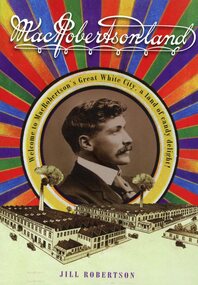
Book, Jill Robertson, MacRobertsonland, 2010
... Small paperback biography of Macpherson Robertson (1859-1945)...MACROBERTSONLAND tells the amazing rags-to-riches tale of Macpherson Robertson, Austrlia's very own Willy Wonka."...MACROBERTSONLAND tells the amazing rags-to-riches tale of Macpherson Robertson, Austrlia's very own Willy Wonka." ...MacRobertson's chocolate factory in Fitzroy, Victoria, expanded to Ringwood at 323 Canterbury Road before takeover in 1968 by Cadbury-Schweppes P/L.Small paperback biography of Macpherson Robertson (1859-1945)"Meet the man behind some of Australia's favourite confectionery - including Freddo Frog, Cherry Ripe and Old Gold chocolate - a charming self-made millionaire and generous philanthropist whose spirit reflected the hopes and dreams of a young nation. MACROBERTSONLAND tells the amazing rags-to-riches tale of Macpherson Robertson, Austrlia's very own Willy Wonka." -
Whitehorse Historical Society Inc.
Newspaper, Ready For Role, 6/05/1992 12:00:00 AM
... macpherson...Steve MacPherson, General Manager of Eastern Metropolitan Region of the Education Department, visits recently formed Primary Campus of Blackburn P-12 College....macpherson steve victoria. education department blackburn p-12 college blackburn north primary school middlefield primary school primary schools Steve MacPherson, General Manager of Eastern Metropolitan Region of the Education Department Steve MacPherson, General Manager of Eastern Metropolitan Region of the Education Department, visits recently formed Primary Campus of Blackburn P-12 College. ...Steve MacPherson, General Manager of Eastern Metropolitan Region of the Education DepartmentSteve MacPherson, General Manager of Eastern Metropolitan Region of the Education Department, visits recently formed Primary Campus of Blackburn P-12 College.Steve MacPherson, General Manager of Eastern Metropolitan Region of the Education Departmentmacpherson, steve, victoria. education department, blackburn p-12 college, blackburn north primary school, middlefield primary school, primary schools -
 Yarra Ranges Regional Museum
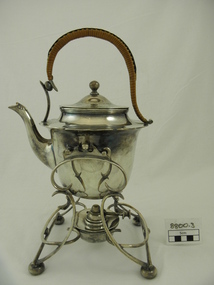
Teapot, c. 1934
... Given to Nell (Helen) Mitchell, daughter of Charlie Mitchell, and her husband John Macpherson Smith as a wedding gift from he emloyees of Cave Hill, Lilydale 19 June 1935....On lid: Presented to Miss Nell Mitchell on the occasion of her marriage to Mr John Macpherson Smith from the employees of Cave Hill. ...Given to Nell (Helen) Mitchell, daughter of Charlie Mitchell, and her husband John Macpherson Smith as a wedding gift from he emloyees of Cave Hill, Lilydale 19 June 1935. ...Given to Nell (Helen) Mitchell, daughter of Charlie Mitchell, and her husband John Macpherson Smith as a wedding gift from he emloyees of Cave Hill, Lilydale 19 June 1935.Historic significance related to Cave Hill Quarry, a major enterprise in Lilydale which has existed since the mid 1800s and was founded by David Mitchell, father of Dame Nellie Melba (opera singer). Cave Hill Quarry was a major employer in the area. The Museum also holds a humidifier made by the engineer at Cave Hill Quarry for Dame Nellie Melba as a gift. Significance also related to David Mitchell and Dame Nellie Melba and Mitchell family. Nell Mitchell was David Mitchell's grand-daughter and Nellie Melba's niece (Charlie Mitchell Melba's brother)..1 Electroplated nickel silver teapot with wicker handle. Hinged lid, scalloped rim, four feet and an acanthus leaf spout. .2 Electroplated nickel silver tipping stand .3 Oil burnerOn lid: Presented to Miss Nell Mitchell on the occasion of her marriage to Mr John Macpherson Smith from the employees of Cave Hill. Lillydale. June 19 - 1935 On bottom: D/ TN/- 10Y10Y? Dunklings Melbourne EPNS 5489 Made in Englandnell (helen) mitchell, john macpherson smith, cave hill lilydale, weddings -
 Flagstaff Hill Maritime Museum and Village
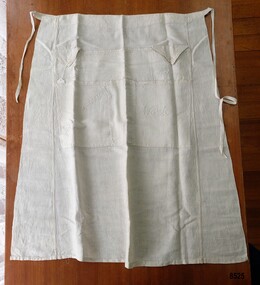
Clothing - Traveller's Apron, Eliza Towns, Circa 1915
... Macpherson Street, Nhill, Wimmera, Wimmera, Australia ...This apron is one of several linen and clothing items that were made and belonged to Mrs. Eliza Towns and donated to Flagstaff Hill Maritime Museum and Village. Eliza was born Eliza Gould in 1857 in South Melbourne (Emerald Hill) and in 1879 married Charles Towns. In the early 1880's they moved to Nhill in western Victoria and remained there for the rest of their married life. Charles was a jeweller and later became an accountant and for many years was involved with the Shire Council, the local show committee (A & P Society), the Hospital Committee and the Board of the local newspaper (the Nhill Free Press). They had three children and lived a life that would be regarded as comfortably "middle class". Eliza probably had a treadle sewing machine and would have made many of her own clothes - adding her own handmade embroidered or crocheted decorative trim. In March 1915 Eliza travelled to San Francisco to visit her son, James. She went by train to Melbourne ("a pleasant journey on the up express') and the next day caught the express train to Sydney. She noted in her letters home that a " number of young men were going to Sydney to enlist but they had to stop in the corridors most of the way as there was no room for them to sit down". She spent the night on the train and arrived in Sydney the next morning and on the following day she boarded the R.M.S. "Moana" (a steamer which took about twenty-four days to reach San Francisco). She returned from Vancouver about five months later on board the "Manuka". It is very likely Eliza took this "Travelling Apron" with her on her travels. Eliza was travelling by herself and had no one to help her with her dress or her hair. "Travelling Aprons" (also known as Toilet Aprons or Tourist Aprons) were designed with different sized pockets for holding a lady's toiletries - hairbrush, hair pins, comb and sometimes even soap and a powder puff. This allowed the owner, when travelling and getting dressed in small places such as an overnight train compartment or a ship's cabin, to have all her requirements at hand without needing to search for them or have them roll onto the floor. Some of the pockets are finished with buttoned flaps to keep the items in place and when not in use, the apron could be hung up or rolled up and put away. Articles about the "Traveller's Apron" appeared in numerous Women's columns in Australian newspapers in the early 20th century - often with instructions and sometimes a pattern. In the "Age" on Sat 5th October 1907 in a column titled "Feminine Facts and Fancies" the author wrote "No man can appreciate the difficulties of dressing in a "wobbly" train or trying to do one's hair while a ship is weathering a storm". A year earlier (Saturday 24th March 1906) in the same column, the author wrote "... you have to spend nights in a train... forever struggling to dress yourself in a wretched little lavatory. You know how your hairpins and combs jump all over the place ... a train is always at its liveliest when you're trying to do your hair. My travelling apron saved me many a rage."This item is an example of the needlework skills of women in the early 20th century - combining machine stitching with hand embroidery to personalise and embellish a practical domestic object. It is also an excellent (and rare) example of an early 20th century innovation that helped solve the difficulties of privacy and convenience that many women experienced at a time when travel was becoming more accessible to them. A half apron, made of ivory linen with two waist ties and seven pockets. Along the top are two smaller pockets with triangular, buttoned flaps labelled "Hairpins" and "Nailbrush" and one larger unlabelled pocket. Underneath are two larger pockets labelled "Brush & Comb" and "Work" and two unlabelled narrow pockets. The seams are machine stitched and the pockets are outlined with hand embroidered feather stitch. The labels on the pockets are embroidered in stem stitch."Hairpins" / "Nailbrush" / "Brush and Comb" / "Work"flagstaff hill maritime museum and village, nhill, eliza towns, apron, travelling apron, tourist apron, textiles, toilet apron, sewing, embroidery, travel, warrnambool, great ocean road, trains, ships, moana, manuka, feather stitch, stem stitch, fashion, handmade, clothing, charles towns, needlework -
 Flagstaff Hill Maritime Museum and Village
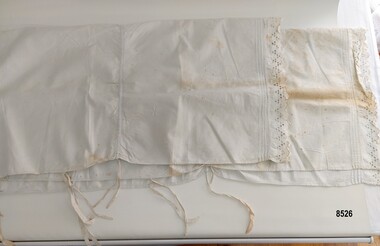
Textile - Bolster Sham, Eliza Towns, Late 19th century to early 20th century
... Macpherson Street, Nhill, Wimmera, Victoria, Australia ...This bolster sham is one of several linen and clothing items that were made and belonged to Mrs. Eliza Towns and donated to Flagstaff Hill Maritime Museum and Village. Eliza was born Eliza Gould in 1857 in South Melbourne (Emerald Hill) and in 1879 married Charles Towns. In the early 1880's they moved to Nhill in western Victoria and remained there for the rest of their married life. Charles was a jeweller and later became an accountant and for many years was involved with the Shire Council, the local show committee (A & P Society), the Hospital Committee and the Board of the local newspaper (the Nhill Free Press). They had three children and lived a life that would be regarded as comfortably "middle class". Eliza probably had a treadle sewing machine and would have made many of her own clothes and household linens - adding her own handmade embroidered or crocheted decorative trim. Most beds during the late 19th and early 20th century had a feather, hair or spring mattress covered by a blanket and topped with an under sheet, an upper sheet, several blankets and a bedspread. A flat bolster could be placed either under the pillows or on top of the pillows with a decorative sham. Washing pillows and quilts by hand would have been a very onerous task (involving heating water and handwashing in a tub or using a copper) and so it became the practise of many housewives to cover the pillows and bolsters with an outer slip (or sham) of washable material which could be easily removed and washed when needed. If the bolster was kept under the pillows it wouldn't need to be very decorative but many shams or slips that were "on show" were often highly decorated with embroidery, pintucks, ribbons or lace. This bolster sham is machine made and quite plain with the exception of some pintucking and eyelet lace on each end which suggests that it would mostly be hidden under the top pillows with just the decorative edges on display.This item is an example of the needlework skills of women in the early 20th century - combining machine stitching with hand embroidery to personalise and embellish a practical domestic object. It is also significant as an example of an early 20th century innovation that helped make the working lives of housewives a little bit easier.A long white cotton rectangular bolster sham, machine sewn, with seven ties and two buttons (plus one missing button) to enable it to be folded over lengthwise and closed. It has two pull string ties near each end to enclose a bolster and is finished with a decorative edge of pintucks and handmade eyelet lace and embroidery.flagstaff hill maritime museum and village, eliza towns, sham, bedding, great ocean road, shipwreck coast, warrnambool, household textiles, sewing, bolster sham, housework, pillow sham, charles towns, nhill, haberdashery, needlework, manchester, handmade, household linen -
 Flagstaff Hill Maritime Museum and Village
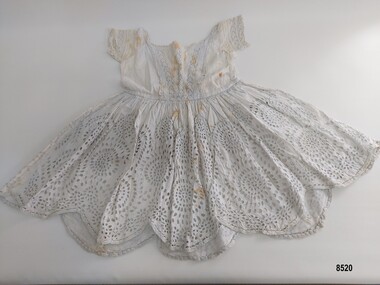
Clothing - Child's dress, Eliza Towns, Late 19th century
... Macpherson Street, Nhill, Wimmera, Victoria, Australia ...This child's dress is one of several linen and clothing items that were made and belonged to Mrs. Eliza Towns and donated to Flagstaff Hill Maritime Museum and Village. Eliza was born Eliza Gould in 1857 in South Melbourne (Emerald Hill) and in 1879 married Charles Towns. In the early 1880's they moved to Nhill in western Victoria and remained there for the rest of their married life. Charles was a jeweller and later became an accountant and for many years was involved with the Shire Council, the local show committee (A & P Society), the Hospital Committee and the Board of the local newspaper (the Nhill Free Press). They had three children and lived a life that would be regarded as comfortably "middle class". Eliza probably had a treadle sewing machine and would have made many of her own clothes as well as clothes for her children - adding her own handmade embroidered or crocheted decorative trim. A photograph of their youngest child, Alice, taken in circa 1903 depicts her wearing the dress. The dress would have been only worn on special occasions (such as a formal family photographic portrait) as most young girls in that era would have smocks or pinafores for everyday wear. The age of the dress is in question as it may have been made by Eliza for her eldest daughter, Dorcus, who was born in 1884. This dress has some machine sewing at the neck, waistband and pintucks but much of the dress is handsewn and richly embroidered with Broderie anglaise. Broderie anglaise (also known as eyelet lace) is a form of cutwork embroidery. The foundation fabric is cut to make decorative holes which are sewn with overcast or buttonhole stitches to create a lace like effect. Designs often involve floral motives that are enhanced with simple embroidery stitches such as stem stitch and satin stitch and scalloped edges finished with buttonhole stitches. It was commonly used to trim baby clothes, dresses, nightclothes, underclothes and household linens - particularly in the Victorian and Edwardian eras. This item is an example of the needlework skills of women in the late 19th century - combining machine stitching with hand embroidery to personalise and embellish a child's special dress.Child's white dress made of cotton and lawn, with a skirt of hand embroidered circular cutwork (broderie anglaise), a scalloped hem edged in buttonhole stitch and a gathered waist. The lined bodice has three panels of hand embroidered broderie anglaise (eyelet lace) inserted in a V shape with pintucks and bordered with a broderie anglaise lace frill. The short sleeves also have an inserted broderie anglaise lace strip, three pintucks and a broderie anglaise lace frill. The skirt is semi lined with fine lawn. The dress has a back opening with one button and two ties. The neckline is decorated with two rows of hand embroidered broderie anglaise lace.flagstaff hill, flagstaff hill maritime museum & village, warrnambool, shipwreck coast, great ocean road, nhill, wimmera, eliza towns, dorcus towns, child's dress, machine sewing, hand sewing, broderie anglaise, cutwork, embroidery, eyelet lace, clothing, handmade, charles towns, alice towns -
 Flagstaff Hill Maritime Museum and Village
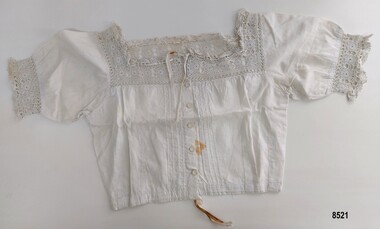
Clothing - Corset cover, Eliza Towns, Mid to late 19th century
... Macpherson Street, Nhill, Wimmera, Victoria, Australia ...This corset cover is one of several linen and clothing items that were made and belonged to Mrs. Eliza Towns and donated to Flagstaff Hill Maritime Museum and Village. Eliza was born Eliza Gould in 1857 in South Melbourne (Emerald Hill) and in 1879 married Charles Towns. In the early 1880's they moved to Nhill in western Victoria and remained there for the rest of their married life. Charles was a jeweller and later became an accountant and for many years was involved with the Shire Council, the local show committee (A & P Society), the Hospital Committee and the Board of the local newspaper (the Nhill Free Press). They had three children and lived a life that would be regarded as comfortably "middle class". Eliza probably had a treadle sewing machine and would have made many of her own clothes as well as clothes for her children - adding her own handmade embroidered or crocheted decorative trim. This corset cover is an excellent example of an everyday clothing item with the decorative trim favoured by women in the late Victorian era. Eliza Towns has added pintucks, embroidered feather stitch and a highly decorative hand crocheted lace trim to the neckline, sleeves and front of the bodice. Corset covers (sometimes called camisoles) began to appear in women's fashion around 1840 and continued through the late Victorian decades into the Edwardian era. The long chemise was considered too bulky to cover the corset and so the corset cover was developed to be short and light and was worn over the corset and under the bodice of the outer garment. A woman would dress into her chemise and drawers first, followed by her corset and finally her corset cover as a final layer under her dress. Corset covers served several purposes. They provided protection against sweat (and the need to regularly wash the corset), helped smooth the lines of the corset and increased a woman's modesty.This item is an example of the needlework skills of women in the late 19th century - combining machine stitching with hand embroidery and crochet to embellish an item of personal underclothing. It is also significant as an example of a practical solution to the difficulty of hand washing a corset in the Victorian era.A short (waist length) corset cover of fine cotton. Short sleeves fall from a square neckline and are gathered into a wide crocheted lace trim with a band of embroidered feather stitch. The same crocheted lace design and feather stitching are also on the square neckline which is finished with a drawstring ribbon. The bodice has a front opening with five buttons and is bordered on each side with four pintucks. It has a drawstring ribbon at the waist and an extra layer of fine cotton lining has been added to strengthen the corset cover under the arms. The back has two bands of three pintucks running vertically from the neckline to the waist.flagstaff hill, flagstaff hill maritime museum & village, warrnambool, great ocean road, shipwreck coast, nhill, wimmera, eliza towns, underclothing, corset cover, camisole, machine sewing, hand sewing, crocheted lace, pintucks, feather stitch, embroidery, underwear, victorian era underclothing, victorian era corset cover -
 Flagstaff Hill Maritime Museum and Village
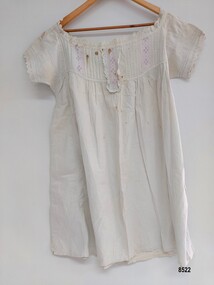
Clothing - Chemise, Eliza Towns, Late Victorian era
... Macpherson Street, Nhill, Wimmera, Victoria, Australia ...This chemise is one of several linen and clothing items that were made and belonged to Mrs. Eliza Towns and donated to Flagstaff Hill Maritime Museum and Village. Eliza was born Eliza Gould in 1857 in South Melbourne (Emerald Hill) and in 1879 married Charles Towns. In the early 1880's they moved to Nhill in western Victoria and remained there for the rest of their married life. Charles was a jeweller and later became an accountant and for many years was involved with the Shire Council, the local show committee (A & P Society), the Hospital Committee and the Board of the local newspaper (the Nhill Free Press). They had three children and lived a life that would be regarded as comfortably "middle class". Eliza probably had a treadle sewing machine and would have made many of her own clothes as well as clothes for her children - adding her own handmade embroidered or crocheted decorative trim. This chemise is machine sewn by Eliza Towns and she has added pintucks and broderie anglaise lace as a decorative element. A chemise was usually a sleeveless garment made of linen or cotton (so they could be easily washed) and its shape was much like a modern day nightgown. The name comes from the French word for "shirt" or "shift". Women wore chemises next to the skin (under the corset) to keep stains and odors away from the less washable corset and gown.This item is an example of the needlework skills of women in the mid to late 19th century - combining machine stitching with hand embroidery to personlise and embellish an item of clothing. It is also significant as an example of a practical solution to the difficulties of needing to regularly hand wash a bulky outer garment or gown in the Victorian era.A white cotton, short sleeved, knee length chemise. The fabric at the front is gathered on a yoke which is decorated with bands of five pintucks alternating with broderie anglaise lace and embroidered strips lined with pink ribbon. A different broderie anglaise design decorates the sleeve edges, neckline and center broderie anglaise strip. The back of the chemise is gathered on to the neckline. There are two bands of pintucks on each sleeve. The fabric around each armhole has been strengthened with another layer of cotton and a length of cotton has been added (from the left shoulder to the hem) to increase the width of chemise.flagstaff hill, flagstaff hill maritime museum and village, warrnambool, great ocean road, south west victoria, victorian era, victorian era undergarments, chemise, victorian era chemise, undergarments, pintucks, victorian chemise, eliza towns, nhill, wimmera, home sewing, machine sewn, hand made
