
Showing 5 items matching "magneto wall telephones"
-
 Warrnambool and District Historical Society Inc.
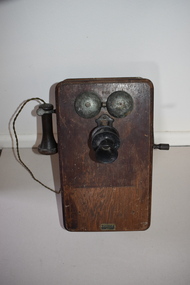
Wall Telephone, Early 20th century
... ...Magneto wall telephones... Magneto wall telephones such as this one were commonly in use in Australia around the end of the 19th century and the beginning of the 20th century. ...Magneto wall telephones such as this one were commonly in use in Australia around the end of the 19th century and the beginning of the 20th century. ...Magneto wall telephones such as this one were commonly in use in Australia around the end of the 19th century and the beginning of the 20th century. The wall telephone, powered by dry cells, was an invention of the late 1870s. In the first half of the 20th century many old wall telephones were restored and put back in use by the Australian P.M.G. when there was a shortage of telephones in the 1930s Depression and during World War Two. This item, a reminder of the days of early technology, has no known local provenance but is retained for display and research purposes.This telephone piece is contained within a brown wooden box with a back board that has curved edges and extends over the edges of the box. On the back there are three metal screws for attaching the box to a wall or door. The front section of the box has curved edges with an inset panel around the edges. There is a metal turning handle on one side of the box and on the other side there is a metal clip holding a hearing piece attached to the box by a cord. On the front of the box is a speaking piece attached to the box by a metal piece. Attached to the front of the box are two semi-circular ringing pieces now situated some centimetres out from the box. The box was originally varnished but the edges are now rubbed and there are some splotches of paint. vintage wall telephones, history of warrnambool, magneto wall telephones -
 National Communication Museum
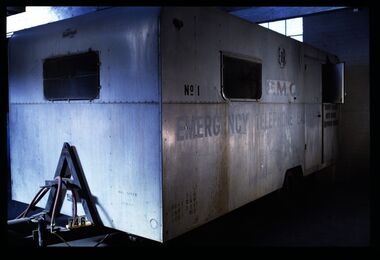
Vehicle - Mobile Telephone Exchange, c. 1965
... The main frame room contains many metres of coiled black covered cable, a black covered magneto wall telephone with 300 type handset; grey plastic jumper cords, a rack of termination points and wire with wasp nests attached. ...The main frame room contains many metres of coiled black covered cable, a black covered magneto wall telephone with 300 type handset; grey plastic jumper cords, a rack of termination points and wire with wasp nests attached. ...Manufactured in the 1960s, this mobile emergency telephone exchange was fitted into a caravan. Part of the Shepparton Division State Disaster Plan, the caravan could be towed to areas affected by disasters to enable communications to recommence. The caravan remained in service until approximately 1974.Mobile infrastructure plays an important role in Australian communications, owing to the often remote and hostile environments in which Australians live and work. Exchanges such as this facilitated phone calls in the aftermath of an emergency, particularly for hospitals, police and other emergency services. Today, Mobile Exchange on Wheels (MEOWs), Cell on Wheels (CoW) and Satellite Cell on Wheels (SatCOW) - which provide temporary landline and broadband services, mobile phone coverage and service in areas without communications infrastructure respectively - are a critical part of emergency response procedures for natural disasters such as fire and flood. Though technology has progressed, the need for rapid service in remote areas remains a present concern of the communications service providers in Australia. This mobile service infrastructure is historically significant as an early example of a service which has evolved over decades, yet is still needed today. The exchange, as a representative example of a vehicle which would provide early-response in a disaster, is socially significant as a facilitator of critical communications needs in devastated communities: access to emergency services and contact with family and friends. The exchange itself, intact from its period of use, provides an insight into technology of the 1970s.Mobile emergency exchange housed in a caravan trailer on 2 wheel base, duralin body, steel tow bar, Caravan divided into 3 sections; the exchange room; the relay room and the main frame room. The exchange room contains 3 switchboards, a folding table, cupboards, benches and switch rack (.1). table (.2), steel bar for attaching the table (.3), back boards of switchboards (.4-.6), switches (.7-.16), box of switches (.17). There is a wall phone magneto, 300 type handset on wall and 2 skylights with wire screens. .11? hat pegs and shelf; there are 2 fluorescent tubes for lighting, all in exchange section. The floor is covered with 2 tone grey tiles and there are wire mesh on outside of windows and a geometric curtain inside behind switch rack. There is a flywire screen door as well as exterior door. The relay room has a sectioned door so half can open at a time. Room contains a cupboard with folding bench top beneath a curtained window. The opposite wall has a bank of batteries and transmission condensers; there is a shelf above window, one fluorescent tube and fuse boxes. Tiles on floor also. The main frame room contains many metres of coiled black covered cable, a black covered magneto wall telephone with 300 type handset; grey plastic jumper cords, a rack of termination points and wire with wasp nests attached. There is a small iron step under door, a fluorescent tube on wall and 3 hat hooks. Roll of Paper Handtowels (.18), cord and handle (.19), red exchange cords and plugs (.20-.22), plastic aluminium runners (.23,.24), headset (.25,.26), logbook (.27), battery readings (.28), box containing papers circuit drawings etc (.29-.93), paper lists off wall (.94,.95). Books, record books etc (.96-.103). Manila folder (.104) containing circuit drawings (105-.124). Wooden drawer (.125), metal drawer containing subscribers master cards, record of faults cards, particular switchboards connected, Junction line cards (.126). Box of valves (.127), box of clamps (.128). Box of 2000 type rack fuses, red 1 1/2 AMPS, black 3 AMP, blue 1/2 AMP (.129). Box of sleeves for covering wire joints (.130), plastic beakers (.131,.132), soap (.133), box of white plastic squares (.134), time switch "Venner BF/43 time switch" Made in England (.135), box of bolts, knobs etc (.136), box of switchboard number indicators (.137), fuse (.138), fuse wire (.139), football card (.140). Box of cartridge fuse 6 AMP (.141). Envelope of drawing pins, rubber bands (.142), black plastic, paper tape centres (.143-.152), metal plug (.153), 2 signs "Beware of vehicles" (.154-.155). Paper listing Naringal East automatic conversion (.156). Green Commonwealth of Australia note pad (.157). Wiring plug for tail lights (.158). Black fuse plugs (.159,.160). Box of bolts (.161). 2 sections of blue plastic coated wires (.162,.163). Gloves used for working on batteries (.164-.167). Wasp nests (.168,.169). White fuse (.170). Photographs of van in use (.171,.172)..1 on front: "ANOTHER / MOBILETRAIL / PRODUCT" "MAX SPEED / 25MPH" "TRAILER BRAKES / --- / " On sides: "EMERGENCY TELEPHONE EXCHANGE" "NO 1" "PMG" "TCQ / GROSS 250 / TARE 182 / LOAD 162" "6" "COUNTRY BRANCH / NORTH REGION / [SHEPPARTON DIVISION]" "LAW'S SIGNS" "Telecom Australia" On back: "DANGER / LONG LOAD" "MQA 3787" .133: "FIR OIL" "AUSTRALIA"mobile telephone exchanges, mobile telecommunications trailers, trailers, transport, natural disaster, black saturday, bushfires, floods, emergency communications -
 Bendigo Historical Society Inc.
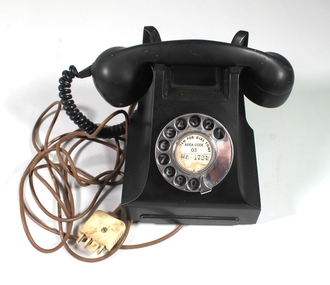
Functional object - Telephone 400 Series, Ericsson, 1957
... telephone series was based on the Ericsson/GEC 1000 type and designed to work on longer and lighter gauge cables (1000 ohm lines). It was fitted with a new 5 winding Induction Coil (Coil, Induction No. 21A), had a more efficient anti-sidetone circuit, a sensitive rocking armature receiver and a new style handset with no spittoon. The 400 Series included automatic (401, 404, 405 and 411), central battery (402, 406 and 407) and local battery/magneto (403) versions and was made as both table and wall...telephone series was based on the Ericsson/GEC 1000 type and designed to work on longer and lighter gauge cables (1000 ohm lines). It was fitted with a new 5 winding Induction Coil (Coil, Induction No. 21A), had a more efficient anti-sidetone circuit, a sensitive rocking armature receiver and a new style handset with no spittoon. The 400 Series included automatic (401, 404, 405 and 411), central battery (402, 406 and 407) and local battery/magneto (403) versions and was made as both table and wall ...The 400 series telephone was developed by the PMG in 1957 and introduced into service in 1958 to replace the 300 Series telephones. This telephone series was based on the Ericsson/GEC 1000 type and designed to work on longer and lighter gauge cables (1000 ohm lines). It was fitted with a new 5 winding Induction Coil (Coil, Induction No. 21A), had a more efficient anti-sidetone circuit, a sensitive rocking armature receiver and a new style handset with no spittoon. The 400 Series included automatic (401, 404, 405 and 411), central battery (402, 406 and 407) and local battery/magneto (403) versions and was made as both table and wall models. The 410 was used on Shared Service. Initially it was intended that the 400 Series would be available in a range of colours but due to fading issues only black and ivory were eventually available to subscribers. There were several variants of the 400 Series and they were manufactured by Ericsson and GEC in England and by AWA in Australia. The Ericsson/GEC version used an internal chassis like the Telephone 332 or 332AT but the AWA version had all the main components mounted on the base plate. The initial APO instruction issued in 1958 showed the rounded GEC/Ericsson 1000 shape case as the new 400 series but the production models had the older 300 type case. The ivory 400 series was only available as a table model and was made by Ericsson. The wall models were only made by AWA Reference https://www.britishtelephones.com/aus/400type.htp.A black telephone with a with a metal dial with numbers 1 to 0 in the finger holes in the dial. A handset with a mouthpiece on one end and an earpiece on the other end sits on the top of the telephone and is attached to the telephone with a plastic black spring winded cord. A plastic brown cord with a white plug connects the telephone to a socket 400 telephone, dial telephone -
 Whitehorse Historical Society Inc.
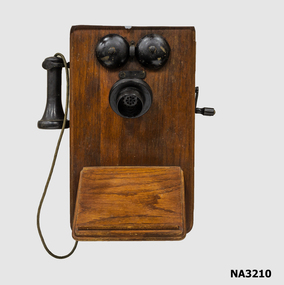
Equipment - Magneto Telephone, C1930
... magneto telephone for communication with a manual telephone exchange. The handle on the right hand side, which was turned to rotate the magneto to call the exchange - ask operator for a number and then to be connected. Telephone enclosed in a specially designed box for mounting on the wall...magneto telephone for communication with a manual telephone exchange. The handle on the right hand side, which was turned to rotate the magneto to call the exchange - ask operator for a number and then to be connected. Telephone enclosed in a specially designed box for mounting on the wall ...Used to communicate with the local telephone exchange and for connection to other subscribers. The introduction of automatic exchanges saw the their demise. This phone was used in the family home of the donor at Caboolture (aboriginal for carpet snake) during the 1940s and 1950s.A magneto telephone for communication with a manual telephone exchange. The handle on the right hand side, which was turned to rotate the magneto to call the exchange - ask operator for a number and then to be connected. Telephone enclosed in a specially designed box for mounting on the wall. There was a bell on top which rang when the magneto ringer at the exchange was turned. Fitted with a carbon microphone mounted on the front of the box for the transmission of the spoken word and an electro- magnet. A receiver which hangs on the left hand side on a hook. The hook acts as the on and off switch to answer the call and to switch on the battery to provide power for the receiver and energize the transmitter. There is an angled ledge for writing any messages. There is no battery. The circuit for the phone is on the inside of the door to the interior of the phone. pHone is type CDA116 - PMG Registered - Ericsson.communication, telephonic -
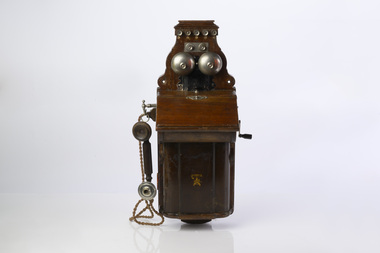 Department of Energy, Environment and Climate Action
Ericsson 'Commonwealth' wall telephone Model AB535
... The Commonwealth Ericsson Wall Telephone was adopted in 1901 by the Post Master General as the standard magneto telephone throughout Australia. ...The Commonwealth Ericsson Wall Telephone was adopted in 1901 by the Post Master General as the standard magneto telephone throughout Australia. ...The Commonwealth Ericsson Wall Telephone was adopted in 1901 by the Post Master General as the standard magneto telephone throughout Australia. It was designated by the Australian Post Office as: "Telephone No.1 - Magneto Wall, Commonwealth Type" The No1 was widely used in country areas and new installations of this type continued throughout the 1920s. Although classified as obsolete in 1951, several were still in service in country areas into the mid-1960s before the phone systems were fully automated. The phone was originally connected to a 'party' line (several connections to a common wire), and the winder was turned in various combinations of long and short turns (being the codes unique to each individual connection) to alert the other party of an incoming call. Anyone could listen in on a party line, although courtesy prevented it occurring most of the time. Central telephone exchanges rendered the party line obsolete. Vintage wall telephone The case originally housed two No6 dry-cell batteries to power the speaker (early models used a pair of Leclanche-like wet-cell batteries - the drawing from 1911 indicates that wet-cell batteries were still in use at that time). Batteries became obsolete when the phone was connected to a central exchange. A plastic speaker horn was fitted in 2025 - the original was missing on front - L M ERICSSON & Co STOCKHOLM inside - serial number: 496018 H 5 (this serial number identifies the phone as being manufactured in 1904) inside - slip of paper identifies date of manufacture as 1904 inside aftermarket writing - F.W.31forests commission victoria (fcv), communications
