
Showing 11 items matching "mahogany box"
-
 Emerald Museum & Nobelius Heritage Park
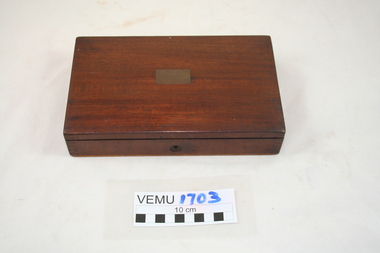
Instrument - Engineer's drafting set and case, pre-1900
... ...mahogany box...Mahogany instrument box with brass hinges, lock, and name plate. ...It had no value after the war ended. engineers instruments mahogany box World War II Japan Allison Osborne Burrows Box: Owner's label pasted inside lid, reading "A.O. ...A mahogany engineers' set created prior to 1900. It was used by Allison Osborne Burrows, a chartered engineer, post-1900. Burrows lived in NSW. The peso note was issued by the Japanese government in World War II for occupied Philippines. It had no value after the war ended.Mahogany instrument box with brass hinges, lock, and name plate. No key. Insert tray covered in blue velvet lining pressed into grooves to hold each instrument. Box contains nickel silver instruments. Some items missing their bone handle. Base of box contains ruler, protractors. Lid has hidden compartment behind it, containing Japanese issued Philippines peso note from World War II. Box owned by engineer, Allison Osborne Burrows 1887-1967 Donated by Scott Cross.Box: Owner's label pasted inside lid, reading "A.O. Burrows, Esq. A.M.I. E. Aust., Chartered Engineer (Australia), 9 Kendall Street, Pymble, N.S.W." Peso Note: "The Japanese Government One Peso"engineers, instruments, mahogany box, world war ii, japan, allison osborne burrows -
The Ed Muirhead Physics Museum
Magnetic Dip Circle
... Dip circle has much the same elments as in the previous model ( cat. no.81), except the brass cylinder is replaced by a mahogany box with two end windows. Tribrach base is fixed into a wooden sheet ( maybe for ease of carrying in the field)....Univ. of Melb” Magnets inscribed “Magnets for dip” Dip circle has much the same elments as in the previous model ( cat. no.81), except the brass cylinder is replaced by a mahogany box with two end windows. Tribrach base is fixed into a wooden sheet ( maybe for ease of carrying in the field). ...Dip circle has much the same elments as in the previous model ( cat. no.81), except the brass cylinder is replaced by a mahogany box with two end windows. Tribrach base is fixed into a wooden sheet ( maybe for ease of carrying in the field).Label: “Nat Phil Lab No. Univ. of Melb” Magnets inscribed “Magnets for dip” -
 Emerald Museum & Nobelius Heritage Park
Engineers Drafting Set and Case
... mahogany engineers set...draftsmen's box...Mahogany instrument box with brass hinges, lock, and name plate. ...Aust., Chartered Engineer (Australia), 9 Kendall Street, Pymble, N.S.W." Mahogany instrument box with brass hinges, lock, and name plate. ...A mahogany engineers' set created prior to 1900. It was used by Allison Osborn Burrows, a chartered engineer, post-1900. Mahogany instrument box with brass hinges, lock, and name plate. No key. Insert tray covered in blue velvet lining pressed into grooves to hold each instrument. Nickle silver instruments. Some items missing their bone handle. Base of box contains ruler, protractors. Lid has hidden compartment behind it, containing Japanese issued currency note from World War II.Owner's label pasted inside lid, reading "A.O. Burrows, Esq. A.M.I. E. Aust., Chartered Engineer (Australia), 9 Kendall Street, Pymble, N.S.W."mahogany engineers set, draftsmen's box, world war 2 -
 Federation University Historical Collection
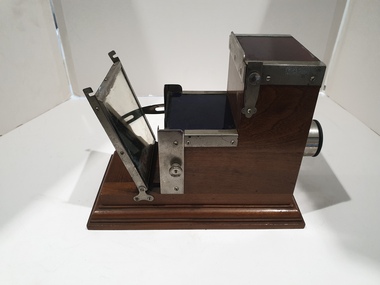
Equipment - Camera, The Junior Kromskop, c1899
... A monocular instrument used to reproduce colours, in a mahogany box The viewer combines stereo images from three-colour separation transparencies called Kromograms, these are viewed through red, green and blue filters. ...Ives Camera club photography colour photography Kromskop Frederic Eugene Ives junior kromskop Photographic Equipment camera A monocular instrument used to reproduce colours, in a mahogany box The viewer combines stereo images from three-colour separation transparencies called Kromograms, these are viewed through red, green and blue filters. ...The Kromskop (pronounced Chromescope) is one of the earliest commercial applications of colour photography, and was invented by Frederic Eugene Ives and announced around 1896, it is described in his English patent of 1895 and in a US patent of 1894. It was shown at a Camera Club in Britain in January 1896 and at the February Royal Photographic Society meeting, and was available for sale from early 1897. The Photochromoscope Syndicate was formed in 1896 or 97 to promote the viewer in Britain, and wound up in 1899. It was manufactured in south London.A monocular instrument used to reproduce colours, in a mahogany box The viewer combines stereo images from three-colour separation transparencies called Kromograms, these are viewed through red, green and blue filters. A Kromogram comprises three monochrome transparencies printed from three-colour separation negatives which are taped together. The order being red image, blue image, green image with a label and caption between the red and blue images. The red image lies horizontally on the top step of the viewer above a red filter, the blue image lies on the lower step above a blue filter, the green image stands vertically at the back of the viewer. The red and blue images are reflected into the eyepieces by transparent mirrors, these are coloured to absorb the light that they reflect to prevent a double image from the rear surface of the mirror, the mirror for the red image is coloured cyan/blue, that used for the blue filter is coloured green (the patent indicates a yellow filter). The green image is illuminated by a yellow reflector. As the mirror below the blue image is green there is no need for a green filter immediately in front of the green image. The viewer can be used in daylight, for some conditions a diffuser is used, this is hinged to the yellow reflector and laid across the steps. An artificial light was also available. The mirrors and image positions can be adjusted in the event that they become misaligned. (http://www.earlyphotography.co.uk/site/entry_V80.html, accessed 08 April 2022) The Junior Kromskop was a mono viewer Kromskop. henry sutton, photochromoscope syndicate, f.e. ives, camera club, photography, colour photography, kromskop, frederic eugene ives, junior kromskop, photographic equipment, camera -
 Phillip Island and District Historical Society Inc.
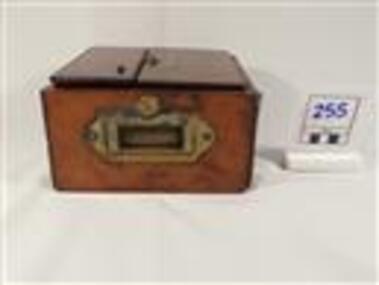
Compass box, 19th Century
... Square wooden compass box with wooden lid, made of mahogany, brass hinges, handles and lock....Many local people salvaged goods from the resulting wreckage. phillip island ship wreck compass box speke kitty miller bay Square wooden compass box with wooden lid, made of mahogany, brass hinges, handles and lock. ...Saved from the ship Speke which ran aground on the coast of Phillip Island on the 22nd of February 1906. The ships captain gave the compass box to the Harris family.The Speke was an all steel ship built in Wales in 1891. She was delivering wheat to Geelong and confused a bushfire in Cowes for navigation lights. Many local people salvaged goods from the resulting wreckage.Square wooden compass box with wooden lid, made of mahogany, brass hinges, handles and lock.phillip island, ship wreck, compass box, speke, kitty miller bay -
 Flagstaff Hill Maritime Museum and Village
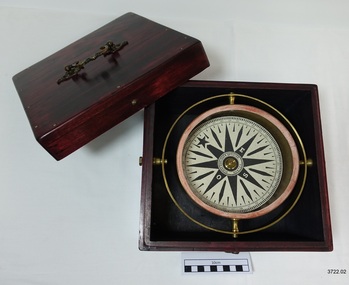
Functional object - Compass, mid-19th Century
... The compass gimbal is attached to the sides of the box and to the front and back of the compass’ cylindrical brass frame. The mahogany coloured timber storage case is joined with brass nails. ...The compass gimbal is attached to the sides of the box and to the front and back of the compass’ cylindrical brass frame. The mahogany coloured timber storage case is joined with brass nails. ...Captain Robilliard: James Arthur Robilliard was a sea captain and tentmaker, born on the 19th April 1843 at Saint Helier, Jersey. He trained there in his father's sail loft as a sailmaker. His first job as a sailor was in Liverpool, England, and in 1875, James Robilliard migrated to Australia as a mate on the "E.M. Young". James Robilliard and his family were amongst the early settlers who arrived along the Curdies River in the Heytesbury district of Western Victoria. In 1877, he became a Captain and would have used his compass from ship to ship. On 28th May 1877, in that same district, a small 3-masted schooner, the "Young Australian", was wrecked. This schooner had been built in 1864 at Jervis Bay, NSW. It had been on her way from Maryborough, Queensland, to Adelaide, under the command of Captain Whitfield, when it lost its mainmast in a heavy gale. It was beached at Curdies Inlet in Peterborough, Victoria. Captain Robilliard was placed in charge of the salvaging operation and recovered a good portion of the cargo. Not long after this incident, a Warrnambool shop owner, David Evans, found employment for James Robilliard with Evan Evans, who produced tents, sails, tarpaulins and similar goods; James already had the necessary skills for this work. Evan Evans was the same sailor rescued from the “Young Australian”. Soon after his rescue, Evan recalled he had a relative in Australia in a town called Warrnambool, and while walking in Timor Street, Warrnambool, he saw a sign over a shop that said “David Evans,” and once the two men met, Evan was warmly welcomed. David then helped his relative establish a tent and tarpaulin-making business there. Evan later transferred his successful business to a shop in Elizabeth St, Melbourne, under the name Evan Evans Pty. Ltd.) James Robilliard was a committed Christian and accredited Lay Preacher with the Methodist Church. He travelled around the local district leading the settlers in worship. On 14th November 1879, Captain Robilliard married Helen Beckett. Alfred and Selina Beckett and their family all attended the church at Brucknell, where Captain Robilliard preached. He was said to have been taken by their young daughter, Helen. James and Helen had ten children: James Arthur (Jnr), Henry William, Nellie Jessie, Alfred Albert, Rubena Nellie, De Jersy Norman, Clifford Beckett, Olive Ida, Frances Ridley Havergal and Nellie Elvie, all born in Victoria. In the 1880s, James Robilliard captained the cutter "Hannah Thompson" into Port Campbell, Victoria. This vessel was the first coastal trader to operate between Melbourne and Port Campbell. At one time, Captain Robilliard had to beach the "Hannah Thompson" for repairs. In 1923, the vessel was blown ashore in a gale and wrecked at Oberon Bay, at Wilson's Promontory. In 1889, the compass was saved by Captain James Arthur Robilliard from his sinking brigantine "Mary Campbell". This vessel was used to carry equipment for the Sydney Sugar Refinery's Mill in Southgate, NSW. The ship had been built in 1869 and traded for the next 20 years between Australian ports and rivers along the east coast, as well as regular ports in New Zealand. It was recognised by the Sydney Morning Herald as one of the best "carrying vessels in the timber trade". It had several owners over this time, the last one being Captain James A. Robilliard. On 29th April 1889, the "Mary Campbell", with Captain James A Robilliard as captain and owner, was on its way from Clarence River, NSW to Melbourne, Victoria with a cargo of railway girders for the Melbourne Harbour Trust. Captain Robilliard encountered a storm off Port Macquarie. He sailed the vessel south to about 40km east of Cape Hawke, near Tuncurry. At around 7 pm, he discovered that the cargo had shifted during the storm and the heavy girders had damaged the hull, causing a leak. The pumps were inadequate to stem the fast-flowing leak, and water soon filled the hull during the next two hours. Some of the crew began throwing the cargo overboard to lighten the vessel, hoping to keep it afloat until daylight. When the water reached over 2 meters in the hull, they realised their efforts were in vain. On the 30th April 1889, the crew left the vessel the ship was sinking fast, so they made for the shore. While still miles off Cape Hawke, all seven crew members, including the Captain, were rescued by the Government Tug "Rhea" and taken to Port Macquarie Hospital and later returned to Sydney in the vessel "Wellington". No cargo had been saved, and the consignment had been under-insured, only covered for half its value. The name of the last ship Captain Robilliard sailed is currently unknown; however, he sailed that ship from the port of Marlborough, Queensland, carting steel railway girders for the Geelong-to-Camperdown railway line. On this trip, the ship hit a storm, the cargo shifted, and the ship was wrecked along the NSW coast. After this, Captain Robilliard retired from the sea and began farming in Peterborough. In about 1897, verging on retirement, Capt. Robilliard superintended the Melbourne Sailors’ Home in Spencer Street, Melbourne, before being asked to leave this position in 1902 for trying to shut down a local hotel. On 6th May 1917, Captain James Arthur Robilliard J.P. died at Blackwood Park, in the Cobden district of Brucknell, the first Robilliard family homestead in Australia. He was buried in the Melbourne General Cemetery, Victoria. His wife Helen, passed away in 1947. This compass, once belonging to Captain James Arthur Robilliard, is of local and state historical significance for its use by the Captain with his vessel, the "Mary Campbell", a trading vessel that was bringing railway girders to the Melbourne Harbour Trust. He also used this compass on the "Hannah Thompson", listed on the Victorian Heritage Register and known as being the first coastal trader to operate between Melbourne and Port Campbell. The compass is also a very fine example of maritime navigational instruments manufactured and used in the mid-19th century. Marine compass, brass, in a wooden box with a separate, fitted lid. The compass card has sixteen points. The four principal points are marked: North with a star-shape, South with an “S”, East with an “E” and West with an “O” (French word OUEST). Each quadrant of the circle is numbered from 0 – 90 degrees. The card is floating in a liquid. The compass gimbal is attached to the sides of the box and to the front and back of the compass’ cylindrical brass frame. The mahogany coloured timber storage case is joined with brass nails. The centre of the lid has a folding decorative brass handle. The lid fits over the base and closes with a brass screw and hook on both front and back. Maker: Dubas Watchmaker Optician, Nantes, France, c 1860-1870. Compass came from the ship “Mary Campbell”, which sank off the NSW coast in 1889, near Forster. The compass, as well as the ship, belonged to Captain James Arthur Robilliard and was donated by his family. “DUBAS MANTES” stamped into the side of the gimbal. “DUBAS HORLOGER OPTICIEN. NANTES.” printed around the centre of the card. flagstaff hill, warrnambool, shipwrecked coast, flagstaff hill maritime museum, maritime museum, shipwreck coast, flagstaff hill maritime village, great ocean road, marine compass, navigation instrument 19th century, marine instruments, dubas mantes, captain james arthur robilliard, j.a. robilliard, helen beckett, ship young australian, ship young australia(n), ship hannah thompson, ship mary campbell, melbourne sailors home, david evans, evan evans, curdies inlet, brucknell church, curdies railway, great lakes museum, dubas horloger opticien. nantes -
 Bendigo Historical Society Inc.
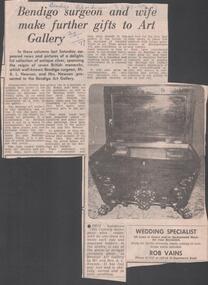
Newspaper - LYDIA CHANCELLOR COLLECTION: BENDIGO SURGEON AND WIFE MAKE FURTHER GIFTS TO ART GALLERY
... This article includes a photo of a 19th Century mahogany wine cooler. It has zinc lined ice boxes on each side and magnum holders in the centre. ...This article includes a photo of a 19th Century mahogany wine cooler. It has zinc lined ice boxes on each side and magnum holders in the centre. ...An article from the Bendigo Advertiser Amy Huxtable column titled 'Bendigo surgeon and wife make further gifts to Art Gallery.' Mr. and Mrs A. L. Newson donated many pieces of furniture and paintings to the Bendigo Art Gallery. This article includes a photo of a 19th Century mahogany wine cooler. It has zinc lined ice boxes on each side and magnum holders in the centre. It also has lion paw feet, is skilfully carved and in mint condition. 19/01/1977.bendigo, buildings, bendigo art gallery, lydia chancellor collection, collection, antiques, mr. a. l. newson, mrs j. newson, bendigo art gallery, art gallery, building, furniture, antique furniture, paintings, art, artwork, heritage, amy huxtable, newson collection -
 National Wool Museum
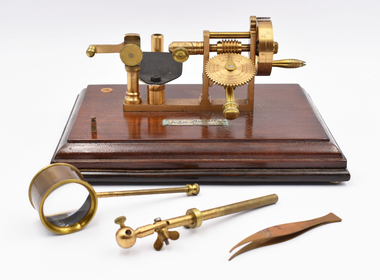
Functional object - Yarn Spinner and Accessories, John Nesbitt, 19th Century
... Custom made wooden hinged box with a hook latch. Brass yarn spinner, attached to a mahogany wood plinth base, which spins fibre into cord/yarn/thread. ...Although Nino has now retired from his honorary position and has hung up his Australian Tartan vest, these items will continue to serve the community in sharing the stories of Australian Textile design. apparatus textile testing spinning nino corda magnifyer tools brass mahogany tweezers yarn spinner design john nesbitt manchester england 19th Century engineering manufacturing Brass plaque on base of spinner: 42 MARKET St / John Nesbitt / REGd TRADE MARK / LIMd / MANCHESTER Underside of wooden plinth: 4976 Custom made wooden hinged box with a hook latch. ...Nino Corda was a Geelong based textile designer who worked at various textile mills between 1957 & 2003. He travelled the world in search of the latest fashions and techniques and developed timeless designs that were much loved by Australians. These items are on rotational display at the National Wool Museum’s ‘In the Factory’ exhibition. For many years, Nino also worked as part of the Honorary Staff of the National Wool Museum. His passion for the world of textiles provided energy and knowledge to the visitors and staff of the museum. Although Nino has now retired from his honorary position and has hung up his Australian Tartan vest, these items will continue to serve the community in sharing the stories of Australian Textile design.Custom made wooden hinged box with a hook latch. Brass yarn spinner, attached to a mahogany wood plinth base, which spins fibre into cord/yarn/thread. It has dials to set the rate that it spins. Metal plaque with black inlaid enamel lettering. Small cork inlay. Brass rod with hinge and wingnut, and ball at end. Ball at end has an adjustment mechanism. Rod also has an adjustable circular collar. Pair of curved tweezers. Circular magnifying glass on long thin handle. Glass has two concave lenses. Weaving sample in shades of blue, green and brown. Twill weave. Alternate pattern samples separated by red thread.Brass plaque on base of spinner: 42 MARKET St / John Nesbitt / REGd TRADE MARK / LIMd / MANCHESTER Underside of wooden plinth: 4976apparatus, textile, testing, spinning, nino corda, magnifyer, tools, brass, mahogany, tweezers, yarn, spinner, design, john nesbitt, manchester, england, 19th century, engineering, manufacturing -
Box Hill Historical Society
Book, McIntyre, Kenneth Gordon, The Secret Discovery of Australia: Portuguese Ventures 200 Years before Captain Cook, 1977
... Kenneth McIntyre, Mayor and foundation member of the Box Hill Historical Society. Explorers Australia Portuguese Mahogany Ship An understanding of deep - sea navigation and of the policies that drove the Maritime Powers of Spain and Portugal to compete to rule the world on either side of the Pope's meridian including the Australian coast. ...An understanding of deep - sea navigation and of the policies that drove the Maritime Powers of Spain and Portugal to compete to rule the world on either side of the Pope's meridian including the Australian coast. An historical mystery unearthing of secrets that have been kept for hundreds of years.450 p. Index; maps; bibliography.An understanding of deep - sea navigation and of the policies that drove the Maritime Powers of Spain and Portugal to compete to rule the world on either side of the Pope's meridian including the Australian coast. An historical mystery unearthing of secrets that have been kept for hundreds of years.explorers, australia, portuguese, mahogany ship -
 Beechworth RSL Sub-Branch
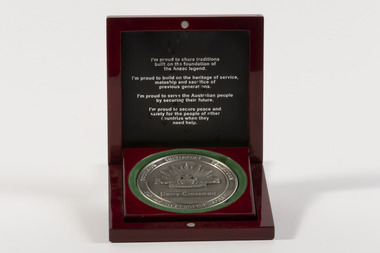
Award - Medallion
... Displayed in a small lacquered square box in a mahogany hue on a green felt inlay. Awarded to Terry Crossman....Displayed in a small lacquered square box in a mahogany hue on a green felt inlay. Awarded to Terry Crossman. ...Medalian presented to Pte Terry CrossmanPresented to Pte Terry Crossman of BeechworthSmall round metal medallion featuring an image of the Rising Sun and text engravings. Displayed in a small lacquered square box in a mahogany hue on a green felt inlay. Awarded to Terry Crossman.Front - Embossed: The Australia Army / Interior - Embossed: I'm proud to share traditions built on the foundation of the Anzac legend / I'm proud to build on the heritage of service mateship and sacrifice of previous generations / I'm proud to serve the Australian people by securing their future / I'm proud to secure peace and safety for the people of other countries when they need help. Front of Medallion - Engraved around the edge: Courage / initiative / teamwork / I'm an Australian Solider / engraved - Terry Crossman / The Australian Army / Reverse - Engraved around the edge: Mentally Prepared every solider physically tough / A leader / an expert on close combat / In the body australian army solider's medallion, medallion -
 Kew Historical Society Inc
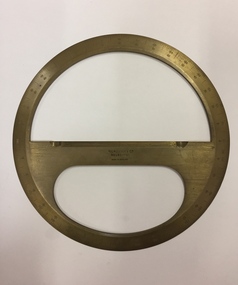
Equipment - Boxed Mathematical Instrument, Kilpatrick & Co, A Victorian cased brass full-circle protractor, 1853-1925
... mahogany lidded case, retailed by Kilpatrick & Co., Melbourne. The protractor was used by staff in the Engineering Department of the former City of Kew. A Victorian cased brass full-circle protractor Equipment Boxed ...Kilpatrick & Co., Melbourne were active 1853-1925.A brass protractor, used in developing plans in the Engineer's Department of the City of KewCircular brass protractor in a square mahogany lidded case, retailed by Kilpatrick & Co., Melbourne. The protractor was used by staff in the Engineering Department of the former City of Kew. Handwritten inscription on label on lid:" J.R. Gray. G.P Russell,1951, Kew City Engineers used this".protractor, mathematical instrument, city of kew (engineering department)
