
Showing 14 items matching "maison"
-
 Federation University Historical Collection
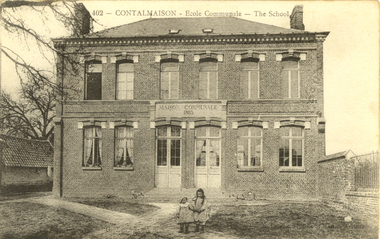
Postcard - Black and White, Maison Communale School, c1917, c1917
... Maison Communale School, c1917......Maison...Maison, France...Maison Communale School, c1917 Postcard - Black and White ...An Australian WW1 soldier's memorabiliaA black and white postcard showing a double storey brick school with two girls standing at the front.402 - Contalmaison - Ecole Communales - The Schoolchatham-holmes collection, maison, contalmaison, school, education, france, world war one -
 Flagstaff Hill Maritime Museum and Village
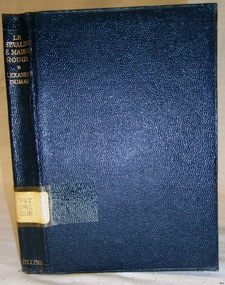
Book, Le Chevalier De Maison Rouge
... Le Chevalier De Maison Rouge...Le Chevalier De Maison Rouge Author: Alexandre Dumas Illustrated by Harold Piffard Publisher: Collins Clear Type Press...The Warrnambool Mechanics' Institute’s publication collection is of both local and state significance. warrnambool shipwrecked-coast flagstaff-hill flagstaff-hill-maritime-museum maritime-museum shipwreck-coast flagstaff-hill-maritime-village shipwrecked-artefact book pattison collection warrnambool library warrnambool mechanics’ institute ralph eric pattison corangamite regional library service warrnambool city librarian mechanics’ institute library victorian library board warrnambool books and records warrnambool children’s library great ocean road le chevalier de maison rouge alexandre dumas harold piffard Label on spine cover with typed text PAT 843 DUM Pastedown front endpaper has sticker from Warrnambool Public Library Front loose endpaper has a sticker from Corangamite Regional Library Service Front loose endpaper has a stamp from Corangamite Regional Library Service Inside front loose endpaper has a stamp from Warrnambool Mechanics Institute Le Chevalier De Maison Rouge Author: Alexandre Dumas Illustrated by Harold Piffard Publisher: Collins Clear Type Press Le Chevalier De Maison Rouge Book ...This item is from the ‘Pattison Collection’, a collection of books and records that was originally owned by the Warrnambool Mechanics’ Institute, which was founded in Warrnambool in 1853. By 1886 the Warrnambool Mechanics’ Institute (WMI) had grown to have a Library, Museum and Fine Arts Gallery, with a collection of “… choice productions of art, and valuable specimens in almost every branch and many wonderful national curiosities are now to be seen there, including historic relics of the town and district.” It later included a School of Design. Although it was very well patronised, the lack of financial support led the WMI in 1911 to ask the City Council to take it over. In 1935 Ralph Pattison was appointed as City Librarian to establish and organise the Warrnambool Library as it was then called. When the WMI building was pulled down in 1963 a new civic building was erected on the site and the new Warrnambool Library, on behalf of the City Council, took over all the holdings of the WMI. At this time some of the items were separated and identified as the ‘Pattison Collection’, named after Ralph Pattison. Eventually the components of the WMI were distributed from the Warrnambool Library to various places, including the Art Gallery, Historical Society and Flagstaff Hill. Later some were even distributed to other regional branches of Corangamite Regional Library and passed to and fro. It is difficult now to trace just where all of the items have ended up. The books at Flagstaff Hill Maritime Village generally display stamps and markings from Pattison as well as a variety of other institutions including the Mechanics’ Institute itself. RALPH ERIC PATTISON Ralph Eric Pattison was born in Rockhampton, Queensland, in 1891. He married Maude Swan from Warrnambool in 1920 and they set up home in Warrnambool. In 1935 Pattison accepted a position as City Librarian for the Warrnambool City Council. His huge challenge was to make a functional library within two rooms of the Mechanics’ Institute. He tirelessly cleaned, cleared and sorted a disarrayed collection of old books, jars of preserved specimens and other items reserved for exhibition in the city’s museum. He developed and updated the library with a wide variety of books for all tastes, including reference books for students; a difficult task to fulfil during the years following the Depression. He converted all of the lower area of the building into a library, reference room and reading room for members and the public. The books were sorted and stored using a cataloguing and card index system that he had developed himself. He also prepared the upper floor of the building and established the Art Gallery and later the Museum, a place to exhibit the many old relics that had been stored for years for this purpose. One of the treasures he found was a beautiful ancient clock, which he repaired, restored and enjoyed using in his office during the years of his service there. Ralph Pattison was described as “a meticulous gentleman whose punctuality, floorless courtesy and distinctive neat dress were hallmarks of his character, and ‘his’ clock controlled his daily routine, and his opening and closing of the library’s large heavy doors to the minute.” Pattison took leave during 1942 to 1945 to serve in the Royal Australian Navy, Volunteer Reserve as Lieutenant. A few years later he converted one of the Museum’s rooms into a Children’s Library, stocking it with suitable books for the younger generation. This was an instant success. In the 1950’s he had the honour of being appointed to the Victorian Library Board and received more inspiration from the monthly conferences in Melbourne. He was sadly retired in 1959 after over 23 years of service, due to the fact that he had gone over the working age of council officers. However he continued to take a very keen interest in the continual development of the Library until his death in 1969. WARRNAMBOOL'S MECHANICS' INSTITUTE Warrnambool's Mechanics' Institute (or Institution as it was sometimes called) was one of the earliest in Victoria. On 17th October 1853 a meeting was held where it was resolved to request the Lieutenant Governor of the Colony to grant land for the erection of a Mechanics' Institutes building. A committee was formed at the meeting and Richard Osburne chaired the first meeting of this committee. The land on the North West corner of Banyan and Merri Streets was granted but there were no funds to erect the building. The Formal Rights of the Warrnambool Mechanics' Institute's encompassed its aims and these were officially adopted in1859; "This Institution has for its object the diffusion of literary, scientific, and other useful knowledge amongst its members, excluding all controversial subjects, religious or political. These objects are sought to be obtained by means of a circulating library, a reading room, the establishment of classes, debates, and the occasional delivery of lectures on natural and experimental philosophy, mechanics, astronomy, chemistry, natural history, literature, and the useful and ornamental arts, particularly those which have a more immediate reference to the colony." The Warrnambool Mechanics' Institute opened its first reading room in November1884 in the National School building at the corner of Banyan and Timor Streets. The Institute was funded by member subscription, payable on a quarterly, half yearly or yearly basis. Samuel Hannaford, the Manager of the Warrnambool Bank of Australasia, was the first Honorary Secretary of the Mechanics' Institutes, and an early President and Vice-President. He also gave several of the early lectures in the Reading Room. Another early Secretary, Librarian and lecturer was Marmaduke Fisher, the teacher at the National School. Lecture topics included The Poets and Poetry of Ireland', 'The Birth and Development of the Earth', 'The Vertebrae - with Remarks on the pleasures resulting from the study of Natural History' and 'Architecture'. In 1856 the Reading Room was moved to James Hider's shop in Timor Street, and by 1864 it was located in the bookshop of Davies and Read. In the 1860's the Mechanics' Institute struggled as membership waned but in 1866, after a series of fund raising efforts, the committee was able to purchase land in Liebig Street, on a site then called Market Square, between the weighbridge and the fire station. A Mechanics' Institute building was opened at this site in August 1871. The following year four more rooms were added to the main Reading Room and in 1873 the Artisan School of Design was incorporated into the Institute. The same year Joseph Archibald established a Museum; however it deteriorated when he was transferred to Bendigo in 1877. In 1880, with Archibald's return to Warrnambool, the Museum was re-established, and in 1885 a new building was built at the back of the Institute to accommodate the re-created School of Design, the Art Gallery and the Museum. In 1887 the Museum section was moved to the former court house in Timor Street (for some time the walls of the building formed part of the TAFE cafeteria but all is now demolished)). In 1911 the Museum was transferred back to the original building and the management of the Mechanics' Institute was handed over to the Warrnambool City Council. The Museum and Art Gallery became one and housed many fine works of art, and the Library continued to grow. The building was well patronised, with records showing that at the beginning of the 20th century there were between 500 and 800 visitors. During World War One the monthly figures were in the thousands, with 3,400 people visiting in January 1915. The Museum was a much loved Institution in Warrnambool until the contents of the Museum and Art Gallery were removed to make room for the Warrnambool City Council Engineers' Department. The contents were stored but many of the items were scattered or lost. When the original building was demolished the site became occupied by the Civic Centre, which included the new City Library. (The library was temporarily located in the old Palais building in Koroit Street.) In the process of reorganisation the Collection was distributed amongst the community groups: -The new City Library took some of the historic books and some important documents, historic photographs and newspapers. -The Art Gallery kept the 19th Century art collection and some of the artefacts from the museum. -The Historic Society has some items -The State Museum has some items -Some items were destroyed -Flagstaff Hill Maritime Village has old newspapers, Government Gazettes, most of the Mechanics' Institute Library, ledgers and documents connected to the Mechanics' Institute Library, some framed and unframed art works and some photographs. The Warrnambool Mechanics' Institute Library book collection is deemed to be of great importance because it is one of the few collections in an almost intact state, and many of the books are now very rare and of great value. The Pattison Collection, along with other items at Flagstaff Hill Maritime Village, was originally part of the Warrnambool Mechanics' Institute’s collection. The Warrnambool Mechanics’ Institute Collection is primarily significant in its totality, rather than for the individual objects it contains. Its contents are highly representative of the development of Mechanics' Institute libraries across Australia, particularly Victoria. A diversity of publications and themes has been amassed, and these provide clues to our understanding of the nature of and changes in the reading habits of Victorians from the 1850s to the middle of the 20th century. The collection also highlights the Warrnambool community’s commitment to the Mechanics’ Institute, reading, literacy and learning in the regions, and proves that access to knowledge was not impeded by distance. These items help to provide a more complete picture of our community’s ideals and aspirations. The Warrnambool Mechanics Institute book collection has historical and social significance for its strong association with the Mechanics Institute movement and the important role it played in the intellectual, cultural and social development of people throughout the latter part of the nineteenth century and the early twentieth century. The collection of books is a rare example of an early lending library and its significance is enhanced by the survival of an original collection of many volumes. The Warrnambool Mechanics' Institute’s publication collection is of both local and state significance. Le Chevalier De Maison Rouge Author: Alexandre Dumas Illustrated by Harold Piffard Publisher: Collins Clear Type PressLabel on spine cover with typed text PAT 843 DUM Pastedown front endpaper has sticker from Warrnambool Public Library Front loose endpaper has a sticker from Corangamite Regional Library Service Front loose endpaper has a stamp from Corangamite Regional Library Service Inside front loose endpaper has a stamp from Warrnambool Mechanics Institute warrnambool, shipwrecked-coast, flagstaff-hill, flagstaff-hill-maritime-museum, maritime-museum, shipwreck-coast, flagstaff-hill-maritime-village, shipwrecked-artefact, book, pattison collection, warrnambool library, warrnambool mechanics’ institute, ralph eric pattison, corangamite regional library service, warrnambool city librarian, mechanics’ institute library, victorian library board, warrnambool books and records, warrnambool children’s library, great ocean road, le chevalier de maison rouge, alexandre dumas, harold piffard -
 St Kilda Historical Society
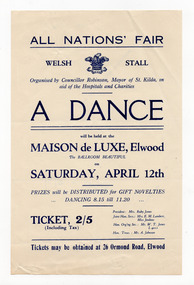
Ephemera - Flyer, All Nations' Fair Dance, 1930
... Advertisement for a dance, organised by the Mayor of St Kilda in aid of hospitals and charities, at the Maison de Luxe, Elwood on 12 April 1930. The Maison de Luxe Dance Palais was on the north corner of Glenhuntly Road and Broadway in Elwood and operated as a venue for dances and private parties from the late 1920s until the mid 1950s (except when occupied by the Army in 1942-1945)....Advertisement for a dance, organised by the Mayor of St Kilda in aid of hospitals and charities, at the Maison de Luxe, Elwood on 12 April 1930. The Maison de Luxe Dance Palais was on the north corner of Glenhuntly Road and Broadway in Elwood and operated as a venue for dances and private parties from the late 1920s until the mid 1950s (except when occupied by the Army in 1942-1945). ...Advertisement for a dance, organised by the Mayor of St Kilda in aid of hospitals and charities, at the Maison de Luxe, Elwood on 12 April 1930. The Maison de Luxe Dance Palais was on the north corner of Glenhuntly Road and Broadway in Elwood and operated as a venue for dances and private parties from the late 1920s until the mid 1950s (except when occupied by the Army in 1942-1945).White paper, discoloured with age, printed in blue on one side.On reverse side, written in pencil: '500 - 8/4/30'hospital fundraising, maison de luxe, all nations fair, elwood -
 Canterbury History Group
Ephemera - "La Maison Blanche" understated class and elegance, {2001]
... Real estate advertisement for the sale by auction of "La Maison Blanche" 160 Mont Albert Road Canterbury on Saturday 15 December {2001] Includes coloured photographs of the exterior of the house, the swimming pool and floor and site plans...Canterbury Mont Albert Road La Maison Blanche Swimming Pools Real estate advertisement for the sale by auction of "La Maison Blanche" 160 Mont Albert Road Canterbury on Saturday 15 December {2001] Includes coloured photographs of the exterior of the house, the swimming pool and floor and site plans Ephemera "La Maison Blanche" understated class and elegance ...Real estate advertisement for the sale by auction of "La Maison Blanche" 160 Mont Albert Road Canterbury on Saturday 15 December {2001] Includes coloured photographs of the exterior of the house, the swimming pool and floor and site planscanterbury, mont albert road, la maison blanche, swimming pools -
 Lakes Entrance Historical Society
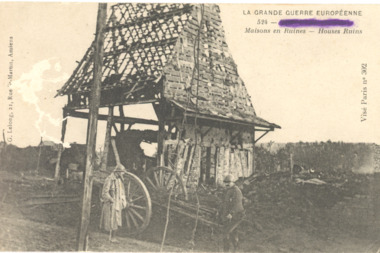
Postcard - Charles Sands WW1 AIF Correspondence, La Grande Guerre House Ruins, c1915
... LA GRANDE GUERRE EUROPEENNE 524 Maisons en Ruines - House Ruins Vise Paris no. 302 G.Lelong, 21, Rue St. ...WW1 Correspondence LA GRANDE GUERRE EUROPEENNE 524 Maisons en Ruines - House Ruins Vise Paris no. 302 G.Lelong, 21, Rue St. ...Postcard sent to Alan Davidson , Buchan South from Charles Sands . Correspondenc on back of card.Black and white postcard showing two men beside ruins of house and wagon LA GRANDE GUERRE EUROPEENNE 524 Maisons en Ruines - House Ruins Vise Paris no. 302 G.Lelong, 21, Rue St. Martin, Amiensww1, correspondence -
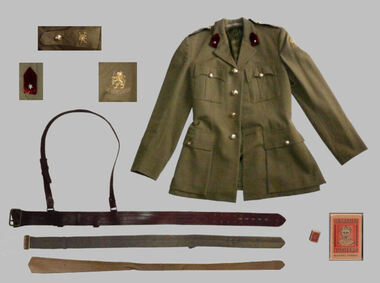 Dutch Australian Heritage Centre Victoria
Lieutenant Dress Uniform Dutch Army
... (1) Label jacket text "Maatkleding, Maison Jordi & Cie, tel 4608, Amersfoort" and rank indication (Lt). (5) Cap has names W van Reed & Dortland. ...Many of the 1950's period uniforms came from people that had been discharged after having served in the Dutch East Indies (now Indonesia) during the Indonesian Indepence War. (1) Label jacket text "Maatkleding, Maison Jordi & Cie, tel 4608, Amersfoort" and rank indication (Lt). (5) Cap has names W van Reed & Dortland. ...Part of the small collection of uniforms in DAHC's possession. Like most of these uniform this one stems from the 1950's. The shoulder insignas indicate a "Genie" division (Engineering Corps).Many of the 1950's period uniforms came from people that had been discharged after having served in the Dutch East Indies (now Indonesia) during the Indonesian Indepence War.Part of Dutch army uniform: (1) dress jacket with (2) cotton dress belt, (3a) leather belt with (3b) cross belt, (4) khaki tie and (5) cap with names W. van Reed//Dorland on the inside. Jacket has brass buttons, NL lion embroidered on sleeve, "genie" emblem on shoulder strap and rank sign (one star - Lieutenant) on collar. Note: match box "Drogist Lucifers" left in pocket.(1) Label jacket text "Maatkleding, Maison Jordi & Cie, tel 4608, Amersfoort" and rank indication (Lt). (5) Cap has names W van Reed & Dortland. "Drogist Lucifers" on matchbox in pocket. -
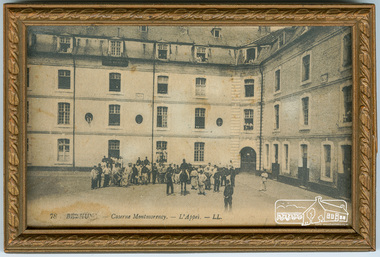 Eltham District Historical Society Inc
Photograph, 78 Bethune - Caserne Montmorency - L'Appel - LL, 1914-1918
... Sources: Montmorency, Val-d'Oise Wikipedia and Chateau d'Ecoun, Wikipedia, Maison d'education de la Legion d'honneur, Wikipedia "Caserne Montmorency - L'Appel" translates as "Montmorency Barracks - Roll-call"....Sources: Montmorency, Val-d'Oise Wikipedia and Chateau d'Ecoun, Wikipedia, Maison d'education de la Legion d'honneur, Wikipedia "Caserne Montmorency - L'Appel" translates as "Montmorency Barracks - Roll-call". ivy sullivan marjorie north montmorency (france) montmorency barracks WW1 Caption: 78 Bethune - Caserne Montmorency - L'Appel - LL Inscribed in pen on reverse: "Montmorency, France Barracks during 2nd World War. ...Black and white image of courtyard in front of four storied building identified as military barracks in Montmorency, France. A group of people assemble for a roll call. Though described as WW2, this image is probably from WW1 era. Possibly identified as the Chateu d'Ecouen located 5.6 kms from Montmorency, a northern suburb of Paris. From 1850, it was the site of a secondary school for girls of the Legion d'Honneur. Today it is a musem dedicated to the Renaissance. Sources: Montmorency, Val-d'Oise Wikipedia and Chateau d'Ecoun, Wikipedia, Maison d'education de la Legion d'honneur, Wikipedia "Caserne Montmorency - L'Appel" translates as "Montmorency Barracks - Roll-call".Image in ornate wooden frame with glass face, string for hanging on backCaption: 78 Bethune - Caserne Montmorency - L'Appel - LL Inscribed in pen on reverse: "Montmorency, France Barracks during 2nd World War. Given to Mrs Ivy Sullivan, Montmorency, Vic., Aust. and passed on to Mrs M. North, Montmorency, Vic. Aust., 1985"ivy sullivan, marjorie north, montmorency (france), montmorency barracks, ww1 -
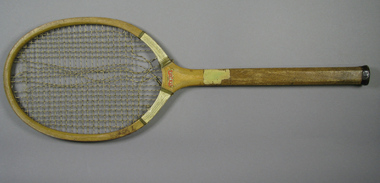 Tennis Australia
Racquet, Circa 1928
... Inscription across throat on reverse: MAISON BLANCHE/MADEIRA. Materials: Wood, Gut, String, Cloth tape, Metal, Glue, Lacquer, Leather...Inscription across throat on reverse: MAISON BLANCHE/MADEIRA. Materials: Wood, Gut, String, Cloth tape, Metal, Glue, Lacquer, Leather Racquet ...A concave, wooden racquet, with white cloth-taped shoulders,brown string whipping, green cloth collar, and a medium-depth grooved handle. Decal across throat on obverse: LA BELLE. Inscription stamped along right side of handle: SLAZENGERS LTD/MADE IN ENGLAND. Inscription along left side: LAURENCE POUNTNEY HILL/LONDON. E.C.4. Butt cover contains maintenance instructions. Inscription across throat on reverse: MAISON BLANCHE/MADEIRA. Materials: Wood, Gut, String, Cloth tape, Metal, Glue, Lacquer, Leathertennis -
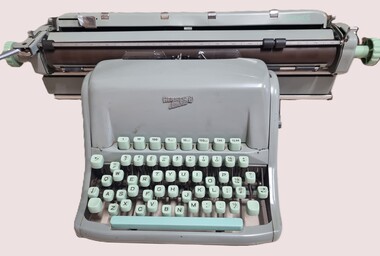 Wodonga & District Historical Society Inc
Functional object - Hermes 8 Standard Wide Carriage Typewriter, Paillard, 1964
... Paillard Ltd (originally Maison Paillard) was a premier Swiss precision engineering company which operated for 175 years. ...Paillard Ltd (originally Maison Paillard) was a premier Swiss precision engineering company which operated for 175 years. ...Hermes typewriters were manufactured by Paillard S.A. of Yverdon in Switzerland. Paillard Ltd (originally Maison Paillard) was a premier Swiss precision engineering company which operated for 175 years. It developed from a small watchmaker collective into a global leader in typewriters as well as gramophones, radio sets and, under the name of Paillard-Bolex, cameras and film cameras. Paillard began making typewriters under the Hermes name in 1923. Early typewriters were usually heavy office typewriters but over time popular portable typewriters were added to their range. The Hermes Standard 8 typewriter was produced between 1953 and 1965. It was a heavy-duty desktop model. Typewriters of this model with a wide carriage were considered to be quiet rare. They were designed for the operator to be able to produce wide ledgers. However by 1963 its successor the Hermes Standard 9 had gone into production. With the rise of personal computers in the 1980s, typewriters gradually fell into obsolescence and came to be thought of as an outdated writing technology of the past. The company was ultimately taken over by Olivetti in 1981, and operations largely ceased by 1989. This item is significant because it was a popular and important piece of office equipment used in many Wodonga business in the 1950s and 1960s.A pale green Hermes Standard 8 typewriter with wide carriage.Serial Number 8120839 Hermes Standard 8 On back - HERMES / Made in Switzerland / paillard s.a. Yverdontypewriter, hermes typewriters, functional office equipment -
 Federation University Historical Collection
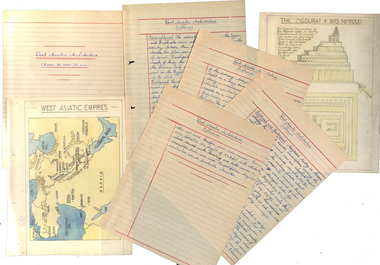
Book - Class Notes, A History of Architecture Grade I by R.D. Fraser, 1948, 1948
... Topics include: Egyptian Architecture, Greek Architecture (BC300-BC700), Etruscan Architecture (BC750-BC100) and Roman Architecture (BC146-BC365) Early Christian Architecture Images include: Egypt, Great Pyramids, rock cut tombs, catacombs, Egyptian Temples, Development of a Pyramid, Egyptian Construction Methods, Greece, Greek Temples, Sloping Roofs, Doric Temples, Temple of Poseidon, Parthenon, arches, Acropolis Athens, Partenon, Ionic Volute, Propylaea, Erechtheion Athens, Corinthian examples, Greek Theatre, Optical Corrections in Architecture, The Greek House, Temple of Fortuna Virilis Rome, Maison Caree Nimes, Roman Circular Temples, Basilica of Trajan, Column of Trajan, Colosseum Rome, Basilica of Constantine, Roman Arched Structures, Romas Thermae at Romes, Arch and Wall construction, columns, mouldings Clemente Rome, S. ...Topics include: Egyptian Architecture, Greek Architecture (BC300-BC700), Etruscan Architecture (BC750-BC100) and Roman Architecture (BC146-BC365) Early Christian Architecture Images include: Egypt, Great Pyramids, rock cut tombs, catacombs, Egyptian Temples, Development of a Pyramid, Egyptian Construction Methods, Greece, Greek Temples, Sloping Roofs, Doric Temples, Temple of Poseidon, Parthenon, arches, Acropolis Athens, Partenon, Ionic Volute, Propylaea, Erechtheion Athens, Corinthian examples, Greek Theatre, Optical Corrections in Architecture, The Greek House, Temple of Fortuna Virilis Rome, Maison Caree Nimes, Roman Circular Temples, Basilica of Trajan, Column of Trajan, Colosseum Rome, Basilica of Constantine, Roman Arched Structures, Romas Thermae at Romes, Arch and Wall construction, columns, mouldings Clemente Rome, S. ...R.D. Fraser was a student of the Ballarat Technical Art School, a division of the Ballarat School of Mines. Numerous hand written and hand drawn class notes from from the Ballarat Technical Art School. Topics include: Egyptian Architecture, Greek Architecture (BC300-BC700), Etruscan Architecture (BC750-BC100) and Roman Architecture (BC146-BC365) Early Christian Architecture Images include: Egypt, Great Pyramids, rock cut tombs, catacombs, Egyptian Temples, Development of a Pyramid, Egyptian Construction Methods, Greece, Greek Temples, Sloping Roofs, Doric Temples, Temple of Poseidon, Parthenon, arches, Acropolis Athens, Partenon, Ionic Volute, Propylaea, Erechtheion Athens, Corinthian examples, Greek Theatre, Optical Corrections in Architecture, The Greek House, Temple of Fortuna Virilis Rome, Maison Caree Nimes, Roman Circular Temples, Basilica of Trajan, Column of Trajan, Colosseum Rome, Basilica of Constantine, Roman Arched Structures, Romas Thermae at Romes, Arch and Wall construction, columns, mouldings Clemente Rome, S. Paolo Fuori le Mura Rome, Baptistery of Constantine Rome, S. Constanza Romearchitecture, art history, ballarat technical art school, r.d. fraser, alumni -
 National Wool Museum
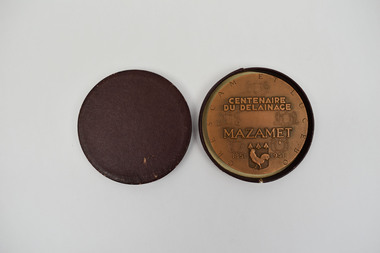
Medallion, CENTENAIRE DU DELAINAGE MAZAMET, 1951
... Its agents in Mazamet were Maison Louis Maffre, an enterprise founded by M. ...Its agents in Mazamet were Maison Louis Maffre, an enterprise founded by M. ...This medallion was struck to celebrate the 100th anniversary of fellmongering in Mazamet in 1951. Fellmongering - In French, ‘delainage” means, literally, ‘de-wooling'. It is the industrial process of separating wool from sheepskins. In the 19th century, the southern French town of Mazamet became the world centre of délainage and played an important part in the Australian wool industry. At one time Mazamet was reputed to be the 15th richest town in Europe, and it was said that the town’s branch of the Banque Nationale de Paris (French banking firm) was the second largest in France. At its height, Mazamet had 48 fellmongeries and imported more than 100,000 tonnes of sheepskins a year from the southern hemisphere, mostly from Australia and Argentina. It also supported numerous associated industries such as tanneries, spinning mills and clothing manufacturers. In the 1980s Mazamet’s fellmongering industry fell into decline under pressure from environmental concerns and cheap imports. The town’s last two fellmongeries closed in 2004. The town continues to have a strong relation to Australia, with street names such as, Rue de Australie, Adelaide, Brisbane, Melbourne and Sydney in recognition of a connection to the two distant lands. Today, half a century since wool importation largely ended, there remains a link to the past. Elite quality leather and woollen clothing companies such as Hermes and Chanel still source much of their stock in Mazamet. This medallion was presented to William Haughton and Co. who were one of Australia’s largest wool-buying companies of the first half of the 20th century. Wm Haughton had a major presence in Geelong and its “SKINS WOOL HIDES TALLOW etc.” signs were prominent on railways stations throughout the Western District and beyond. Haughtons had branches in all Australian capital cities, New Zealand, London and Bradford. Its agents in Mazamet were Maison Louis Maffre, an enterprise founded by M. Louis Maffre, mayor of Mazamet from 1912 to 1919. This medallion was donated to the National Wool Museum by the family of Sir Robert Southey AO CMG, former managing director of Wm Haughton & Co.Bronze medallion contained within purple case. On one side of the medallion, a mill worker is seen scraping the wool off the treated sheepskin. On the reverse the inception can be read.Wording: CRESCAM ET LUCEBO // CENTENAIRE / DU DELAINAGE / MAZAMET // 1851-1951. Smooth edge stamped with a cornucopia and the inscription BRONZEmazamet, fellmongering, délainage -
Royal Australian and New Zealand College of Obstetricians & Gynaecologists (RANZCOG)
Obstetric and Gynaecological Ephemera
... - Item 1: Annotated diagram with comical reference to human anatomy - Item 2: Newspaper article from 26 August 1990 regarding St George's Hospital birthing centre - Item 3: Advertising poster for Livingstone Conductive Gel - Item 4: Victorian Folate Campaign 1999 Public Health Information Leaflet - Item 5: Advertisement for Cervagem removed from a publication - Item 6: IUD Multiload CU250 range medical advertising removed from a publication - Item 7: Fetal Cardio-phonograph Toitu product literature - Item 8: Estraderm and how to use it pharmacopoeia - Item 9: Copy of letter sent in 1980 regarding a donation to the RANZCOG Museum of a 1930's enamel douching instrument - Item 10: Museum display labels on Arthur Wilson / A.M Wilson - Item 11: The IUD Intrauterine Device Public Health Information Leaflet - Item 12: Obstetric Record Patient record [2 x] - Item 13: Planosec Dry Pregnancy Test Medical Advertising - Item 14: A Guide to using Ortho Diaphragms and Spermicides Pharmacopoeia [2 x ] - Item 15: Maison Luer Gynaecological and Obstetric instrument catalogue from 1930,Paris - Item 16: Medicine Recent Acquisitions Rare book brochure with drawing of a pregnant woman on the front cover - Item 17: Feeding Bottle Museum object display material - Item 18: Letter sent from Mr P.W Mitchell, 31/08/1961 regarding Moller Colposcope instruments - Item 19: Sugiview Single Use Laparoscope Advertising - Item 20: Multiload CU375 IUD Advertising - Item 21: Soneryl Drug Advertising - Item 22: Cyclonal Sodium Soluble Hexobarbitone Drug Advertising - Item 23: Aludrox Drug Advertising - Item 24: Veganin Tablets Drug Advertising - Item 25: Priscol Drug Advertising - Item 26: Neocursal Salt Advertising - Item 27: Portable Intra-Uterine Suction Apparatus Medical Advertising - Item 28: The VUC Instrument Medical Advertising... - Item 1: Annotated diagram with comical reference to human anatomy - Item 2: Newspaper article from 26 August 1990 regarding St George's Hospital birthing centre - Item 3: Advertising poster for Livingstone Conductive Gel - Item 4: Victorian Folate Campaign 1999 Public Health Information Leaflet - Item 5: Advertisement for Cervagem removed from a publication - Item 6: IUD Multiload CU250 range medical advertising removed from a publication - Item 7: Fetal Cardio-phonograph Toitu product literature - Item 8: Estraderm and how to use it pharmacopoeia - Item 9: Copy of letter sent in 1980 regarding a donation to the RANZCOG Museum of a 1930's enamel douching instrument - Item 10: Museum display labels on Arthur Wilson / A.M Wilson - Item 11: The IUD Intrauterine Device Public Health Information Leaflet - Item 12: Obstetric Record Patient record [2 x] - Item 13: Planosec Dry Pregnancy Test Medical Advertising - Item 14: A Guide to using Ortho Diaphragms and Spermicides Pharmacopoeia [2 x ] - Item 15: Maison Luer Gynaecological and Obstetric instrument catalogue from 1930,Paris - Item 16: Medicine Recent Acquisitions Rare book brochure with drawing of a pregnant woman on the front cover - Item 17: Feeding Bottle Museum object display material - Item 18: Letter sent from Mr P.W Mitchell, 31/08/1961 regarding Moller Colposcope instruments - Item 19: Sugiview Single Use Laparoscope Advertising - Item 20: Multiload CU375 IUD Advertising - Item 21: Soneryl Drug Advertising - Item 22: Cyclonal Sodium Soluble Hexobarbitone Drug Advertising - Item 23: Aludrox Drug Advertising - Item 24: Veganin Tablets Drug Advertising - Item 25: Priscol Drug Advertising - Item 26: Neocursal Salt Advertising - Item 27: Portable Intra-Uterine Suction Apparatus Medical Advertising - Item 28: The VUC Instrument Medical Advertising Obstetric and Gynaecological Ephemera ...A series of ephemera including information leaflets, advertising, and pharmacopoeia collated by Museum Curator at RANZCOG. There are 28 items. - Item 1: Annotated diagram with comical reference to human anatomy - Item 2: Newspaper article from 26 August 1990 regarding St George's Hospital birthing centre - Item 3: Advertising poster for Livingstone Conductive Gel - Item 4: Victorian Folate Campaign 1999 Public Health Information Leaflet - Item 5: Advertisement for Cervagem removed from a publication - Item 6: IUD Multiload CU250 range medical advertising removed from a publication - Item 7: Fetal Cardio-phonograph Toitu product literature - Item 8: Estraderm and how to use it pharmacopoeia - Item 9: Copy of letter sent in 1980 regarding a donation to the RANZCOG Museum of a 1930's enamel douching instrument - Item 10: Museum display labels on Arthur Wilson / A.M Wilson - Item 11: The IUD Intrauterine Device Public Health Information Leaflet - Item 12: Obstetric Record Patient record [2 x] - Item 13: Planosec Dry Pregnancy Test Medical Advertising - Item 14: A Guide to using Ortho Diaphragms and Spermicides Pharmacopoeia [2 x ] - Item 15: Maison Luer Gynaecological and Obstetric instrument catalogue from 1930,Paris - Item 16: Medicine Recent Acquisitions Rare book brochure with drawing of a pregnant woman on the front cover - Item 17: Feeding Bottle Museum object display material - Item 18: Letter sent from Mr P.W Mitchell, 31/08/1961 regarding Moller Colposcope instruments - Item 19: Sugiview Single Use Laparoscope Advertising - Item 20: Multiload CU375 IUD Advertising - Item 21: Soneryl Drug Advertising - Item 22: Cyclonal Sodium Soluble Hexobarbitone Drug Advertising - Item 23: Aludrox Drug Advertising - Item 24: Veganin Tablets Drug Advertising - Item 25: Priscol Drug Advertising - Item 26: Neocursal Salt Advertising - Item 27: Portable Intra-Uterine Suction Apparatus Medical Advertising - Item 28: The VUC Instrument Medical Advertising -
 Federation University Historical Collection
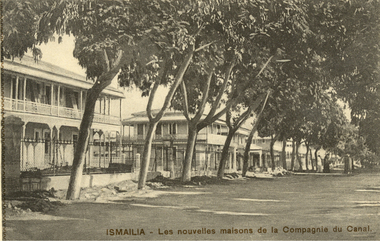
Postcard - black and white, Ismailia - les nouvelles maisons de la Compagnie de Canal, c1917, c1915
... Ismailia - les nouvelles maisons de la Compagnie de Canal, c1917 Postcard - black and white ...Ismalia is a city in north-eastern Egypt. It would have been part of a booklet available during World War One. A black and white postcard showing a row of double storey housed behind a row of trees. This card was purchased by an Australian soldier, probably Henry Smerdon Holmes, during World War One. chatham-holmes family collection, ismailia, egypt, world war one, world war, ascot -
 Flagstaff Hill Maritime Museum and Village
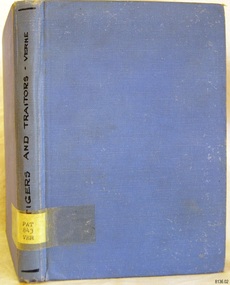
Book - A Fictional Story, Jules Verne, The Steam House Part 2 Tigers and Traitors, 1881
... Both parts of the novel are included in Verne’s major series of adventure and science-fiction novels “Voyages Extraordinaires” originally published in 1880 in French as La maison à vapeur. Both parts “The Demon of Cawnpore” and “Tigers and Traitors” were published in English in 1881, by Sampson Low, Marston, Searle & Rivington, translated by A. ...“The Steam House” part two “Tigers and Traitors” is where the story continues with the Indian adventure from part one and brings the story of Colonel Munro and Nana Sahib to its climax. The same group of people continue their journey through northern India in the steam powered elephant that pulls two houses. The central conflict is Colonel Munro’s continued hunt for Nana Sahib, the rebel leader responsible for atrocities at Cawnpore during the 1857 Sepoy Rebellion, and for Munro’s wife, who was reported killed there. As they travel deeper into India, the party encounters various challenges including, tigers traitors and conspirators linked to Nana Sahib’s network. The landscape still seething with discontent after the Mutiny as the story builds to the confrontation with Nana Sahib and the resolution of Munro’s quest for revenge. The second part is also published under the alternative title “The End of Nana Sahib”, indicating that Nana Sahib’s fate is finally revealed.Hard cover book, The Steam House Part 2 Tigers and Traitors. Author: Jules Verne Publisher: Sampson Low, Marston, Searle & Rivington, London Date: 1881. Light blue hardcover with the title on the spine having lettering to spine in black hand written text pen. fiction“The Steam House” part two “Tigers and Traitors” is where the story continues with the Indian adventure from part one and brings the story of Colonel Munro and Nana Sahib to its climax. The same group of people continue their journey through northern India in the steam powered elephant that pulls two houses. The central conflict is Colonel Munro’s continued hunt for Nana Sahib, the rebel leader responsible for atrocities at Cawnpore during the 1857 Sepoy Rebellion, and for Munro’s wife, who was reported killed there. As they travel deeper into India, the party encounters various challenges including, tigers traitors and conspirators linked to Nana Sahib’s network. The landscape still seething with discontent after the Mutiny as the story builds to the confrontation with Nana Sahib and the resolution of Munro’s quest for revenge. The second part is also published under the alternative title “The End of Nana Sahib”, indicating that Nana Sahib’s fate is finally revealed.warrnambool, shipwrecked-coast, flagstaff-hill, flagstaff-hill-maritime-museum, maritime-museum, flagstaff-hill-maritime-village, shipwrecked-artefact, book, warrnambool mechanics’ institute, pattison collection, warrnambool library, corangamite regional library service, warrnambool city librarian, mechanics’ institute library, victorian library board, warrnambool books and records, warrnambool children’s library, ralph eric pattison, jules verne, voyages extraordinaire series, l’école des robinson's
