
Showing 32 items matching "making bows"
-
 Moorabbin Air Museum
Book - Wooden aircraft, Aircraft Woodwork
... ...Making bows...Wooden aircraft Wood / wind & sky Materials & equipment Construction - fuselage & tail Wings Construction of spars Construction of ribs Making bows Wing assembly Repair of airframes & wings Overview of building an aircraft with wood, circa 1972 Aircraft Woodwork Book Wooden aircraft ...Overview of building an aircraft with wood, circa 1972non-fictionOverview of building an aircraft with wood, circa 1972wood / wind & sky, materials & equipment, construction - fuselage & tail, wings, construction of spars, construction of ribs, making bows, wing assembly, repair of airframes & wings -
 Warrnambool and District Historical Society Inc.
Bees wax
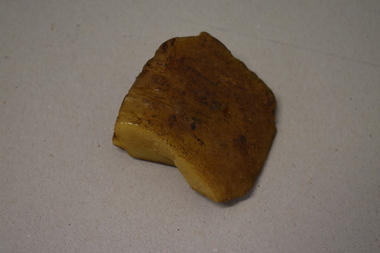
... It was used historically in many areas, including candle making, bow making, cosmetics production, bullet-making and modelling. ...It was used historically in many areas, including candle making, bow making, cosmetics production, bullet-making and modelling. ...This is a lump of beeswax that has been used to polish and clean old flat irons. Beeswax is a natural product made by bees to form the honeycomb in their beehives. It was used historically in many areas, including candle making, bow making, cosmetics production, bullet-making and modelling. It still has many commercial uses today. Flat irons were metal objects that had a flat polished surface and were heated to iron material and garments. The beeswax assisted in keeping the polished surface clean and shiny. This piece of beeswax comes from a local source but the full provenance is not known. It is important to keep it in the collection as an adjunct to the Historical Society’s collection of sad and flat irons from the past. This is a lump of beeswax in a round shape with one end broken across to reveal the inner part of the beeswax. The outer part is somewhat stained. flat and sad irons, household items from the past, history of warrnambool -
 Flagstaff Hill Maritime Museum and Village
Craft - Ship Model, Cutty Sark
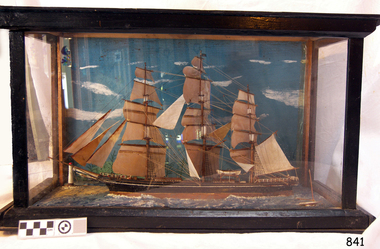
... making "Cutty Sark" Ship model: the clipper ship Cutty Sark in full ship rig with raised poop deck, deck house, three boats on deck (one has fallen). It has a two-toned black and tan hull and three jibs. The model is set in a diorama of a blue sea, a lighthouse and another small yacht. It is housed in a glass-sided case with a dark grey painted structure. The bow ...THE CUTTY SARK: - The Cutty Sark was built in Britain in 1869 and was one of the last great sailing ships. At first, it carried tea from China. Later, it was used to transport wool from Australia. It became famous for its speed and held the record for the fastest voyage from Australia to Britain for ten years. Later, a Portuguese company bought the ship and renamed it Ferreira. After that, a retired sea captain purchased it to use as a training ship in Cornwall. When the captain died, the ship was given to a training college in Greenwich in 1938. In 1954, it was placed in dry dock at Greenwich, where it remains on display. The Cutty Sark is a special ship because it carried wool from Australia to other parts of the world. Models like this one help us imagine what sea travel was like before steam-powered ships were common, and they show us how trade, travel and migration changed over time. The Cutty Sark is also famous for being very fast. It set a record for the journey from Australia to Britain and kept that title for ten years. Today, people still recognise its importance because it has been carefully preserved and is on display at the British Maritime Museum in Greenwich. Its story has also made it a favorite subject for people who enjoy building ship models. Ship model: the clipper ship Cutty Sark in full ship rig with raised poop deck, deck house, three boats on deck (one has fallen). It has a two-toned black and tan hull and three jibs. The model is set in a diorama of a blue sea, a lighthouse and another small yacht. It is housed in a glass-sided case with a dark grey painted structure. The bow has an inscription."Cutty Sark"flagstaff hill, warrnambool, flagstaff hill maritime museum, shipwreck coast, flagstaff hill maritime village, maritime museum, great ocean road, cutty sark, historic sailing ship, tea clipper, sail training vessel, cadet training ship, commercial trading vessel, cargo sail vessel, ferreria, 1869, tea cargo, tea trade, china tea, wool export, australian export, australian wool export, cornwall, training ship, greenwich, british museum, ship model, craft, hobby, ship model cutty sark, model making -
 Flagstaff Hill Maritime Museum and Village
Craft - Ship Model, Mary Campbell, circa 1940
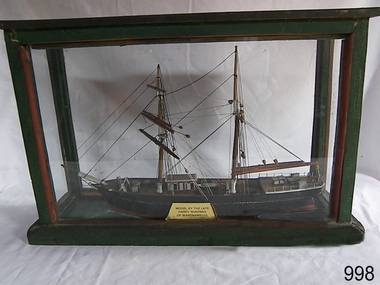
... The model is also significant for its association with the brigantine MARY CAMPBELL, a trading vessel that brought railway girders to the Melbourne Harbour Trust. flagstaff hill warrnambool shipwrecked coast flagstaff hill maritime museum maritime museum shipwreck coast flagstaff hill maritime village great ocean road marine artwork model making captain james arthur robilliard j.a. robilliard vessel mary campbell ship mary campbell melbourne sailors home vessels harry mckenna Mary Campbell Painted on the bow in white “MARY CAMPBELL” Gold label with black print attached to display case “MODEL BY THE LATE HARRY McKENNA OF WARRNAMBOOL” Ship model "Mary Campbell": a two-masted vessel with black hull, brown masts and black rigging, displayed in a glass case with a timber frame painted green. ...This ship model is of the sailing brigantine MARY CAMPBELL, which once belonged to Captain James Arthur Robilliard. The model was made by Harry McKenna, a well-known ship model maker and Warrnambool resident. CAPTAIN ROBILLIARD James Arthur Robilliard, sea captain and tent maker, was born in 19th April 1843 in St. Helier, Jersey, Channel Islands. He trained there in his father’s sail loft as a sailmaker. He later became a skipper. His first job was as a sailor in Liverpool, England. In 1875, James Robilliard migrated to Australia as a mate on the “E.M. Young”. Captain Robilliard and his family were amongst the early settlers along the Curdies River in the Heytesbury district. In 1877, he became a Captain. On 14th November 1879, Captain Robilliard married Helen Beckett. James and Helen had ten children: James Arthur (Jnr), Henry William, Nellie Jessie, Alfred Albert, Rubena Nellie, De Jersy Norman, Clifford Beckett, Olive Ida, Frances Ridley Havergal and Nellie Elvie, all born in Victoria. THE MARY CAMPBELL The ship “Mary Campbell” was built by Alexander Newton Jr. She was carvel-planked, of iron bark and blue gum timber. The family shipyard was at Pelican, on the Manning River, NSW, and “Mary Campbell” was first launched by her builder in 1869 as “The Son”. Three months later, she was renamed “Mary Campbell’ by her purchaser J. Campbell in Sydney. She was used to carry equipment for the Sydney Sugar Refinery’s Mill in Southgate, NSW. She then traded for the next 20 years between Australian ports and rivers along the east coast, as well as regular ports in New Zealand. She was “recognised as one of the best carrying little vessels in the timber trade” (Sydney Morning Herald). She had several owners over this time, the last one being Captain James A. Robilliard. On 29th April 1889, “Mary Campbell”, in the charge of her owner, Captain James A Robilliard, was on her way from Clarence River, NSW to Melbourne, Victoria with a cargo of railway girders for the Melbourne Harbour Trust. Captain Robilliard encountered a storm off Port Macquarie. He sailed the vessel south to 25 miles (about 40km) east of Cape Hawke, near Tuncurry and Forster. At 7 pm, he discovered that the cargo had shifted during the stormy seas and the heavy girders had damaged the hull, causing a leak. The pumps were inadequate to stem the fast-flowing leak, and over a meter of water filled the hull during the next 2 hours. Some of the crew began throwing the cargo overboard to lighten the vessel, hoping to keep it afloat until daylight. When the water reached over 2 meters in the hull, they realised their efforts were in vain. At 1:30 am on 30th April 1889, the crew left the vessel. They stood by in the lifeboat until 3 am. The ship was sinking fast, so they left for the shore, looking for a safe place to beach their boat. While still miles off Cape Hawke, all 7 crew members, including the Captain, were rescued by the Government Tug “Rhea” and taken to Port Macquarie hospital, then returned to Sydney in the “Wellington”. Captain Robilliard managed to rescue his ship’s compass, but no cargo was saved from the vessel. It had been under-insured, only covered for half its value, due to a lack of funds. Many years later, in 1976, an anchor was caught up in the net of a trawler south of Forster and thought to be from the “Mary Campbell”. It was donated and installed in the Great Lakes Museum, Tuncurry, NSW. (The same museum also has a half-model of the hull of “Mary Campbell”.) The name of the last ship Captain Robilliard sailed is currently unknown; however, he sailed that ship from the port of Marlborough, Queensland, carting steel railway girders for the Geelong-to-Camperdown line. On one trip, it hit a storm, the cargo shifted, and the ship was wrecked along the NSW coast. After this, Captain Robilliard exchanged sea life for farming in Peterborough. In about 1897, verging on retirement, Capt. Robiilliard superintended the Melbourne Sailors’ Home in Spencer Street, Melbourne, before being asked to leave this position in 1902 for trying to shut down the local hotel! At this time, the Melbourne Sailors’ Home was about to change its location. On 6th May 191,7, Captain James Arthur Robilliard J.P. died at Blackwood Park, in the Cobden district of Brucknell, which is now considered the first official Robilliard family homestead in Australia. He was buried in the Melbourne General Cemetery, Victoria. His wife, Helen, passed away in 1947. The Becket and Robilliard family names continue to be well known in the Western District. Flagstaff Hill Maritime Village also has a ship’s compass in the collection that was owned by Capt. J. Robilliard and used on the ship Mary Campbell.This ship model of the MARY CAMPBELL is of local significance for its association with well well-known Warrnambool resident and ship model maker. The model is also significant for its association with the brigantine MARY CAMPBELL, a trading vessel that brought railway girders to the Melbourne Harbour Trust.Ship model "Mary Campbell": a two-masted vessel with black hull, brown masts and black rigging, displayed in a glass case with a timber frame painted green. Made by Harry McKenna.Painted on the bow in white “MARY CAMPBELL” Gold label with black print attached to display case “MODEL BY THE LATE HARRY McKENNA OF WARRNAMBOOL”flagstaff hill, warrnambool, shipwrecked coast, flagstaff hill maritime museum, maritime museum, shipwreck coast, flagstaff hill maritime village, great ocean road, marine artwork, model making, captain james arthur robilliard, j.a. robilliard, vessel mary campbell, ship mary campbell, melbourne sailors home, vessels, harry mckenna, mary campbell -
 Flagstaff Hill Maritime Museum and Village
Craft - Ship Model, Mr Edward Howard Grainger (ship model maker), Skylark, circa 1980s
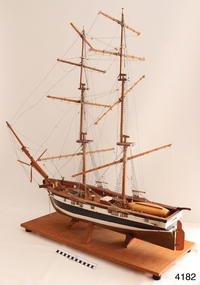
... making, which has been a popular hobby for hundreds of years. Our collection has many ship models, some of which were built by professional model makers, others by naval enthusiasts. The model is also an example of British warships that predate the colonisation of Australia. Flagstaff Hill Flagstaff Hill Maritime Museum and Village Warrnambool Maritime Museum Maritime Village Great Ocean Road Shipwreck Coast ship model Skylark two-masted ship sailing ship hobby war ship HMS Skylark British sloop British brig Carronade Brig of War 1806 "SKYLARK" on both sides of the bow. ...This handmade ship model was built and donated by mr E H Grainger in the late 20th century. The warship represents the British Sloop, Seagull Class, HMS Skylark 1806-1812. The brig-rigged, two-masted HMS Skylark was built at William Rowes' Yard on the River Tyne for the Royal Navy of the United Kingdom in 1806. The ship was armed with 14 British 24-pound Carronades and 2 British 6-pounders. It could carry a crew of 95. This model is an example of the craft of ship model making, which has been a popular hobby for hundreds of years. Our collection has many ship models, some of which were built by professional model makers, others by naval enthusiasts. The model is also an example of British warships that predate the colonisation of Australia.Ship model, Skylark. 2-masted sailing ship, hull painted, with a white strip on white. Separate wooden lifeboat. "Skylark" on each side of the bow and across the stern. The rudder pivots. Mounted on a timber stand. Model built by Mr E.H. Grainger."SKYLARK" on both sides of the bow. "SKYLARK HULL" across bowflagstaff hill, flagstaff hill maritime museum and village, warrnambool, maritime museum, maritime village, great ocean road, shipwreck coast, ship model, skylark, two-masted ship, sailing ship, hobby, war ship, hms skylark, british sloop, british brig, carronade, brig of war, 1806 -
 Flagstaff Hill Maritime Museum and Village
Craft - Ship Model, S.S. Orotava, ca. 1930-1974
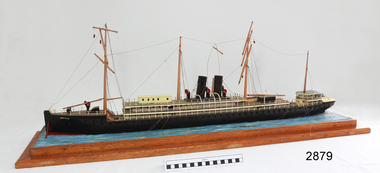
... The model is also an example of ship model-making, a skilled craft enjoyed for hundreds of years, demonstrating the evolution of ocean vessels. flagstaff hill warrnambool shipwrecked-coast flagstaff-hill flagstaff-hill-maritime-museum maritime-museum shipwreck-coast flagstaff-hill-maritime-village ship model ss orotava naval construction and armaments co. n c & a co. pacific steam navigaiton company passenger liner orient line orient-pacific steam line royal mail line hms orotava "OROTAVA" painted in white on each side of the bow. ...This is a ship model of the SS Orotava, a British Screw Steamship built at Barrow-in-Furness, county of Lancashire, by the Naval Construction and Armaments Company (NC & A Co.) in 1889. The gross tonnage was 5552.10 tons, length 430 feet, breadth 49.3 feet and depth 34.2 feet. It was built for the Pacific Steam Navigation Company (of 31, James Street, Liverpool) and used as a passenger liner. The vessel was launched in 1889 and made two voyages for the Pacific Steam Navigation Company during 1889. Then, under the new management of the Orient Line, its first sailing was 6th June 1890 from Liverpool to Australia via Suez. During the Boer War (1889 – 1903), Orotava served as a troop ship, but apart from this, it remained in the Orient Line’s Australia service until 1906. On 14th December 1896, the Orotava sank at Tilbury Docks after being serviced on her return from Australia, becoming unstable and taking in water. Five men lost their lives. The ship was then raised to dry dock and repaired for service again, and an investigation was launched into the cause of the sinking. Between 1901 – 1906, the name Orient-Pacific Steam Line was used due to the close ties between the Pacific and the Orient lines. In 1906, the Pacific Steam Line Australian service was taken over by the Royal Mail Steam Packet Co., and the alliance between them and the Orient Line was dissolved in 1909. Orotava then served the West Indies service of the Royal Mail Line. In World War 1 (Dec 1914 – June 1916), the vessel served as HMS OROTAVA, an armed merchant cruiser. It was broken up in 1919.The model shows a visual description of the SS Orotava, which was used for commercial and government purposes from 1889 to 1919. The model is also an example of ship model-making, a skilled craft enjoyed for hundreds of years, demonstrating the evolution of ocean vessels. Ship model: SS Orotava. The model, without a case, has four masts and two funnels, and is mounted on a small timber base. The SS Orotave was a British passenger liner, launched in 1889. Inscriptions are painted on the hull. "OROTAVA" painted in white on each side of the bow. 'OROTAVA / LONDON" painted in white on the stern.flagstaff hill, warrnambool, shipwrecked-coast, flagstaff-hill, flagstaff-hill-maritime-museum, maritime-museum, shipwreck-coast, flagstaff-hill-maritime-village, ship model, ss orotava, naval construction and armaments co., n c & a co., pacific steam navigaiton company, passenger liner, orient line, orient-pacific steam line, royal mail line, hms orotava -
 Flagstaff Hill Maritime Museum and Village
Tool - Bow Saw, Prior to 1950
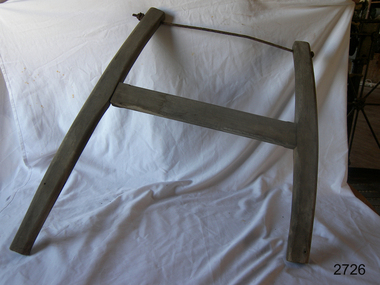
... A bow saw is a type of frame saw with a thin toothed blade that is held in tension by a frame with two long narrow handles called "cheeks" that are supported and separated by a thin stretcher in the center of the handles, making a wide H shape (the cheeks form the uprights of the H, the stretcher the crossbar of the H). ...A bow saw is a type of frame saw with a thin toothed blade that is held in tension by a frame with two long narrow handles called "cheeks" that are supported and separated by a thin stretcher in the center of the handles, making a wide H shape (the cheeks form the uprights of the H, the stretcher the crossbar of the H). ...A coopers turning or bow saw is a woodworking tool used for straight or curved cuts. A bow saw is a type of frame saw with a thin toothed blade that is held in tension by a frame with two long narrow handles called "cheeks" that are supported and separated by a thin stretcher in the center of the handles, making a wide H shape (the cheeks form the uprights of the H, the stretcher the crossbar of the H). The blade is kept in tension with a turnbuckle that runs parallel to the blade between the two cheeks but on the opposite side of the stretcher.An age old tool used for cutting timber for hundreds of years before the modern cross cut saws were invented. This design of saw was part of a Coopers tool kit and used in the production of making barrels. However this item at this time cannot be associated with an historical event, person or place, provenance is unknown, item assessed as a collection asset as it is believed to have been produced before 1950.Bow saw wooden handle with metal blade missingNonewarrnambool, flagstaff-hill, flagstaff-hill-maritime-museum, maritime-museum, shipwreck-coast, flagstaff-hill-maritime-village, bow saw, turning saw, coopers tools, cutting wood, sawing timber, coopering -
 Federation University Historical Collection
Photograph - Black and White, Frank Wright stands beside a ships wheel
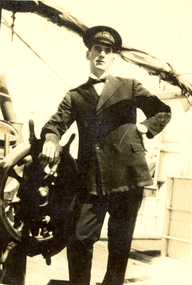
... The Frank Wright Medal at the Royal South Street competition is awarded to an individual recognized as making an outstanding contribution to brass music in Australia. frank wright A black and white photo of a man in a suit, cap and bow tie leaning on a ship's wheel. ...Frank Wright was a renown resident of Smeaton, where he was born. He lived at Laura Villa, and attended Smeaton State School. His father William was a gold miner and his mother's name was Sarah. Their family won many singing and instrumental awards. Frank was tutored by Percy Code and was awarded a gold medal for the highest marks in the ALCM examinations in the British Colonies at the age of seventeen years. He became the Australian Open Cornet Champion by the age of eighteen. A year later, Frank conducted the City of Ballarat Band, and later the Ballarat Soldiers’ Memorial Band. He formed the Frank Wright Frisco Band and Frank Wright and his Coliseum Orchestra. These bands won many South Street awards, and Frank as conductor won many awards in the Australian Band Championship contest. In 1933 Frank Wright sailed to England to conduct the famous St Hilda’s Band and was later appointed Musical Director of the London County Council, where he organized many amazing concerts in parks, in and around the London district. He was made Professor of Brass and Military Band Scoring and conducted at the Guildhall of Music and Drama. Frank was often invited to adjudicate Brass Band Championships around Europe, in Australia, including South Street and in New Zealand. The Frank Wright Medal at the Royal South Street competition is awarded to an individual recognized as making an outstanding contribution to brass music in Australia.A black and white photo of a man in a suit, cap and bow tie leaning on a ship's wheel. The man is Frank Wright.frank wright -
 Federation University Historical Collection
Photograph - Sepia, Frank Wright
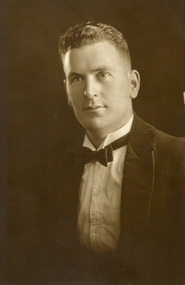
... making an outstanding contribution to brass music in Australia. He died in England in 1970 at the age of 69. frank wright conductor brass band Sepia photograph of the torso of a man dressed in a formal suit and bow tie. ...Frank Wright was a renown resident of Smeaton, where he was born on 2 August 1901. He lived at Laura Villa, and attended Smeaton State School. His father William was a gold miner and his mother's name was Sarah. Their family won many singing and instrumental awards. Frank was tutored by Percy Code and was awarded a gold medal for the highest marks in the ALCM examinations in the British Colonies at the age of seventeen years. He became the Australian Open Cornet Champion by the age of eighteen. A year later, Frank conducted the City of Ballarat Band, and later the Ballarat Soldiers’ Memorial Band. He formed the Frank Wright Frisco Band and Frank Wright and his Coliseum Orchestra. These bands won many South Street awards, and Frank as conductor won many awards in the Australian Band Championship contest. In 1933 Frank Wright sailed to England to conduct the famous St Hilda’s Band and was later appointed Musical Director of the London County Council, where he organized many amazing concerts in parks, in and around the London district. He was made Professor of Brass and Military Band Scoring and conducted at the Guildhall of Music and Drama. Frank was often invited to adjudicate Brass Band Championships around Europe, in Australia, including South Street and in New Zealand. The Frank Wright Medal at the Royal South Street competition is awarded to an individual recognized as making an outstanding contribution to brass music in Australia. He died in England in 1970 at the age of 69.Sepia photograph of the torso of a man dressed in a formal suit and bow tie. The man is Frank Wright.frank wright, conductor, brass band -
 Flagstaff Hill Maritime Museum and Village
Tool - Spokeshave, Sides & Skinner, First half of the 20th century
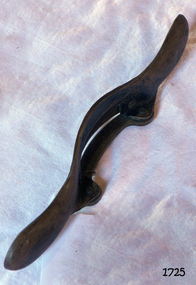
... A spokeshave is a hand tool used to shape and smooth woods in woodworking jobs such as making cart wheel spokes, chair legs, paddles, bows, and arrows. The tool consists of a blade fixed into the body of the tool, which has a handle for each hand. ...A spokeshave is a hand tool used to shape and smooth woods in woodworking jobs such as making cart wheel spokes, chair legs, paddles, bows, and arrows. The tool consists of a blade fixed into the body of the tool, which has a handle for each hand. ...A spokeshave is a hand tool used to shape and smooth woods in woodworking jobs such as making cart wheel spokes, chair legs, paddles, bows, and arrows. The tool consists of a blade fixed into the body of the tool, which has a handle for each hand. Historically, a spokeshave was made with a wooden body and metal cutting blade. With industrialization metal bodies displaced wood in mass-produced tools. Being a small tool, spokeshaves are not suited to working large surfaces. The name spokeshave dates back to at least the 16th century, though the early history of the tool is not well documented. The name spokeshave reflects the early use of the tool by wheelwrights. The first spokeshaves were made of wood usually beech with steel blades, before being largely superseded by the development of metal-bodied spokeshaves in the latter half of the 19th century, though many woodworkers still use wooden spokeshaves. Due to their widespread use and versatility vintage wooden spokeshaves remain commonly available and relatively low in price. Spokeshaves consist of a blade or iron secured to the body or stock of the tool, which has two handles one for each hand. The bottom surface of the tool is called the sole. The blade can be removed for sharpening, and adjusted to vary the depth of the cut. An early design consisted of a metal blade with a pair of tangs to which the wooden handles were attached, as with a draw knife. Unlike a draw knife, but like a plane, spokeshaves typically have a sole plate that fixes the angle of the blade relative to the surface being worked. There are a wide variety of different types of spokeshave, suited to different trades and applications. A now vintage tool made by an Australian manufacture in NSW who specialised in making pruning shears, hacksaw frames and heel shaves under the Erskin brand name. This tool is now sought after by collectors even though it was probably made in the first quarter of the 20th century. It gives a snapshot of how carpenters work with wood by hand showcasing their craftsmanship. Hollow face Spokeshave, metal body with black enamel finish. Erskin stamped on frontflagstaff hill, warrnambool, flagstaff-hill, flagstaff-hill-maritime-museum, maritime-museum, shipwreck-coast, flagstaff-hill-maritime-village, spokeshave, cabinet makers tools, wood working, cutting tool, shaping tool -
 Flagstaff Hill Maritime Museum and Village
Tool - Spokeshave, Mathieson and Son, 1860 to 1910
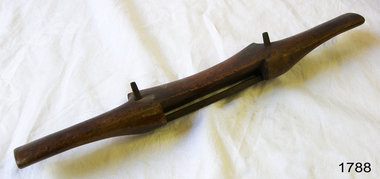
... A spokeshave is a hand tool used to shape and smooth woods in woodworking jobs such as making cart wheel spokes, chair legs, paddles, bows, and arrows. The tool consists of a blade fixed into the body of the tool, which has a handle for each hand. ...A spokeshave is a hand tool used to shape and smooth woods in woodworking jobs such as making cart wheel spokes, chair legs, paddles, bows, and arrows. The tool consists of a blade fixed into the body of the tool, which has a handle for each hand. ...A spokeshave is a hand tool used to shape and smooth woods in woodworking jobs such as making cart wheel spokes, chair legs, paddles, bows, and arrows. The tool consists of a blade fixed into the body of the tool, which has a handle for each hand. Historically, a spokeshave was made with a wooden body and metal cutting blade. With industrialization metal bodies displaced wood in mass-produced tools. Being a small tool, spokeshaves are not suited to working large surfaces. The name spokeshave dates back to at least the 16th century, though the early history of the tool is not well documented. The name spokeshave reflects the early use of the tool by wheel wrights. The first spokeshaves were made of wood usually beech with steel blades, before being largely superseded by the development of metal-bodied spokeshaves in the latter half of the 19th century, though many woodworkers still use wooden spokeshaves. Due to their widespread use and versatility vintage wooden spokeshaves remain commonly available and relatively low in price. Spokeshaves consist of a blade or iron secured to the body or stock of the tool, which has two handles – one for each hand. The bottom surface of the tool is called the sole. The blade can be removed for sharpening, and adjusted to vary the depth of the cut. An early design consisted of a metal blade with a pair of tangs to which the wooden handles were attached, as with a draw knife. Unlike a draw knife, but like a plane, spokeshaves typically have a sole plate that fixes the angle of the blade relative to the surface being worked. There are a wide variety of different types of spokeshave, suited to different trades and applications. Company History: The firm of Alexander Mathieson & Sons was one of the leading makers of hand tools in Scotland. Its success went hand in hand with the growth of the shipbuilding industries on the Firth of Clyde in the nineteenth century and the emergence of Glasgow regarded as the "second city of the Empire". It also reflected the firm's skill in responding to an unprecedented demand for quality tools by shipyards, cooperage's and other industries, both locally and far and wide. The year 1792 was deemed by the firm to be that of its foundation it was in all likelihood the year in which John Manners had set up his plane-making workshop on Saracen Lane off the Gallowgate in the heart of Glasgow, not far from the Saracen's Head Inn, where Dr Johnson and James Boswell had stayed on their tour of Scotland in 1773. Alexander Mathieson (1797–1851) is recorded in 1822 as a plane-maker at 25 Gallowgate, but in the following year at 14 Saracen's Lane, presumably having taken over the premises of John Manners. The 1841 national census described Alexander Mathieson as a master plane-maker at 38 Saracen Lane with his son Thomas Adam working as a journeyman plane-maker. In 1849 the firm of James & William Stewart at 65 Nicolson Street, Edinburgh was taken over and Thomas was put in charge of the business, trading under the name Thomas A. Mathieson & Co. as plane and edge-tool makers. Thomas's company acquired the Edinburgh edge-tool makers Charles & Hugh McPherson and took over their premises in Gilmore Street. The Edinburgh directory of 1856/7 the business is recorded as being Alexander Mathieson & Son, plane and edge-tool makers at 48 Nicolson Street and Paul's Work, Gilmore Street. The 1851 census records indicate that Alexander was working as a tool and plane-maker employing eight men. Later that year Alexander died and his son Thomas took over the business. Under the heading of an edge-tool maker in the 1852/3 (Post-Office Glasgow Annual Directory) the firm is now listed as Alexander Mathieson & Son. By the early 1850s, the business had moved to 24 Saracen Lane. The directory for 1857/8 records that the firm had moved again only a few years later to East Campbell Street, also off the Gallowgate, and that through further diversification was also manufacturing coopers' and tin men's tools. The ten-yearly censuses log the firm's growth and in 1861 Thomas was a tool manufacturer employing 95 men and 30 boys; in 1871 he had 200 men working for him and in 1881 300 men. By 1899 the firm had been incorporated as Alexander Mathieson & Sons Ltd, even though only Alexander's son Thomas appears ever to have joined the firm.A vintage tool made by a well-known firm made for other firms and individuals that worked in wood. The tool was used to shape various items mainly in use by wheel wrights. A significant vintage item from the mid to late 19th century that today is quite sought after by collectors. It gives us a snapshot of how trade people predominately worked materials such as wood by hand and with tools that were themselves hand made shows the craftsman's art of the time. Spokeshave with blade 4 inches wide.Mathieson and Son Glasgow. flagstaff hill, warrnambool, shipwrecked-coast, flagstaff-hill, flagstaff-hill-maritime-museum, maritime-museum, shipwreck-coast, flagstaff-hill-maritime-village, spokeshave, mathieson and son, carpentry tools, wheel wright tools -
 Flagstaff Hill Maritime Museum and Village
Craft - Ship Model, S.S. Nelson, 1877 - 1984
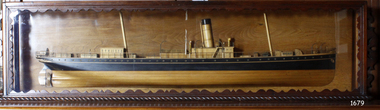
... Once the railway came to Warrnambool in 1889, the steam shipping industry began to decline. flagstaff hill warrnambool shipwrecked-coast flagstaff-hill flagstaff-hill-maritime-museum maritime-museum shipwreck-coast flagstaff-hill-maritime-village s.s. nelson steam ship 1877 screw steamer 1877 vessel ship model s.s. nelson blackwood and gordon port glasgow warrnambool steam packet company western steam navigation company south west coast trader sea transport melbourne to portland victorian steam navigation board s.s. julia percey captain john nicholson captain thomas smith captain s drewet captain john thompson captain carrington huddart, parker and co bass strait crossing 1890 sea transport melbourne to launceston porpoise rock tamar river australian alliance insurance company ship model making vessels victorian coastal trader "NELSON" painted on bow Ship model; relief of the S.S. ...This beautifully made ship model is a side relief of the steam ship “S.S. Nelson”, which was launched in 1877. The model’s case stands out because of its ornately carved internal frame. Relief models of ships, sometimes called half models, were often built by the shipbuilders as an exact scale model of the finished ship. The shipbuilders would use the model to ensure that the design was balanced. They would use the model as a point of reference during building. Also, ship models were used to demonstrate the designs to prospective buyers. It is not known whether this model of the “S.S. Nelson” was made for these purposes. HISTORY of the “S.S. Nelson” During the period 1840-1890 shipping was the cheapest and most practical means of carrying produce and goods to and from coastal towns such as Warrnambool. In the 1850s regular domestic steamer services began and by 1870 the passenger trade was booming. Passengers were taken to the ship’s side in small boats called lighters, which took it to ships at anchorage in Lady Bay, then climbed aboard up ladders or gangways. Their fare covered accommodation Saloon/Cabin section (higher class and more expensive) or the Steerage section (lower class and less expensive, below deck level). Produce included livestock such as pigs and fowls, and dairy products, bales of wool, and potatoes. The goods were loaded from the Warrnambool Jetty into the lighters. The S.S. Nelson was built by Messrs Blackwood and Gordon of Port Glasgow for a cost £25,000 in 1877. She was an iron screw steamer with an overall length of 200 feet, beam 25.5 feet and a depth of hold of 19.4 feet, which gave her a gross measurement of 649 tons. Her engines gave her a best speed of 13 knots and a maintainable speed of 12 knots. She was described as a handsome, star decked, efficient steamship, fitted with accommodating for 75 first class passengers in a saloon, and 40 second class passengers in a cabin. The S.S. Nelson arrived in the colony of Victoria on March 9th, 1877. She was first registered in Warrnambool by the Warrnambool Steam Packet Company under the management of Mr William Evans, and employed in the coastal trade of south west Victoria. She was very popular in 1878, registered under the new ownership of the Western Steamship Navigation Company, trading between Melbourne, Warrnambool and Portland. Captained John Nicholson commanded the S.S. Nelson after the previous captain, Thomas Smith, was suspended in 1882 for six months by the Victorian Steam Navigation Board following the collision between the S.S. Nelson and the S.S. Julia Percy. Other Captains include S Drewet and John Thompson. The S.S. Nelson was sold to Messrs. Huddart, Parker and Co. and re-registered in Melbourne on June 23rd, 1890. The new owners intended to use her for their Bass Strait crossing between Melbourne, Victoria and Launceston, Tasmania. On the night of Friday, June 27th 1890, under the command of Captain Carrington, she was on her way to Launceston on her first crossing for her new owners. She had no passengers and very little cargo and was to return to Melbourne with passengers the following morning. She was only 21 hours out of the dock when she struck Porpoise Rock in the Tamar River. All crew of 25 were saved but the bulkheads gave way and she rapidly filled before keeling over and disappearing in approximately 130 feet of water. The new owners had fully insured the almost 14-year-old S.S. Nelson with the Australian Alliance Insurance Company and she had only been in their possession for four days. This ship model of the S.S. Nelson is significant for its connection with the steam screw ship S.S. Nelson, one of a fleet of vessels owned by the Warrnambool Steam Packet Company. The S.S. Nelson was specifically built and purchased for the Victorian coastal trade business of the late 19th century, when shipping was the cheapest and most practical means of transporting goods and passengers between Victoria’s coastal towns and the major port at Melbourne. Once the railway came to Warrnambool in 1889, the steam shipping industry began to decline.Ship model; relief of the S.S. Nelson, showing deck superstructure, ventilators and single funnel. Ship's name is painted on the bow "NELSON". Wood model, varnished finish over natural wood and black painted areas. Timber case with ornate edging and glass front and sides."NELSON" painted on bowflagstaff hill, warrnambool, shipwrecked-coast, flagstaff-hill, flagstaff-hill-maritime-museum, maritime-museum, shipwreck-coast, flagstaff-hill-maritime-village, s.s. nelson steam ship 1877, screw steamer, 1877 vessel, ship model s.s. nelson, blackwood and gordon port glasgow, warrnambool steam packet company, western steam navigation company, south west coast trader, sea transport melbourne to portland, victorian steam navigation board, s.s. julia percey, captain john nicholson, captain thomas smith, captain s drewet, captain john thompson, captain carrington, huddart, parker and co, bass strait crossing 1890, sea transport melbourne to launceston, porpoise rock tamar river, australian alliance insurance company, ship model making, vessels, victorian coastal trader -
 Lara RSL Sub Branch
Book, Nautical Press, HMAS Melbourne 25 Years
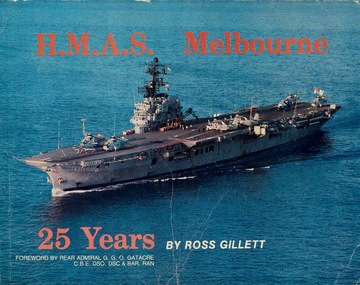
... making Melbourne the third ship to be constructed with an angled flight deck. Delays in construction and integrating the enhancements meant that the carrier was not commissioned until 1955. Melbourne never fired a shot in anger during her career, having only peripheral, non-combat roles in relation to the Indonesia-Malaysia confrontation and the Vietnam War. However, she was involved in two major collisions with allied vessels. On the evening of 10 February 1964, Melbourne collided with and sank HMAS Voyager when the Daring class destroyer altered course across her bow...making Melbourne the third ship to be constructed with an angled flight deck. Delays in construction and integrating the enhancements meant that the carrier was not commissioned until 1955. Melbourne never fired a shot in anger during her career, having only peripheral, non-combat roles in relation to the Indonesia-Malaysia confrontation and the Vietnam War. However, she was involved in two major collisions with allied vessels. On the evening of 10 February 1964, Melbourne collided with and sank HMAS Voyager when the Daring class destroyer altered course across her bow ...HMAS Melbourne (R21) was a Majestic-class light aircraft carrier of the Royal Australian Navy (RAN). Operating from 1955 until 1982, she was the third and final conventional aircraft carrier to serve in the RAN. Melbourne was the only British Commonwealth naval vessel to sink two friendly warships in peacetime collisions. The ship was laid down for the British Royal Navy as the lead ship of the Majestic class in April 1943, and was launched as HMS Majestic (R77) in February 1945. At the end of World War II, work on the ship was suspended until she was purchased by the RAN in 1947. At the time of purchase, it was decided to incorporate new aircraft carrier technologies into the design, making Melbourne the third ship to be constructed with an angled flight deck. Delays in construction and integrating the enhancements meant that the carrier was not commissioned until 1955. Melbourne never fired a shot in anger during her career, having only peripheral, non-combat roles in relation to the Indonesia-Malaysia confrontation and the Vietnam War. However, she was involved in two major collisions with allied vessels. On the evening of 10 February 1964, Melbourne collided with and sank HMAS Voyager when the Daring class destroyer altered course across her bow. Eighty-two of Voyager's crew were killed, and two Royal Commissions were held to investigate the incident. The second collision occurred in the early morning of 3 June 1969, when Melbourne collided with and sank the Allen M. Sumner class destroyer USS Frank E. Evans in similar circumstances. Seventy-four United States Navy (USN) personnel died, and a joint USN–RAN Board of Inquiry was held. These incidents, along with several minor collisions, shipboard accidents, and aircraft losses, led to the reputation that Melbourne was jinxed. Melbourne was paid off from RAN service in 1982. A proposal to convert her for use as a floating casino failed, and a 1984 sale was cancelled, before she was sold in 1985 and towed to China for breaking. The scrapping was delayed so Melbourne could be studied by the People's Liberation Army Navy (PLAN) as part of a secret project to develop a Chinese aircraft carrier and used to train PLAN aviators in carrier flight operations. HMAS Melbourne was decommissioned on 30 June 1982, having spent 62,036 hours underway and having steamed 868,893 nautical miles. A proposal to convert her for use as a floating casino failed, and a 1984 sale was cancelled, before she was sold for scrap in 1985 and towed to China for breaking. The scrapping was delayed so Melbourne could be studied by the People's Liberation Army Navy (PLAN) as part of a secret project to develop a Chinese aircraft carrier and used to train PLAN aviators in carrier flight operations.The pictorial history of HMAS Melbourne with rare photos. Now a scarce title and highly desirable title that is now long out of print. Has provenance history of all ships movements from 1955 till decommissioned.HMAS Melbourne 25 YearsOn the front page is a picture of HMAS Melbourne with the words at top "H.M.A.S. Melbourne. At bottom are the words in orange, '25 Years'. In white, are the words 'by Ross Gillett' then 'Forward by Rear Admiral G.G.O. Gatacre C.B.E. DSO. DSC & Bar, RAN'. On the rear page is a list of all the Captains that served on the HMAS Melbourne between 1955-1980.hmas melbourne, aircraft carrier, royal australian navy, australian navy, westland whirlwind, sea venom, fairy gannet, bristol sycamore, westland wessex, douglas skyhawk, grumman tracker, westland sea king, fleet air arm, hmas albatross, nowra -
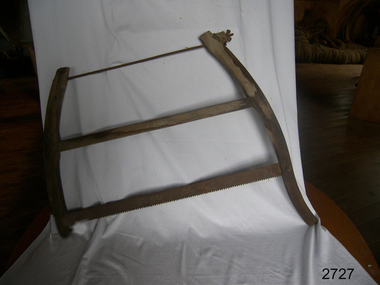 Flagstaff Hill Maritime Museum and Village
Tool - Bow Saw, Prior to 1950
... A bow saw is a type of frame saw with a thin toothed blade that is held in tension by a frame with two long narrow handles called "cheeks" that are supported and separated by a thin stretcher in the center of the handles, making a wide H shape (the cheeks form the uprights of the H, the stretcher the crossbar of the H). ...A bow saw is a type of frame saw with a thin toothed blade that is held in tension by a frame with two long narrow handles called "cheeks" that are supported and separated by a thin stretcher in the center of the handles, making a wide H shape (the cheeks form the uprights of the H, the stretcher the crossbar of the H). ...A coopers turning or bow saw is a woodworking tool used for straight or curved cuts. A bow saw is a type of frame saw with a thin toothed blade that is held in tension by a frame with two long narrow handles called "cheeks" that are supported and separated by a thin stretcher in the center of the handles, making a wide H shape (the cheeks form the uprights of the H, the stretcher the crossbar of the H). The blade is kept in tension with a turnbuckle that runs parallel to the blade between the two cheeks but on the opposite side of the stretcher.An age old tool used for cutting timber for hundreds of years before the modern cross cut saws were invented. This design of saw was part of a Coopers tool kit and used in the production of making barrels. However this item at this time cannot be associated with an historical event, person or place, provenance is unknown, item assessed as a collection asset as it is believed to have been produced before 1950.Bow saw wooden handle with metal bladeNonewarrnambool, flagstaff-hill, flagstaff-hill-maritime-museum, maritime-museum, shipwreck-coast, flagstaff-hill-maritime-village, bow saw, turning saw, coopers tools, cutting wood, sawing timber, coopering -
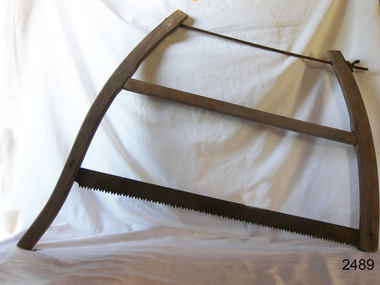 Flagstaff Hill Maritime Museum and Village
Tool - Bow Saw, Prior to 1950
... A bow saw is a type of frame saw with a thin toothed blade that is held in tension by a frame with two long narrow handles called "cheeks" that are supported and separated by a thin stretcher in the center of the handles, making a wide H shape (the cheeks form the uprights of the H, the stretcher the crossbar of the H). ...A bow saw is a type of frame saw with a thin toothed blade that is held in tension by a frame with two long narrow handles called "cheeks" that are supported and separated by a thin stretcher in the center of the handles, making a wide H shape (the cheeks form the uprights of the H, the stretcher the crossbar of the H). ...A coopers turning or bow saw is a woodworking tool used for straight or curved cuts. A bow saw is a type of frame saw with a thin toothed blade that is held in tension by a frame with two long narrow handles called "cheeks" that are supported and separated by a thin stretcher in the center of the handles, making a wide H shape (the cheeks form the uprights of the H, the stretcher the crossbar of the H). The blade is kept in tension with a turnbuckle that runs parallel to the blade between the two cheeks but on the opposite side of the stretcher.An age old tool used for cutting timber for hundreds of years before the modern cross cut saws were invented. This design of saw was part of a Coopers tool kit and used in the production of making barrels. However this item at this time cannot be associated with an historical event, person or place, provenance is unknown, item assessed as a collection asset as it is believed to have been produced before 1950.Bow saw wooden handle with metal blade & frame tightening rodNonewarrnambool, flagstaff-hill, flagstaff-hill-maritime-museum, maritime-museum, shipwreck-coast, flagstaff-hill-maritime-village, bow saw, turning saw, coopers tools, cutting wood, sawing timber, coopering -
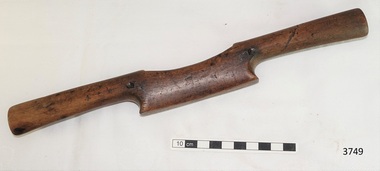 Flagstaff Hill Maritime Museum and Village
Tool - Spokeshave, 1930-1955's
... making of ship model Sovereign of the Seas. It would have been used to shave and shape wood in a similar way that a plane would be used. Its name comes from its use for shaping curved objects such as wheel spokes, oars, paddles, chair legs and bows. ...making of ship model Sovereign of the Seas. It would have been used to shave and shape wood in a similar way that a plane would be used. Its name comes from its use for shaping curved objects such as wheel spokes, oars, paddles, chair legs and bows. ...This wooden spokeshave was used in the making of ship model Sovereign of the Seas. It would have been used to shave and shape wood in a similar way that a plane would be used. Its name comes from its use for shaping curved objects such as wheel spokes, oars, paddles, chair legs and bows. It is part of a collection of objects used by Jim Williams, maker of fine ship models from about 1930-1955. Most of the components for the models, as well as many of the tools, were handmade by Jim Williams. Jim’s family has donated the ship model “Sovereign of the Seas” and many tools, accessories and documents used in the making of this and other ship models have been donated to Flagstaff Hill Maritime Village. Ship model of HMS Sovereign of the Seas, scale model of 17th Century English war ship, was handmade and carved from plans, enclosed in airtight glass case. All components of that model, including even the smallest pulleys, were hand crafted using tools designed and made by Jim. Outstanding details include functional rigging and moving cannons. Please see our record 3732 of the mode Sovereign of the Seas for further details of the ship and the maker.This spokeshave is connected with the hobby and skill of ship model making that has been crafted as a leisure activity for many generations. The hobby is often chosen by serving and retired mariners who appreciate the connection with maritime history. This spokeshave was used by local Warrnambool man, Jim Williams, who was employed at Cramond and Dickson clothing store, and then at Fletcher Jones menswear for 27 years. It was used in making components for the model of the historic ship, the Sovereign of the Seas. The Sovereign of the Seas was a historic 17th century English war ship with important maritime heritage. Spokeshave; two-handled, medium coloured wood tool, slightly curved centre. The front has two blade screws protruding from it, the back has a flat ‘sole’ with removable brass blade attached by screws. This spokeshave is part of a collection of tools and accessories once used by Jim Williams, maker of a series of ship models 1930-1955 including “HMS Sovereign of the Seas”. (Illegible text is pressed into the top side of the spoke shave.)flagstaff hill, warrnambool, flagstaff hill maritime museum, shipwreck coast, flagstaff hill maritime village, great ocean road, jim williams, james bernard williams, ship model hobby, ship model tools, ship model making equipment, ship model making accessories, spokeshave, spoke shave, sovereign of the sea, ship model, hobby, ship model tool, english war ship -
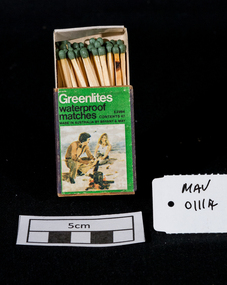 City of Moorabbin Historical Society (Operating the Box Cottage Museum)
Maufactured Objects, 1 box of Bryant & May waterproof safety matches, 20thC
... making commercial quantities of phosphorus sesquisulfide in 1899 and started selling it to match manufacturers. Bryant and May was a United Kingdom (UK) company created in the mid-nineteenth century specifically to make matches. Their original Bryant and May Factory was located in Bow...making commercial quantities of phosphorus sesquisulfide in 1899 and started selling it to match manufacturers. Bryant and May was a United Kingdom (UK) company created in the mid-nineteenth century specifically to make matches. Their original Bryant and May Factory was located in Bow ...‘Strike anywhere’ or ‘Waterproof’ matches are still used today all around the world, including many developing countries and are widely used for camping, outdoor activities, emergency/survival /military situations, and stocking homemade survival kits. Anton Schrötter von Kristelli discovered in 1850 that heating white phosphorus at 250 °C in an inert atmosphere produced a red allotropic form, which did not fume in contact with air. It was suggested that this would make a suitable substitute in match manufacture although it was slightly more expensive. Two French chemists, Henri Savene and Emile David Cahen, proved in 1898 that the addition of phosphorus sesquisulfide meant that the substance was not poisonous, that it could be used in a "strike-anywhere" match, and that the match heads were not explosive. British company Albright and Wilson, was the first company to produce phosphorus sesquisulfide matches commercially. The company developed a safe means of making commercial quantities of phosphorus sesquisulfide in 1899 and started selling it to match manufacturers. Bryant and May was a United Kingdom (UK) company created in the mid-nineteenth century specifically to make matches. Their original Bryant and May Factory was located in Bow, London. They later opened other match factories in the United Kingdom and Australia. On 15th December 1909, Bryant & May, Australia’s first match factory at Church Street, Richmond, Victoria. was opened by The Honorable Alfred Deakin, Prime Minister of Australia, and Mrs. Deakin The Bryant & May Ltd factory in Church St Richmond is a listed building and has been converted to apartments following the closure of the Company 1980. Bryant & May's Ltd were influential in fighting against the dreadful disease known as Phossy jaw which was caused by white phosphorus used in the manufacture of the early matches. They were also the object of the 'Match Girls Strike' in London 1888, which won important improvements in working conditions and pay for the mostly female workforce working with the dangerous white phosphorus. The public were slow to purchase these red phosphorus sesquisulfide safety matches because of the higher price1 box of unused Bryant & May safety matches 'Greenlite' waterproof Greenlites / waterproof / matches / CONTENTS 47 / MADE IN AUSTRALIA BY BRYANT & MAY / E 2994 photograph of a man and woman beside a camp fire on the beachsafety matches, bryant & may pty ltd, phossy jaw disease, early settlers, moorabbin, bentleigh, cheltenham, lights, lamps, tobacco, white phosphorous, red, phosphorus sesquisulfide, swedish match pty ltd, pitt william, savens henri, cahen emile david , richmond victoria, -
 City of Moorabbin Historical Society (Operating the Box Cottage Museum)
Tool - Bow saw with blade, 20thC
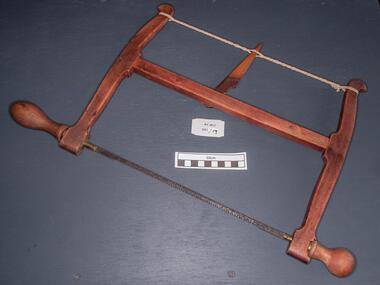
... bow saw is a type of frame saw. Its thin blade is held in tension by a frame. In English and American vocabulary it denotes a toothed blade suspended between two long narrow handles called "cheeks" that are supported and separated by a thin stretcher in the centre of the handles, making a wide H shape (the cheeks form the uprights of the H, the stretcher the crossbar of the H). ...bow saw is a type of frame saw. Its thin blade is held in tension by a frame. In English and American vocabulary it denotes a toothed blade suspended between two long narrow handles called "cheeks" that are supported and separated by a thin stretcher in the centre of the handles, making a wide H shape (the cheeks form the uprights of the H, the stretcher the crossbar of the H). ...Traditionally, a bow saw is a woodworking tool used for straight or curved cuts. A bow saw is a type of frame saw. Its thin blade is held in tension by a frame. In English and American vocabulary it denotes a toothed blade suspended between two long narrow handles called "cheeks" that are supported and separated by a thin stretcher in the centre of the handles, making a wide H shape (the cheeks form the uprights of the H, the stretcher the crossbar of the H). The blade is kept in tension with a turnbuckle or a twisted cord that runs parallel to the blade between the two cheeks but on the opposite side of the stretcher. If a cord is used, the cord is twisted with a toggle attached to one loop of the cord, adding tension. The toggle hits the stretcher, which keeps the cord from untwisting. A finer version of the saw uses a narrow blade (1/4" or less) with handles that allow the user to hold the saw and turn the blade. In this context it is also known as a turning saw[2] which is larger than a coping saw.Early settlers in Moorabbin Shire had to be self reliant and made their own clothes, tools and equipment as they established their market gardens and farms. A wooden Bow saw with tensioning string, toggle and bladetools, woodwork, metalwork, carpentry, pioneers, market gardeners, early settlers, moorabbin, cheltenham, bentleigh, ormond -
 Orbost & District Historical Society
black and white photograph, early 20th century
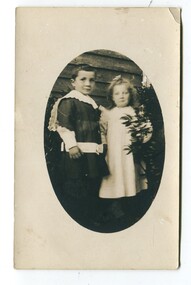
... making. (by Ivy Rodwell in from Personalities and Stories of the Early Orbost District by Mary Gilbert). This photograph has significance in its association with Helen Frances Warren, a popular Orbost identity who was well known as an accomplished photographer and needleworker, Warren-Frank Warren-Ivy A black / white studio portrait photograph of a young boy and girl standing against an outdoor wall. The girl is wearing a long white dress and has a ribbon bow ...The children in this photograph are Frank abd Ivy Warren. Helena Francis Warren (nee McKeown) was married to William John Warren and lived in Newmerella. She supplied the photos for the Back-To-Orbost celebration book in 1937 and also designed the Back-To-Orbost badge. She was known for her soft toy making. (by Ivy Rodwell in from Personalities and Stories of the Early Orbost District by Mary Gilbert). This photograph has significance in its association with Helen Frances Warren, a popular Orbost identity who was well known as an accomplished photographer and needleworker,A black / white studio portrait photograph of a young boy and girl standing against an outdoor wall. The girl is wearing a long white dress and has a ribbon bow in her hair.The boy a tunic with a wide belt and lace collar. His long sleeved have wide cuffs. The photograph is an oval shape on a grey / white background.warren-frank warren-ivy -
 Bendigo Historical Society Inc.
Clothing - MAGGIE BARBER COLLECTION: CREAM TULLE AND BRUSSELLS LACE BOLERO
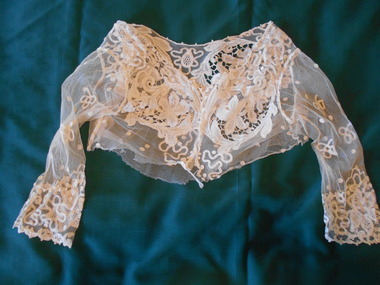
... making an accurate assessment impossible. A beautiful panel of lace from the neckline, dipping to a Vshape at the centre back, has a swirled and leaf design. This design extends over the shoulders and bustline, with a peaked finish below the bust. Bows...making an accurate assessment impossible. A beautiful panel of lace from the neckline, dipping to a Vshape at the centre back, has a swirled and leaf design. This design extends over the shoulders and bustline, with a peaked finish below the bust. Bows ...Clothing. The lower section of this garment has been removed, making an accurate assessment impossible. A beautiful panel of lace from the neckline, dipping to a Vshape at the centre back, has a swirled and leaf design. This design extends over the shoulders and bustline, with a peaked finish below the bust. Bows and spots decorate the below elbow sleeves, and are finished at the lower edge with a panel of lace 8 cm deep at the seam, extending to 15 cms deep at the outer side. Brussells lace is a bobbin lace added to the background fabric. forming the design.costume, female, cream tulle and brussells lace bolero -
 Embroiderers Guild, Victoria
Tool - Mother of pearl pin cushion, 19th century
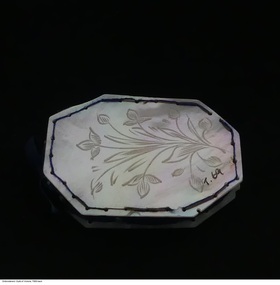
... making pins and preparation of thinner sheets of mother of pearl led to production of pin discs such as this. Mother of pearl Pin disc Floral design Mother of pearl elongated octagonal pin cushion. Double sided with incised floral design. Padding covered with blue silk ribbon, ending in a bow ...Pins are essential sewing tool, the second half of the 19th century saw mass production of them and many 'receptacles' to protect and keep them were made. Disc style pin cushions were very popular and this one has been made with mother of pearl which was very fashionable and with improved cutting and polishing equipment could be used on luxury items more affordably.Era of improving technology for both making pins and preparation of thinner sheets of mother of pearl led to production of pin discs such as this.Mother of pearl elongated octagonal pin cushion. Double sided with incised floral design. Padding covered with blue silk ribbon, ending in a bow, Stitching with matching navy blue threadFloral designmother of pearl, pin disc -
 Geelong Naval and Maritime Museum
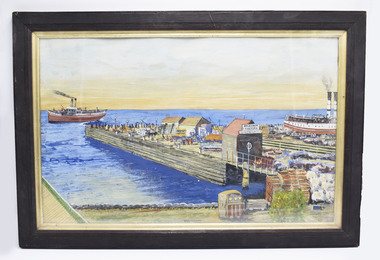
Painting, Excelsior Courier, Unsure
... bow above the surface. The Edina is almost uninjured, but she will be immediately placed in dock, as she is making water slightly. c 1900 → The SS ‘Excelsior’ was raised from her watery grave where a large cut can be seen on the SS Excelsior in dock and reveals the breach made and damage done by the Edina. c 1939 → Records regarding the SS ‘Excelsior’ are elusive until c 1939, when she was commissioned to relocate to Brisbane, Queensland, during the Second World War: The Excelsior came to Brisbane on a voyage north during the 1939-45 War. ...bow above the surface. The Edina is almost uninjured, but she will be immediately placed in dock, as she is making water slightly. c 1900 → The SS ‘Excelsior’ was raised from her watery grave where a large cut can be seen on the SS Excelsior in dock and reveals the breach made and damage done by the Edina. c 1939 → Records regarding the SS ‘Excelsior’ are elusive until c 1939, when she was commissioned to relocate to Brisbane, Queensland, during the Second World War: The Excelsior came to Brisbane on a voyage north during the 1939-45 War. ...The SS ‘Excelsior’ was an iron screw steamer, built in Southampton, England, in 1882 and first registered in Melbourne, Victoria, in 1882. Her journey from Southampton, England to Melbourne, Victoria is reported to have taken just 66 days. She would prove to be a very popular vessel on Port Phillip Bay, though her reign may have been relatively short as she was sunk in 1890. She was refloated sometime between 1890 to 1900 as some records state 1890, others at 1900. Gross Tonnage: 350, Net Tonnage: 172, Length: 186 ft 6 in (56.85 m), Beam: 21 ft 1 in (6.43 m), Depth: 10 ft 7 in (3.23 m), First Owner: Huddart Parker & Co. A Timeline of SS Excelsior’s life: 15 Jan 1883 → the SS ‘Excelsior’ commenced the Melbourne to Geelong run. 27 Jan 1940 21 Jan 1890 →the SS ‘Flora’ ran aground whilst heading out to Hobart, Tasmania, on a tight bend in the Yarra River at Spotswood. Whilst stuck fast in the mud, the SS ‘Excelsior’ ran into her stern – thankfully the damage to both vessels was only minor. 9 Jan 1897 → The SS ‘Excelsior’ sank the Ketch ‘Lu Lu’ on the south bank of the Hopetoun Channel near Geelong, Victoria. Blame is shared between Captains of both vessels: At the meeting of the Marine Board the report of the nautical expert committee, relative to the collision between the steamer Excelsior and ketch Lulu, was considered. The committee recommended that the matter should be remitted to the Marine Court, and a charge of misconduct preferred against Gilbert Moore, master of the Excelsior. Mr Wilson, one of the committee, dissented. He thought in view of the nature of the evidence charges should be preferred against both masters. Mr Dickens moved an amendment to the latter effect, but it was rejected, and the report adopted. 11 Jul 1899 → The SS ‘Edina’ sinks the SS ‘Excelsior’ during thick fog: Shortly after, half-past 11 o’clock this, morning a serious collision took place in Port Phillip Bay between the steamers Edina and the Excelsior. The Edina was on her way to Geelong, to which place she makes a trip every forenoon in the course of her trade with that port, and the Excelsior was coming up the bay to Melbourne. The weather was calm but thick, and a fog hung over the water. The Edina struck the Excelsior on the port side amidships, and she sank within a quarter of an hour. Both vessels carried a large number of passengers, and large cargoes, but there was very little excitement. The whole thing happened so suddenly that until the crash came those on board the steamers were not aware that any other boat was near at all. When both vessels began to draw away after the collision it was at once seen that the Excelsior was the most seriously injured of the two, and she at once began to settle down rapidly. Some of the Excelsior’s passengers were dragged on board the Edina at once, while the remainder, including the crew, were rescued by boats. As far as can be ascertained no one was drowned, but some 20 or 25 were injured. Dr. Wilson, headmaster of the Brighton Presbyterian Ladies’ College, was perhaps the most seriously injured of the Excelsior’s passengers. He was looking down the companion ladder ‘when the collision took place, and he was thrown violently below, sustaining a compound fracture of the right fore-arm. When attended to it was found, that he suffered severely from the shook of his fall and was rather in a bad way. A lady passenger by the Excelsior had her side lacerated, while another had her ankle sprained. The remainder of the others injured had either small cuts or were suffering from shock. The Excelsior went down stern first, and now lies in about five fathoms of water, with her bow above the surface. The Edina is almost uninjured, but she will be immediately placed in dock, as she is making water slightly. c 1900 → The SS ‘Excelsior’ was raised from her watery grave where a large cut can be seen on the SS Excelsior in dock and reveals the breach made and damage done by the Edina. c 1939 → Records regarding the SS ‘Excelsior’ are elusive until c 1939, when she was commissioned to relocate to Brisbane, Queensland, during the Second World War: The Excelsior came to Brisbane on a voyage north during the 1939-45 War. Being unseaworthy she could not be taken further and was used here as a workshop. After the war, she was discarded on Bishop Island. c 1946 → Sometime after WWII was over, the SS ‘Excelsior’ joined many a ship in the graveyard at Bishop Island in Queensland. The island has been the site for the disposal of many ships. Ships recorded as being discarded here include the Groper, Adonis, Roderick Dhu, Excelsior, Yosemite, Maida, Civility, Captain Cook, Bingera, St. Kilda, Lucinda, Moreton, Miner, Schnapper, Lochiel, Queensland, Victoria, and BadgerThe SS Excelsior is a well known ship from the history of Geelong. Its collision with the equally well known SS Edina is of particular interest to Geelong. She was a famous ship in the reckon of Port Phillip despite her short life stand, especially when compared to the SS Edina. Colour painting of ship departingship collision, ship wreck, ss excelsior, ss edina, bishop island -
 City of Ballarat
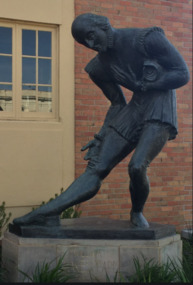
Artwork, other - Public Artwork, Andor Mészáros, Shakespeare by Andor Mészáros, 1960
... bow before the Civic Hall, a performance and community center for Ballarat. The unique abstract and elongated mannerist style used in this cast bronze sculpture hints at the art deco style of the Hall behind. The sculptor, Andor Mészáros, was from Budapest but created much of his work in Melbourne. He also created works for Canterbury Cathedral in the UK and several carved stone sculptures for Sydney Hospital. The artwork was commissioned in 1959 through a widely publicised competition and installed in 1960. In addition to making...bow before the Civic Hall, a performance and community center for Ballarat. The unique abstract and elongated mannerist style used in this cast bronze sculpture hints at the art deco style of the Hall behind. The sculptor, Andor Mészáros, was from Budapest but created much of his work in Melbourne. He also created works for Canterbury Cathedral in the UK and several carved stone sculptures for Sydney Hospital. The artwork was commissioned in 1959 through a widely publicised competition and installed in 1960. In addition to making ...The well known sculpture of English playwright William Shakespeare takes an elaborate bow before the Civic Hall, a performance and community center for Ballarat. The unique abstract and elongated mannerist style used in this cast bronze sculpture hints at the art deco style of the Hall behind. The sculptor, Andor Mészáros, was from Budapest but created much of his work in Melbourne. He also created works for Canterbury Cathedral in the UK and several carved stone sculptures for Sydney Hospital. The artwork was commissioned in 1959 through a widely publicised competition and installed in 1960. In addition to making sculptures, Mészáros was also renown as a creator of medallions. In 1951 he received 'the highest award' at the International Medallion Exhibition, Madrid and in 1964 he won the 'purchase prize' at the International Medallion Competition, Arezzo, Italy. From 1970 Mészáros worked with his younger son Michael, also a sculptor. In 2002, the City of Ballarat granted permission for Michael Mészáros to make a cast of the Ballarat Shakespeare artwork to create replica installed in Budapest. The Budapest installation commemorates Shakespeare's connection to the City and the achievements of Andor Mészáros. The artwork was unveiled by Mayor Arthur W. Nicholson. The statue was presented by L.F. North, general Manager of the Fidelity Trustee Company Limited, representing the late H.P. Stevens as one of the benefactors whose generosity enabled the Statue to be erected.The artwork is of aesthetic significance to the people of BallaratLarge bronze statue of William Shakespeare mounted on a stone plinthWilliam Shakespeare 1564-1616. Erected by benefactions from Harry Pearson Stevens who settled here 1855 and other Citizens unveiled by Arthur W. Nicholson J.P. Mayor.17.11.1960shakespeare, andor mészáros, civic hall, ballarat -
 Rutherglen Historical Society
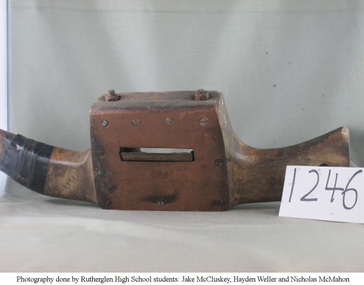
Tool - Swift Plane, Alan, !900s to1920s (Approximate)
... Coopers tool for making wine barrels Alan Patent Cast Steel Wooden handled bow shaped plane Tool Swift Plane Alan ...Coopers tool for making wine barrelsWooden handled bow shaped planeAlan Patent Cast Steel -
 Kew Historical Society Inc
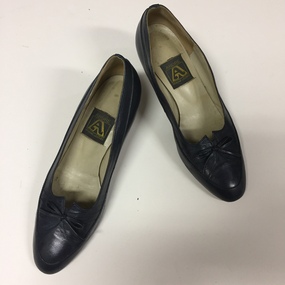
Footwear - Pair of Navy Leather Court Shoes, Andre, 1980s
... making techniques. The shoes date from the 1890s to the 1980s. women's shoes footwear andre --shoes ANDRE / A / Genuine Leather All leather / Upper & Sole / Leather Lining / Made in China Pair of leather navy women’s court shoes designed by Andre. The shoes have small leather bows ...The extensive fashion and design collection of the Kew Historical Society has been assembled over a number of decades. One subsection of this collection is shoes, designed and manufactured for Australian women by Australian and European designers. Many of the shoes, while often mass-produced, were generally constructed by skilled artisans using traditional shoe-making techniques. The shoes date from the 1890s to the 1980s. Pair of leather navy women’s court shoes designed by Andre. The shoes have small leather bows at the front.ANDRE / A / Genuine Leather All leather / Upper & Sole / Leather Lining / Made in Chinawomen's shoes, footwear, andre --shoes -
 Kew Historical Society Inc
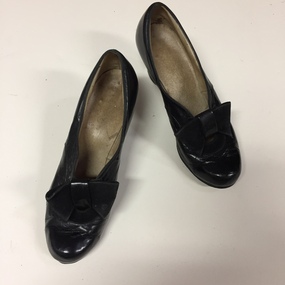
Footwear - Pair of Black Leather & Velvet Court Shoes, Rules, 1980s
... making techniques. The shoes date from the 1890s to the 1980s. women's shoes rules of launceston footwear court shoes Exclusive to / Rules of Launceston Pair of black leather women’s shoes with black velvet bows, retailed by Rules of Launceston Footwear Pair of Black Leather & Velvet Court Shoes Rules ...The extensive fashion and design collection of the Kew Historical Society has been assembled over a number of decades. One subsection of this collection is shoes, designed and manufactured for Australian women by Australian and European designers. Many of the shoes, while often mass-produced, were generally constructed by skilled artisans using traditional shoe-making techniques. The shoes date from the 1890s to the 1980s. Pair of black leather women’s shoes with black velvet bows, retailed by Rules of LauncestonExclusive to / Rules of Launcestonwomen's shoes, rules of launceston, footwear, court shoes -
 Kew Historical Society Inc
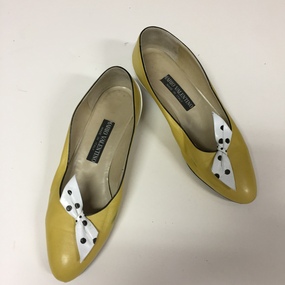
Footwear - Pair of Leather Court Shoes with Polka Dot Bows, Mario Valentino, 1970s–1980s
... making techniques. Mario Valentino was founded in Naples in 1952. international fashion women's shoes court shoes mario valentino Label: "MARIO VALENTINO / MADE IN ITALY" Pair of leather women’s court shoes, manufactured by Mario Valentino of Italy. The yellow leather shoes have a cream leather insole and decorative white leather bows ...The extensive fashion and design collection of the Kew Historical Society has been assembled over a number of decades. One subsection of this collection is shoes, designed and manufactured for Australian women by Australian and European designers. Many of the shoes, while often mass-produced, were generally constructed by skilled artisans using traditional shoe-making techniques. Mario Valentino was founded in Naples in 1952.Pair of leather women’s court shoes, manufactured by Mario Valentino of Italy. The yellow leather shoes have a cream leather insole and decorative white leather bows with black polka dots. This pair of shoes reflects the playfully structural styles of the late 1970s and 1980s. Label: "MARIO VALENTINO / MADE IN ITALY"international fashion, women's shoes, court shoes, mario valentino -
 Kew Historical Society Inc
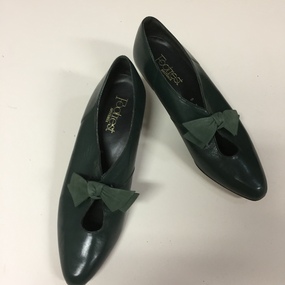
Footwear - Pair of Green Leather Court Shoes, Footwear Australia, 1980s
... making techniques. The shoes date from the 1890s to the 1980s. Footrest Shoes were manufactured in High Street Preston, on the west side not far up from Dundas Street, but well before Bell St. Preston is a suburb of Melbourne. women's shoes footrest shoes footwear ladies footwear Footrest, Australia. Made by Footrest /Leather Uppers Linings & Soles Pair of dark green leather women’s court shoes with a green fabric bow ...The extensive fashion and design collection of the Kew Historical Society has been assembled over a number of decades. One subsection of this collection is shoes, designed and manufactured for Australian women by Australian and European designers. Many of the shoes, while often mass-produced, were generally constructed by skilled artisans using traditional shoe-making techniques. The shoes date from the 1890s to the 1980s. Footrest Shoes were manufactured in High Street Preston, on the west side not far up from Dundas Street, but well before Bell St. Preston is a suburb of Melbourne.Pair of dark green leather women’s court shoes with a green fabric bow at the front, manufactured by Footrest, Australia.Footrest, Australia. Made by Footrest /Leather Uppers Linings & Soleswomen's shoes, footrest shoes, footwear, ladies footwear -
 Whitehorse Historical Society Inc.
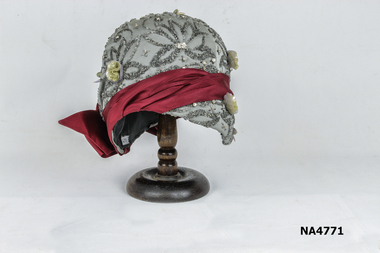
Headwear - HAT, c1920
... Grey jewelled hat with maroon bow. Hat is covered in beads and diamantes making a pattern of flowers with tuille and diamentes flowers scattered about. ...Purchased at a Vintage clothing fair. costume female headwear Grey jewelled hat with maroon bow. Hat is covered in beads and diamantes making a pattern of flowers with tuille and diamentes flowers scattered about. ...Purchased at a Vintage clothing fair. Grey jewelled hat with maroon bow. Hat is covered in beads and diamantes making a pattern of flowers with tuille and diamentes flowers scattered about. Small pearl like shells are sown around in several places.costume, female headwear -
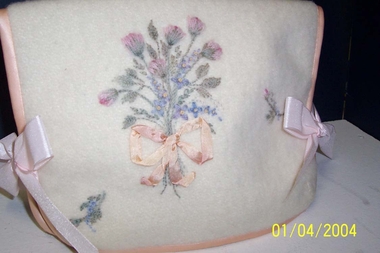 Whitehorse Historical Society Inc.
Domestic object - Tea Cosy, c1972
... making a blanket for her baby in 1972. Janet is the niece of Margaret Skey member of the Whitehorse Historical Society and resident of Mitcham. The embroidery was an examination piece for the Embroiders Guild of Victoria. Janet, now Janet Green, is a tutor at the Embroiders Guild. handcrafts embroidery domestic items food & drink consumption Tea cosy made of beige blanket material with apricot satin edging and two pink satin bow ties. ...Made by Janet West in the 1970s when she lived in Nunawading. Blanket material left over from making a blanket for her baby in 1972. Janet is the niece of Margaret Skey member of the Whitehorse Historical Society and resident of Mitcham. The embroidery was an examination piece for the Embroiders Guild of Victoria. Janet, now Janet Green, is a tutor at the Embroiders Guild.Tea cosy made of beige blanket material with apricot satin edging and two pink satin bow ties. Lined in blue cotton material with small daisy pattern in pale apricot. Front of tea cosy has a wool embroidered bunch of flowers pink roses and blue/mauve daisies and tied with a silk satin bow. Two sprigs of roses are on the front and 5 sprigs scattered on the back.handcrafts, embroidery, domestic items, food & drink consumption
