
Showing 6 items matching "margaret wagner"
-
 Tatura Irrigation & Wartime Camps Museum
Functional object - Blanket, 1946
... ...margaret wagner...Made to be taken to Germany but the maker stayed in Australia wool camp 3 tatura ww2 camp 3 manchester bedding margaret wagner Hand crocheted grey woollen blanket. ...Made by internee at Camp 3. Made to be taken to Germany but the maker stayed in AustraliaHand crocheted grey woollen blanket. One edge bound with grey cotton materialwool, camp 3, tatura, ww2 camp 3, manchester, bedding, margaret wagner -
 Eltham District Historical Society Inc
Audio - Audio Recording, Audio Recording; 2018-08-08 David and Jacqui Wagner and St Margaret's Church, Eltham, 8 Aug 2018
... from Atelier Wagner will speak about the opportunities and challenges experienced in designing and constructing a contemporary style extension to this revered historical building, valued by the local congregation. Prior to becoming involved with St Margaret’s... from Atelier Wagner will speak about the opportunities and challenges experienced in designing and constructing a contemporary style extension to this revered historical building, valued by the local congregation. Prior to becoming involved with St Margaret’s ...August Meeting (Newsletter No. 241, Aug. 2018) How do you consider designing an extension to a church that was built in 1861, just where do you start, especially when it is a church of local significance and listed by Heritage Victoria? The church in question was designed by architect Nathaniel Billings, built by well-known pioneer builder George Stebbing on land donated by Henry Dendy and is St Margaret’s Church in Pitt Street, Eltham. Adjoining this church is a large mud brick hall known to many of our Society members. It was also the venue for our 50th anniversary celebration dinner on 21st November 2017. At our Society meeting at 8.00pm on Wednesday 8th August 2018 architect David Wagner from Atelier Wagner will speak about the opportunities and challenges experienced in designing and constructing a contemporary style extension to this revered historical building, valued by the local congregation. Prior to becoming involved with St Margaret’s the Atelier Wagner architectural practice has, among an extensive range of projects, renovated and extended several churches. With this project there was also the challenge of incorporating, modifying and connecting the adjacent buildings that shared an entrance foyer.0:57:51 duration Digital MP3 File 20 MB audio recording, david wagner, eltham district historical society, jacqui wagner, meeting, society meeting, st margaret's church -
 Eltham District Historical Society Inc
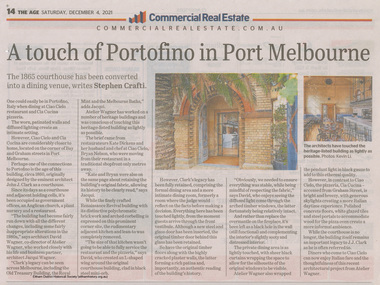
Newspaper - News Clipping, Stephen Crafti, A touch of Portofino in Port Melbourne, The Age, Commercial Real Estate, 4 Dec 2021
... In a further synergy with Eltham, Atelier Wagner were the architects who designed the extension to St Margaret's Anglican Church in Pitt Street, Eltham. ...Atelier Wagner St Margarets Anglican Church Pitt Street Eltham Courthouse Port Melbourne Courthouse Restaurant John J. ...Courthouse built in Port Melbourne of similar vintage to Eltham's courthouse (1860). 1865 Couthouse in Port Melbourne converted into a restaurant. The courthouse was originally designed by architect John J. Clark. Since its days as a courthouse and adjacent holding cells, it's been occupied as government offices, an Anglican church, a plant nursery and a restaurant. The building had become fairly run-down with some inappropraite changes according to David Wagner of Atelier Wagner, who in conjunction with partner Jacqui Wagner worked with present owners toi breathe new life intoi the building. In a further synergy with Eltham, Atelier Wagner were the architects who designed the extension to St Margaret's Anglican Church in Pitt Street, Eltham. atelier wagner, st margarets anglican church, pitt street, eltham courthouse, port melbourne courthouse, restaurant, john j. clark -
 Eltham District Historical Society Inc
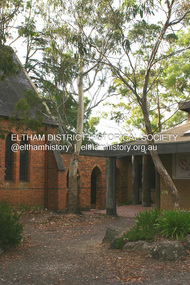
Photograph - Digital Photograph, Alan King, St Margaret's Anglican Church, Pitt Street, Eltham, 30 January 2008
... Wagner and constructed by Conrad Construction and Management. Covered under Heritage Overlay, Nillumbik Planning Scheme. National Trust of Australia (Victoria) State significance Victorian Heritage Published: Nillumbik Now and Then / Marguerite Marshall 2008; photographs Alan King with Marguerite Marshall.; p67 St Margaret’s Anglican Church in Pitt Street, Eltham, which officially opened on December 12, 1861, is the oldest intact church building in Eltham.1 With the nearby courthouse and police station, it was one of the first permanent community buildings in the district. ...Wagner and constructed by Conrad Construction and Management. Covered under Heritage Overlay, Nillumbik Planning Scheme. National Trust of Australia (Victoria) State significance Victorian Heritage Published: Nillumbik Now and Then / Marguerite Marshall 2008; photographs Alan King with Marguerite Marshall.; p67 St Margaret’s Anglican Church in Pitt Street, Eltham, which officially opened on December 12, 1861, is the oldest intact church building in Eltham.1 With the nearby courthouse and police station, it was one of the first permanent community buildings in the district. ...St Margaret’s Church of England was officially opened on December 12, 1861. It is the oldest intact church building in Eltham. At the time it was known as Christ Church until its consecration in 1871, when it was completely free of debt (£1,700 for the church and parsonage) despite the district’s poverty. This was largely due to the free labour and materials, including locally made bricks donated by local artisans and others. The church is historically significant because it is the oldest church in the former Shire of Eltham and has associations with the philanthropist and founder of Brighton, Henry Dendy (who donated the land on which the church is built), the architect Nathaniel Billing and the prominent local builder, George Stebbing. The church is architecturally and aesthetically significant because it is constructed in the Gothic Revival style with several stained-glass windows of various dates and is also a very early use of polychromatic brickwork in Victoria. Billing was one of the first Melbourne architects to employ polychromatic brickwork and an important early architect. The rear wall was intended to be temporary. A major feature of the design is the large buttresses with long, steeply graded upper faces. The overall design is well proportioned with the surface brick patterns relieving an otherwise austere design. The church is spiritually and socially significant because it has been an important place of worship for the people of Eltham for almost 150 years. The land on which the buildings stand was donated by Henry Dendy. Dendy arrived in Melbourne in 1841 after purchasing in England eight square miles at Brighton under the system of "special surveys". After this land passed out of his hands, Dendy moved about Victoria, visited England, then returned to settle in Eltham where he purchased a flour mill. Dendy chaired the meeting held in 1860 “for the purpose of devising such means as may be expedient for the establishment of a Church of England in the township of Eltham”. He became chairman and treasurer of the church committee. Unlike the establishment of many early churches in Victoria where a vicar was appointed to a parish and later a permanent church was constructed, the population at Eltham initiated action to build a church. The nearest church at that time was at Heidelberg and the Eltham settlement was part of the parish of St Johns Heidelberg. Isolation and the tedious, time consuming journey between Heidelberg and Eltham resulted in the Eltham community taking its own action. The original vicarage (Dendy House) at the rear of the church is also an important part of the cultural significance of this place because it is connected to the church and the development of the Eltham area. Together, the church and the vicarage are aesthetically significant because they form a significant streetscape feature. The mud-brick community hall designed by Robert Marshall was added in 1978. In 2014 the original temporary rear wall was removed as part of a modern extension designed by Architects Atelier Wagner and constructed by Conrad Construction and Management. Covered under Heritage Overlay, Nillumbik Planning Scheme. National Trust of Australia (Victoria) State significance Victorian Heritage Published: Nillumbik Now and Then / Marguerite Marshall 2008; photographs Alan King with Marguerite Marshall.; p67 St Margaret’s Anglican Church in Pitt Street, Eltham, which officially opened on December 12, 1861, is the oldest intact church building in Eltham.1 With the nearby courthouse and police station, it was one of the first permanent community buildings in the district. The church and vicarage are on the Register of the Heritage Council of Victoria and the National Trust of Australia – Victoria. The church is important as an early example of polychrome brickwork by the notable architect Nathaniel Billings. It is also notable for its historic associations with the early settlement of the Shire of Eltham and its connection with Henry Dendy, Brighton’s founder.2 Henry Dendy, who lived in Eltham much longer than at Brighton, chaired the original meeting which planned the church, and he donated the half-acre (0.2ha) site. Dendy had arrived in Melbourne in 1841 after buying eight square miles (20.7sq km) at Brighton while in England. After this land passed out of his hands, he eventually settled in Eltham where he bought a flour mill, west from the corner of Main Road and Pitt Street (then called Brewery Lane). The vicarage was named Dendy House after him. The Eltham settlers were unusual in initiating the establishment of a church. Usually in Victoria a vicar was appointed to a parish and then a permanent church was constructed. But then, the nearest church was at Heidelberg, which was a tedious and time-consuming journey. St Margaret’s builder was a local, George Stebbing, who also constructed the former Methodist, later Uniting, Church at John Street and the Shillinglaw Cottage near Eltham’s Central Park. It is believed the first Anglican Bishop of Melbourne, Bishop Perry, dedicated the church. After the ceremony he joined in the festivities at the nearby pub and a bill was sent to the parish for teas taken there by the bishop with other participants. The first vicar was the Reverend Robert Mackie from 1864 to1866. St Margaret’s Church was originally called Christ Church until its consecration in 1871, when it was completely free of debt (£1700 pounds for the church and parsonage) despite the district’s poverty. This was largely due to the free labour and materials, including local bricks, donated by local artisans and others. St Margaret’s Church is in the Gothic Revival tradition with a buttressed nave, paired lancet windows, porch and bell-cote. It was the first polychromatic brick church in Australia, using softly contrasting coloured brickwork.3 Billing was one of the first architects to introduce polychrome brickwork into Melbourne. His original drawings for St Margaret’s survive in a folio of his architectural work. However the church’s brickwork is more subdued than in his drawings. About half the windows – those in clear glass with gold borders – are original. The stained glass windows were made much later, but the one behind the altar is thought to be the oldest in the Diamond Valley. It was to be temporary until the congregation could afford to extend the church. In the early 1960s the original cedar pews were replaced by blonde timber pews and the originals were sold to restaurants and to private individuals. Eminent local sculptor Matcham Skipper created a crucifix for the church. A major addition was made in 1978, when the weatherboard hall was replaced by a mud-brick hall. Made of local material, it was designed by local architect and a former shire president Robert Marshall. The mud-brick hall reflects the style of building in Eltham of the late 1970s and for which Eltham is well-known. Perhaps because its earthy tones blend with the surrounding environment, the hall sits well with the church building. St Margaret’s membership has included economist and ABC chairman, Richard Downing; political commentator, diplomat and academic, William Macmahon Ball; Eltham civic leader, Charles Wingrove; artist, Peter Glass; and Eltham’s first postmaster, Frederick Falkiner.This collection of almost 130 photos about places and people within the Shire of Nillumbik, an urban and rural municipality in Melbourne's north, contributes to an understanding of the history of the Shire. Published in 2008 immediately prior to the Black Saturday bushfires of February 7, 2009, it documents sites that were impacted, and in some cases destroyed by the fires. It includes photographs taken especially for the publication, creating a unique time capsule representing the Shire in the early 21st century. It remains the most recent comprehenesive publication devoted to the Shire's history connecting local residents to the past. nillumbik now and then (marshall-king) collection, eltham, st margaret's anglican church, st margaret's church, st margarets church hall, christ church -
 Tatura Irrigation & Wartime Camps Museum
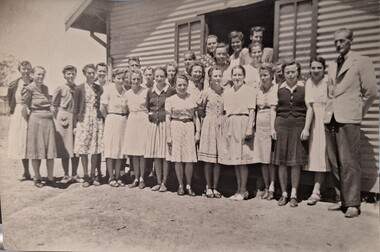
Photograph, German Internees at Camp 3, 1940 - 1946
... Margaret Pfander...Ruth Vollmer...Irene Krockenberger...Gudrun Frank...Mrs Kollat...Wolpurge Wagner...Bochrer, Isolde Frank, Elizabeth Vollmer, Emma Baumert, Ilse Fast, Helga Loebert, Liesolotte Steller, Annemarie Trefz, Gerda Kuebler, Gerda Decker, Hilde Kuebler, Irma Decker, Margaret Pfander, Ruth Vollmer, Irene Krockenberger, Gudrun Frank, Mrs Kollat, Wolpurge Wagner, Anni Kuebler, Mrs Ilse Boerner, Dr Reitmeier....Bochrer, Isolde Frank, Elizabeth Vollmer, Emma Baumert, Ilse Fast, Helga Loebert, Liesolotte Steller, Annemarie Trefz, Gerda Kuebler, Gerda Decker, Hilde Kuebler, Irma Decker, Margaret Pfander, Ruth Vollmer, Irene Krockenberger, Gudrun Frank, Mrs Kollat, Wolpurge Wagner, Anni Kuebler, Mrs Ilse Boerner, Dr Reitmeier. internee children camp 3 German internees Mrs Wieberle Mrs Lippmann Mrs Wurster Lily Fast Eva Ruff Leni Haar Isolde Pfander Bochrer Isolde Frank Elizabeth Vollmer Emma Baumert Ilse Fast Helga Loebert Liesolotte Steller Annemarie Trefz Gerda Kuebler Gerda Decker Hilde Kuebler Irma Decker Margaret Pfander Ruth Vollmer Irene Krockenberger Gudrun Frank Mrs Kollat Wolpurge Wagner Anni Kuebler Mrs Ilse Boerner Dr Reitmeier Black and white photograph of group of about 40 people. ...Teachers and students from Camp 3 school. Left to right: Mrs Wieberle, Mrs Lippmann, Mrs Wurster, Lily Fast, Eva Ruff, Leni Haar, Isolde Pfander, ? Bochrer, Isolde Frank, Elizabeth Vollmer, Emma Baumert, Ilse Fast, Helga Loebert, Liesolotte Steller, Annemarie Trefz, Gerda Kuebler, Gerda Decker, Hilde Kuebler, Irma Decker, Margaret Pfander, Ruth Vollmer, Irene Krockenberger, Gudrun Frank, Mrs Kollat, Wolpurge Wagner, Anni Kuebler, Mrs Ilse Boerner, Dr Reitmeier.Black and white photograph of group of about 40 people. Mostly ladies in front of a hut. Teachers and students.internee children, camp 3, german internees, mrs wieberle, mrs lippmann, mrs wurster, lily fast, eva ruff, leni haar, isolde pfander, bochrer, isolde frank, elizabeth vollmer, emma baumert, ilse fast, helga loebert, liesolotte steller, annemarie trefz, gerda kuebler, gerda decker, hilde kuebler, irma decker, margaret pfander, ruth vollmer, irene krockenberger, gudrun frank, mrs kollat, wolpurge wagner, anni kuebler, mrs ilse boerner, dr reitmeier -
Tatura Irrigation & Wartime Camps Museum
Photograph, Camp 3 School Children
... ; Isolde Frank; Elizabeth Vollmer; Emma Baumert; Ilse Fast; Helga Loebert; Liesolotte Steller; Annemarie Trefz; Gerda Kuebler; Gerda Decker; Hilde Kuebler; Irma Decker; Margaret Pfander; Ruth Vollmer; Irene Krockenberger; Gudrun Frank; Mrs. Kollat; Wolpurga Wagner; Anni Kuebler; Mrs. ...; Isolde Frank; Elizabeth Vollmer; Emma Baumert; Ilse Fast; Helga Loebert; Liesolotte Steller; Annemarie Trefz; Gerda Kuebler; Gerda Decker; Hilde Kuebler; Irma Decker; Margaret Pfander; Ruth Vollmer; Irene Krockenberger; Gudrun Frank; Mrs. Kollat; Wolpurga Wagner; Anni Kuebler; Mrs. ...Camp 3. School Children with Teachers. Photo 2: Mrs. Weiberle; Mrs. Lippmann; Mrs. Wurster; Lily Fast; Eva Ruff; Leni Haar; Isolde Pfander; ? ; Isolde Frank; Elizabeth Vollmer; Emma Baumert; Ilse Fast; Helga Loebert; Liesolotte Steller; Annemarie Trefz; Gerda Kuebler; Gerda Decker; Hilde Kuebler; Irma Decker; Margaret Pfander; Ruth Vollmer; Irene Krockenberger; Gudrun Frank; Mrs. Kollat; Wolpurga Wagner; Anni Kuebler; Mrs. Ilse Boerner; Dr. Reitmeier.photograph, people
