
Showing 36 items matching "marine engineer"
-
 Bay Steamers Maritime Museum
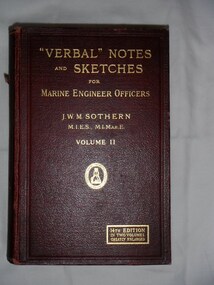
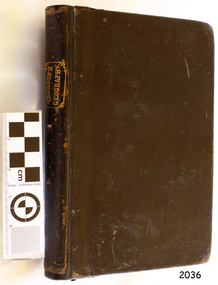
Book, J.W.M. Sothern, "Verbal" Notes and Sketches for Marine Engineer Officers Volume II
... "Verbal" Notes and Sketches for Marine Engineer Officers Volume II...Maroon hard cover book of 700 or so pages "Verbal" Notes and Sketches for Marine Engineer Officers Volume II Book J.W.M. Sothern James Munro & Co. ...Maroon hard cover book of 700 or so pages -
 Flagstaff Hill Maritime Museum and Village
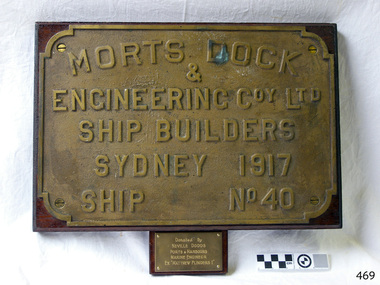
Plaque - Nameplate, Morts Dock & Engineering Co. Ltd, Matthew Flinders I, 1917
... ...Marine Engineer...It was donated by the Marine Engineer, Neville Dodds, from Ports and Harbours, from the Matthew Flinders I. .... / SHIP BUILDERS / SYDNEY 1917 / SHIP NO 40" On small plaque: "Donated by / NEVILLE DODDS / PORTS & HARBOURS / MARINE ENGINEER / EX "MATTHEW FLINDERS I"...It was donated by the Marine Engineer, Neville Dodds, from Ports and Harbours, from the Matthew Flinders I. ...This nameplate was attached to the steel steamer Matthew Flinders I, a Suction Hopper Dredge used for pumping up sit and sanding from seabeds. It was donated by the Marine Engineer, Neville Dodds, from Ports and Harbours, from the Matthew Flinders I. The Matthew Flinders was constructed by Morts Dock & Engineering Coy. Ltd in Sydney, New South Wales. Identified as Ship No. 40, the dredge had twin screw engines that were made in Sydney. Its gross tonnage was 1180. It was launched on July 15th, 1916, and registered in 1917 at the Port of Melbourne by the owner, the Department of Public Works in Victoria. Unlike bucket dredges, the Matthew Flinders did not use permanent moorings but instead had bow and stern anchors. It travelled forward on the bow anchor, taking up a strip of even-depth wilt from the bed below. A local newspaper noted that the Matthew Flinders has many advantages that were especially useful for its work at Warrnambool. Warrnambool Harbour had been experiencing silting and sanding for many years. The problem continued even after the construction of the Breakwater in 1890, which was overseen by New Zealand engineer Arthur Dudley Dobson. Melbourne’s Department of Ports and Harbours sent the new Matthew Flinders to dredge the heavy silting in the Warrnambool Harbour in May 1919. This work was previously done by the smaller dredge, the Pioneer. However, after a month of work, the Matthew Flinders was returned to Melbourne for alterations to make it suitable for work in the heavy seas it experienced at Warrnambool. Both dredges were sent up from Melbourne when required over the years to periodically attend to the silting in the Harbour, but the Matthew Flinders was preferred because of its efficiency. It was still dredging the Harbour even in July 1938. The ship’s original master was J G Rosney. In February 1922 Percy Taylor from Ports and Harbours joined the Matthew Flinders as a Mate. 1923 the master in charge was Captain Dunbar. In August 1926 Percy Taylor was appointed as her Master and was later transferred to the Pioneer as Master in 1933. 1930 the dredges were no longer required as the Harbour was no longer suitable as a port. However, one source notes that the Matthew Flinders was still dredging the Harbour in 1938.This nameplate is significant for its association with the suction hopper dredge Matthew Flinders I, which was used to remove the build-up of silt and sand from the Warrnambool Harbour, allowing shipping activities to continue to operate in the Port of Warrnambool. The nameplate identifies the vessel and shows that it was built in Australia in the early 20th century for use within Australia. The need for dredging in the Warrnambool Harbour was a serious and ongoing problem, as silting continued to happen after a series of measures were taken to try and resolve the issue. Eventually, the Harbour could no longer function successfully as a port.Brass nameplate, rectangular with cut-away corners and moulded text, mounted with screws on timber. The plate is from a vessel, the dredge Matthew Flinders I, ship no. 40, built by Morts Dock & Engineering Coy Ltd in Sydney, and registered in 1917. A small rectangular engraved plaque below the nameplate gives further details of the ship and the donor.On nameplate: "MORTS DOCK / & / ENGINEERING COY. LTD. / SHIP BUILDERS / SYDNEY 1917 / SHIP NO 40" On small plaque: "Donated by / NEVILLE DODDS / PORTS & HARBOURS / MARINE ENGINEER / EX "MATTHEW FLINDERS I"flagstaff hill, warrnambool, maritime village, maritime museum, flagstaff hill maritime museum & village, shipwreck coast, great ocean road, dredge, mathew flinders i, steel steam ship, twin screw engines, nsw, state of victoria, suction hopper, public works melbourne, warrnambool harbour, lady bay, sanding, silting, breakwater, morts dock & engineering co ltd, captain dunbar, ship no. 40, niville dodds, ports & harbours, marine engineer, marine technology, ship relic, percy taylor, matthew flinders, pioneer -
 Mission to Seafarers Victoria
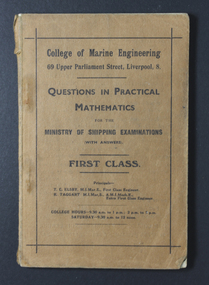
Education kit - Text Book, Questions in Practical Mathematics for Ministry of Shipping Examinations with Answers, early to mid 20th Century
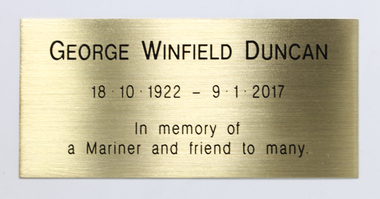
... marine engineer training...As the previous owner, a marine engineer and donor of this textbook was based in Liverpool for some years it is possible that he may have studied for the Ministry of shipping exam at the former College of Marine Engineers, Liverpool in the early - mid 20th C. ...As the previous owner, a marine engineer and donor of this textbook was based in Liverpool for some years it is possible that he may have studied for the Ministry of shipping exam at the former College of Marine Engineers, Liverpool in the early - mid 20th C. ...As the previous owner, a marine engineer and donor of this textbook was based in Liverpool for some years it is possible that he may have studied for the Ministry of shipping exam at the former College of Marine Engineers, Liverpool in the early - mid 20th C. Mariner Duncan had a particular regard for the Mission to Seafarers. A plate for display on a commissioned new table at the MTSV chapel acknowledges his bequest and the material donated. Collectively the G W Duncan material includes: photographs, professional data memorabilia and written and commercially printed resources. The memorabilia relates to his career at sea and in particular the role of an engineer, including a handwritten manual of notes and references relating to the mechanical and engineering aspects and areas of responsibility for maintenance. Text book with dull grey brown cover with black printing and simple line border.See image attachedmarine engineer training, engineers, mathematics, ministry of shipping, liverpool, exams, mariners, george winfield duncan (1922-2017), ship engineer, s.s. athenic -
 Federation University Historical Collection
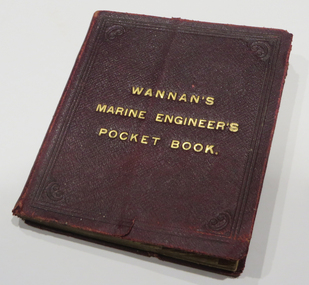
Book, A.C. Wannan, Wannan's Marine Engineer's Pocket Book, 1902, 1902
... ...marine engineer...Small, illustrated maroon hard cover book containing the latest (1902) board of trade rules and Data for Marine Engineers....Small, illustrated maroon hard cover book containing the latest (1902) board of trade rules and Data for Marine Engineers. marine marine engineer engineer Maroon hard covered book of 183 pages. ...Small, illustrated maroon hard cover book containing the latest (1902) board of trade rules and Data for Marine Engineers.Maroon hard covered book of 183 pages.marine, marine engineer, engineer -
 Frankston RSL Sub Branch
Medals Set (set of 4)
... Service medal set awarded to P/A/Petty Officer Marine Engineer Kenneth Greenwood, ex RAN R55206. ...Service medal set awarded to P/A/Petty Officer Marine Engineer Kenneth Greenwood, ex RAN R55206. ...Service medal set awarded to P/A/Petty Officer Marine Engineer Kenneth Greenwood, ex RAN R55206. The set consists of four medals in original presentation cases. -
 Flagstaff Hill Maritime Museum and Village
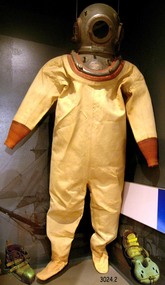
Functional object - Diving Suit, boots and weight, Early-to-mid 20th century
... Siebe Gorman & Company Ltd was a British company that developed diving equipment and breathing equipment and worked on commercial diving and marine salvage projects. The company advertised itself as 'Submarine Engineers'. ..."Siebe Gorman & Co Ltd Marine Engineers London. Patent" with "E G Ward" on front and back plate. ...Ward Edward Ward Ted Ward "Siebe Gorman & Co Ltd Marine Engineers London. Patent" with "E G Ward" on front and back plate. ...This diving suit with helmet, boots and weight is part of the E. G.Ward collection, along with the diving compressor and a photograph of a diver in this equipment. Siebe Gorman & Company Ltd was a British company that developed diving equipment and breathing equipment and worked on commercial diving and marine salvage projects. The company advertised itself as 'Submarine Engineers'. It was founded by Augustus Siebe, a German-born British engineer chiefly known for his contributions to diving equipment. Siebe Gorman traded as an engineering firm for over 180 years from 1819 to 1999. The early success of the business was due to its founder, the Prussian immigrant Christian 'Augustus' Siebe (1788-1872). For business reasons, he applied for and was granted British citizenship in 1856. He was a gifted engineer who was able to translate theoretical problems into practical, working products. During the industrial Victorian period, the business traded as 'A. Siebe' at 145 High Street Holborn London, but in 1828 new premises were acquired at 5 Denmark Street, Soho. The family firm produced a wide range of manufactured goods including paper-making machinery, measuring machinery, water pumps, refrigeration equipment and diving apparatus. Augustus Siebe specialised in submarine engineering early on and the company gained a reputation for the manufacture of safe, reliable diving apparatus. Augustus Siebe is best remembered for the development and manufacture of the ‘closed’ Diving Dress based on the ideas of Charles and John Deane, George Edwards and Charles Pasley. Apart from some small modifications to valves and diver communications, the basic 12-bolt ‘closed’ diving dress remained relatively unchanged after the 1870s. Later company successes were also based on innovation, with new products that could be successfully developed and manufactured to high standards. This was largely attributed to the inventive nature, foresight, engineering and entrepreneurial skills of Robert Henry Davis (1870-1965). In 1882, RH Davis joined the company of 'Siebe & Gorman' as a young 11-year-old office boy and he was to remain with the company until he died in 1965. Augustus Siebe retired in 1869 and handed over the company to a new partnership of Henry H. Siebe (1830-1885) and William A. O'Gorman (1834-1904). The new firm traded as 'Siebe & Gorman' (1870-1879) from premises in and around Mason Street, Westminster Bridge Road, Lambeth, London. The two partners soon recognised the potential of R.H. Davis and in 1894, aged 24, he became General Manager of Siebe & Gorman. Davis increasingly ran the company until the surviving partner (W.A. Gorman) died in 1904. The firm was disposed of to the Vickers (armaments) family and a new company 'Siebe Gorman & Co. Ltd.' (1905-1998) was formed. Under the chairmanship of Albert Vickers, R.H. Davis was kept on as Managing Director, and the company forged ahead. However, after WW1, the Great Depression caused manufacturing output and share prices to slump. In 1924 Robert Davis made a deal with the Vickers Board and acquired control of the company through majority shares. Under his leadership, the Siebe Gorman Company flourished and within time, four of his sons also joined the firm. The company gained a worldwide reputation for the manufacture of diving apparatus, decompression and observation chambers, and safety breathing apparatus of all types for use on the land, in the air and under the sea (including mine rescue, tunnelling, aircraft, diving, submarine escape and in other hazardous environments). Close research and development links with the MOD (especially the Admiralty), also provided a lucrative outlet for the company products. In 1932, Robert Davis was knighted by King George V, principally for his invention of the ‘Davis Submerged Escape Apparatus’ (D.S.E.A.). Siebe Gorman essentially remained a family firm from the beginning (under A.Siebe) until it became a public company for the first time in 1952. However, following WW2, British manufacturing stagnated through stifled investment and post-war austerity, and there was little innovation. Siebe Gorman fortunes began to decline as an ageing Sir Robert Davis failed to invest, or change the company business and management practices. In 1959, Siebe Gorman was acquired by the “Fairy Group” and the ailing Sir Robert was made Life President. Consequently, nothing changed and the slow decline continued until Sir Robert's death in March 1965. Around 1960, Siebe Gorman acquired the diving apparatus manufacturer C E Heinke, and for a brief period, it manufactured some diving equipment under the combined name of Siebe Heinke. Around 1964, Mr E. 'Barry' Stephens was appointed as the new Managing Director to modernise Siebe Gorman. Changes were made, including a move to a new factory in Wales in 1975. The new company concentrated on fire-fighting breathing apparatus and escape equipment, and the move coincided with the loss of many of the older, traditional craft skills. Between 1985 and 1998, Siebe expanded through acquisitions, and several other companies were acquired. The Siebe Gorman (diving apparatus) company has therefore traded as A. Siebe (1819-1870); Siebe & Gorman (1870-1879); Siebe Gorman & Co (1880-1904); Siebe Gorman & Co. Ltd (1905-1998).The diving suit, helmet, boots, and weights, along with associated equipment in the Flagstaff Hill collection, represent a highly significant snapshot of marine history. These items are particularly important in understanding the evolution of diving equipment, with a special focus on their use in salvage operations before and throughout the Second World War. Manufactured by a company renowned for its inventions, development, and innovation in marine engineering, the equipment demonstrates the progression of technology in deep-sea diving. Early helmets and related items produced by this company remain highly sought after by collectors worldwide, highlighting their historical and technological value. The presence of these items within the Flagstaff Hill Maritime Museum allows for a unique insight into the working conditions and methods employed by divers. It also illustrates the considerable dangers they faced while performing such essential and hazardous work, underscoring the critical role played by these professionals in maritime history.Diving suit including helmet, boots and a weight. Diving suit is made of canvas with knitted cuffs. The helmet is metal. The boots have a thick sole and thick leather upper that is held on with leather straps and buckles. The toe of the boot is heavy metal. The weight is worn next to the trunk of the diver and it has an inscription to mark the front. It is worn with straps and buckles holding it in place. Royal Navy Admiralty Pattern 6 bolt No 3 light Siebe Gorman light diving helmet circa 1960, used by the Royal Navy before and after World War 2. This equipment is part of the E. G. Ward Collection."Siebe Gorman & Co Ltd Marine Engineers London. Patent" with "E G Ward" on front and back plate. On weight "FRONT"flagstaff hill, warrnambool, diving suit, siebe gorman and co ltd., siebe gorman and co ltd marine engineers london, marine engineers, diving helmet, diving boots, diving weight, marine diving, maritimemuseum, maritime village, maritime history, marine technology, life saving, deep sea diving, maritime museum, siebe gorman and co ltd., siebe gorman and co ltd, london, deep-sea diving, e. g. ward, e g ward, e.g. ward, edward ward, ted ward -
 Lakes Entrance Historical Society
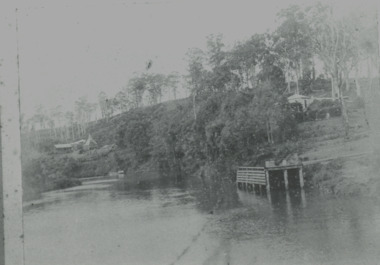
Photograph, Battens Landing on Tambo River, Tambo Upper Victoria, 1915 c
... Tambo Upper House on right Captain Wilson Marine Engineer steam launch Union Jack, house on left is Sam Solomans House and Hop kilns ...Tambo Upper House on right Captain Wilson Marine Engineer steam launch Union Jack, house on left is Sam Solomans House and Hop kilns Rivers Jetties Farming Black and white photograph of Battens Landing on Tambo River, Tambo Upper Victoria Battens Landing on Tambo River, Tambo Upper Victoria Photograph ...Tambo Upper House on right Captain Wilson Marine Engineer steam launch Union Jack, house on left is Sam Solomans House and Hop kilns Black and white photograph of Battens Landing on Tambo River, Tambo Upper Victoriarivers, jetties, farming -
 Flagstaff Hill Maritime Museum and Village
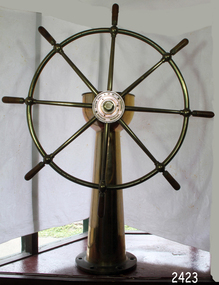
Equipment - Ship's Wheel, John Hastie et al, Early 20th Century
... He was also a Fellow of the Royal Society of Edinburgh, a member of the Institute of Mechanical Engineers and of the Institution of Marine Engineers he died in 1906 at the age of 67....He was also a Fellow of the Royal Society of Edinburgh, a member of the Institute of Mechanical Engineers and of the Institution of Marine Engineers he died in 1906 at the age of 67. ...John Hastie Engineer and millwright John Hastie opened small manufacturing works in Greenock in 1845 and 1853 patented the first self-holding steering gear. The firm became known as John, Hastie and Co. Ltd. in 1898 after taking on limited liability status and their main works were at Kilblain Street, Greenock, where they specialised in ships' steering gear. The company also occupied works at Rue End Street, Greenock. Plans of this unit depict a stockyard to the east, with areas for welding; fitting and assembly; flame, cutting and fabrication; and a machine bay. The company was dissolved in 1991. Brown Brothers Brown Bros Rosebank Ironworks made the steering gears for many large ship's, including The Titanic. Andrew Betts Brown the founder was born in 1741 and closely associated with many improvements in marine engineering. He was educated in his native city and served his apprenticeship as an engineer in the locomotive works of the North British Railway Company at St. Margaret's. During his apprenticeship, he attended the evening classes at Watt College. subsequently going to Manchester to study chemistry. He went to London around 1863 and took over an old brewery, which he converted into an engineering works. During his time there he invented an overhead travelling crane, which was used on the construction of Blackfriars Bridge London. He went on to develop plant which used steam and hydraulic power for discharging ships as a result the company was contracted to install this equipment in Hamburg Docks. By around 1870 he continued to construct machinery in London but realised that conditions were more favourable in Edinburgh. He acquired land at Rosebank adjoining the North British Railway Company's line to Granton, and the necessary infrastructure was completed allowing him to finish the Hamburg contract. The works at Rosebank were eventually extended and added to until they became one of the largest engineering works in the East of Scotland. Mr Brown was a member of numerous engineering institutions, the best known at the time being the Institution of Naval Architects. He was also a Fellow of the Royal Society of Edinburgh, a member of the Institute of Mechanical Engineers and of the Institution of Marine Engineers he died in 1906 at the age of 67.An item made by two marine innovators of marine auxiliary machinery, equipment and itemsShip's wheel, brass, attached to brass pillar. The base has six holes in it for securing it in place. Top of the ship's wheel pillar has a brass, adjustable arrow pointer that is positioned over a dial etched into the flat brass surface. The dial reads " PORT STABD". Lines and degrees are marked, with '0' in centre and every 5 degrees, from 0-35, in both Port and Starboard sidesInscription to wheel hub "Brown Brothers & Co. Ltd, Rosebank Ironworks, Edinburgh"flagstaff hill, warrnambool, shipwrecked-coast, flagstaff-hill, flagstaff-hill-maritime-museum, maritime-museum, shipwreck-coast, flagstaff-hill-maritime-village, john hastie, john hastie, andrew betts brown, ships wheel, ship steering gear, marine equipment, instrument, navigation -
The Beechworth Burke Museum
Audio - Oral History, Jennifer Williams, Max Suter, 29 June 2000
... He first began his work as a marine engineer at the Mildura Irrigation Trusts, moving later to the Melbourne Harbour Trusts. ...He first began his work as a marine engineer at the Mildura Irrigation Trusts, moving later to the Melbourne Harbour Trusts. ...Mr Max Sutor was born in South Australia. He first began his work as a marine engineer at the Mildura Irrigation Trusts, moving later to the Melbourne Harbour Trusts. After a number of years as an engineer, he moved into farming at Gippsland and joined the prison service several years after during the late 1960s. He was first stationed at Morwell River Prison in South Gippsland, transferring to McLeod Prison in 1972 and finally to Beechworth in 1974 as senior prison and stores officer. He would assist in the organisation, obtaining and distribution of food and medication to prisoners. The prison, at the time, was of medium security and held high security prisoners, with an estimated amount of 108 prisoners to 23 staff. Mr Suter showed a great push in showing humility towards prisoners, wanting to avoid animosity against them by never looking at their records to treat them equally. His choice of kind behaviour towards prisoners had clearly influenced their own, especially during manual labor. The prison had worked cooperatively with a local farm, having their prisoners assist in the farm work. Attitudes inevitably changed positively for several prisoners. Whilst he held no control over their actions at the farm, he still became well trusted and liked amongst the prisoners, as they would continue to go to him for assistance and questions. Mr Suter had also worked as an instigator of finding drugs within each prison he has worked within. This led him to study the variations, and being a member of the Parents and Citizens Association at the high school his children attended, as well as Community Service Director of a Rotary club, he wanted to educate parents in guidance for those unsure on how to conduct actions against such behaviours. From his first seminar, a police surgeon told him that three drug users were found by their parents. This oral history recording was part of a project conducted by Jennifer Williams in the year 2000 to capture the everyday life and struggles in Beechworth during the twentieth century. This project involved recording seventy oral histories on cassette tapes of local Beechworth residents which were then published in a book titled: Listen to what they say: voices of twentieth century Beechworth. These cassette tapes were digitised in July 2021 with funds made available by the Friends of the Burke.Mr Max Suter's account on his time and experience as a senior prison officer at Beechworth Prison is historically and socially significant for the cultural heritage of the region. His recounts of his time working within the prison and out in local parent and community associations held a positive effect on the awareness and behaviours of the Beechworth area, and provides detailed information on the duties and complications working in a 20th century rural prison, as well as the lack of local awareness from adults with young influential children. This oral history account is socially and historically significant as it is a part of a broader collection of interviews conducted by Jennifer Williams which were published in the book 'Listen to what they say: voices of twentieth-century Beechworth.' While the township of Beechworth is known for its history as a gold rush town, these accounts provide a unique insight into the day-to-day life of the town's residents during the 20th century, many of which will have now been lost if they had not been preserved.This is a digital copy of a recording that was originally captured on a cassette tape. The cassette tape is black with a horizontal white strip and is currently stored in a clear flat plastic rectangular container. It holds up 40 minutes of recordings on each side.Max Suterlisten to what they say, beechworth, oral history, burke museum, max suter, beechworth prison, farming, drug awareness -
 Eltham District Historical Society Inc
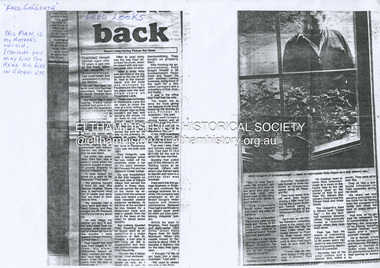
Document - Photocopy, Diamond Valley News, Newspaper article: Fred looks back by Linley Hartley, Diamond Valley News, c.1985
... “He was like a father to me,” Fred declared. He was a marine engineer as well, so I …. that as well as blacksmithing. ...“He was like a father to me,” Fred declared. He was a marine engineer as well, so I …. that as well as blacksmithing. ...Fred looks back; Report: Linley Hartley, Picture: Ron Grant Teaching himself German again after 70 years is just one of the many tasks Fred Golgerth, of Greensborough, has undertaken and succeeded in during his lifetime. As the two year old tenth child of a German descendent, Fred learnt to speak German from an Aunt. But World War 1 was raging. Fred’s older brother had gone to Europe with the Australian forces, changing his name … to ….. to sound less German. “I used to get my bottom slapped for speaking German at home,” Fred said. Even his name was changed from Otto to the more anglicised Frederick. Fred claims his involvement with Eltham started two years before he was born! His sister, two years older than him, was a babe in arms when his parents bought a piece of grazing property in Mount Pleasant Rd. “It was about 24 acres on a spur of Mt Pleasant,” Fred said. “My parents bought it from Mr and Mrs Hughes. There was a two-room mud hut in wattle and daub that we lived in from time to time. “My parents had a dairy farm and dairy in West Coburg, and they bought the Mt Pleasant land to put the dry stock on. “At one stage my mother got very ill and my older sister took my younger sister and myself to Eltham for four or five months. I went down to Eltham Primary School then.” That wasn’t the only time Fred stayed in Eltham. His sister, Wilhemina, known as Willa, married Jim Watson who had the Eltham hotel for some years from the end of World War 1. Pillar to post living was the way Fred described his youth, when he stayed with one married sister after another. “After a while Will and Jim lived in the big house at the top of Pitt St, next to the Council depot, and the hotel was managed by Fitzsimmons who had a big place near the river down there on Fitzsimons Lane. There was no bridge in Fitzsimons Lane but we used to cross the river at a ford, rolling up our trouser legs so they wouldn’t get wet, and carrying our shoes. I’d o down to visit some friends I had in Templestowe. And sometimes Jim Watson took his horse drawn lorry across the ford on his way to the brewery, instead of going don through Heidelberg.” “The bridge across the Yarra in Fitzsimons was not built until 1961.” Fred Golgerth, was only a teenager when he was rolled off his pushbike under a car on the bend between Mt Pleasant Rd and the Diamond Creek bridge. He was hospitalised in the little hospital on the east side of Eltham village that served the district in those days. He still carries the scars of the burns he received from the exhaust pipe and recent x-rays have revealed several broken vertebrae. At the time of the accident he was treated for a dislocated neck and was in plaster from his hip to the base of his head for about seven months. But nothing daunted Fred. Bouncing back he began work as an apprentice to a motor mechanic in Bell St, Preston, a man who is still living (at 90) in Queensland and who still communicates with Fred frequently. “He was like a father to me,” Fred declared. He was a marine engineer as well, so I …. that as well as blacksmithing. They taught us properly then.” After finishing his apprenticeship, Fred bought himself a 30 hundredweight Fargo truck and began his own contract carting business, doing most of the work for a firm called Carnegie’s and a subsidiary of that, Howard Radio. It was in the office Fred met his wife. “He taught me to drive the truck giving me lessons in my lunch hours up the Bourke St and Flinders St extension,” she said. “After work I’d have a driving lesson and all the girls from the Howard Radio would pile in the back to get a lift to Richmond Station.” In the 1939 bushfires, the Mt Pleasant Rd property was burnt out and the hut raised. Two years later, Fred and Dorothy were married. Fred paid £7.15.0 ($15.50) for the suit in which he was married. Dorothy had pulled out of the Women’s Air Training Corps to be married. Others with whom she trained went to Darwin and were in a convoy that was bombed. Fred went into the garage business in Brighton and continued his cartage business for a while. His company was employed to do all Brown Gouge’s motor repairs and factory maintenance. Because Fred had a certificate to do steam repair work he often got jobs maintaining industrial boilers. While he was in Brighton, Fred bought an eight-seater 1925 Silver Ghost Rolls Royce from Sir Keith Murdoch. When the couple moved to Rosanna in about 1943, it became a delivery van for the dairy they operated. “I thought I’d like to get back into a dairy business” Fred said. “We used to deliver the milk in the Rolls. “But it was hard work. We couldn’t get the labour and we’d drive to the farm and pick up the milk cans, take them back to the dairy, cool the milk, bottle it and deliver it. The inspectors would come regularly and the walls for bacteria.” Fred was exhausted. The couple gave up the dairy and moved to Eltham to live on the old property where a weatherboard house had now been built. It wasn’t a big house and the glassed in Rolls Royce limousine became the daytime nursery for the Golgerth’s second daughter. We’d put her in there to sleep during the day.” “Dorothy Golgerth was known to drive the Rolls at breakneck speed along Mt Pleasant Rd. Fred took some time off work then began driving a little local bus run by the Lyon Brothers before taking a maintenance job at the Athenaeum Club in the city. He’d ride an old Harley-Davidson to the station and travel into the city by train. Later, when the family moved to Pryor St. (their house stood where McEwans car park is now) Fred could walk to and from the station. “There was no resident doctor in the early days of Eltham,” Fred said. “Dr Cordner used to come from Greensborough to a room in the old house next to the old grocery shop on the corner of York St and Main Rd, Eltham (the grocery shop is now the Eltham Feed and Grain Store). The Golgerths lived in Eltham until “Dollar Day” – the day decimal currency became official. They eventually moved to Greensborough, when they have lived since. Fred has had his share of interesting jobs since then, retiring at 65 seven years ago when he was working in the engineering department at Larundel. Recently, two of his older sisters and a brother died, within a month. They were all in their 80s. They all had a profound influence on Fred, especially during his youth. His sharp wit and amusing anecdotes are the richer for his having been the youngest of a family that made the best of every circumstance. And now, as he enjoys his retirement, he is concentrating on relearning the language of his infancy; teaching himself German from tapes and a ‘teach yourself’ manual. He is fiercely proud of his German ancestry and treasures the diary, written in German in Gothic script, kept by his grandparents during their journey to Australia. On the inside in blue pen: "To Sadie, Wal Margaret & Elizabeth with lots & lots of love & best wishes from Mother"marg ball collection, eltham hotel, herbert james watson, otto (fred) golgerth, wilhemina watson (nee golgerth) -
 Flagstaff Hill Maritime Museum and Village
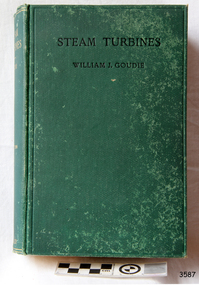
Book - Reference, William J Goudie, D. Sc., Professor (William john Goudie), Steam Turbines, 1922
... Sc, was a mechanical engineer who had practical experience in a marine consulting engineering service and lectured in the theory and practice of mechanical engineering.This book is an example of the development of technology that contributed to the evolution of steam turbines. ...This textbook was written for engineering students by Scottish Professor, William J Goudie, D. Sc., (1868-1945). He was a member of the Institution of Mechanical Engineers, a member of the Institution of Engineers and Shipbuilders in Scotland, an Associate Member of the Institution of Civil Engineers, James Watt Chair of Mechanical Engineering, University of Glasgow, and Professor of "The Theory and practice of Heat Engines" in the University of Glasgow. He wrote several papers and books on the topics of mechanical speed and power. The publisher firm, Longmans, Green & Co., was originally founded in 1724 in London by Thomas Longman under the name Longman. In August of that year, he bought the two shops and goods of William Taylor and set up his publishing house there at 39 Paternoster Row. The shops were called Black Swan and Ship, and it is said that the 'ship' sign was the inspiration for Longman's Logo. After many changes of name and management, the firm was incorporated in 1926 as Longmans, Green & Co. Pty Ltd. The firm was acquired by Pearson in 1968 and was known as Pearson Longman or Pearson PLC. The first practical steam turbine was built in 1884 by Charles Parsons and this became the beginning of generating electricity and powering large ships. The author of Steam Turbines, Professor William John Couldie D. Sc, was a mechanical engineer who had practical experience in a marine consulting engineering service and lectured in the theory and practice of mechanical engineering.This book is an example of the development of technology that contributed to the evolution of steam turbines. The book is also significant for its connection to the publisher Longmans, Green and Co., of London, a firm that has been established for over two centuries, renowned for publishing encyclopedias, dictionaries, books on English grammar, textbooks, poetry, reference books, novels, magazines and more.Steam Turbines, by William J. Goudie, D. Sc., Second edition, rewritten and enlarged. Published by Longmans, Green & Co. in 1922. The book has a textured green hardcover with a printed black title on the front cover and a gold embossed title on the spine. The fly page describes the contents. It states the author's credentials and the book's features - 329 illustrations and numerous examples.. The logo of Longmans, Green & Co. is on the fly page. It is a line drawing of a shield above a leafy wreath border surrounding a sailing ship at sea with a plaque below. Inscriptions are on the shield and plaque.On the shield: "L & Co" [Longman Green & Co.] On the plaque: "1724" [date business was established]flagstaff hill, flagstaff hill maritime museum and village, warrnambool, maritime museum, maritime village, great ocean road, shipwreck coast, steam turbines, longmans green and co, paternoster row london, ship logo, engineering studies, textbook, 1922, longmans green and co., l & co., 1724, institution of mechanical engineers, institution of engineers and shipbuilders scotland, institution of civil engineers, james watt professor of "the theory and practice of heat engines", thomas longman, paternoster row, william goudie, william j goudie, professor william j goudie d. sc., james watt chair of mechanical engineering, steam turbine, marine turbines, steam power -
 Flagstaff Hill Maritime Museum and Village
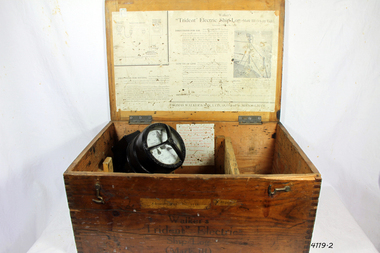
Instrument - Ship Log, Early 20th Century
... marine navigators. Thomas Walker & Son were internationally renowned in the manufacturing of ship logs the founding father, Thomas Walker (1805–1871), an engineer in Birmingham, patented his mechanical log in 1878 which was a recording instrument that attached to a rail at the stern of a vessel connected by a long cord with a rotor which was towed behind the ship. ...marine navigators. Thomas Walker & Son were internationally renowned in the manufacturing of ship logs the founding father, Thomas Walker (1805–1871), an engineer in Birmingham, patented his mechanical log in 1878 which was a recording instrument that attached to a rail at the stern of a vessel connected by a long cord with a rotor which was towed behind the ship. ...In times past the only way to measure a ship’s speed was to throw a wood log into the water and observe how fast it moved away from the ship. In the 16th century, the log was fastened to a rope knotted at set intervals. The log was thrown over the stern (back) of the vessel and a crew member counted the number of knots that were paid out in a set time. From this, they could estimate the vessel's speed through the water. This was known as streaming the log and is also the derivation of the knot as a measurement of nautical speed. Various manufacturers of nautical equipment had sought over the years to perfect the operation of determining a ship's speed and it wasn't until Thomas Walker and his son Ferdinand developed a mechanical system that eventually made this task became easy for marine navigators. Thomas Walker & Son were internationally renowned in the manufacturing of ship logs the founding father, Thomas Walker (1805–1871), an engineer in Birmingham, patented his mechanical log in 1878 which was a recording instrument that attached to a rail at the stern of a vessel connected by a long cord with a rotor which was towed behind the ship. The instrument dial then recorded the distance travelled. Thomas Walker first went into business to manufacture stoves at 58 Oxford Street Birmingham. Walker’s self-feeding stove was widely lauded at the Paris Exhibition of 1855, winning a prize medal and kickstarting the first of many notable innovations for the Walker family's manufacturing business. However, it wasn’t until working on an earlier ship’s log model invented by his Uncle that Thomas Walker became interested in the further development of this device, used to ascertain a ship’s speed. Walker continued to improve on the common log for the company of Massey & Sons and these improvements were deemed revolutionary. This log became a firm favourite of the West India Association (a British-based organisation promoting ties and trade with the British Caribbean), being the most common log in use for two generations. It took until 1861 for Thomas Walker and his son, Thomas Ferdinand Walker (1831-1921) to patent the first Walker log of many. Together, with the introduction of the A1 Harpoon Log two years later, they established the Walker Log Business as a force to be reckoned with. By his passing in 1871, Thomas Walker Snr had not only founded a family business with considerable staying power but also instilled a tradition of public service. Having sat as a representative on the Birmingham Town Council for 15 years and played an active role in public works, he was soon given the nickname of ‘Blue Brick Walker’. Much like his father, Thomas Ferdinand Walker changed the face of the maritime industry. His patent of 1897, the ‘Cherub’ log, was a notable departure from the past providing a far more accurate reading and replacing the majority of logs of the age. They were the first to produce an electric log (Trident) and the Walker factory was one of the first to introduce the 48-hour work week for employees.The ship log was invented and made by a significant marine instrument maker and innovator of machinery. It demonstrates the huge leap taken to improve navigational accuracy at sea with an instrument that was in use for decades.Ships Log, Walker Trident electric motor, in wooden box with instructions inside box. The motor dial with electric cord is still inside box.Inscription "Admiralty patent number 3332" and "Walker Trident Electric Ship Log (Mark III), 15-25 volt". On top of lid, hand written, is "G TAYLOR"flagstaff hill, warrnambool, shipwrecked-coast, flagstaff-hill, flagstaff-hill-maritime-museum, maritime-museum, shipwreck-coast, flagstaff-hill-maritime-village, ships log, thomas walker & son, electric ships log, marine navigation, thomas ferdinand walker, ship log -
 Flagstaff Hill Maritime Museum and Village
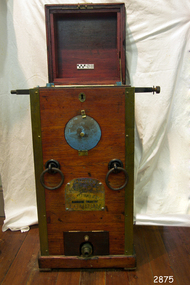
Machine - Diving Compressor, Siebe Gorman & Co. Ltd, 1880-1890
... Siebe Gorman & Company Ltd was a British company that developed diving equipment and breathing equipment and worked on commercial diving and marine salvage projects. The company advertised itself as 'Submarine Engineers'. ...It also illustrates the considerable dangers they faced while performing such essential and hazardous work, underscoring the critical role played by these professionals in maritime history. flagstaff hill warrnambool flagstaff-hill maritime-museum diving compressor London Siebe Gorman & Co Ltd Marine technology Life Saving Deep sea diving maritime museum maritime village manine history maritime history marine engineers marine diving deep-sea diving E G Ward vintage diving compressor E. ...This compressor was part of the E.G. Ward Collection. It is connected to the diving suit and boots, also in our collection. Siebe Gorman & Company Ltd was a British company that developed diving equipment and breathing equipment and worked on commercial diving and marine salvage projects. The company advertised itself as 'Submarine Engineers'. It was founded by Augustus Siebe, a German-born British engineer chiefly known for his contributions to diving equipment. Siebe Gorman traded as an engineering firm for over 180 years, from 1819 to 1999. The early success of the business was due to its founder, the Prussian immigrant Christian 'Augustus' Siebe (1788-1872). For business reasons, he applied for and was granted British citizenship in 1856. He was a gifted engineer who was able to translate theoretical problems into practical, working products. During the industrial Victorian period, the business traded as 'A. Siebe's at 145 High Street, Holborn, London, but in 1828, new premises were acquired at 5 Denmark Street, Soho. The family firm produced a wide range of manufactured goods, including paper-making machinery, measuring machinery, water-pumps, refrigeration equipment and diving apparatus. Augustus Siebe specialised in submarine engineering early on, and the company gained a reputation for the manufacture of safe, reliable diving apparatus. Augustus Siebe is best remembered for the development and manufacture of the ‘closed’ Diving Dress based on the ideas of Charles and John Deane, George Edwards and Charles Pasley. Apart from some small modifications to valves and diver communications, the basic 12 bolt ‘closed’ diving dress remained relatively unchanged after the 1870s. Later company successes were also based on innovation, with new products that could be successfully developed and manufactured to high standards. This was largely attributed to the inventive nature, foresight, engineering and entrepreneurial skills of Robert Henry Davis (1870-1965). In 1882, RH Davis joined the company of 'Siebe & Gorman' as a young 11-year-old office boy, and he was to remain with the company until he died in 1965. Augustus Siebe retired in 1869 and handed over the company to a new partnership of Henry H. Siebe (1830-1885) and William A. O'Gorman (1834-1904). The new firm traded as 'Siebe & Gorman' (1870-1879) from premises in and around Mason Street, Westminster Bridge Road, Lambeth, London. The two partners soon recognised the potential of R.H. Davis, and in 1894, aged 24, he became General Manager of Siebe & Gorman. Davis increasingly ran the company until the surviving partner (W.A. Gorman) died in 1904. The firm was disposed of to the Vickers (armaments) family, and a new company, Siebe Gorman & Co. Ltd. (1905-1998) was formed. Under the chairmanship of Albert Vickers, R.H. Davis was kept on as Managing Director, and the company forged ahead. However, after WW1, the Great Depression caused manufacturing output and share prices to slump. In 1924, Robert Davis made a deal with the Vickers Board and acquired control of the company through majority shares. Under his leadership, the Siebe Gorman Company flourished, and in time, four of his sons also joined the firm. The company gained a worldwide reputation for the manufacture of diving apparatus, decompression and observation chambers, and safety breathing apparatus of all types for use on the land, in the air and under the sea (including mine rescue, tunnelling, aircraft, diving, submarine escape and in other hazardous environments). Close research and development links with the MOD (especially the Admiralty), also provided a lucrative outlet for the company's products. In 1932, Robert Davis was knighted by King George V, principally for his invention of the ‘Davis Submerged Escape Apparatus’ (D.S.E.A.). Siebe Gorman essentially remained a family firm from the beginning (under A Siebe) until it became a public company for the first time in 1952. However, following WW2, British manufacturing stagnated through stifled investment and post-war austerity, and there was little innovation. Siebe Gorman's fortunes began to decline as an ageing Sir Robert Davis failed to invest or change the company's business and management practices. In 1959, Siebe Gorman was acquired by the “Fairy Group” and the ailing Sir Robert was made Life President. Consequently, nothing changed, and the slow decline continued until Sir Robert's death in March 1965. Around 1960, Siebe Gorman acquired the diving apparatus manufacturer C E Heinke, and for a brief period, it manufactured some diving equipment under the combined name of Siebe Heinke. Around 1964, Mr E. 'Barry' Stephens was appointed as the new Managing Director to modernise Siebe Gorman. Changes were made, including a move to a new factory in Wales in 1975. The new company concentrated on firefighting breathing apparatus and escape equipment, and the move coincided with the loss of many of the older, traditional craft skills. Between 1985 and 1998, Siebe expanded through acquisitions, and several other companies were acquired. The Siebe Gorman (diving apparatus) company has therefore traded as A. Siebe (1819-1870); Siebe & Gorman (1870-1879); Siebe Gorman & Co (1880-1904); Siebe Gorman & Co. Ltd (1905-1998).The diving compressor, along with associated equipment in the Flagstaff Hill collection, represents a highly significant snapshot of marine history. These items are particularly important in understanding the evolution of diving equipment, with a special focus on their use in salvage operations before and throughout the Second World War. Manufactured by a company renowned for its inventions, development, and innovation in marine engineering, the equipment demonstrates the progression of technology in deep-sea diving. Early helmets and related items produced by this company remain highly sought after by collectors worldwide, highlighting their historical and technological value. The presence of these items within the Flagstaff Hill Maritime Museum allows for a unique insight into the working conditions and methods employed by divers. It also illustrates the considerable dangers they faced while performing such essential and hazardous work, underscoring the critical role played by these professionals in maritime history.A single cylinder divers' pump by Siebe Gorman & Co Ltd, London, eccentric hand cranked in brass, brass-mounted mahogany case with instructions to the underside of the lid, brass-covered pressure gauge and air outlet, brass maker's plaque to the front, water inlet and outlet to the rear, green-painted lifting rings. Machinery has some blue-painted areas on the metal. This compressor is part of the E.G. Ward Collection.Plate on the back 'WATER SUPPLY" "WATER OVERFLOW" "WATER DRAIN-IN" Pressure gauge dial "BOURDON'S PRESSURE GAUGE" STEBE GORMAN & CO. LONDON", "LBS PRESSURE" "FEET OF SALT WATER" Plate on the front " PATENT, Siebe Gorman & Co Ltd Submarine Engineers" below emblem (Lion, Crown, Horse)flagstaff hill, warrnambool, flagstaff-hill, maritime-museum, diving compressor, london, siebe gorman & co ltd, marine technology, life saving, deep sea diving, maritime museum, maritime village, manine history, maritime history, marine engineers, marine diving, deep-sea diving, e g ward, vintage diving compressor, e. g. ward, e.g. ward, edward ward, ted ward -
 Federation University Historical Collection
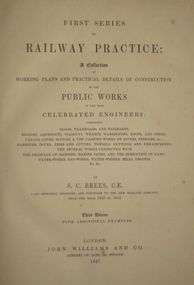
Book, Railway Practice: a collection of working plans and practical details of construction in the public works of the most celebrated engineers, 1847 (exact)
... marine sands, and the irrigation of land, water-works, gas-works, water-wheels, mills, engines. Railway Practice: a collection of working plans and practical details of construction in the public works of the most celebrated engineers. ...A green cloth hard cover book. Title and author's name are engraved in gold on spine. This is the 3rd edition, first series with black and white illustrations. It describes the engineering practices of the early days of British railroads. The book includes (series 1 to 4)and it contains, roads, tramroads and railroads, bridges, aqueducts, viaducts, wharfs, warehouses, roofs, and sheds, canals, locks, sluices, & the various works on rivers, streams, etc., harbours, docks, piers and jetties, tunnels, cuttings and embankments, the several works connected with the drainage of marshes, marine sands, and the irrigation of land, water-works, gas-works, water-wheels, mills, engines.civil engineering, railway practice, rail constructions, s c brees, western railway great britain, public works, railroads, canals, s.c. brees, samuel brees, samuel charles brees -
 Flagstaff Hill Maritime Museum and Village
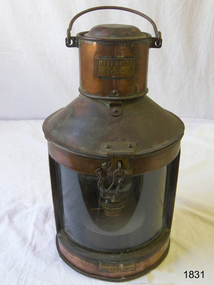
Equipment - Marine Kerosene Lamp, W T George & Co, 1941 +
... They all appear to have been partners in some way making marine lamps under the William Harvie banner. William Harvie & Co. Ltd advertised as being electric light and power engineers, and patent ship lamp manufacturers, as early as 1901-1902, as listed in the Post Office annual Glasgow Directory 1901-1902....They all appear to have been partners in some way making marine lamps under the William Harvie banner. William Harvie & Co. Ltd advertised as being electric light and power engineers, and patent ship lamp manufacturers, as early as 1901-1902, as listed in the Post Office annual Glasgow Directory 1901-1902. ...WT George & Co of Sherlock Street Birmingham were makers of ships lanterns under the trade name “Meteorite”. In 1941 Thomas George writer assumes a relative of WT George was granted a patent number GB546575 relating to improvements to his lamps. After this date a plate was affixed with this number. What's confusing with the companies records is that they show that in Birmingham three companies are listed making lamps together and the writer is assuming under a partnership agreement. First in 1983 W T George & Co with William Harvie & Co went into liquidation with G Bocock & Co, together, then in 1992 George Bocock and Harvie Ltd were in liquidation. Although these companies seem to have different addresses in Birmingham they were linked together given they were all liquidated at the same time for two of them. They all appear to have been partners in some way making marine lamps under the William Harvie banner. William Harvie & Co. Ltd advertised as being electric light and power engineers, and patent ship lamp manufacturers, as early as 1901-1902, as listed in the Post Office annual Glasgow Directory 1901-1902.An item made by a company that was an innovator of significant improvements in the manufacture of marine signal and navigation lamps during the late 19th and 20th centuries. Lamps made by this manufacturer are now sought after collector's items that are of significant value. Lamp, round ship's copper lamp with clear glass, handle at top, fitted with hinged and catch section at top to service lamp. Bracket at back for hanging lamp. Stamped "Meteorite 110560" Bottom stamped "Patent no GB546575 and others pending".warrnambool, flagstaff-hill, flagstaff-hill-maritime-museum, maritime-museum, shipwreck-coast, flagstaff-hill-maritime-village, lamp, round ship's lamp, kerosene marine lamp, w t george & co, william harvie & co, george bocock & co -
 Flagstaff Hill Maritime Museum and Village
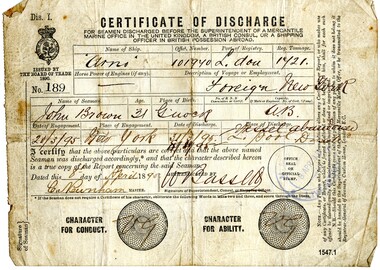
Certificate - Certificates of Discharge, Commonwealth Governments Shipping Offices, 1895 - 1919
... "CERTIFICATE OF DISCHARGE" "FOR SEAMEN DISCHARGED BEFORE THE SUPERINTENDENT OF A MERCANTILE / MARINE OFFICE IN THE UNITED KINGDOM, A BRITISH CONSUL, OR A SHIPPING/OFFICER IN BRITISH POSSESSION ABROAD" Headings filled out include - "Name of Ship", "Official number", "Reg. Tonnage", "Horse power of Engine (if any)", "Description of Voyage or Employment", "Name of Seaman", "Age", "Place of Birth", "No. of R.N.R. Commission or Certificate", "Capacity. If mate or Engineer...Peregrine "CERTIFICATE OF DISCHARGE" "FOR SEAMEN DISCHARGED BEFORE THE SUPERINTENDENT OF A MERCANTILE / MARINE OFFICE IN THE UNITED KINGDOM, A BRITISH CONSUL, OR A SHIPPING/OFFICER IN BRITISH POSSESSION ABROAD" Headings filled out include - "Name of Ship", "Official number", "Reg. Tonnage", "Horse power of Engine (if any)", "Description of Voyage or Employment", "Name of Seaman", "Age", "Place of Birth", "No. of R.N.R. Commission or Certificate", "Capacity. If mate or Engineer ...The following information is taken from the PROV (Public Records Office of Victoria) website - "In Victoria regulation of the engagement and discharge of seamen was initially subject to New South Wales legislation. An Act to amend and consolidate the Laws relating to Seamen in the Merchant Service of the Colony of New South Wales, and for keeping a Register of Seamen belonging to Ships registered in the said Colony (13 Vic., No.28) of 1849 introduced requirements for ships masters to enter into written agreements with seamen engaged by them as crew, specifying wages and provisions, the capacity in which they would serve and the nature of the voyage. It also required masters to issue to seamen certificates of discharge upon their discharge or upon payment of their wages. The 1849 Act applied only to ships registered in the Colony. In 1854 the Imperial Merchant Shipping Act was passed, which had application to all British ships except those registered in the Colony. Consolidation of the separate laws occured with the passing of the Seamen Statute 1865 (28 Vic.,No.245) which adopted Part III of the Merchant Shipping Act 1854 (17 & 18 Vic, C 104) (see Parliamentary Debates, Session 1, 22 February 1865). The Imperial Act, like the New South Wales Act before it, required the master or owner of every British ship, over a certain tonnage, to enter a written agreement for the engagement and discharge of seamen. The Articles of Agreement (VPRS 566) were to be made at the start of a particular voyage, although running agreements were able to be made for a defined period in which short and frequent voyages would be made. At the end of the voyage the discharge and release of the crew was recorded. The date, place and reason for leaving the ship, and the balance of wages paid upon discharge, were recorded in the articles of agreement. Under the Merchant Shipping Act 1854 each seaman discharged was also to be issued with a certificate of discharge (this series) giving particulars of the ship, period of service and the seamans capacity, ability and conduct. No seaman could be engaged to work on a ship unless he delivered to the person engaging him a discharge from his last ship or a permit to sign articles. In the articles of agreement and in the Release Books (VPRS 945) the crew were required to sign their release of the ship, master or owner from any claims to wages or otherwise in respect of the voyage. In the release books the master also signed a release of the crew from all claims. It appears that in Victoria licensed shipping agents were initially able to facilitate the engagement and discharge of seamen. From 1 April 1859, however, the function was to be performed entirely in the Government Shipping Office (Government Gazette, 29 March 1859). In 1869, the names of Shipping Offices were changed to Mercantile Marine Offices and Shipping Masters to Superintendents of Mercantile Marine Offices. The role of the Shipping Office/Mercantile Marine Office was to facilitate and oversee the engagement and discharge of seamen and apprentices to the sea service. The facilities provided were subject to fees payable by ships masters. The Offices were located within the Department of Trade and Customs (VA 606) until 1901 and then within the Chief Secretarys Department (VA 475) to 1922. Responsibility for attesting master and seamen engagements and discharges transferred to the Commonwealth under Parts II and III of the Commonwealth Navigation Act 1912, which became effective on 1 March 1922 when the Navigation (Master and Seamen) Regulations were passed. Seamens Discharge Certificates 1882 to 1922 This series comprises counterfoils (or stubs) of Certificates of Discharge issued to seamen upon their discharge or upon payment of their wages between 1882 and 1922. The Certificates were signed by the Master of the ship and authorised by the Mercantile Marine Office. The counterfoils record details about the ships, the birthplaces and ages of the seamen, the dates of engagement and discharge, and the capacity, conduct and ability of the seamen." This particular set of Certificates of Discharge belonged to a seaman called John F. Brown. Little is known about him but information taken from the cerificates tell us that John F. Brown was born in Greenock, Scotland in about 1868 and that his rank was "Able Bodied Seaman". All of his cerificates describe his conduct and ability as "V. G. (Very Good). During the period from April 1895 to August 1908, he worked on about twenty two different ships - sailing on several Liverpool to New York voyages in 1895 and 1896. In September 1896 he began working on Australian coastal steamers - travelling up and down the coast of Australia (between the ports of Melbourne, Sydney, Newcastle, Adelaide and Brisbane) until August 1908. There is an eleven year gap in his records and his final certificate was issued in September 1919. Some of the ships he worked on include the "Arno", "Melbourne", "Burrumbeet", "Kalgoorlie", "New Guinea", "Buninyong", "Pilbarra", "Oakworth", "Cintra", "Lady Musgrave", "Dawn", "Moorabool", "Colac", "Ramazon", 'Brisbane", "City of Lincoln", "Peregrine" "Mareeba" and "Wear".Theses certificates are significant examples of the legal paperwork generated by the British and Australian governments in the day to day regulation of working seamen in the late 19th and early 20th centuries. They are also significant as they document the career of a working seaman at that time.This is a set of twenty three "Certificates of Discharge" issued to seaman John F. Brown primarily between the years 1895 and 1908 (although the last one is dated 1919). They have been issued by the Shipping Masters at U.K. Mercantile Marine Office (abroad), the Port of Melbourne Victoria, the Port of Sydney N.S.W., the Port of Newcastle N.S.W. and the Port of Brisbane. They are all of a similar size and layout with slight differences in their crests (depending on the port of issue) and the fonts used over the preceding years. They give a good overview into the career of John F. Brown as they list his place and date of birth, his voyages (places of engagement and discharge and the dates of the voyages), the ships he served on (with their tonnage, horsepower, official number and place of registry) plus his ranking, conduct and ability. All certificates are signed by the Master and authenticated by the Shipping Officer. Eight of the certificates have a purple circular stamp on the back with "S. F. 19 SEPT 1908 GLASGOW""CERTIFICATE OF DISCHARGE" "FOR SEAMEN DISCHARGED BEFORE THE SUPERINTENDENT OF A MERCANTILE / MARINE OFFICE IN THE UNITED KINGDOM, A BRITISH CONSUL, OR A SHIPPING/OFFICER IN BRITISH POSSESSION ABROAD" Headings filled out include - "Name of Ship", "Official number", "Reg. Tonnage", "Horse power of Engine (if any)", "Description of Voyage or Employment", "Name of Seaman", "Age", "Place of Birth", "No. of R.N.R. Commission or Certificate", "Capacity. If mate or Engineer. No of certificate (if any)", "Date of Engagement", "Place of Engagement", Date of Discharge", "Place of Discharge", "I certify that the above particulars are correct and that the abovenamed Seaman was discharged accordingly* and that the character described herein is a true copy of the report concerning the said seaman." "Dated this .... day of ... " , "Authenticated by ...." "Character for Conduct" , "Character for Ability".flagstaff hill, warrnambool, shipwrecked-coast, flagstaff-hill, flagstaff-hill-maritime-museum, maritime-museum, shipwreck-coast, flagstaff-hill-maritime-village, certificate of discharge for j.f.brown, certificate of discharge, certificate, discharge, discharge for j.f.brown, john f. brown, arno, s.s. melbourne, s.s. burrumbeet, s.s. kalgooli, s.s. new guinea, s.s. buninyong, s.s. pilbarra, s.s. oakworth, s.s. lady musgrave, s.s. dawn, s.s. moorabool, s.s. colac, s.s. city of lincoln, s.s. mareeba, s.s. wear, s.s. ramazon, s.s. peregrine -
 Flagstaff Hill Maritime Museum and Village
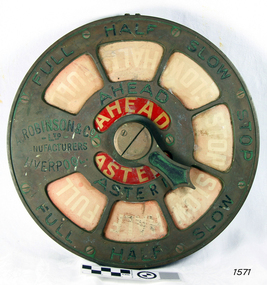
Equipment - Ship's Telegraph section, A. Robinson & Co. Ltd, Late-19th to mid-20th centuries
... engineer then adjusts the ship’s engines and steering equipment to follow the pilot’s Order. The manufacturer, A. Robinson & Co. Ltd of Liverpool, established his business in 1780 and continued until 1968 when the business was purchased by marine products maker Chadburns, established in London in 1870....engineer then adjusts the ship’s engines and steering equipment to follow the pilot’s Order. The manufacturer, A. Robinson & Co. Ltd of Liverpool, established his business in 1780 and continued until 1968 when the business was purchased by marine products maker Chadburns, established in London in 1870. ...The ship’s communication system that was used from the late 19th century to early-to-mid-20th-century is called an Engine Order Telegraph (E.O.T.) or ship’s telegraph. The system has two parts, the Bridge Section and the Engine Room Section. The Bridge Section is usually mounted on top of a pedestal, and the Engine Room Section is often attached to a vertical surface. The standard commands printed or stamped onto the dial are the directions of AHEAD and ASTERN, and the speeds of STOP, SLOW, HALF, and FULL. The ship’s pilot on the Bridge of a vessel sends his Orders for speed and direction to the to the Engine Room with the E.O.T. He moves the lever or levers, depending on the number of engines the ship has, to change the indicator on the Bridge Section’s dial to point in the new direction and speed of travel. This change causes the Orders to be duplicated on the Engine Room Section’s dial and a bell to signal the change at the same time. The engineer then adjusts the ship’s engines and steering equipment to follow the pilot’s Order. The manufacturer, A. Robinson & Co. Ltd of Liverpool, established his business in 1780 and continued until 1968 when the business was purchased by marine products maker Chadburns, established in London in 1870.This Engine Room section is part of a ship's telegraph communication system and represents marine technology used in the late-19th to mid-20th-century. Engine Room Section of a ship’s telegraph or Engine Order Telegraph (E.O.T.). The round brass dial has inscriptions stamped around its edge and centre. Red inlaid glass plates have inscriptions in white paint on them. The inscriptions are nautical terms for direction and speed and include the maker’s details. A rotating pointer is joined to the centre of the dial. The maker is A. Robinson & Co. Ltd of Liverpool. Stamped: “FULL / HALF / SLOW / STOP / FULL / HALF / SLOW / STOP”, “AHEAD / ASTERN” Printed: “FULL / HALF / SLOW / STOP / FULL / HALF / SLOW / STOP” Stamped on the dial: “A. ROBINSON & CO. LTD / MANUFACTURERS / LIVERPOOL”flagstaff hill, warrnambool, maritime museum, maritime village, great ocean road, shipwreck coast, marine technology, marine communications, engine order telegraph, e.o.t., ship’s telegraph, bridge section, engine room section, ship’s engine telegraph section, marine telegraph, a. robinson & co. ltd, liverpool -
 Flagstaff Hill Maritime Museum and Village
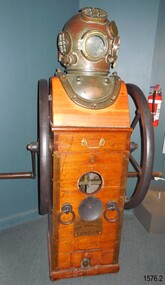
Equipment - Diving compressor and helmet, 1944
... Siebe Gorman & Company Ltd was a British company that developed diving equipment and breathing equipment and worked on commercial diving and marine salvage projects. The company advertised itself as 'Submarine Engineers'. ...Siebe Gorman & Company Ltd was a British company that developed diving equipment and breathing equipment and worked on commercial diving and marine salvage projects. The company advertised itself as 'Submarine Engineers'. ...Siebe Gorman & Company Ltd was a British company that developed diving equipment and breathing equipment and worked on commercial diving and marine salvage projects. The company advertised itself as 'Submarine Engineers'. It was founded by Augustus Siebe, a German-born British engineer chiefly known for his contributions to diving equipment. Siebe Gorman traded as an engineering firm for over 180 years from 1819 to 1999. The early success of the business was due to its founder, the Prussian immigrant Christian 'Augustus' Siebe (1788-1872). For business reasons, he applied for and was granted British citizenship in 1856. He was a gifted engineer who was able to translate theoretical problems into practical, working products. During the industrial Victorian period, the business traded as 'A. Siebe' at 145 High Street Holborn London, but in 1828 new premises were acquired at 5 Denmark Street, Soho. The family firm produced a wide range of manufactured goods including paper-making machinery, measuring machinery, water pumps, refrigeration equipment, and diving apparatus. Augustus Siebe specialised in submarine engineering early on and the company gained a reputation for the manufacture of safe, reliable diving apparatus. Augustus Siebe is best remembered for the development and manufacture of the ‘closed’ Diving Dress based on the ideas of Charles and John Deane, George Edwards, and Charles Pasley. Apart from some small modifications to valves and diver communications, the basic 12 bolt ‘closed’ diving dress remained relatively unchanged after the 1870s. Later company successes were also based on innovation, with new products that could be successfully developed and manufactured to high standards. This was largely attributed to the inventive nature, foresight, engineering, and entrepreneurial skills of Robert Henry Davis (1870-1965). In 1882, RH Davis joined the company of 'Siebe & Gorman' as a young 11-year-old office boy and he was to remain with the company until he died in 1965. Augustus Siebe retired in 1869 and handed over the company to a new partnership of Henry H. Siebe (1830-1885) and William A. O'Gorman (1834-1904). The new firm traded as 'Siebe & Gorman' (1870-1879) from premises in and around Mason Street, Westminster Bridge Road, Lambeth, London. The two partners soon recognised the potential of R.H. Davis and in 1894, aged 24, he became General Manager of Siebe & Gorman. Davis increasingly ran the company until the surviving partner (W.A. Gorman) died in 1904. The firm was disposed of to the Vickers (armaments) family and a new company 'Siebe Gorman & Co. Ltd.' (1905-1998) was formed. Under the chairmanship of Albert Vickers, R.H. Davis was kept on as Managing Director, and the company forged ahead. However, after WW1, the Great Depression caused manufacturing output and share prices to slump. In 1924 Robert Davis made a deal with the Vickers Board and acquired control of the company through majority shares. Under his leadership, the Siebe Gorman Company flourished and within time, four of his sons also joined the firm. The company gained a worldwide reputation for the manufacture of diving apparatus, decompression and observation chambers, and safety breathing apparatus of all types for use on the land, in the air, and under the sea (including mine rescue, tunneling, aircraft, diving, submarine escape and in other hazardous environments). Close research and development links with the MOD (especially the Admiralty), also provided a lucrative outlet for the company products. In 1932, Robert Davis was knighted by King George V, principally for his invention of the ‘Davis Submerged Escape Apparatus’ (D.S.E.A.). Siebe Gorman essentially remained a family firm from the beginning (under A.Siebe) until it became a public company for the first time in 1952. However, following WW2, British manufacturing stagnated through stifled investment and post-war austerity, and there was little innovation. Siebe Gorman's fortunes began to decline as an aging Sir Robert Davis failed to invest, or change the company's business and management practices. In 1959, Siebe Gorman was acquired by the “Fairy Group” and the ailing Sir Robert was made Life President. Consequently, nothing changed and the slow decline continued until Sir Robert's death in March 1965. Around 1960, Siebe Gorman acquired the diving apparatus manufacturer C E Heinke, and for a brief period, it manufactured some diving equipment under the combined name of Siebe Heinke. Around 1964, Mr E. 'Barry' Stephens was appointed as the new Managing Director to modernise Siebe Gorman. Changes were made, including a move to a new factory in Wales in 1975. The new company concentrated on fire-fighting breathing apparatus and escape equipment, and the move coincided with the loss of many of the older, traditional craft skills. Between 1985 and 1998, Siebe expanded through acquisitions, and several other companies were acquired. The Siebe Gorman (diving apparatus) company has therefore traded as A. Siebe (1819-1870); Siebe & Gorman (1870-1879); Siebe Gorman & Co (1880-1904); Siebe Gorman & Co. Ltd (1905-1998). (For information regards the diving helmet & Frank King see Notes Section at the end of this document)The items are very significant as a snapshot into marine history and the development of diving equipment generally especially that used for salvage operations before and during WW2. The company that made the equipment was a leading inventor,developer and innovator of marine equipment with its early helmets and other items eagerly sought after today for collections around the world. The items in the Flagstaff Hill collection give us an insight as to how divers operated and the dangers they faced doing a very necessary and dangerous job. Frank Kings' diving helmet and compressor (communication pipe stored separately). Compressor is hand cranked. US Navy diving helmet, Mark V. Two maker's plates attached. Made in 1944.On rear "WATER SUPPLY" On front 'PATENT" " Logo: Images (Lion, Crown, Horse, Shield within an oval) "SIEBE, GORMAN & Co. Ltd. SUBMARINE ENGINEERS, LONDON.flagstaff hill, warrnambool, maritime museum, great ocean road, us navy diving helmet, commonwealth government salvage, diving helmet, marine salvage, frank king, diver, siebe. gorman & co ltd, submarine equipment, diving equipment, communication under water, hand cranked, diving compressor -
 Flagstaff Hill Maritime Museum and Village
Book - Textbook, Introduction to Modern Geography
... engineer...19th century Irish mathematician...Irish Presbyterian...William Thomson 1st Baron of Kelvin...Professor of Mathematics...Glasgow University...William Thomson Professor of Natural Philosophy...Introduction to Modern Geography...Outline of Astronomy...Use of the Globes...James Thomson LL.D....Simms and McIntyre...1843...scientific book...school book...Lord Kelvin...Baron Kelvin of Langs...nautical instruments...marine...Flagstaff Hill Flagstaff Hill Maritime Museum and Village Warrnambool Maritime Museum Maritime Village Great Ocean Road Shipwreck Coast Introduction to Geography James Thomson reference book Professor Thomson's Introduction to Modern Geography Bobinawarrah Public Library James Thomson mathematician James Thomson engineer 19th century Irish mathematician Irish Presbyterian William Thomson 1st Baron of Kelvin Professor of Mathematics Glasgow University William Thomson Professor of Natural Philosophy Introduction to Modern Geography Outline of Astronomy Use of the Globes James Thomson LL.D. Simms and McIntyre 1843 scientific book school book Lord Kelvin Baron Kelvin of Langs nautical instruments marine ...This mid-19th century scientific reference book, Introduction to Modern Geography, explains geography and astronomy using the globe of the world as a teaching aid. The inscription connects this book to the Bobinawarrah Public Library but research to date has found no further details about the library. The rural area was settled in 1859, but in 2016 its population was only 87. It is situated about 21 kilometres south of the City of Wangaratta, in Northeast Victoria. In 2024 the local community received a grant for preservation of its almost 100-year-old Bobinawarrah Memorial Hall which displays an honour board of the Pioneers of Bobinawarrah 1859-1959. The donor of the book lived in Warrnambool. ABOUT THE AUTHOR, James Thomson (1786-1849): - James Thomson was a British Irish mathematician. He became Professor of Mathematics at the University of Glasgow. He wrote many school textbooks and reference books, one of which was Introduction to Modern Geography, first published in Belfast in 1827, and revised and published in over 20 more editions. Thomson tutored two of his several children at home. His older son James Thomson (1822-1892) became an engineer and physicist. His younger son William Thomson (1824-1907) became Professor of Natural Philosophy from 1846-1899 at the University of Glasgow, and later the 1st Baron of Kelvin, famous for his designs of nautical instruments such as the navigational compass and sounding equipment used in the transatlantic installation of sea cable. William was part of the firm that became famous as Kelvin & Hughes Ltd., suppliers of radar and echo sounders to the Ministry of Transport and the Ministry of Defence. The name continued on as Kelvin & Hughes. James Thomson (1786-1849) was a renowned British Irish mathematician and Professor of Mathematics at the University of Glasgow. He was a respected author of many important school books and textbooks that were widely used to provide understanding of arithmetic and geography. Thomson encouraged practical education and held extra classes for young ladies to learn mathematics and geography, which were a novelty at that time. Many of his works were known and used worldwide. This work was published in many editions. It is now considered as culturally significant as a basis for knowledge about our civilisation and has been made publicly available in overseas countries, and republished and reproduced in a readable format, including its diagrams and maps. Book; scientific textbook. The book has a black leather cover. The front cover is blank, but the spine has an embossed gold vertical title within a rectangular border boasting fancy corners. The fly page has a detailed title. The author is James Thomson. It is the Eighteenth edition, published in Simms & McIntyre of London and Belfast in 1845. An inscription connects it to the Bobinawarrah Public Library in Victoria.Spine within a gold border: "THOMSON'S GEOGRAPHY" Fly Page: "AN INTRODUCTION TO MODERN GEOGRAPHY, WITH AN APPENDIX, CONTAINING AN OUTLINE OF ASTRONOMY, AND THE USE OF THE GLOBES. BY JAMES THOMSON, LL.D., PROFESSOR OF MATHEMATICS IN THE UNIVERSITY OF GLASGOW." "Eighteenth Edition" "LONDON: SIMMS AND McINTYRE, ALDINE CHAMBERS, PATERSOSTER ROW; AND DONEGALL -STREET, BELFAST.""1845"flagstaff hill, flagstaff hill maritime museum and village, warrnambool, maritime museum, maritime village, great ocean road, shipwreck coast, introduction to geography, james thomson, reference book, professor thomson's introduction to modern geography, bobinawarrah public library, james thomson mathematician, james thomson engineer, 19th century irish mathematician, irish presbyterian, william thomson 1st baron of kelvin, professor of mathematics, glasgow university, william thomson professor of natural philosophy, introduction to modern geography, outline of astronomy, use of the globes, james thomson ll.d., simms and mcintyre, 1843, scientific book, school book, lord kelvin, baron kelvin of langs, nautical instruments, marine instruments, transatlantic cable, kelvin & hughes, thomson’s geography, astronomy, geography, world globe, cartography, pioneers of bobinawarrah, textbook -
 Mission to Seafarers Victoria
Plaque - Memorial Plaque, G.H.Rice Memorials, George Winfield Duncan, 2018
... The memorabilia relates to his career at sea and in particular the role of an engineer, including a handwritten manual of notes and references relating to the mechanical and engineering aspects and areas of responsibility for maintenance. g.w. duncan marine engineering plaque george winfield duncan (1922-2017) seafarers sailors George Winfield Duncan / 19.10.1922 - 9.01.2017 / In memory of a Mariner and friend to many small brass engraved commemorative plaque George Winfield Duncan Plaque Memorial Plaque G.H.Rice Memorials ...This plaque links to a number of other items donated to the MTSV in 2017 from the estate of mariner G.W. Duncan (b. 1922 - d.2017). see also 1685 - 1698Mariner Duncan had a particular regard for the Mission to Seafarers. Collectively the G W Duncan material includes: photographs, professional data memorabilia and written and commercially printed resources. The memorabilia relates to his career at sea and in particular the role of an engineer, including a handwritten manual of notes and references relating to the mechanical and engineering aspects and areas of responsibility for maintenance. small brass engraved commemorative plaque George Winfield Duncan / 19.10.1922 - 9.01.2017 / In memory of a Mariner and friend to manyg.w. duncan, marine engineering, plaque, george winfield duncan (1922-2017), seafarers, sailors -
 Federation University Historical Collection
Article - Article - Women, Ballarat School of Mines: Women of Note; Jeanette Perkins, First Female Geology Student, (1927 - )
... engineer. After their return to Melbourne in 1960, Jeanette taught herself to SCUBA dive and quickly developed a passion for the sport and the marine environment. ...engineer. After their return to Melbourne in 1960, Jeanette taught herself to SCUBA dive and quickly developed a passion for the sport and the marine environment. ...Jeanette Perkins was born in 1927 at Ballarat. She attended Alfredton State School and Pleasant Street State School before completing her secondary schooling at Ballarat High School (BHS). During her later years at BHS Perkins decided that she wanted to become a geologist, but was ineligible for university when she failed Leaving Certificate maths. She attended an interview with the principal (Heseltine) at the Ballarat School of Mines (SMB) and announced that she wanted to be a geologist. Heseltine was, according to Perkins, aghast: he informed her that there had never been a female geologist at SMB and they didn't want one. But Perkins persisted. Only then did Heseltine reluctantly enrol her in the School's Applied Chemistry Course which offered the most geological subjects, moreover, it was the only one he considered available to a 'mere' female. After graduating Perkins was employed as a metallurgical chemist with M.B. Johns Valves, Ballarat. In 1949 she married Alfred Watson. In 1951 Jeanette and Alf Watson moved to Melbourne where she commenced work as a metallurgical chemist at the Maribyrnong Ordnance Factory while studying geology part time: Alf returned to study at the University of Melbourne. Once again, Watson set a precedent by becoming the first female student to study geology part-time at the Melbourne Technical College. Increasing demands brought about by her growing family, she turned to part-time lecturing second and third year stratigraphy and palaeontology at RMIT. In 1957 the Watsons moved to the Mary Kathleen Uranium Mine in NW Queensland where he was appointed electrical design engineer. After their return to Melbourne in 1960, Jeanette taught herself to SCUBA dive and quickly developed a passion for the sport and the marine environment. She taught senior science to secondary students for 10 years whilst working towards a Masters degree. In 1991 Jeanette Watson was awarded a Doctorate from Deakin University.women of note, ballarat school of mines, alfredton state school, pleasant street state school, ballarat high school, leaving certificate maths, interview with principal, heseltine, geologist, applied chemistry course, no female geologists, metallurgical chemist, married 1949, melbourne, ordinance factory, part time study, melbourne technical college, rmit, part time lecturer, scuba diving, science teacher for ten years, masters degree, doctorate, deakin university -
Federation University Historical Collection
Document - Document - Syllabus, Education Department, Victoria, Syllabuses, Technical Schools, 1921 and 1924
... They were produced at the beginning of each year. .1, .2, .3 are for 1921. .4 to .22 are for 1924. .1: Mechanics and Mechanics Applied to Mining (1921) .2: Mechanics and Heat (1921) .3: Graphics (1921) .4: Hydraulics (1924) .5: Civil Engineering (1924) .6: Electrical Technology (1924) .7: Electric Wiring (1924) .8: Sheet Metal Work, Pattern Cutting for Tinsmiths, Galvanized Iron Workers and Sheet Copper Workers (1924) .9: Metal Work (Machine Shop Practice) (1924) .10: Farm Irrigation and Irrigation Engineering .11: Food Analysis .12: Theory of Aircraft Design and Construction (1924) .13: Iron, Steel and Engineering Alloys (Special Course for Aeronautical Engineers) (1924) .14: Civil Engineering (1924) .15: Diploma Students - Iron, Steel and Engineering Alloys (1924) .16: Aerodynamics (1924) .17: Electrical Engineering (1914) .18: Mechanical Drawing, 2nd Year Students - Junior Technical Schools (1924) .19: Mechanical Drawing, 3rd Year Students - Junior Technical Schools or Preparatory Evening Course for Technical School Students (1924) .20: Mathematics (1924) .21: Diploma Courses in Engineering - Electrical, Mechanical, Marine, Civil, Aeronautical (1924) .22: Civil Engineering (1924) ...They were produced at the beginning of each year. .1, .2, .3 are for 1921. .4 to .22 are for 1924. .1: Mechanics and Mechanics Applied to Mining (1921) .2: Mechanics and Heat (1921) .3: Graphics (1921) .4: Hydraulics (1924) .5: Civil Engineering (1924) .6: Electrical Technology (1924) .7: Electric Wiring (1924) .8: Sheet Metal Work, Pattern Cutting for Tinsmiths, Galvanized Iron Workers and Sheet Copper Workers (1924) .9: Metal Work (Machine Shop Practice) (1924) .10: Farm Irrigation and Irrigation Engineering .11: Food Analysis .12: Theory of Aircraft Design and Construction (1924) .13: Iron, Steel and Engineering Alloys (Special Course for Aeronautical Engineers) (1924) .14: Civil Engineering (1924) .15: Diploma Students - Iron, Steel and Engineering Alloys (1924) .16: Aerodynamics (1924) .17: Electrical Engineering (1914) .18: Mechanical Drawing, 2nd Year Students - Junior Technical Schools (1924) .19: Mechanical Drawing, 3rd Year Students - Junior Technical Schools or Preparatory Evening Course for Technical School Students (1924) .20: Mathematics (1924) .21: Diploma Courses in Engineering - Electrical, Mechanical, Marine, Civil, Aeronautical (1924) .22: Civil Engineering (1924) sylabus education department victoria technical schools 1921 1924 mechanic and mechanics applied to mining mechanis and heat graphics hydraulics civil engineering electrical technology electric wiring sheet metal work pattern cutting for tinsmiths galvanised iron workers sheet copper workers machine shop practice farm irrigation irrigation engineering food analysis theory of aircraft design and construction aeronautical engineers diploma students aerodynamics electrical engineering mechanical engineering mechanical drawing junior technical schools evening course for technical students mathematics 22 items, A5 in size. ...Syllabuses produced by the Education Department of Victoria. They are for Technical Schools and outline requirements for various subjects. They were produced at the beginning of each year. .1, .2, .3 are for 1921. .4 to .22 are for 1924. .1: Mechanics and Mechanics Applied to Mining (1921) .2: Mechanics and Heat (1921) .3: Graphics (1921) .4: Hydraulics (1924) .5: Civil Engineering (1924) .6: Electrical Technology (1924) .7: Electric Wiring (1924) .8: Sheet Metal Work, Pattern Cutting for Tinsmiths, Galvanized Iron Workers and Sheet Copper Workers (1924) .9: Metal Work (Machine Shop Practice) (1924) .10: Farm Irrigation and Irrigation Engineering .11: Food Analysis .12: Theory of Aircraft Design and Construction (1924) .13: Iron, Steel and Engineering Alloys (Special Course for Aeronautical Engineers) (1924) .14: Civil Engineering (1924) .15: Diploma Students - Iron, Steel and Engineering Alloys (1924) .16: Aerodynamics (1924) .17: Electrical Engineering (1914) .18: Mechanical Drawing, 2nd Year Students - Junior Technical Schools (1924) .19: Mechanical Drawing, 3rd Year Students - Junior Technical Schools or Preparatory Evening Course for Technical School Students (1924) .20: Mathematics (1924) .21: Diploma Courses in Engineering - Electrical, Mechanical, Marine, Civil, Aeronautical (1924) .22: Civil Engineering (1924) 22 items, A5 in size. Some are folded sheets of A4 paper.sylabus, education department, victoria, technical schools, 1921, 1924, mechanic and mechanics applied to mining, mechanis and heat, graphics, hydraulics, civil engineering, electrical technology, electric wiring, sheet metal work, pattern cutting for tinsmiths, galvanised iron workers, sheet copper workers, machine shop practice, farm irrigation, irrigation engineering, food analysis, theory of aircraft design and construction, aeronautical engineers, diploma students, aerodynamics, electrical engineering, mechanical engineering, mechanical drawing, junior technical schools, evening course for technical students, mathematics -
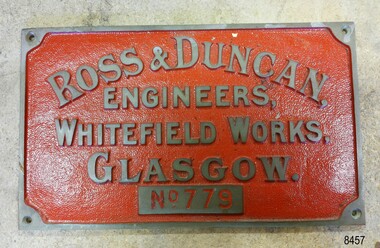 Flagstaff Hill Maritime Museum and Village
Plaque - Nameplate, ca. 1970s
... The nameplate was reproduced to represent the Glasow marine engineers and boilermakers, Ross & Duncan, that were the makers of the engine for the exhibition steam ferry Rowitta. ...This nameplate is a reproduction of the Ross & Duncan nameplate and was displayed on the Rowitta vessel activation at Flagstaff Hill. Ross & Duncan of Glasgow manufactured marine engines and boilers from the time it was established in 1860 and growing to employ 450-500 workers by 1911. SS ROWITTA: - The 1909 steam ferry, SS Rowitta, was installed as an exhibit at Flagstaff Hill in 1975 and was enjoyed by many visitors for 40 years. Rowitta was a timber steam ferry built in Hobart in 1909 using planks of Huon and Karri wood. It was a favourite of sightseeing passengers along Tasmania’s Tamar and Derwent rivers for 30 years. Rowitta was also known as Tarkarri and Sorrento and had worked as a coastal trading vessel between Devonport and Melbourne, and Melbourne Queenscliff and Sorrento. In 1974 Rowitta was purchased by Flagstaff Hilt to convert into a representation of the Speculant, a historic and locally significant sailing ship listed on the Victorian Heritage Database. (The Speculant was built in Scotland in 1895 and traded timber between the United Kingdom and Russia. Warrnambool’s P J McGennan & Co. then bought the vessel to trade pine timber from New Zealand to Victorian ports and cargo to Melbourne. It was the largest ship registered with Warrnambool as her home port, playing a key role in the early 1900s in the Port of Warrnambool. In 1911, on her way to Melbourne, it was wrecked near Cape Otway. None of the nine crew lost their lives.) The promised funds for converting Rowitta into the Speculant were no longer available, so it was restored back to its original configuration. The vessel represented the importance of coastal traders to transport, trade and communication in Australia times before rail and motor vehicles. Sadly, in 2015 the time had come to demolish the Rowitta due to her excessive deterioration and the high cost of ongoing repairs. The vessel had given over 100 years of service and pleasure to those who knew her. The nameplate was reproduced to represent the Glasow marine engineers and boilermakers, Ross & Duncan, that were the makers of the engine for the exhibition steam ferry Rowitta. The Tasmanian-built vessel had a long career in Tasmania and Victoria. The nameplate is significant for its connection with the Rowitta, representing the importance of coastal traders to transport, trade and communication in Australia in conjunction with the new rail and motor vehicles. The nameplate is a record of an exhibit at Flagstaff Hill Maritime Village from its early beginnings. Maker's brass nameplate; brass, with embossed text and a hole in each corner. The background is painted red. There are five rows of text; the top row is arranged in an arc. On the bottom row is a number. The nameplate is a replica that was once displayed on the Rowitta vessel at Flagstaff Hill. The reproduction nameplate is for the company Ross & Duncan of Glasgow."ROSS & DUNCAN / ENGINEERS / WHITEFIELD WORKS GLASGOW / NO. 779" flagstaff hill, flagstaff hill maritime museum and village, warrnambool, maritime museum, maritime village, great ocean road, shipwreck coast, steamer, steam ferry, ross & duncan, marine engineers, marine boilers, glasgow engineers, whitefield works, reproduction, scotland, steamer engine, rowitta, sorrento, ss rowitta, navigation, marine technology, steam power, hobart, tasmania, devonport, tasmanian-built, ferry, 1909, early 20th century vessel, passenger vessel, tamar trading company, tamar river, launceston, george town, tarkarri, speculant, peter mcgennan, p j mcgennan & co. port phillip ferries pty ltd, melbourne, coastal trader, timber steamer, huon, karri, freighter, supply ship, charter ferry, floating restaurant, prawn boat, lakes entrance -
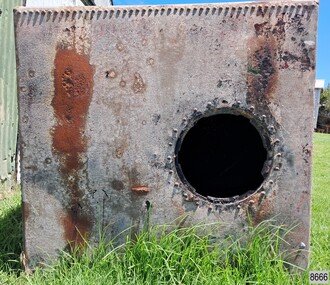 Flagstaff Hill Maritime Museum and Village
Container - Ship Tank, Early 20th century
... marine container...Richard Trevithich...1808...Robert Dickson...water transport...water storage...iron foundry...steel sheets...iron sheets...revets...Victoria Settlement...Port Essington...Globe Tank and Foundry...Wolverhampton...British engineer...Flagstaff Hill Flagstaff Hill Maritime Museum and Village Warrnambool Maritime Museum Maritime Village Great Ocean Road Shipwreck Coast iron cube water tank shipping container ship tank ship's tank ship tanks marine container Richard Trevithich 1808 Robert Dickson water transport water storage iron foundry steel sheets iron sheets revets Victoria Settlement Port Essington Globe Tank and Foundry Wolverhampton British engineer British inventor wooden casks Ship tank: a cubed iron container with an offset hole on one side. ...Cubed iron ship tanks were invented by Richard Trevithich in 1808, in partnership with Robert Dickson, and the design was patented that year. The invention eventually replaced the wooden casks or barrels used at the time, as the ship tanks were more secure and their shape was much more economical in storage space. The robust metal tanks were originally made to transport water, but their preserving quality enabled them to transport perishable dry goods such as grain on long voyages, as well as other forms of liquid and solid cargo. The first ship tanks were made from sheets of iron, and later mild steel sheets, with double riveted edges and corners. A round cast iron lid with handle grips was fitted snugly into the top opening, providing an air-tight and water-tight seal. Brass taps were often fitted into the base, which could have been the case with this tank, but it now has a wooden bung in the hole. Sailing ships began using the new ship tanks on Australian voyages from around the 1830s, storing food and water for those on board, and filling them with other cargo. A large number of the ship tanks were repurposed in 1838 for the Victoria Settlement at Port Essington, N.T., as they were able to protect the food, clothing and other stores from termite and insect damage. Other ‘recycled’ ship tanks were cut in half and used as washing tubs or cookers. A 1929 catalogue from Hudson’s Tank Stores advertised square tanks that contained around 600 litres – 160 gallons – which equals an internal measurement of 33.25 inches – 84.5 centimetres – per side ship tanks are still made and sold in 1952 by the Globe Tank and Foundry in Wolverhampton, England, which was incorporated in 1922. Today, ship tanks can be seen around Australia. Wilsonson’s Promontory Lightstation has the lid from a ship tank that was used on site for the storage of water. Some have been repurposed as domestic water tanks and dog kennels, others for eucalyptus distilleries. Flagstaff Hill has two ship tanks. The Campaspe Port at Echuca, once a bustling river port, has a ship tank beside the locomotive yard. The lids of ship tanks are collectible items. Richard Trevithick (1771-1833): - Trevithick was born in 1771 in Cornwall, England. He was a famous British engineer and inventor during the Industrial Revolution, known for his invention of the first full-scale working railway, the high-pressure steam locomotive, which he demonstrated hauling a railway train in 1804. He set up a small workshop in 1808 at 72 Fore Street, Limehouse, London, to make iron ship tanks, and this invention was instrumental in replacing the wooden casks formerly used for storage on ships. He was involved with mining technology, iron foundry and ship equipment. Ship tanks changed the way that cargo was transported on ships and other vehicles from the 1830s and were used into the mid-20th century. The ship tanks’ advantages were that they could store more content, lasted longer, were waterproof and airtight, stackable and could be repurposed for many uses other than water, such as fuel, dry goods and domestic cargo. They have even been used aa dog kennels and cookers. Ship tanks were part of the evolving methos to transport water, food and cargo, which changed in 1956 when Malcolm McLean invented the large, rectangular shipping containers that are in use today; they speed up the process of loading on and off the ships, saving time and money. Ship tank: a cubed iron container with an offset hole on one side. The hole has cutouts for securely attaching a lid. This tank is on its side on the ground with the opening facing sideways. The side facing upwards has a wooden bung in a round hole. The ship tank is made from six square, thick iron sheets, rolled and riveted along the edges. The inside has a black sticky coating, possibly bitumen, and a strong creosote odour. There are small remnants of green paint on the outer surface.flagstaff hill, flagstaff hill maritime museum and village, warrnambool, maritime museum, maritime village, great ocean road, shipwreck coast, iron cube, water tank, shipping container, ship tank, ship's tank, ship tanks, marine container, richard trevithich, 1808, robert dickson, water transport, water storage, iron foundry, steel sheets, iron sheets, revets, victoria settlement, port essington, globe tank and foundry, wolverhampton, british engineer, british inventor, wooden casks -
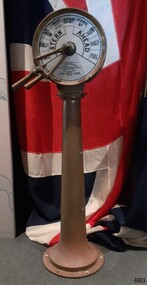 Flagstaff Hill Maritime Museum and Village
Equipment - Ship's Telegraph section, Chadburn & Sons, 1875-1898
... engineer then adjusts the ship’s engines and steering equipment to follow the pilot’s Order. CHADBURN & SON, Liverpool- Chadburn Brothers, William and C.H., were joint inventors and well-established makers of optical and scientific instruments and marine gauges. ...engineer then adjusts the ship’s engines and steering equipment to follow the pilot’s Order. CHADBURN & SON, Liverpool- Chadburn Brothers, William and C.H., were joint inventors and well-established makers of optical and scientific instruments and marine gauges. ...The ship’s telegraph section was once part of the navigational equipment of the famous paddle steamer, PS Hygeia, and was later installed on Flagstaff Hill’s exhibit, the steamer Rowitta. This is the Bridge Section of a ship’s telegraph, a Duplex Gong model, made by Chadburn & Son of Liverpool. The gong sounded two signals whenever the navigational commands to change the speed or direction were given by the ship’s pilot. Communication between the ship’s pilot and the engine room in the late 19th to the mid-20th centuries was made with a system called an Engine Order Telegraph (E.O.T.) or ship’s telegraph. The equipment has two parts, the Bridge Section and the Engine Room Section. The Bridge Section was usually mounted onto a pedestal, and the Engine Room Section was attached to a vertical surface. The standard marine commands were printed or stamped around the face of the dial and indicated by a pointer or arrow that was usually moved by a rotating brass section or handle. The ship’s pilot stationed on the Bridge of a vessel sends his Orders for speed and direction to the Engine Room with the E.O.T. He moves the lever or levers, depending on the number of engines the ship has, to change the indicator on the Bridge Section’s dial to point in the new direction and speed of travel. This change causes the Orders to be duplicated on the Engine Room Section’s dial and a bell or bells to signal the change at the same time. The engineer then adjusts the ship’s engines and steering equipment to follow the pilot’s Order. CHADBURN & SON, Liverpool- Chadburn Brothers, William and C.H., were joint inventors and well-established makers of optical and scientific instruments and marine gauges. The firm was granted the Prince Albert Royal Warrant in the late 19th century. In 1870, William Chadburn applied for a patent for his navigational communication device for use on ships. By 1875, Chadburn & Son was producing the brass Engine Order Telegraph in its plant at 71 Lord Street, Liverpool. In 1911, the ship, RMS Titanic, was launched, fitted with Chadburn & Sons E.O.T. The Chadburn Ship Telegraph Company Limited was registered in 1898 to take over Chadburn & Sons. In 1903, a large factory at Bootle, near Liverpool, and its products were being sold overseas. In 1920, electric-powered telegraphs were developed. In 1944, the name changed to Chadburn’s (Liverpool) Limited. In 1968, the company became Chadburn Bloctube Ltd. In 2000, the company, now Bloctube Marine Limited, was still manufacturing ship telegraphs. The P.S. HYGEIA 1890-1932: - This ship’s telegraph was installed on the new paddle steamer, PS Hygeia, one of three iconic pleasure steamers famous for providing regular services in Port Phillip Bay, Victoria, to thousands of passengers between the ports of Queenscliff, Sorrento, Portsea, Dromana, Rosebud, Rye, and Mornington. It joined the Ozone and the Weeroona, all three described as being glamorous, powerful and fast. Its ticket office was on the pier itself. The P.S. Hygeia was built in Yorker, Scotland, in 1890, by Napier, Sharks & Bell. It was registered in Melbourne, Australia, by Hubbart, Parker & Co. in 1891. The steel ship was 92 metres long, able to travel at 22 knots, and licensed to carry over 1600 passengers in luxury, with even a barber shop on board. The regular service between the ports in Port Phillip Bay, Victoria, continued for over 40 years. With the decline in passenger demand, the service wound down. The Hygeia was sold to H.M. Morris in 1931 for demolition and breaking up. Equipment, fittings, and even lifebuoys were sold, with many items purchased by people who had some connection to the Hygeia. On August 25th, 1931, what was left of the vessel departed Port Melbourne and eventually, in June 1932, it was laid to rest at the ships’ graveyard outside Port Phillip Heads. The SS ROWITTA 1909-2015: - The ship’s telegraph was originally installed on the PS Hygeia. It was purchased when the Hygeia was broken up in 1931 and later installed, in 1975, on Flagstaff Hill’s SS Rowitta, an exhibit greatly enjoyed by the public until it was demolished in 2015. The ferry “SS Rowitta” was built in 1909 in Hobart, Tasmania. The timber steam ferry was built using planks of Huon and Karri wood. It was a favourite with sightseeing passengers steaming along Tasmania’s Tamar and Derwent rivers for 30 years. Rowitta was also known as Tarkarri and Sorrento and had worked as a coastal trading vessel between Devonport and Melbourne, and Melbourne, Queenscliff and Sorrento. The vessel had given over 100 years of service and pleasure. This Bridge section of a ship’s Engine Order Telegraph, used with an Engine Room section, represents late-19th-century change and progress in communication and navigation at sea. This type of equipment was still in use in the mid-20th century. It is significant for its association with its maker, Chadburn & Son, of Liverpool, a well-known marine instrument maker whose work was recognised by English Royalty, and whose products were selected to supply similar equipment for use on the RMS Titanic. The ship’s telegraph is also significant for its association with the paddle steamer PS Hygeia, one of three iconic steamers that transported thousands of passengers from port to port within Port Phillip Bay, Victoria, for over 40 years from the 1890s to the 1930s. Queenscliff Borough remembers the Hygeia by naming a road near the pier Hygeia Drive. The Hygeia is registered on the Victorian Heritage Database as a vessel of significance, VHR S329. In 1901, Hygeia had the privilege of carrying their Royal Highnesses, the Duke and Duchess of York, from Mornington to St Kilda Pier, Melbourne, during their Royal visit celebrating the Federation of Australia. The ship’s telegraph is also important for its connection with the Rowitta, a large exhibit on display at Flagstaff Hill Maritime Village, aiding maritime education for over 40 years. It represented the importance of coastal traders to transport, trade and communication along the coast of Victoria, and before the availability of rail and motor vehicles, serving many roles. Bridge section of a Ship’s Telegraph or Engine Order Telegraph (E.O.T.). The round, double-sided, painted glass dial is inside a brass case behind glass. It is fitted onto an outward tapering brass pedestal with a round base. The brass indicator arrows between the handles point simultaneously to both sides of the dial when moved. An oval brass maker’s plate is attached to the top of the case. The dial’s faces have inscriptions that indicate speed and direction, and the front face and plate include the maker’s details. A serial number is stamped on the collar where the dial is fitted to the pedestal. The ship’s telegraph is a Duplex Gong model, made by Chadburn & Son of Liverpool. It was originally part of the navigational fittings on the paddle steamer, PS Hygeia.Dial, maker’s details: “PATENT “DUPLEX GONG” TELEGRAPH / CHADBURN & SON / TELEGRAPH WORKS / PATENTEES & MANUFACTURERS / 11 WATERLOO ROAD / LIVERPOOL” LONDON / 105 FENCHURCH STREET” “NEWCASTLE / 85 QUAY + SIDE” “GLASGOW / 69 ANDERSON QUAY” “PATENT” Dial instructions: “FULL / HALF/ SLOW / FINISHED WITH ENGINES / STOP STAND BY / SLOW / HALF / FULL / ASTERN / AHEAD” Maker’s plate: “CHADBURN / & SON / PATENT / LIVERPOOL” Serial number: “22073”flagstaff hill, warrnambool, maritime village, maritime museum, shipwreck coast, great ocean road, engine order telegraph, e.o.t., navigational instrument, communication device, ship’s telegraph, engine room section, bridge section, rms titanic, chadburn & son, chadburn brothers, william chadburn, chadburn ship telegraph company, chadburns, duplex gong, liverpool, ss rowitta, navigation, marine technology, pilot’s orders, steam power, hobart, tasmania, devonport, tasmanian-built, ferry, steam ferry, steamer, 1909, early 20th century vessel, passenger vessel, tamar trading company, launceston, george town, sorrento, tarkarri, speculant, peter mcgennan, p j mcgennan & co. port phillip ferries pty ltd, melbourne, coastal trader, timber steamer, huon, karri, freighter, supply ship, charter ferry, floating restaurant, prawn boat, lakes entrance, ps hygeia, paddle steamer, pleasure steamer, port phillip bay, queenscliff, portsea, dromana, rosebud, rye, mornington, hubbart parker & co, 1890, 1903, h.m. morris, hygeia -
 Glenelg Shire Council Cultural Collection
Book, Manuel of Seamanship 1937, 1944
... engineer. It looks to have been bought second hand and originally belonged to W Barry. Part of a collection donated by the wife of Robert Hodson. maritime sailing seamanship Handbook for a seaman. Contains information about marine ...Handbook for a seaman. Contains information about marine and sailing. Includes how to put on a life jacket etcBlue hardbacked book. The spine is missing. Front cover title is barely visible but a skull and crossbones has been painted over it. Across the pages on the fore edge is handwritten W BARRY 30. non-fictionHandbook for a seaman. Contains information about marine and sailing. Includes how to put on a life jacket etcmaritime, sailing, seamanship -
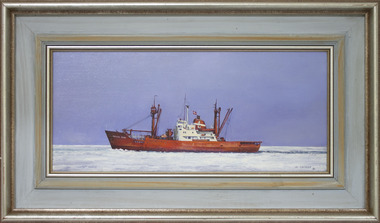 Mission to Seafarers Victoria
Painting, Ib Odfeldt, MS Nella Dan 1961, 1995
... "Ib Odfeldt (b. 1944) is a self-taught painter and sculptor spending many years inspired by and interest in ships and marine art whilst working as an engineer in the Danish Merchant Navy. ..."Ib Odfeldt (b. 1944) is a self-taught painter and sculptor spending many years inspired by and interest in ships and marine art whilst working as an engineer in the Danish Merchant Navy. ...A depiction of the MS Nella Dan an active primary vessel built in 1961 by the Aarlborg Shipyard PTY Ltd, and regularly chartered by the Australian National Antarctic Research Expeditions (ANARE) in the 20th C. The ship ran aground in December 1987 and unable to be salvaged, had to be scuttled in deep water off Macquarie Island. See link above, this record. The ship was named after Nel Law wife of the Director of the Antarctic Division, DR Phil Law. "Ib Odfeldt (b. 1944) is a self-taught painter and sculptor spending many years inspired by and interest in ships and marine art whilst working as an engineer in the Danish Merchant Navy. His paintings demonstrate a keen eye for technical accuracy and skill. The balance and setting of his works have attracted interest in many commissions by lovers of marine and shipping works. In 2002 Ib was awarded the Southern Ocean Maritime Art Prize and this acquisition of the Nella Dan is presented in the foyer of the Tasmanian Maritime Museum in Hobart." (The ASMA 2019 National Exhibition - Maritime Museum of Tasmania catalogue). According to the artist, the painting was part of an exhibition he held at "Melbourne maritime museum " (Polly Woodside) to celebrate ANARE (ARTIC SHOW). He donated two paintings of the Nella Dan. Ib Odfledt has also entered the Maritime Art Prize several times. (2012)Maritime ArtFramed , oil on board painting depicting a red hulled , single funnel ship cutting through sea iceArtist signature at lwr right corner PAINTED.: IB ODFELDT 95 At the back: Square loose label: 3076 Leonard Joel Bottom corner on the frame in Pencil: POW 2894 (National Trust accession number)nella dan, anare, antarctica, icebreakers, explorations, merchant vessels, artwork, maritime art, ib odfeldt, artwork-paintings, australian national antarctic research expeditions (anare), hobbies, asma, australian society of maritime artists -
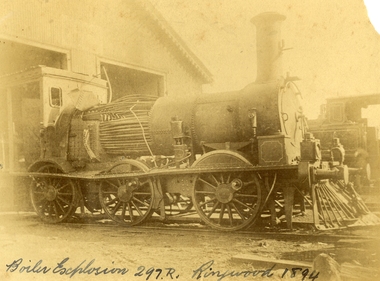 Ringwood and District Historical Society
Photograph, Boiler explosion at Ringwood station 20th June 1894 for engine 297R. "Heard in Box Hill"
... W. McLean; engineer to the Marine Board, and Mr Mephan Ferguson, iron-founder. ...W. McLean; engineer to the Marine Board, and Mr Mephan Ferguson, iron-founder. ...Black and white photographs - 2 copiesTyped below photograph, "Boiler explosion at Ringwood station 20/6/1894. Heard in Box Hill". Article from newspapers:- Weekly Times (Melbourne, Vic. : 1869 - 1954), Saturday 27 January 1894, page 21 Official enquiry. The Board of Enquiry appointed by the Railway Commissioners to enquire into the causes of the boiler explosion which shattered the locomotive at Ringwood on Saturday night, assembled at the Railway department on Wednesday to commence its deliberations, The board consisted of Mr R. Fulton, engineer, C. W. McLean; engineer to the Marine Board, and Mr Mephan Ferguson, iron-founder. There is some difficulty at the outset about the constitution of the board; It was suggested that the Apt of Parliament contemplated that boards of experts, after the manner of the present one, needed, to have their appointments confirmed by the Governor-in-Council. The point, however, was not considered sufficiently important to prevent the board from proceeding with evidence. Robert Greyford, stationmaster at Ringwood, was the first witness. He said he saw the explosion on Saturday night at about twenty minutes to 8. There was a rush to the engine to see what had happened, and the driver and fireman were both found on the platform of the engine. The driver seemed badly hurt, but the fireman, to all appearances, was not so badly injured. They were both attended to and sent up to Melbourne by the last suburban train. Witness had a look at the engine and found the dome and all the plates round the boiler blown clean, away. The springs were also blown clean away. The Chairman (Mr Fulton) : Did you measure the distance ? Witness: Yes; one of the plates was 209 yards away. A piece from the top of the boiler 15 pounds in weight he found driven into the hard beaten track 410 yards away. Several pieces of boiler plate were found scattered at various distances. The buildings roundabout were injured. The Chairman; Did you notice anything peculiar about either of the driver or the fireman ? — No ; nothing wrong, with either of them. If the engine was blowing off at all, it must have been very light. In your opinion, were they perfectly sober ? — Perfectly. In approaching the station, is there a down or an up grade? — A very slight down grade. How is the road from Healesville ? — Up and down all the way. It is down, grade for about 200 yards coming into Ringwood station. They shut off ; steam about a quarter of a mile away, and come in at a good pace. They generally put on 15 pounds of steam while they are in the station. Mr Ferguson : Had the driver the usual load on ? — Yes ; about the usual load. Witness added that he had known the driver personally for about 10 years, and he had always been a careful, steady, sober man. He did not know the fireman so well. John Palmer, porter at Ringwood station, also saw the explosion. He was attending to the train on its arrival. He was knocked down by the force of the explosion. When he got up he saw the engine driver being carried into the office covered in blood. He noticed nothing peculiar about the driver and fireman, nor about the engine. Mr McLean : How far were you from the engine when you were knocked down ? — From ten to fifteen yards. William Paul, the guard of the train to which the injured locomotive Was attached, said he was looking at the engine at the very moment the explosion occurred. It seemed to come from exactly under the dome. The force of it took him off his feet. He was about 15 yards from the tender. When he rose he tried to reach the engine, but could not do so on account of the steam and coal dust. He called out to know whether any of the passengers were injured, and got no response, so that he concluded they were all right. All the lamps but about half dozen were extinguished by the force of the explosion, although the glass was not broken. He could testify most distinctly that the driver and fireman were both sober. The driver was a man who never drank. The steam started to blow off about a minute and a half before the explosion took place. The last place at which the engine took water was Healesville. The Chairman : Do yon know anything of the quality of the water there ? Is it creek water ? — Yes ; it comes from the Graceburn River. You never heard of its quality ?— No. How long have you known this engine on the road— About 13 months. Hew long have you known the driver on this line ? — About six weeks. I have known the fireman several years. The driver was a strict teetotaller, and I never saw the fireman take anything to drink in his life. Mr T. H, Woodroffe, chief mechanical engineer of the Victorian Railways, produced a report he had written to the secretary, about this explosion. The document gave facts concerning the engine and the explosion. It stated that the rapture seemed to have occurred at the rim of the plates adjoining the fire box. The engine was built at the Phoenix Foundry, Ballarat, in 1883. It was repaired at various times, the last time being in July of last year when it was sent to the Port Melbourne shops, and was then tested to a cold water pressure of 195 and found all right. It was the custom to overhaul all locomotives about every five years. The Chairman : There were no very heavy repairs in July, 1893; were there? — Not to the boilers. The shop manager's report says that the plug and safety tap holes were repaired, five new copper studs put in firebox, ash-pan door repaired, tender cleaned and overhauled, and studs re-rivetted, and boiler tested to pressure of 195, cold water. Mr Woodroffe read the report of the repairs effected to the boiler in December, 1888. That would be the time the plate was put in the boiler. On that occasion three new plates were put in the bottom and the boiler tested up to 195. The Chairman: Do you keep a record of the water used ?— Yes, the water in this case, I think, came from the Maroondah scheme. Mr Woodroffe said boilers were examined front time to time in the running sheds. In his opinion every possible care had been taken to keep the engine in proper care. There might, however, be lessons learnt from this. The Chairman: No doubt. From his examination of the plates [the] witness did not think the state of them could have been detected from the outside. There were no signs of leakage or sweating or anything of that sort. The next witness- was Walter Stinton, workshop manager at Newport and he said that the injured engine had been repeatedly repaired under his charge. He gave a technical account of the repairs effected on various occasions. The testing of locomotives was under his special notice. They had a high pressure pipe running; round the works, and a pump set at 2001b. When the boiler was pumped full of water the pressure when applied up to 1951b. The board appointed by the department to inquire into the Ringwood locomotive boiler explosion sat again at Spencer street on 25th inst. Mr R. Fulton presided and the other members of the board were. Mr Mephan Ferguson and Mr C. W. McLean. Charles Grubb, foreman of the boiler-makers at the Newport workshops, said he had inspected the pieces of plate that had been blown out of the engine, and after examining them, pointed out to the Chief Mechanical Engineer the portion where the plate had started to burst. It was under the lap, on the right hand side of the boiler. The grooving might be accounted for by bad water. During the past twenty years he had examined all the boilers that came into the Williamstown workshops, and while some were hardly marked at all, others were very badly eaten away. The practice was to cut out the defective portions. In this case the boiler was repaired in a similar manner. The Chairman : Can you suggest any other way of repairing so as to prevent accident ? — No, unless by taking out a plate on one side from the joint, and carrying it further up so as to avoid the joints meeting, or by taking out the plate altogether. What would.be the cost .of putting in a new " plate I—Perhaps about double the price; but I wouldn't recommend that course. It would be putting a new plate against plates that have been in use ten years or so and that would not be advisable. I think the present system better. I consider the present system of repairing the best. This is the first we have had so bad like that, to my knowledge. You attributed this to bad water. Is there no other probable cause ? — Well; unless the iron be bad. This was Lowmoor iron. I think this accident was caused by the eating away of plates. This one was the worst I have seen, for the short time it had been running. We use three classes of iron — Lowmoor, Monkbridge and Bowling. By Mr Woodroffe (Chief Mechanical Engineer) ; There are engines still running that were repaired at the same time as this one, in 1888, and. in the same way. These are engines 339 and 333. They have been recently examined and are in splendid order. What in your experience, is the age of a boiler on the Victorian railways? — From 17 to 20 years our earlier boilers stood. The later boilers don't stand so well. How is that? — There is difference in construction, and the material is lighter. The old boilers had thicker plates. Have you been asked in any way to curtail boiler affairs? — No, sir; nor in any way. You have never hesitated to carry out any necessary repairs? — Never. Our orders have been to exercise every care in examining, repairing and renewing boilers. Witness said that his practice was when an engine came into the workshop to find out how long she had been running. If over five years, he informed the workshop manager, and they thought it necessary the tubes were taken nut. If everything was in good order witness reported to the manager. The cost of taking out the tubes and putting them in again was about L20. Mr Woodroffe : Have you ever hesitated to repair a boiler on the score of expense ? — No, never. Mr McLean : Hew do yon ascertain whether a boiler requires repairs?— I keep a record of every boiler examined. From every boiler that comes in I have the dome covers taken off, and when it is practical I get inside. l can almost tell from the top of a boiler what the bottom is like. If there is any doubt about it I have the tubes taken out. If I have suspicion of defective plate I cause to have bored a triangle in the plate at the point where there is the most wear. There is a travelling inspector who visits all the running sheds of the colony except Port Melbourne and tests the boilers. He reports to us and we note what he points out. Alfred Thompson, locomotive inspector of the eastern section, said he knew this engine, 297R. He read a list of her repairs. He heard of the accident on Saturday night and went up to Ringwood. The Chairman : Did you ever notice anything peculiar about the engine? — No, I considered her A1 and would not have hesitated to have put on 140lb pressure owing to the repairs she had undergone. Witness considered that the explosion was caused by the expansion and contraction of the plates ; and, no doubt, the plate had been eaten away through bad water. The other side of the boiler showed: signs of corrosion: By Mr Woodroffe ; Is every care taken with the boilers ? — Yes, every possible care is taken for the safety of boilers, Weekly Times (Melbourne, Vic. : 1869 - 1954), Saturday 27 January 1894, page 7 EXPLOSION OF A LOCOMOTIVE BOILER, NARROW ESACPE FROM FATALITIES. THE DAMAGED ENGINE. [See drawing of loco – saved in “Railways” folder] The explosion of a locomotive boiler at Ringwood on Saturday evening, formed the subject of much discussion in railway circles on Monday. The Minister arrived at the office at an unusually early hour and immediately entered into a consultation with the acting chairman, Mr Kibble, and Mr Commissioner Murray. As the result of the interview it was resolved to ask three gentlemen of acknowledged engineering experience to sib as a board with the . object of inquiring into the cause of the accident and furnishing a report. Mr Richardson and the Commissioners are tally seized of the importance of having a searching investigation into the accident, and, with Mr Murray, the former went to Ringwood to inspect the scene of the disaster. They will he accompanied by Mr Woodroffe. During the morning no official report had come to hand from the driver or fireman of the engine in reference to the accident, but that is thought to be due to the circumstance that they have not sufficiently recovered to be able to give a circumstantial account of what occurred. The engine was one of the old R's, and, Mr Kibble pronounced them to be about the best class of engines used. So far nothing can be said as to the probable cause of the accident, as the broken plating of the engine has not been submitted to the inspection of experts. Weekly Times (Melbourne, Vic. : 1869 - 1954), Saturday 27 January 1894, page 7 STATEMENT BY THE FIREMAN. This morning Thomas Miles, fireman on the engine the boiler of which exploded on Saturday night, is suffering from an injury to the spine, as well as a very severe shaking to the system. He states that he was fireman on the engine attached to the train which left Healesville on Saturday evening, at ten minutes to 8. Everything went all right until Ringwood was reached, when, .just as the train was about to continue its journey, a load explosion took place and Miles remembers nothing more until he was picked np on the platform ; and found himself suffering from a pain in the back, and an injury to his arm. He cannot think of any reason which could have caused the explosion, as there was plenty of water in the boiler, and everything seemed working all right. Mr R. Fulton, consulting engineer, of Queen street; Mr McLean, a member of the Marine Board ; and Mr Mephan Ferguson, engineer, have consented to act as a board to inquire into the cause of the engine boiler explosion at Ringwood on Saturday evening. The board has been appointed under section 117 of Act 1135, which provides that the Governor-in-Council may direct the taking of a such a step. Mr1 Fulton will act as chairman of the board, which met for the first time at the railway offices, Spencer street, this forenoon. Before separating the members of the Board paid a visit to the Prince's Bridge locomotive sheds in company with Mr Woodroffe, the chief mechanical engineer, for the purpose of inspecting the shattered boiler. It has been stated that the explosion is known to have been caused by a flaw in a plate which was put on the boiler about four years ago, but enquiries have tailed to elicit anything in support of that view. The engineers connected with the department are not inclined to say anything on the subject. Weekly Times (Melbourne, Vic. : 1869 - 1954), Saturday 14 April 1894, page 20 The Ringwood Boiler Explosion, The Minister of Railways has received the supplementary report of the board appointed by him to investigate the circumstances connected with the explosion of a locomotive boiler at Ringwood. In their first report the board did not attach blame to anyone. Mr Richardson felt satisfied that the responsibility of having the engines properly inspected and overhauled periodically could be fixed if the inquiry were extended. He therefore referred the matter again to the Board, who took further evidence. In the report now furnished, the Board hold Loco. Inspector Thompson blameable, but point out as a mitigating circumstance that he had not received "written instructions" respecting inspections and overhauls. Weekly Times (Melbourne, Vic. : 1869 - 1954), Saturday 7 July 1894, page 32 The Ringwood Boiler Explosion. The Minister of Railways takes exception to the tone of a paragraph appearing in a morning contemporary respecting the Ringwood boiler explosion. It makes it appear that Mr Richardson has referred the report of the board which considered the facts connected with the explosion to the Crown solicitor simply because he differed from the finding of the board. The Minister explains that when he received the report he found that the responsibility for having boilers properly inspected and overhauled had not been clearly fixed. He personally obtained farther evidence on that point, and arrived at a conclusion, from which the commissioners differed. As he did not like to take upon himself the responsibility of deciding upon the effect of the evidence, he submitted the matter to the Crown Solicitor, but that officer did not furnish him with the information sought. He has, therefore, referred the question to the Attorney-General, together with the draft of a regulation respecting boiler inspections and overhauls in the future. Mr Richardson says that his whole aim is to have the responsibility positively fixed. Weekly Times (Melbourne, Vic. : 1869 - 1954), Saturday 28 April 1894, page 23 The Minister of Railways has completed his consideration of the supplementary report received by him from the Ringwood Boiler Explosion Board. The report, it will be remembered, held Loco-Inspector Thompson blameable for the non-inspection of the boiler, but considered there was extenuating circumstances. There was a certain amount of doubt as to the absolute instructions given for overhauling engines periodically. Mr. Richardson is sending the report on to the Commissioners with instructions that the responsibility respecting inspection of boilers shall be made clear for the future. -
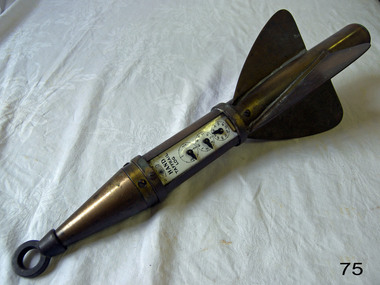 Flagstaff Hill Maritime Museum and Village
Instrument - Ship Log, 1880-1890
... The Company obtained contracts with the Navy, Coast Guard and Marines to develop new instruments, and to build military-engineered nautical equipment. ...The Company obtained contracts with the Navy, Coast Guard and Marines to develop new instruments, and to build military-engineered nautical equipment. ...The John E. Hand & Sons Company was founded in Philadelphia in 1873, quickly gaining a reputation as competent manufacturers of nautical instruments and compass adjusters. In fact, John Enos Hand, the company founder, is recognised as the first man in America to adjust a compass aboard an iron ship. The Hand Company built navigational equipment for all varieties of floating vessels, and operated a chain of retail outlets with “service stations” in numerous port cities, including Baltimore and New Orleans, until 1956. Service stations sold Hand instruments as well as other nautical paraphernalia and provided compass adjusting services. Additionally, John E Hand and his two sons, John L Hand and Bartram Hand, were inventors in their own right who patented design improvements for numerous instruments that were employed in the company’s work. Commercial and private contracts dominated the firm’s business until the late 1930s when the United States military began preparations for World War II. Although the Hand Company never completely abandoned its involvement with private industry, after World War II, military contracts monopolised their business. The Company obtained contracts with the Navy, Coast Guard and Marines to develop new instruments, and to build military-engineered nautical equipment. Of note are the wrist compass, developed for the Navy beginning in the 1950s, and the Mark VII Model 5 Navy Standard Binnacle. Although it moved numerous times, the Hand Company headquarters and factory remained in the Delaware Valley, occupying several buildings in Philadelphia and southern New Jersey. Maintaining its central office in Philadelphia well into the 1900s, the factory was moved to Atco, New Jersey around the turn of the twentieth century and subsequently to Haddon field, New Jersey. It moved one last time in the 1960s to Cherry Hill, New Jersey. In 1997, California-based Sunset Cliffs Merchandising Corporation purchased the Hand Company and all its assets for $100,000. "HAND" brand taffrail log by John F. Hand and Sons Co. Register is enclosed in log, has a glass front and 3 dials on an enameled surface, the first dial registers the miles up to 100, the second registers the units up to 10 mile, the third registers quarters of a mile. The item is rocket shaped with a three blade rotor and a rope ring attachment at one end; the rotor will spin when a rope is attached, allowing the apparatus dials to measure the ship's speed when it is dragged behind a ship. Diagram of the 'Hand' trademark with a compass card in the middle, inscription reads "John F Hand and Sons Co" and "PHILA-BALTO" ( Abbreviation for: Philadelphia / Baltimore) flagstaff hill, warrnambool, shipwrecked coast, flagstaff hill maritime museum, maritime museum, shipwreck coast, flagstaff hill maritime village, great ocean road, bartram hand, john enos hand, john f. hand and sons co, john l hand, john hand & sons instrument makers, john hand & sons of philadelphia, marine instrument, marine service station, mechanical ship log, nautical instrument, nautical navigation, navigational equipment, scientific instrument, ship log, ship log register, ship’s speed, sunset cliffs merchandising corporation, speed log, rocket log, harpoon log, taffrail log, taff rail log -
 Ringwood and District Historical Society
Mixed media - Video, RDHS Guest Speaker Presentation - Royal Children's Hospital and the Development of Paediatrics in Australia - Dr Peter Yule
... Peter is also grandson of Ringwood’s own:- Sir Lewis Ronald East (1899–1994), engineer and water commissioner, was born on 17 June 1899 at Auburn, Melbourne, second of three children of Lewis Findlay East, civil servant and later secretary of the Commonwealth Marine Branch, and his wife Annie Eleanor, née Burchett, both Victorian born. ...Peter is also grandson of Ringwood’s own:- Sir Lewis Ronald East (1899–1994), engineer and water commissioner, was born on 17 June 1899 at Auburn, Melbourne, second of three children of Lewis Findlay East, civil servant and later secretary of the Commonwealth Marine Branch, and his wife Annie Eleanor, née Burchett, both Victorian born. ...Digitised Powerpoint presentation video (3.66GB) Duration: 60 minutes. Recorded May, 2026 (Video is available for viewing at Ringwood & District Historical Society Archives by appointment)Dr Peter Yule is a freelance historian and a fellow of the School of History at the University of Melbourne. He has written a wide range of histories, including The Royal Children's Hospital: A History of Faith, Science and Love (1999), In the Public Interest: 150 Years of the Victorian Auditor-General's Office (2002), Carlton: A History (ed., 2004), and Steel Spies and Spin: The Collins Class Submarine Story (2008). He has also written VIC BAR: A history of the Victorian Bar. More recently he has written biographies of two prominent Melbourne-based financiers: W. L. Baillieu (1859-1936), who founded the prominent family dynasty; and Sir Ian Potter (1902-1994), a major figure in Australia's post-war industrial expansion. Peter will speak about his research on these two remarkable figures, and on the challenges of biography more generally. Peter is also grandson of Ringwood’s own:- Sir Lewis Ronald East (1899–1994), engineer and water commissioner, was born on 17 June 1899 at Auburn, Melbourne, second of three children of Lewis Findlay East, civil servant and later secretary of the Commonwealth Marine Branch, and his wife Annie Eleanor, née Burchett, both Victorian born. Ronald was educated at Ringwood State School.
