
Showing 21 items matching "marine window"
-
 Flagstaff Hill Maritime Museum and Village
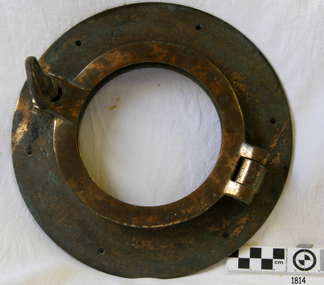
Functional object - Porthole, First half of the 20th century
... ...Marine Window...The porthole is an example of a ships fittings and is not associated with an historical event, person or place, provenance is unable to be determined at this time and the item is believed to have been made in the first half of the 20th century. flagstaff hill warrnambool shipwrecked-coast flagstaff-hill flagstaff-hill-maritime-museum maritime-museum shipwreck-coast flagstaff-hill-maritime-village Porthole Marine Window Marked 6" on hinge and ring Porthole and cover, brass and no glass with screw dog to secure hinged cover. ...A porthole, sometimes called bull's-eye window or bull's-eye, is a generally circular window used on the hull of ships to admit light and air. Though the term is of maritime origin, it is also used to describe round windows on armoured vehicles and aircraft. On a ship, the function of a porthole, when open, is to permit light and fresh air to enter the dark and often damp below-deck quarters of the vessel. It also affords below-deck occupants a limited view to the outside world. When closed, the porthole provides a strong water-tight, weather-tight and sometimes light-tight barrier.The porthole is an example of a ships fittings and is not associated with an historical event, person or place, provenance is unable to be determined at this time and the item is believed to have been made in the first half of the 20th century.Porthole and cover, brass and no glass with screw dog to secure hinged cover.Marked 6" on hinge and ringflagstaff hill, warrnambool, shipwrecked-coast, flagstaff-hill, flagstaff-hill-maritime-museum, maritime-museum, shipwreck-coast, flagstaff-hill-maritime-village, porthole, marine window -
 Flagstaff Hill Maritime Museum and Village
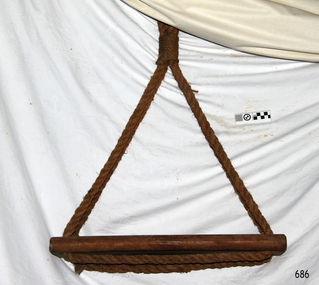
Equipment - Bosun's Chair, ca. mid-20th century
... window cleaning and painting. Flagstaff Hill Warrnambool Maritime Village Maritime Museum Flagstaff Hill Maritime Museum & Village Shipwreck coast Great Ocean Road bosun's chair bosuns chair boatswains chair rigging maritime equipment bosun's seat life saving marine technology ship rigging Bosuns chair; flat smooth rectangular piece of wood, with rope passing through two holes at each end of plank and looped together above plank to form a suspended seat swing. ...The bosun’s chair is a typical piece of equipment included on board a vessel in the late 19th and early 20th century. The nautical word 'bosun' is an abbreviation of the word 'boatswain' who is the person responsible for the repair and maintenance of the vessel. It could be used when rigging the sails and for rescue at sea, along with a thick rope anchored on shore or a rope between ships. It could also be used to move passengers to and from a ship as well as cargo on, to and from the vessel. A bosun's chair is a simple piece of equipment made from a short plank of wood and a sturdy piece of rope. It looks a little like a child's swing but usually has a pulley system that allows the user to adjust the length of the hanging piece of rope, and in so-doing adjusts the height above the floor or ground or sea. In modern times a harness would also be worn by the bosun’s chair user for safety reasons. Bosun's chairs are also used by window cleaners, construction workers and painters. The bosun’s chair is sometimes just a short plank, or even a canvas sling. The bosun's chair is significant for its association with maritime equipment carried on board a vessel in the late 19th and early 20th century for maintenance and safety purposes. It was occasionally used to save lives. The bosun's chair is also significant as an early version of equipment still used today. Since its invention there have been many safety features added in certain industries such as window cleaning and painting.Bosuns chair; flat smooth rectangular piece of wood, with rope passing through two holes at each end of plank and looped together above plank to form a suspended seat swing. Loops a are joined with knot work and ends are spliced together under the seat.flagstaff hill, warrnambool, maritime village, maritime museum, flagstaff hill maritime museum & village, shipwreck coast, great ocean road, bosun's chair, bosuns chair, boatswains chair, rigging, maritime equipment, bosun's seat, life saving, marine technology, ship rigging -
 Flagstaff Hill Maritime Museum and Village
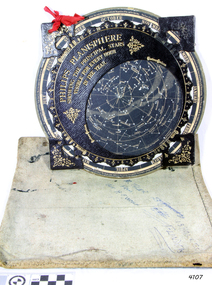
Planisphere, Early 20th Century
... marine navigation maps george philip & sons "Made in Germany for GEORGE PHILIP & SONS Ltd. Geographical and Educational Depot, 32 Fleet Street, London" Canvas bag has "Capt. H (Howard) Tyler from Captain H. F. Woolf" "Tyler 22 ? St East Brighton" also "13 Halls St Flinders" Planisphere of northern hemisphere, with canvas bag. Planisphere consists of a circular star chart attached at its centre to an opaque circular overlay that has a clear elliptical window ...The word Planisphere (Latin planisphaerium) was originally used in the second century by Claudius Ptolemy to describe the representation of a spherical Earth by a map drawn in the plane. This usage continued into the Renaissance: for example Gerardus Mercator described his 1569 world map as a Planisphere. The word describes the representation of the star-filled celestial sphere on the plane. The first star chart to have the name "Planisphere" was made in 1624 by Jacob Bartsch. Bartsch was the son-in-law of Johannes Kepler, discoverer of Kepler's laws of planetary motion. A significant item of celestial mapping used by marine navigators This particular item was made and used in the first quarter to half of the 20th centuryPlanisphere of northern hemisphere, with canvas bag. Planisphere consists of a circular star chart attached at its centre to an opaque circular overlay that has a clear elliptical window or hole so that only a portion of the sky map will be visible in the window or hole area at any given time. The chart and overlay are mounted so that they are free to rotate about a common pivot point at their centres. The star chart contains the brightest stars, constellations and (possibly) deep-sky objects visible from a particular latitude on Earth. The night sky that one sees from the Earth depends on whether the observer is in the northern or southern hemispheres and the latitude. A Planisphere window is designed for a particular latitude and will be accurate enough for a certain band either side of that. Planisphere makers will usually offer them in a number of versions for different latitudes. Planispheres only show the stars visible from the observer's latitude; stars below the horizon are not included. A complete twenty-four-hour time cycle is marked on the rim of the overlay. A full twelve months of calendar dates are marked on the rim of the starchart. The window is marked to show the direction of the eastern and western horizons. The disc and overlay are adjusted so that the observer's local time of day on the overlay corresponds to that day's date on the star chart disc. The portion of the star chart visible in the window then represents (with a distortion because it is a flat surface representing a spherical volume) the distribution of stars in the sky at that moment for the Planispheres designed location. Users hold the Planisphere above their head with the eastern and western horizons correctly aligned to match the chart to actual star positions. "Made in Germany for GEORGE PHILIP & SONS Ltd. Geographical and Educational Depot, 32 Fleet Street, London" Canvas bag has "Capt. H (Howard) Tyler from Captain H. F. Woolf" "Tyler 22 ? St East Brighton" also "13 Halls St Flinders"flagstaff hill, warrnambool, shipwrecked-coast, flagstaff-hill, flagstaff-hill-maritime-museum, maritime-museum, shipwreck-coast, flagstaff-hill-maritime-village, planisphere, star map, marine navigation, maps, george philip & sons -
 Flagstaff Hill Maritime Museum and Village
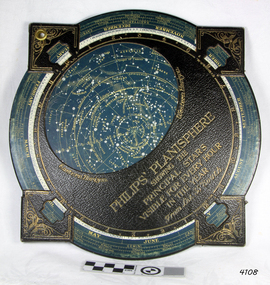
Planisphere, Early 20th Century
... marine navigation maps George Philip & Sons "Sold by J DONNE & SON, Booksellers & Stationers, 349 Post Office Place Melbourne 349. Admiralty Chart Agents" and " Made in Germany for George Philip & Son Ltd" England . Signature "Capt E. B. ?..id, 22 Baund St" Planisphere consists of a circular star chart attached at its centre to an opaque circular overlay that has a clear elliptical window ...The word Planisphere (Latin planisphaerium) was originally used in the second century by Claudius Ptolemy to describe the representation of a spherical Earth by a map drawn in the plane. This usage continued into the Renaissance: for example Gerardus Mercator described his 1569 world map as a Planisphere. The word describes the representation of the star-filled celestial sphere on the plane. The first star chart to have the name "Planisphere" was made in 1624 by Jacob Bartsch. Bartsch was the son-in-law of Johannes Kepler, discoverer of Kepler's laws of planetary motionA significant item of celestial mapping used by marine navigators This particular item was made and used in the first quarter to half of the 20th century.Planisphere consists of a circular star chart attached at its centre to an opaque circular overlay that has a clear elliptical window or hole so that only a portion of the sky map will be visible in the window or hole area at any given time. The chart and overlay are mounted so that they are free to rotate about a common pivot point at their centers. The star chart contains the brightest stars, constellations and (possibly) deep-sky objects visible from a particular latitude on Earth. The night sky that one sees from the Earth depends on whether the observer is in the northern or southern hemispheres and the latitude. A Planisphere window is designed for a particular latitude and will be accurate enough for a certain band either side of that. Planisphere makers will usually offer them in a number of versions for different latitudes. Planispheres only show the stars visible from the observer's latitude; stars below the horizon are not included. A complete twenty-four-hour time cycle is marked on the rim of the overlay. A full twelve months of calendar dates are marked on the rim of the star chart. The window is marked to show the direction of the eastern and western horizons. The disc and overlay are adjusted so that the observer's local time of day on the overlay corresponds to that day's date on the star chart disc. The portion of the star chart visible in the window then represents (with a distortion because it is a flat surface representing a spherical volume) the distribution of stars in the sky at that moment for the Planispheres designed location. Users hold the Planisphere above their head with the eastern and western horizons correctly aligned to match the chart to actual star positions. "Sold by J DONNE & SON, Booksellers & Stationers, 349 Post Office Place Melbourne 349. Admiralty Chart Agents" and " Made in Germany for George Philip & Son Ltd" England . Signature "Capt E. B. ?..id, 22 Baund St"flagstaff hill, warrnambool, shipwrecked-coast, flagstaff-hill, flagstaff-hill-maritime-museum, maritime-museum, shipwreck-coast, flagstaff-hill-maritime-village, star map, marine navigation, maps, george philip & sons -
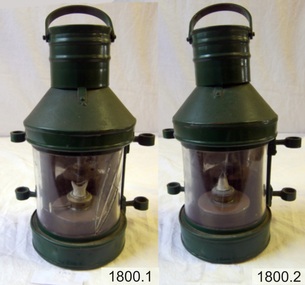 Flagstaff Hill Maritime Museum and Village
Functional object - Anchor Lamp, Bef. 09-02-1984
... The lamp is made to the design of a 19th and early 20th-century kerosene anchor lamp carried as essential marine equipment and used as a signal lamp on sailing ships. brass lamp lamp Anchor Kerosene Lamp kerosene lamp marine equipment marine lamp navigation light ship light ship lamp lantern maritime nautical safety lamp Lamps; a pair of cylindrical kerosene anchor lamps. Each has a flat back, a hinged door, a metal handle and two metal loops or guides fixed on each side. The glass window ...The kerosene lamp was one of the most common oil lamps used and was manufactured until the 1980s. An anchor lamp like the lamps in this pair would be raised on the highest ship mast at night to signal other seafarers that the ship was at anchor or sailing at night. The metal loops on opposing sides of the lamp could hold a pair of rods or ropes. and be used to raise the lamp.The lamp is made to the design of a 19th and early 20th-century kerosene anchor lamp carried as essential marine equipment and used as a signal lamp on sailing ships. Lamps; a pair of cylindrical kerosene anchor lamps. Each has a flat back, a hinged door, a metal handle and two metal loops or guides fixed on each side. The glass window is convex and inside the lamp is a wick in an enamel wick holder.brass lamp, lamp, anchor kerosene lamp, kerosene lamp, marine equipment, marine lamp, navigation, light, ship light, ship lamp, lantern, maritime, nautical, safety lamp -
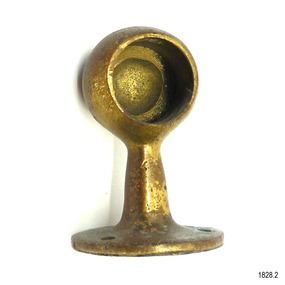 Flagstaff Hill Maritime Museum and Village
Functional object - Rail holder, Before1984
... marine vessels, offices, hotels and many other locations. They are used with a fitted rail for hanging towels, coat hangers in cupboards and wardrobes and curtains over windows. ...marine vessels, offices, hotels and many other locations. They are used with a fitted rail for hanging towels, coat hangers in cupboards and wardrobes and curtains over windows. ...This rail holder is one of a pair of two. The opening in the sphere holds one end of a rail and the screw holes allow the holder to be attached to a flat surface such as a wall or shelf. Pail holders can be found in homes, marine vessels, offices, hotels and many other locations. They are used with a fitted rail for hanging towels, coat hangers in cupboards and wardrobes and curtains over windows. They can also be used for the ends of handrails and shelf rails.This rail holder represents the the type of fittings used on ships in the 19th century. Similar fittings are still used today in the 21st century.Rail holder; one of two brass rail fittings. Hollow sphere on top of a pedestal that has a round base with three holes in it. The sphere has an opening on one side.flagstaff hill, warrnambool, maritime museum, maritime village, shipwreck coast, rail holder, rail fitting, brass ware, domestic item, bathroom furnishing, ball rail fitting, single outlet rail holder -
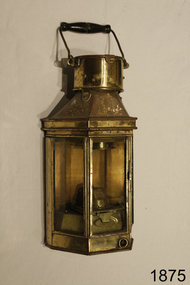 Flagstaff Hill Maritime Museum and Village
Functional object - Lamp, 1886
... Flagstaff Hill Warrnambool Shipwreck Coast Flagstaff Hill Maritime Museum Maritime Museum Maritime Village Alderson & Gyde Ltd Birmingham Lamp Lantern wall lamp marine equipment maritime light wall light 1886 ship lighting "Alderson & Gyde LTD 1886 Birmingham" Lamp; grass and glass, with flat metal back and three glass windows. ...This late 19th century maritime lamp is an example of lighting on ships, wharfs and other outside areas around docks and shipyards as well as on vessels.Lamp; grass and glass, with flat metal back and three glass windows. Has metal handle and wood hand piece. A brass lug on the back makes provision for attaching to a socket on a wall. The chimney lid flips upwards. The right-side door frame has a sliding latch, and the edge behind has a sliding panel to allow air flow. Made in Birmingham by Alderson & Gyde Limited in 1886."Alderson & Gyde LTD 1886 Birmingham" flagstaff hill, warrnambool, shipwreck coast, flagstaff hill maritime museum, maritime museum, maritime village, alderson & gyde ltd, birmingham, lamp, lantern, wall lamp, marine equipment, maritime light, wall light, 1886, ship lighting -
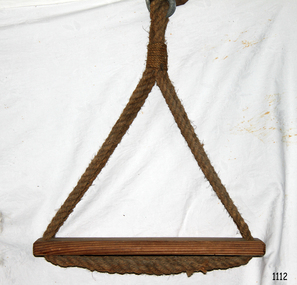 Flagstaff Hill Maritime Museum and Village
Equipment - Bosun's Chair, ca. mid-20th century
... window cleaning and painting. Flagstaff Hill Warrnambool Maritime Village Maritime Museum Flagstaff Hill Maritime Museum & Village Shipwreck coast Great Ocean Road bosun's chair bosuns chair boatswains chair rigging maritime equipment bosun's seat life saving marine technology ship rigging Bosuns chair, rectangular slab of wood with two holes at both ends through which rope ends are threaded for support and the loops above the seat are tied with sailor's knotting to form a triangle. ...The bosun’s chair is a typical piece of equipment included on board a vessel in the late 19th and early 20th century. The nautical word 'bosun' is an abbreviation of the word 'boatswain' who is the person responsible for the repair and maintenance of the vessel. It could be used when rigging the sails and for rescue at sea, along with a thick rope anchored on shore or a rope between ships. It could also be used to move passengers to and from a ship as well as cargo on, to and from the vessel. A bosun's chair is a simple piece of equipment made from a short plank of wood and a sturdy piece of rope. It looks a little like a child's swing but usually has a pulley system that allows the user to adjust the length of the hanging piece of rope, and in so-doing adjusts the height above the floor or ground or sea. In modern times a harness would also be worn by the bosun’s chair user for safety reasons. Bosun's chairs are also used by window cleaners, construction workers and painters. The bosun’s chair is sometimes just a short plank, or even a canvas sling. The bosun's chair is significant for its association with maritime equipment carried on board a vessel in the late 19th and early 20th century for maintenance and safety purposes. It was occasionally used to save lives. The bosun's chair is also significant as an early version of equipment still used today. Since its invention there have been many safety features added in certain industries such as window cleaning and painting.Bosuns chair, rectangular slab of wood with two holes at both ends through which rope ends are threaded for support and the loops above the seat are tied with sailor's knotting to form a triangle. flagstaff hill, warrnambool, maritime village, maritime museum, flagstaff hill maritime museum & village, shipwreck coast, great ocean road, bosun's chair, bosuns chair, boatswains chair, rigging, maritime equipment, bosun's seat, life saving, marine technology, ship rigging -
 Mission to Seafarers Victoria
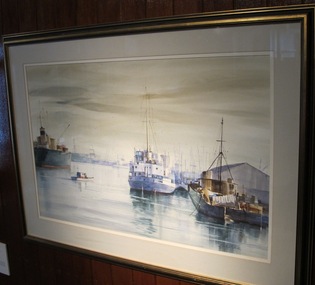
Painting - Watercolour, R.T. Miller, Harbour Reflections, c. 2000
... Fulfills previous MTSV acquisition policy regarding collection of modern or contemporary marine paintings. harbour dockside artwork marine art robert thomas miller robert t. miller watercolour artwork-paintings Artist signed front lower right corner of painting in black ink; no date; sepia label adhered on top centre Verso with artist bio and brief CV ; Other exhibition labels adhered ; inscription describing acquisition and title of work; ( details TBA) M3 in black marker A framed and glazed mat mounted watercolour painting by award winning artist Robert T Miller in ''landscape" format showing moored, masted ships; The modern frame is of moulded or carved wood with appearance of brushed gilt type gilding; image is mounted with pale grey window mount; Backing sealed with paper wire strand hanging system; Harbour Reflections Painting Watercolour R.T. ...Robert Thomas Miller Born in Melbourne in 1916 Studied commercial art at RMIT and for many years worked as graphic designer and design director at ACI Ltd. Member of the Victorian Artists's Society (Council member since 1965), Australian Guild of Realist Artists, Old Water Colour Society Club (past president), Australian Watercolour Institute, Hughesdale Arts Group (past president), Burnie (Tas.) Coastal Art Group. His watercolours have won over 40 major awards, including Victorian Artists' Society, 1973 Artist of the Year Award, and the Rotary Club of Camberwell Watercolour Prize (twice). Represented in many Australian collections both public and private.Maritime artRobert T. Miller, Mission to Seafarers Victoria CollectionA framed and glazed mat mounted watercolour painting by award winning artist Robert T Miller in ''landscape" format showing moored, masted ships; The modern frame is of moulded or carved wood with appearance of brushed gilt type gilding; image is mounted with pale grey window mount; Backing sealed with paper wire strand hanging system;Artist signed front lower right corner of painting in black ink; no date; sepia label adhered on top centre Verso with artist bio and brief CV ; Other exhibition labels adhered ; inscription describing acquisition and title of work; ( details TBA) M3 in black markerharbour, dockside, artwork, marine art, robert thomas miller, robert t. miller, watercolour, artwork-paintings -
 Glenelg Shire Council Cultural Collection
Photograph - Photograph - Marine Discovery Centre Portland, Victoria, c. 1998
... window, looking to courtyard. Display advertising Whale Watch video and assorted souvenirs Photograph Photograph - Marine Discovery Centre Portland, Victoria ...Coloured photograph: MDC, inside view. 2 display stands against window, looking to courtyard. Display advertising Whale Watch video and assorted souvenirs -
Glenelg Shire Council Cultural Collection
Photograph - Photograph - Marine Discovery Centre Portland, Victoria, c. 1998
... View of cafe, people sitting at tables, looking towards windows Photograph Photograph - Marine Discovery Centre Portland, Victoria ...Coloured photograph: MDC, inside. View of cafe, people sitting at tables, looking towards windowsBack: 'C4' -
Glenelg Shire Council Cultural Collection
Photograph - Photograph - Marine Discovery Centre Portland, Victoria, c. 1997
... Adhesive transfer of whale on inside of windows Photograph Photograph - Marine Discovery Centre Portland, Victoria ...Coloured photograph: external view of section of MDC containing the whale skeleton. Adhesive transfer of whale on inside of windowsBack: 'B2' -
 Glenelg Shire Council Cultural Collection
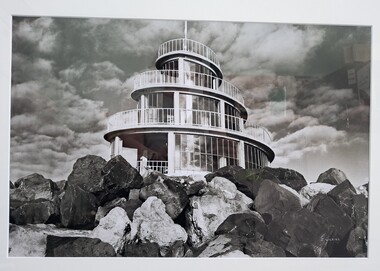
Photograph, John Wilkins, Photographer, Corkscrew, n.d
... marine environment. Portland seafront maritime Portland landmark corkscrew Port of Portland Portland photography Photography Bottom right: J WILKINS Photograph of the Portland Corkscrew in the 1980s. Image is in black and white. The corkscrew is in front of a sky which is dotted with fluffy clouds. To the front of the Corkscrew are large rocks. The building is a spiral with glass windows ...From the Port of Portland website: The original corkscrew was built as a gift to the Portland Harbour Trust by the contractors who constructed the port. It was designed in 1960 and fabricated shortly after the completion of the Main Breakwater. The corkscrew was built as an observatory, with the observation deck approximately 13 metres above sea level. Its original design life was less than 25 years. The original structure was dilapidated, extremely unsafe and in danger of collapse. Understanding the historical and community importance of the original structure, in 2016 Port of Portland began the process of designing and building a replacement. The new corkscrew is a similar size and has been based on the same spiral shape of the original structure. The corkscrew has been constructed using mild steel, heavily coated in marine grade paint (similar to what is used on ships). Heavy duty plastic has been used for the walkway section which will withstand the harsh elements of the marine environment.Photograph of the Portland Corkscrew in the 1980s. Image is in black and white. The corkscrew is in front of a sky which is dotted with fluffy clouds. To the front of the Corkscrew are large rocks. The building is a spiral with glass windows. There is a white metal fence around it and a white pole at the top which reaches to the top of the image.Bottom right: J WILKINSportland, seafront, maritime, portland landmark, corkscrew, port of portland, portland photography, photography -
 Mission to Seafarers Victoria
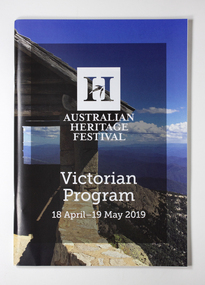
Programme (item) - Program, National Trust, Australian Heritage Festival - Victorian Program 2019, 2019
... In 2019, The Mission hosted "Practice Makes Perfect", a showcase of rare trades: stained glass windows, lace making, marine knots, wood carving etc. australian heritage festival 2019 events victorian program national trust friend of the festival practice makes perfect lost trades artisans rare trades gordon byrne artisan's guild of australia bruce hutton bruce walker henry hakopian keiran dunleavy david stephenson duncan mcharg james charlwood barry smith Programme of events held during May 2019 in Victoria during The Australian Heritage Festival. ...The Australian Heritage Festival is a yearly event organised by the National Trust. Organisations can register their events held during a month, with dates varying in each state.The Mission to Seafarers holds tours and other events every year during this Festival for the community to discover its history. In 2019, The Mission hosted "Practice Makes Perfect", a showcase of rare trades: stained glass windows, lace making, marine knots, wood carving etc.australian heritage festival, 2019, events, victorian program, national trust, friend of the festival, practice makes perfect, lost trades, artisans, rare trades, gordon byrne, artisan's guild of australia, bruce hutton, bruce walker, henry hakopian, keiran dunleavy, david stephenson, duncan mcharg, james charlwood, barry smith -
 Mission to Seafarers Victoria
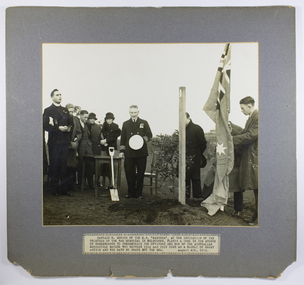
Photograph - Photograph, Black and white, Herald, Captain R. Sunter of the M.S. Manunda , at the invitation of the War memorial in Melbourne, plants a tree, 04 August 1934
... window funded by crew of the Manunda and friends was dedicated to his memory in St Peter's Chapel, MtSV in February 1936 by Padre Oliver. (see item 0038). Depicts one of the few memorials specifically commissioned for Merchant seamen of WW1 and in later years also a focus for those who died in WW2 and other conflicts. padre oliver captain robert sunter m.s. manunda war memorial mercantile marine memorial tree melbourne shrine of remembrance wandilla hospital ship adelaide steamship company memorial trees queensland kauri Typed caption in upper case: CAPTAIN R. ...On the 4 August 1934, to mark the 20th anniversary of the Great Britain declaration of war on Germany, 106 trees were planted, during a ceremony, on the lawns of the newly created garden of the Shrine of Remembrance. The Shrine of Remembrance was built to provide a place to grieve and remember Victorians killed in the First World War (1914-18). Prince Henry, the Duke of Gloucester and son of King George V, officially opened the Shrine before a crowd of 300,000 people in November 1934. Captain Robert Sunter, commander of the coastal liner Manunda, Adelaide Steamship Company, was chosen to plant a Queensland kauri (tree - number 100) on the main avenue from Domain Rd leading to the Shrine of Remembrance. The photograph was published in the Herald (4 August 1934, p. 40). In the Argus (Melbourne, Vic. : 1848 - 1957), Friday 3 August 1934, page 8 In Memory of the Merchant Service- Captain Sunter to Plant Tree at the Shrine Tomorrow will be the 20th anniversary of Great Britain's declaration of war on Germany, and at 10 and. Captain R. Sunter, the commander of the coastal liner Manunda, will plant a tree in the Shrine! of Remembrance reserve In memory of the officers and men of the Australian merchant service who gave their lives during the war. The tree, , which will be No.100 in the reserve, will bear the following inscription based on the wording of the ' British Mercantile Marine memorial at Tower Hill. London: "1914-1918. In remembrance of the officers and men of the Australian Mercantile Marine who died for King and Country and have no grave but the sea. Planted August 4, 1934." During the war 12 ships of the Australian merchant service were sunk and 95 officers and men lost their lives.The Shrine of Remembrance committee recently asked the director of navigation (Captain J. K. Davis) to nominate a member of the mercantile marine to plant a tree in the reserve. Captain Davis passed on the request to the secretary of the Merchant Service Guild of Australia (Captain T. D. Snape) and, after having conferred with various sections of the sea-going service, Captain Snape announced yesterday that Captain Sunter had been chosen unanimously. Captain Sunter has a distinguished war record as commander of the hospital ship Wandilla. Born at South Shields, in England, in 1878, he is a son of the late Canon Sunter, of Adelaide. He served an apprenticeship in sailing ships, and soon after obtaining his master a certificate entered the service of the Adelaide Steamship Company, where he has remained. In the Wandilla during the war Captain Sunter became known to thousands of wounded soldiers and troops." Padre Frank Oliver of MtS can be seen assisting with dedication at far left. Captain Robert Sunter who also served in WW1, a friend of the seamen and the mission, died a month later in Cairns. A window funded by crew of the Manunda and friends was dedicated to his memory in St Peter's Chapel, MtSV in February 1936 by Padre Oliver. (see item 0038).Depicts one of the few memorials specifically commissioned for Merchant seamen of WW1 and in later years also a focus for those who died in WW2 and other conflicts. Mounted black and white photograph of a group of people at a tree planting, minister of religion at far left, on dark grey mount with typed caption label on the lower edge of mountTyped caption in upper case: CAPTAIN R. SUNTER OF THE M.S. “MANUNDA”, AT THE INVITATION OF THE TRUSTEES OF THE WAR MEMORIAL IN MELBOURNE , PLANTS A TREE IN THE AVENUE OF REMEMBRANCE TO COMMEMORATE THE OFFICERS AND MEN OF THE AUSTRALIAN MERCANTILE MARINE WHO BETWEEN 1914 AND 1918 DIED AS A RESULT OF ENEMY ACTION AND WHO HAVE NO GRAVE BUT THE SEA. AUGUST 4TH 1934padre oliver, captain robert sunter, m.s. manunda, war memorial, mercantile marine memorial tree, melbourne, shrine of remembrance, wandilla, hospital ship, adelaide steamship company, memorial trees, queensland kauri -
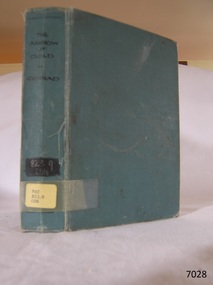 Flagstaff Hill Maritime Museum and Village
Book - Romantic/Adventure Story, Joseph Conrad, The Arrow Of Gold, 1919
... window into Conrad's mysterious early years in Marseille, as it was largely based on his own autobiographical experiences. As a later-period masterpiece, it represents one of the best-received romantic/adventure works from his late period. Pattison Collection see item 3678 Flagstaff Hill collections) https://victoriancollections.net.au/items/5580c7e72162f114d8b758db Flagstaff Hill Flagstaff Hill Maritime Museum and Village Warrnambool Maritime Museum Maritime Village Great Ocean Road Shipwreck Coast Joseph Conrad Captain Joseph Conrad maritime author marine author nautical author sailor seafarer Georg Stage 1882 ship Danish ship training ship boys killed Alan Villiers ship Joseph Conrad Mystic Seaport museum ship Warrnambool Mechanics Institute Pattison Collection Warrnambool Library Ralph Eric Pattison Corangamite Regional Library Service The Arrow of Gold Set in Marseille and the Mediterranean during the 1870s against the backdrop of the Third Carlist War in Spain, The Arrow of Gold: A Story Between Two Notes follows a young sailor (Monsieur George) who becomes involved in running guns to support the royalist Carlist forces. ...Set in Marseille and the Mediterranean during the 1870s against the backdrop of the Third Carlist War in Spain, The Arrow of Gold: A Story Between Two Notes follows a young sailor (Monsieur George) who becomes involved in running guns to support the royalist Carlist forces. Along the way, he falls deeply in love with the enigmatic Doña Rita, an heiress and benefactor of the Carlist cause. The novel is heavily autobiographical, drawing directly on Conrad’s own youth as a seaman in Marseille, his involvement in Mediterranean gun-running, and a formative early romance.The Arrow Of Gold: A Story Between Two Notes Author: Joseph Conrad Publisher: T Fisher Unwin Date: 1919 Blue hardcover book with title and call numbers on spine, and handwritten pencil inscription on ply page. Also stockers on the front end paper have inscriptions and a stamp. The book is part of the Pattison Collection. fictionSet in Marseille and the Mediterranean during the 1870s against the backdrop of the Third Carlist War in Spain, The Arrow of Gold: A Story Between Two Notes follows a young sailor (Monsieur George) who becomes involved in running guns to support the royalist Carlist forces. Along the way, he falls deeply in love with the enigmatic Doña Rita, an heiress and benefactor of the Carlist cause. The novel is heavily autobiographical, drawing directly on Conrad’s own youth as a seaman in Marseille, his involvement in Mediterranean gun-running, and a formative early romance.flagstaff hill, flagstaff hill maritime museum and village, warrnambool, maritime museum, maritime village, great ocean road, shipwreck coast, joseph conrad, captain joseph conrad, maritime author, marine author, nautical author, sailor, seafarer, georg stage, 1882 ship, danish ship, training ship, boys killed, alan villiers, ship joseph conrad, mystic seaport, museum ship, warrnambool mechanics institute, pattison collection, warrnambool library, ralph eric pattison, corangamite regional library service, the arrow of gold -
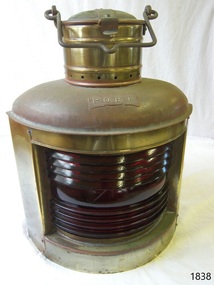 Flagstaff Hill Maritime Museum and Village
Equipment - Navigation Lamp, Port, Bef. 08-02-1984
... Marine lamp: navigation lamp, portside. Metal Kerosene lamp with two flat sides and a curved, rippled red glass front window. ...Marine lamp: navigation lamp, portside. Metal Kerosene lamp with two flat sides and a curved, rippled red glass front window. ...This item appears to be a 20th-century lamp, modelled after an earlier version of a wall-mounted kerosene lamp. Authentic kerosene lamps were typically crafted from copper or brass, renowned for their durability and traditional aesthetic. In contrast, contemporary reproductions are often manufactured using alternative materials and processes, reflecting changes in production methods and cost considerations.The lamp is modelled after marine kerosene navigation lamps that were widely used throughout the 19th and early 20th centuries. These lamps played a significant role in maritime history, providing essential lighting for navigation on vessels during this era. As a representation of this period’s maritime lighting technology, the lamp serves as an example of the type of equipment that would have been commonplace aboard ships of the time. Marine lamp: navigation lamp, portside. Metal Kerosene lamp with two flat sides and a curved, rippled red glass front window. The name "port" is inscribed on a fixed brass plaque. A round chimney is on top of the lid opens with a catch. The fuel tank and wick can be removed through the base. The metal appears to be electroplated.Inscribed on the plaque; "PORT"flagstaff hill, flagstaff hill maritime museum and village, warrnambool, maritime museum, maritime village, great ocean road, shipwreck coast, ship's lamp, kerosene lamp, navigation lamp, ship's equipment, safety equipment, port lamp -
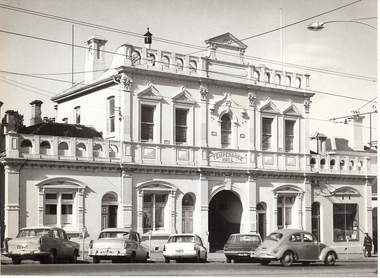 Bendigo Historical Society Inc.
Photograph - TEMPERANCE HALL, 1972
... Signs on windows: 'Chief Agent/Union/Insurance Society of Canton Ltd' 'Marine Accident' 'Auditor/Tax Agent' 'District office/Transport & General/Insurance/Company'...Signs on windows: 'Chief Agent/Union/Insurance Society of Canton Ltd' 'Marine Accident' 'Auditor/Tax Agent' 'District office/Transport & General/Insurance/Company' Photograph TEMPERANCE HALL ...Building Temperance Hall, View St, Bendigo with five cars at front, windows at top with signs. Signs on windows: 'Chief Agent/Union/Insurance Society of Canton Ltd' 'Marine Accident' 'Auditor/Tax Agent' 'District office/Transport & General/Insurance/Company'place, building, commercial -
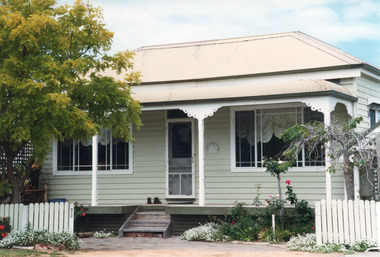 Lakes Entrance Historical Society
Photograph - Historic House, 212 Marine Parade. Lakes Entrance 1999
... Marine Parade. Hipped roof and bull nose veranda of iron. Slim timber veranda posts with decorative brackets. Metal framed windows...Marine Parade. Hipped roof and bull nose veranda of iron. Slim timber veranda posts with decorative brackets. Metal framed windows ...Believed to have been built early 1900's. It was the home of Herb Nadenbousch when he was Assistant Post Master at Lakes Entrance. His wife operated a podiatrist business from rooms at the back of the house in the 1970's. It was raised and extended by June and John Parsons in 1992 and later sold to David and Kathy Bulmer.Colour photograph of a timber dwelling at 212 Marine Parade. Hipped roof and bull nose veranda of iron. Slim timber veranda posts with decorative brackets. Metal framed windows each side of central doorway with fan light above. Lakes Entrance Victoriafences, houses, heritage study -
 Lakes Entrance Historical Society
Photograph - Historic House 216 marine Parade, 1999
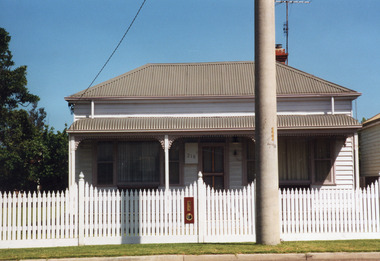
... marine Parade. Hipped roof with bull nose veranda of corrugated iron . Picture window bordered by narrow sash windows each side of front door, which has fan light above. ...marine Parade. Hipped roof with bull nose veranda of corrugated iron . Picture window bordered by narrow sash windows each side of front door, which has fan light above. ...Believed to have been built around WW1Colour photograph of a timber dwelling at 216 marine Parade. Hipped roof with bull nose veranda of corrugated iron . Picture window bordered by narrow sash windows each side of front door, which has fan light above. White painted picket fence. Lakes Entrance Victoriahouses, heritage study -
 Lakes Entrance Historical Society
Photograph - Historic House, 240 Marine Parade. Lakes Entrance Victoria, 1999
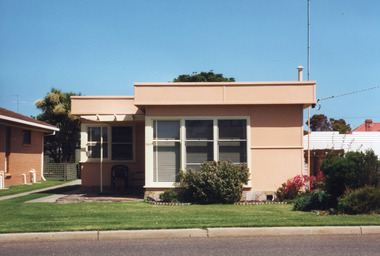
... Colour photograph of a fibro cement, flat roofed dwelling at 240 Marine Parade. Timber framed corner windows. Front patio tiled with natural stone. ...Typical of the flat roofed design of the 1950's Houses Fences Heritage Study Colour photograph of a fibro cement, flat roofed dwelling at 240 Marine Parade. Timber framed corner windows. Front patio tiled with natural stone. ...Typical of the flat roofed design of the 1950'sColour photograph of a fibro cement, flat roofed dwelling at 240 Marine Parade. Timber framed corner windows. Front patio tiled with natural stone. Lakes Entrance Victoriahouses, fences, heritage study
