
Showing 259 items matching "maritime technology"
-
 Bendigo Historical Society Inc.
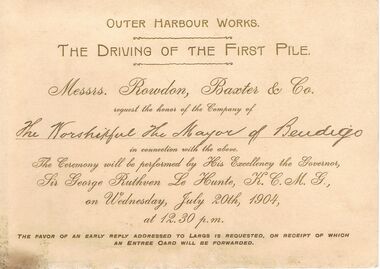
Document - LYDIA CHANCELLOR COLLECTION; THE DRIVING OF THE FIRST PILE INVITATION
... MARITIME TECHNOLOGY...MARITIME TECHNOLOGY Harbour facilities invitation Lydia Chancellor collection invitation maritime technology An invitation in the form of a brown card with the words, ' Outer Harbour Works. ...An invitation in the form of a brown card with the words, ' Outer Harbour Works. The Driving of the First Pile. Messrs Rowdon, Baxter & Co. request the honor of the Company of The Worshipful the Mayor of Bendigo in connection with the above. The Ceremony will be performed by His Excellency the Governor, Sir George Ruthven Le Hunte, K. C.M.G, on Wednesday, July 20th, 1904, at 12.30 p.m. The favor of an early reply addressed to Larqs is requested, on receipt of which an Entrée Card will be forwarded.'maritime technology, harbour facilities, invitation, lydia chancellor, collection, invitation, maritime technology -
 Flagstaff Hill Maritime Museum and Village
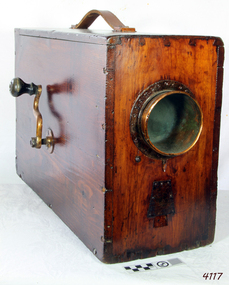
Instrument - Foghorn, Late 19th century
... ...maritime technology...Therefore the item has a historical connection with sailing and maritime pursuits from our past. flagstaff hill warrnambool shipwrecked coast flagstaff hill maritime museum maritime museum shipwreck coast flagstaff hill maritime village great ocean road foghorn maritime technology maritime communication marine warning signal portable foghorn bellows foghorn crank handle Robert Hope-Jones John Northey None English Rotary Norwegian Pattern nautical foghorn within a boxed pine varnished case with exposed corner dovetailing, original leather carrying strap, brass side crank, and original copper trumped horn. ...A foghorn is a device that uses sound to warn of navigational hazards like rocky coastlines, or boats of the presence of other vessels, in foggy conditions. The term is most often used with marine transport. When visual navigation aids such as lighthouses are obscured, foghorns provide an audible warning of rocky outcrops, shoals, headlands, or other dangers to shipping. An early form of fog signal was to use a bell, gong, explosive signal or firing a cannon to alert shipping. From the early 20th century an improved device called the diaphone was used in place of these other devices, The diaphone horn was based directly on the organ stop of the same name invented by Robert Hope-Jones, creator of the Wurlitzer organ. Hope-Jones' design was based on a piston that was closed only at its bottom end and had slots, perpendicular to its axis, cut through its sides, the slotted piston moved within a similarly slotted cylinder. Outside of the cylinder was a reservoir of high-pressure air. Initially, this air would be admitted behind the piston, pushing it forward. When the slots of the piston aligned with those of the cylinder, air passed into the piston, making a sound and pushing the piston back to its starting position, whence the cycle would be repeated. This method of producing a low audible sound was further developed as a fog signal by John Northey of Toronto and these diaphones were powered by compressed air produced by an electric motor or other mechanical means that admitted extremely powerful low-frequency notes. The example in the Flagstaff collection is an early cased and portable diaphone used on pleasure or sailing craft. By manually turning the crank handle air is produced and fed into valves that direct air across vibrating metal reeds to produce the required sound. in foggy weather, fog horns are used to pinpoint a vessels position and to indicate how the vessel is sailing in foggy conditions. One blast, when sailing on starboard tack and two blasts, when sailing on a port tack and three dots, when with wind is behind the vessel. Since the automation of lighthouses became common in the 1960s and 1970s, most older foghorn marine installations have been removed to avoid the need to run the complex machinery associated with them, and have been replaced with an electrically powered diaphragm or compressed air horns. The example in the collection is significant as it was used in the early 19th century for sailing vessels was important but these portable crank fog horns have also been superseded by modern electric varieties. Therefore the item has a historical connection with sailing and maritime pursuits from our past.English Rotary Norwegian Pattern nautical foghorn within a boxed pine varnished case with exposed corner dovetailing, original leather carrying strap, brass side crank, and original copper trumped horn. Card accessory with Directions for Use in both English and French.Noneflagstaff hill, warrnambool, shipwrecked coast, flagstaff hill maritime museum, maritime museum, shipwreck coast, flagstaff hill maritime village, great ocean road, foghorn, maritime technology, maritime communication, marine warning signal, portable foghorn, bellows foghorn, crank handle, robert hope-jones, john northey -
 Flagstaff Hill Maritime Museum and Village
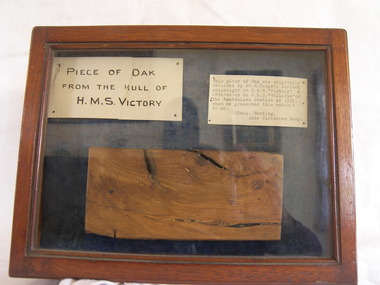
Plant specimen - Wood Sample, Herbst, 1759-1765
... ...maritime technology...Through Nelson’s leadership and unorthodox battle tactics, he secured not only a victory against the French and Spanish but also reaffirmed Britain's naval supremacy, opening the way for Britain to continue the policy of colonisation of many countries, including Australia. flagstaff hill warrnambool shipwrecked-coast flagstaff-hill flagstaff-hill-maritime-museum maritime-museum shipwreck-coast flagstaff-hill-maritime-village oak hms victory vice-admiral lord nelson horatio nelson lord nelson oak piece piece of oaknelson battle of trafalgar maritime technology ship relics 18th century warship british royal navy h cooper shipwright hms wallaroo herbst hyde park sydney charles harding hmv naval orpedo depot williamstown sir home popham’s telegraphic code admiralty official day signal book Photograph Front: printed- "Herbst" "28 Oxford Street, Hyde Park, Sydney", handwritten - "Mr Cooper", "see back". ...The piece of oak wood sample inside the case was obtained from Mr H. Cooper during the time he served as a shipwright for the British Royal Navy on Nelson’s flagship, HMS Victory, in 1891. By that time, the H.M.S. Victory was around 100 years old, having been built in 1765 and was currently in dry dock undergoing restoration. Cooper’s skills as a shipwright would have been well employed during this period. HMS Victory was, and still is, undergoing continuous restoration to preserve her for display as a museum ship, due to the vessel's significant naval history. It was during that early restoration period that Cooper obtained the piece of Oak from HMS Victory, believed to be from the ship's hull. Cooper was in Australia in September 1891 serving on the HMS Wallaroo, a British Auxiliary Squadron commissioned as part of the British Royal Navy contingent, to serve and operate in Australian waters. The photograph included with the donation of the wood sample is a portrait of Mr H Cooper taken in 1895 in Sydney. The inscription on the photograph describes him as a skilled shipwright from H.M.S. Wallaroo, depicting Cooper as a young man in Royal Navy uniform, with the emblem of a petty officer third class. While Cooper was stationed on the H.M.S. Wallaroo in Sydney, he presented the display case, containing the wood sample from H.M.S. Victory, as well as the exhibit labels, to Charles Harding ("Chas"), late of the Royal Australian Navy. Harding had been based at the H M Naval Torpedo Depot at Williamstown, Victoria. Although not mentioned, it is believed the two men met whilst serving together in Australia in their respective assignments. It could have been a retirement gift from Cooper to Harding, with the photograph of Cooper likely included with the case, and gifted to Harding in 1895, as the date on the photograph indicates. One of the exhibit's labels indicates that Harding had the item on display whilst serving at the Naval Torpedo Depot in Williamstown. The label indicates: "This piece of Oak is part of the hull of H.M.S. 'Victory', Lord Nelson’s renowned flagship, which took such a prominent part in the Battle of Trafalgar. 21st October 1805. Exhibited by Charles Harding, H.M.V. Naval Torpedo Depot, Williamstown.” After Charles Harding died in 1931, the case containing the sample of oak from H.M.S. Victory was donated by his son, Reg Harding, to Mr Murphy in 1962. The display case has since become a treasured item at Flagstaff Hill. A newspaper article dated 1905 included with the donation mentions that the city of Hamilton in Victoria was shortly expecting a mounted piece of the H.M.S. Victory to be included in the city’s commemoration of the centenary of the "Battle of Trafalgar". Battle of Trafalgar: On October 21, 1805, twenty-seven British ships of the line led by Admiral Lord Nelson aboard HMS Victory defeated thirty-three French and Spanish ships of the line under French Admiral Villeneuve. The battle took place in the Atlantic Ocean off the southwest coast of Spain, just west of Cape Trafalgar, near the town of Los Caños de Meca. The victory confirmed the naval supremacy Britain had established during the course of the eighteenth century, and it was achieved in part through Nelson's departure from the prevailing naval tactical orthodoxy of the day. Conventional practice at the time was for opposing fleets to engage each other in single parallel lines, to facilitate signalling and disengagement, and to maximise fields of fire and target areas. Nelson instead arranged his ships into two columns to sail perpendicularly into the enemy fleet's line. During the battle, Nelson was shot by a French musketeer, and he died shortly before the battle ended. Villeneuve was captured, along with his ship Bucentaure. He later attended Nelson's funeral while a captive on parole in Britain. Admiral Federico Gravina, the senior Spanish flag officer, escaped with the remnant of the fleet. He died five months later from wounds sustained during the battle. It was before this battle that Nelson had issued his now-famous final orders to his ships in 12 separate flag-hoists: “England expects that every man will do his duty”. This wood sample is historically significant for its association with Admiral Lord Nelson and the Battle of Trafalgar. Through Nelson’s leadership and unorthodox battle tactics, he secured not only a victory against the French and Spanish but also reaffirmed Britain's naval supremacy, opening the way for Britain to continue the policy of colonisation of many countries, including Australia.Wood sample adhered to the base of a hinged wood and glass display case. Wood is a sample of oak taken from the hull of Vice-Admiral Lord Nelson's flagship, the HMS Victory, built in 1765. The case also contain two exhibit labels pinned above the wood sample. Other items donated with the display case, and relating to the wood sample: an 1895 photograph, a 1905 newspaper clipping, a 1962 donor's letter (two pages), and a handwritten exhibit label with a border of red lines. Photograph Front: printed- "Herbst" "28 Oxford Street, Hyde Park, Sydney", handwritten - "Mr Cooper", "see back". Back: handwritten - "Mr H Cooper, skilled shipwright, H.M.S. Wallaroo 1895" Exhibit labels still in the case: Left: handwritten- “PIECE OF OAK FROM THE HULL OF H.M.S. VICTORY”, Right: typewritten- “This piece of Oak was originally obtained by Mr. H. Cooper, skilled shipwright on H.M.S. “Victory” & afterwards on H.M.S. “Wallaroo” on the Australian Station in 1895, when he presented this exhibit to me. Chas. Harding, Late Victorian Navy.”flagstaff hill, warrnambool, shipwrecked-coast, flagstaff-hill, flagstaff-hill-maritime-museum, maritime-museum, shipwreck-coast, flagstaff-hill-maritime-village, oak, hms victory, vice-admiral lord nelson, horatio nelson, lord nelson, oak piece, piece of oaknelson, battle of trafalgar, maritime technology, ship relics, 18th century warship, british royal navy, h cooper shipwright, hms wallaroo, herbst hyde park sydney, charles harding, hmv naval orpedo depot williamstown, sir home popham’s telegraphic code, admiralty official day signal book -
 Flagstaff Hill Maritime Museum and Village
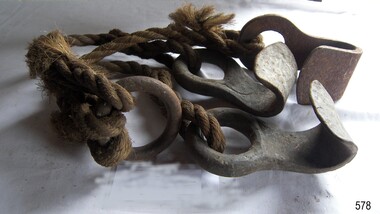
Equipment - Sling Hooks
... ...maritime technology...Flagstaff Hill Warrnambool Maritime Museum Maritime Village Great Ocean Road Shipwreck Coast sling hook ring hook rigging cargo haulage Cargo Lifiting maritime technology Sling hooks; three metal ring hook each on a short length of rope and all attached to the same metal ring . ...Sling hooks are used in ship's rigging for cargo haulage.Sling hooks are necessary for hauling cargo. Cargo was imported to and exported from the busy Port of Warrnambool in the 19th and early 20th centuries. Sling hooks are still used today for cargo.Sling hooks; three metal ring hook each on a short length of rope and all attached to the same metal ring . flagstaff hill, warrnambool, maritime museum, maritime village, great ocean road, shipwreck coast, sling hook, ring hook, rigging, cargo, haulage, cargo lifiting, maritime technology -
 Glenelg Shire Council Cultural Collection
Functional object - Lamp, Navigation Lamp, n.d
... ... maritime technology...Port of Portland Authority Collection Port of Portland navigation maritime technology Navigation light, acetylene type. ...Port of Portland Authority CollectionNavigation light, acetylene type. Steel and bronze body painted grey, glass lens cover, triangular sections; bronze and brass chimney painted grey silver. Thumb screw toggled latch.port of portland, navigation, maritime technology -
Glenelg Shire Council Cultural Collection
Functional object - Fid, n.d
... maritime technology...It is used to work with rope and canvas in marlinespike seamanship Henty brothers maritime technology Henty brothers Fid made of whale bone. ...Used by Peter Carrison (donor's father-in-law) who was a boat builder. Originally used by Henty brothers, for splicing cordage (rope) A fid is a conical tool traditionally made of wood or bone. It is used to work with rope and canvas in marlinespike seamanshipHenty brothersFid made of whale bone. Three decorative grooves (straight) around top. A fid is a conical tool traditionally made of wood or bone. It is used to work with rope and canvas in marlinespike seamanshipmaritime technology, henty brothers -
Glenelg Shire Council Cultural Collection
Instrument - Barometer, Spencer Browning & Rust, c. 1853
... ... maritime technology...James Fawthrop James Fawthrop Portland Customs House maritime technology Front: yellow sticky label with number 4001 on back of case. ...Believed to have been used at Portland Customs House during the time that Captain James Fawthrop was Harbour Master, 1853 - 1868. Hung on the wall of the Portland Custom House during his period of office as Portland Harbour Master.James FawthropGlass fronted wooden case containing a thermometer and a 'vapour pressure' barometer.Front: yellow sticky label with number 4001 on back of case.james fawthrop, portland customs house, maritime technology -
 Orbost & District Historical Society
harpoons, Early 1800's
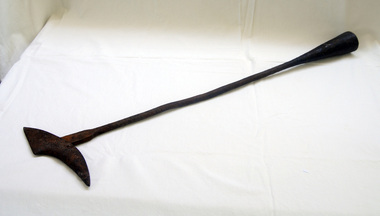
... whaling harpoons Ashby-Arthur maritime-technology...They were handed down to his son, Norman Ashby who gave them to the donor's father for safe-keeping as he did not have a permanent residence. whaling harpoons Ashby-Arthur maritime-technology Two harpoons. .1 is a hand held iron harpoon. ...These whale harpoons belonged to Arthur Ashby. The longer one was his personal hand-forged harpoon. Arthur Ashby was a harpoonist written about in the book, "Killers of Eden". They were handed down to his son, Norman Ashby who gave them to the donor's father for safe-keeping as he did not have a permanent residence. Two harpoons. .1 is a hand held iron harpoon. It is very long with an open neck at one end and a large blade at the other. .2 is smaller and was used in harpoon guns. It is made of brass with a pointed end.whaling harpoons ashby-arthur maritime-technology -
 Flagstaff Hill Maritime Museum and Village
Postcard - Vessel, Sailing Ship, after October 1805
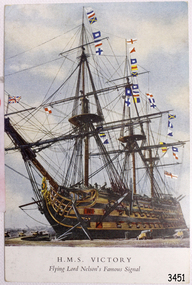
... ...maritime technology...Through Nelson’s leadership and unorthodox battle tactics, he secured not only a victory against the French and Spanish but reaffirmed Britain's naval supremacy opening the way for Britain to continuing the policy of colonisation of many countries including Australia. flagstaff hill warrnambool shipwrecked-coast flagstaff-hill flagstaff-hill-maritime-museum maritime-museum shipwreck-coast flagstaff-hill-maritime-village post card postcard sailing ship vice-admiral lord nelson horatio nelson lord nelson oak piece piece of oak nelson battle of trafalgar maritime technology ship relics 18th century warship british royal navy sir home popham’s telegraphic code admiralty official day signal book october 21, 1805 admiral lord nelson french and spanish navies nelson's famous signal england expects that every man will do his duty hms victory nelson collection at lloyd's lloyd’s of london lloyd’s patriotic fund napoleonic battles british naval history 18th century warship 18th century battleship Printed on the front "H.M.S. ...The British Royal Navy’s warship HMS Victory was once Lord Nelson’s flagship. The HMS Victory was built in 1765 and after serving active duty is now, in 2019, still a ship of the Royal Navy, in dry dock undergoing continuous restoration to preserve her for display as a museum ship, due to the vessel’s significant naval history. Battle of Trafalgar: On October 21, 1805, twenty-seven British ships of the line, led by Admiral Lord Nelson aboard HMS Victory, defeated thirty-three French and Spanish ships of the line under French Admiral Villeneuve. The battle took place in the Atlantic Ocean off the southwest coast of Spain, just west of Cape Trafalgar, near the town of Los Caños de Meca. The victory confirmed the naval supremacy Britain had established during the course of the eighteenth century and it was achieved in part through Nelson's departure from the prevailing naval tactical orthodoxy of the day. Conventional practice at the time was for opposing fleets to engage each other in single parallel lines, in order to facilitate signalling and disengagement and to maximise fields of fire and target areas. Nelson instead arranged his ships into two columns to sail perpendicularly into the enemy fleet's line. During the battle, Nelson was shot by a French musketeer and he died shortly before the battle ended. Villeneuve was captured, along with his ship Bucentaure. He later attended Nelson's funeral while a captive on parole in Britain. Admiral Federico Gravina, the senior Spanish flag officer, escaped with the remnant of the fleet. He died five months later from wounds sustained during the battle. It was prior to this battle that Nelson had issued his now-famous final orders to his ships in 12 separate flag-hoists “England expects that every man will do his duty”. This wood sample is historically significant for its association with Admiral Lord Nelson the Battle of Trafalgar. Through Nelson’s leadership and unorthodox battle tactics, he secured not only a victory against the French and Spanish but reaffirmed Britain's naval supremacy opening the way for Britain to continuing the policy of colonisation of many countries including Australia.A coloured postcard of a sailing ship, warship or battleship, deck cannons on the ship and in the foreground, many signal flags flying from the masts. Printed on the front "H.M.S. Victory Flying Lord Nelson Famous Signal". The signal was given by Lord Nelson in 1805.Printed on the front "H.M.S. Victory / Flying Lord Nelson Famous Signal"flagstaff hill, warrnambool, shipwrecked-coast, flagstaff-hill, flagstaff-hill-maritime-museum, maritime-museum, shipwreck-coast, flagstaff-hill-maritime-village, post card, postcard, sailing ship, vice-admiral lord nelson, horatio nelson, lord nelson, oak piece, piece of oak, nelson, battle of trafalgar, maritime technology, ship relics, 18th century warship, british royal navy, sir home popham’s telegraphic code, admiralty official day signal book, october 21, 1805, admiral lord nelson, french and spanish navies, nelson's famous signal, england expects that every man will do his duty, hms victory, nelson collection at lloyd's, lloyd’s of london, lloyd’s patriotic fund, napoleonic battles, british naval history, 18th century warship, 18th century battleship -
 Glenelg Shire Council Cultural Collection
Functional object - Walker's 'Excelsior' Yacht Log Mark II, Thomas Walker, c. 1900
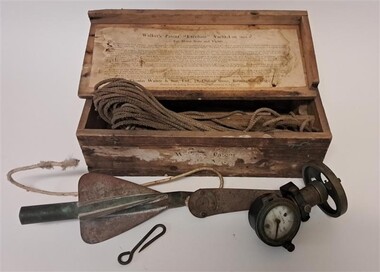
... ...Maritime Technology...Maritime Maritime History Tool Navigational Tool Navigational Instrument Navigation Sailing Walkers Maritime Technology Walker & Son Enamel Dial: Walkers Patent Excelsior Yacht Log Timber Box containing an instrument for measuring speed and distance. ...From Scarborough Maritime Heritage Centre: A Yacht Log was a nautical instrument for measuring a vessel's speed and distance travelled. When navigating a ship it is essential to be able to estimate the boat's speed and distance travelled to determine its position at sea. In times past the only way to measure a ship's speed was to throw a wood log into the water and observe how fast it moved away from the ship. In the 16th century, the log was fastened to a rope knotted at set intervals. The log was thrown over the stern (back) of the vessel and a crew member counted the number of knots that were paid out in a set time. From this they could estimate the speed of the vessel through the water. This was known as streaming the log and is also the derivation of the knot as a measurement of nautical speed. In 1878, Thomas Ferdinand Walker (1837–1921), an engineer in Birmingham, patented a mechanical log in which a recording instrument was attached to a rail at the stern of a vessel connected by a long cord with a rotor which was towed behind the ship. The instrument dial recorded the distance travelled. The 'Log' at the Heritage Centre was recovered from a skip in Scarborough and was one of the first artefacts collected by the volunteer group. It is made of brass with a ceramic dial, with the main scale marked from 0 to 100 nautical miles and an inset dial marked from 0 to 10 miles. It has a fixing plate, on which it can turn, with which it would have been attached to the 'taffrail', the rail at the stern of a ship, usually on the starboard side. The Walker’s Excelsior Mark IV instrument was designed for smaller vessels, such as yachts, launches and fishing vessels. Its exact date of manufacture cannot be determined but this design was manufactured in the first half of the 20th century. These mechanical logs have now been superseded by electronic equipment such as GPS navigation instruments.This instrument was made by a significant nautical instrument manufacturer and demonstrates the innovation needed at the time for improved navigation and safety at sea.Timber Box containing an instrument for measuring speed and distance. There is a brass, cased log with a white enamel dial. It also includes a towing cord and cylindrical rotator. The box has paper labelling on the front and also the inside of the lid. The label on the inside of the lid has instructions for use. Although the lid is hinged it has broken off and is separate. The hinges remain attached.Enamel Dial: Walkers Patent Excelsior Yacht Logmaritime, maritime history, tool, navigational tool, navigational instrument, navigation, sailing, walkers, maritime technology, walker & son -
Phillip Island and District Historical Society Inc.
Photograph
... ...MARITIME TECHNOLOGY...Local History PHOTOGRAPHY Photographs Slides Film CIVIL ENGINEERING Bridges MARITIME TECHNOLOGY Boats Phillip Island Bridge Sailing Boats Black & White Photograph Mrs. ...Phillip Island Suspension Bridge built 1938. Part of an album compiled and donated by Mrs. Helen Jansson.Phillip Island Suspension Bridge with small Sail Boat sailing under - low scrub in foreground.Descriptive caption adjoining this photo print also the one following.local history, photography, photographs, slides, film, civil engineering, bridges, maritime technology, boats, phillip island bridge, sailing boats, black & white photograph, mrs. helen jansson, suspension bridges, phillip island -
 Phillip Island and District Historical Society Inc.
Photograph
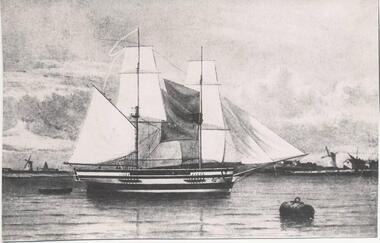
... ...maritime technology...One of a collection of over 400 photographs in an album commenced in 1960 and presented to the Phillip Island & Westernport Historical Society by the Shire of Phillip Island local history photography photographs maritime technology boats sailing ship - lady nelson black & white photograph sailing ships lady nelson john jenner bryant west Photograph of a painting of The Lady Nelson with a buoy in the foreground and windmills on the shore in the background. ...One of a collection of over 400 photographs in an album commenced in 1960 and presented to the Phillip Island & Westernport Historical Society by the Shire of Phillip IslandPhotograph of a painting of The Lady Nelson with a buoy in the foreground and windmills on the shore in the background. The "Lady Nelson" was the first ship to sail Bass Strait from West to East.local history, photography, photographs, maritime technology, boats, sailing ship - lady nelson, black & white photograph, sailing ships, lady nelson, john jenner, bryant west -
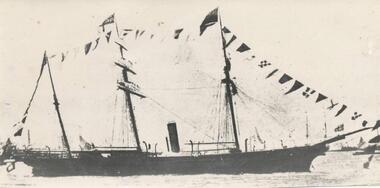 Phillip Island and District Historical Society Inc.
Photograph, 1865
... ...maritime technology...One of a collection of over 400 photographs in an album commenced in 1960 and presented to the Phillip Island & Westernport Historical Society by the Shire of Phillip Island local history photography photographs maritime technology boats steam sailing ship "victoria" black & white photograph ships man-o-war western port survey john jenner bryant west Photograph of the ship "Victoria" which surveyed Western Post in 1865. ...One of a collection of over 400 photographs in an album commenced in 1960 and presented to the Phillip Island & Westernport Historical Society by the Shire of Phillip IslandPhotograph of the ship "Victoria" which surveyed Western Post in 1865. The first Victorian Man-o-War.local history, photography, photographs, maritime technology, boats, steam sailing ship "victoria", black & white photograph, ships, man-o-war, western port, survey, john jenner, bryant west -
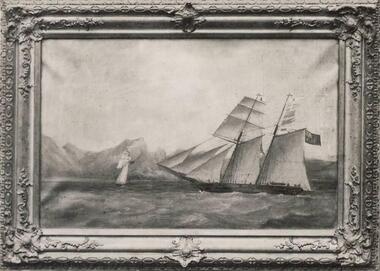 Phillip Island and District Historical Society Inc.
Photograph
... ...maritime technology...One of a collection of over 400 photographs in an album commenced in 1960 and presented to the Phillip Island & Westernport Historical Society by the Shire of Phillip Island local history photography photographs maritime technology boats schooner "henrietta" black & white photograph shipping schooners john cleeland henrietta john jenner bryant west Photograph of a painting of Captain John Cleeland's Schooner "Henrietta" Photograph Bryant West ...One of a collection of over 400 photographs in an album commenced in 1960 and presented to the Phillip Island & Westernport Historical Society by the Shire of Phillip IslandPhotograph of a painting of Captain John Cleeland's Schooner "Henrietta"local history, photography, photographs, maritime technology, boats, schooner "henrietta", black & white photograph, shipping, schooners, john cleeland, henrietta, john jenner, bryant west -
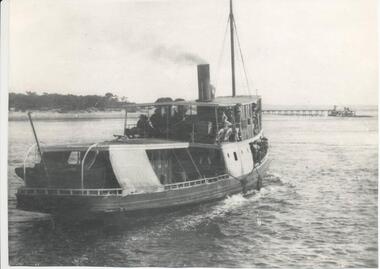 Phillip Island and District Historical Society Inc.
Photograph
... ...maritime technology...One of a collection of over 400 photographs in an album commenced in 1960 and presented to the Phillip Island & Westernport Historical Society by the Shire of Phillip Island local history photography photographs maritime technology ferries ferry "genista" black & white photograph shipping genista john jenner bryant west Photograph of the ferry, "Genista" from a point astern and steaming west towards Cowes Jetty Photograph Bryant West ...One of a collection of over 400 photographs in an album commenced in 1960 and presented to the Phillip Island & Westernport Historical Society by the Shire of Phillip IslandPhotograph of the ferry, "Genista" from a point astern and steaming west towards Cowes Jettylocal history, photography, photographs, maritime technology, ferries, ferry "genista", black & white photograph, shipping, genista, john jenner, bryant west -
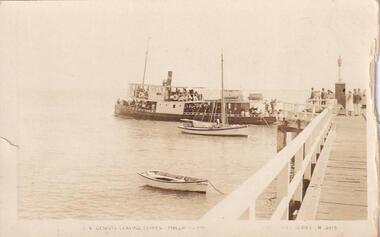 Phillip Island and District Historical Society Inc.
Photograph
... ...maritime technology...Bernard Grayden. 1975 local history maritime technology ferries documents postcards jetties phillip island ferries sepia postcard ferry ss genista cowes pier bernard grayden View of Ferry - S.S.Genista - leaving Cowes Pier. ...Part of collection donated to the Museum by Mr. Bernard Grayden. 1975View of Ferry - S.S.Genista - leaving Cowes Pier.local history, maritime technology, ferries documents, postcards, jetties, phillip island, ferries, sepia postcard, ferry, ss genista, cowes pier, bernard grayden -
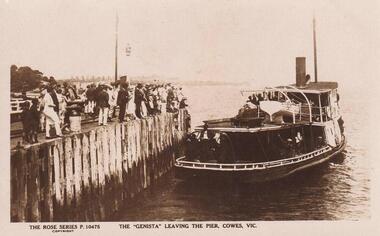 Phillip Island and District Historical Society Inc.
Photograph
... ...maritime technology...Bernard Grayden. 1975 local history maritime technology ferries documents postcards jetties ferries cowes phillip island sepia postcard ss genista bernard grayden View of S.S. ...Part of collection donated to the Museum by Mr. Bernard Grayden. 1975View of S.S. "Genista" leaving Cowes Pier.local history, maritime technology, ferries documents, postcards, jetties, ferries, cowes, phillip island, sepia postcard, ss genista, bernard grayden -
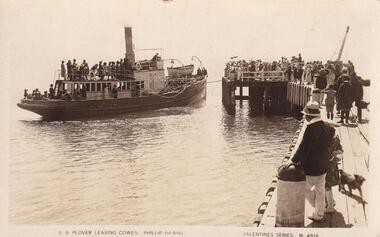 Phillip Island and District Historical Society Inc.
Photograph
... ...maritime technology...Bernard Grayden. 1975 local history maritime technology boats documents postcards ferries jetties phillip island sepia postcard ss plover cowes jetty bernard grayden S.S. ...Part of collection donated to the Museum by Mr. Bernard Grayden. 1975S.S. "Plover" leaving Cowes Pier, crowded with people.S.S. Plover leaving Cowes, Phillip Island. Valentine Series M4916local history, maritime technology, boats documents, postcards, ferries, jetties, phillip island, sepia postcard, ss plover, cowes jetty, bernard grayden -
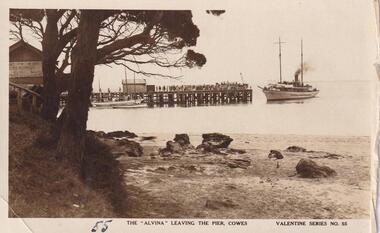 Phillip Island and District Historical Society Inc.
Photograph
... ...maritime technology...Bernard Grayden. 1975 local history maritime technology boats documents postcards jetties vessels cowes phillip island sepia postcard alvina beach bernard grayden The "Alvina" leaving the Pier, Cowes. ...Part of collection donated to the Museum by Mr. Bernard Grayden. 1975View of "Alvina" at Cowes Pier, and Cowes Beach showing sign about Beach Buildings on building at leftThe "Alvina" leaving the Pier, Cowes. Valentine Series No. 55local history, maritime technology, boats documents, postcards, jetties, vessels, cowes, phillip island, sepia postcard, alvina, beach, bernard grayden -
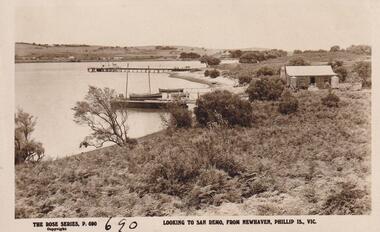 Phillip Island and District Historical Society Inc.
Photograph
... ...postcards maritime technology...Bernard Grayden 1975 local history documents postcards maritime technology boats jetties vessels san remo newhaven phillip island sepia postcard Looking to San Remo, from Newhaven, Phillip Island, Victoria. ...Part of collection donated to the Museum by Mr. Bernard Grayden 1975Newhaven, looking towards San Remo, showing house, two-masted boat & pierLooking to San Remo, from Newhaven, Phillip Island, Victoria. The Rose Series P 690local history, documents, postcards maritime technology, boats, jetties, vessels, san remo, newhaven, phillip island, sepia postcard -
Phillip Island and District Historical Society Inc.
Rotary Fog Horn, Unknown
... ...maritime technology..."Eagle Star" ferry used until 1970's when burned to waterline near pier. local history maritime technology communications signals fog horn eagle star Patent Rotary Fog Horn from "Eagle Star" ferry Rotary Fog Horn ..."Eagle Star" ferry used until 1970's when burned to waterline near pier.Patent Rotary Fog Horn from "Eagle Star" ferrylocal history, maritime technology, communications, signals, fog horn, eagle star -
Phillip Island and District Historical Society Inc.
Engine Room Signal, Unknown
... ...maritime technology...Unknown local history maritime technology communications signals engine room signal Engine Room Signal. ...UnknownEngine Room Signal. Direction face hands attached to central internal bar - stem screw mounted.local history, maritime technology, communications, signals, engine room signal -
Phillip Island and District Historical Society Inc.
Anchor, 1920 approximate
... ...maritime technology...'Hollydene' during oystering. local history maritime technology ship fittings grappling anchor hollydene phillip island White painted iron Grappling Anchor Anchor ...Handmade by Bill Kennon for use on M.V. 'Hollydene' during oystering.White painted iron Grappling Anchorlocal history, maritime technology, ship fittings, grappling anchor, hollydene, phillip island -
Phillip Island and District Historical Society Inc.
Ship's Wheel, Unknown
... ...maritime technology...Unknown local history maritime technology ship fittings ship wheel 8 spar 8 Spar Ship's Wheel - each spar topped with wooden handle. ...Unknown8 Spar Ship's Wheel - each spar topped with wooden handle.local history, maritime technology, ship fittings, ship wheel 8 spar -
Phillip Island and District Historical Society Inc.
Photograph
... ...MARITIME TECHNOLOGY...Local History PHOTOGRAPHY Photographs Slides Film MARITIME TECHNOLOGY Boats Transport - Shipping Black & White Photograph Shipping Phillip Island S.S.Genista leaving the pier at Cowes, Phillip Island. ...This photograph was donated by Mrs A Phillips in February 1998.S.S.Genista leaving the pier at Cowes, Phillip Island.local history, photography, photographs, slides, film, maritime technology, boats, transport - shipping, black & white photograph, shipping, phillip island -
 Phillip Island and District Historical Society Inc.
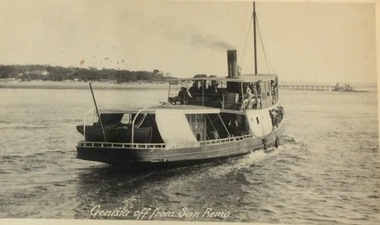
Photograph, Genista off from San Remo, ?
... ...maritime technology...Western Port Ferry 1889 to early 1930's. local history photographs transport shipping maritime technology boats phillip island shipping ferries black & white photograph phillip island western port S.S.Genista off from San Remo. ...S.S. Genista - built 1886, Sydney. Western Port Ferry 1889 to early 1930's.S.S.Genista off from San Remo. View of stern - pier in background.local history, photographs, transport, shipping, maritime technology, boats, phillip island shipping, ferries, black & white photograph, phillip island, western port -
 Phillip Island and District Historical Society Inc.
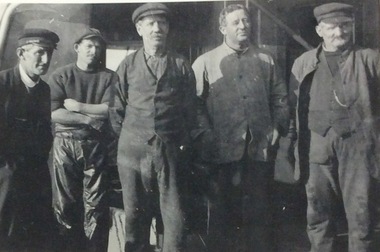
Photograph, Genista's crew 1919, 1919
... ...maritime technology...Group photo of the crew of S.S.Genista 1919 - shown in Fishing gear. local history photographs shipping maritime technology phillip island shipping ferries black & white photograph phillip island western port ferry - genista captain kerr h. kirkland g. kendall mcneil j. jansson Crew of S.S.Genista, 1919. ...Group photo of the crew of S.S.Genista 1919 - shown in Fishing gear.Crew of S.S.Genista, 1919. Left to Right: Capt. Kerr, H.Kirkland, G.Kendall, McNeil, J.Jansson.local history, photographs, shipping, maritime technology, phillip island shipping, ferries, black & white photograph, phillip island, western port, ferry - genista, captain kerr, h. kirkland, g. kendall, mcneil, j. jansson -
 Phillip Island and District Historical Society Inc.
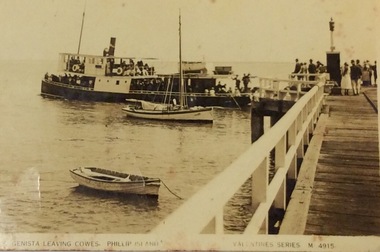
Photograph, Genista leaving Cowes jetty
... ...maritime technology...M4915 local history photographs transport shipping maritime technology boats postcards phillip island shipping ferries black & white photograph phillip island western port ferry - genista Valentine series M4915 S.S. ...Part of a collection of the "Rose & Valentine Series" Post Cards. M4915S.S. Genista leaving Cowes Jetty, Phillip Island. G. Walton's fishing boat in foreground. Small rowing boat near foreground.- Valentine series Post Card M4915Valentine series M4915local history, photographs, transport, shipping, maritime technology, boats, postcards, phillip island shipping, ferries, black & white photograph, phillip island, western port, ferry - genista -
 Phillip Island and District Historical Society Inc.
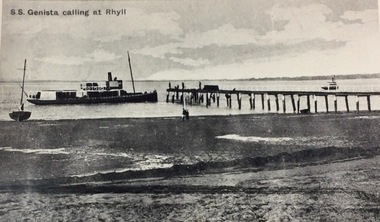
Photograph, Genista calling at Rhyll c1900, ?
... ...maritime technology...Western Port Ferry from 1889 to early 1930's local history photographs transport shipping maritime technology boats phillip island shipping ferries black & white photograph phillip island western port ferry - genista S.S. ...S.S. Genista - built in 1886, Sydney. Western Port Ferry from 1889 to early 1930'sS.S. Genista calling at Rhyll - c.1900 Low tide, sand and mud in foreground.S.S. Genista calling at Rhylllocal history, photographs, transport, shipping, maritime technology, boats, phillip island shipping, ferries, black & white photograph, phillip island, western port, ferry - genista -
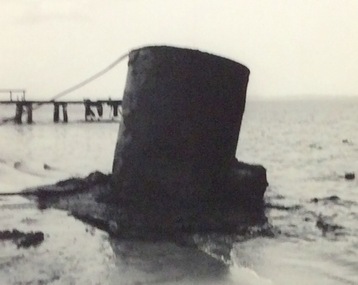 Phillip Island and District Historical Society Inc.
Photograph, Genista's boiler near Rhyll jetty 1966, 1966
... ...maritime technology...Genister being hauled from Channel near Rhyll Jetty 1966 local history photographs transport shipping maritime technology ferries phillip island shipping black & white photograph phillip island westernport bay ferry - genista S.S.Genista's ship's Boiler with line attached floating - Jetty in background. 1966 Genista's boiler near Rhyll jetty 1966 Photograph ...Boiler of S.S. Genister being hauled from Channel near Rhyll Jetty 1966S.S.Genista's ship's Boiler with line attached floating - Jetty in background. 1966local history, photographs, transport, shipping, maritime technology, ferries, phillip island shipping, black & white photograph, phillip island, westernport bay, ferry - genista
