
Showing 130 items matching "mark v"
-
 Linton and District Historical Society Inc
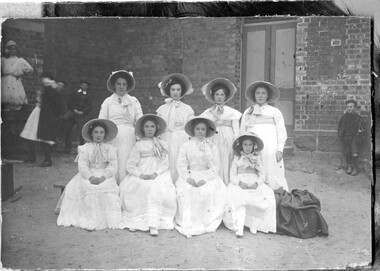
Photograph, Music pupils of Miss Gertrude Barry at Linton State School, c.1912
... ... S. Mark... V...Barry / about 1912 / at Shire Hall (crossed out) State School" "Back row: C McBeath P O'Beirne M Bolte K Burke Front row: K O'Beirne L Burke G Cox J Cox Background S Mark V Cornish A Thompson C Bolte"....Burke G. Cox J. Cox S. Mark V. Cornish A. Thompson C. Bolte Milkmaids On card mounting of photograph, hand written in ink: "Song / Miss Milligan's / by / Music Pupils of / Miss G. ...Photograph appears to have been taken outside Linton State School building.Black and white photograph of eight young ladies dressed in costume for a school concert, four seated, four standing behind, other people in background.On card mounting of photograph, hand written in ink: "Song / Miss Milligan's / by / Music Pupils of / Miss G. Barry / about 1912 / at Shire Hall (crossed out) State School" "Back row: C McBeath P O'Beirne M Bolte K Burke Front row: K O'Beirne L Burke G Cox J Cox Background S Mark V Cornish A Thompson C Bolte".gertrude barry, music students, musicians, c. mcbeath, p. o'beirne, m. bolte, k. burke, g. cox, j. cox, s. mark, v. cornish, a. thompson, c. bolte, milkmaids -
 Australian Army Museum of Western Australia
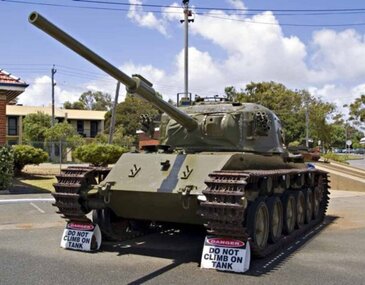
Armoured Fighting Vehicle
... Centurion Tank Mark V...Centurion Tank Mark V Armoured Fighting Vehicle ...Centurion Tank Mark V -
 Moorabbin Air Museum
Book - Supermarine Spitfire, The Spitfire Story
... ...Mark V...Supermarine Spitfire K5054 prototype Mark 1 in service Mark 1 reconnaisance variants Mark II Mark III Mark V Mark VI Marks IX & XVI Marks VII & VIII Marks X/XI & XIII The first Griffon Spitfires Spitfires on floats Second generation Griffon Spitfires Spitfires made for 2 End of the line Historical & technical overview of Supermarine Spitfire , circa 1995 The Spitfire Story Book Supermarine Spitfire ...Historical & technical overview of Supermarine Spitfire , circa 1995non-fictionHistorical & technical overview of Supermarine Spitfire , circa 1995k5054 prototype, mark 1 in service, mark 1 reconnaisance variants, mark ii, mark iii, mark v, mark vi, marks ix & xvi, marks vii & viii, marks x/xi & xiii, the first griffon spitfires, spitfires on floats, second generation griffon spitfires, spitfires made for 2, end of the line -
 Whitehorse Historical Society Inc.
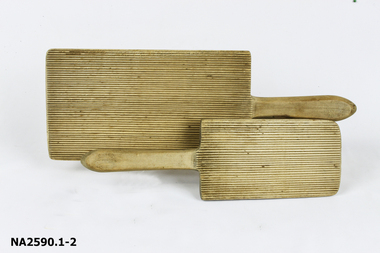
Domestic object - Butter Pats
... Embossed - Mark V Faint...domestic items food preparation Embossed - Mark V Faint Two wooden butter pats, one large, one smaller. ...Two wooden butter pats, one large, one smaller. Both ridged on one side. Makers mark stamped on handle. Light coloured wood.Embossed - Mark V Faintdomestic items, food preparation -
 Flagstaff Hill Maritime Museum and Village
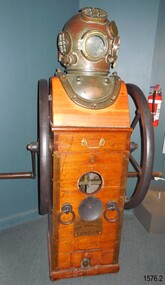
Equipment - Diving compressor and helmet, 1944
... US Navy diving helmet, Mark V. Two maker's plates attached. Made in 1944....US Navy diving helmet, Mark V. Two maker's plates attached. Made in 1944. ...Siebe Gorman & Company Ltd was a British company that developed diving equipment and breathing equipment and worked on commercial diving and marine salvage projects. The company advertised itself as 'Submarine Engineers'. It was founded by Augustus Siebe, a German-born British engineer chiefly known for his contributions to diving equipment. Siebe Gorman traded as an engineering firm for over 180 years from 1819 to 1999. The early success of the business was due to its founder, the Prussian immigrant Christian 'Augustus' Siebe (1788-1872). For business reasons, he applied for and was granted British citizenship in 1856. He was a gifted engineer who was able to translate theoretical problems into practical, working products. During the industrial Victorian period, the business traded as 'A. Siebe' at 145 High Street Holborn London, but in 1828 new premises were acquired at 5 Denmark Street, Soho. The family firm produced a wide range of manufactured goods including paper-making machinery, measuring machinery, water pumps, refrigeration equipment, and diving apparatus. Augustus Siebe specialised in submarine engineering early on and the company gained a reputation for the manufacture of safe, reliable diving apparatus. Augustus Siebe is best remembered for the development and manufacture of the ‘closed’ Diving Dress based on the ideas of Charles and John Deane, George Edwards, and Charles Pasley. Apart from some small modifications to valves and diver communications, the basic 12 bolt ‘closed’ diving dress remained relatively unchanged after the 1870s. Later company successes were also based on innovation, with new products that could be successfully developed and manufactured to high standards. This was largely attributed to the inventive nature, foresight, engineering, and entrepreneurial skills of Robert Henry Davis (1870-1965). In 1882, RH Davis joined the company of 'Siebe & Gorman' as a young 11-year-old office boy and he was to remain with the company until he died in 1965. Augustus Siebe retired in 1869 and handed over the company to a new partnership of Henry H. Siebe (1830-1885) and William A. O'Gorman (1834-1904). The new firm traded as 'Siebe & Gorman' (1870-1879) from premises in and around Mason Street, Westminster Bridge Road, Lambeth, London. The two partners soon recognised the potential of R.H. Davis and in 1894, aged 24, he became General Manager of Siebe & Gorman. Davis increasingly ran the company until the surviving partner (W.A. Gorman) died in 1904. The firm was disposed of to the Vickers (armaments) family and a new company 'Siebe Gorman & Co. Ltd.' (1905-1998) was formed. Under the chairmanship of Albert Vickers, R.H. Davis was kept on as Managing Director, and the company forged ahead. However, after WW1, the Great Depression caused manufacturing output and share prices to slump. In 1924 Robert Davis made a deal with the Vickers Board and acquired control of the company through majority shares. Under his leadership, the Siebe Gorman Company flourished and within time, four of his sons also joined the firm. The company gained a worldwide reputation for the manufacture of diving apparatus, decompression and observation chambers, and safety breathing apparatus of all types for use on the land, in the air, and under the sea (including mine rescue, tunneling, aircraft, diving, submarine escape and in other hazardous environments). Close research and development links with the MOD (especially the Admiralty), also provided a lucrative outlet for the company products. In 1932, Robert Davis was knighted by King George V, principally for his invention of the ‘Davis Submerged Escape Apparatus’ (D.S.E.A.). Siebe Gorman essentially remained a family firm from the beginning (under A.Siebe) until it became a public company for the first time in 1952. However, following WW2, British manufacturing stagnated through stifled investment and post-war austerity, and there was little innovation. Siebe Gorman's fortunes began to decline as an aging Sir Robert Davis failed to invest, or change the company's business and management practices. In 1959, Siebe Gorman was acquired by the “Fairy Group” and the ailing Sir Robert was made Life President. Consequently, nothing changed and the slow decline continued until Sir Robert's death in March 1965. Around 1960, Siebe Gorman acquired the diving apparatus manufacturer C E Heinke, and for a brief period, it manufactured some diving equipment under the combined name of Siebe Heinke. Around 1964, Mr E. 'Barry' Stephens was appointed as the new Managing Director to modernise Siebe Gorman. Changes were made, including a move to a new factory in Wales in 1975. The new company concentrated on fire-fighting breathing apparatus and escape equipment, and the move coincided with the loss of many of the older, traditional craft skills. Between 1985 and 1998, Siebe expanded through acquisitions, and several other companies were acquired. The Siebe Gorman (diving apparatus) company has therefore traded as A. Siebe (1819-1870); Siebe & Gorman (1870-1879); Siebe Gorman & Co (1880-1904); Siebe Gorman & Co. Ltd (1905-1998). (For information regards the diving helmet & Frank King see Notes Section at the end of this document)The items are very significant as a snapshot into marine history and the development of diving equipment generally especially that used for salvage operations before and during WW2. The company that made the equipment was a leading inventor,developer and innovator of marine equipment with its early helmets and other items eagerly sought after today for collections around the world. The items in the Flagstaff Hill collection give us an insight as to how divers operated and the dangers they faced doing a very necessary and dangerous job. Frank Kings' diving helmet and compressor (communication pipe stored separately). Compressor is hand cranked. US Navy diving helmet, Mark V. Two maker's plates attached. Made in 1944.On rear "WATER SUPPLY" On front 'PATENT" " Logo: Images (Lion, Crown, Horse, Shield within an oval) "SIEBE, GORMAN & Co. Ltd. SUBMARINE ENGINEERS, LONDON.flagstaff hill, warrnambool, maritime museum, great ocean road, us navy diving helmet, commonwealth government salvage, diving helmet, marine salvage, frank king, diver, siebe. gorman & co ltd, submarine equipment, diving equipment, communication under water, hand cranked, diving compressor -
 Tennis Australia
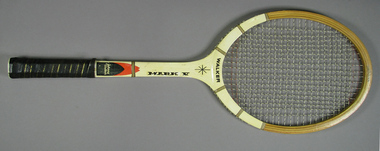
Racquet, Circa 1965
... A Johnny Walker Mark V tennis racquet, with string whipping around shoulders and shaft, and leather handle grip with patterned perforations. ...Tennis A Johnny Walker Mark V tennis racquet, with string whipping around shoulders and shaft, and leather handle grip with patterned perforations. ...A Johnny Walker Mark V tennis racquet, with string whipping around shoulders and shaft, and leather handle grip with patterned perforations. Materials: Wood, Nylon, Ink, Glue, Lacquer, Metal, Leather, Plastic, String, Enameltennis -
 Kiewa Valley Historical Society
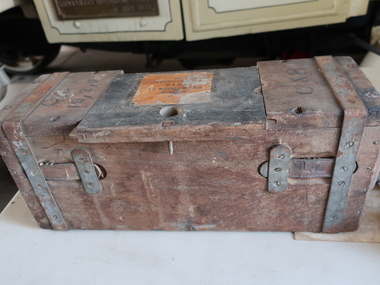
Cartridge Box - B.L.Martin-Henry Arm
... Martini-Henry Arm / Mark V / R. L. " is printed in black on uellowish wood at the top centre of the box. ...Martini-Henry Arm / Mark V / R. L. " is printed in black on uellowish wood at the top centre of the box. ...A box used to store and carry cartridges safely. It is protcted from moisture entering. Labelled with caliber, quantity and manufacturing date or lot number. The Martini-Henry is a single shot ricle with a lever action used in WWI.Sturdy rectangular wooden box with steel straps. At the top is a sliding opening with yellowish wood and printed black label."680 / Cartridges / Ball / b. L. Martini-Henry Arm / Mark V / R. L. " is printed in black on uellowish wood at the top centre of the box. More printing on the top each side "C & H' and "C?? / 19,2,75?"ammunition box, cartridge box, dederang rifle club -
 Bendigo Historical Society Inc.
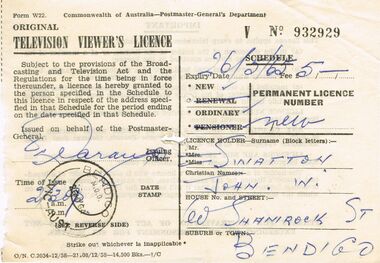
Document - J W SWATTON COLLECTION: TELEVISION VIEWER'S LICENCE
... Television Viewer's Licence, V No. 932929 of John Swatton. Expiry date 26/5/65. Postmarked with Bendigo Post mark. ...PERSON Receipts j w swatton J W Swatton Collection Television Viewer's Licence Broad-casting and Television Act Postmaster General's Department Commonwealth of Australia Television Viewer's Licence, V No. 932929 of John Swatton. Expiry date 26/5/65. Postmarked with Bendigo Post mark. ...Television Viewer's Licence, V No. 932929 of John Swatton. Expiry date 26/5/65. Postmarked with Bendigo Post mark. Receipt V No. 932929.person, receipts, j w swatton, j w swatton collection, television viewer's licence, broad-casting and television act, postmaster general's department, commonwealth of australia -
 Frankston RSL Sub Branch
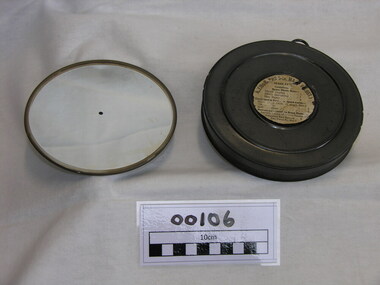
Kit, Spare Parts
... The case has paper label with the inscription "HELIOGRAPHS 5-in MARK V (AUST.)" and a list of the contents. ...ww1 army mirror heliograph spare kit signalling spare parts The case has paper label with the inscription "HELIOGRAPHS 5-in MARK V (AUST.)" and a list of the contents. ...A spare parts kit for a signalling Heliograph, the kit is incomplete. This kit is in a circular, metal carrying case and contains a spare 5 inch mirror and six brown paper discs. The case has a knurled rim and a small metal loop for carrying or attaching to equipment. The case has paper label with the inscription "HELIOGRAPHS 5-in MARK V (AUST.)" and a list of the contents. The other side of the case has the "D^D" symbol. The rear side of the mirror is marked with the 'D^D' symbol and the manufacturers name. "Manufactured by SOUNDCRAFT PTY LTD Sydney"ww1, army, mirror, heliograph, spare kit, signalling, spare parts -
 Moorabbin Air Museum
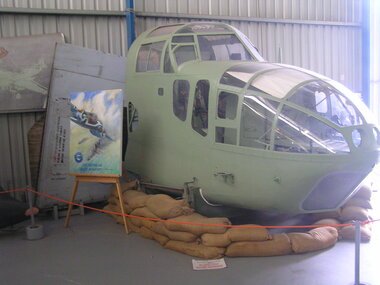
Machine - DAP (Bristol) Beaufort Mk V A9-13 (T9552, "Nk-B")
... Historical Details: The DAP Beaufort A9-13 was the 13th locally built Australian mark V Beaufort Bomber, with the first 20 being assembled from imported UK parts, but fitted with Australian built Pratt and Whitney 1830 Twin Row Wasp engines. ...Historical Details: The DAP Beaufort A9-13 was the 13th locally built Australian mark V Beaufort Bomber, with the first 20 being assembled from imported UK parts, but fitted with Australian built Pratt and Whitney 1830 Twin Row Wasp engines. ...Historical Details: The DAP Beaufort A9-13 was the 13th locally built Australian mark V Beaufort Bomber, with the first 20 being assembled from imported UK parts, but fitted with Australian built Pratt and Whitney 1830 Twin Row Wasp engines. A9-13 was originally built to an. Description: The DAP (Bristol) Beaufort Bomber A9-13, the 13th example built in Australia, was acquired in 2011 with Government funding assistance under the Australian National Cultural Heritage Account. The Beaufort Bomber was the first product of the Department o. Level of Importance: Nationalbeaufort -
 Flagstaff Hill Maritime Museum and Village
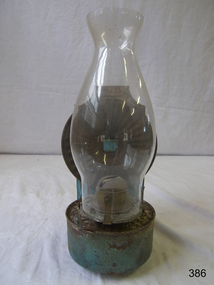
Domestic object - Lamp, Valor Co. Ltd, 1920-1936
... This trade mark (V inside a clover) was German. It was used by the lamp makers Veritas Efsca Works in Birmingham, and for a time by Valor Co. ...This trade mark (V inside a clover) was German. It was used by the lamp makers Veritas Efsca Works in Birmingham, and for a time by Valor Co. ...This trade mark (V inside a clover) was German. It was used by the lamp makers Veritas Efsca Works in Birmingham, and for a time by Valor Co. Ltd. which took over Veritas. Valor Co. Ltd. was established in Birmingham in 1890 and produced oil containers for the Anglo-American Oil Com. In 1901 the firm advertised themselves as Stampers And Pieces. Later it was named 'The Valor Co. and was associated with the Aston Brass Co., and advertised as makers of oil lamps and stoves. Valor became a maker of oil heaters cookers and many other products that were fueled by oil. Later it sold gas heaters and ovens. In 1936 Valor Co. Ltd. was made a Public Company and operated under the name The Velor Company Ltd. The company changed names over the years and it was still operating under Velor Fires in January 2002.Oil or kerosene lamps were the means of lighting for homes, farms and industry in the late 19th and early-to-mid 20th centuries. Lamps like these were important as Lighthouse Keepers and Assistant Keepers' equipment. They were in common use in until the lighting was powered by gas and electricity. The reflector at the back of the lamp makes it of greater significance as most lamps don't have this feature. The logo is also interesting as it originated in Germany and was used with permission by a British company and the company that brought it out for a short time. Similar lamps are still available today, usually with gas for fuel. Kerosene lamp; blue painted metal fuel can and metal rear reflector support. and a round corrugated reflector at the rear. The mid-section wick is made of brass. The glass cover or chimney is bulbous in shape. Inscriptions include a trademark "V" inside a clover. It is British-made in Birmingham by either Veritas Efsca Works or Veritas Valor.Trademark; "[clover symbol] surrounding a "V" Stamp: "BRITISH MADE" Marked on adjusting device: "English Made 1 in w" Marked on support of deflector shield - "British Made" and symbolwarrnambool, shipwreck coast, flagstaff hill, flagstaff hill maritime museum, flagstaff hill maritime village, oil lamp, table lamp, kerosene lamp, valor co. ltd, v inside a clover, veritas, british made, lamp reflector, lighting, lamp, the valor company ltd -
 Flagstaff Hill Maritime Museum and Village
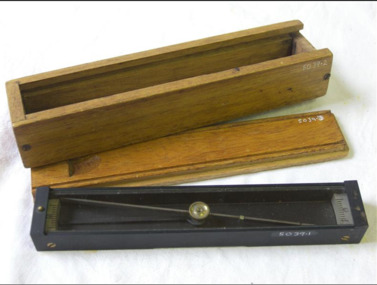
Plane Compass, 1941-1943
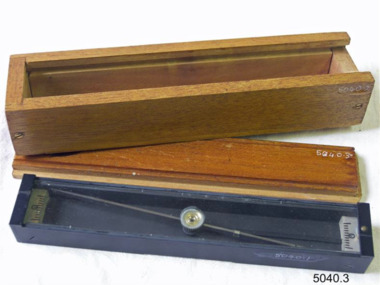
... J.W.H./V Mark 11 D↑D. Made by J W Handley Richmond Melbourne, Victoria. ...It also therefor is of social significance as many Australians served in the Military forces at that time and the item is complete and in very good condition. flagstaff hill warrnambool shipwrecked-coast flagstaff-hill flagstaff-hill-maritime-museum maritime-museum shipwreck-coast flagstaff-hill-maritime-village trough compass navigation instrument surveyor's instrument j w handley artillery australian army trough plane compass world war 2 J.W.H./V Mark 11 D↑D. Made by J W Handley Richmond Melbourne, Victoria. ...This compass is the type used by an artillery unit of the Australian Military Forces during World War 2 and made by J W Handley. Although having owned the factory site since 1935 at 657 Victoria St J W Handley began to produce various items for the Australian Military forces after purchasing and expanding the factory to 655 Victoria St. It appears that he, or some one else may already have been occupying the site for industrial purposes, such as (Manufacturing, Foundry and Electroplating) since at least 1929. J W Handley Pty Ltd was actively producing items for the Military during the war years, a newspaper article from 1939 shows the factory in production and employing 420 people during 1939. J W Handley after the war moved into producing other non military items including a range of fishing reels. The company ceased trading in 1987 and was deregistered as J W Handley Pty Ltd in 1990.The item demonstrates the industrial capability of Australia at the start of World War 2. This item is actively sort by collectors of Australian Military memorabilia and represents a time in Australian history when the country was at war and the general population was concerned about an invasion from Japanese forces. It also therefor is of social significance as many Australians served in the Military forces at that time and the item is complete and in very good condition.A plane table compass, sometimes referred to as a trough compass, used by surveyors and artillery crew to accurately establish magnetic north. The compass is precision machined of brass material with a long needle to ensure accuracy. The compass scale is marked with a centre zero (for magnetic north) and graduations indicating plus and minus five degrees. The compass is housed in a protective wooden case with a sliding lid. The lid has a brass slide which locks the compass needle during periods when the compass is not in use.J.W.H./V Mark 11 D↑D. Made by J W Handley Richmond Melbourne, Victoria. Serial No 353flagstaff hill, warrnambool, shipwrecked-coast, flagstaff-hill, flagstaff-hill-maritime-museum, maritime-museum, shipwreck-coast, flagstaff-hill-maritime-village, trough compass, navigation instrument, surveyor's instrument, j w handley, artillery, australian army, trough, plane compass, world war 2 -
 Flagstaff Hill Maritime Museum and Village
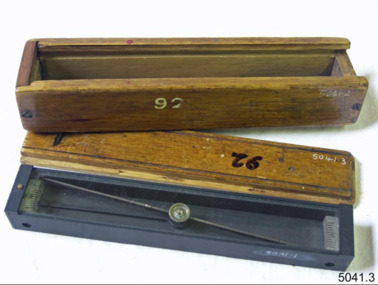
Plane Compass, 1941-1943
... J.W.H./V Mark 11 D↑D. Made by J W Handley Richmond Melbourne, Victoria. ...It also therefor is of social significance as many Australians served in the Military forces at that time and the item is complete and in very good condition. flagstaff hill warrnambool shipwrecked-coast flagstaff-hill flagstaff-hill-maritime-museum maritime-museum shipwreck-coast flagstaff-hill-maritime-village trough compass navigation instrument surveyor's instrument j w handley artillery australian army trough plane compass world war 2 J.W.H./V Mark 11 D↑D. Made by J W Handley Richmond Melbourne, Victoria. ...This compass is the type used by an artillery unit of the Australian Military Forces during World War 2 and made by J W Handley. Although having owned the factory site since 1935 at 657 Victoria St J W Handley began to produce various items for the Australian Military forces after purchasing and expanding the factory to 655 Victoria St. It appears that he, or some one else may already have been occupying the site for industrial purposes, such as (Manufacturing, Foundry and Electroplating) since at least 1929. J W Handley Pty Ltd was actively producing items for the Military during the war years, a newspaper article from 1939 shows the factory in production and employing 420 people during 1939. J W Handley after the war moved into producing other non military items including a range of fishing reels. The company ceased trading in 1987 and was deregistered as J W Handley Pty Ltd in 1990.The item demonstrates the industrial capability of Australia at the start of World War 2. This item is actively sort by collectors of Australian Military memorabilia and represents a time in Australian history when the country was at war and the general population was concerned about an invasion from Japanese forces. It also therefor is of social significance as many Australians served in the Military forces at that time and the item is complete and in very good condition.A plane table compass, sometimes referred to as a trough compass, used by surveyors and artillery crew to accurately establish magnetic north. The compass is precision machined of brass material with a long needle to ensure accuracy. The compass scale is marked with a centre zero (for magnetic north) and graduations indicating plus and minus five degrees. The compass is housed in a protective wooden case with a sliding lid. The lid has a brass slide which locks the compass needle during periods when the compass is not in use.J.W.H./V Mark 11 D↑D. Made by J W Handley Richmond Melbourne, Victoria. Serial number 92 flagstaff hill, warrnambool, shipwrecked-coast, flagstaff-hill, flagstaff-hill-maritime-museum, maritime-museum, shipwreck-coast, flagstaff-hill-maritime-village, trough compass, navigation instrument, surveyor's instrument, j w handley, artillery, australian army, trough, plane compass, world war 2 -
 Flagstaff Hill Maritime Museum and Village
Plane Compass, 1941-1943
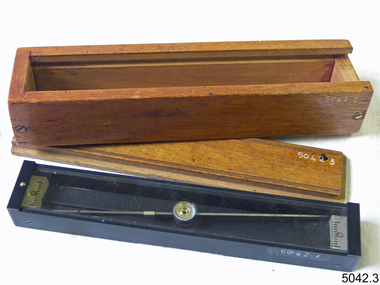
... J.W.H./V Mark 11 D↑D. Made by J W Handley Richmond Melbourne, Victoria. ...It also therefor is of social significance as many Australians served in the Military forces at that time and the item is complete and in very good condition. flagstaff hill warrnambool shipwrecked-coast flagstaff-hill flagstaff-hill-maritime-museum maritime-museum shipwreck-coast flagstaff-hill-maritime-village trough compass navigation instrument surveyor's instrument j w handley artillery australian army trough plane compass world war 2 J.W.H./V Mark 11 D↑D. Made by J W Handley Richmond Melbourne, Victoria. ...This compass is the type used by an artillery unit of the Australian Military Forces during World War 2 and made by J W Handley. Although having owned the factory site since 1935 at 657 Victoria St J W Handley began to produce various items for the Australian Military forces after purchasing and expanding the factory to 655 Victoria St. It appears that he, or some one else may already have been occupying the site for industrial purposes, such as (Manufacturing, Foundry and Electroplating) since at least 1929. J W Handley Pty Ltd was actively producing items for the Military during the war years, a newspaper article from 1939 shows the factory in production and employing 420 people during 1939. J W Handley after the war moved into producing other non military items including a range of fishing reels. The company ceased trading in 1987 and was deregistered as J W Handley Pty Ltd in 1990.The item demonstrates the industrial capability of Australia at the start of World War 2. This item is actively sort by collectors of Australian Military memorabilia and represents a time in Australian history when the country was at war and the general population was concerned about an invasion from Japanese forces. It also therefor is of social significance as many Australians served in the Military forces at that time and the item is complete and in very good condition.A plane table compass, sometimes referred to as a trough compass, used by surveyors and artillery crew to accurately establish magnetic north. The compass is precision machined of brass material with a long needle to ensure accuracy. The compass scale is marked with a centre zero (for magnetic north) and graduations indicating plus and minus five degrees. The compass is housed in a protective wooden case with a sliding lid. The lid has a brass slide which locks the compass needle during periods when the compass is not in use.J.W.H./V Mark 11 D↑D. Made by J W Handley Richmond Melbourne, Victoria. Serial number 1279flagstaff hill, warrnambool, shipwrecked-coast, flagstaff-hill, flagstaff-hill-maritime-museum, maritime-museum, shipwreck-coast, flagstaff-hill-maritime-village, trough compass, navigation instrument, surveyor's instrument, j w handley, artillery, australian army, trough, plane compass, world war 2 -
 Flagstaff Hill Maritime Museum and Village
Plane Compass, 1941-1943
... J.W.H./V Mark 11 D�D. Made by J W Handley Richmond Melbourne, Victoria. ...It also therefor is of social significance as many Australians served in the Military forces at that time and the item is complete and in very good condition. flagstaff hill warrnambool shipwrecked-coast flagstaff-hill flagstaff-hill-maritime-museum maritime-museum shipwreck-coast flagstaff-hill-maritime-village trough compass navigation instrument surveyor's instrument j w handley artillery australian army trough plane compass world war 2 J.W.H./V Mark 11 D�D. Made by J W Handley Richmond Melbourne, Victoria. ...This compass is the type used by an artillery unit of the Australian Military Forces during World War 2 and made by J W Handley. Although having owned the factory site since 1935 at 657 Victoria St J W Handley began to produce various items for the Australian Military forces after purchasing and expanding the factory to 655 Victoria St. It appears that he, or some one else may already have been occupying the site for industrial purposes, such as (Manufacturing, Foundry and Electroplating) since at least 1929. J W Handley Pty Ltd was actively producing items for the Military during the war years, a newspaper article from 1939 shows the factory in production and employing 420 people during 1939. J W Handley after the war moved into producing other non military items including a range of fishing reels. The company ceased trading in 1987 and was deregistered as J W Handley Pty Ltd in 1990.The item demonstrates the industrial capability of Australia at the start of World War 2, this item is actively sort by collectors of Australian Military memorabilia and represents a time in Australian history when the country was at war and the general population was concerned about an invasion from Japanese forces. It also therefor is of social significance as many Australians served in the Military forces at that time and the item is complete and in very good condition.A plane table compass, sometimes referred to as a trough compass, used by surveyors and artillery crew to accurately establish magnetic north. The compass is precision machined of brass material with a long needle to ensure accuracy. The compass scale is marked with a centre zero (for magnetic north) and graduations indicating plus and minus five degrees. The compass is housed in a protective wooden case with a sliding lid. The lid has a brass slide which locks the compass needle during periods when the compass is not in use.J.W.H./V Mark 11 D�D. Made by J W Handley Richmond Melbourne, Victoria. Serial number 1333 on boxflagstaff hill, warrnambool, shipwrecked-coast, flagstaff-hill, flagstaff-hill-maritime-museum, maritime-museum, shipwreck-coast, flagstaff-hill-maritime-village, trough compass, navigation instrument, surveyor's instrument, j w handley, artillery, australian army, trough, plane compass, world war 2 -
 Ringwood and District Historical Society
Newspaper - Newspaper Clipping, Winnington Grammar, Ringwood, School Group on Goodwill trip to Tasmania, Ringwood Mail 20/8/1953 (Photo and News item)
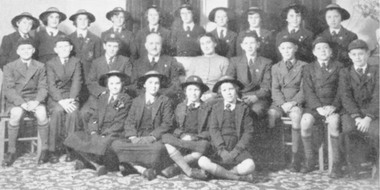
... Carruthers, N. New stead, F. Mark, V. Faudell, M. Homfray, A. Gluth, C. Taylor, P. ...Carruthers, N. New stead, F. Mark, V. Faudell, M. Homfray, A. Gluth, C. Taylor, P. ...Photo and newspaper clipping from Ringwood Mail, 20/8/1953The Ringwood Mail Newspaper article lists the following names: Back Row :- L. Bryant, F. Walker, J. Carruthers, N. New stead, F. Mark, V. Faudell, M. Homfray, A. Gluth, C. Taylor, P. Cockran . Centre Row:- G. Shultz, A. Hauser, D. Baker, Mr. Stiebel, Mrs. Stiebel, D. Parson, A. Watson, D. Eales, J. Carruthers. Front Row :- E. Sell, P. Newstead, M. Palfreyman, J. Palfreyman. Photo by Ivor Kershaw, Heathmont Written on back of clipping, "'Mail 20/8/53' - Group Winnington to Tasmania". -
 Dandenong/Cranbourne RSL Sub Branch
Memorabilia - Pack Saddle
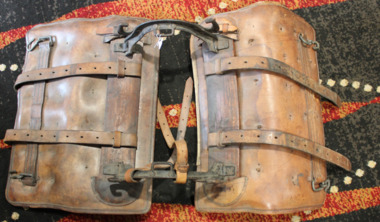
... In 1904 the British Army adopted a new General Service (GS) pack saddle with an adjustable tree, known as the Mark V pack saddle. The main innovation was the adjustable tree created by having the front and back steel arches jointed to the wooden sidebars, which allowed them to turn to adjust to the size of the back of whatever animal carried the saddle, from the largest horse to the smallest donkey, and eliminated the need to manufacture saddles in different sizes. ...In 1904 the British Army adopted a new General Service (GS) pack saddle with an adjustable tree, known as the Mark V pack saddle. The main innovation was the adjustable tree created by having the front and back steel arches jointed to the wooden sidebars, which allowed them to turn to adjust to the size of the back of whatever animal carried the saddle, from the largest horse to the smallest donkey, and eliminated the need to manufacture saddles in different sizes. ...Believed to have been made 1939/43. In 1904 the British Army adopted a new General Service (GS) pack saddle with an adjustable tree, known as the Mark V pack saddle. The main innovation was the adjustable tree created by having the front and back steel arches jointed to the wooden sidebars, which allowed them to turn to adjust to the size of the back of whatever animal carried the saddle, from the largest horse to the smallest donkey, and eliminated the need to manufacture saddles in different sizes. The saddle could be adapted, by the addition of hanging bars, or universal slats, to carry a wide variety of stores, tools and equipment, and also wounded men. The GS pack saddle was used in both world wars by both the British and Australian armies. The use of pack saddles was especially important in the campaign in Palestine during the First World War where wheeled transport was often not an option. Each machine gun carried by light horse units was transported on a pack saddle, and was accompanied by a second pack animal carrying spare ammunition. During the Second World War pack animals were routinely used by patrols, and larger units such as Norforce, in remote areas of northern Australia. The saddle shown here has two separate girths, which crossed under the animal's belly. Most later versions of the saddle used a shorter single girth buckled to a 'V' attachment, which was in turn buckled to the sidebars. Use of the 'V' attachment gave greater strength and stability to the saddle, and decreased 'rocking' of the load. -
 Bendigo Military Museum
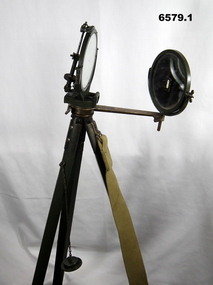
Instrument - Duplex Heliograph Mk V - 1940 with Tripod, LUCO Art Metal Coy Ltd, London, 1940
... The British Army Mark V version uses a flat round mirror with a small unsilvered spot in the centre. ...The British Army Mark V version uses a flat round mirror with a small unsilvered spot in the centre. ...The Heliograph MkV is a fascinating piece of historical surveying and communications equipment. It was primarily used for visual signaling by reflecting sunlight with a mirror to send coded messages over long distances. This method was primarily useful in remote areas where other forms of communication were not available. The MkV model, specifically, was widely used by the British Army and other military forces from around 1906 until the mid 1960s. It remained in use with the Australian Army Survey Corps until the mid 1980s. The device typically included a 5 - inch mirror and was often mounted on a tripod for stability. Initially the instrument was used to communicate between survey stations using Morse code to coordinate their activities. Later when better forms of communication were available, they were used for precise angle alignment where the sunlight reflection from the mirror was targeted between the survey stations to give very accurate results. The MkV was relatively light weight and portable, making it ideal for use in the field. It could be setup and adjusted quickly. The heliograph had an adjustable mirror that could be tilted to reflect sunlight towards a distant receiver. Surveyors could align the mirror using a sighting device. Whilst it was primarily used by the Military it was also used in civil surveying particularly in the remote areas of Australia. The British Army Mark V version uses a flat round mirror with a small unsilvered spot in the centre. The sender aligned the heliograph to the target by looking at the reflected target in the mirror and moving their head until the target was hidden by the unsilvered spot. Keeping their head still, they then adjusted the aiming rod so its cross wires bisected the target, they then turned up the sighting vane, which covered the cross wires with a diagram of a cross, and aligned the mirror with the tangent and elevation screws, so the small shadow that was a reflection of the unsilvered spot hole was on the cross target. This indicated that the sunbeam was pointing at the target. If the sun was in front of the sender, its rays were reflected directly from this mirror to the receiving station. If the sun was behind the sender, the sighting rod was replaced by a second mirror, to capture the sunlight and direct it onto the main mirror to reflect it to the receiving station.. 1 Brish Army "Mance" Mk V A253 Heliograph has two 125mm diameter mirrors on a brass arm with targeting attachments. The Instrument is mounted on a three-legged tripod of brass and mahogany with spiked feet, approximately 1.2 metres high. The instrument was made by LUCO Art Metal Co Ltd, London in 1940. .2 A military green metal carrying safety storage case with khaki shoulder strap.A253 stamped on instrumentroyal australian survey corps, rasvy, fortuna, army survey regiment, army svy regt, asr -
 Bendigo Military Museum
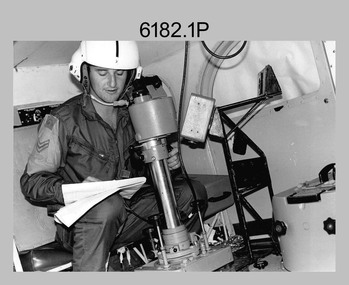
Photograph - Royal Australian Survey Corps Aerial Surveys, c1980
... In 1963 the Royal Australian Survey Corps introduced the radar airborne profile recorder (Canadian Applied Research Ltd, Mark V, Airborne Profiler Recorder) was introduced for 1:100,000 mapping to replace terrain heighting by aneroid barometry. ...In 1963 the Royal Australian Survey Corps introduced the radar airborne profile recorder (Canadian Applied Research Ltd, Mark V, Airborne Profiler Recorder) was introduced for 1:100,000 mapping to replace terrain heighting by aneroid barometry. ...This is a set of nine photographs of technicians from the Royal Australian Survey Corps operating aerial surveys equipment c1980s. In photo .1P, CPL Steve Gloster was operating a RC10 air survey camera mounted in an Australian Army Pilatus Porter aircraft. The Wild RC10 super wide-angle air survey cameras were first introduced in 1971, were equipped with virtual distortion free lenses for supplementary, spot and special photography. In photo .2P, Roger Rees was operating Air Profile Recorder (APR) equipment. it was possibly taken during OP NERVOSE 84, sometime between June – August 1984 when based in Ngukurr, Northern Territory. The APR was operated at this time in unison with an RC10 camera. In 1963 the Royal Australian Survey Corps introduced the radar airborne profile recorder (Canadian Applied Research Ltd, Mark V, Airborne Profiler Recorder) was introduced for 1:100,000 mapping to replace terrain heighting by aneroid barometry. Later in 1974-1975, the Australian developed WREMAPS II airborne laser terrain profile recorder was introduced. In photo .3P, Neil Jones appears at the door of Airsearch Beechcraft Queen Air aircraft, Registration / Serial VH-MWX. This aircraft was typically used by RA Svy on air survey operations flying mission with Aerodist, APR and RC10 camera equipment. The Australian Army’s Pilatus Porter (short take-off and landing turbo propeller) was also equipped with a Wild RC10 aerial mapping camera for identification photography. The Pilatus Porter was also used on RA Svy’s map field checking operations. Photo .9P was taken at a survey station at an unknown location. In this photo an Australian Army Kiowa Light Observation Helicopter (LOH) is supporting a field survey party undertaking Magnavox AN/PRR-14 portable Doppler satellite observations. The satellite receiver’s antenna is plumbed over the survey ground mark surrounded by white plastic panels. The panels were used to identify the survey station on aerial photography. Introduced in 1974–1975, the Magnavox AN/PRR-14 portable Doppler satellite (US Navy Navigation Satellite System – TRANSIT) receivers and computing system provided independent three-dimensional point positions anywhere in the world, anytime, in any weather accurate to about 1.5metres with precise satellite ephemerides. The Bell OH-58 Kiowa LOH was a family of military helicopters used for observation, utility, and direct fire support. It was identified by RA Svy in the mid-1970s that considerable time was lost in replacing unserviceable remote equipment by road. Therefore Aerodist operations (pre-dating satellite receiver operations) were fully supported by Army’s Kiowa LOH aircraft. This is a set of nine photographs of technicians from the Royal Australian Survey Corps operating aerial surveys equipment c1980s. .1P to .3P, .5P to .9P - Colour and black and white photos on photographic paper and scanned at 300 dpi. .4P - Colour photo on 35mm slide film and scanned at 96 dpi. .1) & .2) - Photo, black & white, c1980s, CPL Steve Gloster operating an RC10 air camera. .3) - Photo, colour, 1984, Roger Rees operating Air Profile Recorder (APR) equipment. .4) - Photo, colour, c1980s, Neil Jones at the door of an Airsearch Beechcraft Queen Air aircraft, typically used by RA Svy on air survey operations. .5) - Photo, colour, c1980s. A Beechcraft King Air aircraft, also used by RA Svy on air survey operations. .6) - Photo, colour, c1980s. An Australian Army Pilatus Porter, used by RA Svy on air survey and map field checking operations. SGT Peter Mustart is possibly in the foreground. .7) to .8) - Photo, colour, c1980s. An Australian Army Pilatus Porter and unidentified personnel, used by RA Svy on air survey and map field checking operations. .9) - Photo, colour, c1980s. An Australian Army Kiowa helicopter supporting a field survey party undertaking Magnavox AN/PRR-14 portable Doppler satellite observations. There are biro marks on photos .4P to .9Proyal australian survey corps, rasvy, army survey regiment, asr, fortuna, aerial surveys -
 Flagstaff Hill Maritime Museum and Village
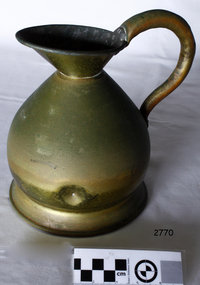
Functional object - Jug, Between 1910 -1936
... These marks signify that the measure complied with the Victorian Government capacity liquid standard measurement. Item made during the reign of George V (1910-1936 (GVR).Other marks indicate model number (61) & SM possible could be either small measure, the maker, or Standards Melbourne....These marks signify that the measure complied with the Victorian Government capacity liquid standard measurement. Item made during the reign of George V (1910-1936 (GVR).Other marks indicate model number (61) & SM possible could be either small measure, the maker, or Standards Melbourne. ...The beginning of standardised weights and measures began In Victoria when the Melbourne Observatory received sets of standard weights and measures, which had been tested in Britain against the then British Imperial standards. These included the primary standard yard and pound for the Colony of Victoria. Other standards of weights and measure held by shires and the administrative body's within the colony could then be compared to these primary standards. A Weights and Measures Act was passed in Victoria in 1862, establishing local inspectors throughout the colony. By the 1870s each local council and shire in Victoria held a set of standards that were used to test scales, weights and dry measures used by wholesalers, factories and shops. Every ten years the councils’ standards would themselves need to be rechecked against the Victorian Standards. The checking was done by the Victorian Customs Department in the 19th century, but with the transfer of responsibility for customs to the Federal Government in 1901, weights and measures function was retained by the Victorian Government and was shifted to the Melbourne Observatory. In 1904, a new building was erected at the south end of the Great Melbourne Telescope House, where the standard weights and measures and testing equipment was installed. This room had a large whirling apparatus for testing air meters and became known as the Whirling Room. When the Melbourne Observatory closed in 1944, the Weights and Measures Branch was formed to continue and this branch remained at the Observatory site unit until 1995.An example of a brass measuring jug made specifically to maintain government standard liquid measurements that were sold to the public. The probability is that this artefact was made sometime between George V reign (1910-1936) and gives us today a snapshot of how imperial weights and measures were checked by Government departments prior to decimalisation and how a standard for the various types of measurement was developed in Australian based on the Imperial British measurement system. The container has social significance as an item used in Victoria as a legal standard measure to ensure that goods sold in Victoria were correct. Jug brass haystack form with a deep lip and pouring spout, small neck and broad base. It displays a curved pistol handle. Inscription at base of handle top of jug stamped 61 GVR SM. These marks signify that the measure complied with the Victorian Government capacity liquid standard measurement. Item made during the reign of George V (1910-1936 (GVR).Other marks indicate model number (61) & SM possible could be either small measure, the maker, or Standards Melbourne.flagstaff hill, warrnambool, shipwrecked-coast, flagstaff-hill, flagstaff-hill-maritime-museum, maritime-museum, shipwreck-coast, flagstaff-hill-maritime-village -
 Federation University Historical Collection
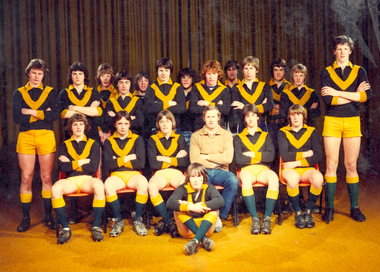
Photograph, Ballarat School of Mines Football Team, c1979, c1980
... V'. Standing left to right: Craig Curran (Jex), Tony James, Craig Curran, ? Graham, Peter Carey, Danny Frawley (Spud), ['Specs' (nickname)]?, Michael Hickman (Bacchus Marsh), 9?, Sandy Blythe (Derrinallum), 11?, 12?, Fred Messamaker? Seated left to right: Mark...V'. Standing left to right: Craig Curran (Jex), Tony James, Craig Curran, ? Graham, Peter Carey, Danny Frawley (Spud), ['Specs' (nickname)]?, Michael Hickman (Bacchus Marsh), 9?, Sandy Blythe (Derrinallum), 11?, 12?, Fred Messamaker? Seated left to right: Mark ...Traditionally the Ballarat School of Mines has fielded a strong Australian Rules Foootball team. This team includes Danny Frawley. Frawley went on to play and coach Australian Rules Football at the highest level. He was the longest serving captain of the St Kilda Football Club and enjoyed a career from 1984–1995. He was inducted into the Saints' hall of fame in 2007. (Wikipedia)The Ballarat School of Mines Football team with Colin McCurry as coach. The team wore yellow shorts and green jumper with yellow 'V'. Standing left to right: Craig Curran (Jex), Tony James, Craig Curran, ? Graham, Peter Carey, Danny Frawley (Spud), ['Specs' (nickname)]?, Michael Hickman (Bacchus Marsh), 9?, Sandy Blythe (Derrinallum), 11?, 12?, Fred Messamaker? Seated left to right: Mark Sculley, Kevin Searle (Carngham Linton), [Stewart Brogden?], Colin McCurry (Coach), Marcus Furlong (Buninyong), Col Baker (Rokewood- Corindhap). Front: ?ballarat school of mines, football, herald shield, mccurry, frawley, danny frawley., australian rules football, vfl, afl -
 Mission to Seafarers Victoria
Article - Magazine article, Louis Peters, Sign of the Times by Louis Peters, July-September 1965
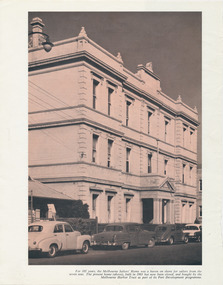
... Mark Howard paper in the Great Circle (Vol.42, No1).) The plaque photographed on page 25 is to be incorporated in the Seafarers park located next to the new Seafarers residential building and at the back of the Mission. nancy oakley sailors' home mission to seamen nancy dingle mrs v. kaiser chinese dolls kakariki ernest kaiser theo h. swanton ernest waldemar kaiser Inscription handwritten in black ink in capital letters by Nancy Oakley: Meetings of Melb. ...The Siddely Street Sailors' Home was built in 1904 to replace the former Spencer Street building. The home closed its doors on 31 January 1963. In 1965 the building was sold and it was later demolished and the site redeveloped. Ernst (Ernest) Waldemar Kaiser (1893-1968) was the last and longest serving superintendent of the home (March 1933 - March 1965). He was employed till 31 March 1965 (year of the article) when he finished up after 32 years in the position. He continued to be employed for a year or so after the home closed, probably serving as caretaker till it was sold. (see Mark Howard paper in the Great Circle (Vol.42, No1).) The plaque photographed on page 25 is to be incorporated in the Seafarers park located next to the new Seafarers residential building and at the back of the Mission.3 pages (p21 to 26) of the Port Melbourne Quarterly issue July-September 1965 about the Melbourne Sailors Home located on Spencer Street.Inscription handwritten in black ink in capital letters by Nancy Oakley: Meetings of Melb. Sailors' Home held at office of Mr Theo H. Swanton Managing Dir. of William Crosby & Co., 464 Collins St. Melb.nancy oakley, sailors' home, mission to seamen, nancy dingle, mrs v. kaiser, chinese dolls, kakariki, ernest kaiser, theo h. swanton, ernest waldemar kaiser -
 Mission to Seafarers Victoria
Journal (item) - Periodicals-Annual, Shiplovers' Society of Victoria, The Annual Dog Watch, 1943
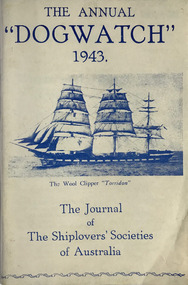
... Marks. - Arthur C. Morgan - 4 Ropes. - J. Scrafton - 7 The Foundation of the Shiplovers’ Society of Victoria. - C. Dickson Gregory 8. The Call of the Sea. - H. O. Challman - 11 Odd Jottings on the Navy. Kevin Byrne - 12 Retired. - C. Bonwick - 15 My First Voyage. - Geoffrey A. Curry - 16 Awatea: Obiter Dicta. - “Alp the Adrian” - 20 An Adventure in Shipowning. R. Johnson - 23 A South Polar Bear. - Gerald S. Doorly - 26 The Sailing Ship Apprentice. - “Tandanya” - 30 Friends of the S. S. V...Marks. - Arthur C. Morgan - 4 Ropes. - J. Scrafton - 7 The Foundation of the Shiplovers’ Society of Victoria. - C. Dickson Gregory 8. The Call of the Sea. - H. O. Challman - 11 Odd Jottings on the Navy. Kevin Byrne - 12 Retired. - C. Bonwick - 15 My First Voyage. - Geoffrey A. Curry - 16 Awatea: Obiter Dicta. - “Alp the Adrian” - 20 An Adventure in Shipowning. R. Johnson - 23 A South Polar Bear. - Gerald S. Doorly - 26 The Sailing Ship Apprentice. - “Tandanya” - 30 Friends of the S. S. V ...This journal provides the reader with glimpses of the adventures and hardships of a seaman's life. Many of the stories are of sailing ships.First issue of the magazine published during the war Contributes to our knowledge of the importance of shipping and places on record those stories of the sea which would otherwise be lost.sailing ships, steamships, shipping, seafaring life, shiplovers' society of victoria, dog watch, ww2, hms jervis bay -
Mission to Seafarers Victoria
Letter - Correspondence, Stanley Quinn et al, 1949
... V and a crown in white on a red, oval background. Postage is two and a half pence. Envelope is addressed to Allan C/- Swedish Seaman's Union, 156 Montague Street, Brooklyn, New York, USA. The postmark is torn. There is a blue air-mail sticker on the upper left-hand corner. 0817d; On the left wing of the model airplane is printed MAA, on the right wing - 17. There are pencilled marks...V and a crown in white on a red, oval background. Postage is two and a half pence. Envelope is addressed to Allan C/- Swedish Seaman's Union, 156 Montague Street, Brooklyn, New York, USA. The postmark is torn. There is a blue air-mail sticker on the upper left-hand corner. 0817d; On the left wing of the model airplane is printed MAA, on the right wing - 17. There are pencilled marks ...Letter 0817a; the writer refers to Allan's 21st birthday and his recent letter from Rio. He also writes of prices rising in Australia, the coal strike, and that 'Sydney especially is badly hit'. He also recommends Allan see a film called 'The Secret Land', a record of an American Naval Expedition to the South Pole, if he gets the opportunity. Letter is signed 'Your loving Dad, Stanley Quinn'. Writer of 0817d also refers to Allan's 21st birthday and the coal strike which has affected manufacturing and the availability of materials, especially bricks as all the brickworks are closed down. The letter is signed 'Your Pal Norm'.Quinn CollectionThree-page letter written to Allan (0817.a1-3) from his father, Stanley Quinn, on three sheets of lined cream-coloured paper, headed Liddesdale Avenue, Frankston and dated 25.07.49. The envelope (0817.b) is buff-coloured. Also found in this envelope is a single-sided, two-page letter written on thin off-white lined paper (0817.c1-2) to Allan from his friend Norm headed 1 Selwyn Street, Artarmon, dated 27.07.49. Enclosed with 0817.c are two small black and white photographs (0817.d1-2). 0817.d1 shows a small boy with a model airplane and 0817.d2 the model airplane from a different angle.Letter 0817a is written on the reverse side of three pages of the Melbourne Stevedoring Company's Cargo Tally sheets. The envelope is pre-stamped with an embossed profile of King George V and a crown in white on a red, oval background. Postage is two and a half pence. Envelope is addressed to Allan C/- Swedish Seaman's Union, 156 Montague Street, Brooklyn, New York, USA. The postmark is torn. There is a blue air-mail sticker on the upper left-hand corner. 0817d; On the left wing of the model airplane is printed MAA, on the right wing - 17. There are pencilled marks on the back of each photograph. letters-from-abroad, quinn, 1949, stanley quinn, coal strike, australia -
 Ballarat Clarendon College
Medal, British War Medal, 1918
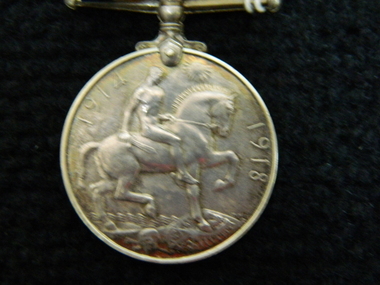
... The British War Medal 1914-20 was iInstituted by King George V in 1919 to mark the end of World War I and record the service given. ...The British War Medal 1914-20 was iInstituted by King George V in 1919 to mark the end of World War I and record the service given. ...The British War Medal 1914-20 was iInstituted by King George V in 1919 to mark the end of World War I and record the service given. The qualification period was later extended to cover post-war mine clearance and service in Russia during 1919 and 1920. The British War Medal was awarded for service in a theatre of war between 5 August 1914 and 11 November 1918. Those eligible included members of women's organisations; persons on the staffs of military hospitals and members of recognised organisations who handled sick and wounded; and members of other duly recognised or other authorised organisations as specified in medal regulations. The qualification period was later extended to cover post-war mine clearance and service in Russia during 1919 and 1920. Lieut E. S. Holgate was mentioned in despatches for Gallantry in the Field 24/25 April 1918. He was killed in action at Villers-Bretonneux, 27 April, 1918. The British War Medal completes a trio of medals awarded to Lieut. E. S. Holgate, including the 1914-15 Star and the Victory Medal. The Holgate medals were the first war medals held by BCC archives. They have historical and social significance for the College.The British War Medal is round and made of cupro-nickel. It features the effigy of George V on the obverse. The reverse has an image of St George on horseback trampling underfoot the eagle shield of the Central Powers, and a skull and cross-bones, the emblems of death. Above this is the risen sun of victory. The British War Medal has a wide central watered stripe of orange, flanked by two narrow white stripes, which are in turn flanked by two black pin-stripes, further flanked by two outer stripes of purple. The colours have no particular significance. Impressed around edge are the recipient's details. Inscribed around outer edge of obverse: 'GEORGEIVS V BRITT. OMN:REX ET IND:IMP:' Impressed around edge of medal: 'LIEUT.E.S.HOLGATE. A.I.F.' Inscribed on the reverse '1914 1918'medal, 1918, world war 1, british war medal, w w 1, holgate, a i f, australian imperial force, holgate e s, holgate medal -
 Federation University Historical Collection
Document - Documents - Reports, Notes for Staff: Ballarat Institute of Advanced Education, 1972
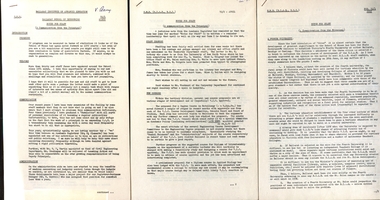
... Ballarat Institute of Advanced Education is a predecessor or Federation University ballarat institute of advanced education notes for staff verna barry e.j. barker r.p. martin b.r grainger j.a.sykes colin kline roy schrieke mark beverlander ken clements bill hitchins lindsay pattenden tom norwood bill durant student union student residences coburn and associates jackson and walker s.j. weir mt helen library albert medal r.w. richards anne mills david ward geoffrey lyle rocky hazlett ray martin dave jelbart zig plavina allan ballard pat hope henry moritz helen ross roger bodenham arch mckinnon frank hogarth harvey hooper geoff barrell jim thyer john collier lenore cox fourth university craftsmanship certificates jenny burrell jennifer hullick r.w richards death danny mullins jack crosbie harry nicholls len taylor library Graham hawley Jack Barker V. ...Ballarat Institute of Advanced Education is a predecessor or Federation University3 typed documents from the Ballarat Institute of Advanced Education 1972. .1 Notes for Staff including progress, welcome, administration, new staff appointments, student enrollments etc. .2 Notes for Staff including staff changes, new courses, past principals, enrollments, staff list etc. .3 Notes for Staff including a fourth university, tertiary finance, academic board etc. V. Barry written on top right hand corner of .1 & .2ballarat institute of advanced education, notes for staff, verna barry, e.j. barker, r.p. martin, b.r grainger, j.a.sykes, colin kline, roy schrieke, mark beverlander, ken clements, bill hitchins, lindsay pattenden, tom norwood, bill durant, student union, student residences, coburn and associates, jackson and walker, s.j. weir, mt helen library, albert medal, r.w. richards, anne mills, david ward, geoffrey lyle, rocky hazlett, ray martin, dave jelbart, zig plavina, allan ballard, pat hope, henry moritz, helen ross, roger bodenham, arch mckinnon, frank hogarth, harvey hooper, geoff barrell, jim thyer, john collier, lenore cox, fourth university, craftsmanship certificates, jenny burrell, jennifer hullick, r.w richards death, danny mullins, jack crosbie, harry nicholls, len taylor, library, graham hawley, jack barker -
 Flagstaff Hill Maritime Museum and Village
Book - Reference Bible, Matthew Henry, An Exposition of The Old and New Testament Vol 5, 1790
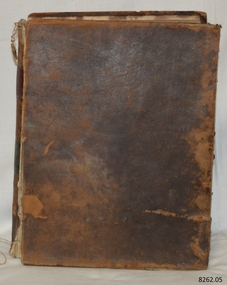
... Mark, Luke and John. This volume opens the New Testament section of Henry’s commentary and moves book by book through the four Gospels. In the standard six-volume arrangement, Volumes V ...The subject volume one is part of a six-volume set. Volume 5 covers the New Testament Gospels: Matthew, Mark, Luke and John. This volume opens the New Testament section of Henry’s commentary and moves book by book through the four Gospels. In the standard six-volume arrangement, Volumes V and VI cover the New Testament, so Volume 5 is the first of those two. That gives it a major place in the work because it begins Henry’s exposition of the gospel narrative. In the six-volume edition, Volume 5 corresponds to Matthew through John. Some later printings and catalogues present the work in different forms, but the content of this volume remains the four Gospels in the standard six-volume sequence.An Exposition of The Old and New Testament Vol 5 Author: Matthew Henry Publisher: Bell and Bradfute, Dickson and M'Cleish Date: 1790 Further Information: Badly worn brown hardcover and spine. The spine has a Library label with an inscription. non-fictionThe subject volume one is part of a six-volume set. Volume 5 covers the New Testament Gospels: Matthew, Mark, Luke and John. This volume opens the New Testament section of Henry’s commentary and moves book by book through the four Gospels. In the standard six-volume arrangement, Volumes V and VI cover the New Testament, so Volume 5 is the first of those two. That gives it a major place in the work because it begins Henry’s exposition of the gospel narrative. In the six-volume edition, Volume 5 corresponds to Matthew through John. Some later printings and catalogues present the work in different forms, but the content of this volume remains the four Gospels in the standard six-volume sequence.flagstaff hill, warrnambool, shipwrecked coast, flagstaff hill maritime museum, maritime museum, shipwreck coast, flagstaff hill maritime village, great ocean road, book, pattison collection, warrnambool library, warrnambool mechanics’ institute, ralph eric pattison, corangamite regional library service, warrnambool city librarian, mechanics’ institute library, victorian library board, warrnambool books and records, warrnambool children’s library, matthew henry, an exposition of the old and new testament vol 1, bell and bradfute, dickson and m'cleish -
 Geelong RSL Sub Branch
Medals V 166315 Cecil Roy Reid, Mid 20th Century
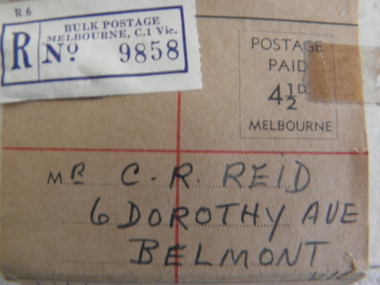
... Three Medals awarded to V 166315 C R Reid who served with AMF during WW2 These Medals are awarded to V166315 C R Reid, they are the original medals decorations amf ww2 c r reid Around the circumference of each medal V166315 C R Reid Three Medals, silver medals with with ribbons attached Medals V 166315 Cecil Roy Reid No Makers Mark ...Three Medals awarded to V 166315 C R Reid who served with AMF during WW2These Medals are awarded to V166315 C R Reid, they are the original medalsThree Medals, silver medals with with ribbons attachedAround the circumference of each medal V166315 C R Reiddecorations, amf, ww2, c r reid -
 The Beechworth Burke Museum
Medal - Order of the British Empire Medal, 01/01/1976
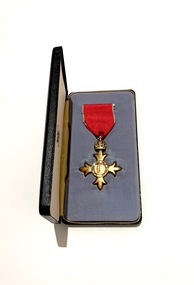
... V's Royal and Imperial Cypher. Both are within a ring bearing the motto of the Order: FOR GOD AND THE EMPIRE. The presentation case in which the medal is housed is of a black outer boarder edge leatherette finishing, block letters in gold OBE. The inside has a cream velvet base with a silk padded liner to the roof with the full set of Royal Mint Crest Mark...V's Royal and Imperial Cypher. Both are within a ring bearing the motto of the Order: FOR GOD AND THE EMPIRE. The presentation case in which the medal is housed is of a black outer boarder edge leatherette finishing, block letters in gold OBE. The inside has a cream velvet base with a silk padded liner to the roof with the full set of Royal Mint Crest Mark ...David Aloysius Patrick McKenzie-McHarg, L.I.B, O.B.E was born on 20th June 1918 in Albury, NSW to Hugh Patrick McKenzie-McHarg and Laura May (Dunne) McKenzie-McHarg. McKenzie-McHarg served on the Council of the United Shire of Beechworth for more than a decade during the 1960s-70s, including seven years as president. He was renowned as a public speaker and played a significant role in the community. In recognition for his outstanding achievements and services rendered to the Beechworth community he was awarded an Order of the British Empire (OBE) in 1976. David McKenzie-McHarg died on 6th June 1992 and is buried in Beechworth Cemetery. David McKenzie-McHarg’s wife, Marjorie Jean McKenzie McHarg, was well known to the Beechworth community as a brilliant pianist and played at all the balls and house parties. Apparently, she could play without sheet-music and would only have to hear a tune once to play it to near perfection. Together, they were a formidable asset to the Beechworth community over many years The British honours system has various orders, usually relating to the monarchy, military and colonial officials. An OBE (or order of the British Empire) is given for an outstanding achievement or service to the community. This will have had a long-term, significant impact and stand out as an example to others. This Order was established by George V in 1917 in response to recognising the thousands of men and women who served in a variety of non-combatant roles during the First world war who didn’t otherwise receive any formal recognition but were certainly worthy of acknowledgement. Recommendations for appointments to this Order were originally made on the nomination of the United Kingdom, however this soon became available to Commonwealth countries as well. However, Australia officially ceased to recommend the Order of the British Empire in 1989 with the establishment of the Order of Australia. Silver badge suspended from red ribbon with pearl-grey edges. The badge is in the form of a cross patonce (having the arms growing broader and floriated toward the end), the obverse of which bears the same field as the star pictures George V and Queen Mary. The reverse bears George V's Royal and Imperial Cypher. Both are within a ring bearing the motto of the Order: FOR GOD AND THE EMPIRE. The presentation case in which the medal is housed is of a black outer boarder edge leatherette finishing, block letters in gold OBE. The inside has a cream velvet base with a silk padded liner to the roof with the full set of Royal Mint Crest Mark. Obverse: FOR GOD AND THE EMPIRE / burke museum, obe, obe medal, beechworth, david mckenzie-mcharg, british honours system, george v, beechworth community, order of australia., order of the british empire, marjorie jean mckenzie mcharg -
 Orbost & District Historical Society
black and white photograph, 1913
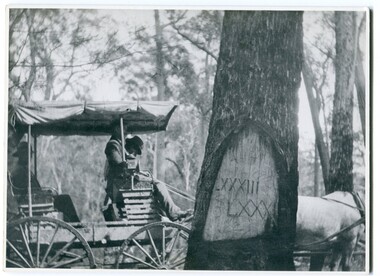
... After July 1886 surveyors were able to use “permanent marks” which were either a glass bottle, gas pipe or iron bolt (for homestead surveys only). This photograph shows the reference tree, 83 miles from Marlo via the original surveyed road v ia Sydenham Inlet and Tamboon, south of Mount Drummer to the New South Wales border - now the Princes Highway....After July 1886 surveyors were able to use “permanent marks” which were either a glass bottle, gas pipe or iron bolt (for homestead surveys only). This photograph shows the reference tree, 83 miles from Marlo via the original surveyed road v ia Sydenham Inlet and Tamboon, south of Mount Drummer to the New South Wales border - now the Princes Highway. ...When marking a boundary for a registered plan, a surveyor would place “Reference Marks” with a stated bearing and distance to a boundary corner. These trees were typically marked by cutting the bark of the tree in a shield or blaze. Until July 1886, surveyors were only able to use trees as reference marks to boundary corners. After July 1886 surveyors were able to use “permanent marks” which were either a glass bottle, gas pipe or iron bolt (for homestead surveys only). This photograph shows the reference tree, 83 miles from Marlo via the original surveyed road v ia Sydenham Inlet and Tamboon, south of Mount Drummer to the New South Wales border - now the Princes Highway.This is a pictorial record of an old survet tree. Knowledge of their location, abundance and condition not only provide important insights to past survey practice, but also provide a lasting legacy of a regions land-use history. Old survey trees serve as one of the few remaining physical legacies of early European land settlement history.A large black / white photograph of a horse and buggy pulled up alongside a reference tree which has notches and markings of Roman numerals.on back - " Refernce tree 83 miles from Marlo........to N.S.W. Border"survey-tree reference-tree
