
Showing 24 items matching "marker post"
-
 Orbost & District Historical Society
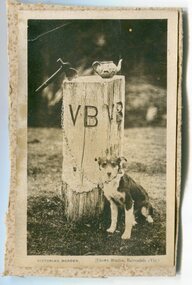
Photograph - V B post - Victorian Border, Crown Studios ( W Stanley Vogt), c.1920s-1950s
... ...Marker post...This photograph is significant because it is a rare image of a marker post which was once very important. Victorian Border NSW Border Marker post Princes Highway Victorian Border. ...The Victorian/New South Wales border is near Genoa in Far East Gippsland. This post marked this border and was positioned beside the Highway. For many years, the border was an important stopping point because it also had a Fruit Fly inspection point for traffic coming into Victoria from N S Wales.This photograph is significant because it is a rare image of a marker post which was once very important. A b/w photograph/postcard of a square post, painted white with the letters W B stencilled into it. The post has a Tea Pot on top, and a small axe. A b/w dog is sitting nearby and appears to be attached to the post by a chain. Victorian Border. Crown Studios, Bairnsdale, Vic.victorian border, nsw border, marker post, princes highway -
 Bendigo Historical Society Inc.
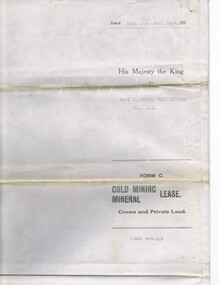
Document - MCCOLL, RANKIN AND STANISTREET COLLECTION: EAST CLARENCE GOLD MINING CO - LEASE 10026, 1934/35
... Mines about confirming lease marker posts in position. No. 10026 Bendigo....Mines about confirming lease marker posts in position. No. 10026 Bendigo. Document MCCOLL, RANKIN AND STANISTREET COLLECTION: EAST CLARENCE GOLD MINING CO - LEASE 10026 ...Document; Esst Clarence Gold Mining Co - Lease 10026. Lease document for Bendigo 10026 with attached plan - Moon Street, Crowlers Street, Elm Street, Hodgson Street. Attached letter from Dept. Mines about confirming lease marker posts in position. No. 10026 Bendigo.MCCOLL RANKIN & STANISTREETorganization, business, gold mining lease, mccoll rankin & stanistreet -
 Bendigo Historical Society Inc.
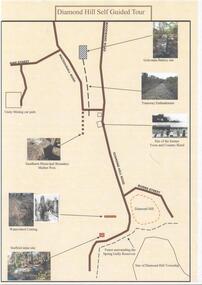
Document - DIAMOND HILL SELF GUIDED TOUR
... Including the Golconda Battery site, Tramway Embankment, site of former Town and Country Hotel, Sandhurst Municipal Boundary Marker Post, Waterwheel Cutting, Stafford Mine site. ...Including the Golconda Battery site, Tramway Embankment, site of former Town and Country Hotel, Sandhurst Municipal Boundary Marker Post, Waterwheel Cutting, Stafford Mine site. ...One page coloured map of historical sites in the Diamond Hill area. Including the Golconda Battery site, Tramway Embankment, site of former Town and Country Hotel, Sandhurst Municipal Boundary Marker Post, Waterwheel Cutting, Stafford Mine site. On the back a description of the various sites. Produced by the Bendigo Historical Societybendigo, tourism, diamond hill -
 Ringwood and District Historical Society
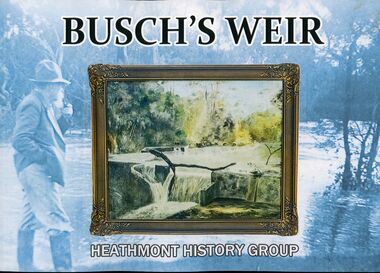
Book, PenFolk Publishing, Busch's Weir, 2019
... One of several Dandenong Creek marker posts inscriptions: "Busch's Weir was located at this section of the creek between 1930s to 1960s. ...One of several Dandenong Creek marker posts inscriptions: "Busch's Weir was located at this section of the creek between 1930s to 1960s. ...One of several Dandenong Creek marker posts inscriptions: "Busch's Weir was located at this section of the creek between 1930s to 1960s. In the 1930s, German migrant Hermann Otto Busch and his wife Dorothea moved to Bayswater and opened the Waldheim Farm Guest House. Busch built a concrete weir to create a popular swimming and fishing destination. The weir was a thriving attraction until the 1960s. Although little remains, it is fondly remembered by the Heathmont community. City dwellers would retreat to the guesthouse and wander down to Dandenong Creek to enjoy a weekend in the 'country'. Busch's guest house, tea rooms, and weir attracted locals and tourists alike."A private weir on Dandenong Creek Bayswater and Heathmont, 1930s-1967. Landscape layout soft covered book by Heathmont History Group (Ringwood & District Historical Society.Front cover image: A 1956 painting by Hermann Busch of his weir. The publication of this book has been made possible by a financial grant from Melbourne Water, as part of the Enhancing Our Dandenong Creek program. We particularly acknowledge the encouragement and support of Sarah Watkins, Senior Planning Engineer, MW. -
 Bendigo Historical Society Inc.
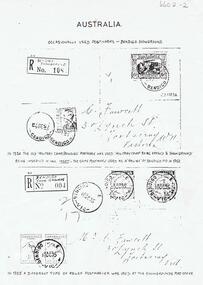
Document - BENDIGO POST OFFICE COLLECTION: OCCASIONALLY USED POSTMARKS, 1915
... In 1935, a different type of relief Post marker was used at the Showgrounds Post office. ...The Post marker that refused to die.(Being Military if simply faded away). ...Document. Occasionally used Postmarks - Bendigo Showground. In 1934 The Old 'Military Camp/Bendigo' postmark was used. Military Camp postmark being erased and Showground being inserted in ink. Inset - the same Postmark used as a 'relief' at Bendigo PO in 1952. In 1935, a different type of relief Post marker was used at the Showgrounds Post office. The Post marker that refused to die.(Being Military if simply faded away).bendigo post office, post marks -
 City of Greater Bendigo - Civic Collection
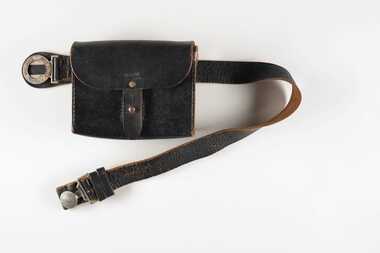
Uniform - Telegram Satchel
... Inside flap of satchel; Australia / Post / Telegram / Boys written in marker. Buckle; Post Office / Communications / Australia. ...Ted Rankins Collection Bendigo Post Office Bendigo Tourism City of Greater Bendigo Tourism Post Office collection Inside flap of satchel; Australia / Post / Telegram / Boys written in marker. Buckle; Post Office / Communications / Australia. ...Electrical telegraphs were point to point text messaging systems primarily used from the 1840's until the late 20th century. It was the first electrical telecommunications system and were sent by an operator or telegrapher using Morse code. Social telegrams were also encouraged and special pictorial forms and envelopes were designed such as the special purple form and envelope which was used when conveying condolence details during World War 2.(fn. Powerhouse https://collection.powerhouse.com.au/object/163103). There was a brief resurgence in telegraphy during World War I but the decline continued as the world entered the Great Depression years of the 1930s. Although telegraph lines continued to play an important part in distributing news feeds from news agencies post World War 2, the rise of the internet in the 1990s and the widespread installation of the telephones in homes saw the need for telegrams to greatly decline. When the Commonwealth Post and Telegraph Act was passed in June 1902, and a national Postmaster General's Department (the PMG) was established the responsibility for the nation's mail and telephone services fell on Post Offices. The Bendigo Post Office, built in 1887 and situated on Pall Mall was the central distribution centre for receiving and delivering telegrams and continued to deliver communication and postal services until 1997. Now a Visitor Centre, dedicated volunteers at the Post Office continued to demonstrate and educate the public about telegraphic services and the development of this unique form of communication up until 2019 when Covid 19 disrupted every day life, coupled with the death Ted Rankins (the last Post Master and a long term telegraph volunteer at the Post Office). This satchel was used by Junior Postal Workers in Bendigo to carry telegrams which were delivered by bicycle in the early years and is part of the postal collection donated by the Rankins family in memory of Ted. Small, dark coloured rectangle, leather satchel with attached belt and ornate buckle. Satchel is made of four pieces of leather: two side pieces, one piece which is folded to create the front, bottom, back and flap and one piece for the central strap. The central strap has a single hole through which a metal toggle is inserted to secure the flap closed. Stitching is evident around the side seams, around the metal toggle and inside flap where strap is attached and has been reinforced. Satchel has four metal tabs to secure the top front to the top sides and an internal pocket on inside. The leather belt is attached to the back outside of the satchel with four metal press studs. The left side buckle also has reinforced stitching. Both sides of the buckle have decorative elements with the words Post Office / Communications/ Australia on the left side around outer circular edge. Underside of right side of buckle end has the words AROS pressed into it. Inside flap of satchel; Australia / Post / Telegram / Boys written in marker. Buckle; Post Office / Communications / Australia. Underside of right side of buckle end; AROS Internal; Gold address sticker with Ted Rankins contact details.ted rankins collection, bendigo post office, bendigo tourism, city of greater bendigo tourism, post office collection -
 Bendigo Historical Society Inc.
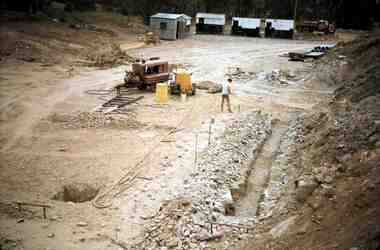
Slide - RALPH BIRRELL COLLECTION: EIG SCHOOL, c1965
... Digging of foundations have been started. Post markers in place....Building equipment workman Digging foundations Post markers Kodak EIG School - Ralph Birrell Collection. - Construction of Latrobe Uni. ...EIG School - Ralph Birrell Collection. - Construction of Latrobe Uni. C1965. Bendigo Institute of Technology, Engineering School, Applied Science. Four temporary buildings and tip truck in back ground, along with pipes and timber. Building equipment and workman in centre of photo. Digging of foundations have been started. Post markers in place.Kodakeducation, tertiary, latrobe university bendigo, eig school - ralph birrell collection. - construction of latrobe uni. c1965. bendigo institute of technology, engineering school, applied science. four temporary buildings and tip truck in back ground, along with pipes and timber. building equipment workman digging foundations post markers -
 Bendigo Military Museum
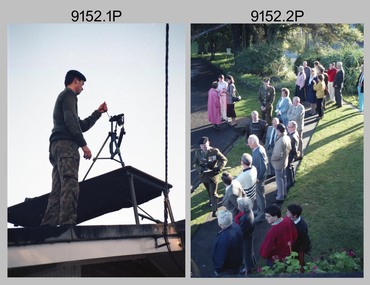
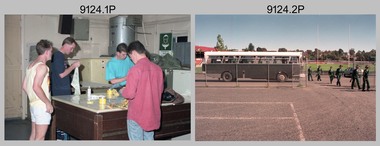
Photograph - Army Survey Regiment – Corps Day Parade Set 1, Fortuna Villa, Bendigo, 1991
... The right markers of each squadron take their positions under RSM WO1 Graham Ragless’s commands. .9) - Photo, colour, 1991. The Officers move to the edge of the parade ground before taking posts. ...The right markers of each squadron take their positions under RSM WO1 Graham Ragless’s commands. .9) - Photo, colour, 1991. The Officers move to the edge of the parade ground before taking posts. ...This set of 31 photographs was taken at the Corps Day Parade held at the Army Survey Regiment, Bendigo on the 26th of June 1991.The Corps Day Parade was held to commemorate the 76th anniversary of the formation of the Royal Australian Survey Corps. The Reviewing officer was the Commander of the 3rd Military District BRIG P. Davies AM ADC and the Parade Host was D-SVY COL Simon Lemon. Refer to items 9154.37P for more photographs taken during the parade; and 9155.27P for photographs taken afterwards during the tour of the unit and the family BBQ.This is a set of 31 photographs of the Corps Day Parade held at the Army Survey Regiment, Fortuna, Bendigo on the 26th of June 1991. The colour photographs are on 35mm negative film and scanned at 2400 dpi. They are part of the Army Survey Regiment’s Collection. .1) - Photo, colour, 1991. Photographer on the roof of the SGTS Mess Accommodation building. .2) - Photo, colour, 1991. Guests gather at the edge of the parade ground. The RSM in the foreground and the WO1 in the background are unidentified. .3) & .4) - Photo, colour, 1991. SGT Chris ‘Charlie’ Brown stands at one corner of the parade ground behind a Wild T2 theodolite mounted with a RED2L Electric Distance Measurement (EDM) instrument. .5) & .6) - Photo, colour, 1991. CPL Steve Wegener stands at one corner of the parade ground behind a Wild T2 theodolite. .7) & .8) - Photo, colour, 1991. The right markers of each squadron take their positions under RSM WO1 Graham Ragless’s commands. .9) - Photo, colour, 1991. The Officers move to the edge of the parade ground before taking posts. SGT Chris ‘Charlie’ Brown is in the foreground behind a Wild T2 theodolite .10) to .15) - Photo, colour, 1991. Army Survey Regiment follows the 3rd MD marches onto the parade ground. RSM WO1 Graham Ragless is in the foreground. .16) - Photo, colour, 1991. Army Survey Regiment at the halt. RSM WO1 Graham Ragless is in the foreground. .17) - Photo, colour, 1991. Headquarters Squadron performs the ‘Right Dress’. .18) - Photo, colour, 1991. Cartographic Squadron performs the ‘Right Dress’. RSM WO1 Graham Ragless is in the foreground. .19) to .21) - Photo, colour, 1991. Army Survey Regiment stands at ease during RSM WO1 Graham Ragless’s handover to ADJT CAPT Geoff Ford. .22) to .24) - Photo, colour, 1991. Army Survey Regiment fixes bayonets under ADJT CAPT Geoff Ford’s commands. .25) - Photo, colour, 1991. Army Survey Regiment stands at ease during ADJT CAPT Geoff Ford’s handover to 2IC MAJ Ray Redman .26) & .27) - Photo, colour, 1991. Army Survey Regiment Officers take posts under 2IC MAJ Ray Redman’s commands. .28) & .29) - Photo, colour, 1991. Army Survey Regiment stands at attention during 2IC MAJ Ray Redman’s handover to CO LTCOL Rene van den Tol. .30) & .31) - Photo, colour, 1991. Army Survey Regiment under CO LTCOL Rene van den Tol’s command awaits arrival of the official guests.There are no personnel identified. ‘Corps Day 26 Jun 1991’ annotated on negative sleeves.royal australian survey corps, rasvy, army survey regiment, army svy regt, fortuna -
 Queenscliffe Maritime Museum
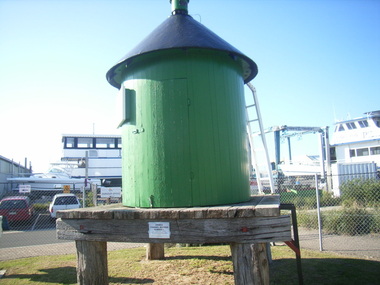
Functional object - Channel Marker - Colour Green, 1955
... This Port Phillip West Channel marker was built in 1955 and was run on acetylene, therefore requiring a platform and circular hut rather than the modern buoys or posts. ...This Port Phillip West Channel marker was built in 1955 and was run on acetylene, therefore requiring a platform and circular hut rather than the modern buoys or posts. ...Port and Starboard channel markers are internationally recognised sea markers used in maritime pilotage to indicate the edge of a channel. This Port Phillip West Channel marker was built in 1955 and was run on acetylene, therefore requiring a platform and circular hut rather than the modern buoys or posts. It was painted green as it marked the starboard side of the channel. West Channel Marker, Grimes No. 5 Built 1955 Accetylene poweredchannel markers, west channel, port phillip, pile light -
 Bendigo Military Museum
Photograph - Army Survey Regiment Freedom of Entry Parade, Bendigo CBD, 1990
... Right markers for the four squadrons await orders to take posts. Front to back: Headquarters Squadron’s SGT Chris Edwards, Air Survey Squadron’s SGT Max Watson, Cartographic Squadron’s SSGT Graham Johnston and Lithographic Squadron’s SPR Doug Whiteside. .15) to .19) - Photo, colour, 1990. ...Right markers for the four squadrons await orders to take posts. Front to back: Headquarters Squadron’s SGT Chris Edwards, Air Survey Squadron’s SGT Max Watson, Cartographic Squadron’s SSGT Graham Johnston and Lithographic Squadron’s SPR Doug Whiteside. .15) to .19) - Photo, colour, 1990. ...The Freedom of Entry to the City on the 26th of October 1990 was an honour first conferred by the Bendigo City Council to the Army Survey Regiment in 1970. This was the fifth time the unit exercised its freedom of marching into the city with swords drawn, bayonets fixed and drums beating. The honour is usually bestowed upon local regiments, in recognition of their dedicated service, and it is common for military units to periodically exercise their freedom by arranging a parade through the city. The event began with a ceremonial parade at the Queen Elizabeth II Oval. The RAAF Central Command Band provided the music at the parade. After formal inspections of the troops, the Army Survey Regiment saluted as it marched past the Reviewing Officer - Mayor of Bendigo Councillor James Douglass, military dignitaries and guests. Led by the Regiment’s CO – LTCOL Rene van den Tol, the unit marched down View St, along Pall Mall and to Gaol Rd. Regiment members were treated to a civic reception at the City Hall after the ceremony. The Regiment also exercised its Freedom of Entry with anniversary parades in 1977, 1980, 1985, 1992 and 1996. See items 9125.54P and 9126.24P for additional sets of photos taken at the event. The formal booklet covering the event is catalogued under item 9123.This set of 28 photographs of the Army Survey Regiment were taken at the beginning of the Freedom of Entry parade, held at the City of Bendigo’s Queen Elizabeth Oval (QEO) on the 26th of October 1990. The colour photographs are on 35mm negative film and scanned at 2400 dpi. They are part of the Army Survey Regiment’s Collection. .1) - Photo, colour, 1990. Lithographic Squadron personnel at Fortuna Villa prepare for the parade. L to R: CPL Daryl South, SGT Steve Burke, SPR Tony Hilbig, unidentified. .2) - Photo, colour, 1990. Female personnel arrive at the QEO. .3) - Photo, colour, 1990, Personnel prepare for the parade at the QEO. L to R: SGT John Phillips, SPR Steve Linane, CPL Mark Lander 4th from right, remainder unidentified. .4) - Photo, colour, 1990, Personnel prepare for the parade at the QEO. In foreground L to R: WO1 Colin Cuskelly, SSGT Paul Leskovec CSM, unidentified, SGT Brendon McKinless, SSGT Paul Cheater, CPL Damian Killeen, SGT Greg Else, SGT Chris Edwards, SGT Wolfgang Thun, WO2 Mick Flynn, WO1 Ken ‘Sluggo’ Slater, unidentified, WO2 Steve Hansen. .5) & .6) - Photo, colour, 1990. Support personnel at the QEO. L to R: unidentified (x2), SPR Steve Wright, LCPL Ross Anza. .7) - Photo, colour, 1990. Officers prepare for the parade at the QEO L to R: LT Derek Bell, CAPT Dave McLachlan. .8) - Photo, colour, 1990. Officers prepare for the parade at the QEO L to R: CO LTCOL Rene van den Tol, CAPT Dave McLachlan, MAJ Peter Clark, MAJ Neil Taylor. .9) - Photo, colour, 1990. Officers prepare for the parade at the QEO L to R: Unidentified partners, LT Craig Hersant, LT Steve Hledik, LT Marty Lyons. .10) - Photo, colour, 1990. View of the QEO’s grandstand prior to the parade. .11) - Photo, colour, 1990. Spectators arriving at QEO are directed by Army Survey Regiment marshalls. L to R: CPL Graeme Priestley, unidentified (x2). .12) - Photo, colour, 1990. Personnel from the four squadrons await orders to form up. .13) & .14) - Photo, colour, 1990. Right markers for the four squadrons await orders to take posts. Front to back: Headquarters Squadron’s SGT Chris Edwards, Air Survey Squadron’s SGT Max Watson, Cartographic Squadron’s SSGT Graham Johnston and Lithographic Squadron’s SPR Doug Whiteside. .15) to .19) - Photo, colour, 1990. The RAAF Central Command Band marches through the car park to the QEO’s entrance led by Drum Major Warrant Officer E. Hayward (in front) and Deputy Music Director Flying Officer S. Wright. .20) - Photo, colour, 1990. Headquarters Squadron commanded by SSM WO1 Colin Cuskelly marches through the QEO’s car park. L to R: SGT Wolfgang Thun, unidentified, CPL John ‘Flash’ Anderson, SGT Rick Gerhardt, unidentified. .21) - Photo, colour, 1990. Headquarters Squadron commanded by SSM WO1 Colin Cuskelly (with sword) marches through the QEO’s car park. .22) & .23) - Photo, colour, 1990. Air Survey Squadron commanded by SSM WO1 Russell ‘Rusty’ Williams (with sword) march through the QEO’s car park. .24) - Photo, colour, 1990. Air Survey Squadron commanded by SSM WO1 Russell ‘Rusty’ Williams (with sword) march through the QEO’s car park. L to R: unidentified, SPR Allan Blake, SPR Bob Bousfield, unidentified, SPR Harris Lee, SPR Andy Love. .25) - Photo, colour, 1990. Cartographic Squadron commanded by SSM WO1 Gary Warnest (with sword) march through the QEO’s car park. L to R: SGT Doug Carswell, CPL Geunther Ebenwaldner, SPR Leigh Palfrey, SGT Bob Garritty, unidentified, SSGT Dennis Learmonth. .26) - Photo, colour, 1990. Cartographic Squadron commanded by SSM WO1 Gary Warnest (with sword) march through the QEO’s car park. L to R: SGT Doug Carswell, CPL Geunther Ebenwaldner, SGT Bob Garritty, SPR Leigh Palfrey, SSGT Dennis Learmonth, unidentified. .27) - Photo, colour, 1990. Lithographic Squadron commanded by SSM WO1 Bill Jones (with sword) march through the QEO’s car park. .28) - Photo, colour, 1990. Lithographic Squadron commanded by SSM WO1 Bill Jones (with sword) march through the QEO’s car park. L to R: SSGT Peter Imeson, SGT Brian Paul, SGT Steve Burke, SPR Scott Cameron, SPR Shane Campbell. No personnel or civilians are identified. ‘Freedom of Entry Parade ‘90’ is annotated on plastic negative sleeve.royal australian survey corps, rasvy, army survey regiment, army svy regt, fortuna -
 Ballarat Tramway Museum
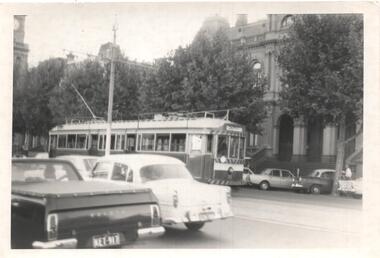
Photograph - Black & White Photograph/s, Neville Gower, 16/04/1972 12:00:00 AM
... Black & White photograph of Bendigo No. 18, travelling along Pall Mall with Post Office in background and motor cars in foreground, with white marker on front of tram, with 'Depot' showing. ...Trams Tramways Bendigo Pall Mall Post Office Tram 18 '2nd last tram back from Eaglehawk / Note markers as used in Bendigo' on rear of photograph Black & White photograph of Bendigo No. 18, travelling along Pall Mall with Post Office in background and motor cars in foreground, with white marker on front of tram, with 'Depot' showing. ...Black & White photograph of Bendigo No. 18, travelling along Pall Mall with Post Office in background and motor cars in foreground, with white marker on front of tram, with 'Depot' showing. No ads in advertising racks on top of tram. On Kodak paper. On 16/4/1972. Reimaged 17/7/2019 both front and back.'2nd last tram back from Eaglehawk / Note markers as used in Bendigo' on rear of photographtrams, tramways, bendigo, pall mall, post office , tram 18 -
 Clunes Museum
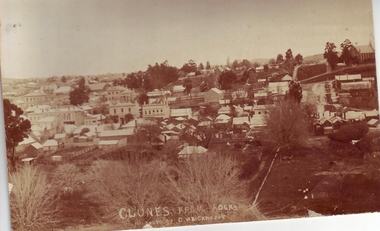
Postcard, C. WEICKHARDT, CLUNES FROM THE ROCKS
... POST CARD local history photographs clunes township ON REVERSE OF POSTCARD: HANDWRITTEN IN GREEN MARKER C.H.S. ...POST CARDSEPIA POSTCARD OF CLUNES , VIEW FROM THE ROCKSON REVERSE OF POSTCARD: HANDWRITTEN IN GREEN MARKER C.H.S. PRINTED IN BLACK POSTCARD - CORRESPONDENCE ADDRESS ONLY - KODAK AUSTRAL local history, photographs, clunes township -
 Ballarat Tramway Museum
Postcard, Murfett Pty Ltd, Princes Bridge Melbourne, c1968
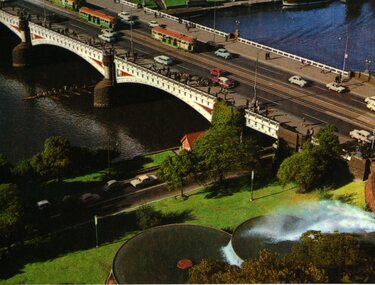
... marker lights and the South Gate fountains, existing at the time of the photograph. Since replaced by the Arts Centre. On rear is printed caption, giving details of the location, the date of the fountain construction (1959), stamp placement area and publishers details and post card number (8P 1053-2), National View by Murfett Publishers....marker lights and the South Gate fountains, existing at the time of the photograph. Since replaced by the Arts Centre. On rear is printed caption, giving details of the location, the date of the fountain construction (1959), stamp placement area and publishers details and post card number (8P 1053-2), National View by Murfett Publishers. ...Colour postcard of Princes Bridge and South Gate Fountain Melbourne, late 1960's. Postcard shows the southern end of the Princes Bridge, has 3 W2's on bridge, each with marker lights and the South Gate fountains, existing at the time of the photograph. Since replaced by the Arts Centre. On rear is printed caption, giving details of the location, the date of the fountain construction (1959), stamp placement area and publishers details and post card number (8P 1053-2), National View by Murfett Publishers.On top edge near stamp area in black ink "1968".trams, tramways, melbourne, southgate, princes bridge, mmtb -
 Ballarat Tramway Museum
Album - Photo Album, Newstar, 1960s to 1970's
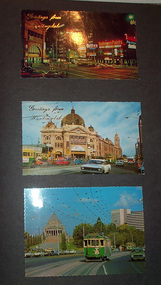
... marker lights, types of motor cars and general Melbourne history. Image files in page number order. Image 15 is of book. All taken with a electronic camera. Page 1 - Night photo - Flinders and Swanston St. - with "Greetings from Huntingdale" embossed in gold. Flinders St. station, with "Greetings from Huntingdale" embossed in gold. (post...marker lights, types of motor cars and general Melbourne history. Image files in page number order. Image 15 is of book. All taken with a electronic camera. Page 1 - Night photo - Flinders and Swanston St. - with "Greetings from Huntingdale" embossed in gold. Flinders St. station, with "Greetings from Huntingdale" embossed in gold. (post ...Photographic album containing 39 Colour postcards of Melbourne trams. The album consists of 30 leaves of dark grey heavy paper with three creases on left hand side of sheet, bound into a heavy bluey grey folder, embossed in gold 'Scrap Book" and bound with bluey grey string with two holes. The cover has been embossed with a the blue grey in swirls. Inside of back cover is a white label, "A New Star Product", with a please ask for No. with "425" stamped on. Postcards have been glued into the album. Entries have been kept to a single line - cards are able to be dated from buildings, whether the trams have marker lights, types of motor cars and general Melbourne history. Image files in page number order. Image 15 is of book. All taken with a electronic camera. Page 1 - Night photo - Flinders and Swanston St. - with "Greetings from Huntingdale" embossed in gold. Flinders St. station, with "Greetings from Huntingdale" embossed in gold. (post 1972 ) St. Kilda road with the Shrine of Remembrance in the background and W2 453 inbound on route 6. (post 1974) Page 2 - Bourke St, looking from Parliament House westwards, with Z8 inbound - after 13/8/1975 on route 89. Bourke St, looking east from Queen St., night photo, early 1970's. Princes Bridge looking towards Flinders St. Station Page 3 - Flinders St. Station, from Princes Gate buildings, - Photo E. Ludwig, John Hinde Studios. Bourke St. from Queen St, looking east, late 1960's - all W's. - W7 1026 east bound on route 88. Flinders St and Swanston St. corner, from Princes Bridge - night photo - W5 756 northbound route 15. Page 4 - W2 584 inbound route 64, St. Kilda Road and Nolan St., late 1960s - photograph. Princes Bridge, looking over Yarra River to the east. (pre Concert Hall) St. Kilda Road, with Shine of Remembrance in background, W2 303 inbound route 4D, mid 1960's. Page 5 - Flinders and Swanston St, W2 530 outbound route 8, early 1970's. Swanston and Collins St., W2 596 westbound in Collins St. City Square built - 1st version. (post 1972) St Kilda Road, with Shine in background, W2 298 and others, route 8 and 72. (post 1972) Page 6 - Flinders and Swanston St., W2, inbound route 5 on a wet evening. (mid 1970's) W2 515 outbound, Collins St., late 1960's, with Town Hall in background. (early 1970's, prior to lights) Collins St. looking west at Russell St with W2 637outbound route 42, early 1960's. Page 7 - Swanston St looking south at Little Bourke, W2's 373 route 67 and 374?(route 5), southbound, early 1970's Flinders St. Station, looking west in Flinders St., early 1970's, at dusk. Melbourne Town Hall with City Square from the North West (early 1970's) Page 8 - Bourke St looking east from Queen St. with W7 1005 inbound on route 96 - early 1970's. Bourke St. looking west from Exhibition St. with W6 976 outbound on route 95 - early 1970's. Swanston St. looking south from Lonsdale, with W2 484 on route 64, W2 228 and W2 364 in photo - early 1970's. Page 9 - Swanston looking south from north of Lonsdale St with many tramcars in photo - mid 1970's. St Kilda Road, with Shrine in background, W2 345 outbound route 4, SW6 913 inbound route 4 - prior to 1970. St Kilda Road, with Shrine in background, with trams in photo - early 1970's. (Photo loose in album - National View postcard by Murfett Ltd. Aust.) Page 10 - Postcard - TMSV? of 1041 and cable car set at Preston Workshops. 1041 in Bourke St., looking east from Queen St. - early 1970's - 1974? Collins St. looking east from Elizabeth St. with W2 253 inbound route 11, and W2 224 outbound - rout 47, early 1970's Page 11 - TMSV Postcard, X217 in Dandenong Road with L class in background. Shrine of Remberance from BP building, looking towards the city with St. Kilda Road on the left. Princes Gate and Flinders St. from the SEC buildings in Flinders St. looking south east - mid 1960's. Page 12 - Swanston St. at Flinders St. looking north at dusk. Flinders St. station at Swanston St with trams crossing at intersection - late 1960's Flinders St. station with W2 327 outbound. Page 13 - Temporary City Square at Collins and Swanston St. with tramcars at intersection. Wellington Parade (Mugs Alley), looking towards the City, with W2 546 inbound on route 38 - mid to late 1960's. Page 14 - Swanston St. looking south, at Lonsdale St, W2 432 inbound route 7 - late 1960's or early 1970's. Partly loose in album - National View postcard by Murfett Ltd. Aust. trams, tramways, photo album, melbourne, postcards -
 Lakes Entrance Historical Society
Photograph, Lakes Post Newspaper, Shayne Clark and Matt Duguid of Gippsland Ports Lakes Entrance Victoria, 1/12/2000 12:00:00 AM
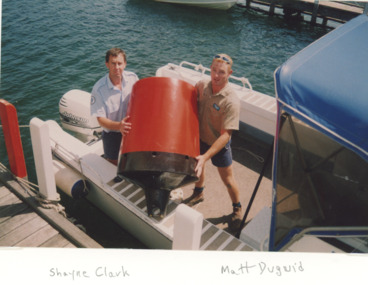
... Gippsland Ports Occupation Health and Safety Waterways Colour photograph of Shayne Clark and Matt Duguid of Gippsland Ports with new marker buoys for Reeves Channel Lakes Entrance Victoria Shayne Clark and Matt Duguid of Gippsland Ports Lakes Entrance Victoria Photograph Lakes Post Newspaper ...Colour photograph of Shayne Clark and Matt Duguid of Gippsland Ports with new marker buoys for Reeves Channel Lakes Entrance Victoriagippsland ports, occupation health and safety, waterways -
 Ballarat Heritage Services
Photograph, LJ Gervasoni, Scarsdale/Linton Milepost (or Milestone), 20-06/2009
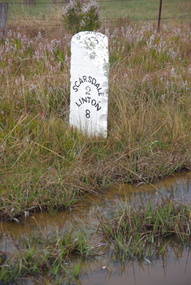
... post...scarsdale...linton...Ballarat...mile marker...The stone milepost in the current City of Ballarat are located on the Glenelg Highway (between Ballarat and Scarsdale), Smythes Creek and Delacombe, and have been registered by Heritage Victoria, (HO155) Other stone mileposts are located In Golden Plains Shire at Smythesdale (Victorian Heritage Register H1701) Metrication in Australia caused former mile markers to be gradually replaced with 10 km markers on highways and country roads, which are referred to as "kilometre plates". Milepost mile post scarsdale linton Ballarat mile marker stone milepost milestone Colour photograph of a stone mile post on between Ballarat, Scarsdale and Linton Scarsdale/Linton Milepost (or Milestone) Photograph Australia Victoria LJ Gervasoni ...Stone mileposts dating from the 1870s are found on the Glenelg Highway. Stone and iron mileposts are now a rarity, and have remanining markers have become a tourist attaction in many smaller towns with remnant markers. The stone mileposts on the Glenelg Highway are listed on the Victorian Heritage Reigister as being significant to the State of Victoria. Their primary purpose is to inform the travelling public of distances and directions to various destinations. The stone milepost in the current City of Ballarat are located on the Glenelg Highway (between Ballarat and Scarsdale), Smythes Creek and Delacombe, and have been registered by Heritage Victoria, (HO155) Other stone mileposts are located In Golden Plains Shire at Smythesdale (Victorian Heritage Register H1701) Metrication in Australia caused former mile markers to be gradually replaced with 10 km markers on highways and country roads, which are referred to as "kilometre plates".Colour photograph of a stone mile post on between Ballarat, Scarsdale and Lintonmilepost, mile post, scarsdale, linton, ballarat, mile marker, stone milepost, milestone -
 Tennis Australia
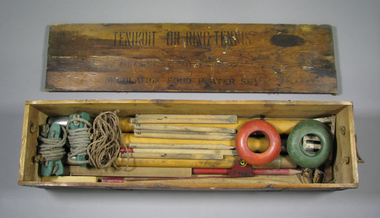
Ring tennis set, Circa 1922
... A Ring Tennis set chest (.1) containing: rings (.2 - .5); guy ropes (.6 - .7); net posts (.8, 2 parts, .9, one part); court boundary markers (.10 - .19); rope (.20), and a metallic flag marker (.21). ...Tennis A Ring Tennis set chest (.1) containing: rings (.2 - .5); guy ropes (.6 - .7); net posts (.8, 2 parts, .9, one part); court boundary markers (.10 - .19); rope (.20), and a metallic flag marker (.21). ...A Ring Tennis set chest (.1) containing: rings (.2 - .5); guy ropes (.6 - .7); net posts (.8, 2 parts, .9, one part); court boundary markers (.10 - .19); rope (.20), and a metallic flag marker (.21). Eight miscellaneous pieces also feature. Inscription across top of lid: "TENIKOIT' OR RING TENNIS/...REGULATION FOUR PLAYER SET. Across top of base: R.H. MOTTRAM/(SOLE MAKER)/CHURCH STRETTON/SHROPSHIRE. On sides of box: TENIKOIT/NO. 2A. Materials: Wood, Metal, Lacquer, Ink, Glue, Rubber, Paint, Rope, Cord, Stringtennis -
 Surrey Hills Historical Society Collection
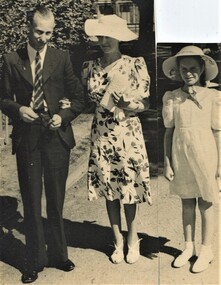
Photograph, Lance & Beryl Young and Shirley Mair at the zoo, 1960, 1940
... Two lines blacked out with permanent marker. "SHIRL MAIR / Melb Zoo / 1940" Post card photograph with a stippled surface which has been cut in two and stuck back together but without the top RH corner section. ...Ernest Lance Young was born 24 March 1915 in Surrey Hills, the son of Ernest Augustus Young and Ruby Nichell Whitty. He married Beryl Mair in 1939 and died on 5 October 1999 at Mont Albert. Electoral rolls record him as a manufacturer. His address after marriage was 11 York Street, Mont Albert. Beryl Mair (1916-1976) was the daughter of David Miller Mair and Lily Vipond Deakin. She had an older brother Geoffrey David (1913) and younger sisters Gwynneth (1918), Isobel Lillian (1921) and Shirley Inez (1928).This is part of a large donation of material relating to the Deakin, Mair and Young families, all of whom had connections with Surrey Hills / Mont Albert. The donor is the daughter of Ernest Lance and Beryl Young.Post card photograph with a stippled surface which has been cut in two and stuck back together but without the top RH corner section. It shows a well-dressed couple and a young girl. The woman and girl are in summer dresses and wearing hats.Multiple inscriptions on both sections. "Young" in lead pencil. "Lance Young / Beryl " / Shirley Mair / at Zoo 1940." Two lines blacked out with permanent marker. "SHIRL MAIR / Melb Zoo / 1940"ernest lance young, lance young, beryl mair, beryl young, shirley inez mair, zoo -
 Melbourne Tram Museum
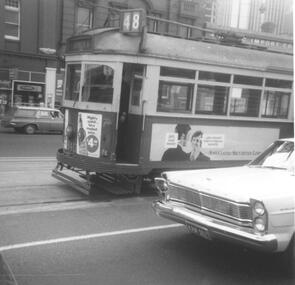
Photograph - Set of 2 Black & White Photograph/s, Ray Jackson, c1971
... Photo taken post August 1971 as the tram is fitted with Marker lights .1 - view of tram and a motor vehicle (Ford Galaxy) with a damaged front right headlight and minor damage to the tram front of the door post. ...Photo taken post August 1971 as the tram is fitted with Marker lights .1 - view of tram and a motor vehicle (Ford Galaxy) with a damaged front right headlight and minor damage to the tram front of the door post. ...Set of two Black and White photographs of the front section of tram SW5 840 in Flinders Melbourne, tram has a Associated Securities Limited advertisement on the side of the tram. Tram has run number K5, route 48 and destination of Spencer St. Photo taken post August 1971 as the tram is fitted with Marker lights .1 - view of tram and a motor vehicle (Ford Galaxy) with a damaged front right headlight and minor damage to the tram front of the door post. Also note the damaged bumper bar on the car. .2 - photo of the tram crew looking at the front of the tram - Opps more paperwork.trams, tramways, flinders st, accidents, crews, route 48, motor vehicles, sw5 class, tram 840 -
 Hymettus Cottage & Garden Ballarat
Work on paper - Bookmark, Bookmarker
... One of several Jewish book dealers' bookmarks employed in Melbourne from the post-war era through to the twenty-first century. These markers give a record of the shifting demography of this community around the city of Melbourne over the decades. ...One of several Jewish book dealers' bookmarks employed in Melbourne from the post-war era through to the twenty-first century. These markers give a record of the shifting demography of this community around the city of Melbourne over the decades.jewish, melbourne, bookseller -
 The Beechworth Burke Museum
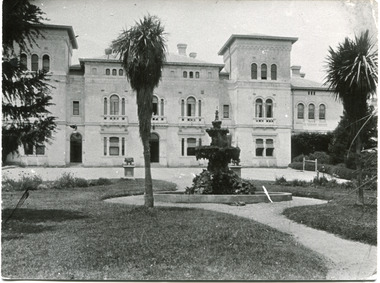
Photograph
... markers, to that in photographs dating to the 1930s. This allows an estimated date of 1930s for this photograph. Beechworth's Mayday Hills was chosen as the site of Victoria's newest asylum, at the time, due to the landscape and altitude. The hilltop atmosphere and the native fauna, it was argued, would assist in the cure of the patients kept at the hospital (Wood 1985, 122). The positioning of the hospital had a beneficial effect on the rural town. A pamphlet published by James Ingram and Son (1849) reveal that famous landmarks in Beechworth which included the Post...markers, to that in photographs dating to the 1930s. This allows an estimated date of 1930s for this photograph. Beechworth's Mayday Hills was chosen as the site of Victoria's newest asylum, at the time, due to the landscape and altitude. The hilltop atmosphere and the native fauna, it was argued, would assist in the cure of the patients kept at the hospital (Wood 1985, 122). The positioning of the hospital had a beneficial effect on the rural town. A pamphlet published by James Ingram and Son (1849) reveal that famous landmarks in Beechworth which included the Post ...This image is a copy of a photograph depicting the front façade of the Mayday Hills Hospital by an unknown photographer. The date this photograph was captured has not been recorded but due to the appearance of the water fountain in the front garden, it can be estimated to be during the 1930s. The fountain does not remain on the site today but stood in the same location, alongside other physical markers, to that in photographs dating to the 1930s. This allows an estimated date of 1930s for this photograph. Beechworth's Mayday Hills was chosen as the site of Victoria's newest asylum, at the time, due to the landscape and altitude. The hilltop atmosphere and the native fauna, it was argued, would assist in the cure of the patients kept at the hospital (Wood 1985, 122). The positioning of the hospital had a beneficial effect on the rural town. A pamphlet published by James Ingram and Son (1849) reveal that famous landmarks in Beechworth which included the Post Office, Gaol, Courthouse and Asylum "demonstrate the appreciation of Beechworth by the Government not only as as important district center, but also as a site unrivaled as a sanitarium". There were other locations in contention at the time, but ultimately Beechworth was chosen (Craig 2000, 33). Prior to the creation of the Asylum in Beechworth, those charged with having mental illnesses or, as it was termed, "insanity" were unable to be properly cared for in the Gaol (which is where they were often sent). John Buckley Castieau wrote, in 1861 for the Ovens and Murray Advertiser, that the Gaol was unable to properly care for those classified then as "insane" but that they would endeavor to treat them above the other inmates (which he notes is not always the case in other establishments). Castieau wrote this in favour of supporting the building of the Mayday Hills Hospital in Beechworth. It was stated that at the time the Mayday Hills Hospital was built, there were 83 prisoners kept in the Gaol who were to be rehoused to the Hospital on the grounds of "insanity". The classification as someone as "insane", in this period of time is a reflection on the inability to cure and understand illnesses of the mind during the mid to late 1800s. Opening on the 24th of October 1867, the Mayday Hills Hospital was originally named the "Ovens Lunatic Asylum", a title which is very much a product of its time. Whilst controversial, changes to the name is part of the history of the Hospital and can provide much insight into the understanding of mental illness throughout history and the use/disuse of this term provides information into the reception/changing opinions of mental illness in society. The Hospital would later become known as the "Mayday Hills Asylum" and/or "Mayday Hills Hospital" with the latter being the most commonly used title. An article in the Ovens and Murray Advertiser notes that on the 7th of March 1865, the foundation stone of the Hospital was laid (it would officially open in 1867) and that it was such a moment of accomplishment and joy for Beechworth that a letter to the editor even suggested that there should be a holiday dedicated to the day the foundation stone as laid. This reveals an extent to which the townspeople of early Beechworth valued the construction of the Hospital in their town. It provided the town with a sense of prestige and honour.At first glance, the remains of the Mayday Hills Hospital in Beechworth, Victoria, inspire tragedy, trauma and beauty. The buildings themselves, with their Italianate style Renaissance architecture designed by J.J. Clark (Craig 2000, 49 & Smith 2016, 203) reflect a bygone period of European and Australian history. The gardens provide a sense of tranquility and beauty. The experience of those within these walls remains a valuable area of study to provide a more complete understanding. This particular hospital is considered the fourth of its like and one of three identified as the largest of their kind. The Mayday Hills Hospital is a sister to the Kew and Ararat Asylums in Melbourne which are both located in relative proximity. Understanding the role of the Mayday Hills Hospital in Beechworth history is integral to understanding the development of the goldfields town, but also for providing important information as to the history of caring for, and the reception of, mental illnesses in Australian and wider European history. Mayday Hills provides a case study which can be researched through oral history, an analysis of the grounds/buildings and through images like this postcard which portray the structure in a highly deliberate manner. Images like this depict the strong façade of the Hospital and provide a glimpse into the tranquility of the gardens. This has been done deliberately to provide a sense of comfort and healing about the building to those looking from the outside. Further research into the importance of the Hospital in Beechworth and it's connection to the town will be supported through images like these kept in the Mayday Hills photo album in the collection of the Burke Museum.Black and white rectangular photograph printed on gloss photographic papermental hospital, insane asylum, mayday hills mental hospital -
 Department of Energy, Environment and Climate Action
Alidade - sight tube used in FCV fire towers, c 1940s
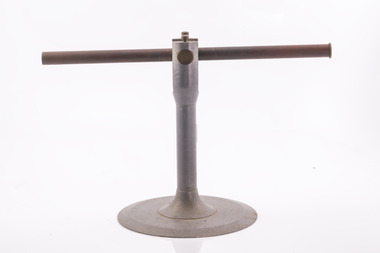
... It was then cross referenced with bearings from other towers on a large wall map to give a "fix" on the fire location Alidades and telescopes were used in the post war period but were replaced with a much simpler map table and reference string suspended from the centre of the tower cabin. Uncommon usage Bushfire Forests Commission Victoria (FCV) FCV and bearing markers on the alloy base. ...Victoria once had well over one hundred fire lookouts and firetowers. Fire lookouts, or observation posts, were often just a clearing on a hill or a vantage point, whereas firetowers were definite structures. Many were established by the Forests Commission Victoria (FCV) in the 1920s, but the network was expanded rapidly in response to recommendations of the Stretton Royal Commission after the 1939 Black Friday bushfires. When a fire or smoke was spotted from the tower a bearing was taken with the alidade and radioed or telephoned into the district office. It was then cross referenced with bearings from other towers on a large wall map to give a "fix" on the fire location Alidades and telescopes were used in the post war period but were replaced with a much simpler map table and reference string suspended from the centre of the tower cabin.Uncommon usageAlidade Sight TubeFCV and bearing markers on the alloy base. Very simple design. bushfire, forests commission victoria (fcv) -
 Returned Nurses RSL Sub-branch
Album - Photograph album, J.Souillard, [circa 1945]
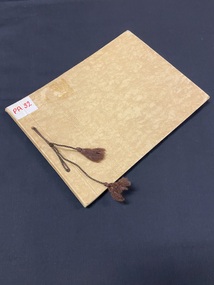
... post-war Victory March in London. Victory March London ceremonies War Memorials Soldiers-Australian Soldiers-French Australian Army Nurses WWII World War 1939-1945 'PA32' [Handwritten in red marker on a white label attached to the front cover] 'PA32' [Handwritten in red ink on the inside front cover] 'Photo J. ...'J. Souillard was a photographer based in Bapaume, France, specializing in capturing postcards and architectural views of the Pas-de-Calais region during the early-to-mid 20th century' - (from google deep search) The album contains photographs of Senior Officers and Ceremonies somewhere in Europe circa World War II. The three additional photographs added at a later date are of the post-war Victory March in London.Fawn manilla folder type cardboard cover with a line of ornate embossed pattern running vertically down the left side (two inces in from the spine). Brown thread is tied through the two hole punches on the left side with both ends finished with a knot and tassle. There is a white sticker label in the top left corner with 'PA32' in red marker. Brown card pages with one 5x7 black and white photograph on each right side page. The reverse side of each page is empty. These photos all have ornate jagged edges. There are three 6x8 photographs with straight edged borders attached inside the back cover and second last page that appear to be added later.'PA32' [Handwritten in red marker on a white label attached to the front cover] 'PA32' [Handwritten in red ink on the inside front cover] 'Photo J. Souillard / Bapaume (L.d.C.)' [Printed inside front cover]victory march london, ceremonies, war memorials, soldiers-australian, soldiers-french, australian army nurses, wwii, world war 1939-1945 -
 Returned Nurses RSL Sub-branch
Album - Photograph album, Post WWII Corps and RNC, 1994[?]
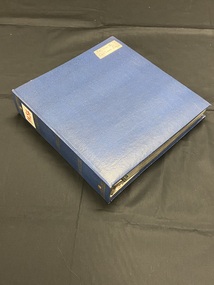
... [Most pages of photographs have a caption handwritten in blue ink on a white label at the top of the page, some pages have the label further down the page and the caption is typed] 'PA54' [Hand written in red marker on a white label on the spine] 'POST WWII / CORPS AND RNC' [Hand written in black ink on a label attached to the front cover]...marker. The top right corner of the front cover has a label with the title handwritten on it in black ink. Inside there are 40 double-sided black self-adhesive pages with plastic covers. Post ...Seven colour 6x4 photographs taken at the ceremony for the Royal Australian Army Nurses Corps (RAANC) Badged Door Dedication in Kapooka on Saturday October 15th, 1994. Six 6x4 coloured photographs from the ANZAC March in 1994. Three undated sepia coloured photographs of inside the office of the Returned Nurses Club. A variety of coloured photos of Returned Nurses Club members at memorials and events [1994?] A copy of a printed article regarding the Vietnam Women's Memorial (titled: Women of the war by Jeanne Wong). A souvenir card with a photo of Queen Elizabeth. Six photos of the floral garden opposite Victoria Barracks taken in 1983. A 6.5x10 black and white photo of a post war ANZAC Day March. Three ring binder photograph album. The cover is mottled dark blue and black. There are five sets of three gold horizontal lines spaced out down the spine. At the top of the spine is a large white sticker with PA54 in red marker. The top right corner of the front cover has a label with the title handwritten on it in black ink. Inside there are 40 double-sided black self-adhesive pages with plastic covers.[Most pages of photographs have a caption handwritten in blue ink on a white label at the top of the page, some pages have the label further down the page and the caption is typed] 'PA54' [Hand written in red marker on a white label on the spine] 'POST WWII / CORPS AND RNC' [Hand written in black ink on a label attached to the front cover]royal australian army nursing corps, raanc, ceremonies, kapooka, returned nurses club, anzac day march, floral garden - victoria barracks, vietnam women's memorial, betty morton, matron johns, mrs. shippen, jean poulter, betty lawson, billie lindsay, eve graham
