
Showing 4 items matching "marlo-newsletter"
-
 Orbost & District Historical Society
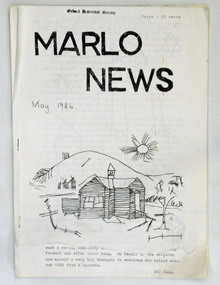
newsletter, Marlo News, May 1984
... Marlo-newsletter...A newsletter, titled Marlo News. It contains articles, children's work, puzzles, events, a calendar, reports and black / white photographs. ...It may also boost the local economy – both through advertising or news coverage. Marlo-newsletter On front cover - stamp of Orbost Historical Society A newsletter, titled Marlo News. ...In small rural communities a community newsletter is an important tools for facilitating communication. It may also boost the local economy – both through advertising or news coverage. A newsletter, titled Marlo News. It contains articles, children's work, puzzles, events, a calendar, reports and black / white photographs. There are local advertisements. On the front cover is a sketch of an old school (Marlo?) below the heading MARLO NEWS and the cost -20 cents. On front cover - stamp of Orbost Historical Society marlo-newsletter -
 Orbost & District Historical Society
black and white photograph, before 1912
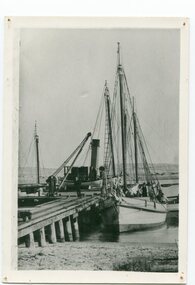
... Marlo and Cunninghame. Eventually river transport became economically unviable. The Wongrabelle is still buried in the sands of the entrance of the Snowy River (albeit where the entrance used to be). It took from April 11th 1912 to August 12th 1912 for the loss of the Wongrabelle to be complete, the final entry in the Orbost Shipping Co. records reads:- "The Wongrabelle is completely covered in sand." (ref River, Road, Railway Newsletter...Marlo and Cunninghame. Eventually river transport became economically unviable. The Wongrabelle is still buried in the sands of the entrance of the Snowy River (albeit where the entrance used to be). It took from April 11th 1912 to August 12th 1912 for the loss of the Wongrabelle to be complete, the final entry in the Orbost Shipping Co. records reads:- "The Wongrabelle is completely covered in sand." (ref River, Road, Railway Newsletter ...This photo shows the Storm Bird at the end of the jetty and the Wangrabelle in the foreground. Both ships were well known traders. the Wangrabelle became beached and wrecked in 1916 and the Storm Bird became obsolete when the railway from Bairnsdale to Orbost arrived in 1916. (ref. Story of Gippsland Shipping - J.C. Bull) At the start of the river trade goods were shipped from Marlo to Melbourne but when the railway reached Bairnsdale this became unprofitable and the ships plied only between Marlo and Cunninghame. Eventually river transport became economically unviable. The Wongrabelle is still buried in the sands of the entrance of the Snowy River (albeit where the entrance used to be). It took from April 11th 1912 to August 12th 1912 for the loss of the Wongrabelle to be complete, the final entry in the Orbost Shipping Co. records reads:- "The Wongrabelle is completely covered in sand." (ref River, Road, Railway Newsletter O.D.H.S.) This is a pictorial record of a time when the water highways were the only feasible transport mode in sending goods from Orbost and Marlo to Melbourne. A black / white photograph of a ship, sails down, anchored at the Marlo jetty. on back - "M. Gilbert, Wangrabelle at Marlo" storm-bird wangrabelle shipping transport- marlo -
 Orbost & District Historical Society
ledger, 1. 8. 1915 - 30 .6. 1923
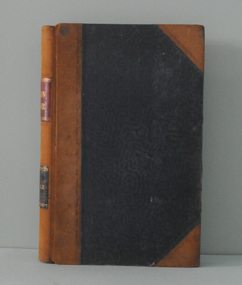
... (more info. in O.D.H.S. newsletter -Tambo Shire) This is an example of record keeping on rural properties in the first half 20th century. It is associated with the Cameron family who were early settlers in the Orbost district. Cameron-Marlo ...This ledger was kept by the management of a rural property in Marlo, East Gippsland. Entries were made by Hugh Cameron and Alaster Cameron. Their property was reputed to be the largest private dairy producer in Australia at one stage. (ref. Mary Gilbert) Some station owners or managers kept records like diaries, wage and ration books, and registers of births, deaths and marriages. This one records federal transactions, costs of produce and payments for share farming at Brodribb and Marl, as well as a list of donations made. Hugh Cameron (1850-1921) was on the Orbost Shire council from 1892-1915. His son Alaster was also an Orbost Shire councillor representing the East riding from 1932 to 1954. Hugh died at Orbost on 3rd May 1921, aged 71, and was buried on 5th May at the Orbost cemetery. (more info. in O.D.H.S. newsletter -Tambo Shire) This is an example of record keeping on rural properties in the first half 20th century. It is associated with the Cameron family who were early settlers in the Orbost district. A large leather bound ledger with a dark blue patterned cover and suede leatherette binding and corners. There are pages with alphabetical indexing. Some pages are ruled for accounts. All entries are hand-written in blue or black ink.There is blotting paper inside. on spine on red leatherette in gold print - " "STATION LEDGER" and on black in gold print - "CLOVERDALE" cameron-marlo dairy-farm-cameron agriculture-records station-ledger-cameron -
 Orbost & District Historical Society
black and white photograph, C1890
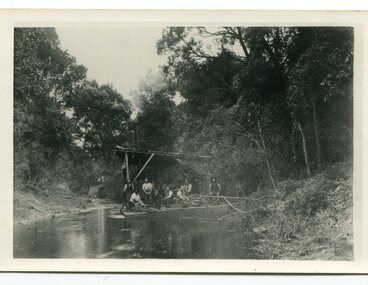
... John Phillips Newsletter March 2004) The snaggers played an important role in the early settlement of the Orbost / Marlo district helping bto open it up to commercial shipping. snaggers-brodribb-river snagging-east-gippsland transportation on back - "Snagging boat on Brodribb with R.McNair" Two copies of a black / white photograph of nine men on a snagging boat, a flat-bottom barge. ...This snagging team is on the Brodribb River, east of Orbost. The Brodribb bridge can be seen in the background of the Photograph. The Snowy River was used for commercial navigation after 1880 and extensive de-snagging A shipping company was formed in 1880, poling barges upstream until the removal of large trees and branches that had fallen into the river was carried out to make the river upstream of Marlo easier to navigate. "The snaggers played an important part in making the river free for transport. By 1880 Captain Collins, R McNair engineer, J McNair and the two Winchesters were at work with a punt on the Snowy and Brodribb. Mr. Jim Winchester took charge soon after. Early snaggers were Johnston, J Renton, Nat Lynch, John Drew, Hatton, J Scott and Harry Wilkinson. The system used was to use a tree on the river bank as a lever and with heavy manila ropes, slowly to haul the snags out. They were piled up around a tree and burned when dry. The snaggers lived in a row of cottages in Snaggers’ Lane." (info. John Phillips Newsletter March 2004) The snaggers played an important role in the early settlement of the Orbost / Marlo district helping bto open it up to commercial shipping. Two copies of a black / white photograph of nine men on a snagging boat, a flat-bottom barge. In the background is a bridge. on back - "Snagging boat on Brodribb with R.McNair" snaggers-brodribb-river snagging-east-gippsland transportation
