
Showing 141 items matching "mary evans"
-
 Greensborough Historical Society
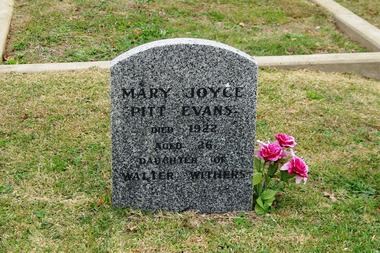
Photograph - Digital image, Marilyn Smith, Grave of Mary Evans, St Helena Cemetery, 1922_
... Grave of Mary Evans, St Helena Cemetery...The Grave of Mary Joyce Pitt Evans, daughter of Walter Withers (died 1922), St Helena Cemetery....The Grave of Mary Joyce Pitt Evans, daughter of Walter Withers (died 1922), St Helena Cemetery. ...The Grave of Mary Joyce Pitt Evans, daughter of Walter Withers (died 1922), St Helena Cemetery.St Helena Cemetery was originally the burial place of the Beale family and friends. The first burials took place in the 1850s. There are now over 200 burials.Digital copy of colour photograph (grave)st helena cemetery, walter withers, withers family -
 Inverloch Historical Society
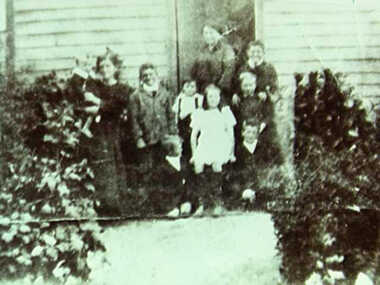
000395 - Photograph -13 Nov 1924 -leaving farm at Ruby -Ian Evans -Olive Jebson -Tom Evans -Barry Baxter -Mary Evans -Gwen Evans -Bill Evans -Charlie Baxter -Joe Evan -Ark (R K Evans)
... 000395 - Photograph -13 Nov 1924 -leaving farm at Ruby -Ian Evans -Olive Jebson -Tom Evans -Barry Baxter -Mary Evans -Gwen Evans -Bill Evans -Charlie Baxter -Joe Evan -Ark (R K Evans)...000395 - Photograph -13 Nov 1924 -leaving farm at Ruby -Ian Evans -Olive Jebson -Tom Evans -Barry Baxter -Mary Evans -Gwen Evans -Bill Evans -Charlie Baxter -Joe Evan -Ark (R K Evans) ... -
 Royal District Nursing Service (now known as Bolton Clarke)
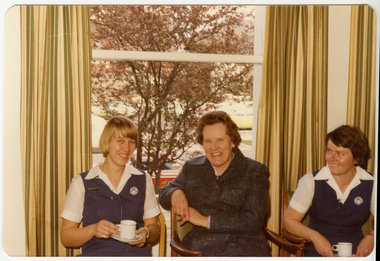
Photograph - Photograph, colour, c.1980
... ...miss mary evans...Kilda Road, Melbourne. Miss Mary Evans was the RDNS Director of Nursing from 1963-1978,...It shows, left to right, Sister Bev Armstrong, who has short blonde hair, Miss Mary Evans, who has short curled brown hair and another RDNS Sister who has short dark hair. ...It shows, left to right, Sister Bev Armstrong, who has short blonde hair, Miss Mary Evans, who has short curled brown hair and another RDNS Sister who has short dark hair. ...The photograph is taken at a function in the Board Room of RDNS Headquarters, 452 St. Kilda Road, Melbourne. Miss Mary Evans was the RDNS Director of Nursing from 1963-1978,From its founding in 1885 until 1891, the Trained nurses (Nurses) of the Melbourne District Nursing Society (MDNS) worked from their own homes which were located in the vicinity of their areas (districts). The Committee meetings were held at the Religious Tract Society rooms at Queen’s walk, off Swanston Street and then at the Library Room at the Melbourne Town Hall. The Annual General Meeting was held at the Town Hall. In November 1891 MDNS was able to rent a two story terraced house at 66 Cardigan Street, Carlton, at £65 a year, which contained accommodation for three Nurses and one pupil nurse as well as being used as their Headquarters. They left from their Nurses Home each morning and returned at the end of their shift to write up their book work before retiring for the day. Three years later they moved into a larger terraced house at 49 Drummond Street Carlton which was rented at ‘a very moderate rental’. There was a Board room, apartments for the Nurses and pupil nurse, a large dispensary which patients could attend each evening to have prescriptions signed and bottles refilled with ‘homely remedies’ and elixirs, which were administered for e.g. to Consumptive cases. Doctor’s prescriptions were filled at the Pharmacy. Cupboards containing donated blankets and bedclothes for needy patients were kept in this room, and it was here where the Nurses kept their nursing bags which were refilled at the end of each shift ready for any emergency and for the next day. A list of Doctors the Nurses could call was kept by the telephone. The home also had a kitchen where nourishing soup was made and distributed twice a week to the needy. Milk was also distributed when needed. In 1902 they moved into rented premises at 188 Leicester Street, Carlton and two years later, in 1904, to premises at 5 Royal Terrace, Nicholson Street, Fitzroy where they remained for ten years. In June 1914 at last the Society had sufficient funds to purchase their own terraced premises, ‘Floraston’ 39 Victoria Parade, Collingwood which was their Headquarters and Nurses Home. In 1926 the After-Care Home for recovering patients, (later called After-Care Hospital) was built by the Society next door, running from 41-47 Victoria Parade (became No. 45); the District nurses (Sisters) continued to live at No. 39. In November 1953 the District Nursing Division moved into their new Headquarters and Nurses Home at 452 St. Kilda Road, Melbourne. As RDNS expanded and now, with Centres opening throughout the suburbs, the Sisters lived in their own homes and the Nurses Home at 452 closed and those rooms used for administrative purposes. On April the 1st 1996 RDNS Head Office relocated to 31 Alma Road, St. Kilda. Coloured photograph taken at a function in a room at Royal District Nursing Service (RDNS). It shows, left to right, Sister Bev Armstrong, who has short blonde hair, Miss Mary Evans, who has short curled brown hair and another RDNS Sister who has short dark hair. The two RDNS Sisters are wearing the RDNS summer uniform of a white blouse under a royal blue V neck tunic style dress with the RDNS insignia on the left hand side. Miss Evans, is wearing a long dark coat. The three are smiling and the Sister on the right is looking at Miss Evans who is turned slightly and has part of her right arm resting over the top of the back of the chair. They are sitting in front of a window and opened gold long curtains. A tree is seen through the window. Both RDNS Sisters have cups in their hands.royal district nursing service, rdns, rdns headquarters, miss mary evans, sister bev armstrong -
 Royal District Nursing Service (now known as Bolton Clarke)
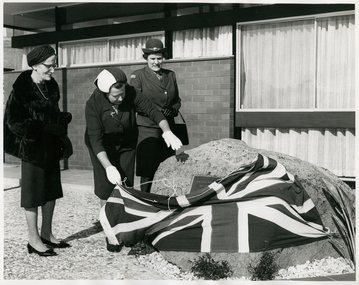
Photograph - Photograph, black and white, 30 08 1967
... ...miss mary evans...Wilson is President of the Royal District Nursing Service. Miss Mary Evans is the Director of Nursing of the Royal District Nursing Service and is wearing her dark grey Director's uniform....Wilson, who is to her left, and is wearing glasses and a black coat, hat and shoes. Miss Mary Evans, who is wearing her RDNS uniform of a dark grey skirt and jacket and brimmed hat, and with a handbag looped over her left arm, is to the right.. ...Wilson is President of the Royal District Nursing Service. Miss Mary Evans is the Director of Nursing of the Royal District Nursing Service and is wearing her dark grey Director's uniform. ...Mrs. R. Gordon is the President of the Victorian branch of the National Council of Women and is unveiling the Memorial plaque to Caroline Chisholm. The plaque stands on a rock in front of the Royal District Nursing Service (RDNS) Essendon Centre, and was unveiled on the same day the Centre opened on the 30th of August 1967. Mrs. E.G. Wilson is President of the Royal District Nursing Service. Miss Mary Evans is the Director of Nursing of the Royal District Nursing Service and is wearing her dark grey Director's uniform.Caroline Chisholm visited the goldfields of Victoria in 1854 and was horrified by the conditions en-route. The Memorial plaque to Caroline Chisholm, in front of the RDNS Essendon Centre, is in recognition for her work in establishing, with Government assistance, shelter sheds about a days walk apart, to enable the prospectors and their families shelter whilst heading for the goldfields. Caroline Chisholm, a Philanthropist, began her work in Madras in 1834 founding a Female School of Industry for the daughters of European soldiers. They were taught to read, write, cook, keep house and were given instructions in nursing. After coming to Sydney in 1838, she set up accommodation for poor young unemployed migrant women and families. This work was extended when she arranged employment in the countryside for assisted immigrant women and families, many times travelling with groups of young women to check their employment conditions. In seven years she placed 11,000 people in homes and employment. On her return to England she fought for, and won, free passage to Australia for wives and children of former convicts, and for children left behind in England by circumstances, when the family migrated. She established the Family Colonisation Loan Society in 1849, which set up a saving scheme for emigrants, and later loaned them half of their passage to Australia. The Society's Agents found them employment on arrival, and the loan was paid back within two years by a humane payment scheme. At first they used emigrant ships for passage, but then the Society provided ships with much improved conditions, and this led to the upgrading of the passenger Act.. The Chisholm's lived in Kyneton for several years, returning to Sydney for health reasons, before going back to England where Caroline died, aged 68 years, on the 25th of March 1877.Black and white photograph showing Mrs. R. Gordon, wearing a black coat and black and white beret style hat, with her left hand on a rock and her right hand on the British Flag, whilst unveiling the Memorial plaque to Caroline Chisholm. Mrs. R. Gordon stands between Mrs. E.G. Wilson, who is to her left, and is wearing glasses and a black coat, hat and shoes. Miss Mary Evans, who is wearing her RDNS uniform of a dark grey skirt and jacket and brimmed hat, and with a handbag looped over her left arm, is to the right.. Part of a building is seen in the background; short glass windows can be seen above the brickwork to the left and a large glass window to the right.Photographers stamp and 'Quote No. GJ 60'rdns, royal district nursing service, essendon centre, caroline chisholm, memorial plaque, mrs r. gordon, miss mary evans, mrs e.g. (hazel janet) wilson -
 Royal District Nursing Service (now known as Bolton Clarke)
Photograph - Photograph, black and white, Barry Sutton, 25.07.1972
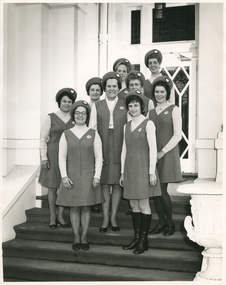
... ...miss mary evans...Miss Mary Evans is the Director of Nursing of Royal District Nursing Service (RDNS). ...Sheehan with dark curly hair, Miss Mary Evans, with dark curled hair and M. Lambert with dark curled hair. ...Miss Mary Evans is the Director of Nursing of Royal District Nursing Service (RDNS). ...Miss Mary Evans is the Director of Nursing of Royal District Nursing Service (RDNS). RDNS changed its uniform style and colour some time in 1971 and this 1972 photograph of the Sisters shows them wearing the new winter uniform of a blue/grey skivvie under a V neck tunic style frock made of blue/grey herringbone winter material, with the RDNS insignia on the upper left, and a beret style hat of the same material. The hat was worn on official occasions. Miss Evans is wearing her uniform of a grey blouse and a skirt and long V neck jacket made of the same blue/grey herringbone winter material worn by the Sisters. The photograph is taken on the steps of RDNS Headquarters, 452 St. Kilda Rd, Melbourne. Part of the white building is seen either side of the steps, and behind the Sisters the wooden and glass panel door is seen.From its earliest years when Melbourne District Nursing Society (MDNS) began to wear uniforms the chosen colour was grey, though the style changed throughout the years as fashions changed from the late 1800s through to the 1970s. Their Trained nurses (Nurses) firstly wore long grey frocks and later a white collar, cuffs and white belt was added, and on their head they wore a white cap with a long white tail hanging from the centre back. When bicycles were introduced the headgear changed to a white pith helmet adorned with a red Maltese cross in the centre front. This was held on with a veil going over the hat and tied under the chin. Over the years there were complaints that the veils became wet in the rain and they asked for a change of uniform, but this did not happen until 1921. Twelve years later the Trained nurses (Sisters) complained their skirts became wet when riding their bicycles in the rain and asked, when raining, to be able to wear breeches and gaiters. This was granted provided they wore aprons when attending patients. It was not long before the uniform changed to a shorter length grey frock, red cardigan, grey coat and grey brimmed hat; later changed to a peaked grey hat. In 1966 MDNS were granted Royal patronage. Now as Royal District Nursing Service (RDNS), Sisters Liz Thomson and Bev Armstrong, in 1971, designed a new uniform and the colour was changed. By 1972 the Sisters were wearing the new winter uniform of a blue/grey skivvie under a V neck tunic style frock made of blue/grey herringbone winter material with the RDNS insignia on the upper left, and a beret style hat of the same material. In summer the uniform became a royal blue V neck tunic style frock, with the RDNS insignia on the upper left, worn over a short sleeve white blouse. A royal blue peaked hat with the RDNS insignia in the centre front was worn at first and then only worn on official occasions. This uniform was worn until changed to a corporate style in the mid 1980s,Black and white photograph of Miss Mary Evans of the Royal District Nursing Service (RDNS), with a group of RDNS Sisters standing, in twos, down the steps outside part of a white painted.building. They are wearing their winter uniforms of a grey V neck tunic style frock worn over a lighter grey skivvie. They are all wearing the matching grey beret style hat. The RDNS insignia is seen on the upper left of their uniforms and in the centre front of their hats. Some of the Sisters are partly hidden. L-R Back row - Sisters: Barbara Watson, who has blonde hair and Judy Peter who has darker hair. The next row down is - Betty McDonald, who has short dark hair and Fonce Hoey, who has curled hair. The next row down is V. Sheehan with dark curly hair, Miss Mary Evans, with dark curled hair and M. Lambert with dark curled hair. Front row - A. Tyler, who is wearing glasses and has short dark hair and Mary Gawith with short dark curled hair. She is wearing below the knee black boots.Photographer stamp. Quote No. LA 3melbourne district nursing society, mdns, royal district nursing service, rdns, rdns uniform, miss mary evans, sister barbara watson, sister judy peter, sister betty mcdonald, sister fonce hoey, sister v sheehan, sister h. lambert, sister a. tyler, sister mary gawith -
 Emerald Museum & Nobelius Heritage Park
Equipment - Wool teaser, 1930 circa
... ...Mary Evans...Used in household of the donor, Mary Evans (nee Handasyde) in Emerald in the 1930s....Used in household of the donor, Mary Evans (nee Handasyde) in Emerald in the 1930s. ...Used in household of the donor, Mary Evans (nee Handasyde) in Emerald in the 1930s.Aluminium short-handled wool-teaser, round, about the size and shape of a small cup : diameter 5cm taping to 4cm. With a detachable pad of rubber with 50mm needles.Aluminium|RubberPatent No. 159770emerald, victoria, australia, sewing, wool, mary evans, mary handasyde -
 Flagstaff Hill Maritime Museum and Village
Book, The Mill On The Floss
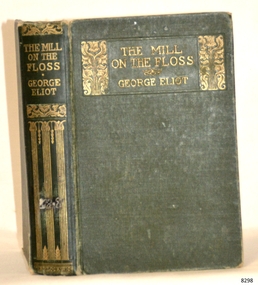
... ...mary ann evans...Further Information: Mary Ann Evans used the pen name George Eliot. ...Further Information: Mary Ann Evans used the pen name George Eliot. The Mill On The Floss Book Book ...This book was part of a large group of books referred to as the Pattison Collection, which belonged to the Warrnambool Public Library, part of the Warrnambool Mechanics’ Institute. About RALPH ERIC PATTISON and the ‘PATTISON COLLECTION’ The ‘Pattison Collection’ is a collection of books and records that was originally owned by the Warrnambool Mechanics’ Institute, founded in Warrnambool in 1853. By 1886 the Warrnambool Mechanics’ Institute (WMI) had grown to have a Library, Museum and Fine Arts Gallery, with a collection of “… choice productions of art and valuable specimens in almost every branch and many wonderful national curiosities are now to be seen there, including historic relics of the town and district.” It later included a School of Design. Although it was very well patronised, the WMI was led to ask the City Council to take it over in 1911 due to lack of financial support. In 1935 Ralph Pattison was appointed as City Librarian to establish and organise the Warrnambool Public Library as it was then called. Ralph Eric Pattison was born in Rockhampton, Queensland, in 1891. He married Maude Swan from Warrnambool in 1920 and they set up home in Warrnambool. In 1935 when Pattison accepted the position as City Librarian for the Warrnambool City Council his huge challenge was to make a functional library within two rooms of the Mechanics’ Institute. He tirelessly cleaned, cleared and sorted a disarrayed collection of old books, jars of preserved specimens and other items reserved for exhibition in the city’s museum. He developed and updated the library with a wide variety of books for all tastes, including reference books for students; a difficult task to fulfil during the years following the Depression. He converted all of the lower areas of the building into a library, reference room and reading room for members and the public. The books were sorted and stored using a cataloguing and card index system that he had developed himself. He also prepared the upper floor of the building and established the Art Gallery and later the Museum, a place to exhibit the many old relics that had been stored for years for this purpose. One of the treasures he found was a beautiful ancient clock, which he repaired, restored and enjoyed using in his office during the years of his service there. Ralph Pattison was described as “a meticulous gentleman whose punctuality, floorless courtesy and distinctive neat dress were hallmarks of his character, and ‘his’ clock controlled his daily routine and his opening and closing of the library’s large heavy doors to the minute.” Pattison took leave from 1942 to 1945 to serve in the Royal Australian Navy, Volunteer Reserve as Lieutenant. A few years later he converted one of the Museum’s rooms into a Children’s Library, stocking it with suitable books for the younger generation. This was an instant success. In the 1950’s he had the honour of being appointed to the Victorian Library Board and received more inspiration from the monthly conferences in Melbourne. He was sadly retired in 1959 after over 23 years of service, due to the fact that he had gone over the working age of council officers. However, he continued to take a very keen interest in the continual development of the Library until his death in 1969. THE NEW WARRNAMBOOL LIBRARY When the WMI building was pulled down in 1963 a new civic building was erected on the site and the new Warrnambool Library, on behalf of the City Council, took over all the holdings of the WMI. At this time some of the items were separated and identified as the ‘Pattison Collection’, named after Pattison. Eventually, the components of the WMI were distributed from the Warrnambool Library to various places, including the Art Gallery, Historical Society and Flagstaff Hill. Later some were even distributed to other regional branches of Corangamite Regional Library and passed to and fro. It is difficult now to trace just where all of the items have ended up. The books at Flagstaff Hill Maritime Village generally display stamps and markings from Pattison as well as a variety of other institutions including the Mechanics’ Institute itself. The Pattison Collection, along with other items at Flagstaff Hill Maritime Village, was originally part of the Warrnambool Mechanics' Institute’s collection. The Warrnambool Mechanics’ Institute Collection is primarily significant in its totality, rather than for the individual objects it contains. Its contents are highly representative of the development of Mechanics' Institute libraries across Australia, particularly Victoria. A diversity of publications and themes has been amassed, and these provide clues to our understanding of the nature of and changes in the reading habits of Victorians from the 1850s to the middle of the 20th century. The collection also highlights the Warrnambool community’s commitment to the Mechanics’ Institute, reading, literacy and learning in the regions, and proves that access to knowledge was not impeded by distance. These items help to provide a more complete picture of our community’s ideals and aspirations. The Warrnambool Mechanics Institute book collection has historical and social significance for its strong association with the Mechanics Institute movement and the important role it played in the intellectual, cultural and social development of people throughout the latter part of the nineteenth century and the early twentieth century. The collection of books is a rare example of an early lending library and its significance is enhanced by the survival of an original collection of many volumes. The Warrnambool Mechanics' Institute’s publication collection is of both local and state significance. The Mill On The Floss Author: George Eliot Publisher: Ward Lock & Co Date: First Published in 1860 Illustrated by Bertha Newcombe. Further Information: Mary Ann Evans used the pen name George Eliot. The label on the spine is unreadable Pastedown front endpaper has a sticker from Warrnambool Public Library covered by a sticker from Corangamite Regional Library Service flagstaff hill, warrnambool, shipwrecked coast, flagstaff hill maritime museum, maritime museum, shipwreck coast, flagstaff hill maritime village, great ocean road, book, pattison collection, warrnambool library, warrnambool mechanics’ institute, ralph eric pattison, corangamite regional library service, warrnambool city librarian, mechanics’ institute library, victorian library board, warrnambool books and records, warrnambool children’s library, the mill on the floss, george eliot, mary ann evans, bertha newcombe -
 Greensborough Historical Society
Book, The Mick Evans Story, 2011
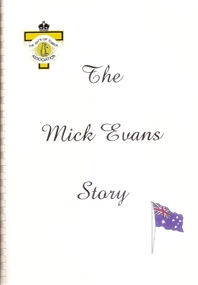
... Inside front cover: "From Betty, Shirley, June and Mary Evans"...Inside front cover: "From Betty, Shirley, June and Mary Evans" Spiral bound book, 95 p., illus. (some col.). ...Mick Evans (E.H.) Evans, VX10125, 9th Division, 2nd/1st Field Workshop. This story was transcribed from 9 x 90 minute audio tapes recorded by Mick Evans several years before his death. The book was completed in 2000 just before Mick's death.One man's story of life during World War II, in particular as a "Rat of Tobruk".Spiral bound book, 95 p., illus. (some col.). Clear plastic outer cover. Printed cover has title, Rats of Tobruk Association logo and Australian flag.Inside front cover: "From Betty, Shirley, June and Mary Evans"mick evans, june hall, tobruk, australian army, world war ii. -
Surrey Hills Historical Society Collection
Work on paper - Vertical File, Nurses
... ...Mary Evans...‘Lifted nursing to a new level of skills and dedication.’ Obituary of Mary Evans ‘The Age’ 14.6.2004 (1 page) 8. Florence Christina Gray. 2 pages of correspondence between Mrs V Von Wedel and Box Hill Historical Society Inc, October 2004 and nurses register (1 page). 9. ...Nurses Elizabeth Anderson Mosgiel Hospital Joan Wicks Mrs Sedgeman Eliza Tank Mary Freeland Mary Evans Florence Gray Marsh Midwives Nurses 1. ...Nurses 1. (Matron) Elizabeth Anderson (and others), 3 pages – various notes and dates 2. Photo and photocopy of nurses at Mosgiel Hospital 1950s 3. Mrs Joan Wicks (Née Bray) (2 pages) undated 4. Mrs Sedgeman (notes by son Frank) (1 page) undated 5. (Matron) Eliza Tank (Nethercourt Hospital). 3 pages including 2 of notes by her son Ossie, 1983. 6. Mary Freeland (1 page, 2 copies) notes by Phyllis McArthur, 11/1983. 7. ‘Lifted nursing to a new level of skills and dedication.’ Obituary of Mary Evans ‘The Age’ 14.6.2004 (1 page) 8. Florence Christina Gray. 2 pages of correspondence between Mrs V Von Wedel and Box Hill Historical Society Inc, October 2004 and nurses register (1 page). 9. Listing of Marsh Midwives from 1948 printed in Victorian Gazette, 19 May 1949. nurses, elizabeth anderson, mosgiel hospital, joan wicks, mrs sedgeman, eliza tank, mary freeland, mary evans, florence gray, marsh midwives -
 Royal District Nursing Service (now known as Bolton Clarke)
Photograph - Photograph, black and white, Barry Sutton, 24.06.1971
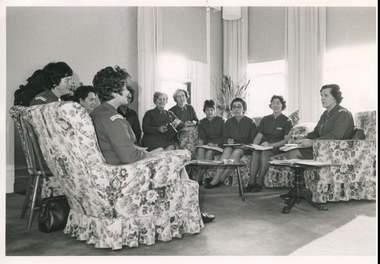
... ...miss mary evans...Black and white photograph of Miss Mary Evans, Director of Nursing of the Royal District Nursing Service (RDNS), with a group of RDNS staff. ...Quote No. 5 A Black and white photograph of Miss Mary Evans, Director of Nursing of the Royal District Nursing Service (RDNS), with a group of RDNS staff. ...Miss Evans, the Director of Nursing of Royal District Nursing Service (RDNS) is holding a meeting with some RDNS Sisters in a room at RDNS Headquarters, 452 St. Kilda Road, Melbourne. Mary Evans was born in Adelaide in 1915. She completed her General Nursing Training at the Royal Adelaide Hospital and her Midwifery Certificate at the Queen Victoria Memorial Hospital in Melbourne. Mary worked in the Midwifery section of Melbourne District Nursing Society from 1943–1945, and then qualified as a Maternal and Child Health Nurse. Gaining a Scholarship from MDNS in 1959, she studied and investigated District Nursing practices in England, Sweden, Denmark, Norway, Finland, Canada and the USA, which had a profound impact on the planning of MDNS. As Deputy Matron, then Matron from 1963, she began implementing her 5 point plan of - Education, Liaison, Ancillary Services, MDNS Centres in strategic areas and Home Health Aides. Miss Mary Evans retired as Director of Nursing of, the now, Royal District Nursing Service in 1978 and became an adviser to the Australian Council of Community Nursing Services. In 1981 she was awarded an O.B.E. for services to District Nursing, and as recognition for her leading role in Community nursing in Australia. From 1986-1990 she was heavily involved in the running of the Baxter Retirement Village. She was also Vice President of the Airdrie Retirement place for nurses in Canterbury. Mary Evans was placed on the Honour Roll of Victorian Women in 2001. Miss Mary Evan, O.B.E. died in early 2004.Black and white photograph of Miss Mary Evans, Director of Nursing of the Royal District Nursing Service (RDNS), with a group of RDNS staff. Miss Evans is sitting in a floral patterned lounge chair on the far right hand side. The other staff are sitting in a semi-circle in matching lounge chairs and couches. In attendance are Sisters: P. Holdsworth, B. Harris, E. Holland, M. Campbell, H. Beckett, J. Wilkinson, J. Tarn, E. Anderson. Some are partly hidden. Miss Evans has short dark curled hair and is wearing her grey uniform skirt and jacket. The rdns insignia can be seen on her upper left sleeve. The Sisters are wearing their grey short sleeve uniform frocks; some are wearing cardigans. The RDNS Insignia can be seen on the upper sleeve of some Sisters. A small round table with papers on it, sits beside Miss Evans and a rectangular coffee table in front of some of the Sisters. A plain carpet is on the floor and in the background two windows with long side curtains can be seen.Photographer Stamp. Quote No. 5 Aroyal district nursing service, rdns, rdns matron, miss mary evans, sister pat holdsworth, sister betty harris, sister e. holland, sister m. campbell, sister h. beckett, sister joanne wilkinson, sister joan tarn, sister ellen anderson -
 Royal District Nursing Service (now known as Bolton Clarke)
Photograph - Photograph, black and white, Barry Sutton, 25.07.1972
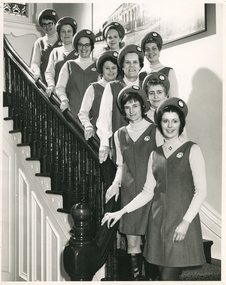
... ...miss mary evans...Black and white photograph showing Royal District Nursing Service (RDNS) Miss Mary Evans amid a group of RDNS Sisters standing down the steps of an internal staircase. ...LA 4 Black and white photograph showing Royal District Nursing Service (RDNS) Miss Mary Evans amid a group of RDNS Sisters standing down the steps of an internal staircase. ...Miss Evans is the Director of Nursing of Royal District Nursing Service (RDNS). She and the group of RDNS Sisters are standing on the staircase inside RDNS Headquarters, 452 St. Kilda Road, Melbourne.The photograph on the right rear is of a full view of 452. They are wearing the new winter uniform of a blue/grey skivvie worn under a V neck tunic style herringbone winter material dress with the RDNS insignia on the upper left. Their beret style hats are made of the same herringbone material. Miss Evans is wearing her uniform of a grey blouse, and a skirt and long jacket made of the blue/grey herringbone winter material.From its earliest years when Melbourne District Nursing Society (MDNS) began to wear uniforms the chosen colour was grey, though the style changed throughout the years as fashions changed from the late 1800s through to the 1970s. Their Trained nurses (Nurses) firstly wore long grey frocks, and later a white collar, cuffs and white belt was added, and on their heads they wore a white cap with a long white tail hanging from the centre back. When bicycles were introduced in 1903 the headgear changed to a white pith helmet adorned with a red Maltese cross in the centre front. This was held on with a veil going over the hat and tied under the chin. Over the years there were complaints that the veils became wet in the rain and they asked for a change of uniform, but this did not happen until 1921. Twelve years later the Trained nurses (Sisters) complained their skirts became wet when riding their bicycles in the rain and asked, when raining, to be able to wear breeches and gaiters. This was granted provided they wore aprons when attending patients. It was not long before the uniform changed to a shorter length grey frock, red cardigan, grey coat and grey brimmed hat; later changed to a peaked grey hat. In 1966 MDNS were granted Royal patronage. Now as Royal District Nursing Service (RDNS), Sisters Liz Thomson and Bev Armstrong, in 1971, designed a new uniform and the colour was changed. By 1972 the Sisters were wearing the new winter uniform of a blue/grey skivvie under a V neck tunic style frock made of blue/grey herringbone winter material with the RDNS insignia on the upper left, and a beret style hat of the same material. In summer the uniform became a royal blue V neck tunic style frock, with the RDNS insignia on the upper left, worn over a short sleeve white blouse. A royal blue peaked hat with the RDNS insignia in the centre front was worn at first and then only worn on official occasions. This uniform was worn until changed to a corporate style in the mid 1980s,Black and white photograph showing Royal District Nursing Service (RDNS) Miss Mary Evans amid a group of RDNS Sisters standing down the steps of an internal staircase. They are wearing their new winter RDNS uniforms of a light grey skivvy under a V neck tunic style grey frock with the RDNS insignia on the upper left, and a beret style hat of the same material. Sisters from top to bottom:- P. Rowley, who is wearing glasses and has short dark hair, next down is F. Hoey, who has short dark hair and then in pairs L-R A. Tyler, wearing glasses and with dark curled hair and B. Watson, who has shoulder length blonde curled hair. Next down is B. McDonald with short dark hair and J. Peter, with curly dark hair. Next down is Miss Evans, who has short curled hair, On the next step down is V. Sheehan, who has short wavy blonde hair, down further is M. Gawith, who has short dark hair and is wearing below the knee black boots. and in front is M. Lambert who has short dark hair and has her hospital badge attached under the centre neck of her skivvy. The staircase has dark wooden turned balustrades topped with a matching curved handrail and below this is white woodwork. In the rear of the photograph part of a stained glass window can be seen and on the right is part of a large photograph. Photographer stamp. Quote No. LA 4melbourne district nursing society, mdns, royal district nursing service, rdns, rdns uniform, miss mary evans, sister pat (paddy) rowley, sister fonce hoey, sister a. tyler, sister barbara watson, sister betty mcdonald, sister judy peter, sister mary gawith, sister v. sheehan, sister m. lambert -
 Glen Eira Historical Society
Document - Bentleigh Baptist Church Vickery Street Bentleigh
... Mary... Evans William John...Issues includes a CD with digital photos Reflections reprinted history upon the centenary of Bentleigh Baptist Church 1984 by DL Audemard from May 1985 The Way We Were Feb 1990 pamphlet notes reflections on the churches ministery over the last 50 years by unknown author A brief printed history author unknown and undated on Bentleigh Baptist Church, 10 Vickery Street Bentleigh Two computer generated articles of correspondence between Claire Barton and Robert Bell on the gathering of Bentleigh & Korean Baptist Church history April 2010 Bentleigh Baptist Church Brewer Mr Tucker Road Box Henry Lush GP Rev East Boundary North Road Bentleigh Baptist Church Brighton Baptist Church Tucker Road Church Box Francis Box Edith Clay Jack Clay Joy Lipman Vern Lipman Bronwyn Watt family Pioneers Watt Richard Watt Martha Market gardens Centre Road Jasper Road Watt Herbert Horse drawn vehicles Stamp Mr Hall Annie Vickery Street Watt May Clay family Marriott Hector Watt Don Watt family Box Chris Lipman Joy Grewar family Alexander Chas Shephard F Chapman Samuel Rev Chambers H Eunson TA Rev Boreham E Rev Fletcher W Rev Marriott Hec – market gardens Kennedy Jack Kennedy Lil Kennedy Isa Mary Herron John Seawright Celia Streckfuss Edith Cole Alice Grewar Annie Grewar Hall Faulkner Ern Graham Tom Cross Mabel Cross W Rev Trenches Grewar Jean Ormond Wadley Mr Wellum Mr Hinton WH Rees GP Rev Hinton Mrs Wade Ken Rev Wadley Mrs Bent St Wade Mrs Bell Powell Warner Lawrence Architects Winckel L Rev Richards JL Builders Streckfuss Bert Marriott May Streckfuss family Sach Florrie Sach family Reid Mrs Reid Lesley McMillan Mrs Drapers McKinnon Road Streckfuss Edith Simpson Mrs Wellum Mrs Leadlights Main Mary Evans William John Cooke J Cooke Mrs Cahill Samuel George Smith Kate Freeman Nancy Wanless Mrs Redmore AB Redmore Mrs Audemard Phil Rev Hawkins Margaret Ord Elton Hawkins Shiela Pith Ron Bell Mr Wallace Pat Bell Margaret Audemard Joan Docker Sandra Hubbard Mark Thomas Bernie Thomas Mrs Lamprell Mrs Herron Mr Herron Mrs Freeman Mrs Beach Mrs Paton John Mrs George Lloyd Aspinal Eric Bell Gwen Sutton Mrs Winkel Mrs Neil Mary Costain Mrs Main Mrs Baker Mrs Cross Mrs Kershaw Mrs Smith Millie Smith Jack Freeman Alf Harwood Lindsay Harwood Doreen Bell Lesley Bell Roberta Bentleigh Korean Baptist Church Barton Claire Hoare Mike Hoare Margaret Bott Muriel Bridgeman Pat Cook Don Small Hugh Trewin Bill Smith Eddie Iggulden Sid Neve Keith Horsford David Spencer Wally McEwan Bill Holmes Ron Holmes Joyce Pullman Peter Pullman Elly Probbel Peter Robinson John Bott Laurie Main Alice Disney Clarrie Taylor Kath Woff Miss Rutledge Peter Cameo Playgroup Bentleigh Baptist Church Bentleigh Tucker Road Foundation stones Document Bentleigh Baptist Church Vickery Street Bentleigh ...Reflections reprinted history extracts from Bentleigh Baptist Church Diary from September 1989 to March 1993. Issues includes a CD with digital photos Reflections reprinted history upon the centenary of Bentleigh Baptist Church 1984 by DL Audemard from May 1985 The Way We Were Feb 1990 pamphlet notes reflections on the churches ministery over the last 50 years by unknown author A brief printed history author unknown and undated on Bentleigh Baptist Church, 10 Vickery Street Bentleigh Two computer generated articles of correspondence between Claire Barton and Robert Bell on the gathering of Bentleigh & Korean Baptist Church history April 2010bentleigh, baptist church, brewer mr, tucker road, box henry, lush gp rev, east boundary, north road, bentleigh baptist church, brighton baptist church, tucker road church, box francis, box edith, clay jack, clay joy, lipman vern, lipman bronwyn, watt family, pioneers, watt richard, watt martha, market gardens, centre road, jasper road, watt herbert, horse drawn vehicles, stamp mr, hall annie, vickery street, watt may, clay family, marriott hector, watt don, watt family, box chris, lipman joy, grewar family, alexander chas, shephard f, chapman samuel rev, chambers h, eunson ta rev, boreham e rev, fletcher w rev, marriott hec – market gardens, kennedy jack, kennedy lil, kennedy isa mary, herron john, seawright celia, streckfuss edith, cole alice, grewar annie, grewar hall, faulkner ern, graham tom, cross mabel, cross w rev, trenches, grewar jean, ormond, wadley mr, wellum mr, hinton wh, rees gp rev, hinton mrs, wade ken rev, wadley mrs, bent st, wade mrs, bell powell, warner lawrence, architects, winckel l rev, richards jl, builders, streckfuss bert, marriott may, streckfuss family, sach florrie, sach family, reid mrs, reid lesley, mcmillan mrs, drapers, mckinnon road, streckfuss edith, simpson mrs, wellum mrs, leadlights, main mary, evans william john, cooke j, cooke mrs, cahill samuel george, smith kate, freeman nancy, wanless mrs, redmore ab, redmore mrs, audemard phil rev, hawkins margaret, ord elton, hawkins shiela, pith ron, bell mr, wallace pat, bell margaret, audemard joan, docker sandra, hubbard mark, thomas bernie, thomas mrs, lamprell mrs, herron mr, herron mrs, freeman mrs, beach mrs, paton john mrs, george lloyd, aspinal eric, bell gwen, sutton mrs, winkel mrs, neil mary, costain mrs, main mrs, baker mrs, cross mrs, kershaw mrs, smith millie, smith jack, freeman alf, harwood lindsay, harwood doreen, bell lesley, bell roberta, bentleigh korean baptist church, barton claire, hoare mike, hoare margaret, bott muriel, bridgeman pat, cook don, small hugh, trewin bill, smith eddie, iggulden sid, neve keith, horsford david, spencer wally, mcewan bill, holmes ron, holmes joyce, pullman peter, pullman elly, probbel peter, robinson john, bott laurie, main alice, disney clarrie, taylor kath, woff miss, rutledge peter, cameo playgroup, bentleigh baptist church, bentleigh, tucker road, foundation stones -
 Royal District Nursing Service (now known as Bolton Clarke)
Photograph - Photograph, black and white, 07 06 1967
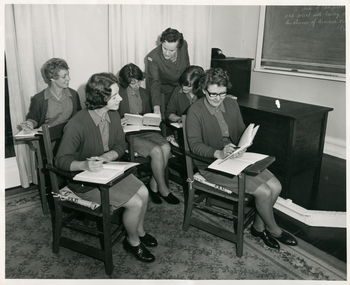
... ...miss mary evans...Mary Evan standing in the centre rear of the photograph. She is with five RDNS Sisters who have short hair, three with curly hair and two with straight hair, who are sitting on chairs with white paged books resting on 'over the lap' tables. Three Sisters are seated in front of Miss Evans...Rowley, was evaluated as successful, and Home Health Aides were employed and worked in RDNS Centres under the supervision of the RDNS Registered Nurses. rdns royal district nursing service rdns education miss mary evans rdns d.o.n Photographers stamp. Quote No. ...Miss Evans, Director of Nursing of Royal District Nursing Service, (RDNS), is holding an Education session with RDNS staff. Her uniform is a grey skirt and jacket with the RDNS badge emblazoned on her right shoulder. The badge has a white background and black writing. The RDNS Sisters are wearing their grey uniform frocks and red cardigans. Education was an integral part of Melbourne District Nursing Society (MDNS), from its inception in 1885, later, in 1966, called Royal District Nursing Service, (RDNS). From 1885, only Trained Nurses, through the hospital training system, were employed by the Society, and on visits to patients they taught the necessity of hygiene and cleanliness, as well as the need for a good diet, to bring about good health. Doctor’s lectures were later given at the MDNS home to instruct patients and their families on prevention of disease. Education to patients continued throughout the years regarding health care and the use of equipment in the home. In 1961, Education programs commenced at MDNS with Sisters receiving In-service education. Sr. Pat (Paddy) Rowley was a leader in In-service Education and established the RDNS Department of Community Nursing Education in 1962. Staff could also apply for scholarships to further their education outside of RDNS. Many of their senior trained nurses received Postgraduate diplomas from the College of Nursing in Community Health Nursing, Education, and Administration and several travelled overseas visiting nursing organizations viewing their public health and district nursing systems. At RDNS many programs were run, including: a Post Basic Course, Cardiac Rehabilitation Nursing, Haematology/Oncology Nursing, Palliative Care program, Diabetic Stabilization Program, Leg Ulcer Management Program, Wound Care Specialist Program, HIV/AIDS Nursing Care, Cystic Fibrosis Home Support, Veterans Home Care Program, Breast Cancer Support Program, Continence Management Program, Stomal Therapy Program, In-Home Lactation Support Program and the Homeless Persons Program. RDNS staff attended several hospitals to observe and learn special care needed to some clients, e.g. to the Austin Hospital to learn the care required for paraplegic and quadriplegic clients at home, and to Mount Royal Hospital to observe the care of clients in the Rehabilitation ward. A Community Nursing Education Program was extended to student nurses from hospitals and to other nursing organizations. These Education programs kept the RDNS Sisters abreast of new techniques, such as changes in technology for e.g. new testing methods in detecting glucose levels in Diabetic patients. Sr. Nan Deakin obtained a Post Basic Certificate in Psychiatric Nursing and included this area in her education lectures. Sr. Daphne Geldard specialized in the area of Alzheimer’s disease and Dementia. These Sisters visited patients in District areas with the regular RDNS Sister when required. Every member of staff, both professional and non professional staff, received regular education in the Education Department. In 1980, a Home Health Aide pilot study, funded by the Federal Government, the Brotherhood of St. Laurence and RDNS, with the program written and taught by Sr. Rowley, was evaluated as successful, and Home Health Aides were employed and worked in RDNS Centres under the supervision of the RDNS Registered Nurses. Black and white photograph showing Miss Mary Evan standing in the centre rear of the photograph. She is with five RDNS Sisters who have short hair, three with curly hair and two with straight hair, who are sitting on chairs with white paged books resting on 'over the lap' tables. Three Sisters are seated in front of Miss Evans, and another two Sisters are sitting in the foreground. Miss Evans, who has short dark curled hair, is wearing her grey uniform jacket which can be seen with the RDNS cloth badge visible at the top of her right sleeve. She is bending over one of the Sisters and has her right hand pointing to something on the Sister's book. Closed light curtains are seen in the rear of the photograph and a dark desk to the right. On the wall above this, part of a blackboard can be seen.Photographers stamp. Quote No. GF 28rdns, royal district nursing service, rdns education, miss mary evans, rdns d.o.n -
Emerald Museum & Nobelius Heritage Park
Lace Cuffs, 1930s circa
... ...Mary Evans...Emerald Victoria Australia clothing Mary Evans 2 x lace cuffs, ecru colour, for sewing on to sleeves. ...From donor's possessions. History unclear. Probably used in 1930's.2 x lace cuffs, ecru colour, for sewing on to sleeves.emerald, victoria, australia, clothing, mary evans -
 Eltham District Historical Society Inc
Photograph, Shire of Eltham Historical Society 25th Anniversary Dinner, Wednesday 8th July, 1992, 08/07/1992
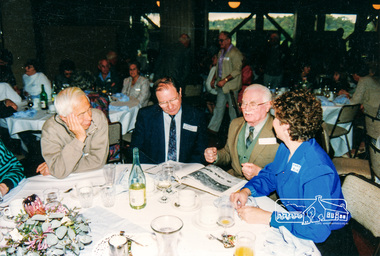
... L-R: Tony Evans, Peter Bassett-Smith, Mary Evans looking at pages 96-97 of Pioneers and Painters....L-R: Tony Evans, Peter Bassett-Smith, Mary Evans looking at pages 96-97 of Pioneers and Painters. shire of eltham historical society 25th anniversary activities bassett-smith collection Colour photograph Shire of Eltham Historical Society 25th Anniversary Dinner, Wednesday 8th July, 1992 Photograph ...L-R: Tony Evans, Peter Bassett-Smith, Mary Evans looking at pages 96-97 of Pioneers and Painters.Colour photographshire of eltham historical society, 25th anniversary, activities, bassett-smith collection -
 Eltham District Historical Society Inc
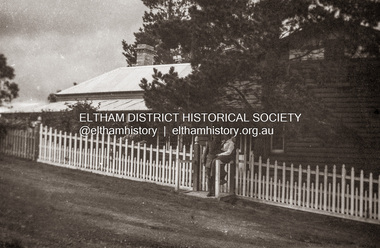
Photograph, Sgt Tyrrell George Evans with fiancee, Mary Pitt Withers outside the Withers family home, Southernwood, Bolton Street, Eltham, c.1917
... Sgt Tyrrell George Evans with fiancee, Mary Pitt Withers outside the Withers family home, Southernwood, Bolton Street, Eltham...Tyrrell George Granville Evans...Mary...They had three children, Mary Roberta Evans born February 8, 1921, at Balwyn and twins Shirley and Joyce born June 10, 1922. ...They had three children, Mary Roberta Evans born February 8, 1921, at Balwyn and twins Shirley and Joyce born June 10, 1922. ...Present day Google Street View https://goo.gl/maps/PZZMoEdJYUXbgf4a8 Tyrrell George Granville Evans was born on 17th August 1892 Enlisted (No. 789) 7 July 1915 as a Private and was assigned to the 31st Battalion. Promoted to Sergeant 1 Nov 1915. Disembarked Suez 7 Feb 1916 Admitted to 32nd Stat. Hospital in France 21 July 1916 with a gunshot wound to the left arm. According to daughter-in-law, Janet Evans, on 19 July 1916, in the battle near Pozieres on the Somme, he was hit by a German high explosive shell and was unconscious and badly wounded. His left arm was shattered, and he had a bullet wound on his leg. Embarked at Boulogne on H.S. Cambria for Middlesex War Hospital, England 24 July 1916. Evans returned to Australia and was discharged medically unfit, 7 April 1917. After months in the Caulfield Hospital his arm could not be saved, and it was amputated 18 July 1917. On July 6, 1918, Tyrrell George Granville Evans married Mary Pitt Withers at Eltham, daughter of artist Walter Herbert Withers (deceased) and wife Fanny (nee Flinn). They had three children, Mary Roberta Evans born February 8, 1921, at Balwyn and twins Shirley and Joyce born June 10, 1922. Mary died 17 days later, June 27, 1922, at Balwyn. Tyrrell had to cope with three children under three years old and a missing left arm. He had been lefthanded before his war injuries. He had help from the family, especially his sister. On August 1, 1924, Tyrrell George Granville Evans married Marian Frances Wilcox and they had two children: Barbara Marian, born 27 July 1925 and Tyrrell Granville, born 3 July 1928. The children were all brought up together in Glen Iris. Tyrrell became renowned as a one-armed golfer and tennis player. He was Senior Vice-President of the Lawn Tennis Association of Victoria and was on the committee of the Metropolitan Golf Club. At the time of his retirement, he was General Manager of the Colonial Meat Company. Tyrrell died September 3, 1962 and was succeeded by sixteen grandchildren. Contributed to by Janet Evans (daughter-in-law), 27 May 2024Many items in this collection have suffered from significant water damage and black mouldjohn withers collection, eltham, tyrrell george granville evans, mary pitt withers, 1917, bolton steet, scan - 620 format 6x9 negative, southernwood -
 Flagstaff Hill Maritime Museum and Village
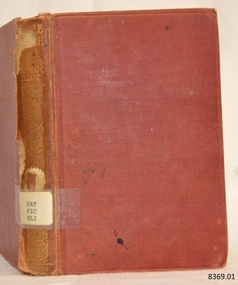
Book, Middlemarch Vol 1
... ...Mary Ann Evans...The Warrnambool Mechanics' Institute’s publication collection is of both local and state significance. flagstaff hil Warrnambool flagstaff hill maritime museum maritime museum shipwreck coast flagstaff hill maritime village great ocean road book pattison collection warrnambool library warrnambool mechanics’ institute ralph eric pattison corangamite regional library service warrnambool city librarian mechanics’ institute library victorian library board warrnambool books and records warrnambool children’s library Middlemarch Vol 1 George Eliot A A Dixon Mary Ann Evans The label on the spine cover with typed text PAT FIC ELI Paste down front end paper has a sticker from Warrnambool Mechanics Institute and Free Library covered by a sticker from Corangamite Regional Library Service. ...This book was part of a large group of books referred to as the Pattison Collection, which belonged to the Warrnambool Public Library, part of the Warrnambool Mechanics’ Institute. About RALPH ERIC PATTISON and the ‘PATTISON COLLECTION’ The ‘Pattison Collection’ is a collection of books and records that was originally owned by the Warrnambool Mechanics’ Institute, founded in Warrnambool in 1853. By 1886 the Warrnambool Mechanics’ Institute (WMI) had grown to have a Library, Museum and Fine Arts Gallery, with a collection of “… choice productions of art and valuable specimens in almost every branch and many wonderful national curiosities, are now to be seen there, including historic relics of the town and district.” It later included a School of Design. Although it was very well patronised, the WMI was led to ask the City Council to take it over in 1911 due to a lack of financial support. In 1935 Ralph Pattison was appointed as City Librarian to establish and organise the Warrnambool Public Library as it was then called. Ralph Eric Pattison was born in Rockhampton, Queensland, in 1891. He married Maude Swan from Warrnambool in 1920 and they set up a home in Warrnambool. In 1935 when Pattison accepted the position as City Librarian for the Warrnambool City Council his huge challenge was to make a functional library within two rooms of the Mechanics’ Institute. He tirelessly cleaned, cleared and sorted a disarrayed collection of old books, jars of preserved specimens and other items reserved for exhibition in the city’s museum. He developed and updated the library with a wide variety of books for all tastes, including reference books for students; a difficult task to fulfil during the years following the Depression. He converted all of the lower areas of the building into a library, reference room and reading room for members and the public. The books were sorted and stored using a cataloguing and card index system that he had developed himself. He also prepared the upper floor of the building and established the Art Gallery and later the Museum, a place to exhibit the many old relics that had been stored for years for this purpose. One of the treasures he found was a beautiful ancient clock, which he repaired, restored and enjoyed using in his office during the years of his service there. Ralph Pattison was described as “a meticulous gentleman whose punctuality, floorless courtesy and distinctive neat dress were hallmarks of his character, and ‘his’ clock controlled his daily routine and his opening and closing of the library’s large heavy doors to the minute.” Pattison took leave from 1942 to 1945 to serve in the Royal Australian Navy, Volunteer Reserve as Lieutenant. A few years later he converted one of the Museum’s rooms into a Children’s Library, stocking it with suitable books for the younger generation. This was an instant success. In the 1950’s he had the honour of being appointed to the Victorian Library Board and received more inspiration from the monthly conferences in Melbourne. He was sadly retired in 1959 after over 23 years of service, due to the fact that he had gone over the working age of council officers. However, he continued to take a very keen interest in the continual development of the Library until his death in 1969. THE NEW WARRNAMBOOL LIBRARY When the WMI building was pulled down in 1963 a new civic building was erected on the site and the new Warrnambool Library, on behalf of the City Council, took over all the holdings of the WMI. At this time some of the items were separated and identified as the ‘Pattison Collection’, named after Pattison. Eventually, the components of the WMI were distributed from the Warrnambool Library to various places, including the Art Gallery, Historical Society and Flagstaff Hill. Later some were even distributed to other regional branches of Corangamite Regional Library and passed to and fro. It is difficult now to trace just where all of the items have ended up. The books at Flagstaff Hill Maritime Village generally display stamps and markings from Pattison as well as a variety of other institutions including the Mechanics’ Institute itself. The Pattison Collection, along with other items at Flagstaff Hill Maritime Village, was originally part of the Warrnambool Mechanics' Institute’s collection. The Warrnambool Mechanics’ Institute Collection is primarily significant in its totality, rather than for the individual objects it contains. Its contents are highly representative of the development of Mechanics' Institute libraries across Australia, particularly Victoria. A diversity of publications and themes has been amassed, and these provide clues to our understanding of the nature of and changes in the reading habits of Victorians from the 1850s to the middle of the 20th century. The collection also highlights the Warrnambool community’s commitment to the Mechanics’ Institute, reading, literacy and learning in the regions, and proves that access to knowledge was not impeded by distance. These items help to provide a more complete picture of our community’s ideals and aspirations. The Warrnambool Mechanics Institute book collection has historical and social significance for its strong association with the Mechanics Institute movement and the important role it played in the intellectual, cultural and social development of people throughout the latter part of the nineteenth century and the early twentieth century. The collection of books is a rare example of an early lending library and its significance is enhanced by the survival of an original collection of many volumes. The Warrnambool Mechanics' Institute’s publication collection is of both local and state significance. Middlemarch Vol 1 Author: George Eliot Publisher: Collins' Clear-Type Press Date: First Published 1871-1872 Further Information: Illustrated by A A DixonThe label on the spine cover with typed text PAT FIC ELI Paste down front end paper has a sticker from Warrnambool Mechanics Institute and Free Library covered by a sticker from Corangamite Regional Library Service. Flyleaf has a stamp from Warrnambool Mechanics Institute and Free Library.flagstaff hil, warrnambool, flagstaff hill maritime museum, maritime museum, shipwreck coast, flagstaff hill maritime village, great ocean road, book, pattison collection, warrnambool library, warrnambool mechanics’ institute, ralph eric pattison, corangamite regional library service, warrnambool city librarian, mechanics’ institute library, victorian library board, warrnambool books and records, warrnambool children’s library, middlemarch vol 1, george eliot, a a dixon, mary ann evans -
 Flagstaff Hill Maritime Museum and Village
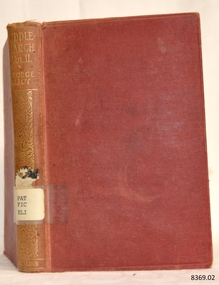
Book, Middlemarch Vol 2
... ...Mary Ann Evans...The Warrnambool Mechanics' Institute’s publication collection is of both local and state significance. flagstaff hil Warrnambool flagstaff hill maritime museum maritime museum shipwreck coast flagstaff hill maritime village great ocean road book pattison collection warrnambool library warrnambool mechanics’ institute ralph eric pattison corangamite regional library service warrnambool city librarian mechanics’ institute library victorian library board warrnambool books and records warrnambool children’s library Middlemarch Vol 2 George Eliot A A Dixon Mary Ann Evans The label on the spine cover with typed text PAT FIC ELI Paste down front end paper has a sticker from Warrnambool Public Library covered by a sticker from Corangamite Regional Library Service. ...This book was part of a large group of books referred to as the Pattison Collection, which belonged to the Warrnambool Public Library, part of the Warrnambool Mechanics’ Institute. About RALPH ERIC PATTISON and the ‘PATTISON COLLECTION’ The ‘Pattison Collection’ is a collection of books and records that was originally owned by the Warrnambool Mechanics’ Institute, founded in Warrnambool in 1853. By 1886 the Warrnambool Mechanics’ Institute (WMI) had grown to have a Library, Museum and Fine Arts Gallery, with a collection of “… choice productions of art and valuable specimens in almost every branch and many wonderful national curiosities, are now to be seen there, including historic relics of the town and district.” It later included a School of Design. Although it was very well patronised, the WMI was led to ask the City Council to take it over in 1911 due to a lack of financial support. In 1935 Ralph Pattison was appointed as City Librarian to establish and organise the Warrnambool Public Library as it was then called. Ralph Eric Pattison was born in Rockhampton, Queensland, in 1891. He married Maude Swan from Warrnambool in 1920 and they set up a home in Warrnambool. In 1935 when Pattison accepted the position as City Librarian for the Warrnambool City Council his huge challenge was to make a functional library within two rooms of the Mechanics’ Institute. He tirelessly cleaned, cleared and sorted a disarrayed collection of old books, jars of preserved specimens and other items reserved for exhibition in the city’s museum. He developed and updated the library with a wide variety of books for all tastes, including reference books for students; a difficult task to fulfil during the years following the Depression. He converted all of the lower areas of the building into a library, reference room and reading room for members and the public. The books were sorted and stored using a cataloguing and card index system that he had developed himself. He also prepared the upper floor of the building and established the Art Gallery and later the Museum, a place to exhibit the many old relics that had been stored for years for this purpose. One of the treasures he found was a beautiful ancient clock, which he repaired, restored and enjoyed using in his office during the years of his service there. Ralph Pattison was described as “a meticulous gentleman whose punctuality, floorless courtesy and distinctive neat dress were hallmarks of his character, and ‘his’ clock controlled his daily routine and his opening and closing of the library’s large heavy doors to the minute.” Pattison took leave from 1942 to 1945 to serve in the Royal Australian Navy, Volunteer Reserve as Lieutenant. A few years later he converted one of the Museum’s rooms into a Children’s Library, stocking it with suitable books for the younger generation. This was an instant success. In the 1950’s he had the honour of being appointed to the Victorian Library Board and received more inspiration from the monthly conferences in Melbourne. He was sadly retired in 1959 after over 23 years of service, due to the fact that he had gone over the working age of council officers. However, he continued to take a very keen interest in the continual development of the Library until his death in 1969. THE NEW WARRNAMBOOL LIBRARY When the WMI building was pulled down in 1963 a new civic building was erected on the site and the new Warrnambool Library, on behalf of the City Council, took over all the holdings of the WMI. At this time some of the items were separated and identified as the ‘Pattison Collection’, named after Pattison. Eventually, the components of the WMI were distributed from the Warrnambool Library to various places, including the Art Gallery, Historical Society and Flagstaff Hill. Later some were even distributed to other regional branches of Corangamite Regional Library and passed to and fro. It is difficult now to trace just where all of the items have ended up. The books at Flagstaff Hill Maritime Village generally display stamps and markings from Pattison as well as a variety of other institutions including the Mechanics’ Institute itself. The Pattison Collection, along with other items at Flagstaff Hill Maritime Village, was originally part of the Warrnambool Mechanics' Institute’s collection. The Warrnambool Mechanics’ Institute Collection is primarily significant in its totality, rather than for the individual objects it contains. Its contents are highly representative of the development of Mechanics' Institute libraries across Australia, particularly Victoria. A diversity of publications and themes has been amassed, and these provide clues to our understanding of the nature of and changes in the reading habits of Victorians from the 1850s to the middle of the 20th century. The collection also highlights the Warrnambool community’s commitment to the Mechanics’ Institute, reading, literacy and learning in the regions, and proves that access to knowledge was not impeded by distance. These items help to provide a more complete picture of our community’s ideals and aspirations. The Warrnambool Mechanics Institute book collection has historical and social significance for its strong association with the Mechanics Institute movement and the important role it played in the intellectual, cultural and social development of people throughout the latter part of the nineteenth century and the early twentieth century. The collection of books is a rare example of an early lending library and its significance is enhanced by the survival of an original collection of many volumes. The Warrnambool Mechanics' Institute’s publication collection is of both local and state significance. Middlemarch Vol 2 Author: George Eliot Publisher: Collins' Clear-Type Press Date: First Published 1871-1872 Further Information: Illustrated by A A Dixon The label on the spine cover with typed text PAT FIC ELI Paste down front end paper has a sticker from Warrnambool Public Library covered by a sticker from Corangamite Regional Library Service. Flyleaf has a stamp from Warrnambool Mechanics Institute and Free Library.flagstaff hil, warrnambool, flagstaff hill maritime museum, maritime museum, shipwreck coast, flagstaff hill maritime village, great ocean road, book, pattison collection, warrnambool library, warrnambool mechanics’ institute, ralph eric pattison, corangamite regional library service, warrnambool city librarian, mechanics’ institute library, victorian library board, warrnambool books and records, warrnambool children’s library, middlemarch vol 2, george eliot, a a dixon, mary ann evans -
Linton Mechanics Institute and Free Library Collection
Book - Novel, Eliot, George, [Daniel Deronda Books VII and VIII], n.d. [first published in eight instalments from February to September 1876.]
... ...Mary Anne Evans...Fiction Romance George Eliot Mary Anne Evans Daniel Deronda contains two parallel narratives that are united by the title character. ...Daniel Deronda contains two parallel narratives that are united by the title character. The novel begins in September 1865 with the meeting of Daniel and Gwendolen Harleth in the fictional town of Leubronn, Germany. Daniel finds himself attracted to, but wary of, the beautiful, stubborn, and selfish Gwendolen, whom he sees losing all her winnings in a game of roulette. The next day, Gwendolen receives a letter from her mother telling her that the family is financially ruined and asking her to come home. Gwendolen pawns a necklace and debates gambling again to make her fortune. However, her necklace is returned to her by a porter, and she realises that Daniel had seen her pawn the necklace and had redeemed it for her. From this point, the plot breaks off into two separate flashbacks; one gives us Gwendolen's history and the other Daniel's.367p. ; Title page missing ; Contents : The mother and the son, Book VII ; Fruit and seed, Vol VIII ; Front cover advertises 'Mariwari Ceylon Tea', rear cover advertises 'Empire Cocoa Essence and Robt. Harper & Co.'. Advertisements are examples of nineteenth century advertising and illustrate the use of books to cross-promote a range of products. Bookbinder's details 'T. Craig, 268 Post Office Place, Melbourne', printed lower ths on front end paper. fictionDaniel Deronda contains two parallel narratives that are united by the title character. The novel begins in September 1865 with the meeting of Daniel and Gwendolen Harleth in the fictional town of Leubronn, Germany. Daniel finds himself attracted to, but wary of, the beautiful, stubborn, and selfish Gwendolen, whom he sees losing all her winnings in a game of roulette. The next day, Gwendolen receives a letter from her mother telling her that the family is financially ruined and asking her to come home. Gwendolen pawns a necklace and debates gambling again to make her fortune. However, her necklace is returned to her by a porter, and she realises that Daniel had seen her pawn the necklace and had redeemed it for her. From this point, the plot breaks off into two separate flashbacks; one gives us Gwendolen's history and the other Daniel's.fiction, romance, george eliot, mary anne evans -
 Federation University Historical Collection
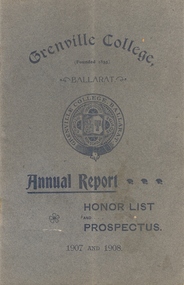
Booklet - Annual Report, Grenville College Annual Report, 1907-8, 1908
... ...mary delahunty...lily evans...Those who intended to matriculate were advised to take the following subjects: - English, History, and Geography; Arithmetic, Algebra, Euclid, and Trigonometry; and either French and German, or Latin and Greek. grenville college cyril callister frank g. menzies william morcom sydney r. curnow william h. collyer revill tinworth c. brokenshire george p. merz alfred h. barrett anthony jenkin alexander sutherland wilford whittle owen peters john la gerche mary delahunty lily evans henry japp edith forster j. sutherland a.m. lilburne eustace coltman james g. leadbeater Fourteen page soft covered Annual Roport, Honor List and Prospectus Grenville College Annual Report, 1907-8 Booklet Annual Report ...Grenville College was founded in 1855 by W. Stellard as Ballarat Grammar School. The school was amalgamated by Mr Victor are Ballarat Grammar School in 1867 as the Ballarat Collegiate and Grammar School. Its name was changed to Grenville College in 1869. In 1908 Grenville College was situated in Mair Street, Ballarat, and the Principal was A.A. Buley. Pupils were educated for either commercial life or for the University. Those who intended to matriculate were advised to take the following subjects: - English, History, and Geography; Arithmetic, Algebra, Euclid, and Trigonometry; and either French and German, or Latin and Greek.Fourteen page soft covered Annual Roport, Honor List and Prospectusgrenville college, cyril callister, frank g. menzies, william morcom, sydney r. curnow, william h. collyer, revill tinworth, c. brokenshire, george p. merz, alfred h. barrett, anthony jenkin, alexander sutherland, wilford whittle, owen peters, john la gerche, mary delahunty, lily evans, henry japp, edith forster, j. sutherland, a.m. lilburne, eustace coltman, james g. leadbeater -
 Federation University Historical Collection
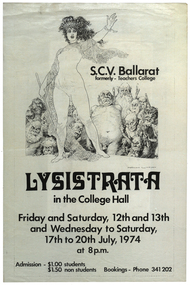
Poster, 'Lysistrata ' Production Poster, 1974, 1974
... ...elizabeth evans...mary...WOMEN'S CHORUS, Sue Richards, Tina Conroy, Ann Bilston, Anne Giles, Glenda Hamilton, Janette Marshall, Gillian Hogan, Janine Grieg, Robyn Stanesby, Stephanie Buchanan, Janeen McCullough, Wendy Gray, Elizabeth Evans, Jenny Tait (Leader of Spartans), Mary Staindl, Barbara Price. ...ballarat teachers' college production state college of victoria, ballarat gillies street liz stubbs joy dunstan jenny tait denise maroney ann bilston tina conroy michael russo tony ryan terrence doran shane quick sue richards anne gillies glenda hamilton janette marshall gillian hogan janine grieg robyn stanseby stephanie buchanan janeen mccillough wendy gray elizabeth evans mary staindl barbara price john rowe jeff moore stephen schneider chris slater peter hassell errol elbourne peter orford keith mcdougall terrance doran robbie eastcott gary oliver david murphy alex traianou kim hatcher steve albon austin rickell stuart tolliday keith mcivor bruce miller ken jones cheryl brown ruth newall michael d. edwards norman lindsay Front: "S.C.V. ...White paper poster with black text and drawing of a woman in front of some gruesome looking people. The the poster was for a State College Victoria (formerly Ballarat Teachers' College) production held at the college hall in Gillies Street, Ballarat.Front: "S.C.V. Ballarat, formerly - Teachers Collge, Lysistrata, in the College Hall, Friday and Saturday, 12th and 13th, and Wednesday to Saturday, 17th to 20th July, 1974, at 8 pm, Admission - $1.00 Students, $1.50 non students, Bookings - Phone 341 202" Back: "Lysistrata, by Aristophanes, CAST LIST, Lysistrata: Liz Stubbs, Kalonike: Joy Dunstan, Lampito: Jenny Tait, Myrrhine: Denise Maroney, Stratyllis: Ann Bilston, Interviewer: Tina Conroy, Kinesias: Michael Russo, Police Commisioner: Tony Ryan, Spartan Ambassador: Terrence Dorian, Spartan Herald; Shane Quick. WOMEN'S CHORUS, Sue Richards, Tina Conroy, Ann Bilston, Anne Giles, Glenda Hamilton, Janette Marshall, Gillian Hogan, Janine Grieg, Robyn Stanesby, Stephanie Buchanan, Janeen McCullough, Wendy Gray, Elizabeth Evans, Jenny Tait (Leader of Spartans), Mary Staindl, Barbara Price. MEN'S CHORUS, John Rowe, Stephen Schneider, Chris Slater, Peter Hassell, Errol Elbourne, Peter Orford, Kieth McDougall,Terrence Dorian, Robbie Eastcott, Shane Quick, Gary Oliver. MUSIC, Piano: Robbie Eastcott. Drums: Alex Traianou. Congas: David Murphy. Rhythm Guitar: Kim Hatcher. Bass Guitar: Shane Quick. Clarinet: Steve Albon. Flute: Tina Conroy. Acoustic Guitar: Tony Ryan. TECHNICAL CREW, Lighting: Austin Rickell, Sound: Stuart Tolliday, Keith McIvor, Design: Bruce Miller, Terrence Dorian, Set Construction: Bruce Miller, Terrence Dorian, Ken Jones, Choreograph: Cheryl Brown, Costumes: Gillian Hogan, Mary Staindl, Props: Denise Maroney, Jenny Tait, Publicity and Front of House: Ruth Newall. ACKNOWLEDGEMENTS, Meena Bazaar for the Jug, Turner Audio Systems. DIRECTED BY, Miichael D. Edwards. DIRECTOR'S NOTE, The sexual power of women is all persuasive. If, as Germaine Greer says, they stopped loving the victors, there would be genuine revolution. The idea of a sex strike to stop a war seems preposterous.... What else is left to the aware but politically emasculated woman? Aristophanes, like us, had been appalled by a pointless and hopeless war. Outrageous indignation had failed to stop it - so he resorted to comic absurdity; perhaps to shame the warmakers. Our version of the play is colloquial and probably ' in vogue'. It is colorful, musical, flippant, and not a little risque. It is, however, based on an awareness of the power of sex roles and the arrogance of a male-dominated society and a profound sense of frustration at the apparently immovable forces that make our wars and enact repression in all its forms."ballarat teachers' college, production, state college of victoria, ballarat, gillies street, liz stubbs, joy dunstan, jenny tait, denise maroney, ann bilston, tina conroy, michael russo, tony ryan, terrence doran, shane quick, sue richards, anne gillies, glenda hamilton, janette marshall, gillian hogan, janine grieg, robyn stanseby, stephanie buchanan, janeen mccillough, wendy gray, elizabeth evans, mary staindl, barbara price, john rowe, jeff moore, stephen schneider, chris slater, peter hassell, errol elbourne, peter orford, keith mcdougall, terrance doran, robbie eastcott, gary oliver, david murphy, alex traianou, kim hatcher, steve albon, austin rickell, stuart tolliday, keith mcivor, bruce miller, ken jones, cheryl brown, ruth newall, michael d. edwards, norman lindsay -
Greensborough Historical Society
Memoir, My trip to Wales in 2007 - my Scott ancestors in Wales: by June Hall, 2007_
... june hall nee evans...mary...Oral History. june hall nee evans mary scott wales oral history 2 pages of text. ...June Hall (nee Evans) related details of her trip to Wales where she met distant relatives from the Scott family.Oral History.2 pages of text.june hall nee evans, mary scott, wales, oral history -
 Phillip Island and District Historical Society Inc.
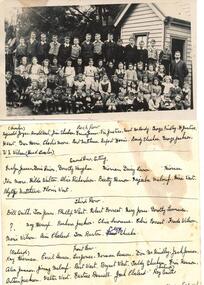
Photograph, Cowes State School pupils 1911, 1911
... ...w evans...Mary...Photograph donated by W Evans - owner of the Quarry in the 1960's. Second, original photo from Mary Karney....Photograph donated by W Evans - owner of the Quarry in the 1960's. Second, original photo from Mary Karney. cowes state school pupils w evans Mary Karney Education Jenner family West family Justice family McLArdy family Harris Robert Forrest Alice Richardson leeson Cleeland Names on back as per scanned copy. ...Photograph donated by W Evans - owner of the Quarry in the 1960's. Second, original photo from Mary Karney.Black & White photograph of the Cowes State School in 1911. Reproduction of original photograph. Also original photo on cardboard mount and names on rear. Names on back as per scanned copy.cowes state school pupils, w evans, mary karney, education, jenner family, west family, justice family, mclardy family, harris, robert forrest, alice richardson, leeson, cleeland -
 Eltham District Historical Society Inc
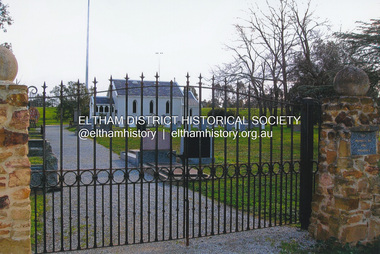
Photograph, Fay Bridge, St. Katherine's Church, St. Helena, n.d
... ...Mary Joyce Pitt Evans (nee Withers)...Fay Bridge Collection Annie Janet Beale (nee McLennan) anthony beale Gravestones James Harold Beale James Young Beale Jane Hewitt Katherine Rose Beale Margaret Lindsay Beale Mark Hewitt Mary Joyce Pitt Evans (nee Withers) St. Helena St. ...St Katherine’s Anglican Church was built in 1858, by Anthony Beale as a memorial to his late wife Katherine. The cemetery is a rare example in Victoria of a traditional English parish church with its private graveyard and is of State Significance. Rose Chapel with its stained-glass windows of local historical significance, commemorates casualties of the Beale family in World War One.fay bridge collection, annie janet beale (nee mclennan), anthony beale, gravestones, james harold beale, james young beale, jane hewitt, katherine rose beale, margaret lindsay beale, mark hewitt, mary joyce pitt evans (nee withers), st. helena, st. katherine's church, walter withers -
Glen Eira Historical Society
Article - ELSTER AVENUE, 18, ELSTERNWICK
... ... Evans Mary Arthur...Elsternwick Gardenvale Elster Avenue Robinson Charles Caulfield Robinson William Henry Robinson George Augustus Inglis Robert Davies Matthew Henry Ross William Murray Colonial Investment and Agency Company Victorian Permanent Property Investment and Building Society Calder William Anderson Watson John Rosstown Junction Railway and Property Company Kooyong Road College Street Parnell (Muntz) Street Lempriere John Thomson Thomson William Hamilton Collinson William Morris Elizabeth Street Cumming Euphemia Taylor Thomas Hill Caroline Evans Alexander Cameron Evans Horace Evans Gordon Lemaitre Roach Joyce Rubena Evans Mary Arthur Nallo Luigi Nallo Joyce North Road Darke Richard Alexander Darke Peta Peile Edgar Stoddart Corio Darke Caroline Elizabeth Darke Cameron Andrew Oswald Street Bertram Street Taylor M. ...This file contains 5 items about this property: 1/Handwritten notes from titles searches of 18 Elster Avenue complied by Peta Darke dated 29/07/2014 – photocopy 7 pages. 2/Handwritten list of Sands & McDougall entries for 1915 to 1970, and notes to present, compiled by Peta Darke dated 29/07/2014. 3/Photocopy of two pages of the title to the property dated 22/10/1909. Includes plan of subdivision of the area. 4/Photocopies of five advertisements from The Argus relating to the property: 28/08/1918 Land Wanted 12/07/1921 Lost Heifer 26/04/1919 Owner has House For Sale (20 Elster Avenue) 10/05/1919 same – No. 20 For Sale 29/11/1927 M. M. Taylor has Oats and Barley For Sale. 5/Photocopy of photograph of exterior taken by R. Darke circa 1998.elsternwick, gardenvale, elster avenue, robinson charles, caulfield, robinson william henry, robinson george augustus, inglis robert, davies matthew henry, ross william murray, colonial investment and agency company, victorian permanent property investment and building society, calder william anderson, watson john, rosstown junction railway and property company, kooyong road, college street, parnell (muntz) street, lempriere john thomson, thomson william hamilton, collinson william morris, elizabeth street, cumming euphemia, taylor thomas, hill caroline, evans alexander cameron, evans horace, evans gordon lemaitre, roach joyce rubena, evans mary arthur, nallo luigi, nallo joyce, north road, darke richard alexander, darke peta, peile edgar stoddart, corio, darke caroline elizabeth, darke cameron andrew, oswald street, bertram street, taylor m. m., land subdivision, architectural styles, edwardian style, brick houses, teak street, caulfield south -
 Ringwood and District Historical Society
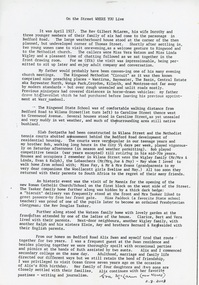
Document - Family History, McLaren Family, Bedford Road, Ringwood - from April 1927
... +Additional Keywords: McLaren, Eva / McLaren, Rev Gilbert / McLaren, Dorothy / Wigley, Linda / Wigley, Evan / Wigley, Ralph / Wigley, Eslie / Wigley, Amy / Wigley, Bernard / Wigley, Ray / Lobascher, Joe / Lobascher, Mary / Evans, Fay / Evans, Mr and Mrs / Woollacott, Eveline / Woollacott, May / Mannix, Dr / Tasker Family / Paddock, Miss / Watson, Clarice / Watson, Bert / Watson, Vera / Swan, Alix...+Additional Keywords: McLaren, Eva / McLaren, Rev Gilbert / McLaren, Dorothy / Wigley, Linda / Wigley, Evan / Wigley, Ralph / Wigley, Eslie / Wigley, Amy / Wigley, Bernard / Wigley, Ray / Lobascher, Joe / Lobascher, Mary / Evans, Fay / Evans, Mr and Mrs / Woollacott, Eveline / Woollacott, May / Mannix, Dr / Tasker Family / Paddock, Miss / Watson, Clarice / Watson, Bert / Watson, Vera / Swan, Alix McLaren Family, Bedford Road, Ringwood - from April 1927. ...Single page of typed notes on the McLaren family having lived in the Bedford Road area of Ringwood from April 1927, headed "On The Street Where You Live" prepared by Eva McLaren (now Moore), dated 11 March 2003. +Additional Keywords: McLaren, Eva / McLaren, Rev Gilbert / McLaren, Dorothy / Wigley, Linda / Wigley, Evan / Wigley, Ralph / Wigley, Eslie / Wigley, Amy / Wigley, Bernard / Wigley, Ray / Lobascher, Joe / Lobascher, Mary / Evans, Fay / Evans, Mr and Mrs / Woollacott, Eveline / Woollacott, May / Mannix, Dr / Tasker Family / Paddock, Miss / Watson, Clarice / Watson, Bert / Watson, Vera / Swan, Alix -
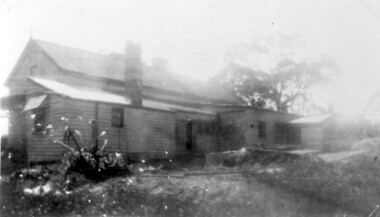 Surrey Hills Historical Society Collection
Photograph, 6a Thistle Street, Surrey Hills, 1924
... Mary Evans pre-deceased her husband, who died on 23 October 1924 at Hillsborough, 6A Thistle Street. ...Mary Evans pre-deceased her husband, who died on 23 October 1924 at Hillsborough, 6A Thistle Street. ...One of the oldest homes in Surrey Hills. The photo was taken in 1924 when the property was purchased by Mr John Francis Evans, father of Mrs Lillian Austin. The Evans family came from Gembrook. John Evans was born in Wales; he and his wife Mary had 3 children, 2 daughters and one son. Mary Evans pre-deceased her husband, who died on 23 October 1924 at Hillsborough, 6A Thistle Street. The first owner of the property was Mrs Rachel Sweetnam (nee Lewis) who married Thomas Edward Sweetnam on 24 September 1884 at St John's Church, Camberwell. REF: THE ARGUS 4 Oct 1884 Thomas second eldest surviving son of Matthew Sweetnam married to Rachel (Ray) third eldest daughter of Captain T.D. Lewis, Culm Haven, Camberwell. Thomas was active in land sales and variously described as a land agent, real estate agent and auctioneer. The property - Hillsboro or Hillsborough - was originally a house on a farm of 10 acres owned by her. It became 6A Thistle Street. According to the Alan Holt property register Rachel Sweetnam owned the property prior to 1890 and a family tree on Ancestry.com has that it was owned by her in c1886. It is likely that at this stage the property was an investment rather than the Sweetnam's family residence. Other property owners or residents are: 1890 Selina Gaylor 1900 Stephen Pullen 1910 William Murray (draftsman) 1920 George C Hughes 1930 Arthur Leslie Austin (tram driver) 1980 Mrs Lillian Evelyn Austin Lillian Austin died on 19 August 1983 and the property was sold that year for $87,000. The house is still extant (January 2025). Note that we also have material / photos regarding George Hughes and family.Black and white photo of a timber home with brick chimneys and a (?) corrugated iron roof. There are sheds and outbuildings attached to the house. The garden looks untended. In the background a mature eucalypt tree can be seen.houses, hillsboro, timber houses, mrs lillian austin, hillsborough, selina gaylor, stephen pullen, william murray, george hughes, arthur austin, john francis evans, thistle street -
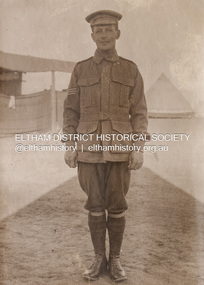 Eltham District Historical Society Inc
Photograph, Sgt Tyrrell George Evans, Sern. 789, 31st Battalion, c.1916
... Evans...X-ray...Mary...They had three children, Mary Roberta Evans born February 8, 1921, at Balwyn and twins Shirley and Joyce born June 10, 1922. ...They had three children, Mary Roberta Evans born February 8, 1921, at Balwyn and twins Shirley and Joyce born June 10, 1922. ...Tyrrell George Granville Evans was born on 17th August 1892 Enlisted (No. 789) 7 July 1915 as a Private and was assigned to the 31st Battalion. Promoted to Sergeant 1 Nov 1915. Disembarked Suez 7 Feb 1916 Admitted to 32nd Stat. Hospital in France 21 July 1916 with a gunshot wound to the left arm. According to daughter-in-law, Janet Evans, on 19 July 1916, in the battle near Pozieres on the Somme, he was hit by a German high explosive shell and was unconscious and badly wounded. His left arm was shattered, and he had a bullet wound on his leg. Embarked at Boulogne on H.S. Cambria for Middlesex War Hospital, England 24 July 1916. Evans returned to Australia and was discharged medically unfit, 7 April 1917. After months in the Caulfield Hospital his arm could not be saved, and it was amputated 18 July 1917. On July 6, 1918, Tyrrell George Granville Evans married Mary Pitt Withers at Eltham, daughter of artist Walter Herbert Withers (deceased) and wife Fanny (nee Flinn). They had three children, Mary Roberta Evans born February 8, 1921, at Balwyn and twins Shirley and Joyce born June 10, 1922. Mary died 17 days later, June 27, 1922, at Balwyn. Tyrrell had to cope with three children under three years old and a missing left arm. He had been lefthanded before his war injuries. He had help from the family, especially his sister. On August 1, 1924, Tyrrell George Granville Evans married Marian Frances Wilcox and they had two children: Barbara Marian, born 27 July 1925 and Tyrrell Granville, born 3 July 1928. The children were all brought up together in Glen Iris. Tyrrell became renowned as a one-armed golfer and tennis player. He was Senior Vice-President of the Lawn Tennis Association of Victoria and was on the committee of the Metropolitan Golf Club. At the time of his retirement, he was General Manager of the Colonial Meat Company. Tyrrell died September 3, 1962 and was succeeded by sixteen grandchildren. Contributed to by Janet Evans (daughter-in-law), 27 May 2024Many items in this collection have suffered from significant water damage and black mouldjohn withers collection, eltham, 1916, tyrrell george granville evans, x-ray, mary pitt withers -
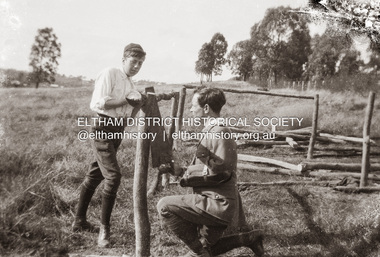 Eltham District Historical Society Inc
Photograph, Charles Withers (aka Bill) and Sgt Tyrrell George Evans at work on the Withers property, Southernwood, Bolton Street, Eltham, c.1917
... They had three children, Mary Roberta Evans born February 8, 1921, at Balwyn and twins Shirley and Joyce born June 10, 1922. ...They had three children, Mary Roberta Evans born February 8, 1921, at Balwyn and twins Shirley and Joyce born June 10, 1922. ...Charles Meynell Pitt Withers (aka Bill) was the youngest son of artist Walter Withers and Fanny (nee Flinn). He was born at Eltham 5 February 1902. Tyrrell George Granville Evans was born on 17th August 1892 Enlisted (No. 789) 7 July 1915 as a Private and was assigned to the 31st Battalion. Promoted to Sergeant 1 Nov 1915. Disembarked Suez 7 Feb 1916 Admitted to 32nd Stat. Hospital in France 21 July 1916 with a gunshot wound to the left arm. According to daughter-in-law, Janet Evans, on 19 July 1916, in the battle near Pozieres on the Somme, he was hit by a German high explosive shell and was unconscious and badly wounded. His left arm was shattered, and he had a bullet wound on his leg. Embarked at Boulogne on H.S. Cambria for Middlesex War Hospital, England 24 July 1916. Evans returned to Australia and was discharged medically unfit, 7 April 1917. After months in the Caulfield Hospital his arm could not be saved, and it was amputated 18 July 1917. On July 6, 1918, Tyrrell George Granville Evans married Mary Pitt Withers at Eltham, daughter of artist Walter Herbert Withers (deceased) and wife Fanny (nee Flinn). They had three children, Mary Roberta Evans born February 8, 1921, at Balwyn and twins Shirley and Joyce born June 10, 1922. Mary died 17 days later, June 27, 1922, at Balwyn. Tyrrell had to cope with three children under three years old and a missing left arm. He had been lefthanded before his war injuries. He had help from the family, especially his sister. On August 1, 1924, Tyrrell George Granville Evans married Marian Frances Wilcox and they had two children: Barbara Marian, born 27 July 1925 and Tyrrell Granville, born 3 July 1928. The children were all brought up together in Glen Iris. Tyrrell became renowned as a one-armed golfer and tennis player. He was Senior Vice-President of the Lawn Tennis Association of Victoria and was on the committee of the Metropolitan Golf Club. At the time of his retirement, he was General Manager of the Colonial Meat Company. Tyrrell died September 3, 1962 and was succeeded by sixteen grandchildren. Contributed to by Janet Evans (daughter-in-law), 27 May 2024Many items in this collection have suffered from significant water damage and black mouldjohn withers collection, eltham, tyrrell george granville evans, 1917, bolton steet, scan - 620 format 6x9 negative, southernwood, charles meynell pitt withers -
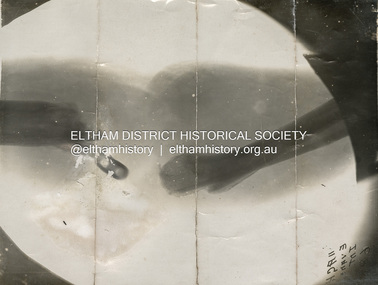 Eltham District Historical Society Inc
Photograph, X-ray, left arm of C.S.M. Tyrrell George Evans, Sern. 789, 31st Battalion, AIF, 1916
... Evans...X-ray...Mary...They had three children, Mary Roberta Evans born February 8, 1921, at Balwyn and twins Shirley and Joyce born June 10, 1922. ...They had three children, Mary Roberta Evans born February 8, 1921, at Balwyn and twins Shirley and Joyce born June 10, 1922. ...No. 11 AGH X-Ray Department photo of a gun shot wound to left arm suffered July 1916 in France by C.S.M. Tyrrell George Evans, Sern. 789, 31st Battalion, AIF Tyrrell George Granville Evans was born on 17th August 1892 Enlisted (No. 789) 7 July 1915 as a Private and was assigned to the 31st Battalion. Promoted to Sergeant 1 Nov 1915. Disembarked Suez 7 Feb 1916 Admitted to 32nd Stat. Hospital in France 21 July 1916 with a gunshot wound to the left arm. According to daughter-in-law, Janet Evans, on 19 July 1916, in the battle near Pozieres on the Somme, he was hit by a German high explosive shell and was unconscious and badly wounded. His left arm was shattered, and he had a bullet wound on his leg. Embarked at Boulogne on H.S. Cambria for Middlesex War Hospital, England 24 July 1916. Evans returned to Australia and was discharged medically unfit, 7 April 1917. After months in the Caulfield Hospital his arm could not be saved, and it was amputated 18 July 1917. On July 6, 1918, Tyrrell George Granville Evans married Mary Pitt Withers at Eltham, daughter of artist Walter Herbert Withers (deceased) and wife Fanny (nee Flinn). They had three children, Mary Roberta Evans born February 8, 1921, at Balwyn and twins Shirley and Joyce born June 10, 1922. Mary died 17 days later, June 27, 1922, at Balwyn. Tyrrell had to cope with three children under three years old and a missing left arm. He had been lefthanded before his war injuries. He had help from the family, especially his sister. On August 1, 1924, Tyrrell George Granville Evans married Marian Frances Wilcox and they had two children: Barbara Marian, born 27 July 1925 and Tyrrell Granville, born 3 July 1928. The children were all brought up together in Glen Iris. Tyrrell became renowned as a one-armed golfer and tennis player. He was Senior Vice-President of the Lawn Tennis Association of Victoria and was on the committee of the Metropolitan Golf Club. At the time of his retirement, he was General Manager of the Colonial Meat Company. Tyrrell died September 3, 1962 and was succeeded by sixteen grandchildren. Contributed to by Janet Evans (daughter-in-law), 27 May 2024Many items in this collection have suffered from significant water damage and black mouldjohn withers collection, eltham, 1916, gun shot wound, tyrrell george granville evans, x-ray, mary pitt withers
