
Showing 37 items matching "matron in chief"
-
 Returned Nurses RSL Sub-branch
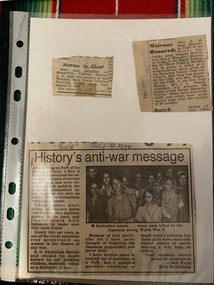
Newspaper - Newspaper clipping, Matron in Chief, unknown
... Matron in Chief...A M Sage Annie Moriah Sage One column partial article, rest cut off Matron in Chief Newspaper Newspaper clipping ...Partial article about Matron A[nnie] M[oriah] Sage. One column partial article, rest cut offa m sage, annie moriah sage -
 Returned Nurses RSL Sub-branch
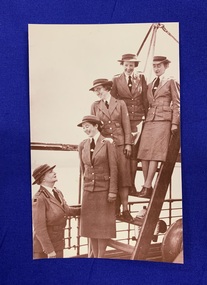
Photograph - Photograph on photo paper, [Circa 1940s]
... "Photographs of AANS boarding ship 1940/41 farewelled by Matron Grace Wilson Matron in Chief. 1 framed copy, 1 unframed copy. ...Unframed, printed sepia photograph on photo paper of 4 AANS boarding a ship, being fare-welled by Matron Grace Wilson Matron in Chief in 1940-41...."Leaving Australia 1940-41, L to R, Miss Wilson, Matron-in-Chief, Ruth Meaney, Jean Headberry, Patricia Chomley, Claire Meinoge, Photo: Ruth Millear" [Handwritten in biro on the back of the photo]..."Photographs of AANS boarding ship 1940/41 farewelled by Matron Grace Wilson Matron in Chief. 1 framed copy, 1 unframed copy. ...Event photography, AANS boarding a ship. "Photographs of AANS boarding ship 1940/41 farewelled by Matron Grace Wilson Matron in Chief. 1 framed copy, 1 unframed copy. Nurses groups AANS WWII, Matron Grace Wilson." [Former catalogued description, entry P36]Unframed, printed sepia photograph on photo paper of 4 AANS boarding a ship, being fare-welled by Matron Grace Wilson Matron in Chief in 1940-41."Leaving Australia 1940-41, L to R, Miss Wilson, Matron-in-Chief, Ruth Meaney, Jean Headberry, Patricia Chomley, Claire Meinoge, Photo: Ruth Millear" [Handwritten in biro on the back of the photo]aans, ww2, world war two, world war ii, world war 2, matron grace wilson, ruth meaney, jean headberry, patricia chomley, claire meinoge -
 Returned Nurses RSL Sub-branch
Photograph - Photograph on photo paper, mounted on card
... "B & W photograph of Matron in Chief Lang, M. RAAF Nursing Service ." ...Unframed, black and white photograph mounted on card of Matron in Chief Lang. ...Returned Nurses RSL Sub-branch ANZAC House Level 3 4 Collins Street Melbourne "B & W photograph of Matron in Chief Lang, M. RAAF Nursing Service ." ..."B & W photograph of Matron in Chief Lang, M. RAAF Nursing Service ." [Former catalogued description, entry P46]Unframed, black and white photograph mounted on card of Matron in Chief Lang. Pencil signature on front bottom right corner underneath photograph. Sticker on reverse: "Athol Shmith F.R.P.S. F.R.S.A. 125 Collins St Melbourne Central 27"m lang, wwii, world war two, world war 2 -
 Returned Nurses RSL Sub-branch
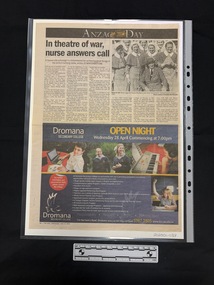
Newspaper - Newspaper clipping, The Mail, In theatre of war, nurse answers call, Wednesday, April 21, 2010
... ...Matron-in-Chief Australian Military Forces...Annie Moriah Sage WWII World War Two WW2 Florence Nightingale Medal Commander of the British Empire (CBE) Nurses Memorial Centre Matron-in-Chief Australian Military Forces Full newspaper page clipping with heading and article at the top and large colour advertisement underneath. ...General biographical, war and subsequent service article about A[nnie] M[oriah] Sage.Full newspaper page clipping with heading and article at the top and large colour advertisement underneath. Article has a black and white photograph of women in Army nurses uniforms. The article has six columns of text.annie moriah sage, wwii, world war two, ww2, florence nightingale medal, commander of the british empire (cbe), nurses memorial centre, matron-in-chief australian military forces -
 Returned Nurses RSL Sub-branch
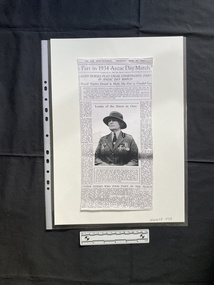
Newspaper - Photocopy of newspaper clipping, The Sun News-Pictorial, Army nurses play usual unobstrusive part in Anzac Day march: Record number, dressed in mufti, slip past in crowded cars, April 26 1934
... ...Matron in Chief...WW1 WWI World War 1 E Conyers Matron in Chief Australian Army Nursing Service AANS Australian Imper Australian Imperial Forces AIF A Dowsley 3rd Military District E Cornwell Edith Cavell Trust Fund McHardie White Gertrude Davis Hamilton Russell Wing Alfred Hospital I O'Dwyer Repatriation Hospital Caulfield M.E. ...Dressed in mufti, attended by no band or banners, more than 200 women slid past the almost unheeding crowd in a battalion of cars, unobtrusively taking their part in the Anzac Day march, as they played their part during World War One. They were all returned army nurses who served in Egypt, Salonika, Flanders, Belgium, England and India. Many were wearing medals such as the Commander of the Order of the British Empire medal (CBE), the Royal Red Cross medal (RRC), the Florence Nightingale medal, the Order of St Sava and the Medal of Honour of Greece. The article goes on to list many of the women who participated in the march.A photocopy of a newspaper clipping consisting of titles, one large photo and several columns of text. The photo depicts a woman in nurse's uniform and war medals.ww1, wwi, world war 1, e conyers, matron in chief, australian army nursing service, aans, australian imper, australian imperial forces, aif, a dowsley, 3rd military district, e cornwell, edith cavell trust fund, mchardie white, gertrude davis, hamilton russell wing, alfred hospital, i o'dwyer, repatriation hospital, caulfield, m.e. nicholson, methodist homes for children, cheltenham, a.f. roberts, masonic homes, punt rd, d ryall (nee newton), trinity college, g douglas, newport, e cameron, melbourne university, nan reay, bryant and may, c fisher (nee pratti), grace wilson, edith cavell memorial service, returned army nurses' club, parliament house, h. hayes (nee gawler), m.m. loughron, children's welfare department, e hart, b.m. gibbings, a.r. broughton (nee bolton), a forrest, baby health centre, ivanhoe, buckham, a. king, lily rutherford, m. coombes, v woinarski, m. humphrey, police hospital, n. rhoden, anzac hostel, j. tyers, mont park, j. stanbury, bundoora, f. grylls, children's health bureau, anzac house, m. ambler, jean robertson, macrobertson's, rose quarterman, buckleu and nunn, v. payne, tanganyika, w.b. healy (nee brocklebank), rushworth, c. murray, nauru, e.m. mccarthy, traralgon, l.e. wheeler, st arnaud, b. g. stubbs, tecoma, e.l. weitnaure (nee trant), bateford, cope (nee hewlett), tatura, w.s. philip (nee green), echuca, b. o'connor (nee balkam), maldon, scurry (nee barry), silvan, long (nee garden), fussell (nee garden), gillies, m peet, a purcell, geelong, j.r. porter, peake (nee ekers), harcourt (nee tuxworth), o. sommerville (nee deane), lorimer (nee pilkington), r. b. kelley (nee malcolm), i. owen, e cullen (nee newton), e shepard (nee harrison), gaff (nee steele), wilkinson (nee peters), p. n. lewis (nee evans), p dooley (nee haynes), barber (nee webb), d monat (nee crossing), w. scurry (nee barry), e. geddison (nee edwards), arruthers, winfield, hambridge, l. dutton, w. b. heily (nee bocklebank), e. glyde (nee whitely), b o'connor (nee balham), i. prime (nee ogilvie), r. e.ireland (nee grove), e. kitchen (nee neville), c. matheson (nee donaldson), m. clyne (nee hardie), s. buckley (nee flett), stewart cowan, wiseman (nee jamieson), h. welch (nee white), jj. sedgeick (nee waddell), n drysdale, m. roberts (nee brown), geach, c. bonwick (nee strom), l. thompson (nee stewart), g. easter (nee jeremiah), n. kenward, h. davis (nee colwill), geddison, g. owen, g. cochran, hales (nee whitfield), l. sheppard, g. levinson (nee irvine), g. sylvester, tregellis smith (nee sampson), h. f. allison wallilien (nee canard), v. woinarski, l. leich, d. white, s. bennett smith, mcphail, l. rutherford, m. hall, n. coombs, w. holding, c. cadwellader, dowling, stewart, j. bage, m. hobler, i. mcalpine, condon, s. malcolm, m. smith, a. h. stone, m. nuzum, j. burgess, m. burtley, k. devine, e. simpson, s. pines, i. bonnin, a. cassidy, kendall, i. f. donald, j. currie, t. tyson, j. robertson, r. quarterman, g. grace, m. tilton, m. robinson, a. lee-brown, c. williams, l. moxham, e. reddie, f. tabor, n. isaacs, e. m. renard, mackenzie, k. garney, g. duncan, f.m. dowell, n.w. gillespie, e.l. prescott, sandbrook, m. peet, e. thistlewaite, e. palmer, b. lord, b. mckinnell, g. bishop, b mcphail, m. pearce, l. hancock, o. saloway, e. dixon, g.c. marum, m. folwer, a.m. gallen, a. brown, a. hardie, j. simpson, m. thomas, e.g. beer, goodman, s. greenaway, w. williamson, j. donald, a. gill, e. gill, k. fegan, m. humphreys, j.m. matthews, e.c. kerr, holding, g. sumner, a. kitchen, e. pitchford, m. cumming, m. donnellan, o. gillin, a. purcell, j. jennings, m. delehenty, m. stevens, m. duggan, j. reeves, a. neunham -
 Returned Nurses RSL Sub-branch
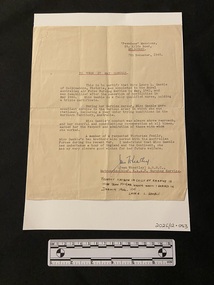
Letter - Typed letter, Jean Wheatley, 7 December 1949
... Letter of recommendation for Laura Louise Gamble (500391), written by the Matron-in-chief of the Royal Australian Air Force Nursing Service (RAAFNS), where Miss Gamble served from 1943-1946....'Jean Wheatley' [Handsigned in blue ink] [Three lines of text have been underlined in red ink] 'PRESENT MATRON IN CHIEF OF RAAFNS IS / MISS JOAN McRAE UNDER WHOM I SERVED IN / DARWIN 1944-1945. / LAURA L. ...Letter of recommendation for Laura Louise Gamble (500391), written by the Matron-in-chief of the Royal Australian Air Force Nursing Service (RAAFNS), where Miss Gamble served from 1943-1946. ...Letter of recommendation for Laura Louise Gamble (500391), written by the Matron-in-chief of the Royal Australian Air Force Nursing Service (RAAFNS), where Miss Gamble served from 1943-1946.Four paragraph letter typed with a typewriter and hand-signed.'Jean Wheatley' [Handsigned in blue ink] [Three lines of text have been underlined in red ink] 'PRESENT MATRON IN CHIEF OF RAAFNS IS / MISS JOAN McRAE UNDER WHOM I SERVED IN / DARWIN 1944-1945. / LAURA L. GAMBLE.' [Handwritten in black ink at the bottom of the page]laura gamble, laura louise gamble, royal australian air force nursing service, raafns -
Lakes Entrance Historical Society
Book, Jeffrey, Betty, Matron A.M. Sage "Sammie", 1970
... A tribute to Matron A.M.Sage, Matron in Chief of Australian Army Nursing Services, and some references to P.O.W. life and rehabilitation. ...Lakes Entrance Historical Society 4 Marine Parade Lakes Entrance gippsland Nurses A tribute to Matron A.M.Sage, Matron in Chief of Australian Army Nursing Services, and some references to P.O.W. life and rehabilitation. ...A tribute to Matron A.M.Sage, Matron in Chief of Australian Army Nursing Services, and some references to P.O.W. life and rehabilitation. Booklet produced as fundraiser for College of Nursing, Australianurses -
National Vietnam Veterans Museum (NVVM)
Photograph, Yes Matron, 1/11/1969 12:00:00 AM
... Sgt Len Dyer 1st Field Regt RAA, A patient of 1st Field Hospital receives visit from Matron in Chief. RAANC Col Edna Doig, Capt Pam West and Major Nell Espie...Sgt Len Dyer 1st Field Regt RAA, A patient of 1st Field Hospital receives visit from Matron in Chief. RAANC Col Edna Doig, Capt Pam West and Major Nell Espie Yes Matron Photograph Photograph ...Mounted black and white photograph taken at Vung Tau November 1969. Sgt Len Dyer 1st Field Regt RAA, A patient of 1st Field Hospital receives visit from Matron in Chief. RAANC Col Edna Doig, Capt Pam West and Major Nell EspieAWM BEL?69?0750?VNphotograph, 1st australian field hospital, raa, raanc, vung tau, col edna doig, capt pam west, major nell espie, sgt len dyer -
 Returned Nurses RSL Sub-branch
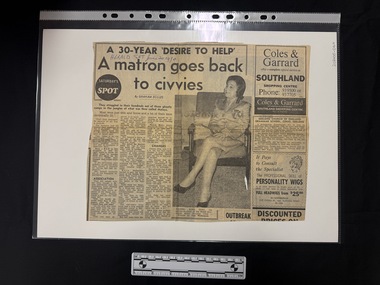
Newspaper - Newspaper clipping, [Herald], A 30-year 'desire to help' : A matron goes back to civvies, [Saturday, June 20, 1970]
... Biographical article about the service of Colonel Edna Doig, retiring Matron-in-Chief of the Royal Australian Army Nursing Corps....Returned Nurses RSL Sub-branch ANZAC House Level 3 4 Collins Street Melbourne Biographical article about the service of Colonel Edna Doig, retiring Matron-in-Chief of the Royal Australian Army Nursing Corps. ...Biographical article about the service of Colonel Edna Doig, retiring Matron-in-Chief of the Royal Australian Army Nursing Corps.Article featuring three columns of text and one large black and white photograph of a woman in uniform seated on a chair. The clipping also has two and a bit advertisements and another small article down the right hand side.'HERALD SAT June 20 1970' [Blue ink towards the top of the page]edna doig, royal australian army nursing corps -
 Returned Nurses RSL Sub-branch
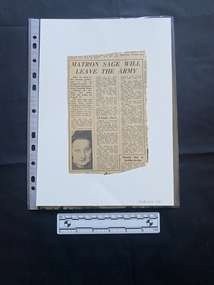
Newspaper - Newspaper clipping, The Argus, Matron Sage will leave the army, 31 July 1952
... Annie Sage served as Matron-in-chief of the Royal Australian Army Nursy Corps for twelve years....Annie Sage served as Matron-in-chief of the Royal Australian Army Nursy Corps for twelve years. ...Colonel A. M. Sage will retire from the Army after thirty-two years of service. Annie Sage served as Matron-in-chief of the Royal Australian Army Nursy Corps for twelve years.A newspaper clipping of three columns of text with a small black and white photo of an older woman's faceannie moriah sage, somerville, war nurses' memorial centre, college of nursing of australia, melbourne hospital, royal melbourne hospital, rg casey -
 Returned Nurses RSL Sub-branch
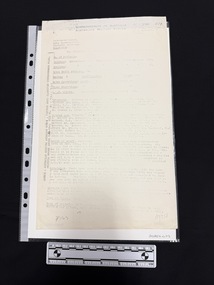
Document - Commonwealth of Australia Austrlain Military Forces report, 109 Australian General Hospital, December 1942
... Copy of file no. 21-720-337 from the National Archives of Australia being the December 1942 report from the 109 Australian General Hospital in Alice Springs to the Matron-in-Chief at Army Headquarters, Victoria Barracks, Melbourne. ...Returned Nurses RSL Sub-branch ANZAC House Level 3 4 Collins Street Melbourne Copy of file no. 21-720-337 from the National Archives of Australia being the December 1942 report from the 109 Australian General Hospital in Alice Springs to the Matron-in-Chief at Army Headquarters, Victoria Barracks, Melbourne. ...Copy of file no. 21-720-337 from the National Archives of Australia being the December 1942 report from the 109 Australian General Hospital in Alice Springs to the Matron-in-Chief at Army Headquarters, Victoria Barracks, Melbourne. The report includes statistics on patient admissions and discharges, averages, staff movements, health and other relevant headings.Faded foolscap copy of a typed report relating to the 109 Australian General Hospital in December 1942. Document has information on the source along the left hand edge.'21-720-337' [Blue ink on left hand side]wwii, ww2, world war 2, 109 agh alice springs, 109 australian general hospital -
![Stapled booklet with black cover. Title and authors name are printed in white on the front cover along with phograph of a sculpture of two hands reaching towards each other ['hands' by Henry Moore].](/media/collectors/64a5077bc83bd7b7b94f4211/items/692986fe6f314f23e0ecb086/item-media/6929872f6f314f23e0ecb12b/item-fit-380x285.jpg?cb=6) Returned Nurses RSL Sub-branch
Returned Nurses RSL Sub-branchBook - Paperback book, Betty Jeffrey, Matron A.M.Sage 'Sammie': a tribute, 1970[?]
... Sage, CBE, RRC, FNM, / FCNA(Hon.) / Matron in Chief, AANS 1943-1952' [Handwritten in blue ink at the top of page 2] 'B32' [Handwritten in pencil on the first page] 'RETURNED NURSES CLUB OF VICTORIA / SUB BRANCH R.S.L.' ...Sage, CBE, RRC, FNM, / FCNA(Hon.) / Matron in Chief, AANS 1943-1952' [Handwritten in blue ink at the top of page 2] 'B32' [Handwritten in pencil on the first page] 'RETURNED NURSES CLUB OF VICTORIA / SUB BRANCH R.S.L.' ...This is a short book about nurses, the enduring race of women into whose helping handsnwe all of us inevitably fall, from time to time, from birth to death. How could we do without them? (taken from the foreward, page 3)Stapled booklet with black cover. Title and authors name are printed in white on the front cover along with phograph of a sculpture of two hands reaching towards each other ['hands' by Henry Moore]non-fictionThis is a short book about nurses, the enduring race of women into whose helping handsnwe all of us inevitably fall, from time to time, from birth to death. How could we do without them? (taken from the foreward, page 3)annie moriah sage, prisoners of war, australian nurses, military nursing -
 Returned Nurses RSL Sub-branch
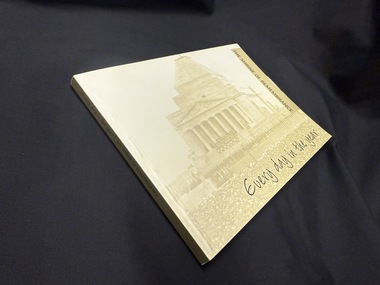
Book - Illustrated paperback book, Richard Reid, Every day in the year : The Shrine of Remembrance, 2003
... Miss Conyers was the first Matron-in-Chief of the Australian Army Nursing Service in World War 1. ...Miss Conyers was the first Matron-in-Chief of the Australian Army Nursing Service in World War 1. ...'Every day in the year is a pictoral record of the Shrine of Remembrance and the people who have embraced it.' [from first page text by Danna Vale, then Member of Parliament, Minister for Veterans' Affairs, Minister Assisting Minister for Defence]Paperback book with faded photograph of Melbourne Shrine of Remembrance as background of covers and spine with black text used. Photograph shows the Shrine with the Union Jack flag on a stand at the front, people on the steps in uniform and an extremely large crowd in the foreground.non-fiction'Every day in the year is a pictoral record of the Shrine of Remembrance and the people who have embraced it.' [from first page text by Danna Vale, then Member of Parliament, Minister for Veterans' Affairs, Minister Assisting Minister for Defence]world war one, wwi, ww1, evelyn conyers, australian army nursing service, shrine of remembrance -
 Returned Nurses RSL Sub-branch
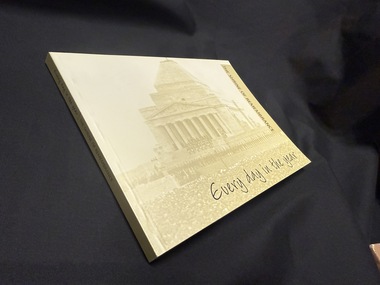
Book - Illustrated paperback book, Richard Reid, Every day in the year : The Shrine of Remembrance, 2003
... Miss Conyers was the first Matron-in-Chief of the Australian Army Nursing Service in World War 1. ...Miss Conyers was the first Matron-in-Chief of the Australian Army Nursing Service in World War 1. ...'Every day in the year is a pictoral record of the Shrine of Remembrance and the people who have embraced it.' [from first page text by Danna Vale, then Member of Parliament, Minister for Veterans' Affairs, Minister Assisting Minister for Defence]Paperback book with faded photograph of Melbourne Shrine of Remembrance as background of covers and spine with black text used. Photograph shows the Shrine with the Union Jack flag on a stand at the front, people on the steps in uniform and an extremely large crowd in the foreground.non-fiction'Every day in the year is a pictoral record of the Shrine of Remembrance and the people who have embraced it.' [from first page text by Danna Vale, then Member of Parliament, Minister for Veterans' Affairs, Minister Assisting Minister for Defence]world war one, wwi, ww1, evelyn conyers, australian army nursing service, shrine of remembrance -
 Returned Nurses RSL Sub-branch
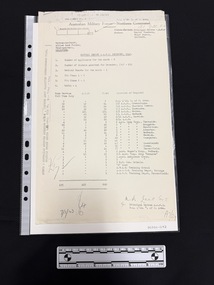
Document - Australian Military Forces - H.Q. Q'ld. L. of C. Area. AANS Monthly report, Australian Army Nursing Service, Monthly Report A.A.N.S. December, 1942, December 1942
... Copy of file no. 21-720-332 from the National Archives of Australia being the monthly report for December 1942 from the Principal Matron of the AANS at the Queensland Headquarters to the Matron-in-Chief of the Allied Land Forces at Headquarters in Melbourne. ...Returned Nurses RSL Sub-branch ANZAC House Level 3 4 Collins Street Melbourne Copy of file no. 21-720-332 from the National Archives of Australia being the monthly report for December 1942 from the Principal Matron of the AANS at the Queensland Headquarters to the Matron-in-Chief of the Allied Land Forces at Headquarters in Melbourne. ...Copy of file no. 21-720-332 from the National Archives of Australia being the monthly report for December 1942 from the Principal Matron of the AANS at the Queensland Headquarters to the Matron-in-Chief of the Allied Land Forces at Headquarters in Melbourne. The report includes a table of numbers of nurses located at various Australian General Hospitals and other facilities within Australia delineating between those on Home Service Full Time Duty or those with the AIF. At the time of this report the combined number of nurses serving in (mostly) Queensland was 600. Foolscap copy of a typed Australian Army Nursing Service internal report with table of numbers of nurses located at various Australian General Hospitals and other facilities within Australia. Document has information on the source along the left hand edge.'21-720-332' [Blue ink on left hand side]wwii, ww2, world war 2, queensland, australian army nursing service, aans, aif, home service -
 Returned Nurses RSL Sub-branch
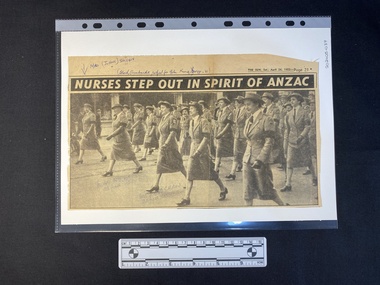
Newspaper - Newspaper clipping, The Sun, Nurses step out in spirit of anzac, April 26 1952
... Kath McMillan and Betty Pump who served with them in the 2/10 Australian General Hospital (AGH) also marched. Matron-in-Chief Sage let the procession that also included Miss Edna Shaw, Lady Superintendent of the Alfred Hospital. ...Kath McMillan and Betty Pump who served with them in the 2/10 Australian General Hospital (AGH) also marched. Matron-in-Chief Sage let the procession that also included Miss Edna Shaw, Lady Superintendent of the Alfred Hospital. ...Betty Jeffery and Beryl Woodbridge were among the war nurses who marched in the 1952 Anzac march. The two nurses were both Japanese POWs for three years. Kath McMillan and Betty Pump who served with them in the 2/10 Australian General Hospital (AGH) also marched. Matron-in-Chief Sage let the procession that also included Miss Edna Shaw, Lady Superintendent of the Alfred Hospital. An English ex-pat, Kathleen Carpenter, who served in the Queen Alexandra Imperial Nursing Service Reserve, having settled in Australia after being demobilised, also marched. A newspaper clipping from a larger sheet consisting of a title above a large black and white photo of a large group of women in uniform marching together down a street. The story has been cut off.'[down arrow] MRS (JOHNS) SHIPPEN' [blue ink, upper left hand side] '(Black Armbands respect for late King.) George. VI)' [blue ink upper left hand side] 'Miss HANNAH / Alford Hosp.' [graphite, lower left hand side] 'Miss E [R] SHAW / Alford Hosp.' [graphite, lower left hand side]annie moriah sage, british army, italy, west africa, north nigeria, willaura district hospital, peggy wall, foncie smith, egypt, palestine, greece, aip, british expeditionary force, bef -
 Returned Nurses RSL Sub-branch
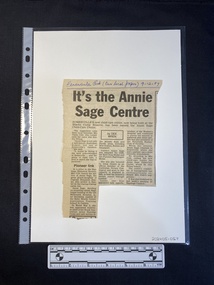
Newspaper - Newspaper clipping, [Peninsula Post], It's the Annie Sage centre, [1987]
... In World War 2 she was appointed matron-in-chief of the Royal Australian Army Nursing Corps and saw service in the Middle East and Pacific areas. ...In World War 2 she was appointed matron-in-chief of the Royal Australian Army Nursing Corps and saw service in the Middle East and Pacific areas. ...Somerville's new child-care centre has been named the Annie Sage Child-Care centre. Annie embarked on her nursing career by training at the old Melbourne Hospital, later becoming matron of the Baby Heath Centre Association Training School in Carlton. In World War 2 she was appointed matron-in-chief of the Royal Australian Army Nursing Corps and saw service in the Middle East and Pacific areas. Colonel Sage was awarded the CBE, the Red Cross Medal and the Florence Nightingale Medal. Later she appointed lady superintendent of the Women's Hospital. After retirement Annie returned to Somerville.A newspaper clipping of a story with a large title above three columns of text'Peninsula Post (Our local paper) 9-12-87' [blue ink, along top]melbourne, valda cole, hastings historical society, benjamin baxter, baxter, carrup-carrup, carlton, new guinea, borneo, singapore, australian victory contingent, england, london, returned nurses club, hastings council, raanc, order of the british empire -
 Returned Nurses RSL Sub-branch
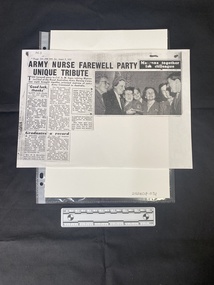
Newspaper - Photocopy of a newspaper clipping, The Sun, Army nurse farewell party : unique tribute, August 9 1952
... The farewell party for Col Annie Sage, retiring Matron-in-Chief of the Royal Australian Army Nursing Corps (RAANC) brought together principal matrons of every Army Command in Australia, as part of the 250 guests. ...Returned Nurses RSL Sub-branch ANZAC House Level 3 4 Collins Street Melbourne The farewell party for Col Annie Sage, retiring Matron-in-Chief of the Royal Australian Army Nursing Corps (RAANC) brought together principal matrons of every Army Command in Australia, as part of the 250 guests. ...The farewell party for Col Annie Sage, retiring Matron-in-Chief of the Royal Australian Army Nursing Corps (RAANC) brought together principal matrons of every Army Command in Australia, as part of the 250 guests. Guests included nurses from many parts of Australia, as well as the Chief of the General Staff, Minister for the Army and the former Director-General of Army Medical Services. A brooch was presented to Miss Sage on behalf of friends in and out of the profession by the former Director-General, who said "Miss Sage was one of the most outstanding examples of leadership I have ever seen." Miss Sage also received telegrams from well wishers.. A newspaper clipping from a larger page, consisting of three columns of text next to a black and white photo of a group of women, one of which is presenting something to another.'NC3' [written, top left] annie moriah sage, sydney fairbairn rowell, josiah francis, samuel burston, harry crowe, vivien bullwinkel, banka island, g m taylor, c a fall, jean elsie ferguson, joan stevenson abbott, c a kestal, edith lydia shaw -
 Returned Nurses RSL Sub-branch
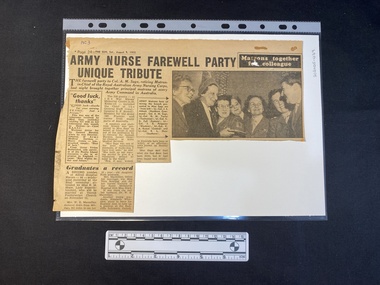
Newspaper - Newspaper clipping, The Sun, Army nurse farewell party : unique tribute, August 9 1952
... The farewell party for Col Annie Sage, retiring Matron-in-Chief of the Royal Australian Army Nursing Corps (RAANC) brought together principal matrons of every Army Command in Australia, as part of the 250 guests. ...Returned Nurses RSL Sub-branch ANZAC House Level 3 4 Collins Street Melbourne The farewell party for Col Annie Sage, retiring Matron-in-Chief of the Royal Australian Army Nursing Corps (RAANC) brought together principal matrons of every Army Command in Australia, as part of the 250 guests. ...The farewell party for Col Annie Sage, retiring Matron-in-Chief of the Royal Australian Army Nursing Corps (RAANC) brought together principal matrons of every Army Command in Australia, as part of the 250 guests. Guests included nurses from many parts of Australia, as well as the Chief of the General Staff, Minister for the Army and the former Director-General of Army Medical Services. A brooch was presented to Miss Sage on behalf of friends in and out of the profession by the former Director-General, who said "Miss Sage was one of the most outstanding examples of leadership I have ever seen." Miss Sage also received telegrams from well wishers.. A newspaper clipping from a larger page, consisting of three columns of text next to a black and white photo of a group of women, one of which is presenting something to another.'NC3' [blue ink, top left, front of page] 'NC3' [blue ink, top right, back of page]annie moriah sage, sydney fairbairn rowell, josiah francis, samuel burston, harry crowe, vivien bullwinkel, banka island, g m taylor, c a fall, jean elsie ferguson, joan stevenson abbott, c a kestal, edith lydia shaw -
 Returned Nurses RSL Sub-branch
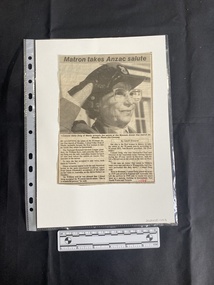
Newspaper - Newspaper clipping, Jim Campey, Matron takes Anzac salute, [1988]
... Edna, who was Matron-in-chief and Director of the Australian Army Nursing Service during her 29 year career in the army, was born in Brisbane and joined the army in 1939. ...Edna, who was Matron-in-chief and Director of the Australian Army Nursing Service during her 29 year career in the army, was born in Brisbane and joined the army in 1939. ...By accepting the salute at the Wynnum Anzac Day march, Colonel Edna Doig of Manly, probably became the first woman to take an Anzac Day salute in Queensland. The National Returned Services League (RSL) president, Sir William Keys, said Edna was the only Australian wiman he knew of who had taken the salute at Anzac Day marches in the nation. Edna has also accepted it twice before, both in Victoria. These three occasions appear to the the only break in the historically male-santioned tradition, apart from Queen Elizabeth's acceptance if the salute on her visits to Australia. Edna, who was Matron-in-chief and Director of the Australian Army Nursing Service during her 29 year career in the army, was born in Brisbane and joined the army in 1939. A newspaper clipping featuring a large black and white photo of an older woman in glasses saluting, beneath a title and above two columns of text'1988'[red ink, bottom right of page] 'UNIT 36 / 87 SEYMOUR ROAD / ELSTERNWICK, 3185'[stamped in black ink, reverse side, lower left of page]world war 2, wwii, ww2, world war ii, fred hillier, mildura, wangaratta, england, new south wales -
 Returned Nurses RSL Sub-branch
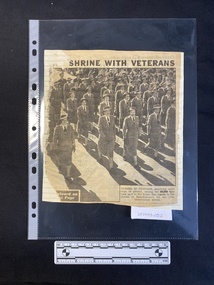
Newspaper - Newspaper clippings, The Age, '[?] shrine with veterans' [front of page], ' Memorial to nurses' [back of page], 20 Feb 1950
... During the service of dedication two addresses were given, with Miss Sage, Matron in Chief of the Royal Australian Army Nursing Service (RAANS), speaking on the courage, loyalty and devotion to duty that the nurses showed during the 1939-46 war. ...During the service of dedication two addresses were given, with Miss Sage, Matron in Chief of the Royal Australian Army Nursing Service (RAANS), speaking on the courage, loyalty and devotion to duty that the nurses showed during the 1939-46 war. ...Front page - The large photo is of nurses in uniform, marching more than 20 abreast. They join the [26,000] who were taking part in the Anzac Day march to the Shrine of Remembrance. Back page - Governor, Sir Dallas Brooks, opens the War Nurses' Memorial Centre on Feb 19 1950. A large crowd included those from the nursing and medical professions, the services as well as Lady and Miss Brooks and other dignitaries. During the service of dedication two addresses were given, with Miss Sage, Matron in Chief of the Royal Australian Army Nursing Service (RAANS), speaking on the courage, loyalty and devotion to duty that the nurses showed during the 1939-46 war. Miss Betty Jeffrey is the administrative officer of the centre that is available for use by all nursing organisations, including accommodations for nurses travelling from the country or out of state.Two newspaper clippings have been glued to either side of a lined sheet of paper. Front of page - a torn newspaper clipping of part of a title, a large black and white photo of women in nurse's uniforms marching and a caption. Back of page - a newspaper clipping of a black and white photo of a man in military uniform listening to four women in nurse's uniforms, with a story of two columns of text'Feb. 19th 1950' [blue ink, back of page, lower left]melbourne, wwii, ww2, st kilda road, jeanette brooks, muriel violet turner laing, thomas blamey, annie moriah sage, john latham, eleanor mary (ella) tobin, muriel brooks, eleanor latham, edmund herring, sydney fairbairn rowell, blanche may murison, blanche rowell, kingsley norris, richard gavin gardiner casey, ethel marian sumner (maie) ryan, ethel casey, kent hughes, edith kerr, edith hughes, college of nursing, australian nursing conference, melbourne town hall -
 Returned Nurses RSL Sub-branch
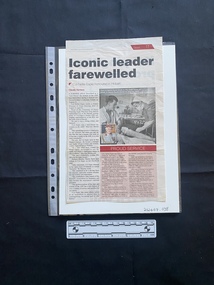
Newspaper - Newspaper clipping, defence.gov.au/news/armynews, Iconic leader farewelled, [2016]
... by the time she was discharged from the service in 1981 she was Matron in Chief of the RAANC and Director of Army Nursing. ...She went on to be a Ward Sister and Charge Sister in Japan, Korea, Duntroon, Malaya, Queensland and Victoria. 1969 saw Col Espie become Matron of the Australian Field Hospital at Vung Tau in South Vietnam. by the time she was discharged from the service in 1981 she was Matron in Chief of the RAANC and Director of Army Nursing. ...A funeral service was held for Col Nellie Espie (retd) at St Mary's Cathedral, Hobart, on August 22. Nellie, a former Director of Army Nursing dies on August 15, aged 92. Nellie was born in Tasmania in 1924, trained as a nurse in the 1940's and became an Army nurse when the Korean War broke out. She was commissioned as a lieutenant with the Royal Australian Army Nursing Corps (RAANC) and posted to Ingleburn, NSW in 1951. She went on to be a Ward Sister and Charge Sister in Japan, Korea, Duntroon, Malaya, Queensland and Victoria. 1969 saw Col Espie become Matron of the Australian Field Hospital at Vung Tau in South Vietnam. by the time she was discharged from the service in 1981 she was Matron in Chief of the RAANC and Director of Army Nursing. Nellie continued to take an active role in the RAANC after her retirement. A newspaper clipping of a story consisting of three columns of text, an old black and white photo of a masked up nurse treating a man's leg and a small colour photo of an older woman in military uniform.adf, australian defense force, centenary of anzac planning team, greg melick, rsl, returned services league, maj-gen greg melick, marise payne, defense minister, oatlands, florence nightingale trust, national medal, royal red cross, member if the order of australia, centenary medal, meritorious service medal -
 Returned Nurses RSL Sub-branch
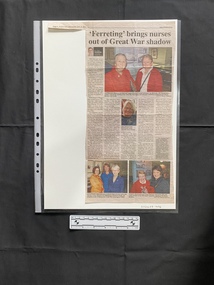
Newspaper - newpaper clipping, Advertiseer, 'Ferreting' brings nurses out of great war shadow, June 10 2015
... Questions remained at the time about srving rank, gender and value. The matron-in-chief was accorded the rank of major but paid as a captain, while nurses ranked as lieutenant were paid as soldiers....Questions remained at the time about srving rank, gender and value. The matron-in-chief was accorded the rank of major but paid as a captain, while nurses ranked as lieutenant were paid as soldiers. ...The lives and service of a pair of Great War nurses have inspired a collaboration that has led to a special Anzac centennial exhibition. 'Red capes and suitcases', at Beechworth's Burke Museum, features stories and memorabilia of nineteen nurses associated with Indigo Shire. Included are Rose Carter and Elizabeth Duncan. Both trained at Wangaratta hospital before volunteering to nurse in the Great War. Wangaratta family history researcher, Heather Lane felt an important story remained untold in the nurses' home communities and encouraged the museum to apply for a Veterans' Affairs grant to fund research. Colonel Jan McCarthy, who opened the exhibition, said that seven Australian nurses in the Great War were awarded the Military Medal rather that the Military Cross, as they were volunteers and served in a honorary capacity. Questions remained at the time about srving rank, gender and value. The matron-in-chief was accorded the rank of major but paid as a captain, while nurses ranked as lieutenant were paid as soldiers.A large newspaper clipping consisting of a title, five columns of text and four colour photos. The first and largest photo, directly under the title, is of two older women, both wearing red. The second photo is a small headshot of a smiling woman. The third and fourth photo are both at the bottom of the page and show smiling women, three and two of, respectively.ww1, wwi, world war one, wangaratta district hospital, chiltern, australian army, vietnam war, anne hanson, skillshare, the australian, peter rees, the other anzacs, north east, linda peacock, associate of the royal red cross, arrc, the queen, ali rowe, helen mcintyre, elisabeth modlia, agnes o'neill, julia smith, lesley browne -
 Returned Nurses RSL Sub-branch
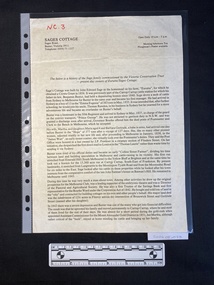
Document - Printed document, Victorian Conservation Trust, Sages Cottage : The below is a history of the Sage fanily commisioned by the Victoria Conservathin Trust - present day owners of Eurutta/Sages Cottage, [2004]
... She was made matron-in-chief, AIF (Middle East) in 1940, and was appointed a member of the Red Cross in 1942. ...She was made matron-in-chief, AIF (Middle East) in 1940, and was appointed a member of the Red Cross in 1942. ...Information page detailing the history of Sages Cottage from building in 1853/56 as a homestead, to being purchased in 1976 by the Victoria Conservation Trust. John Edward Sage built the cottage as the homestead for his farm "Eurutta" in 1856. John lived in the cottage with his wife and children up until his death in 1908 with his wife, Maria Sage (nee Baxter) continuing to live there until her death in 1927. Their youngest son, Thomas Holden Sage, and three daughters, Fanny Martha, Annie Agususta and Ellen Amynta continued to live there until their deaths. Thomas died in 1960 but gifted the remaining block of land with the cottage to his [niece?] Annie Moriah Sage a year before his death. Annie was Matron of the Australian Military Forces (AMF) in WW2. [Annie was born in 1895 as the fifth child to Edward Arthur and Mary Anne Sage. She trained in nursing, obtaining her nursing certificate in 1926. 1940 saw Annie join the Australian Army Nursing Service (AANS), Australian Imperial Force (AIF). During WWII Annie served as matron for the 2nd/2nd Australian General Hospital in the Middle East. She was made matron-in-chief, AIF (Middle East) in 1940, and was appointed a member of the Red Cross in 1942. Returning to Australia in 1942, she was elevated to deputy matron-in-chief, AMF in February 1943, and sub-sequentially promoted to colonel in March. Her duties included organising the AANS for duty in the South-West Pacific Area and oversaw the training scheme for the Australian Army Medical Women's Service (AAMWS). In September 1945 Annie flew to Sumatra to assist with the repatriation of the twenty four Australian nurses imprisoned by the Japanese. For her war service she was awarded the Florence Nightingale medal (1947) by the International Red Cross. In 1951 she was appointed Commander of the Most Excellent Order of the British Empire (CBE).] After Annie's death in 1969 the cottage and land went to a nephew and two nieces, before being purchased in 1976 by the Victoria Conservation Trust as an example of early settlement history.A printed information document in black ink on white paper, with an address in the upper left and opening times and refreshments available in the upper right. Below and over the page is full width text.'NC.3' [red ink top left hand corner of front page] '059 7111 3577 [?] Alastair Herbert / & / [?] Camilla [Hapfor]' [blue ink, top if second page]wwii, world war 2 -
 Returned Nurses RSL Sub-branch
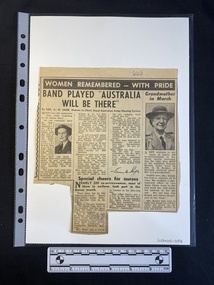
Newspaper - Newspaper clipping, The Age, Women remembered - with pride: Band played 'Australia will be there' ; Grandmother in march ; Special cheers for nurses, 26 April 1951
... Third story - Nearly 200 ex-servicewomen took part in the Anzac march. Led by Matron-in-Chief Sage, the grey nurse's uniforms was the signal for cheers and clapping. ...Third story - Nearly 200 ex-servicewomen took part in the Anzac march. Led by Matron-in-Chief Sage, the grey nurse's uniforms was the signal for cheers and clapping. ...First story - Colonel Annie Sage recounts memories that come up on Anzac Day. 'Dressing' their ship while in mid-ocean, listening to 'Australia Will Be There'; the agony and suspense waiting to learn if allies and friends had escaped terrible situations; having patients in beds and under beds in rain, mud and heat; learning awful news; reuniting with POW sisters and hearing their stories. Second story - Mrs GM Knight marched on Anzac Day in the light grey dress of the Auxiliary Nursing Service(ANSI), India. Born in England, she has lived in Australia for 30 years. Her husband, an officer in the RAF, died before WW2. Her two sons joined the army. Mrs Knight went to India and joined the ANSI and served for six years. Third story - Nearly 200 ex-servicewomen took part in the Anzac march. Led by Matron-in-Chief Sage, the grey nurse's uniforms was the signal for cheers and clapping. Mrs E Wildy and Miss Lillian Foster, both Voluntary Aid Detachment (VAD) during the war also attended.A newspaper clipping of three stories. The first story consists of three columns of text and includes a small black and white portrait photo of a woman in nurse's uniform. The second story is a single column of text beneath a small black and white portrait photo of a woman in nurse's uniform. The third story is two columns of text underneath the title.'WWII' [blue ink, top right]order of the british empire, ans, aans, australian general hospital, australian imperial forces, royal air force, strathaird, ramilles, navy, 2/4 australian general hospital, tobruk, haifa, kantara, greece, crete, islands, 2/9th, moresby, centaur, japanese, singapore, malaya, rabaul, la haat, sumatra, reg knight, sidney knight, irak, persia, st kilda, edith cavell, swadeston, norwich, england, london, imperial ex-service women's association -
 Returned Nurses RSL Sub-branch
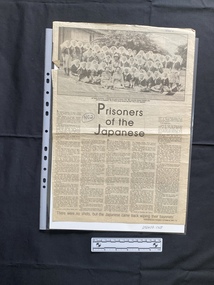
Newspaper - Newspaper clipping, The Border Mail, Prisoners of the Japanese, October 28 1989
... Finally after the Japanese surrendered they were met at an airstrip by the Matron in Chief, A.M. Sage. She was hoping for the full sixty five from the Vyner Brooke. ...Finally after the Japanese surrendered they were met at an airstrip by the Matron in Chief, A.M. Sage. She was hoping for the full sixty five from the Vyner Brooke. ...The newspaper article gives a basic overview of two groups of POW nurses during World War 2. Twenty two of the nurses trying to escape from the Japanese in Singapore, February 1942, on the Vyner Brooke came ashore on Banka Island. A few days afterwards they were all machine gunned by the Japanese, with only one survivor, Vivian Bullwinkel. She managed to get herself and a wounded British soldier to Muntok, where they both became POWs (prisoners of war). Of the sixty nurses on the Vyner Brooke, twelve had drowned, twenty one had been murdered and thirty two had gone into prison. Those that would survive the war made it through on a terrible diet consisting mostly of rice, attempts of the Japanese to use them for 'entertainment', making their own entertainment in celebrating birthdays and holidays, having music concerts and terrible sicknesses including cerebral malaria. Finally after the Japanese surrendered they were met at an airstrip by the Matron in Chief, A.M. Sage. She was hoping for the full sixty five from the Vyner Brooke. There were twenty four left. Another group of nurses were captured by the Japanese in Rabaul, January 1942, where twenty of their patients were taken, killed and buried in a mass grave. The nurses were put in a prison camp with civilian women where they too were treated terribly. They would be knocked down and kicked if they didn't bow deep enough, or would have their captors trying to urinate on them while laughing. After being moved to Japan they continued to try to survive by eating glue they were using to make envelopes for the Japanese. Large newspaper page with a full page story consisting of five columns of text and a large, bold title beneath a large black and white group photo of forty six people, most in nurses uniforms'NC2' [circled, blue ink, middle left of page]world war 1939-1945, thelma mceachern, 10th australian general hospital, agh, radji beach, sumatra, banka strait, 2/22nd battalion, tootie mcpherson, mavis cullen, naruto maru, dutch, eurasian, iole harper, nesta james, waltzing matilda, margaret dryburgh, marjory jennings, norah chambers, new guinea, yokohama yacht club, yokohama, mount fuji, kay parker, eileen callaghan, banks island, betty jeffrey, flo trotter, blanche hempsted, perth, melbourne, melbourne cup, micky syer -
 Mission to Seafarers Victoria
Booklet - Manual, Sailing directions for Port Phillip, in the colony of Victoria including the ports of Melbourne and Geelong, 1854
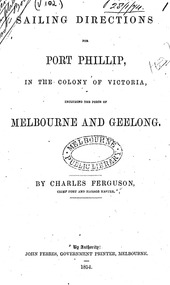
... Chief Harbour Master for the port of Melbourne in 1852 after being the first Harbour Master and Water Police Officer in Geelong for 12 months. On the 5th of April 1841, the Rajah sailed with James Donovan M.D. as Surgeon Superintendent, and the Rajah sailed from Woolwich with 180 female convicts. The Rajah arrived on the 19th of July in Hobart, with 179 females (one died during the voyage) and 10 children. Miss Kezia Elizabeth Hayter was the matron...Chief Harbour Master for the port of Melbourne in 1852 after being the first Harbour Master and Water Police Officer in Geelong for 12 months. On the 5th of April 1841, the Rajah sailed with James Donovan M.D. as Surgeon Superintendent, and the Rajah sailed from Woolwich with 180 female convicts. The Rajah arrived on the 19th of July in Hobart, with 179 females (one died during the voyage) and 10 children. Miss Kezia Elizabeth Hayter was the matron ...Captain Charles Ferguson was born in Scotland in 1813. He was the Master of the "Rajah" from 1838 to 1850 on voyages from England to Australia and vice versa. He became the First Chief Harbour Master for the port of Melbourne in 1852 after being the first Harbour Master and Water Police Officer in Geelong for 12 months. On the 5th of April 1841, the Rajah sailed with James Donovan M.D. as Surgeon Superintendent, and the Rajah sailed from Woolwich with 180 female convicts. The Rajah arrived on the 19th of July in Hobart, with 179 females (one died during the voyage) and 10 children. Miss Kezia Elizabeth Hayter was the matron on board. On page 28 of the "Sailing directions for Port Phillip, in the colony of Victoria including the ports of Melbourne and Geelong", a mention is made of the Mariner's Hospital and Floating Church soon to be established. There were discussions to built the hospital in Williamstown but instead the Government decided to build it in Melbourne. The Harbour Master and a commiittee decided to use the water police hulk, Emily, left unsold in 1856, to create a floating church: the Bethel was open in July 1857 with Reverend Kerr Johnston as Chaplain. Latrobe wrote a letter to Captain Cole in 1869, a few months after learning his death : "To Captain George Ward Cole † [from a draft in another’s hand] Clapham House, Lewes, Sussex, January 28th, 1869. My dear Captain Cole, Last mail will have taken out the sad intelligence of the death of our excellent old friend, Captain Ferguson. This will have been a terrible blow to his children and to his friends in the colony, who may have held reason to expect his early return to his home, with a not unreasonable prospect of ultimate restoration to health and activity. In the course of last October I went up to town with one of my children, mainly with the purpose of finding my way to Pinner, where he and Mrs. Ferguson were staying with an intimate friend. I found him in excellent health and spirits, and enjoying the prospect of a speeding resumption of the service to which he had devoted his best days, and upon the furtherance of which his entire energy was still directed. A week or two later Captain and Mrs. Ferguson went to Dover for change of air, and being still under the impression received from the advisers by whom they had been guided during their residence at a hydropathic establishment at Matlock, felt encouraged to plan almost immediate return to the colony by the Jerusalem early in December. However, certain misgivings in the mind of a medical gentleman, then in England, under whose care Captain Ferguson had at one time placed himself in Williamtown, led them to consider it judicious before departure to take the advice of some surgeon of eminence in London. Accordingly they came up to town at the close of November. The first London practitioners they consulted shook their heads, and advised consultation with Sir Wm. Ferguson. The result was that amputation, without loss of time, was pronounced necessary. The rest is soon told. He received the painful intelligence with calmness and full resignation to God's will, and underwent the operation at King's College Hospital with exemplary firmness and Courage on the 28th of November. Perfect success seemingly attended it, and there seemed, humanly speaking, to be every prospect of a prompt cure and early convalescence; everything seemed in his favour. A few days later, however, all was clouded by symptoms of hospital fever (pyoe æm ia). This resisted all control, and finally carried him off on the 27th of December, just one month after the operation. He had lived a Christian life, and his death was the peaceful and resigned death of a Christian. It was a melancholy satisfaction to me to be able to join a few friends in following his remains to their resting place in one of the outlying London cemeteries on the last day of the year. You know Mrs Ferguson well, and will be prepared to hear me say that her whole conduct and demeanour throughout this period of suspense and bitter trial has been worthy of her high character and steadfast principle. Come what will, and happen what may, I have the fullest conviction that neither the widow nor the children will be forsaken, however doubtful and clouded the future may appear, in consequence of the irreparable loss which, they have sustained. And now, dear Captain Cole, it is possible that you may already have heard all this from other sources, but I have dictated it to you under strong impulse, for I feel assured that there is no member of the community in which you live who will more sincerely deplore the loss of Captain Ferguson on private grounds; at the same time that there is no one who, from long acquaintance with his official character and services, will be in a better position to estimate their real value or the loss which the colony has sustained. The circumstances in which Captain Ferguson's family are left not only demands the utmost display of sympathy and interest on the part of friends, but may call for decided and prompt action; therefore I cannot rest satisfied without discharging what I consider my duty, and seeking to strengthen your hands as far as I may in bringing the character of his long services before the existing colonial authorities. Of his private career previous to his entering the service of the Colonial Government in 1851 nothing need be said. Captain Ferguson was appointed as the Harbour Master at Geelong in April, 1851 – a few months before the separation of the colony from New South Wales. He there did excellent service in a variety of ways calculated to advance the interests of the port, and to introduce www.latrobesociety.org.au 27 order, where, from circumstances, but little order had hitherto prevailed. His was the first appointment of this class in that locality. The separation of the colony from New South Wales took place in the month of July following. Shortly after, the late Captain Bunbury resigned the Harbour Mastership of Port Phillip. Captain Ferguson was at once (February, 1852) appointed to succeed him, and from that time performed all duties of Chief Harbour Master of the colony. The previous year (May 1851) the first gold discoveries in New South Wales had taken place, and in the month of August those of our colony followed. At the time of Captain Ferguson’s taking charge of the Port of Melbourne their influence had begun to be fully felt, and in no department more seriously than in that of the Harbour Master. This is no place for statistical details, but they must bear me out in reminding you of a few facts connected with our late friend’s career. At the time of separation that department comprised only 30 individuals of all ranks, and when he took charge the number was much reduced. There were at that time, according to the returns, no fewer than 54 vessels, registering 26,785 tons, in Hobson’s Bay alone. The crews on arrival numbered 1,235 men. Of this number only 463 remained on board, 500 having deserted, and the rest having been discharged by arrangement or pure necessity. For the first six months after Captain Ferguson’s assumption of office as Harbour Master the duties of Police Magistrate and Chief of the Water Police were superadded, and how much labour they involved may be surmised from the fact that from 1st of April to the 31st July, 1852, four months only, no less than 236 marine cases were brought before the bench at Williamstown - sometimes as many as 30 in a day. A year later (March 1853) the returns show that the number of vessels in the harbour in Hobson’s Bay alone were 91, tonnage 43,754; and passing on to the still later returns of May, 1853, two years after Captain Ferguson’s assumption of office, we find from the records that the number of ships in port had increased to 129; tonnage, 63,292; crew on board on arrival, 2872, and at the date of report, 1628; the amount of desertions at that time having, however, proportionally diminished, in consequence of the abatement of the gold fever, caused by the non-success attendant upon the labours of thousands at the goldfields. The above numbers take no account of the large number of vessels and amount of tonnage lying at the wharves at Melbourne or elsewhere. From these figures alone it may be judged what must have been a struggle in which the Chief Harbour Master was engaged from the very outset to secure order, and answer the innumerable calls on every branch of his department, at the same time that there was for many months an almost complete impossibility of securing subordinate agency, such as boatmen, pilots, and police, at any price. But I may bear witness to the untiring diligence, energy, and self-devotion with which Captain Ferguson grappled with the difficulties of his position, and the seemingly insurmountable obstacles which stood in his way. Ashore and afloat he was always ready, showing the same directness of purpose, intelligence, and forgetfulness of self. He shunned no responsibility, and turned his hand from no work, whether within or beyond the ordinary scope of his duty, which the hard necessity of the times forced the Government to bring under his notice. Already in 1852, when the overflowing of our gaol and stockade rendered the adoption of other methods of restraint absolutely necessary, and addition to the existing buildings could not be thought of, it was Captain Ferguson who first suggested the employment of hulks; and it was with his personal assistance and supervision, and under his unflagging energy, that the three first of these – the Success, the President, and the Sacramento – were purchased, fitted up, and made available for the purpose in view, and the rules and regulations for the employment and safety of the men afloat and ashore prescribed and carried out. He carried the same energy into every branch of his department, and his influence was soon apparent. His subordinates of every class became actuated by his spirit. As time moved on, the range of his duties, both ordinary and extraordinary, increased. In the formation of the quarantine station at the heads, in the management if not the erection of lighthouses, sailing directions, port and wharf regulations, buoys, signal stations, www.latrobesociety.org.au 28 steam dredging &c., he was the main and most active agent. The whole pilot establishment and regulations, men, and vessels, were under his charge; and when I left the colony in May, 1854, the entire range of ports outside Port Phillip Heads from Point Lonsdale to Portland, as well as that of Geelong had felt the influence of his intelligent supervision and care. The entire department of Chief Harbour Master, which I have numbered at the period of separation about thirty individuals, then numbered 230. The character of Captain Ferguson’s unbroken service during the fourteen years which have elapsed since I left the colony must be well known to the Government and the people he has served so long and so faithfully. I confine myself to recalling to mind those earlier, and what must have been the hardest and most difficult, period – none can know how difficult but those who were in that fierce struggle for the maintenance of order under so many disadvantages; and on this subject I have spoken advisedly and with reason, for I may truly say he worked under my own eye. I had sincere regard for the man, and just pride in the qualities of his heart, head, and hand. Whatever mistakes may have been made by the Government of the colony in those hard and difficult times (and I am quite ready to admit that there were many, especially if the past is to be judged by the light of the present), I never have hesitated in believing that, in appointing Captain Ferguson to the office he has so long filled, it was the right man in the right place. I shall be heartily rejoiced to find that the Government and inhabitants of the colony admit that this has been the case, and to learn that they have not forgotten the strong claims of one who has served them so long and so faithfully, and who, removed by God’s providence, so to say, in the maturity of his powers, has left a widow and young family behind him. I have done, I leave you to make use of this communication, or any portion of it, which you may think judicious and called for. There may be among Ferguson’s friends those who may not be sorry to be reminded of facts. By-the-bye, I may mention as a proof how completely Captain Ferguson’s mind was engrossed by devotion to his public duty, that while in Dover, only ten days before the operation, he took an opportunity to drag himself up into the lantern of the S. Foreland Lighthouse, and made a most careful scrutiny of the whole apparatus and arrangement, with a view of the adoption of any hint for the perfection of those under his charge in the colony. And now, goodbye. I trust this will find you in good health, and in comparative vigour. Believe me ever, dear Captain Cole, Yours very truly, C. J. La Trobe"The attempt for a floating church was made as early as 1853 following similar examples in London like the Seamen's Hospital. Captain Ferguson was instrumental in the foundation of the Bethel Church.Digital copies of the 37 pages ; 22 cm.1854, hobsons bay, geelong, melbourne, williamstown, sandridge, mariner's hospital, floating church, seamen's hospital, captain charles ferguson (1813-1868), kezia elizabeth hayter (1818-1885), rajah quilt, prison hulks, water police, harbour master, harbor master, gaols -
 Returned Nurses RSL Sub-branch
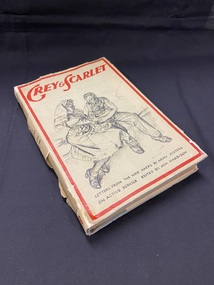
Book - Hardcover book, Ada Harrison, Grey & Scarlett : letters from the war areas by Army Sisters on active service, 1944
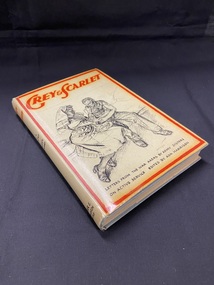
... Includes a forward written by Her Majesty Queen Mary and an introduction by Dame Katharine Jones (Matron in Chief of the Queen Alexandra's Imperial Military Nursing Service. '18' [Handwritten in blue ink on the top corner of the first page] 'Dorothy Verosta [?]' ...A collection of letters, diary extracts and accounts, written by Army Sisters on active service between 1940-1942. The nurses were members of Queen Alexandra's Imperial Military Nursing Service and the Territorial Army Nursing Service , they were recognised by the grey and scarlet uniforms they wore. Includes a forward written by Her Majesty Queen Mary and an introduction by Dame Katharine Jones (Matron in Chief of the Queen Alexandra's Imperial Military Nursing Service.Grey dust jacket covered hardback book. There is a red border around the front and the title printed in red across the top. The centre of the cover shows a hand-drawn image of a nurse tending a wounded patient at his bedside. The subtitle is printed across the bottom in black. The title is printed in red at the top of the spine and below that, in black print, it reads : 'with a forward by Her Majesty Queen Mary'.non-fictionA collection of letters, diary extracts and accounts, written by Army Sisters on active service between 1940-1942. The nurses were members of Queen Alexandra's Imperial Military Nursing Service and the Territorial Army Nursing Service , they were recognised by the grey and scarlet uniforms they wore. Includes a forward written by Her Majesty Queen Mary and an introduction by Dame Katharine Jones (Matron in Chief of the Queen Alexandra's Imperial Military Nursing Service. queen alexandra's imperial military nuring service, territorial army nursing service, army nurses, ww2, wwii, world war two -
 Returned Nurses RSL Sub-branch
Book - Hardcover book, Ada Harrison, Grey & Scarlett : letters from the war areas by Army Sisters on active service, 1944
... Includes a forward written by Her Majesty Queen Mary and an introduction by Dame Katharine Jones (Matron in Chief of the Queen Alexandra's Imperial Military Nursing Service. ...A collection of letters, diary extracts and accounts, written by Army Sisters on active service between 1940-1942. The nurses were members of Queen Alexandra's Imperial Military Nursing Service and the Territorial Army Nursing Service , they were recognised by the grey and scarlet uniforms they wore. Includes a forward written by Her Majesty Queen Mary and an introduction by Dame Katharine Jones (Matron in Chief of the Queen Alexandra's Imperial Military Nursing Service.Grey dust jacket covered hardback book. There is a red border around the front and the title printed in red across the top. The centre of the cover shows a hand-drawn image of a nurse tending a wounded patient at his bedside. The subtitle is printed across the bottom in black. The title is printed in red at the top of the spine and below that, in black print, it reads : 'with a forward by Her Majesty Queen Mary'.non-fictionA collection of letters, diary extracts and accounts, written by Army Sisters on active service between 1940-1942. The nurses were members of Queen Alexandra's Imperial Military Nursing Service and the Territorial Army Nursing Service , they were recognised by the grey and scarlet uniforms they wore. Includes a forward written by Her Majesty Queen Mary and an introduction by Dame Katharine Jones (Matron in Chief of the Queen Alexandra's Imperial Military Nursing Service. queen alexandra's imperial military nuring service, territorial army nursing service, army nurses, ww2, wwii, world war two -
 Returned Nurses RSL Sub-branch
Book - Hardcover book, Ada Harrison, Grey & Scarlett : letters from the war areas by Army Sisters on active service, 1944
... Includes a forward written by Her Majesty Queen Mary and an introduction by Dame Katharine Jones (Matron in Chief of the Queen Alexandra's Imperial Military Nursing Service. ...A collection of letters, diary extracts and accounts, written by Army Sisters on active service between 1940-1942. The nurses were members of Queen Alexandra's Imperial Military Nursing Service and the Territorial Army Nursing Service , they were recognised by the grey and scarlet uniforms they wore. Includes a forward written by Her Majesty Queen Mary and an introduction by Dame Katharine Jones (Matron in Chief of the Queen Alexandra's Imperial Military Nursing Service.Light bluish-grey hardback book. The only markings on the book are along the spine where it reads 'GREY AND SCARLET / Edited by ADA HARRISON / Hodder & Stoughton' in red text. The dustjacket is missing from this copy.non-fictionA collection of letters, diary extracts and accounts, written by Army Sisters on active service between 1940-1942. The nurses were members of Queen Alexandra's Imperial Military Nursing Service and the Territorial Army Nursing Service , they were recognised by the grey and scarlet uniforms they wore. Includes a forward written by Her Majesty Queen Mary and an introduction by Dame Katharine Jones (Matron in Chief of the Queen Alexandra's Imperial Military Nursing Service. queen alexandra's imperial military nuring service, territorial army nursing service, army nurses, ww2, wwii, world war two
