
Showing 8 items matching "medallion register"
-
 Dandenong & District Historical Society
Booklet - 1958 Annual Report & Balance Sheet Dandenong Football Club, Annual Report & Balance Sheet 1958
... ...Medallion Register...Annual Report Expenditure Medallion Register Annualo Report for 1958 Inside front cover Notes on Annual Meeting, Dandenong Town Hall Thursday 12th February, 1959 4pp Cover 12pp Text Annual Report Annual Report & Balance Sheet 1958 Booklet 1958 Annual Report & Balance Sheet Dandenong Football Club ...Annualo Report for 19584pp Cover 12pp Text Annual Reportnon-fictionAnnualo Report for 1958expenditure, medallion register -
 Lara RSL Sub Branch
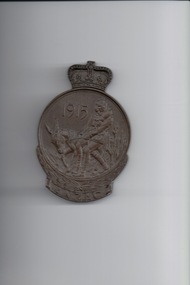
Medallion, W.H.Mathews, 1967
... The medallion was sent by registered post and comes in a presentation case with a moulded velvet base to receive the medallion, with a silk lined hinged lid....The medallion was sent by registered post and comes in a presentation case with a moulded velvet base to receive the medallion, with a silk lined hinged lid. ...Every Anzac soldier who served on the Gallipoli Peninsula, or in direct support of operations there - or his family if he did not survive until into the late 1960s - was entitled to be issued with the Anzac Commemorative Medallion. The Medallion was issued in 1967. The medallion was sent by registered post and comes in a presentation case with a moulded velvet base to receive the medallion, with a silk lined hinged lid.Medallion presented to all army personnel serving at GallipoliANZAC Medallion Badge issued in memory of W.H. MathewsThe obverse of the medallion depicts Simpson and his donkey carrying a wounded soldier to safety. It is bordered on the lower half by a laurel wreath above the word ANZAC and the date 1915 above the donkey. The reverse shows a map in relief of Australia and New Zealand superimposed by the Southern Cross. The lower half is bordered by New Zealand fern leaves and the name W.M. Mathewsmedallion, army, anzacs, australian army, world war 1, ww1, gallipoli -
 Flagstaff Hill Maritime Museum and Village
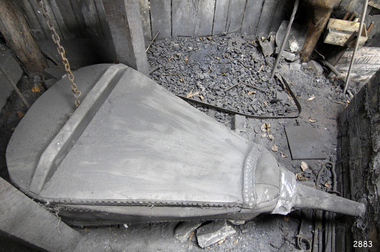
Functional object - Bellows, 1862-1875
... registered company in 1875. In 1876 an advertisements included that the company were smiths for hearths and tools in general and showed a row of six medallions including one with “Napoleon III, Emperor” and his portrait, and another “ _ _ _ 1862 MEDAL”. ...registered company in 1875. In 1876 an advertisements included that the company were smiths for hearths and tools in general and showed a row of six medallions including one with “Napoleon III, Emperor” and his portrait, and another “ _ _ _ 1862 MEDAL”. ...This bellows was used at the Warrnambool Racecourse by Master Farrier, Brian Chapman (1931-2017), during the 1970s but its history before then is still being investigated. The bellows have continued to be used from 1978 at Flagstaff Hill's blacksmith's workshop. Even today, in 2021, this same bellows are used by a volunteer blacksmith as he demonstrate the skills and tells of the importance of the blacksmith trade to colonial Australia. This 1860s double-action bellows is a typical form of blacksmith's or shipsmith's bellows. The end is forge-fitted with an iron nozzle or tube, called a tuyere or Tue iron, which concentrates the air to fan the fire or furnace. Tuyeres were traditionally made of cow horn. The double-action design of this bellows efficiently moves air both in and out of the chambers in the one movement of the long handle. The bellows was manufactured by John C. Onions of Birmingham, England, between 1862 and 1875. The stamp with the text, Gold Medal 1862, was also used on the business’ advertising. In 1875 the company was registered and began using the name John C. Onions Limited. JOHN C. ONIONS - John C. (Collingwood) Onions (1841-1904) was the son of a bellows maker of the same name. Onions (born 1841) and his wife Helen married in 1867 and they named one of their children John Collingwood Onions (1868-1913), as was the family tradition. He was well known as a Birmingham manufacturer of patented bellows and other forge-related equipment. He sold to the wholesale and retail markets for both local and overseas customers, including the British colonies. An 1862 advertisement points out that John C. Onions was a “Bellows manufacturer and contractor to Her Majesty’s Honourable Board of Ordinance” and His Imperial Majesty the Emperor of the French [Napoleon Bonaparte]”. The advertisement includes a sketched portrait of the Emperor Napoleon III, and an Imperial Autograph Letter dated May 23, 1854, from Napoleon, Palace of the Tulleries to Mr J C Onions of Bradford Street, Birmingham. In 1863 the company registered a patent on portable forges. In 1871 there were eight employees. John C. Onions Limited became a registered company in 1875. In 1876 an advertisements included that the company were smiths for hearths and tools in general and showed a row of six medallions including one with “Napoleon III, Emperor” and his portrait, and another “ _ _ _ 1862 MEDAL”. Their advertising motto was “For Excellence of Quality”. In 1885 the company merged with William Allday and Sons to become Allday and Onions. This mid-19th century bellows has local historical significance as it were once used by blacksmiths at the Warrnambool Racecourse in the annual racing event that continues today. This bellows is significant as a working example of equipment used in the 1800 and 1900s in the trace of blacksmiths and other metal working smiths. The bellows is technologically significant as it shows the progress from simple bellows to the double-action bellows, a time saving and efficient improvement. The manufacturer John C. Onions is historically significant as a family business that began in the 1600s and continued up until the 1980s.Bellows; large, oval, mechanical double-action smith’s bellows, manually operated, in working condition. The paddles of wood that form the top, middle sections and base of the bellows have flexible leather pieces attached firmly between them, forming airtight double lungs. Cut-outs in the panels allow the bellows to fill with air then force it out. A long handle is connected to pump the bellows and control the quantity and force of the air. The blasts of air are forced through the metal nozzle or tuyere at the end of the bellows and into the forge’s fire. Inscriptions are impressed into the wood on the upper paddle or board of the bellows. There are three circular stamps containing text. Text impressed in the wooden upper paddle of the bellows has been assumed to read “JOHN C. ONIONS, PATENTEES & MANUFACTURERS, BIRMINGHAM””?” “EXTRA” “AWARDED FOR EXCELLENCE OF QUALITY”, made from the following readable text :- “JOHN C ONIONS“ “PATENT - - - & MAN - - - - - - - - -“, “BIR - - - - HAM“, “ _ ERA - - - - “- XTRA-“, “- - - - - - - FOR EXCELL-“ “OF - - - - ITY” Text in the stamp “ - - ECE - - “, “ - - - - - / 1862 / MEDAL”, “- ITY” flagstaff hill, warrnambool, shipwrecked-coast, flagstaff-hill, flagstaff-hill-maritime-museum, maritime-museum, shipwreck-coast, flagstaff-hill-maritime-village, john collingwood onions, john c onions, allday and onions, bellows, smith’s bellows, 19th century bellows, double-action bellows, double-acting bellows, double lung bellows, double chamber bellows, blacksmith tools, blacksmith trade, blacksmith craft, blacksmith equipment, forging equipment, john c onions patented double-action bellows, brian chapman, warrnambool racecourse, blacksmith, shipsmith, iron smith, mechanical bellows -
 Kiewa Valley Historical Society
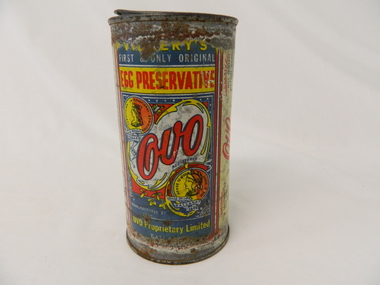
Tin Egg Preservative, from mid 1800's to mid 1900's
... REGISTERED" and in a double lined enclosed square "AWARDED TWO GOLD MEDALS" underneath is a sketch of a mixing dish containing fourteen visible eggs. The bottom label has within an oval boundary (white print on a blue background) "FOR HOUSEHOLD USE" underneath "OVO" and underneath "PRESERVES EGGS PERFECTLY WITHOUT MESS OR TROUBLE" On the opposite side of the tin is printed "VICKERY'S FIRST & ONLY ORIGINAL EGG PRESERVATIVE - in red print. Underneath this is a "round stamp" with the figurehead(royalty) and these encircling words" TASMANIAN INTERNATIONAL EXHIBITION" with a scrolled "GOLD MEDAL HOBART 1895" with another medal like "medallion...REGISTERED" and in a double lined enclosed square "AWARDED TWO GOLD MEDALS" underneath is a sketch of a mixing dish containing fourteen visible eggs. The bottom label has within an oval boundary (white print on a blue background) "FOR HOUSEHOLD USE" underneath "OVO" and underneath "PRESERVES EGGS PERFECTLY WITHOUT MESS OR TROUBLE" On the opposite side of the tin is printed "VICKERY'S FIRST & ONLY ORIGINAL EGG PRESERVATIVE - in red print. Underneath this is a "round stamp" with the figurehead(royalty) and these encircling words" TASMANIAN INTERNATIONAL EXHIBITION" with a scrolled "GOLD MEDAL HOBART 1895" with another medal like "medallion ...The egg preservation material offered in this tin was during a period in Australia's history (especially in the rural areas) when the "freshness" of produce was not able to be maintained by refrigeration means. Rural towns did rely on the "Ice Works" providing block ice for prolonging "produce shelf life" however semi remote and smaller communities did not have that facility. It was products such as this egg preserving ability that enabled these smaller rural communities to maintain a constant source of healthy "short life" organic produce.This tin which contained egg preservative powder is very significant to a rural region (Kiewa Valley) in the late 1800's to early 1900's. It details the type of food preservative methods that were available to rural areas which lacked proper refrigeration means at their disposal. Basic foodstuff which required "special" preservation means to extend their "shelf" life were sometimes regarded as luxuries by semi remote communities. Kiewa Valley and its regions were typical of these remote communities in the time frame of this egg preservation product. The ability to keep products that deteriorate due to "normal" outdoor temperature (bacterior prone produce) was a factor of rural living.This round "tubular" tin has a indented lid which fits snugly into the top opening. The lid has a rolled out lip which ensures a degree of "air" tightness. The tin is pressed and folded together and has no synthetic inner cover to protect the egg preservative powder from the raw tin surface. This "raw" method was the typical application for all tins containing dry food stuffs in this period(mid 1900's) of goods manufacture. The outer tin surface has a tightly pressed laminated paper label with product and manufacturer's information (promotional, preservation "tips" and usage details - will preserve sixteen dozen eggs). On the "front" side "EGG PRESERVATIVE" underneath "OVO" ,underneath "REGISTERED" and in a double lined enclosed square "AWARDED TWO GOLD MEDALS" underneath is a sketch of a mixing dish containing fourteen visible eggs. The bottom label has within an oval boundary (white print on a blue background) "FOR HOUSEHOLD USE" underneath "OVO" and underneath "PRESERVES EGGS PERFECTLY WITHOUT MESS OR TROUBLE" On the opposite side of the tin is printed "VICKERY'S FIRST & ONLY ORIGINAL EGG PRESERVATIVE - in red print. Underneath this is a "round stamp" with the figurehead(royalty) and these encircling words" TASMANIAN INTERNATIONAL EXHIBITION" with a scrolled "GOLD MEDAL HOBART 1895" with another medal like "medallion" showing another female face with a "warrior" headdress and these encircling words "HONOR TO WHOM HONOR IS DUE". Below this within a scrollis printed "GOLD MEDAL BALLARAT 1896" underneath this is printed "MANUFACTURED BY OVO PROPRIETARY LIMITED BALLARAT"egg preservation, rural food storage, kitchen preservation facilities -
 Bendigo Military Museum
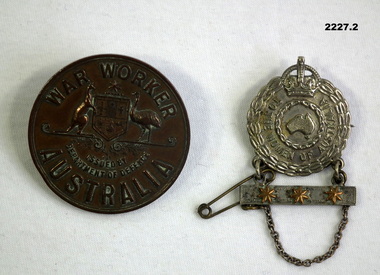
Badge - FEMALE RELATIVE BADGE, WAR WORKER MEDALLION, 1940
... A number of the back appears in a register that records the name of the holder. .2) Three stars denotes 3 members of the family in the army in 1939 - 1945. Badages medallions ...The badge (on the right) is a Female Relatives Badge from the Second World War and the stars represent the number of serving individuals related to the holder of the badge. A number of the back appears in a register that records the name of the holder. .2) Three stars denotes 3 members of the family in the army in 1939 - 1945..1) Badge, brassround with 2 lugs on rear. Front has "War Worker Australia". Centre is coat of arms. On rear is "Navies & Labourers". Stamped numbered badge. .2) Female relative badge. Metal, silver colour, round shape with crown. wreath arrangement with map of Australia centre. Rear has pin attached. Attached by two small chains is a clasp with 3 small bronze stars. Rear of badge is stamped..1) :"Issued by the department of defence, 618. .2) Front "To the Women of Australia" Rear "Issued by the C/Weath Govt. A6800badages, medallions, female, relative, war workers -
 Royal Australian and New Zealand College of Obstetricians & Gynaecologists (RANZCOG)
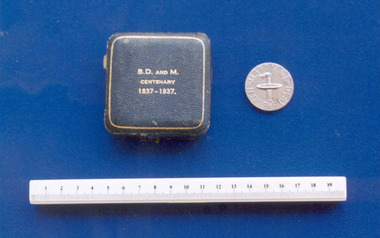
Medal - Commemorative medal celebrating the centenary of the Births, Deaths and Marriages Registration Act, 1937, Royal Mint, c. 1937
... Register Office and a new system of national registration of births, marriages and deaths to take effect from 1837. There was a need to set up a system to record births, to aid with the planning of services and to record deaths to enable further study on the causes of mortality. The accurate recording of births and deaths was to be a vital tool in improving population health and would later enable systematic interventions such as vaccination, as well as aiding research and data analysis. ('1836 Registration Act') Numismatics Round silver medallion with presentation case. ...The Registration Act 1836 established the General Register Office and a new system of national registration of births, marriages and deaths to take effect from 1837. There was a need to set up a system to record births, to aid with the planning of services and to record deaths to enable further study on the causes of mortality. The accurate recording of births and deaths was to be a vital tool in improving population health and would later enable systematic interventions such as vaccination, as well as aiding research and data analysis. ('1836 Registration Act')Round silver medallion with presentation case. Front of medal features portraits of King George VI and Queen Elizabeth in profile. Text encircling the portraits reads 'BIRTHS & DEATHS REGISTRATION & MARRIAGES ACTS". Back of medal carries a lit torch design at centre, encircled by the text "BIRTH . MARRIAGE . DEATH". Presentation case is a square, green, leather box with cream satin and beige velvet lining. There is a central depression within the case in which the medallion sits. Text printed on upper surface of box lid reads "B.D. and M./CENTENARY/1837-1937". Royal Mint insignia stamped in gold inside lid.numismatics -
 Anglesea and District Historical Society
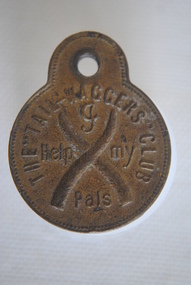
Tailwaggers Club Identification Tag
... registered / no. (edge) Latham House, 234 Swanston St, Melb. Back: (Centre) Crossed Tails / J / Help my / Pals (edge) The Tail-Waggers Club. Circular medallion ...Circular medallion with flange at top with hole (for attachment).Front: (Centre) If I'm / lost ring / FB3626 / 59027 / is my / registered / no. (edge) Latham House, 234 Swanston St, Melb. Back: (Centre) Crossed Tails / J / Help my / Pals (edge) The Tail-Waggers Club.tailwaggers, registered no 59027 -
Tatura Irrigation & Wartime Camps Museum
Document, Tatura Est School Records and Photographs, 1879
... Toolamba West State School Records from 1879-1960. 2 plaques, 1 medallions, 4 photograph albums big, 3 flip photograph albums, pupils register x 3, 1 school t shirt, 2 books, 1 inspectors report and book, 1 teacher information book (not to be displayed, 1 newspaper clipping....Toolamba West State School Records from 1879-1960. 2 plaques, 1 medallions, 4 photograph albums big, 3 flip photograph albums, pupils register x 3, 1 school t shirt, 2 books, 1 inspectors report and book, 1 teacher information book (not to be displayed, 1 newspaper clipping. ...Toolamba West State School later known as Tatura East State SchoolTatura East School Records and photographs. Toolamba West State School Records from 1879-1960. 2 plaques, 1 medallions, 4 photograph albums big, 3 flip photograph albums, pupils register x 3, 1 school t shirt, 2 books, 1 inspectors report and book, 1 teacher information book (not to be displayed, 1 newspaper clipping.
