
Showing 11 items matching "medical dental training"
-
 4th/19th Prince of Wales's Light Horse Regiment Unit History Room
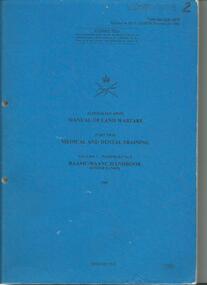
Booklet, Manual of Land Warfare Part 2 Medical & Dental Training Vol 3 Pam No 3 RAAMC/RAANC Handbook (Other Ranks) 1984, 1984
... Manual of Land Warfare Part 2 Medical & Dental Training Vol 3 Pam No 3 RAAMC/RAANC Handbook (Other Ranks) 1984...medical dental training...medical dental training 7610-66-122-4275 Soft covered booklet aimed at providing doctrine for the employment of medical and nursing assistants Manual of Land Warfare Part 2 Medical & Dental Training Vol 3 Pam No 3 RAAMC/RAANC Handbook (Other Ranks) 1984 Booklet ...Soft covered booklet aimed at providing doctrine for the employment of medical and nursing assistants7610-66-122-4275medical dental training -
 Bendigo Military Museum
Book - BOOKS, BOXED SET, Graham R McKenzie - Smith, The Unit Guide, 2018
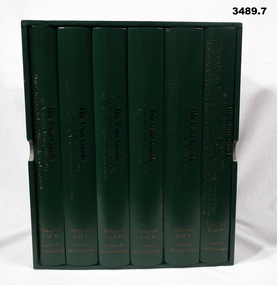
... Medical and Signal Units. Box of 6 books. The Unit Guide / The Australian Army / 1939 - 1945. 654 pages .6) Volume 5 of 6. Aust Army Service Corps, Aust Army Ordnance Corps and Aust Electrical & Mechanical Engineer Units. 706 pages. .7) Volume 6 of 6. Womens Services / Volunteer Defence Corps / War Graves, Survey, Labour, Salvage / Military Policing / Recruiting & Training / Dental...Medical and Signal Units. Box of 6 books. The Unit Guide / The Australian Army / 1939 - 1945. 654 pages .6) Volume 5 of 6. Aust Army Service Corps, Aust Army Ordnance Corps and Aust Electrical & Mechanical Engineer Units. 706 pages. .7) Volume 6 of 6. Womens Services / Volunteer Defence Corps / War Graves, Survey, Labour, Salvage / Military Policing / Recruiting & Training / Dental ....1) Box open, cardboard, dark green buckram, white paper lining, gold print on sides. .2) - .7) Hard cover book, cardboard, dark green buckram with gold print on front cover & spine. Pages are plain, cut, white, black print, black & white illustrations. .2) Volume 1 of 6. Unit & Location Indexes / Bibliography, Orders of Battle. 483 pages. .3) Volume 2 of 6. Headquarters, Infantry, Cavalry / Armoured & Intelligence Units. 605 pages. .4) Volume 3 of 6. Artillery, Air Defence and Engineer Units. 626 pages. .5) Volume 4 of 6. Medical and Signal Units. Box of 6 books. The Unit Guide / The Australian Army / 1939 - 1945. 654 pages .6) Volume 5 of 6. Aust Army Service Corps, Aust Army Ordnance Corps and Aust Electrical & Mechanical Engineer Units. 706 pages. .7) Volume 6 of 6. Womens Services / Volunteer Defence Corps / War Graves, Survey, Labour, Salvage / Military Policing / Recruiting & Training / Dental, Bath & Laundry / Veterinary & Animal / Movements & Transit / Pay, Records & Printing, Postal / Amenities & Canteens Units. 568 pages. books- military history, unit guide -
 Bendigo Military Museum
Pamphlet - PAMPHLETS, ARMY APPRENTICE, c.1960 - 1963
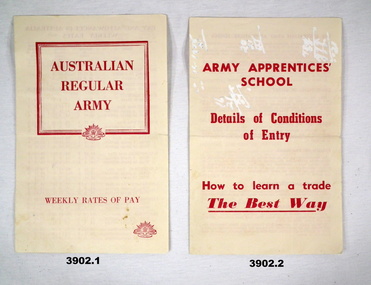
... Pamphlet, folding, printed in red showing rates of weekly pay in pounds / shillings / pence, from a Band Boy through to a Warrant Officer Class 1. .2) Pamphlet, folding, printed in red detailing 4 year Army Apprenticeships, conditions, rations, training, pay, medical, dental,amenities, sport....Pamphlet, folding, printed in red showing rates of weekly pay in pounds / shillings / pence, from a Band Boy through to a Warrant Officer Class 1. .2) Pamphlet, folding, printed in red detailing 4 year Army Apprenticeships, conditions, rations, training, pay, medical, dental,amenities, sport. Pamphlet PAMPHLETS, ARMY APPRENTICE ...1.) Pamphlet, folding, printed in red showing rates of weekly pay in pounds / shillings / pence, from a Band Boy through to a Warrant Officer Class 1. .2) Pamphlet, folding, printed in red detailing 4 year Army Apprenticeships, conditions, rations, training, pay, medical, dental,amenities, sport..1) Printed in red on front: “AUSTRALIAN REGULAR ARMY, WEEKLY RATES OF PAY” Bottom R: “Rising Sun badge” .2) Printed in red on front: “ARMY APPRENTICES' SCHOOL” “Details of Conditions of Entry. How to learn a trade The Best Way”pamphlets, army apprenticeship, rates, conditions -
 Waverley RSL Sub Branch
R.A.A.F. Long Service Medal
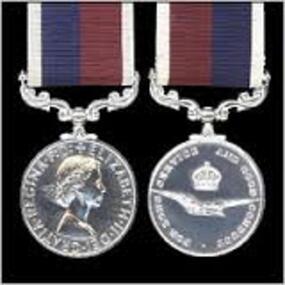
... dental clinics being established around Australia. Priority was given to aircrew training units in order to get these personnel dentally fit for operational deployment, but Dental Officers could equally find themselves posted to recruit depots, fixed stations, medical clearance stations, mobile dental sections, and RAAF and civilian hospitals. ...Awarded to Alan Bowers (A236814) who was a R.A.A.F. dental mechanic who serverd during WWII including service in Darwin, and then continued in the R.A.A.F. for some years after the end of WWII The Royal Australian Air Force (and all Commonwealth Air Forces) Long Service and Good Conduct Medal: Awarded to NCOs and ORs of the RAAF (RAF, RCAF etc) for 15 years service. A cupro-nickel plated medal, the obverse features the sovereign's head, the reverse features the crown and eagle emblem of the RAAF (and RAF). Officers are eligible for the award provided they have served a minimum 12 years in the ranks. The riband is dark blue and maroon with white edges. This medal ceased to be awarded in Australia in 1975 when it was replaced by the National Medal (and sbsequently the DFSM and DLSM) in the Australian system of honours and awards. http://www.heritagemedals.com.au/medals-1/service-long-service/air-force-long-service-and-good-conduct-medal.html History of the RAAF Dental Branch It took six years following the formation of the RAAF in 1921 for the first Dental Clinic to be established at Point Cook, Victoria. On 10th June 1927 Flying Officer James Carl Rosenbrock commenced work as an RAAF Dental Officer for the FlyingTraining School at Point Cook. As personnel numbers were still relatively small, Rosenbrock was also responsible for the dental care of all Victorian RAAF units, which involved treating members at 1AD Laverton, as well as Air Force Headquarters at Victoria Barracks in Melbourne. As Army Dental Officers were currently caring for RAAF personnel at Richmond, NSW, the Senior Dental Officer of the 3rd Military District in Victoria (SDO 3MD) requested through the military board that a similar arrangement be established, where that the newly appointed RAAF Dentist provide part time dental services to the Army units stationed at Queenscliff. This was seen as an effective reciprocal arrangement, with both units having a Dental Officer in attendance for, in total, around 3-4 weeks a year. Rosenbrock continued to serve as the sole RAAF Dental Officer until the middle of 1933, when the Air Board asked for his service to be terminated following ‘behaviour unbecoming of a RAAF officer'. He had borrowed several sums of money, of around 40 Pounds or so, from junior ranks on base (as well as from the Regimental Sergeant Major) and had failed to pay the money back. He was replaced by a fellow Victorian, FLGOFF Norman Henry Andrews, on the 18th Sep 1933, who went on to become our first Director of Dental Services, and was instrumental in establishing the organisations and conditions of the Branch that are still present today. Through a fair amount of persistence and hard work on the part of Norman Andrews, the RAAF Dental Branch began to expand from 1937, with the introduction of 2 additional positions, at RAAF station Richmond, and at the FlyingTraining School at Point Cook. This gave the RAAF 3 uniformed Dental Officers, which was expanded to 5 in the months leading up to WW2. 4 of these Dental Officers were based in Victoria and 1 at Richmond, with the other two RAAF units being cared for by the Army (as in the case of Pearce in WA) or by civilians (as in Darwin). With the sudden increase in RAAF personnel required at the outbreak of WW2, the number of RAAF Dental Officers increased dramatically, from 5 in 1939, 28 in 1940, 64 in 1941, 147 in 1942, 193 in 1943, 219 in 1944, and peaking at 227 in 1945. RAAF Dental Officers were required to work in a variety of locations, both in and out of Australia. Between 1940 and 1942 a massive construction programme occurred, with new dental clinics being established around Australia. Priority was given to aircrew training units in order to get these personnel dentally fit for operational deployment, but Dental Officers could equally find themselves posted to recruit depots, fixed stations, medical clearance stations, mobile dental sections, and RAAF and civilian hospitals. RAAF Dental Officers were posted to the large dental centres at Ascot Vale (Vic) and Bradfield Park (NSW) when first appointed, where they received military and clinical training, before being deployed to their needed location. Mobile Dental Units When Japan entered the war in 1941, the rapid deployment of troops to northern operational areas with less than ideal dental fitness was extremely high. As a result, the RAAF deployed a range of mobile dental units, either alone or with medical sections, to support the increasing number of isolated deployed personnel within Australia and overseas. There were three types of mobile unit used: a. Mobile Dental Unit – relied on using either a semi-trailer to get around or by building a surgery directly on to the truck chassis, and installing hydraulic chairs, units, x-rays, and laboratory equipment. They were able to move around between small units, such as RAAF radar stations, where they could plug into the local power supply and work immediately. b. Transportable Dental Units – used for stops of longer duration, where field equipment was carried in panniers from one unit to another by road or rail and housed in whatever accommodation was available at the destination. They were often carried within Australia on Tiger Moths and Dakota aircraft. c. Itinerant Dental Units – in some areas, the dental equipment was installed at the RAAF unit and the Dental Officer and their staff would travel from unit to unit, using the equipment available at each location. RAAF Dental BadgeAs the war developed in Europe, it soon became obvious that the RAF Dental support was not capable of supporting the increasing numbers of RAAF aircrew that were being sent for service with the RAF, with only enough Dental Officers available to provide one to every 2000 men ( instead of the preferred 1 to 600). As a result, the RAAF provided a mobile dental unit, fitted out in a caravan and pulled by a Ford V8 Coupe, to travel around England in support of RAAF personnel at various squadrons. Some degree of tact was needed to ensure that the RAF did not take this as a comment on the treatment they were providing, but it proved successful in maintaining a satisfactory state of dental fitness in RAAF personnel, and a second mobile unit was soon dispatched. They were also set up with a laboratory on board as well as the surgery, which was a major difference between the RAF and RAAF, as the RAF did not provide dentures for their troops (the RAAF would, providing they had served for 6 years). In 1943 the RAF was no longer able to provide Dental support to Australian troops in the Middle East, which resulted in the need for a transportable dental unit to be deployed from Australia. It functioned in a similar manner to the RAF, by moving from one squadron to another. It served in the Middle East and Africa, from Cairo across North Africa, to Italy, and eventually back to England to treat returned prisoners of war. GPCAPT Norman Andrews The growth and development of the RAAF Dental Branch owes a debt to one man in particular, GPCAPT Norman Andrews. As the second RAAF Dental Officer to enlist on 18 Sep 1933, Andrews became the principal architect of the structure and organisation of the RAAF Dental Branch leading up to and during WW2. Until early 1940, the RAAF Dental Branch was administered by the Director of Medical Services (Air), which placed it under the control of the Army Medical staff. The Army would provide their Inspector of Dental Services for advice whenever needed. In April 1940, the RAAF Medical service separated from the Army, resulting in the control of the RAAF Dental Branch shifting back to the RAAF. Andrews became the first Director of Dental Services, when the position was created in 1943 as recognition of the higher profile the Dental Branch was now playing in the RAAF Medical service. Until this time, Andrews's title had been as the Dental Staff Officer to the RAAF Medical Service. Andrews was responsible for the establishment of the war-time structure of the Dental service, establishing new dental centres at all major bases, creating mobile and transportable dental units, ensuring the continual growth of the Branch, maintaining professional development of staff through the establishment of a professional journal, and by organising renowned lecturers to speak at RAAF bases. He also believed in visiting as many dental units as possible to see for himself what conditions were like and to talk first-hand to staff in remote units. His itinerary during the war years, both in and out of Australia, shows a large number of trips in a variety of modes of transport in order to reach remote areas where units were serving. He was promoted to GPCAPT in July 1944, as the numbers of Dental Officers soon peaked at 227 towards the end of the war (1 GPCAPT, 9 WGCDRs, 60 SQNLDRs, and 157 FLTLTs). After the war, with the reduction in RAAF personnel required in uniform, the Dental Branch also reduced its numbers significantly. By 1947 there were only 18 Dental Officers serving (many part-time), with 1 GPCAPT, 1 WGCDR, 10 SQNLDRs, and 6 FLTLTs, and only 13 by 1950. With the decrease in Branch personnel numbers, the ‘powers to be' saw fit to reduce the Director of Dental Service rank to WGCDR, and as a result Norman Andrews found that in order to continue serving in the RAAF he would have to wear a reduced rank. This appears to have been a contributing factor in his decision to discharge at the relatively early age of 43 and accept an administrative job as Director of the Victorian Government's School Dental Service. Norman Andrews holds the proud honour of being the founder of the RAAF Dental Branch, which during the war was instrumental in educating servicemen of the importance of dental health and maintaining the dental fitness of troops in a variety of areas. Dental Orderlies (Assistants) The dental orderly mustering was first introduced in 1937. Until that time, medical orderlies were assigned to assist the Dental officer with their duties. As early as 1931 it had been noted by both RAAF and Army Dental Officers working in Victoria and Richmond that a lot of the troubles they were having would be solved by appointing a permanent Dental Orderly. Often they would find that the medical orderly they were assigned was a different one each day, and as a result the administration and work in general was very inefficient. By 1937, with the increase in Dental Officers to 3, it was realised that a Dental Orderly mustering needed to be created. Dental Mechanics/Technicians Before WW2, dental laboratory work was provided by civilian laboratories, as most RAAF units were stationed around metropolitan areas. At this time, service personnel were still required to pay for their own dentures, unless they had served for six years or had their dentures damaged during performance of their duties. In July 1940, mainly in response to the development of more remote RAAF dental units and the increasing demand for dental prostheses, the Dental Mechanic mustering was established. Unfortunately there was a very limited pool of civilian dental mechanics to recruit from, and as a result the RAAF set up a training school at Laverton (which was later moved to Ascot Vale) in June 1941 which conducted an intensive 6 month course in Dental mechanics. Dental mechanics were quickly in demand. In all fixed and mobile dental units at least 1 Mechanic was supplied for each Dental Officer, and indeed the RAAF supplied Dental Mechanics throughout all its deployments, something the RAF were unwilling, or unable, to do. Two grades of dental mechanic existed: the Senior Mechanic (with the rank of NCO), who was competent in all phases of laboratory work; and the Junior Mechanic, who could only handle routine work and not more advanced denture work. The progression to Senior required a further trade test in techniques including setting up, clasp-forming, casting and backing teeth. During the course of the War, two special courses were held for Mechanics. The first, directed at senior mechanics so that they could instruct others, was in 1942 when Acrylic Resin was first introduced as a denture base material, as an alternative to the current option of vulcanite. Later, towards the end of the War, a ‘refresher' course was provided for those that had served for the greatest period of time in order to allow them retraining in techniques that they had not practised during their service and which were common in civilian life. This included cast base dentures, crowns and bridges, partial dentures, and retainers. Towards the end of the War, a course was held with WAAAF trainees to train them as Mechanics. However, as the War was soon to end they never had the opportunity to progress within the mustering to become Senior Mechanics. The RAAF Dental Branch has survived 75 years of turbulence, with reviews of its viability occurring regularly every few years from as early as 1937. The Branch continues to provide excellent service to the ADF community and, despite reduced manpower, will continue to play an important role in Air Force Health operations. http://www.defence.gov.au/health/about/docs/RAAFDental.pdf40cm cupro-nickel plated medal, the obverse features the sovereign's head, the reverse features the crown and eagle emblem of the RAAF (and RAF). A23814 BOWERS.A. A. F.r.a.a.f long service medal, r.a.a.f good conduct, r.a.a.f. dental service medal -
 Bendigo Military Museum
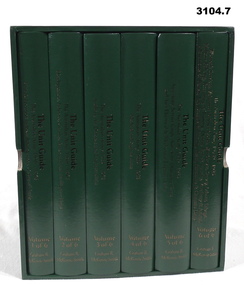
Book - BOOKS, BOXED SET OF 6, Graham R McKenzie - Smith, The Unit Guide, 2018
... Medical & Signals Units. .6) Volume 5 of 6. Aust Army Service Corp, Aust Army Ordnance Corp & Aust Electrical & Mechanical Engineer Units. .7) Volume 6 of 6. Women's Services, Volunteer Defence Corps, War Graves Survey, Labour Salvage, Military Policing, Recruiting & Training, Dental, Bath & Laundry, Veterinary & Animal, Movements & Transit, Pay, Records & Printing & Postal, Amenities & Canteens Units....Medical & Signals Units. .6) Volume 5 of 6. Aust Army Service Corp, Aust Army Ordnance Corp & Aust Electrical & Mechanical Engineer Units. .7) Volume 6 of 6. Women's Services, Volunteer Defence Corps, War Graves Survey, Labour Salvage, Military Policing, Recruiting & Training, Dental, Bath & Laundry, Veterinary & Animal, Movements & Transit, Pay, Records & Printing & Postal, Amenities & Canteens Units. ...Boxed set of 6 books. The Unit Guide, The Australian Army 1939 - 1945. .1) Box, open, cardboard, dark green buckram, white paper lining, gold print on sides. .2) - .7) Hard cover book, cardboard, dark green buckram with gold print on front cover & spine. Pages plain cut, black print, black & white illustrations. .2) 483 pages. .3) 605 pages. .4) 626 pages. .5) 654 pages. .6) 706 pages. .7) 568 pages..2) Volume 1 of 6. Unit & Location Indexes, Bibliography, Orders of Battle .3) Volume 2 of 6. Headquarters, Infantry, Cavalry, Armoured & Intelligence Units. .4) Volume 3 of 6. Artillery, Air Defence & Engineer Units. .5) Volume 4 of 6. Medical & Signals Units. .6) Volume 5 of 6. Aust Army Service Corp, Aust Army Ordnance Corp & Aust Electrical & Mechanical Engineer Units. .7) Volume 6 of 6. Women's Services, Volunteer Defence Corps, War Graves Survey, Labour Salvage, Military Policing, Recruiting & Training, Dental, Bath & Laundry, Veterinary & Animal, Movements & Transit, Pay, Records & Printing & Postal, Amenities & Canteens Units.books-military-history, units, 1939 - 45 -
 Royal Australian and New Zealand College of Obstetricians & Gynaecologists (RANZCOG)
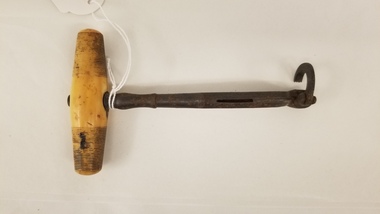
Tool - Tooth extractor associated with midwife Mary Howlett, c. 1866 - 1920
... Medical Instruments', 1979, p. 204-205.) Mary Howlett (1840-1922) began practising as a country midwife in 1866 in the western district of Victoria. She qualified as a 'ladies monthly nurse' in 1887 and continued to practise as a nurse and midwife until 1920.She began her six months training at the Melbourne Lying-In Hospital. She was known by many as 'Auntie', and her career spanned more than 50 years. Mrs Howlett's midwifery box and contents were given to Dr Frank Forster, and he donated them to the museum collection in 1993. Midwifery Dentistry Dental ...Tooth elevators and extractors were first used in Greece in the 11th and 12th centuries. Many of these instruments were named after birds (eg. the Pelican) or objects which they resembled (eg. screws, keys, toothkey hooks). In France, the instrument is also referred to as a "clef anglais". (Bennion, Elizabeth. 'Antique Medical Instruments', 1979, p. 204-205.)Mary Howlett (1840-1922) began practising as a country midwife in 1866 in the western district of Victoria. She qualified as a 'ladies monthly nurse' in 1887 and continued to practise as a nurse and midwife until 1920.She began her six months training at the Melbourne Lying-In Hospital. She was known by many as 'Auntie', and her career spanned more than 50 years. Mrs Howlett's midwifery box and contents were given to Dr Frank Forster, and he donated them to the museum collection in 1993.Dental instrument consisting of a metal shaft with small hook attachment and bone or ivory handle. midwifery, dentistry -
 Melbourne Legacy
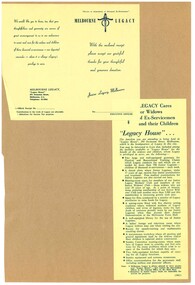
Document, Thank you note to donors and a flyer, 1965
... dental examinations and treatment. Free medical examinations are carried out here too. Meeting rooms for Junior Legacy Mothers' Club and Senior Widows Club (those over 50 years of age). When printed the Senior Widows Club numbered more than 5,200. It mentions room for fetes run by a number of auxiliaries to raise funds. Also a sewing room fitted with 5 electric sewing machines to make costumes for the Annual Demonstration. A well equipped library for use of the Junior Legatees. A ladies lounge and television room where widows may rest when visiting the city. Rooms for speech training...dental examinations and treatment. Free medical examinations are carried out here too. Meeting rooms for Junior Legacy Mothers' Club and Senior Widows Club (those over 50 years of age). When printed the Senior Widows Club numbered more than 5,200. It mentions room for fetes run by a number of auxiliaries to raise funds. Also a sewing room fitted with 5 electric sewing machines to make costumes for the Annual Demonstration. A well equipped library for use of the Junior Legatees. A ladies lounge and television room where widows may rest when visiting the city. Rooms for speech training ...A copy of note that was given to donors to thank them for their donations it was sent with their receipt. Was part of a folio of proforma stationery from the 1960s. The flyer gives some information about Legacy House. It mentions the facilities available for the benefit of widows and children. Including two large well equipped gymnasia which are attended by more than 700 junior legatees each week. A dental clinic were Junior Legatees under 17 years of age are able to receive free dental examinations and treatment. Free medical examinations are carried out here too. Meeting rooms for Junior Legacy Mothers' Club and Senior Widows Club (those over 50 years of age). When printed the Senior Widows Club numbered more than 5,200. It mentions room for fetes run by a number of auxiliaries to raise funds. Also a sewing room fitted with 5 electric sewing machines to make costumes for the Annual Demonstration. A well equipped library for use of the Junior Legatees. A ladies lounge and television room where widows may rest when visiting the city. Rooms for speech training and mathematics coaching classes. A maintenance workshop where all sporting and general equipment used by widows and children can be repaired and/or constructed. Sundry committee meeting rooms where members of Legacy meet to consider and find solutions for the many problems which arise in respect of the families they care for. Sundry equipment and costume storerooms. Office accommodation for permanent staff including welfare and pension officers. Was compiled in a folio of proforma stationery. A similar set of proformas are at 00338.A record of forms and items used in Legacy's business practices in the 1960s.Yellow brochure thanking donors and a flyer about Legacy pasted on brown paper from a folio of forms and brochures from the 1960s.Pencil mark '1960/1'.proformas, stationery, forms, dureau house -
 Northern District School of Nursing. Managed by Bendigo Historical Society Inc.
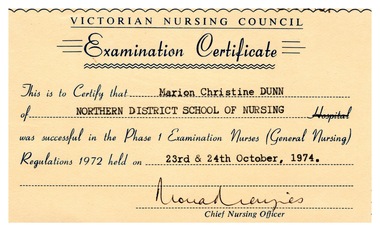
Administrative record - Northern District School of Nursing Progress Report for Nurse M. C. Dunn and other items pertaining to her exams, 1974
... Marion has been accepted into the Preliminary Training School at the Northern District School of Nursing. Medical and Dental ApprovalHer medical and dental certificates have been reviewed and approved. ...Marion has been accepted into the Preliminary Training School at the Northern District School of Nursing. Medical and Dental ApprovalHer medical and dental certificates have been reviewed and approved. ...Managed by a committee including hospital administrators, medical professionals, and nursing leaders from several regional hospitals. Associated with major hospitals in the Northern District, including Bendigo Base, Mildura Base, Castlemaine, Echuca, Swan Hill, St. Arnaud, and Kyneton District Hospitals. Provide high-quality theoretical and practical nursing training. Raise the standard of nursing education in the region. Maintain the highest principles of nursing practice. Applicants must be at least 17 years old and hold a Proficiency Certificate or higher educational qualification. Application involves submitting forms, certificates, an interview, an aptitude test, and a medical examination. A three-month probationary period follows initial acceptance. Preliminary Training School: Four-week introductory course covering basic nursing, anatomy, hygiene, and practical skills. Practical experience in various hospital departments, guided by senior staff. Study Block Plan: Includes several blocks of theoretical and practical instruction throughout the three-year program. Regular school exams and two state exams (First Professional and Final State) are required for progression and graduation. Nurses work a 40-hour week with at least one or two days off per week and three weeks of annual leave. Accommodation is provided in comfortable hostels with good facilities. Uniforms are supplied free; nurses provide their own shoes and stockings. Salaries and allowances are regulated, with deductions for board and free medical care. Additional Information Post-Graduate Opportunities. Senior positions require further experience and additional certificates (e.g., Midwifery, Infant Welfare).Diploma courses available in administration, teaching, and specialized nursing fields. Bursaries are available for advanced study.Career Prospects: Graduates can pursue roles in administration, teaching, ward and departmental leadership, district and visiting nursing, industrial and school nursing, and more. Opportunities exist both within hospitals and in community or specialized settings.FAQs and Practical Details. Minimal training costs (mainly exam fees and personal items).Living out allowances and travel expenses are covered. Four training intakes per year; waiting periods are short if qualifications are met.Northern District School of Nursing Progress Report for Nurse M. C. Dunn and other items pertaining to her exams. This item contains the following six documents: 3791.15a This document is a progress examination report for Nurse M.C. Dunn from the Northern District School of Nursing, summarizing her performance in the Phase 1 Progress Examination held in July 1974. Examination Results Outstanding Performance Passed both Anatomy & Physiology and General Nursing with distinction. Eligible to attend the First Year Study Block and required to sit for the First Professional State Examination in October 1974. Chemistry & Physics will be included in the upcoming examination, with no repeat lectures during the study block. Examiner's General Comments: Anatomy & PhysiologyMost questions were well answered, especially on tissue distribution, limb movement, and muscle functions.Areas needing revision: functions of the skin, diagrams (vertebra, kidney, leaf), function of chordae tendinae, factors maintaining venous return, difference between inspired and expired air, and formation/circulation of cerebrospinal fluid. Some gaps in knowledge about blood volume, urea formation, and water contamination. Generally strong answers on patient care, conversions between measurement systems, and infection prevention.Areas for improvement: dilution of lotions, suitable lotions for skin prep, definitions of pH and specific gravity of urine, and details on sterilization (especially destruction of spores). Good understanding of pressure sore prevention, patient bathing, and care of valuables, though some answers lacked detail or used outdated expressions. 3791.15b This document is a formal acceptance letter addressed to Marion from the Northern District School of Nursing. Marion has been accepted into the Preliminary Training School at the Northern District School of Nursing. Medical and Dental ApprovalHer medical and dental certificates have been reviewed and approved. Marion is scheduled to begin training on 4th February. She is expected to attend on Thursday, 31st January, 1974, prior to the official start. 3791.15c The Victorian Nursing Council's examination instructions for nursing candidates 3791.15d Invitation to a dinner to congratulate the 1973 pilot students in their examination successes 3791.15e Signature of Examiner Card Victorian Nursing Council 3791.15f Examination certificate from the Victorian Nursing Councilnurse training, lister house, marion dunn -
 Northern District School of Nursing. Managed by Bendigo Historical Society Inc.
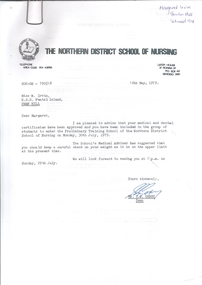
Document - NDSN Staff Nurse Course - letter to Miss Margaret Irvin to attend the Preliminary Training School of NDSN on Monday 30 July 1979, 18th May 1979
... Gerry, Dean of NDSN, to Miss Margaret Irvin; to attend the Preliminary Training School of the NDSN on Monday 30 July 1979; with NDSN (medical, dental, birth certificate, and education) requirements over ten pages. ...Gerry, Dean of NDSN, to Miss Margaret Irvin; to attend the Preliminary Training School of the NDSN on Monday 30 July 1979; with NDSN (medical, dental, birth certificate, and education) requirements over ten pages. ...The Northern District School of Nursing opened in 1950 to address the issues around nurse recruitment, training and education that had previously been hospital based. The residential school was to provide theoretical and in-house education and practical training over three years. The students would also receive practical hands-on training in the wards of associated hospitals. The Northern District School of Nursing operated from Lister House, Rowan Street, Bendigo. It was the first independent school of nursing in Victoria and continued until it closed in 1989. Northern District School of Nursing letter from Mr. S. G. Gerry, Dean of NDSN, to Miss Margaret Irvin; to attend the Preliminary Training School of the NDSN on Monday 30 July 1979; with NDSN (medical, dental, birth certificate, and education) requirements over ten pages. nurse education, nursing administration -
 Melbourne Legacy
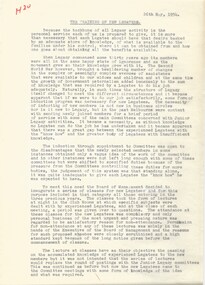
Document, The training of new Legatees. 26 May 1954 (H20), 1954
... training would be necessary. A two page report was included as attachment 'C'. This is the report. It mentions the Board of Management decided to inaugurate a course of classes, over six Monday evenings. The topics covered: 1) The structure of Legacy and the nature of contact work. 2) Welfare Committee and Welfare assistance available from statutory sources. 3) Education and Employment Committee 4) Residences, Housing and Accommodation, Camp and Holidays Committees. 5) The Medical, Dental, Boys' and Girls' Group Committees. 6) Personnel and Comradeship. ...training would be necessary. A two page report was included as attachment 'C'. This is the report. It mentions the Board of Management decided to inaugurate a course of classes, over six Monday evenings. The topics covered: 1) The structure of Legacy and the nature of contact work. 2) Welfare Committee and Welfare assistance available from statutory sources. 3) Education and Employment Committee 4) Residences, Housing and Accommodation, Camp and Holidays Committees. 5) The Medical, Dental, Boys' and Girls' Group Committees. 6) Personnel and Comradeship. ...In the report on the work of Legacy in 1953 (see item 01491) it was mentioned that the education of Legatees was seen as something that needed to be addressed and a formal induction process with proper training would be necessary. A two page report was included as attachment 'C'. This is the report. It mentions the Board of Management decided to inaugurate a course of classes, over six Monday evenings. The topics covered: 1) The structure of Legacy and the nature of contact work. 2) Welfare Committee and Welfare assistance available from statutory sources. 3) Education and Employment Committee 4) Residences, Housing and Accommodation, Camp and Holidays Committees. 5) The Medical, Dental, Boys' and Girls' Group Committees. 6) Personnel and Comradeship. The notation H20 in red pen shows that it was part of the archive project that was trying to capture the history of Legacy. A report covering the need to train Legatees and how it was proposed to be achieved by a course of lectures.White foolscap paper with black type x 2 pages of recommendations of training of new Legatees.Handwritten H20 in red pen. Handwritten 'C' in top right corner.history, organisation structure, rules -
 Melbourne Legacy
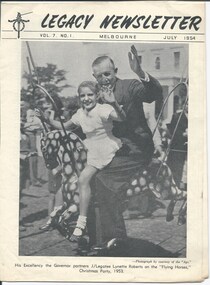
Magazine - Newsletter, Melbourne Legacy, Legacy Newsletter July 1954, 1954
... Also photos of the Legacy library and the medical and dental care given to junior legatees. Also an article and photo about speech training by Miss Williams. ...Also photos of the Legacy library and the medical and dental care given to junior legatees. Also an article and photo about speech training by Miss Williams. ...The newsletter from July 1954. It featured Governor Sir Dallas Brooks on a carousel horse with a girl on the cover. The president's introduction talked ofvalue of books and reading. There was a piece on the death of Legacy founder Stan Savige and has a photo of funeral cortege. Pages showed news from the different Boys and Girls Classes and photos showcased the annual demonstration. Also photos of the Legacy library and the medical and dental care given to junior legatees. Also an article and photo about speech training by Miss Williams. Photo of mothers working hard at sewing costumes for the girls classes. There was an article about the royal visit of to the MCG and the JLs that presented flowers to the Queen. A newsletter published by Legacy in this format for many years from 1942. It mentions "Issued from time to time for Private Circulation among the Sons and Daughters of Deceased Service men and Merchant Seamen who served their Country during the War of 1914-18, or the present War". Many articles on the work of Legacy, including features on boys classes, girls classes, camps, the residences and where their past residents ended up. There are some suggestion for careers and some general interest articles. Some very interesting photos.Newsletter outlining news of Junior Legatee activities.Black and white printed newsletter x 16 pages from July 1954. Volume 7 Number 1boys classes, activities, girls classes, ilc
